Available Online at www.ijpret.com 64
INTERNATIONAL JOURNAL OF PURE AND
APPLIED RESEARCH IN ENGINEERING AND
TECHNOLOGY
A PATH FOR HORIZING YOUR INNOVATIVE WORK
COMPARATIVE STUDY OF HEAT TRANSFER EFFECT ON QUALITY OF
DIFFERENT GRAINS DRYING IN FBD
DR. P.K.WANKHADE
Department of Chemical Technology, Sant Gadge Baba Amravati University Accepted Date: 15/03/2016; Published Date: 01/05/2016
\
Abstract: Drying of agricultural grains, seeds is widely used to prevent biodegradation and for further processing. Fluidized bed technology is one of the most effective means for the interaction between solid and gas flow, mainly due to its good mixing and high heat and mass transfer rate. When applied to drying of non-porous moist solid particles, the water is drawn-off driven by the difference in water concentration between the solid phase and the fluidizing gas. The use of a fluidized bed dryer with a lateral air flow and mechanical activity to the drying of some selected grains was investigated. The drying rates curves in terms of moisture content versus drying time for moth beans and soybeans were obtained experimentally using a fluidized bed, the drying rates were found to be dependent on the inlet air temperature and velocity. The effects of heat and mass transfer parameters on the efficiency of fluidized bed drying have been studied to optimize the input and output conditions. The analysis was carried out using two different materials, soybean and moth beans. Experimental curves of moisture content vs. drying time, as well as drying rate and the size characteristics of the products, were determined at temperatures between 50°C and 90°C, and air velocity of 0.5m/s – 1.5m/ for moisture content 45-58 % (db) to about 20-26 %(db). The objective of this study was to examine the effects of the fluidized-bed drying method on the final quality on various grains. The results were compared to that of drying using a traditional method. Dried samples were compared on the basis of quality factors like colour, appearance, taste and texture were observed for each sample. Finally, the data was analyzed. Results show that drying in a fluidized bed dryer would improve the quality factors compared to the conventional drying.
Keywords: Fluidized bed dryer, biodegradation, moisture content, effective drying, drying curves, heat and mass transfer.
Corresponding Author: DR. P.K.WANKHADE
Access Online On:
www.ijpret.com
How to Cite This Article:
P. K. Wankhade, IJPRET, 2016; Volume 4 (9): 64-71
Available Online at www.ijpret.com 65 INTRODUCTION
Reduction of water in food products or the processes often cause irreversible biological or chemical degradation. Since temperature is one of the major factors causing such degradation, drying at low temperature is usually preferable for achieving high product quality. Under such circumstances, improving the rate of heat transfer can provide significant benefits to the drying process. Moth beans are one of the major grains of the world and involve both consuming and producing countries. In order to retard deterioration after harvest, moth beans should be dried down to a level that will enable safe storage and prevention of production. In commercial drying of agriculture products heated air is used. Mechanical systems, especially those using hot air for rapid drying of grains high in moisture content are becoming increasingly popular. Researches show that rough drying can affect the quality properties of grain which, in turn, affects acceptance of the commodity by the consumers at different levels of the market.
Therefore, with increasing demand for better and higher quality products and for efficient operations, the processing technique and its control for minimizing product degradation is a current challenge for grain drying. The results showed no loss of quality due to thermal gradients if grain is exposed to temperature levels of 50ºC, 70ºC and 90ºC. This study showed that temperature alone cannot explain the observed quality degradation of moth beans and soybeans during drying. The quality of moth beans and soybeans in terms of appearance, taste, texture and colour was acceptable in comparison to the traditional method.
I. MATERIALS AND METHODS:
2.1 Grains: The moth bean and soybeans plant produces bright yellow flowers which turn into elongated seedpods, which will ultimately produce small seeds around the size of a grain. These seeds can be dried and cooked, or some are saved for planting next year. Small, elongated beans with a brown skin and a brownish yellow interior. They have a nutty flavor and a strong earthy smell. Because of its size and color, moth attracts adulteration and almost always contains dust and small stones which are mixed with it.
Available Online at www.ijpret.com 66 During fluidization the particles are circulated within the fluidized bed. This circulation has a direct bearing on the heat transfer properties of gas solid fluidized bed system. Fluidized beds have been used for heat exchange in both physical operations and chemical process because of rapid transport. Also, because of mixing uniform temperature throughout the bed can be maintained. Calculations of drying curve from the record of moisture contain of the drying medium.
Fig.1: Bubbling Fluidization processes
2.3 Heat Penetration: Generally, it is possible to calculate the rate of heat transfer from the surface of an immersing body to either packed or stirred bed of granular material (or from the heating surface to the drying material in other types of indirect dryers) using the following equation (Kimball, 2001) [11].
𝑄 = 𝑈𝐴 (𝑇1 − 𝑇2 )
Available Online at www.ijpret.com 67
Outer surface heat penetration
Inner layer heat transfer
Since the initial moisture content of grain (𝑀 𝑜) used in the experiment at various inlet air conditions is different, comparison of drying time and efficiency in terms of absolute moisture content may be misleading. Therefore, the non-dimensional moisture content 𝑀𝑅 is used for
analyzing the data.
𝑀𝑅 = 𝑀 𝑡− 𝑀 𝑒
𝑀 𝑜 − 𝑀 𝑒
Where, 𝑀 𝑡 and 𝑀 𝑒 are the moisture content of grain as a particular time and equilibrium
respectively.
It was observed that as a general trend, the results obtained for both materials are similar. Energy efficiency was found to be higher. Furthermore, at the beginning of the drying process, energy efficiencies were observed to be higher than at the final stage. The energy efficiency of the fluidized bed dryer column was found to be very low at the end of the drying process.
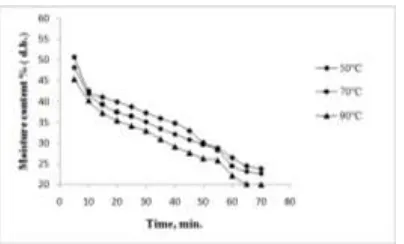
2.4 Experimentation: The soaked moth beans and soybeans in water are used for experimentation. The flow rate maintained which should be sufficient to fluidize the material. Dry it completely and weight it again and hence recorded the percentage moisture present. Repeated the steps for constant air flow rate at the hot air temperature 50°C, 70°C, and 90°C. Observations were recorded as in the weights recorded at 5-10 min. intervals and drying curve and drying rate is obtained are as in fig. 3 and 4.
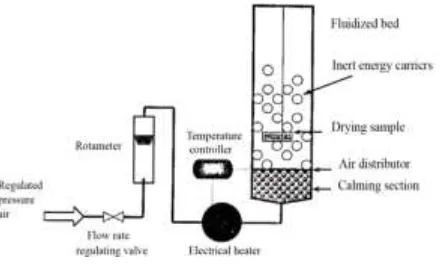
Available Online at www.ijpret.com 68 Fig. 2: Schematic diagram of Fluidized Bed Drying
The material supported on the screen mesh held between two flanges. Air from the blower is heated in the heater box and past through the column at velocity of 1 m/s by adjusting flow varying the cross section opening by operating needle valve. And air flow velocity is measured by the hot wire anemometer. Orifice with differential manometer is provided to the measure the air flow rate. The flow rate can be adjusted by needle valve provided for air supply to the column. Sensors are given at different positions to measure the temperature of inlet and outlet of air flow through drying section of fluidized bed dryer.
II. RESULTS AND DISCUSSION:
Available Online at www.ijpret.com 69
Fig. 3: Drying curve in FBD
Fig.4: Drying rate in FBD
Fig.5: Comparative Drying curve
Available Online at www.ijpret.com 70 III. CONCLUSION:
The grains were dried from the initial moisture content in the range of 45-58%db to about 20-26%db. However, there were several runs in this study in which grains were dried below the moisture content of 30%db. This was because additional data were required or needed for a better understanding of the drying characteristics of grains in a fluidised bed dryer. Drying performance in the fluidized bed dryer was better than the other methods of drying used for drying moth beans and soybeans. Colour was retained by the dried moth beans with change in the texture by contracting the area of the dried product. Some textural cracks appear on the moth beans drying in the fluidized bed dryer at higher temperature drying.
REFERENCE:
1. A. Go, S. K. Das, G. Srzednicki, R. H. Driscoll (2007): Modeling of Moisture and Temperature Changes of Wheat during Drying in a Triangular Spouted Bed Dryer, Drying Technology: An International Journal, 25:4, 575-580
2. A. Karbassi1, Z. Mehdizadeh, Drying Rough Rice in a Fluidized Bed Dryer, J. Agric. Sci. Technol. (2008) Vol. 10: 233-241
3. A. Reyes, P. I. Alvarez, F. H. Marquardt (2002): Drying of carrots in a Fluidized bed I. Effects of drying conditions and Modelling, Drying Technology: An International Journal, 20:7, 1463-1483 4. Alebregtse, J.B. Van Swaajj, W.P.M., Afgan, Fluidised bed drying: A mathematical model for hydrodynamics and mass transfer. In Heat and Mass Transfer in Fixed and Fluidised Bed; N.H., Eds.; Hemisphere Publishing Corp.: New York, 1986; 511.
5. C. Srinivasakannan, N. Balasubramaniam (2006): An Experimental and Modeling Investigation on Drying of Ragi (Eleusine corocana) in Fluidized Bed, Drying Technology: An International Journal, 24:12, 1683-1689
6. Fluidized Bed Drying of Oilseeds, CMERI Report; Durgapur, India, 1999.
7. Hatamipour, M.S.; Mowla, D. Shrinkage of carrots during drying in an inert medium fluidized bed. J. Food Eng. 2002, 55 (3), 247–252.
8. Hideo Inaba, Heat and Mass Transfer Analysis of Fluidized Bed Grain Drying, Memoirs of the Faculty of Engineering, Okayama University, Vol.41, pp.52-62, January, 2007
9. Hoebink, J.H.B.J.; Rietema, K. Drying of granular solids in a fluidised bed I. Chemical Engineering Science 1980, 35, 2135.
10. K. M. Kundu, R. Das, A. B. Datta, P. K. Chatterjee (2005): On the Analysis of Drying Process, Drying Technology: An International Journal, 23:5, 1093-1105
Available Online at www.ijpret.com 71 12. Kudras, T.; Efremov, G.I. A quasi-stationary approach to drying kinetics in fluidized particulate materials. Drying Technology 2003, 21 (6), 1077–1090.
13. Kundu, K.M.; Das, R.; Datta, A.B.; Chatterjee, P.K. On the drying kinetics in drying process, Proceedings of ADC-01, W.R.W. Davd, et al., Eds.; Bangi, Malaysia, 2001, 657–669.
14. M. S. Hatamipour, D. Mowla (2003): Experimental and Theoretical Investigation of Drying of Carrots in a Fluidized Bed with Energy Carrier, Drying Technology: An International Journal, 21:1, 83-101
15. Manal AL-Hafidh, Heat and Mass Transfer during Air Drying of Fruits, The Iraqi Journal For Mechanical And Material Engineering, Vol.8, No.2, 2008, p.p. 110-126.
16. Mujumdar, A.S. Handbook of Industrial drying; Marcel Dekker: New York, 1987.
17. P.K. Wankhade, R.S. Sapkal, V.S. Sapkal, Drying characteristics of okra slices on drying in hot air dryer, (2013) Elsevier Procedia Engineering 51, 371-374.dryer, (2013)
18. Parti, M.; Dugmanics, I. Diffusion coefficient for corn drying. Transactions of the ASAE 1990, 33 (5), 1652–1656
19. Satoru Watano, Nan Yeh, Kei Miyanami, Heat Transfer and the Mechanism of Drying in Agitation Fluidized Bed, Chem. Pharm. Bull. 47(6) 843—846 (1999)