Available Online at www.ijpret.com 760
INTERNATIONAL JOURNAL OF PURE AND
APPLIED RESEARCH IN ENGINEERING AND
TECHNOLOGY
A PATH FOR HORIZING YOUR INNOVATIVE WORK
DISTRIBUTED MOBILITY MANAGEMENT WITH SDN
SHILPA V. M1, NILIMA DONGRE2
1.M.E. (Computer Science and Engineering) R.S.C.E., Buldhana. 2.Dept. of computer sci. &engg, Prof. R. S. C. E., Buldhana.
Accepted Date: 05/03/2015; Published Date: 01/05/2015
Abstract: Today’s cellular network is not a centralized as that of traditional. Centralized
Mobility Management (CMM) introduces delays for network functions and also presents a single point of failure related to Mobility Management. With Distributed Mobility Management (DMM), the mobile network core evolving towards an un-layered and decentralized architecture, it appears to be more compatible and efficient. This paper focuses on the DMM with Software Defined Networking (SDN) technique. SDN for DMM introduces multiple controllers which harmonizes the DMM mechanism and also update the involved forwarding tables directly in case of handover. It consist the solution for the SDN’s mobility and secure handover as it does not support IP mobility , with the help of Open flow and HIP which is an integration of HIPv1 layer with the existing Open Flow version to replace the SSL/TLS based mutual authentication.
Keywords: CMM, DMM, SDN, OPENFLOW Protocol
Corresponding Author: MS. SHILPA V. M.
Access Online On:
www.ijpret.com
How to Cite This Article:
Shilpa V. M., IJPRET, 2015; Volume 3 (9): 760-770
Available Online at www.ijpret.com 761
INTRODUCTION
This new era of cellular network is not a centralized as that of traditional one which has conducted to deployment models are centralized. Mobility management with centralized mobility anchoring in existing mobile networks is quite prone to suboptimal routing and issues related to a single point of failure, and inevitably introduce longer delays [6]. Distributed Mobility Management (DMM) a new architectural design for evolving mobile IP networks [1] introduces the new way of handling the mobility. The detailed comparative study about the mobility management [2] describes current and traditional mobility architecture. However, when a mobile node i.e. a source node moves to another point of anchor, the previous flow is forwarded to current router by the previous router. For this reason, the optimization of router could be a consequence. [7] Proposes a routing optimization method in distributed architecture and the SDN [3] concept which is applied to DMM architecture for the routing optimization. OpenFlow architecture includes Open Flow switches which do not allow being mobile [8]. The openflow pcc rules and flow rules maintains the flow table updating [9] Openflow-HIP employs secure mobility with openflow [8]. The rest of this paper is organized as follows. Section II represents related work and literature survey. Section III compares Mobility Management techniques in detail. Section IV briefly addresses the SaDMM i e Software Defined Networking for DMM [2] with Openflow protocol and its secure mobility problem, architecture of proposed system. At the end Section V concludes the paper.
Literature Survey
Mobility Management
Available Online at www.ijpret.com 762
between areas. The location update procedure call encounters that a mobile device has an area code which is differs from a previous update, then the location update service call is raised by the mobile device, by sending a location request to its network, prior location and specific Temporary Mobile Subscriber Identity (TMSI). Location area is nothing but a group of base stations assembled collectively to optimize signalling overhead. Base stations are integrated to form a base station controller (BSC), a single network area. Roaming is also the basic procedures of mobility management, enables subscribers to use mobile services when moving outside of the geographical area of a specific network.
CMM
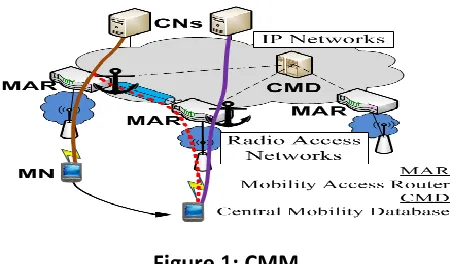
Centralized schemes require the management of centralized entity and its relation with MNs. It requires the management of either one or no. of several hierarchical tunnels, to maintain the data path between the MN and a central entity. The fig.1 below gives the brief idea about how the mobility management is happened through centralized database. A single data path is preserved by each MN. Due to the simplicity to deploy such single tunnels, they are broadly used. However, those tunnels introduce data overhead due to the necessary encapsulations, as well as at their end-points data processing to perform encapsulations and de-capsulation functions.
Figure 1: CMM
Available Online at www.ijpret.com 763
DMM
CMM faces several problems and limitations such as low scalability, suboptimal routing, signaling overhead, more complex network deployment, also single point of failure [2]. For this reason several mobile operators are finding for alternative solutions which are more distributed in nature, which allows efficient and cheaper network deployments [1]. This new prototype is defined as Distributed Mobility Management (DMM).
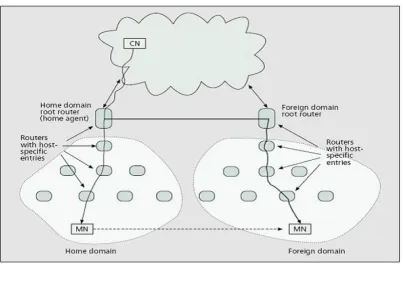
Figure 2: DMM
Fig 2.2 generalizes the idea about the DMM Architecture. DMM is a flatter system. The mobility anchors are placed closer to the user which distributes the data and control infrastructures among the entities located at the edge point (access point) of the network. DMM may be partially or fully distributed. Which distribution scheme should apply, it depends on which technique is going to follow by network. The partially distributed scheme where the distribution scheme is applied to data plane only and the distributed anchor keeps the location information provided by a centralized entity. In a fully distributed approach the distribution scheme is applied to both the Data plane and Control plane and this information is stored at every distributed anchor point which used to share with its peers. The distribution of the mobility anchors is improved scalability and robustness of the mobility infrastructure. In DMM the placed mobility management functions always attain routing optimality and lower delays.
SDN
Available Online at www.ijpret.com 764
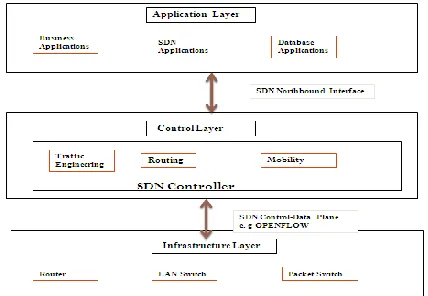
communicate with the data plane. One such mechanism is Open Flow. SDN is architecture that cost-effective, is dynamic, manageable and adaptable, making it ideal for dynamic and the high-bandwidth nature current applications The Open Flow protocol is a foundational element for building SDN solutions. Fig 3 describes the overview about the architecture of the SDN and its components. The following list defines and explains the architectural components:
• SDN Application (SDN App): SDN Apps are programs that directly, and programmatically
communicate to the SDN Controller via a northbound interface (NBI).
• SDN Controller: The SDN Controller is centralized entity used for understanding the
requirements from the SDN Application layer to the SDN Data paths and also provides the SDN Applications with an abstract view of the network. An SDN Controller consists of more no. of the SDN Control Logic NBI Agents, and the Control to Data-Plane Interface (CDPI) driver.
Figure 3. SDN Architectural Diagram
• SDN Data path: The SDN Data path is a logical network device. It revels and uncontained
control and visibility over its advertised forwarding and data processing capabilities.
• SDN Control to Data-Plane Interface (CDPI): The SDN CDPI is the interface between an SDN
Controller and an SDN Data path, which provides (i) capabilities advertisement, (iii) programmatic control of all forwarding operations, statistics reporting, and event notification.
OPENFLOW
Available Online at www.ijpret.com 765
networking switches to logically centralized control software. The OpenFlow protocol is implemented on both sides of the interface between network infrastructure devices and the SDN control software. OpenFlow supports and uses the concept of flows that used to identify network traffic based on pre-defined match rules that can be statically or dynamically programmed by the SDN control software. OpenFlow-based SDNs can be deployed on existing networks, both virtual and physical. Network devices can support OpenFlow-based forwarding as well as traditional forwarding, which makes it easy for enterprises and introduce OpenFlow based SDN technologies, even in multi-vendor network environments.
Messages in Open Flow protocol:
The Open flow protocol consists of three types of messages: controller-to-switch, synchronous and symmetric.
1. Controller-to-switch messages are to
Specify, modify or delete flow
Request for information on switch capabilities
Retrieve information such as, counters from the switch.
2. Asynchronous messages are sent by the switch to:
Send the controller a packet. The packet that does not match an existing flow of mobility.
Inform the controller that a mobility flow has been removed
Inform the controller that there is an error has occurred on the switch or a change in port status.
3. Symmetric messages can be sent by both the switch and the controller and are used for:
Hello messages exchanged between the controller and the switch.
Echo messages determine the latency of the switch-to-controller connection and also verify that the controller-to-switch connection is still operative or not operative.
SDN and DMM
Available Online at www.ijpret.com 766
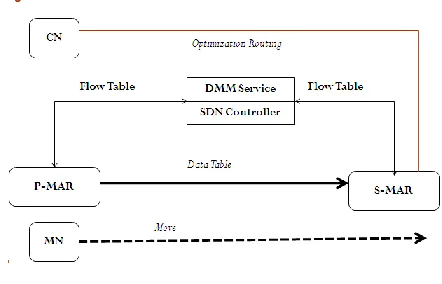
The purpose of this concept is to make optimized routing path from the DMM architecture [7].
Figure. 4 SaDMM
If data path is controlled by SDN controller in the DMM architecture with a DMM service that stored mobile node status, mobile node data path which is possible to set up by optimized path. Tunneling is not necessary when receiving data from previous router. The architecture of method is shown in the figure 4.
A. Handover process and potential optimization routing:
In the architecture, mobile node is supported mobility management by binding update to controller with DMM service. As in a Figure 4, as soon as mobile node attaches to initiate router, P-MAR sends a Packet in Message which includes MNs ID, for registration to the controller. On accepting this Packet in Message, a Packet out Message is sent by the controller and controller stores mobile node information in binding cache entry. For set up the data path, a Flow Modify message is sent by the controller to set up the flow table in the P-MAR. If the mobile node moves e.g. to the S-MAR, the S-MAR sends a Packet in Message which includes mobile nodes ID, new location of mobile node(S-MAR). As soon as the controller receives packet in message, it will check and update BCE. On receiving this Packet in Message, a Flow Modify message is sent by the controller to P-MAR, S-MAR to set up the new data path. On receiving flow modify messages, the S-MAR and P-MAR will update their routing tables. Then the data session will flow to new S-MAR from P-MAR and finally to the mobile node.
B. Advantage of DMM architecture with SDN
Available Online at www.ijpret.com 767
1. Routing optimization
2. No need to control the Data
C. Problem Statement: What is missing in OpenFlow?
1. Flow processing: Change of address from network switches or routers would disrupt flow processing i. e has a mobility problem.
2. Secure session management: Change in an IP address also destroy active SSL/TCP sessions.
3. Secure handover: Problem of support mobility and mutual authentication
also certificate exchange is not desirable for fast moving Open Flow clients.
4. Flow rule management: since flow rules must be updated frequently, change of IP address to solve latter issue causes additional overhead.
D. Secure SaDMM:
In this work we are going to focus on the two problems, which have described briefly in the following section. Also it is explaining about the solution of the same.
Mobility Issue:
In SDN architecture, the centrally managed control layer in a software-based controller maintains the overall view of the network. The controller grants the flexibility to manage, configure, secure the software, and also help to optimize network resources via dynamic and automated software programs. One such realization of SDN is OpenFlow that exploit new opportunities over the existing networking. OpenFlow at the current stage is not able to support mobility [8]. This is a critical limit of OpenFlow. Current SDN architecture inhabited critical issues in robust multipath connectivity for fault tolerance. This is even more essential when the switch or the controller is mobile. In one hand, number of channels between the controller and the switch can guarantee a certain level of assurance for consistent or smooth connectivity. Mobile routers, mobile switches mobile base stations, mobile, mobile clouds and server migration are some of the powerful reasons why mobility is insisted in SDNs. This would cover and extend SDN benefits into mobile environments such as moving buses, moving trains, buses, flights and other moving automobiles.
E. Secure handover issue:
Available Online at www.ijpret.com 768
Solution:
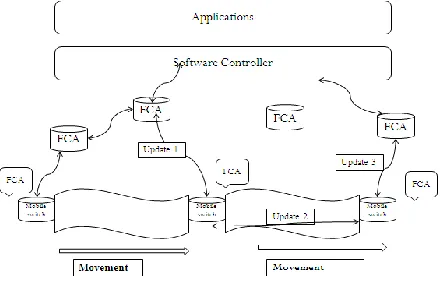
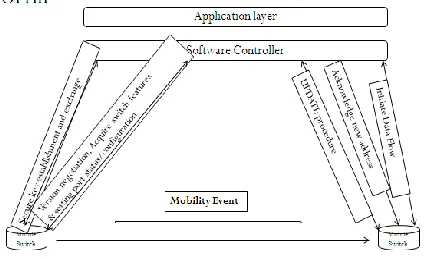
The fig. 6 below will illustrate the system architecture where the routers and switches configured on the fly. The flow control agents (FCA) on the mobile routers and switches are very essential on mobile switch or routers and updating the software controller of the new
location information which is helpful in location based services.
The flow rules built on top the newly introduced cryptographic global identifiers which remain unchanged over time. Thus, updatation of the flow rules due to mobility is no longer useful. This would reduce the processing overhead and control traffic overhead due to dynamic address configuration because of mobility and thus, flow processing. Over more, it reduces overhead in the PCRF i.e. policy charging and rules function and improve the flexibility with QoS management and network configurations.
Figure 5 Secure SaDMM Scenario
Available Online at www.ijpret.com 769
Figure. 6: Secure Handover-update procedure
Comparisons and Analysis
We have done comparison work on three existing methods of Mobility Management which is a CMM, DMM, SaDMM with our forth new technique i.e. Secure SaDMM. With considering the issues related handover
Delay, tunneling, Scalability issues etc explained detailed study on all techniques. The TABLE I below entitled the same.
Table 1. Comparison Table
CONCLUSION
Mobility management is used to trace physical user and subscriber locations to provide mobile phone services, like calls and Short Message Service (SMS)UMTS and GSM are each made up of POINTS
TECHNIQ
HANDOVE DELAY TUNNELING DATA PROCESSING SCALABILITY
ISSUES
NETWORK ISSUES
CMM IP Address
changes so
session will be broken
High Fixed tunneling for
each node
Yes Yes -Optimal Routing issues
-Costly for Service Provider
-Single pt. of failure
DMM Separating the
session Identity
Medium Temporary Yes but diminished Diminished
More (In case of lots of MN)
- Admin level issue -Self configuration
SaDMM Controller will
update the
involved forwarding tables
Low No Tunneling No No -Securing the controller
-Visibility loss
-OPENFLOW can't
support Mobility
Secure SaDMM
Secure Handover
Low No Tunneling No No Though it provides
security, SDN’s
Available Online at www.ijpret.com 770
separate cells (base stations) that cover a specific geographical area .The mobility management related information is maintained in the distributed controllers, which are organized in different domains rather than centralized controller like CMM. By modifying the Flow Tables at the involved gateways, the routes can be optimized inherently. A SaDMM is an efficient mechanism for mobility management oriented to the future mobile network architecture as SDN uses Open flow protocol which does not support mobility and has issue of secure handover, mutual authentication. The new architecture i.e Open flow HIP layer protocol for these issues of Open flow, presents the architecture that enables Open Flow switches to change their IP addresses securely during mobility.
REFERENCES
1. H. A. Chan, Distributed Mobility Management with Mobile IP,IEEE ICC 2012 Workshop on Telecommunications: from Research to Standards, June 2012, Ottawa
2. P Bertin, S Bonjour, J Bonnin” Distributed or Centralized Mobility?” Global Telecommunications Conference, 2009. GLOBECOM 2009. IEEE, 1-6
3. Yuhong Li; Haimeng Wang; Ming Liu; Bofan Zhang; Huanqu Mao, ”Software defined networking for distributed mobility management,” Globecom Workshops (GC Wkshps), 2013 IEEE , vol., no., pp.885,889, 9-13 Dec. 2013
4. Nunes, B.A.A.; Mendonca, M.; Xuan-Nam Nguyen; Obraczka, K.; Turletti, T.,”A Survey of Software-Defined Networking: Past, Present, and Future of Programmable Networks,” Communications Surveys Tutorials, IEEE , vol.16, no.3, pp.1617,1634, Third Quarter 2014
5. Zuniga, J.C.; Bernardos, C.J.; de la Oliva, A.; Melia, T.; Costa, R.; Reznik, A., ”Distributed mobility management: A standards landscape,” Communications Magazine, IEEE , vol.51, no.3, pp.80,87, March 2013
6. Requirements of distributed mobility management draft-ietf dmm-requirements-01 H. Chan (Ed.) Huawei Technologies July 12, 2012.
7. Hyunsik Yang, Younghan Kim Soongsil University ”Routing Optimization with SDN” draftyang-dmm-sdn-dmm-01.txt October 2014 April 22, 2014