MURDOCH RESEARCH REPOSITORY
http://researchrepository.murdoch.edu.au/22421/
Anda, M., Brennan, J. and Paskett, E. (2012) Behaviour change
programs for water efficiency: Findings from North West and
Metropolitan Residential Programs in Western Australia. In:
IWA World Water Congress & Exhibition, 16 - 21 September,
Busan, Korea.
Behaviour Change Programs for Water Efficiency: Findings from North
West and Metropolitan Residential Programs in Western Australia
Anda M1, Brennan J2, Ho G1 & Paskett E2
1. [email protected], School of Environmental Science, Murdoch University, Murdoch WA 6150 AUSTRALIA; Principal Engineer Sustainability, ENV Australia Pty Ltd.
2. [email protected], Water Corporation, 629 Newcastle Street, Leederville, WA 6007 AUSTRALIA
Abstract
A residential water saving program in a small Southwest country town of Western Australia achieved a 12% saving in participating households that received behavioural change and retrofits. This came at a cost of $1.82/kL which is significantly less than the cost of source development for this scheme. Buoyed by this success the Water Corporation followed with the North West residential behavioural change program. The program faced a number of problems unique to this region that were not experienced in other past or current programs. The successes achieved can be attributed to the program expanding the incomplete database by a variety of techniques, building social capital through newspaper and radio media, use of a TV personality role model, industry partnerships, well trained and committed eco-coaches and moving from a prescriptive to facilitative conversation approach in the telephone coaching. A key lesson from the North West program has been that complete database information (to enable feedback letters in each coaching round), market segmentation and community and industry partnerships will enable better outcomes if already established at commencement of the program. The Water Corporation then commenced several other regional demand management programs around the State including behavioural change and retrofits in the Perth metropolitan region. Lessons from previous programs were again taken on board and this combined with a more complete database resulted in the savings target of 12% being in sight half way through delivery.
Keywords:
Residential water use, water efficiency, behaviour change, Community Based Social Marketing
INTRODUCTION
Behaviour Change Programs (BCP) are now commonly used internationally by utilities and governments to assist customers to better manage their resource consumption. Techniques such as dialogue marketing, advertising campaigns, role models and incentive prizes are used as part of such programs. Community based social marketing (CBSM) is an established methodology that brings together many of these techniques. In this paper we report on the results of residential water use behaviour change programs that used CBSM techniques in the North West and Perth metropolitan regions of Western Australia, two very different settings.
Background
The Water Corporation (‗the Corporation‘) is Western Australia‘s principal water utility providing services of water supply, wastewater services and drainage across the state. The potable water supply is currently highly dependent on rainfall recharging both surface and groundwater supplies. In the last 30 years there has been a notable decline in rainfall throughout the majority of the state. For the North West, fewer cyclonic events are predicted in the long term putting major groundwater sources at risk, in addition to the strain on water supply from increasing population from extended housing and mining developments. In the South West, including the Perth metropolitan area, the seasonal winter rainfall in a Mediterranean climate has declined steadily, by at least 15% since the
Manuscript
1970s, not only resulting in reduced recharge to groundwater but also runoff to surface catchment dams has reduced by over 50%.
The Corporation has recognised that it needs to maintain a strong focus to deliver a sustainable water service to Western Australia with less reliable climatic conditions and increasing population. In order to achieve this, the following targets have been set to help steer long term planning to address the climate resilience issues of Western Australia:
15% reduction in per capita scheme water use by 2030, 25% reduction by 2060;
30% increase in wastewater recycling by 2030, increasing to 60% by 2060; and
developing new sources (Water Corporation, 2009).
In order to achieve its goal of reducing water use by 25% the Corporation has planned for a variety of strategies including increasing wastewater recycling, working with industrial customers towards water efficiency, development of new sources and water efficient retrofits for small business. Whilst potential water savings for these initiatives are high they are unlikely to have an impact in the short term.
In the residential sector, a behavioural change pilot project was designed using CBSM methods to reduce residential water use for a small town in the southwest of Western Australia, Margaret River. Besides raising awareness for water conservation, the project aimed to provide 1,030 participating households with information delivery and a 10% reduction in water consumption in 2009. Starting with an adjusted gross of 1,351, 96% of the contacted households were interested in the project. With 89% requesting information, delivery to a total number of 1,157 participating households was accomplished. A continuously high participation resulted in 1,043 households being part of the project until the very end. Upon completion of the project, the participating households reduced their water consumption by 12% amounting for a saving of 35 kL per household in one year. Due to a highly effective Diffusion Effect in the community, all residents in the Margaret River township reduced their water consumption by 11% summing up to savings of 72,970 kL in one year for all 2,644 residential properties for which valid readings existed. The households prior to the project displayed an average water use of 296 kilolitres per annum (kLpa) while after the project they reduced to 260 kLpa. With 97% being satisfied with the project, a deeper understanding of their own water use and a considerable amount of water saving appliances purchased during the project, the evaluation of the participants‘ behavioural changes seems to indicate sustainable ongoing water savings for some time to come.
Results indicated that behavioural change methods are a desirable inclusion to the Corporation‘s water use reduction strategy to provide water security throughout the State. Programs commenced in a number of regions.
North West
H2ome Smart North West was a regional behavioural change program conducted in the state‘s Kimberley and Pilbara regions over a 12-month period in 2010/11. The aim was to achieve a 15% reduction of water consumption each year in participating households over a 5-year period. It was designed to assist residential customers in making immediate, cost effective reductions in their water consumption.
the southern towns and cities. For instance whilst Perth is subject to seasonal sprinkler bans down to 2 watering days per week in the warmer months, North West residents can irrigate gardens on alternate watering days year round.
Table 1. Household water consumption averages in North West Towns
TOWN Average Consumption (kL/annum)
Karratha 557
Onslow 450
Wickham 491
Point Samson 697
Dampier 690
Port Hedland 795
South Hedland 604
Broome 619
Halls Creek 652
NW Region 606
In addition to the behavioural change component of the program, H2ome Smart North West also included free retrofits (regardless of participation in the behavioural change aspect) targeting a 12% savings in these homes. It is worth noting that the Corporation did not expect households that participated in both the behavioural change and retrofits to have a cumulative savings of 27% as previous programs have shown that this is not a typical outcome. The retrofit included free installation of high efficiency showerheads, tap aerators, dual flush toilets and repair of visible leaks.
Perth Metro
The Corporation‘s water efficiency strategy consists of three activities to reduce residential potable water use by 1,200,000 kL in Perth. The critical tasks associated with these activities are
summarised below:
Showerhead Swap — exchange 124,000 inefficient showerheads for water efficient showerheads (commenced in February, 2011);
Community Based Social Marketing (CBSM)— a minimum of 10,000 households in Perth
to take part in a behavioural change activity to identify their water use and to implement remedial actions to reduce water use (commenced in November, 2011); and
Audit and retrofit— approximately 4,000 households to take part in an audit and retrofit activity, which will include installation of water efficient showerheads, tap aerators and repair of any visible leaks.
In scoping the CBSM project, there were a number of criteria considered to determine an appropriate project area. The 18 suburbs listed below were selected as ideal target suburbs for the Perth H2ome Smart project as they fit the following criteria:
Typical consumption is moderate to high (184 to 388 kL/ household/ year, average over all 18 suburbs was 310 kL/hh/yr) and therefore there is greater ability to reduce excess consumption. The average overall Perth household consumption is 280 kL/hh/yr.
The suburb‘s water pressure is high and therefore water efficient appliances are likely to be suitable to install.
The suburbs are located in two groups- one north of the river and one group south of the river. Each group of suburbs are physically located close to each other for economies of scale.
The suburbs were established before 2001 when building regulations stipulated that water efficiency products were mandatory
Table 2. Household water consumption averages in targeted Perth suburbs
Suburbs North Average consumption (kL/hh)
Suburbs South Average consumption (kL/hh)
Beldon 310 Canning Vale 322
Carine 345 Kardinya 323
Edgewater 346 Leeming 280
Greenwood 318 Murdoch 264
Hillarys 324 North lake 325
Mullaloo 311 O'Connor 184
Sorrento 322 Parkwood 248
Woodvale 388 Samson 329
Thornlie 275
Perth average 277 Winthrop 388
10,907 owner/ occupier households identified 15,571 owner/ occupier households identified
Whilst the retrofit component is closely tied to achieving significant savings for the regions, this paper will examine the merits of behavioural change only.
METHODS
The targeted behavioural change for H2ome Smart was to encourage residents to use less potable water in their homes by making small, achievable changes on an individual scale to achieve great benefits on a community scale.
Community Based Social Marketing
Community Based Social Marketing (CBSM) was used to create and sustain a positive change in behaviour whilst assisting individuals to overcome barriers to change. This is done by engaging with households on a personal level. It becomes a powerful method for change by means of setting relevant goals, gaining commitment, giving feedback, prompting behaviour, alleviating any social concerns and developing new social norms (McKenzie-Mohr & Smith, 1999).
McKenzie‐Mohr (2000) and others (Sheehy & Dingle, 2005) identified that unintegrated intensive approaches towards changing individual‘s behaviour, such as education and economic self‐interest are not successful. Instead CBSM has shown to be very effective at inducing behavioural change due to its pragmatic approach. The CBSM methods deployed across Western Australia during 2010 to 2012 included:
a) Identifying a range of sustainable behaviours for householders to choose from (see water saving actions in Table 3);
b) Identifying the barriers to engaging sustainable behaviours;
c) Designing a strategic approach that integrates behaviour change tools; d) Radio and print media advertising, community events, door knocking; e) Announcement letter and phone call;
f) Delivery of requested educational materials;
g) Two (Perth) or three (NW) annual meter reads supplemented by five more by contractor; h) Five coaching phone calls and progress letters;
i) Final thank you letter and scorecard.
training of coaches, call and mail centre operations including coaching, meter reading, website development, statistical analysis of data and evaluation by subcontractors ENV Australia Pty Ltd, Research Panel, Josh Byrne & Associates, Green Skills, Data Analysis Australia and Colin Ashton Graham.
Table 3. Most popular water saving actions that participants agreed to, including estimated kL saved/yr.
Perth
From lessons learnt in the North West H2ome Smart Program, ongoing research into Community Based Social Marketing (CBSM) and expert advice from a specialist behavioural economist (Colin Ashton Graham) a new improved Behavioural Change Program (BCP) was designed for increasing water efficiency in Perth Metropolitan households.
The following were key elements to the Perth H2ome Smart Program to aim for maximum participation and success in achieving objectives:
Eco-coaches contacted eligible households for opt-in survey as a ‗friend‘ casually talking about water use around the house. By making residents feel personally responsible for becoming more water efficient and accountable for their water use, and getting an initial, informal commitment, the target participation rates were achieved and retained.
There was not a large focus on being Waterwise in the garden, unless it was in relation to reducing irrigation, as this focus can often lead to more gardening which will result in higher water use in the short term.
All water use feedback was given to participants in a form that they can understand and relate to. For example: buckets per day and comparisons to a Waterwise participant, instead of averages which are usually too high and give participants a false reflection that they are being waterwise.
An important aspect of the Perth H2ome Smart Program was to ensure that eligible residents are approached in a way that ensured they understand the importance of saving water, the benefits of small behavioural changes and that there is a sense of a larger community movement towards a more sustainable future.
The letters, scripts, eco-coaching sessions and all other materials were structured around the key steps and tools as defined by CBSM methodology and the outcomes of the focus group sessions, with particular focus on the following:
The public will respond to conversations, discussions and social contracts, rather then the demands or lists from an unknown government body on the phone.
Residents will not understand what ―eco-coaching‖ is or they may look for ‗the catch‘ when asked to specifically to ―sign-up‖ or ―participate‖. Phone conversations and letters were therefore focused on discussing water saving actions, and potential actions to save water.
Majority of the public will not be able to relate to L or kL per annum, therefore water use communications need to be as simple as possible; bucket per day or Litres per day.
Water Saving Action Estimated kL saved per year per household
Reduce shower time to 4 minutes 3
Use a bucket to catch the cold water 4
Rinse veggies in a bowl 7
Adjust irrigation system for the season 50 Reduce Irrigation time by 2min permanently 50
Use washing machine only when full 5
Adjust irrigation times appropriate for irrigation types 50
Don't rinse dishes before dishwasher 2
Turn off running tap when brushing teeth / shaving 6
Clean outside with broom/blower 7
Use a bucket for car / boat 10
Reduce watering in cool season / rainy days 40
It is often misconceived that people are Waterwise when they are below their local average. However local averages are usually very high, and hence individual water use is also high even though it is below the average. This needs to be mitigated by comparing water use to quintiles of water use ranging from a Very High Water User to a H2ome Smart Champion Water User.
Focus groups were conducted prior to commencement of dialogue coaching to determine the preferred prompts, messages and graphics to be utilised in feedback letters (see Figure 1) and telephone conversations and these relied on:
Water usage in litres per person per day;
Using buckets per person per day within the image of a 10-litre bucket;
Using a triangle graphic, arrow and colours to represent the water use quintile the household fits into for the round;
a comparison of household seasonal water use against the average of the program and an average of households not on the program; and
the household current agreed water saving actions.
Figure 1. Feedback letter showing water usage table, quintiles pyramid, buckets used and actions.
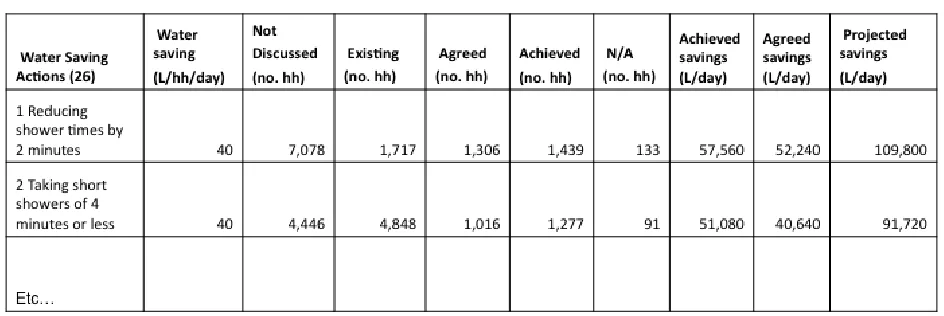
Table 4. Tracking the water saving progress midway through a coaching round.
RESULTS
The North West program is now complete and data analysis underway by the Water Corporation‘s Water Industry Policy Branch before these results can be formally released. The Perth program is still underway so only preliminary results are available.
North West
It became apparent in the planning stage and throughout the program that there were several challenging constraints unique to the region (compared to the Metropolitan or Southwest regions). These included;
Database lacking customer contact details across dispersed towns making contact difficult for registration;
Highly transient communities with ‗Fly-In Fly-Out‘ workers for extractive resource industries (mining);
Majority of households were rental (not owner-occupied) provided by major employers (mainly mining);
Less appeal/motivation to save water as its use is cost-subsidised by employer housing provider;
Perception by local communities that mining companies should take on more water saving
initiatives;
Long term water security message is skewed at times by visibly large rainfall (cyclonic events).
The North West registration and opt-in survey was completed by 1,480 households in November 2010. The survey revealed that over a third of people were watering gardens in excess of rostered irrigation days. Some 6 months later the database had been developed to enable nearly 5,000 homes to be registered closer to the target 8,330. Due to incomplete match ups of account numbers in the database, a large proportion of generic feedback letters had to be sent out to households instead of the more detailed data letter. As the analysis is still underway, the amount of water saved was not available at the time of writing this report. Initial analysis, however, does indicate that a saving has been achieved overall, although lower than the target amount. A lower than desired result is likely, largely due to a combination of factors, commencing with the curtailed database and low registration followed by incomplete participation through the entire program (i.e. late starters and early withdrawals), and the wide population distribution preventing diffusion effects.
‗Reduce shower times by 4 minutes‘ followed by ‗use a bucket to catch the cold water in the shower‘. Both of these actions have a comparatively low water savings (Table 3). The actions that have a higher water savings relate primarily to adjusting household irrigation systems, such as adjusting for seasonality. These actions appear to be taken up less than the lower water saving actions, however these actions can be considered a ‗once off‘ action that people do not need to constantly do. The numbers of irrigation-based actions may also be kept low because many households do not have irrigation infrastructure in place, their irrigation maintenance is contracted by a rental housing arrangement or during subsequent coaching sessions the action has been deemed completed and replaced by a new action.
Figure 2. Number and type of water saving actions taken up by participants
0 200 400 600 800 1000 1200 1400 1600 1800 2000
Wave 1 (Precribed WSA)
Wave 2 (Confirmed)
Wave 3 (Confirmed)
Reduce shower times
Bucket when shower warming up
Rinse veggies in a bowl
Adjust irrigation system
Reduce Irrigation time by 2min permanently
Use washing machine full
Whilst six coaching calls were available to each participating household there were several reasons why many households did not receive all six, including:
Withdrawal from the program;
Joining the program late;
No answer, exhausted call backs.
The program could have focussed more on ensuring the rest of the household were engaged with the nominated water saving actions.
The inordinate number of houses owned by mining companies became apparent later in the program and the project team saw that there was an opportunity to utilise communication pathways to influence employees to sign onto the program. Mining companies in particular have numerous contracts with irrigators and plumbers for housing maintenance. In some instances irrigation times could not be adjusted by the tenant because the irrigation controller box is locked and the key is kept by the maintenance contractor.
may have saved the largest percentage of water (7%) and this could be explained by the company promoting water efficiency to its employees over several years prior to the H2ome Smart program.
Perth
During Round 4 (of a total of 6 to be completed) in the Perth program the following key activities had been achieved:
Feedback letters (10,625 detailed and 1,076 generic) were sent in two batches;
Eco-coaching phone calls (32,789 phone call attempts with 8,217 successful conversations) were made;
Meter Reading Round Four was completed with a total of 12,295 successful reads from 13,053 attempts.
Newsletter # 4 – a total of 6,407 were sent;
Greensense smart metering trial at 10 selected homes – households gained access to their real-time dashboards and the competition for best water saver was underway amongst them;
Josh Byrne Gardening Sustainability Films – the second short film ―Waterwise Plants‖ was made available to participants for download during the milestone.
Josh Byrne front garden makeover – the makeover was completed with all media statements being released.
To date, the H2ome Smart Perth program is set to deliver all milestones by the agreed completion date of the 31st August 2012, with participation rates and water reduction rates on track to reach the agreed targets of 10,000 participating households retained to end of program and a 12% water saving overall. By round 4 participating households were saving an estimated 46 litres/household.day on average.
For both programs results will be assessed after 12 months and 5 years by analysis of the normal ongoing water meter readings. This evaluation will identify the ‗stickiness‘ of the behaviour changes, impact of the retrofit programs and return on investment in terms $/kL saved. Home ownership, renovations and occupancy changes will also need to be taken into account. At this stage a nominal decay rate of 3% pa was being assumed which would indicate that a new program would need to be repeated approximately every 5 years in the target suburbs and towns.
CONCLUSIONS
The North West H2ome Smart program provided an insight into CBSM techniques applied to a transient community whose attitudes to water were previously ambiguous. Those who participated in the North West H2ome Smart program reduced their water consumption over the 12-month program by an estimated 6.9% or 9.9% if this was annualised to allow for late registrants and early withdrawals.
In the Perth program with more systems developed and experience gained from Margaret River and the North West a more sophisticated program was developed. The vastly superior database of customer contacts enabled a rapid recruitment of 12,000 households from a base of 33,000 and it appeared by the end of the program 11,000 would be retained to completion. It also seemed highly likely that the 12% savings target would be achieved.
The following recommendations and observations are made for future programs:
1. Develop a complete database prior to commencement. More registrations can result in greater social diffusion and sustained water use behaviour change.
3. Tailor the program to suit a smaller cohesive community (i.e. town or suburb) rather then an entire region. Water saving messages will be more effective and locally relevant.
4. Strategies to engage major stakeholders, for example large mining employers, may advance the water saving message.
5. More consideration of incentives for different groups of people, for example, free retrofits for pensioners. In the North West there was little incentive for wealthy mining employees.
Acknowledgements:
Particular thanks are owed to Kim Dennison, Aisha Chalmers, Liz Petrow, Kristy Ferguson, Paula Arthur and Siobhan Jennings at ENV Australia Pty Ltd; Bartholomew Hart and Noel Higgins at IA (Australia) Group Pty Ltd; Bill Heppard at Research Panel and the eco-coaches; Josh Byrne, Yvette Canet-Gibson & Morgan Gillham at JBA; Alex Maund at Data Analysis Australia Pty Ltd and Colin Ashton Graham.
REFERENCES
Laskey, A. and Kavazovic, O. 2010. Opower: Energy Efficiency through behavioural change and
technology, XRDS Magazine, Vol. 17, No. 4.
Loh, M. and Coghlan, P. 2003. Domestic Water Use Study: In Perth, Western Australia 1998-2000, Water Corporation, Perth, Western Australia.
McKenzie-Mohr, D., and Smith, S. (1999). Fostering sustainable behaviour: An introduction to
community-based social marketing. New Society Publishers: Gabriola Island, BC Canada.
McKenzie‐Mohr, D. (2000). Fostering sustainable behaviour through community‐based social
marketing. American Psychologist 55(5): 531‐537.
Sheehy L & Dingle P (2005), Evaluating Environmental Education Programs: How Do We Know if
They Work? AAEE 2004 Conference, Adelaide.
Water Corporation (2009). Water Forever: Towards Climate Resilience.
http://www.thinking50.com.au/go/publications
Water Corporation, 2010. Perth Residential Water Use Study 2008/2009. Water Corporation, Perth, Western Australia.