Introduction
The marginal fit is one of the most important criteria for long-term success of all-ceramic restorations.[1] When considered clinically, a casting becomes acceptable only when the marginal gap between the prepared tooth and the casting is indiscernible both visually and also while probing. The marginal gap may lead to increased retention of plaque. This changes the distribution of microflora as the marginal gap becomes a protective space for microorganisms. This paves way for secondary caries and periodontal disease. Furthermore, microleakage under the restoration may cause endodontal inflammation and hypersensitivity.[2-4] The marginal fit of restorations is governed by many factors such as perceptive tooth preparation, accurate impressions, type of casting metal used, precision casting, and careful finishing.[3] The crowns and copings are manufactured either from base metal alloys
ABSTRACT
Marginal discrepancy in crowns and bridges can pave way to secondary caries, endodontal, periodontal problems, etc. As marginal discrepancy is also influenced by the type of alloy used, it was decided to review systematically the influence of different alloys on marginal discrepancy. The study is to compare and evaluate the amount of marginal discrepancy in complete veneer crowns fabricated using base metal and noble metal alloy. An electronic search was initiated for scholarly articles on crowns and bridges, base metal alloys crowns, noble metal alloy crowns and marginal discrepancy. The search was PubMed based. The search methodology applied was a combination of MESH terms and suitable keywords based on PICO formulated for the review. Suitable keywords were formulated for PICO and subjected to advanced search using Boolean operators. The search strategy yielded 17 articles. 6 were excluded following reading extract and 11 were selected for full-text reading. Of these 6 were excluded based on exclusion criteria. Finally, 5 articles were included for final search. Data extraction was done from the selected articles. The extracted data were analyzed statistically. The mean marginal discrepancy incurred by base metal alloy was 125.7 ± 43.03. The mean marginal discrepancy incurred by noble metal alloy was 56.723 ± 34.14. Meta analysis showed a statistically significant difference in the amount of marginal discrepancy incurred by base metal alloys than noble metal alloys with overall effect size of
Z = 7.57, P < 0.00001, respectively. This study revealed that the base metal alloys incurred more marginal discrepancy than noble metal alloys. However, the marginal discrepancy incurred is considered clinically acceptable.
Keywords: Base metal alloys, complete veneer crowns, marginal discrepancy, noble metal alloys
Marginal discrepancy in base metal alloys: A systematic review
and meta analysis
P. Kalyani, M. Dhanraj, Ashish R. Jain
Department of Prosthodontics, Saveetha Dental College and Hospitals, Chennai, Tamil Nadu, India
Correspondence: Dr. Ashish R. Jain, Department of Prosthodontics, Saveetha Dental College and Hospital, Poonamalle High Road, Chennai - 600 077, Tamil Nadu, India. Phone: +91-9884233423. E-mail: [email protected]
or from noble metal alloys. The base metals commonly used are nickel chromium (NiCr) alloys. The noble metal alloys include Type III gold alloys, gold palladium, silver-palladium alloys, and alumina. When comparing NiCr and gold alloys, the former has extensive physical and mechanical properties, with greater yielding properties and moduli of elasticity.[5] The complete veneer crown is the form of crown restoration done to reproduce the normal tooth contour by artificial materials. Among the metal alloys, CoCr exhibits the best fit at the cervical and incisal areas.[6] The marginal discrepancy also varied when the NiCr crowns covered the occlusal surface and when they didn’t. The marginal discrepancy was found to be higher when they covered the occlusal surface.[7] Ag Pd alloy exhibited the best marginal discrepancy when compare to Type III gold and NiCrMo alloys.[2] Hence, this systematic review was formulated with the following aims and objectives:
Aim
The aim of this systematic review is:
• To evaluate the amount of marginal discrepancy in complete
veneer crowns fabricated using base metals
• To evaluate the amount of marginal discrepancy in complete
veneer crowns fabricated using noble metals
• To compare the marginal discrepancies between base metal and
noble metal alloys and to infer the alloy with the least marginal discrepancy.
Access this article online
Website: www.japer.in E-ISSN: 2249-3379
PICO analysis
Population
Complete cast crown, complete veneer crown, full veneer crown and metal crown.
Intervention
Base metal alloys, base metal crowns, NiCr crowns, cobalt chromium crowns and titanium crowns.
Comparison
Gold crowns, noble metal crowns, precious metal crowns, semi-precious metal crowns, Type III gold crowns, Type IV gold crowns, gold platinum crowns, and gold palladium crowns.
Outcome
Marginal discrepancy, marginal gap, marginal leakage and microleakage.
Variables of interest
Influence of the following factors on marginal discrepancy:
1. Noble metal alloys 2. Base metal alloys.
Materials and Methods
Sources used
An electronic search was initiated for scholarly articles on crowns and bridges, base metal alloys crowns, noble metal alloy crowns, and marginal discrepancy. The search was PubMed based. The search methodology applied was a combination of MESH terms and suitable keywords based on population, intervention, comparision, outcome (PICO) formulated for the review.
Search methodology
Suitable keywords were formulated for PICO and subjected to advanced search using Boolean operators.
Selection of studies
The review process comprises two phases. In the first phase, the title and abstracts of the articles obtained through PubMed search were examined for relevance. The full text of relevant articles was obtained and accessed. In the second phase, relevant articles were isolated based on inclusion and exclusion criteria, for further data extraction and statistical analysis.
Inclusion criteria
The articles focusing on the following parameters were included for the systematic review:
• In vitro studies evaluating marginal discrepancy in complete veneer crowns
• In vitro studies reporting marginal discrepancy in cast copings
• In vitro studies discussing the marginal discrepancy in universal post abutments.
Exclusion criteria
The articles discussing the following parameters were excluded from the systematic review:
• Case reports and case series
• Marginal discrepancy in partial veneer crowns
• Studies on inlay or onlay.
The database search yielded 17 articles of which, 6 articles were excluded after reading the abstract. For the remaining 11 articles, full text was accessed and obtained. Of these 11 articles, 6 articles were excluded based on exclusion criteria and 5 were included for the final review. The selected articles were subjected to data extraction. The following data were extracted (Charts 1 and 2):
• Journal
• Authors
• Study design
• Study groups
• Intervention/treatment
• Method of measurement
• Outcome measure - marginal discrepancy
• Statistics
• Inference.
The following data regarding marginal discrepancy were extracted from the selected articles and were tabulated as Table 1.
Name of the journal, author, the design of the study, study groups, the intervention or treatment focused in this study, methods used to measure the marginal discrepancy, outcome measure such as mean marginal discrepancy, statistical test, and inference were extracted and tabulated.
Ta ble 1: Marg inal discrepanc y da
ta extracted from selected ar
ticles Jour nal Author Stud y design Stud y g roups Inter vention/ trea tment
Method of measurement
Outcome measure marg
inal discrepanc y Sta tistics Inference Eur opean J our nal
of Oral Sciences
Faot et al ., 2015 In vitro with
paralleling group design
Cobalt c hr omium, nic kel c hr omium, nic kel c hr omium mol ybdenum titanium,
gold and pr
emac hined alumina Univ er sal post ab utments
Monocular micr
oscope×20
magnifica
tion
Mean±SD in micr
ons . CoCr - 20±10. NiCrMoTi - 15±6. NiCr - 19±10. A u - 29±11. Alumina - 105±5 One -w ay ANO VA, Tuk eys HSD post -hoc test
The alumina g
roup sho w ed marg inal o ver extension, and the Au g roup sho w
ed the highest
discr
epanc
y in marg
inal fit
among the metal allo
ys
. The
CoCr and alumina g
roups
sho
w
ed the lo
w est discr epancies in inter nal fit. In conclusion,
the alumina c
ylinder
s exhibited
the best inter
nal fit, despite their hor izontal o ver extension.
Among the metal allo
ys,
CoCr
exhibited the best fit a
t cr
itical
reg
ions,
suc
h as the cer
vical and occlusal ar eas Eur opean J our nal of Pr osthodontics and Restora tiv e Dentistr y Reg ish et al ., 2013 In vitro with
paralleling group design NiCr and zirconia copings, Group
1
-
NiCr copings f
abr ica ted using lost w ax tec hnique , Gr oup 2 - NiCr copings f abr ica
ted using lost w
ax
tec
hnique and v
eneer
ed with ceramic
,
Gr
oup
3
-
Zirconia copings f
abr ica ted using cop y milling , Gr oup 4 - Zirconia copings f abr ica
ted using cop
y milling
and v
eneer
ed with ceramic
Base metal and zirconia copings
SEM In micr ons . Mean±SD 1-204.48±46.99, 2 -205.24±51.76, 3-274.80±20.35, 4 -238.34±55.67 Student’ s t -test The inter
nal fit and marg
inal
adaptability of NiCr copings wer
e found to be better than
cop
y milled Zirconia copings
but inter
nal fit and marg
inal adaptability deter iora ted after ceramic v eneer ing Jour nal of Pr osthodontics Saber et al ., 2013 In vitro with
paralleling group design
NiCr based metal ceramic allo
y Gr oup 1 - Dies w er e co ver ed with 4 la yer
s of die spacer
, co
ver
ing the entir
e
pr
epara
tion together with occlusal
surf
ace excluding apical 0.5 mm of
pr epara tion. Gr oup 2 - Co ver ing same ar
ea excluding the occlusal surf
ace Cr owns, metal ceramic copings Ster eoscopic zoom micr oscope a t×20 magnifica tion In micr ons . Mean±SD Gr oup 1 -103.16±44.33. Gr oup 2 -77.16±35.5 Student’ s t -test The marg inal discr epancies of Gr oup 1 w er
e higher than those
of Gr oup 2 The J our nal of Pr osthetic Dentistr y Tjan et al ., 1991 In vitro with
paralleling group design
1 lo
w gold palladium allo
y, 1 high
palladium allo
y, 1 silv
er palladium allo
y, 1 nic kel c hr omium mol ybdenum base allo
y, 1 copper aluminium base allo
y and
Type III high gold allo
y Complete cr owns Ster omicr oscope at×4 magnifica tion, video micr oscope with dig ima tic micr ometer s
Mean±SD in micr
ons . Har mon y line - 9.7±3.59. W3 -43.0±13.51. Spir
it 2 plus
- 45.8±12.07. Duracast MS - 45.2±15.02. Litecast - 121.1±21.50. Elektra - 22.2±3.74 One -w ay ANO VA, Duncan’ s m ultiple range test
The findings indica
ted tha t Ag -Pd allo y cr owns exhibited
the best marg
inal accurac
y
among the alter
na tiv e allo ys tested. Ho w ev er
, their marg
inal discr epanc y v alue w as still slightl
y higher than tha
t of
cr
owns made of type III
high -gold allo y. Con ver sel y, NiCr -Mo allo y cr owns exhibited the poor est marg inal accurac y Jour nal of Pr osthetic Dentistr y Duncan, 1982 In vitro with
paralleling group design
NiCr allo ys (Ultra tek, Nobil cr eam, Micr obond, Omega). Ceramic pr ecious casting allo y (J elenk o O)
Cast copings for maxillar
y central incisor Ster eo micr oscope Bausc
h n Lomb×20
Jelenk o O - Mean±SD - 0.111±0.0832. Ultra tek - 0.237±0.09776. Omega - 0.463±0.2297. Micr o bond - 0.451±0.1933. Nobil cr eam - 0.373±0.0816 Duncan’ s ne w m ultiple range test Least discr epanc
y in J
elenk o allo y (ceramic pr ecious casting allo y)
Chart 2: (a and b) PubMed search
Results
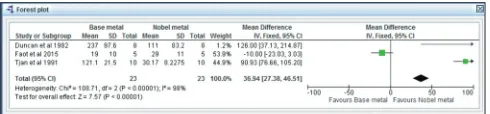
The following information was extracted and tabulated. Name of the journal, author, the design of the study, study groups, the intervention or treatment focused in this study, methods used to measure the marginal discrepancy, outcome measure such as mean marginal discrepancy, statistical test, and inference were extracted and tabulated (Table 1). 5 studies were included for the review. All the 5 studies included for the systematic review were in vitro studies with paralleling group design. The base metal alloy and noble metal alloy studied differed in the chosen studies. However, NiCr was the common base metal alloy among all the five studies. Rejish et al. studied the internal fit of NiCr and zirconia copings before and after ceramic veneering rather than the comparison between base metal and noble metal alloys (Table 1). Saber et al. evaluated the marginal discrepancy only in NiCr base metal-ceramic alloy crowns as two groups - covering the entire preparation including occlusal surface and excluding occlusal surface (Table 1). Hence, these studies cannot be included for meta analysis. The studies of Faot et al., Tjan et al., and Duncan, which compared the marginal discrepancy between base metal and noble metal alloys were subjected to meta analysis (Table 1). The effect size parameter for this meta analysis was the difference between the means in base metal and noble metal alloys, respectively. The results showed a marked deviation toward noble metal in a forest plot (Figure 1). The heterogeneity of variance was observed in the selected studies Chi-square = 108.71, df = 2 (P < 0.00001), I2 = 98%; and hence a fixed effects model was chosen. The overall effect size was Z = 7.57 (P < 0.00001). Hence, a very significant difference in the marginal discrepancy between base metal alloy and noble metal alloys was inferred.
Discussion
Literature includes more number of in vitro studies than in vivo studies with respect to marginal discrepancy in complete veneer crowns. The limitation of in vitro studies is that they are conducted in laboratory conditions, but further in vivo studies must be carried out to check if the same results are obtained.[8]
All the five studies selected for the review process were in vitro
studies with paralleling group design. The method of measurement of marginal discrepancy was predominantly stereomicroscope (different magnifications) (Saber et al., Tjan et al., Duncan). Other methods used were monocular magnification (Faot et al.) and scanning electron microscope (Regish et al.). The study groups varied with each study designed with its own group of base metal and noble metal alloys.
Faot et al. (Table 1) have used only one base metal alloy – NiCr while the noble metal alloys used were CoCr, NiCrMo, Au, and Alumina.
Of these base metals, we chose Au for the meta Analysis against NiCr because Au had incurred the highest marginal discrepancy (29 ± 11) among all other noble metal alloys used in this study. In relation to this, other studies have also reported that the rising cost of gold has encouraged the search for alternative dental alloys[2] of which NiCr alloys have received much attention.[9,10]
Regish et al. (Table 1) used NiCr and zirconia copings. However, his study primarily focused on the marginal discrepancy before and after ceramic veneering rather than on the marginal discrepancy based on the type of alloy used. The zirconia copings are typically manufactured using
manual-aided manufacturing/computer-aided manufacturing (CAM) or computer-aided design/CAM. Also according to a study, the vertical
marginal discrepancy of zirconia restorations was smaller than that of metal ceramic group. Copy milling is another technique employed in all ceramic fabrication. This technique is employed in celay system that is commercially used. Here, a resin wax pattern is fabricated over the refractory die and laser scan is used which subsequently transfers the scanned image and a ceramic core is fabricated.[1] However, for both the alloy systems, it was found that the marginal fit deteriorated after ceramic veneering. As there was not any significant analysis of marginal discrepancy based on the alloy system, this study was excluded from meta analysis. Similarly, the study of Saber et al., which had used only NiCr alloys, was also excluded from meta analysis (Table 1).
A meta analysis was possible for the assessment of marginal discrepancy in base metal alloys and noble metal alloys used in the studies by Duncan, Faot et al., and Tjan et al. The effect size for this meta analysis was the difference between the means in base metal alloys and noble metal alloy, respectively. The results showed a significant deviation toward the noble metals group in the forest plot favoring the noble metal group with less marginal discrepancy in all the studies. This strongly indicates that the type of alloy and the alloy composition have a significant effect on marginal discrepancy.[11] While selecting an alloy, the factors to be taken into consideration include castability, alloy casting accuracy, resistance to tarnish, and corrosion and biocompatibility. It has been reported that decrease in noble metal content decrease the resistance to tarnish and corrosion.[2,11,12] Moreover, NiCr alloys containing beryllium had improved casting accuracy, lower casting temperature, and less casting shrinkage. Thus, further studies with controlled variables need to be initiated and such quantitative outcome measures will enable further understanding and could be a scope for future research.
This systematic review thus reveals that the base metal alloys incurred more marginal discrepancy when compared with noble metal alloys. However, the marginal discrepancy incurred is considered clinically acceptable.
References
1. Hemalatha R, Ganapathy D. Marginal discrepancy in ceramic laminate veneers
influenced by resin luting agents - A systematic review and meta-analysis. Int J Recent Adv Multidiscip Res 2016;3:1232-44.
2. Tjan AH, Li T, Logan GI, Baum L. Marginal accuracy of complete crowns made
3. Ushiwata O, Moraes JV, Bottino MA, Silva EG. Marginal fit of nickel-chromium copings before and after internal adjustments with duplicated stone dies and disclosing agent. J Prosthet Dent 2000;83:634-43.
4. Regish KM, et al. Evaluation and comparison of the internal fit and marginal
accuracy of base metal (Nickel chromium) and zirconia copings before and after ceramic veneering: A SEM study. Eur J Prosthodont Restor Dent 2013;21:44-8.
5. Duncan JD. The casting accuracy of nickel-chromium allays for fixed prostheses.
J Prosthet Dent 1982;47:63-8.
6. Faot F, Suzuki D, Senna PM, da Silva WJ, de Mattias Sartori IA. Discrepancies
in marginal and internal fits for different metal and alumina infrastructures cemented on implant abutments. Eur J Oral Sci 2015;123:215-9.
7. Saber FS, Abolfazli N, Mahboub F, Razavi FE. The effect of occlusal surface relief
of dies on marginal adaptation of metal-ceramic casting copings. J Prosthodont
2013;22:287-91.
8. Harish V, Ali SA, N J, Ifthikar M, Senthil S, Basak D, et al. Evaluation of internal
and marginal fit of two metal ceramic system - In vitro study. J Clin Diagn Res
2014;8:ZC53-6.
9. Guess PC, Stappert CF. Midterm results of a 5-year prospective clinical investigation of extended ceramic veneers. Dent Mater 2008;24:804-13. 10. Gonzalo E, Suárez MJ, Serrano B, Lozano JF. A comparison of the marginal
vertical discrepancies of zirconium and metal ceramic posterior fixed dental prostheses before and after cementation. J Prosthet Dent 2009;102:378-84.
11. Karatasli O, Kursoğlu P, Capa N, Kazazoğlu E. Comparison of the marginal
fit of different coping materials and designs produced by computer aided manufacturing systems. Dent Mater J 2011;30:97-102.