Ms. Sadhana Rajput
The MS University of Baroda, Fatehgunj, Vadodara Email- [email protected]
Address for correspondence
Access this article online www.japer.in
RPHPLC method for simultaneous estimation of Ambroxol
hydrochloride, Potassium clavulanate and Amoxicillin trihydrate
in bulk drugs and laboratory synthetic mixture
1. INTRODUCTION
Ambroxol hydrochloride is chemically, trans-4-(2-amino-3,5-dibrombenzylamino)-cyclohexanol
monohydrochloride[1,3] (Fig. 1), which is a semi
synthetic derivative of vasicine obtained from the Indian shrub “Adhatoda vasica”. Ambroxol hydrochloride is an N–desmethyl metabolite of bromohexine which acts by breakdown of acid mucopolysaccharide fibers in the mucous, making it thinner and less viscous and is used as a co adjuvant therapy for treating bronchitis, pulmonary emphysema, pneumonia, tuberculosis, cystic fibrosis[2]. Potassium clavulanate(PC) is white to off
white powder produced by fermentation of streptomyces clavuligerus and chemically known as potassium (Z)–(2R,5R)–3–(2–hydroxyethylidene)–7–
oxo–4–oxa–1-azabicyclo[3.2.0]–heptane–2-carboxylate[1-2] (Fig. 1). It is mostly formulated in
combination with antibiotic and is usually supplied as
a mixture with Avicel (microcrystalline cellulose) [4].
Amoxicillin trihydrate (AMX) is chemically (2S, 5R, 6R)-6- [(R)-(-)-2-amino-2-(p-hydroxyphenyl) acetamido]-3, 3-dimethyl-7-oxo-4-thia-1-azabicyclo[3.2.0]heptane-2-carboxylic acid trihydrate[1] (Fig. 1). Amoxicillin trihydrate is
semisynthetic antibiotic with a broad spectrum of bactericidal activity against many gram – positive and gram – negative microorganisms. AMX is, however susceptible to degradation by β – lactamases, and therefore, the spectrum of activity does not include organisms which produce these enzymes. Clavulanic acid is a β – lactam, structurally related to the penicillin’s, which possesses the ability to inactivate a wide range of β – lactamase enzymes commonly found in microorganisms resistant to penicillin and cephalosporins [2,4].
The literature survey revealed that there are several analytical methods reported for PC, AMX and AML either individually or in combination with other drugs like spectrophotometric methods[5,6,7], simultaneous
estimation of PC and AMX in human urine by spectrophotometry[8], RP-HPLC methods [9,10,11], liquid
chromatography with amperometric detection[12],
estimation of AMX in human plasma by RPHPLC
A simple, accurate, precise, specific, economical and fast gradient HPLC-PDA method has been developed and validated for the simultaneous determination of Ambroxol hydrochloride (AML), Potassium clavulanate (PC) and Amoxicillin trihydrate (AMX) in bulk drugs and laboratory prepared synthetic mixture. Effective chromatographic separation was achieved on a Phenomenex Luna C18 (250 mm×4 mm i.d., 5µm particle size) column with gradient elution of mobile phase solvent A (methanol: 0.01 M phosphate buffer (pH 3.0) (14:86)), and solvent B(methanol) and at a detection wavelength of 220 for PC, AMX and AML. The retention times for PC, AMX, and AML were 4.26, 5.15 and 6.25 min respectively. The reliability and analytical performance of the proposed HPLC procedure were statistically validated with respect to linearity, range, precision, accuracy, specificity, robustness, detection limit and quantification limit as per ICH guideline Q(2). The validated HPLC method was applied to the analysis of synthetic mixture of three drugs prepared in laboratory in which the analytes were successfully quantified with good recovery values and no interfering peaks were encountered from the excipients.
Keywords: Gradient, HPLC, Ambroxol HCl (AML), Potassium clavulanate (PC), Amoxicillin trihydrate (AMX)
ABSTRACT Sadhana Rajput*, Prachi
Bhamre, Satish Bambhrolia
method [13], stability indicating RPHPLC methods[14, 15, 16], estimation of AMX and AML by HPTLC method[17]
and stability indicating HPTLC method for AMX and AML[18]. However no analytical method is available for
the simultaneous estimation of three drugs in combined formulation.
It was a very challenging task to develop HPLC method for this ternary combination because among these three drugs AMX and PC have pH dependent stability in different aqueous solvent, also theoretical values of log p for AML, PC and AMX are 2.92, -2.3 and -1.5 respectively [19]. Thus the difference in log p
values was a challenging task to develop an isocratic HPLC method for the three component system. Finally a rapid, accurate, precise, economic and specific gradient HPLC method was developed. The effect of pH, mobile phase composition and flow rate was studied on various chromatographic parameters such as resolution, plates, asymmetry factor, and retention time.
2. MATERIALS AND METHODS 2.1. Instrument
Chromatography was performed on Shimadzu (Shimadzu Corporation, Kyoto, Japan) chromatographic system equipped with Shimadzu LC-20AD pump and Shimadzu PDA-M20A Diode Array Detector. Samples were injected through a Rheodyne 7725 injector valve with fixed loop at 20μl. Data acquisition and integration was performed using LC real time analysis software was used. Chromatographic separation was carried out at ambient temperature on Phenomenex Luna C18 (250mm × 4.6mm internal diameter, 5µm particle size) column.
2.2. Chemicals and reagents
The API of Potassium clavulanate was obtained as a gift sample from Elite Pharmaceutical (Ahmedabad, India) and the APIs of Amoxicillin trihydrate and Ambroxol were obtained as gift sample from Alembic Pharmaceutical (Vadodara, India). HPLC grade methanol was purchased from Ranchem Pvt. Ltd.
(Mumbai, India), Potassium dihydrogen phosphate and sodium hydroxide were purchased from Loba Chemicals Pvt. Ltd. (Mumbai, India). All the required solutions were prepared in double distilled water. All solutions were filtered through a 0.2 µm Ultipor® N66® Nylon 6, 6 membrane filter (Pall Life Sciences, USA) prior to use.
2.3. Chromatographic condition
The mobile phase comprised of methanol and phosphate buffer. Phosphate buffer (0.01 M) was prepared by dissolving 0.68 mg of anhydrous potassium orthophosphate in 500 ml of double distilled water and adjusted to pH 3.0 using phosphoric acid and triethylamine which was filtered with 0.2 µm Nylon 6, 6 membrane filter. The elution was carried out with a mixture of 0.01M phosphate buffer pH 3 and methanol mixed in proportion of 86:14 (and degassed by ultra-sonication), as solvent A and HPLC grade methanol (degassed by ultra-sonication) as solvent B. The compounds were eluted at the flow rate of 1.2 ml/min and ambient temperature using gradient programming as shown in Table 1.
2.4. Preparation of standard solutions
The standard stock solutions were prepared by dissolving accurately weighed 10 mg AML, 25mg PC and 50mg AMX in 100 ml double distilled water (pH 6.2) to get concentrations of 100µg/ml, 250 µg/ml, and 500 µg/ml. Working standard solutions were prepared by series of dilution up to 10 ml to get desired concentrations in the range of 12.5-75 µg/ml for PC, 50-300 µg/ml for AMX and 3-18 µ g/ml for AML. The 20 µl of the diluted standard solutions with varying concentration were injected in triplicate into the HPLC system separately and chromatographed under above mentioned chromatographic conditions.
2.5. Preparation of laboratory sample
The combined dosage formulation of AML, PC and AMX with the trade name CLAMOXY-A [20] was not
standard procedure [22]. Formula for the laboratory
sample used for analysis is shown in Table 2. From the laboratory sample, powder equivalent to 30mg of AML, 125mg of PC and 500mg of AMX was accurately weighed and transferred to 100ml volumetric flask. The powder was dissolved initially in 20-30ml of double distill water by sonicating it for 5 minutes and then the solution was made up to the mark with double distill water. The solution was filtered through whatman filter paper No. 41 and 0.45 μm membrane filter to remove undissolved substances (excipients). From this solution an aliquot of 1ml was taken and diluted upto 10ml with double distill water and again an aliquot of 6ml was taken from this and diluted upto 10ml with double distill water to give resultant sample solution which was injected into the HPLC system. The chromatogram of the laboratory sample solution is shown in Fig. 2.
2.6. Validation of HPLC method
The proposed methods were validated as per ICH guideline [23] for linearity, precision, accuracy,
specificity sensitivity, robustness. All the parameters are listed in (Table 3).
2.6.1. Linearity
The calibration curve was constructed by plotting concentration of PC, AMX and AML versus peak areas, and the regression equations were calculated. The linearity of the method was investigated by using concentrations in the range 12.5-75 µg/ml for PC, 50-300 µg/ml for AMX and 3-18 µg/ml for AML. These concentrations were prepared by diluting appropriate volumes of working standard with double distil water. The retention times of AML, PC and AMX were recorded at 6.248, 4.261and 5.160 min. respectively. 2.6.2. Accuracy
Accuracy of the method was studied by recovery experiments using the standard addition method at three different levels (50, 100, and 150%). Known amounts of standard solutions containing AML (3, 6 and 9 µg/ml) PC (12.5, 25 and 37.5 µg/ml) and AMX (50, 100 and 150 µg/ml) were added to prequantified laboratory mixture sample solutions to reach 50%,
100% and 150% levels. This three level recovery study results are shown in Table 3.
2.6.3. Precision
To demonstrate agreement among results, a series of measurements were done with AML, PC and AMX. Six replicate injections of specific standard at various time intervals on the same day were injected into system for intraday precision and on three different days for interday precision. The % RSD (relative standard deviation) of the results was calculated. 2.6.4. Sensitivity
Sensitivity of optimized method was determined by the limit of detection (LOD) and limit of quantification (LOQ) by equation 1 and 2.
LOD =3.3 σ/S ……….. (1) LOQ =10 σ/S ……... (2) 2.6.5 Robustness
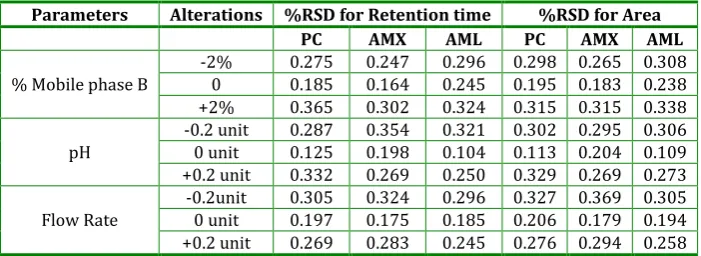
Robustness of the method was demonstrated by deliberately changing the chromatographic conditions like pH, organic phase composition as percentage and flow rate. The results of robustness are given in Table 4.
2.6.6. Specificity
Specificity of the method was demonstrated by injecting the blank solution, standard solution, sample solution prepared from laboratory mixture with excipient and responses were determined.
2.6.7 System suitability parameters
System suitability testing was carried out on freshly prepared standard solutions (n=6) containing AML, PC and AMX. System suitability parameters obtained with 20µl injection volumes are summarized in Table 5.
3. Results and Discussion
Several compositions of mobile phase were tried for the optimisation of the mobile phase.
mobile phase B composition from 78%, 80% and 82%. Moreover, the effects of different level of all these factors were systematically addressed on system suitability parameters such as resolution, theoretical plates, retention time and asymmetry.
3.1.1. Effect of mobile phase pH
With the aim of the optimization of mobile phase pH (2.8, 3.0, 3.2), the remaining factors were kept constant, i.e. flow rate of 1.2 ml/min, detection wavelength 220 nm. Buffer increases method’s ruggedness since amine retention and peak shape is pH dependent. As pH is lowered amine retention times shortens and peak shape sharpens as the buffer protonates acidic silanols on the silica surface. At pH 2.8 there was a difficult to separate AMX and AML as both eluted very closely and were not resolved properly. Thus potassium phosphate buffer pH 3 was found to be the most suitable pH buffer.
3.1.2. Effect of flow rate
While optimizing the flow rate (1.0, 1.2, and 1.4) ml/min, the remaining factors were kept constant, i.e. mobile phase A and mobile phase B composition, buffer pH 3.0 and detection wavelength 220 nm. As the flow rate increases retention time decreases. At flow rate 1.0 all peaks were well separated but tailing was observed and at flow rate 1.4 ml/min, resolution between two peaks was lower than 2. So finally flow rate 1.2 ml/min was selected, at which the peaks were well resolved and the asymmetry factor for three peaks was within the range.
3.2. Validation parameters
Linearity data are summarized in Table 3, which shows a good linear relationship between concentration and peak areas over a concentration range of 3-18 µg/ml of AML, 12.5-75µg/ml of PC and 50–300 µg/ml of AMX. The correlation coefficient (R2)
was found to be 0.9999 for AML, 0.9992 for PC and 0.9993 for AMX.
From the precision studies, %RSD of mean assay values for intraday precision was found to be 0.716% for AML, for PC 0.491% and 0.594% for AMX, This values indicate that repeatability of this method is
satisfactory. The intermediate precision study revealed that the method is rugged with RSD values of 1.181% for AML, 1.318% for PC and 0.716% for AMX. Accuracy studies indicated that the mean recovery of the added standard drug was 101.44, 98.85 and 100.66 % for AML, PC and AMX, respectively. Specificity studies indicated no interference from excipients, impurities, or degradation products, and ensured that the peak response was due to AML, PC and AMX only.
The LOD was found to be 0.264 for AML, 0.504 for PC and 0.269 for AMX. The LOQ was found to be 0.792 for AML, 1.512 for PC and 0.809 for AMX. These results show that method was enough sensitive for the analysis of synthetic mixture. Hence the method was applicable to synthetic mixture.
Robustness of method was determined in form of % RSD of retention time and area by small deliberate changes in flow rate (±0.2ml/min), mobile phase ratio (solvent B ±2%), pH of buffer (±0.2). The method was found to be enough robust and provided accurate results in normal quality control labs even if with some sort of experimental error by human or system. System suitability with the satisfactory acceptance levels was demonstrated every time before the experiments of validation parameters on freshly prepared standard solutions (n=6) containing AML, PC and AMX. All these system suitability parameters are listed in Table 5.
3.3 Analysis of the laboratory sample
As the preliminary validation parameters show satisfied results hence the method was applied to laboratory sample. In the assay of laboratory sample, percentage purity was found to be 100.36 ± 0.69, 101.26 ± 0.78 and 99.49 ± 0.28 w/w for PC, AMX and AML respectively. The results for percentage purity are also shown in Table 6.
4. CONCLUSION
precise, reliable and economic. This method can be used for routine quantitative estimation of three components in synthetic mixture.
Table 1: Gradient program
Time (min.) % B Conc.
0.01 0 2 80 7 80
9 0
10 Stop
Table 2: Formula for laboratory mixture
Sr. no Chemicals Quantity
1 Ambroxol∙HCl 30 mg 2 Potassium Clavulanate 125 mg 3 Amoxicillin Trihydrate 500 mg 4 MCC(Avicel pH 102) 41 mg 5 HPMC 150 mg 6 Purified talc 2 mg 7 Mg stearate 2 mg
Table 3: Validation parameters of HPLC-PDA method for PC, AMX and AML
Parameters PC AMX AML
Detection wavelength 220 nm
Linearity range (µg/ml) 12.5-75 50-300 3-18 Regression coefficient (r2) 0.9991 0.9993 0.9998
Regression equation (y=mx+c) y = 20791x - 8087.8 y = 24498x - 144686 y = 37618x + 90641 LOD (µg/ml) 0.504 0.269 0.264
LOQ (µg/ml) 1.512 0.809 0.792
Precision %RSD
Intra-day Precision 0.491 0.594 0.716 Inter-day Precision 1.318 0.716 1.181
Accuracy
% Amount Added %Recovery ± S.D.*
50 100.32±0.35 101.92±0.65 99.33±0.52 100 101.44±0.68 98.85±0.20 100.66±0.51 150 98.21±0.12 101.65± 0.96 99.44±0.63
*mean value of three determinations
Table 4: Robustness parameter studied for HPLC-PDA method
Parameters Alterations %RSD for Retention time %RSD for Area
PC AMX AML PC AMX AML
% Mobile phase B
-2% 0.275 0.247 0.296 0.298 0.265 0.308 0 0.185 0.164 0.245 0.195 0.183 0.238 +2% 0.365 0.302 0.324 0.315 0.315 0.338
pH
-0.2 unit 0.287 0.354 0.321 0.302 0.295 0.306 0 unit 0.125 0.198 0.104 0.113 0.204 0.109 +0.2 unit 0.332 0.269 0.250 0.329 0.269 0.273
Flow Rate
-0.2unit 0.305 0.324 0.296 0.327 0.369 0.305 0 unit 0.197 0.175 0.185 0.206 0.179 0.194 +0.2 unit 0.269 0.283 0.245 0.276 0.294 0.258
Table 5: System suitability parameters validated HPLC-PDA method
SST Parameters* (±RSD, %) PC (±RSD, %) AMX (±RSD, %) AML
Retention Time 4.267±0.65 5.157±0.36 6.264±0.53 Capacity factor (k) 2.55 3.297 4.221 Separation factor (α) - 1.293 1.280 Theoretical plates (USP) 7019.6±0.645 26294.2±0.965 32940.8±1.154
Resolution (Rs) - 5.576±0.18 8.367±0.11
Asymmetry (As) 1.5562±0.269 1.5392±0.325 1.4476±0.112
Table 6: Percent purity of PC, AMX and AML in synthetic mixture by HPLC-PDA method
Synthetic Mixture
Labeled Claim :- PC:AMX:AML (125mg:500mg:30mg)
PC±S.D* AMX±S.D* AML±S.D*
100.36 ± 0.69 101.26±0.78 99.49 ± 0.28 *Average of six determinations
Figure 1: Chemical structure of Ambroxol hydrochloride, Potassium clavulanate and Amoxicillin trihydrate
5. ACKNOWLEDGMENTS
We are grateful to Elite Pharma Pvt. Ltd. and Alembic Pharma, Vadodara, India for providing the gift samples of the API under study.
6. REFERENCES
1. Indian pharmacopoeia. Vol. 2, Govt. of India, Ministry of health and family welfare, controller and publication, Delhi, 2007; 83, 102, 959.
2. Tripathi K.D. Essentials of Medical pharmacology. 5th Ed, Jaypee Brothers Medical publishers, New Delhi, 2004; 181-182.
3. British Pharmacopoeia. Vol. 1, British Pharmacopoeia Commission Office, London, UK, 2008; 116-117.
4. http://www.drugs.com/monograph/amoxicillin-and-clavulanate-potassium.html. accessed on: Jan 2013
5. Umadevi B.,Vetrichelvan T. Development and validation ofUV spectrophotometric determination of doxofylline and ambroxol hydrochloride in bulk and combined tablet formulation. International journal of current pharmaceutical research. 2011; 3(4): 89-92.
6. Huong V.T., Hoang V.D. Simultaneous determination of Amoxicillin and Clavulanate in combined tablets by non-derivative and derivative UV spectrophotometric techniques International Journal of PharmTech Research. 2009; 1(4): 1173-1181. 7. Gupta A., Rawat S., Gandhi M., Namdeo R.
Simultaneous Estimation of Amoxycillin and Potassium Clavulanate in Injection Formulation by Simultaneous Equation Method. Journal of Pharmacy Research. 2011; 4(4): 1244-1245.
8. Singh R., Gujral S.K., Haque M. Simultaneous Determination of Potassium Clavulanate and Amoxicillin Trihydrate in Bulk, Pharmaceutical Formulations and in Human Urine Samples by UV Spectrophotometry. International Journal of Biomedical Science. 2010; 6(4): 335-343.
9. Khan I.U., Sharif S., Muhammad A., Muhammad N.
Simultaneous Determination of Potassium Clavulanate and Cefixime in Synthetic Mixtures by High Performance Liquid Chromatography. Journal of AOAC International. 2008; 91(4): 744-749(6).
10. Jayakar B., Kumudhavalli M.V., Margret R., Kumar M., Saravanan C. Method development and validation of RP-HPLC method for simultaneous determination of amoxycillin and potassium clavulanate. International Journal of Pharmtech Research. 2010; 2(1): 906-909. 11. Shanmugasundaram P., Kamal R., Mohanrangan J. Simultaneous estimation of amoxicillin and flucloxacillin in its combined capsule dosage form by HPLC. Rasayan J.chem. 2009; 2: 57-60.
12. Aghazadeh A., Kazemifard G. Simultaneous determination of amoxycillin and clavulanic acid in pharmaceutical dosage forms by LC with amperometric detection. Journal of Pharmaceutical and Biomedical Analysis. 2001; 25(2): 325-9. 13. Numan A.A., Noman M., Alkadi H. Validation and
Application of a Reversed-phase HPLC method for the determination of Amoxicillin Trihydrate in human plasma. Journal of Applied Sciences Research. 2009; 5(12): 2219-2224.
14. Tippa D.M.R., Singh N. Development and validation of stability indicating HPLC method for simultaneous estimation of Amoxicillin and Clavulanic Acid in injection. American Journal of Analytical Chemistry. 2010; 1(3): 95-101.
15. Chitlange S.S., Tawargeri S.R., Chaturvedi K.K. Simultaneous Determination of Amoxicillin trihydrate and Ambroxol hydrochloride in solid dosage form by spectrophotometric and stability indicating RP-HPLC method. Asian Journal of Research in Chemistry. 2011; 4(6): 1025-1030. 16. Jerzsele A., Nagy G. The stability of amoxicillin
trihydrate and potassium clavulanate combination in aqueous solutions. Acta Veterinaria Hungarica. 2009; 57(4): 485–493.
17. Dhaneshwar S. R., Dhoka M.V., Chopade S.S., Bhusari V.K. Validated HPTLC method for simultaneous estimation of Amoxycillin trihydrate and Ambroxol hydrochloride in pharmaceutical dosage form Asian J Pharm Biol Res. 2011; 1(2): 129-135.
18. Chitlange S.S., Tawargeri S.R., Bhole R.P. Stability indicating HPTLC method for simultaneous estimation of Amoxicillin trihydrate and Ambroxol hydrochloride in bulk and pharmaceutical dosage form. Pharm Anal Acta 2013; 4: 261.
19. http://www.drugbank.ca/ accessed on: Jan 2013 20. www.mims.com/India/drug/info/CLAMOXY-A/
21. http://www.drugs.com/uk/co-amoxiclav-500-125-mg-tablets-spc-8950.html accessed on: Jan 2013. 22. Lachmann, et al. (2009) The Theory & Practice of
Industrial Pharmacy, special Indian edition: 320 – 329.
23. International Conference on Harmonization (1996) Technical Requirements for Registration of Pharmaceuticals for Human Use, ICH Harmonized Tripartite Guideline Validation of Analytical
Procedures: Text and Methodology Q2 (R1), Geneva Switzerland.
How to cite this article: Sadhana Rajput*, Prachi
Bhamre and Satish Bambhrolia; RPHPLC method for simultaneous estimation of Ambroxol hydrochloride, Potassium clavulanate and Amoxicillin trihydrate in bulk drugs and laboratory synthetic mixture; J. Adv. Pharm. Edu. & Res. 2014: 4(2): 178-185.