INITIAL TASK PLACEMENT FOR MACRO-PROGRAMMED
WIRELESS SENSOR NETWORK
Vitalijus Martuseviius
1, Asta Martuseviien
2, Egidijus Kazanaviius
1,
Vaidas Jukaviius
11
Department of Computer Engineering, Kaunas University of Technology Studentu St. 50-208, LT-51368 Kaunas, Lithuania
email:[email protected]
2
Department of Applied Mathematics, Kaunas University of Technology Studentu St. 50-324a, LT-51368 Kaunas, Lithuania
Abstract. One of the most important issues in wireless sensor network programming is to assign a set of tasks to a set of nodes with limited energy resources in order to minimize energy consumption. In this paper, we develop a task assignment model where cost function is formulated as a sum of computation and communication energy spent in the network. The model employs task placement constraints that ensure expected lifetime of individual node. We propose an efficient genetic algorithm with repair operator to obtain a minimal cost solution. The repair operator guarantees valid task assignments that meet model constraints as candidate solutions are generated during the process of evolution. Experiments reveal that provided heuristic takes a reasonable amount of time to produce near optimal results.
Keywords: wireless sensor network; task mapping; genetic algorithm; macro-programming.
1. Introduction
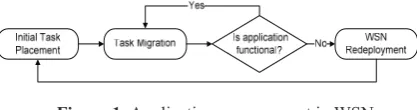
Energy is a critical performance metric of a wire-less sensor network (WSN). In order to extend the lifetime of the WSN, energy efficient task placement on a given deployment of sensor nodes is required. Initial task placement utilizes global knowledge avail-able at compile time with the aim to minimize energy consumption for application execution in the network. As WSN is a dynamic environment, changing energy levels and positions of nodes are further handled by task migration subsystem [21]. These techniques enable effective WSN application management as depicted in Figure 1.
The assignment of m tasks onto n nodes is a
classical NP-complete problem, usually solved in pa-rallel computing [1], [10]. Yet some aspects are specific for WSN: strict task placement constraints, communication of tasks between each other and the fact that nodes involved in routing also spend energy in the process.
Several approaches to task assignment problem have been identified in literature. Graph theoretical algorithms [16], [19] or mathematical programming [12], [26] require high time complexity and do not allow constrains to be easily incorporated into the model. These algorithms obtain an optimal solution. Otherwise, heuristic-based techniques like genetic
algorithm [7], [15] or simulated annealing [14] are applicable to larger dimensional problems due to their low time complexity. However, these algorithms pro-vide suboptimal solution. As well as aforementioned exact methods, most of genetic algorithms do not take into account constraints to meet various application requirements.
A number of researchers have already considered
task placement in WSNs. Tian et al. [24] deal with
task mapping problem from a protocol-centric point of view. Their aim is to map and schedule application tasks with minimum schedule length subject to energy consumption constrains. Here network assumptions are a bit different as sensors are grouped into single-hop clusters and attention is paid more on scheduling but not mapping of tasks. As opposite, we consider a multi-hop homogenous WSN. In [23], Hamouda and Phillips propose biological task mapping and schedu-ling algorithm claiming it outperforms an algorithm in [25]. Task allocation in these papers takes into account network dynamics during the lifetime of WSN whereas we deal only with initial task placement. Park
et al. [14] use simulated annealing method to solve task transformation and assignment problem. In their case, tasks to be deployed are decomposable and transformable while we consider atomic tasks. In [5], energy consumption is addressed through energy-ba-lanced task allocation that is most similar to our case.
However, Pathak and Prasanna only consider overall energy expenditure in the network whereas we also take into account energy dissipation of individual nodes. Besides, network communication and energy consumption mechanisms are more accurate in our simulations. We also propose an advanced adaptive genetic algorithm to solve task assignment problem.
Our goal is to near optimally assign tasks to the WSN nodes in terms of energy spent in the network and apply the given constraints. We minimize a classi-cal performance metric of total energy spent in the system in order to find the best task placement. This optimization goal consists of computation and com-munication energy costs. We use genetic algorithm to explore the solution space efficiently. In order to comply with the given constraints, our constructed
genetic algorithm employs a special repairoperator to
guarantee valid assignments during the process of evolution. Actual WSN application of greenhouse ma-nagement is chosen to demonstrate the effectiveness of our solution to the task assignment problem.
The remainder of this paper is structured as follows. Initial task assignment onto the target network is introduced in detail in Section 2. Next, the case study is provided. In Section 4, we conclude and present directions of future work.
2. Energy Efficient Task Placement
2.1. Application Model
The task mapping problem emerges while com-piling data-driven macro-programs for WSNs. As a case study for the task assignment problem, we consider a monitoring system to prevent dew conden-sation in a greenhouse environment [6], [11]. Dew condensation on the plants surface can promote va-rious crop diseases. Our system is composed of three types of sensor nodes that collect ambient temperature and air humidity as well as plants surface temperature. Also, actuators that control ventilating fans are deployed for adjusting the environment inside the greenhouse.
Figure 1. Application management in WSN
We design the application as a directed acyclic graph (DAG) that describes tasks dependencies (Fig. 2). The tasks of the DAG are to be placed onto the underlying target network. Each sensor node has an
associated ambient temperature (T1, T2) or plant
sur-face temperature (T5, T6) or humidity (T3, T4)
samp-ling task. Additional five tasks T7–T11 that control
application functionality are to be placed onto any of the nodes of the WSN. These are the tasks for
optimi-zation. Here T7, T8, and T9 collect and average
am-bient temperature, air humidity and plants surface
temperature respectively, while T10 calculates the dew
point and T11 compares it with the averaged plants
surface temperature.
Figure 2. Task graph of the greenhouse management application
The temperature of the dew point is calculated by Barenbrug formula [11] using averaged values of am-bient temperature and air humidity. If the dew point temperature of the greenhouse is higher than the ave-raged plants surface temperature, the environment is
adjusted by actuating tasks (T12, T13) that control
ventilating fans.
It is important to highlight that the assignment of tasks onto the target nodes should achieve the following goals:
x minimize total energy spent in the entire system,
x evaluate task placement constraints.
According to these goals, we create a mathema-tical model and formulate a cost function as described in the next section.
2.2. Problem Formalization
The concept of the model is based on the results presented in [5], where the framework of mathema-tical description consists of four matrices that define task assignment problem. We complete these matrices with respect to actual WSN operation, whereas Pathak and Prasanna [5] provide inaccurate assumptions to perform simulations. Thus, in our case, elements of the model are supplemented with techniques that eva-luate platform-dependent computation and communi-cation energy consumption.
Atarget network TN= {1,…,k,…n} consists of n
nodes with initial properties that depend on the plat-form in use. We explore a homogenous sensor net-work, where all nodes have the same initial energy
level ek.
A task graph D = (DT, DE) consists of a set of
vertices DT = {1,…,i,…m} representing the tasks to
DEDT × DT depicting communication
dependen-cies among tasks. Each task i has a firing rate fi
depending on the nature of the task. It indicates the number of times the task is invoked in a period of system behavior. Each edge has an associated size of
data sij that task i provides to task j per invocation.
We construct task execution energy matrix Tm×n to
present energy consumption of each task execution on every node and comply with task placement
const-raints. Here entry Tik of the matrix T defines the
ener-gy spent by node k per invocation of task i.
Further, we create a routing energy cost matrix
Rn×n×nfor target network, where each entry Rk
de-picts the energy required at node k to transmit a unit of
data from node to node . We used Dijkstra shortest
path algorithm to fill the routing matrix. The
const-ruction of routing matrix R is elaborated in Section 3.
The task mapping is a surjective function map:
DTTN, assigning task i to node map(i).
After model elements are defined, computation and communication energy costs at a node in a period of system behavior are evaluated as follows:
comp :
, 1, , ,
k
i ik i map i k
C
¦
f T k ! n (1)comm ,
, 1, , .
k
i ij map i map j k i j
C f s R
k n
¦
DE!
(2)
Finally, the total energy spent in the WSN is ex-pressed as the sum of energy consumptions of individual nodes:
total compk commk ,
k
C C C
¦
TN(3)
comp , 1, ,
t
k ek
C d O k ! n. (4)
The system level metric (3) is to be minimized in order to find an optimal mapping of tasks in terms of energy consumption. This is a classical goal function estimating the performance of distributed systems. The constraint (4) puts a limit on computation energy
for the tasks on node k in a period of system behavior.
It ensures that tasks are spread over the network
avoiding high workload on a few nodes. In (4), is the
computation energy component and t denotes the
expected lifetime of a node expressed in periods of system behavior. For performance metric (3) a feasible solution is possible only when all nodes have enough energy left at the end of period of system behavior (4), otherwise the task mapping algorithm should report failure.
The time required to minimize the cost function (3) increases exponentially as the size of the problem
nmopt grows. Here m
opt is the number of tasks to be
optimized. Thus, various heuristic and approximation methods are used to speed up the process of finding a good enough solution, where an exhaustive search is
impractical. In [5], the problem is formulated as a mixed integer programming (MIP) problem and also special greedy algorithms are provided to solve it with
computational complexity O(n3|DE|2). On the other
hand, we propose a well established genetic-based ap-proach to find a solution that minimizes a given cost function. We adapt general genetic algorithm for task assignment in WSN using repair operator. Also, the parameters of genetic algorithm are tuned. Introduced heuristic is adjustable to complex applications and effective for large networks.
2.3. Genetic Algorithm for Task Mapping
A genetic algorithm (GA) is a heuristic [3] that mimics natural biological evolution. GAs operate on a population of potential solutions applying the prin-ciple of survival of the ttest to produce better and better approximations to a solution. This heuristic is usually used to generate useful solutions to optimi-zation and search problems. Closest to our case, it has been applied to assign tasks for multiprocessors with limited memory in parallel computing [1]. Other applications were also considered [2], [13], [17], [18]. There are several basic points that all genetic algo-rithms are based on.
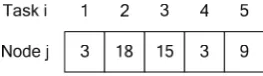
Firstly, a genetic representation of the solution domain should be created. This means that a solution to a problem should be represented as a genome
(chromosome). We assume that setting the i-th cell,
called gene, of the chromosome array to j means
as-signing of the i-th task to node j (Figure 3). A
chro-mosome is called valid if tasks are allocated to nodes in such a way that each node has enough energy to execute assigned tasks. The total cost for a given assignment is the total energy spent while executing all tasks assigned to the nodes of the target network.
Figure 3. Chromosome representation of task assignment
Further, we have to define a fitness function to evaluate the potential solution. Fitness function is the key element in the whole genetic algorithm and de-pends on the problem. It measures the quality of the chromosome and correlates closely with the objective function. Also, computation time of fitness value of a chromosome should not be high. Hence, in our case,
the fitness function fit is defined as follows:
comp comm1
.
k k
k
fit
C C
¦
TN(5)
space and to maintain diversity. Our mutation operator involves a probability that a randomly selected gene in a genetic sequence will be changed from its original state.
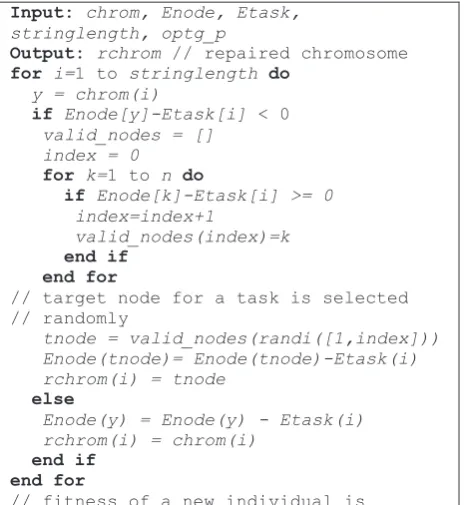
After crossover and mutation operators are ap-plied, it is possible some child chromosomes to be invalid due to node capacity restrictions. Thus we deliver an additional repair operator that converts the invalid chromosomes to valid ones (Fig. 4). The input to the repair procedure consists of a chromosome
chrom, which defines the mapping of tasks onto the
nodes, as well as Enode and Etaskarrays, which
re-present the energy levels of nodes and tasks, respect-tively. It is assumed that a proportion of node energy is reserved for computation as WSNs deplete most of energy for communication. Dividing this energy by a number of periods of system behavior we get an amount of energy that can be consumed in one period to achieve expected lifetime of a node. Thus, each cell
of the Enode array represents the available energy of
particular node and its value is obtained by subtracting energy required for predetermined tasks from the
ener-gy that can be consumed in one period. Further, Etask
array represents the tasks under optimization, where the value in each cell defines computation costs for particular task in a period of system behavior. Here, energy consumption for each task is calculated using
formula (6) which is multiplied by firing rate fi in
order to obtain computation costs in a period. Additio-nal parameters, i.e. stringlength, that represents the
number of optimization tasks, and optg_p, that is
required to compute the value of the objective func-tion for a given task assignment, are also needed as inputs of the repair operator. The repair operator veri-fies the validity of a chromosome and, if required, corrects it according to constraints. Finally, a valid
chromosome rchrom is provided as an output.
Input: chrom, Enode, Etask,
stringlength, optg_p
Output: rchrom // repaired chromosome
for i=1 to stringlength do y = chrom(i)
if Enode[y]-Etask[i] < 0
valid_nodes = [] index = 0
for k=1 to n do
if Enode[k]-Etask[i] >= 0 index=index+1
valid_nodes(index)=k end if
end for
// target node for a task is selected // randomly
tnode = valid_nodes(randi([1,index])) Enode(tnode)= Enode(tnode)-Etask(i) rchrom(i) = tnode
else
Enode(y) = Enode(y) - Etask(i) rchrom(i) = chrom(i)
end if end for
// fitness of a new individual is
computed
// in the last element of an array
rchrom(stringlength+1)=1/C_total(optg_p, rchrom(1:stringlength))
return rchrom
Figure 4. Method of the repair operator. Function C_total
calculates the value of the objective function for a chromosome
Once we have the genetic representation of the so-lution, the fitness function and genetic operators de-fined, GA proceeds to initialize a population of valid solutions randomly and then improves it through repetitive application of crossover, mutation, repair and selection operators. There are many ways to select chromosomes to the next generation like roulette-wheel selection, stochastic universal sampling or tour-nament selection. We executed various schemes of selection to improve the performance of GA and found the most effective one as follows:
x Firstly, 10% of elite chromosomes with large
values of the fitness function are moved to the next generation without any change.
x The crossover operator with the probability
pc=0.7 is applied to the next 70% of chromosomes.
x The mutation operator is applied to the rest of
chromosomes with small values of the fitness function. It is a mandatory mutation, so mutation
probability pm is set to 1.
x Finally, the repair operator corrects invalid child
chromosomes.
Evolutional process of genetic algorithm is repea-ted until a termination condition is reached. We stop the evolution when the fitness of generation does not significantly increase over time (Figure 8). The gene-ral structure of genetic algorithm for task mapping is depicted in Figure 5.
Figure 5. Procedure of genetic algorithm
3. Results
As a case study of task assignment, we adopted a greenhouse management application discussed in Sec-tion 2.1. Firstly, a generalized task graph, which de-scribes the application tasks and their dependencies, is produced (Figure 2). It consists of ambient tempera-ture, ambient humidity and plants temperature sampler tasks as well as actuator tasks. The number of sampler and actuator tasks depends on the number of nodes with appropriate capabilities. Besides, five application management tasks, which process the data from samplers and control actuators, are part of the task graph. These tasks can be assigned to any node in the target network, thus allowing optimizations. Also, each task in the task graph represents an indivisible unit of processing as opposed to task partitioning ap-proach [14].
Secondly, we simulated various WSN topologies where tasks of DAG are to be deployed. The number of nodes varied from 10 to 50 and they were randomly
distributed in the area of 100m2. We assume line of
sight (LOS) communication between the nodes within the same coverage area. Two nodes are in the same coverage area if the distance between them is equal to or less than the radio range, which is set to 30m. An example of topology is depicted in Figure 6.
Since it is important to use realistic values during the simulation, the proposed application was imple-mented to run on Sun SPOT nodes [20]. These nodes are equipped with 400MHz 32bit ARM926EJ-S pro-cessor, 1M SRAM, 8M Flash memory and 2.4GHz IEEE 802.15.4 radio with integrated antenna. The Sun SPOT has lithium-ion rechargeable battery with 770mAh capacity and a normal voltage output of
3.7V. Thus, each node has its initial energy ek equal to
10256J.
In order to estimate computation costs in the network, we firstly defined task execution energy
mat-rix T and selected firing rates fi. The task execution
energy matrix T is an mun matrix that represents
com-putational energy required for tasks and ensures that tasks which perform particular sensing and actuating would be tied up to nodes with the relevant
capabili-ties. Thus, each entry Tik of the matrix is either
compu-ted using formula (6) and depicts the energy spent by
node k per invocation of task i or is set to f if it is
impossible for node k to execute task i. We explore
homogenous network, where energy consumption for task execution is the same on each node it is invoked on. In order to accurately estimate task execution cost, each task is expressed in CPU cycles [9]. Then the
energy consumption of executing Ni clock cycles with
CPU clock frequency fcpu and core supply voltage Vdd
is evaluated as follows:
dd cpu dd leakcpu
V , f V I
f
i
ik i
N
T NCVdd2 , (6)
where C and Ileak are processor dependent parameters
[8]. It should be noted that this energy consumption
model only considers the energy expenditure directly related with application executions. Thus energy dissipation during idle time is not taken into account. The parameters of Sun SPOT processor ARM926EJ-S
in formula (6) are set as follows: Vdd=1V, C=0.52nF,
Ileak=12mA, and fcpu=400MHz. Further, we selected
higher firing rates fi for sensing tasks compared to
actuating and controlling tasks in order to comply with data-driven approach.
0 10 20 30 40 50 60 70 80 90 100 0
10 20 30 40 50 60 70 80 90 100
Distance (m)
D
is
tanc
e (
m
)
1
2
3 4 5
6 7
8
9
10 11
12
13 14
15
16
17 18
19 20 21 22
23
24
25
26 27
28 29
30
Figure 6. Network topology with three types of sensors and one type of actuators. The shortest route is depicted between
Node7 and Node25
Network communication costs are evaluated by
formula (2), where routing matrix R and data size in
packets sij are to be provided. Routing matrix entry
Rk is obtained as follows: the shortest path between
nodes and in the target network is found using
Dijkstra algorithm and the energy consumption per
data packet at intermediate node k, that belongs to this
route, is computed via radio model [8], [22]:
2
tx_elec amp 0
, E , d ,
tx
E l d l l d dd (7)
rx_elec
E ,
rx
E l l (8)
where Etx_elec, Erx_elec andHamp are node hardware
pro-perty parameters. Formula (7) defines that power
con-sumption on a sensor node to transmit l-bit data packet
depends on transmission distance d and the energy
dissipated by transmit electronics and power amplifier. Likewise, formula (8) states that energy required to
receive l-bit data packet depends only on the energy
dissipated to run the receive electronics. The approp-riate parameter values for Chipcon CC2420 transcei-ver used in Sun SPOT nodes were obtained from the
datasheet [20]: Etx_elec=130nJ/bit, Erx_elec=144nJ/bit,
Hamp=100pJ/bit/m2, d0=30m. It should be mentioned
that if a particular node k in WSN does not belong to
the shortest route from node to node , then its
energy consumption value Rk equals to 0 in the
routing matrix R. Also, sij denotes the number of
packets per data item that task i produces to task j per
invocation. In our simulation, we assume sij=1 for all
Node1Node2 Node3Node4
Node5Node6
Node1 Node2 Node3 Node4 Node5 Node6
40 45 50 55 60 65 70 75
Opt task 1 Opt task 2
T
o
ta
l E
n
er
gy
S
pe
nt
(
J
)
Figure 7. Task mapping in terms of energy consumption
After all elements required for computation and communication costs are defined, the total energy
spent in the entire network Ctotal is computed using
formula (3). It takes 0.05s to find an optimal mapping for the network with 6 nodes and 2 tasks for optimi-zation, as depicted in Figure 7, while the total energy spent in the network is 41J.
As the number of optimization tasks and WSN nodes increases, computations grow exponentially and it is impossible to solve the problem within a reasonable amount of time. Therefore, we introduced a low time complexity genetic algorithm with repair operator which leads to near optimal results. A number of experiments were performed to identify suitable GA parameters presented in Table 1.
Table 1. Values of GA parameters
Parameter Value
Maximum number of generations 200
Population size 100
Number of genes in a chromosome 5
Crossover probability 0.7
Mutation probability 1.0
We select maximum number of generations as stopping criterion according to the analysis of the convergence rate of fitness over populations as pre-sented in Figure 8.
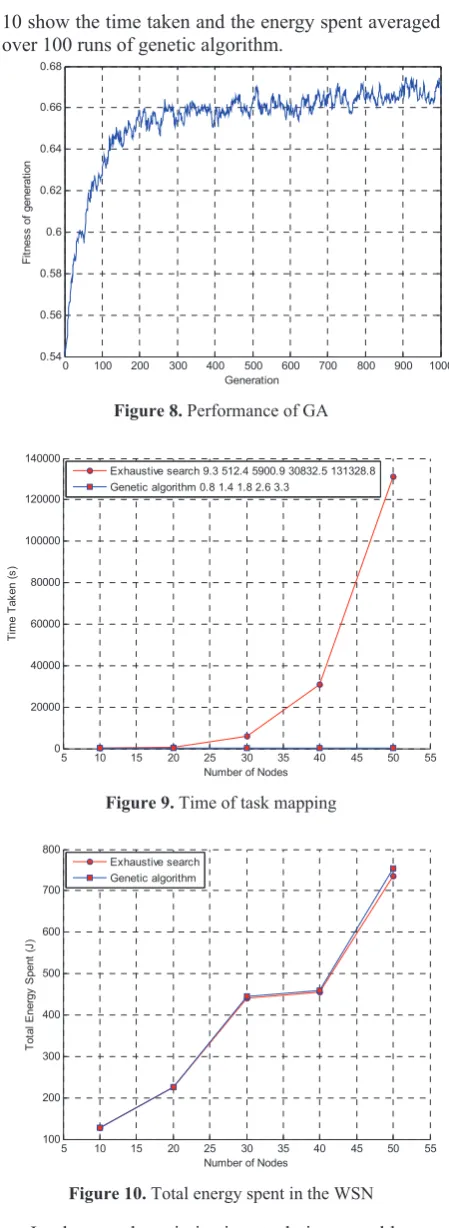
In order to evaluate the efficiency of the proposed heuristic, we performed optimization of five tasks (Figure 2) on various network topologies with in-creasing number of nodes. Time taken for task assign-ment using exhaustive search and genetic algorithm is exhibited in Figure 9. It demonstrates the effectiveness of genetic algorithm, particularly for complex applications to be mapped onto large WSNs.
In our experiments the solution Ctotal produced by
the genetic algorithm was the same as the one provided by exhaustive search for deployments with 10 and 20 nodes and introduced only 2.5% error for the network with 50 nodes (Figure 10). Figures 9 and
10 show the time taken and the energy spent averaged over 100 runs of genetic algorithm.
0 100 200 300 400 500 600 700 800 900 1000 0.54
0.56 0.58 0.6 0.62 0.64 0.66 0.68
Generation
F
it
ne
s
s
o
f
ge
ne
ra
ti
o
n
Figure 8. Performance of GA
5 10 15 20 25 30 35 40 45 50 55 0
20000 40000 60000 80000 100000 120000 140000
Number of Nodes
T
im
e
T
ak
en
(s
)
Exhaustive search 9.3 512.4 5900.9 30832.5 131328.8 Genetic algorithm 0.8 1.4 1.8 2.6 3.3
Figure 9. Time of task mapping
5 10 15 20 25 30 35 40 45 50 55 100
200 300 400 500 600 700 800
Number of Nodes
T
o
ta
l E
n
ergy
S
p
e
n
t (
J
)
Exhaustive search Genetic algorithm
Figure 10. Total energy spent in the WSN
Implemented optimization technique enables to save up to 52% of energy for the network depicted in Figure 6. Therefore, network lifetime is extended to
46.13 hours. Our experiments indicate that the
4. Conclusions
In this paper, an approach for optimal initial task mapping that improves system lifetime was presented. Firstly, mathematical model for tasks assignment onto target network nodes was developed. Model const-raints prevent the assignment of optimization tasks to the same node in order to extend the longevity of indi-vidual node with the aim to evenly distribute the energy depletion in the WSN. Network performance was evaluated using energy balance as optimization goal. To minimize this goal a genetic algorithm with repair operator was implemented. The repair operator is required to comply with model constraints.
Experiments were performed to tune parameters of the genetic algorithm in order to achieve best conver-gence rate of its fitness function. Simulation results have shown that our genetic algorithm efficiently determines the mapping of tasks that leads to minimal energy consumption in the WSN. Even in large sensor networks genetic algorithm finds suboptimal solution with minimal error.
To sum up, the proposed technique is dedicated to the compiler task allocation module [4]. We intro-duced accurate energy and communication models that lead to better cost estimates.
In the future, we intend to extend our work to de-sign space exploration for wireless sensor network in order to evaluate various performance metrics in differrent platforms.
References
[1] A. Mehrabi, S. Mehrabi, A. D. Mehrabi. An Adap-tive Genetic Algorithm for Multiprocessor Task As-signment Problem with Limited Memory. Proc. of World Congress on Engineering and Computer Science, October 2009, Vol.2, 1018-1023.
[2] A. Miseviius, D. Rubliauskas, V. Barkauskas. Some Further Experiments with the Genetic Algo-rithm for the Quadratic Assignment Problem. Infor-mation Technology and Control, Vol.38, No.4, 2009, 325-332.
[3] A. Miseviius, T. Blažauskas, J. Blonskis, J. Smo-linskas. An Overview of Some Heuristic Algorithms for Combinatorial Optimization Problems. Information Technology and Control, Vol.30, No.1, 2004, 21-31. [4] A. Pathak, L. Mottola, A. Bakshi, V.K. Prasanna,
G.P. Picco. A Compilation Framework for Macro-programming Networked Sensors. Proc. of the 3rd Intl. Conf. on Distributed Computing in Sensor Sys-tems, Vol.4549, June 2007, 189-204.
[5] A. Pathak, V. K. Prasanna. Energy-Efficient Task Mapping for Data-Driven Sensor Network Macroprog-ramming. Proc. of the 4th IEEE Intl. Conf. on Distri-buted Computing in Sensor Systems, Vol.5067, 2008, 516-524.
[6] A. Pawlowski, J.L. Guzman, F. Rodriguez, M. Be-renguel, J. Sanchez, S. Dormido. Simulation of Greenhouse Climate Monitoring and Control with Wireless Sensor Network and Event-Based Control.
Sensors, Vol.9, No.1, January 2009, 232-252.
[7] A.S. Wu, H. Yu, S. Jin, K. Lin, G. Schiavone. An Incremental Genetic Algorithm Approach to Multipro-cessor Scheduling. IEEE Trans. on Parallel and Dis-tributed Systems, Vol.15, No.9, September 2004, 824-834.
[8] A. Wang, A. Chandrakasan. Energy-Efcient DSPs for Wireless Sensor Networks. IEEE Signal Proces-sing Magazine, Vol.19, No.4, July 2002, 68-78. [9] B.L. Titzer, D.K. Lee, J. Palsberg. Avrora: Scalable
Sensor Network Simulation with Precise Timing.
Proc. of the 4th Intl. Conf. on Information Processing in Sensor Networks, April 2005, 477-482.
[10] B. Ucar, C. Aykanat, K. Kaya, M. Ikinci. Task as-signment in heterogeneous computing systems. Jour-nal of Parallel and Distributed Computing, Vol.66,
No.1, January 2006, 32-46.
[11] D.H. Park, J.W. Park. Wireless Sensor Network-Based Greenhouse Environment Monitoring and Auto-matic Control System for Dew Condensation Preven-tion. Sensors, Vol.11, No.4, March 2011, 3640-3651. [12] F.H. Bijarbooneh, P. Flener, E. Ngai, J. Pearson.
Energy-Efficient Task-Mapping for Data-Driven Sen-sor Network Macroprogramming Using Constraint Programming. Proc. of the 12th INFORMS Com-puting Society Conference, January 2011, 1-13. [13] G. Narvydas, R. Simutis, V. Raudonis. Autonomous
Mobile Robot Control Using IF-THEN Rules and Ge-netic Algorithm. Information Technology and Control,
Vol.37, No.3, 2008, 193-197.
[14] H. Park, M.B. Srivastava. Energy-Efficient Task As-signment Framework for Wireless Sensor Networks.
Center for Embedded Network Sensing, Technical Report 26, September 2003, 1-10.
[15] J. Zhu, J. Li, H. Gao. Energy Efficient and QoS-Aware Tasks Allocation for Sensor Networks. Journal of Digital Information Management, Vol.5, No.2, April
2007, 88-94.
[16] K. Kaya, B. Ucar. Exact Algorithms for a Task As-signment Problem. Parallel Processing Letters,
Vol.19, No.3, May 2009, 451-465.
[17] M. Paulinas, A. Ušinskas. A Survey of Genetic Algo-rithms Applications for Image Enhancement and Segmentation. Information Technology and Control,
Vol.36, No.3, 2007, 278-284.
[18] N. Nedic, S. Vukmirovic, A. Erdeljan, L. Imre, D. Capko. A Genetic Algorithm Approach for Utility Management System Workflow Scheduling. Informa-tion Technology and Control, Vol.39, No.4, 2010, 310-316.
[19] S.M.S. T. Yazdi, S.A. Savari. A Max-Flow/Min-Cut Algorithm for a Class of Wireless Networks. Proc. of the 21st ACM-SIAM Symp. on Discrete Algorithms,
January 2010, 1209-1226.
[20] Sun SPOT World. SunTM SPOT Main Board Technical Datasheet, Rev. 8.0, www.sunspotworld.com.
[21] V. Martuseviius, E. Kazanaviius, V. Jukaviius. Task Migration Subsystem for Macro-Programmed Wireless Sensor Network. Proc. of the 16th Intl. Conf. on Information and Software Technologies, April 2010, 175-182.
Hawaii Intl. Conf. on System Sciences, Vol.8, January
2000, 3005-3014.
[22] Y.E. M. Hamouda, C. Phillips. Biological Task Map-ping and Scheduling in Wireless Sensor Networks.
IEEE International Conference on Communication Technology and Applications, October 2009, 914-919. [23] Y. Tian, E. Ekici, F. Ozguner. Energy-Constrained
Task Mapping and Scheduling in Wireless Sensor Networks. Proc. of the IEEE Intl. Workshop on Re-source Provisioning and Management in Sensor Net-works, November 2005, 211-218.
[24] Y. Tian, E. Ekici. Cross-Layer Collaborative In-work Processing in Multihop Wireless Sensor Net-works. IEEE Trans. on Mobile Computing, Vol.6,
No.3, March 2007, 297-310.
[25] Y. Yu, V. K. Prasanna. Energy-Balanced Task Allo-cation for Collaborative Processing in Networked Embedded Systems. Proc. ACM SIGPLAN Conference on Languages, Compilers, and Tools for Embedded Systems, June 2003, 265-274.