CCET JOURNAL OF SCIENCE AND ENGINEERING EDUCATION
(ISSN 2455-5061)
Vol. - 3, Page-20-24, Year-2018
20
www.ccetbhilai.ac.in
Energy Optimization in Clustering for Wireless Sensor Networks
Using Firefly Algorithm
Yogesh Tamrakar
PhD Scholar, Computer Science & Engg, CSVTU Bhilai, Chhattisgarh, India,
[email protected]
Abstract
Nature-inspired algorithms are among the most powerful algorithms for optimization. Among the several algorithms, Firefly Algorithm is the motivation behind this paper. Fireflies are attracted to each other according to their light intensity which reduces as their distance increases. In Wireless Sensor Network (WSN) each sensor node consists of a battery, transmitter, receiver and a processor. Replacing or recharging the battery is not possible every time. So load balancing is a critical issue during communication. In this paper, Energy efficient clustering for wireless sensor networks using Firefly algorithm is implemented at the base station. A new cost function has been defined to minimize the distance between sensor nodes within a cluster to optimize the energy consumption of the network.
Index Terms:
Wireless Sensor Network, Clustering methods, Firefly algorithm, Centralized algorithm, Energy
efficient clustering.
1. Introduction
In a Wireless Sensor Network each sensor node is communicating each other using radio signals and deployed randomly or manually to sense any activity in the required area. Due to the limited power supply, designing of wireless sensor network protocol is difficult. Therefore energy efficient clustering algorithms have become a key part in the network lifetime of WSNs.
1.1 Clustering in Wireless Sensor Network
Here, the sensor nodes are divided into small groups, which are called clusters. Each cluster will be having a cluster head (CH), which will monitor the remaining nodes. Nodes in a cluster do not communicate with the sink node directly. They will collect the data and send to the cluster head [1]. Cluster head will aggregate this data and transmit it to the base station. So the energy consumption and number of messages transmitted to the base station will be reduced and number of active nodes in communication is also reduced. In this way the network lifetime is increased. One of the well-known techniques is LEACH (Low Energy Adaptive Clustering Hierarchy) [3]. LEACH is a distributed clustering algorithm, where nodes make decisions without any centralized control.All nodes have a chance to become Cluster Head to balance the energy spent per round by each sensor node.
Main approaches proposed so far are focused on making the changes at MAC layer and network layer.
Two more major challenges are to fix the cluster heads over the grid and number of clusters in a network. To tackle with all these challenges clustering has been found to be the efficient technique. In this paper, a centralized, energy aware cluster-based protocol to extend the sensor network lifetime by using Firefly algorithm has been developed. It makes use of a high-energy node as a cluster head and produces clusters that are evenly positioned throughout the whole sensor field. The main idea in the proposed protocol is the selection of intra cluster distance between itself and the cluster member and optimization of energy management of the network.
CCET JOURNAL OF SCIENCE AND ENGINEERING EDUCATION
(ISSN 2455-5061)
Vol. - 3, Page-20-24, Year-2018
21
2. System Model
2.1 Network Model
In this section the network model is discussed. Assume that the network consists of N different sensor nodes which can sense, monitor and acquire information and are randomly deployed uniformly within an M×M square region. The following assumptions are made for modelling the network.
All the nodes in the network are stationary and energy constrained.
Each and every node can perform sensing tasks periodically and always has the data to transfer to the sink (Base Station).
A fixed base station can be presented inside or outside the network sensor fields.
All nodes are capable of varying their transmitted power.
All nodes are eligible to operate either in cluster head mode or cluster member mode.
Data fusion is used to remove the redundant data.
Data communication is based on the single hop.
2.2 Radio Energy Model
The energy model for the sensor nodes is implemented based on the first order radio model, which is used in [5]. Here the energy dissipation of transmitter is due to running the radio electronics and power amplifier while the dissipation of energy in receiver is because of radio electronics as shown in Figure 1. The energy dissipation is directly proportional to the square of the distance. For longer distances the energy consumption is proportional to where d is the distance between sender and receiver nodes. In order to attain an acceptable SNR for transmitting an l bit message over a distance d, the radio spends the energy given by:
(1)
(2)
While receiving an l bit message, the radio spends:
E
RX(
l
,d) =
l
.
E
elec (3)Where ETX is transmitter radio energy dissipation, ERX is the receiver radio energy dissipation, is the energy consumption per bit to run the transmitter or the receiver circuit ἐfs , ἐmp and depend on the transmitter amplifier model used and d0 is the threshold transmission distance which is given by
d
0= √ (ἐ
fs/ ἐ
mp)
(4)2.3. Protocol Description
Firefly Algorithm (FFA): Firefly algorithm is one of the Meta-heuristic algorithms developed recently by Dr. Xin She yang at Cambridge University in 2007, modeled after the flashing behavior of fireflies. The aim of Firefly Algorithm is to find the particle position that results in the best evaluation of a given fitness function. In this algorithm, there are three main rules [2]:
All fireflies are unisex i.e. a firefly will be attracted by other fireflies regardless of their sex.
Firefly’s attractiveness is directly proportional to its brightness and it decreases as the distance increases.
The objective function gives the brightness of a firefly.
CCET JOURNAL OF SCIENCE AND ENGINEERING EDUCATION
(ISSN 2455-5061)
Vol. - 3, Page-20-24, Year-2018
22
2.4 Attractiveness and Light Intensity
The light intensity varies according to the inverse square law. The light intensity can be determined as shown below
I(r)
= I
0exp(-γr
2)
(5)
Where I(r)is the light intensity at a distance r and I0 is the
intensity at the source,
γ
is the absorption coefficient of the medium. The attractiveness of a firefly is proportional to the light intensity seen by the adjacent fireflies. So the attractiveness β of a firefly is given by the equation (6)β = β0 exp(-
γr
m)(6)
Where β0 is the attractiveness at r = 0. ri,j is the distance
between any two fireflies i and j, which are located at xi
and xj respectively. The Cartesian distance is given by the
equation:
(7)
Where xi,k is the k th
component of the spatial coordinate xi
of the ith firefly and d is the number of dimensions. The movement of a firefly i towards more attractive (brighter) firefly j is given by
(8)
Where the second term is due to the attraction while the third term α is the randomization parameter.
2.5 Cluster setup using Firefly algorithm
The protocol is a centralized algorithm in which the Base Station runs Firefly Algorithm to determine the best K CHs that can minimize the cost function, which is defined as
(9)
(10)
(11)
Where f1 is the maximum average Euclidean distance of
nodes to their associated cluster heads and | Cp,k | is the
number of nodes that belong to cluster Ck of particle p. f2
is the function which is the ratio of total initial energy of all the nodes ( ni, i = 1, 2…. N) in the network to the total
current energy of the cluster head candidates in the current round. The constant value β is a user defined constant to weigh the contribution of each of the sub-objectives. For a sensor network with N nodes and K predetermined number of clusters, the wireless sensor network can be clustered as follows:
1. Initialize S particles to contain K randomly selected cluster heads among all the eligible cluster head candidates.
2. Calculate the cost function of each particle:
a. For each node nodes ( ni, i = 1, 2…. N) calculate the
distance d( ni , CHp,k ) between node ni and all cluster
heads CHp,k
b. Assign node ni to cluster head CHp,k
where: d( ni ,CHp,k ) = min{ d( ni ,CHp,k ) } for k = 1 to K
3. Rank the fireflies and find the current best.
4. Update the position of the particle and limit the change in the particles position value.
5. Map the new updated position with the closest (x, y) coordinates.
6. Repeat the steps 2 to 5 until the maximum number of iterations is reached.
The base station has identified the optimal set of cluster heads and their associated cluster members.
3. Simulation Results
CCET JOURNAL OF SCIENCE AND ENGINEERING EDUCATION
(ISSN 2455-5061)
Vol. - 3, Page-20-24, Year-2018
23
Table-1: Summary of parameters values
Parameter Value
Eelec , EDA
50
nJ/bit,
50
nJ/bit/signal
ἐ
fs, ἐ
mp10
pJ/bit/ ,
0.0013
pJ/bit/ m
2
l
4000 bits
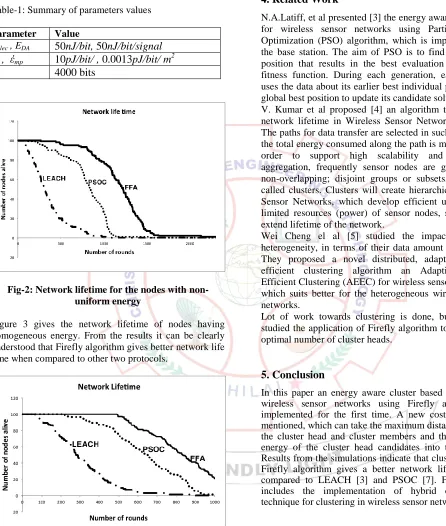
Fig-2: Network lifetime for the nodes with non-uniform energy
Figure 3 gives the network lifetime of nodes having homogeneous energy. From the results it can be clearly understood that Firefly algorithm gives better network life time when compared to other two protocols.
Fig. 3:Network lifetime for the nodes with uniform energy
4. Related Work
N.A.Latiff, et al presented [3] the energy aware clustering for wireless sensor networks using Particle Swarm Optimization (PSO) algorithm, which is implemented at the base station. The aim of PSO is to find the particle position that results in the best evaluation of a given fitness function. During each generation, each particle uses the data about its earlier best individual position and global best position to update its candidate solution. V. Kumar et al proposed [4] an algorithm to maximize network lifetime in Wireless Sensor Networks (WSNs). The paths for data transfer are selected in such a way that the total energy consumed along the path is minimized. In order to support high scalability and fine data aggregation, frequently sensor nodes are grouped into non-overlapping; disjoint groups or subsets, which are called clusters. Clusters will create hierarchical Wireless Sensor Networks, which develop efficient utilization of limited resources (power) of sensor nodes, so that they extend lifetime of the network.
Wei Cheng el al [5] studied the impact of nodes heterogeneity, in terms of their data amount and energy. They proposed a novel distributed, adaptive, energy efficient clustering algorithm an Adaptive Energy Efficient Clustering (AEEC) for wireless sensor networks, which suits better for the heterogeneous wireless sensor networks.
Lot of work towards clustering is done, but none has studied the application of Firefly algorithm to choose the optimal number of cluster heads.
5. Conclusion
In this paper an energy aware cluster based protocol for wireless sensor networks using Firefly algorithm is implemented for the first time. A new cost function is mentioned, which can take the maximum distance between the cluster head and cluster members and the remaining energy of the cluster head candidates into the account. Results from the simulations indicate that clustering using Firefly algorithm gives a better network lifetime when compared to LEACH [3] and PSOC [7]. Future scope includes the implementation of hybrid optimization technique for clustering in wireless sensor networks.
References
[1] I. F. Akyildiz et al., “Wireless Sensor Networks: A Survey”, Elsevier Sci. B.V. Comp.
CCET JOURNAL OF SCIENCE AND ENGINEERING EDUCATION
(ISSN 2455-5061)
Vol. - 3, Page-20-24, Year-2018
24
micro sensor networks”, Proc. 33rd Hawaii Int’l. Conf. Sys. 2000.
[3] N. A. Latiff, C. Tsimenidis, and B. Sharif, “Energy-aware clustering for wireless sensor networks using particle swarm optimization”, in Personal, Indoor and Mobile Radio
Communications. PIMRC 2007. IEEE 18th International Symposium 2007, pp. 1–5.
[4] V.Kumar, S.Jain,S.Tiwarietal.,“Energy efficient clustering algorithms in wireless sensor
networks: A survey”,” IJCSI International Journal of Computer Science Issues, vol. 8, no.
5, 2011, pp. 259-268
[5] W. Cheng and H. Shi, “AEEC: An adaptive energy efficient clustering algorithm in sensor
networks”, in Industrial Electronics and Applications. ICIEA. 4th IEEE Conference on.
IEEE, 2009, pp. 3950–3954.
[6] MA Sasa, Xue Jia, Fang Xingqiao, Liu Dongqing, “Research on Continuous Function Optimization Algorithm Based on Swarm Intelligence”, 5th International Conference on Computation, 2009, pg no. 61-65
[7] I˜naki Navarro, Ezequiel Di Mario and Alcherio Martinoli, “Distributed vs. Centralized Particle Swarm Optimization for Learning Flocking Behaviors” Distributed Intelligent Systems and Algorithms Laboratory, School of Architecture, Civil and Environmental Engineering, Ecole Polytechnique F´ed´erale de Lausanne ´ {ezequiel.dimario, inaki.navarro, alcherio.martinoli}@epfl.ch