Quantifying Investment in Language Learning: Model
and Questionnaire Development and Validation in the
Iranian Context
Nahid Soltanian*
Ph.D. Candidate, English Language and Literature Department,
FerdowsiUniversity of Mashhad
Zargham Ghapanchi
Associate Professor, Ferdowsi University of Mashhad
Saeed Rezaei
Assistant Professor, Languages and Linguistics Centre,
Sharif University ofTechnology
Reza Pishghadam
Professor, Ferdowsi University of Mashhad
Abstract
The present exploratory study aimed to provide a more tangible and comprehensive picture of the construct of investment in language learning through investigating the issue from a quantitative perspective. To this end, the researchers followed three main phases: First, a hypothesized model of investment in language learning with six components was developed for the Iranian learners of English as a foreign language (EFL) based on the extensive readings of the literature on investment, consultations with a panel of experts, that is three university professors in the relevant fields, and interviews with 20 language learners. Second, a questionnaire was developed and validated based on the proposed model to represent its components. Finally, the data collected through this questionnaire were fed into the model to determine the extent to which the model fitted the data. The participants were male and female English language learners belonging to different age groups and English language proficiency levels. The initial results showed poor values; however, the model was trimmed by removing one item from the questionnaire, and final statistical indices showed that the model fitted the data.
Keywords: Investment, language learning, model, questionnaire, validity, reliability, EFL learners
INTRODUCTION
The strong relationship between language learning and identity has been an issue of great concern to many researchers in the field of English language teaching (Morgan & Clarke, 2011; Norton, 2010). Interest in identity in the field signifies a shift from an emphasis on psycholinguistic models of second language acquisition (SLA) to greater focus on sociological and anthropological facets of language learning (Norton, 2013a). Norton (2000) uses the term identity “to reference how a person understands his or her relationship to the world, how that relationship is constructed across time and space, and how the person understands possibilities for the future” (p. 5). In language learning, identity can be used to mean "who the learner is when starting to learn the second language (L2), during the process of learning, and when using the L2, and who he or she will become with the development of L2 competence" (Gao, Jia, & Zhou, 2015, p. 137).
Essentially, intertwined with the concept of a language learner's identity is the notion of the learners' investment in language learning (Norton, 1997). This term was initially used by Bonny Norton Peirce in 1995. It implies a learner’s commitment to learn an L2 and considers the learners' hopes for the future, their imagined identities, their interest in the language practices of the classroom or community, and their consequent improvement in language learning (Norton, 2016).
contexts of the learners' lives, and their cultural experiences.
To complement the psychological construct of motivation in SLA, Norton Peirce (1995), drawing on her study in Canada and informed mainly by Weedon's (1987) and Bourdieu’s (1991) works and theories, introduced the sociological construct of investment in language learning. Darvin and Norton (2016) state that Norton Peirce intended to update the dominant conceptions of individual language learners, as having an essential, unique, fixed, and coherent core, and develop social theories which could improve the leading cognitive and psychological ones so that the complexity of language learning, as both a social and a cognitive process, could be signified.
Considering the shift of focus from motivation theories to investment in SLA, the scholars paid more attention to the latter construct from 1995 to fill the gaps in the previous considerations of language teaching and learning which were based on the psychological construct of motivation. Investment may be effective in complementing the concept of motivation in the field of SLA (Norton & Gao, 2008) by giving a more comprehensive analysis of why and how a language learner shows commitment to learning the target language (Wharton & Eslami, 2015). In this process, the language learner is recognized as a social being with an active role in the socially complex experience of language learning.
Investment is a construct which is considered foundational in language education (Kramsch, 2013) and holds a significant place in applied linguistics since it demonstrates the socially and historically constructed relationship between language learner identity and learning commitment (Darvin & Norton, 2015). Hence, further research in this regard is called for to uncover the effects of the learners' investment on their L2 identity construction and language learning. Moreover, since investment has the complementary function for the well-known construct of motivation, extensive research on this construct seems to be sensible and crucial. The present study explored investment in an EFL context.
identity, these studies have been conducted through qualitative approaches, chiefly interview, and quantitative or mixed-methods measures have been ignored by researchers. Although Haneda (2005) used questionnaire as a source of data collection in her research on investment in L2 writing, all the data in her research were examined qualitatively, and there is little information on the questionnaire's validation and reliability index. Quantitative approaches are often neglected in doing research on identity and its related constructs in applied linguistics, but a review of research in neighboring disciplines like psychology, sociology, and anthropology indicates that quantitative measures are usually preferred for research on identity issues (Khatib & Rezaei, 2013). The preference given to quantitative research in neighboring disciplines has been effective in applied linguistics, and, recently, there have been studies which have followed this tendency (e.g. Ehala, 2012; Khatib & Rezaei, 2013).
LITERATURE REVIEW
In this section, the researchers give an overview of the initial understanding of the construct of investment in language learning and discuss how some developments happened in this construct when globalization and technology in the 21st century changed the social world. The theoretical framework of the study is also presented.
Early Developments in Investment in Language Learning
question of "To what extent is the learner motivated to learn the target language?" should be complemented by the instructor with "What is the learner’s investment in the language practices of this classroom?” (p. 421).
The sociological construct of investment stemmed from the dynamic view of individuals’ identity (Pittaway, 2004). Investment, in contrast to the construct of motivation, reflects a language learner as having a complex identity which is constantly changing from time to time and setting to setting and is reproduced in the ongoing social interactions between the language learner and the social world (Norton, 2013b). The learners' investment in the target language is in fact an investment in their changing identity (Norton, 2000). Moreover, instead of considering L2 learners as ahistorical and having a fixed motivation, the concept of investment implies a conceptualization of the learner as “having a complex social history and multiple desires” (Norton, 2000, p. 10).
Norton (2013b) argues that investment is done contextually. In other words, the learners have different investment or involvement in different contexts, and the extent of the learner's investment in L2 and claiming legitimacy as speakers depends on the dynamic negotiation of power in different fields. Therefore, it can be argued that investment is a complex, contradictory, and changing construct (Norton, 2013b).
achieving his/her desired identity in the L2 context (Norton, 2000).
Different endeavors have been made to explore language learners' investment in language learning. Earlier research on investment was done mostly in the North American context (e.g. Bearse & de Jong, 2008; Haneda, 2005; Potowski, 2004; Skilton-Sylvester, 2002), but later it became international. Researchers utilized the construct of investment to investigate the language learning development of learners in numerous contexts and for different skills. For example, drawing on the work of Norton Peirce (1995), Skilton-Sylvester (2002) investigated the experiences of four Cambodian women in ESL programs in the United States. The results demonstrated that their shifting identities at home and work, and the ways these identities were related to the classroom activities, affected their investment in participation in ESL programs. Skilton-Sylvester (2002) argues that the learners' shifting identities have much to do with their investment in English language programs that support their language development. He suggests that the investment of learners in learning English requires considering the class as a place where the multiple selves of learners are significant in teaching and learning.
In her research on two case studies, Haneda (2005) reported how two Canadian university students from contrasting enthnolinguistic backgrounds were engaged in writing in Japanese in an advanced Japanese literacy course. Employing a theoretical and interpretive framework which was based on the constructs of identity, investment, and community of practice (Lave & Wenger, 1991; Norton, 2000; Wenger, 1998), Haneda argued that the learners did similar literacy activities differently. The learners' differential investment in L2 writing was due to variations in their life histories and trajectories including past, present, and projected futures, their L2 learning trajectory, their shifting identities, their agency and understanding of self as a writer or an individual, their multiple desires, and the communities to which they aspired to belong in their imagined futures.
(MPT) and their EFL proficiency. The findings showed that when all the participants were considered as EFL students, the correlation between their MPTs and EFL proficiency was not high (r = .238), but when they were grouped as high, mid, and low-proficiency learners in accordance with their TOEFL scores, the data analyses on high-proficiency and low-proficiency groups showed fascinating results: Strong positive correlation was found between high-proficiency EFL students’ MPTs and their EFL proficiency (r = .62), whereas in the low-proficiency EFL students, the correlation was low (r = .01). His research supported the hypothesis that EFL students with greater investment in L2 would achieve higher EFL proficiency.
Investment in Language Learning in the Digital Age
Two decades after Norton Peirce’s (1995) original formulation of investment, issues such as globalization, advancement in technology, and shifts in the global economic order dramatically changed the social world. Following the advancements in the digital age, new questions, analyses, and theories of identity were needed. Thus, Darvin and Norton (2015) revolutionized the previous understanding of investment in language learning to respond to the requests of a more mobile and fluid world, in which language learners can participate in unlimited spaces of learning and socialization, both face-to-face and virtual, and prove themselves as legitimate speakers in different degrees.
Figure 1: Darvin and Norton’s (2015) model of investment. Adapted from
"Identity and a Model of Investment in Applied Linguistics," by R. Darvin & B. Norton, 2015, Annual Review of Applied Linguistics, 35, p. 42
The new model's focal interest is in the greater appreciation for the connections between identity, capital, and ideology, and the conditions under which language learners invest in the language and literacy practices of their classrooms (Darvin & Norton, 2015). Hence, it presents a more comprehensive examination of the relationship between identity, investment, and language learning and has important implications for the theories of language and identity (Darvin, 2016).
dominant systemic patterns of control make it hard for learners to gain the desired capital. Based on Darvin and Norton's (2015) model, in the digital age the learners have the agency and power to invest in learning which lets them not only gain material and symbolic resources, but also question, resist or disagree with dominant systemic practices and views in different fields.
The 2015 model of investment extends the question, “To what extent are learners invested in the language and literacy practices of their classrooms and communities?” which was asked in Norton's earlier theory, to the following ones:
1. What are learners’ imagined identities? How do these impact their investment in different language and literacy practices?
2. What do learners perceive as benefits of investment, and how can the capital they possess serve as affordances for learning?
3. What systemic patterns of control (policies, codes, institutions) make it difficult for learners to invest and acquire certain capital? How have prevailing ideologies structured learners’ investments? (Norton, 2015, p. 381).
According to Darvin and Norton (2016), due to the existence of digital innovation, superdiversity, and mobility in the technologically-driven 21st century, the construct of investment has become more complex, and there should be a greater appreciation for the connections between identity, capital, and ideology. Darvin and Norton (2016) argue that examining these three elements facilitates the investigation of how learners are positioned, constrained or empowered as they move in diverse spaces and perform a variety of identities.
it increased their cultural, social, and economic capital, and that this could provide a more promising future for them. However, it was not always the case that the capital which the students already owned functioned as affordances for learning. Norton (2015) suggests language teachers to harness the capital that students already possess, and employ it as resources for learning. Concerning the third question, Norton (2015) states that the data in her research do not sufficiently address the invisible mechanisms of power exercised by systemic patterns of control like university admissions programs, immigration policies, and language testing agencies. Norton (2015) argues that teachers must help learners recognize and navigate systemic patterns of control and provide visible ideological practices that constrain human possibility.
The range of research conducted on investment demonstrates that in numerous attempts, the researchers have drawn on the construct of investment in different contexts. This research supports the view that the examination of identities and investments of English language learners can give much insight into the process of language learning. Generally, investment is known as a construct which is foundational to understanding language learning as a social practice (Darvin & Norton, 2018) and the investigation of learner (and teacher) investment and its connection to identity, capital, and ideology can be effective in shaping language education policy by showing how classroom practices are indexical of larger power relations (Darvin & Norton, 2017). Moreover, an examination of the interplay of the three elements of identity, capital, and ideology can help language teachers to understand the conditions under which language learners invest in the language and literacy practices of different spaces and how changes in this new shifting communication landscape provide learners with innovative affordances of learning while they are positioned in new ways. Then, language teachers can design activities that distinguish the diversity of learners and confirm the histories, languages, and identities that they bring to the classroom (Darvin & Norton, 2018).
in the 21st century (Darvin & Norton, 2016), and the three key constructs of investment are effective in examining the relationship between classroom practice and language policy in the twenty-first century (Darvin & Norton, 2017).
Theoretical Framework of the Study
In order to develop a model and questionnaire for investment in language learning, the researchers drew on some theories. The theories and studies on language and identity, especially Norton Peirce’s (1995) conceptualization of identity and language learning, were utilized to support this study. Norton Peirce adopts a poststructuralist conception of social identity, and emphasizes “the role that social identity plays in L2 acquisition” (Ellis, 1997, p. 243). In Norton’s (1997) view, language learners negotiate their identity/sense of self during the learning process and contribute to their own process of meaning-making in an L2. Although the processes of language learning and identity construction are messy, complex, ongoing, and contextualized within the society, some factors such as individuals’ differences, and the “contradictions and tensions within themselves” are influential (Cohen, Manion, & Morrison, 2011, p. 28).
because the dominant language policy in Iran is to appreciate the Persian language almost in all organizations and societies. Finally, some local works on identity and investment were helpful in shaping the model (e.g. Khatib & Rezaei, 2013; Samadi Bahrami, 2013).
PURPOSE OF THE STUDY
Although the literature on investment in language learning generally indicates that this construct belongs to the qualitative paradigm, considering that many complex, dynamic, and fuzzy constructs in applied linguistics, e.g. language proficiency, critical thinking, anxiety, language competence, motivation, language identity, and, recently, language learner's imagined communities have been translated into quantifiable measures, investment likewise can be researched with quantitative or more mixed-methods research approaches. Quantification of this construct can help researchers to benefit from the advantages of quantitative approaches in research and triangulate qualitative approaches with research tools such as questionnaires to make up for potential weaknesses inherent in qualitative approaches (Rezaei, 2017). To quantify investment in language learning in Iran as an EFL context, this study followed three key steps: In the first step, a hypothesized model of investment in language learning was developed in Iran; in the second phase, a questionnaire was developed and validated to test the hypothesized model; and, in the third step, the data collected through the questionnaire were fed into the model to see to what extent the model fitted the data.
METHOD
In this section, the researchers provide the information on the participants and the procedures for developing the model and questionnaire.
Participants
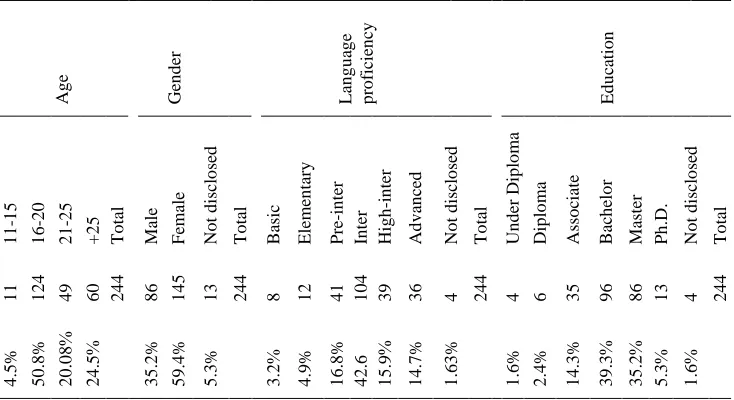
For the initial pilot phase of the questionnaire, there were 47 respondents (28 (59.5%) female and 19 (40.4%) male), and, for reliability and validation phases, 244 English language learners, including 145 female (59.4%), 86 male (35.2%), and 13 (5.3%) participants who did not disclose their gender took part. Moreover, in order to check the content validity of the questionnaire, six EFL learners participated.
The participants' ages ranged from 11 to 36 years (mean age: 19.02, SD: 1.13). The number of years the participants had learned English in a language institute or university was different. Generally, it ranged from 5 to 12 years. Table 1 (see Appendix) shows the descriptive statistics (age, gender, language proficiency level, and education level) for the participants in the reliability and validation phases of the study.
The informative comments of six experts and non-experts on the diction of the items and the content of the questionnaire were taken into account and some revisions were made to the items of the questionnaire based on them. The panel of experts included university professors in the fields of applied linguistics, sociolinguistics, sociology, Iranian studies, survey design, and statistics.
Data Collection Procedure
The researchers went through three main steps in the current study. Firstly, they developed a hypothesized model of investment in language learning. Secondly, they developed and validated a questionnaire based on the model, and thirdly, the data collected through the questionnaire were fed into the model. Below, the instrument development and validation will be explained in detail.
The Hypothesized Model of Investment in Language Learning in Iran The researchers aimed to develop a model for investment in language learning in the Iranian context based on the components specified for it. Developing such a model, which is followed by constructing a reliable and valid questionnaire, is useful to change the common qualitative approach to investment research and make it feasible to do large-scale surveys and provide consistent instruments to find general patterns (Gao et al., 2015) through quantitative approaches. To this end, the researchers first established the theoretical foundation of the study by reviewing previous works and theories.
iteratively, conducting interviews with 20 EFL learners, and consultations with the panel of experts, the researchers specified a number of components for investment in language learning in Iran. The interviews with EFL learners were held in Persian, in 20 to 40 minutes. The content of these interviews focused on the language learners' engagement and interest in learning English. To ensure the comprehensiveness and accuracy of these components, the specified components were shown to three experts for their reflection. Their informative comments were taken into account and some minor changes occurred in the components based on them. The intercoder agreement was .88. To search for the experts' opinions, the researchers employed the Delphi technique. The steps taken in the collection of the experts' opinions through several rounds of interviewing or survey and applying the received feedback into a unified whole as a point of agreement among the experts forms the modified version of a multiphase research approach for finding experts’ opinions called the Delphi technique (Timmerman, Strickland, Johnson, & Payne, 2010). In this study, to reach an agreement in the experts' opinions on the components of the model and the items of the questionnaire, the researchers asked the experts to evaluate their early judgments on the components and items made in previous rounds and change their ideas in the next iterations by reviewing and assessing the comments provided by other experts. A summary of other experts' comments was given to each expert. In this way, they knew the range of opinions and the reasons for those opinions.
The six components specified for investment in language learning in Iran were as follows:The (historical and social) commitment of learners to language learning, manifestation of multiple, dynamic, and evolving nature of identity, legitimacy (claiming the right to speak), achieving various capitals and resources (social, economic, symbolic, and cultural), opportunities to exercise agency, individuality, voice, and choice (language learner's agency) and finally emerging selves in L2. In Table 2, the definition for each of the identified components can be seen.
Table 2: Components of investment in language learning in Iran along with their definitions
Definition Component
interest in learning English and their beliefs about the amount of time, energy, and money which should be spent
on learning it. social) commitment
of learners to language
learning
This reflects how language learners might be affected by English, how language learners' identities shift in response to the changing relations within the L2 classroom, and how a shift in the participants’ identity impacts their interest in learning English and their future direction in learning English.
2. Manifestation of multiple, dynamic, and evolving nature of identity
This refers to the fact that the teacher’s methods in the class should not silence language learners, but they should encourage their active participation. The language teacher should acknowledge the learners' identity as part of the formal language curriculum, positioning them as language learners, and help them claim the right to speak (Norton, 2013b).
3. Legitimacy (claiming the right to speak)
It refers to the numerous advantages which can be gained by language learners in the process of language learning.
Economic capital refers to wealth, property, and income;
Cultural capital refers to knowledge, educational
credentials, and appreciation of specific cultural forms;
Social capital refers to connections to networks of power,
and symbolic capital refers to resources like language, education, and friendship (Norton Peirce, 1995).
4. Achieving various capitals and resources (social, economic, symbolic, and cultural)
This refers to discovering the extent learners know themselves responsible for learning the language. Through human agency, the learners can claim more powerful identities from which to speak, read or write, thereby improving language learning.
5. Opportunities to exercise agency, individuality, voice, and choice (language learner's agency)
This refers to the individuals' ideas of what they might become (possible self), what they would like to become (ideal self), what they are afraid of becoming (feared self), and what they think others expect them to be (ought self) (Markus & Nurius, 1986).
6. Emerging selves in L2
Questionnaire Development
went through several systematic steps. In the following sections, these steps are explained.
Item Generation: In the first step of questionnaire development, the related literature was reviewed in order to gain awareness of the existing instruments and establish a robust theoretical framework for the instrument. After reviewing the literature, the researchers went to the self-initiative item generation step.They applied a multi-item scale in generating the items.
The researchers were careful to generate items tapping the specified components of the model. They did their best to generate simple and short items using natural language away from any loaded and ambiguous words. Both positively and negatively worded items were included to avoid the problem of responding haphazardly. The negatively worded items went through reverse coding in the data analysis phase of the study. Following Dörnyei (2010), it was also attempted not to put the sensitive items at the beginning of the questionnaire.
Finally, 82 items were generated. After numerous reviews, 23 items were deleted due to being irrelevant, long, or not having good diction. The researchers aimed to develop a short questionnaire but not to the point of eliminating the central points. This goal was achieved by having the questionnaire not take more than 20 minutes to complete.
Designing the Rating Scales and Personal Information Box: The respondents were required to show their degree of agreement/disagreement with each statement on a six-point Likert-type scale. This scale, including strongly agree, agree, slightly agree, slightly disagree, disagree and strongly disagree, was used to avoid the problem of respondents hedging in sensitive items and also to make the data result in normal distribution. To score the items, ‘strongly agree’ received six points, ‘agree’ five points, ‘slightly agree’ four points and so on. For the negatively worded items, scoring was reversed.
The personal demographic information included information about gender, age, language proficiency level, English pronunciation preference, education level, place of residence (city), and the number of years spent learning English. The respondents were asked to complete the personal information box first, since they might forget or ignore it after answering the items.
accuracy, content representativeness, and bias. Since the final respondents to the questionnaire were non-experts too, their feedbacks were informative for the researchers to know which items must be removed due to their unnecessary jargon and loaded words.
The criteria to keep an item or discard it were the opinions of the panel of experts and non-experts. They rated the items based on a Likert scale from one to four. In this scale, they commented on the items as 'Not important to be included in the survey', 'Somehow important to be included', 'Important to be included', and finally 'Extremely important to be included in the survey'. Moreover, they were asked to express their final decision on the item by telling either 'discard' or 'keep' the item. If the majority agreed on the acceptability of the item, the item was kept. Generally, items which received more than 70% of acceptability were preserved for the next step. The results of the responses were helpful in decreasing the items from 59 to 46 items. Thirteen items were deleted because of a number of reasons including the ambiguity, redundancy, length and irrelevance of the items. Item Translation and Revision: The researchers translated the English version into Persian so that the respondents, who were from different language proficiency levels, could complete the questionnaire easily. Back translation was also applied to ensure the accuracy of translation. Then, the English back-translation and the original English items were considered carefully, and the researchers revised some items. It was double-checked by another expert for translation accuracy. Eventually, two Persian editors of Iranian newspapers and magazines were asked to edit the Persian version and make it standard Persian. To increase the return rate, the Persian version was administered upon the respondents' requests.
Initial Piloting and Item Analysis: In this step, the questionnaire was administered to 40 students similar to the target population for which the questionnaire had been developed. Before administering the questionnaire, the respondents were ensured that the information elicited would be kept anonymous so that they would feel relaxed about answering the potentially sensitive items. Since the title of the questionnaire, investment in language learning questionnaire, might have affected the participants’ responses, it was deleted during its administration. The respondents' feedbacks were helpful in modifying some items and omitting four. Therefore, the remaining questionnaire included 42 items.
researchers examined face validity, content validity, and construct validity of the questionnaire as the main kinds of validity for questionnaire validation in this study. The internal consistency of the questionnaire was also estimated through Cronbach's Alpha coefficient. For these two steps, the questionnaire was sent via the Telegram messaging application or email, and, in some cases, it was given by hand. The response rate of the questionnaire was 98%. In the next section, the results for these two stages are provided.
RESULTS
Instrument Validation
Three types of validity were examined in the present study: Face validity, content validity, and construct validity.
To establish the face validity of the questionnaire, it was distributed in a good form, enjoying reader-friendly font type, margin, color, and paper. Thus, the researchers did their best to meet the criteria for face validity.
To check the content validity of the questionnaire, as discussed before, six experts and non-experts commented on the representativeness and appropriateness of the questionnaire and its instructions. Moreover, six English language learners in the language institutes and universities were asked to read the items and give their comments on their intelligibility. Some minor modifications were made in the wording of the items based on these comments.
CFA Results
The aim of running CFA in this study was to check if the questionnaire data fitted the hypothesized model.
Analysis of Moment Structures (AMOS 21) software was utilized to test the hypothesized model. The AMOS software was run to perform CFA and Structural Equation Modeling (SEM). SEM is a powerful multivariate analysis technique used to examine causality in models and the causal relations among variables and to confirm the proposed structural theory (Khajavy, Ghonsooly, Hosseini Fatemi, & Choi, 2014). SEM shows the relationship between latent variables, that is, the components of investment in language learning in this study, and the observable variables, i.e. the items in the questionnaire generated for each of the components.
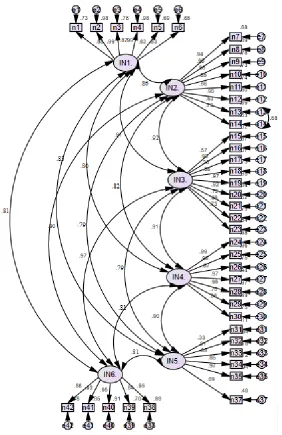
Before testing a structural model, all latent variables should be validated using CFA (Hair, Anderson, Tatham, & Black, 1998). Based on the CFA analysis, the association between each sub-factor of the proposed model was analyzed, results of which can be seen in Figure 2. The model with all factor loadings can be seen in this Figure. This scale included six sub-constructs: A. The (historical and social) commitment of learners to language learning (IN1), B. manifestation of multiple, dynamic, and evolving nature of identity (IN2), C. legitimacy (IN3), D. achieving various capitals and resources (IN4), E. opportunities to exercise agency, individuality, voice, and choice (IN5), and F. emerging selves in L2 (IN6).
To examine the validity of the measurement model and check the model fitness, goodness-of-fit indices were used (Kline, 2011). There are several fit indices that show the adequacy of the measurement models. In this study, Chi-square/degree of freedom (χ2/df), goodness-of-fit index (GFI), comparative fit index (CFI), Normed Fit Index (NFI) and root mean squared error of approximation (RMSEA) were used. To have a fit model, χ2/df should be a value of less than 3 (Tseng & Schmitt, 2008), GFI CFI, and NFI should be above .90 (Hu & Bentler, 1999), and RMSEA should be less than .08 (MacCallum, Browne, & Sugawara, 1996).
indices for SEM before and after modification can be seen in Table 3. As Table 3 shows, all the goodness-of-fit indices are within the acceptable range. Therefore, the scale enjoyed perfect validity, and the model seemed to be a fit model. The final model showed a very good fit to the data. In other words, the data gathered in this study seemed to support the model.
Table 3: Goodness-of-fit indices for the model
X2 df X2/df GFI CFI NFI RMSEA
Acceptable fit <3 >.90 >.90 >.90 <.08
Model 2350.15 770 3.05 .87 .91 .91 .069
Revised model 2210.29 763 2.89 .89 .92 .93 .065
As Table 3 shows, all the goodness-of-fit indices are within or near the acceptable range. Therefore, the scale enjoyed acceptable validity.
Figure 2: Final model of investment in language learning in Iran
Reliability Index of the Instrument
To measure the internal consistency of the questionnaire, Cronbach’s Alpha coefficient was employed. The researchers followed Dörnyei (2010) to determine the acceptable measure for the reliability index of the questionnaire and selected an index below 0.60 as weak and above that as acceptable. To calculate the reliability, it had already been administered to 244 Iranian English language learners in the CFA phase. The results for the Cronbach’s Alpha analyses showed that the internal consistency of the whole questionnaire was 0.94 and for the six subscales, i.e. the six components constituting the questionnaire, it was 0.96, 0.96, 0.93, 0.97, 0.89, and 0.96 respectively. Table 4 shows the reliability indices obtained from Cronbach alpha analyses for the subscales of the questionnaire along with the related items. As can be seen, the questionnaire gained high indices of Cronbach alpha as a whole as well as in its subscales.
Table 4: Components of the questionnaire, the related items, and reliability indices
Reliability Related items in the questionnaire
Component
0.96 1. I find studying English more interesting than other subjects.
2. I like to keep studying English in school, college or institute.
3. I study English just to pass the exams not anything more.
4. Learning the English language is worth spending a lot of money and time.
5. I hate those persons whose Persian is mixed with English words.
6. I think using digital technology in language class can enrich the content of our lesson and consequently our learning.
The (historical and social) commitment of learners to language learning
0.96 7. For me, it’s meaningless to talk about personal changes after learning English (e.g. learning English does not have a great impact on my self-confidence). 8. Studying English makes me able to create new thoughts.
9. After learning English, I feel I have a hybrid identity (combination of both national and international identities)
10. After learning English, I find myself more sensitive to changes in the outside world.
11. After learning English, I feel my behaviors have become somewhat Westernized.
12. I feel less belongingness to my country and people if I speak English fluently (Learning English is a threat to my national identity).
13. My engagement with digital technology in language class makes me feel more empowered 14. By using digital technology for language learning, I experience identities that were once in my imagination.
0.93 15. Initially I was silent in language class, but gradually I changed.
16. I am afraid that other people will laugh at me when I speak English.
17. If I am given more status, and respect in the class, I feel more comfortable using English.
18. If the language teacher is not patient with my English and does not care about me and my goals and wishes, I feel isolated and silenced in class. 19. I would refuse to be silenced in class even if I were ashamed of my language. (I cannot give up despite my feelings of inferiority).
20. The language teacher must call me by name so that I can speak in class; otherwise, I won't speak. 21. In the current digitally advanced society, I can convey my ideas to others better in English.
22. I feel frustrated when I can't use the modern technology pivoted on using English.
23. I like my instructor to connect the language learning material to the everyday, lived experiences of the learners.
Legitimacy (claiming the right to speak)
0.97 24. I am eager to learn English so that I can enjoy respect from educated people (e.g. studying English helps me gain the approval of my teachers).
25. My limited language proficiency has placed constraints on my ambitions.
26. I value English for the access it gives me to the public world- the outside world (e.g. by learning Achieving
English I can find and meet new friends across the world).
27. I can earn money by learning English (e.g. I can be a tour guide)
28. I perceive by learning English I can have access to social networks which are appropriate for my educational level.
29. By using English in this high-tech world, I can earn more prestige, empowerment, honor, and fame nationally and transnationally.
30. My confidence and self-esteem are improved as my English proficiency grows.
and cultural)
0.89 31. If I cannot communicate in English, I myself am guilty at not being able to do so.
32. In my English classes, I experience a greater degree of freedom and control in the learning process, and this is enjoyable to me.
33. Studying English makes me have more confidence in expressing myself freely.
34. In my language class, I am accustomed to and expect to be told what to do (I always need to have the language teacher around to help me).
35. I think if I am fully involved in language learning activities, I can improve my level.
36. I feel I can have more agency (independence) in the virtual interaction with English speakers internationally than real interaction.
37. I feel that gaining power through learning English is easier as I lead increasingly mobile lives. Opportunities
to exercise agency, individuality, voice, and choice (language learner's agency)
0.96 38. The person I would like to be in the future is the one who communicates in English very well both in face-to-face and virtual interactions.
39. I am afraid of being perceived as less competent in English language classes by my teacher or peers (because I cannot react to peers’ initiatives or follow instructions given in class).
40. Learning English is important because the people I respect think that I should do it.
41. I can imagine myself using English effectively to communicate with international friends or Emerging
colleagues.
42. When I become a very good speaker of English, with my English knowledge I am able to do works that I am not able to do now.
DISCUSSION
This study aimed to develop and validate an instrument for measuring Iranian EFL learners' investment in language learning. To this end, at first a six-component model of investment in language learning was developed based on the comprehensive review of the related literature and the established theories, researchers' consultations with experts and interviews with language learners.
show adequacy to the data. So, some modifications were made to the model which included the removal of one item, (q. 36) in IN5 sub-construct, due to low loadings. This item did not load on opportunities to exercise agency, individuality, voice, and choice. Error terms of two IN2 items (items 13 and 14) were also correlated due to content overlap in this pair of items. To attain satisfactory fit, it was necessary to include a correlated error term between them. After making these revisions, the model indicated acceptable fit to the data. Hence, all the six initially proposed components in the instrument were substantiated by the collected data and the majority of the items of the questionnaire remained intact and just one item was deleted. The calculated model-fit approximations confirmed the CFA model as valid for measuring Iranian EFL learners' investment in language learning. Moreover, the Cronbach's Alpha estimated the reliability of all the items as 0.94. All of the six factors yielded good reliability estimates ranging from 0.89 to 0.97.
Although further research is needed to examine why item 36 item was dropped out in the confirmatory analysis, it can be argued that the removal of this item was probably caused as a result of little ability or no ability of Iranian EFL learners in using technology as a way of interaction with English speakers and that the majority of them have not experienced this kind of interaction.
All in all, the current study increases our theoretical and practical understanding of EFL learners' investment in language learning. The present questionnaire was developed to afford measurement of Iranian EFL learners' investment in language learning and encourage language teachers to delve deeply into the level of their learners' investment and do not consider silent or inactive students as unmotivated since they may be motivated but do not show any investment in the language practices of the classroom (Norton, 2013b).
CONCLUSION AND IMPLICATIONS
language learners, they can play an important role in increasing language learners' investment in language learning to intensify the sense of devotion to learn another language (Pittaway, 2004). Clearly, it may be good for the teacher to highlight the significance of language learners' investment and adjust classroom practices in response to the learners' investments.
Following the discussion that most of the sociolinguistics researchers in language learning have generally considered qualitative approaches, the researchers attempted to do a different work. In fact, the absence of an instrument to measure language learners' investment in learning prompted the present study. To this end, it drew on prior research and theories, and a model was initially hypothesized for investment in language learning in Iran and then the researchers tested its fitness through developing a valid questionnaire which measures the extent to which EFL learners show investment in language learning.
The results of this study indicated that though the model was the first one developed to statistically and methodologically carve out investment in language learning in the Iranian context, it enjoyed a reasonable degree of reliability and validity as confirmed by the statistical indices from SEM. The questionnaire also showed a respectable degree of reliability and validity. It is our hope that this newly-made scale can be utilized to shed more light on the status of learners' investment in language learning.
Although qualitative approaches are generally preferred by sociolinguistic researchers since they can provide detailed accounts of individuals (Gao et al., 2015), it should not be ignored that they are time-consuming, costly for administration and scoring, and less generalizable. The potential problems of qualitative approaches make the use of quantitative approaches an appropriate solution (Khatib & Rezaei, 2013). The model developed and validated in this study can be a foundational framework for research on investment in Iran. It can serve as a template for future researchers to use the model and test its components and applicability. Language teachers can usefully employ the questionnaire developed and validated in the current study to examine EFL learners' extent of investment in language learning and teach accordingly. Moreover, the rigorous statistical procedures utilized can also provide helpful guidelines for future researchers on how to develop and validate a model.
language learning to develop similar models and questionnaires. Future studies may reconfigure or expand the model for the inclusion of other potential components or items to promote both the model and the questionnaire. This is a common phenomenon in language studies, since many other models (e.g. communicative competence) have been expanded and are being expanded by researchers (Khatib & Rezaei, 2013). Further research may also reduce probable confounding variables and subsequently enhance the reliability and validity of this model and establish it as a robust model.
Considering the contextual nature of constructs such as investment, the researchers should be careful about the generalizability of the model proposed here which is limited to the Iranian context. Other replication studies are called for to collect data from different groups of Iranians to see if the data obtained from them fit the model validated here. Studies are needed to be done to test if this model is truly applicable in Iran across time and place and also if it can be used as a valid model in other contexts.
Future research can examine the role of different variables, e.g. demographic data on investment in language learning. Researchers in non-Iranian contexts can also use the model and questionnaire if they are modified based on the contextual variances and rechecked for reliability and validity. When the dynamic and contextualized nature of investment in language learning is taken into account, the necessity of further studies is felt to develop a more fluid model. That model can encompass the constructs and visually depict the interrelatedness of the subcomponents in a spherical way.
The last point which should be mentioned is that although questionnaires have numerous advantages - for example being invaluable tools for large-scale surveys in a short time, meeting generalizability in results, yielding rich data, and making it feasible to score objectively and extrapolate data easily - in doing research studies, it is recommended to mix quantitative approaches with qualitative ones to complement the shortcomings in the data collected through each approach (Rezaei, 2017).
References
Bearse, C., & de Jong, E. J. (2008). Cultural and linguistic investment: Adolescents in a secondary two-way immersion program. Equity & Excellence in
Education, 41(3), 325–340.
Bourdieu, P. (1977). The economics of linguistic exchanges. Social Science
Information, 16(6), 645-668.
Bourdieu, P. (1991). Language and symbolic power. Cambridge, MA: Harvard University Press.
Brown, J. D. (2001). Using surveys in language programs. New York, NY: Cambridge University Press.
Cohen, L., Manion, L., & Morrison, K. (2011). Research methods in education. London: Routledge.
Coupland, N. (Ed.) (2010). The handbook of language and globalization. Malden, MA: Wiley-Blackwell.
Darvin, R. (2016). Language and identity in the digital age. In S. Preece (Ed.), The
Routledge handbook of language and identity (pp. 523-540). Oxon:
Routledge.
Darvin, R., & Norton, B. (2015). Identity and a model of investment in applied linguistics. Annual Review of Applied Linguistics, 35, 36-56.
Darvin, R., & Norton, B. (2016). Investment and language learning in the 21st century. Langage et société, 157(3),19-38.
Darvin, R., & Norton, B. (2017). Language, identity and investment in the 21st century. In T. L. McCarty & S. May (Eds.), Language policy and political
issues in education: Encyclopedia of language and education (pp.227-240).
Berlin: Springer International Publishing AG.
Darvin, R., & Norton, B. (2018). Identity, investment, and TESOL. In S. Nero & J. Liontas (Eds.), Sociocultural aspects of English language teaching, The
TESOL encyclopedia of Englishlanguage teaching. n.p.: Wiley.
Dörnyei, Z. (2010). Questionnaires in second language research: Construction,
administration, and processing (2nd ed.). London: Routledge.
Ehala, M. (2012). Cultural values predicting acculturation orientations: Operationalizing a quantitative measure. Journal of Language, Identity, &
Education, 11(3), 185-199.
Ellis, R. (1997). SLA research and language teaching. Oxford: Oxford University Press.
Gao, Y., Jia, Z., & Zhou, Y. (2015). EFL learning and identity development: A longitudinal study in 5 universities in China. Journal of Language, Identity, &
Education, 14(3), 137-158.
Hair, J. F., Anderson, R. E., Tatham, R. L., & Black, W. C. (1998). Multivariate
data analysis. Upper Saddle River, NJ: Prentice Hall.
multicultural learners. Journal of Language, Identity, & Education, 4(4), 269– 290.
Hu, L. T., & Bentler, P. M. (1999). Cutoff criteria for fit indexes in covariance structure analysis: Conventional criteria versus new alternatives. Structural
Equation Modeling, 6, 1–55.
Khajavy, G. H, Ghonsooly, B., Hosseini Fatemi, A., & Choi, C. W. (2014). Willingness to communicate in English: A microsystem model in the Iranian EFL classroom context. TESOL Quarterly, 50(1), 154-180.
Khatib, M. & Rezaei, S. (2013). A model and questionnaire of language identity in Iran: A structural equation modeling approach. Journal of Multilingual and
Multicultural Development, 34(7), 690-708.
Kline, R. B. (2011). Principles and practice of structural equation modeling (3rd ed.). New York, NY: Guilford Press.
Kramsch, C. J. (2013). Afterword. In B. Norton, Identity and language learning:
Extending the conversation (2nd ed., pp. 192–201). Bristol: Multilingual
Matters.
Lantolf, J. P. & Appel, G. (Eds.). (1994). Vygotskian approaches to second
language research. Norwood, NJ: Ablex.
Lave, J., & Wenger, E. (1991). Situated learning: Legitimate peripheral
participation. Cambridge: Cambridge University Press.
MacCallum, R. C., Browne, M. W., & Sugawara, H. M. (1996). Power analysis and determination of sample size for covariance structure modeling.
Psychological Methods, 1(2), 130–149.
Markus, H., & Nurius, P. (1986). Possible selves. American Psychologist, 41(9), 954-969.
Morgan, B., & Clarke, M. (2011). Identity in second language teaching and learning. In E. Hinkel (Ed.), Handbook of research in second language
teaching and learning (pp. 817–836). New York, NY: Routledge.
Norton, B. (1997). Language, identity, and the ownership of English. TESOL
Quarterly, 31(3), 409- 429.
Norton, B. (2000). Identity and language learning: Gender, ethnicity, and
educational change. Harlow: Pearson Education.
Norton, B. (2010). Language and identity. In N. H. Hornberger & S. L. McKay (Eds.), Sociolinguistics and language education (pp. 349–369). Bristol: Multilingual Matters.
Norton, B. (2013b). Identity and language learning: Extending the conversation
(2nd ed.). Bristol: Multilingual Matters.
Norton, B. (2013a). Identity, literacy, and English language teaching. Iranian
Journal of Language Teaching Research (IJLTR), 1(2),85-98.
Chinese Journal of Applied Linguistics,38(4), 375-391.
Norton, B. (2016). Identity and language learning: Back to the future. TESOL
Quarterly, 50(2), 475-479.
Norton, B., & Gao, Y. (2008). Identity, investment, and Chinese learners of English. Journal of Asian Pacific Communication, 18(1), 109-120.
Norton, B., & Toohey, K. (2011). Identity, language learning, and social change.
Language Teaching, 44(4),412-446.
Norton Peirce, B. (1995). Social identity, investment, and language learning.
TESOL Quarterly, 29(1), 9-31.
Omoniyi, T., & White, G. (Eds.). (2006). The sociolinguistics of identity. London: Continuum.
Pittaway, D. S. (2004). Investment and second language acquisition. Critical
Inquiry in Language Studies, 1(4),203-218.
Potowski, K. (2004). Student Spanish use and investment in a dual immersion classroom: Implications for second language acquisition and heritage language maintenance. The Modern Language Journal, 88(1), 75–101.
Rezaei, S. (2017).Researching identity in language and education. InK. A. King, Y. J. Lai, & S. May (Eds.), Research methods in language and education (pp. 171-182). Cham: Springer International Publishing AG.
Samadi Bahrami, A. H. (2013). Personality development by means of investment in L2 and its impact on EFL proficiency: A survey of Iranian MA EFL students. The Journal of Teaching Language Skills (JTLS), 5(3), 83-105. Skilton-Sylvester, E. (2002). Should I stay or should I go? Investigating
Cambodian women’s participation and investment in adult ESL programs.
Adult Education Quarterly,53(1), 9–26.
Spolsky, B. (2003). Language policy. Cambridge: Cambridge University Press. Spolsky, B. (2011). Ferguson and Fishman: Sociolinguistics and the sociology of
language. In R. Wodak, B. Johnstone & P. E. Kerswill (Eds.), The Sage
handbook of sociolinguistics (pp.11-23). London: Sage.
Timmerman, B. E. C., Strickland, D. C., Johnson, R. L., & Payne, J. R. (2010). Development of a universal rubric for assessing undergraduates’ scientific reasoning skills using scientific writing. Assessment and Evaluation in Higher
Education, 36(5), 509–547.
Tseng, W. T., & Schmitt, N. (2008). Toward a model of motivated vocabulary learning: A structural equation modeling approach. Language Learning, 58(2), 357–400.
Vygotsky, L. (1978). Mind in society: The development of higher psychological
processes. Cambridge, MA: Harvard University Press.
Wenger, E. (1998). Communities of practice: Learning, meaning, and identity.
Cambridge: Cambridge University Press.
Wharton, A., & Eslami, Z. (2015). Investment and benefits of adult female English language learners. International Journal of Business and Social Science, 6(1), 49-58.
Appendix
Demographic information of the participants in reliability and validation estimation step