[Gondkar* 4(4): April, 2017] ISSN 2349-4506
Impact Factor: 2.785
G
lobal
J
ournal of
E
ngineering
S
cience and
R
esearch
M
anagement
FACE AND FINGERPRINT PATTERN RETRIEVAL USING UNIQUE CODE
Snehal Gondkar*, Kurhe Prasad, Unde Madhuri
*
Department of Electronics and Telecommunication, *Department of Information Technology, SRES’
Sanjivani College of Engineering, Kopargaon. S. P. University of Pune, (M.S.) India
DOI: 10.5281/zenodo.556396
KEYWORDS
:
Multiple biometric, features, indexing.ABSTRACT
The use of number of biometric sources for human recognition is referred to as multibiometrics, which in turn mitigates limitations of single modal biometric systems by increasing identification accuracy, improving the population coverage, and imparting fault-tolerance and improving security.
In this paper, we present a method for indexing multiple modality biometric databases which is completely based on index codes .And the index codes are generated by a inbuilt biometric matcher. The indexing mechanism which is executed individually for and the results are then combined together into a final list of all the potential candidates. The proposed indexing technique is based generation of index code depending upon the miniature position of orientation imagery for each modality and then by matching an input (probe) image against reference images which are stored in the database, which results in a set of, match scores.
During identification, the index code which is generated for the input image is compared with the index codes of the identities which are already enrolled in the available database set so that find out a set of probable matches. The guide code of several number of modalities are fused together so that they can altogether percentage accuracy of indexing resulting in a and efficient and effective indexing system. This approach is based on a matcher, which is important part of every automated biometric identification system Because the generated index codes are very compact and their dissimilarity can be measured rapidly, this approach has a low memory storage requirements and can improve the overall response time of the system even for of the databases also.
INTRODUCTION
Dependable consumer verification is fetching an more and more significant mission in the Web-enabled world. The penalty of an insecure verification organization in a business or venture situation can be shattering, and may include loss of classified in sequence, dissent of check, and compromise figures reliability. The charge of unswerving user substantiation is not classified to very soon computer or system admission. a lot of additional application in daily life also need user verification, such as banking, e- trade, and bodily access direct to processor and its funds, and might benefit as of better safety.
The current technique of consumer verification, which engage the employ of moreover passwords and consumer IDs (identifiers), or recognition cards and PINs (personal identification numbers), undergo as of several limits. Passwords and PINs can be illegally acquired by straight secret surveillance. on one time an intruder acquire the consumer ID and the code word, the impostor has sum right of entry to the user’s income. In adding together, there is no way to completely link the custom of the organization or examine to the real user, that is there is no guard against refutation by the user ID proprietor.
[Gondkar* 4(4): April, 2017] ISSN 2349-4506
Impact Factor: 2.785
G
lobal
J
ournal of
E
ngineering
S
cience and
R
esearch
M
anagement
Biometric reading, which series from more than a few hundred bytes to over a megabyte have the lead that there in order contented is frequently advanced than that of a code word or a get ahead of idiom. Simply extending the length of passwords to get equivalent bit strength presents significant usability troubles. It is practically impracticable to learn by compassion a 2K saying, and it would take an nauseatingly stretched time to brand such a turn of phrase (especially without errors). Opportunely, preset biometrics can afford the defense reward of long passwords while retaining the momentum and feature ease of small passwords.
Yet, the user only has a partial digit of biometric features (one face, ten fingers, two eyes). If the biometric statistics is compromise, the consumer may quickly run not at home of biometric features to be used for authentication.
PERFORMANCE MEASURES
Following parameters are used for evaluating the efficiency of a biometric system:
False Acceptance Rate (FAR)
False Rejection Rate (FRR)
Failure To Enroll rate (FTE or FER)
Failure To Acquire (FTA) rate
False Identification Rate (FIR)
False Genuine Error or False Match
False Impostor Error or False Non Match
Information Retrieval
SYSTEM DEVELOPMENT
General Requirement of system:1) Input to the system- Use of different modalities like finger, face, iris, palm etc. the inputs which we have used are face and fingerprint.
2) Output of the system- Output of the system will be in a numeric form for index code as well as graphical form for penetration rate, hit rate and the feature distribution for modalities like face and fingerprint. 3) Hardware and Software 1. PC with MATLAB R2012a
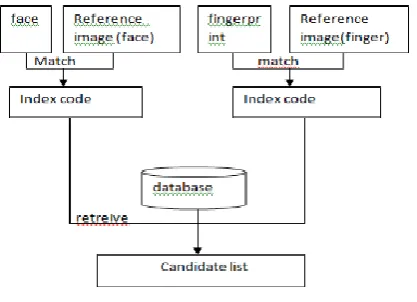
BLOCK DIAGRAM OF THE SYSTEM FOR GENERATION OF UNIQUE CODE
Fig.1 Generation of unique code.
[Gondkar* 4(4): April, 2017] ISSN 2349-4506
Impact Factor: 2.785
G
lobal
J
ournal of
E
ngineering
S
cience and
R
esearch
M
anagement
Multiple modal biometric which can also be used to accomplish rapid recovery that is getting it back immediately and also the low error rates, even identity is enrolled in the midst of a solitary image description for all the modalities.
Matcher is used for the purpose of generation of key codes for every modalities like face finger, iris etc by means of the comparison. During repossession progression of an image, the code of the investigation is in opposition to those which are stored in the gallery or database using a correspondence appraise to release a identity in favor of biometric.
INDEXING USING MATCH SCORE
As per the below block diagram images are acquired for the fingerprints and facial images of the Candidates for the purpose of training. And then Feature components are extracted for the classification. PCA will be used for the extraction of the eigenvectors which will be used as Features.
Fig. 2. Indexing of two modalities.
Further moreover the hash codes will be generated for the combination of the two modes of the feature set. And then the Corresponding index code will be generated for the multimodal feature Set. Finally, Minimum distance classifier will be used for the final retrieval of the class (Candidate) Conditions, which will help to achieve the increased Speedup conditions.
The retrieval process performs an search which will include aspects transversely the unique index code of the enrolled identities which are there in database. Consequently, the enhancement in rate recognition if the look for liberty is of significant consequence or may considerably be packed together and if the liberty between two key codes can be computed in section of the illustration necessary to the same two biometric templates.
[Gondkar* 4(4): April, 2017] ISSN 2349-4506
Impact Factor: 2.785
G
lobal
J
ournal of
E
ngineering
S
cience and
R
esearch
M
anagement
VI Indexing scheme along with its parametersSimilarity measures for key Codes.
Even though most information group protocol require severe constraint on the records gaining procedure, noise in the participation imagery can considerably crash the equal or the match scores and, as a result, the key codes. The relationship sandwiched among two key codes be able to be the calculated through their correspondence. Key code resembling in the direction of alike uniqueness should be projected to include a physically powerful constructive association. Key codes belonging to dissimilar identity are likely in the direction of being not related. Pearson product-moment relationship coefficient is being proposed.
Unique index code values should be capable of and also be viewed as points in a Euclidean space, and the likeness among them be capable to determine by their spatial nearness. Two examples of such events are the Euclidean distance.
The cosine resemblance or similarity
The dot product is represented as “.”.
Dimension of the key Codes.
Although using a superior amount of orientation imagery can recover indexing presentation it also increase the computational necessities of the scheme Additionally, raising the number of orientation imagery beyond a certain number is not helpful because the enhancement in accuracy will be unimportant compared to the augmented transparency. Commonly, as more imagery are incorporated in the orientation set, the unpredictability among them decrease (unless the biometric pattern has never-ending ability). Therefore, this number be supposed to be selected empirically according to the preferred accurateness and get faster.
Select Reference Images.
Orientation of the reference description images can be selected commencing the documentation of the record itself. They can also be specified and generate imagery. While the complete record be capable of be view as a applicant group for selecting orientation descriptions, sensible consideration can be ordered for the use of a minute arbitrary separation of imagery for this purpose. A greater amount of variety in the middle of the reference imagery increase the likelihood so as to the solution or the key codes of dissimilar subjects will be only one of its kind and well-spread in liberty.
We consider three dissimilar collection set of laws to ensure good variety.
First, the max-variation law select situation of descriptions with the prevalent variances of fake equal score (equal scores next to images of dissimilar identity).
Second, the max-mean law select imagery whose fake equal scores contain a huge indicates cost (the operative in the on top of algorithm is replaced by the illustration represent operator). The underlying principle of this law is to avoid selecting reference imagery resultant in thin key codes (i.e., key codes that contain a lot of zeros).
[Gondkar* 4(4): April, 2017] ISSN 2349-4506
Impact Factor: 2.785
G
lobal
J
ournal of
E
ngineering
S
cience and
R
esearch
M
anagement
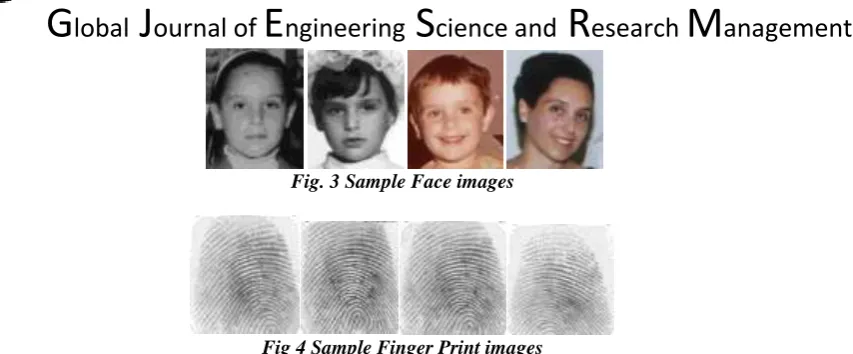
Fig. 3 Sample Face images
Fig 4 Sample Finger Print images
Estimating performance of Indexing.
The hit rate and penetration rate are basically used for evaluating the performance of indexing. The hit rate is the proportion of probe for which the equivalent arcade picture with the accurate uniqueness is recovered by the indexing method.
- - - (1)
Wherever Nh is the amount of probe meant for which the exact uniqueness
is here in the recovered candidate list and N is the total quantity of probes for which indexing was attempted. The saturation time denote the typical proportion of gallery entries so as to have be recovered depending upon the unique indexing method.
- - - (2)
Therefore Li is the amount of identities in the entrant list of the search picture M in addition to is the figure of identities in the record. In my experiments, N=M. An effectual unique indexing method will include a high hit rate as well as a short penetration rate or the saturation rate.
[Gondkar* 4(4): April, 2017] ISSN 2349-4506
Impact Factor: 2.785
G
lobal
J
ournal of
E
ngineering
S
cience and
R
esearch
M
anagement
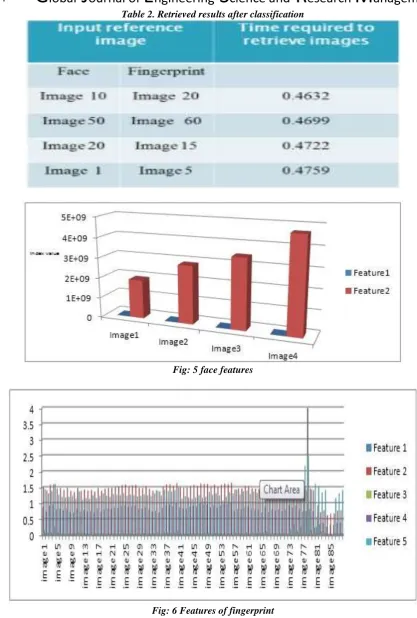
Table 2. Retrieved results after classification[Gondkar* 4(4): April, 2017] ISSN 2349-4506
Impact Factor: 2.785
G
lobal
J
ournal of
E
ngineering
S
cience and
R
esearch
M
anagement
CONCLUSION
A method for indexing biometric databases for efficient identity retrieval. The use of reference image that had different sizes, resolutions, and color depths are compared to the images in the database which substantially reduce the retrieval time. Hence, accuracy depends on penetration rate and Hit rate.
REFERENCES
1. F. Perronnin and J.-L. Dugelay, “Clustering face images with application to image retrieval in large databases,” in Proc. SPIE Conf. Biometric Technology for Human Identification II, 2005, vol. 5779, pp. 256–264.
2. D. Sturim, D. Reynolds, E. Singer, and J. Campbell, “Speaker indexing in large audio databases using anchor models,” inProc. IEEE Int. Conf. Acoustics Speech, and Signal Processing, 2001, vol. 1, pp. 429– 432.
3. AglikaGyaourova,”Index codes for Multibiometric pattern retrieval,” IEEE Transactions on information on forensics and security .vol.7.No.2,April 2012.
4. Y. Mami and D. Charlet, “Speaker recognition by location in the space of reference speakers,” Speech Commun., vol. 48, no. 2, pp. 127–141, 2006
5. Y. Yang, M. Yang, and Z. Wu, “A rank based metric of anchor models for speaker verification,” in Proc. IEEE Int. Conf. Multimedia and Expo, Jul. 2006, pp. 1097–1100.
6. M. Collet, D. Charlet, and F. Bimbot, “A correlation metric for speaker tracking using anchor models,” in Proc. IEEE Int. Conf. Acoustics, Speech, and Signal Processing, 2005, vol. 1, no. 18–23, pp. 713–716. 7. K. Sakata, T. Maeda, M. Matsushita, K. Sasakawa, and H. Tamaki, “Fingerprint authentication based on