Int. J. Industrial Mathematics Vol. 1, No. 3 (2009) 265-276
Extension on Regularity Condition in DEA
Models
F. Rezai Balfa;b, R. Shahverdia;b
(a) Department of Mathematics, Gaemshahr Branch, Islamic Azad University, Gaemshahr, Iran (b)Member of Young Researchers Club in Gaemshahr Branch
|||||||||||||||||||||||||||||||-Abstract
Data envelopment analysis (DEA) is a method to estimate the relative eciency of deci-sion making units(DMUs) performing similar tasks in a production system that consumes multiple inputs to produce multiple outputs. So far, a number of DEA models have been developed: The CCR model and the BCC model are well known as basic DEA models. The generic regularity condition for the CCR model is introduced so that each weakly ecient decision making unit in the CCR model of data envelopment analysis is also CCR-ecient. In this study, we give a general regularity condition under which each weakly ecient de-cision making unit in the BCC model and Additive model of data envelopment analysis is also BCC-ecient and Additive-ecient,respectively.
Keywords: Data Envelopment Analysis, Multi-objective Programming, Symmetric Model, General Position, Regularity Condition.
||||||||||||||||||||||||||||||||{
1 Introduction
Data envelopment analysis (DEA) was suggested by Charnes, Cooper and Rhodes(CCR), and built on the idea of Farrell [7], which is concerned with the estimation of techni-cal eciency and ecient frontiers. The CCR model [4, 5] generalized the single out-put/single input ratio eciency measure for each decision making unit (DMU) to multiple outputs/multiple inputs situations by forming the ratio of a weighted sum of outputs to a weighted sum of inputs. DEA is a method for measuring the relative eciency of DMUs performing similar tasks in a production system that consumes multiple inputs to produce multiple outputs. The main characteristics of DEA are (a) it can be applied to analyze multiple outputs and multiple inputs without preassigned weights, (b) it can be used for measuring the relative eciency based on the observed data without having information
on the production function, and (c) decision makers' preferences can be incorporated in DEA models.
The CCR ratio model for data envelopment analysis was proposed by Charnes, Cooper, and Rhodes in [4] in order to determine relative eciencies for a nite number of decision-making units (DMUs). Each DMU processes a given set of inputs into a given set of outputs, where prices of inputs and outputs are assumed to be unknown. The relative eciency of a given DMU is dened via a multi-objective programming problem that de-termines how well the DMU accomplishes the task of processing little amounts of inputs into large amounts of outputs.
Later , Banker, Charnes and Cooper (BCC) suggested a model for estimating technical eciency and scale ineciency in DEA. The BCC model [1] relaxed the constant returns to scale assumption of the CCR model and made it possible to investigate whether the performance of each DMU was conducted in region of increasing, constant or decreasing returns to scale in multiple outputs and multiple inputs situations.
The preceding models required us to distinguish between input-oriented and output-oriented models. Now, however, it combines both orientations in a single model , called the Additive model. The Additive model is a linear programming (LP)-based method proposed by Charnes et al. [2].
The remaining part of this article is organized as follows. In Section 2 we introduce some basic notation concerning the CCR ratio model and its reformulations in multiplier and envelopment forms, as well as the denitions of weak eciency and CCR eciency. Then, we give equivalent reformulations of the multiplier and envelopment models in a form which is symmetric in outputs and inputs. A regularity condition for the CCR model [9] in data envelopment analysis is also introduced in this section. We show why prob-lems that satisfy this regularity condition are actually in general position, and that each of their weakly ecient DMUs is also CCR-ecient. In Section 3, we show the BCC model in multiplier and envelopment forms, as well as the denitions of weak eciency and BCC eciency. Then, we introduce equivalent reformulations of the multiplier and envelopment models in a symmetric form in outputs and inputs in this section . Next a regularity condition on the BCC model in data envelopment analysis is introduced and we show that under this condition each of their weakly ecient DMUs is also BCC-ecient. In Section 4 Additive model, as well as a regular condition for and a symmetric form of it are introduced, and nally the conclusion is provided in Section 5.
2 CCR(Charnes-Cooper-Rhodes) Model
F Po: maxvuTTXYoo
s:t: uTYj
vTXj 1 j = 1; :::; n;
u; v 0
(2.1)
Here, the evaluated entities (DMUs) form a reference set and n is the number of DMUs. Yj = [yj1; :::; yjs]tand Xj = [xj1; :::; xjm]tin (2.1) are the given positive output and input
vectors of the jth DMU, respectively, s and m are the number of outputs and inputs of the DMUs, respectively, u and v are the coecient vectors of Yj and Xj, respectively, and
the index o indicates the evaluated DMU. u 0 represents the vector whose elements are not less than zero and at least one element is positive, whereas u > 0 represents the vector with positive elements.
Let Pj =
Yj
Xj
, F Po can equivalently be written as (for a proof, cf., e.g., [6])
LPo : maxuTYo
s:t: vTXo = 1
uTYj vTXj j = 1; :::; n;
u; v 0
(2.2)
It can be seen from (2.2) that the essence of the CCR model is that the DMU evaluated tries to nd out its weight vector to maximize its weighted output with the constraint that its weighted input is xed as unity and the weighted output is not larger than the weighted input for all DMUs. In other words, each DMU seeks its favorite weight vector to its own advantage.
By introducing the vector w =
u v
2 Rm+s and the matrices
X = (X1; :::; Xn),
Y = (Y1; :::; Yn),
P = (P1; :::; Pn);
A =
Y I 0
X 0 I
= (P j I),
where I and 0 in the denition of A denote identity and zero matrices of appropriate dimensions, respectively, we have another form of LPo as follows:
LPo: max wT
Yo
0
s:t: wT 0
Xo
= 1 wTA 0
(2.3)
DLPo : min
s:t: A 0 @s+
s 1
A + X0
o
=
Yo
0
; s+; s 0
(2.4)
where 2 Rn, s+ 2 Rs , s 2 Rm and 2 R. Note that LPo is called the "multiplier
model", whereas DLPo is referred to as the "envelopment model".
Denition 2.1. (a) DMUo is called Weakly Ecient if the optimal value of DLPo
equals 1.
(b) DMUo is called CCR-Ecient if it is weakly ecient, and if all solution points of
DLPo possess vanishing slack variables s+ and s .
(c) DMUo is called Inecient if it is not weakly ecient.
Note that weak eciency is also known as radial, technical or Farrell eciency, whereas CCR-eciency is also called Pareto-Koopmans eciency(for more details, see [2]). Theorem 2.1. (a) DMUo is called Weakly Ecient if and only if the optimal value of
LPo is 1.
(b) DMUo is called CCR-Ecient if and only if it is weakly ecient , and if there exists
a positive solution w > 0 of LP o.
For details of the proof, see [6].
2.1 Symmetric CCR model
Problems LPoand DLPoare not symmetric in the inputs Xoand outputs Yo,("Symmetric"
is just supposed to mean that units( inputs and outputs) may be exchanged in the model without changing the model . In the previous models this is not the case, so in this sense they are "asymmetric".). The symmetric form of LPo is dened as follows:
SLPo : max wTPo
s:t: wTe = 1;
wTA 0 (2.5)
It is called the symmetric multiplier model, and its dual
DSLPo : min
s:t: A 0 @s+
s 1
A + e = Po
; s+; s 0
(2.6)
the symmetric envelopment model. Here, e denotes an all-one vector of appropriate di-mension.
Theorem 2.2. (a) DMUo is called Weakly Ecient if and only if the optimal value of
SLPo is 0.
(b) DMUo is called CCR-Ecient if and only if it is weakly ecient , and if there exists
a positive solution w > 0 of SLP o.
For details of the proof see [9].
Remark 2.1. (a) DMUo is called Weakly Ecient if and only if the optimal value of
DSLPo is 0.
(b) DMUo is called CCR-Ecient if and only if it is weakly ecient , and if all solution
points of DSLPo possess vanishing slack variables s+ and s .
2.2 A regular condition for the CCR model
In this section , it is shown that if the data which dene the DMUs are in "general position " , each weakly ecient DMU will also be CCR-ecient.
Denition 2.2. DMU1; :::; DMUn are said to be in general position if the following
regu-larity condition (RC) holds: each (s+m)(s+m)-submatrix of the (s+m)(s+m+n)-matrix
A =
Y I 0
X 0 I
= (P j I), is non-singular.
Theorem 2.3. Let DMU1; :::; DMUn be in general position. Then a DMUo is weakly
ecient if and only if it is CCR-ecient. For more details of the proof see [9].
3 BCC(Banker-Charnes-Cooper) Model
In this section , we introduce the BCC model in multiplier and envelopment forms , then we dene weak eciency and BCC-eciency.
Banker, Charnes and Cooper [1] introduced, the BCC model, whose production possibility set PB is dened as:
PB= f(x; y)jx X; y Y ; e = 1; 0g (3.7)
where X = (xj) 2 Rmn and Y = (yj) 2 Rsn are a given data set, 2 Rnand e is a row
vector with all elements equal to 1. The BCC model diers from the CCR model only in the adjunction of the condition e = 1.
The BCC model evaluates the eciency of DMUo(o = 1; :::; n) by solving the following
(envelopment form) linear program:
min
s:t: X xo
Y yo
e = 1 0
where is a scalar.
The dual multiplier form of this linear program is expressed as:
max z = uTY o+ u0
s:t: vTX o = 1
uTYj vTXj+ u0e 0 j = 1; :::; n;
u 0; v 0; u0 free in sign:
(3.9)
where z and u0 are scalars and the latter, being "free in sign" may be positive or negative
(or zero).
Since u0 is free in sign, it could be written as the dierence of two positive variables in a
subtraction. So, by introducing u+
0 and u0 , we will have u0 = u+0 u0.
Consequently, by substitution in model (3.9), we have model the following:
max z = uTYo+ u+ 0 u0
s:t: vTX o= 1
uTYj vTXj + u+
0 u0 0 j = 1; :::; n;
u 0; v 0; u+0 0; u0 0
(3.10)
We introduce the vector w = 0 B B @ u v u+0 u0
1 C C
A 2 Rm+s+2 and the matrices
X = (X1; :::; Xn),
Y = (Y1; :::; Yn),
P = (P1; :::; Pn);
A = 0 B B @
Y I 0 0 0
X 0 I 0 0
1 0 0 1 0
1 0 0 0 1
1 C C A
where I and 0 in the denition of A denote identity and zero matrices of appropriate dimensions, respectively. Then, we have another form of model (3.10) as follows:
BLPo: max wT
0 B B @ Yo 0 1 1 1 C C A
s:t: wT
0 B B @ 0 Xo 0 0 1 C C A = 1
wTA 0
(3.11)
DBLPo : min s:t: A 0 B B B B @ s+ s t+ t 1 C C C C A+ 0 B B @ 0 Xo 0 0 1 C C A = 0 B B @ Yo 0 1 1 1 C C A
; s+; s ; t+; t 0
(3.12)
where 2 Rn, s+ 2 Rs , s 2 Rm and 2 R. Note that BLPo is called the "multiplier
model", whereas DBLPo is referred to as the "envelopment model".
Denition 3.1. (a) DMUo is called Weakly Ecient if the optimal value of DBLPo
equals 1.
(b) DMUo is called BCC-Ecient if it is weakly ecient , and if all solution points of
DBLPo possess vanishing slack variables s+ , s , t+ and t .
(c) DMUo is called Inecient if it is not weakly ecient.
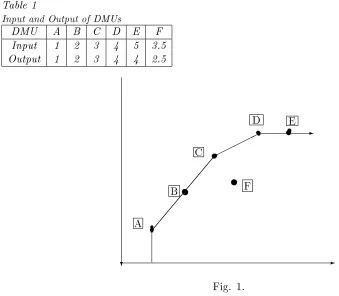
Example 3.1. Consider the six DMUs with one input and one output in Table 1. The input and output data of the DMUs are depicted in Fig. 1. Straightforward calcula-tions show that A; B; C; D are BCC-ecient, F is inecient, and E is weakly ecient , but not BCC-ecient.
Table 1
Input and Output of DMUs
DMU A B C D E F Input 1 2 3 4 5 3.5 Output 1 2 3 4 4 2.5
? -6 * 7 ps -t t t sr s r u r qs u A B C D E F Fig. 1.
Theorem 3.1. (a) DMUo is called Weakly Ecient if and only if the optimal value of
(b) DMUo is called BCC-Ecient if and only if it is weakly ecient , and if there exists
a positive solution w > 0 of BLPo.
Proof: Part (a) follows immediately form the strong duality theorem of linear program-ming, and part (b) is due to the strong complementarity theorem.
3.1 Symmetric BCC models
Problems BLPoand DBLPowhich are used to ascertain the eciency properties of DMUo
clearly are not symmetric in the inputs Xo and outputs Yo. In this section, we introduce
symmetric BCC model in two forms. We call
SBLPo: max wTPo
s:t: wTe = 1;
wTA 0 (3.13)
the symmetric multiplier model , where Po =
0 B B @
Yo
Xo
1 1
1 C C
A , and its dual
DSBLPo : min
s:t: A
0 B B B B @
s+
s t+
t 1 C C C C
A+ e = Po
; s+; s ; t+; t 0
(3.14)
the symmetric envelopment model. Here, e denotes an all-one vector of appropriate di-mension. Setting o= 1 and all remaining variables of DSBLPo to zero yields a feasible
point, and the optimal value of DSBLPo does certainly not exceed zero. Furthermore, the
constraints X s + e = Xo; ; s 0 together with X 0 imply e Xo , so
that is bounded from below by minfxio : i = 1; :::; mg on the feasible set of SDBLPo.
Note that, one can be verify which the BCC model have conformed from Rm+s space to
regular CCR model in Rm+s+2 space . Actually , in this case, space's dimension only is
exchanged. Consequently, according to the model (3.14), all theorem, associated with the regular CCR model are proved.
Theorem 3.2. (a) DMUo is weakly ecient if and only if the optimal value of SBLPo
is 0.
(b) DMUo is BCC-ecient if and only if it is weakly ecient, and if there exists a
positive solution w > 0 of SBLPo.
Corollary 3.1. (a) DMUo is weakly ecient if and only if the optimal value of DSBLPo
is 0.
(b) DMUo is BCC-ecient if and only if it is weakly ecient, and if all solution points
3.2 A regularity condition for the BCC model
In this section , it is shown that if the data which dene the DMUs are in "general position " , each weakly ecient DMU will also be BCC-ecient.
Denition 3.2. DMU1; :::; DMUn are said to be in general position if the following
reg-ularity condition (RC) holds: each (s + m + 2) (s + m + 2)-submatrix of the (s + m + 2) (s + m + n + 2)-matrix
A = 0 B B @
Y I 0 0 0
X 0 I 0 0
1 0 0 1 0
1 0 0 0 1
1 C C A
is non-singular.
Theorem 3.3. Let DMU1; :::; DMUn be in general position. Then, a DMUo is weakly
ecient if and only if it is BCC-ecient.
Note that the models introduced in this section and the next section (the Additive model) are reducible to symmetric CCR forms, so all properties and theorems from the symmetric CCR model also apply for these models.
4 The Additive model
The Additive model is a linear programming (LP)-based method proposed by Charnes et al. [2]. There are several types of Additive models in data envelopment analysis , among which we select the following:
ADDo: min z = es es+
s:t: X s = Xo
Y s+= Yo
0; s ; s+ 0
(4.15)
The above model is called the multiplier form of the Additive model and the dual problem to the above can be expressed as follows :
DADDo: max w = uYo vXo
s:t: uYj vXj 0 j = 1; :::; n
u 1; v 1
(4.16)
which is the envelopment form of the Additive model.
Let the optimal solutions of model (4.15) be (; s
; s+
) . The denition of eciency is as follows for the Additive model.
Denition 4.1.
Theorem 4.1.
DMUo is ADD-ecient if and only if it is BCC-ecient.
Let u0 = u + 1 and v0 = v + 1. So, the model (4.16) can be reformulated as
fol-lows:
DADDo: max w = u0Yo+ v0Xo+ (1Yo 1Xo)
s:t: u0Yj + v0Xj+ (1Yj 1Xj) 0 j = 1; :::; n
u0 0; v0 0
(4.17)
Let 1Yj 1Xj = kj and Xjnew=
Xj
kj
.
By introducing the vector w =
vnew
u0
2 Rm+s+1, where vt
new= (v0; 1), and the matrices
X = (X1; :::; Xn),
Y = (Y1; :::; Yn),
A =
Xnew I1 0
Y 0 I2
,
where I1, I2 and 0 in the denition of A denote identity ((m + 1) (m + 1)), identity
(s s) and zero matrices of appropriate dimensions, respectively, we have another form of DADDo as follows:
DADDo : max wT
Xnew
o
Yo
s:t: wTA 0 (4.18)
Note that DADDo is referred to as the the "multiplier model". We can conveniently
write the dual of DADDo which is called the "envelopment model".
4.1 Symmetric Additive model
With regard to the denition of "symmetry" in subsection 2.1 , we observe that problem DADDo and its dual are asymmetric. Hence, we dene the symmetric DADDo model as
follows:
SDADDo : max wTPo
s:t: wTe = 1;
wTA 0 (4.19)
This is called the symmetric multiplier model, where Po =
0 @Xkoo
Yo
1 A.
We can conveniently write the dual of SDADDo, is called the " symmetric envelopment
model".
Note that, like the symmetric BCC's models , space's dimension only is exchanged.
4.2 A regular condition for the Additive model
Denition 4.1. DMU1; :::; DMUn are said to be in general position if the following
reg-ularity condition (RC) holds: each (s + m + 1) (s + m + 1)-submatrix of the (s + m + 1) (s + m + n + 1)-matrix
A =
Xnew I1 0
Y 0 I2
is non-singular.
Theorem 4.1. Let DMU1; :::; DMUn be in general position. Then, a DMUo is weakly
ecient if and only if it is ADD-ecient. For details of the proof see [8, 9].
5 Conclusion
DEA evaluates the relative eciency of a set of DMUs. The relative eciency of a DMU is the result of comparing the inputs and outputs of the DMU and those of other DMUs in the PPS (Production Possibility Set). The generic regularity condition for the CCR model was introduced by Neralic and Stein [9]. In this article, we give a general regularity condition under which each weakly ecient decision making unit in the BCC model and Additive model of data envelopment analysis is also BCC-ecient and ADD-ecient, respectively. Note that, this approach can be adapted to other models in data envelopment analysis like the BCC additive model and FDH model. Also , we can investigate the regularity condition (RC) for these model with inaccurate (interval, fuzzy, ordinal, etc.) data.
References
[1] Banker RD, Charnes A, Cooper W.W, Some models for estimating technical and scale ineciencies in data envelopment analysis, Management Science 30 (1984) 1078-1092. [2] Charnes A, Cooper W.W, Golany B, Seiford L, Stutz J, Foundations of data envelop-ment analysis for Pareto-Koopmans ecient empirical production functions, Journal of Econometrics 30 (1985) 91-107.
[3] Charnes A, Cooper W.W, Lewin AY, Seiford LM, Data Envelopment Analysis: The-ory, Methodology, and Applications, Kluwer, Boston, (1994).
[4] Charnes A, Cooper W.W, Rhodes E, Measuring the eciency of decision-making units, European Journal of Operational Research 2 (1978) 429-444.
[6] Cooper W.W, Seiford LM, Tone K, Data Envelopment Analysis: A Comprehen-sive Text with Models, Applications, References and DEA-Solver Software, Kluwer, Boston, (2000).
[7] Farrell M.J., The Measurment of productive eciency, Journal of the Royal Statistical Society 120 (1957) 253-281.
[8] Hosseinzadeh Lot F., Jahanshahloo G.R., Rezai Balf F., Shahverdi R., The ecient units classication on Additive model in DEA, European Journal of Operational Research, submitted.