DEMOGRAPHIC RESEARCH
VOLUME 28, ARTICLE 22, PAGES 637-648
PUBLISHED 26 MARCH 2013
http://www.demographic-research.org/Volumes/Vol28/22/ DOI: 10.4054/DemRes.2013.28.22
Descriptive finding
Changing patterns of tobacco and alcohol co-use
by gender in the United States, 1976-2010
Jonathan Daw
Kathryn M. Nowotny
Jason D. Boardman
© 2013 Daw, Nowotny & Boardman.
This open-access work is published under the terms of the Creative Commons Attribution NonCommercial License 2.0 Germany, which permits use, reproduction & distribution in any medium for non-commercial purposes, provided the original author(s) and source are given credit.
2 Data and methods 638
2.1 Data 638
2.2 Methods 639
3 Results 640
4 Discussion and conclusion 644
5 Acknowledgements 646
Descriptive Finding
Changing patterns of tobacco and alcohol co-use by gender in the
United States, 1976-2010
Jonathan Daw1
Kathryn M. Nowotny2
Jason D. Boardman3
Abstract
BACKGROUND
Smoking is a serious health concern both globally and in the U.S. Because drinking amplifies the negative health effects of smoking, the high association of these behaviors is an additional source of population morbidity. However, very little is known about trends in the co-use of smoking and drinking over time.
OBJECTIVE
To describe trends in tobacco use, alcohol use, and their co-use among U.S. youth, and to separate out trends in the association of smoking and drinking from trends in their marginal distributions.
METHODS
We use data on the smoking and drinking behaviors of 12th graders from 1976 to 2010 in the Monitoring the Future study to examine trends in smoking, drinking, and co-use separately by gender. In each year we estimate the degree of co-use attributable to tobacco and alcohol use probabilities as well as the association between tobacco and alcohol use.
RESULTS
Although the prevalence of tobacco and alcohol co-use has declined over time, the association of the two has increased. This association accounts for an increasing proportion of the co-use of tobacco and alcohol.
CONCLUSION
We conclude that co-users of tobacco and alcohol are an increasingly select subpopulation. This suggests that continued decreases in the contribution of substance use to population health and mortality may not continue apace.
1 Department of Sociology, University of Alabama-Birmingham, U.S.A.
1. Background
Globally, tobacco use is one of the leading causes of death. The World Health Organization attributes six million deaths per year to tobacco (WHO 2012). More than 600,000 middle school students and 3 million high school students in the U.S. currently smoke cigarettes, a rate of about 20 percent. This is slightly higher than the overall median percent of current use of any tobacco product globally (18.7%) among youths aged 13-15 (The Global Youth Tobacco Survey Collaborative Group 2002). Historically, men have had a higher prevalence of smoking than women (Mermelstein et al.1999; Piko et al. 2007; Waldron 1991). The 2012 U.S. Surgeon General’s Report emphasizes that nearly 9 out of 10 smokers started smoking by age 18, which can result in prolonged tobacco use and can lead to both immediate and long-term severe health consequences (DHHS 2012).
Confounding this problem is the high rate of tobacco and alcohol co-use, especially among youth (Grant 1998; Koopmans, vanDoornen, and Boomsma 1997; Levine et al. 2011; Weitzman and Chen 2005). Tobacco and alcohol use influence long-term health both independently and interdependently; co-use is a greater risk than the sum of their independent effects (Castellsagué et al. 1999; Kalman et al. 2010), although this is somewhat in dispute (Mukamal 2006). For example, Castellsagué and colleagues (1999) found that alcohol or tobacco use alone were strongly related to the risk of esophageal cancer even in the absence of the other behavior. However, tobacco and alcohol co-use had a strong multiplicative effect on risk such that simultaneous moderate exposure increased the risk 12- to 19-fold in men and women, respectively. The authors conclude that this effect may be due to the physiological interaction between the two substances. Therefore, examining not only trends in smoking and drinking among youth, but also examining trends in their co-use is imperative for understanding population health. This paper examines trends in the prevalence and co-use of tobacco and alcohol among U.S. youth, separating the contributions of the marginal distributions of tobacco and alcohol use from the effect of their association.
2. Data and methods
2.1 Data
ensure cross-year comparability. MTF employs a school-based sampling design, and the school participation rate has varied between 66 and 85%. Samples of approximately 350 12th graders are drawn from each participating school.4
Cigarette smoking is measured using the question, “How frequently have you smoked cigarettes during the past 30 days?” Response categories included “Not at all,” “Less than one cigarette per day,” “One to five cigarettes per day,” “About one half-pack per day,” “About one half-pack per day,” “About one and one-half half-packs per day,” and “Two packs or more per day,” which were coded 0-6 respectively. Similarly, drinking behavior was measured using the question, “On how many occasions (if any) have you had alcoholic beverages to drink – more than just a few sips – during the last 30 days?” Response categories included 0, 1-2, 3-5, 6-9, 10-19, 20-39, and 40 or more, which were coded 0-6, respectively. We use responses to these questions to characterize use (yes/no) of each substance and heavy use of cigarettes (≥ half-pack per day) and alcohol (≥ 6 drinks in the past 30 days).
The total sample size is 556,731 with yearly samples ranging from a low of 13,286 in 2000 to a high of 18,924 in 1978. Since 2005, the sample was approximately 70% white, 13% black, and 16% Hispanic. (Before 2005 only white and black race was measured; other race/ethnicities were recoded to missing to preserve confidentiality.) Boys and girls over time have used tobacco at the same rate (29% vs. 29%) whereas boys have a somewhat higher rate of alcohol use compared to girls (62% vs. 53%). Similar patterns are observed for heavy use (smoking: 6% vs. 5%; drinking: 15% vs. 8%).
2.2 Methods
We examine self-reported use and heavy use of cigarettes and alcohol within the past month for boys and girls separately. Our objective is to compare the prevalence of observed co-use to the independent prevalence of each substance. This will allow us to characterize co-use in excess of what would be expected if tobacco and alcohol use were independent; that is, use due to factors that cause the two behaviors to co-occur. To do this, we distinguish between two sources of tobacco and alcohol co-use: (a) expected co-use due to marginal probabilities of tobacco and alcohol use; and (b) ‘excess’ co-use above that expected by chance. Unrelated decreases in smoking and drinking prevalence will decrease the prevalence of co-use even in the absence of a smoking-drinking association. For this reason, our test looks for a higher or lower prevalence of observed co-use than the expected co-use in a given year as an indicator of the year-specific association between tobacco and alcohol use. For instance, suppose
that in a certain year the prevalence of any tobacco use, 𝑝𝑠𝑚𝑘,𝑎𝑛𝑦, is 0.40 and the prevalence of any alcohol use (𝑝𝑑𝑟𝑘,𝑎𝑛𝑦) = 0.25. If these substance use behaviors are
independent, then the expected co-use for that year is
pco,any = psmk,anypdrk,any = (0.40)(0.25) = 0.10. If the observed co-use is 𝑝𝑐𝑜,𝑎𝑛𝑦= 0.20, this is an excess prevalence of 0.20 − 010 = 0.10 which we attribute to the association of smoking and drinking rather than simply the separate prevalence thereof. The proportion of co-use attributable to this association would then be calculated as
𝑃𝑎𝑠𝑠𝑜𝑐,𝑎𝑛𝑦=𝑝𝑐𝑜−𝑢𝑠𝑒,𝑎𝑛𝑦𝑝− 𝑝𝑠𝑚𝑘,𝑎𝑛𝑦𝑝𝑑𝑟𝑘,𝑎𝑛𝑦 𝑐𝑜−𝑢𝑠𝑒,𝑎𝑛𝑦
and the proportion of co-use attributable to the separate prevalence of smoking and drinking use is its inverse.
3. Results
Figure 1: Trends in the prevalence of any past month alcohol consumption and cigarette smoking among U.S. high school seniors by gender, 1976-2010
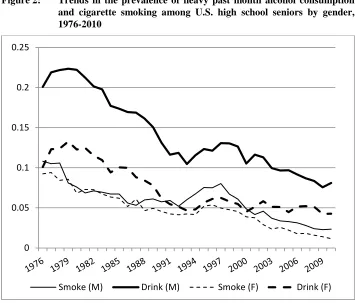
There are greater gender differences in drinking behavior. Boys have consistently consumed more alcohol than girls, whether measured as any (𝑝 = 0.09) or heavy
(𝑝 = 0.00) consumption in the past 30 days. Furthermore, there is a statistically
significant interaction between gender and heavy alcohol use (𝑝 = 0.00), and a weaker interaction for any use (𝑝 = 0.10).
Figure 3 shows that the observed co-use of smoking and drinking has declined fairly consistently for both boys and girls between 1976 and 2010, with the exception of an upward trend between 1993 and 2000. For example, in 1976, 30.8% of high school male seniors had smoked at least one cigarette and consumed at least one alcoholic beverage in the past 30 days compared to only 16.4% of male seniors in 2010. Even more starkly, the observed co-use of heavy smoking and heavy drinking among boys has declined from a peak of 4.9% in 1977 to a low of .8% by 2010. A similar decline is also evident among girls - the prevalence of these co-use behaviors is virtually non-existent by 2010 (.2%).
0 0.1 0.2 0.3 0.4 0.5 0.6 0.7 0.8 0.9
Figure 2: Trends in the prevalence of heavy past month alcohol consumption and cigarette smoking among U.S. high school seniors by gender, 1976-2010
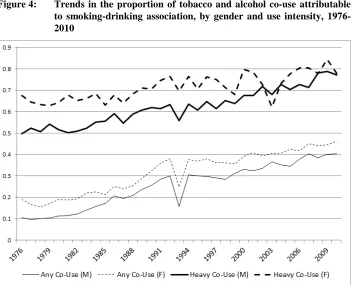
The estimates in Figure 4 explore the extent to which temporal changes in the incidence of co-use do not merely reflect changes in the prevalence of each behavior. The estimates instead describe the proportion of the prevalence of observed co-use that is due to an association between smoking and drinking (over the expected co-use if the two behaviors were independent). For example, in 1976, the proportion of boys who smoked cigarettes and drank alcohol was .369 and .746, respectively. If smoking and drinking were independent, then we would expect the proportion of co-users to be .276 (.369*.746). Instead, we observe a proportion of use that is .308. This excess of co-use (. 208 − .276 = .032) is then divided by the proportion of co-use (.308) to retrieve a value (.106) that describes the proportion of co-use that is due to an association between the two behaviors.
0 0.05 0.1 0.15 0.2 0.25
Figure 3: Trends in the co-use of tobacco and alcohol among U.S. high school seniors by gender, 1976-2010
Figure 4: Trends in the proportion of tobacco and alcohol co-use attributable to smoking-drinking association, by gender and use intensity, 1976-2010
4. Discussion and conclusion
remain is increasingly driven by factors that influence smoking and drinking, not simply each separately.
These findings suggest that, as tobacco use, alcohol use, and their co-use has declined among 12th graders in the U.S., the segment of the population that engage in smoking and drinking co-use has become increasingly differentiated from the general population of high school seniors. In other words, rather than being more reflective of the population prevalence of smoking and drinking, those who engage in both tobacco use and alcohol use are increasingly driven either by a common disposition for using both or a causal connection between the two behaviors.
There is increasing evidence that the health effects of smoking and drinking are non-additive, such that using both together has a greater negative impact on one’s health than the separate behaviors. This is particularly relevant for our study because the increasing association between the two behaviors suggests that the subpopulation of youth engaged in these behaviors is increasingly comprised of a select group for unknown reasons. It is possible that this select group is most susceptible to addiction or that they are select on other characteristics associated with health behaviors. This is particularly important because the increasing association between the two behaviors suggests that this select population is increasingly comprised of relatively unhealthy youth who may face new risks as the co-use of the two substances may have interactive health effects. We suspect that high school students who co-use tobacco and alcohol are increasingly subject to unusual environments and/or have especially strong genetic dispositions toward tobacco and alcohol use. Although this is a speculative claim, it is consistent with the evidence as well as with prior investigations of smoking using behavioral genetic methods (Boardman et al., 2011). The validity of this conjecture should be investigated in future research. If true, this implies that decreases in the prevalence of deleterious health behaviors, and their effects on population morbidity and mortality, should not be expected to continue apace. Nonetheless, the decreasing use of tobacco and alcohol among the young in the U.S. represents progress for public health.
There are several limitations in this study, which are common to most observational research using survey data. First, tobacco and alcohol use are measured by self-report. While we believe this is unlikely, it is possible that the changing association of smoking and drinking could be attributable to changing recall concerning these behaviors. Second, it is difficult to tell whether the changing association of smoking and drinking is attributable to change in any causal connection between these behaviors or changing common dispositions to both behaviors. More refined measures of substance use would be required to differentiate these.
excess co-use above expected co-use has increased, especially for heavy use among boys. Because of the increased health consequences of smoking in conjunction with drinking, this finding implies that continued decreases in tobacco and alcohol co-use may hinge on addressing their association
5. Acknowledgements
References
Boardman, J.D., Blalock, C.L., Pampel, F.C., Hatemi, P.K., Heath, A.C., and Eaves, L.J. (2011). Population composition, public policy, and the genetics of smoking.
Demography 48(4): 1517-1533. doi:10.1007/s13524-011-0057-9.
Castellsagué, X., Muñoz, N., De Stefani, E., Victora, C.G., Castelletto, R., Rolón, P.A., and Quintana, M.J. (1999). Independent and joint effects of tobacco smoking and alcohol drinking on the risk of esophageal cancer in men and women.
International Journal of Cancer 82(5): 657-664. doi:10.1002/ (SICI)1097-0215(19990827)82:5<657::AID-IJC7>3.0.CO;2-C.
Grant, B.F. (1998). Age at smoking onset and its association with alcohol consumption and DSM-IV alcohol abuse and dependence: Results from the national longitudinal alcohol epidemiologic survey. Journal of Substance Abuse 10(1): 59-73. doi:10.1016/S0899-3289(99)80141-2.
Kalman, D., Kim, S., DiGirolamo, G., Smelson, D., and Ziedonis, D. (2010). Addressing tobacco use disorder in smokers in early remission from alcohol dependence: The case for integrating smoking cessation services in substance use disorder treatment programs. [Review]. Clinical Psychology Review 30(1): 12-24. doi:10.1016/j.cpr.2009.08.009.
Koopmans, J.R., van Doornen, L.J.P., and Boomsma, D.I. (1997). Association between alcohol use and smoking in adolescent and young adult twins: A bivariate genetic analysis. Alcoholism: Clinical and Experimental Research 21(3): 537-546. doi:10.1111/j.1530-0277.1997.tb03800.x.
Levine, A., Huang, Y.Y., Drisaldi, B., Griffin Jr., E.A., Pollak, D.D., Xu, S., Yin, D., Schaffran, C., Kandel, D.B., and Kandel, E.R. (2011). Molecular mechanism for a gateway drug: Epigenetic changes initiated by nicotine prime gene expression by cocaine. Science Translational Medicine 3(107). doi:10.1126/ scitranslmed.3003062.
Mermelstein, R. and The Tobacco Control Network Writing Group (1999). Explanations of ethnic and gender differences in youth smoking: A multi-site, qualitative investigation. Nicotine & Tobacco Research 1(S1): S91-S98.
doi:10.1080/14622299050011661.
Piko, B.F., Wills, T.A., and Walker, C. (2007). Motives for smoking and drinking: Country and gender differences in samples of Hungarian and US high school students. Addictive Behaviors 32(10): 2087-2098. doi:10.1016/ j.addbeh.2007.01.013.
The Global Youth Tobacco Survey Collaborative Group (2002). Tobacco use among youth: A cross country comparison. Tobacco Control 11: 252-270. doi:10.1136/tc.11.3.252.
U.S. Department of Health and Human Services. (2012). Preventing tobacco use among youth and young adults: A report of the surgeon general. Atlanta, GA: U.S. Department of Health and Human Services, Centers for Disease Control and Prevention. [ http://www.surgeongeneral.gov/library/reports/preventing-youth-tobacco-use/full-report.pdf]
Waldron, I. (1991). Patterns and causes of gender differences in smoking. Social
Science & Medicine 32(9): 989-1005. doi:10.1016/0277-9536(91)90157-8. Weitzman, E.R. and Chen, Y.-Y. (2005). The co-occurrence of smoking and drinking
among young adults in college: National survey results from the United States.
Drug and Alcohol Dependence 80(3): 377-386. doi:10.1016/j.drugalcdep. 2005.05.008.