Volume 6 Issue 2 Article 1
August 2019
Colored complete hypergraphs containing no rainbow Berge
Colored complete hypergraphs containing no rainbow Berge
triangles
triangles
Colton Magnant
Follow this and additional works at: https://digitalcommons.georgiasouthern.edu/tag
Part of the Discrete Mathematics and Combinatorics Commons
Recommended Citation Recommended Citation
Magnant, Colton (2019) "Colored complete hypergraphs containing no rainbow Berge triangles," Theory and Applications of Graphs: Vol. 6 : Iss. 2 , Article 1.
DOI: 10.20429/tag.2019.060201
Colored complete hypergraphs containing no rainbow Berge triangles
Colored complete hypergraphs containing no rainbow Berge triangles
Cover Page Footnote Cover Page Footnote
Department of Mathematics, Clayton State University, Morrow, GA, 30260, USA Academy of Plateau Science and Sustainability, Xining, Qinghai 810008, China
Abstract
The study of graph Ramsey numbers within restricted colorings, in particular for-bidding a rainbow triangle, has recently been blossoming under the name Gallai-Ramsey numbers. In this work, we extend the main structural tool from rainbow triangle free colorings of complete graphs to rainbow Berge triangle free colorings of hypergraphs. In doing so, some other concepts and results are also translated from graphs to hypergraphs.
1
Introduction
Edge-colorings of graphs, particularly complete graphs, have been studied from a wide variety of perspectives. Among the most famous of these is certainly Ramsey theory, but even within Ramsey theory, there have been many variants. One particular direction, has been restricting the colorings to those containing no rainbow copy of some specified subgraph. In light of the following structural result, originally proven by Gallai [11] in 1967, it is natural that the rainbow triangle has received the most attention.
To be precise, a subgraph of a colored graph is called rainbow if its edges have been assigned all distinct colors. A colored complete graph is called aGallai coloring if it contains no rainbow colored triangle.
Theorem 1 ([4, 11, 14]). Every Gallai coloring of a complete graph of order at least 2
contains a non-trivial partition (with at least two parts) of the vertices such that between the parts there is a total of at most two colors on the edges, and between each pair of parts there is only one color on the edges.
Such a partition is called a Gallai partition or G-partition.
The goal of this paper is to extend Theorem 1 to hypergraphs and apply it to several related areas of study. When transitioning to hypergraphs, the first question is how to translate the definitions. For example, what does “complete” mean and what shall be called a “triangle”?
Given a positive integern, letK3
ndenote the complete 3-uniform hypergraph onnvertices.
A hypergraph with at least 4 vertices and three distinct edges e1, e2, e3 is called a Berge
triangle, denoted by BC3, if there exist three distinct vertices, say u, v, w, with u, v ∈ e1,
v, w∈ e2, and u, w∈e3. As in the case for graphs, a Berge triangle is called rainbow if the
hyperedges have been assigned distinct colors. We first consider colorings of K3
n containing no rainbow Berge triangles. Our first main
result shows that the structure of rainbow-BC3-free colored 3-uniform hypergraphs is actually
much stronger than the structure provided by Theorem 1 for graphs. A color is called
universal if no two hyperedges of any two other colors share a vertex. In this work, we consider only colorings of the hyperedges (not the vertices) of hypergraphs.
Theorem 2. For a positive integer n, let H be a copy of K3
n and c(H) be a coloring of H
containing no rainbow BC3. Then there exists a universal color.
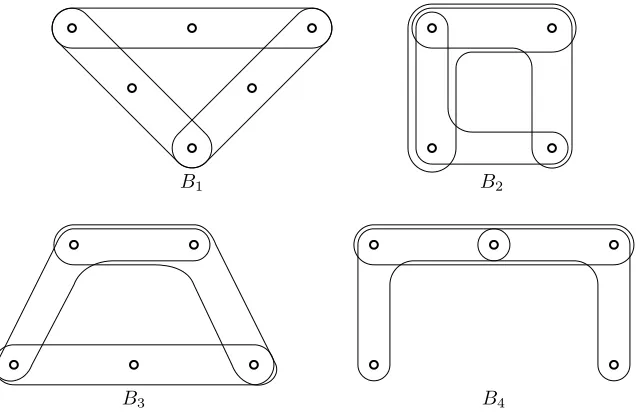
B1 B2
B3 B4
Figure 1: All 3-uniform Berge triangles
Note that B1 is also known as a “linear” or “loose” C3 and B2 can also be regarded as a
K3
4 minus a single hyperedge. With this notation for the different specific Berge triangles,
we can be more specific in our statements. In fact, it turns out that not all of the Berge triangles are needed in the statement of Theorem 2.
Theorem 3. For a positive integer n, let H be a copy of K3
n and let c(H) be a coloring of
H containing no rainbow B3. Then there exists a universal color.
We have yet to find any indication whether this also holds true for B1, B2, or B4. It is
also unclear what one might find when forbidding any other Berge hypergraphs.
In order to extend these results to hypergraphs that are not 3-uniform, we first define what it means to be “complete”. A hypergraph H is called 3-complete if, for each set of 3 vertices, there is a distinct hyperedge containing those 3 vertices. Notice that this definition does not require H to be uniform. With this definition, we get the following extension of Theorem 2.
Theorem 4. LetH be a 3-complete hypergraph onn ≥4vertices and let c(H) be a coloring of H. Ifc(H) contains no rainbow Berge triangle, then there is a universal color.
Note that Theorem 2 is a corollary of Theorem 4 but Theorem 3 is not. After some preliminary results though, see Lemmas 1-4, it turns out that Theorem 2 and Theorem 3 are equivalent, meaning that Theorem 4 also implies Theorem 3. We therefore only include the proof of Theorem 4, provided in Section 3.
Also observe that the conclusions of Theorems 3 and 4 imply that if H is a hyperedge-colored hypergraph satisfying either of the hypotheses, then there is a nice partition of the vertices.
Corollary 5. Let n ≥4 and let H be a hypergraph and c(H) be a coloring of H containing no rainbow B3 such that either
2
Theory and Applications of Graphs, Vol. 6 [2019], Iss. 2, Art. 1
• H is a copy of K3
n, or
• H is a copy of an arbitrary hypergraph (perhaps not even uniform) in which for every set of 3 distinct vertices, there is a distinct hyperedge containing those 3 vertices,
then, up to renumbering the colors, there is a partition of the vertices ofHintoH1, H2, . . . , Hk
such that all hyperedges containing vertices from more than one part Hi must have color 1
and all hyperedges contained within Hi have either color 1 or color i.
Conversely, if such a partition exists, then there is no rainbow BC3.
Theorem 6. If H is a hypergraph (not necessarily uniform) of order at least 4 and c(H)
a coloring of H for which there is a partition of the vertices into H1, H2, . . . , Hk such that
all hyperedges containing vertices from more than one part Hi must have color 1 and all
hyperedges contained within Hi have either color 1or color i, thenc(H)contains no rainbow
BC3.
Section 2 contains several helpful lemmas that are used to show that Theorem 2 and Theorem 3 are equivalent. The proof of Theorem 4 is presented in Section 3 and the proof of Theorem 6 is presented in Section 4. Finally, Section 5 contains several applications of Corollary 5 to other areas of hyperedge-colorings, extending corresponding graph notions.
2
Preliminaries
In this section, we prove some helpful implications between the existence of certain rainbow subhypergraphs in a complete 3-uniform hypergraph K3
n.
A hypergraph with at least n+ 1 vertices andndistinct hyperedgese1, e2, . . . , enis called
a Berge path of length n if there exist a subset of n+ 1 distinct vertices v1, v2, . . . , vn, vn+1
such that vi, vi+1 ∈ ei for each i with 1 ≤ i ≤ n. We say that a hypergraph is connected
if, between every pair of vertices, there is a Berge path. In particular, a path is called
tight if each pair of consecutive hyperedges shares two vertices. Given a hyperedge-colored hypergraph H containing a hyperedge e, we denote by c(e) the color of the hyperedge e. Note thatB4 is a tight path on 3 hyperedges.
Lemma 1. For n ≥ 5, if a coloring c(H) of H = K3
n contains a rainbow B4, then c(H)
contains a rainbow B3.
Proof. Suppose c(H) contains a rainbow B4, say using hyperedges e1 = uvw in color 1,
e2 =uvxin color 2, ande3 =vwy in color 3. Ifc(wxy)∈ {/ 2,3}, thenwxyalong withe2 and
e3 form a rainbow B3. If c(wxy) = 3, then wxy along with e1 and e2 form a rainbow B3.
These observations together imply that c(wxy) = 2, and symmetrically, c(uxy) = 3. Then wxyin color 2, uxyin color 3 ande1 in color 1 form a rainbowB3, completing the proof.
Since B4 is a tight path on 3 hyperedges, the following is a corollary of Lemma 1.
Lemma 2. If a coloring c(H) of H = K3
n with n ≥ 5 contains a rainbow tight path on 3
Lemma 3. For n ≥ 6, if a coloring c(H) of H = K3
n contains a rainbow B1, then c(H)
contains a rainbow B3.
Proof. Suppose c(H) contains a rainbow B1, say using hyperedges uvw with color 1, wxy
with color 2, and yzu with color 3. Then regardless of the color of uwy, there is a rainbow tight path on three hyperedges. By Lemma 2, the proof is complete.
Lemma 4. If a coloring c(H) of H = K3
n with n ≥ 5 contains a rainbow B2, then c(H)
contains a rainbow B3.
Proof. Suppose c(H) is a coloring of H = K3
n with a rainbow B2, say with hyperedges
e1 = abc in color 1, e2 = bcd in color 2, and e3 = cda in color 3. Let f be another vertex
inH and consider the hyperedge bdf. If bdf has color 2 or a new color, then this hyperedge along with e1 and e3 form a rainbow B3 as claimed. This edge therefore has either color 1
or 3 so by symmetry, we may assume c(bdf) = 1. Then the edgesf bd in color 1, e2 =bdcin
color 2, and e3 =dca in color 3 forms a rainbow tight path on 3 hyperedges. By Lemma 2,
the desired rainbow copy of B3 is present.
With these lemmas in place, we observe the equivalence of our first two main results.
Corollary 7. Theorem 2 and Theorem 3 are equivalent.
Proof. That Theorem 3 implies Theorem 2 is immediate so suppose we assume the hypothesis of Theorem 3, that the coloring ofK3
n in question contains no rainbowB3. By Lemmas 1, 3,
and 4, the hypergraph also contains no rainbowB4, B1, orB2 respectively. Thus, there is no
rainbowBC3, which is the hypothesis of Theorem 2, completing the reverse implication.
3
Proof of Theorem 4
Proof. LetH be a 3-complete hypergraph on n≥4 andc(H) be a coloring ofH containing no rainbow BC3. If the number of colors used in c(H) is at most 2, then the result is
immediate so suppose at least 3 colors appear on the hyperedges ofH. We first prove a claim about the color degree of each vertex.
Claim 1. Every vertex is contained in hyperedges of at most two different colors.
Proof. Suppose, for a contradiction, that a vertex v is contained in hyperedges of three different colors, sayeiof colorifor 1≤i≤3. Since these hyperedges are distinct, there must
exist a set of three distinct vertices vi ∈H\ {v} such that vi ∈ei for each 1≤i≤3. Then
a hyperedge e0 containing vertices {v1, v2, v3} must be present and colored so let c =c(e0).
Regardless of the colorc0 =c(e0), there exist indicesiandj such thatc0 ∈ {/ c(ei), c(ej}. Say
for example, if c0 = 2, thene1 and e3 have different colors than e0. Then {e0, ei, ej} forms a
rainbow BC3, for a contradiction.
Since every pair of vertices is contained in a hyperedge, certainly every pair of vertices shares at least one color on their incident edges. If every vertex has a color in common, then Claim 1 implies that this is the desired universal color so suppose not. Then, without loss of generality, there must be three vertices v1, v2, v3 such that v1 has incident hyperedges in
4
Theory and Applications of Graphs, Vol. 6 [2019], Iss. 2, Art. 1
colors 1 and 2, v2 has incident hyperedges in colors 2 and 3, andv3 has incident hyperedges
in colors 1 and 3. Then regardless of the color of the edge v1v2v3, one of these vertices will
have three different colors on incident hyperedges, contradicting Claim 1 and completing the proof of Theorem 4.
4
Proof of Theorem 6
Proof. For a contradiction, suppose there is a rainbow BC3 in c(H), and let u, v, w be the
representative vertices for this triangle. If all three of u, v, w are in a single part of the assumed partition, then every edge containing any of these three vertices come from only two colors, the universal color and the color corresponding to the part, contradicting the assumption that the BC3 was rainbow. On the other hand, if at least two of the vertices
u, v, w are in different parts, then at least two of the hyperedges in the BC3 are crossing,
and so must have the universal color, again contradicting the assumption that the BC3 was
rainbow. This completes the proof of Theorem 6.
5
Applications of Corollary 5
In this section, we consider applications of Corollary 5 to other areas related to Ramsey-type questions.
5.1
Gallai-Ramsey Numbers
Using Theorem 1, many authors have considered a variant of Ramsey numbers in which a rainbow triangle is forbidden. Given a positive integer kand graphsGandH, letgrk(G:H)
be the minimum integerN such that everyk-coloring of the edges ofKn forn ≥N contains
either a rainbow copy ofG or a monochromatic copy ofH. See [10] for many results on this topic. Naturally, the most common choice for the graph Gis the triangle. In particular, the sharp value ofgrk(K3 :Kn) was conjectured in [7]. The casen = 3 was proven in [5] and the
case n= 4 was recently settled in [20] but the conjecture in general remains open and likely very difficult since it depends on unknown classical 2-color Ramsey numbers for complete graphs.
Let hrR
k(H) be the k-colored hypergraph Ramsey number for finding a monochromatic
copy of a givenr-uniform hypergraph H within ak-colored completer-uniform hypergraph. We refer the interested reader to [2, 12, 13, 15, 16, 17, 18] for several results related to this topic.
We now define the hypergraph version of the Gallai-Ramsey number.
Definition 1. Given connected r-uniform hypergraphs G and H, define the k-color hyper-graph Gallai-Ramsey number hrgr
k(G : H) to be the minimum integer N such that for all
n≥N, every k-coloring of the hyperedges ofKr
n contains either a rainbowG or a
monochro-matic H in some color.
can easily extend 2-color hypergraph Ramsey numbers to any number of colors. This result follows from Corollary 5 by simply merging all non-universal colors into a single color.
Corollary 8. For an integer k ≥2 and a connected hypergraph H,
hgrk(B3 :H) = h 3
R2(H).
5.2
Anti-Ramsey Numbers
Given graphs G and H, the anti-Ramsey number ar(G, H) is defined to be the maximum number of colorsk such that there exists a coloring of the edges ofGusing k colors in which every copy of H as a subgraph of G has at least two edges of the same color. In other words, the anti-Ramsey number is the maximum number of colors that can be used within G while avoiding a rainbow copy of H. Since their introduction by Erd˝os, Simonovits, and S´os [6], anti-Ramsey numbers have been well studied from many perspectives. See [10] for an updated list of results in the area.
Despite a robust literature on anti-Ramsey numbers for graphs, the hypergraph version has seen very little attention, the most visible results being contained in only three publica-tions [1, 19, 24]. For completeness, given hypergraphsGandH, the hypergraph anti-Ramsey number har(G, H) is defined to be the maximum number of colorsk such that there exists a coloring of the hyperedges ofG usingk colors in which every copy of H as a subhypergraph of G has at least two edges of the same color.
Using Corollary 5, we easily obtain the precise anti-Ramsey number for avoiding a rain-bow B3 within K
3
n.
Corollary 9. For all n≥3,
har(K3
n, B3) =
jn
3
k
+ 1.
5.3
Monochromatic Connectivity
Given fixed positive integer parameters k and m, a positive integer n, and some function f(k, m) (not depending on n), a subgraph R of an m-edge-coloring of Kn is called almost
spanning if |R| ≥ n − f(k, m). The search for almost spanning monochromatic highly connected subgraphs was initiated, in this form, by Bollob´as and Gy´arf´as in 2008 with the following conjecture.
Conjecture 1 (Bollob´as and Gy´arf´as [3]). If n >4(k−1), then every2-edge-coloring of Kn
contains a monochromatic k-connected subgraph of order at least n−2(k−1).
After several partial solutions including some partial results in the original paper [3] along with others in [8, 21, 22], Luczak [23] recently published a proof of Conjecture 1 but a gap in the proof has been found and not yet fixed.
Introducing forbidden rainbow subgraphs to the problem, in 2013, Fujita and Magnant classified those graphs H with the property that if G is an edge-coloring of Kn without
rainbow H, then Gcontains an almost spanning monochromatic k-connected subgraph.
6
Theory and Applications of Graphs, Vol. 6 [2019], Iss. 2, Art. 1
Theorem 10 (Fujita and Magnant [9]). Let n, k, m be positive integers with n ≫ m ≫ k. A connected graph H has the property that “any m-edge-coloring of Kn without rainbow
H contains an almost spanning monochromatic k-connected subgraph” if and only if H ∈ {K3, P
+
4 , P6} or a connected subgraph of them.
This concept can naturally be extended to hypergraphs through the following question. Here we say a hypergraph is k-connected if the removal of any set of at most k−1 vertices leaves behind a connected hypergraph.
Question 1. For which 3-uniform hypergraphsH does the following hold for k andm suffi-ciently large? If G is a rainbow H-free m-coloring ofK3
n, then G contains a monochromatic
k-connected subgraph of order at leastn−f(k, m) where f is a function of k and m but not
n.
LetH denote the set of hypergraphs satisfying the claim in Question 1. Then Corollary 5
implies the following result, meaning that B3 ∈H .
Corollary 11. Letk ≥1 and n≥4. IfG is an m-coloring of K3
n with no rainbow B3, then
G contains a spanning monochromatic k-connected subgraph.
Acknowledgements
The author is deeply thankful to Ervin Gy˝ori for enlightening conversations on this topic and insightful suggestions. The author would also like to thank the referees for their careful reading and constructive comments, leading to a much improved presentation of this work.
References
[1] N. Alon, H. Lefmann, and V. R¨odl. On an anti-Ramsey type result. InSets, graphs and numbers (Budapest, 1991), volume 60 of Colloq. Math. Soc. J´anos Bolyai, pages 9–22. North-Holland, Amsterdam, 1992.
[2] M. Axenovich and A. Gy´arf´as. A note on Ramsey numbers for Berge-G hypergraphs.
Discrete Math., 342(5):1245–1252, 2019.
[3] B. Bollob´as and A. Gy´arf´as. Highly connected monochromatic subgraphs. Discrete Mathematics, 308(9):1722–1725, 2008.
[4] K. Cameron and J. Edmonds. Lambda composition. J. Graph Theory, 26(1):9–16, 1997.
[5] F. R. K. Chung and R. L. Graham. Edge-colored complete graphs with precisely colored subgraphs. Combinatorica, 3(3-4):315–324, 1983.
[7] J. Fox, A. Grinshpun, and J. Pach. The Erd˝os-Hajnal conjecture for rainbow triangles.
J. Combin. Theory Ser. B, 111:75–125, 2015.
[8] S. Fujita and C. Magnant. Note on highly connected monochromatic subgraphs in 2-colored complete graphs. Electron. J. Combin., 18(1):Paper 15, 5, 2011.
[9] S. Fujita and C. Magnant. Forbidden rainbow subgraphs that force large highly con-nected monochromatic subgraphs. SIAM Journal on Discrete Mathematics, 27(3):1625– 1637, 2013.
[10] S. Fujita, C. Magnant, and K. Ozeki. Rainbow generalizations of Ramsey theory: a dynamic survey. Theo. Appl. Graphs, 2014.
[11] T. Gallai. Transitiv orientierbare Graphen. Acta Math. Acad. Sci. Hungar, 18:25–66, 1967.
[12] D. Gerbner, A. Methuku, G. Omidi, and M. Vizer. Ramsey problems for berge hyper-graphs. arXiv preprint: 1808.10434v3.
[13] D. Gerbner and C. Palmer. Extremal results for Berge hypergraphs. SIAM J. Discrete Math., 31(4):2314–2327, 2017.
[14] A. Gy´arf´as and G. Simonyi. Edge colorings of complete graphs without tricolored triangles. J. Graph Theory, 46(3):211–216, 2004.
[15] Andr´as Gy´arf´as, Jen˝o Lehel, G´abor N. S´ark¨ozy, and R. H. Schelp. Monochromatic Hamiltonian Berge-cycles in colored complete uniform hypergraphs. J. Combin. Theory Ser. B, 98(2):342–358, 2008.
[16] Andr´as Gy´arf´as and G´abor N. S´ark¨ozy. The 3-colour Ramsey number of a 3-uniform Berge cycle. Combin. Probab. Comput., 20(1):53–71, 2011.
[17] Andr´as Gy´arf´as, G´abor N. S´ark¨ozy, and Endre Szemer´edi. Long monochromatic Berge cycles in colored 4-uniform hypergraphs. Graphs Combin., 26(1):71–76, 2010.
[18] Andr´as Gy´arf´as, G´abor N. S´ark¨ozy, and Endre Szemer´edi. Monochromatic Hamiltonian 3-tight Berge cycles in 2-colored 4-uniform hypergraphs. J. Graph Theory, 63(4):288– 299, 2010.
[19] H. Lefmann, V. R¨odl, and B. Wysocka. Multicolored subsets in colored hypergraphs.
J. Combin. Theory Ser. A, 74(2):209–248, 1996.
[20] H. Liu, C. Magnant, A. Saito, I. Schiermeyer, and Y. Shi. Gallai-Ramsey number for K4. Submitted.
[21] H. Liu, R. Morris, and N. Prince. Highly connected multicolored subgraphs of multi-colored graphs. Discrete Math., 308:5096–5121, 2008.
[22] H. Liu, R. Morris, and N. Prince. Highly connected monochromatic subgraphs of mul-ticolored graphs. J. Graph Theory, 61:22–44, 2009.
8
Theory and Applications of Graphs, Vol. 6 [2019], Iss. 2, Art. 1
[23] T. Luczak. Highly connected monochromatic subgraphs of two-colored complete graphs.
J. Combin. Theory Ser. B, 117(1):88–92, 2016.