The Thirty-Third AAAI Conference on Artificial Intelligence (AAAI-19)
Document Informed Neural
Autoregressive Topic Models with Distributional Prior
Pankaj Gupta,
1,2Yatin Chaudhary,
1Florian Buettner,
1Hinrich Sch ¨utze
21Corporate Technology, Machine-Intelligence (MIC-DE), Siemens AG Munich, Germany 2CIS, University of Munich (LMU) Munich, Germany
{pankaj.gupta, yatin.chaudhary, buettner.florian}@siemens.com [email protected] — [email protected]
Abstract
We address two challenges in topic models: (1) Context infor-mation around words helps in determining their actual mean-ing, e.g., “networks” used in the contextsartificial neural net-worksvs.biological neuron networks. Generative topic mod-els infer topic-word distributions, taking no or only little con-text into account. Here, we extend a neural autoregressive topic model to exploit the full context information around words in a document in a language modeling fashion. The proposed model is named asiDocNADE. (2) Due to the small number of word occurrences (i.e., lack of context) in short text and data sparsity in a corpus of few documents, the ap-plication of topic models is challenging on such texts. There-fore, we propose a simple and efficient way of incorporating external knowledge into neural autoregressive topic models: we use embeddings as a distributional prior. The proposed variants are named asDocNADEeandiDocNADEe. We present novel neural autoregressive topic model variants that consistently outperform state-of-the-art generative topic models in terms of generalization, interpretability (topic co-herence) and applicability (retrieval and classification) over 7 long-text and 8 short-text datasets from diverse domains.
Introduction
Probabilistic topic models, such as LDA (Blei, Ng, and Jordan 2003), Replicated Softmax (RSM) (Salakhutdinov and Hinton 2009) and Document Autoregressive Neural Distribution Estimator (DocNADE) (Larochelle and Lauly 2012) are often used to extract topics from text collections and learn document representations to perform NLP tasks such as information retrieval (IR), document classification or summarization.
To motivate our first task of incorporating full
contex-tual information, assume that we conduct topic analysis on a
collection of research papers from NIPS conference, where one of the popular terms is “networks”. However, without context information (nearby and/or distant words), its ac-tual meaning is ambiguous since it can refer to such dif-ferent concepts as artificial neural networks in computer
science or biological neural networks in neuroscience or
Computer/data networksintelecommunications. Given the
Copyright c2019, Association for the Advancement of Artificial Intelligence (www.aaai.org). All rights reserved.
context, one can determine the actual meaning of “net-works”, for instance, “Extracting rules from artificial neural networks with distributed representations”, or “Spikes from the presynaptic neurons and postsynaptic neurons in small networks” or “Studies of neurons or networks under noise in artificial neural networks” or “Packet Routing in Dynam-ically Changing Networks”.
Generative topic models such as LDA or DocNADE infer topic-word distributions that can be used to estimate a doc-ument likelihood. While basic models such as LDA do not account for context information when inferring these distri-butions, more recent approaches such as DocNADE achieve
amplified word and document likelihoods by accounting
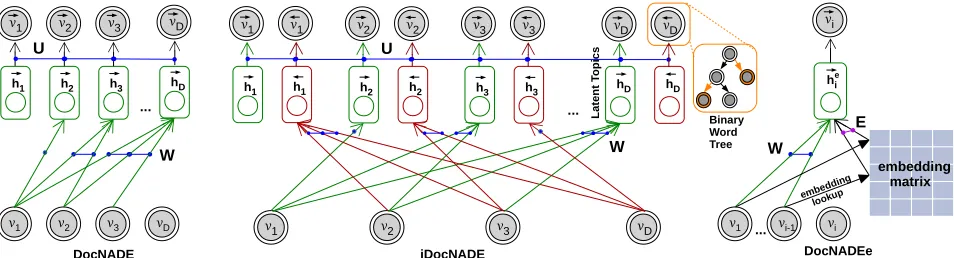
for words preceding a word of interest in a document. More specifically, DocNADE (Larochelle and Lauly 2012; Zheng, Zhang, and Larochelle 2016) (Figure 1, Left) is a probabilistic graphical model that learns topics over se-quences of words, corresponding to a language model (Man-ning and Sch¨utze 1999; Bengio et al. 2003) that can be in-terpreted as a neural network with several parallel hidden layers. To predict the wordvi, each hidden layer hi takes
as input the sequence of preceding wordsvăi. However, it
doesnottake into account the following wordsvąiin the
se-quence. Inspired by bidirectional language models (Mousa and Schuller 2017) and recurrent neural networks (Elman 1990; Gupta, Sch¨utze, and Andrassy 2016; Vu et al. 2016b; 2016a), trained to predict a word (or label) depending on its full left and right contexts, we extend DocNADE and incor-porate full contextual information (all words around vi) at
each hidden layerhi when predicting the wordviin a
lan-guage modeling fashion with neural topic modeling. While this is a powerful approach for incorporating con-textual information in particular for long texts and cor-pora with many documents, learning contextual informa-tion remains challenging in topic models with short texts and few documents, due to (1) limited word co-occurrences or little context and (2) significant word non-overlap in such short texts. However, distributional word representa-tions (i.e. word embeddings) have shown to capture both the semantic and syntactic relatedness in words and demon-strated impressive performance in natural language process-ing (NLP) tasks. For example, assume that we conduct topic analysis over the two short text fragments: “Goldman
v1
h1
Binary Word Tree
DocNADE iDocNADE
W W
U
L
at
en
t
To
p
ic
s
v2 v3 vD v1 h1
v1 v1
v2 v3 vD
h2 U
h2
v2 v2
h3 h3
v3 v3
hD hD
vD vD
v1 v2 v3 vD
h1 h2 h3 hD
... ...
v1
DocNADEe
vi-1 vi
vi
hi
W
embedding matrix
E
embedd ing
looku p
...
e
Figure 1:DocNADE(left),iDocNADE(middle) and DocNADEe (right) models. Blue colored lines signify the connections that share parameters. The observations (double circle) for each wordvi are multinomial. Hidden vectors ingreenandredcolors
identify the forward and backward network layers, respectively. SymbolsÝÑviandÐÝvirepresent the autoregressive conditionals ppvi|văiqandppvi|vąiq, respectively. Connections between eachviand hidden units are shared, and each conditionalÝÑvi(or
ÐÝv
i) is decomposed into a tree of binary logistic regressions, i.e. hierarchical softmax.
weaken economy”. Traditional topic models will not be able
to infer relatedness between word pairs across sentences such as (economy,shares) due to the lack of word-overlap between sentences. However, in embedding space, the word pairs (economy,shares), (market,shares) and (falling,drop) have cosine similarities of0.65,0.56and0.54.
Therefore, we incorporate word embeddings as fixed prior in neural topic models in order to introduce com-plementary information. The proposed neural architectures learn task specific word vectors in association with static embedding priors leading to better text representation for topic extraction, information retrieval, classification, etc.
The multi-foldcontributionsin this work are:(1)We pro-pose an advancement in neural autoregressive topic model by incorporating full contextual information around words in a document to boost the likelihood of each word (and document). This enables learning better (informed) docu-ment representations that we quantify via generalization
(perplexity),interpretability(topic coherence) and
applica-bility(document retrieval and classification). We name the
proposed topic model asDocument Informed Neural
Autore-gressive Distribution Estimator (iDocNADE).(2)We
pro-pose a further extension of DocNADE-like models by incor-porating complementary information via word embeddings, along with the standard sparse word representations (e.g., one-hot encoding). The resulting two DocNADE variants are named asDocument Neural Autoregressive Distribution
Estimator with Embeddings (DocNADEe) and Document
Informed Neural Autoregressive Distribution Estimator with
Embeddings(iDocNADEe).(3)We also investigate the two
contributions above in the deep versions of topic models.
(4) We apply our modeling approaches to 8 short-text and 7 long-text datasets from diverse domains. With the learned representations, we show a gain of 5.2% (404 vs 426) in perplexity,11.1% (.60 vs .54) in precision at retrieval frac-tion 0.02 and5.2% (.664vs.631) inF1for text categoriza-tion, compared to the DocNADE model (on average over 15 datasets).Codeandsupplementary materialare available at
https://github.com/pgcool/iDocNADEe.
Neural Autoregressive Topic Models
RSM (Salakhutdinov and Hinton 2009), a probabilistic undi-rected topic model, is a generalization of the energy-based Restricted Boltzmann Machines RBM (Hinton 2002) that can be used to model word counts. NADE (Larochelle and Murray 2011) decomposes the joint distribution of observa-tions into autoregressive conditional distribuobserva-tions, modeled using non-linear functions. Unlike for RBM/RSM, this leads to tractable gradients of the data negative log-likelihood but can only be used to model binary observations.
DocNADE(Figure 1, Left) is a generative neural
autore-gressive topic model to account for word counts, inspired by RSM and NADE. For a document v “ rv1, ..., vDs of
size D, it models the joint distribution ppvq of all words vi, where vi P t1, ..., Kuis the index of the ith word in
the dictionary of vocabulary sizeK. This is achieved by de-composing it as a product of conditional distributions i.e. ppvq “śDi“1ppvi|văiqand computing each autoregressive
conditionalppvi|văiqvia a feed-forward neural network for iP t1, ...Du,
Ý Ñ
hipvăiq “gpc`řkăiW:,vkq (1)
ppvi“w|văiq “
exppbw`Uw,: Ý Ñ
hipvăiqq
ř
w1exppbw1`Uw1,: Ý Ñ
hipvăiqq
wherevăi P tv1, ..., vi´1u.gp¨qis a non-linear activation
function,WPRHˆKandUPRKˆHare weight matrices,
c P RH andb P RK are bias parameter vectors.H is the
number of hidden units (topics).W:,ăiis a matrix made of
thei´1 first columns ofW. The probability of the word viis thus computed using a position-dependent hidden layer
Ý Ñ
hipvăiqthat learns a representation based on all previous
words văi; however it does not incorporate the following
wordsvąi. Taken together, the log-likelihood of any
docu-mentvof arbitrary length can be computed as:
LDocN ADE
pvq “
D ÿ
i“1
iDocNADE (Figure 1, Right), our proposed model, ac-counts for the full context information (both previous văi
and following vąi words) around each wordvi for a
doc-ument v. Therefore, the log-likelihood LiDocN ADE for a
documentviniDocNADEis computed using forward and backward language models as:
logppvq “ 1
2 D ÿ
i“1
logppvi|văiq loooooomoooooon
forward
`logppvi|vąiq loooooomoooooon backward
(3)
i.e., the mean of the forward (ÝÑL) and backward (ÐLÝ) log-likelihoods. This is achieved in a bi-directional language modeling and feed-forward fashion by computing position dependentforward(ÝÑhi) andbackward(
ÐÝ
hi) hidden layers
for each wordi, as:
Ý Ñ
hipvăiq “gpÝÑc ` ÿ
kăi
W:,vkq (4)
ÐÝ
hipvąiq “gpÐÝc ` ÿ
kąi
W:,vkq (5)
whereÝÑc P RH andÐÝc P RH are bias parameters in
for-ward and backfor-ward passes, respectively.H is the number of hidden units (topics).
Two autoregressive conditionals are computed for each ith word using the forward and backward hidden vectors,
ppvi“w|văiq “
exppÝÑbw`Uw,: Ý Ñ
hipvăiqq ř
w1expp
Ý Ñ
bw1`Uw1,:ÝÑhipvăiqq (6)
ppvi“w|vąiq “
exppÐÝbw`Uw,:ÐhÝipvąiqq ř
w1expp
ÐÝ
bw1`Uw1,:ÐhÝipvąiqq (7)
fori P r1, ..., DswhereÝÑb P RK andÐbÝ PRK are biases
in forward and backward passes, respectively. Note that the parametersWandUare shared between the two networks.
DocNADEe and iDocNADEe with Embedding priors:
We introduce additional semantic information for each word into DocNADE-like models via its pre-trained embedding vector, thereby enabling better textual representations and semantically more coherent topic distributions, in particular for short texts. In its simplest form, we extend DocNADE with word embedding aggregation at each autoregressive stepkto generate a complementary textual representation, i.e.,řkăiE:,vk. This mechanism utilizes prior knowledge
encoded in a pre-trained embedding matrix E P RHˆK
when learning task-specific matrices W and latent repre-sentations in DocNADE-like models. The position depen-dent forwardÝhÑeipvăiqand (only in iDocNADEe) backward
ÐÝ
heipvąiqhidden layers for each wordinow depend onEas:
ÝÑ
heipvăiq “gpÝÑc ` ÿ
kăi
W:,vk`λ
ÿ
kăi
E:,vkq (8)
ÐÝ
heipvąiq “gpÐÝc ` ÿ
kąi
W:,vk`λ
ÿ
kąi
E:,vkq (9)
where,λis a mixture coefficient, determined using valida-tion set. As in equavalida-tions 6 and 7, the forward and backward
Algorithm 1 Computation of logppvq in iDocNADE or
iDocNADEeusingtree-softmaxorfull-softmax
Input: A training document vectorv, Embedding matrix
E
Parameters:{ÝÑb,ÐÝb,ÝÑc,ÐÝc,W,U} Output:logppvq
1: ÝÑa Ð ÝÑc
2: ifiDocNADEthen
3: ÐÝa Ð ÐÝc `řią1W:,vi
4: ifiDocNADEethen
5: ÐÝa Ð ÐÝc `řią1W:,vi`λ
ř
ią1E:,vi
6: qpvq “1
7: forifrom1toDdo
8: ÝÑhiÐgpÝÑaq;
ÐÝ
hiÐgpÐÝaq
9: iftree-softmaxthen
10: ppvi|văiq “1; ppvi|vąiq “1
11: formfrom1to|πpviq|do
12: ppvi|văiq Ðppvi|văiqppπpviqm|văiq
13: ppvi|vąiq Ðppvi|vąiqppπpviqm|vąiq
14: iffull-softmaxthen
15: computeppvi|văiqusing equation 6
16: computeppvi|vąiqusing equation 7
17: qpvq Ðqpvqppvi|văiqppvi|vąiq
18: ifiDocNADEthen
19: ÝÑa Ð ÝÑa `W:,vi;
ÐÝa Ð ÐÝa ´W :,vi
20: ifiDocNADEethen
21: ÝÑa Ð ÝÑa `W:,vi`λE:,vi
22: ÐÝa Ð ÐÝa ´W:,vi´λE:,vi
23: logppvq Ð 12logqpvq
autoregressive conditionals are computed via hidden vectors
ÝÑ
heipvăiqand
ÐÝ
heipvąiq, respectively.
Deep DocNADEs with/without Embedding Priors:
DocNADE can be extended to a deep, multiple hidden layer architecture by adding new hidden layers as in a regular deep feed-forward neural network, allowing for improved perfor-mance (Lauly et al. 2017). In this deep version of DocNADE variants, the first hidden layers are computed in an analogous fashion to iDocNADE (eq. 4 and 5). Subsequent hidden lay-ers are computed as:
Ý Ñ
hi pdq
pvăiq “gpÝÑcpdq`Wpdq¨ÝÑhi pd´1q
pvăiqq
and similarly, ÐhÝi pdq
pvąiqfor d “ 2, ..., n, wherenis the
total number of hidden layers. The exponent “pdq” is used as an index over the hidden layers and parameters in the deep feed-forward network. Forward and/or backward con-ditionals for each word i are modeled using the forward and backward hidden vectors at the last layer n. The deep DocNADE or iDocNADE variants without or with embed-dings are named asDeepDNE,iDeepDNE,DeepDNEeand
iDeepDNEe, respectively whereWp1qis the word
represen-tation matrix. However inDeepDNEe(oriDeepDNEe), we introduce embedding priorEin the first hidden layer, i.e.,
Ý Ñ
hi e,p1q
“gpÝÑcp1q
`ÿ
kăi
Wp1q
:,vk`λ
ÿ
kăi
for each word i via embedding aggregation of its context
văi(andvąi). Similarly, we compute
ÐÝ
hi e,p1q
.
Learning: Similar to DocNADE, the conditionalsppvi“
w|văiqandppvi “w|vąiqin DocNADEe, iDocNADE or
iDocNADEe are computed by a neural network for each wordvi, allowing efficient learning of informed
represen-tations ÝÑhi and
ÐÝ
hi (or
ÝÑ
heipvăiqand
ÐÝ
heipvąiq), as it
con-sists simply of a linear transformation followed by a non-linearity. Observe that the weight W(or prior embedding matrixE) is the same across all conditionals and ties con-textual observables (blue colored lines in Figure 1) by com-puting eachÝÑhior
ÐÝ
hi(or
ÝÑ
heipvăiqand
ÐÝ
heipvąiq).
Binary word tree (tree-softmax) to compute
condi-tionals: To compute the likelihood of a document, the
au-toregressive conditionalsppvi“w|văiqandppvi“w|vąiq
have to be computed for each wordiP r1,2, ...Ds, requiring time linear in vocabulary sizeK. To reduce computational cost and achieve a complexity logarithmic inK we follow Larochelle and Lauly (2012) and decompose the computa-tion of the condicomputa-tionals using a probabilistic tree. All words in the documents are randomly assigned to a different leaf in a binary tree and the probability of a word is computed as the probability of reaching its associated leaf from the root. Each left/right transition probability is modeled using a bi-nary logistic regressor with the hidden layerÝÑhi orÐhÝi (
ÝÑ
hei or ÐhÝei) as its input. In the binary tree, the probability of a given word is computed by multiplying each of the left/right transition probabilities along the tree path.
Algorithm 1 shows the computation of logppvq using
iDocNADE(oriDocNADEe) structure, where the
autogres-sive conditionals (lines 14 and 15) for each wordviare
ob-tained from the forward and backward networks and mod-eled into a binary word tree, whereπpviq denotes the
se-quence of binary left/right choices at the internal nodes along the tree path andlpviqthe sequence of tree nodes on
that tree path. For instance, lpviq1 will always be the root
of the binary tree andπpviq1 will be 0 if the word leafvi
is in the left subtree or 1 otherwise. Therefore, each of the forward and backward conditionals are computed as:
ppvi“w|văiq “ |πpviq|
ź
m“1
ppπpviqm|văiq
ppvi“w|vąiq “ |πpviq|
ź
m“1
ppπpviqm|vąiq
ppπpviqm|văiq “gp
Ý Ñ
blpviqm`Ulpviqm,:
Ý Ñ
hpvăiqq
ppπpviqm|vąiq “gpÐÝblpviqm`Ulpviqm,:
ÐÝ
hpvąiqq
whereU P RTˆH is the matrix of logistic regressions
weights, T is the number of internal nodes in binary tree, andÝÑb andÐbÝare bias vectors.
Each of the forward and backward conditionalsppvi “ w|văiq orppvi “ w|vąiq requires the computation of its
own hidden layersÝÑhipvăiqandÐÝhipvąiq(orÝhÑeipvăiqand
ÐÝ
heipvąiq), respectively. WithHbeing the size of each hidden
Algorithm 2Computing gradients of ´logppvq in
iDoc-NADEoriDocNADEeusingtree-softmax
Input: A training document vectorv Parameters:{ÝÑb,ÐbÝ,ÝÑc,ÐÝc,W,U}
Output:δÝÑb, δÐÝb, δÝÑc, δÐÝc, δW, δU
1: ÝÑa Ð0;ÐaÝÐ0;ÝÑc Ð0;ÐÝc Ð0;ÝÑb Ð0;ÐbÝÐ0
2: forifromDto1do
3: δÝÑhiÐ0; δÐhÝiÐ0
4: formfrom1to|πpviq|do
5: ÝÑblpviqmÐ
Ý Ñ
blpviqm` pppπpviqm|văiq ´πpviqmq
6: ÐÝblpviqmÐ
ÐÝ
blpviqm` pppπpviqm|vąiq ´πpviqmq
7: δÝÑhiÐδÝÑhi` pppπpviqm|văiq ´πpviqmqUlpviqm,:
8: δÐÝhiÐδÐhÝi` pppπpviqm|vąiq ´πpviqmqUlpviqm,:
9: δUlpviqm Ð δUlpviqm ` pppπpviqm|văiq ´
πpviqmqÝÑh T
i ` pppπpviqm|vąiq ´πpviqmqÐÝh T i
10: δÝÑg ÐÝÑhi˝ p1´ÝÑhiq# for sigmoid activation
11: δÐÝg ÐÐÝhi˝ p1´ÐÝhiq# for sigmoid activation
12: δÝÑc ÐδÝÑc `δÝÑhi˝δÝÑg ; δÐÝc ÐδÐÝc `δÐhÝi˝δÐÝg
13: δW:,viÐδW:,vi`δÝÑa `δÐÝa
14: δÝÑa ÐδÝÑa `δÝÑhi˝δÝÑg ; δÐÝa ÐδÐÝa `δÐhÝi˝δÐÝg
layer andDthe number of words inv, computing a single layer requires OpHDq, and since there areD hidden lay-ers to compute, a naive approach for computing all hidden layers would be in OpD2Hq. However, since the weights
in the matrixW are tied, the linear activationsÝÑa andÐÝa (algorithm 1) can be re-used in every hidden layer and com-putational complexity reduces toOpHDq.
With the trainediDocNADEe(orDocNADEvariants), the representation (ÐhÑe PRH) for a new documentv* of sizeD˚
is extracted by summing the hidden representations from the forward and backward networks to account for the context information around each word in the words’ sequence, as
ÝÑ
hepv˚
q “gpÝÑc ` ÿ
kďD˚ W:,v˚
k `λ
ÿ
kďD˚ E:,v˚
kq (10)
ÐÝ
hepv˚
q “gpÐÝc `ÿ
kě1
W:,v˚
k `λ
ÿ
kě1
E:,v˚
kq (11)
Therefore;ÐhÑe “ÝhÑepv˚
q `ÐhÝepv˚
q (12)
The DocNADE variants without embeddings compute the representationÐÑh excluding the embedding termE. Param-eters{ÝÑb,ÐÝb,ÑÝc,ÐÝc,W,U}are learned by minimizing the average negative log-likelihood of the training documents using stochastic gradient descent (algorithm 2). In our pro-posed formulation of iDocNADE or its variants (Figure 1), we perform inference by computingLiDocN ADE
pvq(Eq.3).
Evaluation
We perform evaluations on 15 (8 short-text and 7 long-text) datasets of varying size with single/multi-class labeled documents from public as well as industrial corpora. See
thesupplementary materialfor the data description,
Data Train Val Test K L C Domain
Tree-Softmax(TS) Full-Softmax (FS)
DocNADE iDocNADE DocNADE iDocNADE DocNADEe iDocNADEe
PPL IR PPL IR PPL IR PPL IR PPL IR PPL IR
20NSshort 1.3k 0.1k 0.5k 2k 13.5 20 News 894 .23 880 .30 646 .25 639 .26 638 .28 633 .28
TREC6 5.5k 0.5k 0.5k 2k 9.8 6 Q&A 42 .48 39 .55 64 .54 61 .56 62 .56 60 .57
R21578title: 7.3k 0.5k 3.0k 2k 7.3 90 News 298 .61 239 .63 193 .61 181 .62 179 .65 176 .66 Subjectivity 8.0k .05k 2.0k 2k 23.1 2 Senti 303 .78 287 .81 371 .77 365 .80 362 .80 361 .81
Polarity 8.5k .05k 2.1k 2k 21.0 2 Senti 311 .51 292 .54 358 .54 345 .56 341 .56 340 .57
TMNtitle 22.8k 2.0k 7.8k 2k 4.9 7 News 863 .57 823 .59 711 .44 670 .46 668 .54 664 .55
TMN 22.8k 2.0k 7.8k 2k 19 7 News 548 .64 536 .66 592 .60 560 .64 563 .64 561 .66
AGnewstitle 118k 2.0k 7.6k 5k 6.8 4 News 811 .59 793 .65 545 .62 516 .64 516 .66 514 .68
Avg (short) 509 .55 486 .59 435 .54 417 .57 416 .58 413 .60
20NSsmall 0.4k 0.2k 0.2k 2k 187 20 News - - - - 628 .30 592 .32 607 .33 590 .33
Reuters8 5.0k 0.5k 2.2k 2k 102 8 News 172 .88 152 .89 184 .83 178 .88 178 .87 178 .87
20NS 8.9k 2.2k 7.4k 2k 229 20 News 830 .27 812 .33 474 .20 463 .24 464 .25 463 .25
R21578: 7.3k 0.5k 3.0k 2k 128 90 News 215 .70 179 .74 297 .70 285 .73 286 .71 285 .72 RCV1V2: 23.0k .05k 10.0k 2k 123 103 News 381 .81 364 .86 479 .86 463 .89 465 .87 462 .88 SiROBs: 27.0k 1.0k 10.5k 3k 39 22 Industry 398 .31 351 .35 399 .34 340 .34 343 .37 340 .36
AGNews 118k 2.0k 7.6k 5k 38 4 News 471 .72 441 .77 451 .71 439 .78 433 .76 438 .79
Avg (long) 417 .61 383 .65 416 .56 394 .60 396 .60 393 .60
Avg (all) 469 .57 442 .62 426 .54 406 .58 407 .59 404 .60
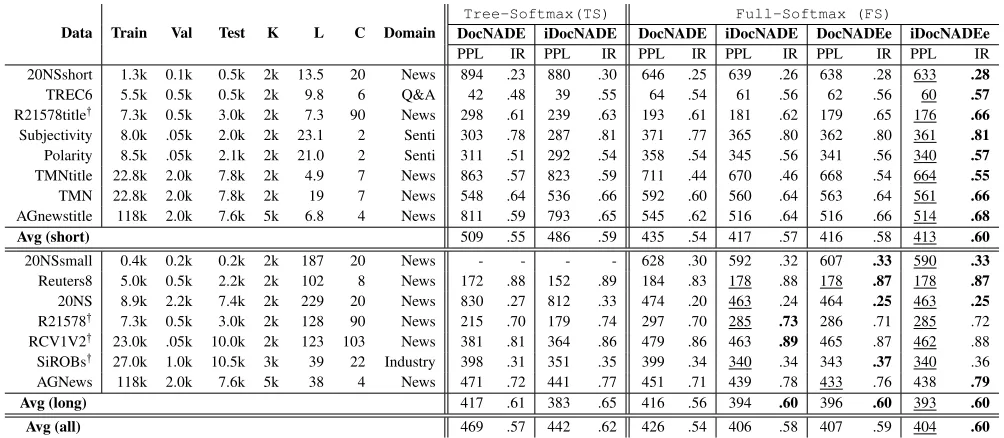
Table 1: Data statistics of short and long texts as well as small and large corpora from various domains. State-of-the-art
comparison in terms of PPL and IR (i.e, IR-precision) forshortandlongtext datasets. The symbols are-L: average text length in number of words,K:dictionary size,C: number of classes, Senti: Sentiment, Avg: average, ‘k’:thousand and:: multi-label data. PPL and IR (IR-precision) are computed over 200 (T200) topics at retrieval fraction = 0.02. For short-text,Lă25. The
underlineandboldnumbers indicate the best scores in PPL and retrieval task, respectively in FS setting. See Larochelle and
Lauly (2012) for LDA (Blei, Ng, and Jordan 2003) performance in terms of PPL, where DocNADE outperforms LDA.
300 600 900 1,200 1,500 300
600 900 1,200 1,500
iDocNADE
DocN
ADE
20NS (20-NewsGroups)
(a) PPL: 20NS
2 3 4 5 6 7 8 9 10 11 2
3 4 5 6 7 8 9 10 11
CD comment
course does
doubt
march microsoft
NT port
ROM server
source
windows
iDocNADE
DocN
ADE
20NS (20-NewsGroups)
(b) NLL of 14 Words
Figure 2: (a) PPL (T200) by iDocNADE and DocNADE for each of the 50 held-out documents of 20NS. Thefilled circle
points to the document for whichPPLdiffers by maximum. (b) NLL of each of the words in the document marked by
thefilled circlein (a), due to iDocNADE and DocNADE.
et al. (2018a) have shown that DocNADE outperforms gaussian-LDA (Das, Zaheer, and Dyer 2015), glove-LDA and glove-DMM (Nguyen et al. 2015) in terms of topic co-herence, text retrieval and classification, therefore we adopt DocNADE as the strongbaseline. We use the development (dev) sets of each of the datasets to perform a grid-search on mixture weights,λ“ r0.1,0.5,1.0s.
Generalization (Perplexity, PPL) We evaluate the topic
models’ generative performance as a generative model of documents by estimating log-probability for the test documents. During training, we initialize the proposed DocNADE extensions with DocNADE, i.e., W ma-trix. A comparison is made with the baselines
(Doc-NADE and DeepDNE) and proposed variants (iDoc(Doc-NADE, DocNADEe, iDocNADEe, iDeepDNE, DeepDNEe and iDeepDNEe) using 50 (in supplementary) and 200 (T200) topics, set by the hidden layer sizeH.
Quantitative: Table 1 shows the average held-out
perplexity (P P L) per word as, P P L “ exp` ´ 1
N řN
t“1 1
|vt|logppv
t
q˘whereNand|vt
|are the total num-ber of documents and words in a documentvt. To compute
PPL, the log-likelihood of the documentvt, i.e.,logp
pvt
q, is obtained byLDocN ADE (eqn. 2) in the DocNADE
(for-ward only) variants, while we average PPL scores from the forward and backward networks of the iDocNADE variants. Table 1 shows that the proposed models achieve lower perplexity for both the short-text (413vs435) and long-text (393 vs 416) datasets than baseline DocNADE with full-softmax (or tree-full-softmax). In total, we show a gain of5.2% (404 vs 426) in PPL score on an average over the 15 datasets. Table 2 illustrates the generalization performance of deep variants, where the proposed extensions outperform the DeepDNE for both short-text and long-text datasets. We re-port a gain of 10.7% (402vs450) in PPL due to iDeepDNEe over the baseline DeepDNE, on an average over 11 datasets.
Inspection: We quantify the use of context
0.0001 0.0005 0.001 0.002 0.005 0.01 0.02 0.05 0.1 0.2
0.3 0.35 0.4 0.45 0.5 0.55 0.6 0.65 0.7
Fraction of Retrieved Documents (Recall)
Pr
ecision
(%)
iDeepDNEe DeepDNE iDocNADEe
iDocNADE DocNADEe DocNADE glove
(a)IR:TMNtitle
0.0001 0.0005 0.001 0.002 0.005 0.01 0.02 0.05 0.1 0.2
0.4 0.45 0.5 0.55 0.6 0.65 0.7 0.75 0.8
Fraction of Retrieved Documents (Recall)
Pr
ecision
(%)
iDeepDNEe DeepDNE iDocNADEe
iDocNADE DocNADEe DocNADE glove
(b)IR:AGnewstitle
0.0005 0.001 0.002 0.005 0.01 0.02 0.05 0.1 0.2
0.12 0.16 0.2 0.24 0.28 0.32 0.36 0.4 0.44 0.48
Fraction of Retrieved Documents (Recall)
Pr
ecision
(%)
iDeepDNEe DeepDNE iDocNADEe
iDocNADE DocNADEe DocNADE glove
(c)IR:20NSshort
0.0001 0.0005 0.001 0.002 0.005 0.01 0.02 0.05 0.1 0.2 0.3
0.1 0.14 0.18 0.22 0.26 0.3 0.34 0.38 0.42
Fraction of Retrieved Documents (Recall)
Pr
ecision
(%)
iDeepDNEe DeepDNE iDocNADEe
iDocNADE DocNADEe DocNADE glove
(d)IR:20NS
0.0005 0.001 0.002 0.005 0.01 0.02 0.05
0.1 0.2 0.3
0.64 0.67 0.7 0.73 0.76 0.79 0.82 0.85 0.88 0.91 0.94
Fraction of Retrieved Documents (Recall)
Pr
ecision
(%)
iDeepDNEe DeepDNE iDocNADEe iDocNADE DocNADEe DocNADE glove
(e)IR:Reuters8
0.0001 0.0005 0.001 0.002 0.005 0.01 0.02 0.05 0.1 0.2
0.5 0.55 0.6 0.65 0.7 0.75 0.8 0.85
Fraction of Retrieved Documents (Recall)
Pr
ecision
(%)
iDeepDNEe DeepDNE iDocNADEe
iDocNADE DocNADEe DocNADE glove
(f)IR:AGnews
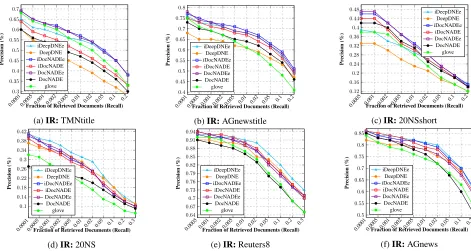
Figure 3: Document retrieval performance (IR-precision) on 3 short-text and 3 long-text datasets at different retrieval fractions
PPLdiffers by a maximum between iDocNADE and Doc-NADE. We select the corresponding document and compute the negative log-likelihood (NLL) for every word. Figure 2b shows that theNLLfor the majority of the words is lower (better) in iDocNADE than DocNADE. See the
supplemen-tary materialfor the raw text of the selected documents.
Interpretability (Topic Coherence) Beyond PPL, we
compute topic coherence (Chang et al. 2009; Newman, Karimi, and Cavedon 2009; Das, Zaheer, and Dyer 2015; Gupta et al. 2018b) to assess the meaningfulness of the un-derlying topics captured. We choose the coherence measure proposed by R¨oder, Both, and Hinneburg (2015) that iden-tifies context features for each topic word using a sliding window over the reference corpus. The higher scores imply more coherent topics.
Quantitative:We use gensim module (coherence type=
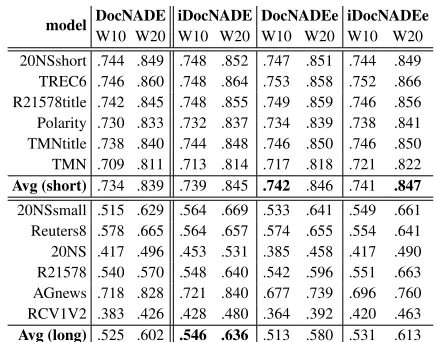
c v) to estimate coherence for each of the 200 topics (top 10 and 20 words). Table 3 shows average coherence over 200 topics using short-text and long-text datasets, where the high scores for long-text in iDocNADE (.636vs.602) sug-gest that the contextual information helps in generating more coherent topics than DocNADE. On top, the introduction of embeddings, i.e., iDocNADEe for short-text boosts (.847vs .839) topic coherence.Qualitative: Table 5 illustrates ex-ample topics each with a coherence score.
Applicability (Document Retrieval) To evaluate the
quality of the learned representations, we perform a docu-ment retrieval task using the 15 datasets and their label in-formation. We use the experimental setup similar to Lauly et al. (2017), where all test documents are treated as queries to retrieve a fraction of the closest documents in the orig-inal training set using cosine similarity measure between
data DeepDNE iDeepDNE DeepDNEe iDeepDNEe
PPL IR PPL IR PPL IR PPL IR
20NSshort 917 .21 841 .22 827 .25 830 .26
TREC6 114 .50 69 .52 69 .55 68 .55
R21578title 253 .50 231 .52 236 .63 230 .61
Subjectivity 428 .77 393 .77 392 .81 392 .82
Polarity 408 .51 385 .51 383 .55 387 .53
TMN 681 .60 624 .62 627 .63 623 .66
Avg (short) 467 .51 424 .53 422 .57 421 .57
Reuters8 216 .85 192 .89 191 .88 191 .90
20NS 551 .25 504 .28 504 .29 506 .29
R21578 318 .71 299 .73 297 .72 298 .73
AGNews 572 .75 441 .77 441 .75 440 .80
RCV1V2 489 .86 464 .88 466 .89 462 .89
Avg (long) 429 .68 380 .71 379 .71 379 .72
Avg (all) 450 .59 404 .61 403 .63 402 .64
Table 2: Deep Variants (+ Full-softmax) with T200: PPL and IR (i.e, IR-precision) forshortandlongtext datasets.
their representations (eqn. 12 in iDocNADE and ÝÑhD in
DocNADE). To compute retrieval precision for each frac-tion (e.g., 0.0001, 0.005, 0.01, 0.02, 0.05, 0.1, 0.2, etc.), we average the number of retrieved training documents with the same label as the query. For multi-label datasets, we average the precision scores over multiple labels for each query. Since Salakhutdinov and Hinton (2009) and Lauly et al. (2017) showed that RSM and DocNADE strictly outper-form LDA on this task, we only compare DocNADE and its proposed extensions.
im-model DocNADE iDocNADE DocNADEe iDocNADEe
W10 W20 W10 W20 W10 W20 W10 W20 20NSshort .744 .849 .748 .852 .747 .851 .744 .849 TREC6 .746 .860 .748 .864 .753 .858 .752 .866 R21578title .742 .845 .748 .855 .749 .859 .746 .856 Polarity .730 .833 .732 .837 .734 .839 .738 .841 TMNtitle .738 .840 .744 .848 .746 .850 .746 .850 TMN .709 .811 .713 .814 .717 .818 .721 .822
Avg (short) .734 .839 .739 .845 .742 .846 .741 .847
20NSsmall .515 .629 .564 .669 .533 .641 .549 .661 Reuters8 .578 .665 .564 .657 .574 .655 .554 .641 20NS .417 .496 .453 .531 .385 .458 .417 .490 R21578 .540 .570 .548 .640 .542 .596 .551 .663 AGnews .718 .828 .721 .840 .677 .739 .696 .760 RCV1V2 .383 .426 .428 .480 .364 .392 .420 .463
Avg (long) .525 .602 .546 .636 .513 .580 .531 .613
Table 3: Topic coherence with the top 10 (W10) and 20 (W20) words from topic models (T200). Since, (Gupta et al. 2018a) have shown that DocNADE outperforms both glove-DMM and glove-LDA, therefore DocNADE as the baseline.
data glove doc2vec DocNADE DocNADEe iDocNADE iDocNADEe
F1 acc F1 acc F1 acc F1 acc F1 acc F1 acc
20NSshort .493 .520 .413 .457 .428 .474 .473 .529 .456 .491 .518 .535 TREC6 .798 .810 .400 .512 .804 .822 .854 .856 .808 .812 .842 .844 R21578title .356 .695 .176 .505 .318 .653 .352 .693 .302 .665 .335 .700 Subjectivity .882 .882 .763 .763 .872 .872 .886 .886 .871 .871 .886 .886 Polarity .715 .715 .624 .624 .693 .693 .712 .712 .688 .688 .714 .714 TMNtitle .693 .727 .582 .617 .624 .667 .697 .732 .632 .675 .696 .731
TMN .736 .755 .720 .751 .740 .778 .765 .801 .751 .790 .771 .805
AGnewstitle .814 .815 .513 .515 .812 .812 .829 .828 .819 .818 .829 .828 Avg (short).685 .739 .523 .593 .661 .721 .696 .755 .666 .726 .700 .756
Reuters8 .830 .950 .937 .852 .753 .931 .848 .956 .836 .957 .860 .960 20NS .509 .525 .396 .409 .512 .535 .514 .540 .524 .548 .523 .544 R21578 .316 .703 .215 .622 .324 .716 .322 .721 .350 .710 .300 .722 AGnews .870 .871 .713 .711 .873 .876 .880 .880 .880 .880 .886 .886
RCV1V2 .442 .368 .442 .341 .461 .438 .460 .457 .463 .452 .465 .454
Avg (long).593 .683 .540 .587 .584 .699 .605 .711 .611 .710 .607 .713
Avg (all).650 .718 .530 .590 .631 .712 .661 .738 .645 .720 .664 .740
Table 4: Text classification for short and long texts with T200 or word embedding dimension (Topic models with FS)
proved performance on the IR task for short-text and long-text datasets. We report a gain of11.1% (.60vs.54) in pre-cision on an average over the 15 datasets, compared to Doc-NADE. On top, the deep variant i.e. iDeepDNEe (Table 2) demonstrates a gain of 8.5% (.64vs.59) in precision over the 11 datasets, compared to DeepDNE. Figures (3a, 3b, 3c) and (3d, 3e and 3f) illustrate the average precision for the re-trieval task on short-text and long-text datasets, respectively.
Applicability (Text Categorization) Beyond the
docu-ment retrieval, we perform text categorization to measure the quality of word vectors learned in the topic models. We consider the same experimental setup as in the doc-ument retrieval task and extract the docdoc-ument representa-tion (latent vector) of 200 dimension for each document (or text), learned during the training of DocNADE variants. To perform document categorization, we employ a logistic regression classifier withL2regularization. We also com-pute document representations from pre-trained glove (Pen-nington, Socher, and Manning 2014) embedding matrix by
DocNADE iDocNADE DocNADEe
beliefs, muslims, scripture, atheists, atheists, christianity,
forward, alt, sin, religions, belief, eternal,
islam, towards, christianity, lord, atheism, catholic,
atheism, christianity, bible, msg, bible, arguments,
hands, opinions heaven, jesus islam, religions
0.44 0.46 0.52
Table 5: Topics (top 10 words) of 20NS with coherence
book jesus windows gun
neighbors si sg neighbors si sg neighbors si sg neighbors si sg
books .61 .84 christ .86 .83 dos .74 .34 guns .72 .79 reference .52 .51 god .78 .63 files .63 .36 firearms .63 .63 published .46 .74 christians .74 .49 version .59 .43 criminal .63 .33 reading .45 .54 faith .71 .51 file .59 .36 crime .62 .42 author .44 .77 bible .71 .51 unix .52 .47 police .61 .43
Table 6: 20NS dataset: The five nearest neighbors by iDoc-NADE.si: Cosine similarity between the word vectors from
iDocNADE, for instance vectors ofjesusandgod.sg:
Co-sine similarity in embedding vectors from glove.
summing the word vectors and compute classification per-formance. On top, we also extract document representation from doc2vec (Le and Mikolov 2014).
Table 4 shows thatglove leads DocNADE in classifica-tion performance, suggesting a need for distribuclassifica-tional pri-ors. For short-text dataset, iDocNADEe (and DocNADEe) outperforms glove(.700vs .685) and DocNADE (.700 vs .661) in F1. Overall, we report a gain of 5.2% (.664vs.631) in F1 due to iDocNADEe over DocNADE for classification on an average over 13 datasets.
Inspection of Learned Representations: To analyze the
meaningful semantics captured, we perform a qualitative in-spection of the learned representations by the topic mod-els. Table 5 shows topics for 20NS dataset that could be in-terpreted asreligion, which are (sub)categories in the data, confirming that meaningful topics are captured. Observe that DocNADEe extracts a more coherent topic.
For word level inspection, we extract word
representa-tionsusing the columnsW:,vias the vector (200 dimension)
representation of each wordvi, learned by iDocNADE
us-ing 20NS dataset. Table 6 shows the five nearest neighbors of some selected words in this space and their correspond-ing similarity scores. We also compare similarity in word vectors from iDocNADE and glove embeddings, confirming that meaningful word representations are learned.
Conclusion
References
Bengio, Y.; Ducharme, R.; Vincent, P.; and Jauvin, C. 2003. A neural probabilistic language model. InJournal of
Ma-chine Learning Research 3, 1137—1155.
Blei, D.; Ng, A.; and Jordan, M. 2003. Latent dirichlet allocation. 993–1022.
Chang, J.; Boyd-Graber, J.; Wang, C.; Gerrish, S.; and Blei., D. M. 2009. Reading tea leaves: How humans interpret topic models. InIn Neural Information Processing Systems
(NIPS).
Das, R.; Zaheer, M.; and Dyer, C. 2015. Gaussian lda for topic models with word embeddings. InProceedings of the 53rd Annual Meeting of the Association for Computational Linguistics and the 7th International Joint Conference on
Natural Language Processing. Association for
Computa-tional Linguistics.
Elman, J. L. 1990. Finding structure in time. Cognitive
science14(2):179–211.
Gupta, P.; Chaudhary, Y.; Buettner, F.; and Sch¨utze, H. 2018a. texttovec: Deep contextualized neural autoregressive models of language with distributed compositional prior. In
Preprint arxiv.
Gupta, P.; Rajaram, S.; Sch¨utze, H.; and Andrassy, B. 2018b. Deep temporal-recurrent-replicated-softmax for top-ical trends over time. InProceedings of the 2018 Conference of the North American Chapter of the Association for Com-putational Linguistics: Human Language Technologies,
Vol-ume 1 (Long Papers), volume 1, 1079–1089. New Orleans,
USA: Association of Computational Linguistics.
Gupta, P.; Sch¨utze, H.; and Andrassy, B. 2016. Table fill-ing multi-task recurrent neural network for joint entity and relation extraction. InProceedings of COLING 2016, the 26th International Conference on Computational
Linguis-tics: Technical Papers, 2537—2547.
Hinton, G. E. 2002. Training products of experts by min-imizing contrastive divergence. In Neural Computation, 1771–1800.
Larochelle, H., and Lauly, S. 2012. A neural autoregres-sive topic model. InProceedings of the Advances in Neural
Information Processing Systems 25 (NIPS 2012). NIPS.
Larochelle, H., and Murray, I. 2011. The neural autoregres-sive distribution estimato. InProceedings of the 14th Inter-national Conference on Artificial Intelligence and Statistics
(AISTATS 2011), 29—37. JMLR.
Lauly, S.; Zheng, Y.; Allauzen, A.; and Larochelle, H. 2017. Document neural autoregressive distribution estima-tion.Journal of Machine Learning Research18(113):1–24. Le, Q. V., and Mikolov, T. 2014. Distributed representations of sentences and documents. 1188–1196.
Manning, C. D., and Sch¨utze, H. 1999. Foundations of sta-tistical natural language processing. Cambridge MA: The MIT Press.
Mousa, A. E.-D., and Schuller, B. 2017. Contextual bidi-rectional long short-term memory recurrent neural network language models: A generative approach to sentiment anal-ysis. InProceedings of the 15th Conference of the European
Chapter of the Association for Computational Linguistics,
1023—1032. Association for Computational Linguistics. Newman, D.; Karimi, S.; and Cavedon, L. 2009. External evaluation of topic models. InProceedings of the 14th
Aus-tralasian Document Computing Symposium.
Nguyen, D. Q.; Billingsley, R.; Du, L.; and Johnson, M. 2015. Improving topic models with latent feature word rep-resentations. Transactions of the Association for
Computa-tional Linguistics3:299–313.
Pennington, J.; Socher, R.; and Manning, C. D. 2014. Glove: Global vectors for word representation. In Proceedings of the 2014 Conference on Empirical Methods in Natural Language Processing, EMNLP 2014, October 25-29, 2014, Doha, Qatar, A meeting of SIGDAT, a Special Interest Group
of the ACL, 1532–1543.
R¨oder, M.; Both, A.; and Hinneburg, A. 2015. Exploring the space of topic coherence measures. InProceedings of
the WSDM. ACM.
Salakhutdinov, R., and Hinton, G. 2009. Replicated soft-max: an undirected topic model. InProceedings of the Ad-vances in Neural Information Processing Systems 22 (NIPS
2009), 1607–1614. NIPS.
Vu, N. T.; Adel, H.; Gupta, P.; and Sch¨utze, H. 2016a. Com-bining recurrent and convolutional neural networks for re-lation classification. InProceedings of the North American Chapter of the Association for Computational Linguistics:
Human Language Technologies, 534–539. San Diego,
Cali-fornia USA: Association for Computational Linguistics. Vu, N. T.; Gupta, P.; Adel, H.; and Sch¨utze, H. 2016b. Bi-directional recurrent neural network with ranking loss for spoken language understanding. In Proceedings of IEEE/ACM Trans. on Audio, Speech, and Language
Pro-cessing (ICASSP). IEEE.
Zheng, Y.; Zhang, Y.-J.; and Larochelle, H. 2016. A deep and autoregressive approach for topic modeling of multi-modal data. InIEEE transactions on pattern analysis and