ISSN: 2231-5373
http://www.ijmttjournal.org
Page 120
Graphs and Codes
N. Suresh Babu
1, G. Suresh Singh
2Sreedevi S.L.
3 1Assistant Professor, Dept. of Mathematics,University College, Thiruvananthapuram. 2
Professor, 3Research Scholar, Dept. of Mathematics, University of Kerala,
Thiruvananthapuram.
Abstract. Binary codes from graphs have been studied widely since 1960’s. Matrices associated with the graphs were considered as a good tool to construct codes from graphs. Incidence matrix, Adjacency matrix, cut set matrix, circuit matrix etc. were widely used to construct codes with desirable properties. Here we introduce a new binary code –the vertex code 𝐶 from a given graph 𝐺, depending on the degree of the vertices of 𝐺, in such a way that the vertex polynomial of 𝐺 is same as the weight enumerator of 𝐶.
Key words: Graph, vertex degree, binary code.
Introduction
Let 𝐺 = (𝑉, 𝐸) be any simple graph of order 𝑝 and size 𝑞. 𝑑𝑒𝑔 𝑣𝑖 denotes the degree of vertex 𝑣𝑖, 𝛿 𝐺 and
∆ 𝐺 represents the minimum and maximum degree of 𝐺. For the definitions and algorithms from graph theory we follow [3].
A binary block code 𝐶 of length 𝑛 is a collection of binary words of length 𝑛. A word is a sequence of binary digits. In a binary word the only digits are 0 and 1. The size of 𝐶 denoted as 𝐶 is the number of words of 𝐶.
If 𝐶 = 𝑐1, 𝑐2, 𝑐3, … , 𝑐𝑛 , the Hamming distance between any two code words 𝑐𝑖 and 𝑐𝑗 is defined as 𝑑𝐻 𝑐𝑖, 𝑐𝑗 = 𝑁𝑢𝑚𝑏𝑒𝑟 𝑜𝑓 𝑐𝑜𝑜𝑟𝑑𝑖𝑛𝑎𝑡𝑒𝑠 𝑖𝑛 𝑤𝑖𝑐 𝑐𝑖 𝑎𝑛𝑑 𝑐𝑗 𝑑𝑖𝑓𝑓𝑒𝑟. The minimum distance of 𝐶 is the
𝑚𝑖𝑛 𝑑𝐻 𝑐𝑖, 𝑐𝑘 ; 𝑐𝑖 ≠ 𝑐𝑘; ∀ 𝑐𝑖, 𝑐𝑘 ∈ 𝐶 . The Hamming weight of a code word 𝑐𝑖 is the number of ones in it and
is denoted as 𝑤𝑡𝐻 𝑐𝑖 . For coding concepts we refer to [1].
1. Codes from Graphs
A non linear code 𝐶 can be constructed from certain classes of graphs such that to every vertex 𝑢𝑖, of the given
graph 𝐺, there corresponds a code word 𝑐𝑖 of 𝐶 satisfying:
i. 𝑑𝑒𝑔 𝑢𝑖 = 𝑤𝑡𝐻 𝑐𝑖 .
ii. To every pair of adjacent vertices 𝑢𝑖, 𝑢𝑗 of 𝐺, there corresponds code words 𝑐𝑖, 𝑐𝑗 having the
property, 𝑑𝐻 𝑐𝑖, 𝑐𝑗 =
𝑑𝑒𝑔 𝑢𝑖 − 𝑑𝑒𝑔 𝑢𝑗 ; 𝑖𝑓 𝑑𝑒𝑔 𝑢𝑖 ≠ 𝑑𝑒𝑔 𝑢𝑗
2, 𝑖𝑓 𝑑𝑒𝑔 𝑢𝑖 = 𝑑𝑒𝑔 𝑢𝑗
.
iii. The block length 𝑛 of 𝐶 is chosen to be the minimum 𝑛 satisfying
𝑛
𝑗 ≥ 𝑛𝑢𝑚𝑏𝑒𝑟 𝑜𝑓 𝑣𝑒𝑟𝑡𝑖𝑐𝑒𝑠 𝑜𝑓 𝑑𝑒𝑔𝑟𝑒𝑒 𝑗 𝑖𝑛 𝐺; 𝛿(𝐺) ≤ 𝑗 ≤ ∆(𝐺).
iv. Thus the size of 𝐶 is equal to the order of 𝐺.
The code so formed gives an idea about the number of vertices and the vertex degrees of the graph 𝐺 and hence called vertex code of 𝐺.
Definition The vertex code 𝐶 of a graph 𝐺 of order 𝑝 is a collection of 𝑝 code words satisfying the conditions i.-iii. mentioned above.
The condition ii., is here after termed as distance-degree criteria of code and graph.
ISSN: 2231-5373
http://www.ijmttjournal.org
Page 121
Remark Since 𝐺 is a simple graph of order 𝑝, no vertex in 𝐺 can have degree greater than (𝑝 − 1), also at least
two vertices will have same degree.
Algorithm
1. Write the degree sequence of 𝐺 and let 𝑎𝑖 be the number of vertices with degree 𝑖.
2. Fix the block length 𝑛 of code 𝐶 to be the minimum 𝑛 satisfying 𝑛𝑖 ≥ 𝑎𝑖 for every 𝑎𝑖.
3. Start from a vertex 𝑣𝑘 with maximum degree, assign a code word 𝑐𝑘 arbitrarily to 𝑣𝑘, with length 𝑛 as
on step 2. and 𝑤𝑡𝐻 𝑐𝑘 = 𝑑𝑒𝑔 𝑣𝑘 .
4. If more than one vertex has maximum degree, choose the first vertex arbitrarily, and assign a code word with weight equal to its degree. Next vertex is arbitrarily chosen and assigned code word as earlier. Continue this process till all the vertices with maximum degree are assigned code words. 5. Next higher degree vertex is selected and code word of length 𝑛 and Hamming weight equal to the
degree of vertex is assigned to it, satisfying the distance-degree criteria with the code words assigned in steps 3. and 4.
6. A vertex 𝑣𝑗 having degree just one less than the maximum degree can be assigned a code word 𝑐𝑗 only
if 𝑣𝑗 is adjacent to at most two vertices say 𝑣𝑘 and 𝑣𝑙 of maximum degree. Also if there exist any other
vertex 𝑣𝑓 such that 𝑑𝑒𝑔 𝑣𝑗 = 𝑑𝑒𝑔 𝑣𝑓 and 𝑣𝑓 is also adjacent to 𝑣𝑘 and 𝑣𝑙, then no distinct code
words 𝑐𝑗 and 𝑐𝑓 can be assigned to the vertices 𝑣𝑗 and 𝑣𝑓. Then go to step 9. and if no such 𝑣𝑓 exists 7.
7. Choose the next highest vertex degree and assign code words as in 5. 8. Repeat steps 5. → 7. till we reach 9. or 10.
9. No vertex code of 𝐺 exists.
10. The code words with respect to all vertices of 𝐺 makes the vertex code 𝐶 of 𝐺, such that 𝐶 = 𝑝.
Remark: The vertex code of a graph is not unique.
To find the vertex code of given graphs using the algorithm
Example 1
To show the existence of the vertex code for the graph 𝐺 in figure 1.
The degree sequence is 5, 5, 4, 4, 4, 4, 3, 3, 3, 3, 2 ; 𝑎5= 2; 𝑎4= 4; 𝑎3= 4;
𝑎2= 1.
The block length 𝑛 = 6
The maximum degree 5° vertices 𝑣1 and 𝑣7 are assigned code words 𝑐1 and 𝑐7 of length 6 and
Hamming weight 5. Let
ISSN: 2231-5373
http://www.ijmttjournal.org
Page 122
𝑐1= 111110
𝑐7= 111101
The vertices with then the maximum degree 4° are 𝑣3, 𝑣4, 𝑣5, 𝑣10 . The vertex 𝑣5 is adjacent to both 𝑣1
and 𝑣7. So it is given a preference over 𝑣3, 𝑣4 and 𝑣10 and assigned a code word 𝑐5, such that
𝑑𝐻 𝑐1, 𝑐5 = 1 = 𝑑𝐻 𝑐7, 𝑐5
Hence, 𝑐5= 111100.
Then code words 𝑐3, 𝑐4 and 𝑐10 are assigned to vertices 𝑣3, 𝑣4 and 𝑣10, such that,
𝑑𝐻 𝑐1, 𝑐4 = 𝑑𝐻 𝑐1, 𝑐3 = 𝑑𝐻 𝑐7, 𝑐10 = 1
𝑑𝐻 𝑐4, 𝑐3 = 𝑑𝐻 𝑐4, 𝑐10 = 2
Thus,
𝑐3= 101110
𝑐4= 110110
𝑐10= 110101
Now the vertices 𝑣6, 𝑣8, 𝑣9, 𝑣11 have degree 3 each and all have equal priority in getting assigned a
code word. So choosing randomly and assigning code words 𝑐6, 𝑐8, 𝑐9, 𝑐11 respectively to the vertices 𝑣6, 𝑣8, 𝑣9, 𝑣11 only based on distance - degree criteria of:
𝑑𝐻 𝑐5, 𝑐6 = 1 ; 𝑑𝐻 𝑐7, 𝑐6 = 2
𝑑𝐻 𝑐6, 𝑐11 = 2 ; 𝑑𝐻 𝑐7, 𝑐8 = 2
𝑑𝐻 𝑐3, 𝑐8 = 1; 𝑑𝐻 𝑐8, 𝑐9 = 2
𝑑𝐻 𝑐1, 𝑐9 = 2 ; 𝑑𝐻 𝑐10, 𝑐9 = 1
𝑑𝐻 𝑐7, 𝑐11 = 2 ; 𝑑𝐻 𝑐10, 𝑐11 = 1
Thus,
𝑐6= 111000 𝑐8= 101100
𝑐9= 110100 𝑐11= 110010
Then the only two degree vertex 𝑣2 is assigned code word 𝑐2 satisfying,
𝑑𝐻 𝑐1, 𝑐2 = 3
𝑑𝐻 𝑐3, 𝑐2 = 2
Thus,
𝑐2= 101000
Thus the vertex code 𝐶 of 𝐺2is :
𝐶 = 111110, 101000, 101110, 110110, 111100, 111000, 111101, 101100, 110100, 110101,110001
Example 2
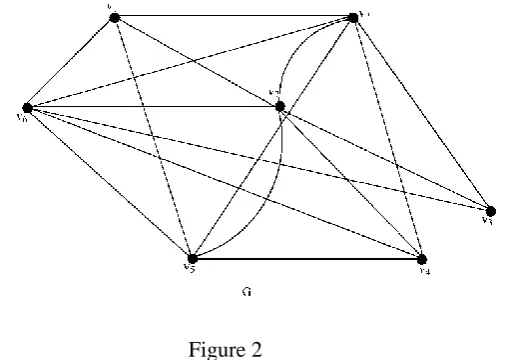
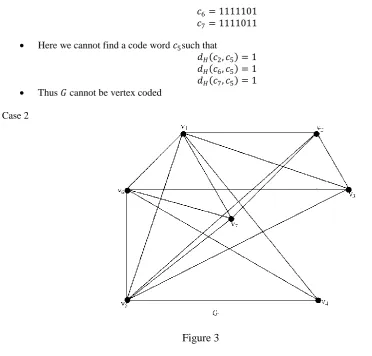
To show the non existence of the vertex code of graphs 𝐺 in figure 2 and 𝐺1 in figure 3. (Considered as case 1
and case 2) Case 1
Following the algorithm the block length 𝑛 of the required code 𝐶 can be fixed as 𝑛 = 7.
Here the maximum degree (6°) vertices are 𝑣2, 𝑣6, 𝑣7. The vertex having degree next to the maximum degree is
𝑣5 (of degree 5).
𝑣2, 𝑣6, 𝑣7 are assigned code words 𝑐2, 𝑐6, 𝑐7 of length 7 and Hamming weight 6 arbitrarily so that
𝑐2= 1111110
ISSN: 2231-5373
http://www.ijmttjournal.org
Page 123
𝑐6= 1111101
𝑐7= 1111011
Here we cannot find a code word 𝑐5such that
𝑑𝐻 𝑐2, 𝑐5 = 1
𝑑𝐻 𝑐6, 𝑐5 = 1
𝑑𝐻 𝑐7, 𝑐5 = 1
Thus 𝐺 cannot be vertex coded
Case 2
Degree sequence is 6, 6, 5, 5, 4, 4, 4 . So that 𝑎6= 2; 𝑎5= 2; 𝑎4= 3.
Block length 𝑛 is chosen to be the minimum satisfying all 𝑛
6 ≥ 2; 𝑛
5 ≥ 2; 𝑛
4 ≥ 3. Thus 𝑛 = 7.
The vertices 𝑣1 and 𝑣5 with maximum degree are arbitrarily assigned two code words 𝑐1 and 𝑐5 with
length 7 and Hamming weight 6, where
𝑐1= 1111110
𝑐5= 1111101
The vertices 𝑣2 and 𝑣6 have vertex degrees 5. The code words 𝑐2 and 𝑐6 must be of length 7 and Hamming weight 5, also they should satisfy,
𝑑𝐻 𝑐1, 𝑐6 = 1 = 𝑑𝐻 𝑐5, 𝑐6
and
𝑑𝐻 𝑐1, 𝑐2 = 1 = 𝑑𝐻 𝑐5, 𝑐2
Since, there exists only one code word 1111100 satisfying these conditions either 𝑣2 or 𝑣6 can be assigned a
code word.
Thus the vertex coding of graph 𝐺1ends in failure.
Result Let 𝐺 be a graph having vertex code 𝐶. Then the vertex polynomial of 𝐺 is the same as that of the weight enumerator of 𝐶.
We already have for any given graph 𝐺, its vertex polynomial [2], 𝑆𝐺 𝑥 = ∆(𝐺)𝑗 =0𝑎𝑗𝑥𝑗, where 𝑎𝑗 is the number
of vertices with degree 𝑗. Since our study is restricted only to connected graphs, 𝑆𝐺 𝑥 = ∆(𝐺)𝑗 =1 𝑎𝑗𝑥𝑗.
In the vertex code we defined here the code words depend on the vertex degrees of the corresponding graphs. Hence the Hamming weight of each code word equals the degree of the corresponding vertex.
Figure 3
ISSN: 2231-5373
http://www.ijmttjournal.org
Page 124
Also in [2] the weight enumerator of a code 𝐶is defined as 𝑊𝐶 𝑥 = 𝑛𝑘=1𝑐𝑘𝑥𝑘, where 𝑐𝑘 denotes the numberof code words with Hamming weight 𝑘.
In vertex code 𝛿(𝐺) ≤ 𝑘 ≤ ∆(𝐺).
Thus 𝑊𝐶 𝑥 = 𝑆𝐺 𝑥
𝑑𝐻 𝑐2, 𝑐4 = 𝑑𝐻 𝑐3, 𝑐5 = 2
𝑑𝐻 𝑐1, 𝑐5 = 𝑑𝐻 𝑐3, 𝑐4 = 𝑑𝐻 𝑐4, 𝑐5 = 4
We have the distance of a Code, 𝑑 𝐶 = 𝑚𝑖𝑛 𝑑𝐻 𝑐𝑖, 𝑐𝑗 , 𝑐𝑖, 𝑐𝑗 ∈ 𝐶, ∀ 𝑐𝑖 ≠ 𝑐𝑗 .
Thus the vertex code of cycle 𝐶𝑚 is of distance two.
2. Graphs from codes
Earlier we constructed vertex code from a graph subject to certain conditions. Here we try to retrace a graph from a given code assuming it represents the vertex code of some graph.
To check whether the given code 𝑪 = 𝒄𝟏, 𝒄𝟐, 𝒄𝟑, … , 𝒄𝒏 can be retraced to a graph 𝑮.
1. If 𝐶 = 𝑛, it is assumed that the graph 𝐺 to be constructed from 𝐶 is of order 𝑛.
2. Write the weight enumerator 𝑊𝐶 𝑥 of 𝐶, which in turn gives the vertex polynomial of 𝐺. Thus
giving the number of vertices with particular degrees. 3. Write down the degree sequence.
4. Check whether the degree sequence is graphical.*[3]
5. If the degree sequence is graphical, evaluate, 𝑑𝐻 𝑐𝑖, 𝑐𝑗 ∀𝑐𝑖, 𝑐𝑗 ∈ 𝐶.
6. If 𝑑𝐻 𝑐𝑖, 𝑐𝑗 = 2 and 𝑤𝑡𝐻 𝑐𝑖 = 𝑤𝑡𝐻 𝑐𝑗 , then 𝑐𝑖 and 𝑐𝑗 may represent the code words of two
adjacent vertices 𝑣𝑖 and 𝑣𝑗 having same degree of the required graph.
7. Find the probability of each code word to be adjacent with the other.
8. Every code word with weight 𝑚 should be in degree- distance relation with at least 𝑚 code words, if not no such graph 𝐺 exists with given 𝐶 as vertex code.
9. Try to draw the graph by plotting 𝑛 vertices, the given 𝑛 code words and join the vertices satisfying degree- distance relation.
To check the existence of graphs and whether it is retrace for a given code
Example 3
Consider the code, 𝐶1= {110010, 100110, 011010, 001110, 000111, 101010}.
From the given code 𝐶1, 𝑊𝐶1 𝑥 = 6𝑥3= 𝑆𝐺1 𝑥 The degree sequence 3, 3, 3, 3, 3, 3, is graphical.
⇒ 𝑡𝑒 𝑒𝑥𝑝𝑒𝑐𝑡𝑒𝑑 𝑔𝑟𝑎𝑝 𝐺1 𝑓𝑟𝑜𝑚 𝐶1 𝑖𝑠 3 − 𝑟𝑒𝑔𝑢𝑙𝑎𝑟 𝑜𝑓 𝑜𝑟𝑑𝑒𝑟 6
Let the Code 𝐶1 be rewritten as 𝐶1 , = {𝑐1, 𝑐2, 𝑐3, 𝑐4, 𝑐5, 𝑐6} , where 𝑐𝑖 is the 𝑖𝑡 word of 𝐶1.
Now,
𝑑𝐻 𝑐1, 𝑐2 = 2 𝑑𝐻 𝑐1, 𝑐3 = 2 𝑑𝐻 𝑐1, 𝑐4 = 4
𝑑𝐻 𝑐1, 𝑐5 = 4 𝑑𝐻 𝑐1, 𝑐6 = 2 𝑑𝐻 𝑐2, 𝑐3 = 4
𝑑𝐻 𝑐2, 𝑐4 = 2 𝑑𝐻 𝑐2, 𝑐5 = 2 𝑑𝐻 𝑐2, 𝑐6 = 2
𝑑𝐻 𝑐3, 𝑐4 = 2 𝑑𝐻 𝑐3, 𝑐5 = 4 𝑑𝐻 𝑐3, 𝑐6 = 2
𝑑𝐻 𝑐4, 𝑐5 = 2 𝑑𝐻 𝑐4, 𝑐6 = 2 𝑑𝐻 𝑐5, 𝑐6 = 4
ISSN: 2231-5373
http://www.ijmttjournal.org
Page 125
100110 and 𝑐4= 001110. Hence 𝐶1 cannot be the vertex code with respect to any graph 𝐺1 with vertex set𝑣1, 𝑣2, 𝑣3, 𝑣4, 𝑣5, 𝑣6 .
Example 4
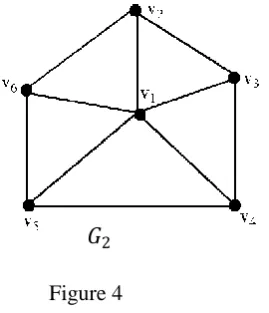
Consider the code 𝐶2= 11111, 11100, 11010, 10110, 01110, 01101
Solution: From the given code 𝐶2, 𝑊𝐶2 𝑋 = 𝑥5+ 5𝑥3= 𝑆𝐺2 𝑥 .
𝐶2 = 6 = 𝑜𝑟𝑑𝑒𝑟 𝑜𝑓 𝑟𝑒𝑞𝑢𝑖𝑟𝑒𝑑 𝑔𝑟𝑎𝑝 𝐺2
The degree sequence 5, 3, 3, 3, 3, 3 is graphical.
Let the code 𝐶2 be re written as 𝐶2= 𝑐1, 𝑐2, 𝑐3, 𝑐4, 𝑐5, 𝑐6 where,
𝑐1= 11111 𝑐2= 11100 𝑐3= 11010
𝑐4= 10110 𝑐5= 01110 𝑐6 = 01101
We have 𝑑𝐻 𝑐1, 𝑐𝑗 = 2, ∀𝑗 = 2,3, … ,6, and
𝑑𝐻 𝑐2, 𝑐3 = 2 𝑑𝐻 𝑐2, 𝑐4 = 2 𝑑𝐻 𝑐2, 𝑐5 = 2 𝑑𝐻 𝑐2, 𝑐6 = 2
𝑑𝐻 𝑐3, 𝑐4 = 2 𝑑𝐻 𝑐3, 𝑐5 = 2 𝑑𝐻 𝑐3, 𝑐6 = 4 𝑑𝐻 𝑐4, 𝑐5 = 2
𝑑𝐻 𝑐4, 𝑐6 = 4 𝑑𝐻 𝑐5, 𝑐6 = 2
Assign the vertex 𝑣1 to code 𝑐1 with degree 5 and vertices 𝑣2, 𝑣3, 𝑣4, 𝑣5 and 𝑣6 corresponding to the code words
𝑐1, 𝑐2, 𝑐3, 𝑐4 and 𝑐5 respectively, each having vertex degree 3.
Since, 𝑑𝐻 𝑐3, 𝑐6 = 4 = 𝑑𝐻 𝑐4, 𝑐6 , the vertices 𝑣3 and 𝑣4 cannot be adjacent to the vertex 𝑣6. The vertex 𝑣1
is adjacent to all otherfive vertices. Thus the graph 𝐺2 from 𝐶2 is :
Example 5
Consider the code
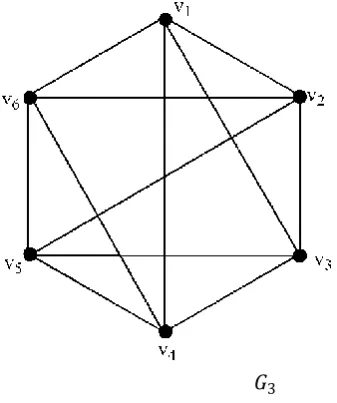
𝐶3= 111100, 111010, 011110, 011101, 011011, 111001 .
The degree sequence is graphical, the expected graph 𝐺3is four regular of order 6. Let the code words be called
𝑐1, 𝑐2, … , 𝑐6 in the respective order in 𝐶3. If 𝑣1, 𝑣2, … , 𝑣6 are the vertices with respect to the code words, from
the degree- distance criteria (after finding the distance between every pair of code words and considering their respective Hamming weights) it follows that 𝑣1 not adjacent to 𝑣5 , 𝑣2 not adjacent to 𝑣4 and 𝑣3 not adjacent to
𝑣6. Thus 𝐺3with respect to 𝐶3 is:
𝐺
2ISSN: 2231-5373
http://www.ijmttjournal.org
Page 126
Example 6
Consider the code 𝐶4= 010110, 110001, 100011, 110100, 110111 010101, 110010, 100110, 111000, 111110,
𝑊𝐶4 𝑥 = 8𝑥3+ 2𝑥5, which implies, if a graph 𝐺4 exists for 𝐶4 of its 10 vertices, two are of degree 5 each and
rest are of degree 3. Also,
𝑑𝐻 010101, 110010 = 4 𝑑𝐻 010101, 100110 = 4
𝑑𝐻 010101, 111000 = 4 𝑑𝐻 010101, 111110 = 4
𝑑𝐻 010101, 010110 = 2 𝑑𝐻 010101, 110001 = 2
𝑑𝐻 010101, 100011 = 4 𝑑𝐻 010101, 110100 = 2
𝑑𝐻 010101, 110111 = 2 𝑑𝐻 110010, 100110 = 2
𝑑𝐻 110010, 111000 = 2 𝑑𝐻 110010, 111110 = 2
𝑑𝐻 110010, 010110 = 2 𝑑𝐻 110010, 110001 = 2
𝑑𝐻 110010, 100011 = 2 𝑑𝐻 110010, 110100 = 2
𝑑𝐻 110010, 110111 = 2 𝑑𝐻 100110, 111000 = 4
𝑑𝐻 100110, 111110 = 2 𝑑𝐻 100110, 010110 = 2
𝑑𝐻 100110, 110001 = 4 𝑑𝐻 100110, 100011 = 2
𝑑𝐻 100110, 110100 = 2 𝑑𝐻 100110, 110111 = 2
𝑑𝐻 111000, 111110 = 2 𝑑𝐻 111000, 010110 = 4
𝑑𝐻 111000,110001 = 2 𝑑𝐻 111000,100011 = 4
𝑑𝐻 111000,110100 = 2 𝑑𝐻 111000,110111 = 4
𝑑𝐻 111110, 010110 = 2 𝑑𝐻 111110, 110001 = 4
𝑑𝐻 111110,100011 = 4 𝑑𝐻 111110, 110100 = 2
𝑑𝐻 111110, 110111 = 2 𝑑𝐻 010110, 110001 = 4
𝑑𝐻 010110, 100011 = 4 𝑑𝐻 010110, 110100 = 2
𝑑𝐻 010110,110111 = 2 𝑑𝐻 110001,100011 = 2
𝑑𝐻 110001,110100 = 2 𝑑𝐻 110001, 110111 = 2
𝑑𝐻 100011,110100 = 4 𝑑𝐻 100011,110111 = 2
𝑑𝐻 110100, 110111 = 2
There are only two code words 111110 and 110111 with Hamming weight 5 and their Hamming distance is 2 ⇒they may represent adjacent vertices. The vertices corresponding to the code words with weight 3 are adjacent to the vertices which are assigned code words with weight 5, if and only if, the Hamming distance between those words are 2. Also, code words with weight 3 can be assigned to adjacent vertices of degree 3, only if their corresponding Hamming distance is 2.
Hence if 𝑣1, 𝑣2, 𝑣3, … , 𝑣10 are the vertices with respect to the code words in the given order, the probabilities of
the adjacencies of each vertex are as follows:
𝑣1 → 𝑣6, 𝑣7, 𝑣9, 𝑣10.
𝐺
3ISSN: 2231-5373
http://www.ijmttjournal.org
Page 127
𝑣2 → 𝑣3, 𝑣4, 𝑣5, 𝑣6, 𝑣7, 𝑣8, 𝑣9, 𝑣10.𝑣3 → 𝑣2, 𝑣5, 𝑣6, 𝑣8, 𝑣9, 𝑣10.
𝑣4 → 𝑣2, 𝑣5, 𝑣7, 𝑣9.
𝑣5 → 𝑣2, 𝑣3, 𝑣4, 𝑣6, 𝑣9, 𝑣10.
𝑣6 → 𝑣1, 𝑣2, 𝑣3, 𝑣5, 𝑣9, 𝑣10.
𝑣7 → 𝑣1, 𝑣2, 𝑣4, 𝑣8, 𝑣9, 𝑣10.
𝑣8 → 𝑣2, 𝑣3, 𝑣7, 𝑣10 .
𝑣9 → 𝑣1, 𝑣2, 𝑣3, 𝑣4, 𝑣5, 𝑣6, 𝑣9, 𝑣10.
𝑣10 → 𝑣1, 𝑣2, 𝑣3¸𝑣5, 𝑣6¸𝑣7, 𝑣8, 𝑣9 .
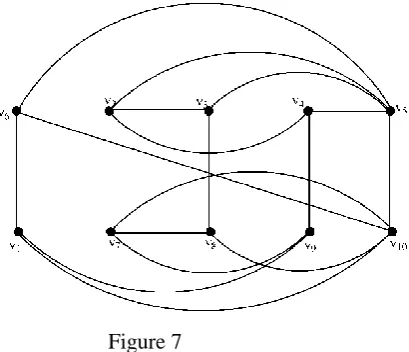
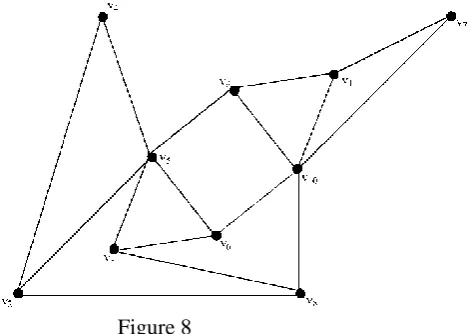
Of the many possible representations of 𝐺4 from 𝐶4 three are represented as follows.
Figure 6
ISSN: 2231-5373
http://www.ijmttjournal.org
Page 128
Remark
As the code words of the vertex code of a particular graph may differ, the graphical representation of a given code too will differ. Figures 6 and 7 are isomorphic representations of code 𝐶4, where as figure 8 also represents
𝐶4, and is non isomorphic to Figures 6 and 7.
Reference
[1] F. J. Macwilliams , N. A. J. Sloane, ‘The Theory of Error Correcting Codes’, Elsevier Science Publishers B.V, P.O. Box 1991, 1000BZ Amsterdam, The Netherlands.
[2] S. Sedghi, N.Shobe, M.A.Salahshoor, ‘The Polynomials of a Graph’, Iranian Journal of Mathematical Sciences and Informatics, Vol. 3, No. 2, (2008)pp 55-67.