NSW PUBLIC HEALTH
BULLETIN
Vol. 20(1–2) • January–February 2009State Health Publication PH 090001 ISSN 1034 7674
Climate change: an emerging health issue
GUEST EDITORS
Anthony G. Capon
A,Band Elizabeth G. Hanna
AANational Centre for Epidemiology and Population Health, Australian National University BCorresponding author. Email: [email protected]
w w w. p u b l i s h . c s i r o. a u / j o u r n a l s / p h b CONTENTS – See back page
Climate Change and Health
The core concern is succinctly stated: climate change endangers health in fundamental ways.
Dr Margaret Chan, Director-General, World Health Organization on the occasion of World Health Day 2008.
The World Health Organization chose climate change as the theme for last year’s World Health Day in an explicit attempt to attract policy-makers to the compelling evidence about the impacts of climate change on health. The reality of human-induced climate change can no longer be doubted, but the extent of its consequences for health can still be reduced. Consideration of the health impacts of climate change can enable political leaders to act with the required urgency.1
Figure 1 illustrates the many ways in which climate change will affect health.2 There are likely to be some (modest)
positive health consequences from climate change (for example, reduced extreme cold weather events in some locations); however, climate change will mostly have nega-tive impacts on health. Climate change will affect health by changing the frequency and distribution of existing health problems. The health impacts of climate change will be greater in low-income communities; those who have con-tributed least to climate change will be affected the most.3
Climate change is currently high on the public policy agenda in Australia and around the world. A vitally impor-tant aspect of climate change policy is the opportunity of co-benefits for health from both mitigation and adaptation actions – examples include eating less meat; using renew-able energy sources that reduce air pollution; and active modes of transport.4This positive story is expected to be
presented at the United Nations conference on climate change in Copenhagen later in 2009.
Current actions
The New South Wales (NSW) Government recognises climate change as a serious environmental, economic and social threat. The challenges posed by climate change have informed the NSW Greenhouse Plan, the current State Plan and the forthcoming Climate Action Plan. Box 1 provides a perspective on climate change and the NSW health system.
The Australian Government recently established the National Climate Change Adaptation Research Facility (NCCARF) at Queensland’s Griffith University to generate information needed by decision-makers in government, and in vulnerable sectors and communities, to manage the risk of climate change impacts. A National Climate Change Adaptation Research Plan for Human Health has been pub-lished.5This plan will inform the work of a research network
on this theme (Box 2).
The papers in this issue
Kjellstrom and Weaver present a succinct overview of climate change and health in Australia. The paper encom-passes current and future threats facing Australians, includ-ing extreme weather events (storms, floods, heat waves), impacts on worker productivity, water supplies, air quality, vector- and foodborne disease, and impacts on mental health.
2 | Vol. 20(1–2) 2009 NSW Public Health Bulletin
Box 1. Climate change and the NSW health system
Adam Craig
Environmental Health Branch, NSW Department of Health
NSW Health is the largest consumer of energy and water of all NSW government agencies and has a commitment to minimise the environmental pollution resulting from the ongoing provision of public health services in NSW. This commitment is articulated in the NSW Government’s Sustainability Strategy to reduce greenhouse gas emissions through energy savings and water use.
Developing adaptive responses to the inevitable impacts of climate change on health is another important challenge. Some adaptive strategies will entail revision or extension of existing public health and health planning policies and practices, while others will require innovative actions. Many will require co-ordinated action across components of the health system and by government, industry and community more broadly.
By 2050, NSW is likely to experience an increase in mean maximum and minimum temperatures of 1–3°C across the state with most of the change occurring in autumn, winter and spring. NSW will generally be wetter in the warmer months but drier in
winter, particularly in the south-west, where a reduction in winter rain of between 20% and 50% has been projected.1
Environmental changes of this proportion will have both acute and insidious health impacts. For example, more frequent heat waves will result in increased hospital admission for heat-related illness. Changes to the social, economic and cultural fabric of communities, particularly in rural areas, as a result of more frequent and longer lasting droughts will also affect the mental
health burden in those communities.2The flow-on impacts on infrastructure management and health service provision are yet
to be accurately quantified; nevertheless, it does suggest that significant planning and adaptation will be required.
In NSW, the Department of Environment and Climate Change (DECC) is the lead agency for responding to climate change. NSW Health has been working with DECC through the Greenhouse Innovation Fund to develop a range of adaptation initiatives. These include:
• The development and testing of a public health heat response plan by Northern Sydney Central Coast Area Health Service in 2007.
• The development, implementation and evaluation of a range of targeted heat health messages by Greater Southern Area Health Service.
• North Coast Area Health Service is harnessing the opportunities offered by climate change mitigation and adaptation to promote healthy lifestyle behaviours – increased physical activity, healthy diets and social connectedness.
The focus of NSW Health’s climate change adaptation activity in 2009 will be heat-related illness adaptation, regional health vulnerability assessment and regional adaptation planning.
References
1. New South Wales Government Department of Environment and Climate Change. Regional Climate Change Impacts. Available from: http://www.environment.nsw.gov.au/climateChange/regionsummary.htm [Updated 20 November 2008; Cited 12 December 2008]
2. Sartore GM, Kelly B, Stain HJ. Drought and its effect on mental health: how GPs can help. Aust Fam Physician2007; 36: 990–3.
Figure 1. Putative pathways between climate change and health impacts. Used with permission from AJ McMichael. Climate
change
Flow-on effects, via social, economic, demographic disruptions Biological changes:
processes, timing
Changes to ecosystem structure and function
Direct impact
Indirect (system-mediated) impacts
Health impacts e.g. heatwaves,
floods, fires, storms; water shortage
e.g. fisheries; constraints on microbes; nutrient cycles; forest productivity Changes to physical systems/processes
e.g. urban air pollution (ozone formation; aeroallergens)
e.g. mosquito density, range; temp, soil moisture crop yields
1
2
Climate change
Box 2. National Climate Change Adaptation Research Network – human health
This network was recently established to improve Australian knowledge about climate change adaptation and human health to enable decision-making by government, industry and communities. The objectives of the network are to:
• foster interdisciplinary research and emerging research methods (time-series methods, spatial analysis, systems-based modelling of complex ecological relationships and processes and scenario-based modelling of future health risks); • build research and decision-making capacity by mentoring and support for early and mid-career researchers and
policymakers;
• facilitate collaboration between researchers, policymakers and practitioners, including involvement across the research cycle (scoping, planning, analysis, reporting); and
• communicate research findings in ways relevant to different sectors and varying regional conditions to strengthen Australia’s capacity to anticipate, adapt to and mitigate the human health consequences of climate change.
The Australian National University is the Network host. Further information is available from: http://www.nccarf. edu.au/?q=node/24
Box 3. Glossary*
Adaptation
Initiatives and measures to reduce the vulnerability of natural and human systems against actual or expected climate change effects. Various types of adaptation exist, for example, anticipatory and reactive, private and public and autonomous and planned. Examples include heat wave early warning systems and growing more vegetation in cities to reduce the urban heat island.
Adaptive capacity
The capabilities, resources and institutions of a country, region or individual to implement effective adaptation measures. Co-benefits
The benefits of policies implemented for various reasons at the same time, acknowledging that most policies designed to address greenhouse gas mitigation have other, often at least equally important, rationales (e.g. related to objectives of development, sustainability, equity and health).
Extreme weather event
A weather event that is rare at a particular place and time of year. Definitions of rare vary, but an extreme weather event would normally be as rare as or rarer than the 10th or 90th percentile of the observed probability density function. By definition, the characteristics of what is called extreme weather may vary from place to place in an absolute sense. Single extreme events cannot be simply and directly attributed to anthropogenic climate change, as there is always a finite chance the event in question might have occurred naturally.
Greenhouse gas (GHG)
Greenhouse gases are those gaseous constituents of the atmosphere, both natural and anthropogenic, that absorb and emit radiation at specific wavelengths within the spectrum of thermal infrared radiation emitted by the Earth’s surface, the
atmosphere itself, and by clouds. This property causes the greenhouse effect. Water vapour (H2O), carbon dioxide (CO2),
nitrous oxide (N2O), methane (CH4) and ozone (O3) are the primary greenhouse gases in the Earth’s atmosphere.
Mitigation
Technological change and substitution that reduce resource inputs and emissions per unit of output. Although several social, economic and technological policies would produce an emission reduction, with respect to climate change, mitigation means implementing policies to reduce greenhouse gas emissions and enhance sinks.
Resilience
The ability of a social or ecological system to absorb disturbances while retaining the same basic structure and ways of functioning, the capacity for self-organisation, and the capacity to adapt to stress and change.
Vulnerability
The degree to which a system is susceptible to, and unable to cope with, adverse effects of climate change, including climate variability and extremes. Vulnerability is a function of the character, magnitude and rate of climate change and variation to which a system or individual is exposed as well as its sensitivity and its adaptive capacity.
*Source: Climate Change 2007: Synthesis Report. Contribution of Working Groups I, II and III to the Fourth Assessment Report of the Intergovernmental Panel on Climate Change [Core Writing Team, Pachauri, R.K. and Reisinger, A. (eds.)]. Geneva: IPCC; 2007.
co-benefits in the food system, examining the link between industrial food production and food problems such as diets poor in nutrients and loss of control over food choices. Climate change threatens further food shortages. The authors explain why promoting urban agriculture is
sustainable and brings multiple health and environmental benefits.
4 | Vol. 20(1–2) 2009 NSW Public Health Bulletin
experienced major bushfires and widespread smoke pollu-tion. Kolbe and Gilchrist evaluate the effectiveness of public health advisories about bushfire smoke pollution provided to Albury residents in the summer of 2003.
In the concluding paper, Capon and colleagues argue for systems approaches in governance to address climate change. They argue for a focus on the underlying causes of problems such as climate change and the obesity epidemic. Effective governance will necessitate moving beyond ‘silo’ approaches to integrative policy and planning.
Climate change, an environmental health issue of unprece-dented scale and complexity, necessitates new ways of thinking, communicating and acting for public health.4We
hope this special issue of the Bulletin will encourage public health workers to take on these challenges.
Box 3 contains a glossary of terms used in this issue that may be unfamiliar to Bulletin readers.
References
1. World Health Organization. Protecting health from climate change – World Health Day 2008. Geneva: WHO, 2008.
2. McMichael AJ, Woodruff RE, Hales S. Climate change and human health: Present and future risks. Lancet 2006; 367: 859–69. doi:10.1016/S0140-6736(06)68079-3
3. St. Louis ME, Hess JJ. Climate change: impacts on and implications for global health. Am J Prev Med 2008; 35: 527–38. doi:10.1016/j.amepre.2008.08.023
4. Frumkin H, McMichael AJ. Climate change and public health: Thinking, communicating, acting. Am J Prev Med 2008; 35: 403–10. doi:10.1016/j.amepre.2008.08.019
Since 1950, average land temperatures in Australia have risen by 0.9°C.1A decline in rainfall has been observed for
much of eastern and south-western Australia, whereas north-western Australia has experienced wetter summers.1
Globally, the trend of climatic variability is similar.2
The process will continue with a projected average global temperature increase of 1.8 to 4.0°C (average 3°C) by 2100 depending on actions taken to limit greenhouse gas (GHG) emissions and scenarios for future development.2
Rainfall is likely to become more variable and there will be more extreme weather with storms, floods and droughts.2 By 2030 the average temperature in Australia
Climate change and health: impacts,
vulnerability, adaptation and mitigation
Abstract: Global climate change is progressing
and health impacts have been observed in a number of countries, including Australia. The main health impacts will be due to direct heat exposure, extreme weather, air pollution, reduced local food production, food- and vectorborne infec-tious diseases and mental stress. The issue is one of major public health importance. Adaptation to reduce the effects of climate change involves many different sectors to minimise negative health out-comes. Wide-scale mitigation is also required, in order to reduce the effects of climate change. In addition, future urban design must be modified to mitigate and adapt to the effects of climate change. Strategies for mitigation and adaptation can create co-benefits for both individual and community health, by reducing non-climate-related health hazard exposures and by encouraging health pro-moting behaviours and lifestyles.
Tord Kjellstrom
A,Band Haylee J. Weaver
AANational Centre for Epidemiology and Population Health, Australian National University
BCorresponding author. Email: [email protected]
may increase by 1°C, and by 2070, it may have increased by 1.8°C.1Decreases in rainfall are predicted for southern
areas in winter, and for eastern areas in spring, while Australian average rainfall may not change.1It is essential
that the Australian community is adequately prepared for any health consequences of climate change.3
Adaptation and mitigation
Australia has diverse environments including alpine, temperate, tropical and desert. There are numerous low population density rural areas and highly populated cities. The possible health impacts of climate change for people living in each type of area need to be considered when developing strategies to manage climate change.
The aim of mitigation is to reduce anthropogenic GHG emissions and other causes of climate change, for instance, by increasing electricity generated from renewable sources (hydro-electric, solar and wind energy) and reducing motor vehicle use. In addition, reduction of meat consumption is considered a mitigation strategy, due to the energy-intensive methods of modern farming and methane emissions from cows and sheep.4Mitigation strategies are often integrated
into planning and infrastructure by local councils and state and federal governments; however, individuals can also participate on a small scale by reducing unnecessary energy consumption and using cars less frequently.
Adaptation means modifying current policy and practice to cope with unavoidable changes in climate. Governments need to implement community-wide adaptation plans, while individuals can act in a number of ways; for example, by staying in the shade while outside, or installing ceiling fans to reduce the risk of direct heat effects.5Mitigation and adaptation strategies can have
co-benefits for health. For example, a reduction in car use reduces GHGs as well as decreasing crash injuries, air pollution and traffic noise and increasing personal physi-cal activity and fitness levels.6
Coping with health impacts of climate change in Australia
The expected changes in the climate may lead to several types of increased mortality and morbidity, including temperature-related illness and death, extreme weather effects, air pollution effects, water and food-related dis-eases, vectorborne disdis-eases, effects of food and water
6 | Vol. 20(1–2) 2009 NSW Public Health Bulletin
shortages and effects of population displacement.7,8
Although the most severe health impacts are expected in low income countries, Australia will not be spared (see for example, http://www.environment.nsw.gov.au/ climatechange/health.htm).7–9The people most vulnerable
to the effects of climate change are children, elderly people, Indigenous communities and people with pre-existing diseases and disabilities.
Environmental disasters, storms and floods
Storms, droughts and other climatic disasters are likely to increase in intensity and frequency (albeit with regional variation).10 Regional, targeted preparation plans for the
health sector are therefore necessary. Tropical cyclones and other storms will cause injuries and flooding due to storm surges and severe downpours.11Storms create the risk of
drowning and health risks from damaged water supplies, sewage pipes, loss of electricity and contaminated food. The harmful effects of storms were demonstrated in the Hunter region of New South Wales (NSW) in 2007.12
Problems with water and sewerage supply and quality were experienced because pumps failed. Food was spoiled as it could not be cooked properly or kept cool in refrigerators, due to problems with electricity supply.12Floods can also
lead to increased infectious and vectorborne diseases.13
Adaptation to storms requires preventive steps, including timely storm warnings and long-term seasonal modelling of the future frequency of storms.
Extreme heat exposure
Heat waves can dramatically increase mortality as seen in France in 2003.14For Australia, models project more hot
days (temperatures greater than 35 to 40°C) by 2070, while the frequency of cold spells will decrease.1 Heat
exposure causes morbidity and mortality, particularly in urban areas due to the heat island effect.15,16Research in
five major Australian cities showed that mortality increased at temperatures above 28°C, particularly among people 65 years or older.17–20In NSW, hospital admissions
for heat-related illnesses increased during heat waves. In Adelaide, overall daily mortality has not increased during heat waves, but ambulance emergencies and certain types of hospital admissions (for instance, mental health categories) have increased.21Heat wave warning systems
and response plans are needed in addition to housing, workplace and urban design that maximises natural breezes and shade and minimises the heat island effect.20
A particular risk in hot weather in Australia is bush fires and related health risks from smoke and burns.22Adaptive
strate-gies for fires involve reducing fire risk by controlled burning of fuel in fire-prone forests and fire warning systems.
Heat stress and workforce productivity
Heat can cause physiological stress, particularly in people with high levels of physical activity.23Children and elderly
people are also vulnerable to heat stress as their physiol-ogy is less resilient than that of younger adults and they may be less able to take cooling action in heat waves.24
Australian studies have primarily measured exposure and physiological effects in workers with extreme heat expo-sure, such as fire fighters, mine workers, sheep shearers, and cattle musterers.25–31Direct heat exposure reduces a
worker’s ability to continuously carry out heavy physical work. International standards recommend adequate rest breaks in hot environments.32–35Heat exposure also limits
the ability of people to exercise for leisure and health.36
Water quality and quantity
Intense precipitation events can overload sewers and storm-water drains and flush pathogens from catchment areas into drinking water reservoirs and dams.37Drought
can concentrate pollutants in dams, via evaporation, and increased water temperature in dams and lakes can lead to blooms of toxin-producing cyanobacteria.38 Modelling
can be used to predict pathogen loads in water supplies, which may be a useful tool in managing drinking water supplies in the future, when climate change influences water quality and availabilty.39 Desalination plants, and
improved water recycling may contribute to water security. Adaptive strategies for reducing water consumption are already in place in most councils and shires in Australia in order to conserve the water currently held in dams.
Air pollution
Epidemiological studies in Australian cities have docu-mented increased daily mortality and hospital admissions associated with urban air pollution.40,41 More ozone is
formed from the exhaust emissions of motor vehicles during summer periods of increasing heat in combination with strong sunlight.42During the heat wave in France in
2003, the attributable fractions of daily mortality excess due to heat and ozone exposure were similar.43 Many
excess deaths may have been caused by ozone and not by heat itself. The effects of particulate matter air pollution in Brisbane have been shown to increase alongside tempera-ture.44A reduction in car usage, to reduce emissions of
GHGs and other air pollutants such as particulate matter and nitrogen dioxide, is a key mitigation strategy.40
Pollen and other aeroallergens, such as mould spores, may be influenced by climate change, increasing asthma risks.45 Pollen warnings and individual management of
asthma are two adaptive strategies that can reduce respira-tory diseases affected by aeroallergens.
Vectorborne infectious diseases
The potential risk of increased vectorborne disease spread in Australia due to climate change was first discussed a decade ago.46,47 Distributions of most arboviruses may
Climate change and health
Barmah Forest virus (BFV) and dengue virus.13The
dis-tributions of both RRV and BFV are likely to be altered by changes in rainfall, tidal inundation and land-use patterns, which will enable populations of mosquito vectors to establish in new areas.48Under climate change scenarios,
it has been predicted that dengue virus may eventually be found as far south as Sydney.49 Adaptive strategies for
arbovirus control include improved modelling, early warning and control systems for mosquitoes, and ensuring the use of flyscreens in mosquito-prone areas.
Foodborne diseases
Foodborne diseases, particularly gastroenteritis, are rela-tively common in Australia.50The symptoms of these
dis-eases are usually mild, but can be serious in vulnerable people, occasionally causing death.51The most common
pathogens in food are Campylobacter and Salmonella and the notification rate is related to monthly temperature indi-cating a potential effect of climate change.52 In addition,
Staphylococcus aureus is a common bacterium on skin
that can grow in food, producing a powerful toxin that causes diarrhoea and vomiting. The growth and spread of these pathogens increase if the storage temperature of foods is not sufficiently cold, which is of vital importance in the event of interruptions to electricity supply.51
Adaptation strategies include better monitoring of food-borne diseases and increased awareness of health risks.
Community and mental health
Climate change may lead to adverse mental health out-comes.53Natural disasters, such as storms, cyclones and
prolonged drought have been shown to adversely affect mental health over time.54–57 In the future, Australia is
likely to experience increases in droughts, which have been shown to be associated with an increased rate of suicide.57Increases in individual mental health problems
will have a follow-on effect for communities. Therefore, an important adaptive strategy is to increase community resilience to enable individuals to cope better with the con-ditions created by climate change.
A well-developed health care system in each community is another important adaptive strategy. Whether the health impacts are due to heat, violent weather, air pollution, infectious diseases or mental stress, efficient diagnostic and treatment services will make it possible to minimise the health impacts on the community. Such a system needs to ensure equitable access for all in the community, includ-ing the most vulnerable groups. A hotter climate may cause deterioration of medications and pharmaceutical therapies during storage, particularly in remote places with less developed health services.58
Health co-benefits of mitigation and adaptation
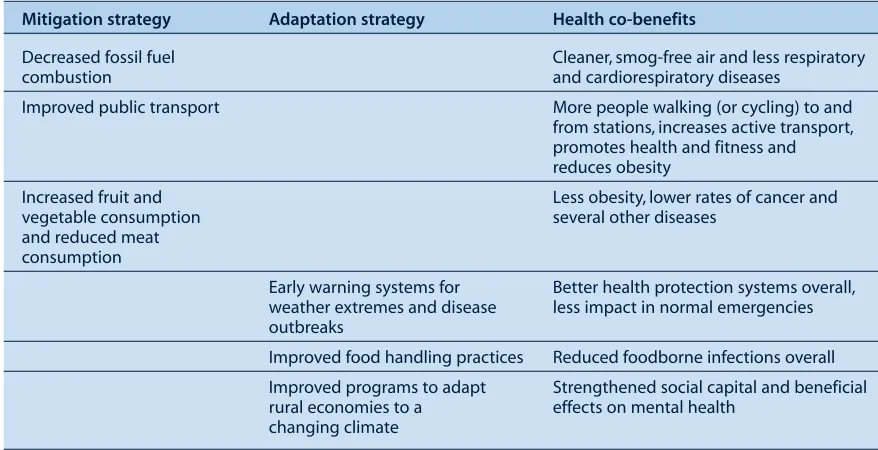
Table 1 summarises examples of health co-benefits that can be expected from mitigation and adaptation strategies as a response to climate change. There is a need for further research into the potential effects of different intervention strategies. For certain interventions, the value of health co-benefits may be even greater than the prevented climate change impacts.
Conclusion
The broad range of likely health impacts of climate change in NSW and Australia means that a variety of methods and strategies should be applied for mitigation and adaptation. Mitigation and adaptation can have direct co-benefits for the health of individuals and communities and should be encouraged. Early warning systems have a range of appli-cations that can be used to assist communities to prepare for adverse conditions and the associated threats to health. Improving response teams and health systems (such as
Table 1. Examples of the main co-benefits of mitigation and adaptive strategies as a response to climate change
Mitigation strategy Adaptation strategy Health co-benefits
Decreased fossil fuel Cleaner, smog-free air and less respiratory
combustion and cardiorespiratory diseases
Improved public transport More people walking (or cycling) to and
from stations, increases active transport, promotes health and fitness and reduces obesity
Increased fruit and Less obesity, lower rates of cancer and
vegetable consumption several other diseases
and reduced meat consumption
Early warning systems for Better health protection systems overall,
weather extremes and disease less impact in normal emergencies
outbreaks
Improved food handling practices Reduced foodborne infections overall
Improved programs to adapt Strengthened social capital and beneficial
rural economies to a effects on mental health
8 | Vol. 20(1–2) 2009 NSW Public Health Bulletin
emergency services and health care practitioners) will enable a rapid response to emergency situations. The most important adaptive strategy that can be applied, however, is that of increased community awareness of climate change and the associated health risks. By understanding how environmental changes can result in adverse health impacts, we can plan to minimise exposure and health risks and to cope with the unavoidable effects of climate change.
References
1. CSIRO. Climate change in Australia. Technical report 2007. Melbourne: CSIRO and Australian Bureau of Meteorology; 2007.
2. IPCC. 2007: Climate Change 2007: Synthesis Report. Contribution of Working Groups I, II and III to the Fourth Assessment Report of the Intergovernmental Panel on Climate Change. IPCC, Geneva, Switzerland. Available from:
http://www.ipcc.ch/ipccreports/ar4-syr.htm (Cited 02 December 2008.)
3. Preston BL, Jones RN. Climate change impacts on Australia and the benefits of early action to reduce global greenhouse gas emissions. Melbourne: CSIRO; 2006.
4. McMichael AJ, Powles JW, Butler CD, Uauy R. Food, livestock production, energy, climate change, and health. Lancet 2007; 370: 1253–63. doi:10.1016/S0140-6736(07)61256-2
5. Mukheibir P, Ziervogel G. Developing a Municipal Adaptation Plan for climate change: the city of Cape Town. Environ Urban 2007; 19: 143–58. doi:10.1177/0956247807076912
6. Kjellstrom T, van Kerkhoff L, Bammer G, McMichael AJ. Comparative assessment of transport risks – how it can contribute to health impact assessment of transport policies. Bull World Health Organ 2003; 81: 451–7.
7. McMichael AJ, Campbell-Lendrum D, Kovats S, Edwards S, Wilkinson P, Wilson T et al. Global climate change. In: Ezzati M, Lopez AD, Rodgers A, Murrgay CJL, editors. Comparative quantification of health risks: global regional burden of diseases due to selected major risk factors. Vol. 2. Chapter 20. Geneva: World Health Organization; 2004. pp. 1543–649.
8. Patz JA, Gibbs HK, Foley JA, Rogers JV, Smith KR. Climate change and global health: quantifying a growing ethical crisis. EcoHealth 2007; 4: 397–405. doi:10.1007/s10393-007-0141-1
9. Bambrick H, Dear K, Woodruff R, Hanigan I, McMichael AJ. The impact of climate change on three health outcomes: Temperature-related mortality and hospitalisations, salmonel-losis and other bacterial gastroenteritis, and population at risk from dengue. Commissioned report for the Garnaut Climate Change Review. Canberra: The Australian National University; 2007.
10. Kirch W, Menne B, Bertollini R. Extreme weather events and public health responses. Berlin: Springer; 2005.
11. McMichael AJ, Woodruff RE, Whetton P, Hennessy K, Nicholls N, Hales S et al. Human health and climate change in Oceania: a risk assessment 2002. Canberra: Commonwealth Department of Health and Ageing; 2003.
12. Cretikos MA, Merritt TD, Main K, Eastwood K, Winn L, Moran L et al. Mitigating the health impacts of natural disaster – the June 2007 long-weekend storm in the Hunter region of New South Wales. Med J Aust 2007; 187: 670–3.
13. McMichael AJ, Weaver HJ, Berry H, Beggs PJ, Currie B, Higgins J et al. National Adaptation Research Plan (Human Health). Commissioned report by the Australian Department of Health and Ageing, 2008.
14. Poumadere M, Mays C, Le Mer S, Blong R. The 2003 heat wave in France: Dangerous climate change here and now. Risk Anal 2005; 25: 1483–94. doi:10.1111/j.1539-6924.2005.00694.x
15. Kovats RS, Hajat S. Heat stress and public health: a critical review. Ann Rev Public Health 2008; 29: 41–51.
doi:10.1146/annurev.publhealth.29.020907.090843
16. Haines A, Kovats RS, Campbell-Lendrum D, Corvalan C. Climate change and human health: impacts, vulnerability and mitigation. Lancet 2006; 367(9528): 2101–9.
doi:10.1016/S0140-6736(06)68933-2
17. Guest CS, Willson K, Woodward AJ, Hennessy K, Kalkstein LS, Skinner C et al. Climate and mortality in Australia: retrospective study, 1979–1990, and predicted impacts in five major cities in 2030. Clim Res 1999; 13: 1–15. doi:10.3354/cr013001
18. Vaneckova P, Hart MA, Beggs PJ, de Dear RJ. Synoptic analysis of heat-related mortality in Sydney, Australia, 1993-2001. Int J Biometeorol 2008; 52(6): 439–51. doi:10.1007/s00484-007-0138-z
19. Bi P, Parton KA, Wang J, Donald K. Temperature and direct effects on population health in Brisbane, 1986–1995. J Environ Health 2008; 70: 48–53.
20. Nicholls N, Skinner C, Loughnan M, Tapper N. A simple heat alert system for Melbourne, Australia. Int J Biometeorol 2008; 52: 375–84. doi:10.1007/s00484-007-0132-5
21. Nitschke M, Tucker GR, Bi P. Morbidity and mortality during heatwaves in metropolitan Adelaide. Med J Aust 2007; 187: 662–5.
22. Hennessy K, Lucas C, Nicholls N, Bathols J, Suppiah R, Ricketts J. Climate change impacts on fire-weather in south-east Australia. Melbourne: CSIRO; 2005.
23. Taylor NAS. Challenges to temperature regulation when working in hot environments. Ind Health 2006; 44: 331–44. doi:10.2486/indhealth.44.331
24. Parsons K. Human thermal environments. 2nd ed. London: Taylor and Francis; 2003.
25. Budd GM, Brotherhood JR, Hendrie AL, Jeffery SE, Beasley FA, Costin BP et al. Project Aquarius 10. Effects of work, weather and fire on the energy expenditure, strain and productivity of men suppressing wildland fires. Int J Wildland Fire 1997; 7: 167–80. doi:10.1071/WF9970167
26. Donoghue A, Sinclair M, Bates G. Heat exhaustion in a deep underground metalliferous mine. Occup Environ Med 2000; 57: 165–74. doi:10.1136/oem.57.3.165
27. Miller VS, Bates GP. The thermal work limit is a simple reliable heat index for the protection of workers in thermally stressful environments. Ann Occup Hyg 2007; 51: 553–61. doi:10.1093/annhyg/mem035
Climate change and health
29. Muller R, Carter A, Williamson A. Epidemiological diagnosis of occupational fatigue in a fly-in/fly-out operation of the mineral industry. Ann Occup Hyg 2008; 52: 63–72. doi:10.1093/annhyg/mem058
30. Gun RT, Budd GM. Effects of thermal, personal and behav-ioural factors on the physiological strain, thermal comfort and productivity of Australian shearers in hot weather. Ergonomics 1995; 38: 1368–84. doi:10.1080/00140139508925195
31. Taylor NAS, Caldwell JN. The impact of protective helmets on physiological strain and cognitive function during horseback mustering. Sydney: Meat and Livestock Australia; 2007.
32. Budd GM. Wet-bulb globe temperature (WBGT) – its history and limitations. J Sci Med Sport 2008; 11: 20–32.
doi:10.1016/j.jsams.2007.07.003
33. International Standards Organization. Hot environments – Estimation of the heat stress on working man, based on the WBGT-index (wet bulb globe temperature). ISO Standard 7243. Geneva: International Standards Organization; 1989.
34. Kjellstrom T. Climate change, heat exposure and labour productivity. Epidemiology 2000; 11: S144.
35. Kjellstrom T, Dirks KN. Heat stress and ability to work in the context of climate change. Proceedings of the International Thermal Physiology Symposium; 2001 Sep 2–6; Wollongong: University of Wollongong; 2001. Available from:
http://www.apps.org.au/Proceedings/32(2)Suppl.1/23P/ 23P.pdf (Cited 11 December 2008.)
36. American Academy of Pediatrics, Committee on Sports Medicine and Fitness. Climatic heat stress and the exercising child and adolescent. Pediatrics 2000; 106: 158–9.
doi:10.1542/peds.106.1.158
37. Thomas KM, Charron DF, Waltner-Toews D, Schuster C, Maarouf AR, Holt JD. A role of high impact weather events in waterborne disease outbreaks in Canada, 1975-2001. Int J Environ Health Res 2006; 16(3): 167–80.
doi:10.1080/09603120600641326
38. Hunter PR. Climate change and waterborne and vector-borne disease. J Appl Microbiol 2003; 94: S37–46.
doi:10.1046/j.1365-2672.94.s1.5.x
39. Ferguson CM, Croke BFW, Beatson PJ, Ashbolt NJ, Deere DA. Development of a process-based model to predict pathogen budgets for the Sydney drinking water catchment. J Water Health 2007; 5: 187–208. doi:10.2166/wh.2006.050
40. Kjellstrom T, Neller A, Simpson R. Air pollution and its health impacts: the changing panorama. Med J Aust 2002; 177: 604–8.
41. Simpson RW, Chan YC, Hansen CA, Jalaludin B, Morgan G, Barnett AG et al. Several references on epidemiological studies of air pollution in Australia 2008. Available from:
http://research.usc.edu.au/vital/access/manager/Repository? expert=creator%3a%22Simpson%2c+R+W%22 (Cited 02 December 2008.)
42. Duffy BL, Nelson PF, Ye Y, Weeks IA. Speciated hydrocarbon profiles and calculated reactivities of exhaust and evaporative emissions from 82 in-use light-duty Australian vehicles. Atmos Environ 1999; 33: 291–307.
doi:10.1016/S1352-2310(98)00163-0
43. Dear K, Ranmuthugala G, Kjellstrom T, Skinner C, Hanigan I. Effects of temperature and ozone on daily mortality during the
August 2003 heat wave in France. Arch Environ Occup Health 2005; 60: 205–12. doi:10.3200/AEOH.60.4.205-212
44. Ren C, Tong S. Temperature modifies the health effects of particulate matter in Brisbane, Australia. Int J Biometeorol 2006; 51: 87–96. doi:10.1007/s00484-006-0054-7
45. Beggs PJ. Impacts of climate change on aeroallergens: past and future. Clin Exp Allergy 2004; 34: 1507–13.
doi:10.1111/j.1365-2222.2004.02061.x
46. Russell RC. Mosquito-borne arboviruses in Australia: the current scene and implications of climate change for human health. Int J Parasitol 1998; 28(6): 955–69.
doi:10.1016/S0020-7519(98)00053-8
47. Sutherst RW. Implications of global change and climate variability for vector-borne diseases: generic approaches to impact assessments. Int J Parasitol 1998; 28: 935–45. doi:10.1016/S0020-7519(98)00056-3
48. Jacups SP, Whelan PI, Currie BJ. Ross River virus and Barmah Forest virus infections: a review of history, ecology and predictive models, with implications for tropical northern Australia. Vector Borne Zoonotic Dis 2008; 8(2): 283–97. doi:10.1089/vbz.2007.0152
49. Hales S, de Wet N, Maindonald J, Woodward A. Potential effect of population and climate changes on global distribution of dengue fever: an empirical model. Lancet 2002; 360(9336): 830–4. doi:10.1016/S0140-6736(02)09964-6
50. Hall GV, Kirk MD, Ashbolt R, Stafford R, Lalor K. OzFoodNet Working Group. Frequency of infectious gastrointestinal illness in Australia, 2002: regional, seasonal and demographic variation. Epidemiol Infect 2006; 134: 111–8.
doi:10.1017/S0950268805004656
51. Hall GV, D’Souza RM, Kirk MD. Foodborne disease in the new millennium: out of the frying pan and into the fire? Med J Aust 2002; 177: 614–8.
52. D’Souza RM, Becker NG, Hall G, Moodie KBA. Does temperature affect foodborne disease? Epidemiology 2004; 15: 86–92. doi:10.1097/01.ede.0000101021.03453.3e
53. Berry HL, Kelly BJ, Hanigan IC, Coates JH, McMichael AJ, Welsh JA et al. Rural mental health impacts of climate change. Commissioned report for the Garnaut Climate Change Review. Canberra: The Australian National University; 2008.
54. Raphael B. When disaster strikes: How individuals and commu-nities cope with catastrophe. New York: Basic Books; 1986.
55. McFarlane A, Clayer J, Brookless C. Psychiatric morbidity following a natural disaster: an Australian bushfire. Soc Psychiatry Psychiatr Epidemiol 1997; 32(5): 261–8. doi:10.1007/BF00789038
56. Sartore G, Hoolahan B, Tonna A, Kelly B, Stain H. Wisdom from the drought: Recommendations from a consultative conference. Aust J Rural Health 2005; 13(5): 315–20. doi:10.1111/j.1440-1584.2005.00723.x
57. Nicholls N, Butlere CD, Hanigan I. Inter-annual rainfall variations and suicide in New South Wales, Australia, 1964-2001. Int J Biometeorol 2006; 50: 139–43. doi:10.1007/s00484-005-0002-y
10 | Vol. 20(1–2) 2009 NSW Public Health Bulletin
New South Wales (NSW) per capita greenhouse gas emis-sions are in the order of 23 tonnes per person each year, which is more than double that of the United Kingdom, Germany and Japan (with emissions at just over 10 tonnes per person) and almost double the average for industri-alised nations (about 13 tonnes).1 Transport emissions
include those from road (cars, buses and trucks), rail, ship-ping and aviation for both passengers and freight, and rep-resent the second largest source of emissions (14%).2
Reducing the burning of fossil fuels for transport will help reduce the rate of climate change and the severity of the impact of climate change. A number of factors are now simultaneously contributing to higher oil and petrol prices, which are likely to have the effect of reducing the con-sumption of fossil fuels for transport. If Australian govern-ment policy introduces an emissions trading scheme that includes transport, the price of (carbon-based) petrol will increase.
Even greater increases in price will come from oil supply crises (e.g. natural disasters such as Hurricane Katrina, or
Active travel: a climate change mitigation
strategy with co-benefits for health
Abstract: Reducing the burning of fossil fuels for
transport will help reduce the rate of climate change and the severity of the impact of climate change. The alternatives to private motor vehicles include active travel modes such as walking, cycling and use of public transport. While simultaneously reducing carbon dioxide emissions and traffic congestion, active transport leads to increased levels of physical activity and social interaction. This article sum-marises a number of NSW active travel initiatives. Despite some positive steps in NSW, other Australian states have invested far more and can demonstrate greater changes in travel behaviour.
Chris E. Rissel
Health Promotion Service, Sydney South West Area Health Service School of Public Health, University of Sydney
Email: [email protected]
threats to the oil supply from terrorists). Ultimately, demand for oil will exceed supply (which is finite) as the economies of China and India continue to grow. This situ-ation is likely within our lifetime.3–5Already Australians
are looking at the cost of driving motor vehicles and think-ing about drivthink-ing less, and the shift away from cars is expected to become more pronounced as petrol prices inevitably rise and concern about climate change increases.
Transport is a social determinant of health
Although transport is not a traditional focus for health services, it is recognised internationally as a social deter-minant of health.6As well as being a source of greenhouse
gas emissions and other air pollutants, the transport system contributes to injury rates and congestion, and affects access to services and social activities. As transport costs increase, transport and transport availability will increasingly be an issue of equity. Transport deserts – areas without reasonable access to public transport – have already been identified in parts of western Sydney, and people living in such areas will be increasingly disadvan-taged.7People who cannot afford to drive will need other
transport options, such as public transport and bicycle paths. It will be the responsibility of government to ensure that this infrastructure is provided. As Enrique Peñalosa, former mayor of Bogata, Colombia, said, ‘A safe cycle path is a symbol of democracy; it shows that a person on a $40 bicycle is as important as a person in a $40 000 car’ (personal communication, July 2008).
The alternatives to private motor vehicle-oriented trans-port include active travel modes such as walking, cycling and use of public transport, either for the whole or part of journeys. While simultaneously reducing carbon dioxide emissions and traffic congestion, active travel leads to increased levels of physical activity, reduced exposure to pollutants (air and noise) and increased social interaction. While the concept of active travel is quite simple, people will default to current practice (i.e. use of the private motor vehicle) unless the alternative travel modes are uncomplicated, safe, easy, affordable and convenient. Active travel is more difficult in settings where there is no or infrequent public transport, or where distances make the time and distance barrier too great to make cycling or walking feasible, as is the case in some outer urban and rural settings.
Active travel
NSW initiatives
In NSW there are a number of initiatives that seek to increase active travel. While these initiatives are usually designed initially to increase physical activity levels, they also have the added benefit of mitigation of climate change. This outcome is in contrast to many other initia-tives that represent adaptation and response to climate change (e.g. responding to severe weather events).
In NSW, the Premier’s Council for Active Living involves a number of relevant agencies in high level discussions and collaboration.8The role of the Council is to ‘provide
leadership and advice to the Premier to encourage more people to be more active more often’ by working collabo-ratively with senior representatives from government, industry and community sector. Projects tend to be of statewide significance, and include:
• work with a developer to incorporate active living design considerations in new housing developments • incorporation of active living physical environment
characteristics into Metrix, a proposed tool that the Department of Planning is developing to evaluate local councils’ local environmental plans
• input into the urban design code for new housing release areas
• work with the NSW State Property Authority to incorporate end-of-trip facilities (such as secure bicycle parking, showers and change rooms) within refurbished buildings when government agencies relocate
• co-ordination of a new whole-of-NSW government Bicycle Plan
• co-ordination of a high level government agency active transport roundtable.
Specific government agencies have also developed guide-lines for planners and engineers responsible for building the urban environment that can positively or negatively influ-ence physical activity and active travel.9The former NSW
Department of Infrastructure, Planning and Natural Resources in conjunction with the Roads and Traffic Authority (RTA) developed planning guidelines for walking and cycling, and the RTA runs training programs for local government engineers, who are in a position to apply these guidelines to the building of specific local environments.10
The RTA also conducts free courses in how to prepare trans-port access guides. Other agencies such as the National Heart Foundation of Australia have also produced similar documents that highlight the benefits of designing urban environments to facilitate walking and cycling.11
Sydney South West Area Health Service initiatives
There are many examples of local programs that promote active travel. The Sydney South West Area Health Service (SSWAHS) has implemented a number of programs over the last decade. One such program was a health service worksite program involving social marketing and an individual travel
behaviour change program that led to modest changes in driving to work and reduced car travel on weekends.12
Another strategy has been the development of transport access guides for major trip generators such as hospitals.13
These guides illustrate how to travel to and from the hospi-tals through active travel by showing where the locations of cycle paths, recommended walking routes from rail stations and bus stops (including an indication of the frequency of buses). By not showing parking stations and making active travel easier, this strategy is intended to influence the deci-sion of how to travel to these specific destinations.
An innovative research program underway in SSWAHS is promoting cycling in two local government areas (with a third as a comparison area). The Cycling Connecting Communities project will test whether promoting the use of cycling infrastructure such as new cycle paths in the Fairfield and Liverpool areas will increase overall levels of physical activity in the community.14 It will focus on
adults, and particularly those people who do not currently ride bicycles, with a wide range of strategies. This project continues earlier cycling promotion work involving the development of a cycling proficiency course to increase the skills and confidence of people wanting to ride more, and the development of a staff bicycle pool.15,16
Two other programs in SSWAHS have focused on active travel to school. One is the Central Sydney Walk to School Trial, involving 24 primary schools in the inner west of Sydney and the other is the NSW TravelSmart Schools Program involving 15 primary schools in the inner west and eastern suburbs of Sydney.17,18 Both programs had
a modest influence on travel behaviour, and highlighted that it is the parent journey to work that is a key factor that influences parents’ decisions on how they and their children travel to and from school.19Interestingly, most of
the walk-to-school programs internationally have had small effects. In contrast, a well-funded program in California sought to change the physical environment around schools and the main routes to schools.20This program is probably
the most successful of any in the world in increasing the number of children actively travelling to school.
With cycling the lowest of the active travel modes, there is considerable potential to increase the proportion of trips by bicycle. Cycling is the fourth most popular form of recre-ational sport or exercise in Australia, and the Australian Bureau of Statistics census indicates that the journey to work by bicycle has consistently increased over the last decade, with a 22% increase across Australia from 2001 to 2006.21,22
Almost half (42%) of all households in Sydney in 2005 had a bicycle and new bicycles have consistently outsold new cars for each of the last eight years in Australia.23,24
Investment in cycling produces outcomes
12 | Vol. 20(1–2) 2009 NSW Public Health Bulletin
invested far more and can demonstrate greater changes in travel behaviour. For example, investment in cycling infra-structure over the last decade in Melbourne (up to $13 million per annum) has led to increases in cycling from 2001 to 2006 of 42%.22,25In comparison, cycling in Sydney
has increased only 9%, with the RTA spending $7 million across NSW in 2006–07 (see Table 1).26 The city of
London, as part of their Climate Action Plan, has increased funding for cycling and walking by almost five-fold – from £13 million a year in 2003–04 to £62 million in 2008–09.27
Analysis of the 1980 to 1987 Fremantle Network Bike Plan found that it was a worthwhile economic investment for the community, with a 12% annual increase in the cycling population resulting in transport and health savings to that community of $420 000 per annum, com-pared to the implementation costs of the bike plan of $273 000 per annum.28In addition to social and
environ-mental benefits, there was a benefit-to-cost ratio, in economic terms alone, of 1.46 : 1.28
A recent review of transport and health promotion inter-ventions to increase levels of cycling found that, despite varying levels of research rigour, most programs did lead to a positive increase in cycling.29An investment in
infra-structure for cycling and social and behavioural programs
that encourage cycling will readily lead to more Australians cycling.
Recommendations to increase cycling
The barriers to more Australians cycling are relatively well known.30 A report commissioned by the Australian
Department of Health and Ageing seeking to raise popula-tion levels of physical activity identified the barriers and rec-ommended strategies that a whole-of-government approach could use to increase levels of cycling.22These
recommen-dations are largely dependent upon each other and would need to be implemented in an integrated, co-ordinated way: • Improved bicycle infrastructure: to provide safe,
attractive and enjoyable on and off road bicycle routes as well as high quality end-of-trip facilities.
• Funding: to better reflect the role and value of cycling in a range of areas, including transport, health and sustainability, with support from all levels of government.
• Mass marketing campaigns: to promote the multiple health, environmental, transport, economic and social inclusion benefits of cycling, and address perceived barriers such as safety, required fitness level and road-user behaviour. These campaigns can be supported through the extensive network of cycling
organisations around Australia, and should be combined with infrastructure improvements. • Behaviour change programs such as TravelSmart,
Ride to Work and Ride to School programs: to help more Australian children and adults make the daily commute by bicycle.
• Bicycle events: to encourage infrequent and novice riders to cycle in a supportive social environment. • Bicycle education programs: to increase confidence
and skill levels in both the child and adult population. • Urban design: to create a physical environment more
conducive to cycling, such as higher density, mixed use development and shorter trip distances.
Cycling is a carbon-neutral, petrol-free form of transport, simultaneously helping Australians fight climate change, reduce fuel costs and increase physical activity and improve health. As Australian society comes to terms with global warming and the need to change personal behaviour to slow the rate of climate change, active travel needs to be a central platform in this program. Political will is neces-sary to create an environment that facilitates walking and cycling, as well as public transport options, for all.
References
1. NSW Department of Environment and Climate Change. What are greenhouse emissions in NSW? Sydney: NSW Department of Environment and Climate Change; 2008. Available from: http://www.environment.nsw.gov.au/climatechange/ emissionsoverview.htm (Cited 18 October 2008.)
2. Department of Climate Change. State and Territory Greenhouse Gas Inventories 2006. Canberra: Australian Government; 2008. Table 1. Investment in cycling* and change in cycling usage
for journeys to work by Australian capital cities, 2001 to 2006
Annual investment Journey to work by in cycling ($ ’000s)* bicycle – ABS data (% change 2001
to 2006)
Sydney 7000**a 9
Melbourne 13 000b 43
Adelaide 3450**b 31
Hobart 750**b 25
Perth 9750b 16
Canberra 2950b 16
Brisbane 17 000c 13
Darwin 1270d ⫺7
Available from: http://www.greenhouse.gov.au/inventory/ stateinv/pubs/states2006.pdf (Cited 27 June 2008.)
3. Parker AA. The end of suburbia: what will happen when all the cheap oil is gone and what are the health implications? Health Promot J Austr 2005; 16(1): 61–8.
4. Rissel C. What price petrol? Health Promot J Austr 2006; 17(1): 3–4.
5. Deffeyes KS. Hubbert’s Peak: the impending world oil short-ages. Princeton, New Jersey: Princeton University Press; 2003.
6. McCarthy M. Transport and health. In: Marmot M, Wilkinson RG, editors. Social Determinants of Health. Oxford: Oxford University Press; 1999. pp. 132–54.
7. Gordon-Larsen P, Nelson MC, Page P, Popkin BM. Inequality in the built environment underlies key health disparities in physical activity and obesity. Pediatrics 2006; 117(2): 417–24. doi:10.1542/peds.2005-0058
8. Premier’s Council for Active Living. What is the Premier’s Council for Active Living? Sydney: Premier’s Council for Active Living; 2008. Available from: http://www.pcal. nsw.gov.au/ (Cited 22 July 2008.)
9. Gebel K, King L, Bauman A, Vita P, Gill T, Rigby A et al. Creating Healthy Environments – A review on the links between the physical environment, physical activity and health. Sydney: NSW Health Department and NSW Centre for Overweight and Obesity; 2005. Available from: http://www.coo.health.usyd. edu.au/publications/creatin.php (Cited 29 July 2008.)
10. NSW Department of Infrastructure, Planning and Natural Resources and the Roads and Traffic Authority. Planning Guidelines for Walking and Cycling NSW Department of Infrastructure, Planning and Natural Resources. Sydney: Roads and Traffic Authority; 2004.
11. National Heart Foundation of Australia (Victorian Division). Healthy by design: a planner’s guide to environments for active living. Melbourne: National Heart Foundation of Australia (Victorian Division); 2004. Available from: http://www. heartfoundation.org.au/SiteCollectionDocuments/ Healthy%20by%20Design.pdf (Cited 29 July 2008.)
12. Wen LM, Orr N, Bindon J, Rissel C. Promoting active transport in a workplace setting: evaluation of a pilot study in Australia. Health Promot Int 2005; 20(2): 123–33.
doi:10.1093/heapro/dah602
13. Bresciani E, Wen LM, Rissel C, Alley J, Jochelson T. Promoting active transport: where to start? Environ Health 2002; 2(1): 55–60.
14. Health Promotion Service, Sydney South West Area Health Service. Cycling Connecting Communities. Sydney: Sydney South West Area Health Service; 2008. Available from: http://cyclingconnectingcommunities.wordpress.com/ (Cited 23 July 2008.)
15. Telfer B, Rissel C, Bindon J, Bosch T. Encouraging cycling through a pilot cycling proficiency training program among adults in central Sydney. J Sci Med Sport 2006; 9(1-2): 151–6. doi:10.1016/j.jsams.2005.06.001
16. Rissel C, Telfer B. Managing risk in a workplace bicycle pool. J Australas Coll Road Safety 2005; 16(1): 18–24.
Active travel
17. Fry D, Wen LM, Merom D, Dirkis H, Rissel C, Balafas A. Final Report of the Central Sydney Walk to School Research Program 2004–2007. Camperdown: Health Promotion Service, Sydney South West Area Health Service; 2008.
18. Fry D. NSW TravelSmart Schools Program 2006–2007 Summary Report. Sydney: NSW Ministry of Transport, SSWAHS and Australian Greenhouse Office; 2008.
19. Wen LM, Fry D, Rissel C, Dirkis H, Balafas A, Merom D. Factors associated with children being driven to school: implications for walk to school programs. Health Educ Res 2008; 23(2): 325–34. doi:10.1093/her/cym043
20. Boarnet MG, Anderson C, Day K, McMillan T, Alfonzo M. Evaluation of the California Safe Routes to School legislation: Urban form changes and children’s active transportation to school. Am J Prev Med 2005; 28(2): 134–40. doi:10.1016/ j.amepre.2004.10.026
21. Australian Sports Commission. Participation in Exercise Recreation and Sport – Annual Report 2006. Canberra: Australian Sports Commission; 2006.
22. Bauman A, Rissel C, Garrard J, Ker I, Speidel R, Fishman E. Cycling – Getting Australia Moving: Barriers, facilitators and interventions to get more Australians physically active through cycling. Melbourne: Cycling Promotion Fund; 2008.
23. Ministry of Transport and Roads and Traffic Authority. Cycling in Sydney – Bicycle ownership and use. Sydney: Ministry of Transport and Roads and Traffic Authority; 2008.
24. Cycling Promotion Fund. Bicycle Outsells cars in Australia – sales top 1.4 million. Melbourne: Cycling Promotion Fund; 2008. Available from: http://www.cyclingpromotion.com.au/ latest-news/page_3.html (Cited 24 July 2008.)
25. Bicycle Victoria. Transport and Liveability Statement provides $72 million for riders. Melbourne: Bicycle Victoria; 2007. Available from: http://www.bv.com.au/change-the-world/ 12064 (Cited 24 July 2008.)
26. Roads and Traffic Authority. RTA Annual Report 2007. Sydney: Roads and Traffic Authority; 2007. p. 60. Available from: http://www.rta.nsw.gov.au/publicationsstatisticsforms/ downloads/2007_rta_annualreport_mainbody.pdf (Cited 24 July 2008.)
27. Cycling Promotion Fund. London increases its cycling budget. Melbourne: Cycling Promotion Fund; 2008. Available from: http://www.cyclingpromotion.com.au/latest-news/latest/ london-increases-its-cycling-budget.html (Cited 24 July 2008.)
28. Campbell R. Bicycle Friendly City [online]. In: 1989 National Transport Conference: Transport for the Users; Preprint of Papers. Barton, ACT: Institution of Engineers, Australia; 1989. pp. 214–8. National conference publication (Institution of Engineers, Australia); no. 89/7. Available from: http://search. informit.com.au/documentSummary;dn=820558195016115; res=IELENG (Cited 15 October 2008.)
29. Rissel C, Garrard J. Cycling for active transport and recreation in Australia: status review and future directions. World Transp Policy Pract 2006; 13(1): 49–63.
14 | Vol. 20(1–2) 2009 NSW Public Health Bulletin
There is growing awareness that diets in affluent countries, rich in meat protein, dairy and preprepared foods, have a negative impact on biophysical environments as well as on public health.1–4Consensus is also emerging that healthier
diets are more environmentally sustainable.4–6 By
chal-lenging the ongoing supply of affluent country diets, climate change provides a population and environmental health opportunity. However, it also poses a significant risk to food-insecure populations. Already, data show that
Functional foods and urban agriculture:
two responses to climate change-related
food insecurity
Abstract: Affluent diets have negative effects on
the health of the population and the environment. Moreover, the ability of industrialised agricultural ecosystems to continue to supply these diets is threatened by the anticipated consequences of climate change. By challenging the ongoing supply of the diets of affluent countries, climate change provides a population and environmental health opportunity. This paper contrasts two strategies for dealing with climate change-related food insecurity. Functional foods are being posi-tioned as one response because they are consid-ered a hyper-efficient mechanism for supplying essential micronutrients. An alternative response is civic and urban agriculture. Rather than empha-sising increased economic or nutritional efficien-cies, civic agriculture presents a holistic approach to food security that is more directly connected to the economic, environmental and social factors that affect diet and health.
Jane M. Dixon
A,C, Kelly J. Donati
B,
Lucy L. Pike
Band Libby Hattersley
AANational Centre for Epidemiology and Population Health, Australian National University
BMelbourne School of Land and Environment, University of Melbourne
CCorresponding author. Email: [email protected]
undernutrition in less affluent countries is rising; and due to higher food prices, poorer subpopulations in the devel-oped world are missing out on a range of protective foods, like fruit and vegetables, and in the developing world, staples like rice, maize and wheat.7–9
This paper focuses on the opportunities for food system transformations posed by climate change. It begins by sketching the symbiotic relationship between climate change and sustainable food yields, before contrasting two strategies for dealing with anticipated food shortages and the associated growth in diet-related diseases: the promo-tion of the funcpromo-tional food sector and civic and urban agriculture. While examples of civic agriculture such as farmers’ markets and food co-operatives are relatively recent in Western countries, urban agriculture has a long tradition as a localised response to food shortages, the degradation of urban communities and urban poverty in cities in both developed and developing countries. With over half of the global population living in cities, urban agriculture may have significant implications for rethink-ing conventional approaches to agrifood systems.
Industrial food systems and climate change
Food is a major user of energy and thus contributor to greenhouse gas emissions, with 15 to 20% of energy used in developed countries attributed to their food sectors.5 In Australia, emissions from agriculture
accounted for 16% of net emissions in 2004.10This
pro-portion increases to 23% when producer emissions from energy, transport and waste are included.3The entire food
chain is implicated, with household food preparation, organic waste disposal and car shopping trips adding a further 10% to emissions.3
In Europe, and we assume Australia, the most energy intensive food commodities are the most health damaging: animal-based foods, fats and oils, and sweets, snacks and drinks.5,11While there is popular debate about the distance
that foods travel, or food miles, it is the mode of transport that is important. The 1% of foods known to be air-freighted in the United Kingdom (UK) accounts for 11% of food transport’s overall contribution to carbon dioxide.12Global free trade arrangements will deepen the
Functional foods and urban agriculture
extent of air-freighted foods. It is now generally recog-nised that the food miles metric is a poor proxy for environmental damage, and that lifecycle assessments from paddock to plate are important.3
As a result of climate change, food yields are declining albeit unevenly across the globe.7,9,15,16 Reduced cereal
and rice yields are the most troubling in terms of food insecurity in poorer countries. Declines result from either too little or too much rainfall, soil loss due to winds, higher temperatures, storm and hail damage to crops, and the spread of pests and plant and animal diseases.17
Australia’s major food production region based on the Murray–Darling river system is collapsing due to inade-quate water flows and increased temperatures.17
Climate change is also compromising food yields indi-rectly, through:
1. redirecting agricultural efforts away from human food to biofuel production as a strategy for reducing greenhouse gas emissions related to fossil fuel-dependant industries
2. reduced fishing permits near distressed marine ecosystems, for example, the Great Barrier Reef 3. the growth of aquaculture as a response to exhausted
capture of wild fisheries, further disturbing these more traditional fish sources.17,18
The functional food response
For more than a century, governments have periodically called on food manufacturers to fortify foods and drinks as a population-wide strategy for eliminating micronutrient deficiencies: for example, iodised salt and thiamine-enriched beer.19,20 Since the 1980s, nutrient enrichment
(energy drinks, vitamin-fortified cereals) and nutrition engineering (reduced-fat milk) have also taken place inde-pendently of government.21These commodities have been
called corporate marketing devices for value-adding
health to foods, and they may be redundant in countries where food supplies are replete with nutrients.22,23
To date, most functional food activity has occurred in the developed world where people can afford to pay more for the value-added items. Involving the largest agrifood and pharmaceutical corporations, it is a hugely profitable sector estimated to be worth US$30–50 billion in 2004, with large annual growth forecasts.20
In part, because of success with golden rice (rice that is genetically engineered to deliver vitamin A), and the green revolution, an argument is gaining momentum that foods genetically modified to produce essential micronutrients are an important technological response to improving the nutrient values of the reduced food supply.24What is often
overlooked is that the green revolution contributed to marked rural inequalities and despoiled agricultural environments.25,26
There is good reason to fortify food supplies where micronu-trient deficiencies exist, especially in the developing world where food scarcity is an issue, but the functional food sector has major shortcomings as a response to climate change-induced food insecurity.27 First, it does little to challenge
industrial agriculture and its externalities, including climate change. Second, it does not guarantee a balanced and diverse diet, which bodies like the World Health Organization deem important for health.28 Third, it does not address another
determinant of good nutrition: household incomes. Even in wealthy countries, climate change is driving farmers off their land into cities in search of employment.15 Farmer and
peasant reliance on cash incomes for food previously acquired through various self-sufficiency strategies can lead to inferior diets.29 Finally, by limiting participation in the
food system to the act of purchasing and consuming nutri-ents, it does not engage consumers with their food supply.
The civic and urban agriculture response
An alternative response to a corporate approach (that is, led by large-scale, profit-driven corporations) is civic and urban agriculture. Civic agriculture emerged out of the environmental and food counterculture movements of the 1960s and 1970s. It shifts the focus away from simply increasing economic or nutritional efficiencies in food production, instead adopting a broader perspective, which uses localised food production as a way of developing and strengthening communities.30
Urban agriculture is an important aspect of civic agricul-ture in cities in both developing and developed countries. For example, when Cuba lost access to cheap fuel and petrochemical-based agricultural chemicals in the mid-1990s, it worked to secure a sustainable and healthy food supply through organic food production (for both export and domestic consumption and urban agriculture).31 For
cities and urban areas in South America, Africa and the Box 1. Life cycle assessment in the agrifood sector
Life cycle assessment is a tool for the systematic evaluation of the environmental aspects of specific products over their
life cycle (from cradle to grave).13The technique emerged
from the industrial and commercial sectors and has been
internationally standardised since 1997.14Unlike other
approaches to environmental impact assessment, it includes all supporting processes within a system and allows for multiple environmental indicators to be assessed concurrently.
Within the agrifood sector, the technique is attracting growing commercial interest as a tool for communicating broader environmental information to increasingly-interested stakeholders. It is of particular relevance to environmental health officers and urban planners, and could facilitate food consumers to become climate watchers as they monitor the environmental consequences