Effect of Cutting Parameters on the Surface
Roughness and MRR of Titanium alloys using
VMC
Darpan Punjabhai Vansh Diptesh Patel
Student Assistant Professor
Department of Mechanical Engineering Department of Mechanical Engineering
S V B I T, Gandhinagar-382650 S V B I T, Gandhinagar-382650
Maulik Patel Assistant Professor
Department of Mechanical Engineering S V B I T, Gandhinagar-382650
Abstract
The use of titanium alloys is increasing rapidly nowadays. Simultaneously the requirement for machining of titanium alloys is also increasing. The present research work deal with the optimization of process parameters such as spindle speed, feed rate, depth of cut, MRR and surface roughness value for titanium alloy by using Advanced cutting Tools. Hence the present study uses titanium Grade 12 as work piece material and CBN and carbide as tool material and focusses on the optimum value of material removal rate and surface roughness. In this paper, Taguchi Method has been used to identify the optimal combination of influential factors in the milling process. Milling experiment has been performed on titanium Grade 12 material, according to Taguchi orthogonal array (L9) for various combinations of controllable parameters viz. speed, feed and depth of cut. The surface roughness (Ra) is measured and recorded for each experimental run and analyzed using Taguchi S/N ratios and the optimum controllable parameter combination is identified.
Keywords: VMC, Optimization, Surface roughness (Ra), Material removal rate (MRR), Carbide tool material, cubic boron nitride tool material, Alluminium alloy
_______________________________________________________________________________________________________
I. INTRODUCTION
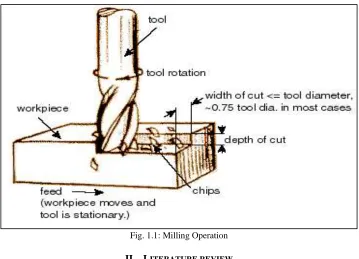
Milling machine is one of the most versatile conventional machine tools with a wide range of metal cutting capability. Many complicated operations such as indexing, gang milling, and straddle milling etc. can be carried out on a milling machine. This training module is intended to give you a good appreciation on the type of milling machines and the various types of milling processes. Emphasis is placed on its industrial applications, operations, and the selection of appropriate cutting tools. Milling is the machining process of using rotary cutters to remove material from a work piece by advancing (or feeding) in a direction at an angle with the axis of the tool. It covers a wide variety of different operations and machines, on scales from small individual parts to large, heavy-duty gang milling operations. It is one of the most commonly used processes in industry and machine shops today for machining parts to precise sizes and shapes.
Types of milling machines
Fig. 1.1: Milling Operation
II. LITERATURE REVIEW
Many investigators have suggested various methods to explain the effect of process parameter on surface roughness and MRR in CNC end milling process.
N .V. Malvade, S. R. Nipanikar.[1] In this paper, the milling of OHNS steel material using End milling with a high speed steel tool material by using Taguchi methodology has been reported. The Taguchi method is used to formulate the experimental layout, to analyse the effect of each parameter on the machining characteristics, and to predict the optimal choice for each end milling parameter such as Speed, Feed, Depth of cut. The analysis using Taguchi method reveals that, in general the depth of cut significantly affects the MRR and speed significantly affects the surface roughness. The response parameter material removal rate (MRR) mostly affected by depth of cut (d). The effect of feed (F) on MRR is less. The effect of speed (S) on MRR is least as compared with depth of cut (d) and feed (F). The input parameter speed (S) affects roughness value Ra mostly. Other input parameters have less impact Ra. Alike, roughness value Ra, speed (S) has major effect on roughness value Rq. Input parameters feed (F), depth of cut (d) have less effect on roughness value Rq. Speed (S) affects mainly to roughness value Rz. Input parameters feed (F), depth of cut (d) have less effect on roughness value Rz..
V Krishnaraj, S Samsudeensadham, R Sindhumathi, P Kuppan[2].This paper investigates high speed end milling of titanium alloy (Ti–6% Al–4% V) using carbide insert based end mill cutter. In this study experiments have been carried out under dry cutting conditions. Experiments were conducted based on the Taguchi’s design of experiments, in order to analyse the effect of cutting parameters on cutting force, temperature and surface roughness. From this study it is found that depth of cut and feed rate have higher effect on cutting forces when compared to cutting speed whereas the effect of cutting speed has higher effect on temperature. Cutting speed has less effect on cutting forces; at higher depths of cuts (in this cast at 1 mm) the cutting force stabilizes and even reduces because of stable cutting and temperature. Moreover it is found than depth of cut has higher influence on cutting force than feed rate. From the study it is found that depth of cut 0.75 mm is preferable. Cutting speed has higher effect on temperature than depth of cut and feed rate. Within the machining range studied, cutting speed of 150m/min, 0.75 mm depth of cut and feed rate of 0.075 mm/rev is suitable for high speed machining.
Lohithaksha M Maiyar, Dr.R.Ramanujam, K.Venkatesan, Dr.J.Jerald.[3] This study investigated the parameter optimization of end milling operation for Inconel 718 super alloy with multi-response criteria based on the taguchi orthogonal array with the grey relational analysis. Nine experimental runs based on an L9 orthogonal array of Taguchi method were performed. Finally, confirmation tests were performed to make a comparison between the experimental results and developed model. Experimental results have shown that machining performance in the end milling process can be improved effectively through this approach. It has been established that grey relational analysis is an effective optimization tool for machining of Inconel 718 alloy in end milling. It has been also found that the optimal cutting parameters for the machining process lies at 75m/min for cutting velocity, 0.06 mm/tooth for feed rate and 0.4 mm for depth of cut. Further it has been observed that there is a 64.8%increase in material removal rate and at the same time a 9.52% decrease in surface roughness. Analysis of variance shows that the cutting velocity is the most significant machining parameter followed by feed rate affecting the multiple performance characteristics with 56.88% and 34.64% influence respectively.
as surface roughness and cutting force components using a face milling operation during the cutting process of the titanium alloy (Ti–6Al–4V). The results showed that one could predict the surface roughness by measuring the feed cutting force instead of directly measuring the surface roughness experimentally through using the finite element method to build the model and to predict the surface roughness from the values of the feed cutting force. It was found that there is good agreement between the trend of feed cutting force and surface roughness at different feed rates. Therefore, finite element modeling is useful to predict the value of feed cutting force to control the surface roughness rather than conducting experiments. FEM can lead to reduced machining time and manufacturing cost as well. This is because the accuracy of both values of the cutting force for the experimental and predicted model was about 97%. It is also found that the main cutting force gives no indication of surface roughness.
A. Daymi , M. Boujelbene , J.M. Linares , E. Bayraktar , A. Ben Amara.[5]The aim of this work is to provide an in-depth understanding of the surface texture produced by various workpiece inclination angles using high speed finish ball end-milling of the titanium alloy Ti-6Al-4V. Design/methodology/approach: This paper presents an approach to develop a mathematical model of surface roughness in end-milling by the experimental design methodology. Machining variables such as cutting speed, feed and radial depth of cut, which are easily controllable, are considered in building the model. The influence of the workpiece inclination angle on the surface roughness of the machined workpiece was also investigated. From the results, it appeared that the effect of inclination angle in the resulting surface quality is very important. Moreover, we showed the importance of 5-axis machining. This technology allows the slope between the cutting tool and the surface to be machined. This considerably improves the obtained surface roughness.
III. EXPERIMENTAL SETUP AND DATA COLLECTION
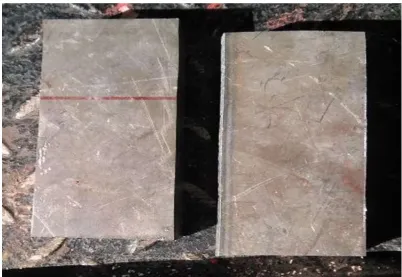
Fig. 1.2: Work piece material diagram
Advantages of Titanium Grade 12 Alloy
Grade 12 titanium possesses characteristics similar to 300 series stainless steels. This alloy can be hot or cold formed using press brake forming, hydropress forming, stretch forming or drop hammer method.
Its ability to be formed in a variety of ways makes it useful in many applications.
The reason behind selecting grade 12 titanium is its “excellent” rating for its high quality weldability. It is a highly durable alloy that provides a lot of strength at high temperatures.
This alloy’s high corrosion resistance also makes it invaluable to those manufacturing equipment where crevice corrosion is a concern.
Chemical Composition of titanium grade 12
Molybdenum 0.290% Nickel 0.800%
Silicon 0.006% Chromium 0.005%
Vanadium 0.004% Tin 0.003% Titanium 98.590%
Application of Titanium Grade 12 Alloy
Shell and heat exchangers
Hydro metallurgical applications.
Elevated temperature chemical manufacturing. Marine and airfare components.
Selected Process & Response Parameters are
Process Parameters Response Parameters Cutting Speed (Vc) mm/min Surface roughness (μm)
Feed Rate (Fd) mm/min Material Removal Rate (mm³/min) Depth of Cut (Ap) mm
Design of Experiment
In industry, designed experiments can be used to systematically investigate the process or product variables that influence product quality.
After you identify the process conditions and product components that influence product quality, you can direct improvement efforts to enhance a product's manufacturability, reliability, quality, and field performance.
Designed experiments are often carried out in four phases: planning, screening (also called process characterization), optimization, and verification.
DOE is considered as one of the most comprehensive approach in product or process developments.
It is a statistical approach that attempts to provide a predictive knowledge of a complex, multi-variable process with few trials.
Taguchi Method Steps:-
Identified the main function and its side effects
Identified the noise factors, testing condition and quality characteristics Identified the objective function to be optimized
Identified the control factors and their levels
Select a suitable Orthogonal Array and Construct the matrix Conduct the matrix experiment
Examine the data, predict the optimum control factor levels and its performance Conduct the verification experiment
Selected levels of DOE
Factor level of DOE
Factors Level Factors Value Cutting Speed(mm/min) 3 80,115,150
Feed Rate(mm/min) 3 0.12, 0.18, 0.24 Depth of Cut(mm) 3 1.5, 2, 2.5
For Carbide 10º Inserts:
Cutting speed (rpm)
Feed rate (mm/min)
Depth of cut (mm)
MRR (mm3/min)
Surface Roughness (micron) 80 0.12 1.5 36.68 1.40
80 0.18 2 73.37 1.62
80 0.24 2.5 122.29 1.80
115 0.12 2 70.31 1.52
115 0.18 2.5 131.84 1.79 115 0.24 1.5 105.47 1.92 150 0.12 2.5 114.64 1.59 150 0.18 1.5 103.18 1.72
Taguchi Analysis: MRR versus cutting speed, feed rate and depth of cut
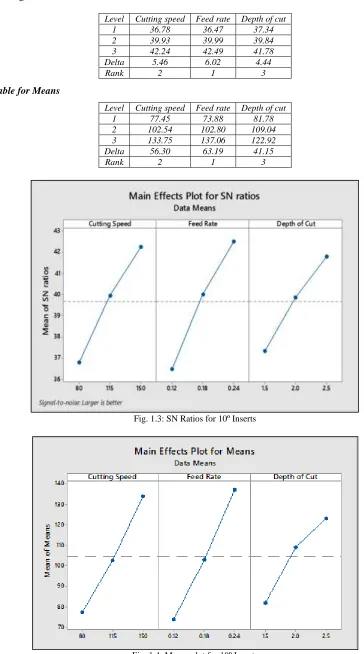
Response table for signal to Noise Ratios Larger is better
Level Cutting speed Feed rate Depth of cut 1 36.78 36.47 37.34 2 39.93 39.99 39.84 3 42.24 42.49 41.78 Delta 5.46 6.02 4.44
Rank 2 1 3
Response table for Means
Level Cutting speed Feed rate Depth of cut 1 77.45 73.88 81.78 2 102.54 102.80 109.04 3 133.75 137.06 122.92 Delta 56.30 63.19 41.15
Rank 2 1 3
Fig. 1.3: SN Ratios for 10º Inserts
Taguchi Analysis: Surface Roughness versus cutting speed, feed rate and depth of cut
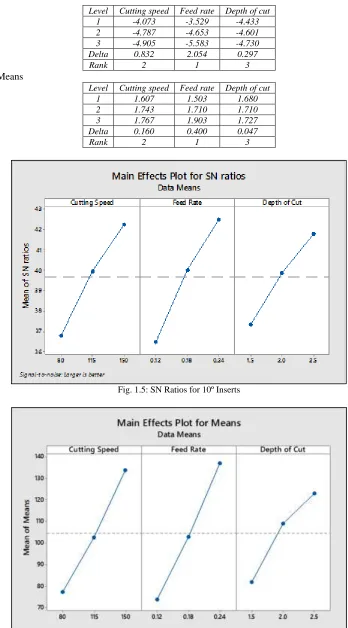
Response table for signal to noise ratios Smaller is better
Level Cutting speed Feed rate Depth of cut 1 -4.073 -3.529 -4.433 2 -4.787 -4.653 -4.601 3 -4.905 -5.583 -4.730 Delta 0.832 2.054 0.297
Rank 2 1 3
Response table for Means
Level Cutting speed Feed rate Depth of cut 1 1.607 1.503 1.680 2 1.743 1.710 1.710 3 1.767 1.903 1.727 Delta 0.160 0.400 0.047
Rank 2 1 3
Fig. 1.5: SN Ratios for 10º Inserts
Factor level of DOE
Factors Level Factors Value Cutting Speed(mm/min) 3 160, 205, 250 Feed Rate(mm/min) 3 0.40, 0.45, 0.50
Depth of Cut(mm) 3 1.5, 2, 2.5
DOE Table for CBN 10º Inserts:
Cutting speed (rpm)
Feed rate (mm/min)
Depth of cut (mm)
MRR (mm3/min)
Surface Roughness (micron) 160 0.40 1.5 244.58 1.25
160 0.45 2 366.87 1.30
160 0.50 2.5 509.55 1.37
205 0.40 2 417.83 1.28
205 0.45 2.5 587.57 1.96 205 0.50 1.5 391.71 1.52 250 0.40 2.5 636.94 1.40 250 0.45 1.5 429.93 1.57
250 0.50 2 636.94 1.82
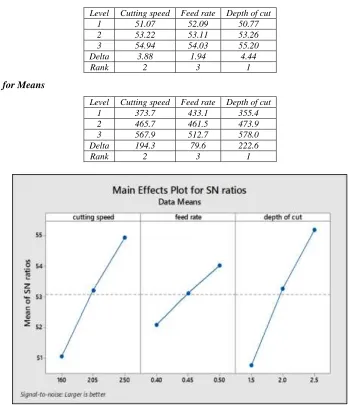
Taguchi Analysis: MRR Versus Cutting speed, feed rate and depth of cut
Response table for signal to noise ratios Larger is better
Level Cutting speed Feed rate Depth of cut 1 51.07 52.09 50.77 2 53.22 53.11 53.26 3 54.94 54.03 55.20 Delta 3.88 1.94 4.44
Rank 2 3 1
Response table for Means
Level Cutting speed Feed rate Depth of cut 1 373.7 433.1 355.4 2 465.7 461.5 473.9 3 567.9 512.7 578.0 Delta 194.3 79.6 222.6
Rank 2 3 1
Fig. 1.8: Means main effects plot
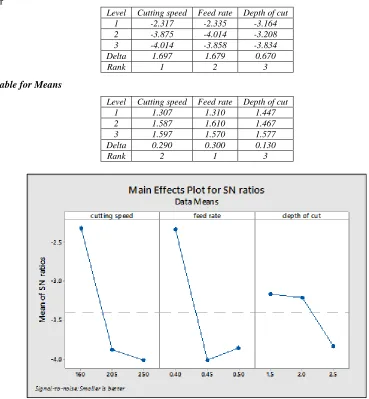
Taguchi Analysis: Surface Roughness versus cutting speed, feed rate and depth of cut
Response table for signal to noise ratios Smaller is better
Level Cutting speed Feed rate Depth of cut 1 -2.317 -2.335 -3.164 2 -3.875 -4.014 -3.208 3 -4.014 -3.858 -3.834 Delta 1.697 1.679 0.670
Rank 1 2 3
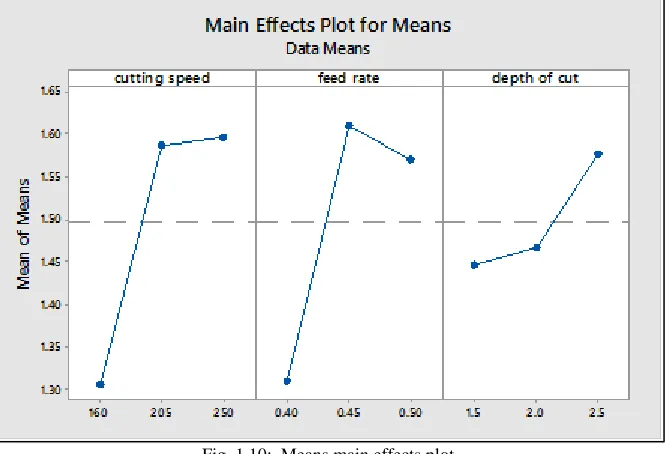
Response table for Means
Level Cutting speed Feed rate Depth of cut 1 1.307 1.310 1.447 2 1.587 1.610 1.467 3 1.597 1.570 1.577 Delta 0.290 0.300 0.130
Rank 2 1 3
Fig. 1.10: Means main effects plot
The study proposes an integrated optimization approach using Taguchi method. In this research work, the average value of surface roughness and S/N ratio were calculated and were found to be within the range.
Taguchi parameter design can provide a systematic procedure that can effectively and efficiently identify the optimum surface roughness in the process control of individual end milling machines.
It also allows industry to reduce process or product variability and minimize product defects by using a relatively small number of experimental runs and costs to achieve superior-quality products. This research only demonstrates how to use Taguchi parameter design for optimizing machining performance with minimum cost.
This approach can be recommended for continuous quality improvement and off-line quality of any production process. As speed increases surface roughness decreases and feed increases surface roughness also increases. For achieving good surface finish on the Al 6061 alloy work piece, higher cutting speed, lower feed and lower depth of cut are preferred. And Cutting Insert 210° consider as a high cutting speed.
IV. CONCLUSION
In this study, the effects of cutting speed, feed and depth of cut on surface roughness and material removal rate during milling of titanium grade 12 alloy were investigated using Taguchi's experimental design method by Design of Experiment.
From the experimental analysis, we can see that the Surface Roughness and Material Removal Rate (MRR) are mainly affected by the process Parameters of Cutting Speed, Feed Rate and Depth of Cut.
While using Carbide tool material with 10º inserts we find that feed rate has the maximum effect on material removal rate compared to cutting speed and depth of cut,while feed rate has the maximum effect on surface roughness compared to cutting speed and depth of cut.
While using CBN tool material with 10º inserts we find that depth of cut has the maximum effect on material removal rate compared to cutting speed and feed rate, while feed rate has the maximum effect on surface roughness compared to cutting speed and depth of cut.
REFERENCES
[1] Şeref Aykut, “Surface Roughness Prediction in Machining Castamide Material Using ANN” (2011), Acta Polytechnica Hungarica, Vol. 8, No. 2, PP 21-32. [2] Dr. Mike S. Lou, Dr. Joseph C. Chen & Dr. Caleb M. Li, (1999), “Surface roughness prediction technique for CNC End-milling”, Journal of industrial
technology, Vol-15.
[3] Surasit Rawangwong, Jaknarin Chatthong, Romadorn Burapa, and Worapong Boonchouytan, “An investigation of optimum cutting conditions in face milling semi-solid AA7075 using carbide tool” (2012), International journal of innovation, Vol-3, No. 6, PP 692-696.
[4] Mathew A. Kuttolamadom, Sina Hamzehlouia, M. Laine Mears, “Effect of machining feed on surface roughness in cutting 6061 aluminum” (2010), International center for automotive research, Clemson university, 2010-01-0218 .
[5] Yang Yang, Xinyu Li, Ping Jiang and Liping Zhang, “Prediction of surface roughness in end milling with gene expression programming”, Proceedings of the 41st International Conference on Computers & Industrial Engineering, PP 441-446.
[7] B. Vijaya Krishna Teja, N. Naresh and K. Rajasekhar, “Multiple response optimization of Milling parameters on AISI 304 Stainless steel using grey-taguchi method” (2013), International Journal of Engineering Research and Technology, Vol-2, issue 8, PP 2335-2341.
[8] Sanjit Moshat, Saurav Datta, Asish Bandyopadhyay and Pradip Kumar Pal, “Optimization of CNC end milling process parameters using PCA-based taguchi method” (2010), International Journal of Engineering, Science and Technology, Vol-2, No-1, PP 92-102
[9] Ghani, J.A., Choudhury, I.A., Hassan, H.H., 2004, Application of Taguchi method in the optimization of end milling parameters. Journal of Materials Processing Technology 145, pp84 92.
[10] Palanisamy, P., Rajendran, I., Shanmugasundaram, S., and Saravanan, R., 2006. Prediction of cutting force and temperature rise in the endmilling operation, J. Engineering Manufacture 220,pp 1577- 1587
[11] LI, H.Z., Zeng, H., Chen, X.Q., 2006. An experimental study of tool wear and cutting force variation in the end milling of Inconel 718 with coated carbide inserts. Journal of Materials Processing Technology 180,pp296 304.
[12] Soo Kang Ik, Jeong Suk Kim , Yong Wie Seo., 2008. Cutting force model considering tool edge geometry for micro end milling process, Journal of Mechanical Science and Technology 22 , pp293-299
[13] Oktem, H., Erzurumlu , T., Kurtaran , H., 2005. Application of response surface methodology in the optimization of cutting conditions for surface roughness. Journal of Materials Processing Technology 170 , pp11 16.
[14] Campatelli, G., Scippa, A., 2012. Prediction of milling cutting force coefficients for Aluminum 6082- T4, 5th CIRP Conference on High Performance Cutting 2012, Procedia CIRP 1,pp 563 568
[15] Milfelner , M., Kopac , J., Cusa, F. , Zuperl, U. , 2005 . Genetic equation for the cutting force in ball-end milling. Journal of Materials Processing Technology 164 165 ,pp1554 1560.
[16] Zhang, S., Li J. F., Sun, J., Jiang, F., 2010. Tool wear and cutting forces variation in high-speed end-milling Ti-6Al-4V alloy, Int J Adv Manuf Technol 46,pp69 78
[17] Fnides, B., Aouici, H., Yallese, MA, 2008. Cutting forces and surface roughness in hard turning of hot work steel X38CrMoV5-1 using mixed ceramic, International Journal of Scientific and Research ,2(70),pp73-78.
[18] Yung-Kuang Yang, Ming-Tsan Chuang, Show-Shyan Lin., 2009. Optimization of dry machining parameters for high-purity graphite in end milling process via design of experiments methods. Journal of Materials Processing Technology 209 , pp4395 4400.