DEMOGRAPHIC RESEARCH
VOLUME 34, ARTICLE 16, PAGES 451
−
466
PUBLISHED 4 MARCH 2016
http://www.demographic-research.org/Volumes/Vol34/16/ DOI: 10.4054/DemRes.2016.34.16
Descriptive Finding
Transition to adulthood in China in 1982−2005:
A structural view
Felicia F. Tian
©2016 Felicia F. Tian.
This open-access work is published under the terms of the Creative Commons Attribution NonCommercial License 2.0 Germany, which permits use, reproduction & distribution in any medium for non-commercial purposes, provided the original author(s) and source are given credit.
2 Data and methods 453
2.1 Data and measures 453
2.2 Methods 455
3 Results 454
3.1 Timing of transitions 454
3.2 Sequencing of transitions 457
3.3 Heterogeneity of transitions 460
4 Discussion 461
5 Acknowledgements 462
Transition to adulthood in China in 1982
−2005: A structural view
Felicia F. Tian1
Abstract
BACKGROUND
The transition to adulthood has increasingly been postponed, shuffled, and individualized in the United States and Western Europe. Less is known about changes in the transition to adulthood in non-Western countries, especially whether they follow a similar pattern of change. Moreover, the existing literature uses diverse indicators to measure the transition to adulthood, which makes the cross-national comparison even more difficult.
OBJECTIVE
This article takes a structural view to examine changes in the transition to adulthood in China, which has the largest youth population in the world and which has experienced rapid social change since reform in the 1980s.
METHODS
The analysis uses data from 1982, 1990, and 2000 censuses and a 2005 mini-census. It treats participants aged 18−30 as synthetic cohorts and examines changes in three structural features of the transition to adulthood: timing, sequencing, and heterogeneity.
RESULTS
Though school completion and entry into the labor force have been notably delayed, only minor delays have occurred in marriage and parenthood. Some individualization occurs in urban residents, but the pathway remains relatively structured and follows a very ordered sequence.
CONCLUSION
These findings suggest stability in the transition to adulthood amidst rapid social change in China during these twenty years.
1. Introduction
The transition to adulthood includes certain trajectories, such as leaving school, entering the labor force, getting married, and having children. These transitions have been increasingly postponed, shuffled, and individualized in the United States and Western Europe (for reviews, see Buchmann and Kriesi 2011; Settersten and Bay 2010; Shanahan 2000). Less is known about changes in the transition to adulthood in non-Western countries, especially whether they follow a similar pattern of change. Some research suggests that aspects of these changes mimic those of the West (Lesthaeghe 2010; Lloyd 2005). Others suggest that the changes are path-dependent (Furstenberg 2013; Fussell 2005; Grant and Furstenberg 2007; Yeung and Alipio 2013; Yeung and Hu 2013). Furthermore, the research in non-Western countries uses diverse indicators to measure the transition to adulthood that hinder comparisons with each other and to Western countries. Life course theory (Elder, Johnson, and Crosnoe 2003) suggests that the meaning of single transitions differs depending on when they occur in the life course, where they fit within a large sequence, and how they vary in a population. Thus it is useful to take a structural view, tracing changes in the timing and sequencing of transitions as well as the distribution of these transitions at the population level.
2. Data and methods
2.1 Data and measures
This analysis uses samples from four population data sources: Chinese censuses collected in 1982, 1990, and 2000, and a 2005 mini-census that comprises a 1% sample of the Chinese population. The samples from the 1982 and 1990 censuses are 1% random samples, harmonized by the Integrated Public Use Microdata Series − International project. Our sample from the 2000 census is a .095% random sample and the 2005 mini-census is a 20% random sample. To make the sample sizes comparable, we draw a 10% random sample from the 1982 and 1990 samples. For all four samples, we limit young adults to those between the ages 18 and 30 (Rindfuss 1991).
The adulthood transitions are measured in four statuses: school attendance, employment status, marital status, and parental status. Because the parental status was collected exclusively for women, women in our analysis have four statuses and men have three. The four statuses are coded as dichotomous variables that equal 1 if the respondents occupy the status and 0 otherwise2.
2.2 Methods
The analysis is organized by gender and residence (urban or rural). Residence is distinguished by permanent household registration status (hukou).3 Urban residents are measured as those with urban hukou who lived in the registered hukou place at the time of survey. Likewise, rural residents are measured as those with rural hukou who lived in the registered hukou place at the time of the survey.
We use three structural features to measure change: timing, sequencing, and heterogeneity. Timing measures any delay in the transition to adulthood and at which transition the delay occurs. The timing of each transition is measured as the percentage of respondents who occupy each status at every age between 18 and 30.
2 The 2000 and 2005 censuses did not collect the parental status for never-married women; we thus code the
parental status of never-married women as 0. Premarital childbearing is very rare in China (Yeung and Hu 2013), so this is a reasonable approximation.
3 We exclude migrants (i.e., those who left places in which their hukou were registered), because the four
samples use two different definitions of migrants, resulting from a change in measurement from the 1990 to 2000 census. In 2000 and 2005, migrants are classified as those who have left places in which their hukou
Sequencing is used to examine whether the transition to adulthood has been shuffled. Because the survey did not ask respondents the ages at which each transition occurred, we examine sequencing indirectly by tracing changes in the distributions of status combinations. Respondents can occupy one status or multiple statuses at the same time. For example, a respondent can be working and married (not a student and not a parent) or a student and a parent (not working and not married) at the same time. As school-work-marriage-childbearing is often considered to be an ordered sequence during the transition to adulthood the work-marriage combination is viewed as an ordered status, whereas the school-parent combination is not. In the analysis, ordered status combinations include school (S), work (W), marriage (WM), work-marriage-parenthood (WMP), and work-marriage-parenthood (MP). Shuffled status combinations include none (N), parenthood (P), school-work (SW), school-marriage (SM), school-parenthood (SP), work-parenthood (WP), school-marriage-parenthood (SMP), work-parenthood (SWP), work-marriage (SWM), and school-work-marriage-parenthood (SWMP).
Heterogeneity is used to examine whether the transition to adulthood has been individualized. We use an entropy index (Fussell 2005) to trace population-level heterogeneity over time. Higher scores mean the transition to adulthood is more heterogeneous (individualized). The formula is as follows:
𝐸 = � 𝑝𝑠log(𝑝1 𝑠) 𝑠
𝑠=1
(1)
where S is the number of statuses (4 for women and 3 for men), and Ps is the proportion
of population in status combination s. To make the index more intuitive we transform the entropy index into a percentage of the maximum index, which is defined as the status combination when the population is equally distributed in all possible combinations (Fussell 2005). It equals 24*(1/24)*log(1/ 24) = 1.24 for women and 23*(1/23)*log(1/ 23) = .903 for men.
3. Results
3.1 Timing of transitions
more pronounced for urban residents than for rural residents. In general, a notable postponement occurs in the timing of education completion and employment, but minor change occurs in the timing of marriage and childbearing. For example, in 2005, more than 90% of urban women were married and more than 80% had had their first child by age 30. The very small proportion of single women older than 30 in urban China is in sharp contrast with other East Asian societies such as Japan, South Korea, and Taiwan, where 30% or more women stay single beyond age 30 (Jones 2007; Jones and Yeung 2014).
Figure 1a: Age-specific distribution of statuses in 1982−2005 for urban and rural residents, men
Urban residents Rural residents
In school In work In marriage 0 0.2 0.4 0.6 0.8 1
18 19 20 21 22 23 24 25 26 27 28 29 30
M ean 1982 1990 2000 2005 0 0.2 0.4 0.6 0.8 1
18 19 20 21 22 23 24 25 26 27 28 29 30 1982 1990 2000 2005 0 0.2 0.4 0.6 0.8 1
18 19 20 21 22 23 24 25 26 27 28 29 30
M ean 1982 1990 2000 2005 0 0.2 0.4 0.6 0.8 1
18 19 20 21 22 23 24 25 26 27 28 29 30 1982 1990 2000 2005 0 0.2 0.4 0.6 0.8 1
18 19 20 21 22 23 24 25 26 27 28 29 30
M ean Age 1982 1990 2000 2005 0 0.2 0.4 0.6 0.8 1
18 19 20 21 22 23 24 25 26 27 28 29 30 Age
Figure 1b: Age-specific distribution of statuses in 1982−2005 for urban and rural residents, women
Urban residents Rural residents
In school In work In marriage In parenthood 0 0.2 0.4 0.6 0.8 1
18 19 20 21 22 23 24 25 26 27 28 29 30
M ean 1982 1990 2000 2005 0 0.2 0.4 0.6 0.8 1
18 19 20 21 22 23 24 25 26 27 28 29 30 1982 1990 2000 2005 0 0.2 0.4 0.6 0.8 1
18 19 20 21 22 23 24 25 26 27 28 29 30
M ean 1982 1990 2000 2005 0 0.2 0.4 0.6 0.8 1
18 19 20 21 22 23 24 25 26 27 28 29 30 1982 1990 2000 2005 0 0.2 0.4 0.6 0.8 1
18 19 20 21 22 23 24 25 26 27 28 29 30
M ean 1982 1990 2000 2005 0 0.2 0.4 0.6 0.8 1
18 19 20 21 22 23 24 25 26 27 28 29 30 1982 1990 2000 2005 0 0.2 0.4 0.6 0.8 1
18 19 20 21 22 23 24 25 26 27 28 29 30
M ean Age 1982 1990 2000 2005 0 0.2 0.4 0.6 0.8 1
18 19 20 21 22 23 24 25 26 27 28 29 30
3.2 Sequencing of transitions
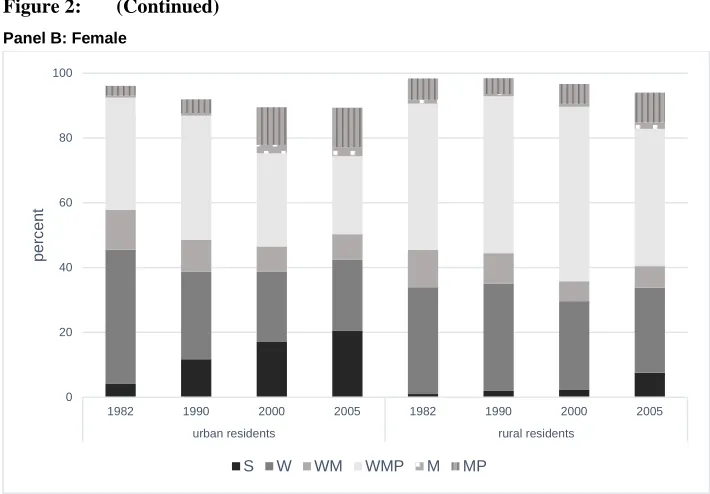
Figure 2 shows the percentage of these ordered and shuffled status combinations out of all possible status combinations for men and women, respectively. Again, the trend is similar for men and women but more pronounced for urban residents than for rural residents. For rural residents these three ordered status combinations comprise more than 90% of all possible status combinations in all years. For urban residents the percentage of ordered status combinations declines, from more than 95% in 1982 to slightly more than 80% in 2005.
Figure 2: Percentage of ordered status combinations by gender, hukou, and year
Panel A: Male
Note: S=school, W=work, WM=work-marriage, M=marriage. These status combinations are considered as ordered sequences for men.
The percentage is calculated as the percentage of S, W, WM, and M, against the total possible status combinations, which includes none (N), school-marriage (SM), school-work (SW), and school-work-marriage (SWM).
0 20 40 60 80 100
1982 1990 2000 2005 1982 1990 2000 2005
urban residents rural residents
per
c
ent
Figure 2: (Continued)
Panel B: Female
Note: S=school, W=work, WM=work-marriage, M=marriage, MP=marriage-parenthood, WMP=work-marriage-parenthood. These status combinations are considered as ordered sequences for women.
The percentage is calculated as the percentage of S, W, WM, WMP, M, and MP against the total possible status combinations, which also include none (N), parenthood (P), school-marriage (SM), school-work (SW), school-parenthood (SP), work-parenthood (WP), school-marriage-parenthood (SMP), parenthood (SWP), marriage (SWM), and school-work-marriage-parenthood (SWMP).
Among ordered status combinations, fast growth occurs among stay-at-home mothers. In 1982 and 1990 about 4% of urban women are in MP status; in 2005 the percentage triples to 12%. This trend is consistent with the “women return home” debate of the 1980s (Ochiai 1989). Since the reform, the famous phrase of the Mao era that “women hold up half the sky” (fu nv neng ding ban bian tian) has been replaced with the ideology of “good wives and wise mothers” (xian qi liang mu), which highlights women’s roles as housewives and caregivers (Ochiai and Aoyama 2014). This ideology shift is heightened by women’s deteriorating labor market conditions (Zhang, Hannum, and Wang 2008) and the stronger gendered division of household labor (Evans 2010) since the 1980s.
Urban men and women show some decline in ordered status combinations over time. Table 1 shows the percentage of shuffled status combinations out of the total possible combinations by year, for urban men and urban women. The majority of the
0 20 40 60 80 100
1982 1990 2000 2005 1982 1990 2000 2005
urban residents rural residents
per
c
ent
increase comes from an increase in the ‘None’ status (Table 1). For urban men, the ‘None’ status comprises about 3% of the young adult years in 1982 and rises to almost 15% in 2005. The rise of the ‘None’ status is slightly lower for urban women, from about 4% in 1982 to around 10% in 2005. This change is likely to be the result of an increasingly precarious labor market (Furlong et al. 2012; Inui 2005). The typical shuffled status combinations found in Western societies, such as non-marital childbearing (P, SP, WP, or SWP) or work-study (SW), remain very rare in China.
Table 1: Distributions of status combinations, urban men and urban women
Status combinations (shuffled) 1982 1990 2000 2005
Urban Mena
None (N) 3.36 9.29 12.75 14.92
School-work (SW) 0 0.01 0.1 0.2
School-marriage (SM) 0.11 0.12 0.02 0.04
School-work-marriage (SWM) 0 0 0.07 0.16
Urban Womenb
None (N) 3.69 7.46 9.67 9.84
Parenthood (P) 0.02 0.08 0.21 0.19
School-work (SW) 0 0 0.1 0.17
School-marriage (SM) 0.02 0.01 0.03 0.05
School-parenthood (SP) 0 0 0 0
Work-parenthood (WP) 0.02 0.47 0.4 0.32
School-marriage-parenthood (SMP) 0.01 0.06 0 0.03
School-work-parenthood (SWP) 0 0 0 0
School-work-marriage (SWM) 0 0 0.03 0.04
School-work-marriage-parenthood (SWMP) 0 0 0.06 0.08
Note: a. The denominator is the total number of transition-to-adulthood-years in all possible status combinations, which includes school (S), work (W), work-marriage (WM), and marriage (M).
3.3 Heterogeneity of transitions
Figure 3 displays the age-specific entropy indices between 1982 and 2005. The majority of lines follow an inverted-U shape, indicating that the heterogeneity of the transition to adulthood first increases in the early twenties and then decreases in the late twenties. This inverted-U shape is also found Brazil, Mexico, and South Korea (Fussell 2005; Park, Ribeiro, and Fussell 2010).
Figure 3: Age-specific percentage of maximum entropy index by gender, hukou, and year
Male Female
Urban residents
Rural residents
Again, the change is similar for men and women but more pronounced among urban residents than rural residents. For rural residents the entropy index remains almost stable between 1982 and 2000 and increases slightly in 2005 for all ages. For urban residents on the other hand, a slight drop in the entropy index occurs between
0 20 40 60 80 100
18 19 20 21 22 23 24 25 26 27 28 29 30
% m ax . ent ropy Age 1982 1990 2000 2005 0 20 40 60 80 100
18 19 20 21 22 23 24 25 26 27 28 29 30
% m ax . ent ropy Age 1982 1990 2000 2005 0 20 40 60 80 100
18 19 20 21 22 23 24 25 26 27 28 29 30
% m ax . ent ropy Age 1982 1990 2000 2005 0 20 40 60 80 100
18 19 20 21 22 23 24 25 26 27 28 29 30
ages 18 and 20, which is likely related to extended school participation in the previous twenty years. From age 20, levels of heterogeneity increase from 1982 to 2005 at every age. Even among urban residents the level of heterogeneity is comparable to Mexico (Fussell 2005) and some South Eastern countries (Nahar, Xenos, and Abalos 2013) with a structured transition to adulthood.
4. Discussion
This article provides a structural view of changes in the transition to adulthood in China. Specifically, we trace changes in timing, sequencing, and level of heterogeneity among four synthetic cohorts between 1982 and 2005. The results suggest that, despite rapid social changes in this period, the transition to adulthood remains almost stable, especially in the realm of family formation. With regard to timing, the results suggest a postponement in education completion and employment, but a minor delay in marriage and parenthood. With regard to sequencing, the results show virtually no change. There is a modest increase in shuffled status combinations for urban residents but this change is largely driven by young adults staying in the ‘None’ status rather than in typically reshuffled status combinations, such as non-marital childbearing or work-study. With regard to heterogeneity, we see some evidence for individualization, but only for urban residents. In general, the transition to adulthood remains structured.
China has strong population policies that influence the transition to adulthood, but young adults who came of age between 1982 and 2005 experienced less political influence than previous or subsequent cohorts. The “late, longer, and fewer” policy of the 1970s that significantly postponed family formation (Coale et al. 1991) was abandoned in the 1980s. Marriage choices returned to individuals and their families4 (Cai and Wang 2011). Additionally, those who came of age during 1982−2005 were mostly born in the 1960s and 1970s, which had normal sex ratios at birth (Li 2007). The effects of unbalanced sex ratios resulting from the one-child policy on the transition to adulthood await further exploration with future data.
Some aspects of the changes in the transition to adulthood in China resemble those of the West, especially the prolonged education and delayed labor force participation. However, the changes are modest. Chinese young adults, despite coming of age in a rapidly changing society, still follow a timely, ordered, and structured transition to adulthood, especially in the realm of family formation. The ordered and structured transition to adulthood has historical roots. As Dribe et al. (2014) point out, the Chinese population in the 18th and 19th centuries also followed an ordered transition to adulthood
4 While the Chinese government requires the minimum age of marriage to be 22 for men and 20 for women,
that was characterized by early and universal marriage. These findings again suggest no convergence to a single trajectory of transitioning to adulthood (Furstenberg 2013). Some global forces, such as increased economic uncertainty and the ideational spread of individual autonomy, may create general conditions for young adults to forge adulthood pathways (Lesthaeghe 2010; McDonald 2006). Yet young adults’ responses and actions depend on embedded institutional contexts and cultural traditions (Blossfeld et al. 2005; Buchmann 1989; Mayer 2004; Modell, Furstenberg, and Hershberg 1976).
Compared to its Eastern Asian neighbors, China is an outlier in the realm of delayed marriage and rising singlehood (Raymo et al. 2015). Almost all Chinese women are married by age 30, which contrasts sharply with Japan and South Korea and with the ethnic Chinese population in Taiwan, Hong Kong, Singapore, and Malaysia (Jones 2007). China’s outlier status may result from its low economic development and female educational attainment (Ji and Yeung 2014). Future research should investigate whether economic development and college education expansion will postpone Chinese young adults’ transitions into marriage and childbearing.
5. Acknowledgements
References
Blossfeld, H.-P., Klijzing, E., Mills, M., and Kurz, K. (2005). Globalization, uncertainty and youth in society. London: Routledge.
Bramall, C. (2009). Chinese economic development. London: Routledge.
Buchmann, M.C. (1989). The script of life in modern society: entry into adulthood in a changing world. Chicago: University of Chicago Press.
Buchmann, M.C. and Kriesi, I. (2011). Transition to adulthood in Europe. Annual Review of Sociology 37: 481−503. doi:10.1146/annurev-soc-081309-150212. Cai, Y. and Wang, F. (2011). (Re)emergence of late marriage in new shanghai. Paper
presented at the Conference on Marriage in Cosmopolitan China. Hong Kong, China, July 4−6 2011.
Chan, K.W. (2013). The Chinese hukou system at 50. Eurasian Geography and Economics 50(2): 197−221. doi:10.2747/1539-7216.50.2.197.
Coale, A., Wang, F., Riley, N. E., and De, L.F. (1991). Recent trends in fertility and nuptiality in China. Science 251(4992): 389−393. doi:10.1126/science.251.
4992.389.
Dribe, M., Manfredini, M., Oris, M., Kurosu, S., and Campbell, C. (2014). The roads to reproduction: comparing life-course trajectories in preindustiral Eurasia. In: Lundh, C. and Kurosu, S. (eds.). Similarity in difference: marriage in Europe and Asia, 1700−1900. Cambridge: the MIT Press: 89−120. doi:10.7551/mitpress
/9780262027946.003.0004.
Elder, G.H., Johnson, M.K., and Crosnoe, R. (2003). The emergence and development of life course theory. In: Mortiimer, J.K. and Shanahan, M. (eds.). Handbook of the life course. New York: Kluwer-Plenum: 3−19.
doi:10.1007/978-0-306-48247-2_1.
Evans, H. (2010). The gender of communication: changing expectations of mothers and daughters in urban China. The China Quarterly 204: 980−100.
doi:10.1017/S0305741010001050.
Furstenberg, F.F. (2013). Transitions to adulthood: what we can learn from the west. The Annals of the American Academy of Political and Social Science 646: 28−41. doi:10.1177/0002716212465811.
Fussell, E. (2005). Measuring the early adult life course in mexico: an application of the entropy index. Advances in Life Course Research 9: 91−122. doi:10.1016/S1040
-2608(04)09004-5.
Grant, M.J. and Furstenberg, F.F. (2007). Changes in the transition to adulthood in less developed countries. European Journal of Population 23: 415−428.
doi:10.1007/s10680-007-9131-9.
Inui, A. (2005). Why freeter and neet are misunderstood: recognizing the new precarious conditions of japanese youth. Social Work & Society 3(2): 244−251. Ji, Y. and Yeung, W.-J.J. (2014). “Heterogeneity in contemporary Chinese marriage”.
Journal of Family Issues 35(12): 1662−1682. doi:10.1080/10670564.2013.
832526.
Jones, G.W. (2007). Delayed marriage and very low fertility in pacific asia. Population and Development Review 33(3): 453−478. doi:10.1111/j.1728-4457.2007.
00180.x.
Jones, G.W. and Yeung, W.-J.J. (2014). Marriage in Asia. Journal of Family Issues 35(12): 1567−1583. doi:10.1177/0192513X14538029.
Lesthaeghe, R. (2010). The unfolding story of the second demographic transition. Population and Development Review 36(2): 211−251.
doi:10.1111/j.1728-4457.2010.00328.x.
Li, S. (2007). Imbalanced sex ratio at birth and comprehensive intervention in China. Paper presented at the 4th Asia Pacific Conference on Reproductive and Sexual Health and Rights, Hyderabad, India, October 29−31 2007.
Liang, Z. (2001). The age of migration in China. Population and Development Review 27(3): 499−524. doi:10.1111/j.1728-4457.2001.00499.x.
Lloyd, C.B. (2005). Growing up global: The changing transitions to adulthood in developing countries. Washington, D.C.: The National Academies Press.
Mayer, K.U. (2004). Whose lives? how history, societies and institutions define and shape life courses. Research in Human Development 1(3): 161−187.
McDonald, P. (2006). Low fertility and the state: the efficacy of policy. Population and Development Review 32(3): 485−510. doi:10.1016/j.fertnstert.2006.07.1078. Modell, J., Furstenberg, F.F., and Hershberg. T. (1976). Social change and transitions to
adulthood in historical perspective. Journal of Family History 1: 7−32.
doi:10.1177/036319907600100103.
Nahar, Q., Xenos, P., and Abalos, J. (2013). The changing transitions to adulthood across southeast asia: a census approach to cross-national comparisons. The Annals of the American Academy of Political and Social Science 646: 42−68.
doi:10.1177/0002716212469921.
Ochiai, E. (1989). Will Chinese Women Go Back Home? Modernization Policy and the Outcome of “Women Return Home” Debate. Tokyo: Keiso Shobo.
Ochiai, E. and Aoyama, K. (2014). Asian Women and Intimate Work. Leiden: Brill. Parish, W.L. and Farrer, J. (2000). Gender and family. In: Tang, W.F. and Parish, W.L.
(eds.). Chinese Urban Life Under Reform: The Changing Social Contract. Cambridge: Cambridge University Press: 232−272.
Park, H., Ribeiro, C.A.C., and Fussell, E. (2010). Cross-time and cross-national comparisons of the transition to adulthood: Brazil, Mexico, and South Korea, 1970−2000. Paper presented at the Annual Meeting of Population Association of America, Dallas, Texas, April 15−17 2010.
Raymo, J.M., Park, H., Xie, Y., and Yeung, W.-J.J. (2015). Marriage and family in east asia: continuity and change. Annual Review of Sociology 41: 471−492.
doi:10.1080/01494929.2015.1076554.
Rindfuss, R.R. (1991). The young adults years: diversity, structural change, and fertility. Demography 28(4): 493−512. doi:10.2307/2061419.
Settersten, R.A. and Bay, B. (2010). What's going on with young people today? the long and twisting path to adulthood. The Future of Children 20(1): 19−66.
doi:10.1353/foc.0.0044.
Shanahan, M.J. (2000). Pathways to adulthood in changing societies: variability and mechanisms in life course perspective. Annual Review of Sociology 26: 667−692. doi:10.1146/annurev.soc.26.1.667.
Tang, W.F. and Parish, W.L. (2000). Chinese urban life under reform: the changing social contract. Cambridge: Cambridge University Press.
Wu, X. and Treiman, D.J. (2004). The household registration system and social stratification in China: 1955−1996. Demography 41(2): 363−384. doi:10.1353/
dem.2004.0010.
Xie, Y. and Zhou, X. (2013). The structure of high income inequality in China. Paper presented at the Annual Meeting of American Sociological Association, New York, New York, August 10−13, 2013.
Yeung, W.-J.J. and Alipio, C. (2013). Transitioning to adulthood in asia: school, work, and family life. The Annals of the American Academy of Political and Social Science 646: 6−27. doi:10.1177/0002716212470794.
Yeung, W.-J.J. and Hu, S. (2013). Coming of age in times of change: the transition to adulthood in china. The Annals of the American Academy of Political and Social Science 646: 149−171. doi:10.1177/0002716212468667.