Evolution occurs by the accumulation of genetic changes. Behavior is under genetic control and evolves in response to selection. It is thought (at least this seems to be the view of prominent textbooks [1,2]) that behavior evolves in large part by changes in quantitative characteristics such as the intensity or frequency of a behavior, the thresholds for eliciting a particular response, or the relative timing of component actions. This implies the existence of genes whose sequences control the values of numbers that determine behavior. I like to think of an animal as a device with a complicated control panel - the genome - covered with buttons and switches and knobs - the genes. Mutation and natural selection turn the knobs to adjust behavior so as to optimize fitness in the environment in which the animal finds itself.
For almost 50 years geneticists studying the nematode worm Caenorhabditis elegans have been isolating and study ing behavioral mutants. (See Box 1 for an explana-tion of what I mean by ‘behavior’.) Does this work tell us anything about how behavior evolves? In particular, can it identify candidates for the knobs - genes whose sequences move the numbers that control behavior?
A brief overview of C. elegans behavioral genetics
Behavioral genes have figured prominently in C. elegans genetics since Sydney Brenner began isolating mutants over 40 years ago. Of the 95 genes listed in Table 4 of Brenner’s first paper on the genetics of C. elegans, 57 affect nervous system function and behavior. (The others
affect morphology (29) or muscle contraction (9); another 5 of Brenner’s 100 genes are no longer thought to be distinct genes.) In part this is because Brenner and his postdocs and students were interested in the function of the nervous system, but it was also a consequence of technical constraints. Worms are morphologically simple. Unlike mice or flies, for instance, which bristle with external spikes, hairs and protuberances in a variety of shapes and colors, there is not much to see on the outside of a worm. The insides are visible and a little more complex, but most of the obvious features are too important to mess with in any serious way.
In contrast, viable and visible behavioral mutants are easy to isolate and work with. Many behavioral abnor-malities are obvious under dissecting microscope obser-va tion. And viable mutants are common because under laboratory conditions, hermaphrodites can survive and reproduce even with a largely nonfunctional nervous system. We now have at least some information about the functions of most of the 118 types of neurons in the hermaphrodite [3,4], and only one of them, CAN, is known to be essential in the lab. (Worms lacking CAN wither and fail to grow, but its exact function is still not clear.) The feeding motor neuron M4 was reported to be essential [5], but it has since been found that M4-minus worms are viable and fertile when grown on small bacteria (JT Chiang, M Steciuk, B Shtonda, and L Avery, unpublished). Feeding is essential, but the motion of the feeding muscles continues in a slow, uncoordinated, but still functional way in the absence of the motor neurons that control them [6]. Since they self-fertilize, herma-phrodites do not need to mate to reproduce. We grow them literally swimming in food, so they do not need to move to find it. Egg-laying is not essential for fertility, as unlaid eggs hatch inside the mother, eat her, and escape [7,8]. Defects in mechanosensation [9], thermotaxis [10], chemosensation [11] and many other behaviors that are probably important or essential in the wild have little effect on survival in the lab.
Consequently, mutations that drastically reduce or eliminate the function of most of the nervous system are
Abstract
Thousands of behavioral mutants of Caenorhabditis eleganshave been studied. I suggest a set of criteria by which some genes important in the evolution of behavior might be recognized, and identify neuropeptide signaling pathways as candidates.
Caenorhabditis elegans
behavioral genetics:
where are the knobs?
Leon Avery*
O P I N I O N
Open Access
*Correspondence: [email protected]
Department of Molecular Biology, University of Texas Southwestern Medical Center, 6000 Harry Hines Blvd, Dallas, TX 75390-9148, USA
easily isolated. This has been a great advantage for the investigation of fundamental neuronal processes such as synaptic transmission [12]. Many of the genes identified by Brenner affect such processes as neurotransmitter synthesis, vesicle loading, active zone formation, vesicle fusion, or postsynaptic response [12]. Similar mutations in other animals are almost always lethal.
In most cases, one need only look at one of these mutants to be convinced that the mutation is unlikely to be important in evolution. unc‑18, for instance, is essen-tial for synaptic transmission [13], and unc‑18 mutants are almost totally paralyzed, feed slowly, and grow and reproduce much more slowly than wild type [14]. Very few of the behavioral mutations studied in C. elegans labs are convincing candidates for a useful setting on the evolutionary control panel. The reason for this is selec-tion bias. Mutaselec-tions that cause large, obvious changes are the easiest to identify and study. And as geneticists we focus on null or strong loss-of-function mutations, as these typically provide the most easily interpretable information about the function of the wild-type gene.
However, although the mutations we study are unlikely fodder for evolution, the genes they identify might, if their functions were more subtly altered, tweak behavior in adaptive ways.
Why evolution is hard to do
The behavior of an animal is a complicated machine with many interlocking gears. If you change one part, you must change the connecting parts, too, if the machine is not to break. Consider the changes that would be neces-sary to adapt an animal that evolved under conditions of stable food supply to a new environment in which food supply is unpredictable. If the food supply is stable, it is wasteful to store lots of fat - the energy is better devoted
to attaining reproductive age as rapidly as possible and producing progeny. If food is unpredictable, it makes sense to eat more than you need and stock away some of the surplus as fat, so that you can survive lean times. But without other adaptations, simply increasing the amount that you eat would serve little purpose. Without increased expression of digestive enzymes, an increase in feeding rate might have little effect. Physiological changes such as slowing reproduction and increasing the expres-sion of anabolic enzymes in storage organs would be necessary to allow the accumulation of reserves. Foraging strategies would need to change in order to match the accumulation of reserves to the risk of hunger. And, of course, reserves are only valuable if they are used when needed. You need to gather information about nutritional stress, or the possibility of stress, and adjust behavior and physiology in response.
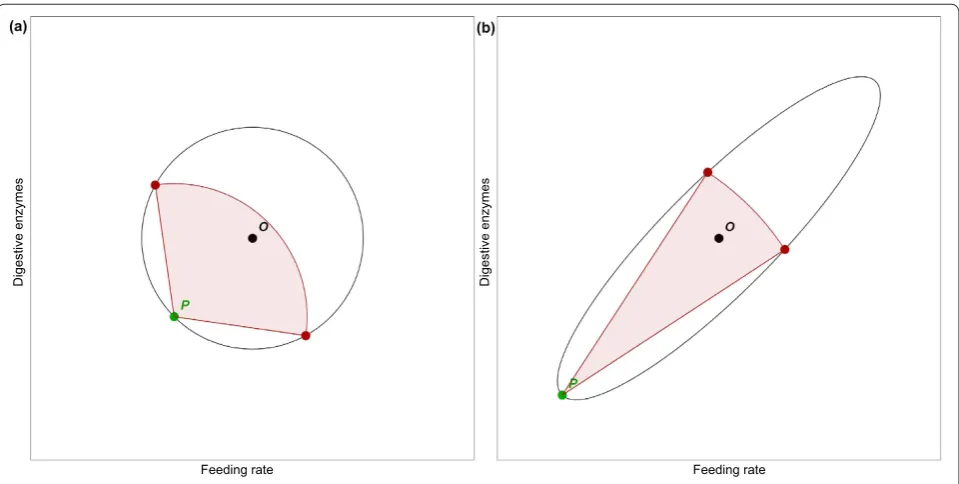
Of course, this is not a new observation, nor is the problem unique to behavior. Every extant living thing is adapted to its environment through the action of many complicated machines whose parts must work together, and which are therefore difficult to change. In The Genetical Theory of Natural Selection [15], Ronald Fisher offered a geometric analogy to understand the problem of adaptation. It begins by thinking of phenotype as a point in space. Each dimension of the space represents some aspect of the phenotype that can vary. For instance, one might plot average feeding rate along the x-axis and digestive enzyme expression on the y-axis (Figure 1a). The optimal combination of these two (which will depend on the environment) is a point O in this phenotype space; the actual phenotype another point, P. Fisher suggested that the degree of adaptation might be represented by the distance from O to P. The target of adaptation, compris-ing all phenotypes better than P, is located in a disk centered at O whose edge passes through P.
Now, suppose a mutation causes a change in the phenotype: what is the probability that the change will be an improvement? For very small changes, the chance that a random change moves P towards O is about equal to the chance that it moves away. Thus, the probability of hitting within the target and improving adaptation is 50%. But this probability decreases progressively as the size of the change increases (see demonstration in Additional file 1). If we were considering three changes - for example, eat more, express digestive enzymes, and slow reproduction - the target would be a ball centered at O, and random changes would be even less likely to be inside. Most likely, real adaptations occur in a phenotype space of far more than three dimensions. Fisher showed that when there are many dimensions along which adaptation occurs, only very small changes are likely to improve adaptation. This is consistent with the intuitive perception that changes to a complex machine with many
Box 1: What is behavior?
parts are far more likely to damage it than improve it. Fisher therefore argued that evolution would occur only by small steps.
The example suggests, however, that this picture is too simple. One adaptation does not affect fitness indepen-dently of others - rather, they interact. Increased expres-sion of digestive enzymes will have only a limited effect if the rate of feeding does not change. An increased feeding rate may have little effect unless digestive enzyme expres-sion increases. But simultaneous increases in these two quantities may result in a far greater change in nutrient intake than the sum of the two individual changes. One can easily imagine that in an appropriate environment, the two changes together might improve fitness.
Thus, some directions in phenotype space make more functional sense than others. Increasing enzyme expres-sion while decreasing feeding (movement toward the upper left in Figure 1)is almost certainly a bad idea, no matter where you are, but increasing them together (movement toward the upper right) may well improve fitness. The target for improved adaptation, rather than being a circle or a ball, is more like an ellipsoid (Figure 1b). Although random changes are still unlikely
to be improvements, changes along the length of the ellipsoid are far more likely to hit within it than changes in other directions. To the extent that we understand the function of the behaviors, we can recognize these directions as coherent changes in many behaviors that together serve a common purpose.
If an animal is poorly adapted to its environment, a likely cause is that the environment has recently changed. Changes in the environment correspond to motion of the point O. Changes in the environment are not random. For instance, a sustained increase in food availability is more likely to be accompanied by sustained increases in population density and predator activity than by decreases. This means that O is more likely to move in some directions than in others. If an animal is maladapted because of a recent change in its environment, a mutation to adapt an animal to the new environment should move P in the same direction that O moved.
These arguments suggest that, if they exist, genes that satisfy the following criteria might be particularly impor-tant in behavioral evolution. First, the gene affects multiple related behaviors (pleiotropy). Second, the behaviors are affected in such a way that together they
Figure 1. Adaptation can be represented by motion in phenotype space. This figure shows a hypothetical phenotype space for feeding rate and expression of digestive enzymes. (a) Point O is the optimal phenotype, and P is the animal’s current phenotype. Now suppose that a mutation changes the phenotype. This can be thought of as a step from P to some other point. If the new point is closer to O than P was, that is, if it is within the black circle, then it is adaptive. For very small steps the probability of an adaptive step is close to 50%. The set of adaptive points for a step 1.2 times the distance from P to O is shown by the red arc; the probability of improved adaptation is 30%. This probability continues to decrease as step size increases, until it becomes 0 for steps of size 2 or greater. (b) Part (a) assumes no interaction between feeding rate and digestive enzyme expression. In reality, correlated changes are more likely to be adaptive than changes in which one increases while the other decreases. This can be represented by changing the target area to an ellipse. It is still the case that small changes are more likely to be adaptive than big changes. However, much larger adaptive changes are now possible, if they are along the axis of the ellipse. The figure shows a change of size 2.4, which would always be maladaptive for a circular target of equal area. Here the probability of improvement is 7%.
Feeding rate Feeding rate
make functional sense (functional coherence). Third, these combined behavioral changes are in a direction that is an appropriate response to a likely environmental change (environmental responsiveness).
Signals with significance
Can we identify genes that meet these criteria? They seem extraordinarily demanding. It is not just that they constrain the genes of interest. Our ability to recognize them is also a problem. To evaluate them, we require at least a crude understanding of how the environment is likely to change, and what sort of behavioral changes represent a functionally coherent response. Are there any genes that match?
In fact, although the majority of C. elegans genes studied do not fit these criteria, some do. Examples are egl‑4, which encodes cGMP-dependent protein kinase (PKG), and daf‑2, which encodes the insulin/insulin-like growth factor (IGF) receptor. egl‑4 affects a variety of food-seeking behaviors. Normal worms alternate between two modes of locomotion: roaming, in which they search for good food; and dwelling, when they consume what they have found [16,17]. Loss of egl‑4 function causes worms to roam, as if continually searching for better food [16]. Wild-type worms, given abundant high-quality food, will eventually stop eating and become quiescent; egl‑4 loss-of-function worms continue to eat, while egl‑4 gain-of-function mutants become quiescent even in poor food [18]. egl‑4 loss-of-function mutants grow bigger than wild type [16,19], while the gain-of-function mutant is small [20]. These phenotypes can be understood as responses to a change in the reliability and quality of the food supply: specifically, egl‑4 function makes worms act in a way that is appropriate for a reliable, high-quality food supply. egl‑4 also affects egg-laying [20,21] and chemosensory adaptation [22]. The Drosophila PKG gene foraging has similar effects on fly behavior [23,24]. foraging is polymorphic in wild populations and affects fitness in laboratory selection experiments. The expres-sion of its homolog in honeybees correlates with the transition from nurse to forager caste [25].
daf‑2 activity is controlled by nutritional state, and regulates the balance between growth and reproduction on the one hand, versus survival and safety on the other. daf‑2 loss-of-function mutants were initially identified because they become dauer larvae even under favorable growth conditions [26]. The dauer larva is a develop-mental diapause normally entered by wild-type worms only under unfavorable conditions. Dauers can survive harsh conditions for many times the normal lifespan with out aging. But daf‑2 has since been shown to profoundly affect physiology. daf‑2 loss-of-function mutants are bullet-proof: they have up to twice the lifespan of wild-type worms [27] and are resistant to
pathogens [28] and a wide variety of stresses (see, for example [29,30]). They grow more slowly than wild-type worms (Y You, A Artyukhin, unpublished observations) and synthesize and store more fat than wild-type [31].
There are other genes that meet the criteria of pleio-tropy, functional coherence, and environmental respon-sive ness. Mutations in other genes in the insulin signaling pathway, not surprisingly, have phenotypes either similar or opposite to daf‑2 loss-of-function. Other examples would be genes in the daf‑7 transforming growth factor beta (TGF-β) and flp‑18 neuropeptide signaling path-ways. The neuropeptide receptor gene npr‑1, which affects social foraging in response to atmospheric gases [32-36], is also a candidate, although in this case it is less obvious what sort of environmental change, if any, its activity might represent an appropriate response to.
This short list of genes is subjective and likely to be incomplete, but still it is intriguingly nonrandom. First, all these genes are concerned with responses to food or nutrition. This may not be very informative: almost every known C. elegans behavior is influenced by food, and changes in the quantity, quality and reliability of the food supply are among the most easily recognized environ-mental variables. Second, and more interesting, all the genes affect specific peptide hormone signaling pathways. (egl‑4, for instance, is thought to affect the signaling pathways of two TGF-βs: DBL-1 [37] and DAF-7 [18]).
At some cost in precision, the statement that a signal meets the criteria of pleiotropy, functional coherence and environmental responsiveness can be summarized as a claim that it has significance. The signal carries infor ma-tion about some important characteristic of the environ-ment and provokes appropriate responses. Put this way, it is not, after all, so surprising that there are such genes. Behavior exists to allow an animal to adapt to changes in its environment. Of course animals have signals that signify changes in the environment and provoke appro-priate responses. Within the life of an animal the pathways are regulated by all the mechanisms by which the function of a gene product may be regulated: gene expression, post-translational modification, subcellular location, and so on. But over generations they may also be regulated by changes in the genes that encode them.
important in development, most developmental signals can be understood not as conveying information about the animal’s environment, but rather the local environ-ment of a cell within the animal.
The idea that evolution of behavior occurs by changes in signaling pathways raises a question. I have implied that a mutation that increased the activity of the DAF-2 insulin/IGF receptor might make the worm more fit for environments in which food is abundant. But the activity of DAF-2 is regulated in real time by food abundance. Doesn’t this behavioral flexibility trump genetic adapta-tion? Wouldn’t the fittest organism be one that can adapt to any environment it will encounter?
The answer is sometimes yes, sometimes no. Flexibility has costs (Box 2). The Worm for All Seasons, capable of responding to every environmental change that it is likely to encounter during its long-term evolution, will not necessarily be fitter than a less flexible worm able to respond behaviorally only to those changes that occur frequently in its environment.
Is it true?
Are these genes really the volume knobs that are turned by the evolution of behavior? To my knowledge, this has not yet been tested in C. elegans. (However, the idea is consistent with work suggesting the importance of oxytocin/vasopressin signaling in the regulation and evolution of monogamy in voles [38] and possibly even in humans [39].) Unfortunately, although genes such as daf‑2 and egl‑4 may be particularly important in the evolution of behavior, it is unlikely that the mutations that have been studied in the lab are. Most of these mutations were found in screens biased towards large, obvious effects. In most cases the mutant worms are obviously crippled by changes in gene activity that are far too large (null mutations, for instance) and would not be competitive in the wild.
The hypothesis could be tested, however. First, labora-tory evolution experiments or recombinant inbred lines could be used to identify genes that confer an advantage under selection for changed behavior. It is particularly
Box 2: The cost of flexibility
Henry Ford was aware of the cost of flexibility. He wrote:
“Therefore in 1909 I announced one morning, without any previous warning, that in the future we were going to build only one model, that the model was going to be “Model T,” and that the chassis would be exactly the same for all cars, and I remarked:
‘Any customer can have a car painted any colour that he wants so long as it is black.’ “ [43].
Ford knew that, all other things equal, he could sell more cars if he produced red and black than if he made only black. But he also knew that if he produced red cars, it would make black cars more expensive. Flexibility has three (at least) types of costs: overhead, information and error. These can be illustrated with an example.
Imagine you are a bird nesting on the side of a mountain. The weather varies unpredictably from day to day: 50% of the days are hot, and 50% are cold. Every morning you choose to spend the day hunting for food either on the mountaintop or in the valley. If you go to the mountain on a cold day, you freeze to death; if you go to the valley on a hot day you die of heat exhaustion. From the temperature in the morning you can guess the likely weather today with 80% accuracy. Flexibility clearly benefits you. By choosing to go to the mountain on hot mornings and to go to the valley on cold mornings, you have an 80% chance of surviving the day. If you always went to one or the other, your chance would only be 50%.
Now, suppose that one year the climate changes. From that time on, the probability of a cold day is 10% and hot day 90%. If you continue to follow your strategy of assessing the temperature every morning and responding accordingly, you will now spend 74% of your days on the mountain, and your daily survival probability will remain 80%. In one sense, this is a triumph for flexibility. With no genetic change, you have adjusted your behavior to the changed environment and suffered no ill effect. But compare your strategy with that of a mutant bird who goes to the mountain every day. In the old climate, her survival probability would have been 50%, and the mutation would have been eliminated by competition with more flexible birds like you. Now, however, her probability of survival is 90%, and the future belongs to her descendants. Her error cost, the selective disadvantage that results from incorrect decisions, is lower than yours, and as a result she wins. Error cost exists when consequential behavioral decisions are based on imperfect information.
In fact, her fitness may be improved by even more than the reduction in error cost. Suppose, to assess the weather with 80% accuracy, you need to wait until the sun rises. She, on the other hand, can fly to the mountaintop before sunrise and have first pick of the insects that fly at dawn. Your loss of this opportunity is information cost, incurred in exchange for information about the weather. Furthermore, she could nest closer to the mountaintop, where she would have less flying to do, and therefore could get along with smaller flight muscles. Your powerful and energetically expensive flight muscles, which give you the capacity to pursue a different strategy every day, are an overhead cost.
easy to make hermaphrodite recombinant inbred lines [40], and some behavioral studies have already been done [41]. Second, one could look at variation in natural populations. One might expect to see more than average polymorphism in genes of these signaling pathways, accompanied by signals of stronger selection. Third, one could compare the genes from other Caenorhabditis species, several of which have now been sequenced. Even without knowing how the niches of these species differ, it is likely that optimal behavior differs, and therefore that there would be a higher frequency of functional polymorphisms in these genes than in others.
Additional material
Acknowledgements
I thank Joe Dent, Erik Jorgensen, Shawn Lockery, members of the Avery Lab, and anonymous referees for criticism.
Published: 8 June 2010
References
1. Futuyma DJ: Evolutionary Biology. Sunderland, MA: Sinauer; 1998.
2. Alcock J: Animal Behavior: An Evolutionary Approach. Sunderland, MA: Sinauer; 2009.
3. WormAtlas [http://www.wormatlas.org/]
4. White JG, Southgate E, Thomson JN, Brenner S: The structure of the nervous system of the nematode Caenorhabditis elegans.Philos Trans R Soc Lond B Biol Sci 1986, 314:1-340.
5. Avery L, Horvitz HR: A cell that dies during wild-type C. elegans
development can function as a neuron in a ced-3 mutant.Cell 1987,
51:1071-1078.
6. Avery L, Horvitz HR: Pharyngeal pumping continues after laser killing of the pharyngeal nervous system of C. elegans.Neuron 1989, 3:473-485. 7. Ferguson EL, Horvitz HR: Identification and characterization of 22 genes
that affect the vulval cell lineages of the nematode Caenorhabditis elegans.Genetics 1985, 110:17-72.
8. Trent C, Tsung N, Horvitz H: Egg-laying defective mutants of the nematode
Caenorhabditis elegans.Genetics 1983, 104:619-647.
9. O’Hagan R, Chalfie M: Mechanosensation in Caenorhabditis elegans.Int Rev Neurobiol 2006, 69:169-203.
10. Mori I, Sasakura H, Kuhara A: Worm thermotaxis: a model system for analyzing thermosensation and neural plasticity.Curr Opin Neurobiol 2007, 17:712-719. 11. Bargmann CI: Chemosensation in C. elegans.WormBook 2006:1-29. 12. Richmond J: Synaptic function.WormBook 2005:1-14.
13. Weimer RM, Richmond JE, Davis WS, Hadwiger G, Nonet ML, Jorgensen EM:
Defects in synaptic vesicle docking in unc-18 mutants.Nat Neurosci 2003,
6:1023-1030.
14. Hosono R, Hekimi S, Kamiya Y, Sassa T, Murakami S, Nishiwaki K, Miwa J, Taketo A, Kodaira KI: The unc-18 gene encodes a novel protein affecting the kinetics of acetylcholine metabolism in the nematode Caenorhabditis elegans.J Neurochem 1992, 58:1517-1525.
15. Fisher R: The Genetical Theory of Natural Selection. Reprint. New York: Dover Publications; 1958.
16. Fujiwara M, Sengupta P, McIntire SL: Regulation of body size and behavioral state of C. elegans by sensory perception and the EGL-4 cGMP-dependent protein kinase. Neuron 2002, 36:1091-1102.
17. Shtonda BB, Avery L: Dietary choice behavior in Caenorhabditis elegans.
J Exp Biol 2006, 209:89-102.
18. You YJ, Kim J, Raizen DM, Avery L: Insulin, cGMP, and TGF-beta signals regulate food intake and quiescence in C. elegans: a model for satiety.Cell Metab 2008, 7:249-257.
19. Hirose T, Nakano Y, Nagamatsu Y, Misumi T, Ohta H, Ohshima Y: Cyclic GMP-dependent protein kinase EGL-4 controls body size and lifespan in C. elegans.Development 2003, 130:1089-1099.
20. Raizen DM, Cullison KM, Pack AI, Sundaram MV: A novel gain-of-function mutant of the cyclic GMP-dependent protein kinase egl-4 affects multiple physiological processes in Caenorhabditis elegans.Genetics 2006,
173:177-187.
21. Desai C, Horvitz HR: Caenorhabditis elegans mutants defective in the functioning of the motor neurons responsible for egg laying.Genetics 1989, 121:703-721.
22. L’Etoile ND, Coburn CM, Eastham J, Kistler A, Gallegos G, Bargmann CI: The cyclic GMP-dependent protein kinase EGL-4 regulates olfactory adaptation in C. elegans.Neuron 2002, 36:1079-1089.
23. Osborne KA, Robichon A, Burgess E, Butland S, Shaw RA, Coulthard A, Pereira HS, Greenspan RJ, Sokolowski MB: Natural behavior polymorphism due to a cGMP-dependent protein kinase of Drosophila.Science 1997, 277:834-836. 24. Raizen DM, Zimmerman JE, Maycock MH, Ta UD, You YJ, Sundaram MV, Pack
AI: Lethargus is a Caenorhabditis elegans sleep-like state. Nature 2008,
451:569-572.
25. Kaun KR, Sokolowski MB: cGMP-dependent protein kinase: linking foraging to energy homeostasis.Genome 2009, 52:1-7.
26. Riddle DL: A genetic pathway for dauer larva formation in C. elegans.
Stadler Genet Symp 1977, 9:101-120.
27. Kenyon C, Chang J, Gensch E, Rudner A, Tabtiang R: A C. elegans mutant that lives twice as long as wild type.Nature 1993, 366:461-464.
28. Evans EA, Chen WC, Tan MW: The DAF-2 insulin-like signaling pathway independently regulates aging and immunity in C. elegans.Aging Cell 2008,
7:879-893.
29. Scott BA, Avidan MS, Crowder CM: Regulation of hypoxic death in C. elegans
by the insulin/IGF receptor homolog DAF-2.Science 2002, 296:2388-2391. 30. Mendenhall AR, LaRue B, Padilla PA: Glyceraldehyde-3-phosphate
dehydrogenase mediates anoxia response and survival in Caenorhabditis elegans.Genetics 2006, 174:1173-1187.
31. Perez CL, Van Gilst MR: A 13C isotope labeling strategy reveals the influence
of insulin signaling on lipogenesis in C. elegans.Cell Metab 2008, 8:266-274. 32. Hallem EA, Sternberg PW: Acute carbon dioxide avoidance in
Caenorhabditis elegans.Proc Natl Acad Sci USA 2008, 105:8038-8043. 33. Pocock R, Hobert O: Hypoxia activates a latent circuit for processing
gustatory information in C. elegans.Nat Neurosci, 13:610-614.
34. de Bono M, Bargmann CI: Natural variation in a neuropeptide Y receptor homolog modifies social behavior and food response in C. elegans.Cell 1998, 94:679-689.
35. Bretscher AJ, Busch KE, de Bono M: A carbon dioxide avoidance behavior is integrated with responses to ambient oxygen and food in Caenorhabditis elegans.Proc Natl Acad Sci USA 2008, 105:8044-8049.
36. Rogers C, Persson A, Cheung B, de Bono M: Behavioral motifs and neural pathways coordinating O2 responses and aggregation in C. elegans.Curr Biol 2006, 16:649-659.
37. Nagamatsu Y, Ohshima Y: Mechanisms for the control of body size by a G-kinase and a downstream TGFbeta signal pathway in Caenorhabditis elegans.Genes Cells 2004, 9:39-47.
38. Hammock EA: Gene regulation as a modulator of social preference in voles.Adv Genet 2007, 59:107-127.
39. Walum H, Westberg L, Henningsson S, Neiderhiser JM, Reiss D, Igl W, Ganiban JM, Spotts EL, Pedersen NL, Eriksson E, Lichtenstein P: Genetic variation in the vasopressin receptor 1a gene (AVPR1A) associates with pair-bonding behavior in humans. Proc Natl Acad Sci USA 2008, 105:14153-14156. 40. Rockman MV, Kruglyak L: Recombinational landscape and population
genomics of Caenorhabditis elegans.PLoS Genet 2009, 5:e1000419. 41. Doroszuk A, Snoek LB, Fradin E, Riksen J, Kammenga J: A genome-wide
library of CB4856/N2 introgression lines of Caenorhabditis elegans.Nucleic Acids Res 2009, 37:e110.
42. Mathematica Player [http://www.wolfram.com/products/player] 43. Ford H, Crowther S: My Life and Work. Garden City, NY: Doubleday, Page &
Company; 1922.
44. Kussell E, Leibler S: Phenotypic diversity, population growth, and information in fluctuating environments.Science 2005, 309:2075-2078.
doi:10.1186/1741-7007-8-69
Cite this article as: Avery L: Caenorhabditis elegansbehavioral genetics: where are the knobs?BMC Biology 2010, 8:69.