R E S E A R C H A R T I C L E
Open Access
Comparative efficacy of serotonin (5-HT
3
)
receptor antagonists in patients undergoing
surgery: a systematic review and network
meta-analysis
Andrea C. Tricco
1,2, Charlene Soobiah
1,3, Erik Blondal
1, Areti A. Veroniki
1, Paul A. Khan
1, Afshin Vafaei
1, John Ivory
1,
Lisa Strifler
1, Huda Ashoor
1, Heather MacDonald
1, Emily Reynen
1, Reid Robson
1, Joanne Ho
1, Carmen Ng
1,
Jesmin Antony
1, Kelly Mrklas
1,4, Brian Hutton
5, Brenda R. Hemmelgarn
4, David Moher
5and Sharon E. Straus
1,6*Abstract
Background:Serotonin (5-HT3) receptor antagonists are commonly used to decrease nausea and vomiting for surgery patients. We conducted a systematic review on the comparative efficacy of 5-HT3receptor antagonists.
Methods:Searches were done in MEDLINE, Embase, and the Cochrane Central Register of Controlled Trials to identify studies comparing 5-HT3receptor antagonists with each other, placebo, and/or combined with other antiemetic agents for patients undergoing surgical procedures. Screening search results, data abstraction, and risk of bias assessment were conducted by two reviewers independently. Random-effects pairwise meta-analysis and network meta-analysis (NMA) were conducted. PROSPERO registry number: CRD42013003564.
Results:Overall, 450 studies and 80,410 patients were included after the screening of 7,608 citations and 1,014 full-text articles. Significantly fewer patients experienced nausea with any drug relative to placebo, except for ondansetron plus metoclopramide in a NMA including 195 RCTs and 24,230 patients. Significantly fewer patients experienced vomiting with any drug relative to placebo except for palonosetron plus dexamethasone in NMA including 238 RCTs and 12,781 patients. All agents resulted in significantly fewer patients with postoperative nausea and vomiting versus placebo in a NMA including 125 RCTs and 16,667 patients.
Conclusions:Granisetron plus dexamethasone was often the most effective antiemetic, with the number needed to treat ranging from two to nine.
Keywords:Network meta-analysis, Postoperative nausea, Postoperative vomiting, Serotonin receptor antagonists, Systematic review
Background
Postoperative nausea and/or vomiting can be defined as nausea and/or vomiting within 24 h of surgery [1, 2]. Between 20 % and 65 % of patients undergoing surgery experience postoperative nausea and/or vomiting [2, 3]
and the anesthetic agents administered during the pro-cedure have been identified as a contributing factor. Nausea and vomiting are associated with decreased qual-ity of life and patient satisfaction [4, 5]. Vomiting can also cause complications such as aspiration pneumonia [6] and a longer hospital stay [7].
Serotonin (5-HT3) receptor antagonists reduce nausea and vomiting by inhibiting vagal nerves in the central nervous system and intestinal mucosa [8]. These agents are recommended by clinical practice guidelines for pa-tients undergoing surgery and at risk for nausea and/or vomiting [9, 10].
* Correspondence:[email protected] 1
Li Ka Shing Knowledge Institute, St. Michael’s Hospital, 209 Victoria Street, East Building, Toronto, ON M5B 1W8, Canada
6
Department of Geriatric Medicine, University of Toronto, 27 Kings College Circle, Toronto, ON M5S 1A1, Canada
Full list of author information is available at the end of the article
We were commissioned by Health Canada to conduct a systematic review and network meta-analysis to assess the comparative efficacy of 5-HT3receptor antagonists.
Methods
Protocol
A protocol based on the Preferred Reporting Items for Systematic reviews and Meta-Analysis for Protocols (PRISMA-P) guidelines was developed [11]. We revised our protocol using feedback from the research team and the research users, including Health Canada, a depart-ment of the federal governdepart-ment, who posed the original query. The final protocol was registered with PROSPERO (CRD42013003564) and published in an open-access jour-nal [12]. As described in our protocol [12], our initial ob-jective was to include data for patients undergoing surgery and chemotherapy in the overall analysis for both safety and efficacy outcomes. However, due to the extensive number of studies that met the inclusion criteria, we subdi-vided the analysis and presentation of results in separate papers for chemotherapy and surgery, as well efficacy and safety outcomes [13]. This paper focuses on the efficacy of 5-HT3receptor antagonist for patients undergoing surgery. Our methods are described briefly below.
Eligibility criteria
We included studies involving patients of any age undergo-ing any type of surgery and who were given a 5-HT3 recep-tor antagonist for nausea and/or vomiting (Additional file 1: Appendix 1). Randomized controlled trials (RCTs), quasi-RCTs, non-quasi-RCTs, interrupted time series, controlled be-fore–after studies, and observational (cohort) studies were eligible for inclusion. We limited our systematic review to trials published in English due to resource constraints, and excluded studies that were identified as fraudulent or were retracted [14]. The primary outcome was the number of pa-tients who vomited, and secondary outcomes were the num-ber of patients with nausea and the numnum-ber of patients with both postoperative nausea and vomiting (PONV).
Information sources
Information sources included electronic databases (MEDLINE, EMBASE, and the Cochrane Central Register of Controlled Trials from inception until January 11, 2013), trial protocol registries, and conference proceedings.
Study selection and data collection
Two reviewers screened the literature search results and potentially relevant full-text articles, independently. The same process was followed for data abstraction and methodological quality/risk of bias appraisal. We con-tacted authors as necessary; for example, to obtain add-itional information.
Appraisal of methodological quality and risk of bias We used the Cochrane Effective Practice and Organization of Care (EPOC) risk-of-bias tool to assess risk of bias for experimental and quasi-experimental studies [15], and the Newcastle–Ottawa Scale (NOS) [16] for cohort studies.
Synthesis of included studies
A random-effects pairwise meta-analysis on the odds ratio (OR) scale was performed to combine studies addressing the same clinical outcome and treatment comparison. We decided to apply a random-effects model, as we expected methodological and clinical heterogeneity across the in-cluded studies that compared the same pairs of interven-tions. For studies with dichotomous outcomes where zero events were reported in one treatment arm, we added 0.5 to all cells. Between-study heterogeneity (τ2) was exam-ined using the restricted maximum likelihood (REML) [17] method, and quantified using theI2statistic [18]. The R 3.1.2 [19] and metafor package [20] were employed to conduct all pairwise meta-analyses.
For a connected network diagram, we conducted a ran-dom effects network meta-analysis to make inferences on the comparative efficacy of the 5-HT3receptor antagonists [21]. Treatment nodes were selected by the clinicians and statisticians on the research team. If a study compared dif-ferent doses of a particular intervention, we included only the recommended dose in the analysis [9, 10, 22–30].
[17]. Important heterogeneity and/or inconsistency would have been explored using network meta-regression ana-lyses adjusting for potential effect modifiers. For each out-come, we carried out subgroup analyses using time of administration of antiemetics (all time periods versus dur-ing surgery) and age (all ages versus children), and sensi-tivity analyses excluding studies with high risk of incomplete outcome data bias. Although our primary ana-lyses were restricted to RCTs only, as a secondary analysis, we included quasi-RCTs and non-RCTs to examine the robustness of the network meta-analysis results.
We present the network meta-analysis summary of treatment effects along with their 95 % confidence interval (CI) and 95 % predictive interval (PrI). The PrI captures both the uncertainty around the summary treatment effect and between-study variance, and shows the interval within which the treatment effect is expected to lie when a future study is conducted [35, 36]. To visually assess the presence
of reporting bias (including publication bias and small-study effects), we used the comparison-adjusted funnel plot [32]. We also ranked the effectiveness of the 5-HT3agonist receptors using the surface under the cumulative ranking (SUCRA) curve [37]. Network meta-analyses were con-ducted in Stata 13.0 [38] using themvmetacommand [39].
Results
Literature search
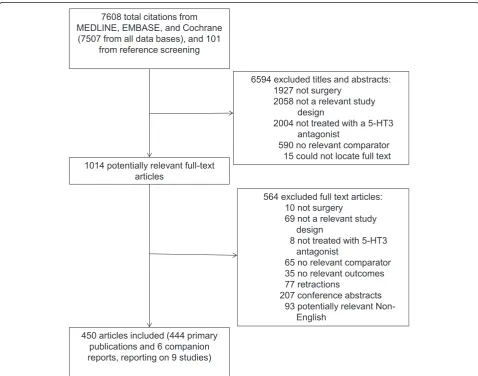
The literature search yielded 7,608 citations in total that met the search criteria, of which 450 full text articles met eligibility criteria for inclusion (444 primary publications and six companion reports reporting on nine studies, Fig. 1; Additional file 1: Appendix 2). Five unpublished confer-ence abstracts were included in the review [40–44]. We excluded 77 studies because we suspected or confirmed that their results were fraudulent [14] and 535 studies from previous reviews that did not fulfill our eligibility
criteria (reasons for exclusion presented in Additional file 1: Appendix 3).
Study and patient characteristics
The majority of the included studies had an RCT design (97 %) with a short duration of follow-up of 12 to 24 h (72 %). Most studies were published between 1995 and 2013 (94 %), and were mainly conducted in Asia (39 %), North America (27 %), or Europe (24 %) (Table 1, Additional file 1: Appendix 4).
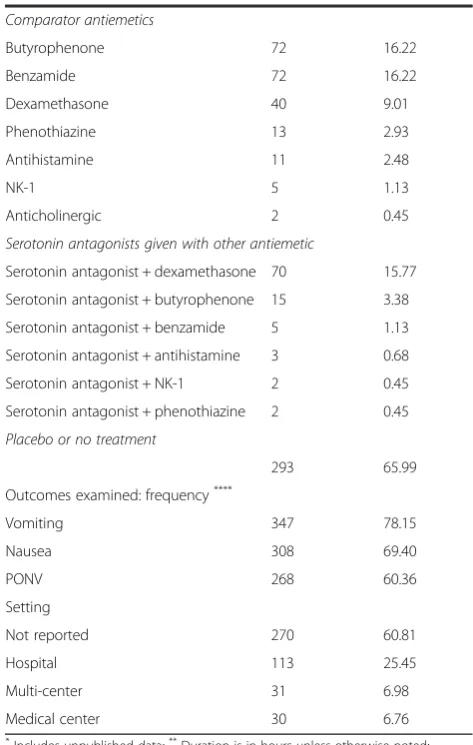
The 5-HT3 receptor antagonists we examined were ondansetron (0.1−48 mg/day; 76 %), granisetron (0.1− 3 mg/day; 13 %), tropisetron (0.1−5 mg/day; 8 %), dolasetron (12.5−200 mg/day; 7 %), palonosetron (0.025− 0.25 mg/day; 3 %), and ramosetron (0.1−0.6 mg/day; 2 %) (Table 1, Additional file 1: Appendix 5). We also included studies comparing combinations of 5-HT3drugs adminis-tered concomitantly with other antiemetics, e.g., dexa-methasone (2–20 mg/day; 16 %), butyrophenone (3 %), and benzamide (1 %).
Overall, 286 studies with dichotomous outcome data were included in our analyses. Studies with continuous outcome data and studies investigating the same 5-HT3 treatment in different doses were not included in the analysis.
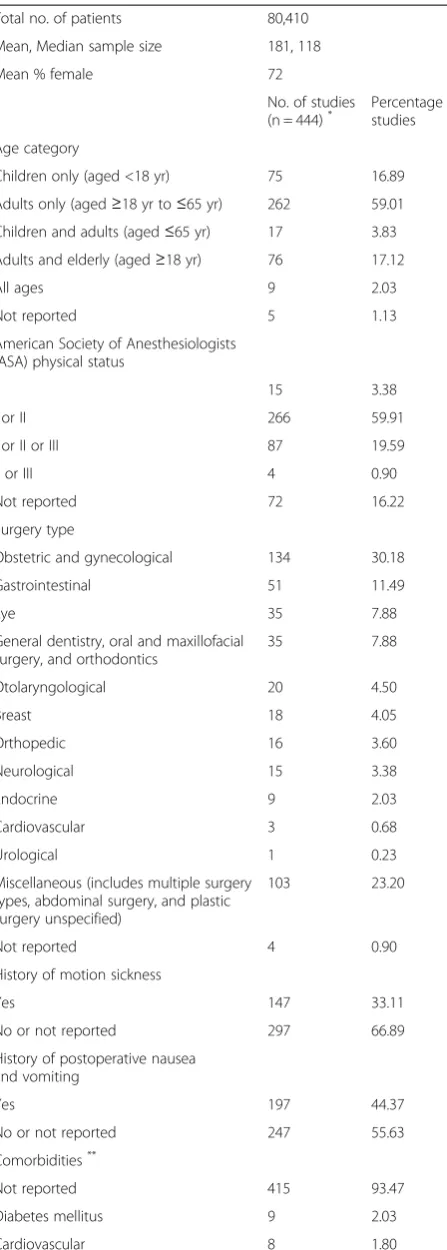
The median study size was 118 (interquartile range, 75–180) patients, whereas most patients were women (72 %), and adults (59 %), with an American Society of Anesthesiologists (ASA) physical status [45] of I or II (60 %) undergoing obstetrical and gynecological (30 %) surgery (Table 2, Additional file 1: Appendix 6). The in-cluded studies often did not report patients’ history of PONV (56 %). Similarly, a history of motion sickness was reported in only 33 % of the studies; comorbidities were rarely reported (5 %).
Methodological quality and risk of bias
Most of the included RCTs and quasi-RCTs had an unclear or high risk of bias on the following items: allo-cation concealment (59 %), baseline outcome character-istics (89 %), incomplete outcome data (60 %), and selective outcome reporting bias (97 %). When assessing potential for funding bias, we considered a study at a high or unclear risk of bias when it was funded by a private industry or when an author on the publication was employed by the company sponsoring the study, which occurred in 92 % of the RCTs and quasi-RCTs (Additional file 1: Appendices 7 and 8). Of the nine ob-servational studies included in the analysis, eight used a somewhat representative sample, two did not describe ascertainment of exposure, all failed to demonstrate that the outcome was not present at the start of the study, six did not control for confounders, three did not de-scribe the assessment of outcome, and all neglected to
report follow-up (Additional file 1: Appendix 9). The vis-ual inspection of the comparison adjusted funnel plots showed that there is no evidence for small-study effects and publication bias (Additional file 1: Appendix 10).
Vomiting
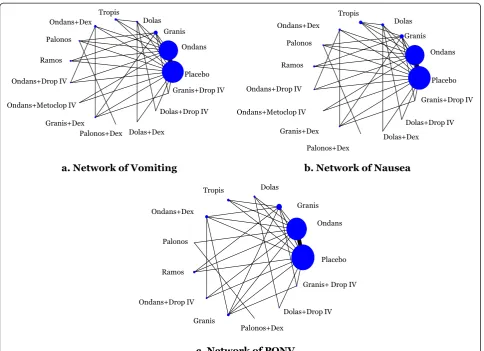
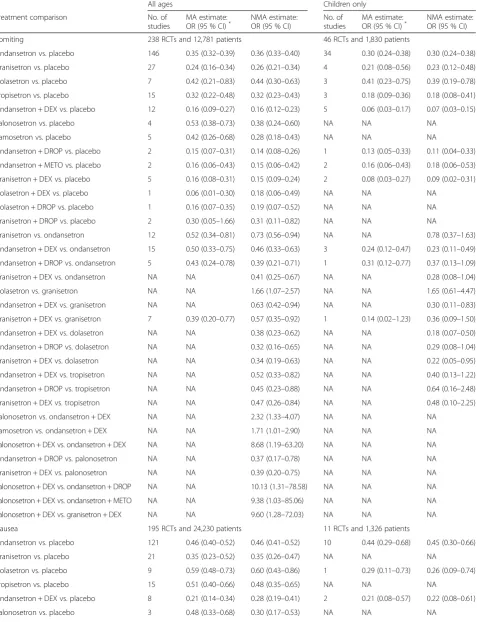
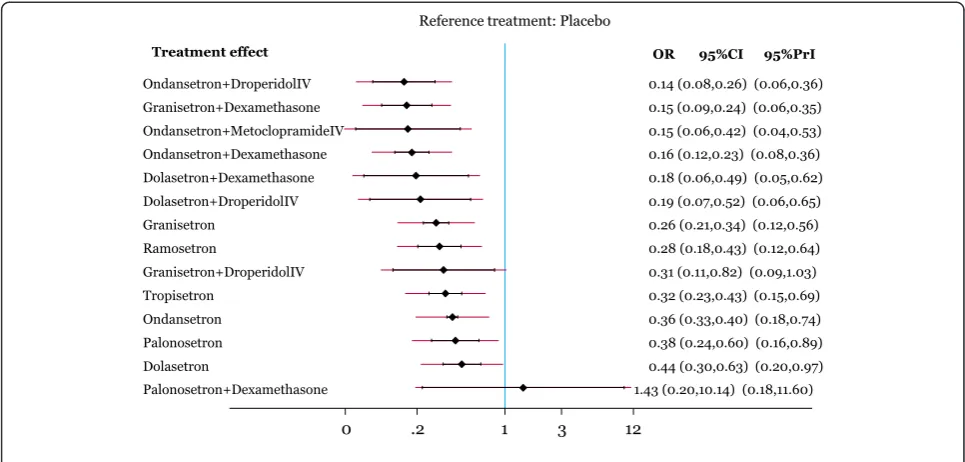
The network meta-analysis for vomiting included 238 RCTs with a total of 12,781 patients. The network geom-etry and included drugs can be found in Fig. 2a, whereas the statistically significant results are available in Table 3 and the overall results in Additional file 1: Appendix 11. The following treatment comparisons were statistically significant using both the CIs and PrIs: all agents (except for palonosetron plus dexamethasone and granisetron plus droperidol intravenous (IV)) versus placebo, ondan-setron plus droperidol IV versus ondanondan-setron, graniondan-setron plus dexamethasone versus ondansetron, ondansetron plus dexamethasone versus dolasetron, ondansetron plus droperidol IV versus dolasetron, granisetron plus methasone versus dolasetron, palonosetron plus dexa-methasone versus ondansetron plus dexadexa-methasone, palonosetron plus dexamethasone versus ondansetron plus droperidol IV, and palonosetron plus dexamethasone versus granisetron plus dexamethasone (Fig. 3). According to the SUCRA (Additional file 1: Appendix 12), the most effective agents for vomiting were ondansetron plus droperidol IV (85 % probability) and granisetron plus dexamethasone (84 % probability). The within-network heterogeneity in the network meta-analysis model was es-timated at 0.15, and the evaluation of the network incon-sistency using the design-by-treatment interaction model suggested that there was no evidence of statistical incon-sistency (χ2= 49.27, degrees of freedom = 44, P= 0.271, heterogeneity variance = 0.15).
In order to account for the treatment effect modifier
In order to account for the treatment effect modifier
‘timing of administration’(Additional file 1: Appendix 14), a subgroup analysis was conducted for 220 RCTs involving 10,811 patients when the agents were administered during surgery (Additional file 1: Appendix 15). The results were the same as for the primary analysis, except that ondanse-tron plus droperidol IV was statistically superior to granisetron, and ondansetron plus droperidol IV and gran-isetron plus dexamethasone were superior to ramosetron. According to the SUCRA for this subgroup analysis, the most effective agents for vomiting were ondansetron plus droperidol IV (88 % probability) and granisetron plus dexamethasone (84 % probability).
In order to account for the treatment effect modifier
‘risk of bias’, a sensitivity analysis was conducted in which 11 RCTs were removed because of high risk of incomplete outcome data bias (Additional file 1: Appendix 15); the same results were observed, except granisetron plus Table 1Study characteristics
Characteristic No. of studies* (n = 444)
Percentage of studies
Year of publication
1990–1994 25 5.63
1995–1999 141 31.76
2000–2004 110 24.77
2005–2009 107 24.10
2010–2013 61 13.74
Geographic region
Asia 171 38.51
North America 118 26.58
Europe 108 24.32
Australasia 13 2.93
Multi-continent 12 2.70
Africa 11 2.48
South America 9 2.03
Not reported 2 0.45
Study design
Randomized clinical trial 429 96.62
Cohort study 9 2.03
Non-randomized clinical trial 5 1.13
Controlled before–after study 1 0.23
Study conduct period
1990–1999 11 2.48
2000–2009 45 10.14
2010–2013 8 1.80
Not reported 380 85.59
Duration of follow-up**
0 to≤6 13 2.93
>6 to≤12 9 2.03
>12 to≤24 319 71.85
>24 to≤48 52 11.71
>48 to≤72 14 3.15
>72 to≤1 week 12 2.70
>1 week 3 0.68
Not reported 22 4.95
Interventions examined: frequency***
Serotonin antagonistsReported as administered alone (administered with dexamethasone)
Ondansetron 336 (46) 75.68 (10.36)
Granisetron 57 (15) 12.84 (3.38)
Tropisetron 35 (2) 7.88 (0.45)
Dolasetron 33 (3) 7.43 (0.68)
Palonosetron 14 (3) 3.15 (0.68)
Ramosetron 10 (1) 2.25 (0.23)
Table 1Study characteristics(Continued)
Comparator antiemetics
Butyrophenone 72 16.22
Benzamide 72 16.22
Dexamethasone 40 9.01
Phenothiazine 13 2.93
Antihistamine 11 2.48
NK-1 5 1.13
Anticholinergic 2 0.45
Serotonin antagonists given with other antiemetic
Serotonin antagonist + dexamethasone 70 15.77
Serotonin antagonist + butyrophenone 15 3.38
Serotonin antagonist + benzamide 5 1.13
Serotonin antagonist + antihistamine 3 0.68
Serotonin antagonist + NK-1 2 0.45
Serotonin antagonist + phenothiazine 2 0.45
Placebo or no treatment
293 65.99
Outcomes examined: frequency****
Vomiting 347 78.15
Nausea 308 69.40
PONV 268 60.36
Setting
Not reported 270 60.81
Hospital 113 25.45
Multi-center 31 6.98
Medical center 30 6.76
*
Includes unpublished data;**
Duration is in hours unless otherwise noted;
***
Multiple interventions and comparators examined across the studies;
****
Multiple interventions and outcomes reported per study
dexamethasone was associated with significantly less vomiting compared with ramosetron (OR, 0.52;, 95 % CI, 0.27–0.99). In another sensitivity analysis, in which four cohort studies [46–49], two non-randomized controlled trials [50, 51], and one controlled before–after study [52] were added to the included studies, all of the results were the same, except that the differences between ondansetron plus dexamethasone and granisetron or ramosetron and between ondansetron plus metoclopramide IV and palo-nosetron plus dexamethasone were no longer statistically significant (Additional file 1: Appendix 15).
Nausea
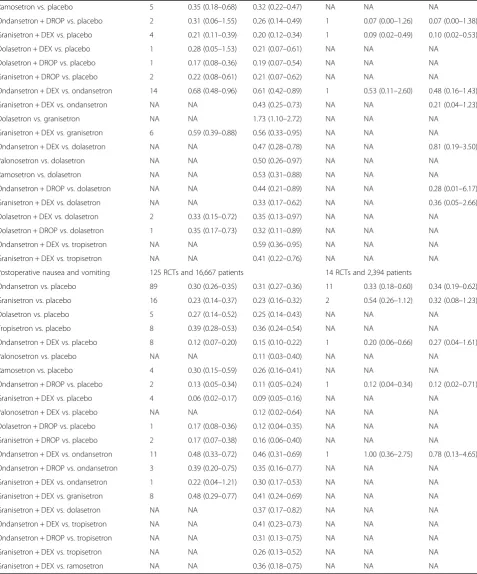
The network meta-analysis for nausea included 195 RCTs with a total of 24,230 patients. The network geom-etry and included drugs can be found in Fig. 2b. We present the statistically significant treatment effect esti-mates derived through the network meta-analysis model in Table 3 and overall results in Additional file 1: Appendix 11. Using both the CIs and PrIs, the only treatment comparisons that were statistically significant for nausea were granisetron versus placebo (OR, 0.35; 95 % PrI, 0.13–0.91), ondansetron plus dexamethasone versus placebo (OR, 0.28; 95 % PrI, 0.10–0.76), palonose-tron versus placebo (OR, 0.30; 95 % PrI, 0.10–0.89), ramosetron versus placebo (OR, 0.32; 95 % PrI, 0.12– 0.86), ondansetron plus droperidol IV versus placebo (OR, 0.26; 95 % PrI, 0.09–0.80), granisetron plus dexa-methasone versus placebo (OR, 0.20; 95 % PrI, 0.07– 0.57), dolasetron plus droperidol IV versus placebo (OR, 0.19; 95 % PrI, 0.05–0.77), and granisetron plus droperi-dol IV versus placebo (OR, 0.21; 95 % PrI, 0.05–0.87) (Additional file 1: Appendices 11 and 16). According to the SUCRA (Additional file 1: Appendix 17), the most effective agents for nausea were granisetron plus dexa-methasone (82 % probability) and dolasetron plus droperidol IV (78 % probability). The within-network heterogeneity in the network meta-analysis model was Table 2Patient characteristics
Total no. of patients 80,410
Mean, Median sample size 181, 118
Mean % female 72
No. of studies
(n = 444)* Percentage ofstudies
Age category
Children only (aged <18 yr) 75 16.89
Adults only (aged≥18 yr to≤65 yr) 262 59.01
Children and adults (aged≤65 yr) 17 3.83
Adults and elderly (aged≥18 yr) 76 17.12
All ages 9 2.03
Not reported 5 1.13
American Society of Anesthesiologists (ASA) physical status
I 15 3.38
I or II 266 59.91
I or II or III 87 19.59
II or III 4 0.90
Not reported 72 16.22
Surgery type
Obstetric and gynecological 134 30.18
Gastrointestinal 51 11.49
Eye 35 7.88
General dentistry, oral and maxillofacial surgery, and orthodontics
35 7.88
Otolaryngological 20 4.50
Breast 18 4.05
Orthopedic 16 3.60
Neurological 15 3.38
Endocrine 9 2.03
Cardiovascular 3 0.68
Urological 1 0.23
Miscellaneous (includes multiple surgery types, abdominal surgery, and plastic surgery unspecified)
103 23.20
Not reported 4 0.90
History of motion sickness
Yes 147 33.11
No or not reported 297 66.89
History of postoperative nausea and vomiting
Yes 197 44.37
No or not reported 247 55.63
Comorbidities**
Not reported 415 93.47
Diabetes mellitus 9 2.03
Cardiovascular 8 1.80
Table 2Patient characteristics(Continued)
Obesity 5 1.13
Cancer 4 0.90
Migraines 3 0.68
Gallbladder 2 0.45
Liver disease 2 0.45
Asthma 1 0.23
Disorder of the ear 1 0.23
Mental health 1 0.23
Osteoarthritis 1 0.23
Urological 1 0.23
*
Includes unpublished data;**
estimated at 0.24, and the design-by-treatment interaction model suggested that there was no statistically signifi-cant inconsistency (χ2
= 26.65, degrees of freedom = 41,
P= 0.959, heterogeneity variance = 0.27).
In order to account for the treatment effect modifier
‘age’ (Additional file 1: Appendix 13), a subgroup analysis was conducted for 11 RCTs involving 1,326 chil-dren (Table 3, Additional file 1: Appendix 11). The following treatment comparisons were statistically sig-nificant for nausea: ondansetron versus placebo, dolase-tron versus placebo, ondansedolase-tron plus dexamethasone versus placebo, and granisetron plus dexamethasone ver-sus placebo (Additional file 1: Appendix 11). According to the SUCRA, the most effective agents for nausea in children were granisetron plus dexamethasone (84 % probability) and ondansetron plus droperidol IV (81 % probability).
In order to account for the treatment effect modifier
‘timing of administration’(Additional file 1: Appendix 14), a subgroup analysis was conducted for 175 RCTs involving
21,844 patients when the agents were administered during surgery (Additional file 1: Appendix 18). All of the results were the same as for the primary analysis, except that the difference between tropisetron and ondansetron plus dexa-methasone was no longer statistically significant. Accord-ing to the SUCRA for this subgroup analysis, the most effective agents for nausea were granisetron plus dexa-methasone (82 % probability) and dolasetron plus droperi-dol IV (77 % probability).
In order to account for the treatment effect modifier
Table 3Statistically significant results of network meta-analysis for all time periods of drug administration
All ages Children only
Treatment comparison No. of
studies
MA estimate:
OR (95 % CI)* NMA estimate:OR (95 % CI) No. ofstudies MA estimate:OR (95 % CI)* NMA estimate:OR (95 % CI)
Vomiting 238 RCTs and 12,781 patients 46 RCTs and 1,830 patients
Ondansetron vs. placebo 146 0.35 (0.32–0.39) 0.36 (0.33–0.40) 34 0.30 (0.24–0.38) 0.30 (0.24–0.38)
Granisetron vs. placebo 27 0.24 (0.16–0.34) 0.26 (0.21–0.34) 4 0.21 (0.08–0.56) 0.23 (0.12–0.48)
Dolasetron vs. placebo 7 0.42 (0.21–0.83) 0.44 (0.30–0.63) 3 0.41 (0.23–0.75) 0.39 (0.19–0.78)
Tropisetron vs. placebo 15 0.32 (0.22–0.48) 0.32 (0.23–0.43) 3 0.18 (0.09–0.36) 0.18 (0.08–0.41)
Ondansetron + DEX vs. placebo 12 0.16 (0.09–0.27) 0.16 (0.12–0.23) 5 0.06 (0.03–0.17) 0.07 (0.03–0.15)
Palonosetron vs. placebo 4 0.53 (0.38–0.73) 0.38 (0.24–0.60) NA NA NA
Ramosetron vs. placebo 5 0.42 (0.26–0.68) 0.28 (0.18–0.43) NA NA NA
Ondansetron + DROP vs. placebo 2 0.15 (0.07–0.31) 0.14 (0.08–0.26) 1 0.13 (0.05–0.33) 0.11 (0.04–0.33)
Ondansetron + METO vs. placebo 2 0.16 (0.06–0.43) 0.15 (0.06–0.42) 2 0.16 (0.06–0.43) 0.18 (0.06–0.53)
Granisetron + DEX vs. placebo 5 0.16 (0.08–0.31) 0.15 (0.09–0.24) 2 0.08 (0.03–0.27) 0.09 (0.02–0.31)
Dolasetron + DEX vs. placebo 1 0.06 (0.01–0.30) 0.18 (0.06–0.49) NA NA NA
Dolasetron + DROP vs. placebo 1 0.16 (0.07–0.35) 0.19 (0.07–0.52) NA NA NA
Granisetron + DROP vs. placebo 2 0.30 (0.05–1.66) 0.31 (0.11–0.82) NA NA NA
Granisetron vs. ondansetron 12 0.52 (0.34–0.81) 0.73 (0.56–0.94) NA NA 0.78 (0.37–1.63)
Ondansetron + DEX vs. ondansetron 15 0.50 (0.33–0.75) 0.46 (0.33–0.63) 3 0.24 (0.12–0.47) 0.23 (0.11–0.49)
Ondansetron + DROP vs. ondansetron 5 0.43 (0.24–0.78) 0.39 (0.21–0.71) 1 0.31 (0.12–0.77) 0.37 (0.13–1.09)
Granisetron + DEX vs. ondansetron NA NA 0.41 (0.25–0.67) NA NA 0.28 (0.08–1.04)
Dolasetron vs. granisetron NA NA 1.66 (1.07–2.57) NA NA 1.65 (0.61–4.47)
Ondansetron + DEX vs. granisetron NA NA 0.63 (0.42–0.94) NA NA 0.30 (0.11–0.83)
Granisetron + DEX vs. granisetron 7 0.39 (0.20–0.77) 0.57 (0.35–0.92) 1 0.14 (0.02–1.23) 0.36 (0.09–1.50)
Ondansetron + DEX vs. dolasetron NA NA 0.38 (0.23–0.62) NA NA 0.18 (0.07–0.50)
Ondansetron + DROP vs. dolasetron NA NA 0.32 (0.16–0.65) NA NA 0.29 (0.08–1.04)
Granisetron + DEX vs. dolasetron NA NA 0.34 (0.19–0.63) NA NA 0.22 (0.05–0.95)
Ondansetron + DEX vs. tropisetron NA NA 0.52 (0.33–0.82) NA NA 0.40 (0.13–1.22)
Ondansetron + DROP vs. tropisetron NA NA 0.45 (0.23–0.88) NA NA 0.64 (0.16–2.48)
Granisetron + DEX vs. tropisetron NA NA 0.47 (0.26–0.84) NA NA 0.48 (0.10–2.25)
Palonosetron vs. ondansetron + DEX NA NA 2.32 (1.33–4.07) NA NA NA
Ramosetron vs. ondansetron + DEX NA NA 1.71 (1.01–2.90) NA NA NA
Palonosetron + DEX vs. ondansetron + DEX NA NA 8.68 (1.19–63.20) NA NA NA
Ondansetron + DROP vs. palonosetron NA NA 0.37 (0.17–0.78) NA NA NA
Granisetron + DEX vs. palonosetron NA NA 0.39 (0.20–0.75) NA NA NA
Palonosetron + DEX vs. ondansetron + DROP NA NA 10.13 (1.31–78.58) NA NA NA
Palonosetron + DEX vs. ondansetron + METO NA NA 9.38 (1.03–85.06) NA NA NA
Palonosetron + DEX vs. granisetron + DEX NA NA 9.60 (1.28–72.03) NA NA NA
Nausea 195 RCTs and 24,230 patients 11 RCTs and 1,326 patients
Ondansetron vs. placebo 121 0.46 (0.40–0.52) 0.46 (0.41–0.52) 10 0.44 (0.29–0.68) 0.45 (0.30–0.66)
Granisetron vs. placebo 21 0.35 (0.23–0.52) 0.35 (0.26–0.47) NA NA NA
Dolasetron vs. placebo 9 0.59 (0.48–0.73) 0.60 (0.43–0.86) 1 0.29 (0.11–0.73) 0.26 (0.09–0.74)
Tropisetron vs. placebo 15 0.51 (0.40–0.66) 0.48 (0.35–0.65) NA NA NA
Ondansetron + DEX vs. placebo 8 0.21 (0.14–0.34) 0.28 (0.19–0.41) 2 0.21 (0.08–0.57) 0.22 (0.08–0.61)
Table 3Statistically significant results of network meta-analysis for all time periods of drug administration(Continued)
Ramosetron vs. placebo 5 0.35 (0.18–0.68) 0.32 (0.22–0.47) NA NA NA
Ondansetron + DROP vs. placebo 2 0.31 (0.06–1.55) 0.26 (0.14–0.49) 1 0.07 (0.00–1.26) 0.07 (0.00–1.38)
Granisetron + DEX vs. placebo 4 0.21 (0.11–0.39) 0.20 (0.12–0.34) 1 0.09 (0.02–0.49) 0.10 (0.02–0.53)
Dolasetron + DEX vs. placebo 1 0.28 (0.05–1.53) 0.21 (0.07–0.61) NA NA NA
Dolasetron + DROP vs. placebo 1 0.17 (0.08–0.36) 0.19 (0.07–0.54) NA NA NA
Granisetron + DROP vs. placebo 2 0.22 (0.08–0.61) 0.21 (0.07–0.62) NA NA NA
Ondansetron + DEX vs. ondansetron 14 0.68 (0.48–0.96) 0.61 (0.42–0.89) 1 0.53 (0.11–2.60) 0.48 (0.16–1.43)
Granisetron + DEX vs. ondansetron NA NA 0.43 (0.25–0.73) NA NA 0.21 (0.04–1.23)
Dolasetron vs. granisetron NA NA 1.73 (1.10–2.72) NA NA NA
Granisetron + DEX vs. granisetron 6 0.59 (0.39–0.88) 0.56 (0.33–0.95) NA NA NA
Ondansetron + DEX vs. dolasetron NA NA 0.47 (0.28–0.78) NA NA 0.81 (0.19–3.50)
Palonosetron vs. dolasetron NA NA 0.50 (0.26–0.97) NA NA NA
Ramosetron vs. dolasetron NA NA 0.53 (0.31–0.88) NA NA NA
Ondansetron + DROP vs. dolasetron NA NA 0.44 (0.21–0.89) NA NA 0.28 (0.01–6.17)
Granisetron + DEX vs. dolasetron NA NA 0.33 (0.17–0.62) NA NA 0.36 (0.05–2.66)
Dolasetron + DEX vs. dolasetron 2 0.33 (0.15–0.72) 0.35 (0.13–0.97) NA NA NA
Dolasetron + DROP vs. dolasetron 1 0.35 (0.17–0.73) 0.32 (0.11–0.89) NA NA NA
Ondansetron + DEX vs. tropisetron NA NA 0.59 (0.36–0.95) NA NA NA
Granisetron + DEX vs. tropisetron NA NA 0.41 (0.22–0.76) NA NA NA
Postoperative nausea and vomiting 125 RCTs and 16,667 patients 14 RCTs and 2,394 patients
Ondansetron vs. placebo 89 0.30 (0.26–0.35) 0.31 (0.27–0.36) 11 0.33 (0.18–0.60) 0.34 (0.19–0.62)
Granisetron vs. placebo 16 0.23 (0.14–0.37) 0.23 (0.16–0.32) 2 0.54 (0.26–1.12) 0.32 (0.08–1.23)
Dolasetron vs. placebo 5 0.27 (0.14–0.52) 0.25 (0.14–0.43) NA NA NA
Tropisetron vs. placebo 8 0.39 (0.28–0.53) 0.36 (0.24–0.54) NA NA NA
Ondansetron + DEX vs. placebo 8 0.12 (0.07–0.20) 0.15 (0.10–0.22) 1 0.20 (0.06–0.66) 0.27 (0.04–1.61)
Palonosetron vs. placebo NA NA 0.11 (0.03–0.40) NA NA NA
Ramosetron vs. placebo 4 0.30 (0.15–0.59) 0.26 (0.16–0.41) NA NA NA
Ondansetron + DROP vs. placebo 2 0.13 (0.05–0.34) 0.11 (0.05–0.24) 1 0.12 (0.04–0.34) 0.12 (0.02–0.71)
Granisetron + DEX vs. placebo 4 0.06 (0.02–0.17) 0.09 (0.05–0.16) NA NA NA
Palonosetron + DEX vs. placebo NA NA 0.12 (0.02–0.64) NA NA NA
Dolasetron + DROP vs. placebo 1 0.17 (0.08–0.36) 0.12 (0.04–0.35) NA NA NA
Granisetron + DROP vs. placebo 2 0.17 (0.07–0.38) 0.16 (0.06–0.40) NA NA NA
Ondansetron + DEX vs. ondansetron 11 0.48 (0.33–0.72) 0.46 (0.31–0.69) 1 1.00 (0.36–2.75) 0.78 (0.13–4.65)
Ondansetron + DROP vs. ondansetron 3 0.39 (0.20–0.75) 0.35 (0.16–0.77) NA NA NA
Granisetron + DEX vs. ondansetron 1 0.22 (0.04–1.21) 0.30 (0.17–0.53) NA NA NA
Granisetron + DEX vs. granisetron 8 0.48 (0.29–0.77) 0.41 (0.24–0.69) NA NA NA
Granisetron + DEX vs. dolasetron NA NA 0.37 (0.17–0.82) NA NA NA
Ondansetron + DEX vs. tropisetron NA NA 0.41 (0.23–0.73) NA NA NA
Ondansetron + DROP vs. tropisetron NA NA 0.31 (0.13–0.75) NA NA NA
Granisetron + DEX vs. tropisetron NA NA 0.26 (0.13–0.52) NA NA NA
Granisetron + DEX vs. ramosetron NA NA 0.36 (0.18–0.75) NA NA NA
*
Meta-analysis was not conducted for treatment comparisons where only 1 trial was included. In that situation, the direct estimate was obtained from the single trial
dolasetron were no longer statistically significant (Additional file 1: Appendix 18).
Postoperative nausea and vomiting
The network meta-analysis for PONV included 125 RCTs with 16,667 patients. The network geometry and included drugs can be found in Fig. 2c, statistically sig-nificant results are presented in Table 3, and the overall results in Additional file 1: Appendix 11. According to both the CIs and PrIs, the following treatment compari-sons were statistically significant for PONV: all agents versus placebo except for tropisetron, granisetron plus dexamethasone versus ondansetron, and granisetron plus dexamethasone versus tropisetron (Additional file 1: Appendix 19). According to the SUCRA, the most effective agents for PONV were granisetron plus dexamethasone (86 % probability) and ondansetron plus droperidol IV (78 % probability; Additional file 1: Appendices 11 and 20). The within-network heterogen-eity in the network meta-analysis model was estimated at 0.25, and the design-by-treatment interaction model suggested that there was no statistically significant in-consistency (χ2
= 26.58, degrees of freedom = 32,P= 0.737, heterogeneity variance = 0.26).
In order to account for the treatment effect modifier
‘age’ (Additional file 1: Appendix 13), a subgroup ana-lysis was conducted for 14 RCTs involving a total of 2,394 children (Table 3, Additional file 1: Appendix 11). The following treatment comparisons were statistically significant: ondansetron versus placebo and ondansetron
plus droperidol IV versus placebo. According to the SUCRA, the most effective agents for PONV in children were ondansetron plus droperidol IV (85 % probability) and ondansetron plus dexamethasone (59 % probability). In order to account for the treatment effect modifier
‘timing of administration’(Additional file 1: Appendix 14), a subgroup analysis was conducted for 116 RCTs involving 12,415 patients in which the agents were administered dur-ing surgery (Additional file 1: Appendix 21). All of the re-sults were the same as for the primary analysis, except that ondansetron plus dexamethasone was statistically superior to ramosetron. According to the SUCRA for this subgroup analysis, the most effective agents for PONV were granise-tron plus dexamethasone (84 % probability) and ondanse-tron plus droperidol IV (79 % probability).
In order to account for the treatment effect modifier
‘risk of bias’, a sensitivity analysis was conducted in which 10 RCTs were removed because of high risk of incom-plete outcome data bias (Additional file 1: Appendix 21) [53–55, 58, 59, 61–65]; the results were unchanged from the primary analysis, except that the risk of PONV was sig-nificantly higher with tropisetron than with granisetron. In another sensitivity analysis, two cohort studies [46, 49] and three non-randomized controlled trials [50, 51, 66] were added to the included studies, and the same results were observed (Additional file 1: Appendix 11).
Discussion
PONV relative to placebo. However, some of the corre-sponding PrIs were not statistically significant, suggest-ing that the statistically significant treatment effects might change should a new study become available. For all age groups and across all outcomes, the most effect-ive agents were granisetron plus dexamethasone. For adults, the most effective agents were ondansetron plus droperidol IV; and for children, the most effective agents were ondansetron plus dexamethasone.
We also conducted a systematic review and network meta-analysis on the safety of these medications [13]. Our network meta-analysis results suggested that granisetron plus dexamethasone increases the risk of arrhythmia. However, a statistically significant increase in the risk of delirium was not observed in another network meta-analysis. In a meta-analysis including three studies for ondansetron versus placebo, no statistically significant results were observed for mortality. Only two studies re-ported prolongation of the QT interval; meta-analysis was not feasible because the studies compared different interventions.
Our network meta-analysis results for vomiting and PONV are similar to those of a previous network meta-analysis that examined only these two outcomes [67]. The only difference was that, unlike the current study, the earlier analysis showed that granisetron was signifi-cantly better than ondansetron and dolasetron for PONV. However, we included 378 studies involving a total of 68,167 patients that were not included in the earlier review. Although we are aware of other system-atic reviews and meta-analyses of 5-HT3receptor antag-onists [14, 68], the previous researchers did not conduct a network meta-analysis, and therefore the results can-not be compared. Notably, because of our comprehen-sive literature search and broad eligibility criteria, we included 205 studies involving a total of 43,075 patients that were not included in those previous reviews (Additional file 1: Appendix 22).
The included studies were limited by having an un-clear or high risk of bias on important components, including allocation concealment, selective outcome reporting bias, and potential for funding bias. Further, this systematic review process had some inherent limita-tions. Slight changes to the original protocol [12] were necessary, such as preparing a separate paper for pa-tients undergoing chemotherapy, as well as one focused on the safety of these agents for patients with surgery [13]. Furthermore, it was assumed that the effects of the different doses and durations were identical across the treatments, and that they defined the same node they belong to. We are currently exploring these assumptions in another paper [69]. Although study designs above and beyond RCTs were included, the network meta-analysis was limited to the RCTs in order to increase the
confidence of the results. We also were unable to present the results from the hundreds of meta-analyses conducted, as well as the raw data; these are available from the corresponding author upon request. Although the analyses were adjusted to account for the treatment effect modifiers (age, timing of administration, and risk of bias), the results might be influenced by effect modi-fiers that we were unaware of. However, the statistical evaluation of the transitivity assumption using the design-by-treatment interaction model suggested there was no evidence of inconsistency. Finally, 77 studies were excluded because they contained data known to be fraudulent or were retracted [14].
Conclusions
In conclusion, granisetron plus dexamethasone was often the most effective antiemetic across the effectiveness out-comes considered here, with the number needed to treat ranging from two to nine. A study that examines the ad-ministration of these agents at different dosages would provide further clarity to this important issue and our team is currently working on such an initiative [70].
Additional file
Additional file 1:Appendices 1–22.
Abbreviations
5-HT3:Serotonin; CI: Confidence interval; IV: Intravenous.; OR: Odds ratio; PONV: Postoperative nausea and vomiting; PrI: Predictive interval; RCTs: Randomized control trials; REML: Restricted maximum likelihood; SUCRA: Surface under the cumulative ranking.
Competing interests
This systematic review was funded by the Canadian Institutes of Health Research/Drug Safety and Effectiveness Network (CIHR/DSEN). ACT and BH are funded by a CIHR/DSEN New Investigator Award in Knowledge Synthesis. BRH receives funding from the Alberta Heritage Foundation for Medical Research. AAV is funded by the Banting Postdoctoral Fellowship Program from the CIHR. DM is funded by a University of Ottawa Research Chair. SES is funded by a Tier 1 Canada Research Chair in Knowledge Translation. RR owns stock in a company (GlaxoSmithKline Inc) that manufactures one of the interventions included in our study. All of the other authors declare no conflicts of interest.
Authors’contributions
Acknowledgements
This systematic review was funded by the Canadian Institutes for Health Research/Drug Safety and Effectiveness Network (CIHR/DSEN). We thank Laure Perrier for conducting the literature searches, Becky Skidmore for peer-reviewing the literature search, and Drs. Maggie Chen and Joseph Beyene for providing feedback on conceptualization of the review. We also thank Vladi Struchkov, Vera Nincic, Roberta Cardoso, Christy Johnson, and Derek Roberts for screening some of the citations, and/or abstracting some of the data, and/or appraising quality for a few of the included studies. Finally, we thank Wing Hui for abstracting some of the data, Ana Guzman for formatting the manuscript, and Peggy Robinson for copyediting the manuscript.
Author details
1
Li Ka Shing Knowledge Institute, St. Michael’s Hospital, 209 Victoria Street, East Building, Toronto, ON M5B 1W8, Canada.2Epidemiology Division, Dalla Lana School of Public Health, University of Toronto, 6th floor, 155 College St, Toronto, ON M5T 3M7, Canada.3Institute for Health Policy Management & Evaluation, University of Toronto, 4th Floor, 155 College St, Toronto, ON M5T 3M6, Canada.4Departments of Community Health Sciences, Faculty of Medicine, University of Calgary, TRW Building, 3rd Floor, 3280 Hospital Drive, Calgary, AB T2N 4Z6, Canada.5Clinical Epidemiology Program, Centre for Practice-Changing Research, Ottawa Hospital Research Institute, 725 Parkdale Ave., Ottawa, ON K1Y 4E9, Canada.6Department of Geriatric Medicine, University of Toronto, 27 Kings College Circle, Toronto, ON M5S 1A1, Canada.
Received: 10 March 2015 Accepted: 15 May 2015
References
1. Habib AS, Chen YT, Taguchi A, Hu XH, Gan TJ. Postoperative nausea and vomiting following inpatient surgeries in a teaching hospital: a retrospective database analysis. Curr Med Res Opin. 2006;22:1093–9.
2. Sarin P, Urman RD, Ohno-Machado L. An improved model for predicting postoperative nausea and vomiting in ambulatory surgery patients using physician-modifiable risk factors. J Am Med Inform Assoc. 2012;19:995–1002. 3. Apfel CC, Laara E, Koivuranta M, Greim CA, Roewer N. A simplified risk score for predicting postoperative nausea and vomiting: conclusions from cross-validations between two centers. Anesthesiology. 1999;91:693–700. 4. Ballatori E, Roila F, Ruggeri B, Betti M, Sarti S, Soru G, et al. The impact of
chemotherapy-induced nausea and vomiting on health-related quality of life. Support Care Cancer. 2007;15:179–85.
5. Osoba D, Zee B, Warr D, Latreille J, Kaizer L, Pater J. Effect of postchemotherapy nausea and vomiting on health-related quality of life. The Quality of Life and Symptom Control Committees of the National Cancer Institute of Canada Clinical Trials Group. Support Care Cancer. 1997;5:307–13.
6. Apfel CC, Korttila K, Abdalla M, Kerger H, Turan A, Vedder I, et al. A factorial trial of six interventions for the prevention of postoperative nausea and vomiting. N Engl J Med. 2004;350:2441–51.
7. Chung F, Mezei G. Factors contributing to a prolonged stay after ambulatory surgery. Anesth Analg. 1999;89:1352–9.
8. Constenla M. 5-HT3 receptor antagonists for prevention of late acute-onset emesis. Ann Pharmacother. 2004;38:1683–91.
9. Gan TJ, Meyer T, Apfel CC, Chung F, Davis PJ, Eubanks S, et al. Consensus guidelines for managing postoperative nausea and vomiting. Anesth Analg. 2003;97:62–71.
10. McCracken G, Houston P, Lefebvre G. Guideline for the management of postoperative nausea and vomiting. J Obstet Gynaecol Can. 2008;30:600–7. 11. Shamseer L, Moher D, Clarke M, Ghersi D, Liberati A, Petticrew M, et al.
Preferred reporting items for systematic review and meta-analysis protocols (PRISMA-P) 2015: elaboration and explanation. BMJ. 2015;349:g7647. 12. Tricco AC, Soobiah C, Antony J, Hemmelgarn B, Moher D, Hutton B, et al.
Safety of serotonin (5-HT3) receptor antagonists in patients undergoing surgery and chemotherapy: protocol for a systematic review and network meta-analysis. Syst Rev. 2013;2:46.
13. Tricco AC, Soobiah C, Blondal E, Veroniki AA, Khan A, Vafaei A, et al. Comparative safety of serotonin (5-HT3) receptor antagonists in patients undergoing surgery: a systematic review and network meta-analysis. BMC Med. 2015; ahead of print.
14. Carlisle JB. The analysis of 168 randomised controlled trials to test data integrity. Anaesthesia. 2012;67:521–37.
15. Effective Practice and Organization of Care (EPOC). Suggested risk of bias criteria for EPOC reviews. EPOC Resources for review authors. Oslo: Norwegian Knowledge Centre for the Health Services; 2014. http:// epoc.cochrane.org/sites/epoc.cochrane.org/files/uploads/14%20 Suggested%20risk%20of%20bias%20criteria%20for%20EPOC%20reviews% 202013%2008%2012_0.pdf. Accessed: Jan 2015.
16. Wells GA, Shea B, O’Connell D, Peterson J, Welch V, Losos M, et al. The Newcastle-Ottawa Scale (NOS) for assessing the quality of nonrandomised studies in meta-analyses. http://www.ohri.ca/programs/clinical_epidemiology/ oxford.htm. Accessed: Jan 2015
17. Raudenbush SW. Analyzing effect sizes: random-effects models. In: Cooper H, Hedges LV, Valentine JC, editors. The Handbook of Research Synthesis and Meta-analysis. 2nd ed. New York: The Russell Sage Foundation; 2009. p. 295–316.
18. Higgins JP, Thompson SG. Quantifying heterogeneity in a meta-analysis. Stat Med. 2002;21:1539–58.
19. R Core Team. R: A language and environment for statistical computing. http://www.R-project.org. Accessed Jan 2015.
20. Viechtbauer W. Conducting meta-analyses in R with the metafor package. J Stat Softw. 2010;36:1–48.
21. White IR, Barrett JK, Jackson D, Higgins J. Consistency and inconsistency in network meta‐analysis: model estimation using multivariate meta‐ regression. Res Synth Methods. 2012;3:111–25.
22. Chen C-C, Lin C-S, Ko Y-P, Hung Y-C, Lao H-C, Hsu Y-W. Premedication with mirtazapine reduces preoperative anxiety and postoperative nausea and vomiting. Anesth Analg. 2008;106:109–13.
23. Omran HASA, Nasr DAM. Effect of premedication with mirtazapine versus ondansetron on postoperative nausea and vomiting in breast surgery. Egyp J Anaesth. 2011;27:135–9.
24. Homesley HD, Hahne WF, McLees B, Heck K, Barrett RJ, Lentz SS, et al. Randomized comparison of the antiemetic efficacy of a serotonin type 3 receptor antagonist (MDL 72,222) with a high-dose metoclopramide regimen. Am J Clin Oncol. 1993;16:175–9.
25. Gan TJ, Meyer TA, Apfel CC, Chung F, Davis PJ, Habib AS, et al. Society for Ambulatory Anesthesia guidelines for the management of postoperative nausea and vomiting. Anesth Analg. 2007;105:1615–28.
26. Golembiewski J, Chernin E, Chopra T. Prevention and treatment of postoperative nausea and vomiting. Am J Health Syst Pharm. 2005;62:1247–60.
27. Kovac AL. Prevention and treatment of postoperative nausea and vomiting. Drugs. 2000;59:213–43.
28. Yun MJ, Kim YH, Kim AR. Comparison of azasetron and ondansetron for preventing postoperative nausea and vomiting in patients undergoing gynecological laparoscopic surgery. Yonsei Med J. 2010;51:88–92.
29. MIMS. Ramosetron. http://www.mims.com/Thailand/drug/search/Ramosetron. Accessed: Jan 2015.
30. MIMS. Azasetron. http://www.mims.com/Thailand/drug/search/ Azasetron?AllFlag=ALL. Accessed: Jan 2015.
31. Salanti G. Indirect and mixed-treatment comparison, network, or multiple-treatments meta-analysis: many names, many benefits, many concerns for the next generation evidence synthesis tool. Res Synth Methods. 2012;3:80–97.
32. Chaimani A, Higgins JP, Mavridis D, Spyridonos P, Salanti G. Graphical tools for network meta-analysis in STATA. PLoS One. 2013;8:e76654.
33. Song F, Altman DG, Glenny A-M, Deeks JJ. Validity of indirect comparison for estimating efficacy of competing interventions: empirical evidence from published meta-analyses. BMJ. 2003;326:472.
34. Veroniki AA, Vasiliadis HS, Higgins JP, Salanti G. Evaluation of inconsistency in networks of interventions. Int J Epidemiol. 2013;42:332–45.
35. Riley RD, Higgins JPT, Deeks JJ. Interpretation of random effects meta-analyses. BMJ. 2011;342:d549.
36. Higgins JP, Thompson SG, Spiegelhalter DJ. A re-evaluation of random-effects meta-analysis. J R Stat Soc Ser A Stat Soc. 2009;172:137–59. 37. Salanti G, Ades AE, Ioannidis JPA. Graphical methods and numerical
summaries for presenting results from multiple-treatment meta-analysis: an overview and tutorial. J Clin Epidemiol. 2011;64:163–71.
38. StataCorp. Stata Statistical Software: Release 13. College Station, TX: StataCorp LP; 2013.
40. Apfel CC, Candiotti K, Gan TJ, Ahmed R, Cox D. Palonosetron or ondansetron for rescue treatment of PONV after failed prophylaxis with ondansetron. Anesth Analg. 2011;112:S16.
41. Gaynes B, Fiscella R, Larson B, Kiesling D. Intravenous ondansetron versus placebo for post-operative nausea and vomiting following cataract surgery. In: American Academy of Optometry. 1996: 170p.
42. Gurha P, Kaur RD, Sanjay RR. Prophylactic intravenous palonosetron, granisetron and ondansetron in the prevention of post operative nausea and vomiting in laparoscopic surgeries. Br J Anaesth. vol. 108: Oxford Univ Press; 2012: 376–376.
43. Samra SK, Williams B, Ciarralo C, Turner C, Smythe P. Lack of effect of droperidol, ondansetron, and dolasetron administration on PONV in a placebo controlled trial. Anesthesiology. 2003;99:A305.
44. White PF, Scuderi PE. Prevention of postoperative nausea and vomiting (PONV): A dose-ranging study involving palonosetron, a potent 5-HT3 receptor antagonist. Anesthesiology. 2005;103:A703.
45. American Society of Anesthesiologists. ASA Physical Status Classification System. http://www.asahq.org/resources/clinical-information/asa-physical-status-classification-system. Accessed: Jan 2015.
46. Chen YF, Yeh WL, Lee KH, Li MC, Yang TH, Huang HC, et al. Intravenous ondansetron as antiemetic prophylaxis for postoperative nausea and vomiting after shoulder arthroscopy. Chang Gung Med J. 2011;34:205–12. 47. Flynn BC, Nemergut EC. Postoperative nausea and vomiting and pain after
transsphenoidal surgery: a review of 877 patients. Anesth Analg. 2006;103:162–7.
48. Shakeel M, Trinidade A, Al-Adhami A, Khan I, Supriya M, Kubba H. Retrospective review of three antiemetic regimens versus no therapy in the prevention of postoperative and vomiting following adenotonsillar surgery. J Otolaryngol Head Neck Surg. 2012;41:35–40.
49. Walker JB. Efficacy of single-dose intravenous dolasetron versus ondansetron in the prevention of postoperative nausea and vomiting. Clin Ther. 2001;23:932–8.
50. Biedler A, Wermelt J, Kunitz O, Muller A, Wilhelm W, Dethling J, et al. A risk adapted approach reduces the overall institutional incidence of postoperative nausea and vomiting. Can J Anaesth. 2004;51:13–9. 51. Kim EJ, Ko JS, Kim CS, Lee SM, Choi DH. Combination of antiemetics for the
prevention of postoperative nausea and vomiting in high-risk patients. J Korean Med Sci. 2007;22:878–82.
52. Wagner DS, Gauger V, Chiravuri D, Faust K. Ondansetron oral disintegrating tablets for the prevention of postoperative vomiting in children undergoing strabismus surgery. Ther Clin Risk Manag. 2007;3:691–4.
53. Alexander R, Fennelly M. Comparison of ondansetron, metoclopramide and placebo as premedicants to reduce nausea and vomiting after major surgery. Anaesthesia. 1997;52:695–8.
54. Aouad MT, Siddik-Sayyid SM, Taha SK, Azar MS, Nasr VG, Hakki MA, et al. Haloperidol vs. ondansetron for the prevention of postoperative nausea and vomiting following gynaecological surgery. Eur J Anaesthesiol. 2007;24:171–8.
55. Gan TJ, Gu J, Singla N, Chung F, Pearman MH, Bergese SD, et al. Rolapitant for the prevention of postoperative nausea and vomiting: a prospective, double-blinded, placebo-controlled randomized trial. Anesth Analg. 2011;112:804–12.
56. McKenzie R, Sharifi-Azad S, Dershwitz M, Miguel R, Joslyn AF, Tantisira B, et al. A randomized, double-blind pilot study examining the use of intravenous ondansetron in the prevention of postoperative nausea and vomiting in female inpatients. J Clin Anesth. 1993;5:30–6.
57. Metaxari M, Papaioannou A, Petrou A, Chatzimichali A, Pharmakalidou E, Askitopoulou H. Antiemetic prophylaxis in thyroid surgery: a randomized, double-blind comparison of three 5-HT3 agents. J Anesth. 2011;25:356–62. 58. Munro FJ, Fisher S, Dickson U, Morton N. The addition of antiemetics to the
morphine solution in patient controlled analgesia syringes used by children after an appendicectomy does not reduce the incidence of postoperative nausea and vomiting. Paediatr Anaesth. 2002;12:600–3.
59. Sarvela PJ, Halonen PM, Soikkeli AI, Kainu JP, Korttila KT. Ondansetron and tropisetron do not prevent intraspinal morphine- and fentanyl-induced pruritus in elective cesarean delivery. Acta Anaesthesiol Scand. 2006;50:239–44. 60. Tang J, Watcha MF, White PF. A comparison of costs and efficacy of
ondansetron and droperidol as prophylactic antiemetic therapy for elective outpatient gynecologic procedures. Anesth Analg. 1996;83:304–13. 61. Jain V, Mitra JK, Rath GP, Prabhakar H, Bithal PK, Dash HH. A randomized,
double-blinded comparison of ondansetron, granisetron, and placebo for
prevention of postoperative nausea and vomiting after supratentorial craniotomy. J Neurosurg Anesthesiol. 2009;21:226–30.
62. Jokela R, Koivuranta M, Kangas-Saarela T, Purhonen S, Alahuhta S. Oral ondansetron, tropisetron or metoclopramide to prevent postoperative nausea and vomiting: a comparison in high-risk patients undergoing thyroid or parathyroid surgery. Acta Anaesthesiol Scand. 2002;46:519–24. 63. Bacic A, Rumboldt Z, Gluncic I, Buklijas J. The impact of the menstrual cycle
and ondansetron on postoperative nausea and vomiting. Int J Clin Pharmacol Res. 1998;18:153–8.
64. Iatrou CA, Dragoumanis CK, Vogiatzaki TD, Vretzakis GI, Simopoulos CE, Dimitriou VK. Prophylactic intravenous ondansetron and dolasetron in intrathecal morphine-induced pruritus: a randomized, double-blinded, placebo-controlled study. Anesth Analg. 2005;101:1516–20.
65. Ruiz de Adana J, Tobalina Bonis R, Garcia Galan F, Hernandez Matias A, Fernandez Luengas D, Ortega Deballon P, et al. Antiemetic efficacy of ondansetron in laparoscopic cholecystectomy. A randomized, double-blind, placebo-controlled study. Rev Esp Enferm Dig. 1999;91:639–43.
66. Manani G, Cantele P, Dona B, Meroni M, Tiberio I, Ceschin C, et al. Oculo-emetic and oculo-cardiac reflex in the prevention of postoperative nausea and vomitus by diehydrobenzperidol and ondansetron after squint surgery. Acta Anaesthesiol Italica. 1996;47:201–9.
67. Tang DH, Malone DC. A network meta-analysis on the efficacy of serotonin type 3 receptor antagonists used in adults during the first 24 h for postoperative nausea and vomiting prophylaxis. Clin Ther. 2012;34:282–94.
68. Rawlinson A, Kitchingham N, Hart C, McMahon G, Ong SL, Khanna A. Mechanisms of reducing postoperative pain, nausea and vomiting: a systematic review of current techniques. Evid Based Med. 2012;17:75–80. 69. Tricco A, Veroniki A, Blondal E, Hamid J, Straus S. Incorporating dosages
increases the relevance of network meta-analysis for decision-makers: A case example using data from a systematic review of serotonin (5-HT3) receptor antagonists in patients undergoing surgery. Toronto: Canadian Association of Pharmacy Technicians (CAPT) Conference; 2014.
70. Veroniki AA, Del Giovane C, Blondal E, Thavorn K, Straus SE, Tricco A. How to model different dose-effects in networks of interventions? 2015 Canadian Agency for Drugs and Technologies in Health (CADTH) Symposium. Saskatoon, Saskatchewan; 2015. http://www.slideshare.net/CADTH_Symposium/cadth-2015-d5-veroniki-modeling-dose-effects-in-nma-cadth-14-apr2015-v3. Accessed: Apr 2015.
Submit your next manuscript to BioMed Central and take full advantage of:
• Convenient online submission
• Thorough peer review
• No space constraints or color figure charges
• Immediate publication on acceptance
• Inclusion in PubMed, CAS, Scopus and Google Scholar
• Research which is freely available for redistribution