World Intellectual Property Organization (WIPO) 34, chemin des Colombettes
P.O. Box 18, 1211 Geneva 20 Switzerland e-mail: [email protected] ORIGINAL: English DATE: December 2002
W O R L D I N T E L L E C T U A L P R O P E R T Y O R G A N I Z A T I O N
GENEVAINTELLECTUAL PROPERTY ON THE INTERNET:
A SURVEY OF ISSUES
TABLE OF CONTENTS
INTRODUCTION... 5
I. THE INTERNET AND THE DEVELOPMENT OF THE DIGITAL SOCIETY... 7
II. THE MIGRATION OF INTELLECTUAL PROPERTY TO THE INTERNET ... 19
III. (a) COPYRIGHT AND RELATED RIGHTS ... 29
(i) INTRODUCTION TO DIGITAL COPYRIGHT ... 29
(ii) THE WIPO INTERNET TREATIES... 31
(a) Scope of Rights ... 32
(b) Enforcement and Management of Rights ... 34
(c) Status of the WIPO Internet Treaties ... 38
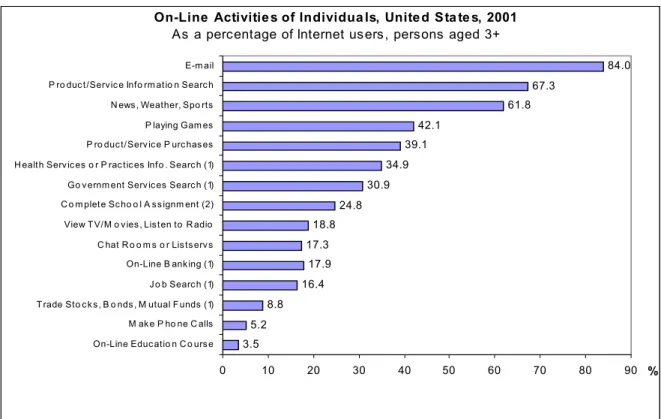
(iii) EMERGING COPYRIGHT ISSUES... 40
(a) Scope of Copyright Protection in the Digital Environment ... 41
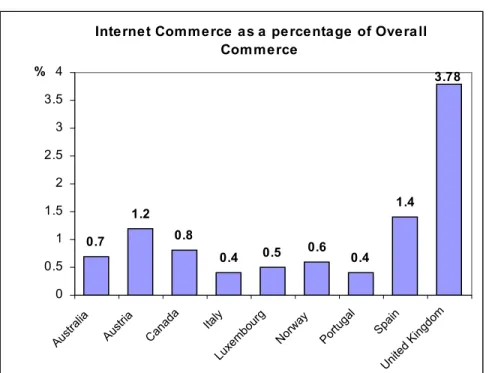
(b) Liability of Internet Service Providers ... 43
(c) Rights of Performers in a Digital Environment ... 46
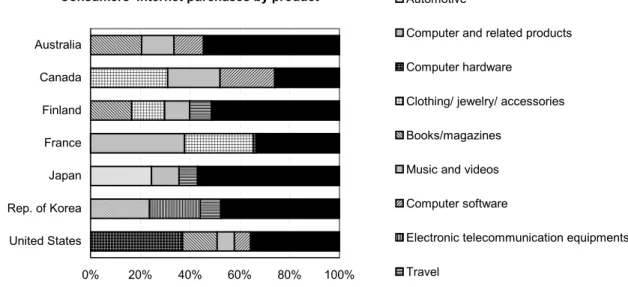
(d) Rights of Digital Broadcasters... 48
(e) Linking of Copyright Information Online ... 51
(f) Protection of Databases ... 53
(g) Peer-to-Peer File Sharing – Napster ... 54
IV. LICENSING AND RIGHTS MANAGEMENT IN THE DIGITAL ARENA ... 59
(a) Licensing and Collective Management of Rights... 59
(b) Digital Rights Management ... 60
(c) Trends in Licensing and Rights Management ... 62
III. (b) TRADEMARKS AND OTHER RIGHTS IN DISTINCTIVE SIGNS... 64
(i) IMPORTANCE OF TRADEMARKS ONLINE... 64
(ii) DEVELOPMENTS IN USE OF TRADEMARKS ONLINE ... 65
(a) Use of Trademarks as Meta Tags... 67
(b) Sale of Trademarks as Keywords ... 69
(c) Pop-Up Advertisements... 70
(d) Mousetrapping ... 70
(e) Linking and framing... 71
(iii) PRINCIPLE OF TERRITORIALITY AND USE OF TRADEMARKS ONLINE ... 72
(a) Acquisition of Trademark Rights Through Use of a Sign on the Internet... 72
(b) Infringement of Trademark Rights Through Use of a Sign on the Internet ... 73
(c) Acceptable Unauthorized Use... 74
(d) Global Effect of Injunctions ... 75
(e) Enabling Co-existence of Rights on the Internet... 75
(iv) WIPO JOINT RECOMMENDATION ON PROTECTION OF MARKS ON THE INTERNET... 77
(v) WIPO JOINT RECOMMENDATION ON WELL-KNOWN MARKS... 81
(vi) UNFAIR COMPETITION ... 82
(a) Interactive Marketing Practices... 83
(b) Transparency and Privacy Concerns... 83
(d) Trade Secrets... 84
III. (c) DOMAIN NAMES ... 85
(i) INTRODUCTION TO DOMAIN NAMES ... 85
(ii) RECENT DEVELOPMENTS CONCERNING DOMAIN NAMES AND INTELLECTUAL PROPERTY... 86
(a) New gTLDs... 86
(b) Multilingual Domain Names ... 88
(c) Keywords... 90
(d) Multiple Roots ... 91
(e) Creation of the Generic Top-Level Domain .EU ... 91
(f) ICANN Reform ... 92
(g) World Implementation of the Enum Protocol ... 93
(iii) WIPO PROGRAMS... 94
(a) WIPO Arbitration and Mediation Center... 94
(b) Second WIPO Internet Domain Name Process... 98
(c) WIPO Cooperation Program for ccTLDs ... 102
III. (d) PATENTS ... 104
(i) PATENTS IN THE DIGITAL ENVIRONMENT ... 104
(a) Business Method Patents... 105
(b) Software Patents... 107
(c) Prior Art Effect... 109
(d) Enforcement of Rights ... 110
(ii) WIPO PROGRAMS... 111
IV. THE ROLE OF PRIVATE INTERNATIONAL LAW AND ALTERNATIVE DISPUTE RESOLUTION ... 113
(i) PRIVATE INTERNATIONAL LAW, INTELLECTUAL PROPERTY AND THE INTERNET... 113
(a) What is Private International Law?... 113
(b) Private International Law and the Internet... 114
(c) Sources of Private International Law ... 116
(d) Private International Law, Harmonization and Intellectual Property ... 117
(e) Jurisdiction and Applicable Law in Intellectual Property Disputes ... 122
(ii) ALTERNATIVE DISPUTE RESOLUTION... 131
(a) What are the Methods of Alternative Dispute Resolution? ... 131
(b) The WIPO Arbitration and Mediation Center... 132
(c) General Characteristics of ADR ... 133
(d) ADR in E-Commerce... 134
(e) ADR, E-Commerce and Intellectual Property... 137
(f) ADR and Legal Systems ... 138
(g) ADR Limits and Challenges ... 140
(h) An Example: The WIPO UDRP Experience ... 143
(i) New Developments in ADR ... 146
V. ISSUES FOR DEVELOPING COUNTRIES IN THE DIGITAL ENVIRONMENT ... 148
(i) INTRODUCTION... 148
(ii) ‘DIGITAL BRIDGES’ OVER THE DIGITAL DIVIDE ... 148
(iv) OPPORTUNITIES AND CHALLENGES ... 154
(v) DIFFERENTIAL E-DEVELOPMENT... 156
(vii) WIPO’s DIGITAL AGENDA IN DEVELOPING COUNTRIES... 163
(viii)MUSEUMS AND IMAGES OF CULTURAL HERITAGE ONLINE... 167
(ix) TRADITIONAL KNOWLEDGE DATABASES AND DIGITAL LIBRARIES ... 170
VI. DIGITAL DELIVERY OF INTELLECTUAL PROPERTY SERVICES ... 173
(i) DEVELOPMENTS IN NATIONAL INTELLECTUAL PROPERTY OFFICES .... 174
(a) Traditional Intellectual Property Office Administration ... 174
(b) Use of New Information Technology Systems in IP Offices... 174
(ii) WIPO SERVICES ... 180
(a) WIPONET... 180
(b) The PCT Treaty and Procedure ... 183
(c) The Madrid Agreement and Electronic Systems ... 190
(d) The Hague Agreement and Electronic Systems... 192
INTRODUCTION
1. In May 2000, the World Intellectual Property Organization (“WIPO”) published a Primer on Electronic Commerce and Intellectual Property Issues aimed at broadly defining the questions raised by the Internet for the exploitation and protection of intellectual property. Many developments have occurred in the areas concerned since its publication. These
developments are reflected in this publication, “Intellectual Property on the Internet: A Survey of Issues” (the “Survey”).
2. Many of the questions covered by the Survey are still unsettled and are likely to remain so, at least for the next few years. Rather than attempting to predict what the future will hold, or prescribe what it should look like, the Survey describes current issues and developments that are of relevance to intellectual property on the Internet, as they are experienced and debated in industry and among consumers, as well as in policy-making bodies. In line with WIPO’s role and mandate, the Survey’s focus is on the international dimension of the issues concerned.
3. In light of its object and purpose, the Survey is primarily addressed to those who would benefit from a general introduction to, and overview of, the topic of intellectual property in the digital environment. It assumes, however, a basic understanding of the fundamentals of the various branches of intellectual property law and the role of certain multilateral
institutions, including WIPO, in that context. 4. The Survey is organized into seven chapters:
- Chapter I, relying on a number of statistical indicators, outlines the recent
evolution of certain aspects of the Internet and provides background to the discussion of the topics covered in the remainder of the Survey.
- Chapter II describes how the Internet has evolved from a technical infrastructure into a virtual market for intellectual property, providing concrete illustrations of this development, as those are occuring in the private sector and public sectors.
- Chapter III addresses the impact of the Internet on the various branches of intellectual property, namely, copyright and related rights, trademarks and other rights in distinctive signs, and patents, as well as the responses that have been developed to date. The Chapter also includes a topic that is integral to any discussion of intellectual property on the Internet: domain names and their relationship to distinctive signs. - Chapter IV discusses intellectual property dispute resolution on the Internet, and the role of private international law and alternative dispute resolution (ADR) in that connection.
- Chapter V examines certain Internet issues as they relate to developing countries, including the challenges raised by disparities in infrastructure development and the resulting differential levels of participation in electronic commerce (‘e-commerce’), as well as the opportunities that e-commerce offers. It also highlights WIPO’s initiatives in this regard.
- Chapter VI discusses progress in the electronic delivery of intellectual property services by intellectual property public authorities, both at national levels and by WIPO. - Chapter VII closes with a status report on the WIPO Digital Agenda, a set of guidelines and goals first outlined by the Director General of WIPO at the first International Conference on Electronic Commerce and Intellectual Property in September 1999, and which subsequently received the approval of WIPO’s Member States at their annual Assemblies.
I. THE INTERNET AND THE DEVELOPMENT OF THE DIGITAL SOCIETY
5. The digital age and the global economy are now closely linked. Since the 1990s,
information technologies have accounted for a large share of investment and made a significant contribution to economic growth, supported by an intellectual property system that has provided effective protection for digital technologies in the new economy. Businesses, individuals and governments have all profited from the benefits delivered by the ever-increasing and broadening use of the Internet. The explosion of the Internet, and the increase in .com enterprises, has profoundly shaken the economic world and has generated new commercial models; they have also affected the legal world by posing new problems, inter alia, in relation to the protection of intellectual property on the Internet. Following a period of sudden growth, in 2001 the
businesses of the new economy nevertheless experienced a significant crash, of such a magnitude that questions were raised as to how the Internet would develop in the future.
6. However, after what the Organization for Economic Cooperation and Development
(OECD) described as “short-term turbulence”1and, even if in certain areas development remains slow, it is likely that the Internet will continue to play a major role in the world economy and intellectual property system. Since the importance of its influence in economic terms can be seen as a result of its own development, it is of interest, by way of introduction, to describe the current developments relating to the Internet by reference to a number of indices. These indices, detailed below, are especially important for this Survey, since they directly affect the world of intellectual property.
World Online Population
7. About 10% of the world’s population is now online, representing more than 605 million users.2 This figure is increasing more quickly than earlier foreseen, given that 1999 forecasts envisaged 250 million Internet users in 2002. Certain optimistic forecasts even estimate that the world online population could reach one billion by 2005.3
1 See OECD Report, “Information Technology Outlook - ITCs and the Information Economy,” (2002),
available at http://www.oecd.org/pdf/M00030000/M00030907.pdf.
2 See Nua Internet Surveys, Nua.com report, “More than 600 million people have Net access,”
(November 1, 2002), at http://www.nua.com/surveys.
Source: World Telecommunication Development Report, ITU, March 2002
Countries Connected to the Internet
8. The number of countries connected to the Internet has increased significantly in the past ten years. Whereas at the beginning of the 1990s, a little over ten countries were connected to the Internet, this figure stood at 214 at the end of 2001.4 However, the rate of Internet penetration still remains imbalanced throughout the different regions of the world. The regions with the largest numbers of users are mainly the North American (37%), Asian (31%) and European (29%) regions. However, recent statistics demonstrate that the regional pattern in terms of number of Internet users is changing. In May 2002, the countries or regions with the highest level of Internet penetration were located primarily on the European continent: Sweden (64.6%), Denmark (60.3%), Netherlands (58.07%), United Kingdom (56.88%) and Norway (54.4%); in the Asian region: Hong Kong, SAR of China (59.58%); and in North America: United States (59.22%) and Canada (52.79%).5 By contrast, although the number of users has increased slightly in Africa, the lack of telecommunications infrastructure means that this region of the world still represents less than 2% of the world online population.
4 See International Telecommunication Union (ITU), “World Telecommunication Development Report,”
(March 2002).
5 See Nua Internet Surveys, at http://www.nua.com/surveys.
Internet Users in the world (millions)
7 10 20 39 73 116 181 270 385 501 1992 1993 1994 1995 1996 1997 1998 1999 2000 2001
Source: World Telecommunication Indicators, ITU, March 2002
Cost of Internet Access
9. A variety of factors explain the variation in the rate of Internet penetration in different regions. The cost of Internet access, which varies widely between countries and regions, is one of these factors. In this regard, the Secretary General of the International Telecommunication Union (ITU) has noted that the costs of access are often higher for developing countries.6
6 See the statement by Mr. Yoshio Utsumi at the United Nations General Assembly, on June 17, 2002, at
http://www.un.org/News/fr-press/docs/2002/AG1295.doc.htm.
Geographical Distribution of On Line Population (millions) Africa 6.867 Oceania8.505 Europe 144.413 Asia 156.508 Americas 182.514
Source: World Telecommunication Indicators, ITU, March 2002
Languages Used on the Internet
10. The culture of the Internet, which was largely Anglo-American in its early stages, is in transformation. Where once the English language dominated, increasingly some of the 6700 languages that are spoken in 228 countries throughout the world are finding a voice on the Internet. It is envisaged that by 2003, non-English speakers will represent one third of the community of Internet users,7 the major part of this expansion coming from Asia and Latin America. This diversification of the languages used online is in no way surprising when it is considered that 92% of the world population has a mother tongue other than English. It can therefore be anticipated that the Web will increasingly reflect the diversity of cultures and that this will be accompanied by an increase in its non-English content. According to forecasters, the most widely used language on the Web in 2007 will be Chinese.8 The table below provides some statistics on the languages used online. The effect of this globalization of the Internet on
intellectual property and, in particular as regards domain names, is discussed in Chapter III(c) of this Survey.
7 Statistics as at September 2002, provided by Walid, Inc., see http://www.walid.com. 8 Statistics as at September 2002, Ibid.
D i a l - u p I n t e r n e t T a r i f f s , 2 0 0 1 ( 3 0 h o u r s p e r m o n t h ) 0 5 0 1 0 0 1 5 0 2 0 0 D j i b o u ti B e n i n L i b y a A r g e n t i n a L e b a n o n J a p a n D e n m a r k E l S a l v a d o r M o r o c c o N e t h e r l a n d s F r a n c e C a n a d a G e r m a n y A u s tr a l i a S o u th A fr i c a T h a i l a n d M a l a y s i a B u l g a r i a S i n g a p o r e U S $
Global Internet Statistics by Language
Language Speakers
(millions)
English 230.6
Total non-English including: 403.5
Chinese 68.4 Japanese 61.4 Spanish 47.2 German 42.0 Korean 28.3 Italian 24.0 French 22.0 Portuguese 19.0 Dutch 12.4 Malay 8.0 Swedish 6.8 Arabic 5.5 Turkish 4.6 Danish 3.5 Czech 3.1 Thai 2.4 Romanian 2.3 Farsi 2.2 Greek 2.0 Hebrew 2.0
Total Online Population 619
Source: Global Reach (last revised September 30, 2002), at http://www.global-reach.biz/globstats
Developments in Means of Internet Access
11. Faced with users’ demands for faster Internet connections, the technologies that enable access to the Internet have undergone significant changes. Broadband technologies have
developed, including ADSL (Asymmetric Digital Subscriber Line). Various methods of Internet access now exist, and include the telephone system (Plain Old Telephone System (POTS)), the Integrated Services Digital Network (ISDN) and ADSL.
12. As shown by the table below, the rate of penetration of each of these technologies varies considerably among the countries of the European Union. It is noted that, despite increased demand for faster Internet connections, the telephone system remains the most popular mode of Internet access. The rate of penetration of other technologies such as ADSL, the high
performance of which when compared to the conventional telephone system is well recognized, is still low. Nevertheless, since 2000 there have been rapid developments of these new
technologies. In addition, ADSL is now present in all European Union member States except Greece.9 The countries with the highest rate of ADSL penetration are Sweden (4.6%), Denmark
(3.9%), Belgium (3.9%) and Austria (3.3%).
Source: BDRC Ltd. Report, “The Development of Broadband Access Platforms in Europe” commissioned by the European Commission, from Figures 1a and 1b, at
pp.7 and 8, August 2001
13. At the international level, it is observed that the development of broadband technologies is uneven among the different regions in the world. The table below, which compares the potential growth of these technologies in Europe, the United States of America and Japan, indicates a high number of subscribers in the United States of America. However, a recent report commissioned by the European Commission,10 foresees significant development of these technologies in Europe and Japan between 2002 and 2003. In 2003, the rate of penetration of broadband technologies is expected to reach 11% in Europe and 8% in Japan.
10 See BDRC Ltd. Report, “The Development of Broadband Access Platforms in Europe,” commissioned by the
European Commission (August 2001).
Growth of EU Household Penetration of Internet Access Platforms - Ranked by Broadband Platforms 0 10 20 30 40 50 60 70 2001 EU-Mean 2000 2001 Greece 2000 2001 Spain 2000 2001 Italy 2000 2001 Portugal 2000 2001 Luxembourg 2000 2001 France 2000 2001 Finland 2000 2001 Ireland 2000 2001 Germany 2000 2001 Denmark 2000 2001 Belgium 2000 2001 Sw eden 2000 2001 Austria 2000 2001 UK 2000 2001 Netherlands 2000 % POTS ISDN ADSL Cable
Source: BDRC Ltd. Report, “The Development of Broadband Access Platforms in Europe,” commissioned by the European Commission, at p.139, August 2001
14. Although these new technologies are still at an early stage of development, their progress merits examination because, in the long term, they could have a significant impact on the intellectual property system. To a large extent, they facilitate the downloading of intangible assets protected as intellectual property, including music and video and, as a result, their growth could substantially increase the number of online transactions relating to these works.
Online Activities
15. According to the OECD, in most countries the Internet is used mainly for e-mail and searching for information relating to goods or services. In the United States of America, for example, e-mail and information searches represent the most common uses of the Internet, constituting 84% and 67% respectively of individuals’ activities online. There is, however, a trend toward other categories of activities, such as purchasing of goods and services, watching films, or listening to the radio. These developments in Internet use inevitably have an impact on intellectual property, insofar as these activities involve works protected by intellectual property laws. This issue is dealt with in Chapters I and III(a) of this Survey.
Predicted Growth of Household/SME Broadband in Europe, US and Japan
0 5000 10000 15000 20000 25000 Subscribers (x1000) Europe US Japan Europe 1283 4220 9351 16885 US 5000 9680 17230 22640 Japan 495 1066 2046 3578 2000 2001 2002 2003
1. For these online activities, only individuals aged 15 and over were surveyed.
2. All respondents were asked about this activity. If the response is restricted to individuals enrolled in school, the share of Internet users completing school assignments would increase to 77.7%.
Source: OECD “Information Technology Outlook - ITCs and the Information Economy,” Figure 9 at p.197. Copyright OECD, 2002
On-Line Activitie s of Individua ls, Unite d Sta te s, 2001
As a percentage of Internet users, persons aged 3+
3.5 5.2 8.8 16.4 17.9 17.3 18.8 24.8 30.9 34.9 39.1 42.1 61.8 67.3 84.0 0 10 20 30 40 50 60 70 80 90
On-Line Educ atio n C o urs e M ak e P ho ne C alls T rade Sto c k s , B o nds , M utual F unds (1) J o b Searc h (1) On-Line B ank ing (1) C hat R o o m s o r Lis ts erv s View T V/M o v ies , Listen to R adio C o m plete Sc ho o l A ss ignm ent (2) Go v ernm ent Serv ic es Searc h (1) H ealth Serv ic es o r P rac tic es Info . Searc h (1) P ro duc t/Serv ic e P urc has es P laying Gam es N ews , Weather, Spo rts P ro duc t/Servic e Info rm atio n Searc h E-m ail
Value of Commercial Transactions on the Internet
16. The value of commercial transactions on the Internet has increased substantially over the past five years. Whereas in 2000, it was estimated at US$433 billion, it is envisaged that in 2002 it will represent US$1.9 trillion and, by 2004, US$6 trillion.11
Source: Data published by Gartner, Inc.
Percentage of Online Commercial Transactions Compared to Overall Commerce
17. Despite the significant value of commercial transactions over the Internet (including sale or purchase of goods or services between businesses, households, individuals, public or private organizations, over the Internet),12 their share of global trade remains small. As indicated in the table below, in certain OECD countries the use of the Internet in commercial transactions represents 0.4 to 3.78% of all commercial transactions. It appears, therefore, that businesses use the Internet mainly as a marketing tool rather than as a commercial tool and that consumers are still reluctant to make transactions over the Internet.
11 These statistics compiled by Gartner Group cover only business-to-business (B2B) transactions. See
http://www4.gartner.com/5_about/press_room/pr20010313a.html.
12 See OECD (2002), supra note 1, Table 1 at p.131.
Predicted Growth of Internet Commerce Value
0 1,000,000 2,000,000 3,000,000 4,000,000 5,000,000 6,000,000 7,000,000 8,000,000 9,000,000 1998 1999 2000 2001 2002 2003 2004 2005 Millions of dollars
Source: OECD “Information Technology Outlook - ITCs and the Information Economy,” Figure 5 at p.140
Percentage of Individuals Purchasing Goods and Services over the Internet
18. The number of individuals who purchase goods and services over the Internet is generally quite small in relation to the overall number of Internet users. This percentage varies
considerably between countries. Among OECD countries, Sweden, for example, has the highest figure, given that 43% of individuals residing in Sweden and using the Internet bought goods online in 2000. It is followed by the United Kingdom (33%) and the United States of America (30%). In Finland and Australia, as reported by the OECD, one in seven individuals buys goods on the Internet, and there would appear to be potential for even greater growth given that around half of all households in these countries owned a computer in 2000. This relatively small amount of business-to-consumer (B2C) commerce can be explained, inter alia, by the increasing concern of users with respect to protection of personal data and security of Internet transactions.
Internet Commerce as a percentage of Overall Commerce 0.7 1.2 0.8 0.4 0.5 0.6 0.4 1.4 3.78 0 0.5 1 1.5 2 2.5 3 3.5 4 Aus tralia Austr ia Canada Ital y Lux embo urg Nor way Portu gal Spa in Unite d Ki ngdo m %
1. Age cut-off: 16 years and older except for Canada and Finland (15+), Italy (11+), the Republic of Korea (6+) and Australia and Turkey (18+).
2. Third quarter 2001. 3. Last quarter 2000.
4. Individuals belonging to households in urban areas.
Source: OECD, “Information Technology Outlook - ITCs and the Information Economy,” Figure 7 at p.143. Copyright OECD, 2002.
Categories of Goods Purchased on the Internet
19. In the same way that habits of consumption differ from one country to another, the type of goods purchased on the Internet also varies among countries. Overall, computer goods, clothing and digital products represent the largest share of Internet sales. For example, computer goods represent the largest number of Internet sales in the United States of America, Japan and the Republic of Korea. Digital goods such as music, computer software and books also represent a significant source of sales. This is notable insofar as transactions of these goods, which may be the subject of intellectual property rights, either as a mark, patent or copyright, will necessarily have an impact on the intellectual property system and rightsholders.
Percentage of individuals using and ordering goods and services over the Internet, 2000 (1) 0 20 40 60 80
Sweden Denm ark Finland Canada Rep. of Korea (2) Australia United States United Kingdom (3) Italy Turkey (4) %
Source: OECD, “Information Technology Outlook - ITCs and the Information Economy,” Figure 11 at p.145. Copyright OECD, 2002.
Distribution of Internet Sales between National and International Markets
20. Transactions that take place over the Internet are mainly concluded between parties located in the same territory. The statistics for online sales for nine European Union countries (see table below) indicate that European companies have a strong propensity to sell over the Internet to purchasers located in their countries, or in the European Union. According to the OECD, these results reflect a global trend of European commerce. In addition, they constitute relevant information from the point of view of the discussion of private international law and the extrajudicial settlement of Internet-related disputes (see Chapter IV of this Survey).
Share of Internet sales in dom estic and international m arkets, 2000
0% 20% 40% 60% 80% 100% United Kingdom Finland Austria Norway Canada Spain Denm ark Sweden Italy Luxem bourg
Abroad European Union Dom estic
Source: OECD, “Information Technology Outlook - ITCs and the Information Economy,” Figure 13 at p.147. Copyright OECD, 2002.
Consumers' Internet purchases by product
0% 20% 40% 60% 80% 100% United States Rep. of Korea Japan France Finland Canada Australia Automotive
Computer and related products Computer hardware
Clothing/ jewelry/ accessories Books/magazines
Music and videos Computer software
Electronic telecommunication equipments Travel
II. THE MIGRATION OF INTELLECTUAL PROPERTY TO THE INTERNET
21. When the World Wide Web was first developed in the 1990s, it transformed the Internet from a technological infrastructure into a popular network linking people in diverse communities throughout the world. The Internet, and ‘killer apps’ such as the Web, became the instrument by which people throughout the world exchanged and shared ideas, information and, gradually, goods and services. What had begun as a military and research tool became the conduit for electronic commerce forecast to be worth US$6 trillion by 2004,13and the harbinger of the
‘information age’. The Web now contains several billion pages of information, growing at the rate of more than seven million pages each day.14 It is this ready availability of information on
every conceivable subject, combined with advancements in digitization, that has made the Internet such a revolutionary tool.
22. There are numerous .com companies that rely on business models that trade in physical objects of intellectual property. The online traders Barnes and Noble and Amazon, for example, utilize vast databases of book, video and music titles and user-friendly purchasing systems to attract consumers away from the shopping mall, and then send these products (each a work of intellectual property) to consumers using postal mail. Travel sites and airline companies such as EasyJet and RyanAir and entertainment ticket sellers such as Ticketmaster, profit through saved overheads by conducting sales online, using e-ticketing or mailing tickets to purchasers.
Numerous small and medium sized enterprises have used the Internet in this way, as a marketing tool to locate buyers for their products in a huge global marketplace.
23. It is, however, the digitization of works of intellectual property, by a process that reduces text, visual images and sound to computer-readable binary code of ‘0’s and ‘1’s, grouped in bits and bytes that can travel over the networks, that has enabled intellectual property to transfer so efficiently to the Internet. This rising trend led John Perry Barlow, Internet commentator and co-founder of the Electronic Frontier Foundation, to speak of the “digitization of everything not obstinately physical.”15 Internet traffic has been doubling every six months,16 and the flow of this
data over the Internet, first measured in megabits and gigabits, and now in terabits and petabits (1,000 trillion bits), includes the transmission of works of intellectual property. The Internet offers an unprecedented channel through which foreign markets that number more than half a billion users17 and the diaspora of nationals living abroad and hungry for access to their cultural
heritage, can be exploited.
13 Supra note 11.
14 See Cyveillance Study Report “Internet Exceeds 2 Billion Pages,” (July 10, 2000) at
http://www.cyveillance.com/web/newsroom/releases/2000/2000-07-10.htm.
15 See John Perry Barlow, “Selling Wine Without Bottles: The Economy of Mind on the Global Net,” in High
Noon on the Electronic Frontier: Conceptual Issues in Cyberspace, (Peter Ludlow, ed., 1996) at pp.9-10.
16 See Lawrence Roberts, “Internet Still Growing Dramatically Says Internet Founder,” (August 15, 2001) at
http://www.caspiannetworks.com/press/releases/08.15.01.shtml
17 Nua reported approximately 580.78 million people had Internet access, representing some 10% of the world’s
population (see NUA Internet Surveys, “Onwards and Upwards,” (August 12, 2002) at
24. The character of the intellectual property system is evolutionary and while the nature of the rights themselves, to control and exploit the products of one’s creativity and innovation, remains relatively constant, the manner by which they are expressed and exchanged is constantly adapting to developments in the underlying technologies. The invention of, in turn, the printing press, phonograms, radio and television broadcasting, cable and satellite transmission, videocassette recorders, compact disc (CD) and digital versatile disc (DVD) technology and, now, the Internet, has affected both the form and the substance of intellectual property rights. Ever adaptable, intellectual property has now migrated to the Internet and is being modified to suit the online environment in ways that are described in the following chapters. Intellectual property has gained importance in this digital environment as, increasingly, business assets are reflected in intellectual as opposed to physical property. The value of many online companies, for example, may be found in their vast databases of customer information, which may be the subject of intellectual property protection.18
25. This migration of intellectual property onto the Internet can be seen with respect to each species of rights. In the field of copyright, vast numbers of works of literature, film and art, and notably computer programs, have already transferred to the digital environment. Software, protected as a form of intellectual property by patent and copyright law, underlies the operation of all digital technologies.19 Systems software, including utilities and operating systems, enable our computers to operate, while utilities software provides us with the programs that make the digital networks so useful. Much software is protected by intellectual property law, and its theft is endemic.20 It is estimated that 40% of business software programs worldwide were pirated in
2001, at a cost to the industry of some US$11 billion.21 As one commentator stated:
“[C]omputer security and digital rights are so vexing because their solutions seek to protect technology from itself. How does one make computer systems secure from code writers whose
[Footnote continued from previous page]
http://www.nua.com/surveys/). Netsizer shows more than 812,000,000 at Internet users as at August 2002, and its website allows viewers to watch this number constantly growing, at http://www.netsizer.com.
18 The European Union Database Protection Directive (No. 96/9/EC of March 11, 1996), according to the
legislative history of Section 71, defines a database as “a collection of independent works, data or other materials arranged in a systematic or methodical way or individually accessible by electronic or other means” and requires Member States’ database protection laws to protect the owners of databases from the “repeated and systematic extraction and/or reutilization of insubstantial parts of the contents of the database by implying acts which conflict with a normal exploitation of that database.”
19 A ‘computer program’ is “[a] set of instructions capable, when incorporated in a machine readable medium,
of causing a machine having information processing capabilities to indicate, perform or achieve a particular function, task or result.” See WIPO Model provisions on the protection of computer software, Geneva, 1978. Refer generally to an article by Daewhan Koo, “Patent and Copyright Protection of Computer Programs,” Issue 2, Intellectual Property Quarterly, pp.172 –211 (2002).
20 Some non-proprietary software, called ‘open source’, has been developed based on a certification standard set
by the Open Source Initiative that requires the source code of a computer program to be made freely available to the public, relying on peer review to detect errors and encourage software development under a form of license that allows modifications and derivative works (see http://www.opensource.org/).
21 See Report by the Business Software Alliance, “Seventh Annual BSA Global Software Piracy Study,”
(June 2002), at http://www.bsa.org/resources/2002-06-10.130.pdf. See also D. Ian Hopper, “Group Says Software Piracy on Rise,” FindLaw Legal News, (June 10, 2002) at http://www.findlaw.com.
goal is to defeat such security? And how does one protect digital content when technology, by its nature, encourages copying?”22
26. Textual works such as books and newspapers are ideally suited to digitization and, although online publishing of popular literature has had a mixed reception with a public accustomed to paper and ink, there is evidence of a growing demand for e-books.23 There has been real success
in the online availability of science, technology and medical publications, where the demand for fee-based research has supported the e-publishing industry.24 Demand has also grown for the
online collections of more than 7,300 libraries that have provided free remote access to the texts of hundreds of thousands of e-books, with particular demand for non-English language texts.25
One commercial operation, Ebrary, offers consumers paid access to more than 10,000 recently published titles, as well as maintaining a database of digital books for libraries.26 Online
newspaper publishing is also prolific,27although many of these initially free sites are now seeking
to introduce subscription access. In September 2002, for the first time, The New York Times received more visitors to nytimes.com (1.28 million daily), than its weekday paper circulation (1.2 million daily). Increasingly, numerous journalists and aspiring writers have engaged in online publishing to post ‘blogs’, Web logs or journals, that allow individuals to make their views available to the public without the need for intermediation by large publishing houses or
distributors.28
22 Refer generally to an article by Jonathon Krim, “The Internet Gets Serious: Security, Copyright Problems
Must be Resolved as Medium Matures,” Washingtonpost.com, (June 28, 2002) at
http://www.washingtonpost.com.
23 eBookWeb (see http://www.ebookweb.org) reports traffic of 500,000 page views per month, while Palm
Digital Media (http://www.palmdigitalmedia.com) reported sales of 180,000 titles in 2001. See M.J. Rose, “Promising Chapter in E-Book Story,” Wired News, (July 9, 2002) at http://www.wired.com.
24 See, for example, ScienceDirect, which provides access to over 1,500 technical journals and 40 million
scientific articles on the basis of a license fee or pay-per-view (at http://www.sciencedirect.com).
25 See David D. Kirkpatrick, “Battle Over Access to Online Books,” The New York Times on the Web
(June 17, 2002) at http://www.nytimes.com.
26 See http://www.ebrary.com/. One controversy has arisen over the business practice of RosettaBooks, a
company that offers libraries unlimited access to 100 20th century classics for an annual fee of between $200 and $1,000, having acquired the rights to publish digital editions of the books directly from the authors, on the basis that their existing contracts were exclusive of digital rights. The U.S. Court of Appeals upheld a restrictive view of the scope of publishing licenses under State law in Random House Inc. v Rosetta Books LLC, 2d Cir., No. 01-7912, 3/8/02. See Kirkpatrick (2002), supra note 25.
27 For example, Online Newspapers.com (at http://www.onlinenewspapers.com/), Paperboy (at
http://www.thepaperboy.com/welcome.html) and the Internet Public Library (at http://www.ipl.org/div/news/), consolidate the sites of thousands of newspapers from around the world.
28 There are currently more than 40,000 blogs (see http://www.blogfinder.com and http://www.daypop.com/top),
the most popular of which may be purchased by large media enterprises. See Andrew Sullivan, “An Honest Blogger Will Never Make a Quick Buck,” The Sunday Times, p.4 (October 13, 2002); Jonah Goldberg, “Attack of The Blogs,” The Washington Times (May 24, 2002) at http://www.washingtontimes.com; and John C. Dvorak, “The Blog Phenomenon,” PC Magazine (February 5, 2002).
27. In the field of fine art, indigenous craft and artifacts, numerous museums and art galleries have digitized their collections and made them available for viewing on the Internet.29 One such
site, Artnet,30 allows users to access works by over 16,000 artists and in over 1,300 art galleries.
Interesting questions have arisen as to whether the digital images of works of art, themselves, become derivative works entitled to copyright protection.31 There are also many artists using the
digital technologies themselves, to create art specifically for the digital networks.32 One site, the
Digital Art Museum,33provides an online resource for information and works of digital art.
28. Intellectual property, through the trademark system, also facilitates the identification of goods and services and allows consumers to distinguish those produced by a certain enterprise. The importance of commercial branding, traditionally achieved through the use of trademarks combined with advertising and marketing strategies, is heightened in an online environment where consumers are naturally cautious, traders may be remotely located and there is little or no physical contact to reassure purchasers of a company’s financial security and bona fides. The Web is a territory where caveat emptor is the rule and, as a result, consumers increasingly rely upon strong brand awareness and brand performance for the confidence to engage in
e-commerce.34 While trademarks are of greater importance in this virtual environment, they are
also more vulnerable to infringement, dilution and anticompetitive practices, as described in Chapter III(b) below. Trademark owners expend vast resources, engaging automated ‘web crawling’ software and cybersurveillance firms, to monitor the billions of Web pages and protect their intellectual property rights.
29. Identity on the Internet also goes beyond the trademark system, because of the role played by the Internet domain name system, which facilitates users’ ability to navigate on the network. Domain names are user-friendly addresses that correspond to the unique Internet Protocol numbers that connect our computers to the Internet and enable the network routing system to direct data requests to the correct addressee. Domain names were originally intended to perform a purely technical function in a user-friendly way, but because they are intuitive and easy to remember they now perform a function as business or personal identifiers. Most businesses, whether e-commercial or not, advertise their domain name to signal a Web presence. In this way, although, as such, not a form of intellectual property, domain names now perform an identifying function similar to that of a trademark. Because of the way in which people and search engines operate, most businesses use their trademark or trade name as their domain name, and this has caused conflict with the advent of predatory practices, known as ‘cybersquatting.’ These
29 The Museum Computer Network (at http://www.mcn.edu/resources/sitesonline.htm) and Virtual Library
Museums Pages (at http://vlmp.museophile.com/ ) list more than 1,000 museums and museum-related sites globally that maintain digital collections online.
30 See Artnet (at http://www.artnet.com/).
31 See Barbara Hoffman, “Public Domain Artwork: Who Owns the Rights?,” IP Worldwide, pp.52 –58 (2000). 32 For example, see the Digital Art Source (at http://www.digitalartsource.com/index2.shtml).
33 The Digital Art Museum at http://www.dam.org/intro.htm.
34 See Laura Rush, “Top E-Commerce Companies Analyzed,” Internet.com, (July 30, 2002) at
http://ecommerce.internet.com; and Robin D. Rusch “Apple Shines: 2001 Brand of the Year Results,” Brandchannel.com (March 4, 2002) at http://www.brandchannel.com/features_effect.asp?id=82#more.
developments, and international efforts to resolve these conflicts, is described in Chapter III(c) below.
30. The patent system has also migrated to the Internet, as businesses have sought to recoup research and development costs in digital technologies by patenting their online business methods. The Japanese Patent Office defines ‘business method inventions’ broadly as
“inventions which are concerned with methods or systems of doing business using computers or the Internet.”35 In fact, the technology-intensive nature of e-commerce means that many of its constituent processes may be patentable subject matter so long as the legal criteria for
patentability are met. Some controversy has developed over patents granted with respect to business methods, originally by the United States Patent and Trademark Office and increasingly in other jurisdictions such as Australia, Canada, Japan and the Republic of Korea.36 High profile
patents in America have included the U.S. 5,851,117 (Priceline.com), U.S. 5,960,411
(Amazon.com) and U.S. 5,193,056 (State Street Bank).37 A case involving State Street Bank, raised awareness of the patentability of business methods, as the United States Court of Appeals held that methods of doing business should be subject to the same legal requirements for
patentability as applied to any other processes, that is, they should be new, useful and
non-obvious.38 Patents have since been granted for electronic shopping carts,39 online credit card
payment systems,40 and for a system to manage personal privacy in a computer network.41 The
European Patent Office has taken a more restrictive approach, requiring that the subject matter of a patentable invention have a ‘technical character’ or involve ‘technical teaching’. Some
countries, such as Chile and South Africa, exclude protection for business method patents under their patent laws.42
31. The ‘global information society’ foreseen in the early days of the Internet has yet to become a worldwide reality, but the focus on information remains the key to the e-commerce economy. Although a good proportion of the information on the Web is in the public domain, that is, freely available to use and copy, an increasingly significant amount is protected as intellectual
35 See Chapter 1, “Implementing Guidelines for Inventions in Specific Fields”, Japanese Patent Office (April 1,
1997), at http://www.jpo.go.jp/infoe/sisine.htm. See Koo (2002), supra note 19, pp.172 –211, at p.174.
36 See Toru Takano, “Research and Study on the Trend of New Areas (Business Method)-related Inventions,”
IIP Bulletin, pp.32-42 (2001); Thomas B Koch, “Patenting e-Business Methods in Europe,” International Internet Law Review, pp.43-46 (April 2001); Reinier B. Bakels, “How to Find and Define Proper Boundaries for Patentability,” Paper for the Workshop ‘Frontiers of Ownership in the Digital Economy,’ Paris,
(June 10-11, 2002).
37 See Arun Chandra, “Protecting Business Methods in the United States,” Vol. 5(4), The Journal of World
Intellectual Property, pp.545-563 (July 2002).
38 State Street Bank and Trust Co. v.Signature Financial Group, Inc. (149 F. 3d 1368, 1375) Fed. Circ. 1998. 39 U.S. Patent No. 5,790,793, issued 8/4/98 to Thomas Higley.
40 U.S. Patent No. 5, 724,424, issued 3/3/99 to Open Market, Inc. 41 U.S. Patent No. 5,855,08, issued 12/29/99 to CyberGold, Inc.
42 See FICPI International Questionnaire Report, Rodney Cruise, “A Report on Patent Protection of Software,
property.43 The enthusiasm excited by the availability of so much online information, easily
accessible through browsing and hyperlinking, contributed to a general expectation that this information was free and its use uncontrolled. Even the term ‘hacking’, as initially understood, was a positive concept that implied expertise in computer programming.44 The intellectual
property community has been addressing the challenge of this perception, in an effort to determine and exert legal rights over digital content, ever since.45
32. Difficult issues are raised for this community by the vast availability of intellectual property on the Internet, the ease of copying and distribution of copies and the relative anonymity afforded to these digital transactions. Key among these challenges is the expectation among many users that information and intellectual property sourced or downloaded from the Internet should be free of charge. Many .com companies took the approach that it was initially more important to make their products (information) available freely, and thereby establish a market presence, and to address issues of revenue and profit at a later stage. Most of these companies did not endure the burst of the .com bubble in March 2000. Many companies that continue to operate in the online environment have developed other business models, often relying on advertising revenue or value-added service charges to finance their free services and information. Surveys have shown that consumers are gradually becoming more willing to pay for online content.46 However there
remains a general reticence to pay for material that was once free. The business and financial news sites, offered by CNN, ABC and The Wall Street Journal, for example, have been relatively successful in charging for content, as they established an early pattern of charging for information and found customers who saw value in their purchase.47 This trend suggests that education of
online consumers is key, through programs designed to raise awareness at an early age of the value of intellectual property and the realization that unauthorized copying of such works is theft. 33. The intellectual property community, including film and music creators, software
developers, authors and publishers, are now exploring ways in which to make their products available online, while protecting their rights and recouping their investment. To some extent, the uptake of fee-based intellectual property services is dependent on the efficient management of
43 See James Hilton, “An Introduction to Copyright and Fair Use in the United States,” Regents of the
University of Michigan, Fathom, (2002) at http://www.fathom.com.
44 The term ‘hacker’ is defined by Webopedia as “a slang term for a computer enthusiast, i.e., a person who
enjoys learning programming languages and computer systems and can often be considered an expert on the subject(s). Among professional programmers, depending on how it used, the term can be either
complimentary or derogatory, although it is developing an increasingly derogatory connotation. The pejorative sense of hacker is becoming more prominent largely because the popular press has co-opted the term to refer to individuals who gain unauthorized access to computer systems for the purpose of stealing and corrupting data.” at http://www.webopedia.com/TERM/h/hacker.html.
45 Refer generally to an article by Krim (2002), supra note 22.
46 A survey conducted by the Online Publishers Association of the online transactions of 1.1 million consumers
found that consumers spent US$675 million for digital goods and services in 2001, nearly double the US$350 million spent in 2000. See Matt Richtel, “A Shift Registers Willingness to Pay for Internet Content,” New York Times on the Web, (August 1, 2002) at http://www.nytimes.com.
47 Business and news sites raised revenue of US$214.3 million in 2001 from selling content, mainly through
subscription fees. The Wall Street Journal has 650,000 subscribers, and the ABC has established an ‘ABC News on Demand’ fee-based subscription service. CNN has also introduced fees for access to its video material. See Ibid.
these rights, as well as the availability of workable and secure methods of micropayments that would enable pay-per-unit purchases, and the building of consumer confidence in online payment security, privacy and consumer protection. At the same time, however, creators and intellectual property rightsholders need to feel sure that they can protect their property from piracy and control its use, before they will be willing to make it available online.
34. The current levels of online piracy were described by an American litigant as “a 21st century piratical bazaar.”48 New international laws such as the WIPO Internet Treaties,
described in Chapter III(a), adapt the intellectual property laws to facilitate the dissemination of protected material over the Internet. Technological tools such as encryption and watermarking provide practical solutions and, together with digital rights management initiatives, contribute to meeting this concern. However, many creators and rightsholders remain apprehensive. When the American singer-songwriter, Bruce Springsteen, released his new CD ‘The Rising’, only ten advance discs were released and none were available online before being sold in stores, in an effort to thwart online piracy.49 Conversely, some music executives use online ‘leaks’ of
forthcoming musical releases to win fans and media exposure, and thereby boost disc sales. 35. One approach is to employ business models by which subscribers, eager to access
intellectual property in the form of music, film, software or text, can be persuaded to legitimately purchase these products, instead of relying upon illegal markets. Surveys have shown that the priority for users of online music file-trading services was availability of a wide number of compositions, and ready access, while the free price was a lesser consideration.50 Subscription
services, based on secure and monitored access are being explored. In the music industry, for example, subscription music downloads and streaming services are available through a variety of proprietary systems including, eMusic, MusicNet, FullAudio, Rhapsody, Liquid Audio, Inc. and Pressplay,51 that seek to replace the popularity of more than 200,000 unauthorized online music
sharing sites, including Napster, Morpheus and KaZaA.52 These ‘peer-to-peer’ (P2P) networks
enable millions of users to upload and share their music and film files via the Internet, often infringing copyright in the works they trade. As described in Chapter III(a) below, the copyright industry in various countries has taken legal action to prevent the widespread piracy via the P2P
48 As filed by the plaintiffs in an action brought by the Motion Picture Association of America (MPAA) and the
Recording Industry Association of America (RIAA), against Kazaa, Musiccity.com Inc., Musiccity Networks Inc., and Grokster Ltd. in the U.S. District Court for the Central District of California, October 2, 2001. See “Kazaa Denies Copyright Infringement Claims; Developer Says P2P No Different Than HTTP,” 7 (5) Electronic Commerce and Law Report, p.99 (January 2002).
49 See Chris Nelson, “Springsteen Protects His New CD’s Online in an Old-Fashioned Way,” The New York
Times On the Web, (July 15, 2002) at http://www.nytimes.com.
50 See Gretchen Hyman, “The Fate of Online Music at Streaming Media,” Internet.com, (April 25, 2002) at
http://www.internet.com.
51 Universal Music Group offers content from some 1,000 albums via EMusic.com, a unit of Vivendi Universal
Net USA, while MusicNet is a joint venture of AOL Time Warner, Inc., Bertelsmann AG, EMI Group and RealNetworks, Inc., Rhapsody is a service of Listen.com, and Pressplay is a joint venture of Vivendi and Sony Corporation.
52 See presentation of Richard Gooch, Senior Technology Adviser, International Federation of Phonographic
Industry (IFPI), London, at WIPO Seminar on the WIPO Copyright Treaty and WIPO Performances and Phonograms Treaty: Opportunities and Challenges, Geneva, (May 16, 2002) at
networks, with some success, although the problem is not yet solved. Some systems, like
Napster, use a centralized server to process the transfers, while others are decentralized and more difficult to regulate, and the industry has grappled with how to target millions of individual pirates and rapidly evolving technological methods. Although the music industry is now
embracing the online medium, it continues to grapple with the problem of piracy, as 950 million pirated music discs were sold in 2001, in a world pirate-music market valued at US$4.3 billion.53
36. The online distribution of audiovisual works has been held back until recently by the lack of bandwidth, which has prevented the relatively large data files required to transmit video to be downloaded or streamed at a speed or quality acceptable to consumers. Nevertheless, more than a million users are typically online with Morpheus, a P2P site that enables users to trade video files, and most PCs now come with CD burners that can be used to compress and store films on discs without any significant loss in quality. While the technology is still developing to facilitate accessible video-on-demand and digital pay-per-view, the film industry is yet to match the progress of the music industry, and most legitimate film sites are webcasters that distribute short made-for-online film and animation material which is largely experimental and available free of charge.54 As in the music industry, copyright owners in the film industry are also reluctant to
release their audiovisual works online while there is a lack of adequate copy protection that could protect them from rampant piracy, that today sees 400,000 to 600,000 films downloaded illegally every day.55 For these reasons, major studio executives have forecast that film distribution via the
Internet will account for only 4% of revenue by distribution channel by 2010.56
37. In the radio and webcasting industry, Internet radio has been luring customers away from traditional media sources by providing access to thousands of global radio broadcasts in real time.57 Since January 2001, the total audience time spent listening to monitored Web radio
stations increased by 749%.58 For some time, Internet radio was unregulated, however in the United States, the Digital Millenium Copyright Act, 1998, established that webcasters must pay royalties to record companies that hold the song rights for the copyright music they play under statutory compulsory licenses for digital performances.59 The issue is then what royalty rates
53 See IFPI’s “Music Piracy Report 2002,” at http://www. ifpi.org.
54 Such short film sites include http://www.atomfilms.com and http://www.ifilm.com, and animation sites such as
http://www.icebox.com, http://www. entertaindom.com (featuring Warner Bros. cartoons) and
http://www.joecartoon.com. See generally, Andrea D. Fessler, “The Next Frontier: Film Distribution Over the Internet,” Issue 8, Entertainment Law Review, p.183 (2000).
55 Data compiled by research firm, Viant, suggests that 10 million users attempted to download illegal movies
online, but only two million succeeded in obtaining complete copies, as reported by Reuters, “Internet Movie Piracy on the Increase,” as reported by Nua Internet Surveys (May 30, 2002) at http://www.nua.ie.
56 According to an Andersen survey of major studio executives. See Report of Screen International and
Andersen, by John Nedick, Rob Matthews and James Thomas, “The Big Picture: 2010: An Entertainment Odyssey,” p.7 (2001).
57 Radio Locator, for example, lists over 10,000 radio stations available online (at
http://www.radio-locator.com/cgi-bin/page?page=about).
58 Internet radio streaming audience size and demographic data provided by the MeasureCast Internet Radio
Listening Index™, at http://www.measurecast.com.
59 In the case of Bonneville International Corp. v Peters, (E.D. Pa. No. 01-0408, 8/1/01), the United States
District Court for the Eastern District of Pennsylvania affirmed that webcasts do not qualify for the statutory exemption available under the Copyright Act (17 USC. §114(d) (1) (A)) for transmissions of digital audio
such entities can afford to pay as, as discussed above, listeners have not traditionally paid for content received online. Following a June 2002 determination of royalty rates by the United States Government (of 0.07 cents per song per listener), KPIG, the first commercial radio station to stream its broadcasts over the Internet suspended its webcasts, stating that it was not making money from its Internet services and could not afford new royalties.60
38. In the changing digital marketplace, convergence of media, communications and information technologies have been mirrored by the convergence of multinational corporate structures, as content providers in the copyright and entertainment industries have merged with communications, cable and online service providers. One example has been the merger in 2000 of America Online (AOL) and Time Warner, to create the world’s largest media conglomerate, a ‘clicks and mortar’ company that combined AOL’s online service capacities with Time Warner and its media offspring (including cable networks CNN and HBO, Time Warner movies and Warner Music) the Time Warner cable network, linking 21 million American homes, and significant media content (32,000 television titles and magazines including Time and Sports Illustrated).61 Immediately prior to the merger, the combined market value of AOL and Time
Warner was US$290 billion, creating a post-merger company valued at US$350 billion, which had fallen by August 2002 to a market capitalisation of about US$45 billion.62 Similarly, the
merger in December 2000 of the trans-Atlantic media and communication group Vivendi with Seagram created the media conglomerate Vivendi Universal, that included Universal Music
[Footnote continued from previous page]
works, and are liable to record companies for royalties due on broadcasts simultaneously transmitted over the Internet. See “Webcasters of Radio Broadcasts Not Exempt From Paying Royalties to Record Companies,” Vol. 6(31), Electronic Commerce and Law Report, p.839 (August 8, 2001).
60 See David Ho, “Rates Set for Royalties on Internet,” June 20, 2002, Yahoo! News at http://www.yahoo.com,
and Associated Press, “Internet Radio Pioneer Stops Webcasts,” Yahoo! News (July 22, 2002).
61 See “Time Warner: An Entertainment Blue Chip,” and “The First ‘Clicks-and-Mortar’ Company,” BBC
News, (October 11, 2000) at http://www.bbc.co.uk.
Group, Vivendi Universal Entertainment and Publishing, MP3.com, American publisher Houghton Mufflin, French broadcaster Canal Plus, joint-ownership (with Vodafone) of the Vizzavi Internet portal, a 44% stake in Cegetal telecom company, as well as utilities units Vivendi Environment. Vivendi Universal reported losses of 13.4 billion euros and a debt of 19 billion euros in 2001, and losses of 12.3 billion euros for the first half of 2002.63 Arguably, the
relative roles of the content provider and access provider, and how these two entities may successfully syndicate, remains a question for a changing marketplace in the digital economy. 39. Intellectual property has migrated to the Internet, both in substance and as a concept vital to the success of e-commerce enterprises. The ‘Wired Index’ of the key businesses in the global economy, published by Wired Magazine, states that these companies “have demonstrated a mastery of five essentials needed to prosper in the technology-enabled, borderless world: innovation, intelligent use of new tools, strategic vision, global reach, and, above all, networked communication.”64 It is notable that the premier criteria, innovation, also serves as the basis for
the intellectual property system, such that the promotion of innovation and the protection of its products is the goal of intellectual property law, more imperative than ever in this digital age.
63 See Charles Masters, “Falling Down” and “Embattled Messier Ousted,” The Hollywood Reporter, p.1 and
pp.14-15 (July 2-8, 2002). See also Business Wire, “Vivendi Universal Reports First Half 2002 Results,” New York Times On the Web (August 14, 2002) at http://www.nytimes.com.
64 The Wired Index is at http://www.wired.com/wired/archive/wired_index. See James Surowiecki, “The New
III. (A) COPYRIGHT AND RELATED RIGHTS
40. This Chapter addresses the developments that have taken place in the field of copyright and related rights, as a result of the impact of digital technologies. It begins with an introduction to ‘digital copyright,’ then addresses the WIPO ‘Internet Treaties,’ and describes emerging
developments in law and technologies that relate to the protection and exploitation of copyright works online. Finally, it describes developments in licensing and collective management of rights that enable creators and rightsholders to manage and exploit their rights in the digital environment.
(i) INTRODUCTION TO DIGITAL COPYRIGHT
41. The protection of copyright and related rights covers a wide array of human creativity. Much of the creative content that fuels electronic commerce is subject to such protection. Under the most important international copyright convention, the Berne Convention,65 copyright
protection covers all “literary and artistic works.” This term encompasses diverse forms of creativity, such as writings, both fiction and non-fiction, including scientific and technical texts and computer programs; databases that are original due to the selection or arrangement of their contents; musical works; audiovisual works; works of fine art, including drawings and
paintings; and photographs. Related rights protect the contributions of others who add value in the presentation of literary and artistic works to the public: performing artists, such as actors, dancers, singers and musicians; the producers of phonograms, including CDs; and broadcasting organizations.
42. Digital technology enables the transmission and use of all of these protected materials in digital form over interactive networks. The process of ‘digitization’ allows the conversion of such materials into binary form, which can be transmitted across the Internet, and then
re-distributed, copied and stored in perfect digital form. While the transmission of text, sound, images and computer programs over the Internet is already commonplace, this is also becoming true for transmission of audiovisual works such as feature films, as the technical constraints of narrow bandwidth begin to disappear.66 Materials protected by copyright and related rights,
65 The Paris Act of the Berne Convention for the Protection of Literary and Artistic Works (1971), at
http://www.wipo.int/treaties/ip/berne/index.html.
66 For a discussion of digital distribution of films online, see presentation of A. Khanna, Chairman, Reliance
Entertainment, Ltd., and presentation of T. Dow, Vice President and Counsel, Technology and New Media, Motion Picture Association of America (MPAA), Second WIPO International Conference on Electronic Commerce and Intellectual Property (“Second WIPO E-commerce Conference”, September 2001), at
http://ecommerce.wipo.int/meetings/2001/conference/program/index.html. See also presentations of G. Whitson, Senior VP, Business and Legal Affairs, Warner Bros. Online, and L. Safir, Chairman, AFMA Europe, WIPO International Conference on Electronic Commerce and Intellectual Property (“First WIPO E-commerce Conference”, September 1999), at
spanning the range of information and entertainment products, constitutes much of the valuable subject matter of e-commerce.67
43. Given the capabilities and characteristics of digital network technologies, e-commerce has had a tremendous impact on the system of copyright and related rights, and the scope of
copyright and related rights in turn is affecting how e-commerce evolves. It is essential that legal rules are set and applied appropriately, to ensure that digital technology does not undermine the basic tenets of copyright and related rights. From one perspective, the Internet has been
described as “the world’s biggest copy machine.”68 Whereas earlier technologies such as photocopying and taping allow mechanical copying by individual consumers, they do so in limited quantities, requiring considerable time, and resulting in copies of lesser quality.
Moreover, the copies are physically located in the same place as the person making the copy. On the Internet, by contrast, one can make an unlimited number of copies, virtually instantaneously, without perceptible degradation in quality.69 And these copies can be transmitted to locations around the world in a matter of minutes. The result could be the disruption of traditional markets for the sale of copies of programs, art, books and movies.70 In the music industry, for example, the emergence of Internet-based file swapping services such as Napster and others, described below, have enabled a large-scale exploitation of music and recordings without the authorization of the rightsholders. That exploitation was further aggravated by the simultaneous broad
commercialization of CD burners and portable MP3 players, adapted to the most commonly used file format.
44. These challenges face the copyright industry at a time when the share of copyright in national economies is reaching unprecedented levels. The economic value of the copyright industry in the United States alone is estimated at US$91.2 billion (motion pictures, music and television), according to International Intellectual Property Alliance (IIPA). 71 The share of
67 For a discussion of online publishing of literary works, see presentation of H. Spruijt, Member, Executive
Committee, International Publishers Association, and J. Bourgois, Chief Executive Officer, Vuibert Publishers, Second WIPO E-Commerce Conference (September 2001). For a discussion of the current state of online delivery of music, see presentation by J. Vacher and presentation of A. Vänttinen, New Media Adviser, International Federation of Musicians (FIM), Founder, Musicfinland.com, and presentation of S. Perlmutter, at the Second WIPO E-Commerce Conference (September 2001).
68 See “It’s the World’s Biggest Copy Machine,” PC Week (January 27, 1997).
69 Indeed, in the earliest discussions concerning the Internet and its implications for copyright, some
commentators argued that content subject to such rights could not be controlled on the Internet, and authors would have to find new ways to make money in cyberspace. See L. Lessig, “The Law of the Horse: What Cyberlaw Might Teach,” Harvard Law Review (1999); C. Mann, “Who Will Own Your Next Good Idea,”, The Atlantic Monthly (September 1998); see also “Digital Rights and Wrongs,” Economist, p.95
(July 17, 1999). As the WIPO Internet Treaties of 1996 demonstrate, however, copyright continues to play an essential role in this new environment.
70 Even without the effects that can result from copyright infringement, these markets will face considerable
pressures generated by new business models and disintermediation in the networked environment. See “The Economic and Social Impacts of Electronic Commerce: Preliminary Findings and Research Agenda,” OECD, at Ch.4 (1999) at http://www.oecd.org/pdf/M00032000/M00032941.pdf (in particular, the OECD highlights the effects of disintermediation).
71 See IIPA Report by Stephen Siwek, Economists Incorporated, “Copyright Industries in the U.S. Economy:
The 2002 Report,” at http://www.iipa.com/pdf/2002_SIWEK_FULL.pdf. See Tamara Conniff and Craig Linder, “U.S. Intellectual Prosperity,” Hollywood Reporter, p.1 (April 23-29, 2002).