Luca Compagna
A dissertation submitted for the degree of Doctor of Philosophy in
Electronics and Computer Science Engineering under a joint programme between
Universit`a degli Studi di Genova and the University of Edinburgh
Thesis Supervisors: Prof. Alessandro Armando(1) Prof. Alan Smaill(2)
Committee: Prof. David Aspinall (University of Edinburgh)
Prof. Giorgio Delzanno (Universit`a degli Studi di Genova) Prof. Paul Jackson (University of Edinburgh)
Prof. Luca Vigan`o (ETH Z¨urich)
(1) Dipartimento di Informatica, Sistemistica e Telematica, Universit`a degli Studi di Genova
T H E UN I V E RS I T Y O F E D I N B U R G H
(2) School of Informatics, University of Edinburgh
c
“The only system which is truly secure is one which is switched off and unplugged, locked in a titanium lined safe, buried in a concrete bunker, and is surrounded by nerve gas and very highly paid armed guards. Even then, I wouldn’t stake my life on it.”
Security protocols are communication protocols that aim at providing secu-rity guarantees through the application of cryptographic primitives. Since these protocols are at the core of security-sensitive applications in a variety of domains (e.g. health-care, e-commerce, and e-government), their proper functioning is crucial as a failure may undermine the customer and, more in general, the public trust in these applications. In spite of their apparent simplicity, security protocols are notoriously error-prone. It is thus of ut-most importance to have tools and specification languages that support the activity of finding flaws in protocols.
This thesis presents an high level protocol specification language accessi-ble to protocol designers and easily translataaccessi-ble into a lower-level formalism for protocol insecurity problems. This thesis shows that automatic SAT-based model-checking techniques SAT-based on a reduction of protocol insecurity problems to propositional satisfiability problems (SAT) can be used effec-tively to find attacks on security protocols. The approach results from the combination of a reduction of protocol insecurity problems into planning problems and SAT-encoding techniques developed for planning. A model-checker, SATMC, based on these ideas has been developed and experimental results obtained by running SATMC against industrial-scale security proto-cols confirm the effectiveness of the approach.
Acknowledge
Firstly, I would like to thank my supervisors, Prof. Alessandro Armando and Prof. Alan Smaill for them patient and expert guidance throughout the course of the research described in this thesis.
Moreover, I would like to express sincere thanks to all the members of the AVISS and AVISPA projects for the endless, but truly interesting discussions about security protocols and related topics. You have been a remarkable source of inspiration for many ideas developed in this thesis. I am really glad to have collaborated with you all.
Finally I would like to thank my family, my girlfriend, and all my friends for their love and encouragement. Without their help and understanding, I certainly would not have been able to finish this thesis.
Declaration
I declare that this thesis was composed by myself, and that the work con-tained herein is my own except where explicitly stated otherwise in the text, and that this Thesis has been carried out in a joint supervision pro-gramme between the University of Genova and the University of Edinburgh as specified in the document “Agreement for the realization of a PhD in co-operation” attached. Besides this, I hereby declare that this work has not been submitted for any other degree or professional qualification except as specified.
(Luca Compagna)
Publications
Some of the work in this thesis has previously been published in [AC02, ABB+02, ACG03, AC04a, AC05, CCC+04, AC04b, ACL04, ABB+05].
For comments and suggestions, please [email protected] This dissertation is copyright c 2005 by Luca Compagna.
Contents
1 Introduction 1
1.1 Research area, motivations and objectives . . . 1
1.2 An Overview of the SAT-based Model-Checking approach . . 7
1.3 Structure of the Thesis . . . 8
1.4 Contribution of the Thesis . . . 9
2 Formal Preliminaries 11 2.1 (Multi)-Set Rewriting . . . 11
2.2 Planning Problems . . . 14
2.3 Propositional Satisfiability Problems (SAT) . . . 19
3 Modelling Security Protocols 22 3.1 Background . . . 22
3.1.1 Cryptography . . . 23
3.1.2 A simple example: NSPK . . . 25
3.2 Protocol Insecurity Problems . . . 27
3.2.1 Honest agents . . . 28
3.2.2 Intruder . . . 31
3.2.3 Goals . . . 33
3.2.4 Optimisations . . . 34
3.2.5 A worked out example . . . 38
3.3 (Un-)Decidability of Security Protocols . . . 41
3.3.1 Undecidability in the general case . . . 41
3.3.2 High-level Parameters of Security Protocols . . . 50
3.3.3 (Un-)Decidability over the Parameter Space . . . 51
3.4 NPC Protocol Insecurity Problems . . . 53
4 SAT-based Model-Checking of Security Protocols 55 4.1 Protocol Insecurity Problems as Planning Problems . . . 55
4.1.1 Freshness . . . 56
4.1.2 Reduction to Planning . . . 61
4.2 Planning Problems as SAT . . . 61
4.2.1 Linear Encodings . . . 63
4.2.2 Graphplan-based Encodings . . . 69
4.3 The overall Approach . . . 82
4.3.1 Planning via SAT . . . 85
4.3.2 Planning via SAT with Abstraction/Refinement . . . 90
5 Specification Languages for Security Protocols 93 5.1 The High Level Protocol Specification Language (HLPSL) . . 94
5.1.1 Preliminaries . . . 96
5.1.2 The Language . . . 97
5.1.3 The Semantics . . . 111
5.2 The Intermediate Format (IF) . . . 118
5.2.1 The Language . . . 119
5.2.2 The Semantics . . . 126
5.3 Experimental Modelling Results . . . 129
6 Implementing a SAT-based Model-Checker: SATMC 132 6.1 The Architecture . . . 133
6.2 The SATE Language . . . 136
6.3 Running SATMC . . . 138
7 Experimental Results 142 7.1 Comparison of the encodings in SATMC . . . 142
7.1.1 Linear Encodings . . . 143
7.1.2 Graphplan-Based Encodings . . . 145
7.1.3 Linear versus Graphplan-Based Encodings . . . 148
7.2 Comparison with other Automated Reasoning Tools . . . 148
7.2.1 Planning Systems: blackbox . . . 150
7.2.2 Logic Programming: cmodelsand smodels . . . 152
7.2.3 AVISPA/AVISS back-ends: OFMC and CL-AtSe . . . 154
8 Related Work 162 8.1 Planning as Satisfiability. . . 162
8.2 Answer Set Programming. . . 164
8.3 Model Checking. . . 165
8.3.1 Bounded Model Checking. . . 167
8.3.2 Process Calculi. . . 167
8.3.3 Explicit State Model Checking. . . 168
8.4 The AVISPA approaches. . . 169
8.5 Strand Spaces approaches. . . 171
9 Conclusions and Perspectives 176
9.1 Wrapping up . . . 176
9.2 Future development(s) . . . 177
9.2.1 Axioms . . . 178
9.2.2 Abstraction for verification . . . 179 A Reduction to planning: soundness and completeness 181 B Experimental results: AVISPA details 183
1.1 Vulnerabilities reported by CERT between 1995 and 2003 . . 5
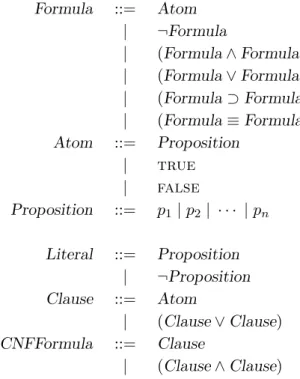
2.1 Propositional Logic: syntax . . . 20
2.2 Propositional Logic: semantics . . . 21
3.1 Caesar code . . . 23
3.2 Encryption and Decryption, [CJ97] . . . 23
3.3 BNF rules for facts . . . 28
3.4 NSPK protocol insecurity problem: attack trace . . . 40
3.5 NSPK protocol insecurity problem: honest agent rules . . . . 42
3.6 NSPK protocol insecurity problem: intruder rules . . . 43
3.7 PCP as a Security Protocol . . . 44
3.8 PCP as a PIP: honest agents rules . . . 46
3.9 PCP as a PIP: concatenation rules . . . 48
4.1 Forward search tree . . . 73
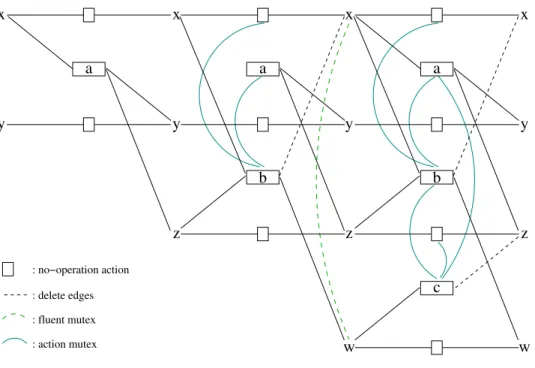
4.2 Planning Graph . . . 74
4.3 Approach . . . 84
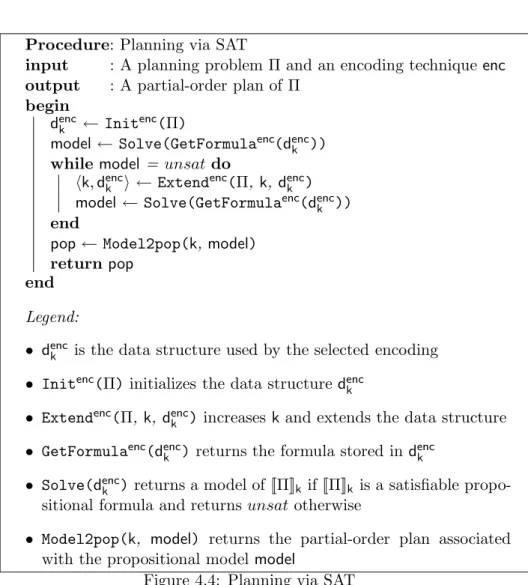
4.4 Planning via SAT . . . 86
4.5 Planning via SAT: Initlinear . . . . 87
4.6 Planning via SAT: Extendlinear . . . . 87
4.7 Planning via SAT: Initgp−schema . . . . 88
4.8 Planning via SAT: Extendgp−schema . . . . 88
4.9 Planning via SAT with termination . . . 90
4.10 Planning via SAT with the abstraction/refinement strategy . 92 5.1 HLPSL to IF framework . . . 94
5.2 The NSPK-KS protocol . . . 97
5.3 NSPK-KS protocol: HLPSL spec.(basic roles) . . . 99
5.4 NSPK-KS protocol: hierarchy of roles . . . 101
5.5 NSPK-KS protocol: HLPSL spec.(topmost-level role) . . . 102
5.6 NSPK-KS protocol: HLPSL spec.(goals) . . . 109
5.7 The Kerberos protocol . . . 110
5.8 HLPSL roles: generic structure. . . 113
5.9 Dolev-Yao intruder knowledge formulae . . . 116 ix
5.10 The semantics of safety temporal formulae . . . 117
5.11 Prelude file . . . 120
5.12 NSPK-KS protocol: IF spec.(signature, types, and inits) . . . 121
5.13 NSPK-KS protocol: IF spec.(rules) . . . 122
5.14 NSPK-KS protocol: IF spec.(goals) . . . 123
5.15 Applicability of a IF rewrite rule . . . 128
5.16 Semantics of a IF rewrite rule . . . 129
6.1 Architecture of SATMC . . . 133
6.2 Grammar for the SATE specification language . . . 137
6.3 Output generated by SATMC . . . 140
6.4 A screen-shot of SATMC within the AVISPA Tool . . . 141
7.1 Comparison between graphplan-based and linear encodings on the number of atoms and clauses . . . 149
7.2 Comparison between graphplan-based and linear encodings on the encoding time . . . 150
7.3 AVISPA/AVISS Architecture . . . 155
7.4 Comparing SATMC versions . . . 158
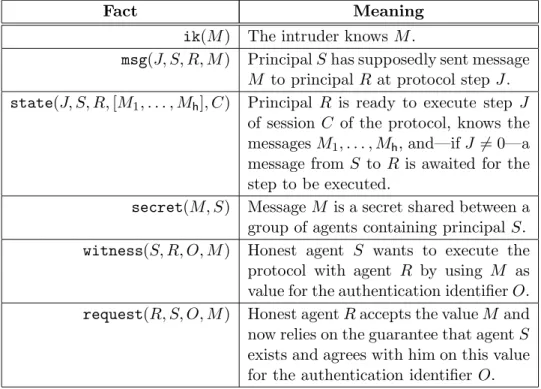
3.1 Facts and their informal meaning . . . 38 3.2 (Un-)Decidability Overview . . . 52 5.1 HLPSL coverage . . . 131 7.1 Experimental data on protocols from the Clark/Jacob library
using Linear encodings . . . 144 7.2 Experimental data on protocols from the Clark/Jacob library
using Graphplan-based encodings . . . 146 7.3 Experiments on the Clark/Jacob library: SATMC versus
black-box . . . 151 7.4 Experiments on the Clark/Jacob library: SAT versus Logic
Programming . . . 153 7.5 Experiments on the Clark/Jacob library: AVISS back-ends . 157 7.6 Experiments on the AVISPA library . . . 159 7.7 Experiments on the NSPK-KS with increasing number of
ses-sions . . . 161 B.1 Experiments on the AVISPA library . . . 185
Introduction
1.1
Research area, motivations and objectives
Research area
This Thesis is about the application of automated reasoning techniques to formal analysis ofsecurity protocols. More in particular, it explores the novel combination of various techniques borrowed from and devised for(bounded) model checking, AI planning, andpropositional satisfiability with the ulti-mate goal of analysing in a formal and automatic way industrial-scale secu-rity protocols.
Propositional Satisfiability (SAT). Boolean satisfiability (SAT) is the problem of deciding if there is an assignment for the variables in a proposi-tional formula that makes the formula true. SAT is of considerable practical interest as many decision problems, such as graph colouring problems, plan-ning problems, and scheduling problems can be encoded into SAT. As a matter of fact, unless P = NP, SAT is intractable in the worst case, as it is a NP hard problem. Namely it is the first known NP-complete problem, as proved by Stephen Cook in 1971 (see Cook’s theorem for the proof, [Coo71]). However there is consolidated empirical evidence showing that many SAT instances are characterised by structural properties permitting efficient solu-tion (e.g. see [PCK99]). Needless to say, SAT is such a fundamental problem in logic and computer science that it received a lot of attention and many different algorithms and techniques have been devised to try and solve it efficiently (see, for a good survey [GPFW97] and for more recent develop-ments [GMW00]). The history of SAT solvers can be divided into three main periods strictly related with the creation and evolution of comput-ers. Until 1960, SAT solving algorithms were just theoretically described, but with no real interest as they could not be used in practice. In 1960, Davis and Putnam published an algorithm (denoted by DP) which
rated a new era.1 DP is very inefficient at finding a satisfying assignment when one exists. This fact, and the fact that DP’s memory consumption is explosive in practice, motivated the subsequent development of the Davis-Logemann-Loveland (DLL) algorithm [DLL62]. The algorithm has been used extensively to solve many kinds of problems using computers (espe-cially from artificial intelligence and operating research). In the 90’s, the interest in SAT solvers increased significantly. Computers of the 90’s were able to handle large SAT instances (thousands of variables), which widened the scope of SAT solver applications to include circuit design, scheduling, and model checking. As a consequence, some researchers started studying how to improve SAT solvers in practice. Benchmarks and worldwide com-petition has been established and the quest for the fastest ever solver was born (see [SAT] to read the latest news on the Propositional Satisfiability domain).
AI Planning. Planning is the area of Artificial Intelligence (AI) that aims to find a sequence of actions to apply to an input problem, in order to achieve a set of predefined objectives, starting from a given initial state. Artificial Intelligence is concerned with the representation and the use of knowledge. For planning, this means developing representations that facilitate reasoning about actions and goals, and developing techniques for efficiently manipu-lating the entities in the representation. Planning has been a challenge area of research in AI from the early 1960s. The conceptualisation of a changing world as an alternating sequence of stable states and instantaneous actions was a natural extension of the symbolic logic representations that domi-nate AI, and most planning approaches have thus been built on state-based representations. The most influential planning representation has been the STRIPS formalism [FN71], because of its simplicity and efficient treatment of the frame problem [MH69]. Within this formalism, classical planning is correct and complete. During the last decade a number of researchers tried to develop algorithms and systems that combine both classical planning tech-niques and consolidated techtech-niques from other areas of Artificial Intelligence. One of the most promising combination exploits recent improvements in the performances of propositional satisfiability methods. The basic idea is to compile bounded-length planning problems to SAT [KMS96, EMW97] and to use state-of-the-art SAT solvers to efficiently discover solutions. Planning techniques have been applied in numerous areas including robotics, space ex-ploration, transportation logistics, marketing and finance, assembling parts, crisis management.
Model Checking. Model checking [CGP99] is a powerful and automatic technique for verifying finite state concurrent systems. Introduced in early
1980s, it has been applied widely and successfully in practice to verify digital sequential circuit designs and communication protocols. However, thestate explosion problem, wherein the number of system states grows exponentially with the number of system components, generally limited the application of model checking to designs with less than one million states (e.g. hardware circuit designs with at most 20 latches). During the 1990s, it has been devised and improved asymbolic model checking technique based on the idea to symbolically explore the search space through the use ofBinary Decision Diagrams (BDDs) whose allow computation of transitions among sets of states rather than individual states [McM93]. Although the application of BDD-based symbolic model checkers allowed designers to verify systems with 1020states, it remains the case that model checkers lack a certain robustness, in that they cannot consistently handle designs of typical industrial size. In late 1990s, it has been proposed a new type of model checking technique called bounded model checking [BCCZ99] that by exploiting the dramatic speed-up of propositional solvers it is able to analyse designs with hundreds of thousands of latches. Bounded model checking has been proved to be particularly suited in finding counter-examples, i.e. to return paths through the transition system that violate one of the specified system requirements.
Motivations
Hardware and software are widely used in critical systems (e.g. ecommerce, communication networks, medical systems, air traffic) where a failure is unacceptable because its consequences can be costly (e.g. in 1994, the Pen-tium FDIV bug costed $475 millions to INTEL; in 1996, the explosion of Ariane 5 due to a floating point overflow has been estimated in a lost of $500 millions) and even more serious when they endanger people’s safety (e.g. between 1985 and 1987, the medical machine for radiotherapy Therac-25 distributed wrong amounts of radiations to several patients because of a software bugs and two people died; in 1991 during Operation Desert Storm, a failure in the software controlling a Defence Patriot Missile resulted in 28 deaths). The huge number of reported system failures shows that conven-tional validation techniques based on informal arguments and/or testing are not up to the task. It is now widely recognised that only verification tools based on formal methods can provide the level of assurance required.
One of the area that has received growing attention by the formal meth-ods community as a new, very promising and challenging application domain is that of security protocols. In fact, in a world strongly dependent on dis-tributed data communication, the design of secure IT infrastructures like the Internet is a crucial task. The acceptance and continued expansion of these infrastructures depends on trust: all participants must have confi-dence in their security, which is integrated into the infrastructure either by means of specific security protocols or protocol families (cf. protocols like
IPSec, IKE, TLS, and SSH) aimed at satisfying general security require-ments, or by augmenting protocols and applications with security sensitive parts (cf. Geopriv, SIP, etc.), i.e. security specific functional elements that satisfy application-oriented security requirements. With the spread of the Internet and network based services, and the development of new technolog-ical possibilities, the number and scale of new protocols under development is out-pacing our ability to rigorously analyse and validate them. This is an increasingly serious problem for standardisation organisations like the Inter-net Engineering Task Force (IETF), the International Telecommunication Union (ITU), and the World Wide Web Consortium (W3C) as well as for companies whose products and/or services depend on the rapid standardisa-tion and correct funcstandardisa-tioning of these protocols. It is also a problem for users of these technologies whose rights and freedoms, e.g. the right to privacy of personal data, depend on a secure infrastructure.
Designing secure protocols is a very challenging problem. In open net-works, such as the Internet, protocols should work even under worst-case assumptions, namely messages may be eavesdropped or tampered with by anintruder (also called the attacker or spy) or dishonest or careless princi-pals (where we callprincipals the agents participating in a protocol execu-tion). Surprisingly, severe attacks can be conducted even without breaking cryptography, but by exploiting weaknesses in the protocols themselves, for instance by carrying outman-in-the-middle attacks, where an attacker plays off one protocol participant against another, or replay attacks, where mes-sages from one session (i.e. execution of an instance of the protocol) are used in another session. The history of security protocols is full of exam-ples, where weaknesses of supposedly correct published protocols that have been implemented and deployed in real applications only to be found flawed years later. A well-known case is the Needham-Schroeder authentication protocol [NS78] that was found vulnerable to a serious attack 17 years after its publication [Low96]. An up to date and interesting amount of statistics about security violations can be found in the yearly “Computer Crime and Security Survey” [CSI04] conducted by the Computer Security Institute (San Francisco, U.S.)2 with the participation of the San Francisco Federal Bureau of Investigation’s Computer Intrusion Squad. Here we sketch a summary of the 2004 survey results that are based on the responses of 494 computer security practitioners in U.S. corporations, government agencies, financial institutions, medical institutions and Universities:
? even if the percentage of organisations that experienced an unautho-rised use of their computer systems within the last 12 months is de-creasing since 2000 (mainly due to the growing use of security counter-measures technologies), such a number is still quite high (53%) as well as the dollar amount of annual financial losses resulting from security
breaches ($142 millions);
? within the 53% of respondents answering that there was unauthorised use of their organisation’s computer systems in the last 12 months:
– the 47% experienced from 1 to 5 incidents, 20% from 6 to 10, 12% experienced more than 10 security violations, and the rest (22%) do not know;
– only the 36% reported such intrusions to public opinion in order to avoid negative publicity and further economic losses [KCZ03]. Other significant data can be found in [CER03] published by CERT/CC (CERT/Coordination Center)3 within the Software Engineering Institute of the Carnegie Mellon University (Pittsburgh, USA). Figure 1.1 is borrowed from such a report and shows the number of vulnerabilities reported to CERT/CC between 1995 and 2003. It is immediate to see that the number of
Figure 1.1: Vulnerabilities reported by CERT between 1995 and 2003
security vulnerabilities is highly growing up and it is estimated in more than 11 vulnerabilities for day (according to [Sym04] seven new vulnerabilities a day were announced in 2003).
The possibility of these violations and attacks sometimes stems from sub-tle misconceptions in the design of the protocols. Typically, these attacks
are simply overlooked, as it is difficult for humans, even by careful inspec-tion of simple protocols, to determine all the complex ways that different protocol sessions could be interleaved together, with possible interference of a malicious intruder.
To speed up the development of the next generation of network proto-cols and to improve their security and ultimately the acceptance of products based on them, it is of utmost importance to have tools and specification languages that support the activity of finding flaws in protocols or of estab-lishing their absence. Optimally, these tools should be robust, expressive, and easily usable, so that they can be integrated into the protocol develop-ment and the standardisation process to improve the speed and quality of that process.
A variety of languages and tools (e.g. [ABB+02, BAN90, DM00, DNL99, Mea96, MD03, Pau98, SBP01]) based on different automated reasoning techniques have been devised and applied to automate the analysis of se-curity protocols. Urged by the success of the SAT technology in do-mains like hardware verification, we have investigated in this thesis if sim-ilar results can be obtained by applying SAT-based model-checking to se-curity protocols. Besides this practical reason, an important theoretical reason candidates SAT as a possible successful approach for security pro-tocol analysis. In fact, although the general verification problem—to prove whether a security protocol satisfies its security guarantees or not—is unde-cidable [DLMS99, EG83], by focusing on verification of a bounded number of sessions the problem is known to be in the same complexity class of SAT i.e. NP-complete (see [RT01]). The encoding into SAT can be done in a variety of ways. However the specific nature of security protocols that make them particularly suited to be represented through rule-based for-malisms [CDL+99] suggests that SAT-reduction techniques like those de-vised for AI planning may be particularly successful in such a context.
Objectives
Driven by the request for assistance arisen from standardisation committees for Internet protocols that mainly ask for tools and specification languages to support their activities, the objectives of this thesis have been three-fold: 1. to contribute to design a framework suited for the easy specification
of industrial-scale security protocols;
2. to develop an automatic tool for security protocol analysis. More specifically, levered by the advancements of the SAT technology this thesis aims to devise a SAT-based semi-decision procedure for model checking of security protocols; and
against a large collection of practical relevant, industrial security pro-tocols and therefore to determine whether this approach usually ap-plied to finite-state transition systems and control-intensive application-domains, scales to the data and control-intensive domain of security protocols.
1.2
An Overview of the SAT-based Model-Checking
approach
This thesis presents an automatic reduction of the question “Does the pro-tocol satisfy its security requirements?” into propositional logic (SAT) thus exploiting the high performance of state-of-the-art SAT solvers for discov-ering attacks on protocols.
The above question is formalised into a security problem Ξ = hΓ,Bi where Γ is a state transition system representing the concurrent execution of honest agents that exchange the messages of the protocol over an insecure network controlled by the very general Dolev and Yao intruder [DY83] and B is a set of states whose reachability corresponds to a violation in the requirements of the protocol. In tackling this problem we specify Γ in a declarative language based on multiset rewriting4 and we make the standard assumptions of perfect cryptography5 and strong typing.6
The basic idea behind our SAT-based model-checking approach is that given an integer k and a security problem Ξ, it is possible to generate a propositional formula ΦΞk whose models correspond to attacks on the
secu-rity problem. Intuitively the formula represents all the possible evolutions of the transition system described by Ξ up to depthk. Therefore the unsat-isfiability of the formula, in general, does not permit to conclude that the modelled protocol satisfies its security requirements, but only that the secu-rity protocol does not suffer from any attack of length up tok. In order to provide a (semi-decision) procedure able to discover any attack on security protocols, it suffices to iterate the procedure for increasing values ofk. This results in executing bounded model-checking [BCCZ99] of security protocols by means of a reduction to propositional formulae with iterative deepening on the number of steps.
Last but not least it is worth pointing out that our automatic reduction from security problems to SAT results from the combination of a translation
4Multiset rewriting is an action-based formalism particularly amenable to formal
anal-ysis of security protocols [CDL+99, JRV00].
5The perfect cryptography assumption states that an encrypted message can be
de-crypted only by using the appropriate decryption key.
6The strong typing assumption imposes that agents only react to a message if, and only
if, this message has the type and the pattern expected by the receiver (i.e. type confusion is not allowed). As pointed out in [HLS00], a wide variety of type-flaw attacks can be prevented by tagging the fields of a message with information indicating its intended type.
of security problems into planning problems and SAT-encoding techniques developed for planning. This provides a significant benefit to our approach where we may exploit a decade-long research area very prolific in devising sophisticated AI planning SAT-encoding techniques.
1.3
Structure of the Thesis
This thesis is divided in the following main chapters:
Formal Preliminaries where we set the basic formal concepts of general-purpose decision problems useful in the context of this thesis. In this chapter are defined the concepts of multiset rewriting, planning, and propositional satisfiability.
Modelling Security Protocols where we define what is a security proto-col and how we model the question of deciding whether the protoproto-col enjoys its security requirements or not as a protocol insecurity prob-lem.
SAT-based Model-Checking of Security Protocols we provide a va-riety of techniques for reducing protocol insecurity problems to propo-sitional satisfiability problems and we describe in details the overall approach.
Specification Languages for Security Protocols where we present a frame-work for the specification of industrial-scale security protocols. Namely, a protocol and its security requirements are specified in an high-level language accessible to a human user and they are then automatically translated into a lower-level language particularly amenable to auto-mated formal analysis.
Implementing a SAT-based Model-Checker: SATMC where we de-scribe the implementation of an open and flexible platform for SAT-based bounded model checking of security protocols SAT-based on our ideas. Experimental Results where we provide a large number of experimen-tal results for comparing (i) the encodings in SATMC and (ii) our SAT-based approach with respect to others state-of-the-art automated reasoning techniques.
Related Work where we survey the most relevant works in the area of security protocols and we discuss the relationships between our SAT-based Model-Checking approach and closely related general-purpose automated reasoning techniques.
Conclusions and Perspectives where we summarise the conclusions of this thesis and future directions that may be worth exploring.
We end up this thesis with two appendices:
Appendix A where we prove that the reduction to planning presented in this Thesis is sound and complete.
Appendix B where we present in details the results obtained by running SATMC against the security problems in the AVISPA library.
1.4
Contribution of the Thesis
This thesis contributes to the research area of security protocol analysis by providing added values to the following points:
Specification Languages for Security Protocols. We have contributed to the design of a framework for the easy specification of security protocols (see Chapter 5).7. In such a framework security protocols are specified in the High-Level Protocol Specification Language (HLPSL) that is designed to be accessible to human users and that is easily translatable into a lower-level term-rewriting based language, called Intermediate Format (IF), well-suited to model-checking tools.
Automatic Tools for Security Protocol Analyses. We have devised an approach for analysing security protocols (see Section 4.3) that results from the combination of a reduction of security problems to planning prob-lems (see Section 4.1) and SAT-encoding techniques developed for planning (see Section 4.2). In doing this we have investigated interesting aspects of cross-fertilisation between planning and model-checking. In fact, while the application of model-checking techniques to planning—usually referred as “Planning as Model-Checking”, [FP99, AFEP97]—have been explored quite widely, the opposite direction, i.e. “Model-Checking as Planning”, has not received the same attention. The SAT-based approach described in this thesis applies planning SAT-reduction techniques for bounded model checking [BCCZ99] of security protocols and thus contributes to determine whether model-checking problems may be successfully tackled through AI planning techniques.
Scaling to Industrial-Scale Security Protocols. We have developed SATMC, a SAT-based Model-Checker, based on our ideas (see Chapter 6).
7It must be noted that this framework is one of the result of a joint work with other
researchers from various institutions—AI-Lab group at DIST of University of Genova (Genova, Italy), the CASSIS group at INRIA (Nancy, France), the Institut fur Infor-matik Albert-Ludwigs-Universitat (Freiburg, Germany), the Information Security Group at ETHZ (Zurich, Switzerland), and Siemens AG (Munich, Germany)—carried out in the context of the EU projects AVISS [AVI01] and AVISPA [AVI02a].
SATMC is an open and flexible platform for bounded model-checking of security protocols that can readily exploit both improvements of SAT tech-nology and advancements in AI planning SAT-reduction. State-of-the-art taken off-the-shelf SAT-solvers (e.g. the best performers in the SAT com-petition, [SAT]) can be directly integrated in SATMC in a plug and play manner. Similarly, new encoding techniques for reducing planning problems into propositional satisfiability problems can be easily imported into our tool. We have thoroughly assessed (see Chapter 7) our approach by running SATMC against security protocols of growing complexity, from those in the Clark-Jacob’s library [CJ97] to those, practically relevant in industrial en-vironments, of the AVISPA library (see Chapter 5). The results obtained confirm the effectiveness of the approach and show that SAT-based Model-Checking technologies usually applied to finite-state transition systems and control-intensive application-domains, can be successfully applied also on data and control-intensive domains like those of security protocols. To the best of our knowledge no other tools, except those integrated in the AVISPA tool [AVI02a], exhibit the same level of scope and robustness while enjoying the same performance and scalability.
Formal Preliminaries
The purpose of this chapter is to set the basic formal concepts of general-purpose decision problems this Thesis focuses on. The chapter consists of three sections: in the first one the concepts about (multi)-set rewriting systems and reachability problems for (multi)-set rewriting are described; in Section 2.2 the planning formalism and some related concepts are pre-sented; finally, the third section describes well-known concepts of proposi-tional logic.1
2.1
(Multi)-Set Rewriting
The theory and applications of rewriting logic have been vigorously devel-oped by researchers all over the world during the past years. In its broad meaning, aterm rewriting systemprovides a general framework for specify-ing and reasonspecify-ing about computation.2 It consists of transformation rules of the formt→t0 (called rewrite rules), working over termstand t0 built out of variable and function symbols. Each rewrite rule can be interpreted as a local transition in a concurrent system. Namely, the rule explains how a local concurrent transition can take place in the system, changing the local state fragment from an instance of the termtto the corresponding instance of the term t0 (see for instance Example 1).
Example 1. Suppose we want to model a simple clock by means of a term rewriting system. In doing this we desire each transition of the rewriting
1Readers familiar with some of the topics presented in this Chapter are invited to
skip the correspondent section. This argument definitely applies to the last section on propositional logic. However, we would suggest to all the readers to give at least a quick look to the section on planning where some important definitions, concepts, and theoretical results are presented.
2In the sequel we will use the concepts of signature, function, predicate, constant, variable,atom,(ground) term,(ground) atomic formula,(ground) substitution, and unifi-cationas commonly defined in first order logic, see for instance first two chapters of [VG91].
system corresponds to a tick of the clock. This can be easily modelled through the rewrite rule x → s(x) where x is a variable ranging on the domain
{0, s(0), s(s(0)), . . .} and s is the unary successor function. Assume the initial state of the system is represented by means of the atomic formula
time(0), then it is immediate to see that the only evolution of the system is
given by this sequence of states: time(0), time(s(0)), time(s(s(0))), etc.
In the context of this Thesis, we focus on a specific class of rewriting systems in which the rules do not rewrite terms, but sets of atomic formulae calledfacts. Moreover, in the spirit of [CDL+99], we augment rewrite rules with existential quantification to provide a natural way of choosing new values. Intuitively, existential quantification introduces an amount of non-determinism particularly suited to model the generation of pseudo-random numbers that is at the core of cryptographic applications and that in reality depends on unpredictable events (e.g. mouse movements, key strokes, and similar user events). Besides this, in order to emulate the practically very low probability of generating more than one time the same pseudo-random number, we restrict our model to those non-deterministic traces in which any existential variable is always replaced by anew pseudo-random number.
Formally, a(multi)-set rewriting systemis a tuple Γ =hF,L,I,Ri where FandLare disjoint sets of ground atomic formulae of a (multi-sorted) first-order language, called facts and rule labels respectively, I is a finite subset of 2F representing the initial states3, and Ris a set of labelled rewrite rules of the form4
L−→ ∃` y:R
where∃ydenotes that the variablesyare to be instantiated with terms that ought to be fresh, i.e. new values that have not been previously encountered, even if the rule is used repeatedly. Letσ be a ground substitution onxand y, the above rewrite rule is such that Lσ and Rσ are finite subsets of F, and`σ ∈Lis a rule label. Moreover, we require that (i) the non-existential variables of the right-hand-side must be a subset of the variables in the left-hand-side, and (ii) if
L1 `(x1) −−−→ ∃y1:R1 ∈R, and L2 `(x2) −−−→ ∃y2:R2 ∈R
are such that `(x1)σ1 = `(x2)σ2, then L1σ1 = L2σ2 and R1σ1 = R2σ2 (where σ1 and σ2 are two ground substitutions). This last requirement en-sures that each rule label is associated with at most one ground rewrite rule.
3IfS is a set, then 2S denotes the powerset ofS.
4For the sake of simplicity in the sequel we will useL,R, and`to denoteL(x),R(x,y),
and`(x) respectively. Similarly, letian integer, thenLi,Ri, and`i will indicateLi(xi),
However, it does not prevent the non-determinism introduced by the exis-tential quantification. In fact a rule label ` does not contain any reference to the existential variables occurring in the rule and therefore the applica-tion of ` can lead to infinitely-many states where existential variables are instantiated with different fresh terms.
Facts are used to represent the states of the transition system associated with the (multi)-set rewriting system. In particular, a state is modelled by the set of facts true in that state. More precisely, ifF is a set of facts then the state represented byF is such that all the facts inF are true in it and all the facts inF\F are false in it (closed-world assumption).
If (L−→ ∃` y:R)∈R, then we definelhs(`) =L,R(`) =R, andex(`) =y to be the left-hand-side, the right-hand-side and the existential variables re-spectively of the rule. Moreover, ifS is a set of facts, then we definev(S) and sub(S) to be the set of variables in S and the set of all the subterms occur-ring in each fact ofS respectively.5 (For instance, if S={q(a), p(x, f(c))}, thenv(S) ={x}and sub(S) ={a, x, f(c), c}).
Let σ be a ground substitution on x and y, then if S ⊆ F is such that lhs(`)σ ⊆ S, then we say that the rewrite rule `σ is applicable in S and that S0 = app→
`σ(S) = (S\lhs(`)σ)∪rhs(`)σ is the state resulting from the
execution of`σ inS. A rewriting path is an alternating sequence of states and rule labelsS0`1σ1S1. . . Sn−1`nσnSn such that for i= 0, . . . , n−1
• σi is a ground substitution,
• Si+1 = app→`i+1σi+1(Si), and
• ex(`i+1σi+1) ∩ sub(S0∪Sij=1(lhs(`i)σi∪rhs(`i)σi))
=∅.6
If S0`1σ1S1. . . Sn−1`nσnSn is a rewriting path, then we say that Sn is
reachable in n steps from S0 by applying in sequence the ground rules
`1σ1, . . . , `nσn. This is denoted by Sn= app→`1σ1;...;`nσn(S0).
A nice feature of (multi)-set rewriting systems is that they can be easily glued together thereby facilitating the writing of modular specifications. Let Γ1 =hF1,L1,I1,R1iand Γ2 =hF2,L2,I2,R2ibe (multi)-set rewriting systems with L1 ∩L2 = ∅.7 The composition of Γ1 and Γ2, in symbols Γ1 ◦ Γ2, is the (multi)-set rewriting system Γ = hF1 ∪F2,L1 ∪L2,I,R1 ∪R2i with I={S1∪S2:S1 ∈I1, S2 ∈I2}.
Let Γ = hF,L,I,Ri be a (multi)-set rewriting system. A reachability problem forΓ is a pair Ξ =hΓ,BiwhereBis a finite subset of 2Frepresenting
5This definitions can be easily adapted to the case of terms.
6Notice that this condition ensures that, at each rule application, the existential
vari-ables have been instantiated with fresh terms.
7IfL
1andL2have some element in common, then it is possible to rename these elements
and change the rewrite rules accordingly so to ensure that the two sets of rule labels are disjoint.
the goal (bad) states. Asolution to Ξ =hΓ,Bi is a run `1σ1, . . . , `nσn of Γ
such that app→
`1σ1;...;`nσn(S)∈Bfor someS ∈I. 8
2.2
Planning Problems
Planning is a fundamental problem for many real world application domains including robotics, process planning, web-based information gathering, au-tonomous agents, and spacecraft mission control. Planning is the process by which we determine actions to achieve our goals (e.g. getting to the super-market to buy a banana for lunch, finishing all our homework assignments and projects and turning them in by their deadlines, building an airplane). Formally, a planning system is a tuple Θ = hF,A,I,Oi, where F and A are disjoint sets of variable-free atomic formulae of a sorted first-order language called fluents and actions respectively, I is a finite subset of 2F representing the initial states, and O is a set of operators of the form
P reAct⇒Add ;Del
where Act ∈ A and P re, Add, and Del are finite sets of fluents such that Add ∩Del = ∅.9 Moreover we require that if P re1⇒Add1a ;Del1 and
P re2
a
⇒Add2 ;Del2, then P re1 = P re2, Add1 = Add2, and Del1 = Del2. This requirement ensures that each action label is associated with at most one planning operator.
Fluents are used to represent the states of the transition system associ-ated with the planning system. In particular, a state is modelled by the set of fluents true in that state. More precisely, ifF is a set of fluents then the state represented byF is such that all the fluents inF are true in it and all the fluents inF \F are false in it (closed-world assumption).
If P re⇒Adda ;Del then we define pre(a) = P re, add(a) = Add, and del(a) =Del. Moreover, ifS ⊆ F is such that pre(a)⊆S, then we say that theactionais applicable inS and thatS0 = app⇒
a(S) = (S\del(a))∪add(a)
is the state resulting from the application ofainS. Aplanning path(pathin short) is an alternating sequence of states and actionsS0a1S1. . . Sn−1anSn,
compactly denoted by πa1,...,an(S0), such that Si+1 = app ⇒
ai+1(Si) for i =
0, . . . , n−1. IfS0a1S1. . . Sn−1anSn is a planning path, then we say thatSn
is reachable in n steps from S0 by applying in sequence a1, . . . , an; this is
denoted bySn= app⇒a1;...;an(S0).
Let Θ =hF,A,I,Oi be a planning system. Aplanning problem for Θ is a pair Π =hΘ,Gi where G is a finite subset of 2F representing the goal states. Asolution toΠ =hΘ,Gi, called plan, is a sequence of actions whose
8It must be noted that when exists a goal state that corresponds to one of the initial
states, then Ξ allows for a trivial solution that we indicates by means of the empty sequence of rules.
execution leads from the initial state to a final state and the preconditions of each action appears in the state to which it applies. Formally,a1, . . . , an
is a plan of lengthnof Π if and only if app⇒
a1;...;an(S)∈ G for some S∈ I. 10 Definition 1 (Parallel Composition). Let ai ∈ A for i= 1, . . . , n. We say thata1, . . . , anare composableif and only ifSni=1add(ai)∩Sni=1del(ai) =
∅, i.e. the effects of the actions ina1, . . . , an do not contradict each other. If
a1, . . . , anare composable actions, then the(parallel) composition ofa1, . . . , an,
in symbolsa1k · · · kan, is the action aassociated with the planning operator
Sn
i=1pre(ai) a
⇒Sni=1add(ai) ;Sni=1del(ai).11
If we extend the definition of planning problem so to consider also the application of the actions obtained fromOby parallel composition, then we may get shorter solutions. Formally, let Π =hhF,A,I,Oi,Gi, we define ˆΠ = hhF,A,ˆ I,Oi,ˆ Gi where ˆO and ˆA are obtained fromO and Aby adding all the parallel composition of actions, i.e. ˆO={a1k · · · kan:{a1, . . . , an} ⊆ O},
and ˆA = {a :{a1, . . . , an} ⊆ A, a1k · · · kan,and ais a unique identifier for
a1k · · · kan}. It is easy to see that ˆΠ may have shorter solutions than Π. To
illustrate, consider Example 2.
Example 2. Given the planning problem Π =hhF,A,I,Oi,Gi where:
F = {a1, . . . , an, b1, . . . , bn} A = {l1, . . . , ln} I = {{a1, . . . , an}} O = {ai l1 ⇒bi ;¬ai :i= 1, . . . , n} G = {{b1, . . . , bn}}
The only solutions toΠare all the permutations ofl1, . . . , ln, whereasl1k · · · kln is a solution to Πˆ of length 1 concisely representing the effect of applying the actions l1, . . . , ln in any order. In the real world, each ai and bi could be two possible configurations of thei-th object of the system and li a switch that, if pressed, allows the i-th object to move from ai to bi. By means of parallel composition we can model the situation in which all the n switches are activated simultaneously.
However a solution to ˆΠ does not necessarily correspond to a solution to Π (see for instance Example 3).
10It must be noted that when there exists a goal state that corresponds to one of the
initial states, then Π allows for a trivial solution that we indicates by means of the empty sequence of actions.
11If Λ is a set of composable actions, thenk(Λ) denotes the parallel composition of the
Example 3. For instance, the planning problem Π =hhF,A,I,Oi,Gi with F = {a, b, c} A = {l1, l2} I = {{a}} O = {(al1 ⇒b ;¬a), (al2 ⇒c ;¬a)} G = {{b, c}}
has no solution, whereas Π =ˆ hhF,A,ˆ I,Oi,ˆ Giis such that (al1⇒kl2b, c ;¬a)∈ ˆ
O and therefore l1kl2 is a solution toΠˆ.
We are thus interested in only those solutions to ˆΠ that correspond to solutions to Π.
Definition 2 (Linearization). Let a1, . . . , an be composable actions. A
linearization of a1k · · · kan is a permutation a = ak1, . . . , akn of a1, . . . , an
such that for allS0 ⊇Sni=1pre(ai)there exists a planning path πa1,...,an(S0).
We say thata1k · · · kanis linearizable if and only if there exists a lineariza-tion of a1k · · · kan.
Lemma 1. Let a1, . . . , an be composable actions, let ak1, . . . , akn be a
lin-earization ofa1k · · · kan, and letS0 ⊇Sni=1pre(ai), thenapp⇒ak1;···;akn(S0) = app⇒a1k···kan(S0).
Proof. The proof is by induction on n. Since the base case is trivial, here we focus on the step case. Then
app⇒
ak1;···;akn(S)
= app⇒akn(app⇒ak1;···;akn−1(S)) [by definition] = app⇒
akn(app⇒ak1k···kakn−1(S)) [by induction hypothesis] = (((S\Sni=1−1del(aki))∪
Sn−1
i=1 add(aki))\del(akn))∪add(akn) [by def.] = (((S\Sni=1−1del(aki))\del(akn))∪
Sn−1
i=1 add(aki))∪add(akn)
[a1, . . . , an are composable and thus del(akn)∩
Sn−1
i=1 add(aki) =∅]
= (S\Sni=1del(aki))∪
Sn
i=1add(aki) [by simplification] = app⇒
a1k···kan(S) [by def.]
Let π = S0a1S1· · ·Sm−1amSm and π0 = S00a01S10 · · ·Sn0−1a0nSn0 be
plan-ning paths such that S0
0 =Sm. The concatenation of π and π0, in symbols
Lemma 2. Let Θ = hF,A,I,Oi and Θ =ˆ hF,A,ˆ I,Oi,ˆ where Oˆ and Aˆ
are obtained from O and A by adding all linearizable compound actions. If
S0a1S1· · ·Sm−1amSm is a path of Θˆ, then πa1(S0)πa2(S1)· · ·πam(Sm) is a
path of Θ where a1, . . . , am are linearizations of a1, . . . , am respectively. In such cases we say that the planning path S0a1S1· · ·Sm−1amSm is lineariz-able.
Proof. Simple consequence of Lemma 1.
It is thus important to identify conditions that guarantee the lineariz-ability of parallel planning paths. A simple approach is based on the idea of requiring that all component actions must be executed in any order and must lead to the same result.
Definition 3 (Interference). We say that a1 interferes witha2, in symbols
a1⊕a2, if and only if (i)a16=a2 and (ii) del(a1)∩pre(a2)6=∅or del(a2)∩ pre(a1) 6= ∅, i.e. a1 is different from a2 and the execution of a1 does not
prevent the execution of a2 and vice versa.
Lemma 3. Let a1, . . . , an be composable actions. If ai does not interfere withaj fori, j = 1, . . . , n withi6=j, then all permutations of a1, . . . , an are linearizations of a1k · · · kan.
Proof. Letak1, . . . aknbe a generic permutation ofa1, . . . , an. We must show that aki+1 is applicable in Si for i= 0, . . . , n−1, where S0 ⊇
Sn
i=1pre(ai)
and Si+1 = app⇒aki+1(Si) fori= 0, . . . , n−1. To this end we prove a more
general fact, namely that akj is applicable in Si for all j=i+ 1, . . . , n and all i = 0, . . . , n−1, from which the above fact can be readily inferred by considering the cases in which j = i+ 1. The proof is by induction on
i. The base case (i.e. i = 0) boils down to showing that akj is applicable
in S0 for all j = 1, . . . , n. This trivially holds since S0 ⊇ Sni=1pre(ai) =
Sn
j=1pre(akj). For the step case we must show that akj is applicable in Si+1 for all j = i+ 2, . . . , n. Let j be such that i+ 1 < j ≤ n. By induction hypothesis it readily follows that akj is applicable in Si or, in other words, that pre(akj) ⊆ Si. Since, by hypothesis, akj and aki+1 do
not interfere, we know that pre(akj)∩del(aki+1) = ∅. From this we can
conclude that pre(akj) ⊆Si\del(aki+1) and therefore also that pre(akj) ⊆ (Si\del(aki+1))∪add(aki+1) =Si+1. Thusakj is applicable in Si and this concludes the proof.
Theorem 1. Let Θ =hF,A,I,Oiand letΘ =ˆ hF,A,ˆ I,Oiˆ whereOˆ andAˆ
are obtained from O and A by adding all compound actions a1k · · · kan for all pairwise non-interfering set of actions {a1, . . . , an} ⊆ O. Given this, if
S0a1S1· · ·Sm−1amSm is a path of Θˆ, then πa1(S0)πa2(S1)· · ·πam(Sm) is a
path of Θ where a1, . . . , am are linearizations of a1, . . . , am respectively. In such cases we also say thatS0a1S1· · ·Sm−1amSm is a partial-order planning path ofΘ.
Proof. Simple consequence of Lemma 1 and Lemma 3.
An immediate consequence of Theorem 1 is that any solution to ˆΠ = hΘ,ˆ Gi compactly represents a finite set of solutions (plans) to Π =hΘ,Gi and it is thus referred to as a partial-order plan of Π. Moreover, since by definition the planning paths of ˆΘ are a superset of those of Θ, then for each solution to Π there exists a correspondent (maybe shorter) solution to
ˆ
Π and vice versa.
Notationally, if k(Λ1), . . . ,k(Λk) is a solution to ˆΠ, then the sequence
of sets of actions Λ1, . . . ,Λk denotes a partial-order plan of Π. Moreover,
let ai,1, . . . , ai,|Λi| be a permutation (without repetition) of the actions in
Λi fori= 1, . . . , k, then any sequence—there are |Λ1|!|Λ2|!· · · |Λk|! possible
sequences—of actions a1,1, . . . , a1,|Λ1|, . . . , ak,1, . . . , ak,|Λk| is a plan of Π (see
Example 4).
Example 4. Given the planning problem Π =hhF,A,I,Oi,Gi where:
F = {at(home), at(sm), taken(toy), taken(milk), own(toy), own(milk)} A = {move(home, sm), move(sm, home), take(toy), take(milk),
buy(toy), buy(milk)} I = {{at(home)}}
O = { at(home) move(home,sm⇒ ) at(sm) ;¬at(home),
at(sm) move(sm,home⇒ ) at(home) ;¬at(sm),
at(sm) take⇒(toy) taken(toy) ;,
at(sm) take⇒(milk) taken(milk) ;,
at(sm), taken(toy) buy⇒(toy) own(toy) ;,
at(sm), taken(milk) buy(⇒milk) own(milk) ;
}
G = {{at(sm), own(milk), own(toy)}}
The sequence of sets of actions
{move(home, sm)},{take(milk), take(toy)},{buy(milk), buy(toy)}}
is a partial-order plan of Π compactly representing all the following four plans of Π:
(1) move(home, sm), take(milk), take(toy), buy(milk), buy(toy)
(2) move(home, sm), take(milk), take(toy), buy(toy), buy(milk)
(3) move(home, sm), take(toy), take(milk), buy(toy), buy(milk)
(4) move(home, sm), take(milk), take(toy), buy(toy), buy(milk)
Intuitively, in order to own the toy and the milk firstly we have to reach the supermarket sm, secondly we have to take the toy and the milk (in any order), and finally we have to pay them (in any order) at the cash-desk.
Finally it is worth pointing out that, in general, planning problems are semi-decidable problems [ENS95]. Basically it is possible to devise a pro-cedure that halts with a correct plan when a plan exists, but otherwise may not terminate. When the planning problem consists of a finite set of propositional fluents and a finite set of operators, then the associated search space becomes finite and the planning problem is decidable. Namely, such a family of planning problems, referred to as Classical planning, belongs to the PSPACE-complete complexity class [ENS95, Neb00]. Finally, it must be noted that Classical planning is NP-complete for plans of polynomially-bounded length [Tur02].
2.3
Propositional Satisfiability Problems (SAT)
The Boolean satisfiability problem (SAT) is a decision problem considered in complexity theory. The class of satisfiable propositional formulae is NP-complete, as is that of its variant 3-SAT. An instance of the problem is defined by a propositional expression written using only standard logical connectives (such as conjunction, disjunction, and negation), and Boolean variables. The question is: given the expression, is there some assignment of trueand falsevalues12 to the Boolean variables that will make the entire expression true?
Formally, a proposition (or Boolean variable) is a symbol from the set
P = {p1, . . . , pn}, our propositional alphabet. As specified by the
(un-ambiguous) grammar rule Formula depicted in Figure 2.1, a propositional formulais built out of propositions, logical connectives, and parenthesis. A
literal (see grammar ruleLiteral in Figure 2.1) is either a proposition (say,
p) or the complement of one (denoted by¬p); in the first case, we say that
l is a positive literal, and in the second, we say that l is a negative literal. A clause (see grammar rule Clause in Figure 2.1) is a finite disjunction of literals. A propositional formula in conjunctive normal form (CNF) (see grammar rule CNFFormulain Figure 2.1) is a finite conjunction of clauses. Any propositional formula can be converted to an equi-satisfiable CNF: by allowing the introduction of auxiliary variables (see, for example, [PG86]) the worst case computation time remains polynomial in the size of the orig-inal formula.
The purpose of a propositional formula is to create meanings of state-ments given meanings of atomic statestate-ments. The semantics of a formula φ with propositional symbolsp1, . . . , pnis a mapping associating to each truth
assignment v to p1, . . . , pn a truth value (false or true) for φ. In other
words, a truth assignment v is a partial function from the set of proposi-tions to{true,false}(v:P 7→ {true,false}). Given a truth assignment
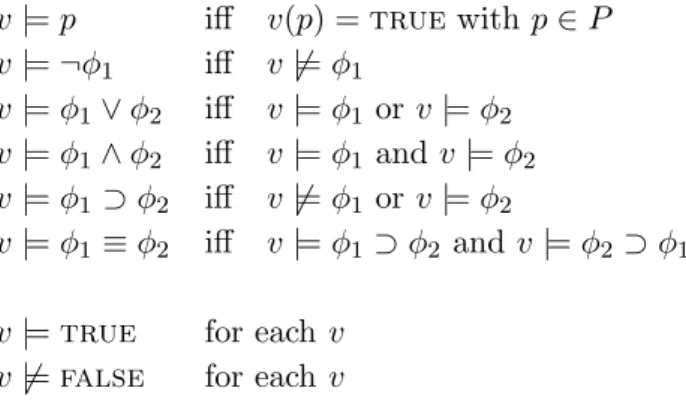
v, the satisfiability of a propositional formula φ, denoted by v |= φ, is
Formula ::= Atom | ¬Formula | (Formula∧Formula) | (Formula∨Formula) | (Formula⊃Formula) | (Formula≡Formula) Atom ::= Proposition | true | false Proposition ::= p1|p2| · · · |pn Literal ::= Proposition | ¬Proposition Clause ::= Atom | (Clause∨Clause) CNFFormula ::= Clause | (Clause∧Clause) Figure 2.1: Propositional Logic: syntax
ductively determined according to Figure 2.2.13 We represent truth value assignments as sets of propositional letters assigned to true. We say that an assignment M satisfies (or is a model of) a propositional formula φ if and only if M ∪ {¬p :p ∈P, p 6∈M} |= φ where P is the alphabet of the propositions, and |= is the aforementioned entailment relation.
In terms of notation we use also V{φ1, . . . , φm} and W{φ1, . . . , φm} to
indicate the conjunction and the disjunction respectively of the SAT formu-lae in the set {φ1, . . . , φm}. Such conjunction and disjunction of formulae
are also denoted by:
∧ φ1 .. . ... ∧ φm and ∨ φ1 .. . ... ∨ φm respectively.
Follow two simple examples of propositional formulae and their related satisfiability results.
13In there,pis a proposition,vis a truth assignment,|= is the entailment relation, and
v|=p iff v(p) =truewith p∈P v|=¬φ1 iff v6|=φ1 v|=φ1∨φ2 iff v|=φ1 orv|=φ2 v|=φ1∧φ2 iff v|=φ1 and v|=φ2 v|=φ1 ⊃φ2 iff v6|=φ1 orv|=φ2 v|=φ1 ≡φ2 iff v|=φ1 ⊃φ2 and v|=φ2 ⊃φ1
v|=true for each v v6|=false for each v
Figure 2.2: Propositional Logic: semantics Example 5. For instance, the propositional formula
Φ = ∧ a⊃(¬b∧c) ∧ c⊃a
∧ c
built out of the propositions {a, b, c} allows for only one model in which a
and b must be assigned to true, and b to false. Formally {a, c} |= Φ.
Furthermore the formula
ΦCN F = ∧ ¬a∨ ¬b
∧ ¬a∨c ∧ ¬c∨a
∧ c
is the (equi-satisfiable) CNF conversion of Φ.
Example 6. For instance, the propositional formula
Φ = ∧ a⊃(¬b∧c) (2.1)
∧ c⊃a (2.2)
∧ c (2.3)
∧ b (2.4)
built out of the propositions {a, b, c} is unsatisfiable: (2.3) and (2.4) would impose c and b to be both assigned to true; (2.2) would then impose a to
be assigned totrue too, but this would cause a contradiction with respect to
Modelling Security Protocols
In this chapter we describe how to model the problem of establishing if a security protocol guarantees its desiderata or not. We start providing in Section 3.1 background informations on security protocols (cryptographic concepts, and the well-know example of the Needham-Schroeder Public-Key protocol discovered to be flawed 17 years after its publication). After this basic and informal notions we introduce in Section 3.2 the concept of protocol insecurity problem to formally describe how we model security protocols, their security properties, and the question, in general undecidable, of deciding whether a protocol satisfies its security requirements or not. We conclude in Section 3.3 by providing an overview of (un)-decidability results on the domain of security protocols.
3.1
Background
Communication protocols specify an exchange of messages between princi-pals, i.e. the agents participating in a protocol execution (e.g. users, hosts, or processes). Messages are sent over open networks, such as the Internet, that cannot be considered secure. As a consequence, protocols should be de-signed “robust” enough to work even under worst-case assumptions, namely messages may be eavesdropped or tampered with by anintruder or dishon-est or careless principals. A specific category of protocols has been devised with the purpose of securing communications over insecure networks: se-curity (or cryptographic) protocols are communication protocols that aim at providingsecurity guarantees such as authentication of principals or se-crecy of some piece of information through the application ofcryptographic primitives.
3.1.1 Cryptography
Cryptography is an ancient science that studies how to convert aplaintext
P into aciphertextC (and vice versa) that is unintelligible to anyone moni-toring the network. The first documented example of written cryptography is dated around 1,900 B.C., when an Egyptian scribe used non-standard hieroglyphs in an inscription. Indeed more famous, the example of Julius Caesar (around 60 B.C.) who used a simple substitution with the normal alphabet, just shifting the letters a fixed amount, to secure government com-munications with his army. Figure 3.1 shows the Caesar code for a shifting fixed to 5. According to this figure the ciphertext “Ymnx xjsyjshj nx ns hqjfw” corresponds to the plaintext “This sentence is in clear”.
Caesar Code: shifting fixed to 5
Plain letter a b c d e f g h i j k l m Code letter f g h i j k l m n o p q r Plain letter n o p q r s t u v w x y z Code letter s t u v w x y z a b c d e
Figure 3.1: Caesar code
The process of convertingP intoCis calledencryption, while the reverse procedure is called decryption. The main feature of modernday encryption is that the precise form of the ciphertext C corresponding to a plaintext P depends on an additional parameter K known as the encryption key. In order to recover the original plaintext the intended receiver should use a second key K−1 called the inverse key.1 The cryptographic mechanism is depicted in Figure 3.2. P Plaintext Ciphertext C Plaintext
Decryption
Encryption
-1 P Key = K Key = K Receiver SenderFigure 3.2: Encryption and Decryption, [CJ97]
1Even if we indicate the inverse key asK−1 there is no way to compute it fromK(and
The most known cryptographic schemes are the symmetric key tosystem and the asymmetric key cryptosystem. In symmetric key cryp-tography, the decryption key and the encryption key are assumed to be identical, i.e.K =K−1. In more details, each pair of principals (e.g. Aand
B) will have their own key (e.g. Kab) for communicating with each other.
In asymmetric key cryptography (also called public key cryptography), each principal A has a public key, Ka, known to all users of the network, and a private key Ka−1, known only to herself. Knowledge of a user’s public key provides no help in finding her private key. Under many public key schemes public keys and private keys can be used for both encryption and decryption. On one side, all users of the network can encrypt messages for Aby using A’s public key, and these messages will then be unintelligible to everyone exceptA. On the other side, a principalA can encrypt her trans-mission with her own private key, Ka−1. This creates a message readable by everyone (they can decrypt it using A’s public key), with the property that it must have been written by someone in possession ofA’s private key (ideally, onlyA should know Ka−1). This is also at the base of digital sig-nature that exploits private key encryption to authenticate the identity of the sender of a message (or the signer of a document), and possibly ensure that the original content of the message (or document) sent is unchanged.
In term of notation, given a messageMand a keyK, we indicate the pro-cess of either encryption or decryption by means of{M}K. Independently
from the cryptosystem used, the following equations hold:
{{M}K}K−1 =M (3.1)
{{M}K−1}K=M (3.2)
In natural language, equation 3.1 (3.2) states that by decrypting withK−1 (K) a message already encrypted withK (K−1) it is possible to recoverM. As a matter of fact cryptographic algorithms ensure a high degree of confidence in exchanging messages over insecure communication channels. The best-known cryptographic algorithms for symmetric and asymmetric key schemes are the DES (Digital Encryption Standard, [FIP77]),2 and the RSA (Rivest, Shamir, and Adleman, [RSA78]) algorithms, respectively. The security of cryptographic algorithms relies in the difficulty of breaking them by performing a brute-force search of the key space. Hence the use of keys sufficiently long to prevent a brute force attack in a reasonable time en-tirely justifies the standard assumption adopted in formal analysis of secu-rity protocols and called perfect cryptography. The idea underlying such an assumption is that an encrypted message can be decrypted only by using the appropriate decryption key, i.e. it is possible to retrieve M from{M}K
only by usingK−1 as decryption key (see for instance Example 7).
2DES has been adopted as an encryption standard by the US government in 1976.
Since 2001 the AES (Advanced Encryption Standard) algorithm replaced DES in such a role and it is expected to be used worldwide and analysed extensively.
Example 7. Suppose that under a symmetric key cryptosystem the agent
A knows K1, but not K2 and K3. Given the message {{M}K3}K2, K2}K1,
the agent A can deduce the terms K2 and {M}K3, but not M.
Informally, the scenario we are interesting in involves a set of honest agents that, according to a security protocol, exchange messages over insecure com-munication channels controlled by a malicious agent called intruder with the ultimate goal of achieving some security requirements (e.g. authentication of principals, secrecy of some data). Specifically, we analyse such a scenario in the attempt of establishing if the security protocol satisfies its design criteria or not.
3.1.2 A simple example: NSPK
Security protocols are usually presented by means of the common and infor-mal Alice&Bob notation, [CJ97]. For instance, the well-known Needham-Schroeder Public-Key (NSPK) authentication protocol [NS78] looks like fol-low:
(1) A → B : {A, N a}Kb
(2) B → A : {N a, N b}Ka
(3) A → B : {N b}Kb
where A and B are the roles involved in the protocol; Ka and Kb are the public keys ofA andB, respectively; N aandN bare nonce3challenges gen-erated byAandB, respectively. Step (1) of the protocol denotesAsending B a message comprising the identity ofAand the nonceN aencrypted with
Kb. Since {A, N a}Kb can only be deciphered by means of the private key
Kb−1 and the latter is (by assumption) only known byB, then the effect of Step (1) is that onlyBcan possibly learn the value ofN a. In Step (2) agent B proves to A his participation in the protocol and, by sendingN b, asks A to do the same. In Step (3) agent A concludes by proving to B her own participation in the protocol. The above high level protocol specification describes a kind of template N SP K(A, B, Ka, Kb, N a, N b) parametrised by some free variables4 appearing in it. A ground instance of the security protocol template represents a session of the protocol. Successful execu-tion of the NSPK protocol should convince both A and B that they have been talking to each other. The rationale is that only B and A could have formed the appropriate response to the nonce challenges issued in (1) and in (2), respectively. In fact, a malicious agent I can deceit bob(an instance
ofB) into believing that he is talking with alice(instance ofA) whereas he
3Nonces are numbers randomly generated by principals and are intended to be used
only once.
4Free variables are indicated by means of capital letters exceptedI that is used to
is talking with I. This is achieved by executing concurrently two sessions
N SP K(alice, I, ka, ki, na, ni) and N SP K(alice, bob, ka, kb, na2, nb) of the
protocol and using messages from one session to form messages in the other as illustrated by the following protocol trace:5
(1.1) alice → I : {alice, na}ki
(2.1) I(alice) → bob : {alice, na}kb
(2.2) bob → I(alice) : {na, nb}ka
(1.2) I → alice : {na, nb}ka
(1.3) alice → I : {nb}ki
(2.3) I(alice) → bob : {nb}kb
where I(alice) indicates the intruder pretending to be alice. At the end of the above trace bob believes he has been talking with alice, but this is obviously not the case. As suggested by Lowe the successful execution of the above trace in a scenario wherebobis a banker would authorise the intruder to send the following request to the bank:
I(alice)→bob:{alice, na, nb,move 10,000 euro from my account toI’s}kb
In natural language such a message can be read as:
Hellobob, this is alice and these are my authentication creden-tials naand nb. Please transfer 10,000 euro from my bank ac-count to that of my friendI.
The problem underlying the NSPK protocol is that the second message does not provide guarantees of the identity of the sender. It is fairly easy to change the protocol so as to prevent the attack by includingB’s identity in the second message of the protocol:
B →A:{B, N a, N b}Ka
After such a correction, step (2.2) of the above attack trace would become
bob→I(alice) :{bob, na, nb}ka
and therefore the intruder can not successfully replay this message in step (1.2), becausealiceis expecting to receive a message containingI’s identity. A problem with the Alice&Bob notation used above to describe secu-rity protocols is that it leaves implicit many important details such as the shared information and how the principals should react to messages of an
5Notice that, such an attack has been discovered by Gavin Lowe 17 years after the
publication of the NSPK protocol. In the sequel we will refer to this attack as the Lowe’s attack on the NSPK.

![Figure 3.2: Encryption and Decryption, [CJ97]](https://thumb-us.123doks.com/thumbv2/123dok_us/1412042.2688961/36.892.251.620.785.911/figure-encryption-and-decryption-cj.webp)