Department of Computer Science
Automated Unit Testing of
Evolving Software
Sina Shamshiri
Supervisors: Gordon Fraser & Phil McMinn
This dissertation is submitted for the degree of
Doctor of Philosophy
As software programs evolve, developers need to ensure that new changes do not affect the originally intended functionality of the program. To increase their confidence, developers commonly write unit tests along with the program, and execute them after a change is made. However, manually writing these unit-tests is difficult and time-consuming, and as their number increases, so does the cost of executing and maintaining them.
Automated test generation techniques have been proposed in the literature to assist developers in the endeavour of writing these tests. However, it remains an open question how well these tools can help with fault finding in practice, and maintaining these automatically generated tests may require extra effort compared to human written ones.
This thesis evaluates the effectiveness of a number of existing automatic unit test generation techniques at detecting real faults, and explores how these techniques can be improved. In particular, we present a novel multi-objective search-based approach for generating tests that reveal changes across two versions of a program. We then investigate whether these tests can be used such that no maintenance effort is necessary.
Our results show that overall, state-of-the-art test generation tools can indeed be effective at detecting real faults: collectively, the tools revealed more than half of the bugs we studied. We also show that our proposed alternative technique that is better suited to the problem of revealing changes, can detect more faults, and does so more frequently. However, we also find that for a majority of object-oriented programs, even a random search can achieve good results. Finally, we show that such change-revealing tests can be generated on demand in practice, without requiring them to be maintained over time.
First and foremost, my deep gratitude goes to my supervisors Gordon Fraser and Phil McMinn for their tireless support, mentorship, and patience throughout the course of this PhD. In particular, the achievements of this work may have not been possible without their wisdom, expertise and thoughtful discussions. I also want to thank Guy Brown for his advice and encouragement during both my undergraduate and postgraduate studies.
Special thanks are due to my collaborators José Campos, José Miguel Rojas, René Just, Andrea Arcuri, and Alessandro Orso. I would like to also thank all members of my research group and laboratory (Verification and Testing) for their moral and personal support. In addition, I am thankful to Chris Wright, Ciprian Dragomir, and Mathew Hall for their help and the enjoyable conversations, during the early part of my PhD.
Finally, I am grateful and eternally indebted to my parents for their love, encouragement, and endless support during all the years.
This thesis contains original work undertaken at the University of Sheffield between October 2012 and September 2016, parts of which have been published or are currently under review.
• Sina Shamshiri, Gordon Fraser, Phil McMinn, and Alessandro Orso (2013). Search-Based Propagation of Regression Faults in Automated Regression Testing. In Proceedings of the ICST International Workshop on Regression Testing, pages 396–399. IEEE
• Sina Shamshiri, José Miguel Rojas, Gordon Fraser, and Phil McMinn (2015). Random or Genetic Algorithm Search for Object-Oriented Test Suite Generation?. InProceedings of the Genetic and Evolutionary Computation Conference (GECCO), pages 1367–1374 . ACM (Winner of the Best Paper award for the SBSE-SS track)
• Sina Shamshiri (2015). Automated unit test generation for evolving soft-ware. In Proceedings of the 10th Joint Meeting on Foundations of Software Engineering (ESEC/FSE), Doctoral Symposium, pages 1038–1041. ACM
• Sina Shamshiri, Rene Just, José Miguel Rojas, Gordon Fraser, Phil McMinn, and Andrea Arcuri (2015). Do Automatically Generated Unit Tests Find Real Faults? An Empirical Study of Effectiveness and Challenges. In Proceedings of the 30th IEEE/ACM International Conference on Automated Software Engineering (ASE), pages 201–211. IEEE (Winner of the ACM Distinguished Paper award)
• Sina Shamshiri, José Campos, Gordon Fraser, and Phil McMinn (2017). Disposable Testing: Avoiding Maintenance of Generated Unit Tests by Throwing Them Away. In Proceedings of the International Conference on Software Engineering (ICSE), Poster Track, IEEE
Sina Shamshiri October 2016
List of figures xv
List of tables xvii
1 Introduction 1
1.1 Overview . . . 1
1.2 Regression Testing . . . 2
1.2.1 Motivation for Automated Regression Testing . . . 3
1.2.2 Summary . . . 5
1.3 Structure and Contributions of this Thesis . . . 6
2 Literature Review 11 2.1 Software Testing . . . 11
2.1.1 Test Adequacy Criteria . . . 12
2.1.2 Automated Test Generation . . . 17
2.1.3 Random Testing . . . 18
2.1.4 Testing Using Symbolic Execution . . . 19
2.1.5 Testing Using Search Based Software Engineering . . . 20
2.2 Regression Testing . . . 31
2.2.1 Test Minimisation, Selection and Prioritisation . . . 32
2.2.2 Test Suite Augmentation . . . 35
2.2.3 Automated Regression Test Generation . . . 40
2.2.4 Differential Testing . . . 43
2.2.5 Regression Verification . . . 47
2.2.6 The Oracle Problem . . . 48
2.2.7 Maintaining Regression Test Suites . . . 49
2.2.8 Summary . . . 50
3 Evaluating Automated Unit Test Generation Tools Using Real Faults 51 3.1 Introduction . . . 51
3.2 Methodology . . . 53
3.2.1 Subject Programs . . . 53
3.2.2 Automated Unit Test Generation Tools . . . 54
3.2.3 Experiment Procedure . . . 56
3.2.4 Threats to Validity . . . 60
3.3 Do Automated Unit Test Generation Tools Find Real Bugs? . . . 61
3.3.1 How Many Usable Tests Are Generated? . . . 61
3.3.2 How Many Bugs Are Found? . . . 62
3.3.3 How Are the Bugs Found? . . . 64
3.3.4 Are Bugs That Are Covered Usually Found? . . . 67
3.4 How Can the Tools Be Improved? . . . 68
3.4.1 Improving Coverage . . . 69
3.4.2 Improving Propagation and Detection . . . 73
3.4.4 False Positives . . . 76
3.5 Related Work . . . 79
3.6 Conclusions . . . 79
4 Differential Testing Using a Search-Based Approach 81 4.1 Introduction . . . 81
4.2 Search-based Regression Test Generation . . . 83
4.2.1 Representation and Fitness Function . . . 83
4.2.2 Generating Assertions . . . 95
4.2.3 Isolation of Changes . . . 96
4.3 Evaluation of the Search Objectives . . . 97
4.3.1 Research Questions . . . 98 4.3.2 Subject Programs . . . 99 4.3.3 Evaluated Techniques . . . 100 4.3.4 Experiment Procedure . . . 101 4.3.5 Experiment setup . . . 103 4.3.6 Data Collection . . . 103 4.3.7 Threats to Validity . . . 105 4.3.8 Results . . . 107 4.4 Summary . . . 112
5 Random vs. GA Search for Generating High-Coverage Test Suites 115 5.1 Introduction . . . 115
5.2 Types of Branches in Java Bytecode . . . 117
5.2.1 “Integer-Integer” Branches . . . 119
5.2.2 “Integer-Zero” Branches . . . 120
5.2.4 “Reference-Null” branches . . . 122
5.2.5 Summary . . . 122
5.3 Experimental Setup . . . 122
5.3.1 Subjects . . . 123
5.3.2 Collation of Branch Type Statistics . . . 124
5.3.3 Experimental Procedure . . . 124
5.3.4 Threats to Validity . . . 125
5.4 Random or Genetic Algorithm Search for Test Suite Generation? 126 5.4.1 RQ5.1: Coverage Effectiveness. . . 126
5.4.2 RQ5.3: Effects of the Time Allowed For the Search. . . . 130
5.5 The Impact of Branch Types . . . 132
5.6 Related Work . . . 133
5.7 Conclusion and Future Work . . . 134
6 Disposable Testing 137 6.1 Introduction . . . 137
6.2 Methodology . . . 140
6.2.1 Test Generation Techniques . . . 140
6.2.2 Subject Programs . . . 141
6.2.3 Experiment Procedure . . . 142
6.2.4 Experiment Analysis . . . 145
6.2.5 Threats to Validity . . . 146
6.3 Answers to RQ6.1 (Detection of Changes To Classes) . . . 148
6.3.1 The Influence of Testing Pairs of Classes . . . 149
6.3.2 Influence of Optimization for Coverage . . . 152
6.4 Answers to RQ6.2 (Detection of Subsequent Changes) . . . 155
6.4.2 RQ6.2-D: Detection of Developer Changes . . . 158
6.5 Answers to RQ6.3 (Comparison of the Maintenance Overhead) . 163 6.6 Conclusions . . . 165
7 Conclusions and Future Work 167 7.1 Summary of Contributions and Achievements . . . 167
7.1.1 Effectiveness of Tools on Detecting Real Faults . . . 168
7.1.2 Search-Based Differential Testing . . . 169
7.1.3 Random or GA for Search-Based Test Generation . . . 170
7.1.4 Maintaining Automatically Generated Tests . . . 171
7.2 Future Work . . . 172
7.2.1 Human Study of Disposable Testing . . . 172
7.2.2 Test Readability . . . 173
7.2.3 Detecting Non-Functional Regressions using Diff. Testing 174 7.2.4 Addressing State Infection in Differential Testing . . . 174
7.2.5 Hyper-heuristics Search and Adaptive Approaches . . . . 176
7.3 Final Remarks . . . 176
References 179 Appendix A Generating Differential Test Suites Using EvosuiteR197 A.1 Introduction . . . 197
A.1.1 Requirements . . . 197
A.2 Command-line and Configuration Options . . . 198
A.3 Differential Test Suite Generation . . . 200
A.4 Generating Test Suites for Whole Projects . . . 201
A.5 Visualisation of the Search Outcome . . . 202
2.1 A population of test suite chromosomes . . . 27
2.2 The search operators crossover and mutation . . . 29
3.1 Overview of the experimental setup . . . 53
3.2 Ratio of bugs that were detected by an assertion or an exception 66 3.3 Code coverage ratios for generated test suites that found a bug and generated test suites that did not . . . 67
4.1 Overview of the EvosuiteR approach . . . 84
4.2 Credit Card example class . . . 88
4.3 Example test suite for the CreditCard class . . . 90
4.4 Comparing the effectiveness of EvoSuiteR using the combined fitness against individual measurements . . . 108
4.5 Comparing the effectiveness of EvoSuiteR to evaluate CFD . . 109
4.6 Comparing EvoSuiteR using random search, against EvoSuiteR using GA-Comb . . . 110
4.7 Comparing the effectiveness of EvoSuiteR using random search, against using GA with individual fitness measurements . . . 111
4.8 Comparing the effectiveness of EvoSuiteR using GA-Comb, against three state-of-the-art test generation techniques . . . 112
5.1 Examples of different branch types and their effect on the fitness landscape . . . 118 5.2 An example of handling adouble comparison . . . 121 5.3 ComparingGA performance with Pure Random and Random+
over the 980 SourceForge classes. . . 126 5.4 Comparing the performance ofGA with Random+: p-values and
effet size. . . 127 5.5 Numbers of different branch types in the classes under test. . . . 129 5.6 Comparing GA performance with Random+ for different types of
branch and with branchless methods. . . 131 5.7 Branch coverage comparison betweenGA vs. Random+ over 10
minutes . . . 132 5.8 Comparing branch coverage performance ofGA againstRandom+
using an extended search budget of 10 minutes . . . 132 6.1 Comparing CT→ and differential testing in regard to their
effec-tiveness at revealing changes . . . 148 6.2 Comparing CT→ and CT← in regard to their effectiveness at
revealing changes . . . 149 6.3 Comparing CT← and differential testing in regard to their
effec-tiveness at revealing changes . . . 152 6.4 Comparing coverage-driven testing and differential testing tests
evolved over 9 commits in regard to their effectiveness at detecting changes . . . 159 6.5 The average number of covered branches at each commit when
evolving test suites using coverage-driven testing and differential testing. . . 163 6.6 Comparing coverage-driven testing (maintained) and differential
testing (disposable) with regards to the number of tests developers need to inspect, for changes found by both techniques . . . 164
3.1 Overall outcome of the test generation and execution process. . . 59 3.2 The percentage of detected bugs, categorized by how the bug was
detected . . . 64 3.3 Summary of bug-finding results for each bug, tool, and execution 65 3.4 Bug coverage of test suites that did not detect the bug . . . 67 4.1 Internal variable changes over time . . . 89 4.2 Numbers of bugs in each project in Defects4J, along with the
number of bugs used in this study . . . 99 4.3 List of tracked measures during the search . . . 104 5.1 Statistics for the sample of 980 classes. . . 123 6.1 The total number of bugs in each Defects4J project and the
number applicable to and used in each research question . . . 141 6.2 Coverage of the changed area of the code, based on the outcome
of the test suite . . . 153 6.3 Overall outcome of test generation and execution . . . 156 6.4 Mutation outcome of the fault revealing test suites generated by
A.1 Configuration options for EvoSuiteR’s Genetic Algorithm . . . 200 A.2 Optional feature flags on EvoSuiteR . . . 201
Chapter
1
Introduction
1.1
Overview
“Software is eating the world.”, claims Marc Andreessen [7]. After the computer revolution, over the past decades more and more industries and businesses rely on software programs to provide service to their customers. With the ubiquity of personal computers and smartphones – which is predicted to reach over 6 Billion people by 2020 – people around the world rely on modern programs every day. Even if people try to avoid having any digital devices, their lives will nevertheless be affected by software if they travel, bank, visit a hospital, and so forth. Therefore, ensuring the reliability of software programs is essential to our everyday lives.
Rarely is it the case that a program is written once, and then forgotten. Software programs evolve over time as developers introduce many changes throughout the life-cycle of the program. These changes often range from small refactorings to the addition of large new features. However, some of these changes may affect the originally intended functionality of the software, by unintentionally introducing bugs – also known as regression faults or regression bugs. To avoid regressions in the functionality, engineers write tests along with the software, and after making changes they execute the tests to assess whether the intended functionality of the software is intact. This practice is better known as regression testing and is commonly used in industry.
1.2
Regression Testing
While regression testing can help with early detection of regression faults, devel-opers face several challenges when applying the technique. As the number of tests grows, execution of all tests after every single change can become expensive and impractical. This problem has been well studied in the literature [198] and many techniques such as test selection, prioritization and minimization have been proposed to address the problem.
The challenges however are not limited to the growing cost of regression testing. Even if all tests are always executed, three main problems remain: 1) an existing set of tests is required, 2) the tests are often written without foreseeing future changes, and 3) the effectiveness of the tests in finding regression faults depends on the quality of the written tests. These challenges give way to techniques (preferably automated), that can help developers with their regression testing efforts by improving the existing set of tests and/or generating new ones.
In order to reveal a fault, a test has to first execute the code that contains a fault; secondly the execution should result in a change in the internal state of the program (infection), which then leads to an observable faulty behaviour (propagation) [174]. While several techniques exist for augmenting existing test suites to improve them (e.g., [148, 196]) and generating regression tests (e.g., [163, 164, 123, 23]), they suffer drawbacks such as focusing on reaching the fault, yet the number of paths to propagate the infected state to the output can explode, which may impose a limit on the scalability of the approach [28]. Other techniques also exist which either rely on existing tests [101] or do not generate test inputs with sequences of method calls [27].
In this thesis, we investigate techniques for automatically testing programs as they evolve, without requiring access to an existing set of tests. We explore different techniques – and propose our own – for automatically generating unit tests such that they can reveal changes across two versions of a program (i.e., after a developer makes a change to a program, two versions of the program can be considered: the one before the change, and the one after the change was applied). In the following section, we motivate how such techniques can work in practice, and how they can benefit developers.
1.2.1
Motivation for Automated Regression Testing
Consider a self-driving car which automatically goes to the factory once it requires maintenance. The engineers of this car have designed to it to visit the factory once the car has driven at least 5000 miles since the last checkup, and also that the maintenance-free period has ended – that is, the current year has passed the year the car will require maintenance (e.g., the engineers of the car may think that a car built in 2020 may not need maintenance until 2024). Therefore, the engineers have written the code below to check for whether or not the car should go to the factory for maintenance.
1 public class AutomatedMaintenance {
2 private CentralDatabase db = new CentralDatabase(); 3 public boolean shouldGotoFactory(int mileage, int year){
4 if (mileage >= 5000 && year >= db.get("year_maintenance_starts")) 5 return true;
6
7 return false;
8 }
9 }
After a while, a new developer joins the team and decides to refactor the long conditional statement on line 4 into separate conditions to increase the clarity of the code.
1 public class AutomatedMaintenance {
2 private CentralDatabase db = new CentralDatabase(); 3 public boolean shouldGotoFactory(int mileage, int year){ 4 if(year <= db.get("year_maintenance_starts")) 5 return false; 6 7 if (mileage >= 5000) 8 return true; 9 10 return false; 11 } 12 }
However, as highlighted above, the developer makes a mistake when inverting the condition on line 4, and uses a <= operator instead of using <. And so, this mistake results in a regression in the functionality such that the car will potentially visit the factory one year late. To prevent such regressions, developers of the program should have written tests to validate the behaviour of the shouldGotoFactory() method. However, despite the simplicity of the toy example above, even if the developers have written tests covering all statements and branches in the program – which are proxy measures commonly used by developers in the industry to assess the quality of their tests – the tests may not be adequate to find the fault. That is, in this case, developers should have tested for boundary values as well.
Although testing for boundary values along with many other testing tech-niques are well-studied and are even taught in most software testing textbooks, putting additional constraints on testing requirements will only increase the time and cost of creating, maintaining, and executing test sets. For instance, in our example, testing for boundary values will result in the following tests (assertTrue and assertFalseare assertions that check whether the output of the method is respectivelytrueor false, and prompt a failure if the check does not hold):
1 AutomatedMaintenance am = new AutomatedMaintenance(); 2 int maintenanceStarts = db.get("year_maintenance_starts"); 3 assertFalse(am.shouldGotoFactory(4999, maintenanceStarts)); 4 assertFalse(am.shouldGotoFactory(4999, maintenanceStarts + 1)); 5 assertFalse(am.shouldGotoFactory(4999, maintenanceStarts - 1)); 6 assertTrue(am.shouldGotoFactory(5000, maintenanceStarts)); 7 assertTrue(am.shouldGotoFactory(5000, maintenanceStarts + 1)); 8 assertFalse(am.shouldGotoFactory(5000, maintenanceStarts - 1)); 9 assertTrue(am.shouldGotoFactory(5001, maintenanceStarts)); 10 assertTrue(am.shouldGotoFactory(5001, maintenanceStarts + 1)); 11 assertFalse(am.shouldGotoFactory(5001, maintenanceStarts - 1));
Of the large number of checks above, when executed on the faulty program, only two of the assertions will fail (lines 6 and 9). This means that developers have to create comprehensive and sensitive test suites (i.e., set of tests), continuously execute them after making changes, and maintain these tests over time. For
some, this leads to the question of whether the effort can be automated – fully or even partially – such that developers can spend more time on the development of the software.
For example, a partially automated technique could take the first 3 lines of the test above as input, and augment it by deriving lines 4–11. A fully automated tech-nique on the other hand could take the class under test (AutomatedMaintenance) as input, and generate the whole test above. Alternatively, in a regression testing scenario where no tests are available, a program could take the two versions of the class under test as input, and return with the following small test case, highlighting the observed behavioural difference between the two programs:
1 AutomatedMaintenance am = new AutomatedMaintenance(); 2 int maintenanceStarts = db.get("year_maintenance_starts");
3 // [change detected] Original version: true | New version: false 4 assertTrue(am.shouldGotoFactory(5000, maintenanceStarts));
Using the test case above, the developer can then investigate whether or not the new behaviour is as expected, and if not, proceed to fix the new program. In fact, creating – either automatically or manually – and maintaining regression unit tests may not even be necessary, if such tests as above can be generated on demand reliably and automatically. In this thesis we review and investigate techniques that can help developers automatically test their programs as they evolve.
1.2.2
Summary
Given that as systems grow more complex, writing good regression tests becomes increasingly more difficult and time consuming, it would be inherently desirable if such tests could be generated automatically. Even when developers have unlimited resources and can afford to rigorously test their programs – i.e., the difficulty and time consumption are not considered as problems – the number of tests will grow over time, such that the cost of maintaining and executing these tests may eventually exceed the cost of damages caused by not testing at all. As we will discuss in depth in Chapter 2, researchers have been actively working on tackling many problems in regression testing. Automated techniques have been developed to augment existing set of tests, or even generate new
ones. Nevertheless, these techniques come with limitations such as requiring existing tests, not being suitable for finding regression faults, or having further implications on maintenance costs.
Therefore, in this work, we look at the problem of automatically generating regression test suites, without requiring an existing set of tests. We evaluate several existing state-of-the-art techniques and algorithms for test generation and detection of real faults, and propose our own techniques. We also look at practical implications and the effectiveness of using these techniques over time when used in addition to/instead of existing manual testing efforts.
1.3
Structure and Contributions of this Thesis
This section outlines the structure of this thesis, alongside presenting the key novel contributions of this work:
Chapter 2: “Literature Review” presents a survey of the literature relating to the topics explored in this thesis. The chapter begins with describing a set of terminologies and definitions on software testing relevant to this work. Manual and automated testing techniques are then described. In particular, we broadly look at automated test generation approaches, as well as automated regression-testing techniques in the literature. A number of challenges faced by existing work are also presented in this chapter. One important gap we identified was the lack of a clear comparison between the automated techniques for detecting real faults, which enables the evaluation of the rest of the work presented in this thesis. The next chapter aims to address this.
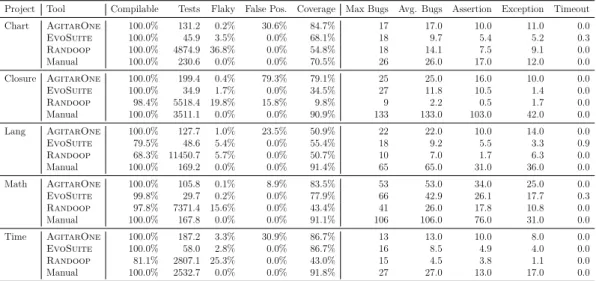
Chapter 3: “Evaluating Automated Unit Test Generation Tools Using Real Faults” investigates the effectiveness of three state-of-the-art automated test generation tools for detecting real-faults. While many different automated test generation tools and techniques exist, these techniques have often been evaluated on different sets of artefacts using different methodologies. We present a methodology and framework for generating, filtering (e.g., removing false positives), and evaluating the effectiveness of generated tests at detecting changes.
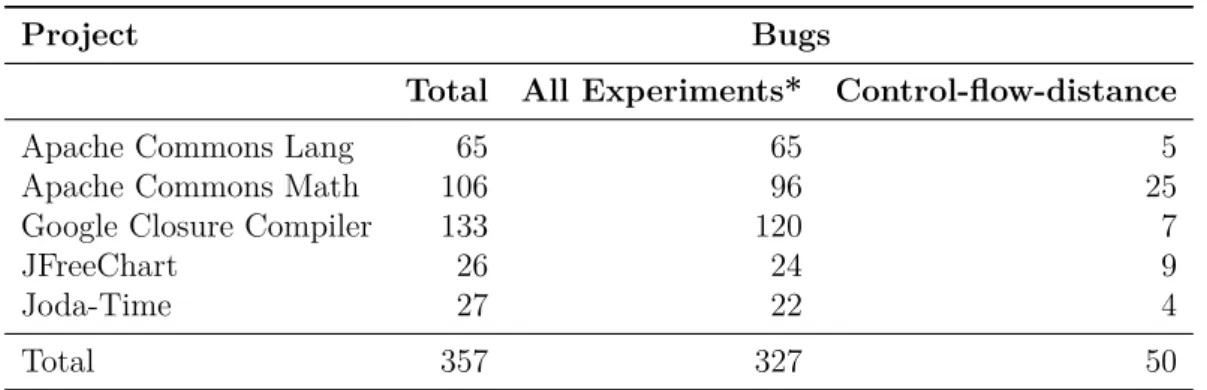
To achieve the objective of this chapter, a large-scale empirical evaluation was conducted using three state of the art test generation tools – two open source and one commercial – on 357 real faults taken from open-source repositories. Using the result of our evaluation, we then present a detailed analysis of the effectiveness of the generated tests at revealing the faults. To guide the development and research in automated test generation tools, we present the result of our in-depth qualitative investigation into the shortcomings and individual advancements of existing state-of-the-art techniques.
Contribution 1: Developing a methodology and framework for evaluating the
effectiveness of tests generated using automated unit test generation techniques at detecting faults, along with insights into the current state-of-the-art and how
it can be further improved
Equipped with insights into shortcomings of existing approaches, and also a framework to evaluate future techniques with, next we propose our own alternative technique.
Chapter 4: “Differential Testing Using a Search-based Approach”
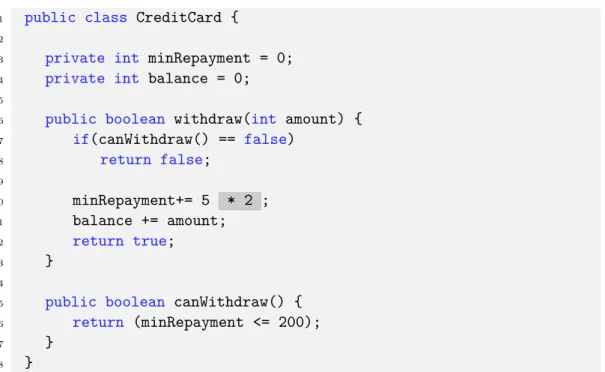
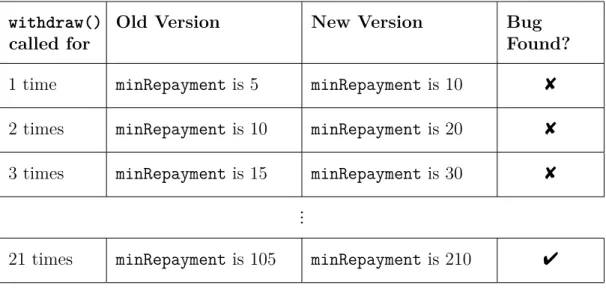
proposes a search-based unit-test generation tool with the aim of finding be-havioural differences – which can be either intended changes or regression faults – given two versions of a program. We present the first search-based technique for automatically generating regression unit test suites. We achieve this using a novel multi-objective fitness function for generating regression tests which simul-taneously maximises code coverage, state differences between the two programs, and divergence in the control-flow of the program.
Using the framework described in Chapter 3, we then conduct a large-scale empirical evaluation of our search-based regression test generation technique at detecting real faults, as well as evaluating individual components of the fitness function. We also compare our results with the ones obtained by the state-of-the-art tools in Chapter 3.
Contribution 2 Developing a novel search based approach for generating
differential regression test suites, accompanied with with a large-scale empirical evaluation using real faults
During the evaluation of our search-based approach, we made an interesting observation that for a majority of classes, using a complex search algorithm may not be necessary, and simple random search may be good enough. To clarify whether this is limited to differential testing, Chapter 5 provides an in-depth investigation to find the underlying reasons.
Chapter 5: “Comparing Random and Genetic Algorithm Search for Generating High-coverage Test Suites” conducts an investigation based on an observation we made in Chapter 4. In particular, for a large number of subjects, random-testing and search-based testing performed equally well, while at the same time, for a small number of subjects random testing was significantly more effective than our proposed GA. In this section we explore whether our observation was limited to the domain of differential/regression testing, or whether it is a broader behaviour which applies to search-based testing in general when testing object-oriented programs. In particular, we conduct a large-scale empirical comparison of GA and random search for coverage-driven test suite generation using 1,000 real-world Java classes
The types of branching conditions found in object-oriented programs – as opposed to procedural programs – can have a direct impact on the effectiveness of search based techniques. That is, given that search-based approaches often guide the search using insights from covered or uncovered branches, can we extract useful information from all branches of different natures to guide the search? We present an in-depth investigation on the influence of the nature of branches in object-oriented programs, on search-based test generation techniques. We also investigate the impact of the search budget on the outcome of the techniques, when generating coverage-driven tests using GA and random search.
Contribution 3 A large-scale empirical comparison of GA and random
search for coverage-driven test suite generation, with an in-depth investigation into the challenges of the search landscape created by the types of branches
prevalent in object-oriented programs
Using the insights gained so far, in Chapter 6 we propose a practical approach for using automated test generation tools to prevent regression faults.
Chapter 6: “Disposable Testing: Detecting Changes during Software Evolution without Keeping and Maintaining Generated Test Suite”
presents disposable testing as an alternative to the traditional generate-and-maintain approaches where tests are generated and then kept and generate-and-maintained along with program code to be executed as the program evolves. Instead, this approach suggests generating change-revealing tests – such as when applying differential testing – and throwing the tests away after inspecting them.
We evaluate this approach using differential-testing – based on the most effective technique evaluated in Chapter 4 – as a means to apply this approach in practice. As such, we present the first large-scale evaluation of coverage-driven (as an example of a traditional generate-and-maintain approach) and differential testing at finding real faults. Moreover, we answer whether or not tests generated using differential testing should be kept or disposed of by investigating their effectiveness at revealing subsequent changes, using mutants and real faults.
Although disposable-testing removes the cost of maintaining the tests, the inspection cost remains – that is, as with any other regression test suite, a developer needs to inspect whether a test failure is due to a bug (regression) or an intended change. As such, we investigate whether or not applying disposable testing has a negative implication on the overall maintenance efforts (i.e., do developers need to inspect more tests as a result?).
Contribution 4 Creating and empirically evaluating a new approach named
“disposable testing” as a practical way to use automated unit test generation techniques during software development
We conclude this work in the final chapter.
Chapter 7: “Conclusions and Future Work” summarises our findings and the contributions of this thesis. We also present future research directions in the area based on the work presented in the prior chapters.
Chapter
2
Literature Review
2.1
Software Testing
According to Beizer [20], software maintenance often accounts for as much as two-thirds of the software production cost. With programs becoming more complex, the possibility of having software bugs increases, and therefore programs need to be tested in order to ensure that the functionality of the program is as intended. This activity has become so important that over 50% of the total development time and cost of software projects often gets allocated to testing [119].
Software testing is the activity of executing a given program P with sample inputs selected from the input space for P, to try to reveal failures in the program. (Harrold et al. [79]) Following this definition, developers create tests that evaluate the behaviour of the program given certain test inputs. They also use test oracles – which are checks validating the output/behaviour of the program, implemented normally using assertions – to assess whether the program is working as intended. These set of inputs and oracles are often implemented together in atest case, where the program is first invoked using the test inputs, and then the resulting output is validated. If executing any of these test cases leads to an unexpected outcome, it can indicate a fault (also referred to as abug ordefect). A defect is often revealed by a test through a failure – a program behaviour contrary to its specification
is detected, e.g., a test oracle observes an unexpected output – or through an error – an unexpected behaviour occurring within the system bounds, such as reaching an unexpected system state, often not detectable by a simple assertion.
To simplify the terminology used in this thesis, we may use failure to refer to both cases of errors and failures. While the term bug is often known to have multiple definitions referring to both a fault (defect) and failure, we normally use this term interchangeably with the former. Moreover, we may use the terms test and test case interchangeably, in which case we normally intend the latter. Furthermore, this thesis mainly focuses on the concept and method of “unit-testing”, where a test case often involves a sequence of program invocations with test inputs, to test the correctness of a program unit. Each “unit” normally refers to a small – or even the smallest – separate testable module of the program, although conflicting ideas exist among developers regarding the scale of each unit [145]. In procedural programming a unit may span from a single procedure to an entire module, while in object-oriented programming it can range from testing a single method to an entire class. While we do review techniques that target testing procedural programs, the focus of this thesis is more on the latter case.
After we as developers start to write such tests, we may face the question of when our testing is sufficient? How can we measure the quality of the tests we have written so far? If the input space is large (or practically infinite), how can we know that the right inputs are being used to test the program? How can we make sure that the inputs used are more likely to reveal a fault? Over the past decades, much work has been done to answer these questions. The next section looks at some of these works and the existing challenges.
2.1.1
Test Adequacy Criteria
Researchers have proposed many different criteria to measure the quality of a test suite (i.e., a set of tests), such as adherence of the program to a certain model, coverage of different characteristics of the program (e.g., program statements, data-flow dependencies, behavioural response [161], structure, execution paths, etc.), and mutation score. We discuss the two most common criteria below.
2.1.1.1 Coverage Criteria
Given that the input space to a program can often be infinitely large, developers seek a quantifiable way to determine the effectiveness of their test suites. Coverage criteria provide an actionable metric that can provide a target to the developers. The simplest and most common of these criteria are the structural coverage criteria which set the target to covering the whole structure of the program [5]. A structural coverage criterion defines some structural items of the source code, and each of these items needs to be executed by at least one test, and then the ratio of covered items is the coverage value (or coverage ratio). A simple yet common example of these criteria isstatement coverage, requiring all statements in the program to be executed. However, simply executing all statements in the program does not necessarily cover the structure of the program. For instance, only covering one side of a conditional statement may be enough to cover all statements.
To improve on the effectiveness of statement coverage, branch coverage – also known as decision coverage, but not to be confused with condition coverage – aims to cover all branches in the program resulted from conditional statements. Therefore, by covering all branches in the program, the code under test will be covered. To further improve upon this, conditional coverage requires all sub-expressions of a conditional statement to be covered. For instance, in a conditional statement if(a>b || b<c), if either (a>b) or (b<c) evaluate to true, the true branch of the program will be covered. Conditional coverage requires both sides of these sub expressions – 4 possible outcomes in total – should be covered. Other coverage criteria also exist that necessitate more rigorous testing of the program [202]. For instance, data-flow coverage requires the values to be carried from their points of definition, to all points they were used, which can be particularly important for testing object-oriented programs.
2.1.1.2 Propagation Problem
Achieving coverage alone however is believed to be insufficient for detecting faults [83]. Marinescu et al. [104] even show that bugs are often introduced on real open-source projects despite the existence of high-coverage test suites. According to the PIE model [174], in order to detect a fault in a program, a
test should be able to first, reach and execute the fault. Secondly, the execution should result in a change, thus infecting the state of the program. Finally, it should propagate to an observable result in the output. Therefore, simply executing the program under test does necessarily mean that the fault can be propagated to the output. Developers generally have to manually write test cases in order to test software programs, however, creating test suites (sets of test cases) that can cover the structure of the program and achieve such propagations is known to be difficult and time-consuming.
The problem of propagation in particular has been deeply studied in the literature, and still remains as a challenge in software testing. In 1991, Freedman [57] proposed domain testability, as a measure of input-output consistency. Voas and Miller [175] later suggested the domain/range ratio (DRR), which is the ratio of the possible inputs to the range of possible outputs. They proposed that by increasing the DRR, there is a higher chance of detecting faults during the testing process. These approaches focused on the testability of programs in general, both from the implementation aspect as well as the program specifications. While the approach by Voas and Miller focused more on increasing the testability of the program, Freedman centred the work around modifications that can make the behaviour of the software observable and controllable. Woodward and Al-Khanjari [184] in a study focused on the connection that exists between these two approaches which aim to help with increasing software testability, and established a mathematical link between them.
Since these studies focused on faults remaining hidden to the testing process, many studies focused on increasing testability and ensuring fault propagation to the output. Clark and Hierons [34] proposed a measure named squeeziness, as an information theoretic measure to prevent fault masking. They suggest an approach of ranking execution paths with the aim of increasing the dependencies. The results of their study suggested that there exists a strong correlation between their proposed measurement and the likelihood of the fault being identified. To tackle the problem of fault finding with coverage metrics, recent ideas have been proposed to guide coverage criteria using databases of real faults [111].
2.1.1.3 Mutation Testing and Analysis
Given that, as discussed in the previous section, coverage criteria may be insufficient to determine the actual effectiveness of a set of tests, an alternative is to actually simulate the possible faults that may occur. This helps developers quantify – to some extent — the effectiveness of their tests at revealing bugs. Mutation testing is a technique that makes such a quantification possible, and has been commonly used for evaluating the adequacy of the existing tests.
Since its first introduction in the 1970s, much research has been done in the area, with the aim of making it an approach that can be practically used in the industry. Principally, mutation testing works by creating mutated versions of a program, where mutations are faults that are deliberately added to the program, that are similar to the ones that developers can make. After creating these mutated versions (also known as mutants), the existing tests are executed against the mutants, and their adequacy is assessed by their ability to identify the faults in the mutated versions. The outcome of this process is the ratio of the number of detected faults over the number of mutations, which is known as the mutation score.
Mutation testing is widely used in other applications such as test data generation, regression testing, and also to assist with test suite minimisation [87]. The main underlying reason for the big appeal of mutation testing is the fact that mutants can be automatically and systematically generated, and exercised, with the aim of representing a large number of potential faults that can happen in the program.
In contrast to the previously discussed coverage criteria, mutation testing aims to provide a proxy to the set of real faults that a test suite can discover. However, this may lead to the question of whether these sets of mutants can – at least to some extent – represent real faults [8]. In a study by Just et al.
[90], the authors aim to answer this. In particular, they conduct a large-scale study using 357 real faults, and measure the correlation between detection of mutants and detection of real faults. Their results show that on the one hand there exists a general correlation between finding mutants and real faults, on the other hand, they observe that for 27% of bugs (i.e., real faults), such a correlation does not exist, thus pointing to the limitations of the technique. The
authors however note that a number of these cases can be addressed by creating stronger or new mutation operators (i.e., a mutation operator applies a specific mutation to a program, for instance, negating all equality operators == to !=). Nevertheless, for 17% of the bugs, they observe that the faults cannot be coupled to mutants. These cases include faults that relate to incorrect implementation of algorithms, extra code that should have been removed, incorrect method calls due to similarity of the names of the methods, understanding of the context, and so forth.
Although the results of the study by Just et al. were supportive of using mutation testing as a proxy for a majority of faults, the challenges with using the technique are not limited to the limitations discussed earlier. The mutation score for instance may not always be actionable. This is mainly due to the fact that a) a large number of mutants need to be generated and evaluated, b) some mutants can be equivalent. An equivalent mutant is created when the functionality of the program remains semantically the same. For instance, consider the simple example below:
1 public boolean isMathsWorking(){ 2 return (2 + 2 == 4);
3 }
The same program can be written as follows, by changing the addition operator +to a multiplication operator ∗:
1 public boolean isMathsWorking(){ 2 return (2 * 2 == 4); 3 }
In this case, although a mutation has been applied to the program, the two programs are semantically equivalent. Therefore, simply achieving a certain mutation ratio does not necessitate that the uncovered mutants are actually feasible. Similarly, not achieving a high mutation ratio does not necessitate that the uncovered mutants were infeasible to kill. Although some equivalent mutants can be detected using mathematical models and symbolic techniques, the problem of detecting equivalent mutants is undecidable [5]. In addition to equivalent mutants, generating and exercising a large number of mutants can be expensive, and may therefore limit the adoption of the technique in practice.
2.1.2
Automated Test Generation
Despite software testing taking a majority of the costs of software development, in 2002 it was reported that the lack of robust infrastructure for software testing has an annual cost of $22.5–$59.5 billion to the US economy [166]. Techniques for automating the generation of software tests aim to lower the cost of the testing process, while at the same time trying to be equally or more effective than the traditional approaches. Although many approaches exist for automated testing (or to aid with software testing efforts), they generally fall under the categories of a) random techniques: randomly generated test data is used to test the program, b) static techniques: test inputs are generated without executing the program; developers can then use these test inputs to test their program, and c) dynamic techniques: the program is executed during the testing process. The techniques are however not limited to three categories; for instance, model-based test generation techniques use a model or specification to validate the system under test, and combinatorial testing aims to test all input combinations while at the same time reducing the input space. Algebraic and exhaustive approaches – as opposed to random ones – have also been proposed, which aim to test the program systematically using a combination of automatically inferred specifications and hints provided by developers (e.g., TACCLE [30], JWalk [160]). JWalk [160] for instance incrementally explores and learns algebraic properties and program specifications lazily with the help of the developer. This enables the approach to search for maximally changed object states and to reach new states during the testing process. These approaches however require – or significantly benefit from – user interactions with the tool to either validate the states or to guide the exploration, and so, are not fully automated or the expected manual inspection effort makes them less practical.
In the following sections, we review three of the most common techniques for test generation: random techniques, techniques relying on symbolic execution, and search based techniques.
2.1.3
Random Testing
The most basic form of test generation is random testing. By generating random inputs and passing them to the program and observing the output, the program can tested. This can be useful if the specification is incomplete, or when the developers are looking for unexpected security problems (such as in fuzz testing [62]). In the context of unit testing of object oriented classes, where test cases involve sequences of calls on interacting objects, a popular approach is to generate these sequences randomly (e.g., [124, 35, 132, 121, 9, 103, 147]). An example of this is Randoop [124], which is commonly used in studies and industry.
Randoop takes a slightly different spin on pure random testing by using a
simple feedback-directed approach. The tool operates by incrementally generating method sequences – where new methods calls are selected randomly – and then executing such method sequences. The execution results are then used as feedback for the test generation to a) avoid illegal (e.g., causing runtime exceptions) or redundant statements, b) detect contract violations, and c) for generating assertions that can help detect future changes (i.e., when performing regression testing). An example of a test case generated by Randoopfor the code snippet in Section 2.1.4 is shown below. Notice that Randoop generates the assertions (Line 6-8) based on the execution results of the foo() method (Line 3-5).
1 public void test001() throws Throwable { 2 Bar bar0 = new Bar();
3 boolean b2 = bar0.foo((int) (short) -1); 4 boolean b4 = bar0.foo((int) (byte) 0); 5 boolean b6 = bar0.foo((int) ’4’);
6 org.junit.Assert.assertTrue(b2 == false); 7 org.junit.Assert.assertTrue(b4 == false); 8 org.junit.Assert.assertTrue(b6 == true);
9 }
To improve random testing, researchers suggest that the randomly generated test inputs should be evenly spread across the input domain. As a result,adaptive random testing (ART) was proposed [32] to guide the test generation. ART has been studied as a popular testing methods and has been shown as an effective
alternative to random testing. However, using a large empirical study, Arcuri and Briand [12] argue that ART may not be cost effective in comparison to random testing. Overall, while a large number of random tests can be generated cheaply, executing and manually evaluating them can become impractical, and the tests may struggle to reach parts of the code that require complex scenarios to be generated, thus limiting the practicality of these approaches [15].
2.1.4
Testing Using Symbolic Execution
Symbolic execution [93] is another popular approach, which uses symbolic input values – as opposed to concrete input values – and executes the program symbolically [6]. To better illustrate the idea, consider the following code:
1 public boolean foo(int x){ 2 x = x + 2; 3 if( x > 7) 4 return true; 5 else 6 return false; 7 }
In the code above, if we consider the input value x as a symbolic value, after the execution of line 2, the value of x in the conditional statement in line 3 is x + 2. Therefore, the evaluated condition on line 3 isif (x>5). Using this information, we simply need to generate two values – a task which is often done using a constraint solver such as Z3 [38] – forx such that the condition evaluates to true andfalse (e.g., respectively for input values 5 and 6). Concolic testing (also referred to as dynamic symbolic execution), combines the static approach we observed above, with dynamic testing. This can be necessary since the program may interact with external dependencies, or that sometimes the conditional constraint cannot be solved.
Some approaches relying on symbolic execution include the use of dy-namic symbolic execution on the basis of developer-written parameterised unit tests [169], or derived techniques that aim to explore relevant sequences of calls [168, 188]. In Section 2.2 we look at some of these techniques that are more closely related to the topic of this thesis.
Although techniques based on symbolic execution can be effective at gen-erating high-coverage tests, as well as deriving inputs to solve mathematical constraints [26], when applied to the problem of unit-testing, particularly when generating a sequence of statements invoking and interacting with the program, these techniques face a number of challenges – especially when applied to object-oriented programs. For example, if the state of the program needs to be modified by a sequence of calls to the public API rather than by setting the state using the input values directly, this may be particularly challenging to achieve using symbolic execution techniques. Additionally, scalability of symbolic techniques creates another challenge, given that as the complexity of the program increases (e.g., increase in the number of branches), the number of paths to explore
in-creases with it [28]. Therefore, these challenges make symbolic execution less suitable for generating sequences of calls when unit-testing object-oriented pro-grams. For example, symbolic techniques excel well when a method is called with a certain input value that is expected to reach a faulty area of code (so that it can generate a certain input that would lead to the fault), as opposed to when a method call with no input values has to be called several times for a faulty behaviour to be propagated to the output (see Chapter 4).
2.1.5
Testing Using Search Based Software Engineering
Use of metaheuristic search techniques is one of the most recent dynamic tech-niques for automated test generation [40]. These techtech-niques aim to apply a search-based optimisation to generate test inputs [76].
In 2001, Harman and Jones [75] claimed that a new field is emerging in software engineering research, named search-based software engineering. This area of software engineering mainly looks at the use of metaheuristic search techniques that can be applied to a large number of areas. The simplest form of a search based algorithm is random search. However, without a guidance, the findings produced by random searching are poor [110]. Such guidance is often provided by a fitness function – further discussed in the rest of this section – which evaluates individual solutions based on their closeness to the ultimate solution. The set of all fitness values form a landscape of possible solutions and their respective fitness score. Guided search-based techniques
employ different strategies for exploring this landscape. Three main metaheuristic search algorithms exist that use guidance measurements, and are widely used in different areas. These techniques are presented in the following sections.
2.1.5.1 Guided Algorithms
Hill Climbing
Hill climbing techniques choose a random position in the search space at the start. Based on the position of the candidate, during each iteration, the candidate will be compared to its neighbours. In case any of the neighbours are found to have better fitness values, a move will be made to that neighbour. Therefore, as a result, the candidate solution is expected to improve over time, and as the search continues, the chosen candidate will have better fitness. Once no better neighbours can be found, then the search has found an optimum solution/fitness (i.e., potentially the best solution).
A problem associated with hill climbing techniques is the fact that the search space is not always linear or unimodal. Therefore, for instance, the hill climbing may improve the chosen candidate until it hits a maximum, and it would be expected that the candidate is the fittest individual in the search space. However, the chosen candidate may be within a local maximum and may be significantly poorer compared to the global maximum in the search space. One way used by researchers to address this issue is to restart the search multiple times at different initial locations in order to create a better understanding of the search space [70].
While using hill climbing is not best suited to find global optima, they can be ideal candidates for local search. A popular and well-studied example of this is Korel’s Alternating Variable Method [95], for test data generation. This technique performs the search by adjusting input values and using different values in turn, that is, an exploratory move is made and the fitness of the solution is calculated. This continues until no variable changes improve the fitness value. The technique was shown to be effective at performing local search, and also to improve the effectiveness of other search-based techniques [76]. However, when applied in isolation, it may not be effective at global search.
Simulated Annealing
With the starting position having a high impact on the outcome of hill climbing techniques, simulated annealing aims to rely less on the initial position. To achieve this, this techniques works in a similar manner compared to hill climbing, however with a difference that it can probabilistically accept poorer solutions. Simulated annealing is given a control parameter named temperature, and the higher this control parameter be, the more freedom the currently chosen solution will have to move around the search space.
Inspired by annealing in nature, the search first starts with a high-temperature. Then, as the search continues, the temperature is cooled down (i.e., decreased), thus giving the selected subject less and less chance of movement. This enables the search to initially explore a large portion of the search space and afterwards follow a more linear hill-climbing approach around the chosen local search space. However, if the cool-down is done at a rapid pace, the search may only explore a small portion of the search space, and thus get stuck in a local optimum similar to hill climbing techniques [109].
Genetic Algorithms
Genetic algorithms use a different approach compared to the previous tech-niques. Inspired by natural selection, this technique simulates evolution as a search strategy. This technique considers solutions in the search space as indi-viduals or “chromosomes”. Similar to natural evolution, a population of these chromosomes is first created (often randomly) and during the search, mutation and recombinations of these individuals will occur. With iterations being called “generations”, and the population of each generation having chromosomes as their members, on each generation, the chromosomes evolve using the following search operators: a) mutation operator, which randomly modifies the chromosome, and b) crossover operator, which recombines certain members of the population, or creates offspring chromosomes by taking two parent chromosomes. In order to make sure that only better individuals in the population make it to the next generation, and to guide the evolution, a “fitness function” is defined. The ultimate goal of the fitness function is to measure how close each individual is from a perfect solution. Individuals with better fitness get a higher chance of being included in the next generation, and as a result, the search will be guided
by the fitness function. Genetic algorithms are by far the most widely applied search technique in search based software engineering [109, 70].
2.1.5.2 Application in Testing
One of the application areas of based software engineering is search-based software testing (SBST). This area focuses on using search-search-based software engineering to automate software testing. To achieve this, different optimisation processes are defined in the form of a fitness function which aims to solve specific challenges, often simultaneously. This approach can be used to generate test inputs with multiple objectives, such as achieving a high code coverage across the whole program [110], which is a powerful aspect of search-based techniques in general. It has also been shown that multi-objective optimisation techniques can be even used to better tackle single objective problems [77]. This section discusses some of the application areas of this approach.
Temporal testing: This area aims to find best-case and worst-case execution times. Using a search-based approach, the search can look for the input data that can result in the shortest and longest execution times. Finding such input values using static analysis cannot be done accurately, since execution of the code with the given input values may be necessary [110].
Functional Testing: Testing the logical behaviour of the system according to its specification is another area of search based testing. In this area, the use of search-based techniques in testing the overall functionality of the system is explored. Different studies have been performed, namely a study of an automated parking system, in which a search based approach was used to automatically park a car [24]. Given the success of their technique, the authors aim to additionally expand the use of evolutionary algorithms in other aspects of vehicles such as the emergency brake system and intelligent speed controls.
Structural Testing: The main and most active area of search-based tech-niques is structural testing. This area targets the execution paths in the software, and input data is generated to target specific structural testing aspects. These
aspects often include branch and data flow coverage. Common approaches target-ing branch coverage aim to generate test inputs with the objective of maximistarget-ing branch coverage [110].
2.1.5.3 Search-Based Unit Test Generation
Search-based techniques search for candidates that most closely represent the ultimate solution. As such, the representation of the problem can vary. This characteristic makes them particularly suited for the problem of generating unit tests. In this section we look at different approaches in the literature that applied these techniques.
Random Search for Test Generation
One strategy for finding branch-covering test cases is simply to generate sequences of statements to the class under test at random, coupled with randomly-generated inputs. If a randomly-generated test case covers new branches that have not been executed before, it is added to the CUT’s test suite, else it can be discarded. One disadvantage of this approach is the size of the resulting test suite, which can be very large and therefore carry a high execution cost.
A further problem is finding inputs that need to be certain “magic” values required to execute certain branches, such as constant values, specific strings, etc. that are unlikely to be generated by chance. One way of circumventing this problem is to enhance the algorithm through seeding.
Seeding
The process of seeding involves biasing the search process towards certain input values that are likely to improve the chances of executing more coverage goals [3, 49, 112]. Fraser and Arcuri [49] propose obtaining seeds both statically and dynamically, and present an implementation of it in the tool EvoSuite. The static approach takes place before test generation: EvoSuite collects all literal primitive and string values that appear in the Java bytecode of the class under test. Then, while tests are being generated, literals that are encountered at runtime may also be dynamically added to the pool of seeds. Some of these
seeds are specially computed, according to a set of predefined rules. For instance, if the test case includes the statement “foo.startsWith(bar)”, involving the stringsfooand bar, the concatenationbar + foo will be added to the seed pool. During the search process, EvoSuitewill then choose to use a seed from the pool instead of generating a fresh value, according to a certain probability.
To distinguish between random search with and without seeding enabled, we refer to the enhanced version of random search incorporating seeding as Random+, and the basic implementation without seeding as Pure Random.
Evolutionary Search for Test Suite Generation
While random search relies on encountering solutions by chance, guided searches aim to find solutions more directly by using a problem-specific “fitness function”. A fitness function scores better potential solutions to the problem with better fitness values. A good fitness function will provide a gradient of fitness values so that the search can follow a “path” to increasingly better solutions that are increasingly fit for purpose. With a good fitness function, guided search-based approaches are capable of finding suitable solutions in extremely large or infinite search spaces (such as the space of all possible test cases for a class as considered in this work).
Genetic Algorithms (GAs) are one example of a directed search technique that uses simulated natural evolution as a search strategy. GAs evolve solutions to a problem based on their fitness, often by evolving several candidate solutions at once in a “population”. The initial population of candidate solutions is generated randomly. Each iteration of the algorithm seeks to adapt these solutions to ones with an increased fitness by using search functions: “Crossover” works to splice two solutions to form a new “offspring”, while “mutation” randomly changes a component of a solution. The new solutions generated are taken forward to the next iteration depending on their fitness.
Algorithm 1 is an example of using a GA for search-based testing – as used in
EvoSuite[51]. As shown, the GA first creates an initial population of solutions
randomly (Line 2). Then, using rank selection, it selects two parents P1 and P2 (Line 6) and crosses them over (Line 7-10). With a certain probability, the GA applies the mutation operator on the resulting offspring O1 and O2 (Line 11),
Algorithm 1 A genetic algorithm as used in search-based tool EvoSuite[51].
1: seeds← initialize seeds with collected static literals from bytecode
2: current_population←generate random population using seeds
3: repeat
4: Z ←elite of current_population
5: while ∣Z∣ ≠ ∣current_population∣ do
6: P1, P2← rank selection from current_population
7: if crossover probability then
8: O1, O2 ←crossover P1, P2
9: else
10: O1, O2 ←P1, P2
11: mutate O1 and O2 ▷ The seeds pool may be used
12: fP =min(f itness(P1), f itness(P2))
13: fO=min(f itness(O1), f itness(O2))
14: seeds ← update seeds with collected dynamic seeds from fitness evaluations 15: if fO≤fP then 16: Z←Z∪ {O1, O2} 17: else 18: Z←Z∪ {P1, P2} 19: current_population←Z
20: until solution found or maximum resources spent
and then compares the fitness value of parents and their offspring to determine which one will be carried over to the next generation Z (Line 15-18). The GA repeats this process until a solution is found or the search budget is exhausted. During this process, to enhance the effectiveness of the generated solutions, the GA collects seeds statically and dynamically and uses them for the generation of new or mutated solutions (Line 1 and 14).
Early work in this area used genetic algorithms for generating test data, with the aim of achieving statement and branch coverage [127] . In this case, the fitness function guided the search to reach (i.e., cover) certain structural points by maximising the number of branching nodes that were executed as intended (i.e., been on the correct path to the intended point in the structure). As such, there was no guidance as tohow any of these branches should be covered. Other work such as the one by Baresel et al. [17] have tried to improve upon the fitness function used for evolutionary test data generation, by for instance, using branch distance – that is, how far a conditional branch is from becoming
Tes t Cas e
i nt i nt 0 = 42;
Fi el dUt i l s . add( i nt 0, l ong0) ;
. . . Tes t Cas e . . . l ong l ong0 = - 213L; 50 Chr omos omes
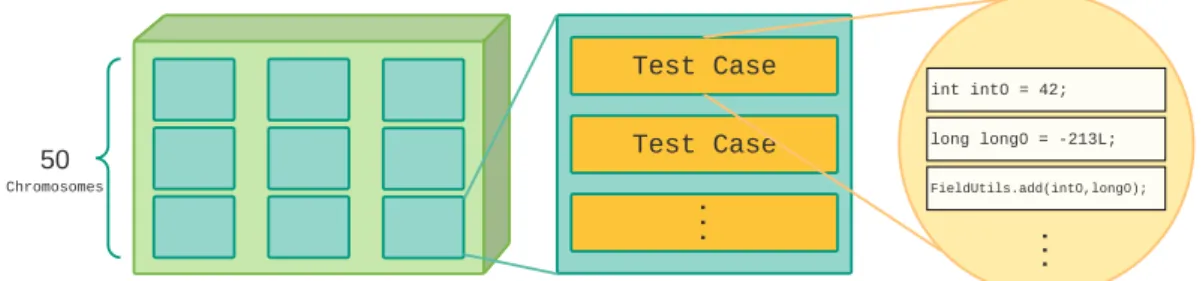
Fig. 2.1 A population of test suite chromosomes for whole test suite optimisation (i.e., as used in EvoSuite). The test statements on the right hand side are
generated randomly.
true orfalse – to better guide the search. Much of these approaches however focused on procedural code, where the chromosomes are simplistic: they often involve a sequence of input values that are passed to the program. Tonella [170] applied a genetic algorithm for automated generation of unit tests, for testing object-oriented classes. The accompanied tool named eToc generated targeted tests for covering coverage goals (e.g., branches) individually, and then combined them into a single test suite. Therefore, the size of the test suite, as well as the test-generation time may grow out of hand for large subjects. Additionally, assertions were required to be added manually to the tests as part of the test process.
Fraser and Arcuri [51] propose using a GA for generating and optimizing whole test suites, and present an implementation of it in their tool EvoSuite.
With EvoSuite’s GA, a “solution” (i.e., chromosome) is a whole test suite,
consisting of a series of test cases, which in turn contain a number of test statements. From a natural evolution point of view, these statements form the genome of the individuals, which are then executed on the class under tests. Therefore, the phenotype is the resulting execution traces which are then passed to the fitness function [143].
After the search budget is exhausted – unless an optimum solution is found earlier – the generated tests are embedded with assertions based on the existing behaviour (i.e., output) of the program. That is, the tool assumes that the current behaviour of the program is correct, and the developers can check whether the program is behaving correctly by validating the generated oracles. Since many different types of assertions can be created based on the different type of output
values, to increase test readability, different approaches have been proposed to reduce the number of produced assertions (e.g., [55, 56]). The following code snippet shows an example of a test-suite generated byEvoSuite for the sample program in Section 2.1.4:
1 public void test0() throws Throwable { 2 Bar bar0 = new Bar();
3 boolean boolean0 = bar0.foo(5); 4 assertFalse(boolean0);
5 }
6
7 public void test1() throws Throwable { 8 Bar bar0 = new Bar();
9 boolean boolean0 = bar0.foo(7); 10 assertTrue(boolean0);
11 } 12
13 public void test2() throws Throwable { 14 Bar bar0 = new Bar();
15 boolean boolean0 = bar0.foo(1); 16 assertFalse(boolean0);
17 }
Whenever a new test case is generated – as with the construction of the initial population, illustrated in Figure 2.1 – it is done so randomly as described in the previous section, with seeding enabled. An initial population of 50 chromosomes (test suites) is first generated. The population is then evolved using the two search functions crossover and mutation, as illustrated in Figure 2.2 and described in Algorithm 1. Crossover involves recombining test cases across two test suites while mutation works at two levels: at a test case level and the test suite level. At the test case level, the mutation operator either randomly adds new statements, removes existing ones, or modifies them and their parameters. At the test suite level, it adds a fresh, randomly-generated test case to an existing test suite.
To guide the search towards achieving a high coverage test suite, the fitness value can be calculated based on the number of covered goals. However, as mentioned earlier, a fitness function based solely on the number of covered goals provides no guidance to goals that remain uncovered. As with previous works
Tes t Cas e Tes t Cas e Tes t Cas e Tes t Cas e Tes t Cas e Tes t Cas e Tes t Cas e Tes t Cas e Tes t Cas e Tes t Cas e Tes t Cas e Tes t Cas e Tes t Cas e Tes t Cas e Tes t Cas e Tes t Cas e PARENTS CHILDREN ? = 0.5
![Fig. 2.2 The search operators crossover and mutation, as applied in EvoSuite (a) single-point crossover is performed: an α is chosen randomly between [0,1]](https://thumb-us.123doks.com/thumbv2/123dok_us/790347.2599913/47.892.200.794.178.389/operators-crossover-mutation-applied-evosuite-crossover-performed-randomly.webp)