The views expressed in this publication are those of the author(s) and do not necessarily reflect the views of the Food and Agriculture Organization of the United Nations. The designations and the presentation of material in this publication do not imply the expression of any opinion whatsoever on the part of the Food and Agriculture Organization (FAO) of the United Nations concerning the legal status of any country, territory, city or area, or of its authorities, or concerning the delimitation of its frontiers or boundaries.
All rights reserved. Reproduction and dissemination of material in this document for educational or other non-commercial purposes are authorised without any prior written permission from copyright holders provided the source is fully acknowledged. Reproduction of material in this document for resale or other commercial purposes is prohibited without the written permission of FAO. Application for such permission should be addressed to the Chief, Publishing and Multimedia Service, Information Division, FAO, Viale delle Terme di Caracalla, 00100 Rome, Italy, or by e-mail to [email protected].
Contents
ACKNOWLEDGEMENTS... III ACRONYMS ... IV EXECUTIVE SUMMARY...V I. INTRODUCTION ...1 II. BACKGROUND ...2 II.1. CONCEPTS... 2II.1.a. Concepts about certification ... 2
II.1.b. Concepts related to food safety management... 4
II.2. ECONOMIC BACKGROUND... 7
II.2.a. Development of private food safety standards in response to consumer expectations... 7
II.2.b. Development of third party certification ... 7
II.2.c. Increasing power of retailers in industrialized countries ... 8
II.3. INTERNATIONAL REFERENCE FOR FOOD SAFETY STANDARDS: THE CODEX ALIMENTARIUS... 11
II.3.a. The Codex Alimentarius... 11
II.3.b. Normative texts of the Codex Alimentarius on food safety... 11
III. OVERVIEW OF EXISTING CERTIFICATION PROGRAMMES ON FOOD SAFETY...15
III.1. OVERVIEW OF THE CERTIFICATION PROGRAMMES PROLIFERATION... 15
III.1.a. Certification programmes for good practices ... 15
III.1.b. Certification programmes for quality management and HACCP systems ... 17
III.1.c. Certification programmes for complete food safety management systems ... 18
III.2. BENCHMARKING BY THE GLOBAL FOOD SAFETY INITIATIVE (GFSI) ... 19
III.2.a. The Global Food Safety Initiative ... 19
III.2.b. Benchmarked standards... 19
IV. MAJOR CERTIFICATION PROGRAMMES ON FOOD SAFETY...20
IV.1.FACT SHEETS... 20
IV.1.a. BRC Global standard – Food ... 20
IV.1.b. International Food Standard (IFS) ... 24
IV.1.c. SQF Codes ... 26
IV.1.d. Dutch HACCP Code ... 29
IV.1.e. EurepGAP ... 32
IV.1.f. ISO 22000 ... 36
IV.2.COMPARISON... 38
IV.2.a. Summary chart of the programmes’ characteristics ... 38
IV.2.b. Comparison of the programmes non specific to farm activities... 39
IV.2.c. Conclusion of the comparison... 41
V. ANALYSIS OF POTENTIAL IMPACT ...42
V.1. ECONOMIC IMPACT... 42
V.1.a. Impact on producers ... 42
V.1.b. Impact on global trade ... 43
V.1.c. Impact on food safety governance... 44
V.2. THE WAY FORWARD: TOWARDS STANDARDS HARMONIZATION? ... 45
CONCLUSION ...46
REFERENCES...47
ANNEXES ...49
ANNEX 1:COMPLIANCE OF THE BRCGLOBAL STANDARD-FOOD WITH CODEX... 49
ANNEX 2:COMPLIANCE OF THE IFS WITH CODEX... 52
ANNEX 3:COMPLIANCE OF THE EUREPGAP“FRUIT AND VEGETABLES” WITH CODEX... 56
Acknowledgements
This paper was written in the summer of 2005 by Nicolas Canivet, FAO Volunteer and student at the Ecole Nationale du Génie Rural, des Eaux et Forêts (ENGREF), France. It was drafted under the supervision of Ezzeddine Boutrif, Chief of the Food Quality and Standards Service in the Food and Nutrition Division of the Food and Agriculture Organization of the United Nations (FAO) and Yves Soyeux, Food and Food Law Professor in the Agri-food Department of the Ecole Nationale du Génie Rural, des Eaux et Forêts.
Acronyms
B2B Business to Business
BRC British Retail Consortium CAC Codex Alimentarius Commission CCP Critical Control Point
CCvD-HACCP Dutch National Board of Experts-HACCP
EU European Union
EUREP Euro-Retailer Produce Association
FAO Food and Agriculture Organization of the United Nations FCD French Trade and Retail Federation
FMI Food Marketing Institute
FSIS United States Food Safety and Inspection Service GAPs Good Agricultural Practices
GFSI Global Food Safety Initiative
GHPs Good Hygiene Practices (also Good Handling Practices) GMO Genetically Modified Organism
GMPs Good Manufacturing Practices
HACCP Hazard Analysis Critical Control Point HDE German Trade and Retail Federation
IFS International Food Standard
ILSI International Life Sciences Institute
ISO International Organization for Standardization
NASA United States National Aeronautics and Space Administration OECD Organization for Economic Cooperation and Development SPS Sanitary and Phytosanitary Measures
SQF Safe Quality Food Standard TBT Technical Barriers to Trade
UK United Kingdom
USA United States of America
USDA United States Department of Agriculture WHO World Health Organization
Executive Summary
Food safety management systems generally include three components:− quality management systems applied to food safety
− Hazard Analysis and Critical Control Point (HACCP) systems
− prerequisite programmes and Good Practices including Good Hygiene Practices (GHPs), Good Manufacturing Practices (GMPs), Good Agriculture Practices (GAPs), etc.
Quality management has been harmonized at the international level through the widespread acceptance of ISO 9001. Yet, although the Codex Alimentarius addresses both HACCP and Good Practices, in particular through its General Principles on Food Hygiene, an international certification programme does not exist for either HACCP or good practices.
Local certification schemes have proliferated to fill this gap, especially in industrialized countries where the major programmes include EurepGAP, the British Retail Consortium (BRC), the International Food Standard (IFS), the Safe Quality Food Standard (SQF) and the Dutch Code. While these standards comply with Codex standards on the whole, their objectives and scope may vary. In fact, some deal with good practices, some with quality management systems that integrate HACCP and others with entire food safety management systems. Likewise, some apply to farm producers, some to manufacturers and others to all food operators. In addition, the geographic scope of these standards is often limited in that they each tend to be recognized by buyers and retailers from specific countries.
These standards have been established by different types of organizations including national standardization organizations, groups of buyers, groups of producers and individual certification bodies. However, the increasing involvement of the retail sector, which has developed its own standards in several industrialized countries and is in an increasingly influential position to dictate and impose these conditions to suppliers, is noticeable.
The proliferation of such independent standards with diverse requirements results in a duplication of time, energy and costs for producers who want to access large markets. This is a burden that small farmers, especially in developing countries, cannot easily bear. Such businesses may thus find themselves excluded from the important centres of economic activity, creating a de facto barrier to global trade.
The International Organization for Standardization (ISO) developed ISO 22000 in this context to create an internationally recognized standard that is applicable to all food operators. However, its acceptance by retailers, an important indicator of its success, is not yet apparent since ISO 22000 does not specify prerequisite programmes. Therefore, it is likely that retailers will continue to require other specific standards for such prerequisite programmes.
I.
Introduction
The ISO 22000 standard, entitled “Food safety management systems – Requirements for any organization in the food chain”, was published in August 2005. This standard aims to establish an internationally recognized certification programme for food safety management systems in response to the proliferation of private food safety standards that has occurred during the last ten years.
But will ISO 22000 effectively take the place of existing certification programmes? Or will it become an additional one, adding to the confusion? What will be the possible benefits for stakeholders, especially small farmers and producers from developing countries, of such unification of food safety certification programmes?
This document aims to improve the understanding of existing food safety certification programmes with regard to the potential impact on the food global trade. For that purpose, it will present:
• a synopsis of the background on food safety certification addressing the concepts of food safety and certification, the economic context (structure of the private sector) and Codex Alimentarius standards (chapter I)
• an overview of existing certification programmes that distinguishes programmes covering good practices from those that deal with management systems (chapter II)
• a focused discussion and comparison of the major certification programmes (including ISO 22000) and Codex Alimentarius standards (chapter III)
• an analysis of the potential economic impacts of these certification schemes, especially on the global food trade, and the possible way forward considering the recent issuing of ISO 22000 (chapter IV)
The scope of this paper is limited to voluntary third-party food safety certification and thus excludes:
− food standards that do not cover food safety (for instance standards that exclusively establish requirements on organoleptic quality, environment, fair trade, etc.)
− food safety standards that are not the subject of certification programmes (the case for many Good Practice standards), except Codex Alimentarius standards since they are used as internationally recognized references for the food safety certification programmes
− food safety audits led by buyers of their suppliers
II.
Background
II.1. Concepts
II.1.a. Concepts about certification1
A number of important concepts must be defined in order to better understand food safety
certification, including the following:
Standardization
The objective of standardization is to set up a standard for a procedure or a product specification, to which every stakeholder adheres, in order to ease logistical procedures, facilitate trade and possibly improve quality if the requirements of the standard involve an improvement compared to common practices.
Standards
Two types of standards exist: product standards (specifications and criteria for the characteristics of products) and process standards (criteria for the way the products are made). Food safety standards are essentially process standards whose aim is to improve the safety of the end products.
Process standards can be further divided into two categories. On the one hand, performance standards establish verifiable requirements on processes, for instance a ban on pesticide use in farm production. In the food safety field, Good Agricultural Practices and Good Hygiene Practices represent such performance standards. On the other hand, management system standards establish criteria for management procedures such as documentation or monitoring procedures. In the context of food safety, such standards may demand HACCP planning.
A standard can be the subject of a certification programme (like the ISO standards for instance) or not (like the ones of the Codex Alimentarius).
Standard-setting body
Standards can be set up by governmental institutions, by the private sector (buyers or suppliers), or even by certification bodies that want to set their own standards, perhaps based on an existing standard.
Certification
Certification is a procedure by which a third party gives written assurance that a product or a process is in conformity with the corresponding standard. Thus, the certificate demonstrates to the buyer that the supplier complies with certain standards, which might be more convincing than if the supplier itself provided the assurance.
Certification programme
A certification programme is the system of rules, procedures and management for carrying out certification, including the standard against which it is being certified.
1
Certification bodies
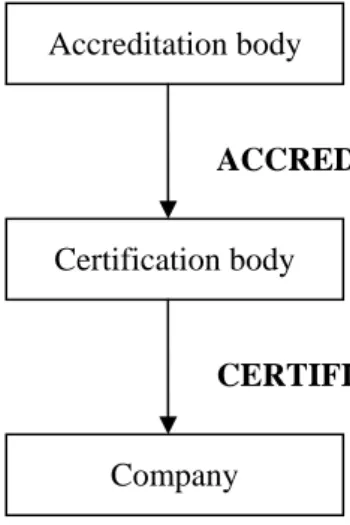
The certification programme is carried out by a certification body, which does the inspection and delivers the certificate. One certification body may execute several different certification programmes. The certification body must always be a third party, without any direct interest in the economic relationship between the supplier and buyer. However, it is not always easy to guarantee independence and the absence of conflicts of interest of certification bodies, in so far as certification costs are borne by suppliers. Indeed, certification is increasingly becoming an industry in itself, with growing competition between certification bodies, which must balance the need to retain clients with the stringency of their standards.
Accreditation
A certification body can carry out certification programmes only if it is evaluated and accredited by an authoritative body (a governmental or para-governmental institute), which ensures that the certification body has the capacity for carrying out certification and inspection in compliance with guidelines set by ISO, the European Union or some other entity. In addition, the certification body may require a license from the standard-setting body, especially if it is a private standard-setting body, for the scope of its particular standard.
Labels
A certification label is a label or symbol put on the product indicating that the product or the process used to make the product comply with standards, and that this compliance has been certified. Use of the label is usually owned and controlled by the standard-setting body.
While the certificate is a form of communication between seller and buyer, the label is a form of communication with the end consumer.
Most food safety certification programmes are not the subject of a label unlike programmes addressing other quality aspects such as organic agriculture or fair trade. Therefore, they are mostly business to business (B2B) programmes.
Figure 1: Certification process
Accreditation body
II.1.b.
Company Certification body
ACCREDITATION (skill assessment)
Concepts related to food safety management
The proliferation of diverse food safety management standards and practices (including GMPs, GHPs, GAPs, HACCP, quality assurance, etc.) has created a situation that is often characterized by a lack of clarity. The different understanding and use of key concepts has sometimes added to the confusion. For instance, although the BRC Global Standard – Food (see section XXX) asserts that it does not impose any good practices programmes, it actually establishes requirements on good practices. Likewise, the EurepGAP (see chapter III) affirms that it supports the HACCP method, although it does not deal with it.
This section seeks to clarify these concepts and is based on a paper of the International Life Sciences Institute(ILSI 1998).
Good practices
Good practices relate to basic requirements on the company’s activities, such as use of appropriate equipment, personnel hygiene, waste management, etc. Standards on good practices can be called Good Agricultural Practices (GAPs), Good Hygiene Practices (GHPs), Good Handling Practices (also called GHPs) or Good Manufacturing Practices (GMPs), according to the aimed profession (primary producer, manufacturer, carrier, etc.). Such standards can also be specific to a product sector (fruit and vegetables, meat products, etc.).
Standards on good practices may have a larger scope than food safety in so far as they address other aspects of quality (e.g. environmental or social issues).
Good practices are often named “prerequisite programmes” within standards with a wider scope, for instance in ISO 22000 or in the annex of the Codex Alimentarius Code of Practice on General Principles of Food Hygiene (CAC/RCP 1).
Quality management system
A “quality management system”, is defined by the International Organization for Standardization (ISO) as the company’s structure for managing its processes or activities that transform inputs of resources into a product or service which meets the company’s objectives, such as satisfying the customer's quality requirements, complying with regulations, or meeting environmental objectives.
A quality management system within food businesses usually has a wider scope than food safety and covers all quality elements. The system elements can be separated into two different groups:
− quality control, that is operational requirements (product realization, measurements, etc.) which eliminate causes of loss of quality
− quality assurance, that is managerial requirements (management responsibility, resource management, etc.) that provide internal and external confidence in the company’s quality management.
The reference for quality management system is the ISO 9000 series, which applies to every type of business.
Hazard Analysis Critical Control Point (HACCP)
The Hazard Analysis Critical Control Point (HACCP) concept was developed in the 1950s by the National Aeronautics and Space Administration (NASA) in order to guarantee that food used in the United States space program would be completely free of microbial pathogens. HACCP was then identified by the United States Department of Agriculture, Food Safety and Inspection Service (FSIS) as a tool to prevent or control microbial safety hazards during meat and poultry production.
The HACCP concept has now become a valuable program for process control of all food safety hazards, not only microbiological ones. It has been legitimised by the Codex Alimentarius
Commission, who incorporated the HACCP guidelines into the food hygiene code (CAC/RCP1) as an annex (see paragraph on Codex Alimentarius below) in 1997.
The HACCP concept is based on seven principles:
1. Conduct a hazard analysis: collect and evaluate information on hazards and conditions leading to their presence to decide which are significant for food safety
2. Determine the Critical Control Points (CCPs): identify for each hazard the steps at which control can be applied and is essential to prevent or eliminate the hazard or reduce it to an acceptable level
3. Establish critical limit(s): establish for each CCP a criterion which separates acceptability from unacceptability
4. Establish a system to monitor control of the CCP: establish a planned sequence of observation or measurements of control parameters to assess whether the CCP is under control
5. Establish the corrective action to be taken when monitoring indicates that a particular CCP is not under control: establish the actions to be taken when results of the monitoring of the CCP indicate a loss of control
6. Establish procedures for verification to confirm that the HACCP system is working effectively: establish methods, procedures, tests and other evaluations, in addition to monitoring, to confirm that the HACCP system is effective
7. Establish documentation concerning all procedures and records appropriate to these principles and their application
Thus, the HACCP method allows each company to identify and control the hazards specific to its activities.
Food safety management system
A “food safety management system” is the policy, structure and procedure implemented by the company to express its concern and involvement in food safety. Thus, a food safety management system is the application of a quality management system within the area of food safety.
The implementation of good practices (often named “prerequisite programme”) is a minimum requirement of a food safety management system but it is not sufficient in itself. In fact, standards on food safety management systems usually demand the additional implementation of procedures allowing the identification and the control of the hazards specific to the company, most of the time on the basis of the principles of the HACCP.
To summarize (see figure 2), a food safety management system usually includes:
• managerial and operational requirements on the model of the quality management system established by ISO 9001
• the implementation of prerequisite food safety programmes (good practices)
• procedures allowing the identification and the control of the hazards specific to the company, on the basis of the HACCP principles
Figure 2: Components of Food Safety Management System
Food safety management and certification
Businesses may be involved in food safety management at three levels:
FOOD SAFETY MANAGEMENT SYSTEM
Prerequisite programmes (good practices) Quality management system
applied to food safety
HACCP system Quality assurance (managerial requirements) Quality control (operational requirements) premises facilities services maintenance
management commitment incoming materials
cleaning and disinfection organizational structure product realization
personnel hygiene
food safety policy measurements
resources traceability
documentation non-conformities
communication
• the respect of food regulations, which is mandatory and thus is not the subject of certification programmes
• the respect of voluntary good practices, which are minimal requirements and which can be the subject of certification programmes
• the implementation of a food safety management system, which can also be the subject of certification programmes (with or without specifications on good practices)
This document seeks to distinguish between certification exclusively of good practices and certification of food safety management system. However, the distinction is not always clear since standards on good practices sometimes also cover other components of food safety management systems (particularly quality control requirements such as traceability or control of incoming materials).
II.2. Economic background
II.2.a. Development of private food safety standards in response to consumer expectations
The concern of private operators for their reputation
The assurance of the safety and quality of the food supply is traditionally a prerogative of governments through the development of regulations and inspections. However, following a number of global food safety incidents during the 1990s, consumer confidence in the capacity of regulators to guarantee food safety has declined in many parts of the world including Europe. In response, the private sector has moved to implement more and more specific standards with higher requirements than regulations in order to ensure the quality, safety and traceability of their products and processes.
This concern of private operators for food safety is linked to their responsibility to put safe products on the market, responsibility usually granted by regulatory provisions (for instance by the Regulation (EC) 178/2002 in the European Union). It is also accentuated by economic concerns linked to customer hypersensitivity to food safety as a negative incident can have disastrous economic consequences for both brand producers and retailers.
Although food safety standards can be established by public bodies, such as the USDA Guidelines to Minimize Microbial Contamination for Fresh Fruits and Vegetables, most are private standards developed by private operators themselves (see chapter III). Furthermore, most of these standards are business to business standards that seek to demonstrate the safety and quality of products or services produced by a supplier or subcontractor to a buyer, without any communication to consumers (by means of a label for instance).
A particular concern for the retail sector
As the final link in the food chain, which is in direct contact with consumers, retailers are generally the first to be concerned if a food safety incident affects consumers.
This responsibility of retailers is naturally greatest on their private label products, since they are directly responsible for the safety of the products they make. This is all the more true as the market share for private label products is increasing especially in Europe (see paragraph II.2.c on retail sector). This can explain why retailers are more and more involved in the establishment of food safety standards, especially in Europe and especially concerning their private label products (see chapters III and IV).
II.2.b. Development of third party certification
The verification of supplier implementation of a certain standard can be carried out by the buyer or retailer itself, but third party certification is increasingly used. Third party certification offers certain advantages:
− auditors are supposed to be objective and independent from the interests of the other parties (however, since auditor fees are usually paid by the audited party, the independence of the auditor may not be absolute)
− third party certification allows buyers to save time and money compared to auditing each supplier themselves
− the use of a certificate allows suppliers to demonstrate to a wide range of buyers that they fulfil certain requirements, which saves time and money compared to assuring each buyer
− certification clearly defines the responsibilities of each party (supplier, buyer), which is a growing concern for private operators since the food safety crises of the 1990s.
The increasing use of certification, buoyed by the proliferation of standards, especially in the food safety field, has thus created a real industry in itself, with a high level of competition between auditors. At present, according to IQNet, an international network of auditors and experts, there are more than 100 accreditation bodies and over 700 certification bodies around the world, and more than 700 000 management system certificates have been granted, mainly based on ISO 90012.
II.2.c. Increasing power of retailers in industrialized countries
Since the 1990s, the power in the food sector in developed and emerging economies has shifted from manufacturers and producers to retailers (OECD, 2004). This shift is mainly due to two factors:
− increased retail market concentration
− increased market share of private label products
Retail concentration
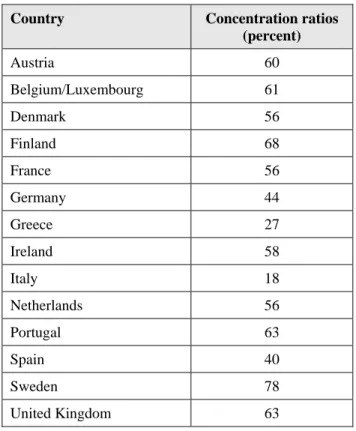
Retailing is currently carried out by a small number of firms in many countries, especially in industrialized countries, due to numerous mergers and acquisitions during the last twenty years.
Table 1: Sales share of the five largest retailers in selected countries
Country Concentration ratios
(percent) Austria 60 Belgium/Luxembourg 61 Denmark 56 Finland 68 France 56 Germany 44 Greece 27 Ireland 58 Italy 18 Netherlands 56 Portugal 63 Spain 40 Sweden 78 United Kingdom 63
Source: OECD (2004) from the CIR European Retail Handbook and trade sources
Many retailers have also become multinational, meaning that global food retailing increasingly resembles an international oligopoly composed of a limited number of multinationals.
Table 2: Top 10 global food retailers in 2003 Rank Name of company Country of origin 2003 food retail sales (US$ million) 2003 food retail sales (US$ million) Countries of operation 1 Wal-Mart US 121,566 278,081
Argentina, Brazil, Canada, China, Germany, Mexico, Puerto Rico, S. Korea, UK, US
2 Carrefour France 77,330 99,872
Argentina, Belgium, Brazil, China, Columbia, Czech Rep., Dominican Rep., Egypt, France, Greece, Indonesia, Italy, Japan, Malaysia, Mexico, Oman, Poland, Portugal, Qatar, Romania, Singapore, Slovakia, Spain, S. Korea, Switzerland, Taiwan, Thailand, Tunisia, Turkey, UAE
3 Ahold Netherlands 72,414 86,205
Argentina, Brazil, Costa Rica, Czech Rep., Denmark, El Salvador, Estonia, Guatemala, Honduras, Latvia, Lithuania, Netherlands, Nicaragua, Norway, Poland, Portugal, Slovakia, Spain, Sweden, Thailand, Turkey, UK
4 Tesco UK 40,907 54,807
Czech Rep., Hungary, Japan, Rep. of Ireland, Malaysia, Poland, S. Korea, Slovakia, Taiwan, Thailand, Turkey, UK
5 Kroger US 39,320 56,024 US
6 Rewe Germany 36,483 48,246
Austria, Bulgaria, Croatia, Czech Rep., France, Germany, Hungary, Italy, Poland, Romania, Slovakia, Spain, Switzerland, Ukraine
7 Aldi Germany 36,189 43,277
Australia, Austria, Belgium, Denmark, France, Germany, Luxembourg, Netherlands, Rep. of Ireland, Spain, UK, US
8 Ito-Yokado Japan 35,812 56,160 Canada, China, Japan, US
9 Metro Germany 34,700 68,692
Austria, Belgium, Bulgaria, China, Croatia, Czech Rep., Denmark, France, Germany, Greece, Hungary, India, Italy, Japan, Luxembourg, Morocco, Netherlands, Poland, Portugal, Romania, Russia, Slovakia, Spain, Switzerland, Turkey, Ukraine, UK, Vietnam
10 ITM
(Intermarché) France 33,487 43,414
Belgium, France, Germany, Poland, Portugal, Romania, Spain Source: DFID, 2004
This consolidation in the retail sector means that producers who want to achieve relevant market access, at least in the developed or emerging countries where two thirds of food consumed passes through the retail sector (OECD, 2004), have a limited choice of buyers and retailers.
In such conditions, only the major brand producers (Nestlé, Unilever, Kraft, etc.) can remain powerful. On the contrary, minor brand producers and non-branded producers (such as fresh fruit and vegetable producers) are obliged to comply with the requirements and conditions set by retailers (see chapter V for potential impact on producers).
Importance of private label products
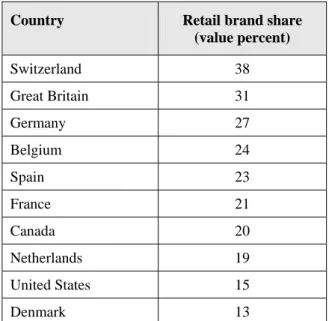
Retailers are not only involved in product distribution but also more and more in manufacturing products (and especially food) under their own brand (which is often called “private label”). Private label products present an upward trend, especially among food products, with an annual growth of approximately 5 percent (ACNielsen, 2003). This trend can be explained by the fact that retailers can control each step of the product (production, marketing and distribution) as well as the distribution of their own competitors, that is the branded products (OECD, 2004).
Table 3: Market share for all private label products (top ten)
Country Retail brand share
(value percent) Switzerland 38 Great Britain 31 Germany 27 Belgium 24 Spain 23 France 21 Canada 20 Netherlands 19 United States 15 Denmark 13 Source: (AC Nielsen, 2003)
Retailers can impose their own conditions and requirements for private label products to producers, since the latter serve as subcontractors rather than normal suppliers. The increasing importance of private label products therefore strengthens the power of retailers in relation to producers.
II.3. International reference for food safety standards: the Codex
Alimentarius
The Codex Alimentarius is a collection of food standards, codes of practice, guidelines and other relate texts. Codex standards represent agreements between member countries and are not therefore intended to lead to certification programmes. However, Codex standards have become global reference points for consumers, food industries, national food agencies and the international food trade. It is therefore important to consider the role of the Codex Alimentarius in any discussion of food safety certification programmes.
II.3.a. The Codex Alimentarius
The Codex Alimentarius Commission was created in 1963 by FAO and WHO to develop food standards, guidelines and related texts, such as codes of practice, under the Joint FAO/WHO Food Standards Programme. The main purposes of this Programme are protecting health of consumers and ensuring fair trade practices in food trade, by promoting harmonization of food standards. In 2005, Commission membership comprised 171 countries, representing 98 percent of the world’s population (FAO/WHO, 2005).
Codex standards gained particular importance in 1995 with the establishment of the World Trade Organization (WTO) and its Agreement on the Application of Sanitary and Phytosanitary Measures (SPS Agreement), which recognizes Codex as the reference in trade disputes in food safety measures.
II.3.b. Normative texts of the Codex Alimentarius on food safety Codex normative texts fall into three groups (FAO/WHO, 2005):
• the standards, usually related to product characteristics. They can be general standards that apply to all product groups (for instance the maximum residue limits for pesticides or veterinary drugs), or commodity standards that are specific to a certain food (for example, milk or poultry).
• the code of practices, defining the production, processing, manufacturing, transport and storage practices that are considered essential to ensure the safety of food for consumption.
• the guidelines, which can be principles that set out policy in certain key areas, or interpretative guidelines for the understanding of these principles or for the interpretation of the provisions of the Codex general standards.
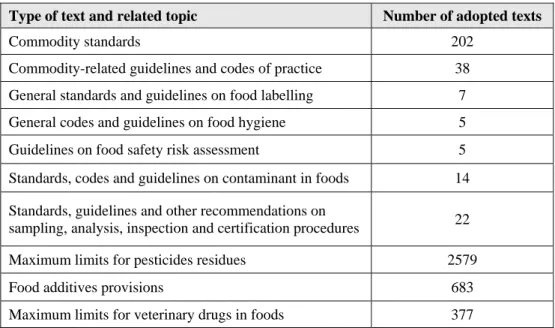
Many of these texts, which are very numerous (see table 3), deal with food safety. This document aims to provide an overview of the relevant texts, rather than an exhaustive study.
Table 3: The Codex scorecard as of 1 July 2005
Type of text and related topic Number of adopted texts
Commodity standards 202
Commodity-related guidelines and codes of practice 38
General standards and guidelines on food labelling 7
General codes and guidelines on food hygiene 5
Guidelines on food safety risk assessment 5
Standards, codes and guidelines on contaminant in foods 14
Standards, guidelines and other recommendations on
sampling, analysis, inspection and certification procedures 22
Maximum limits for pesticides residues 2579
Food additives provisions 683
Maximum limits for veterinary drugs in foods 377
Source: FAO/WHO, 2005
Some Codex texts are especially relevant for private standards in so far as they establish the general requirements for private operators in terms of food safety management. The most significant one is the Recommended International Code of Practice on General Principles of Food Hygiene, CAC/RCP 1- 1969, Rev.(2003), which establishes the general principles that national regulations or Good Hygienic Practices should follow with regard to each step of the food chain .
These general principles concern:
− primary production (environmental hygiene, hygienic production of food sources, handling, storage and transport, cleaning, maintenance and personnel hygiene)
− processing location: design and facilities (location, premises and rooms, equipment, facilities)
− control of operation (control of food hazards, key aspects of hygiene control systems, incoming material requirements, packaging, water, management and supervision, documentation and records, recall procedures)
− processing location: maintenance and sanitation (maintenance and cleaning, cleaning programmes, pest control systems, waste management, monitoring effectiveness)
− processing location: personal hygiene (health status, illness and injuries, personal cleanliness, personal behaviour, visitors)
− transportation (general requirements, use and maintenance)
− product information and consumer awareness (lot identification, product information, labelling, consumer education)
The International Code of Practice on General Principles of Food Hygiene is therefore dedicated to serve as a general scheme for Good Hygienic Practices, but it also establishes requirements for quality control (management of temperature/time, monitoring of incoming materials, product packaging, product identification, product recall) and even for quality assurance (personal training, control of records, definition of responsibilities) (see annex 4).
Among all the advocated procedures for hygiene management, the code recommends more specifically to identify and control the hazards that can occur in each stage of the operator’s activities, according to a management system such as HACCP. Although the code of practice only deals with hygiene, and thus with microbiological hazards, it however recommends this HACCP-based approach for all types of hazards.
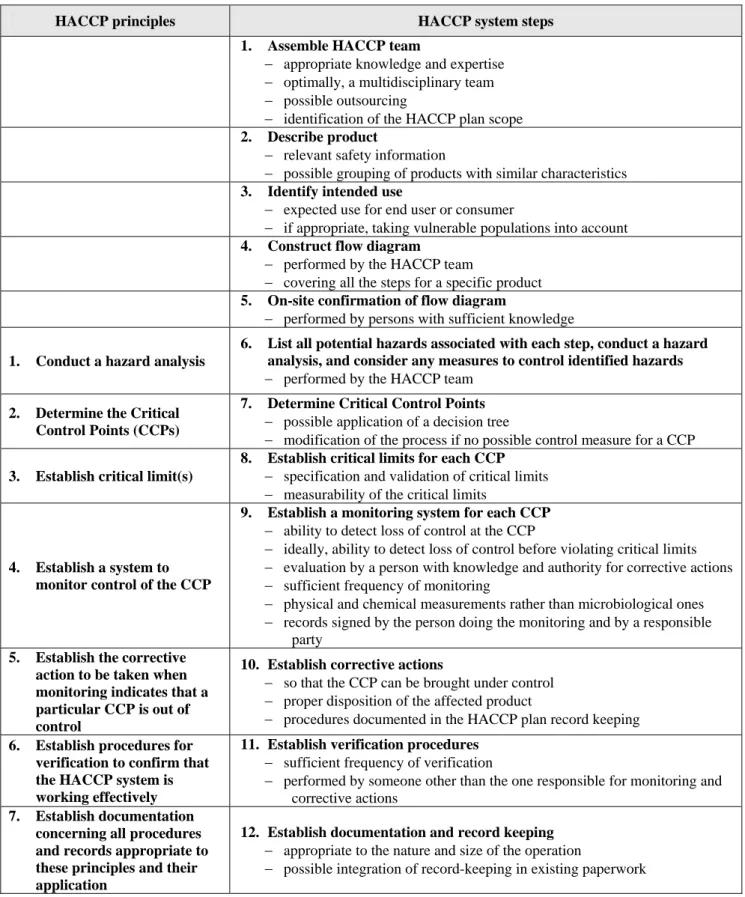
The annex of the code, “Hazard analysis and critical control point (HACCP) system and guidelines for its application”, specifies the definition of “HACCP principles”, “HACCP system” and “HACCP-based system”. Thus, Codex precisely establishes that a HACCP system requires the implementation of the seven principles plus five other preliminary steps.
Table 4: HACCP system steps
HACCP principles HACCP system steps
1. Assemble HACCP team
− appropriate knowledge and expertise
− optimally, a multidisciplinary team
− possible outsourcing
− identification of the HACCP plan scope 2. Describe product
− relevant safety information
− possible grouping of products with similar characteristics 3. Identify intended use
− expected use for end user or consumer
− if appropriate, taking vulnerable populations into account 4. Construct flow diagram
− performed by the HACCP team
− covering all the steps for a specific product 5. On-site confirmation of flow diagram
− performed by persons with sufficient knowledge 1. Conduct a hazard analysis
6. List all potential hazards associated with each step, conduct a hazard analysis, and consider any measures to control identified hazards − performed by the HACCP team
2. Determine the Critical Control Points (CCPs)
7. Determine Critical Control Points − possible application of a decision tree
− modification of the process if no possible control measure for a CCP 3. Establish critical limit(s)
8. Establish critical limits for each CCP − specification and validation of critical limits
− measurability of the critical limits
4. Establish a system to monitor control of the CCP
9. Establish a monitoring system for each CCP − ability to detect loss of control at the CCP
− ideally, ability to detect loss of control before violating critical limits
− evaluation by a person with knowledge and authority for corrective actions
− sufficient frequency of monitoring
− physical and chemical measurements rather than microbiological ones
− records signed by the person doing the monitoring and by a responsible party
5. Establish the corrective action to be taken when monitoring indicates that a particular CCP is out of control
10. Establish corrective actions
− so that the CCP can be brought under control
− proper disposition of the affected product
− procedures documented in the HACCP plan record keeping 6. Establish procedures for
verification to confirm that the HACCP system is working effectively
11. Establish verification procedures − sufficient frequency of verification
− performed by someone other than the one responsible for monitoring and corrective actions
7. Establish documentation concerning all procedures and records appropriate to these principles and their application
12. Establish documentation and record keeping − appropriate to the nature and size of the operation
Codex emphasizes three other relevant points:
I. The company should have in place prerequisite programmes (that is good practices), such as Good Hygienic Practices complying with the provisions of the General Principles of Food Hygiene. II. Training of personnel is an essential element.
III. The implementation of the twelve steps requires appropriate flexibility, especially for small and/or less developed businesses3. However, it is necessary that all the seven HACCP principles are applied so that the management system complies with the HACCP concept. Such a management system is thus referred to as a “HACCP-based system”.
Several other Codex texts emphasize the importance of HACCP system implementation within food businesses. For instance, the Guidelines for the design, operation, assessment and accreditation of food import and export inspection and certification (CAC/GL 26-1997) recommend that member countries “require or encourage the use of HACCP approach by food establishments. Official inspectors should be trained in the assessment of the application of HACCP principles”.
3 FAO and WHO are in the process of developing a guidance document to assist small and less developed businesses (SLDBs) in the implementation of HACCP, planned for release in mid 2006.
III.
Overview of existing certification programmes
on food safety
III.1. Overview of the certification programmes proliferation
An increasing number of certification programmes exist for food safety, related to both good practices and management systems, most of which refer to Codex Alimentarius standards. These programmes have been set up by various types of national and/or global groups including government institutions, national standardization organizations (mostly private associations mandated by government), private certification bodies and the private sector (buyers, retailers and producers).
In some cases, several groups of buyers and retailers realized that they had the same requirements for food safety and developed joint standards accompanied with certification programmes. Although price or product quality (organoleptic quality, freshness, etc.) are competitive issues for businesses, food safety is not. On the contrary, food safety seems to be a “pro-competitive” issue since it is so complex and at the same time so essential to the survival of any business that it can only be effectively dealt with in a collaborative fashion (OECD, 2004).
Similarly, some groups of producers, generally an association or cooperative, have set up standards and certification programmes together in order to demonstrate to a wide range of buyers that they fulfil certain requirements for food safety. However, such initiatives from producers are far less numerous in food safety than in other quality fields (organic agriculture, fair-trade, etc.).
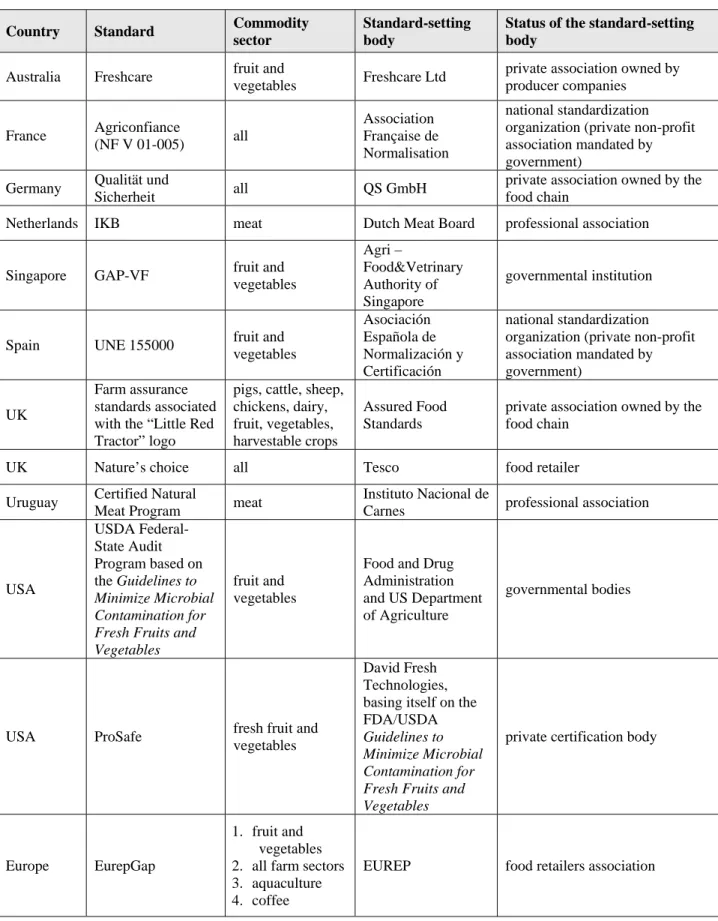
III.1.a. Certification programmes for good practices
This section presents standards that establish requirements for good practices (GAPs, GHPs, GMPs, etc.). In some cases, these standards can also include some requirements for quality control (traceability, management of incoming materials, etc.) or quality assurance (e.g. documentation), which are other components of a food safety management system (see section II.1.b on concepts on food safety management).
In general, certification programmes concern farmers and more generally primary producers (i.e. including fresh product washing and packing activities). In fact, good practices for the farm sector cover more issues than only food safety. For instance, such standards often address environmental (appropriate use of fertilizers, soil conservation, etc.) or ethical issues (e.g. animal welfare). On the contrary, the scope for manufacturers is necessarily less wide and, as national mandatory regulations on hygiene for manufacturers and transporters are usually already strict and precise, additional standards that only provide requirements for GMPs or GHPs are often of no use to them. This is why standards targeting manufacturers instead focus their attention on quality management and HACCP systems (see paragraph III.1.b. below).
Standards for primary producers, which may address environmental, animal welfare or worker welfare issues, are often also wider in scope than food safety.
Table 5 : Examples of GAP/GHP-based certification programmes for primary producers
Country Standard Commodity
sector
Standard-setting body
Status of the standard-setting body
Australia Freshcare fruit and
vegetables Freshcare Ltd
private association owned by producer companies France Agriconfiance (NF V 01-005) all Association Française de Normalisation national standardization organization (private non-profit association mandated by government)
Germany Qualität und
Sicherheit all QS GmbH
private association owned by the food chain
Netherlands IKB meat Dutch Meat Board professional association
Singapore GAP-VF fruit and
vegetables Agri – Food&Vetrinary Authority of Singapore governmental institution
Spain UNE 155000 fruit and
vegetables Asociación Española de Normalización y Certificación national standardization organization (private non-profit association mandated by government)
UK
Farm assurance standards associated with the “Little Red Tractor” logo
pigs, cattle, sheep, chickens, dairy, fruit, vegetables, harvestable crops
Assured Food Standards
private association owned by the food chain
UK Nature’s choice all Tesco food retailer
Uruguay Certified Natural
Meat Program meat
Instituto Nacional de
Carnes professional association
USA USDA Federal-State Audit Program based on the Guidelines to Minimize Microbial Contamination for Fresh Fruits and Vegetables
fruit and vegetables
Food and Drug Administration and US Department of Agriculture
governmental bodies
USA ProSafe fresh fruit and
vegetables
David Fresh Technologies, basing itself onthe FDA/USDA
Guidelines to Minimize Microbial Contamination for Fresh Fruits and Vegetables
private certification body
Europe EurepGap
1. fruit and vegetables 2. all farm sectors 3. aquaculture 4. coffee
EUREP food retailers association
Source: Web sites of relevant bodies (listed in References)
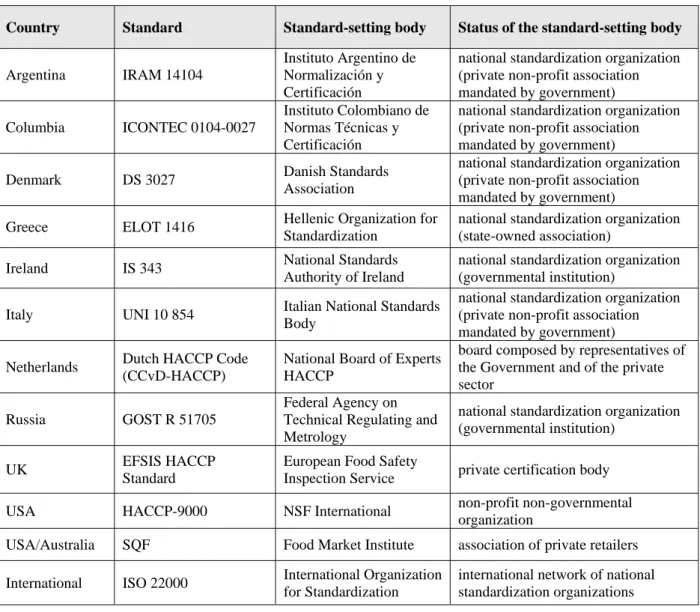
Certification programmes for quality management and HACCP systems
The standards presented in this section deal with quality management systems and HACCP systems, without establishing specific requirements for good practices. They demand only that the company implements relevant good practices programmes (usually called “prerequisite programmes”), whatever they are (though reference is often made to Codex standards).
Certification programmes for quality management and HACCP systems have multiplied during recent years. This proliferation of initiatives is due to the current lack of an international certification programme on quality management systems specific to food businesses. Indeed, the ISO 9001:2000 standard concerns the quality management of the supply chain of any industry and consequently does not take into account the specificities of food safety management. This inadequacy should be alleviated by the adoption of the ISO 22000 standard.
In addition, several countries (including the Netherlands, Denmark and Greece) have decided to set up national standards and certification programmes for products in their national market.
Table 6: Examples of certification programmes for quality management and HACCP systems
Country Standard Standard-setting body Status of the standard-setting body
Argentina IRAM 14104
Instituto Argentino de Normalización y Certificación
national standardization organization (private non-profit association mandated by government)
Columbia ICONTEC 0104-0027
Instituto Colombiano de Normas Técnicas y Certificación
national standardization organization (private non-profit association mandated by government)
Denmark DS 3027 Danish Standards
Association
national standardization organization (private non-profit association mandated by government)
Greece ELOT 1416 Hellenic Organization for
Standardization
national standardization organization (state-owned association)
Ireland IS 343 National Standards
Authority of Ireland
national standardization organization (governmental institution)
Italy UNI 10 854 Italian National Standards
Body
national standardization organization (private non-profit association mandated by government)
Netherlands Dutch HACCP Code
(CCvD-HACCP)
National Board of Experts HACCP
board composed by representatives of the Government and of the private sector
Russia GOST R 51705
Federal Agency on Technical Regulating and Metrology
national standardization organization (governmental institution)
UK EFSIS HACCP
Standard
European Food Safety
Inspection Service private certification body
USA HACCP-9000 NSF International non-profit non-governmental
organization
USA/Australia SQF Food Market Institute association of private retailers
International ISO 22000 International Organization
for Standardization
international network of national standardization organizations Source: Relevant internet sites
Most of these standards demand or establish a system based on HACCP in accordance with the seven principles of HACCP contained in the Codex guidelines. Most are focused on food manufacturers rather than primary producers.
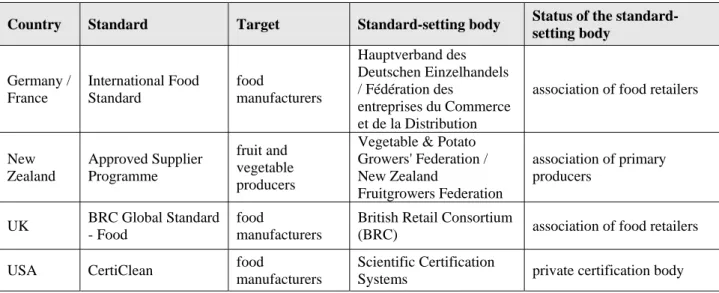
III.1.c. Certification programmes for complete food safety management systems
Some certification programmes establish requirements for quality management systems (including a HACCP system), as well as specific requirements for good practices (Good Agricultural Practices or Good Manufacturing Practices. As such these programmes are the most complete. However, they usually apply to a specific step of the food chain (primary producers or manufacturers).
Table 7: Examples of certification programmes for complete food safety management systems
Country Standard Target Standard-setting body Status of the
standard-setting body Germany / France International Food Standard food manufacturers Hauptverband des Deutschen Einzelhandels / Fédération des entreprises du Commerce et de la Distribution
association of food retailers
New Zealand Approved Supplier Programme fruit and vegetable producers
Vegetable & Potato Growers' Federation / New Zealand Fruitgrowers Federation association of primary producers UK BRC Global Standard - Food food manufacturers
British Retail Consortium
(BRC) association of food retailers
USA CertiClean food
manufacturers
Scientific Certification
Systems private certification body
III.2. Benchmarking by the Global Food Safety Initiative (GFSI)
The Global Food Safety Initiative (GFSI) was launched by food retailers as a means to respond to the proliferation of diverse standards.
III.2.a. The Global Food Safety Initiative
GFSI is a food retail initiative created in May 2000 by the Global Food Business Forum (CIES), a network of 175 retailers and 175 suppliers in over 150 countries, representing 65 percent of global food retail revenue. GFSI aims to ensure that existing worldwide food safety standards are pertinent and reliable. Specifically it implements and maintains a scheme to benchmark food safety standards (for private label products) as well as farm assurance standards, by facilitating mutual recognition between standard owners and by ensuring worldwide integrity in the quality and the accreditation of food safety auditors4.
The GFSI Guidance Document (GFSI, 2004a) establishes a Benchmark Model to serve as an “equivalency framework”. It outlines key elements that a food safety standard should contain:
• good agricultural or manufacturing practices;
• a quality management system applied to food safety (e.g. based on the ISO 9000 series);
• a HACCP-based system in accordance with, or equivalent to, the Codex standard.
The requirements of this Benchmark Model are flexible given the variations within the standards (discussed in chapter IV). For instance, EurepGAP does not require a HACCP system, while neither SQF nor the Dutch HACCP Code establish specified good practices. Nevertheless, a standard approved by GFSI should theoretically be recognized by all retailers around the world.
III.2.b. Benchmarked standards
With regard to the previous version of the GFSI Guidance Document, which applied only to manufacturers, GFSI had approved:
− BRC Global Standard – Food (version 3)
− Dutch HACCP Code (also called CCvD HACCP)
− EFSIS Standard (but EFSIS withdrew its standard from the approval procedure)
− IFS (version 3)
− SQF 2000
With regard to the current fourth version of the guidance document, which also applies to primary producers, GFSI has approved SQF 1000 and is currently benchmarking or re-benchmarking BRC (version 4), IFS (version 4), Dutch HACCP (version 3), SQF 2000, EurepGap Fruit and Vegetables and the New Zealand Fresh Produce Approved Supplier Programme. The China Retailers Standard will likely also be included in this list in the near future.
Despite GFSI approval, these standards are not always mutually recognized. For instance, British retailers continue to demand BRC certification even if the supplier is IFS certified, and even if the two standards are very similar (see chapter IV).
IV.
Major certification programmes on food safety
The major initiatives discussed here have all been benchmarked or are currently being benchmarked by GFSI. The EFSIS Standard is not include here as it withdrew its standard from the approval procedure.
IV.1.Fact sheets
The following information will be reported for each programme:
− the standard-setting body (status, range, etc.)
− the scope of the programme (targeted operator, objectives for the standard setting body, etc.)
− the terms of the programme implementation (compliance requirements, different levels of certification if any, lenient terms for producer groups if any, etc.)
− the provisions of the standard (requirements, comparison with the Codex Alimentarius standards, especially with the “General Principles of Food Hygiene” for the provisions about good practices or quality control)
− the market penetration of the programme (number of retailers demanding the certificate, number of certified producers, etc.)
IV.1.a. BRC Global standard – Food
Standard-setting body
The British Retail Consortium (BRC)5 is the leading trade association for UK retailing. There are three types of members:
− retail members (including Tesco, Marks & Spencer and Sainsbury's), who represent the majority of retailers (approx 80-90 percent) in the UK
− trade association members
− associate members (that is services to the retail industry including accountants, consultants or financial services) who do not participate in the decision-making process.
The BRC set up the food standard in 1998 in response to industry needs. In view of the success and widespread acceptance of this standard, the BRC also published a packaging standard in 2003, a non-food product safety standard in 2003, and then a non-genetically modified non-food assurance in collaboration with the British Food and Drink Federation.
Scope and objectives
The BRC Global standard – Food is a food safety and quality management protocol based on HACCP and designed for manufacturers of all types of food products. Primary producers (including farmers)
are not concerned since a company with primary product preparation activities, such as fruit washing and pre-packing, must exclude these activities from the scope of the certification programme. Furthermore, the standard does not apply to wholesale, importation, distribution and storage activities. The standard was originally developed by retailers and dedicated to the manufacturing suppliers for their private label products, but is now more widely accepted among retailers and branded producers (see paragraph below on market penetration), and is used for all types of manufacturers (branded food manufacturers, sub-contracting manufacturers for branded food companies, etc.).
The BRC standard deals with quality management systems and HACCP, but also establishes general good manufacturing practices for food safety.
Certification programme
The fourth version of the BRC normative document, published in January 2005, has been in effect since July 2005.
After initial certification, suppliers are re-audited, usually once a year or more, often depending on the type and number of non-conformities (the determination of audit frequency is included in the normative document).
The programme formerly provided a two level certification (Foundation Level and Higher Level), but the fourth and more recent edition establishes only one status level.
The standard establishes 50 general requirements named “statements of intent”, each statement being possibly accompanied with specific requirements. Each clause in the standard must be fulfilled. However, the protocol establishes a double gradation:
−among the 50 statements of intent, 10 are qualified as fundamental
−non-conformity to each requirement can be minor, major or critical
The different types of corrective actions to implement and demonstrate compliance thus allow more flexibility in the implementation of certification. For instance, a minor conformity with a non-fundamental requirement does not demand a revisit; the presentation of a corrective actions plan is sufficient.
The number and status of non-conformities found during the first evaluation establishes the re-evaluation frequency (either one or two per year).
Provisions of the standard
The standard is divided into 6 chapters:
− HACCP system
− quality management system
− factory environment standards
− product control
− process control
− personnel
The first chapter demands implementation of a HACCP system. The requirements are entirely compatible with the seven HACCP principles defined by the Codex Alimentarius. However, the BRC standard does not require all of the five preliminary steps defined by Codex. Notably, BRC demands the creation of a HACCP team but not the formal description of the product and its use, nor the construction of an on-site confirmed flow diagram.
quality control issues (traceability, purchasing, management of non-conformities) are sometimes included.
The remaining four chapters establish operational requirements for quality control, as well as general GMPs. However, implementation of these general GMPs does not exempt the company from implementation of a specific and formal GMP plan as required in the first chapter.
Although the requirements of the BRC standard generally comply with the Codex Code of Practice on General Principles of Food Hygiene (see Annex 2), there are some key differences:
− concerning cleaning and maintenance, BRC asks only for adequate procedures whereas Codex recommendations explicitly establish what these procedures should be
− BRC does not explicitly require certain facilities (adequate facilities for cleaning food, utensils and equipment, temperature control facilities, storage facilities, adequate drainage, containers used to hold dangerous substances, etc.)
− BRC explicitly demands only the elaboration and implementation of a HACCP plan but does not specifically require control systems for temperature, cross-contamination, or water use On the other hand, the BRC standard establishes some requirements that are outside the scope of the Codex Code of Practice on General Principles of Food Hygiene. Specifically, these include those dealing with quality control issues (handling of non-conforming products, management of the monitoring system, traceability, management of allergens, quantity control, etc.), but also some on food safety good practices (maintenance of external areas, etc.) (see also annex 4).
Market penetration
The BRC Global Standard - Food was originally developed by British retailers and dedicated to their manufacturing suppliers for their private label products in order to ensure food safety at all levels of the manufacturing supply chain for their private label goods.
However, the standard is increasingly being considered as a benchmark for best practices, many retailers now demand BRC certification from manufacturers of branded products as well as own-brand products. In addition, some other operators, including some global brand owners now require BRC certification from their sub-contracting suppliers.
According to the BRC web site, the majority of British and Scandinavian retailers do business only with suppliers who have gained certification to the BRC Global Standard.
Table 8: Diffusion of the BRC Global standard - Food Number of retail
members within the BRC
BRC members (including Tesco, Marks & Spencer and Sainsbury's), who represent approximately 80-90 percent of the UK retail sector
Number of BRC licensed certification bodies
100 in 23 different countries (Australia, Austria, Belgium, Denmark, Finland, France, Germany, Greece, Holland, Ireland, Italy, New Zealand, Norway, Poland, Portugal, South Africa, Spain, Sweden, Switzerland, Thailand, Uruguay, UK and USA)
plus 9 currently in process to receive license (especially in Argentina and Latvia)
Number of BRC
certified suppliers Not available
International Food Standard (IFS)
Standard-setting body
The International Food Standard (IFS)6 was set up in 2002 by HDE (Hauptverband des Deutschen Einzelhandels), the German retail association. In 2003, French retailers and wholesalers from the FCD (Fédération des entreprises du Commerce et de la Distribution) joined the IFS Working Group and contributed to the development of the current version of the normative document.
Scope and objectives
The IFS is a food safety and quality management protocol based on HACCP that is designed for producers of all types of food products.
This standard was set up specifically in view of retailers’ needs. In fact, it is dedicated to the manufacturing suppliers for private label products, in order to ensure food safety at all levels of the manufacturing supply chain of the products under retailers’ responsibility (that is their private label goods). Like the BRC Global Standard-Food, the IFS is not dedicated to primary producers (for instance fresh fruit and vegetable producers): it comes into force when the product is handled.
As with the BRC standard, IFS deals with quality management system and HACCP, but also establishes general good manufacturing practices related to food safety.
Certification programme
The fourth edition of the IFS normative document was issued in January 2004. The IFS programme allows for two levels of certification:
the “foundation level” is considered as the minimum requirements for the international food industry
the “higher level” is considered as a superior standard in the food industry
This division into steps allows suppliers to implement the standard with more flexibility and to demonstrate continuous improvement.
The criteria are split into two different levels corresponding to two different certifications: the “foundation level criteria” includes 230 items, whereas the “higher level criteria” include 60 additional criteria. Furthermore, 46 recommendations are formulated for companies who wish to demonstrate "best practices" in the sector. For each criterion of the standard, a certain number of points is assigned according to the compliance and to the criterion level. The certificate (foundation or higher level) is delivered for a certain amount of gained points. The system allows flexibility, since companies are not forced to prove effective compliance with every clause of the standard (they only have to present a corrective actions plan for the remaining non-conformities).
The certification is site-specific; that is, the audit scope is limited to the site where the audit takes place, but all types of products produced in this site must be taken into account.
The re-evaluation frequency is once a year (once every 18 months for “higher level” certifications that have already been confirmed twice and that do not concern seasonal products).
The certification costs vary by certification body, but average €2 000 for 1.5 days of on-site audit.
6
Provisions of the standard
The requirements of the IFS cover five topics:
− management of the quality system (HACCP system, quality handbook, etc.)
− management responsibility (inspection of quality and production systems, etc.)
− resource management (human resources, hygiene, social facilities, etc.)
− production processes (product development, factory facilities, traceability, etc.)
− measurements, analyses, improvements (controls, product recalls, etc.)
The first two topics clearly deal with HACCP and quality assurance. The implementation of a HACCP-based system is required, and an explicit mention is made to the Codex HACCP principles. However, the requirements for the “Foundation Level” completely comply with the seven Codex HACCP principles, but not totally with the 12 Codex HACCP steps, since the on-site confirmation of the flow-diagram is required only for the “Higher Level” certification. On the other hand, the “Higher Level” totally complies with the 12 Codex HACCP steps.
The final three topics establish general good manufacturing practices as well as quality management requirements (especially quality control requirements).
These requirements comply on the whole with the Codex Code of Practice on General Principles of Food Hygiene (see annex 3). However, there are some differences:
− concerning cleaning and maintenance, IFS (like the BRC standard) only asks for adequate procedures, whereas Codex recommendations explicitly establish what these procedures should be;
− IFS does not explicitly require certain facilities (adequate facilities for cleaning food, utensils and equipment, temperature control facilities, storage facilities, containers used to hold dangerous substances, etc.).
Like the BRC standard, IFS establishes a certain number of requirements that are not in the Codex Code of Practice on General Principles of Food Hygiene, with regard to quality control (handling of non-conforming products, management of the monitoring system, traceability, management of allergens, etc.) and food safety good practices (maintenance of external areas) (see also annex 4).
Market penetration
According to IFS, almost all German and French retailers (including some of the global players like Metro, Carrefour and Auchan) ask for an IFS certification. However, some major retailers do not support IFS (for instance Leclerc, which is not an FCD member). Among the supporting retailers, some (e.g. Metro) ask all their subsidiaries around the world for IFS. Retailers in several other countries (e.g. Austria, Poland, Switzerland, Italy, etc.) also request IFS certification.
At present, retailers demand IFS certification only from the producers of their private label food products, and do not require it from branded product suppliers. However, according to the IFS, it appears that many branded product companies perform an IFS audit of their own companies and ask their subcontractors and suppliers to do the same.
Table 9: Application of the IFS
Number of retailers supporting the IFS programme
All German and Swiss retailers who take part in the HDE – Committee for Food Law and Quality Assurance (Metro, Rewe, Aldi, Lidl, Spar, COOP, etc.)
All French retailers who participate in the FCD – Quality Committee (Carrefour, Auchan, Casino, Monoprix, Cora, Système U, etc.) HDE and FCD are seeking to spread the IFS standard to retailers based in other European countries (Poland, Austria, Belgium, Netherlands, UK and Italy)
Number of IFS- licensed certification bodies
44 from 10 different European countries (Austria, Belgium, France, Germany, Greece, Italy, Netherlands, Spain, Switzerland and UK) Some have international offices
Number of IFS certified
suppliers 3000 audits performed since May 2003, mostly in Europe
Source: Internet (www.food-care.info), August 2005
IV.1.c. SQF Codes7
Standard-setting body
The Safe Quality Food (SQF) standards were originally established by the Western Australian Department of Agriculture in 1996, in response to the demands of the farming and small food manufacturing sectors for a quality assurance system that enabled their businesses to meet regulatory food safety and commercial food quality criteria. As no suitable system could be identified, the Western Australia government established the SQF Quality Code.
After its creation, the SQF standard caught the attention of the Food Marketing Institute (FMI), an American retail association, and worldwide ownership of the standards was transferred to the FMI in 2003. The SQF Institute, a division established by the FMI, now manages the SQF Programme. The FMI comprises 1,500 United States (US) or international member companies (both food retailers and wholesalers). The US members (in particular Wal-Mart and Kroger) operate approximately 26,000 retail food stores with a combined annual sales volume of $340 billion, that is three-quarters of all food retail sales in the United States. The international membership includes 200 companies (in particular Carrefour, Ahold and Tesco) from 50 countries.
Scope and objectives
The SQF programme is intended to deal with complete food safety management systems; however, in comparison to the BRC or IFS standards, it only specifies requirements on quality management systems and does not specify good practices nor HACCP plans (though it demands them). It is
designed for all types of food products and for all types of suppliers (the SQF 1000 Code for primary producers, the SQF 2000 Code for food industries).
Certification programmes
Two certification programmes have been established for different types of food product suppliers:
• SQF 1000: this standard, currently in its third version, is specific to primary producers and to issues of concern to them (pre-farm gate production, harvesting, preparation of primary products).
• SQF 2000: this standard, currently in its fourth version, is specific to food industries and to issues of concern to them (raw materials and ingredients, processed or prepared foods, beverage or services).
There is no obligation for a supplier who would like to be certified SQF 2000 to receive raw materials from a certified SQF 1000 primary producer.
Each programme allows for three levels of certification, which more or less correspond to the number of food safety system components (see paragraph II.1.b. on the food safety management concepts) that are implemented by the business:
− Level 1 (Food Safety Fundamentals): this certificate assures that the co