Layers of Modern Hardware
Orestis Polychroniou
Submitted in partial fulfillment of the requirements for the degree
of Doctor of Philosophy
in the Graduate School of Arts and Sciences
COLUMBIA UNIVERSITY
2018Orestis Polychroniou All Rights Reserved
Analytical Query Execution Optimized for all
Layers of Modern Hardware
Orestis Polychroniou
Analytical database queries are at the core of business intelligence and decision support. To analyze the vast amounts of data available today, query execution needs to be orders of magnitude faster. Hardware advances have made a profound impact on database design and implementation. The large main memory capacity allows queries to execute exclu-sively in memory and shifts the bottleneck from disk access to memory bandwidth. In the new setting, to optimize query performance, databases must be aware of an unprecedented multitude of complicated hardware features. This thesis focuses on the design and imple-mentation of highly efficient database systems by optimizing analytical query execution for all layers of modern hardware. The hardware layers include the network across multiple machines, main memory and the NUMA interconnection across multiple processors, the multiple levels of caches across multiple processor cores, and the execution pipeline within each core. For the network layer, we introduce a distributed join algorithm that minimizes the network traffic. For the memory hierarchy, we describe partitioning variants aware to the dynamics of the CPU caches and the NUMA interconnection. To improve the mem-ory access rate of linear scans, we optimize lightweight compression variants and evaluate their trade-offs. To accelerate query execution within the core pipeline, we introduce ad-vanced SIMD vectorization techniques generalizable across multiple operators. We evaluate our algorithms and techniques on both mainstream hardware and on many-integrated-core platforms, and combine our techniques in a new query engine design that can better utilize the features of many-core CPUs. In the era of hardware becoming increasingly parallel and datasets consistently growing in size, this thesis can serve as a compass for developing hardware-conscious databases with truly high-performance analytical query execution.
List of Figures vi
List of Tables x
1 Introduction 1
1.1 Modern Hardware Hierarchy . . . 5
1.1.1 Mainstream CPUs . . . 5
1.1.2 Cache Hierarchy . . . 6
1.1.3 Main Memory and NUMA . . . 6
1.1.4 Network Layer . . . 7
1.2 Additional Background . . . 8
1.2.1 SIMD Vectorization . . . 8
1.2.2 Many Integrated Cores . . . 10
1.3 Contributions . . . 10
1.3.1 Distributed Joins with Minimal Network Traffic . . . 10
1.3.2 In-Memory Partitioning and Large-Scale Sorting . . . 11
1.3.3 Lightweight Compression Alongside Fast Scans . . . 11
1.3.4 Advanced SIMD Vectorization Techniques . . . 12
1.3.5 Query Execution Engines for the Many-Core Era . . . 12
1.4 Additional Work . . . 13
1.4.1 Heavy Hitter Aggregation for SIMD Processors . . . 13
1.4.2 Energy Analysis of Hardware and Software Range Partitioning . . . 13
1.4.3 SIMD-accelerated Regular Expression Matching . . . 14
1.5.2 Batch Distributed Data Processing . . . 15
1.5.3 Network-Optimized Databases . . . 15
1.5.4 Query Execution Engines . . . 16
1.5.5 Main-Memory Partitioning . . . 16
1.5.6 In-Memory Joins and Group-by Aggregation . . . 17
1.5.7 Lightweight In-Memory Compression . . . 17
1.5.8 SIMD Vectorization . . . 18
1.5.9 Databases on GPUs and FPGAs . . . 18
2 Distributed Joins with Minimal Network Traffic 20 2.1 Introduction . . . 20
2.2 Track Join . . . 23
2.2.1 2-Phase Track Join . . . 23
2.2.2 3-Phase Track Join . . . 26
2.2.3 4-Phase Track Join . . . 29
2.2.4 Traffic Compression . . . 35
2.3 Query Optimization . . . 36
2.3.1 Network Cost Model . . . 36
2.3.2 Tracking-Aware Hash Join . . . 39
2.3.3 Semi-Join Filtering . . . 40
2.4 Experimental Evaluation . . . 42
2.4.1 Simulations . . . 42
2.4.2 Implementation . . . 49
2.5 Conclusion . . . 53
3 In-Memory Partitioning and Large-Scale Sorting 54 3.1 Introduction . . . 54
3.2 Partitioning Variants . . . 58
3.2.1 Partitioning In-Cache . . . 58
3.2.4 Radix / Hash Histogram . . . 68 3.2.5 Range Histogram . . . 69 3.3 Sorting Algorithms . . . 72 3.3.1 Setting . . . 72 3.3.2 Radixsort . . . 73 3.3.3 Comparison-Based Sorting . . . 75 3.4 Experimental Evaluation . . . 79 3.5 Conclusion . . . 85
4 Lightweight Compression Alongside Fast Scans 86 4.1 Introduction . . . 86
4.2 Horizontal Bit Packing . . . 88
4.2.1 Scalar Packing and Unpacking . . . 88
4.2.2 Word-Aligned Scalar Scanning . . . 89
4.2.3 SIMD Unpacking and Scanning . . . 91
4.3 Vertical Bit Packing . . . 93
4.3.1 Scalar Packing and Unpacking . . . 93
4.3.2 SIMD Packing . . . 94
4.3.3 SIMD Unpacking . . . 96
4.3.4 Selection Scan . . . 97
4.4 Experimental Evaluation . . . 99
4.5 Conclusion . . . 101
5 Advanced SIMD Vectorization Techniques 102 5.1 Introduction . . . 102
5.2 Fundamental Operations for Vectorization . . . 106
5.2.1 Logical Design . . . 106
5.2.2 Gather/Scatter Implementation . . . 107
5.2.3 Implementing Selective Loads / Stores . . . 109
5.4 Hash Tables . . . 113 5.4.1 Linear Probing . . . 114 5.4.2 Double Hashing . . . 119 5.4.3 Cuckoo Hashing . . . 121 5.5 Bloom Filters . . . 125 5.6 Partitioning . . . 127
5.6.1 Radix / Hash Histogram . . . 128
5.6.2 Range Histogram . . . 129
5.6.3 Data Shuffling . . . 130
5.6.4 Buffered Data Shuffling . . . 133
5.7 Sorting and Hash Joins . . . 136
5.8 Experimental Evaluation . . . 137
5.8.1 Selection Scans . . . 138
5.8.2 Hash Tables . . . 139
5.8.3 Bloom Filters . . . 142
5.8.4 Partitioning . . . 143
5.8.5 Sorting and Hash Joins . . . 144
5.9 SIMD CPUs and SIMT GPUs . . . 148
5.10 Conclusion . . . 148
6 Query Execution Engines for the Many-Core Era 149 6.1 Introduction . . . 149
6.2 Background . . . 151
6.2.1 Mainstream & Many-Core Processors . . . 151
6.2.2 Analytical Query Execution Engines . . . 154
6.3 Vectorized Code Generation . . . 155
6.3.1 Scalar Code Generation . . . 155
6.3.2 SIMD Code Generation . . . 156
6.4 Proposed Query Engine Design . . . 160
6.4.3 Hash Joins . . . 167 6.4.4 Partitioning . . . 171 6.4.5 Materialization . . . 174 6.4.6 Group-by Aggregation . . . 176 6.5 Experimental Evaluation . . . 183 6.6 Conclusion . . . 190
7 Conclusions and Future Work 191
Bibliography 198
1.1 SIMD instruction examples . . . 8 2.1 Example of network transfers in hash join and track join per distinct join key 29 2.2 Example of 4-phase track join optimal schedule generation per distinct join
key . . . 34 2.3 Synthetic 109 uniqueR tupleson 109 uniqueS tuples (1× 1 key matches) . 42 2.4 Synthetic 2·108uniqueRtuples
o
n109non-uniqueStuples (1×5 key matches) 43 2.5 Synthetic 4·107 uniqueR tuplesno 2·108 S tuples (1×5 key matches) . . 43 2.6 Synthetic 2·108 R tuples
o
n2·108 S tuples with 4·107 unique keys (5 ×5 key matches intra-table collocated) . . . 44 2.7 Synthetic 2·108 R tuples
o
n2·108 S tuples with 4·107 unique keys (5 ×5 matches inter-table collocated and intra-table collocated) . . . 45 2.8 Slowest join of slowest query (Q1) of workloadX (original data placement) 46 2.9 Slowest join of slowest query (Q1) of workloadX (shuffled data placement) 46 2.10 Common slowest join in slowest queries 1–5 ofX (dictionary compressed) . 47 2.11 Slowest join in slowest query of workloadY using variable byte encoding . . 48 3.1 Partitioning variants and contributions . . . 57 3.2 SIMD comb-sort (4-way) . . . 77 3.3 Throughput of out-of-cache radix partitioning (1010tuples) . . . 79 3.4 Partitioning throughput with uniform random and Zipf data (θ= 1.2) . . . 80 3.5 Scalability of out-of-cache radix partitioning (109 tuples, 1024-way) . . . 80 3.6 Throughput of histogram generation (1010 keys) . . . 81
3.9 Execution time per sorting algorithm phase (1010 tuples) . . . 83
3.10 NUMA-aware vs. NUMA-oblivious sorting (1010 tuples) . . . 83
3.11 Performance of scalar and SIMD comb-sort (32-bit keys and 32-bit payloads) 84 4.1 Throughput of packing, unpacking, and scanning for horizontal and vertical bit packing using scalar and SIMD code (multi-threaded) . . . 100
4.2 Throughput of packing, unpacking, and scanning for horizontal and vertical bit packing using scalar and SIMD code (single-threaded) . . . 101
5.1 Selective store operation . . . 106
5.2 Selective load operation . . . 106
5.3 Gather operation . . . 106
5.4 Scatter operation . . . 107
5.5 Selection scan throughput on KNC and Haswell (32-bit key and 32-bit payload)139 5.6 Throughput of hash table probing on KNC and Haswell using linear probing (LP) and double hashing (DH) (shared, 32-bit key input → 32-bit payload output) . . . 140
5.7 Throughput of hash table probing on KNC and Haswell using cuckoo hashing (shared, 32-bit key input →32-bit payload output) . . . 140
5.8 Throughput of building and probing hash tables on KNC using linear prob-ing (LP), double hashprob-ing (DP), and cuckoo hashprob-ing (CH) (1:1 build–probe, private, 32-bit keys and 32-bit payloads both inputs) . . . 141
5.9 Throughput of building and probing on KNC using linear probing (LP), dou-ble hashing (DH), and cuckoo hashing (CH) (1:10 build–probe, L1-resident, private, 32-bit keys and 32-bit payloads both inputs) . . . 141
5.10 Throughput of Bloom filter probing on KNC (5 hash functions, 10 Bloom filter bits / tuple, 5% selectivity, 32-bit key and 32-bit payload) . . . 142 5.11 Throughput of radix and hash histogram generation on KNC (32-bit keys) . 143 5.12 Throughput of range partitioning function on KNC and Haswell (32-bit keys) 143
5.14 Performance of sorting (LSB radixsort) on KNC . . . 145 5.15 Hash join performance on KNC (2·108./2·108 32-bit key and 32-bit payload)145 5.16 scalability of LSB radixsort and partitioned hash join on KNC (4·108 and
2·108./2·108 32-bit key and 32-bit payload, log/log scale) . . . 146 5.17 LSB radixsort and partitioned hash join on 1 61-core KNC co-processor (Intel
Xeon Phi 7120P) vs. 4 8-core Sandy Bridge CPUs (Intel Xeon E5 4620) (sort 4·108 tuples, join 2·108./2·108 tuples, 32-bit key and 32-bit payload) . . 146 5.18 Radixsort with varying payloads on KNC (2·108 tuples, 32-bit key) . . . . 147 5.19 Hash join with varying payloads on KNC (107./108 tuples, 32-bit keys) . . 147 6.1 Throughput of non-sequential accesses . . . 153 6.2 Running time of example query using code generation (10% selectivity) . . 159 6.3 Running time of example query using code generation (90% selectivity) . . 159 6.4 Example of selection scan (already determined tuples are not skipped) . . . 163 6.5 Hash join FonA from the example query with and without partitioning . . . 175 6.6 Example of mapping hashes to group-ids . . . 176 6.7 Example of resolving hash collisions . . . 179 6.8 Selection scans on uncompressed data (1–3 32-bit key columns, 1 predicate
per key column, 1 32-bit payload column) . . . 183 6.9 Selection scans on compressed data (1–3 32-bit key columns, 1 predicate per
key column, 1 32-bit payload column) . . . 184 6.10 Expression tree for selection on part table from TPC-H Q19 (0.24% selectivity)184 6.11 Selection on part table from TPC-H Q19 . . . 185 6.12 Partition of multiple columns and types . . . 185 6.13 Hash join on synthetic data (1 key, 1–3 payloads, 128Mon32M tuples) . . . 186 6.14 Hash joins using the core TPC-H tables . . . 187 6.15 Group-by aggregation on synthetic data (1 32-bit group-by key, 1–3 32-bit
payloads, 1 sum aggregate per payload, count(*), 256M tuples) . . . 188 6.16 Step breakdown for join and aggregation . . . 189
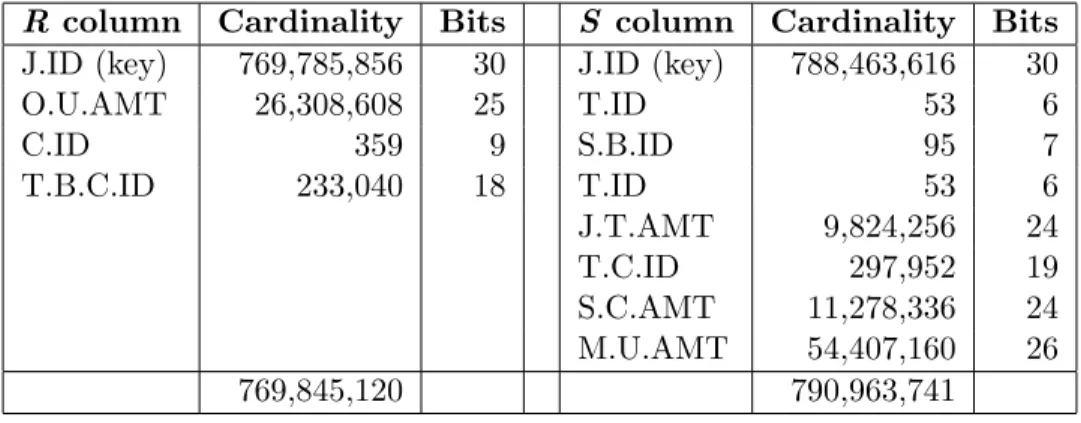
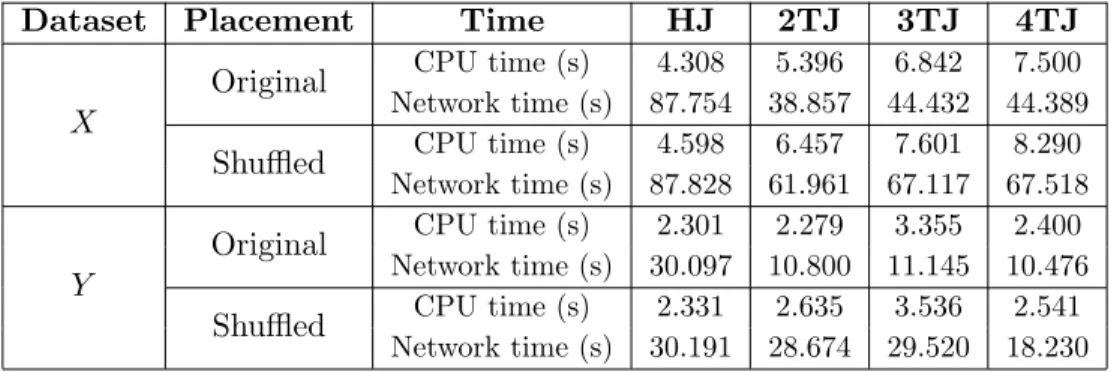
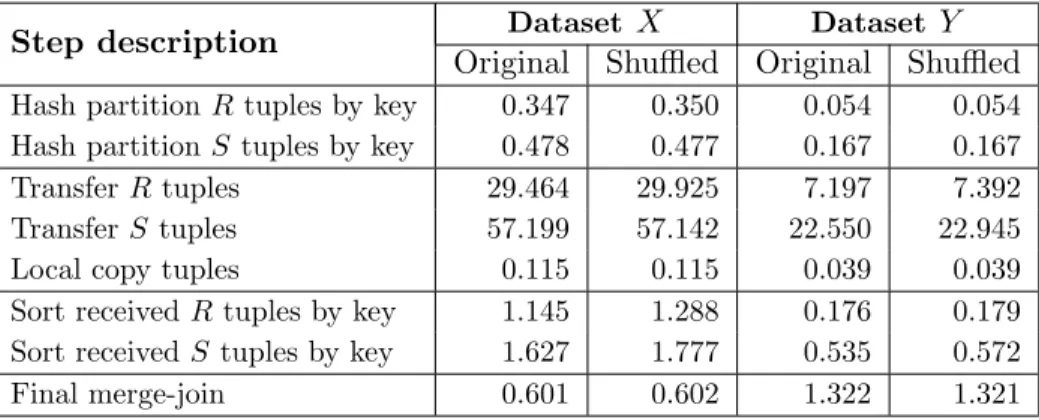
2.1 Column details of R andS tables joined in Q1 . . . 45 2.2 CPU and network time of the slowest join of the slowest query of X and Y 50 2.3 Distributed hash join time per step (in seconds) . . . 51 2.4 4-phase track join time per step (in seconds) . . . 52 5.1 Experimental platforms for advanced SIMD vectorization experiments . . . 137
tolerating me over these last 6 years. I would also like to thank Luis Gravano and Eugene Wu for all the discussions that took place in the Columbia Database Group. I would also like to thank Martha Kim and Stratos Idreos for their participation in the committee and interest in the work.
Second, I would like to thank current and former members of the Columbia Database Group at Columbia: Eva Sitaridi, Fotis Psallidas, John Paparrizos, Pablo Barrio, Bingyi Cao, Jiacheng Yang, and Wandga Zhang, as well as other friends from Columbia: Dimitris Paparas, Evangelia Skiani, Marios Pomonis, and Vasileios P. Kemerlis.
Third, I would like to thank Yannis Ioannidis, Yannis Smaragdakis, Alex Delis, and Panagiotis Stamatopoulos for introducing me to Computer Science and Databases and generally nurturing me during my undergraduate years in the University of Athens.
Fourth, I would like to thank Eric Sedlar, Nipun Agarwal, Rajkumar Sen, Arun Ragha-van, and John Kowtko for the collaboration during my internships at the Oracle Labs.
Finally, I would like to thank Ippokratis Pandis and Michalis Petropoulos from Amazon Web Services.
Chapter 1
Introduction
In the era with large volumes of data easily accessible and business decisions being data driven, analytical database queries are at the core of business intelligence and decision sup-port. Database management systems have traditionally focused on transactions, supporting analytical queries, but executing them at very low efficiency compared to what is achievable by modern hardware. The quality of decision support depends on the amount of data we process in time. Thus, the need for highly efficient analytical query execution is apparent.
Modern hardware advances have fundamentally reshaped the design and implementation of database management systems. The advent of large main memory capacity has allowed small to medium-sized databases to remain main-memory resident. The bottleneck shifts from disk access, the metric that database systems have traditionally optimized for, to memory bandwidth [?; Manegoldet al., 2000a]. In the context of distributed databases, the bottleneck is the network bandwidth. The potential performance improvement supported by the hardware is now orders of magnitude higher compared to disk-oriented databases and marks the one-size-fits-all database model as obsolete [Stonebrakeret al., 2007].
Optimizing database systems by focusing on specific workloads is necessary to achieve the efficiency potential provided by modern hardware [Stonebraker et al., 2005; Stone-braker et al., 2007; Cudre-Mauroux et al., 2009; Raman et al., 2013; Gupta et al., 2015; Dagevilleet al., 2016; Verbitskiet al., 2017]. Workload specialization include transactional (OLTP) databases, analytical (OLAP) databases, and others types such as array databases. Analytical queries are fundamentally different than transactional queries, the classic focus
of database systems. An OLAP database varies in both the storage and the execution model from an OLAP database. Transactional queries favor row-oriented storage, since they up-date a small number of tuples. On the other hand, analytical queries favor column-oriented storage, since they read a small number of attributes from a large number of tuples.
In this thesis, we describe techniques for the design and implementation of efficient analytical query execution on modern hardware. Each chapter discusses optizations to make query execution aware of (or utilize) different layers of the underlying hardware. The hardware layers are main memory, the multiple levels of caches in modern processors, the NUMA interconnection layer across multiple CPUs in shared memory platforms, the network layer, and, finally, the layer above the caches commonly described as the processor registers, but more accurately described as the throughput within each processor core.
The memory layers of a mainstream platform include three levels of CPU caches, the main memory connected to each CPU socket, and the NUMA interconnection layer com-bining multiple CPUs in a single shared memory platform. Memory access during query execution is optimized not only via column-oriented storage and compression, but also by using main memory partitioning to divide or cluster the data in smaller pieces with better memory locality. Cache-conscious execution [Manegold et al., 2000b] can be used on multiple database operators such as joins [Manegold et al., 2002; Kim et al., 2009; ?; Blanas et al., 2011; Albutiu et al., 2012; Balkesen et al., 2013b; Balkesen et al., 2013a; Schuh et al., 2016], group-by aggregation [M¨ulleret al., 2015], and materialization [Mane-goldet al., 2004], in order to eliminate random memory accesses and cache misses altogether. Adapting to the multiple levels of memory hierarchy by minimizing cache misses and trans-fers across CPUs is instrumental to efficiency. Chapter 3 describes multiple main memory partitioning variants optimized for the CPU caches, main memory, and the NUMA inter-connection. The partitioning variants are used as building blocks in the implementation of multiple large-scale sorting algorithms with different properties.
Lightweight compression reduces the memory footprint and increases the data access rate. Contrary to generic lossless compression, lightweight compression focuses on decom-pression efficiency over comdecom-pression ratio. Dictionary encoding is the simplest and most common approach used in databases and allows query execution to use compressed data
directly without decompressing [Willhalmet al., 2009; Ramanet al., 2013]. Dictionary en-coding supports multiple schemes for storing the compressed bits and each scheme provides different trade-offs [Ross and Cieslewicz, 2009; Li and Patel, 2013]. Optimizing and evalu-ating multiple storage schemes is the focus of Chapter 4. The work can be used to choose the most suitable compression storage scheme per case to fully optimize memory access.
Shared-memory platforms can scale up to a few terabytes of RAM using multiple CPUs. However, for datasets that exceed that threshold, database management systems need to scale out to multiple servers, using high speed network. If the data is memory resident across multiple servers, distributed query execution is bound by the network bandwidth that is an order of magnitude lower than main memory bandwidth. Designing distributed algorithms that reduce network traffic by burdening the CPUs can reduce the end-to-end execution time. Chapter 2 introduces track join, a distributed join algorithm that minimizes network traffic by generating optimal transfer schedules for each distinct join key.
The memory hierarchy layers determine the throughput of loading data into the CPU and storing data back to memory. However, the processing throughput within the CPU cores is determined by the implementation of the database operators. Modern processors take advantage of three sources of parallelism to maximize performance. First, instruction-level parallelism optimizes the instruction throughput of the pipeline. Second, thread parallelism involves multiple cores per CPU as well as multiple hardware threads per core executing concurrently. Third, data parallelism is supported via SIMD vector registers that execute the same operation for multiple data items per instruction. The primary source of core pipeline efficiency based on the implementation, is SIMD vectorization. Databases already utilize SIMD instructions for linear-access operators such as scans and compression but not for non-linear-access operators such as hash joins. Chapter 5 describes advanced SIMD vectorization techniques that cover most database operators including non-linear-access cases such as hash tables, partitioning, and Bloom filters. The techniques are evaluated on both mainstream CPUs and co-processors based on the first generation of the Intel many-integrated-core (MIC) architecture. Compared to mainstream CPUs, the MIC archi-tecture uses a larger number of smaller cores with wide SIMD registers and advanced SIMD instructions, stressing thread and data parallelism over instruction-level parallelism.
Analytical query engines dictate how to implement each individual operator based on holistic query engine design goals. For instance, code generation [Kim et al., 2010; Neumann, 2011; Gupta et al., 2015] minimizes data materialization by pipelining oper-ators and eliminate interpretation costs by compiling specific code per query. However, cache-conscious execution is precluded and diminish the impact of SIMD vectorization is diminished. In research, hardware-oriented optimizations such as SIMD vectorization and partitioning, are typically applied to databases operators assuming simple data types and predicates. In order to apply such optimizations in a realistic setting, a careful redesign of each operator is necessary, in order to support multiple data types and complex predicates, as well as contain the cost of data materialization. Chapter 6 describes an analytical query engine design focused on SIMD vectorization. The design is tailored to the latest generation of many-integrated-core processors. Notably, many-core processors include an additional memory layer of on-chip high-bandwidth memory that is faster than main memory but slower than the caches and can be used to facilitate cache-conscious execution.
We now briefly outline the chapters of the thesis. In Chapter 1, we present the necessary background, detail our contributions, and discuss related work. In Chapter 2, we introduce distributed joins with minimal network traffic. In Chapter 3, we design partitioning op-timized for the CPU caches and the NUMA layer. In Chapter 4 we discuss lightweight compression. In Chapter 5, we introduce advanced SIMD vectorization techniques to op-timize the efficiency within the processor core. In Chapter 6, we describe a query engine design tailored to many-core CPUs. In Chapter 7, we conclude and discuss future work.
Each contribution focuses on specific hardware layers but uses techniques from other layers. To optimize query execution in an analytical database, we have to apply them in unison. Partitioning, the focus of Chapter 3, is reused in Chapter 2 to implement a cache-conscious track join, in Chapter 5 to implement cache-cache-conscious hash joins and sorting using SIMD, and in Chapter 6 for joins, aggregation, and materialization. Compression, the focus of Chapter 4, is reused in Chapter 6. SIMD vectorization, the main focus of 5, is used in Chapter 3 for range partitioning, in Chapter 4 to accelerate compression and decompression, and in Chapter 6 as the basis of the query engine design. Finally, Chapter 6 combines the basic principles of Chapters 3, 4, and 5 in the context of a query engine.
1.1
Modern Hardware Hierarchy
The main hardware advances over the last decade that fundamentally reshaped database design and implementation are (i) the increase in main-memory capacity and bandwidth, and (ii) the performance of modern multi-core CPUs. The increase in main-memory capacity allows medium to large databases to remain memory resident. Even when the dataset is too large, query execution can operate in a reduced memory-resident working set. In other words, database operators look like high-performance in-memory algorithms, in contrast to traditional databases where disk access dominated execution time. Modern CPUs have increased their performance throughput, driving novel designs and implementations for most database operators, in order to take advantage of the complex features of modern CPUs.
1.1.1 Mainstream CPUs
Modern mainstream CPUs share specific characteristics. Up to about a decade ago, pro-cessors had been doubling the frequency clock rate every few years. At the same time, the processors had become increasingly complicated. Besides the tens of stages, the pipeline became super-scalar, executing multiple instructions per cycle, with instructions executing mostlyout-of-order. These advances are the basis ofinstruction-level parallelism. When the clock frequency race came to a halt, the solution was to place multiple cores per CPU chip. Each core would retain most advanced instruction-level parallelism capabilities, combined now withthread parallelism. The last source of parallelism,data parallelism, was supported in mainstream CPUs via SIMD instructions, before the advent of multi-cores.
We outline the characteristics of modern CPUs: (i) massively super-scalar execution that reaches 6–8 instructions per cycle, (ii) aggressive out-of-order execution with a reorder buffer window that fits hundreds of instructions, (iii) at least a dozen cores for server-class platforms, (iv) simultaneous multi-threading (SMT) supporting multiple hardware threads per physical core, (v) multiple levels of caches with each lower level increasing in capacity and latency, and (vi) advanced SIMD instructions and wide 256-bit or 512-bit SIMD regis-ters. The latest mainstream CPU micro-architectures by Intel are, in chronological order, Westmere, Sandy Bridge, Haswell, and Skylake.
1.1.2 Cache Hierarchy
The cache hierarchy in modern processors has remained relatively stable among the lat-est micro-architectures. The L1 cache is private per core and is split between data and instruction cache. The L1 capacity is 32–64 KB and the latency is 1–5 cycles. The L2 cache is also private per core, the capacity of 256–512 KB, and the latency is 10 cycles or less. The L3 cache has a capacity in the range 8–128 MB and the latency is 25–50 cycles. The L3 is shared among all the cores in the chip. Deviations from this scheme exist in the many-integrated-cores (MIC) architecture outside of the spectrum of mainstream CPUs. We discuss MIC platforms and their relevance to mainstream CPUs in Chapters 5 and 6.
CPU caches are important in databases, especially for analytical queries. The disk–RAM pair of traditional databases has been substituted by the RAM–cache pair. In the past, the working set was a subset of the dataset and was loaded from disk to memory. Nowadays, the entire dataset is already in memory and the working set is kept small enough to remain cache-resident. Cache-conscious execution refers to database operator algorithms that take into account the cache capacity to manage the working set accordingly. Interestingly, as we show in Chapter 3, main-memory partitioning, the most important operator of cache-conscious algorithms, is particularly unfavorable to caches if implemented na¨ıvely.
1.1.3 Main Memory and NUMA
The capacity of main memory is currently in the scale of terabytes for high-end servers. Small to medium-sized databases can easily fit in memory on server-class platforms. The memory bandwidth has also increased via a quad-channel interconnection between the mem-ory modules and the CPU. The RAM bandwidth today can reach 50 GB/s using a single CPU. Sequential memory accesses take advantage of hardware prefetching, a mechanism that automatically requests the following cache lines before they are explicitly requested by the software. Databases can easily saturate the memory bandwidth for selection scans on uncompressed data. In Chapter 4, we show that lightweight compression not only reduces the data footprint, but also allows for skipping a constant percentage of the input.
Data are transferred from memory into the CPU in cache lines. Cache lines are 64– 128 bytes and are the minimum unit of transfer across the levels of the cache as well as
between the CPU and main memory. The cache line units further reduces the throughput of random accesses. For instance, accessing a large array of 4-byte integers in random order, is at least 16 times slower than sequential accesses given 64-byte cache lines, without taking into account the absence of hardware prefetching. Random accesses are further burdened by TLB (transaction-lookahead-buffer) misses during the translation of virtual memory addresses to physical memory addresses. Virtual addressing is the indirection level for memory translation imposed by the operating system (OS). In Chapter 3, we show that transferring the data between the caches and main memory in cache line units is essential when partitioning inputs larger than the cache.
To scale the memory bandwidth while retaining the shared-memory multi-processing model, we connect multiple CPUs via the NUMA (non-uniform-memory-access) intercon-nection layer. Each CPU is connected to local RAM modules, collectively known as the NUMA region. In order for a CPU to access data from a memory module connected to another CPU, the request travels through the NUMA interconnection layer. These transfers across NUMA boundaries result in additional latency. In Chapter 3, we show that NUMA-aware algorithms can achieve significant speedups over their NUMA-oblivious counterparts.
1.1.4 Network Layer
Toscale upmemory capacity and bandwidth, we can connect 2–8 CPUs in a shared memory platform. Beyond that limit, we scale out to multiple nodes, potentially each node having multiple CPUs, connected via fast local-area network (LAN). The fastest LAN networks today use the InfiniBand protocol and transfer ∼ 10 GB/s node-to-node. Databases take advantage not only of the increased network bandwidth but also of the reduced latencies via RDMA (remote-direct-memory-access), to execute distributed transactions efficiently.
In analytical queries, bandwidth is the relevant factor for network efficiency. Neverthe-less, the fastest networks are still significantly slower than RAM. For nodes with multiple CPUs, the total memory bandwidth can exceed 200 GB/s, which is at least an order of magnitude higher than the bandwidth of the fastest network. In Chapter 2, we discuss how to trade-off network traffic for CPU cycles via a new distributed join algorithm that minimizes the volume of network transfers by placing extra work on the CPUs.
1.2
Additional Background
1.2.1 SIMD Vectorization
SIMD (single-instruction-multiple-data) refers to special CPU instructions that operate on special registers and execute the same instruction for multiple elements at once. The operations for all 8 elements are computed in a single instruction with a throughput of one cycle. SIMD is synonymous to data parallelism. The term data parallelism is derived from the fact that the data must be spatially adjacent to execute the same operation for multiple elements, using as many instructions as we would use for a single element in scalar code.
5 1 2 3 4 6 7 8 3 13 8 5 2 1 1 21 8 15 11 9 8 8 9 22
+
=
(a) 8-way addition
7 9 1 8 2 3 6 4 8 3 5 7 -2 4 -6 1 0 0 -1 0 -1 -1 -1 -1
>
=
(b) 8-way comparison 5 1 1 2 3 8 13 21 7 1 3 2 0 21 5 13 1 3 2 1 8 4 5 6 (c) 8-way permutation Figure 1.1: SIMD instruction examplesWriting code in SIMD requires the use of SIMD instructions directly. We can invoke SIMD instructions by using intrinsics provided by the compiler. Intrinsics are part of the official ISA documentation and their descriptions are available online.1
void add(const int* a, const int* b, int* c, size_t n) {
size_t i = 0;
do {
c[i] = a[i] + b[i]; } while (++i != n); }
We show an example of a simple loop adding the elements of two arrays of 32-bit integers using scalar code and SIMD code. In modern CPUs, SIMD registers are 128-bit, 256-bit, or 512-bit wide. For this example, we assume 256-bit SIMD registers and use the AVX2 instruction set. Each 256-bit register processes 8 32-bit elements. The functions we invoke are intrinsics mapped to single assembly instructions and are inlined by the compiler.
1
void add_simd(const int* a, const int* b, int* c, size_t n) {
size_t i = 0;
do {
// load 8 32-bit integers from array "a" into 256-bit SIMD register "x" __m256i x = _mm256_load_si256((__m256i*) &a[i]);
// load 8 32-bit integers from array "b" into 256-bit SIMD register "y" __m256i y = _mm256_load_si256((__m256i*) &b[i]);
// add 8 32-bit integers from registers "x" and "y" into 256-bit SIMD register "z" __m256i z = _mm256_add_epi32(x, y);
// store 8 32-bit integers from 256-bit SIMD register "z" to array "c" _mm256_store_si256((__m256i*) &c[i], z);
} while ((i = i + 8) != n); // we assume for simplicity that n is a multiple of 8 }
SIMD instructions specify the size of each element they process. Assuming 256-bit SIMD registers, theAVX2SIMD ISA specifies instructions to add 32 8-bit integers, 16 16-bit integers, 8 32-bit integers, 4 64-bit integers, 8 32-bit floating point numbers, and 4 64-bit floating point numbers. The degree of data parallelism is dependent on the hardware that determines the size of the SIMD register, and on the software that specifies the size of each element. In Chapter 4, we show how to utilize 8-bit integer as part of 32-bit integer decompression to increase the degree of parallelism through the use of shorter integers.
SIMD vectorization is a fundamental optimization for modern CPUs since it enables one of the two sources of parallelism triggered by the software. Thread parallelism is enabled in software via the use parallel algorithms. Instruction-level parallelism is already provided by the hardware unless we suffer from performance pitfalls such as branch mispredictions and virtual function calls. Data parallelism is enabled in software via SIMD.
Automatic SIMD vectorization refers to the compilation of scalar source code without SIMD intrinsics into assembly with SIMD instructions. The previous example is simple enough to be automatically vectorized by popular compilers. However, automatic vector-ization is limited to simple cases and does not cover database operators with more complex control flow and non-linear memory accesses.
In database research, the most common SIMD vectorization approach is to implement individual operators in an ad-hoc way, using techniques applicable only to one specific prob-lem. In Chapter 5, we show that generic SIMD vectorization requires the transformation of control flow into data flow. In Chapter 6, we show that vectorization affects the algorithmic design of individual operators as well as the design of the whole query execution engine.
1.2.2 Many Integrated Cores
The trade-off between fewer complex cores versus many simple cores has regained interest since the advent of many-integrated-core (MIC) platforms. The first generation of MIC platforms codenamed Knights Corner (KNC) were co-processors connected via PCI-e like GPUs and used P54C (Pentium 1) cores without super-scalar or out-of-order execution. However, the simpler cores had reduced energy and area footprint and had∼ 60 cores per chip. Still, each core supported 512-bit SIMD ahead of mainstream CPUs at the time. The MIC design reduced instruction-level parallelism in favor of thread and data parallelism. In Chapter 5, we use KNC co-processors to evaluate advanced SIMD vectorization techniques. The latest MIC platform codenamed Knights Landing (KNL) is also available as a stand-alone CPU. KNL (ormany-core) CPUs have 60–70 cores per chip, with super-scalar pipelines, out-of-order execution, with AVX-512 SIMD, same as the latest mainstream CPUs. In addition to regular DRAM, many-core CPUs have access to 16 GB of high-bandwidth on-chip multi-channel DRAM (MCDRAM) that is faster than regular DRAM and slower than the caches, albeit much larger in capacity. In Chapter 6, we discuss the design of analytical query engines for many-core CPUs.
1.3
Contributions
1.3.1 Distributed Joins with Minimal Network Traffic
Network communication is the slowest component of many operators in distributed parallel databases. Existing parallel DBMSs rely on algorithms designed for disks with minor mod-ifications for networks. A more complicated algorithm may burden the CPUs, but could avoid redundant transfers of tuples across the network. In Chapter 2 [Polychroniou et al., 2014], we introduce track join, a novel distributed join algorithm that minimizes network traffic by generating an optimal transfer schedule per distinct join key. Track join extends the trade-off options between CPU and network. Our evaluation based on real and synthetic data shows that track join adapts to diverse cases and degrees of locality. Considering both network traffic and execution time, even with no locality, track join outperforms hash join on the most expensive queries of real workloads.
1.3.2 In-Memory Partitioning and Large-Scale Sorting
High-throughput in-memory query execution relies on partitioning to cluster or divide data into smaller pieces and thus achieve better parallelism and memory locality. In Chap-ter 3 [Polychroniou and Ross, 2014a], we consider a comprehensive collection of variants of main-memory partitioning tuned for various layers of the memory hierarchy. We revisit the pitfalls of in-cache partitioning, and utilizing the crucial performance factors, we introduce new variants for partitioning out-of-cache. Besides non-in-place variants where linear extra space is used, we introduce large-scale in-place variants, and propose NUMA-aware parti-tioning that guarantees locality on multiple processors. Also, we make range partiparti-tioning comparably fast with hash or radix, by designing a novel cache-resident index to compute ranges. All partitioning variants are combined to build three NUMA-aware sorting algo-rithms: a stable LSB radixsort; an in-place MSB radixsort using different variants across memory layers; and a comparison-based sort using high-fanout range partitioning.
1.3.3 Lightweight Compression Alongside Fast Scans
Database systems employ compression, not only to fit the data in main memory, but also to address the memory bandwidth bottleneck. Lightweight compression schemes focus on effi-ciency over compression rate and allow query operators to process the data in compressed form. Dictionary compression keeps the distinct column values in a sorted dictionary and stores the values as index codes with the minimum number of bits. Packing the bits of each code contiguously, namely horizontal bit packing, has been optimized by using SIMD instructions for unpacking and by evaluating predicates in parallel per processor word for selection scans. Interleaving the bits of codes, namely vertical bit packing, provides faster scans, but incurs prohibitive costs for packing and unpacking. In Chapter 4 [Polychroniou and Ross, 2015], we improve packing and unpacking for vertical bit packing using SIMD instructions, achieving more than an order of magnitude speedup. Also, we optimize hori-zontal bit packing on the latest CPUs and compare all approaches. While no single variant is better in all cases, vertical bit packing now offers a good overall trade-off by combining the fastest scans with comparably fast packing and unpacking.
1.3.4 Advanced SIMD Vectorization Techniques
Analytical databases are continuously adapting to the underlying hardware in order to saturate all sources of parallelism. Many-core platforms stray from the mainstream CPU design by packing a larger number of simpler cores per chip, relying on SIMD instructions to fill the performance gap. In Chapter 5 [Polychroniou and Ross, 2014b; Polychroniouet al., 2015], we present vectorized designs and implementations of database operators, based on advanced SIMD operations. We study selections, hash tables, Bloom filters, partitioning, sorting and joins. Our evaluation on many-core co-processors and mainstream CPUs shows that our vectorization techniques are an order of magnitude faster than the state-of-the-art scalar and vectorized implementations. We highlight the impact of SIMD vectorization on the algorithmic design of database operators, as well as the architectural design and power efficiency of hardware, by making simple cores comparably fast to complex cores.
1.3.5 Query Execution Engines for the Many-Core Era
Hardware-conscious query execution engines, even after specializing to transactions or an-alytics, are based on multiple distinctive designs. Due to the continuous evolution of hard-ware, new platforms can favor or disfavor existing designs. For example, the recent many-core platforms revisit the trade-off between many simple many-cores and fewer complex many-cores. In Chapter 6, we focus on analytical query execution on many-core CPUs. We extend a state-of-the-art design used on mainstream CPUs by combining code generation and oper-ator pipelining with SIMD vectorization, and show that the SIMD vectorization speedup is diminished when query execution is memory-bound. To better utilize the hardware, we introduce VIP, an analytical query execution engine built bottom-up from pre-compiled column-oriented data-parallel sub-operators, implemented entirely in SIMD, and utilizing the high-bandwidth on-chip memory of many-core CPUs to facilitate cache-conscious exe-cution. We discuss selection scans, compression, hash joins, and group-by aggregation, and extend the operators to support multiple data types and complex predicates. In our eval-uation using synthetic and TPC-H queries, we show that VIP outperforms hand-written optimized query-specific code without including the runtime compilation overhead, and highlight the efficiency of VIP at utilizing the hardware features of many-core CPUs.
1.4
Additional Work
In this section, we discuss additional work of the author that is not presented in detail in the following chapters. The work is within the topic of analytical query execution.
1.4.1 Heavy Hitter Aggregation for SIMD Processors
Heavy hitters are data items that occur at high frequency in a data set. They are among the most important items for an organization to summarize and understand during analytical processing. In data sets with sufficient skew, the number of heavy hitters can be relatively small. We take advantage of this small footprint to compute aggregate functions for the heavy hitters in fast cache memory in a single pass. In [Polychroniou and Ross, 2013], we design cache-resident, shared-nothing structures that hold only the most frequent elements. Our algorithm works in three phases. It first samples and picks heavy hitter candidates. It then builds a hash table and computes the exact aggregates of these elements. Finally, a validation step identifies the true heavy hitters from among the candidates. We identify trade-offs between the hash table configuration and performance. Configurations consist of the probing algorithm and the table capacity that determines how many candidates can be aggregated. The probing algorithm can be perfect hashing, cuckoo hashing and bucketized hashing to explore trade-offs between size and speed. We optimize performance by the use of SIMD instructions, utilized in novel ways beyond single vectorized operations, to minimize cache accesses and the instruction footprint.
1.4.2 Energy Analysis of Hardware and Software Range Partitioning
Data partitioning is a critical operation for manipulating large datasets because it subdi-vides tasks into pieces that are more amenable to efficient processing. It is often the limiting factor in database performance and represents a significant fraction of the overall runtime of large data queries. In [Wuet al., 2014], we measure the performance and energy of state-of-the-art software partitioners, and describe and evaluate a hardware range partitioner that further improves efficiency. The software implementation is broken into two phases, allow-ing separate analysis of the partition function computation and the cost of data shufflallow-ing.
Although range partitioning is commonly thought to be more expensive than simpler strate-gies such as hash partitioning, our measurements indicate that careful data movement and optimization of the partition function can allow it to approach the throughput and energy consumption of hash or radix partitioning. For further acceleration, we describe a hardware range partitioner, a streaming framework that offers a seamless execution environment for this and other streaming accelerators, and a detailed analysis of a 32nm physical design that matches the throughput of 4–8 software threads while consuming just 6.9% of the area and 4.3% of the power of a Xeon core in the same technology generation.
1.4.3 SIMD-accelerated Regular Expression Matching
String processing tasks are common in analytical queries powering business intelligence. Besides substring matching, provided in SQL by the like operator, popular DBMSs also support regular expressions as selective filters. Substring matching can be optimized by using specialized SIMD instructions on mainstream CPUs, reaching the performance of numeric column scans. However, generic regular expressions are harder to evaluate, being dependent on both the DFA size and the irregularity of the input. In [Sitaridiet al., 2016], we optimize matching string columns against regular expressions using SIMD-vectorized code. Our approach avoids accessing the strings in lockstep without branching, to exploit cases when some strings are accepted or rejected early by looking at the first few characters. On common string lengths, our implementation is up to 2X faster than scalar code on a mainstream CPU and up to 5X faster on the Xeon Phi co-processor, improving regular expression support in DBMSs.
1.5
Related Work
1.5.1 Parallel and Distributed Databases
The foundations of distributed query processing and parallel database implementation [Bernstein and Chiu, 1981; DeWittet al., 1984; DeWitt and Gray, 1992; Epsteinet al., 1978; Mackert and Lohman, 1986] have been laid some decades back. The fundamental dis-tributed hash join algorithm was first presented as part of the Grace database machine
[Kitsuregawaet al., 1983] and was later parallelized by the Gamma project [DeWittet al., 1990]. Distributed algorithms that filter tuples to reduce network traffic have been exten-sively studied, namely semi-joins [Bernstein and Chiu, 1981; Roussopoulos and Kang, 1991; Stamos and Young, 1993], Bloom-joins [Mullin, 1990], and other approaches [Li and Ross, 1995]. Contemporary databases shift from the one-size-fits-all paradigm and are optimized for specific workloads, the most notable cases being transactions and relational analyt-ics. Transactional distributed databases are targeting higher transaction throughput, by eliminating unnecessary network communication [Stonebraker et al., 2007] due to latency induced delays of distributed commit protocols. [Binnig et al., 2016] discussed changes to both transactional and analytical workloads for high-end networks, by improving the dis-tributed 2-phase-commit protocol using RDMA as well as Grace hash join and group-by aggregation using local preprocessing and semi-join filtering.
1.5.2 Batch Distributed Data Processing
Batch distributed data processing systems such as MapReduce [Dean and Ghemawat, 2004] are popular platforms for executing analytical database workloads [Thusoo et al., 2009]. [Pavlo et al., 2009] evaluated MapReduce against distributed databases and finds that found databases to be faster at execution but slow when data loading times are taken into account. [Afrati and Ullman, 2010] proposed a single-pass algorithm for shuffling data across the network for multiple joins. [Chu et al., 2015] evaluated the algorithm alongside Grace hash join alongside multiple approaches for executing the joins in memory. [Okcan and Riedewald, 2011] proposed MapReduce joins with minimized network transfers by collocating the data with the relevant processing operations to reduce the network traffic.
1.5.3 Network-Optimized Databases
[Kim et al., 2012] proposed a distributed sorting algorithm where CPU and network time are overlapped by transferring keys and payloads separately. [Frey et al., 2009] discussed distributed joins on faster networks where the network is not the bottleneck by broadcasting relations using a ring-like topology. [R¨odigeret al., 2014] discussed network time optimiza-tion for distributed joins by formulating the placing of partioptimiza-tions in network nodes as an
integer optimization problem. However, the approach is NP-complete and therefore cannot be applied per-key. In contrast, the track join algorithm we propose in Chapter 2 minimizes network volume using linear scheduling applied per key, achieving a finer granularity opti-mum. While completion time is not necessarily a better metric than network volume when partial results can be consumed as soon as they are generated, track join can utilize the same temporal scheduling to reduce end-to-end time. [Zamanianet al., 2015] discussed data placement to maximize locality for database workloads. [R¨odigeret al., 2015] measured the impact of high-speed networks on query optimization and in-memory execution. [R¨odiger
et al., 2016] proposed a distributed join algorithm that deals with skew building on top of hash join and broadcast join. [Barthels et al., 2015] optimized distributed hash joins to run on low-area high-end networks using RDMA and [Barthels et al., 2017] extended the approach in the latest hardware using thousands of cores.
1.5.4 Query Execution Engines
High-performance in-memory query execution originated with the advent of large main-memory capacities. Column-oriented query execution [Manegold et al., 2000a] and cache-conscious database operators [Manegoldet al., 2002; Manegold et al., 2004] were proposed even before the advent of multi-core CPUs. Analytical database systems adopted column-oriented storage, focusing on columnar compression [Stonebrakeret al., 2005] and complex materialization strategies [Abadi et al., 2007] to further optimize memory access. Notable commercial analytical databases use column-oriented storage and compression as their basic design principles [Raman et al., 2013; Willhalm et al., 2009]. Storage managers have also been improved since [Johnson et al., 2009] to keep up with the increasing speed. Column-oriented block-at-a-time execution [Bonczet al., 2005] as well as per-query code generation and compilation [Gupta et al., 2015; Kim et al., 2010; Neumann, 2011] are both state-of-the-art analytical query engine designs. To combine transactions and analytics, [Grund et al., 2010; Alagianniset al., 2014; Arulrajet al., 2016] proposed hybrid-stores and adaptive stores over column stores. [Menon et al., 2017] combined block-at-a-time execution with prefetching to reduce the cost of cache misses in code generation. We will discuss analytical query execution engines further in Section 6.2.2. While most engine designs dictate a
particular way to build each operator, optimized implementations of isolated individual operators are also popular. These implementations typically use key–rid pairs and omit payload materialization. In Chapter 6 we generalize from key–rid pairs to realistic database operators that support multiple columns, data types, and complex predicates.
1.5.5 Main-Memory Partitioning
We first present related work on in-memory partitioning which is the focus of Chapter 3. [Manegoldet al., 2000b] identified that TLB thrashing occurs when na¨ıvely partitioning to a large number of outputs that exceed the TLB capacity. [Satish et al., 2010] introduced efficient out-of-cache partitioning using cache-resident buffers and [Wassenberg and Sanders, 2011] identified the significance of write-combining to avoid cache pollution. Both works applied efficient partitioning to radixsort. [Wu et al., 2013] proposed hardware-accelerated range partitioning for performance and power efficiency. [Li et al., 2013] evaluated data shuffling on the NUMA layer for platforms with multiple CPUs. [Choet al., 2015] discussed in-place radix-sort. [Psaroudakiset al., 2016] studied data placement on NUMA platforms.
1.5.6 In-Memory Joins and Group-by Aggregation
[Manegold et al., 2002] proposed the first cache-conscious design of hash join and [Kim et al., 2009] applied the design to multi-core CPUs. [Blanaset al., 2011] argued that hardware-oblivious joins are fast enough. [Balkesenet al., 2013b] argued in favor of partitioning-based hash join implementations. [Albutiu et al., 2012] proposed a NUMA-aware sort-merge-join algorithm for mulitple CPUs and later [Balkesen et al., 2013a] evaluated sort-merge join against hash joins on NUMA platforms. [Lee et al., 2014] descibed the execution of joins on compressed data. [Schuhet al., 2016] re-evaluated multiple hash join implementations, pointing out that payload materialization eventually becomes more expensive than the hash join itself and thus optimizing a stand-alone hash join is of limited use. We will use these observations in Chapter 6 to discuss hash joins in the context of the whole query engine. [Cieslewicz and Ross, 2007; Cieslewicz et al., 2010; Ye et al., 2011] discussed how to scale group-by aggregation on multi-core processors by avoiding contention and [M¨uller et al., 2015] discussed cache-conscious aggregation via partitioning.
1.5.7 Lightweight In-Memory Compression
Modern analytical databases are tuned for main-memory accesses [?; Manegold et al., 2000a]. [Stonebraker et al., 2005] highlighted the importance of columnar compression for in-memory databases. [Zukowskiet al., 2006] discussed RAM to CPU-cache decompression. [Abadiet al., 2006] incorporated compression into query execution. [Hollowayet al., 2007] studied schema-tuned query code generation. [Johnsonet al., 2008] studied selection scans on bit packed data. [Raman and Swart, 2006] discussed entropy compression including com-plex dictionary encoding schemes, later applied in commercial database systems [Raman
et al., 2013]. [Afrati and Ullman, 2010] proposed pattern-based compression in processor words. [Li and Patel, 2013] proposed vertical bit packing and denormalization with com-pression to convert complex queries into scans [Leiset al., 2014]. [Fenget al., 2015] proposed vertical byte packing. [Feng and Lo, 2015] showed how to compute aggregation functions on bit packed data. [Satish et al., 2010] studied skew-friendly compression. [Stepanov
et al., 2011] studied vectorized variable-byte encoding. [Lemire and Boytsov, 2015] dis-cussed vectorized frame-of-reference compression and delta encoding. [Lemire et al., 2016; Wanget al., 2017] evaluated such compression techniques on inverted lists and bitmaps.
1.5.8 SIMD Vectorization
Optimizing database operators to use SIMD instructions is essential to take advantage of data parallelism provided by modern processors. [Zhou and Ross, 2002] applied SIMD to linear scans, index scans, and nested loop joins. [Ross, 2007] proposed hash tables with multiple keys per bucket probed via SIMD instructions, and applied the idea to cuckoo hashing. [Willhalmet al., 2009] optimized decompression of bit packed data. In Chapter 4 we discuss the optimization of other bit packing layouts using SIMD instructions. [Inoueet al., 2007] proposed data-parallel combsort and merging. [Chhuganiet al., 2008] optimized bitonic merging for mergesort. [Kim et al., 2010] proposed multi-way trees tailored to the SIMD layout by comparing multiple keys per node. [Royet al., 2012] proposed SIMD-based pre-filtering for frequent itemset mining. [M¨uhlbauer et al., 2013] optimized data loading from CSV files using SIMD instructions for efficient parsing. [Idreoset al., 2007] proposed database cracking, a dynamic partitioning for selection scans. [Pirket al., 2014b] proposed
a SIMD implementation for cracking. [Inoueet al., 2014] redesigned sorted set intersection using SIMD to reduce branch mispredictions. [Inoue and Taura, 2015] studied the sorting of structures instead of key–rid pairs. Hash joins were evaluated on first generation MIC co-processors by [Jha et al., 2015] and on second generation MIC processors by [Cheng et al., 2017]. [Sidirourgos and Kersten, 2013] presented in-memory secondary indexes based on bitmaps and zonemaps, implemented in SIMD by [Sidirourgos and M¨uhleisen, 2017].
Compilers can translate simple scalar code to use SIMD instructions based on loop un-rolling [Larsen and Amarasinghe, 2000] and control flow predication [Shin, 2007]. However, the vectorized operators we present in Chapter 5 are too complex to be automatically vec-torized by any compiler as of yet. Also, the vecvec-torized code executes the same database operation but is not always equivalent to the scalar code.
1.5.9 Databases on GPUs and FPGAs
GPUs are somewhat similar to SIMD vectorization since the SIMT model is loosely similar to the SIMD model. [Bakkum and Skadron, 2010] described the implementation of database operators on GPUs. [Kim et al., 2010] applied the multi-way index optimization to both CPUs and GPUs. [Satish et al., 2010] also evaluated optimized SIMD radixsort on both CPUs and GPUs. [Pirk et al., 2011] discussed the asymmetries in the memory layout of GPUs compared to CPUs. [Sitaridi and Ross, 2012] discussed memory contention for group-by aggregation on GPUs. [Kim et al., 2012] discussed hash joins in GPUs, focusing in efficient data transfers via the PCI-e channel. [Sitaridi and Ross, 2013] studied selective predicates and proposed an optimization model for disjunctive selections on GPUs. [Pirk
et al., 2014a] presented techniques towards co-processing database workloads in multiple platforms including GPUs. [Pirk et al., 2015] measured several hardware traits of GPUs and MIC co-processors. [Pirk et al., 2016] proposed a vectorization algebra for mapping SIMD operations to high-level constructs, encompassing both CPUs and GPUs. [Sitaridi and Ross, 2016] discussed regular expression matching on GPUs and [Sidler et al., 2017] proposed using FPGAs for the same problem. [Stehle and Jacobsen, 2017] revisited data partitioning on GPUs by focusing on TLB misses. [Karaet al., 2017] proposed off-loading in-memory partitioning from the CPUs to FPGAs.
Chapter 2
Distributed Joins with Minimal
Network Traffic
2.1
Introduction
The processing power and storage capacity of a single server can be large enough to fit small to medium scale databases. Servers with memory capacity of more than a terabyte are now common. Packing a few multi-core CPUs on top of shared non-uniform access (NUMA) RAM provides substantial parallelism, where we can run in-memory database operations (i.e. sort, join, and group-by) at rates of a few gigabytes per second [Albutiuet al., 2012; Balkesenet al., 2013a; Satish et al., 2010; Wassenberg and Sanders, 2011; Ye et al., 2011].
Database research has also evolved to catch up to the hardware advances. Fundamental design rules of the past on how a DBMS should operate are now being revised due to their inability to scale and achieve good performance on modern hardware. Special purpose databases are now popular against the one-size-fits-all approach [Stonebraker et al., 2007], while accelerators [Ramanet al., 2013] are the implicit manifestation of the same concept. The advances in database design for storage and execution on modern hardware have not been met by similar advances in distributed parallel database design. When the most fundamental work on distributed and parallel databases was published [Bernstein et al., 1981; Epstein et al., 1978; Mackert and Lohman, 1986], hardware advances of today like multi-core parallelism had not yet occurred. Techniques to speed up short-lived distributed
transactions [Stonebraker et al., 2007] target distributed commit protocols, which suffer from network latencies rather than throughput. Queries where communication is inevitable are less popular research topics or are left for data-centric generic distributed systems for batch-processing [Dean and Ghemawat, 2004; Pavloet al., 2009].
The latest network technologies may be slow relative to main-memory-resident process-ing. A 40 Gbps InfiniBand measured less than 3 GB/s real data rate per node during hash partitioning. If done in RAM, partitioning to a few thousand outputs runs close to the memory copy bandwidth [Satishet al., 2010; Wassenberg and Sanders, 2011]. For instance, a server using 4X 8-core CPUs and 1333 MHz quad-channel DDR3 DRAM achieves a par-tition rate of 30–35 GB/s, more than an order of magnitude higher than the InfiniBand network. [Balkesenet al., 2013a] achieves a hash join rate of 4.85 GB/s of 32-bit key, 32-bit payload tuples on 4X 8-core CPUs. Such high-end specifications are common in commercial hardware platforms for large-scale analytics.
Network optimization is important for both low-end and high-end hardware. In low-end platforms where the network is relatively slow compared to local in-memory processing, we expect the execution time to be dominated by network transfers. Thus, any network traffic reduction directly translates to faster execution. In high-end platforms, given that the network still cannot be as fast as the RAM bandwidth, completion times are also reduced if the reduction in network traffic is comparable with the increase in CPU cycles.
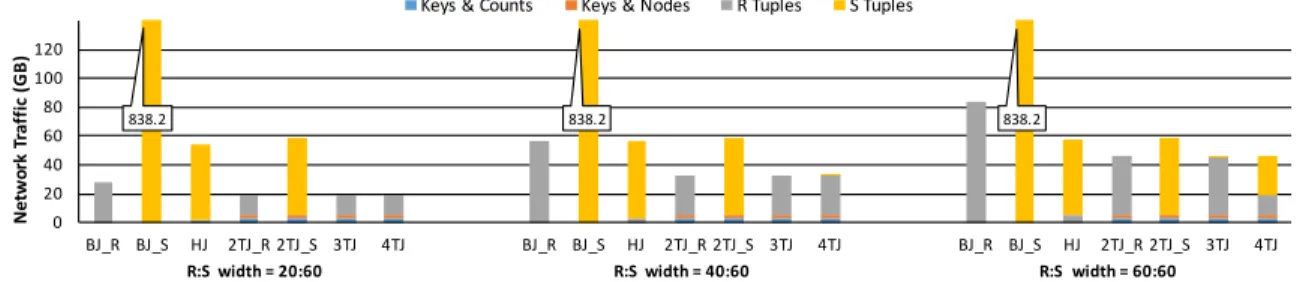
In order to show how much time databases can spend on the network, we give an example of a real analytical workload from a large commercial vendor, using a market-leading commercial DBMS. Using 8 machines connected through 40 Gbps InfiniBand (see Section 2.4 for more details of the configuration), we found that the five most expensive queries spend ∼65–70% of their time transferring tuples on the network and account for 14.7% of the total time required to execute the entire analytical workload with more than 1500 queries. All five queries have a non-trivial query plan (4–6 joins), but spend 23%, 31%, 30%, 42%, and 43% of their total execution time on a single distributed hash join.
A sophisticated DBMS should have available options to optimize the trade-off between network and CPU utilization. One solution would be to apply network optimization at a higher level treating the network as a less desired route for data transfers, without modifying
the underlying algorithms. These approaches are common in generic distributed processing systems [Dean and Ghemawat, 2004]. A second solution would be to employ data compres-sion before sending data over the network. This solution is orthogonal to any algorithm but can consume a lot of CPU resources without always yielding substantial compression. A third solution is to create novel algorithms for database operator evaluation that minimize network communication by incurring local processing cost. This approach is orthogonal and compatible with compression and other higher level network transfer optimizations.
Grace hash join [DeWitt et al., 1990; Kitsuregawa et al., 1983] is the predominant method for executing distributed joins and uses hash partitioning to split the initial problem into shared-nothing sub-problems that can proceed locally per node. Partitioning both tables works almost independently of the table sizes. However, hash join is far from network-optimal because it transfers almost the full size of both tables over the network. Using pre-determined hash functions guarantees load balancing, but limits the probability that a hashed tuple will not be transferred over the network to 1/N on N nodes.
We introduce track join, a novel algorithm for distributed joins that minimizes transfers of tuples across the network. The main idea of track join is to decide where to send rows on a key by key basis. The decision uses information about where records of the given key are located. Track join has the following properties: it (i) is orthogonal to data-centric compression, (ii) can co-exist with semi-join optimizations, (iii) does not rely on favorable schema properties, such as foreign key joins, (iv) is compatible with both row-store and column-store organization, and (v) does not assume favorable pre-existing tuple placement. We implement track join to evaluate the most expensive join operator in the most expensive queries of real workloads. We found that track join reduces the network traffic significantly over known methods, even if pre-existing data locality is removed and all data are used in optimally compressed form throughout the join.
The rest of this chapter is organized as follows. In Section 2.2, we describe the track join algorithm by using three variants with increasing complexity. In Section 2.3, we discuss query optimization costs, tracking-aware hash joins, and semi-join filtering. In Section 2.4, we present our experimental evaluation using both synthetic datasets and real workloads. In Section 2.5, we discuss our conclusions.
2.2
Track Join
Formally, the problem under study is the general distributed equi-join. The input consists of tables R and S split arbitrarily across N nodes. Every node can send data to all other nodes and all links are considered to have the same network bandwidth. We present three versions of track join gradually evolving in complexity.
The first version of track join (2-phase track join) discovers network locations that have at least one matching tuple for each unique key. We then pick one side of the join and broadcast each tuple to all locations that have matching tuples of the other table for the same join key. We use the term selective broadcast for this process.
The second version of track join (3-phase track join) gathers not only a boolean indicator whether a node has tuples of a specific join key or not, but also the total size of these tuples. Using this information at runtime, we pick the cheapest side to be selectively broadcast, a decision taken independently for each distinct join key.
The third and full version of track join (4-phase track join) generates an optimal join schedule for each distinct key achieving minimum payload transfers, without hashing or broadcasting. The schedule migrates tuples from one table to potentially fewer nodes, before selectively broadcasting tuples from the other table.
The algorithm is described here using a pipelined approach. We assume three processes (R,S operating on tablesRandS, andT that generates schedules) running simultaneously on all nodes. A non-pipelined approach is also possible (see Section 2.4).
We now explain the algorithmic convention used throughout this section. Types are shown next to variables when their values are being assigned. Unless a new value assignment is explicitly written, the variable already has a value and is used as input.
2.2.1 2-Phase Track Join
The 2-phase track join is the simplest version of track join. The first phase is the tracking phase, while the second phase is the selective broadcast phase. In the first phase, both
R and S are projected to their join key and sent over the network. The destination is determined by hashing the key, in the same way that hash join sends tuples. Duplicate keys
Algorithm 1:2-Phase Track Join: processR− R toS 1 TR← {}
2 for allhkeyR|S k, payloadRpRiintableRdo
3 if knot inTR then
4 n←hash(k) modN
5 sendktoprocessT n
6 TR←TR ∪ hk,pRi
7 barrier
8 while anyprocessT nT sends do
9 for allhkeyR|S k, processS nSifromnT do
10 for allhk, payloadR pRiinTRdo
11 sendhk,pRitonS
on each node are redundant and are eliminated locally. Every node receives unique keys and stores them alongside the id of the source node. Then, transfer schedules are generated for each join key based on the locations of matching tuples. Hash partitioning the join keys ensures load balancing of the schedule generation process across all nodes.
In the second phase, we transfer payloads from one input only. When R tuples are transferred, processT sends messages to each location with matchingRtuples. Each message includs the join key and the set of locations with matchingS tuples. Algorithm 1 describes processRof 2-phase track join that selectively broadcasts tuples from table R.
Algorithm 2 describes the transferring of R tuples during 2-phase track join. Note that the algorithm is not identical to theR-processing part. WhenR tuples are transferred, the
Algorithm 2:2-Phase Track Join: processS −R toS 1 TS← {}
2 for allhkeyR|S k, payloadSpSiintableS do
3 if knot inTS then
4 n←hash(k) modN
5 sendktoprocessT n
6 TS←TS ∪ hk,pSi
7 barrier
8 while anyprocessR nR sends do
9 for allhkeyR|S k, payloadRpRifromnR do
10 for allhk, payloadS pSiinTSdo
Algorithm 3:2-Phase Track Join: processT −R toS 1 TR|S← {}
2 while anyprocessR or anyprocessSnR|S sends do
3 for allhkeyR|S kifromnR|Sdo
4 TR|S←TR|S∪ hk,nR|Si
5 barrier
6 for all distinctkeyR|SkinTR|S do
7 for allhk, processRnRiinTR|S do
8 for allhk, processSnSiinTR|S do
9 sendhk,nSiinnR
R-processing algorithm sends the payloads, while theS-processing algorithms receives theR
tuples and joins them locally. The inverse would happen ifS tuples were transferred. Both algorithms use a distributed barrier to synchronize all processes between the two phases.
Algorithm 3 describes the process of receiving the join keys, generating the transfer schedules, and distributing the broadcast locations. The decision whether to selectively broadcast R tuples to S locations, or S tuples to R locations, is decided by the query optimizer before the 2-phase track join starts executing, similarly to hash joins where we decide beforehand which relation to build in a hash table and which relation to probe.
The tracking phase of 2-phase track join resembles a hash join on the join keys, after eliminating duplicates. The selective broadcast phase resembles a broadcast join, since only the tuples of one table are transferred over the network. However, compared to a broadcast join that sends theR tuples to all nodes, track join selectively broadcasts theR tuples to nodes that are known to contain matchingS tuples. For instance, consider a join with two equally sized tables with unique join keys and low join selectivity. The total cost of track join would be the cost of the tracking phase plus the size of the smallest table min(|R|,|S|), taking into account the average payload size times the number of tuples. In the same scenario, a broadcast join would cost (N −1)·min(|R|,|S|), and a hash join would cost (N −1)/N ·(|R|+|S|). Having entirely unique keys maximizes the cost of the tracking phase to wkey/(wkey +wpayload) times that of hash join, where wkey and wpayload are the key and payload widths. As long aswkey < wpayload and the key is smaller than half of the tuple, track join will transfer less data than hash join.
2.2.2 3-Phase Track Join
3-phase track join improves over 2-phase track join by deciding whether to broadcast R
tuples to the locations ofS tuples, or vice versa. The decision is taken while executing the join, independently for each distinct join key. In order to decide which selective broadcast direction is cheaper, we need to know how many tuples will be transferred in each case. We gather this information during the tracking phase. Instead of only tracking nodes with at least one matching tuple, as done in 2-phase track join, here we also track the number of matches for each distinct join key per node. Thus, we know not only which nodes have matching tuples per join, but also how many tuples. To generalize for tuples of variable length, instead of using a single count, we sum the widths of the matching tuples per node. Algorithm 4 describes the processing of R tuples during 3-phase track join. The algo-rithms for processing R and S are identical in 3-phase track join. The additional step is
Algorithm 4:3-Phase Track Join: processR 1 TR← {}
2 for allhkeyR|Sk, payloadR pRiintableRdo
3 TR←TR ∪ hk,pRi
4 barrier
5 for all distinctkeyR|SkinTR do
6 c← |kinTR|
7 n←hash(k) modN
8 sendhk,citoprocessT n
9 barrier
10 while anyprocessS or anyprocessT sends do
11 if source isprocessT nT then
12 for allhkeyR|S k, processS nSifromnT do
13 for allhk, payloadR pRiinTRdo
14 sendhk,pRitonS
15 else if source isprocessSnSthen
16 for allhkeyR|S k, payloadSpSifromnS do
17 for allhk, payloadR pRiinTRdo
18 commithk,pR,pSi
Algorithm 5:3-Phase Track Join: processS
the count aggregation of the join keys. The unique join keys and the aggregated counts are hash partitioned over the network. Duplicate key elimination is part of the aggregation. The first of the two barriers can be omitted here since the first phase sends nothing over the network. Nevertheless, we include the barrier to clarify that the tracking phase will practically start only after the local count aggregation on each node is completed.
Algorithm 6 describes the process of receiving the join keys, generating the bi-directional transfer schedules, and driving of bi-directional selective broadcasts. The hash partitioning of keys also distributes the matching tuple counts used to pre-compute the selective broad-cast cost. We compute the cost for both directions and pick the cheapest. Then the suitable key and node-id messages are relayed to source nodes to drive the selective broadcast.
The improvement of 3-phase over 2-phase track join is that bi-directional selective broad-cast can distinguish cases in which movingS tuples would transfer fewer bytes than moving
Algorithm 6:3-Phase Track Join: