Fuzzy Rule Interpolation for Multidimensional Input
Spaces With Applications: A Case Study
Kok Wai Wong
, Senior Member, IEEE
, Domonkos Tikk, Tamás D. Gedeon
, Member, IEEE
, and László T. Kóczy
Abstract—Fuzzy rule based systems have been very popular in many engineering applications. However, when generating fuzzy rules from the available information, this may result in a sparse fuzzy rule base. Fuzzy rule interpolation techniques have been es-tablished to solve the problems encountered in processing sparse fuzzy rule bases. In most engineering applications, the use of more than one input variable is common, however, the majority of the fuzzy rule interpolation techniques only present detailed analysis to one input variable case. This paper investigates characteristics of two selected fuzzy rule interpolation techniques for multidimen-sional input spaces and proposes an improved fuzzy rule interpola-tion technique to handle multidimensional input spaces. The three methods are compared by means of application examples in the field of petroleum engineering and mineral processing. The results show that the proposed fuzzy rule interpolation technique for mul-tidimensional input spaces can be used in engineering applications.
Index Terms—Fuzzy rule interpolation, multidimensional input spaces, sparse fuzzy rules.
I. INTRODUCTION
W
HEN fuzzy systems are applied to typical engineering problems, the fuzzy rule base is constructed using any available information. The information can be in the form of measured data or might come from some computational simulation. The fuzzy systems thus created are normally based on classical inference techniques of fuzzy control originally proposed by Zadeh [1], Mamdani [2], and Takagi and Sugeno [3]. Fuzzy models based on these theories have been producing promising results in control applications with the limitation of not having more than five to ten state variables. However, in many cases, the information provided is not enough to construct a complete and comprehensive fuzzy rule base or, its complexity does not allow a tractable approach; these problems require different techniques of reasoning.In the case when a fuzzy rule base contains gaps, which is called sparse rule base, classical fuzzy reasoning methods can no longer be used. This fact is due to the lack of traditional inference mechanism in the case when observations find no fuzzy rule to
Manuscript received November 6, 2003; revised September 8, 2004 and February 10, 2005. This work was supported by the Hungarian Scientific Research Fund (OTKA) under Grants T34212, T34233, by the Australian Research Council, and by Széchenyi University Grant CEEPUS SK-42.
K. W. Wong is with the School of Information Technology, Murdoch Univer-sity, Perth WA 6150, Australia.
D. Tikk and L. T. Kóczy are with the Department of Telecommunications and Media Informatics, Budapest University of Technology and Economics, H-1117 Budapest, Hungary (e-mail: [email protected]).
T. D. Gedeon is with the Department of Computer Science, Australian Na-tional University, Canberra ACT 0200, Australia.
L. T. Kóczy is with the Institute of Information Technology and Electrical Engineering, Széchenyi István University, H-9026 Györ, Hungary.
Digital Object Identifier 10.1109/TFUZZ.2005.859316
fire. This cannot be allowed when using a fuzzy system in any engineering application and such a fuzzy system is considered useless. Containing gaps could be a major drawback from using fuzzy systems in many engineering applications. Fuzzy rule interpolation techniques provide a tool for specifying an output fuzzy set even when one or all of the input spaces are sparse. Kóczy and Hirota (KH) [4] introduced the first interpolation approach known as (linear) KH interpolation (named after its inventors), which was the basis of many other interpolation techniques described in Section II. These methods determine the conclusion by its -cuts in such a way that the ratio of distances (in some sense) between the conclusion and the consequents should be identical with that among observation and the an-tecedents for all important -cuts, e.g., breakpoint levels. In most fuzzy applications, the input vector involves more than one variable, therefore the characteristics of fuzzy rule interpolation for multidimensional input spaces is of much interest [5], [6]. This paper presents a new technique to perform fuzzy rule inter-polation for multidimensional input spaces referred to as IMUL. The paper is organized as follows. Section II gives an overview of fuzzy rule interpolation techniques. Section III presents the extension of the basic fuzzy rule interpolation theories to be used for multidimensional input spaces. Sec-tion III finishes with the presentaSec-tion of the new technique. Section IV presents results of the new technique. Section IV-A presents the results of IMUL as compared with results of MACI and KH methods; the latter two are the most used fuzzy rule interpolation techniques. Section IV-B presents application of these three methods to petroleum engineering and Section IV-C presents results with an application to mineral engineering. Finally, some concluding remarks are stated in Section V.
II. OVERVIEW OFFUZZYRULEINTERPOLATIONTECHNIQUES
In this section, we give an overview of fuzzy rule interpola-tion techniques based on [7], with special emphasis on the first published (and most commonly used) -cut-based fuzzy inter-polation, termed KH interpolation (Section II-C).
A. Fuzzy Rule Based Interpolation Techniques
The classical inference methods in fuzzy control (Zadeh, Mamdani and Sugeno) deal with dense rule bases, where the input space is completely covered by the rule premises. If the universe of discourse is not completely covered by the rule antecedents it can happen that for certain observation no rule is fired. Fuzzy rule interpolation, proposed first by Kóczy and Hirota [4], is an inference technique for fuzzy rule bases, when-ever the antecedents do not cover the whole input universe, i.e.,
for so-called sparse fuzzy rule bases. Let us now consider the reasons that could lead to sparse or incomplete rule bases.
1) Fuzzy inference methods are often criticized when the number of inputs is large (over 10): the size of the rule base and the complexity of the inference algorithm grow exponentially with the number of inputs. A possible solu-tion to break down the complexity is the omittance of re-dundant rules. This can, however, lead to incomplete rule bases [8].
2) Incomplete knowledge about the modeled system—re-gardless of the technique of construction—can result in sparse rule bases. At the beginning, on the basis of Zadeh’s initial concept about linguistic variables, fuzzy systems were constructed from linguistic IF-THEN rules provided by human experts. More recently, learning tech-niques have increasingly been developed and applied to the construction of fuzzy IF-THEN rules from numerical sample data. Both methods of construction can result in sparse rule bases. In the former case, an incomplete rule base can be the consequence of missing expertise for certain system configurations and state space regions. In the latter case, it may happen that sample data do not represent sufficiently some regions of the input domain. 3) Even originally dense rule bases (inputs are completely
covered by rule premises) can turn to be sparse: by tuning the rules of a dense rule base, rule premises can be par-tially shifted and shrunk in such a way that the tuned model will also contain gaps [9]. The reason of this phe-nomenon is that tuning by learning is usually concentrates to typical, frequently occurring situations, which are rep-resented by the majority of training data/expert knowl-edge.
4) “Gaps” can be defined between rule bases intentionally, in order to avoid too high complexity in very large systems. Hence, fuzzy interpolation techniques have important role in hierarchically structured systems [10].
The rule bases containing gaps require completely new tech-niques of reasoning and control as compared to the original Zadeh (CRI), Mamdani (Larsen, etc.), and TS-algorithms. The family of methods works well only if the system has the “nice” property of not behaving too unexpectedly in areas where the model does not cover. Luckily, in practice such a nice behavior might be ex-pected in most cases. The class of systems where the following algorithms can be applied termed “interpolative system.” B. A Survey of Interpolation Techniques
The first result published in this field was given by Kóczy and Hirota [4]. It is applicable to convex and normal fuzzy (CNF) sets. It determines the conclusion by its -cuts in such a way that the ratio of distances between the conclusion and the consequents should be identical with the ones between the observation and the antecedents for all important -cuts. The fundamental equation of rule interpolation [FERI, see also Section II-C, (2)] describes the connection between the ratios of distances for -cuts. FERI is in accordance with the gradual semantic interpretation, pro-posed first by Dubois and Prade in 1992 [11], “the more similar is the observation to an antecedent the more similar the conclu-sion should be to the consequent corresponding to the given
an-Fig. 1. Abnormal conclusion generated by the KH technique.
tecedent.” This semantic rule interpretation is an improvement of the approximate analogical reasoning technique proposed by Türks¸en [12] “the closer the observation is to an antecedent the closer the conclusion should be to the corresponding consequent of the given antecedent.” In this work, Türks¸en defined the dis-tance between the sets by the measure of overlapping [13] after a very thorough overview and evaluation of various definitions of distance between fuzzy sets. The Revision Principle devel-oped by Dinget al. in 1993, which constructs the conclusion by means of a so-called semantic curve [14]–[16], can be con-sidered as another antecedent of rule interpolation.
The main purpose to introduce fuzzy rule interpolation was the great computational complexity requirement of classical fuzzy reasoning methods [8], [17]. Rule interpolation is efficient if the shape of the rules is simple, most frequently piecewise linear, even, triangular or trapezoidal, since in these cases the rules, i.e., the fuzzy sets involved in them, can be described with only a few characteristic points. It is a natural demand that the method should determine the conclusion based only on a sufficient number of -cuts, namely, based on the characteristic points (or breakpoint levels) of the involved sets, because otherwise the calculation becomes too “expensive”. Although it could be ex-pected that the conclusion preserves the linearity of the premises, it is not satisfied in general, i.e., the shape of the conclusion can be different from the shape of the other involved sets. Kóczy and Kovács [18], [19], Kawase and Chen [20], and Shi and Mizumoto [21]–[23] examined the condition for preserving linearity for the generated conclusion. The investigations give estimates for the linear deviation error, which turns out to be considerably low for most practical cases. This means that it is sufficient to calculate the conclusion only for characteristic points.
Another problematic point of the original method that stim-ulated researchers to modify the original KH rule interpola-tion approach is the following. The KH interpolainterpola-tion technique, though it shows advantageous properties in several aspects, has the shortcoming that under certain configurations of the input fuzzy sets (too heterogeneous shape) the calculated conclusion is abnormal, i.e., not directly interpretable or even completely empty as the fuzzy set obtained as conclusion shown in Fig. 1.
Fig. 2. Formation of solid in the input dimension and determination ofA .
Now we give a brief overview of the alternative fuzzy rule in-terpolation techniques proposed to solve this problem.
The method proposed by Vasset al.[4], [8], [24] decreases the applicability limit of the method, but does not eliminate it completely. Authors compute the conclusion based on the dis-tance of the central points and the supports of fuzzy sets.
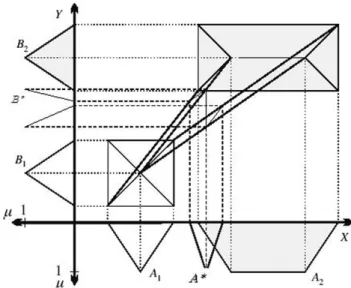
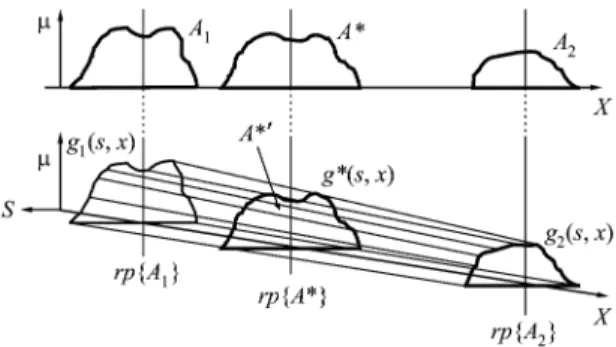
Conceptually different approaches were proposed by Baranyi et al.[25]–[28] based on the relation of the fuzzy sets and by Baranyi et al. in 1998 [29] based on the semantic and inter-relational features of fuzzy sets. They determined the location (central point or most typical point) of the conclusion based on the ratio of the centers of the observation and the antecedents. After all involved sets are rotated by 90 around their centres, and by connecting the corresponding points of antecedents and consequents, two solids can be formed: one in the input and one in the output dimension. On Fig. 2 we depicted the solid formed in the input dimension. The solids are cut at the centres of the observation and at the determined location of the conclusion, respectively, which results in the set in the input space and in the set in the output space. Then, a revision function is used to determine the final conclusion based on the similarity of the observation and the “interpolated” observation . A practically applicable technique for determining the exact shape of this solid is described in detail in [28].
These methods have numerous advantages, such as
— they always give an interpretable conclusion as a “real” fuzzy set, i.e., any abnormal shape of the conclusion is precluded;
— they can be applied to arbitrary shaped fuzzy sets, i.e., neither convexity nor normality is required, only the centres of the sets are supposed to be ordered. It means that some part of the observation can even exceed the support of antecedents;
— versions specialized for piecewise linear fuzzy sets produce piecewise linear fuzzy set as conclusions, hence the shape of the sets at hand is preserved. The only problematic point of these methods is that the calcula-tion of the revision funccalcula-tion even for the special piecewise linear case needs considerable time, thus one of the most important reasons for inventing fuzzy interpolation techniques is violated or at least partly neglected.
Another fuzzy interpolation technique was developed in 1996 by Gedeon and Kóczy [30] founded on the preservation of “rel-ative fuzziness,” a term referring to the size a fuzzy set’s flanks (see also Fig. 5). This approach cannot be applied if any of the
consequent sets are crisp, because of a zero divisor in the for-mulae. This technique was extended by Kóczy in 1997 [31], which was suitable for the above mentioned crisp sets, as well. The authors also showed its immediate connection with FERI. These techniques are applicable also to CNF sets.
In 1996, Kovács and Kóczy proposed yet another interpola-tion technique based on the approximainterpola-tion of the vague envi-ronment of fuzzy rule bases [32]–[34].
A further modified variant of the original technique was pub-lished by Tikk and Baranyi in [7], which was termed modified alpha-cut based interpolation (MACI). MACI technique solves the abnormality problem effectively, while it maintains the ad-vantageous properties of the original approach. In [35] the au-thors show that MACI can be applied to arbitrary shaped fuzzy sets, i.e., even the normality of sets can be relaxed. Obviously, the complexity of the involved fuzzy sets increases the calcula-tion need required to determine the conclusion.
We remark that recently Jenei gave an axiomatic characteriza-tion of fuzzy rule interpolacharacteriza-tion [36]–[38]. This work is however more theoretical and does not propose any easily implementable algorithm, although it completely excludes abnormality in the conclusion.
C. The KH Rule Interpolation Technique
Let us introduce the concept of -cut-distance-based KH rule interpolation. Every fuzzy sets can be approximated with the use of the family of its -cuts. Theoretically all infinite many cuts should be calculated for the approximation that would yield a combinatorial explosion. In most practical cases, however, if the membership function is piecewise linear, it is often sufficient to calculate its -cuts for only a few important or typical values [18], [21], [22], e.g., in the trapezoidal or triangular cases for
and .
The KH rule interpolation algorithm requires the following conditions to be fulfilled: the fuzzy sets in both premises and consequences have to be CNF sets with bounded support, having also continuous membership functions. When input and output universes are bounded and gradual—guaranteeing the existence of a total ordering on them—a partial ordering can be introduced among CNF sets of the input by means of their -cuts
and
i.e., in words, precedes . Here, denotes the set of all CNF sets of .
Based on comparable fuzzy sets, the concept of fuzzy dis-tance can be introduced, and this reduces the problem of de-termining conclusion in sparse rule bases to the application of classical function approximation techniques like interpolation or extrapolation (more details in [39]).
The simplest of these techniques is the linear interpolation of two rules for the area between their antecedents. This can be applied if the observation is located so that
Fig. 3. Location of involved fuzzy sets.
with an apparent ordering . Here and
form the pair of flanking rules for the observation (see Fig. 3).
Using the concept of fuzzy distance , FERI can be written as
(2) where (the consequent) is unknown. After decomposing (2) for all (in practice only breakpoint levels are consid-ered), it can be solved for every independently.
The following formulas are the solution for the linear KH in-terpolator ( and denote “lower” and “upper” fuzzy distance, respectively)
(3)
The two families of solutions determine a fuzzy set , if
they satisfy for every , cf. [39], and
also and
whenever . In certain cases these conditions are not satisfied and, hence, we obtain a conclusion that is not directly interpretable as a fuzzy set or that is completely empty. This is the most important disadvantage of the linear KH technique apart from the restriction on the shape of the input sets, which is rather intuitive for most real applications.
In order to alleviate this problem, conditions were imposed by Kóczy and Kovács [18], Kawase and Chen [20], and Shi and Mizumoto [21], [23] so as to yield a real fuzzy set (see also the survey on other proposed approaches in the previous Section II-B).
The principle of interpolating two rules can be extended in many different ways. One of the most obvious extensions of the interpolation of two rules is the interpolation of rules ( and flanking the observation in the sense of ), where pairs of flanking rules are considered, and the further the elements of the pair from the observation are located, the less weight the re-spective consequents play in the construction of the conclusion. It is obtained from the solution of (3) repeatedly for the pairs
Fig. 4. Notations used.
of points and by averaging the various solutions in a weighted way. The overall solutions are
(4)
More details on this technique can be found in [4]. It was shown in [40] that the generalized form of KH interpolator is a mathe-matically stable technique, i.e., independently of the location of the fuzzy sets being the basis of the calculation, the KH inter-polator is able to approximate “well” any continuous function; i.e., KH interpolator possesses a practically enhanced version of the general universal approximator property.
III. FUZZYRULEINTERPOLATION FORMULTIDIMENSIONAL
INPUTSPACES
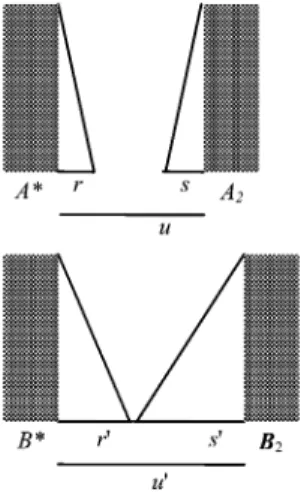
In real fuzzy applications, the input vector involves more than one variable, therefore the characteristics of fuzzy rule interpo-lation for multidimensional input spaces is of much interest. In fact, the advantages of using sparse rule bases manifest only with a few to a few dozen variables really. In this paper, we will limit ourselves to the analysis of only three techniques that can be extended for use in multidimensional input spaces: the orig-inal KH fuzzy interpolation technique [4], the modified -cut fuzzy interpolation (MACI) technique [7] and finally the new improved fuzzy interpolation technique for multidimensional input spaces (IMUL) proposed here. Fig. 4 shows the notations for two trapezoidal rules used in the following analysis. A. KH Fuzzy Rule Interpolation for Multidimensional Input Spaces
The KH fuzzy interpolation can be extended to multidimen-sional input spaces, after normalization of the dimensions by di-viding the values in by , for every , thus
by using the Euclidean distance on all input spaces. For input dimensions, the following hold.
The right core point for trapezoidal membership
(5) where
and
The right flank support point is defined by the expression,
(6) where
and
The left flank support and left core points can be calculated in a similar way.
B. MACI Fuzzy Rule Interpolation for Multidimensional Input Spaces
MACI works with the vector description of fuzzy sets. The fuzzy set is represented by a vector
, where are the
char-acteristic points of , and is the reference point of with membership degree one. This means that , and are the left flank and right flank of , respectively. Similarly as in the case of KH interpolation, the basic technique of MACI is extended to multidimensional input spaces using Euclidean distance on all input spaces. In our case, the reference points of all membership functions can be calculated by taking the mid point of the membership function. For input dimensions, the reference point of the interpolated conclusion for trapezoidal membership function is
where
(7)
With the reference point the left and right cores can be calcu-lated. For the right core
(8) where
For the right flank
(9) where
The left side is calculated in a similar way.
MACI will only yield singleton conclusion if and only if the consequents are singletons themselves.
C. IMUL Fuzzy Rule Interpolation for Multidimensional Input Spaces
This technique incorporates certain features of the MACI and the conservation of fuzziness technique, which is also based on FERI in the original KH interpolation sense [30]. IMUL uses the vector representation form of fuzzy sets (first proposed in [41]), and it applies the coordinate transformation features of MACI. At the same time, it can take the fuzziness of the fuzzy sets in the input space at the conclusion as those are presented in the conservation of fuzziness technique. The advantage of this fuzzy interpolation technique is not only that it takes the fuzziness of the sets at the input spaces, but also takes the core at the consequents into the calculation.
For input dimensions, the reference characteristic point of the interpolated conclusion with the use of Euclidean distance is:
where
Fig. 5. Ratio for the fuzziness.
By using the previous reference point, the right core of the con-clusion calculated as
(11) where
The left core is obtained analogously.
After calculating the two sides of the core, the two flanks can be determined. When calculating the left and right flanks of the conclusion, the relative fuzziness of the fuzzy sets in all the input spaces is taken into consideration as follows. See Fig. 5.
First, we present the calculation of the right flank of the con-clusion. Based on and , the fuzziness of the antecedents
and consequent can be calculated as
(12) (13) The fuzziness of the observed antecedents and the interpo-lated consequent can then be obtained as
(14) (15) The distance of the antecedents and consequent are calculated as follows:
(16) (17) In multidimensional input spaces
(18)
(19)
(20)
For the right flank
(21) The technique is applicable if the observations in each
dimen-sion fulfils
(22) in the sense that the corresponding coordinates in the vector representation of these fuzzy sets are monotone according to
, the ordering in the th dimension.
The following statement follows from the properties of the MACI, but as in [7] it is proved only for the one-dimensional case, it is extended here.
Proposition 1: if in all dimensions the location of the antecedents fulfil expression (22). Proof: We show this for . The proof for the other two parameters is then straightforward. For it is obvious
be-cause condition (22) implies as
for every . The marginal cases are obtained when the reference points of all the observations are identical with the reference points of either the left or the right antecedents.
Theorem 1: With IMUL technique, the slopes of the conse-quent never collapse, i.e.,
(23) Proof: We prove the theorem for the right flank. The re-sults for the left flank can be obtained similarly.
First, we show that , which is, in fact, a consequence of the MACI algorithm used
(24) The last inequality holds, because Proposition 1 ensures that is in the unit interval and (1) implies that the second mem-bers of the products cannot be negative.
Second, we show that . This is straightforward from the definition of , as is nonnegative and
is positive.
Proposition 2: The IMUL technique results in singleton fuzzy set if and only if all the observations are crisp (in the
Fig. 6. Singleton fuzzy set.
sense that apart from the core, the membership degrees vanish) and the core of the consequents is single point.1
Proof: : This is the consequence of the second condition, as then in (24) both tags vanish.
: It follows from the first condition, because from this
for all and, thus, .
Remark: It is a very advantageous property of IMUL that no defuzzification is needed in the case of crisp observations. The proper selection of defuzzification method is usually a pretty difficult issue for system designers, because it is problem de-pendent. This problem can be avoided by using IMUL, if it can be ensured that all observations are crisp.
IV. CASESTUDY ANDDISCUSSIONS
In this section, we will first take a look at the results generated by the three fuzzy rule interpolation techniques (KH, MACI, and IMUL) discussed in the previous section. After their results have been shown and compared, we will further examine the possible use of these techniques in two real world applications: well log analysis in petroleum engineering and hydrocyclone control system in mineral processing.
A. Comparison Study
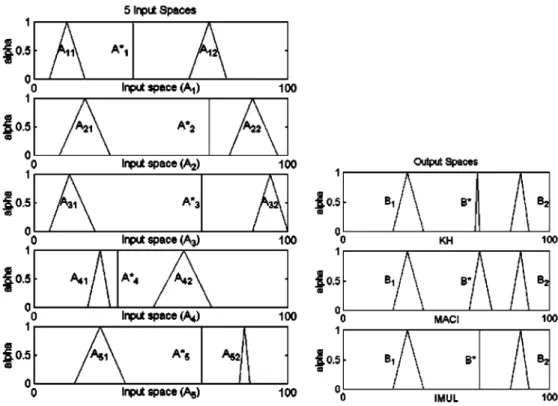
In this first test, a total of five input dimensions are used to predict one output dimension. IMUL fuzzy rule interpolation technique will result in a singleton fuzzy set if and only if all the observations are crisp and the core of the consequent is only one point as shown in Fig. 6.
From Fig. 6, it can be concluded that all three techniques generate similar results. Observe that IMUL has the advantage of obtaining the prediction results directly from the interpolated results, i.e., as remarked earlier, no defuzzification is needed.
1The consequents are so-called fuzzy numbers.
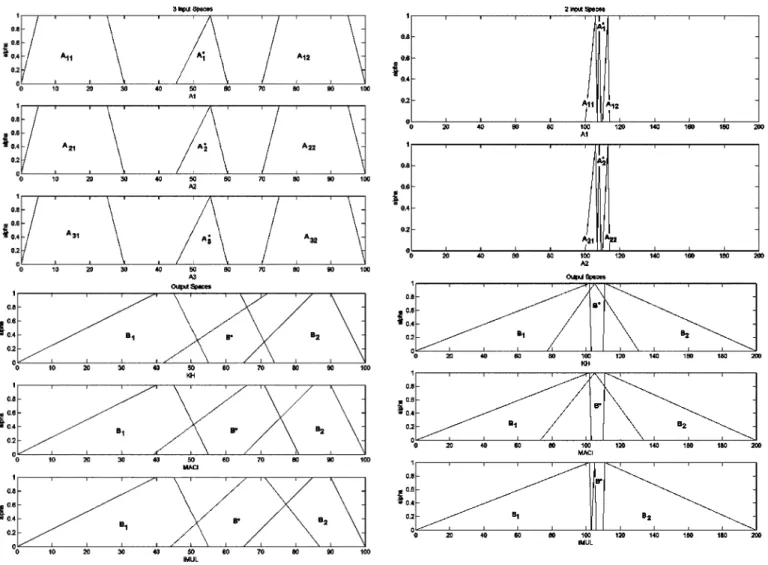
In the second test, we use three input dimensions to show that IMUL and MACI could avoid the undesirable feature of the original KH interpolation. The result can be observed from Fig. 7.
In the third test, we use two input dimensions to show that IMUL has another advantage feature over KH and MACI such that the interpolated results inherit the fuzziness from the input space rather than the output space. In other words, the interpo-lated should be similar to rather than and . Fig. 8 shows the results of this advantage feature of IMUL over KH and MACI. We can interpret this feature in such a way that IMULs result is more accurate, as the conclusion is less fuzzy.
In these case studies, we have shown that IMUL can be used to perform fuzzy rule interpolation for multidimensional input spaces, with advantages over KH and MACI fuzzy interpolation technique. In Sections IV-B and C, we will show the use of the three methods for two real world applications.
B. Application to Well Log Analysis
In petroleum reservoir modeling, boreholes are drilled at dif-ferent locations around the region. Well logging instruments are lowered into the borehole to collect data at different depths known aswell log data. Well logging instruments used in the measurement of well log data fall broadly into three categories: electrical, nuclear, and acoustic [42]. Examples are gamma ray (GR), resistivity (RT), spontaneous potential (SP), neutron den-sity (NPHI), and sonic interval transit time (DT). There are over fifty different types of logging tools available for different requirements. Beside the well log data, samples from various depths are also obtained and undergo extensive laboratory anal-ysis. This laboratory analysis data is known ascore data. In well log analysis, the objective is to establish an accurate interpre-tation model for the prediction of petrophysical characteristics such as porosity, permeability and volume of clay for uncored
Fig. 7. Undesirable feature of KH interpolation.
depths and boreholes around the region [43], [44]. Such infor-mation is essential to the determination of the economic via-bility of a reservoir to be explored.
Normally the information embedded in available core data is not enough to cover the whole range of values. With the use of fuzzy rule extraction techniques, fuzzy rules generated from these core data form a sparse fuzzy rule base, so conventional fuzzy reasoning techniques cannot be used here. This is due to the lack of an inference mechanism in cases when observations find no fuzzy rule to fire, in uncored depths or wells around the region. This is undesirable when using a fuzzy interpretation model. If more than half the input instances in the prediction well cannot find any rule to fire, this interpretation model is considered useless.
In this case study, data from two wells in the same region are used. The input well logs used are GR, deep induction resis-tivity (ILD), and DT. They are used to predict the petrophysical property porosity (PHI). Core data from one well are used to establish a prediction model based on the fuzzy rule extraction algorithm. The model is then used to predict the porosity in the second well. All variables are normalized between the values of 0 and 1. The first well has a total of 71 core data and is used to establish the fuzzy rules. The second well has 51 core data and is used as the testing well to determine the prediction accuracy. As the fuzzy rule extraction algorithm is not the main focus of
Fig. 8. Broad interpolated fuzzy memberships.
this paper, we will not discuss the details here. The self-gen-erating fuzzy rules algorithm that has shown successful appli-cation in this field is used [45]. After all the fuzzy rules have been set up, the input instances from the second well are used to infer the predicted PHI. Using Mamdami type fuzzy inference system [2], it was found that two input instances could not find any rule to fire. When no fuzzy rule can be found to produce a reasonable inference, they are set to zero by default.
After the two input instances have been picked up that do not have any fuzzy rule to fire, the nearest fuzzy rules in the estab-lished fuzzy rule base need to be selected. From observation and Euclidean distance measured on each input variable, the nearest fuzzy rules of the two input instances are determined for use by IMUL. We proceed analogously when applying KH and MACI methods. IMUL technique mentioned in the previous section is used as a fuzzy rule interpolation technique to interpolate the in-ference results of the input instances that find no fuzzy rules to fire. All values have been normalized between 0 and 100 when performing fuzzy rule interpolation.
In order to highlight the significance of using IMUL fuzzy rule interpolation in real world application, we have designed two tests. In the first test, we applied input instances to a fuzzy inference system that showed that two input instances could not find any fuzzy rules to perform inference and set to zero by de-fault. After which, the predicted PHI from this fuzzy inference
Fig. 9. Comparison of KH, MACI, and IMUL on petroleum data. TABLE I
COMPARISONRESULTS ONPETROLEUMDATA
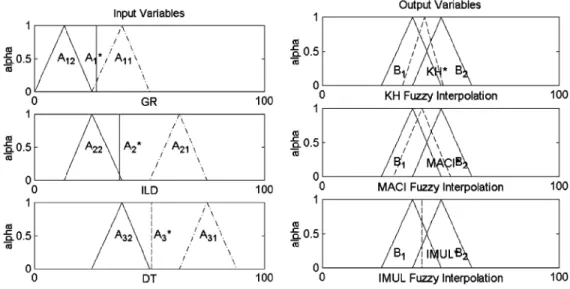
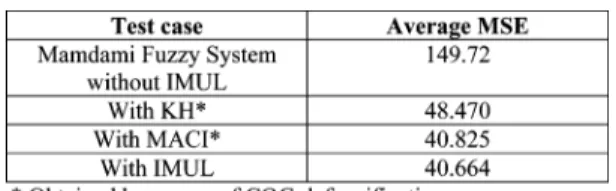
system and the core PHI were used to calculate the average mean square errors. In the second test, we extracted the two input instances that could not find any fuzzy rules to perform infer-ence and applied KH, MACI, and IMUL fuzzy rule interpola-tion techniques to interpolate PHI for them. Fig. 9 depicts a case when rule interpolation methods were used. Table I shows the comparison average mean square errors (MSE) of fuzzy systems constructed from the two tests.
We can observe that with the assistance of fuzzy rule inter-polation techniques, the mean square error of the predicted PHI as compared to the core PHI has decreased quite significantly. This is partly due to the default prediction output for the two input instances being set to zero. The three fuzzy rule interpo-lation techniques yield similar MSE, where KHs error is some-what higher than the ones obtained by IMUL and MACI.
Here we note again that in the case of IMUL, no defuzzifica-tion is needed because the observadefuzzifica-tions are crisp. This is a clear advantage over MACI in real-world applications. When defuzzi-fication comes into question, there is another decision: which method to choose. In the example, we experienced with COG, COA and MOM methods, and they produced different MSE er-rors. In Table I the best values are tabulated obtained with COG. Applying COG, MSE errors of IMUL and MACI are identical in the given examples, because have the same reference point in both cases and is a symmetrical fuzzy set.
In this case study, the number of input instances that cannot find any fuzzy rule to fire is small. In cases where more than half input instances in the prediction well cannot find any rule to fire, the Mamdani based fuzzy model could not be used for petro-physical properties prediction at all. With the applied fuzzy rule interpolation techniques (IMUL, MACI, or KH), the number of
fuzzy rules is considered the same, as no extra fuzzy rule is added into the system. However, the prediction ability has im-proved. This is a desirable characteristic for fuzzy petrophysical properties prediction, as an increase in the number of fuzzy rules would result in an increase in complexity that would make the examination of the fuzzy rule base more difficult.
C. Applying in Hydrocyclone Parameter Determination Hydrocyclones are used extensively in mineral processing and manufacturing industries to classify and separate particles suspended in fluid [46], [47]. Hydrocyclones normally have no moving parts. They are funnel-shaped devices manufactured in different dimensions to suit specific operations. A hydrocyclone is set up in a vertical arrangement with the slurry being fed into the hydrocyclone through the inlet. The bulk of the flow pat-tern will follow a downward spiral inside the cyclone along the wall containing coarse solid particles. The coarse particles leave the hydrocyclone through the underflow opening known as the spigot. On the other hand, an upward helical flow containing fine solid particles is discharged via the vortex finder as over-flow. For a hydrocyclone of fixed geometry, the performance of the system depends on a number of parameters. Some of these parameters are fixed and some are variable. A number of these parameters are related to the physical size of the system, such as the internal diameters of the cyclone , inlet pipe , over-flow pipe and spigot opening . Other parameters are dependent on the operating conditions, the characteristics of the slurry, and the rate of feed into the hydrocyclone. The separation efficiency of particles of a particular size is determined by an operational parameter known as . This value indicates that 50% of a particular size particle is reported to the overflow and the other 50% to the underflow streams. The correct estimation of is important since it is directly related to the efficiency of operations and it will also enable control of the hydrocyclone. In this case study, data collected from a Krebs hydrocyclone model D6B-120-839 has been used. There are a total of 70 training data and 69 testing data used in this study. The input parameters are inlet flow rate , density , vortex finder height , spigot opening , and temperature of slurries and the output is . When the set of sparse rules are used to perform control on the
TABLE II
COMPARISONRESULTS ONHYDROCYCLONEDATA
testing data, 4 input instances cannot find any fuzzy rules to fire using the conventional fuzzy system. Similar to the previous ap-plication, from the observation and Euclidean distance measured on each input variable, the nearest fuzzy rules to the four input instances are determined for use by fuzzy rule interpolation.
Two tests are then designed similarly to the previous applica-tion. In the first test, the input instances are input to the Mamdami type fuzzy inference system [2]. The four inputs instances that find no fuzzy rules to fire are set to zero by default using the Mam-dami type fuzzy inference system. In the second test, KH, MACI and IMUL fuzzy rule interpolation techniques are used for the four input instances that cannot find fuzzy rules to interpolate the predicted . Table II shows the comparison average MSE for the fuzzy systems constructed from the two tests.
From the average mean square errors of the two tests, it can be observed that the fuzzy hydrocyclone model performs unrea-sonably when no fuzzy rule interpolation technique is used. In contrast, when fuzzy rule interpolation techniques are applied, MSE is significantly better. This is mainly due to the four input instances that find no rule to fire and generate a default value of zero. Here, MSE of IMUL is even slightly better than that of MACI when applying the best defuzzification method for the given problem. With KH, MACI and IMUL fuzzy rule interpola-tion techniques, the number of fuzzy rules is not increased, but the prediction ability has improved. Again this has shown that IMUL and other fuzzy rule interpolation techniques play an im-portant role to ensure the usability of a sparse fuzzy rule. IMUL has the advantage over the other two methods that it gives directly interpretable crisp output and it generates slightly better MSE.
V. CONCLUSION
This paper has examined the problem of a sparse fuzzy rule base and insufficient training data that may cause undesirable prediction outcomes. This is mainly due to input instances that could not find any rule in the fuzzy rule base. To provide a solu-tion to this problem, fuzzy rule interpolasolu-tion techniques can be used. However, the majority of the fuzzy rule interpolation tech-niques published only present analysis limited to one input vari-able. This paper investigates KH, MACI, and an improved fuzzy interpolation technique for multidimensional input spaces. This technique can be used to interpolate the gaps between the rules for engineering problems with multidimensional input spaces. It also has the advantageous property that it does not require the application of any defuzzification methods when the observa-tions are crisp, which is typical for engineering problems. This ensures that the set of sparse fuzzy rules generated by the fuzzy rule extraction technique will be usable in a practical system. This is significant as this will allow the use of a fuzzy system as an alternative for most engineering problems, at the same
time without increasing the number of fuzzy rules that allows more human control. Applications in the field of petroleum en-gineering and mineral processing have also been examined. The results have shown that this improved fuzzy rule interpolation technique for multidimensional input spaces can be used in en-gineering applications efficiently.
REFERENCES
[1] L. A. Zadeh, “Fuzzy sets,”Inform. Control, vol. 8, pp. 338–353, 1965. [2] E. H. Mamdami and S. Assilian, “An experiment in linguistic synthesis
with a fuzzy logic controller,”Int. J. Man Mach. Stud., vol. 7, pp. 1–13, 1975.
[3] M. Sugeno and T. Takagi, “Fuzzy identification of systems and its appli-cations to modeling and control,”IEEE Trans. Syst., Man, Cybern., vol. SMC-15, no. 1, pp. 116–132, Feb. 1985.
[4] L. T. Kóczy and K. Hirota, “Approximate reasoning by linear rule inter-polation and general approximation,”Int. J. Approx. Reason., vol. 9, pp. 197–225, 1993.
[5] , “Interpolation and size reduction in fuzzy rule bases,” Tokyo Inst. Technol., Tech. Rep. 93-94/401, LIFE Chair of Fuzzy Theory, 1993. [6] P. Baranyi and L. T. Kóczy, “Multidimensional fuzzy rule inter- and
ex-trapolation based on geometric solution,” inProc. 7th Int. Power Elec-tronics and Motion Control Conference (PEMC’96), vol. 3, Budapest, Hungary, 1996, pp. 443–447.
[7] D. Tikk and P. Baranyi, “Comprehensive analysis of a new fuzzy rule in-terpolation method,”IEEE Trans. Fuzzy Syst., vol. 8, no. 3, pp. 281–296, Jun. 2000.
[8] L. T. Kóczy and K. Hirota, “Size reduction by interpolation in fuzzy rule bases,”IEEE Trans. Syst., Man, Cybern., vol. 27, no. 1, pp. 14–25, Feb. 1997.
[9] D. G. Burkhard and P. P. Bonissone, “Automated fuzzy knowledge base generation and tuning,” inProc. IEEE Int. Conf. Fuzzy Systems, San Diego, CA, 1992, pp. 179–196.
[10] L. T. Kóczy and K. Hirota, “Approximate inference in hierarchical struc-tured rule bases,” inProc. 5th IFSA World Congr. (IFSA’93), Seoul, Korea, 1993, pp. 1262–1265.
[11] D. Dubois and H. Prade, “Gradual rules in approximate reasoning,” In-form. Sci., vol. 61, pp. 103–122, 1992.
[12] I. B. Türks¸en and Z. Zhong, “An approximate analogical reasoning ap-proach based on similarity measures,”IEEE Trans. Syst., Man, Cybern., vol. 18, no. 6, pp. 1049–1056, D 1988.
[13] I. B. Türks¸en and Z. Zhong, “An approximate analogical reasoning ap-proach of functions,” inProc. 2nd Int. Conf. Fuzzy Logic and Neural Networks (IZUKA’92), Iizuka, Japan, 1992, pp. 629–632.
[14] L. Ding, L. Shen, and M. Mukaidono, “Revision principle for approxi-mate reasoning, based on linear revising method,” inProc. 2nd Int. Conf. Fuzzy Logic and Neural Networks (IZUKA’92), Iizuka, Japan, 1992, pp. 305–308.
[15] Z. Shen, L. Ding, and M. Mukaidono, “Fuzzy resolution principle,” in Proc. IEEE 22nd Int. Symp. Multi-Valued Logic (IEEE-ISMVL), Fukuoka, Japan, 1998, pp. 210–215.
[16] , “Methods of revision principle,” inProc. 5th IFSA World Congress (IFSA’93), Seoul, Korea, 1993, pp. 246–249.
[17] L. T. Kóczy, “Computational complexity of various fuzzy inference al-gorithms,”Ann. Univ. Sci., vol. 12, pp. 151–158, 1991.
[18] L. T. Kóczy and Sz. Kovács, “On the preservation of the convexity and piecewise linearity in linear fuzzy rule interpolation,” Tokyo Inst. Technol., Yokohama, Japan, Tech. Rep. TR 93-94/402, LIFE Chair of Fuzzy Theory, 1993.
[19] , “Shape of the fuzzy conclusion generated by linear interpolation in trapezoidal fuzzy rule bases,” inProc. 2nd Eur. Congr. Intelligent Tech-niques and Soft Computing, Aachen, Germany, 1994, pp. 1666–1670. [20] S. Kawase and Q. Chen, “On fuzzy reasoning by Kóczy’s linear rule
interpolation,” Teikyo Heisei Univ., Heisei, Japan, 1996.
[21] Y. Shi and M. Mizumoto, “On Kóczy’s interpolative reasoning method in sparse rule bases,” inProc. 10th Fuzzy Syst. Symp., Osaka, Japan, 1994, pp. 211–224.
[22] , “Some considerations on Kóczy’s interpolative reasoning method,” inProc. FUZZ-IEEE/IFES ’95, Yokohama, Japan, 1995, pp. 2117–2122.
[23] , “A note on reasoning conditions of Koczy’s interpolative rea-soning method,”Fuzzy Sets Syst., vol. 96, no. 3, pp. 373–379, 1998. [24] G. Vass, L. Kalmár, and L. T. Kóczy, “Extension of the fuzzy rule
in-terpolation method,” inProc. Int. Conf. on Fuzzy Sets Theory and its Applications, Liptovský, Czechoslovakia, Jan. 1992.
[25] P. Baranyi and T. D. Gedeon, “Rule interpolation by spatial geometric representation,” inProc. IPMU’96, Granada, Spain, 1996, pp. 483–488.
[26] P. Baranyi, T. D. Gedeon, and L. T. Kóczy, “A general interpolation technique in fuzzy rule bases with arbitrary membership functions,” in
Proc. IEEE Int. Conf. SMC, 1996, pp. 510–515.
[27] P. Baranyi and L. T. Kóczy, “A general and specialised solid cutting method for fuzzy rule interpolation,” inBUSEFAL, vol. 67, 1996, pp. 13–22.
[28] P. Baranyi, L. T. Kóczy, and T. D. Gedeon, “A generalized concept for fuzzy rule interpolation,”IEEE Trans. Fuzzy Syst., vol. 12, no. 6, pp. 820–832, Dec. 2004.
[29] P. Baranyi, S. Mizik, L. T. Kóczy, T. D. Gedeon, and I. Nagy, “Fuzzy rule base interpolation based on semantic revision,” inProc. IEEE Int. Conf. SMC, San Diego, CA, 1998, pp. 1306–1311.
[30] T. D. Gedeon and L. T. Kóczy, “Conservation of fuzziness in rule inter-polation,” inProc. Symp. New Trends in Control of Large Scale Systems, vol. 1, Herl’any, Slovakia, 1996, pp. 13–19.
[31] L. T. Kóczy, K. Hirota, and T. D. Gedeon, “Fuzzy rule interpolation by the conservation of relative fuzziness,” Hirota Lab., Dept. Intell. Comput. Syst. Sci., Tokyo Inst. Technol., Yokohama, Japan, Tech. Rep. 97/2, 1997.
[32] Sz. Kovács, “New aspect of interpolative reasoning,” inProc. IPMU’96, Granada, Spain, 1996, pp. 477–482.
[33] Sz. Kovács and L. T. Kóczy, “Fuzzy rule interpolation in vague envi-ronment,” inProc. 3rd Eur. Congr. Intelligent Techniques and Soft Com-puting (EUFIT’95), Aachen, Germany, 1995, pp. 95–98.
[34] , “The use of the concept of vague environment in approximate fuzzy reasoning,”Tatra Mountains Math. Publ., vol. 12, pp. 169–181, 1997.
[35] D. Tikk, P. Baranyi, T. D. Gedeon, and L. Muresan, “Generalization of a rule interpolation method resulting always in acceptable conclusion,”
Tatra Mountains Math. Publ., vol. 21, pp. 73–91, 2001.
[36] S. Jenei, “A new approach for interpolation and extrapolation of compact fuzzy quantities,” inProc. 21st Linz Seminar on Fuzz set Theory, Linz, Austria, 2000, pp. 13–18.
[37] , “Interpolation and extrapolation of fuzzy quantities revisited—(I) an axiomatic approach,”Soft Comput., vol. 5, pp. 179–193, 2001. [38] S. Jenei, E. P. Klement, and R. Konzel, “Interpolation and extrapolation
of fuzzy quantities—(II) the multiple-dimensional case,”Soft Comput., vol. 6, no. 3–4, pp. 258–270, 2002.
[39] L. T. Kóczy and K. Hirota, “Ordering, distance and closeness of fuzzy sets,”Fuzzy Sets Syst., vol. 59, no. 3, pp. 281–293, Nov. 1993. [40] D. Tikk, P. Baranyi, Y. Yam, and L. T. Kóczy, “Stability of a new
interpo-lation method,” inProc. IEEE Int. Conf. System, Man, and Cybernetics (IEEE SMC’99), vol. III, Tokyo, Japan, 1999, pp. 7–9.
[41] Y. Yam and L. T. Kóczy, “Representing membership functions as points in high dimensional spaces for fuzzy interpolation and extrapolation,” Dept. Mech. Automat. Eng., Chinese Univ., Hong Kong, Tech. Rep. CUHK-MAE-97-03, 1997.
[42] M. Rider,The Geological Interpretation of Well Logs, 2nd ed. Caith-ness, Scotland: Whittles, 1996.
[43] E. R. Crain,The Log Analysis Handbook Volume 1: Quantitative Log Analysis Methods. Tulsa, OK: Penn Well, 1986.
[44] G. B. Asquith and C. R. Gibson, “Basic well log analysis for geologists,”
AAPG Methods Expl. Ser., vol. 3, pp. 91–95, 1982.
[45] C. C. Fung, K. W. Wong, and P. M. Wong, “A self-generating fuzzy rules inference systems for petrophysical properties prediction,” inProc. IEEE Int. Conf. Intelligent Processing Systems, Beijing, China, 1997, pp. 205–208.
[46] D. Bradley,The Hydrocyclone. New York: Pergamon, 1965. [47] A. Gupta and H. Eren, “Mathematical modeling and on-line control of
hydrocyclones,”Proc. Aus. IMM, vol. 295, no. 2, pp. 31–41, 1990.
Kok Wai Wong(SM’02) received the B.Eng. (Hons) and Ph.D. degrees from the School of Electrical and Computer Engineering, Curtin University of Tech-nology, Australia, in 1994 and 2000, respectively.
He joined the School of Information Technology, Murdoch University, Perth, Australia, as a Lecturer in 2005. Prior to this appointment, he was an Assistant Professor at the School of Computer Engineering, Nanyang Technological University, Singapore. His other professional employments include working as a Lecturer and Research Associate at the School of Information Technology, Murdoch University, and as a Lecturer at the South East Metropolitan College of TAFE, Australia. His research interests include intelligent data procession, computational intelligence especially fuzzy Systems, artificial neural networks, and hybrid Systems. Some application areas are business intelligence, petroleum, and spatial analysis.
Domonkos Tikkreceived the B.Sc. and M.Sc. de-grees in computer science both from Eötvös Loránd Science University, Hungary, in 1993 and 1995, re-spectively, and the Ph.D. degree in engineering from Budapest University of Technology and Economics (BUTE), Hungary, in 2000.
Since 1998, he has been a Research Assistant at BUTE. Since 2003, he has been with the same insti-tution as the Project Leader of an R&D program. He was a Visiting Scholar at Murdoch University, Perth, Australia, in 2000; Chonbuk National University, Chonju, Korea, in 2001; and Hull University, Hull, U.K., in 2003. His research interests include data mining, text mining, automatical categorization methods, computer linguistics, fuzzy systems, and soft computing techniques.
Dr. Tikk is a member of the Hungarian Society of the International Fuzzy System Association (IFSA).
Tamás D. Gedeon(M’98) received the B.Sc. (with honors) and Ph.D. degrees from The University of Western Australia, and the Graduate Diploma in management from the Australian Graduate School of Management from the University of New South Wales, Sydney, Australia.
He is currently the Head of the Department of Computer Science at Australian National Uni-versity, Canberra. His research is focused on the development of automated systems for information extraction and for the synthesis of the extracted information into humanly useful information resources, primarily using neural network and fuzzy logic methods.
Dr. Gedeon is an Associate Editor of the IEEE TRANSACTIONS ONNEURAL
NETWORKSand a Past-President of the Asia Pacific Neural Network Assembly.
László T. Kóczywas born in Hungary in 1952. He received the equivalent of the M.Sc. degree in elec-trical engineering, the M.Sc. degree in control en-gineering, and the Ph.D. degree in enen-gineering, all from the Technical University of Budapest, Budapest, Hungary, in 1975, 1976, and 1977, respectively.
Since 1976, he has been with the Department of Telecommunications, Technical University of Budapest, where he is currently a Professor. He was a Visiting Professor at the Dalian Maritime University, China, in 1990 (intensive summer term), The Pohang Institute of Science and Technology, Korea, in 1992, the Tokyo Institute of Technology, Yokohama, Japan, in 1993 and 1994 (holding the Fuzzy Theory Chair), the J. Kepler University, Linz, Austria, in 1994 and 1997(part-time), the University of Trento 1995–96 (part time), and has been a regular Visiting Professor at the University of New South Wales (Sydney), Murdoch University (Perth), and the Australian National University (Canberra), all in Australia, from 1997 to the present. His research interests include fuzzy systems, especially reasoning, modeling and control, image understanding, graphs and hardware components, telecommunications networks and control, and genealogy and heraldry.
Dr. Kóczy is the Past President of the International Fuzzy Systems Associa-tion, a member of the Administrative Committee of the IEEE CIS, a Founding Member of the EURO Working Group on Fuzzy Sets, the Honorary Life Presi-dent of the Hungarian Fuzzy Association and an Associate Editor ofFuzzy Sets and Systems, ofMathware and Soft Computing, of theJournal of Advanced Computational Intelligence, and a few other professional periodicals. He is a Fellow of the Hungarian Academy of Engineering.