ScholarWorks
ScholarWorks
Walden Dissertations and Doctoral Studies Walden Dissertations and Doctoral Studies Collection
2020
Community College Students' Perceptions of Developmental
Community College Students' Perceptions of Developmental
Mathematics and Influences on Persistence
Mathematics and Influences on Persistence
Sumithra S. IyerWalden University
Follow this and additional works at: https://scholarworks.waldenu.edu/dissertations Part of the Science and Mathematics Education Commons
This Dissertation is brought to you for free and open access by the Walden Dissertations and Doctoral Studies Collection at ScholarWorks. It has been accepted for inclusion in Walden Dissertations and Doctoral Studies by an authorized administrator of ScholarWorks. For more information, please contact [email protected].
Walden University
College of EducationThis is to certify that the doctoral study by Sumithra Iyer
has been found to be complete and satisfactory in all respects, and that any and all revisions required by
the review committee have been made. Review Committee
Dr. Linda Swanson, Committee Chairperson, Education Faculty Dr. Sydney Parent, Committee Member, Education Faculty Dr. Timothy Lafferty, University Reviewer, Education Faculty
Chief Academic Officer and Provost Sue Subocz, Ph.D.
Walden University 2020
Abstract
Community College Students’ Perceptions of Developmental Mathematics and Influences on Persistence
by Sumithra Iyer
MS, University of Madras, 1995 BS, University of Madras, 1993
Doctoral Study Submitted in Partial Fulfillment of the Requirements for the Degree of
Doctor of Education
Walden University January 2020
Abstract
The increase in the dropout rates associated with developmental mathematics classes in 1 Texas community college provoked the need for this study. The purpose of this case study was to explore students’ reasons for dropping out of developmental mathematics and what might have helped them be successful. Tinto’s model of student attrition, which is characterized by students’ social and academic integration affecting their retention in the college, provided the conceptual framework for the study. The research questions addressed the students’ perceptions of both why they dropped out of developmental mathematics courses and what might have helped them to successfully complete those courses. A purposeful sampling process was used to select 7 developmental mathematics students who did not complete the course. Data were collected through semistructured interviews from 7 developmental mathematics students. Emergent themes were identified through open coding, and the findings were developed and reviewed for trustworthiness through member checking, rich descriptions, and a code-recode process. Findings revealed that students needed help in acquiring a better understanding of the subject, in adapting to different teaching methods, and in finding available resources. A professional development training for mathematics instructors was created to share the why students drop out of developmental mathematics and to provide suggestions for improved teaching practices. Results from this study may lead to the positive social change by providing teachers with successful developmental mathematics strategies to improve student performance.
Community College Students’ Perceptions of Developmental Mathematics and Influences on Persistence by Sumithra Iyer MS, University of Madras, 1995 BS, University of Madras, 1993
Doctoral Study Submitted in Partial Fulfillment of the Requirements for the Degree of
Doctor of Education
Walden University January 2020
Dedication
I would like to dedicate this study to my beloved parents, mentors and guides. I could not have done this without you. Thank you for your endless love, support and encouragement along the way.
Acknowledgments
I thank my parents for their love and support throughout my life. I also
acknowledge my husband, my children, and my sister for giving me the strength to reach for the stars and chase my dreams. You all deserve my wholehearted thanks.
I would like to sincerely thank my professor Dr. Swanson for her support throughout this study and for being patient with me. Her comments and questions were thought provoking and invaluable. I would also like to thank Dr. Parent and Dr. Law for their guidance.
To all my friends, thank you for understanding and encouraging me throughout. Your friendship makes my life a wonderful experience.
i Table of Contents
Section 1: The Problem ... 1
The Local Problem ... 1
Rationale ... 5
Definition of Terms ... 8
Significance of the Study ... 9
Research Questions ... 9
Review of the Literature ... 10
Implications ... 20
Summary ... 20
Section 2: The Methodology ... 22
Introduction ... 22
Research Design and Approach ... 22
Participants ... 24
Data Collection Methods ... 28
Data Analysis ... 30
Data Analysis Results ... 32
Theme 1: Subject Comprehension ... 33
Theme 2: Factors External to the Class ... 36
Theme 3: Resources ... 38
ii
Discrepant Cases... 42
Evidence of Quality ... 43
Findings from the Study ... 44
Perceived reasons for failure to complete course. ... 44
Perceived needs for success. ... 45
Section 3: The Project ... 48
Introduction ... 48
Rationale ... 49
Review of the Literature ... 50
Effective Professional Development Training ... 51
Andragogy ... 53
Access to Educational Resources ... 55
Active Learning ... 58
Cooperative Learning... 59
Project Description ... 60
Needed Resources and Existing Supports ... 61
Potential Barriers and Potential Solutions ... 61
Project Evaluation Plan ... 63
Project Implications ... 63
Section 4: Reflections and Conclusions ... 66
iii
Scholarship ... 68
Project Development ... 69
Leadership and Change ... 69
Reflection of Self as a Practitioner ... 70
Reflection as a Project Developer ... 71
Reflections on the Importance of the Work ... 71
Implications, Applications, and Directions for Future Research ... 72
Conclusion ... 73
References ... 74
Appendix A: The Project ... 97
Section 1: The Problem
The Local Problem
Community colleges provide the first two years of undergraduate education as well as continuing and adult education. Graduating students earn diplomas, associate degrees, and certificates. Community colleges appeal to many different student
populations, in part because they are a fraction of the cost of attending four-year colleges (Hoxby & Turner, 2013). In addition, community colleges have open admission policies, meaning the admission is noncompetitive, and the only criterion for enrollment is a high school diploma or a General Education Development (GED) (Scherer & Anson, 2014). While the low tuition has opened the doors to many students, both student persistence and completion have become issues at the community college (Terriquez, 2015). Also, Pruett (2015) pointed out that student persistence and completion rates in developmental mathematics need to be addressed to improve college success rates. In fact, researchers from the Institute of Higher Education and California State University, Sacramento, identified that only a third of the students enrolled in mathematics classes from California community colleges over six years earned an associate degree or a vocational certificate (Mejia, Rodriguez, & Johnson, 2016). Further, for those students who are not prepared for college-level mathematics, developmental mathematics classes are required to earn a degree Schargel and Smink, (2014) and Tella (2014) noted that the increase in the number of required math courses to earn a degree is linked to higher dropout rates.
In this technological age, knowledge of advanced levels of mathematics is often needed. In order to maintain its competitive position in the global economy, the United States has renewed its interest in STEM (Science, Technology, Engineering, and
Mathematics) education, especially mathematics (Drew, 2015). Mathematics is generally considered a difficult subject when compared to other curriculum subjects (Rotgans & Schmidt, 2014). Developmental mathematics is one of the core prerequisites for
postsecondary education and completing the needed developmental mathematics courses means that students can then advance to college-level mathematics courses (Edwards et al., 2015; Harwell, Moreno, & Post, 2016). According to labor market statistics, a high school diploma is not sufficient to hold a job with a decent wage and between the years 2010 and 2018, 63% of the jobs will require at least some postsecondary education (Albright & Weissberg, 2010). Thus, it is imperative that students complete their degree or their certification, in order to avoid living in poverty (Gándara, 2015). When students drop out of developmental mathematics classes, their graduation is postponed, and this in turn affects the graduation rates of the college.
Over the past few years, many community colleges have adopted President Obama’s challenge, the college completion agenda of 2020, to significantly increase the
postsecondary education attainment goal (Kilgore & Wilson, 2017). In 2012, the state of Texas trailed California and Florida in terms of graduation rates (Texas Higher Education Coordinating Board, 2014). In fall 2012, the enrollment of students in Texas community colleges was more than the enrollment in Texas universities, and 41.5% of the
Education Coordinating Board, 2014). Texas community colleges are apt avenues for the completion agenda because many students prefer completion of some college instead of obtaining college degrees (Monaghan & Attewell, 2015).To work towards the college completion agenda, students need to complete their developmental education, especially in mathematics (Stanley, Hamilton, Allgyer, Ramsey & Pippin, 2012).
Over the past 40 years and over a series of mathematical reforms to improve developmental mathematics learning, many students have dropped out from
developmental mathematics classes (Edwards, Sandoval, & McNamara, 2015). Although many educators and policy makers have developed various strategies to improve
mathematical learning, it is unclear as to why some students drop out of these classes while others succeed (Bol, Campbell, Perez, & Yen, 2016).
In Texas, where my study was conducted, the Texas Higher Education
Coordinating Board (2014) reported that math poses a major barrier in Texas community colleges, with 41% of freshmen underprepared in mathematics. Only one out of three students graduating from high school is ready for college, which is why two-thirds of the students need to take developmental classes (Klasik, & Strayhorn, 2018). Additionally, research conducted by McClenney (2013), with 38,000 students from various community colleges in Texas, showed that even after enrolling in classes 94% of students took a break from their enrollment, with only 72% re-enrolling. McClenney (2013) argued that research is required to track the causes for the dropouts with a major focus on
significant issue in community colleges and has proportionally reduced the graduation rate (Hsu & Gehring, 2016).
This was an opportune time to research the students dropping out of
developmental mathematics because of the attention this issue is receiving nationally and locally. For example, nationally, the dropout issue is referred to as the silent epidemic
(Harada, Kirio & Yamamoto, 2015). Also, according to McKinney and Hagedorn (2017) and Weiss, Visher, Weissman, and Wathington (2015), Texas community college
students’ success rates remain low. Dropouts from developmental mathematics classes cost students loss of potential earnings, and they also result in lower economic returns for the nation and create a large demand for welfare assistance.
The mission of the local community college, where the study was conducted, is to provide high quality, affordable education, preparation for lifelong learning in diverse communities, and work in a global and technological society. According to an internal report from the local community college, the college provides open admissions with an increase in enrollment each year, and a 25.3% increase for developmental mathematics classes. However, during department meetings, faculty expressed concern about retention in developmental mathematics classes because only 17-20% of students who had been required to complete developmental mathematics graduated within two years.
Furthermore, there has been a marked increase in dropout rates associated with developmental math classes in the recent past, leaving a gap between the goals of developmental mathematics courses and student outcomes in those courses (Osborne,
Rimmer & Houston, 2015). This gap has provoked the need to study the reasons leading to dropouts in one Texas community college.
Rationale
According to the Texas Higher Education Coordinating Board, mathematics poses a major barrier to students in Texas community colleges, with 41% of freshmen
underprepared in mathematics (Abraham, Slate, Saxon, & Barnes, 2014). Klasik and Strayhorn (2018) pointed out that nationally only one out of three students graduating from high school is ready for college, which is why two-thirds of the students need to take developmental mathematics classes. Also, according to Daloz (2012), adult learners returning to school also face the challenge of being underprepared, especially in
mathematics. In fact, as Daloz noted, when adult learners take a break from the regular practice of mathematics, they often forget what they learned in the past. Moreover, the complexity of mathematics adds to the frustrations faced by all students at the
developmental level. Mathematics is abstract and needs logical thinking, and the ability to learn mathematics may vary from person to person. In addition, it has been noted that 6 to 7% of the student population in the state of Texas has some disability in learning mathematics (Texas Higher Education Coordinating Board, 2014).
The community college site for this study has a mission to provide high-quality education and lifelong learning. As an open admission public institution, the college awards associate degrees and certificates in more than 70 fields of work within 17 campuses. With no on-campus housing, the students commute to and from campus. This community college provides education to all learners coming from various educational
backgrounds with or without high school diplomas. Initially, they are enrolled in
appropriate classes after taking placement tests and can also enroll into various workforce or career developmental programs if they satisfy the minimum requirement of
developmental mathematics.
According to the Texas Association of Community Colleges, the enrollment of students for the local community college from fall 2008 to fall 2014 increased by 23.1%. Despite the increase in the enrollment, however, data from the college of study, indicate that for the fall of 2013, only 14.8% of students who enrolled in the developmental mathematics classes completed them within a two-year time period. Compared to other subjects, the developmental mathematics sequence had a completion rate of only 22.9%, which was the lowest completion rate of all the subjects. The institutional data do not offer reasons for the low completion rate in developmental mathematics. As a result of this lack of research at the college to explore why some students drop out and others succeed in the subject of developmental mathematics, the department chair and the associate chairs of mathematics are concerned about the low completion rate and support this study. In fact, the department chair of developmental mathematics extended her offer to help (S.F., personal communication, 2015). Moreover, the president of the college is interested in the results of the study (Z.H., personal communication, 2015).
While the low tuition in community colleges has opened the doors to many students, student persistence and completion are now important concerns (Terriquez, 2015). Research from the Institute of Higher Education and California State University, Sacramento, underscores the need for this focus as findings noted that only a third of the
California Community College students enrolled in mathematics classes over six years earned an associate degree or a vocational certificate (Mejia et al., 2016). For those students who are not prepared for college-level mathematics, developmental mathematics classes are required to earn a degree (Schargel & Smink, 2014). Based on students’ performance on COMPASS and ACT scores, they are placed into three levels of developmental mathematics courses. With the lower-level remedial mathematics class being basic mathematics, students move on to beginning and intermediate algebra courses before they enter the college level. These courses do not count towards transfer credit. Tella (2014) noted that the increase in the number of required math courses to earn a degree is linked to higher dropout rates.
Fulcher (2015) feared that the changing policies in mathematics could affect the decline of student success rates. Also, Weiss et al. (2015) mentioned that the mathematics curriculum has changed due to advancements in technology. The use of calculators (or other devices) in classes has brought a fear that it will affect the students’ potential. Also, the handling of high proficiency calculators in the college placement tests can affect student results and cannot be relied upon to measure their true mathematical knowledge (Scott-Clayton, Crosta, & Belfield, 2014). The use of technology may serve as a tool to help with the calculations, but the awareness of the concepts is what it means to learn mathematics (Moore & Thompson, 2015). He examined 10 teachers from middle school through interviews and concluded that it is fun to use calculators, but they are not necessary to learn mathematics.
According to Riconscente (2014), Hispanic students’ success rate in mathematics is below average, and the author argued that the underachievement of these students is due to the lack of understanding of English. The students understood the mathematical process and were able to participate in classroom activities when a considerable amount of Spanish was used in the classroom. Planas and Civil (2015) pointed out, however, that the students’ poor performance on exams was due to the lack of understanding of the language of mathematics. Essential factors for any successful mathematics learning are to effectively communicate the ideas of mathematics to students. Language is the mediator in the classroom, helping to better understand word problems and their applications as well as playing a key role in the thinking and reasoning skills of a student (Planas & Civil, 2015).
The review of the literature showed a gap in understanding of why some students drop out of developmental mathematics classes while others succeed. The purpose of this study was to identify students’ perceptions about why they dropped out of developmental mathematics and what could have helped them to complete their course of developmental mathematics classes.
Definition of Terms
COMPASS: Computer-adaptive Placement Assessment and Support System,
developed to address the need for accurate course placement in order to support student services (ACT, 2007).
Community college: A public, two-year institution offering a broad array of
Developmental mathematics: Supplemental aid in mathematics curriculum that
starts with elements of arithmetic and progresses into beginning and intermediate algebra (Ariovich & Walker, 2014).
Dropouts: Students who stop attending school or college before finishing the
course (Schargel & Smink, 2014).
Underprepared students: High school graduates not ready for college-level
courses (Bernstein, Edmunds, & Fesler, 2014).
Significance of the Study
Dropping out of developmental mathematics classes can lead to students' loss of potential earnings and to the nation's lower economic returns (Weiss et al., 2015). Reducing and eventually preventing dropouts is critical for the students and is a national goal (Schargel & Smink, 2014). In addition, examining the dropout data has shown that just by moving one student from a dropout status to a graduate status can lower
government expenditures and yield higher tax revenues (DePaoli et al., 2015). The significance of this study is that the results may help the educators at one community college better understand those reasons that contribute to students’ failure to complete developmental mathematics courses and what could lead to students becoming more successful in these courses.
Research Questions
The purpose of this study was to identify students’ perceptions about why they dropped out of developmental mathematics and what could have helped them to complete their course of developmental mathematics classes in a Texas community college.
Researchers (Bailey & Jaggars, 2016; Reilly, 2015) suggested that there were still unexplored concerns regarding why students drop out of developmental mathematics. Also, institutional data do not offer reasons for the successful completion of
developmental mathematics. Furthermore, a review of literature revealed gaps in
understanding why some students drop out of developmental mathematics classes while others succeed. This study was guided by the following research questions:
1. In one community college in Texas, what are students’ perceptions of their reasons for dropping out of developmental mathematics courses?
2. In one community college in Texas, what are students’ perceptions of supports that might have contributed to their completion of developmental mathematics courses?
Review of the Literature
To better understand the problem of dropping out of developmental classes, I reviewed the literature using Google scholar and Walden University's Thoreau multidatabase search and scholar works for dissertations. The key words used for the scholarly search were: developmental mathematics, drop outs from mathematics,
community colleges and basic skills. The review of literature expanded my horizons and
revealed significant ideas, ideal for my study. Some of the findings that emerged were Tinto’s model of student attrition, evolution of community colleges, early preparation, retention, and persistence.
I first explored the conceptual framework of Tinto's model of student attrition using Google scholar search engine that provides broad searches for scholarly literature. Then, the evolution of community colleges, how developmental classes started, and the
involvement of retention and persistence in developmental classes were reviewed using Thoreau multi-database search and scholar works for dissertations from Walden
University. Saturation of literature review was reached through a systematic search of research related to developmental mathematics in higher education.
Conceptual Framework
Tinto (1975) formulated a theoretical model of student attrition and retention based on Spady’s sociological model (1971), which is comprised of five variables
namely, academic capacity, normative congruence, intellectual development, grades, and friendship support. This sociological model focused on social and academic integration as factors that played a key role in the decision to drop out of college. Based on Spady’s sociological model, Tinto then proposed his model of institutional departure, built on three major sources: academic difficulties, incorporated social life of the institution, and unresolved educational and occupational goals. According to Tinto, when students faced academic difficulties such as grade performance, lack of enthusiasm for the subject, lack of interest in studying the subject, and lack of responsibility as a student, they were likely to drop out of the class. Also, institutional departure happened when students did not get involved in social life like peer to peer interactions, faculty student interactions, and enjoyment of student life. Academic difficulty and a lack of social life lead to unresolved goals and the loss of the persistence needed for graduation (Tinto, 1975).
With this theory, Tinto (1975) suggested that students’ retention depended on their social and academic integration into the college. He also mentioned that the more students understand their academic and social realms of college, the more likely it is that
they complete their degree (Tinto, 1975, 1987). Continuing to explore retention and persistence, Tinto (1987) established the “paradox of institutional commitment” (p.11). According to the paradox, students’ retention in college is related to students’ academic and social involvement in college. Tinto’s theory can give insights into why students drop out of developmental mathematics.
Review of the Broader Problem Community Colleges Past to Present
Even though the roots of two-year institutions were proposed during the 1800s, most community college historians (Brubacher & Willis, 2017; Callan, 2017; Harbour, 2015) point to Joliet Junior College, which was founded in Joliet, Illinois, in 1901 as the first community college. In earlier days, colleges focused mainly on liberal arts studies (Brubacher & Willis, 2017). Beach (2012) noted that the concept of junior colleges began to be well accepted during the Great Depression of the 1930s when job training was in demand due to unemployment. National leaders realized that the key to economic growth was a skilled workforce. Consequently, after World War II ended, the military industries were converted to consumer goods, which created new jobs. These jobs needed technical and skilled employees. To address the widespread unemployment and to meet the local labor demands, community colleges began offering technical programs. Also, many high school graduates who were reluctant to leave home and eager to study in postsecondary institutions enrolled in nearby community colleges. The G.I. Bill of Rights, signed by President Roosevelt in 1944, helped veterans returning from World War II to enter postsecondary education. By the end of 1956, about 2 million veterans had made use of
the G.I. Bill to attend colleges or universities and about 5 million used it for training purposes (Kowalski, 2016).
The Truman commission report in 1947 marked the first use of the term
community college (Sullivan, 2017). There were various reasons for the evolution of the
community college, but the most important one was the Civil Rights Movement in the 1960s, an era that marked the implementation of developmental education. With the Civil Rights Act of 1964, educational programs extended opportunities to all students including women and minorities (Dreiband, Swearingen, & Day, 2015). Dreiband et al. noted that students felt displaced and could not meet their expectations in universities, whereas in community colleges, students were able to adjust because of the smaller class size and low tuition. Additionally, developmental education was established in 1973 at the University of Missouri, Kansas, to address the disparities in academic readiness among the diverse student population.
Community colleges serve as a medium for exiting high school students to pursue their education. Community colleges strive to provide equal educational opportunities with affordable tuitions. Most community colleges are open access, meaning all applicants are accepted (Brubacher & Willis, 2017). In addition to associate degrees, they offer a variety of certificate programs and technical programs with credentials that lead to the workforce. Educational programs were extended to all students to provide them with an enriched learning environment, despite their previous level of academic performance (Rhoads & Valadez, 2016). According to Taylor (2015), the number of students underprepared for college has increased in the past 20 years. Although all
students face some challenges during their higher education, underprepared students confront more. Community colleges have evolved and created developmental education for underprepared students.
The purpose of developmental education is to provide students with the skills needed to succeed in college (Weiss et al., 2015), yet at the study site, students were not always successfully completing these prerequisite courses. Because community colleges evolved from offering very limited programs to offering a wide range of programs open to all students, issues that affect student success were critical to the community college’s continued growth and development. The concern for those students who dropped out of developmental classes made the topic of this doctoral study critical for both the future success of the increasing number of underprepared students at community colleges and for community colleges in general.
Significance of Early Preparation
The quality of education students receive and the experiences they have in high school affect the success of their postsecondary education. In fact, students who do well in high school are better prepared and better positioned in college than students who are underprepared and placed into developmental courses in community colleges (Bryk, Gomez, Grunow, & LeMahieu, 2015). Similarly, research conducted by Bryant (2015) linked the underprepared college students to their high school preparation. Tinto (1987) pointed out that three-fourths of the underprepared students drop out during their first year of college. As a matter of fact, when a student enters a community college with various levels of preparation and a family background which includes aspirations to
complete college, their retention depends on their academic involvement (Tinto, 2012). However, Wood (2014) argued that social, psychological, and environmental factors and not just academic integration impact the persistence of nontraditional students. Findings of Bahr et al. (2017) in the California community college system illustrated that
mathematics remediation programs helped in student success. Bahr et al. used an
analytical method to develop six clusters defining the behavior of the community college students. Using the noncognitive variables in the study, Bahr et al. concluded that not all students who enter the mathematics remediation program complete it. Primarily, students enrolled in developmental mathematics classes were less likely to graduate (Reilly, 2015).
Community colleges have grown considerably in the last decade, along with providing students with developmental education, but the problem of students not completing their mathematics courses has become acute (Reilly, 2015). However, the Virginia Community College System conducted a study in 2011 on the students who placed into developmental mathematics courses and found out that there were no significant relationships between underprepared students and students’ success. Similar results were found by Miller (2015) when the research was conducted with Australian students entering community colleges. The differences in the above mentioned studies strengthens the need for community college specific research on finding the reasons influencing students to drop out of developmental mathematics classes in local community colleges.
Retention
For all higher education institutions, retention is a concern as some students choose to continue with their classes while others decide to drop out (Wurtz, 2015). Once students are enrolled into the developmental classes, retention is often the next challenge. A number of dropouts leave their courses before completing their developmental
requirements and then may never return to school. In the years 2000-2010, community colleges focused on student retention. They have implemented faculty advising and learning communities to help with student retention. For example, Johnson et al. (2016) conducted research with faculty members and students and found that thematic programs helped with student retention. Their research showed that when students joined career focused programs (technical education), their retention was better than that of students who did not join the career focused programs. Similar results were found by Fontaine (2014) when a correlational analysis between demographic variables and degree completion and between student intervention programs and degree completion was conducted. Fontaine concluded that the career focused retention programs resulted in a statistically significant improvement in retention.
Retention has also been supported by outreach programs. Bawa (2016) found that outreach programs in the online environment such as emailing students, calling students, and advising them helped to keep students participating and positively impacted their success. In addition, in a qualitative research at a community college, Gaytan (2015) revealed that faculty who reached out to their students by making themselves available to them and referring them to student support services contributed to higher student
retention compared to the faculty who did not advise their students in using these services. Boatman and Long (2018) examined the low student retention rate problem in the United States. They found that colleges placed too many students into their remedial courses and that the longer they took to finish these remedial courses, the more likely they were to drop them. This appeared to hinder students’ academic retention. Overall Boatman and Long emphasized that academic advising, mentoring, and tutoring could improve students’ academic retention.
In Orlando, Valencia Community college implemented academic advising, goal setting, and planning to increase retention success rates. Three years into the
implementation of these practices, their graduation rate increased from 39% to 51% (Foote, Kranzow, & Hinkle, 2015; Nichols & Larson, 2016). In 2004 the Center for Community College Student Engagement (CCCSE) suggested that every community college in Florida participate in the community college survey of student engagement. The survey examined the relationship between student engagement and a variety of student outcomes. The findings of the survey revealed that if the students were actively engaged, they were likely to continue with their academic goals (Kimbark, Peters, & Richardson, 2017). Then, as documented by Nichols and Larson (2016), the CCCSE listed the practices needed for educational institutions to help student retention. The list prescribed that community colleges needed to provide students with clear academic plans, good support systems, sufficient academic foundations, and student engagement for underprepared students.
Persistence
At the community colleges, students enrolled in the developmental classes seemed to have significant issues with persistence. For example, students taking
developmental English and mathematics classes from three community colleges in three different states were examined for the outcome trajectories of students enrolled in developmental courses during their first term of college (Stewart, Lim, & Kim, 2015). It was found that several factors helped the students persist into their second term.
However, the main factors affecting persistence were financial aid and tutoring (Stewart, Lim, & Kim, 2015). Norman (2017) also reported that Carnegie University had
developed a new program called Pathways to Improvement which showed that a
psychological strategy (changing students' mindset towards mathematics) needed to be developed to help students persist in developmental mathematics classes.
Many underprepared students placed in developmental classes find it challenging to remain persistent and focused on completing their courses. However, when students are involved in a learning community, it helps them succeed, which in turn leads to persistence (Weiss et al., 2015). In addition, active learning in developmental classes and membership in learning communities has been shown to promote persistence in STEM programs (Wang, Sun, Lee, & Wagner, 2015). In fact, Dwyer’s (2017) study on the role of active learning in college persistence showed that faculty use of active learning played a major role in persistence and retention of students. Dwyer also found that with
increases in the use of technology and in class size, student engagement and interaction (active learning) became highly important in increasing student persistence. Moreover,
active learning helped to facilitate cooperative learning, which in turn increased students' sense of responsibility and resulted in the actual learning of the subject. Students used the skills and knowledge gained to help them stay on track (Dwyer, 2017).
Tracking student difficulties before they drop out can help improve persistence (Gaytan, 2015). Gaytan examined the factors associated with the ability of the students to persist in their online classes. He found that motivation, learning communities, and increased communication played key roles in persistence. If these factors were not present, students were likely to drop out from their courses. Additionally, when students fall into their daily routine in class, their focus and attention on the subject becomes a challenge. Stimulating student motivation by encouraging them and building different strategies to learn can help students with their persistence (Wlodkowski & Ginsberg, 2017). Furthermore, Cho and Karp (2013) examined the data from the Virginia Community College System. They found that if students enrolled in a student success course during their first year, then they are likely to persist to the second year.
Conclusion
In spite of student retention and persistence programs created for the needs of the students to retain them in their courses, some students still tend to drop out of their developmental classes while others successfully complete these courses and move on to the next level. This study helped to find out why certain students dropped out of
developmental mathematics and what could have helped them to complete their course of developmental mathematics classes.
Implications
This study was conducted in a local community college in Texas, and the results may prove significant to the community college as a means of better understanding why students drop out of developmental math classes. Because no similar study has been conducted in the Texas community college system, the results of this study could be useful for future planning. For example, sharing the results with the department of mathematics and the stakeholders, with a clear explanation of the problem statement, the research methods, and the analysis, may help provide a deeper insight into the issue. The sharing of results will be done through a professional development workshop for the developmental mathematics faculty, where the research findings would be shared. The workshop would be created as a part of my doctoral study project. This work could provide new perspectives on how effectively and efficiently the college could mitigate the drop-out issue. Therefore, it is anticipated that the results of this study could be of great interest to community colleges and could have the potential to bring positive social change to the local community.
Summary
While the low tuition in community colleges has opened the doors to many
students, it is important to focus on student persistence and completion (Terriquez, 2015). Because students entering community colleges are often underprepared, the role of community colleges is to assist them in identifying and meeting their academic goals and to encourage them to be persistent. Institutions develop remedial programs to help
retention to be a challenge. At community colleges, many studies have been conducted on student retention (Bean & Metzner, 1985; Farmer & Hope, 2015; Spady, 1971; Tinto, 1975), and these studies have shown that student retention is closely linked with degree completion concerns. Gaps, or yet unidentified reasons, exist in the current knowledge and understanding of why some students drop out of developmental mathematics classes while others succeed. Understanding these gaps more conclusively was the motivating factor for the study.
Section 1 described the problem statement, the research questions, and the literature review and explained how the results could help the local community college. In Section 2, I describe the research design and approach, sampling methods, data
collection, and data analysis procedures. Section 3 and Section 4 includes an introduction to the project, an additional literature review, the project description and evaluation plan, implications, reflections, and conclusions.
Section 2: The Methodology
Introduction
The purpose of this study was to explore students’ perceptions about why they dropped out of developmental mathematics and what could have helped them to complete their course of developmental mathematics classes. I used a qualitative research design. Although a variety of methods have been used to find out why students drop out of developmental mathematics, qualitative methods can help in determining the perceptions of students (Fraser, 2015). Tinto’s (2012) model for college student departure was used as a conceptual framework for this case study research.
In this section, I explored the problem in-depth through a qualitative case study using semistructured interviews with students who have dropped out of developmental mathematics courses. I reviewed the process of selecting the participants, the procedures for gaining access to the participants, and the measures taken to protect their
confidentiality. Next, I described the data collection instrument and its sources, the procedure for gathering and recording the data, the role of the researcher and the ethical procedures. Finally, I explained the data analysis procedures.
Research Design and Approach
Qualitative and quantitative research designs are the most used research
methodologies (McCusker & Gunaydin, 2015). Quantitative designs use a large sample size to represent their target population when collecting data. Once the data are collected, researchers analyze relationships among variables and then interpret the results (Brannen, 2016). Quantitative research analyzes numerical forms using statistics to examine the
cause and effect of a relationship. In contrast, the qualitative research method, also known as field research, often focuses on the perceptions of a study’s participants. Qualitative studies focus on understanding the central phenomenon and on identifying contextual factors. Thus, the information obtained in qualitative research is descriptive rather than predictive, textual and visual data rather than numeric (Brannen,
2016). Researchers use a smaller sample size and collect data through interviews and observations when investigating a problem (Malterud, Guassora, & Siersma, 2016; McCusker & Gunaydin, 2015). When using semistructured interviews in qualitative studies, researchers have a degree of flexibility as they can alter the questions or add new ones if new topics important to the study emerge (Nyberg, 2012). Collecting data through interviews gives a voice to the participants and allows their perceptions, feelings, and/or experiences to be understood. It has the added benefit of being able to elicit important insights from the participants which might not be captured using quantitative research (Lewis, 2015).
Ethnography, grounded theory, and phenomenology designs were considered and rejected since they were not suitable for this study. Ethnography examines the patterns of behavior, language, and beliefs of a cultural group and requires extended periods of observation (Merriam & Grenier, 2019). My study explored students’ perceptions related to dropping out of developmental mathematics. Consequently, cultural observations of a group and ethnographic research would not be appropriate (Kemparaj & Chavan, 2013). In addition, grounded theory was not appropriate for my study since it is used to generate a theory which would explain interactions that were formed or “grounded” from the data
collected. Since my study did not involve preparing or producing a theory, grounded theory was rejected. Furthermore, phenomenological research generally uses a large number of participants to explore a phenomenon through lived experiences (Merriam & Grenier, 2019) and was not suitable for this study as no human condition was studied.
Case studies are common to qualitative research methods. They are bounded by time and activity. As the name indicates, case studies explore in-depth a single case or sometimes multiple bounded cases (Yin, 2014). Researchers use cases because they can collect multiple types of data for decision making purposes. Cases are also a good source of ideas about behavior as they allow a lot of detail to be collected. In addition, they provide opportunities for innovation because the data they collect is richer and more in-depth than that collected by quantitative research designs (Hancock & Algozzine, 2016). My research into the perceptions of students from a local community college fit a
qualitative bounded case study because it explored in depth a single case focusing on students who drop out of developmental mathematics classes at the college. I used a self-designed interview protocol (see Appendix B) to gather data to answer the research questions.
Participants
This study was conducted at a local community college which has 17 campuses located around the city. Only one of these campuses was the focus of this study. I submitted an application requesting to conduct research at the campus of the local community college, and the president of the college approved it. Once the proposal was approved by Walden’s IRB, and I received a letter of cooperation from the dean of
developmental mathematics department at the study site, I created and posted a recruitment flyer in the student lounge, cafeteria, and library in order to recruit prospective study participants.
I used purposeful sampling to select the participants for this study. This sampling involves the selection of participants who have the most knowledge or information related to the study (Robinson, 2014). Since purposeful sampling includes several different forms, I selected typical sampling, which involved selecting the average or typical person or site from the phenomenon being studied (Merriam & Tisdell, 2016). Typical sampling worked well for this study since I selected participants only from those who have not completed developmental mathematics courses rather than from all
students enrolled in developmental mathematics. The criteria for participant selection were the following:
1. Students who dropped out of or withdrew from one or more developmental mathematics class(es).
2. Students who have never been enrolled in any of the classes I teach or had any contact with me.
Recruitment flyers were posted in the student lounge, cafeteria, and the library to recruit students who dropped out or withdrew from developmental mathematics classes. As I began to get responses from the flyer, I sent an invitation along with the consent form to the students to participate in the research. The invitation included the purpose of the research. Once I received a response from a student agreeing to participate, I asked if he/she understood the purpose of the research and was comfortable with participating.
Fifteen students responded that they would participate, and emails were sent for a mutually agreeable day, time, and location for the interview. Some qualifying students did not respond to the emails that I sent, so I contacted the next student who met the criteria for participation in the study. This process continued until I had 7 student
participants. Unexpectedly, this process took about 6-8 weeks. According to Yin (2014), the appropriate sample size for a qualitative case study
is 15 students, but saturation for a smaller study can be achieved with a smaller sample size. However, the number of participants differs for each study. Some studies require only a few participants to reach data saturation, whereas other studies may require more. Guest, Bunce, and Johnson, (2006) pointed out that “a sample of six interviews may [be] sufficient to enable development of meaningful themes and useful interpretations” (p. 78).
The student participants were provided with a consent form which they were asked to read. The consent form clarified for them that the participation in this study was voluntary, that no incentive would be provided for participation, that they could withdraw from the study at any time without any consequences, and that their names would never be revealed during or after the study. The form also assured them that no harm would come to them through their participation in the study and that their privacy and dignity would be preserved at all times. Once the participants understood the conditions set forth in the consent form and agreed to them but before taking part in the study, they were asked to respond to my email with I consent, which served as their written agreement to
participate in the study. Also, I got their signature on the consent form before the interview.
Qualitative research largely depends on maintaining good interpersonal
relationships, which facilitate the gathering of rich data (Rossetto, 2014). It is important to foster individual rapport in order to have a good relationship between the researchers and the participants. Interviews, however well-planned, can have unforeseen problems. Sometimes, the participants may not divulge information in the detail required for the study. In such cases, the entire study can be delayed. To overcome these instances, the researcher needs to have positive engagement and a thorough understanding of the participants. The development of genuine rapport by showing empathy and appreciation for the participants can assist in establishing and maintaining the positive interpersonal relationships between the researcher and the participants (Taylor, Bogdan, & DeVault, 2015)
The Researcher’s Role
Because I am a member of the mathematics faculty on the campus where the students participating in this study attend classes, I made sure that students who were selected as study participants have never been and are not now in any of my
developmental mathematics classes. Each student participant was assigned a numeric code to ensure confidentiality. After coding and analyzing the data, I stored the data in an electronic file, which was locked for protection and only accessible with a unique
ethical issues in terms of confidentiality, informed consent, and harm to the participants (Yin, 2014).
Data Collection Methods
Data collection focused on exploring the perceptions of the students who dropped out of their developmental mathematics courses. Merriam (2014) pointed out that
qualitative research consists of various forms of data such as interviews, observations, and review of documents. Merriam and Tisdell (2016) indicated that interviewing is probably the most often used type of qualitative data collection. Yin (2014) and Lewis (2015) also identified interviews as the most important source of data collection for qualitative research. In addition, when more individual interviews are conducted with multiple respondents, the accuracy of the study increases since the information is from more than one individual (Yin, 2014). Interviews allow the participants to provide rich descriptions reflecting their perceptions and also help the researcher gain in-depth and widespread resources for a study (Yin, 2013). Merriam (2014) discussed three different ways of data collection during an interview, including audio recording with the
participant’s permission, note taking during the interview, and recording everything post-interview. The last method of recording postinterview is the least effective because the researcher may not remember all the details. The most effective is audio recording during the interview as it records the data accurately.
For this study, I collected the data by audio recording the interviews, with participant permission, along with note taking during the interviews. Interviews with the participating students were scheduled at a date, time, and location that were mutually
agreeable to the researcher and the selected students. The interviews were guided by a set of pre-established, open-ended questions aligned to the research questions (Appendix B). Furthermore, the questions were clear and understandable, and professionalism was maintained throughout the interviews (Bogdan & Biklen, 2011). The length of the interviews varied from 20–40 minutes. I recorded the interviews so that the content could be easily transcribed. Using a secured room inside the library of the campus, I conducted the interviews during noninstructional time over a span of 3 weeks. This was longer than I had expected.
To conduct the interviews, I designed an interview protocol form (Appendix B) which contained instructions for the process of the interview, the questions to be asked, and space to take notes on the responses of the interviewee (Lewis, 2015). On this form, I took short notes highlighting comments made by the interviewee. The interview protocols helped in organizing the field notes and recordings. All students were asked the same set of 5 questions. Since the same interview format was used for each interview, it was reliable, and accuracy was maintained by asking questions for clarifications. I labeled each student’s interview and audio recordings and then transcribed verbatim each interview into a Word document. The participant’s responses were retained with the original meaning and did not deviate from the actual response. I asked probing questions such as, “Did you go for tutoring? Did you talk to your professor about your problem?” These questions provided additional evidence or context for the study (Yin, 2017). All the data were stored in a folder system as well as in an Excel database for easy tracking.
Data Analysis
The most essential part of a research project is the data analysis (Lewis, 2015; Yin, 2014). The purpose of qualitative data analysis is to identify, examine and explicate the emerging patterns and themes to help answer the research questions (Merriam, 2014). The data analysis process for this qualitative study was iterative in nature and began simultaneously as data were collected. I repeated the steps outlined below numerous times, adding some new information each time. According to Creswell and Creswell (2017), qualitative data are analyzed through codes that lead to the development of themes, and the outlined six steps:
1. Explore the data by coding. 2. Use codes to find themes.
3. Use codes to develop an idea of the data. 4. Represent the findings through narratives. 5. Interpret the meaning of the results. 6. Conduct strategies to validate the finding.
The above process was used to code by identifying themes emerging from the interviews. The coding process involved organizing and sorting the data. It acted as a basis to link data collection and interpretation of data for developing the analysis. It served as a way to label and compile the data and was usually a word or a phrase to summarize a topic from the interview transcripts.
Using the research questions as a guide, I began by reading and analyzing the participants’ transcribed interviews, my research journal, and notes taken during the
interviews. The coding process began by making notations in the margins of the
transcripts near words and sentences that were pertinent to the study. Initial coding can be crucial by determining the common words used by the participants, and then a division of coded categories is done in search of repetitive words, ideas, or themes (Creswell & Creswell, 2017). According to Saldaña (2015), code-recode (repeating the process of coding) procedure on data should be conducted throughout the data analysis. Also, Lewis (2015) mentioned that code-recode helps identify themes and ideas from the collected data. Taylor, Bogdan, and DeVault (2015) wrote that word repetition allows the researcher to explore verbatim participant responses from recording the words and transcripts from the interviews and phrases used often. Once I identified a code derived from the transcribed interview, I marked it with a color. This particular color was used to mark the same code every time it appeared elsewhere in the data. As I continued, I used a different color to distinguish each distinctive code that occurred in the data. This process helped in making connections of commonalities in participants’ responses that led to the emergence of themes. The codes marked with the same color then led to the formulation of the themes that emerged as the analysis progressed. The easy way to find themes and subthemes is repetition (Saldaña, 2015). The process of repetition helped in accuracy and in avoiding any missing theme. As the coding re-coding process continued, the identified themes and bridging themes were compared for their conceptual meaning (Saldaña, 2015). To keep a record of the themes, I created an Excel Spreadsheet for each interview question asked during the interview. Then, I transferred the identified themes to the spreadsheet according to the appropriate category.
Data Analysis Results
Semistructured interviews were conducted at one community college in Texas. A qualitative method was used for studying the perceptions of students regarding why they dropped out of developmental mathematics and what could have helped them to complete their course. This study was guided by the following research questions:
1. In one community college in Texas, what are students’ perceptions of their reasons for dropping out of developmental mathematics courses?
2. In one community college in Texas, what are students’ perceptions of supports that might have contributed to their completion of developmental mathematics courses?
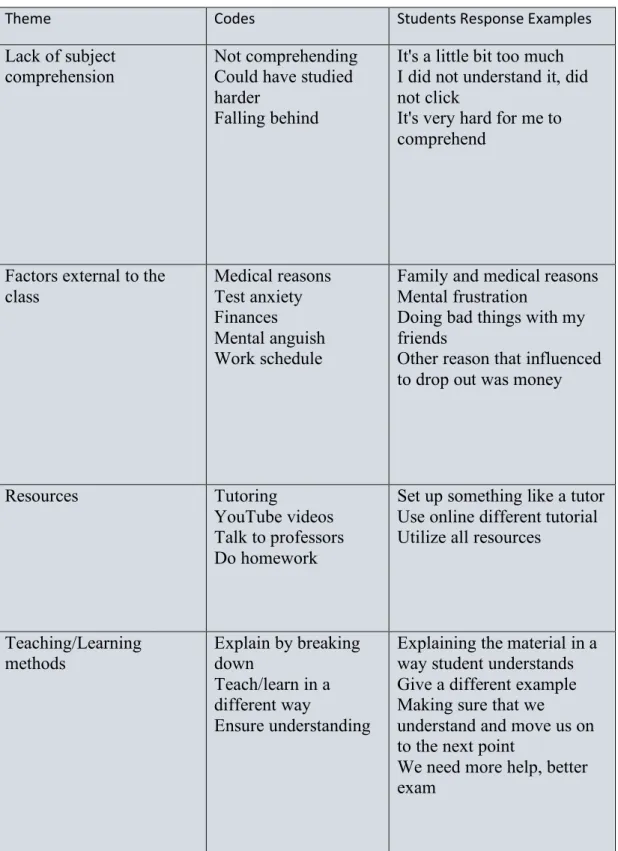
After analyzing each interview, my journal, and notes from the interviews, I did an initial coding of the interviews and found 16 potential themes. Following the code-recode process by reading the transcripts multiple times, I reduced the number to 4 main themes. Then, I transferred the identified themes to the spreadsheet according to the appropriate category. Table 1 shows the list of codes and themes used in this study according to the interviews. Participants were assigned numbers 1-7, and the interview responses were labeled according to the assigned numbers.
Table 1
Themes and Codes
Themes Codes
Lack of Subject Comprehension Not comprehending Could have studied harder Falling behind
Factors External to the Class Medical reasons Test anxiety Finances Mental anguish Work schedule Resources Tutoring You-tube videos Talk to professors Do homework
Teaching/Learning methods Explain by breaking down Teach/learn in a different way Ensure understanding
Theme 1: Subject Comprehension
In order to better understand why students dropped out of developmental mathematics class, I asked my participants “What, if any, characteristics about the class itself led you to decide to withdraw from your developmental mathematics class?”
Participants had varied educational experiences. All the students said that how they learned the subject depended on how they were taught. While some of them managed to understand the basis of the subject, many of them agreed that they struggled with math.
only one out of the six had successfully completed the class at the time of the interviews. According to 85% of the students interviewed, they had trouble comprehending the subject. Student 1 described his first experience:
Because it was from my first math course here, I did not understand it, did not click. If explained step by step I would have passed, I wanted to be explained to me step by step, it did not really click right away, so I had to really start over the whole math course.
Students agreed that they could not comprehend the subject from regular lectures in the class. About 50% of the students wanted word problems that related to real life
applications and a few mentioned hands-on projects to better understand the content. Student 6 mentioned “more real-life problems.” For Student 2, the problem was that the class did not have any practical application to real life:
I tend to absorb things better when I can see, touch and do, so it’s very hard for me to comprehend imaginary things on a piece of paper which has no practical application to apply them to.
With perceived negative attitudes towards the subject and fearing humiliation in front of the class, about 70% of the students did not ask questions in the class. While some students thought that they were asking basic questions, Student 3 assumed that asking questions would slow down other students. He added “the age difference in class, the kids were fresh out of high school…. I didn’t adjust to it.” Moreover, Student 4 said he was “shy and embarrassed and didn’t know… not confident enough to ask.” Participants 2
and 3 discussed how math was difficult during high school and continued to be difficult in college. Student 3 commented:
Even in high school I had to take math over. And we are working on something else and constantly moving on, and I am still at point A and others are now at point B. It’s a little bit too much.
This student continued by indicating that he did not know how to ask for help and
ultimately dropped out of the class. Student 2 felt that she could overcome the problem of math comprehension on her own. She would go home and try to work on her assignments without getting help. She said, “This has always been consistently the frustration with math.” Because of her lack of success, she eventually dropped out. Student 4 offered his perspective:
It was struggling through, trying to understand. I had a very good teacher it was just very hard for me to catch on and keep going like everyone else. So I kind of fell behind and quit…. I would try to study when I get home, but it was just hard to comprehend it.
Two- thirds of the participants shared personal examples about their negative learning experiences that caused a disconnection with the subject. Student 6 noted “I neglected school…I could have studied harder” while student 7 added “the difficulty of the subject …could not comprehend.” Student 5 provided this reply:
I was not grasping the material, it was getting closer to the end of the semester, my professor at that time said I probably would save some money to drop and try it again, but still I was not prepared for it. I tried tutoring, I tried tutoring outside
the school, but math is something that I don't grasp very well. I took algebra 3 times in high school and I finally passed it the final year. It’s always been something that I haven't grasped very well.
These collective acknowledgements suggested that students had difficulty understanding the subject. This led to the formation of the theme lack of subject
comprehension. This was the first major theme that students identified as their challenge. Even though participants had various personal issues, one of the top reasons for
withdrawal from the developmental mathematics class was the lack of subject comprehension. As in previous studies mentioned in the review of literature, many underprepared students placed in developmental classes find it challenging to remain persistent and focus on completing their courses. According to Tinto (1975), when students faced academic difficulties, they were likely to drop out of the class. Hernandez and Henson (2017) examined the reasons why students dropped out of their classes. Based on their findings, academic performance and academic difficulties were related to retention. Moore et al. (2016) mentioned that academic challenges and dropout rates are issues of concern.
Theme 2: Factors External to the Class
Even though difficulty with the subject was one of the primary reasons why students withdrew from developmental mathematics classes, there were other significant external factors that affected their ability to complete the courses. The question I asked my participants was “Were there reasons outside of the class itself that led you to withdraw from the developmental mathematics class (classes)? If so, what were the
reasons?” Three out of the seven students felt that there were external reasons that led them to drop out of developmental mathematics. Tinto (1975) wrote that the students who drop out of classes early do so because of non-academic factors. The nonacademic factors in this study included illnesses, financial problems and bad influences. Academic
challenges added to these external factors were the deciding reasons for the decision to drop out of the classes. Three student participants had to make the decision of dropping out of the developmental mathematics classes because of non-academic reasons. Student 2 felt anguish and frustration from family and medical issues that made her drop out of her class:
Family and medical reasons. A person can handle only so much mental anguish even with all the help that you can get, you get frustrated. Is this mental
frustration worth getting a piece of paper in the end?
For student 6, it was his encounter with outside bad influences that impacted his classes. He believed that his actions were inappropriate at that time and regretted that he had to drop out instead of completing his course. He missed a lot of classes and did not finish his assignments on time. He did not want to be in school and wanted to be with friends. His absences caused him to fall behind academically and ultimately dropped out of the class. He revealed that he was “doing bad things with my friends that I was not supposed to. Now I am back on track, with the help and support of my girlfriend.”
Tinto’s (1975) theory on departure served as the conceptual framework for this study, and the theory stated that an individual’s inability to pay for college or university could likely result in students dropping out of classes. Terriquez and Gurantz (2015)
reported that students opt out of college when there is a lack of financial support. Lack of financial planning for college can lead to students’ dropping out (Leijen, Lepp &
Remmik, 2016). Student 5 described how his financial issues were part of what caused him drop out of his class:
The only other reason would be paying for it. I did take a semester break to work and save money for my other classes. Now I am back to college. The main reason was I was not getting it but the other reason that influenced me to drop out was money.
The review of literature mentioned that Stewart et al. (2015) found that one of the main factors affecting persistence was financial aid. The research data I collected also included financial problems in addition to medical reasons and distractions as external factors that influenced them to drop out of developmental mathematics classes. Theme 2 described the challenges faced by the students that impacted them. Tinto (1975)
suggested that there were certain variables that influenced the students to drop out and both finances and psychological issues were notably significant variables.
Theme 3: Resources
In a classroom, resources generally provide assistance or information for students. In this study, resources referred to tutoring, watching You-tube videos, talking to
professors, and doing homework. Participants were asked “What recommendations would you have, if any, for helping students to be successful in developmental mathematics classes?” Five out of sevenparticipants suggested making use of these resources. Exposure to institutional resources influence students’ success (Tovar, 2015).
The interviews with the student participants indicated that they did not use the resources readily available to them. Students 1 and 4 mentioned that they were not aware of some of the resources that were available to them at the place of study.
Students also discussed how personal communication with the professor can help students voice their concerns and how reaching out to the professors about their progress could have helped them succeed. Student 2 explained:
Students need to know that the professors have an open-door policy and for them to utilize their voice. They need to convey to the professor if they are not
understanding it…so just by talking to the professor and utilizing any and all resources that are available.
Participants believed that individual sessions with the professor would be one of the components for success in the class. Tovar (2015) mentioned that providing academic support can bring about big changes in college outcomes and degree completion. Overall, students wanted support from their professors for academic success. Student 3 shared that additional attention after class would be appreciated. They surmised that a tutoring
opportunity and more one-on-one time on a regular basis with the professors would have been extremely useful.
Dixson (2015) mentioned that there is a relationship between virtual learning and student performances. During interviews, about one-half of the student participants recommended the use of different online tutorials for student support to complete their assignments and homework. Evans, Kearney, Perry, and Sullivan (2017) added that when students are assisted with campus-provided tutors there is an increase in community
college completion rates. Furthermore, e-tutoring along with campus tutoring can strengthen student learning (ChanLin, Lin, & Lu, 2016). Student 4 mentioned that every day he would study at home watching tutorials and you tube.
Students indicated that making use of available resources could help them succeed in their developmental mathematics classes. As mentioned in the review of the literature, the CCCSE (Kimbark et al., 2017) listed the practices needed for educational institutions to help student retention. The list mentioned that community colleges needed to provide students with good support systems and sufficient academic foundations for underprepared students.
Theme 4: Teaching/Learning methods
Students wanted the professors to clearly explain the problems or use different approaches to explain the examples. I asked the students “Thinking back, what, if anything, could have been different about the class (classes) that would have led to your completing the course?”
Although students had different instructors, the common theme was that struggling in math was because their instructors did not explain problems in a method that they could understand. Student 6 said that he ended up with a professor who took time to explain the steps for each problem and that he was eventually able to succeed. Students were eager to share their ideas and thoughts regarding what would have helped them complete the developmental mathematics course. Five-sevenths of the students agreed that student engagement played a big role in their success.Several researchers illustrated that the ins