Firewall Configura/on Errors Revisited
Lecturer: Dr. Tom Chothia
AvishaiWool
Presenter: BINBIN HU
Content
•
IntroducAon
•
Preparatory work& Data collecAon
•
Measure method
•
Data analysis
IntroducAon
•
The definiAon of the firewall
•
The posiAon of the firewall
•
Basic funcAon modules
•
Design goals for a firewall
1.CorporaAon Firewall——the first line of
the cyber-‐defense
1.1 What is firewall?
• Firewall:A firewall is a combinaAon of hardware and
soQware that isolates an organizaAon’s internal network from the Internet at large, allowing some packets to pass and blocking others.
FIRE DOOR FIREWALL
MONITOR IDS
SECURITY FORCES
SCANNER、BUG FINDING
SECURE TRANSMISSION
ENCRYPTION、VPN
DOOR ACCESS CONTROL IDENTITY AUTHENTICATION
& ACCESS CONTROL MONITORING ROOM
SECURITY POERATION CENTER
REINFORCED ROOM SYSTEM REINFORCEMENT
The posiAon of the firewall in the network topology
Basic funcAon modules
NAT VPN Log IDS & Warning Content Filtering User Authen/ca/on Applica/on ProxyDesign goals for a firewall
• 1. All traffic from inside to outside, and vice versa,
must pass through the firewall.
• 2. Only authorized traffic, as defined by the local
security policy, will be allowed to pass.
1.2 Some familiar firewalls
hUp://www.huaxintong.com/^q_sc.asp
(Hardware firewall)
home users office small enterprise large and medium enterprises campus network
pr
ic
Checkpoint(SoQware firewall)
Preparatory work& Data collecAon
•
The most important factor of the firewall
security
•
Firewall configuraAon test
•
The goal for this work
•
New features of this study
2. The most important factor of the
firewall security is
how you configure it
•
The protecAon that these firewalls provide is
only as good as the policy they are configured
to implement.
•
For well-‐configured firewalls
2.1Firewall configuraAon test
•
The network aUack is the best way to test the
firewall configuraAon.
•
Before aUacking, an important technology
• Scan—— the basement of aUack.
• For collecAng useful informaAon of target host.
• scan types
TCP SYN (half open) scanning TCP FIN (stealth) scanning
TCP Qp proxy (bounce aUack) scanning ICMP scanning (ping-‐sweep)
•
Internet Worms' most important feature is the
ability to scan for more vulnerable machines.
•
Firewall ——stop worms
Monitoring the package in the communication
Handling package according to rule-sets
•
The poor state of firewall configura?on can be
observed, indirectly, by the huge prolifera?on of
network worms like Blaster and Saphire that
could have been easily blocked by a well
configured firewall.
——So this provided a quanAtaAve evaluaAon of
the quality of corporate firewall configuraAons.
This state of affairs was validated in a 2004 study, the author of this paper claimed that the arguments are s?ll valid.
2.2The goal for this work
•
To test the hypothesis—— the quality of
corporate firewall configuraAons has improved
over Ame.
•
To check whether the findings of
“A quan?ta?vestudy of firewall configura?on errors,(2004) “
are sAll
valid.
2004 study’s main observaAons: (a) firewalls are poorly configured
(b) a rule-‐set’s complexity is posiAvely correlated with the number of detected configuraAon errors
2.3New features of this study
• To address some possible criAques, such as: the sample used
before was not indicaAve; the detected problems were specific only to one vendor.
• This study has the following features:
(1)collected from firewalls running later firewall versions; (2)covered more than twice as many rule-‐sets as before;
(3)included rule-‐sets from Check Point FireWall-‐1 and Cisco PIX (4)consisted 36 vendor-‐neutral items instead of 12
2.4Data collecAon
•
Data sources
:
The data for this work includes 54 CheckPoint FireWall-‐1 rule-‐sets that were collected between 2003–
2005.The rule-‐sets came from a variety of organizaAons, from the telecommunicaAons, financial, energy, media ,automoAve, and
healthcare market segments. The data for this work also includes 30 Cisco PIX rule-‐sets that were collected between 2003–2005.
•
Objects
:
Checkpoint Firewall-‐1,Cisco PIX•
AnalyAcal data
:
36 configuraAon errorsexamples: Inbound HTTP to 256+ IPs "To Any allow Any service" rules Outbound SMTP from 256+ IPs
Check Point firewalls
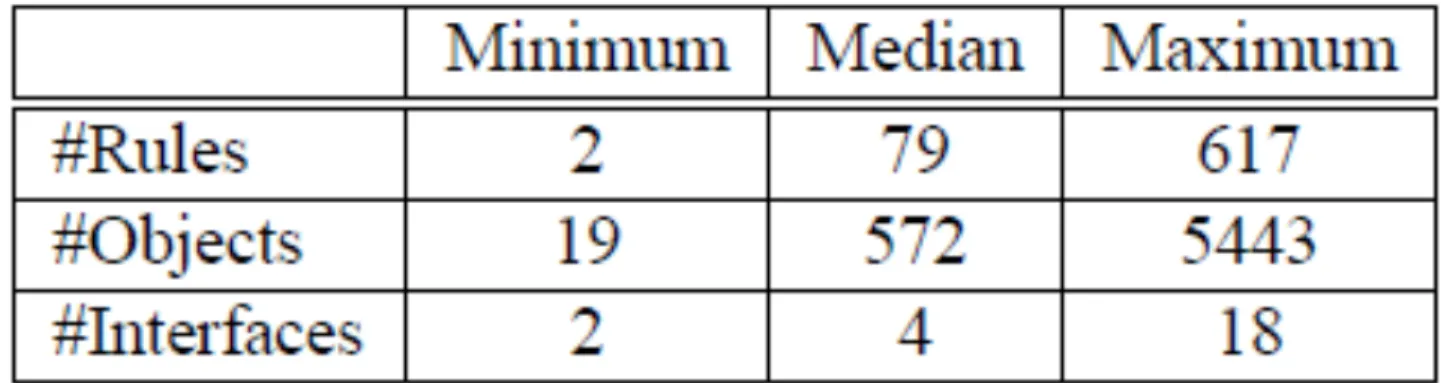
Table 1: StaAsAcal properAes of the collected Check Point FireWall-‐1 rule-‐sets. #Rules counts the total number of rules in the rule-‐set (including NAT rules). #Objects counts the number of network objects (hosts, subnets, and groups of these) defined in the database supporAng the rules. #Interfaces counts the number of network interface cards on the firewall.
Table 2: DistribuAon of Check Point FireWall-‐1 rule-‐sets by soQware version. For each soQware version we show both the absolute number of rule-‐sets and their percentage (in parenthesis)
Cisco PIX firewalls
Table 3: StaAsAcal properAes of the collected Cisco PIX rule-‐sets. #Lines counts the total number of lines in the configuraAon file. #Interfaces counts the number of network interface cards on the firewall.
Table 4: DistribuAon of Cisco PIX rule-‐sets by soQware version. For each soQware version we show both the absolute number of rule-‐sets and their percentage (in parenthesis)
Measure method
•
Previous method—— RC
•
The analysis of objects
•
The defect of RC
•
The new measure ——FC
3
The measure of firewall complexity
The research method used previous is RC.
• RC defined as:
RC=#rules+#objects+(#interface/2)
• #Rules is the raw number of rules in the rule-‐set,
#Objects is the number of network objects, and
#Interfaces is the number of interfaces on the firewall
• The study object for RC is only Checkpoint Firewalls.
Now this method is inappropriate in this search,
3.1The analysis of objects
• Objects of study(Checkpoint FW1and Cisco PIX)
• Main differences
• 1)Type: Emphasize soQware/ hardware
• 2) Technical principle: Checkpoint’s strategy is mainly
based on State InspecAon ; Cisco PIX’s strategy is primary based on ACL.
• 3) Management: Checkpoint is based on graphic
3.2 The defect of RC:
For checkpoint, RC didn’t give enough weight to the
number of interfaces:
•
None of the surveyed Check Point firewalls has
more than 18 interfaces (the median number was
4), but Check Point firewalls with hundreds of
rules and thousands of objects.
•
#Interfaces is only added to the RC, albeit
quadraAcally, its contribuAon is oQen dwarfed by
the two other terms.
3.3The new measure ——FC
•
FC is an evoluAon of RC.
•
Goals of improvement
:
CompaAbility —— for Cisco
• For Cisco PIX firewalls, the simplest measure of
complexity is the number of lines in the configuraAon file.
• The raw number of lines to be slightly misleading,
especially for very small configuraAons. This is
because even the smallest Cisco PIX configuraAon file includes a few tens of “boilerplate” lines that have
liUle to do with traffic filtering.
FCp index
(
For Cisco
)
•
Let #Lines denote the number of lines in the
ASCII file containing the complete Cisco PIX
configuraAon file. Then the firewall complexity
of a Cisco PIX firewall is:
Improvement for Checkpoint
• MulAply gives much more weight to the number of
interfaces
• Let #Rules denote the raw number of rules in the
Check Point FireWall-‐1 rule-‐set, let #Objects denote the number of network objects, and let #Interfaces denote the number of interfaces on the firewall. Then the firewall complexity of a Check Point
FireWall-‐1 firewall is:
Through the FC index two kinds of firewall can
be put together to compare
Firewall complexity distribuAon (log scale) separately for Check Point FireWall-‐1 and Cisco PIX. It can be seen from the picture, checkpoint firewall has higher complexity
3.4 The selecAon of configuraAon errors
• The errors in the study: ConsisAng of 36 errors. All
the errors are vendor-‐neutral and create a risk to the network behind the firewall.
• The angle of the selecAon: Errors are all violaAons of
SelecAon criteria
• To avoid inflaAng the error counts(a single badly
wriUen rule may trigger mulAple counted errors), a more specific error was only counted if it was
triggered by some rule that does not trigger a more general error.
• Count each error type once to avoid introducing
severity levels, so not all the configuraAon errors in the list are equally severe.
• Ignore the number of rules contribuAng to each
error(because the number is less indicaAve of the
amount of risk), and opted for Boolean indicators for each error.
Error categories
• inbound traffic(i): Errors cover things such as allowing Any
traffic inbound, or allowing services such as RPC, SNMP, and several other known-‐risky services, also using the noAon of a thresholds to count errors that are related to services
such as HTTP, DNS, and FTP.
• outbound traffic(o): Most of these deal with services that
are considered to be risky in all direcAons. And counted errors for indiscriminate outbound e-‐mail traffic (again using the noAon of a thresholds) and for IRC.
• internal traffic(d): These all deal with services that are
considered to be risky in all direcAons
• inherently risky rules(r):An error is counted if the rule-‐set
4.Data Analysis
3
1
2
4
5
6
7
Security Policy “First” Rule
Security Policy “Before Last” Rule
Security Policy “Last” Rule
Implicit Drop
IP Spoofing / IP Op/ons / State Table
mail-svr tcp smtp accept Short fw
Any Any accept Short fw
3 Any Any Last Rule In Rule BaseAny drop Long fw
1 local-net 2 Any Rule Base
Match order
ACL match order
1、SIP DIP Sport Dport Accept\Drop
2、SIP DIP Sport Dport Accept\Drop
3、SIP DIP Sport Dport Accept\Drop
4、SIP DIP Sport Dport Accept\Drop
……….
n、SIP DIP Sport Dport Accept\Drop
OUT IN Ac Av e C on tr ol Lis t( AC L) Ma tch O rd er— — Se q N umbe r
Number of errors as a funcAon of the rule-‐set’s complexity FC (log scale). The central red line represents the least-‐squares linear regression fit, and the green and purple lines represent one standard deviaAon above and below the least-‐squares fit.
•
Errors versus version
checkpoint cisco
Errors versus version
It is clear from both figures that, the effect of the soQware version on the number of configuraAon errors is insignificant: the distribuAon of the number of errors is essenAally independent of the firewall soQware version.
conclusion
• Firewall complexity (FC) measure applies to both
firewalls brands and probably to others as well.
• Firewalls are (sAll) poorly configured.
• The effect of the soQware version on the number of
configuraAon errors is insignificant.
• In general Cisco PIX firewalls seem to exhibit fewer
errors than CheckPoint firewalls.
• A rule-‐set’s complexity is (sAll) posiAvely correlated
with the number of detected configuraAon errors.
Thus we can conclude that, for well-‐configured firewalls, “small is (s?ll) beau?ful”.
References & useful informaAon
• Bellovin, S., and Cheswick, W. “Network Firewalls.” IEEE Communica?ons
Magazine, Sep. 1994.
• Chapman, D. and Zwicky, E. Building Internet Firewalls, Sebastppol, CA:
O’Reilly , 2000
• Wack, J.; Cutler, K.; and Pole, J. Guidelines on Firewalls and Firewall Policy.
NIST Special PublicaAon SP 800-‐41, January 2002
Thank you
!