ORGANIZATION
MEASURING
TRADE IN SERVICES
A training module produced by WTO / OMC
Update includes changes in the Manual on Statistics
of International Trade in Services 2010
Following a request of the World Bank, the first version of the training module "Measuring trade in services" was produced in 2003 by the Economic Research and Statistics Division of the World Trade Organization.
Following continuous developments in trade in services, balance of payments and foreign affiliates statistics, this document was revised on a regular basis. The 2010 edition takes into account the recent adoption of various statistical manuals, in particular the 2010 edition of the Manual on Statistics of International Trade in Services.
The WTO Secretariat is very grateful to the participating agencies of the Inter-agency Task Force on Statistics of International Trade in Services who provided material and comments during the preparatory phase of the training module.
For further information on this training module or on statistics of international trade in services, please contact [email protected].
TABLE OF CONTENTS
INTRODUCTORY NOTE ... 5
ACRONYMS AND ABBREVIATIONS ... 6
I. OVERVIEW ... 7
1. SERVICES AND TRADE IN SERVICES IN THE ECONOMY ... 7
a) Importance of services in the economy... 7
b) Trade in commercial services ... 9
2. GATS AND MODES OF SUPPLY ... 10
3. THE MANUAL ON STATISTICS OF INTERNATIONAL TRADE IN SERVICES 2010 ... 10
II. STATISTICS OF TRADE IN SERVICES BETWEEN RESIDENTS AND NON-RESIDENTS OF AN ECONOMY ... 13
1. INTRODUCTION ... 13
2. PRINCIPLES OF RECORDING ... 13
a) Transactions and residence of transactors ... 13
b) Other principles of recording ... 14
3. THE EXTENDED BALANCE OF PAYMENTS SERVICES CLASSIFICATION 2010 ... 14
a) Main principles ... 14
b) EBOPS 2010 components ... 15
4. STATISTICS BY TRADING PARTNER ... 17
5. ALLOCATION OF BOP ITEMS TO MODES OF SUPPLY ... 17
III. FOREIGN AFFILIATES STATISTICS ... 18
1. INTRODUCTION ... 18
2. PRINCIPLES OF RECORDING ... 18
a) Enterprises covered in FATS ... 18
b) The notion of control and its implication on the recording of FATS... 19
3. ECONOMIC VARIABLES FOR FATS ... 20
4. ATTRIBUTION (CLASSIFICATION) OF FATS VARIABLES ... 20
a) Geographical breakdown ... 20
b) By activity (industry) and by service products ... 20
5. FATS AND FDI STATISTICS ... 21
IV. THE PRESENCE OF NATURAL PERSONS ... 23
1. INTRODUCTION ... 23
2. THE PRESENCE OF NATURAL PERSONS IN GATS ... 23
a) Natural persons covered by Mode 4 ... 23
b) “Temporary”: a key issue in the measurement of Mode 4 ... 24
c) Mode 4 and relations to statistical classifications ... 24
3. STATISTICS FOR MEASURING MODE 4 ... 24
a) Value of Mode 4 trade: included in BOP statistics on trade in services ... 25
b) Number of persons moving in the context of Mode 4: Tourism and migration statistics ... 26
V. DATA SOURCES, QUALITY AND DISSEMINATION PRACTICES ... 27
1. INTRODUCTION ... 27
2. MAIN DATA SOURCES FOR BOP STATISTICS... 27
a) International Transactions Reporting System ... 27
c) Using ITRS or enterprise surveys? ... 28
d) Other sources of information... 28
3. DATA COLLECTION SYSTEMS FOR FATS ... 29
a) Key features for the collection of FATS ... 29
b) Examples of country practices ... 29
4. DATA QUALITY ... 30
a) BOP asymmetries ... 30
b) Data dissemination and metadata ... 30
VI. DATA AVAILABILITY AND DISSEMINATION BY INTERNATIONAL ORGANIZATIONS ... 32
1. INTRODUCTION ... 32
2. BOP TRADE IN SERVICES DATA AVAILABILITY AND DISSEMINATION ... 32
a) BOP/EBOPS trade in services data ... 32
b) International dissemination of BOP statistics ... 33
3. COMMERCIAL PRESENCE: INFORMATION AVAILABLE ... 34
a) Availability and dissemination of FATS ... 34
b) FDI statistics ... 35
VII. CURRENT STATE AND PROSPECTS ... 37
1. INTRODUCTION ... 37
2. THE PHASED APPROACH OF MSITS TO IMPLEMENTATION ... 37
3. RECENT PROGRESS AND SHORT-TERM PLANS... 38
4. PROSPECTS FOR TRADE IN SERVICES STATISTICS ... 39
a) Areas where improvements are needed ... 39
b) Future work ... 40
ANNEX I–EXTENDED BALANCE OF PAYMENTS SERVICES CLASSIFICATION 2010 ... 41
ANNEX II–DESCRIPTION OF BASIC VARIABLES FOR FATS ... 46
ANNEX III-ISICCATEGORIES FOR FOREIGN AFFILIATES IN SERVICES (ICFAREV.1) ... 48
ANNEX IV- REPORTING STATUS OF BPM5 COMPONENTS AND SUPPLEMENTARY ITEMS, AS OF OCTOBER 1997 AND JULY 2010 ... 51
ANNEX V-SIMPLIFIED ALLOCATION OF FATS AND BALANCE OF PAYMENTS DATA TO MODES OF SUPPLY ... 52
INTRODUCTORY NOTE
Statisticians often use complex concepts and methodologies to produce reliable numbers. Translating them into simple and readily understandable information for non-specialists can be quite a challenge. The communication gap between producers and users of statistics is particularly wide in the area of trade in services. The entry into force of the WTO General Agreement on Trade in Services (GATS) in 1995 has not only inflated demand for enhanced statistics, but it has also highlighted that the scope of international supply of services is far wider than what statistics conventionally measure.
Statistics are best interpreted with a sound understanding of the methodologies underpinning their production. This text provides an accurate while simple overview on the statistical framework for measuring trade in services.
Primarily intended as reference material, part of a broader course for government officials and trade negotiators, it should also be of benefit to other users such as business analysts, students, etc. Statisticians new to the domain may also find it useful to understand the more complex and accurate reference documents on the methodology for measuring trade in services.
The text starts with a general overview and contains six major Sections that can be read independently from each other. Each Section is introduced by a short paragraph describing what the reader will learn from it. References to further sources of information conclude each Section.
Readers will gain knowledge of:
the economic importance of services and the concept of trade in services as illustrated in the GATS‟ four modes of supply (Section I);
the relevant statistical framework developed on the basis of two major statistical domains (Section II focuses on key concepts related to trade between residents and non-residents as defined in international guidelines, while Section III deals with statistics on operations of services foreign affiliates), its usefulness and current limitations;
the current state of play with regard to statistics useful in assessing the supply of services through the presence of natural persons (Section IV);
the different methods statisticians use to collect statistics on trade in services (Section V);
statistics currently available and where they can be found at the international level (Section VI); and
the recent developments and prospects in the domain of statistics on trade in services (Section VII).
Please note that the statistical rules, guidelines, concepts and definitions described are simplified and should not be used as reference standards. These are covered in the appropriate manuals on which this text is based, namely the Manual on Statistics of International Trade in Services 2010 (MSITS 2010) and the IMF's 6th Edition of the Balance of Payments and International Investment Position Manual (BPM6). Precise references to these documents and other sources used in preparing this text can be found in the bibliography.
ACRONYMS AND ABBREVIATIONS
INTERNATIONAL AND REGIONAL ORGANIZATIONSEurostat Statistical Office of the European Communities ILO International Labour Organization
IMF International Monetary Fund
OECD Organisation for Economic Co-operation and Development
UN United Nations
UNCTAD United Nations Conference on Trade and Development UNSD United Nations Statistics Division
UNWTO World Tourism Organization WTO World Trade Organization
OTHER ACRONYMS AND ABBREVIATIONS
BD4 4th edition of the OECD Benchmark Definition of Foreign Direct Investment
BOP Balance of Payments
BPM6 6th edition of the Balance of Payments Manual CPC Central Product Classification
EBOPS Extended Balance of Payments Services Classification
EU European Union
FATS Foreign affiliates statistics FDI Foreign Direct Investment
GATS General Agreement on Trade in Services GDDS General Data Dissemination System (IMF) GDP Gross Domestic Product
W/120 Services Sectoral Classification List
ICFA ISIC Categories for Foreign Affiliates in services ICSE International Classification of Status in Employment ISCO International Standard Classification of Occupations
ISIC International Standard Industrial Classification of all Economic Activities ITRS international transactions reporting system
LDCs Least Developed Countries
MSITS Manual on Statistics of International Trade in Services n.a. not available
n.i.e. not included elsewhere
SDDS Special Data Dissemination Standards (IMF) 2008 SNA System of National Accounts, 2008
UCI ultimate controlling institutional unit US United States of America
I.
OVERVIEW
This overview gives readers an insight into how important services are and the various ways in which services may be delivered internationally. It provides a brief presentation of the Manual on Statistics of International Trade in Services 2010.
1. SERVICES AND TRADE IN SERVICES IN THE ECONOMY a) Importance of services in the economy
The term services covers a wide range of intangible and heterogeneous products and activities that are difficult to encapsulate within a simple definition. Services are either the result of a production activity that changes the conditions of the consuming units (transformation services), or facilitate the exchange of products or financial assets (margin services). They can cover transport, telecommunication and computer services, construction, financial services, wholesale and retail distribution, hotel and catering, insurance, real estate, health and education, professional, marketing and other business support, government, community, audiovisual, recreational, and domestic services.
Services have a significant impact on growth and efficiency across a wide range of industries and overall economic performance. For instance, sectors such as transport, telecommunications and financial services are key determinants of the conditions in which persons, merchandise, services and capital flow. Another illustration of the services‟ major role is environmental services, which contribute to sustainable development by alleviating negative impacts of economic activities.
Services currently represent more than two thirds of World Gross Domestic Product
(GDP). The share of services value added in GDP tends to rise significantly with the countries‟ level of income, standing at 73% on average in high income countries (77% in the United States), against 54% and 47% respectively in middle- and low- income countries. Even in the latter group, the production of services is generally a core economic activity, whose contribution to GDP is above that of both industry and agriculture. Significant differences however exist between countries within the same income group, as for example for India and Nigeria – two middle income countries whose respective shares of services in GDP are 54% and 27%, or Kenya and Liberia – two low income countries whose shares are 54% and 22%. 0 10 20 30 40 50 60 70 80 90 100 World High income Middle income Low income United States
EU-27 Bra zil Russia n Fed.
India China Lao Nigeria Libe ria
Activity's contribution to GDP of selected countries and country groups, 2008
(percentage)
Services Agriculture Industry
Sources: World Bank, World Development Indicators (WDI) database online and Eurostat database (EU data) Theme 2 (Oct 2010) – note that “construction” is included in the industry sector.
The current importance of services‟ value added follows decades of sustained growth of contribution of the services sector to GDP, which is also mirrored in employment statistics. Looking at developments over the 1997-2007 period, a significant shift of employment from the agriculture and industry sectors to the services-producing sector can be observed. Services' contribution to total employment gained on average 5 percentage points in high income countries. Available information suggests that the increase was also sharp on average in most middle income countries. For instance Mauritius and Malaysia registered growths of about 8 percentage points, and for some of these middle income countries (e.g. Mongolia, Nicaragua, Turkey) the growth was over 10 percentage points. Employment data further confirm the importance of the services sector which is accounting for more than half of the employment in many countries (up to 78% in the United States).
0.0 10.0 20.0 30.0 40.0 50.0 60.0 70.0 80.0 High income United States
EU (27) Japan Bra zil Mauritius Malaysia Egypt Thailan d China
Share of services employment in total employment, 1997 and 2007
(percentage)
1997 2007*
* Except Brazil, 2006; Egypt, 2006; and China, 2002.
Sources: World Bank, World Development Indicators (WDI) database online and Eurostat New Cronos database (EU data) Theme 2 (Oct. 2010) – note that “construction” is included in the industry sector.
Box I.1 Measuring services production (a) Statistics on domestic activity
National Accounts constitute the statistical framework out of which main macroeconomic aggregates are calculated (production, Gross Domestic Product, Gross National Income, consumption…). Value added broken down by industry permits the measurement of the contribution of the services sector and its sub-sectors to GDP.
Employment statistics provide the total number of people employed in various sectors of activity. They allow to identify the number of people employed in the services sector and their distribution among different sub-sectors (it should be noted that such statistics also form part of the central framework of National Accounts).
Other information such as business statistics (available from regional and international organizations) as well as data provided by business federations may also be useful for assessing the activity of specific services sectors.
(b) Quantitative indicators on specific sectors
Quantitative indicators on specific sectors (international number of students enrolled in basic education, arrivals of tourists, number of letters mailed, kilometres flown by planes, number of phone calls, etc.) also provide valuable information for assessing services production and performance, which enables more meaningful analysis of services sectors. However, quantitative indicators do not permit comparisons across sectors.
b) Trade in commercial services1
World exports of commercial services amounted to US$ 3,350 billion in 2009, after growing on average at around 7.9% per year in value terms since 1980. Trade in commercial services grew faster than trade in goods (6.6% on average) during this period, increasing its share in total world trade by 6 percentage points. In 2009, the share of services in world trade reached 21%, that is 2 percentage points up from the previous year, as the decline in global trade in services was considerably less pronounced than that of goods.
0 6 12 18 24 0 500 1000 1500 2000 2500 3000 3500 4000 1980 1982 1984 1986 1988 1990 1992 1994 1996 1998 2000 2002 2004 2006 2008 2009 % U S $ b ill io n
World exports of commercial services, 1980-2009
(USD billion and percentage)
Commercial services
Share of commercial services in total exports (goods+commercial services)
Source: WTO
The share of services in world trade contrasts with the central contribution of services production in domestic economies. Due to their intangible nature, trade in services is
inherently subject to more constraints than trade in goods. While a (tangible) good may be produced, stored, moved and consumed at different places and times, the delivery of a (intangible) service is seldom dissociated from its production and its consumption, requiring the proximity of the supplier and the customer. For instance, hairdressers and their clients need to be physically close for a haircut.
The need for proximity for supplying many services has led producers to supply their products through a commercial presence abroad, i.e. the establishment of foreign affiliates. This form of international supply of services (which is not covered in the chart presented above) is considered at least as important in value terms as “conventional” international trade in services between residents and non-residents.
Box I.2: Patterns of trade in services’ expansion
0% 20% 40% 60% 80% 100% 1995 2009
Changes in the breakdown of world trade in commercial
services, 1995-2009
other commercial services travel
transport
1 Commercial services do not include government services, n.i.e.
The marked growth in trade in services was accompanied by significant changes in the structure of services traded. Among others, the communication revolution eliminated important obstacles to the international delivery of a number of services by providing new means of supplying them remotely. This resulted in a 13.5-percentage-point increase since 1995 in the share of other commercial services in total trade in services to 53% in 2009, mostly at the expense of travel which lost 8.5 points, down to 26%. In 2009, transportation accounted for 21% of commercial services‟ exports (down by 5%).
2. GATS AND MODES OF SUPPLY
One of the most important achievements of the Uruguay Round trade negotiations (1986-1993) is to have brought international trade in services under common multilateral rules. Entering into force on 1 January 1995, the WTO General Agreement on Trade in Services (GATS) is the first set of multilaterally negotiated and legally enforceable rules covering international trade in commercial services (i.e. excluding government services). As stressed in GATS, international trade in services can take place through four modes of supply:
in Mode 1, cross-border supply, only the service crosses the border. The delivery of the service can take place, for example, through telecommunications (telephone, fax, television, Internet, etc.), or the sending of documents, disks, tapes, etc;
Mode 2, consumption abroad, occurs when consumers consume services while outside their country. Visits to museums in a foreign country as well as medical treatment and language courses taken abroad are typical examples;
in Mode 3, the service supplier establishes its commercial presence in another country through e.g. branches or subsidiaries. Examples are medical services provided by a foreign-owned hospital, and banking services supplied by a subsidiary of a foreign bank.
Mode 4, presence of natural persons, occurs when an individual has moved temporarily into the territory of the consumer in the context of the service supply, whether self-employed or as an employee of a foreign supplier. For instance, architects moving abroad to supervise construction work are providing services under this mode of supply.
The pillars of GATS are a set of general obligations, applying to all WTO members and all services, such as the Most-Favoured-Nation treatment (MFN) ensuring non-discrimination between trading partners; countries‟ schedules of specific commitments resulting from negotiations for specific sectors and modes; and several sectoral annexes as well as an annex on the movement of natural persons.
3. THE MANUAL ON STATISTICS OF INTERNATIONAL TRADE IN SERVICES 2010
Following the entry into force of GATS, there has been an increasing demand for detailed, relevant and internationally comparable statistical information on the international supply of services. Trade negotiators require statistics, possibly by mode of supply, as a guide to negotiate specific commitments and to monitor their economic impact for each type of service. Among others, statistics are necessary to evaluate market access opportunities, compare liberalisation commitments, assess the extent of liberalisation reached in specific sectors/markets and provide statistical background for the settlement of disputes.
In 2002, the United Nations Statistical Commission adopted the first Manual on Statistics of International Trade in Services (MSITS). This manual was revised in 2010 (MSITS 2010). Building upon internationally agreed standards, it provides guidelines and recommendations on how to use and develop sources to measure the international supply of services. Two building blocks are identified:
balance of payments (BOP) statistics, which conform to the 6th edition of the IMF Balance of Payments Manual (BPM6), summarise transactions of an economy with the rest of the world into the components of the current account and the capital and financial account. BOP statistics under BPM6 display data on trade in services
between residents and non-residents (within the current account) into 12 items: manufacturing services on physical inputs owned by others; maintenance and repair services n.i.e.; transport; travel; construction; insurance and pension services; financial services; charges for the use of intellectual property n.i.e.;
telecommunications, computer, and information services; other business services; personal, cultural and recreational services; and government goods and services n.i.e. (see section II.3 for more information). MSITS 2010 proposes further breakdowns of these items to respond to needs for more detailed information. Furthermore, although BOP statistics do not allow a comprehensive measurement of services delivered through Mode 3, they support the measurement of supplementary indicators, for example, Foreign Direct Investment (FDI) statistics can be helpful concerning Mode 3.
MSITS 2010 expands the statistical definition of international trade in services by recommending the measurement of services supplied by foreign affiliates, within the new framework of Foreign Affiliates Statistics (FATS). This framework provides for the compilation of a number of indicators aimed at describing the operations of foreign affiliates (turnover/output, exports and imports, employment, number of enterprises, etc.) with a particular – but not exclusive – focus on services.
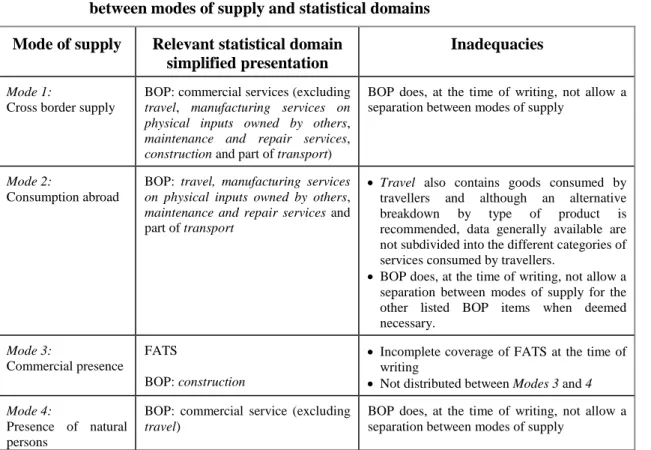
MSITS2010 also provides a statistical approach for measuring the value of the international supply of services by mode with a particular focus on the presence of natural persons. This simplified approach is based on the overall good correspondence between (i) FATS and Mode 3, and (ii) BOP services statistics and the three other modes of supply (as shown in Table I.1 and described further in Section II.5).
Once implemented these guidelines will provide statisticians, economists and trade negotiators with data that will enable more pertinent statistical and economic analyses.
Table I.1: Value of the international supply of services by mode: correspondence between modes of supply and statistical domains
Mode of supply Relevant statistical domain simplified presentation
Inadequacies
Mode 1:
Cross border supply
BOP: commercial services (excluding
travel, manufacturing services on physical inputs owned by others,
maintenance and repair services,
construction and part of transport)
BOP does, at the time of writing, not allow a separation between modes of supply
Mode 2:
Consumption abroad
BOP: travel, manufacturing services on physical inputs owned by others,
maintenance and repair services and part of transport
Travel also contains goods consumed by travellers and although an alternative breakdown by type of product is recommended, data generally available are not subdivided into the different categories of services consumed by travellers.
BOP does, at the time of writing, not allow a separation between modes of supply for the other listed BOP items when deemed necessary.
Mode 3:
Commercial presence FATS
BOP: construction
Incomplete coverage of FATS at the time of writing
Not distributed between Modes 3 and 4 Mode 4:
Presence of natural persons
BOP: commercial service (excluding
travel)
BOP does, at the time of writing, not allow a separation between modes of supply
For further information…
statistics on services:
- employment and value added: the World Bank World Development Indicators, UNCTAD statistics (http://data.worldbank.org/data-catalog and
http://unctadstat.unctad.org/)
- trade: WTO International Trade Statistics (www.wto.org)
- trade indicators: World Bank World Trade Indicators, WTO Services Profiles and Trade Profiles
quantitative indicators on services:
- International Telecommunication Union (www.itu.int), Universal Postal Union (www.upu.int), World Tourism Organization (www.unwto.org) or other specialised
organizations.
II.
STATISTICS OF TRADE IN SERVICES BETWEEN RESIDENTS
AND NON-RESIDENTS OF AN ECONOMY
This section describes how trade in services is measured within the balance of payments framework. It also introduces extensions made to this framework in terms of the breakdown of services into more detailed items. Finally, links of these statistics with GATS’ modes of supply are highlighted.
1. INTRODUCTION
Balance of payments (BOP) statistics on service transactions between residents and non-residents provide a sound basis for the measurement of trade in services in the conventional sense. Recommendations made in the Manual on Statistics of International Trade in Services 2010 (MSITS 2010) for the development of such statistics are made with the underlying concern to build upon existing principles and classifications, without altering these.
Sub-section 2 provides an overview of the fundamental concepts of the 6th edition of the IMF Balance of Payments Manual (BPM6) that underpin the measurement of trade in services. While keeping full consistency with the BPM6 concepts and classification, MSITS 2010 provides a more detailed classification of trade in services statistics (the Extended Balance of Payments Services Classification 2010 – EBOPS 2010), which is presented in Sub-section 3. MSITS 2010 also makes recommendations for the production of a geographical breakdown of trade in services data (Sub-section 4) and proposes a simplified approach to allocate services transactions statistics to the four modes of supply (Sub-section 5).
2. PRINCIPLES OF RECORDING
The residence concept is essential for the measurement of services transactions between residents and non-residents. Other essential concepts relate to the valuation and the time of recording transactions. These main principles are in line with those of BPM6 and the System of National Accounts, 2008 (2008 SNA).
a) Transactions and residence of transactors
A country‟s BOP is a balanced statistical statement that summarises the economic
transactions of its residents with the rest of the world. A transaction is an economic flow that involves change of ownership of goods and/or financial assets, the provision of services, or the provision of labour or capital. Services international transactions are in practice referred to as trade in services. These transactions are to be recorded gross, with each service item displaying a credit and a debit value, representing respectively exports and imports of that service.
The residence concept is not based on nationality or legal criteria but on a transactor‟s centre
of predominant economic interest. Further, because territorial boundaries recognised for political purposes may not always be appropriate for economic purposes, the economic territory of a country or economy is used as the relevant geographical area to which the concept of residence is applied.
The economic territory consists of the geographic territory administered by a government. It also includes territorial enclaves such as embassies, consulates, and military bases located in foreign countries.
It is not always straightforward to determine precisely whether an institutional unit has a
centre of predominant economic interest within a country, and thus is resident in this country. It is deemed that an enterprise has a centre of predominant economic interest in a country when it engages or intends to engage in economic activities on a significant scale, and
over a long time period, within its economic territory. A household has a centre of predominant economic interest where it maintains one or more dwellings within the country that members of the household use as their principal dwelling.2
A period of one year or more is suggested as a flexible guideline (the “one-year rule”) for determining residence (centre of predominant economic interest).
b) Other principles of recording
Market price (i.e. the price at which buyers and sellers trade the item in an open marketplace) should be used as the basis for valuation of international transactions in services. In certain circumstances, such as exchanges between affiliated enterprises, the pricing adopted for bookkeeping purposes (“transfer pricing”) may not always be based closely on market considerations. Because it may be very difficult to evaluate a market price for the recording of such transactions, BPM6 acknowledges that in most cases such an evaluation or imputation would not be applied. In practice, if certain transfer prices are so divorced from those of similar transactions that they significantly distort measurement, they should either be replaced by market price equivalents or be separately identified for analytical purposes.
The appropriate time to record transactions in services is the time at which they are rendered (that is, when they are delivered or received). This may differ from the time at which payment is made or received. Thus transactions should be recorded, whenever possible, on an accrual rather than a cash accounting basis.
Transactions may take place in a range of currencies, including the domestic currency of either the provider or the consumer of the service. To produce meaningful statistics, however, it is necessary for the compiler to convert all transaction values to a common unit of account. Most often, the common unit will be the national currency. However, in some cases such as a significant depreciation of the national currency or hyperinflation, it may analytically be more useful to express transactions in another, more stable currency. The most appropriate exchange rate to be used in converting transaction values from the currency of transaction to the currency of compilation is the market rate prevailing at the time the transaction takes place.
3. THE EXTENDED BALANCE OF PAYMENTS SERVICES CLASSIFICATION 2010
a) Main principles
EBOPS 2010 provides for the production of statistical information at a level of detail that, among others, meets needs for information in the framework of GATS. It builds upon the BPM6 classification of services. In BPM6, 12 main service categories are identified and broken down into a list of standard and supplementary components. EBOPS 2010 consists of a further breakdown of these components into more detailed sub-items. EBOPS 2010 also contains several supplementary items for the recording of useful additional information regarding services transactions in various sectors such as, travel/tourism or insurance services. Like the BPM6 services classification, EBOPS 2010 is primarily a product-based classification. Items of these classifications may be described in terms of the Central Product Classification Version 2 (CPC Ver. 2), which is the standard international product classification.3 In order to facilitate the use of statistics based on EBOPS 2010 for GATS
2 Civil servants and military personnel employed abroad in government enclaves, and their dependants, continue to have centres of predominant economic interest (i.e. they are residents) in their home countries.
3 However, correspondences cannot be established in the areas of travel, construction, and
government goods and services, n.i.e., which focus on the mode of consumption of goods and
purposes, MSITS 2010 provides, as on-line annexes, tables of correspondence between EBOPS 2010 and CPC Ver. 2 and W/120 (the list of service sectors which is generally used as a basis for GATS negotiations).
MSITS 2010 recognises that it will not be possible for all compilers to immediately develop statistics at the detailed component level specified in EBOPS 2010, and puts the highest priority on the development of statistics on international trade in services at the level described in BPM6. Where the breakdown of the main EBOPS 2010 components is developed, it should be carried out in stages. Compilers should commence with the disaggregation of services of major economic importance to their own economies and data on related supplementary items should also be produced if these are immediately available as a result of the data compilation process.
b) EBOPS 2010 components
EBOPS 2010, like BPM6, includes twelve main components which are listed below.4 The entire classification is provided in Annex II, and complete definitions of the components are given in MSITS 2010. "*" indicates items which were not classified as services in BPM5/MSITS 2002.
Manufacturing services on physical inputs owned by others includes activities such as processing, assembly, labelling, packing, etc., undertaken by enterprises that do not own the goods (e.g. oil refining, assembly of clothing, cars, electronics). *
Maintenance and repair services not included elsewhere (n.i.e.) includes those on transport equipment as well as other maintenance and repair of products, performed at the site of the repairer or elsewhere. *
Transport covers all transport services performed by residents of one economy for those of another and that involve the carriage of passengers, the movement of goods (freight), rentals (charters) of carriers with crew, related supporting and auxiliary services. In addition, EBOPS 2010 distinguishes nine modes of transport – sea, air, space, rail, road, internal waterway, pipeline, electricity transmission and other supporting and auxiliary transportation services. Transport also covers post and courier services.
Travel differs from most categories listed in that it is the consumer of these products that gives travel its distinctive characterisation. Travel does not refer to a particular product and covers expenses for goods and services (including accommodation, food, souvenirs, etc.) acquired by a person during his/her visit in a country other than his/her own. If the stay of persons is for more than one year, they are considered to be residents of the visited economy. This guideline does not apply to students studying abroad and patients receiving health care abroad, who remain residents of their economies of origin even if they stay longer than one year.
With respect to the purpose of the trip, travel is subdivided into business travel, and personal travel. The lattercan be further divided into – health-related expenditure, education-related expenditure, and all other personal travel expenditure.5
Construction covers work performed on construction projects and installation by employees of an enterprise in locations outside the territory of residence of an
4 The analysis presented in the rest of this document (except Annex I) refers to the services classification as defined in BPM5 and MSITS 2002, which did not cover the categories manufacturing services and repair and maintenance (previously in the goods account), and may also present a certain number of smaller differences such as reclassification or renaming of items.
5 An alternative disaggregation of travel by product is included in the BPM6 and EBOPS 2010 distinguishing between expenditure on goods, local transport services, accommodation, food-
serving services, and all other travel expenditure (further broken down into health services
enterprise. Construction is further disaggregated into construction abroad and construction in the compiling economy.
Insurance and pension services covers the provision of various types of insurance and pension services. They are further subdivided into four components – direct insurance, reinsurance, auxiliary insurance services and pension and standardized guarantee services. Information on gross premiums and gross claims, which may be the basis for estimating the service charge, is included in the supplementary items.
Financial services covers financial intermediation and auxiliary services, provided by banks, stock exchanges, factoring enterprises, credit card enterprises etc. It also covers financial intermediation service charges indirectly measured (FISIM).
Charges for the use of intellectual property, n.i.e. is divided into franchises and trademarks licensing fees and licenses referring to the use of outcomes of research and development, or for the reproduction/distribution of computer software or audiovisual and related products. Given the complexity of certain arrangements, some of the payments for the use of these rights (other than licenses to reproduce and/or distribute) may be included with the services item (or goods) to which they relate.
Telecommunications, computer and information services are subdivided into telecommunications services, computer services (of which computer software), news agency services (provision of news, photographs, and feature articles to the media), and other information services (database services and web search portals).
The coverage of other business servicesis identical to that of BPM6 but it provides much more detail. This category includes; research and development services, professional and management consulting services (legal services; accounting, auditing; business and management consulting and public relations services; advertising); and technical, trade-related and other business services (architectural, engineering, waste treatment and de-pollution, agriculture, mining; operational leasing services; and trade-related services).
Personal, cultural, and recreational services comprises audiovisual and related services and other personal, cultural, and recreational services. The first component covers audiovisual services (production of motion pictures, radio and television programs, and musical recordings) and artistic related services. Other personal, cultural, and recreational services includes services such as those associated with education services, health services, heritage and recreational services, and other personal services.
Government goods and services, n.i.e. covers all government and international organizations' transactions not contained in other EBOPS 2010 items. It can be subdivided into services transacted by embassies and consulates, by military units and agencies, and all other transactors. Note that GATS does not cover services supplied in the exercise of governmental authority.
For various analytical purposes, compilers may wish to aggregate service and non-service transactions to provide information on areas of particular interest or concern to users, such as all transactions relating to health care, educational, environmental or audiovisual activities. As an example, MSITS 2010 provides a suggested list of complementary groupings, such as audiovisual transactions, computer software transactions, call centre services or total services transactions between related enterprises. Compilation of such groupings is recommended for their analytical usefulness.
4. STATISTICS BY TRADING PARTNER
There is a need for detailed geographical allocations of the statistics on the various types of services supplied and consumed by each economy according to the country of residence of trading partners. Such statistics give a firm basis for the multilateral and bilateral trade in services negotiations, and are important for a variety of analytical purposes. For instance, bilateral comparisons of a country‟s data with those of a trading partner, through the use of “mirror statistics”, are an important tool for investigating and improving data quality.
One of the core recommendations of MSITS 2010 is that countries should compile statistics on international trade in services on the basis of individual partner countries and economies, at least at the level of services trade as a whole and the 12 main components of the BPM6 classification of services, and as a longer term goal at the more detailed EBOPS 2010 level. It is suggested that countries start compiling these statistics at least for their main partners. It is also recommended that, to the extent possible, compilers use an identical geographical basis for all related sets of statistics (including FATS and FDI).
5. ALLOCATION OF BOP ITEMS TO MODES OF SUPPLY6
A country's exports of computer services may be well measured overall. However how much of these sales relate to cross-border supply (Mode 1, e.g. electronic transmission of a specific software developed in the country of the provider), and how much relate to the presence of natural persons (Mode 4, e.g. a programmer developing a specific application in the premises of the foreign customer)? MSITS 2010 acknowledges that compilers will not be able to allocate each EBOPS type of service by GATS modes of supply in the near future. As a first step, it proposes a simplified approach, operational in the current statistical context, for producing approximations. Based on the determination of the location of the supplier at the time of the service transaction, it is assumed that a given service category in the BOP accounts corresponds to only one or two dominant mode(s) of supply.
According to this methodology, the following EBOPS services, when exchanged between residents and non-residents, are deemed to be predominantly delivered through Mode 1 (cross-border supply): transport (except supporting and auxiliary services to carriers in foreign ports, which should be allocated to Mode 2), insurance and pension services, financial services, and charges for the use of intellectual property n.i.e. Services recorded under manufacturing services on physical inputs owned by others, maintenance and repair services n.i.e. and travel (i.e. excluding goods) should be allocated to Mode 2 (consumption abroad). The remaining commercial services may involve significant elements of two modes: telecommunications, computer and information services; other business services; and personal, cultural, and recreational services may be delivered through Mode 1 and Mode 4; construction services recorded in BOP may be provided through Mode 3 and Mode 4.
Further work is necessary to determine an allocation of these statistics to modes of supply. Annex V shows the recommended simplified allocation of statistics which can serve as a first guidance to estimate the value of the supply of services broken down by mode. These rules should be regarded as a guide, but much will depend on the situation in compiling economies.
For further information…
general: MSITS 2010 Chapter III
on BOP concepts and definitions: BPM6, in particular Chapter X and www.imf.org/bop on the allocation of services items to modes of supply: MSITS, Chapter V
6 Please note that Mode 3 (commercial presence) is primarily concerned with FATS output (or sales if output is not available or relevant). These statistics are presented in Section III. Mode 4 (presence of natural persons) is further described in Section IV.
III.
FOREIGN AFFILIATES STATISTICS
This section sheds light on methodological aspects of foreign affiliates statistics: firms covered, economic variables pertinent to study foreign affiliates activities and classification of data (by partner economy and by activity and/or services product).
1. INTRODUCTION
The international delivery of a number of services requires close and continuous contact between producers and consumers, which can often only be achieved through locally established affiliates (i.e. GATS Mode 3, commercial presence). However, because foreign-controlled affiliates are resident entities in their host countries, their sales in these countries are not recorded in the balance of payments, which is only concerned with transactions between residents and non-residents (see section II).
To allow the measurement of this particularly important channel of supply7, MSITS therefore recommends the compilation of Foreign Affiliates Statistics (FATS). It provides guidelines for the production of indicators on the operations of foreign-controlled enterprises, including domestic enterprises controlled by foreign investors (inward FATS), and affiliates abroad controlled by residents (outward FATS). Apart from providing indicators on Mode 3 supply of services, FATS provide general indicators that help understand the phenomenon of globalisation.
Sub-section 2 presents FATS' basic principles, that is, the population of affiliates for consideration in FATS and how their operations are recorded by the various economies involved in the control relationship. Sub-section 3 presentsthe variables of most interest for economic and policy analysis, while sub-section 4 describes how to break down the variables in order to draw a complete picture of foreign affiliates‟ activities. FATS and statistics on foreign direct investment (FDI) are complementary; sub-section 5 highlight the links between these statistical domains and suggests how they can be analysed together.
2. PRINCIPLES OF RECORDING8
a) Enterprises covered in FATS
FATS refer to a set of indicators relating to the operations of affiliates controlled by a foreign investor. To reflect this notion of foreign control, the relevant population is defined for statistical purposes as that of affiliates in which a single investor9 owns more than 50% of voting power.10 "Control" being the key element of FATS relationships, it should be noted that FATS reflect all operations of the affiliates concerned rather than being prorated according to the controlling share of the foreign parent firms.
Although one of FATS' main purpose relate to the production of indicators on GATS Mode 3, these statistics cover producers of goods and services alike. Some enterprises produce both
7 Fragmentary available data suggest that the value of services supplied through foreign affiliates is higher than the value of services traded on a BOP basis (See Section I.1.b). 8 Principles for recording FATS are in line with international statistical standards, especially those governing the measurement of FDI within BPM6 and the OECD Benchmark Definition of FDI 4th edition. Further guidance on FATS is also provided in the OECD Handbook on
Economic Globalisation Indicators which is also fully consistent with MSITS 2010 guidelines.
9 In this respect, an associated group of investors acting in concert is considered as a single investor.
10 In some rare cases, enterprises other than those majority-controlled by a foreign investor are recognised to be of interest, either in the context of the GATS or in studies of globalisation. See MSITS 2010 for more information.
goods and services, and it is only by the coverage of all producers that the activities of those producing services as a secondary activity will be reflected in the statistics. In addition, coverage of all producers allows for the activities of service producers to be seen in the context of statistics covering all enterprises.
b) The notion of control and its implication on the recording of FATS
The chart below features two foreign-controlled enterprises whose operations are measured in FATS. Enterprise EB is directly controlled by an investor EA in country A, and controls directly an enterprise EC in country C. As a consequence EC is also indirectly controlled by EA.11 EA is the ultimate controlling institutional unit (UCI), controlling both enterprises EB and EC. The modalities of the control relationship ("who controls whom and in which way") determine how the operations of EB and EC will be measured in inward and outward FATS.
The example illustrates that EB, resident in country B, is foreign controlled: its operations are therefore included in country B's inward FATS. In country A, the country where the investor is resident, the operations of EB are described in outward FATS.
As enterprise EB controls EC, country B therefore includes the operations of enterprise EC in its outward FATS. Enterprise EB being itself controlled by EA, the operations of EC should also be described in country A's outward FATS. However this results in double counting (i.e. recording of operations of EC in outward FATS of both country A and country B), in particular when conducting comparisons at the international level. To facilitate analysis, MSITS 2010 therefore strongly encourages compilers to identify the share of (outward) FATS accounted for by resident enterprises which are UCIs.
Country C reports the operations of enterprise EC in its inwards FATS.
11 Although arithmetically EA owns 33%, i.e. 55% times 60%, of the voting power, through the chain of control it is indirectly controlling EC.
FATS and control through chains of ownership
Country A
Investor EA (not foreign- controlled, i.e. UCI)
owns 55% of voting power i.e. controls
Statistics on
Outward FATS Inward FATS
Country B
Enterprise EB
owns 60% of voting power i.e. controls
Country C Enterprise EC Investor EA controls enterpriseEC operations of EB operations of EC operations of EB operations of EC (counted once only!) operations of EC
3. ECONOMIC VARIABLES FOR FATS
A wide range of economic data or variables – operational or financial – regarding FATS may be pertinent for analytical and policy purposes. MSITS 2010 recommends that the FATS variables to be collected include at least the following basic measures of foreign affiliate activity: sales (turnover) and/or output (services output is used as the preferred measure of the international supply of services through Mode 3), employment, value added, exports and imports of goods and services, and number of enterprises. A description of these variables is given in Annex II.
Although these variables constitute a basic set that can provide answers to a variety of questions, additional measures of foreign affiliate activities may prove useful in addressing specific issues. MSITS 2010 suggests that the following additional variables be considered for collection in a second stage by economies able to compile them: assets, compensation of employees, net worth, net operating surplus, gross fixed capital formation, taxes on income, research and development expenditures, and purchases of goods and services.Most of both the “basic” and the “additional” variables are drawn from 2008 SNA.
4. ATTRIBUTION (CLASSIFICATION) OF FATS VARIABLES
FATS variables may be distributed following two main breakdowns: the geographical breakdown and the primary industrial activity breakdown (or by product).
a) Geographical breakdown
As illustrated in the example of subsection 2.b, the geographical attribution of FATS can be particularly complex as it is often necessary to analyse chains of control. In breaking down variables by economy, the issues to be addressed depend on whether the statistics are on inward FATS or outward FATS.
MSITS 2010 recommends attributing outward FATS to the economy of the affiliate whose operations are described by the variables. For example, if a British company controls an affiliate in the United States through a holding company located in Bermuda, then in British outward FATS the affiliate should be attributed to the United States rather than to Bermuda. MSITS 2010 recommends that inward FATS should be allocated primarily to the economy that ultimately controls - and that will be benefitting from controlling - the affiliate. The geographical breakdown should therefore be based primarily on the economy of the UCI of the affiliate. For example, if a Russian enterprise is indirectly controlled by a French enterprise through its controlled subsidiary in the Netherlands, then in inward FATS compiled by Russia, the data should be attributed to France. However, considering that information on immediate controllers (or “first foreign parents”) may be available as a by-product of FDI data, and to facilitate comparisons with these data, MSITS 2010 encourages economies to also compile some data classified to the country of the first foreign controller.
b) By activity (industry) and by service products
FATS variables should be broken down by activity of the affiliates. On this basis, all of the data for a given enterprise are classified to its primary activity, that is, the single activity for which its sales (or another key variable) are largest. MSITS 2010 provides an activity classification for FATS variables drawn from the International Standard Industrial Classification of All Economic Activities, Revision 4 (ISIC Rev.4). This classification, termed ISIC Categories for Foreign Affiliates in services (ICFA Rev.1) is shown in Annex IV. The categories provided in ICFA Rev.1 cover all economic activities with more detail for activities where the production/sales of services may be important.
When analysing FATS data broken down by activity, one needs to keep in mind that these statistics might give an approximation, but not a precise measure, of the activity itself. For example, the total output recorded in FATS under legal activities refers to the total output of law firms rather than the total supply of legal services. Some enterprises which are not classified as law firms also offer legal services as a secondary activity, however this production is not included in legal activities. Further, the output of legal activities might include some of law firms' output resulting from secondary activities, such as, for instance, providing financial advisory services.
The extent to which data on resident/non-resident trade classified by product can be aligned with data on FATS variables classified by activity is inherently limited. Nonetheless, a
correspondence between EBOPS 2010 and ICFA Rev.1 (provided on-line at unstats.un.org/unsd/tradeserv) may be useful for some purposes, especially in sectors where firms are specialised and do not tend to have significant secondary activities.
Although MSITS 2010 recommends as a first priority to breakdown FATS by activity, it encourages economies, as a longer term goal, to work towards breaking down a number of variables such as sales, output, and exports and imports, by type of services products.12 Data on a product basis would allow the identification of specific types of services supplied through commercial presence. Product-based statistics are more likely to be free of problems of interpretation, are consistent with the basis on which GATS commitments are made and are consistent with data on trade in services between residents and non-residents. Any product detail for FATS that is available or can be developed should be broken down on a basis compatible with EBOPS 2010. If this level of specificity cannot be achieved, economies are encouraged to at least make the disaggregation in each industry as between total goods and total services, as a first step toward a product breakdown.
5. FATS AND FDI STATISTICS
There are important links between FATS and foreign direct investment (FDI). FDI is the category of international investment that reflects the objective of an investor to obtain a lasting interest in a foreign enterprise. For statistical purposes, FDI relationships are defined by the ownership of at least 10% of a foreign enterprise's voting power. Thus the universe of the FATS enterprises is a subset of the FDI universe. In addition, although not all FDI result in the establishment of a commercial presence as defined in GATS, it is nevertheless a precondition for it.
FDI statistics are concerned by international economic relations between direct investors and the enterprises which receive the investment (the direct investment enterprises). They measure financial transactions between them, and related income and investment position (stock). Although FDI transactions and positions are not, strictly speaking, FATS variables, they should be considered an important adjunct. Countries that cannot implement the compilation of FATS immediately may find that FDI statistics (and more specifically FDI positions) can provide an indicator showing the interest of a country in using commercial presence to supply services internationally. In addition, FDI statistics can be used in conjunction with FATS to indicate the extent to which the operations of affiliates were financed with funds from direct investors, as well as the extent to which the income generated by affiliates accrues to direct investors.
In view of the strong link between FDI and FATS, MSITS 2010 recommends that FDI statistics be compiled as specified by BPM6 and the OECD Benchmark Definition of FDI, 4th Edition (BD4).
For further information
General:
- MSITS 2010, Chapter IV;
- OECD Handbook on Economic Globalisation Indicators, Chapter III;
- Eurostat Foreign Affiliates Statistics (FATS) Recommendations Manual (2009);
FDI and AMNEs definitions: OECD Benchmark Definition of Foreign Direct Investment, 4th Edition and BPM6 (www.imf.org)
IV.
THE PRESENCE OF NATURAL PERSONS
From this section, readers will gain knowledge of the major issues relating to the definition of Mode 4 supply of services (presence of natural persons) and how these relate to statistics. This section also sheds light on the extent to which existing statistical frameworks may be used to develop indicators on Mode 4.
1. INTRODUCTION
Progress has been made since the first version of MSITS was prepared, but in some instances it may be difficult to define the coverage of Mode 4 delivery of services (Sub-section 2).
Sub-section 3 examines statistical sources which could be used to help assess this mode of supply and also presents possible ways for improving its measurement.
2. THE PRESENCE OF NATURAL PERSONS IN GATS
GATS does not provide a precise definition of Mode 4 which could be immediately used for statistical purposes. Mode 4 is generally described in terms of purpose of stay and duration: the supplier gains temporary entry in the context of the supply of a service under GATS, whether he is directly involved in the production/delivery of the service or indirectly (e.g. working for a foreign affiliate, marketing, selling).
a) Natural persons covered by Mode 4
GATS qualifies Mode 4 trade in services as being “the supply of a service … by a service supplier of one Member, through presence of natural persons of a Member in the territory of any other Member”. Mode 4 can in general be described as covering foreign natural persons entering the host economy to:
(i) fulfil directly service contracts (contractual service suppliers): this covers self-employed persons (independent professionals) or employees of a foreign service supplier;13
(ii) work in a foreign affiliate that delivers services (intra-corporate transfer or directly recruited by the affiliate); or
(iii) negotiate a service contract (services sellers), negotiate the constitution/acquisition of an establishment supplying services (persons responsible for setting up commercial presence), market a service etc.
Mode 4 is therefore not limited to foreign persons directly involved in the rendering of services (which in general would be measured as trade in services in the balance of payments services account) but also concerns those whose presence abroad is instrumental to the provision of a service.
However it may be difficult to define the coverage with respect to the supply of services under Mode 4 as for instance:
the difference between a service contract and an employment contract may be difficult to establish, in particular for independent service suppliers;
it is not always easy to determine what constitutes a service: for example, fruit-pickers could be viewed as temporary agricultural labourers (outside the scope of Mode 4) or as suppliers of fruit-picking services; or
13 Some self-employed persons may also establish themselves in the host market and supply services from within this territory as per a Mode 3 commitment. It is considered in this case that the supply of the service is carried out through a commercial presence.
although Mode 4 applies to service suppliers whatever their skills, at the time of writing many WTO members' commitments are generally focusing on highly-skilled workers.
b) “Temporary”: a key issue in the measurement of Mode 4
The GATS Annex on Movement of Natural Persons Supplying Services Under the Agreement (GATS Annex) specifies the temporary nature of the presence: measures regarding citizenship, migration, residence and employment on a permanent basis are excluded from the Agreement. In addition GATS does "not apply to measures affecting natural persons seeking access to the employment market of a Member". Under Mode 4, the natural person gains entry to perform a task with respect to the supply of a service; when the task has been performed, the natural person should leave the economy.
Although GATS does not define temporary presence in terms of a specific duration of stay, in practice this is done in Member's schedules of commitments. The maximum length of stay related to Mode 4 indicated in schedules varies between about three months for service sellers/persons responsible for setting up commercial presence, up to between two to five years for intra-corporate transferees.
Within international statistical standards (BPM6, 2008 SNA and UN Recommendations on Statistics of International Migration, Revision 1), the distinction between temporary and permanent presence is generally determined by a one-year rule, which distinguishes residents of an economy from non-residents. MSITS 2010 notes the divergence between the definition given to “temporary” by statistical standards and GATS and concludes that available statistical information on economic activities of residents (i.e. more than one year) may also contain elements related to the temporary presence in the GATS sense.
c) Mode 4 and relations to statistical classifications
MSITS 2010 stresses the relevance of a number of existing international classifications for GATS negotiations and for measuring Mode 4: CPC Ver.2 (which is also relevant for other modes of supply); the ILO International Standard Classification of Occupations (ISCO-08) distinguishing between the different categories of employment; ISIC Rev.4 which could be relevant in the context of lack of statistical information on the distribution of foreign employment according to occupation; the International Classification of Status in Employment (ICSE) relevant for instance to identify self-employed service suppliers which are often subject to GATS-specific commitments.
3. STATISTICS FOR MEASURING MODE 4
Various indicators are of interest for assessing Mode 4. Most of them relate to the different types of presence of natural persons identified in previous sections. These indicators concern the value of services traded or the number and types of persons moving across borders. Box IV.1 provides a picture of how different types of service supply through the presence of natural persons can be linked to existing statistical areas. As will be shown below, useful indicators to measure Mode 4 are often readily available, but for a much wider population. The major difficulty in the measurement of Mode 4 lies in the identification of the subset of services and workers that should be measured.