STUDYING ACCEPTANCE OF ONLINE BANKING INFORMATION
SYSTEM: A STRUCTURAL EQUATION MODEL
A thesis submitted for the degree of Doctor of Philosophy
by
FIDA HUSSAIN CHANDIO
Brunel Business School, Brunel University London
ii
In the name of Allah, Most Gracious, Most Merciful.
“Praise be to Allah, the Cherisher and Sustainer of the worlds; Most
Gracious, Most Merciful; Master of the Day of Judgment; Thee (alone)
we worship; Thee (alone) we ask for help; Keep us on the right path;
The path of those whom Thou hast favoured; Not the (path) of those
who earn Thine anger nor of those who go astray”.
iii
DEDICATIONS
I would like to dedicate this thesis to my family, especially to my lovely
mother and father, who always believed in their children, and to my
brothers, with love and deepest appreciations.
iv
DECALARATION
I declare that the ideas, results, analysis, findings and conclusions
reported in this thesis are entirely my own efforts, except where
otherwise acknowledged. I also declare that this work is original and has
not been previously submitted for any degree award.
v
ACKNOWLEDGEMENTS
I would like to express my gratitude and thank all who helped and supported me during my PhD.
First of all, I thank ALLAH the Almighty from the core of my heart for guiding and inspiring me. All good and nice things that I have had in my life are due to His Help, Love and Mercy.
I am greatly indebted to my first supervisor, Professor Zahir Irani, for his guidance and support, valuable advice, and perceptive suggestions throughout the research and writing-up process of my PhD. I also wish to extend my thanks to Professor Amir Sharif, my second supervisor, for his support throughout my Ph.D. studies.
I am greatly indebted to Dr. Sarwar Shah for his constant help and support. I am extremely thankful to you “Sain” for all your help.
I am sincerely thankful to my most special friends Muhammad Aslam Shahani, Muhammad Sharif Abbasi, Abdul Fatah Soomro, and Hyder Ali Nizamani, for their best wishes, help and support, and encouragement, whenever things got tough for me.
vi ABSTRACT
Acceptance of information technology (IT) has remained a topic of interest for a last few decades. Several theories, specifically over the conceptualisation of the technology acceptance model (TAM) have emerged and they have been applied in different contexts to investigate new insights into the acceptance behaviour at individual and organisational levels.
However, despite TAM’s maturity and validity in different contexts, very little published literature strives to extend its capability to predict individuals’ acceptance behaviour about an online banking information system (OBIS). A possible rational for this gap may be conceptualisation of the TAM under which individuals’ acceptance behaviour can only be predicted with two beliefs: perceived ease of use (PEOU) and perceived usefulness (PU). The evidence in literature shows that PU and PEOU beliefs are not sufficient; hence, they may not explain individuals’ acceptance behaviour in emerging contexts, such as online banking information systems, especially in developing economies such as Pakistan. There is therefore a need for inclusion of any additional factor that can enhance prediction of acceptance of online banking information system by potential users.
Extending research on the TAM, this study developed and tested a model of OBIS acceptance. The proposed model integrated key constructs from the information systems acceptance research stream into the theoretical frame of the TAM and other theories from social psychology, such as the theory of reasoned action (TRA), theory of planned behaviour (TPB) and the TAM2.
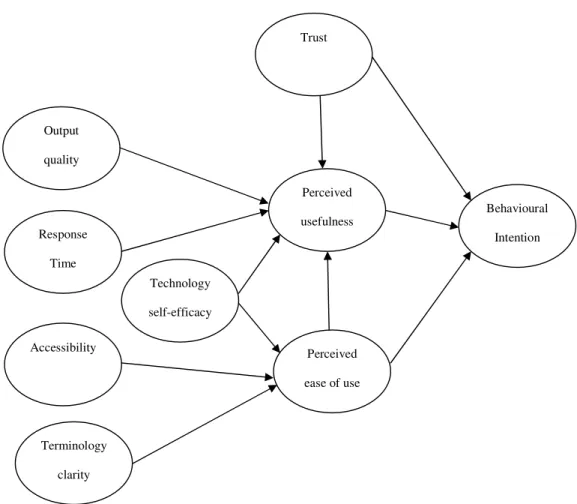
According to the proposed conceptual model, OBIS acceptance was determined by eight main factors, which included perceived usefulness, perceived ease of use, trust, technological self-efficacy, response time, output quality, accessibility, and terminology clarity. In this model, PU was hypothesised to be affected by PEOU, trust, technological self-efficacy (TSE), output quality (OQ) and response time (RT). In addition, PEOU was hypothesised to be determined by three external factors: TSE, accessibility and terminology clarity (TC).
vii
The model was tested on a sample of 353 Internet banking users in Pakistan. Using structural equation modelling with Analysis of Moment Structures (AMOS) software, data analysis showed considerable support for the extended hypothesised model. The result indicated that, in order of importance, PU, PEOU and trust explained 45.7 % of the variance in the acceptance behaviour. The trust and the TSE predicted 28.1 % of the variance in the PU. However, the hypothesised relationships between the PU and the PEOU, OQ and RT were found to be not significant. While in the PEOU, 21.8 % of the variance was predicted by the TSE, accessibility and TC. TSE was found to be a more influential determinant of the PEOU than the PU.
The consideration of factors that have a significant influence on the acceptance of OBIS, as identified in this research, is important for the managers in the banking sector, especially in developing countries, in order to increase wider acceptance and use of these systems, which provide benefits to both the customers and the service providers.
viii
Table of Contents
DEDICATION iii DECLARATION iv ACKNOWLEDGEMENTS v ABSTRACT viTable of Contents viii
List of Tables xii
List of Figures xv
List of Formulas xvi
CHAPTER ONE: Introduction
1.1 Theoretical background and research problem 1
1.2 Research Aims and Objectives 4
1.3 Significance of the Study 5
1.4 Research Boundaries 6
1.5 Research methodology used in this thesis 6
1.6 Context of study: Pakistan 8
1.7 Structure of the Thesis 10
CHAPTER TWO: Literature Review
2.1 Introduction 12
2.2 Theoretical Models Used in Technology Acceptance and Usage 13
2.2.1 Theory of Reasoned Action 14
2.2.2 Theory of Planned Behaviour 16
2.2.3 Technology Acceptance Model 17
2.3 Extensions and integration of models with TAM 21
2.4 Review of technology acceptance studies in different contextual settings
23
2.5 Relative importance of external variables in acceptance of IT/IS technologies
33
2.6 Online banking information system acceptance and use 35 2.7 Relative importance of trust in technology acceptance 46
ix
2.7.1 Definition of trust 49
2.7.2 Trust and TAM in the online context 50
2.8 Critical Assessment of TAM studies 51
2.9 Conclusions 53
CHAPTER THREE: Conceptual Framework
3.1 Introduction 55
3.2 Model development and research hypotheses 55
3.3 Dependent variable – behavioural intentions 58
3.4 Factors affecting online banking information system acceptance 58
3.4.1 Perceived Usefulness 58
3.4.2 Perceived Ease of Use 59
3.4.3 Trust 60
3.5 Technological Self-efficacy 62
3.6 Antecedents of perceived usefulness 63
3.6.1 Output Quality 64
3.6.2 Response time 64
3.7 Antecedents of perceived ease of use 65
3.7.1 Accessibility 65
3.7.2 Terminology clarity 66
3.8 Conclusions 67
CHAPTER FOUR: Methodology
4.1 Introduction 69
4.2 Philosophical Perspectives 70
4.2.1 Positivist approach 72
4.2.2 Interpretivist approach 73
4.2.3 Research approach adopted in this study 74
4.3 Design of the Study 75
4.4 Sampling Strategy 77
4.4.1 Population 77
4.4.2 Sampling frame 78
4.5 Sampling 79
x
4.5.2 Non-probability sampling methods 83
4.6 Sample Size 84
4.7 Data Collection Procedure 85
4.8 Survey Questionnaire 87
4.8.1 Development of survey questionnaire 88
4.8.2 Response formatting 91
4.8.3 Scale development 91
4.8.4 Operationalisation of variables 97
4.9 Pre-test and Pilot Study 101
4.9.1 Pre-testing the questionnaire 101
4.9.2 Pilot study 102
4.10 Data Analysis 105
4.10.1 Preliminary data analysis 106
4.11 Factor analysis 109
4.11.1 Exploratory factor analysis 110
4.12 Structure Equation Modelling 114
4.12.1 Measurement model 114
4.12.2 Reliability 118
4.12.3 Validity 118
4.12.4 Structural model evaluation and hypothesis testing 120
4.13 Ethical Considerations 120
4.14 Conclusions 123
CHAPTER FIVE: Results
5.1 Response rate and non-response bias 126
5.1.1 Response rate 126
5.1.2 Non-response bias 126
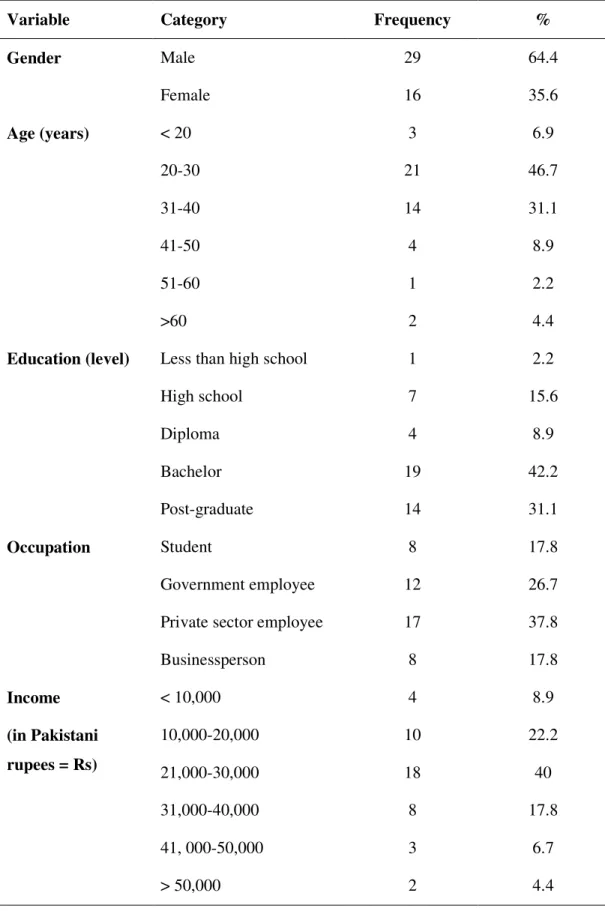
5.2 Demographic characteristics of participants 127
5.3 Descriptive statistics of construct items 131
5.3.1 Behavioural intentions 131
5.3.2 Perceived usefulness 132
5.3.3 Perceived ease of use 132
5.3.4 Trust 133
xi 5.3.6 Accessibility 134 5.3.7 Terminology clarity 135 5.3.8 Output quality 135 5.3.9 Response time 136 5.4 Missing data 136
5.4.1 The amount of missing data 136
5.4.2 Randomness of missing data 138
5.4.3 Handling with missing data 138
5.5 Outliers 138
5.6 Data normality for individual item 140
5.7 Exploratory factor Analysis 140
5.7.1 KMO and Bartlett’s Test of Sphericity 141
5.7.2 Communalities 141
5.7.3 Exploratory factors extraction model 143
5.7.4 Loadings of measured items on latent factors 144
5.8 Creation of latent factors 147
5.9 Pearson’s correlations between latent factors / constructs 158
5.10 Outliers for latent factors 160
5.11 Normality of Data for Latent Factors 163
5.12 Homogeneity of Variance in the Data 163
5.13 Structural Equation Modelling 165
5.13.1 Measurement model specification and confirmatory factor analysis results
166
5.13.2 Goodness of fit indices 166
5.14 Assessment of Reliability and Validity of Constructs 171
5.14.1 Reliability of constructs 172
5.14.2 Validity 173
5.15 Structural Model Evaluation and Hypotheses Testing 180 5.16 Modifying Structural Model by Removing Non-significant Paths 191
5.17 Conclusions 194
CHAPTER SIX: Discussion
6.1 Overview of the Key Objectives of This Research 196
xii
6.3.1 Response rate 198
6.3.2 Participants’ demographic characteristics 199
6.3.3 Constructs and construct items 200
6.3.4 Hypotheses testing 204
6.3 Conclusions 213
CHAPTER SEVEN: Conclusions
7.1 Implications of Research Findings 215
7.1.1 Theoretical implications 217 7.1.2 Managerial implications 218 7.2 Research Contributions 219 7.3 Limitations 221 7.4 Future Research 221 7.5 Conclusions 222
References
226
Appendix
247
List of Tables
Table 1.1 Total number of banks branches in Pakistan 9
Table 2.1 Core constructs in TRA 15
Table 2.2 Core constructs in TBP 17
Table 2.3 Core constructs of the TAM 19
Table 2.4 Review of TAM studies 28
Table 2.5 Internet banking studies 45
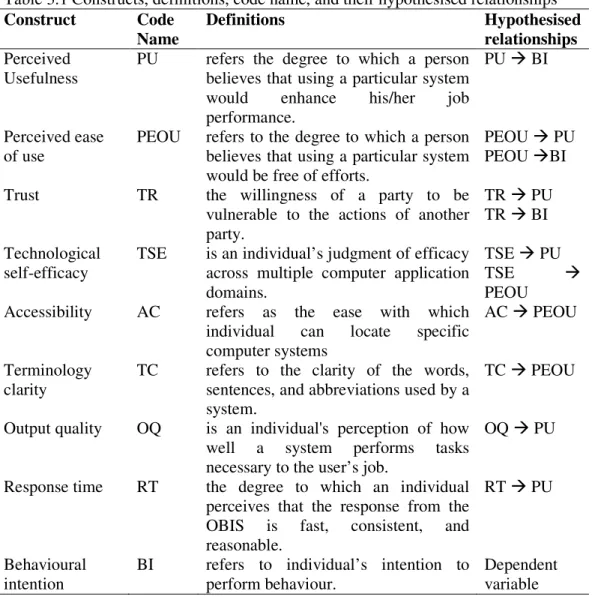
Table 3.1 Constructs, code name, and their hypothesized relationships 61 Table 4.1 Main features of positivistic and interpretivist research
paradigms
74
Table 4.2 Research philosophy, approach and strategy of this study 77 Table 4.3 Internet users and Internet penetration rate in Pakistan 78
xiii
Table 4.4 Taxonomy of Sampling Techniques 80
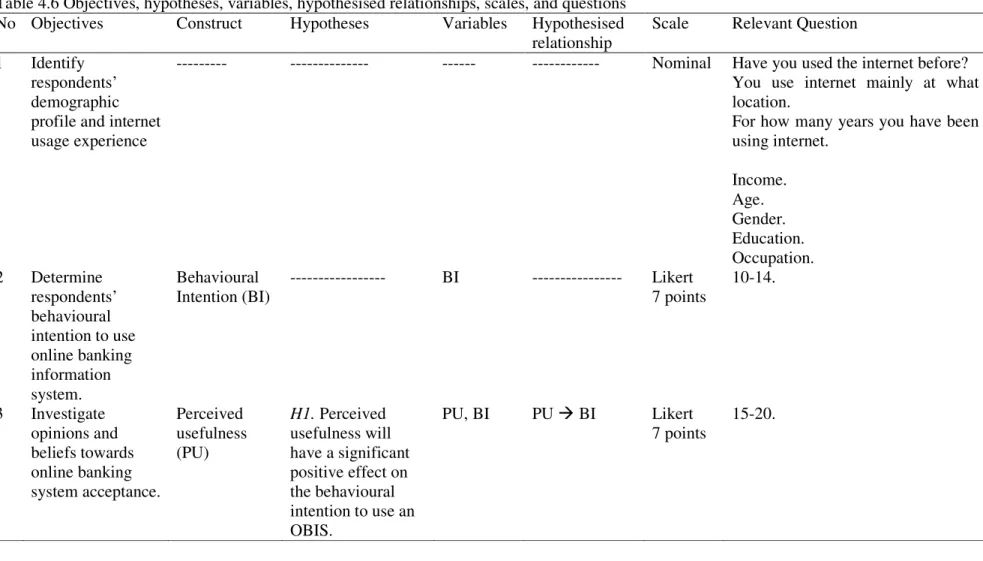
Table 4.5 Questionnaire Distribution and Response Rate 87 Table 4.6 Study objectives, hypotheses, variables, hypothesised
relationships, scales, and questions
93
Table 4.7 Demographic details of pilot study respondents 103 Table 4.8 Cronbach’s alpha coefficients for all constructs obtained in pilot
study
105
Table 4.8 Summary of Statistics 112
Table 4.10 Goodness of Fit Statistics in structural equation modelling 116
Table 4.11 Measurement model estimates 117
Table 5.1 Response bias analysis: Demographic Data 127
Table 5.2a Demographic characteristics of survey respondents 129 Table 5.2b Participants’ experience of Internet use 131 Table 5.3 Descriptive statistics of measured items of behavioural intention
(BI) construct
131
Table 5.4 Descriptive statistics of measured items of perceived usefulness (PU) construct
132
Table 5.5 Descriptive statistics of measured items of the perceived ease of use (PEOU) construct
133
Table 5.6 Descriptive statistics of measured items of trust (TR) construct 133 Table 5.7 Descriptive statistics of measured items of technological
self-efficacy (TSE) construct
134
Table 5.8 Descriptive statistics of measured items of accessibility (AC) construct
135
Table 5.9 Descriptive statistics of measured items of terminology clarity (TC) construct
135
Table 5.10 Descriptive statistics of measured items of output quality (OQ) construct
136
Table 5.11 Descriptive statistics of measured items of response time (RT) construct
136
Table 5.12 Missing data statistics 137
Table 5.13 Little’s MCAR test results 138
xiv
Table 5.15 KMO statistics and Bartlett’s test of sphericity 141
Table 5.16 Communalities 142
Table 5.17 Total number of factors extracted and total variance explained in EFA model
143
Table 5.18 Rotated Component Matrix 145
Table 5.19a Reliability Statistics trust 147
Table 5.19b Summary Item Statistics trust 147
Table 5.19c Item-Total Statistics trust 148
Table 5.20a Reliability Statistics PEOU 148
Table 5.20b Item Statistics PEOU 149
Table 5.20c Item-Total Statistics PEOU 149
Table 5.21a Reliability Statistics PU 150
Table 5.21b Summary Item Statistics PU 150
Table 5.21c Item-Total Statistics PU 150
Table 5.22a Reliability Statistics BI 151
Table 5.22b Summary Item Statistics BI 151
Table 5.22c Item-Total Statistics BI 152
Table 5.23a Reliability Statistics TSE 152
Table 5.23b Summary Item Statistics TSE 153
Table 5.23c Item-Total Statistics TSE 153
Table 5.24a Reliability Statistics OQ 154
Table 5.24b Summary Item Statistics OQ 154
Table 5.24c Item-Total Statistics OQ 154
Table 5.25a Reliability Statistics TC 155
Table 5.25b Summary Item Statistics TC 155
Table 5.25c Item-Total Statistics TC 155
Table 5.26a Reliability Statistics RT 156
Table 5.26b Summary Item Statistics RT 156
Table 5.26c Item-Total Statistics RT 157
Table 5.27a Reliability Statistics AC 157
Table 5.27b Summary Item Statistics AC 157
Table 5.27c Item-Total Statistics AC 158
xv constructs
Table 5.29 Residuals Statistics showing Mahalanobis distance (a) 160 Table 5.30 Descriptive Statistics of latent factors / constructs 162
Table 5.31 Tests of Normality 163
Table 5.32 Test of Homogeneity of Variance 164
Table 5.33 Goodness of fit statistics for the Initial CFA 169 Table 5.34 Goodness of fit statistics of revised CFA model 171
Table 5.35 Construct reliability statistics 173
Table 5.36 Convergent validity 174
Table 5.37 Inter-construct correlations 176
Table 5.38 Discriminant validity 176
Table 5.39 AMOS output - Covariances: (Group number 1 - Default model) 178 Table 5.40 AMOS output - Construct Correlations: (Group number 1 -
Default model)
179
Table 5.41 Hypotheses testing / paths causal relationships 181
Table 5.42 Structural model fit measure assessment 181
Table 5.43 Regression estimates of latent constructs 183
Table 5.44 Hypotheses testing 185
Table 5.45 Results of revised structural model 191
Table 5.46 Goodness of fit indices revised structural model 192
List of Figures
Figure 2.1 Theory of Reasoned Action 14
Figure 2.2 Theory of Planned Behaviour 16
Figure 2.3 Technology Acceptance Model 18
Figure 2.4 Revised Technology Acceptance Model 19
Figure 3.1 Proposed Research model 57
Figure 4.1 Research Design 76
Figure 5.1 Scree plot 144
Figure 5.2 Boxplots for latent factors / Constructs 161
Figure 5.3 Hypothesised CFA model derived from EFA 168
xvi
Figure 5.5 Structural model 186
Figure 5.6 Final revised model 193
Figure 7.1 Summary of research implications 216
List of Formulas
Formula 1 For computing reliability 172
1
CHAPTER ONE
Introduction
This chapter introduces the PhD thesis entitled “Online Banking Information Systems Acceptance: A Structural Equation Model” and the research study reported herein. Section 1.1 provides the background for theoretical issues and the research problem. Section 1.2 introduces the research aims and objectives. Section 1.3 and section 1.4, respectively presents the significance and boundaries of the study. Section 1.5 describes the research methodology. Section 1.6 gives the necessary context of the country in which this study was undertaken. Finally, the structure of this thesis is presented in the section 1.7.
1.1 Theoretical Background and Research Problem
Information technology (IT) is considered as one of the most fundamental forces for change in the financial services sector. Consequently, it has rapidly transcended barriers permeating different sectors by creating new products, services, market opportunities, and developing more information- and systems-oriented businesses and management processes (Liao and Cheung, 2002). Moreover, together with innovative business thinking, technology has been transforming the way in which personal financial services are designed and delivered (Crane and Bodie, 1996; Wang et al., 2003). After the development of faster and secure internet services, the financial services sector including retail banks started introducing online banking information systems to facilitate and complement their traditional service channels namely- counter teller, automated teller machines (ATM), telephone banking, and so on. This technological development and an increase in innovation diffusion serve as defensive measures to satisfy increasingly sophisticated and highly demanding consumers, as well as making the market more competitive in terms of reducing rising costs (Wang et al., 2003; Lin, 2006; Shah et al., 2007).
Online banking has transformed and revolutionised traditional financial institutions (Daniel, 1999; Mols, 1999). This transformation in banking has been achieved by digitising activities and making them automatic for operational purposes (Bradley and Stewart, 2003). The potential competitive advantages of the internet and the web
2
for banks lie in the areas of cost reduction and satisfying consumer needs. However, electronic transactions through internet banking remain a fraction of what is performed through bank branches or other traditional methods such as counter-tellers, automated teller machines (ATMs) or telephone banking (Bradley and Stewart, 2002). However, these methods of carrying out financial transactions are costly compared to online banking. According to Hall et al., (1999), Chang (2002), and Xue et al., (2011), the average cost per transaction charge for different service channels is 1.07 US$ for counter-tellers, 0.54 US$ for telephone banking, 0.27 US$ for the ATM service and 0.01 US$ for internet banking. In addition, setting up a single new branch of a bank costs approximately 3.5 to 5 million US$, whereas the cost of setting up an online banking service is from 1.5 to 2 million US$ (Lin, 2006). Therefore, online banking facilities are much cheaper for the banks; as a result, bankers are very willing to open and provide online banking facilities to their customers. However, the acceptance and the success of online banking facilities rest with the potential users – the bank account holders.
Online banking (or internet banking) is a relatively new type of information system that “uses the innovative resources of the internet and world wide web to enable customers to effect financial activities in virtual space” (Shih and Fang, 2004; pp.213). This newly developed online banking system , if used properly, has the potential to increase customer satisfaction as well as the performance of the banks (Alsajjan and Dennis, 2010; Al-Somali et al., 2009; Pikkarainen, 2004; Hiltunen et al., 2004; Karjaluoto et al., 2002; Wang et al., 2003). Pikkarainen et al. (2004) asserted that electronic banking provides many benefits to the customers all over the world. It has been observed that the benefits and usefulness of OBIS play a significant role in determining customer choice, since many are attracted to those banks that offer more online banking benefits (Pikkarainen, 2004; Wang et al., 2003). There are varieties of benefits that an OBIS can offer which are however not limited only to the banks but customers can also benefit from them by utilising the services in order to carry out their banking transactions (Karjaluoto et al., 2002; Hiltunen et al., 2004; Yiu, et al., 2007; Alsajjan and Dennis, 2010). These benefits can be summarised as: Firstly, online banking service is available 24 hours and seven days a week compared to the brick and mortar banks that are opened only for few
3
hours during the working days. Secondly, online banking systems attend the queries regarding financial irregularities faster than traditional banking system by logging on instantly and accessing the online bank. In this way, online banking services do not only save the time and money but also provide the convenience and instant accessibility. Thirdly, online banking information systems ensure privacy better than human-teller processing speed by executing and confirming transactions at a quicker speed. Finally, consumers are updated not only about new services, but also about special events, promotions and reports, and updates on regular basis.
However, despite the benefits that online banking information systems can offer, it is worth noting that the technological developments alone cannot guarantee the acceptance and the use of systems by the potential customers. Despite the fact that the potential benefits of electronic services in banking have been described in detail in the research conducted (Alsajjan and Dennis, 2010; Al-Somali et al., 2009; Yiu, et al., 2007; Yousafzai, 2005; Pikkarainen et. al., 2004; Wang et al., 2003; Daniel, 1999; Mols, 1999), countries which have played leading role in introducing internet banking have yet to achieve their targets in comparison to the resources invested in technology-based services. For example, according to (Sarel and Marmorstein, 2003) many US online customers are inactive, use online banking very rarely or use it to carry out very basic transactions. It has been reported that all the top 50 largest banks in the US offered online banking by 2002 and approximately 91% of US households had a bank account (Kolodinsky, 2004), but only 17% of them had utilised online banking. Analysts at that time predicted that this online banking penetration would reach 37% by 2007 (Yousafzai, 2005). However, this prediction was proved an over-estimation as new survey conducted by American Bankers Association in 2007 showed that only 23% of the USA consumers use online banking as primary method for banking transactions (Fisher, 2007). Moreover, according to (Flavian et al., 2005) when users really want to make a financial transaction which should generate revenue for the bank they choose to do it at a bricks-and-mortar branch and complex transactions are still performed manually. Therefore, if customers do not accept or fully utilise the capabilities of these information systems based banking facilities than there is a reduced return on such investments (Burton-Jones and Hubona, 2006; Venkatesh and Davis, 1996). Thus, it
4
is important for both researchers and practitioners to understand why customers accept or reject new information systems (Davis et al., 1989) and identify those factors that influence acceptance of online banking systems.
In understanding the importance of customer acceptance, a number of information systems (IS) researchers have investigated and developed models to predict user acceptance and usage behaviour. Among the various models that IS researchers have applied to predict and explain users’ acceptance behaviour, the technology acceptance model (TAM) developed by Davis, 1989; Davis et al., 1989 is perhaps the most widely used model. The main reasons for its widespread use are simplicity, parsimony and robustness (Mathieson et al., 2001; Cheng et al., 2005; Venkatesh and Bala, 2008; Abbasi et al., 2011). The TAM explains that individuals’ perceptions are based on perceived usefulness (PU) and perceived ease of use (PEOU) which, in turn, influence users’ intention and usage behaviour towards a particular information system (Davis, 1989; Davis et al., 1989). Prior research applying the TAM and its core constructs: PU and PEOU, proved its validity in predicting user acceptance behaviour across technologies and contextual settings (Davis et al., 1989; Venkatesh and Davis, 2000; Gefen et al., 2003; Abbasi et al., 2011). However, there is considerable debate among researchers (e.g. Moon and Kim, 2001; Wang et al., 2003; Abbasi et al., 2011) who argue that the TAM’s core constructs (i.e. PU and PEOU) may not be sufficient to explain user acceptance of new IT systems, as the factors influencing the acceptance of a new IS (such as an OBIS, which is focus of this study) are likely to vary with the technology, target users, and context. Therefore, to better understand the acceptance behaviour of potential users, this study intends to extend the TAM in the context of OBIS acceptance, specifically in the context of a developing economy context (i.e. Pakistan).
1.2 Research Aims and Objectives
This research study intends to address a research problem, i.e., what factors affect user acceptance of online banking information systems, by developing and testing an amalgamated model of the antecedents and consequents of individual’s belief towards OBIS acceptance and use. The proposed model integrates key constructs
5
from the information systems and e-commerce acceptance research streams into the theoretical frame of the technology acceptance model (TAM). The results of the present study are expected to contribute literature on online banking information systems and technology acceptance. By addressing the above stated research problem, this study aims to achieve the following two objectives.
1. To develop a model of the determinants of online banking information system acceptance based on technology acceptance model as a foundation.
2. To test the empirical validity of the proposed research model in a developing economy context i.e., Pakistan’s perspective.
1.3 Significance of the Study
Online banking information system (OBIS) is a web-based information system that has the potential to increase customer satisfaction as well as the performance of the banks (Alsajjan and Dennis, 2010; Al-Somali et al., 2009; Pikkarainen, 2004; Hiltunen et al., 2004; Karjaluoto et al., 2002; Wang et al., 2003) and is thus worthy of further research efforts.
Academically speaking, the present study is significant from two points of view. Firstly, this study makes contribution to the research on technology acceptance model as it extends theoretical and empirical research on OBIS acceptance. Secondly, the previous research has contributed to the development of literature both theoretical and empirical related to IT usage. The present study makes a comparison between the results of this study with results of other studies which assist in advancing MIS field to achieve awaited goals. For bank management, who are actually using or planning to use OBIS in their banks, better understanding of critical factors could assist them in achieving the most effective deployment of such system. For IS designer and developers, understanding the crucial factors related to OBIS use will enable them to design more effective systems to enhance the acceptance and use of OBIS among current and potential users. Finally, this study is also useful for OBIS software consultant and vendors as this study provides them a synopsis of very crucial factors which can add or undermine efforts of their provision of successful products and services to the clients and customers. The model validated through
6
study can also serve as a diagnostic tool to assist OBIS practitioners in understanding some reasons regarding why some systems are preferred to the others for extensive use. The results of this study can suggest some crucially key factors. These key factors then could be manipulated in a way they influence behaviour of potential users of OBIS. In this way, they can achieve an efficient and effective use of IT resources.
1.4 Research Boundaries
The boundaries of the present study can be described from different angles. First, the area of application under investigation in this study is the acceptance of online banking information systems. The rational for selecting this area is explained in section 1.1. Second, the investigation for the acceptance behaviour is limited in developing economy context, i.e. from Pakistan’s perspective. The choice of the location is justified in section 1.6. Although, in general sense, the notion of technology acceptance is not restricted to any specific parts of the world, however, there is a reservation in terms of the practicality and applicability of those technology acceptance models that are established in the developed countries and are applied to developing countries context. Moreover, most of the technology acceptance research published in the top journals is based on the data from western world (i.e. North America, UK, Australia, and so on). Therefore, investigating the applicability of technology acceptance models by obtaining data from a developing economy is worth investigating. Finally, as mentioned earlier data for present study is obtained from a single study that focused on the online banking information system, and specific user group (i.e. online banking users). Thus, diligence is required when generalising findings of this study to other IT/IS systems applications and user groups.
1.5 Research Methodology Used in this Thesis
The data for present study was collected using a cross sectional questionnaire survey. The survey approach is considered most appropriate technique, especially in technology acceptance and MIS research, because this technique is faster, inexpensive, efficient, and can be administered to a relatively large sample (Churchill, 1995, Sekaran, 2000; Zikmund, 2003). The questionnaire was developed
7
using seven-point Likert type scale, ranging from (1) strongly disagree to (7) strongly agree.
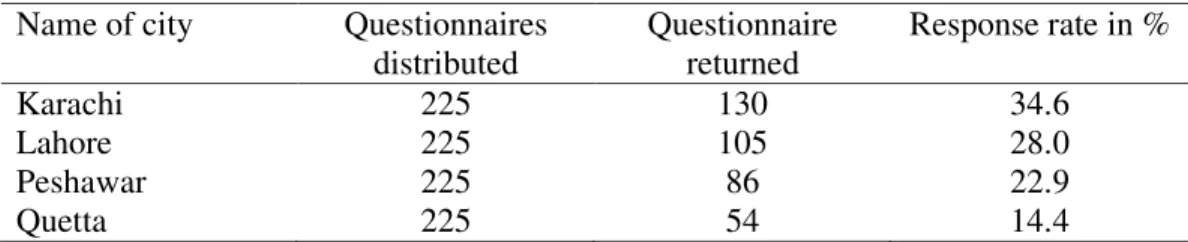
A pre-testing of questionnaire was conducted in order to ensure that there was no ambiguity in the questions and that the respondents felt no difficulty in understanding them. Then the instrument was pilot tested for the assessment of the psychometric properties of the measurement items. In the field survey, 375 questionnaires were returned out of 900 distributed, which represented a response rate of 41.7% of the original sample. However, among those returned questionnaire, 22 responses were discarded because four of them were returned completely blank, five respondents had put the same answers on all the Likert scale items, seven respondents mentioned that they had never used internet before (i.e. not satisfying inclusion criteria) and six questionnaires were partially answered (i.e. some questions and/or some parts of the questionnaire such as demographic questions were left blank). Therefore, remaining 353 questionnaires were used for further data analysis. As a result, the final response rate in this study was 39.2%.
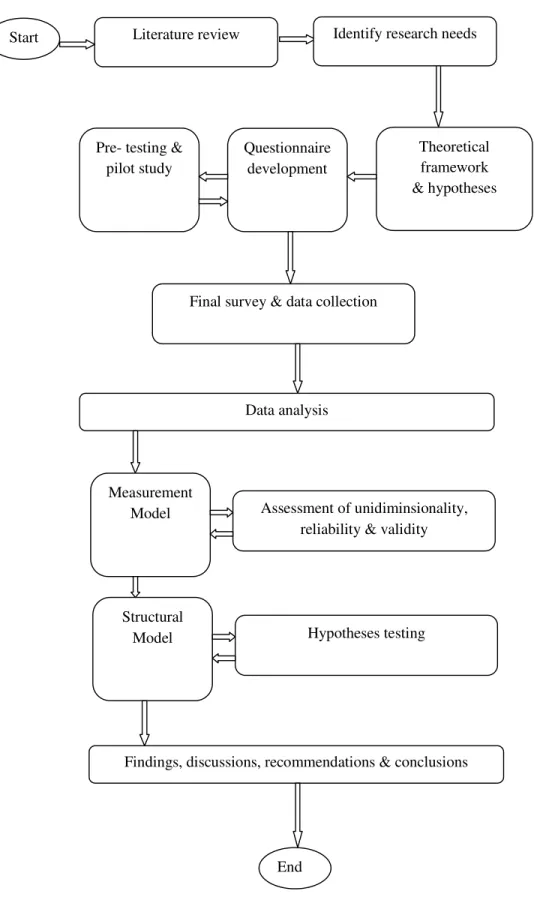
All of these valid responses were coded into Statistical Package for the Social Sciences (SPSS) version 16.0 for statistical analysis. Two types of data analysis were performed on the data: descriptive analysis and inferential analysis. The latter included exploratory factor analysis and structural equation modelling analysis including confirmatory factor analysis and hypotheses testing. Descriptive analysis and exploratory factor analysis were performed using SPSS while structural equation modelling (SEM) analysis was performed using Analysis of Moment Structures (AMOS) software version 16.0. A two-stage approach was adapted to conduct SEM analysis as recommended by Anderson and Gerbing (1988). In the first stage measurement model using confirmatory factor analysis (CFA) was conducted to assess the reliability and validity of latent constructs. In the second stage, hypotheses related to influential factors were tested. The SEM model fit was determined using goodness-of-fit indices and coefficient parameter estimates, as suggested by (Byrne, 2001; Kline, 2005; Hair et al., 2006).
8 1.6 Context of Study: Pakistan
Pakistan has been chosen as the context for data collection for this study. This South Asian country with a total population of 166 million (World Bank, 2008) is the sixth most populous country in the globe and third among Muslim countries (Abbasi et al., 2011). The country has a GDP of 168.28 billion US dollars (as of year 2008) with a growth rate 5.95% per annum (World Bank, 2009). In addition, according to the Information Economy Report published in 2009 by the United Nations Conference on Trade and Development (www.unctad.org), Pakistan is among the five countries of Asia in terms of increased rate of internet and broadband penetration, and mobile phone usage. Given below are the main reasons for selecting Pakistan as the context for this study.
(1) Although enormous funds have been invested in IT in organisations in Pakistan, especially in banking sector, the new technology acceptance rate is observed to be lower than expected.
(2) The culture of Pakistan is different from the countries where the TAM originated (e.g. North American countries). Therefore, selecting Pakistan will help to examine the applicability (validity and robustness) of extending the TAM, which may vary across different cultural settings (Mao and Palvia, 2006).
Pakistan is among the late adopters of IT; nevertheless, the IT sector has grown tremendously since 2000 following the announcement of IT policies and action plans by the Pakistan government in order to boost IT usage (Kundi and Shah, 2009). As a result, there has been a continuing increase in internet users and usage in Pakistan. For example, according to the Internet World Stats, there are now about 6,767,805,208 internet users worldwide, of which 3,808,070,503 are in Asia, making 42.6%. Of total users, Pakistan is ranked 8th among the top 10 Asian countries, covering about 18.5% of the total internet user population in Asia. This tremendous growth among the internet users in Pakistan is evident from the fact that there were approximately 133,900 internet users in the year 2000, which rose to 18,500,000 by 2009. The internet penetration rate has been recorded to be 10.6% (Internet World Stats, 2010). According to the International Telecommunication Union (ITU), the number of internet users per 100 persons in Pakistan was recorded as 11.4 in 2008
9
(ITU, 2009). In addition, the government of Pakistan has reduced the cost of bandwidth, in order to increase the internet penetration rate (Kundi and Shah, 2009). However, despite these efforts on the part of the government, some neighbouring countries have a higher internet penetration rate. In comparison to Pakistan’s internet penetration rate of 10.6 per cent, neighbouring countries like Iran has 32% internet penetration rate, Saudi Arabia has 29.21%, and the UAE has 86% (as cited in Abbasi et al., 2011).
In Pakistan, the banking sector is among the leading players in applying IT for their retail banking activities. Citing Shamshad (2006), Kundi and Shah (2009) have reported that out of a total of 7,406 bank branches in Pakistan by the end of 2005 (Table 1.1), 3,424 (47.3%) branches provided a real-time online banking facility to account holders. Shakaib (2006) reported that the online banking systems in Pakistan increased by 45% during the second quarter of 2006. So, while there has been a considerable growth in online banking in Pakistan, the underutilisation of online banking systems is still a major problem in the country.
Table 1.1 Total number of banks branches in Pakistan
Categories June-2001 June-2002 June-2003 June-2004 June-2005 Dec-2005 Domestic Banks 7,272 7,280 6,829 6,872 7,089 7,301
Foreign Banks 80 78 70 67 82 105
Total 7,352 7,358 6,889 6,939 7,171 7,406
Source: Kundi and Shah (2009), p.3.
The recent literature shows that most of the users do not utilise and make good use of the electronic services, especially those offered by banking sectors. It has been reported, in a survey conducted in a major city, that only 8% of customers had knowledge of online bank account facilities in Pakistan (Kundi and Shah, 2009). Thus, in order to fully utilise electronic services offered by the banks, it is vital to understand the factors that can facilitate or hinder the use of newly developed banking systems; especially in the context of developing economies. In the above stated background, this researcher has undertaken a research study that is reported in the thesis, which is outlined in the next section.
10 1.7 Structure of the Thesis
This section briefly explains the structure of this thesis. Chapter one introduces the issues related to the topic under investigation i.e. acceptance of online banking information system, particularly in developing economies context.
Chapter two discusses in detail various theories such as the theory of reasoned action (TRA), theory of planned behaviour (TPB) and the technology acceptance model (TAM), which have been used in explaining user acceptance of technology in general. Also, it critically reviews the relevant literature related to the important factors that are likely to influence the online banking information system, in order to develop the online banking information system acceptance model. The influential factors identified in the literature along with technology acceptance model include trust, technological self-efficacy, output quality, response time, accessibility, and terminology clarity.
Drawing on the literature review presented in Chapter two, Chapter three presents the conceptual model of acceptance of online banking information system proposed in this research. The conceptual model explains eleven hypotheses to be tested and analysed.
Chapter four presents the methodology applied to empirically test the proposed conceptual model of online banking information system acceptance, established in Chapter three. This chapter discusses research paradigms, and research strategy. It also provides the justification of the methodology, discusses the steps taken to collect the data, discusses the sampling issues, explains scale items selected to measure the underlying latent factors, describes development and operationalisation of the instrument used to collect the data, reports the pre-testing of survey instrument, presents pilot study results, discusses the data analysis techniques, presents reliability and validity of the latent factors, and finally presents the ethical considerations in this research.
Chapter five reports the results of data analysis undertaken in this study using different data analysis tools, which are explained and justified in Chapter four.
11
Results reported include descriptive analysis and inferential statistics including structural equation modelling analysis. This chapter also reports the reliability and the validity of constructs along with hypotheses testing.
The chapters six and seven presents discussion and conclusions of the present study. The chapter six provides an overview of the research and discusses finding related to the results drawn from testing of eleven hypotheses in this study. The chapter presents theoretical and managerial implications drawn from the results reported in Chapter five. Finally, it presents limitations and directions for future research followed by the conclusions.
This chapter provided the background of theoretical issues and the research problem, research objectives, the purpose of the study, the research methodology, the context in which this study was undertaken as well as the outline of the structure of this thesis. The next chapter provides a review of literature relevant to the study topic.
12
CHAPTER TWO
Literature review
2.1 Introduction
Since the inception of information systems, there has been an ongoing quest among the research community to find those factors that influence people to accept and to make use of the systems. This issue is of particular importance for organisations because by understanding influencing factors, management will be able to understand users’ perceptions and intentions towards a given IS. Besides, this will also enable system designers and developers to enhance the use and acceptance of newly developed systems through focusing on user-centred design choices. Over the decades, researchers have been investigating the factors predicting user acceptance of information systems (IS) / information technology (IT). In this regard, researchers have developed and used various models to understand user acceptance of IS.
Among the various user acceptance theories, Theory of Reasoned Action (TRA), Theory of Planned Behaviour (TPB) and Technology Acceptance Model (TAM) appear to be the most widely accepted and used by the IT researchers. The TRA and its derivatives, TPB and TAM follow the Attitude-Behaviour paradigm that suggests that behaviour in question is determined through the intention toward the behaviour. Thus, the intention is influenced by attitude and finally salient beliefs influence the attitude. However, the TAM has more clear focus on the IT/IS usage. The TAM has been extensively used solely for the purpose of predicting, explaining and increasing the understanding regarding individual’s acceptance of technology in variety of fields. It is important to note here, that the present study applies TAM-based findings as the basis for the theoretical model development.
In this chapter, researcher discusses the research that has been conducted in the field of individual’s acceptance of information systems and online banking. Section 2.2 discusses theoretical models used in technology acceptance and usage. Section 2.3 presents extensions and integration of models with TAM. Section 2.4 presents review of technology acceptance studies in different contextual settings. Section 2.5
13
provides relative importance of external variables in technology acceptance of IT/IS. Section 2.6 discusses online banking information system acceptance and use. Section 2.7 discusses relative importance of trust in technology acceptance. Section 2.8 presents critical assessment of technology acceptance studies. Section 2.9 presents conclusions.
2.2 Theoretical Models Used in Technology Acceptance and Usage
Recently, the adoption of technology in organisations has grown immensely. In 1999, it was estimated that annual worldwide expenditures on IT may exceed one trillion US dollars per year and it was predicted to be growing at about 10 per cent compounded annually (Seddon et al, 1999). Further, studies have shown that investment in IT has consumed about half of total capital investment of organisations since 1980’s (Venkatesh et al, 2003). However, the consequential benefits of such investments on the development of IT systems are not guaranteed, until these systems are not accepted and utilised by the intended users (Venkatesh and Davis, 1996). Hence, there is a need to know why people are keen or reluctant in using new information systems in order to figure out practical methods of evaluating and assessing new IT systems, to forecast the user response and acceptance of IT systems along with the implementation of these systems (Davis, 1989).
Literature has confirmed an individual’s ‘intention’ as a significant predictor of the acceptance and usage of new IT systems (Venkatesh and Morris, 2000; Fishbein and Ajzen, 1975; Davis, 1989; Ajzen and Fishbein, 1980; Davis et al., 1989) and suggested models that have theoretical base in social psychology. These intention-based models use behavioural intention to predict information system acceptance and usage (Taylor and Todd, 1995). These theoretical models (TRA, TPB, and TAM), from which the theoretical framework for this research is developed, are discussed in detail in following sections.
The TRA developed by Fishbein and Ajzen (1975) has established as a successful theory in explaining and predicting IT usage behaviour across a broad range of domains. However, due to its limitations on volitional control, Ajzen (1991) extended TRA by including an additional construct i.e. perceived behavioural control
14
(PBC). This construct predicts both behavioural intentions to use as well as the actual use behaviour. The extended model is called the Theory of Planned Behaviour (TPB). Empirical studies (Mathieson, 1991; Taylor and Todd, 1995) showed the appropriateness of using the TRA and the TPB theories for studying the determinants of IT usage behaviour. The TAM developed by Davis in 1986 is an information system theory adapted from the TRA specifically designed for modelling user acceptance of an IS. The TAM is one of the most widely used models to explain user acceptance of new IS/IT systems (Venkatesh and Davis, 2000).
2.2.1 Theory of Reasoned Action
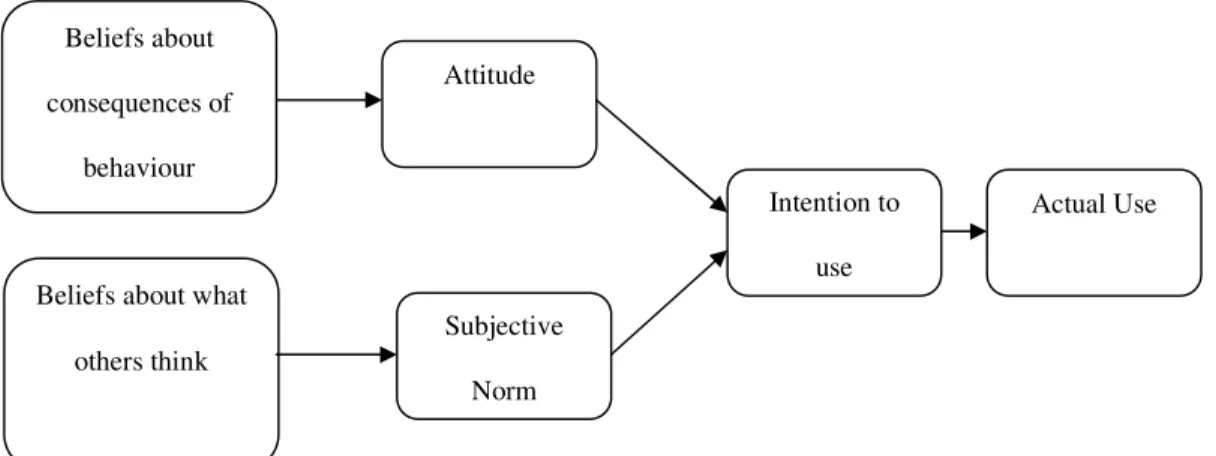
The Theory of Reasoned Action (TRA: Fishbein and Ajzen, 1975) is an intention model developed from social psychology that explains the determinants of users’ behaviour in question (Ajzen and Fishbein, 1980). The main goal of this theory is “to predict and understand an individual’s behaviour” (Ajzen and Fishbein, 1980, p.5). The foundations of the TRA lie in the assumption that behaviour of the users is rational and that the users evaluate the existing data systematically. In other words, the TRA suggests that individuals take into consideration the implications of their activities before performing any specific behaviour (Ajzen and Fishbein, 1980). A model of TRA is illustrated in Figure 2.1.
Figure 2.1 TRA (Fishbein and Ajzen, 1975)
According to Ajzen and Fishbein (1980), the theory of reasoned action posits that "most behaviours of social relevance are under volitional control and are thus Actual Use Intention to use Attitude Subjective Norm Beliefs about what
others think Beliefs about consequences of
15
predictable from intention" (p. 41). The model of TRA, as shown in the Figure 2.1, defines relationships among beliefs, norms, attitudes, intended behaviour, and actual behaviour. In the TRA, attitudes and subjective norms affect individual’s intention, which predicts the behaviour of the person. Attitude refers to individual’s negative or positive assessment of the behaviour in question (Fishbein and Ajzen 1975), while subjective norm, a social influence factor, refers to individual’s perception of social pressure to perform or not to perform the specific behaviour (Fishbein and Ajzen 1975). Therefore, the TRA comprises two core constructs i.e. attitude and subjective norms, which are defined in Table 2.1.
Table 2.1 Core constructs in TRA
Core Constructs Definition Author
Attitude refers to individual’s negative or positive evaluation of the behaviour.
Fishbein and Ajzen (1975)
Subjective Norm refers to individual’s perception of social pressure to perform or not to perform the behaviour.
Fishbein and Ajzen, (1975)
Source: Developed for this study.
The TRA has been broadly applied and tested in various studies to predict and explain the performance of behaviour both the intended and the actual (Davis et al., 1989). However, by the time this theory was applied in various academic disciplines, researchers realised that this theory was not sufficient and there were several limitations when it was applied in particular contextual settings (Davis et al., 1989; Ajzen, 1991). Davis et al. (1989) suggested that TRA is general behavioural theory and it does not point out what particular beliefs would be appropriate in particular situations. Furthermore, the TRA theory was criticised for being unsuitable to predict situations where individuals have low levels of volitional control (Ajzen, 1985). To address these limitations, Ajzen in 1991 extended the TRA and proposed a new theory called theory of planned behaviour (TPB), which is discussed in the next section.
16 2.2.2 Theory of Planned Behaviour
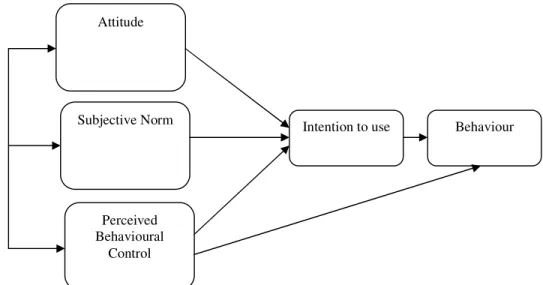
The Theory of Planned Behaviour (TPB) is an extension of the TRA (Ajzen, 1991) and the later (TRA) was proposed to study individuals’ behaviour in situation in which they had no control over the performed behaviour (Mathieson, 1991; Ajzen, 1991). Ajzen (1991) added the perceived behavioural control (PBC) construct in the TRA model to accommodate situation in which individuals’ lacked full volitional control. The PBC was therefore seen as an ease or difficulty in performing a particular behaviour (Ajzen, 1991). Therefore, the TPB that is another intention model established from social psychology (see Figure 2.2) suggests that (PBC) factor, subjective norms (SN), and attitudes are direct determinants of intentions to use and the actual usage behaviour. Thus, the TPB suggests that attitude, social influence factor SN, and PBC jointly determine the intended and actual behaviour. Additionally, the construct PBC was postulated to have casual relationship with both the intention to use and the actual usage.
Figure 2.2 Theory of Planned Behaviour (TPB: Ajzen, 1991)
Researchers have applied the TPB in a variety of situations in order to predict the performance of intentions and actual behaviour, such as, predicting user intentions to use new IS systems (Mathieson, 1991) and to perform unethical behaviour (Man, 1998). While comparing predictive power of TPB and TRA, Madden et al. (1992) and Man (1998) suggested that the TPB has an upper hand over the TRA in terms of predictive power of actual behaviour. The major difference between the TPB and the
Behaviour Intention to use Subjective Norm Attitude Perceived Behavioural Control
17
TRA is that the TPB added an exogenous variable i.e. perceived behavioural control, which has direct and indirect effect on actual behaviour through intention.
Although previous information system research studies suggested that perceived behavioural control may be an important predictor of intentions to use and actual usage (Mathieson, 1991; Taylor and Todd 1995); there is however empirical evidence that suggests that with the behavioural control construct the role of self-efficacy is not only an important incorporation to the theory but it commonly emerges as the most significant factor influencing both behavioural intention to use and actual behaviour (Armitage and Conner, 2001). Table 2.2 provides the definitions of the core constructs included in the TPB.
Table 2.2 Core constructs in TPB
Core Constructs Definition Author
Behavioural Intention refers to individual’s intention to perform behaviour and is a function of Attitude, Subjective Norm and Perceived Behavioural Control.
Fishbein and Ajzen (1975); Ajzen (1991); Mathieson (1991)
Attitude refers to individual’s negative or positive evaluation of the behaviour.
Fishbein and Ajzen (1975); Ajzen (1991); Mathieson (1991) Subjective Norm refers to individual’s perception
of social pressure to perform or not to perform the behaviour.
Ajzen (1991); Mathieson (1991)
Perceived
Behavioural Control
refers to the perceived ease or difficulty of performing the behaviour and reflects.
Ajzen (1991); Mathieson (1991)
Source: Developed for this research
2.2.3 Technology Acceptance Model
The technology acceptance model (TAM), developed by Davis (1989) (Figure 2.3), is one of the most widely applied models used to explain the individual’s acceptance
18
of information systems. The TAM is an information systems (IS) theory adapted from the theory of reasoned action (TRA), which was specifically designed for modelling acceptance of information systems by potential users. The primary purpose of the TAM is to predict IS/IT acceptance and diagnose design problems before users actually use new systems. Therefore, the TAM has been widely used for the purpose of predicting, explaining and increasing the understanding of user acceptance of information systems in various fields.
Figure 2.3 Technology Acceptance Model (TAM: Davis, 1989)
The TAM model suggests that when individuals encounter new IS technologies, two main variables influence how and when individuals will use the system. These variables of the TAM are perceived usefulness (PU) and perceived ease of use (PEOU). PU is referred as “the degree to which person believes that using a particular system would enhance his or her job performance” (Davis, 1989, p.320). PEOU is defined as “the degree to which a person believes that using a particular system would be free from efforts” (Davis, 1989, p.320). The TAM proposes that PU and PEOU beliefs affect users’ attitude towards using information systems. Their attitude directly relates to behavioural intention (BI) to use, which, in turn, will determine usage of the system. PU and PEOU both have an effect on BI. PEOU also affects PU. BI is also indirectly influenced by external variables through PU and PEOU.
However, the original TAM (Davis, 1989) was revised by omitting attitude from the model. Davis et al. (1989) conducted an empirical study among MBA students using System Use Behavioural intention Attitude Perceived Usefulness Perceived Ease of Use External variables
19
word processing application. The results of their study partially supported the model. They found that attitude did not fully mediated perceived ease of use and perceived usefulness. Therefore, they recommended a revision of the original TAM model which they claimed was a more "powerful for predicting and explaining user behaviour, based on only three theoretical constructs: Behavioural intention (BI), perceived usefulness (PU), and perceived ease of use (PEOU)" (Davis, 1989: p. 997). In addition, Davis and Venkatesh (1996) empirically proved that BI to use is only partly mediated by the attitude. The revised TAM is illustrated in Figure 2.4.
Figure 2.4 Revised Technology Acceptance Model (Davis, 1989)
The revised model of technology acceptance, proposes that BI is determined by PU and POEU. PU is determined by PEOU and external factors. PEOU is also hypothesised to have a direct effect on PU. In addition, external variables are postulated to have effect on core beliefs of TAM i.e. PU and PEOU. According to Davis et al. (1989) these external variables, as suggested in the TAM, could be system design features, personal characterises, training, and the like. Table 2.3 shows definitions of the core constructs in the TAM.
Table 2.3: Core constructs of the TAM
Core Constructs Definition Authors
Perceived Usefulness refers to the degree to which a person believes that using a particular system would enhance his or her job
Davis (1989); Davis et al. (1989); Venkatesh et al. (2003) System Use Behavioural intention Perceived Usefulness Perceived Ease of Use External variables
20 performance.
Perceived Ease of Use refers to the degree to which a person believes that using a particular system would be free of effort.
Davis (1989) ; Davis et al. (1989); Venkatesh et al. (2003)
Source: Developed for this research
Davis (1989) conducted various experiments to validate the TAM by using PEOU and PU as two independent variables to understand information system usage. He found that both constructs were significantly correlated with intended use and actual system usage. Although, the TAM was originally developed to test simple word processing software with students, Davis et al. (1989) described the core constructs (i.e. PU and PEOU) of the TAM as universal to varying types of information systems and user populations.
Reliable and valid measurement scales are most important for empirical studies; thus, Davis (1989) developed six item measurement scales for the core constructs: PU and PEOU, of TAM. Both PU and PEOU measurement item scales achieved high reliability and were proven to demonstrate convergent and discriminant validity. Since then many studies have used and replicated these measures and supported their reliability and validity in predicting and explaining user acceptance of various information technology applications (e.g. Segars and Grover 1993; Adams et al. 1992; Mathieson 1991; Hendrickson et al. 1993, 1996). Adams et al. (1992) in their study examined the psychometric properties of PU and PEOU instrument developed by Davis (1989). Results of their study confirmed the reliability and validity of measurement instrument for both perceived usefulness and perceived ease of use. They found that PU and PEOU were robust across different information systems and user groups. Hendrickson et al. (1996) assessed the test-retest reliability of the TAM core constructs PU and PEOU measurements instruments. They confirmed the PU and PEOU measurement scales to be reliable and valid in terms of test-retest analysis. Szajna (1994) examined the validity of PU and PEOU measurements to predict future behaviour with DBMS application using MBA students as sample. The discriminant analysis results of study found good predictive
21
validity for PU and PEOU instrument. Davis and Venkatesh (1996) suggested that original items of TAM could be used for predicting various information systems acceptance. In a research study, Subramanian (1994) concluded that information system researchers can use PU and PEOU scales in different technological and organizational contexts.
Although many research studies found TAM to be suitable as a base model for explaining user acceptance of various internet based technologies, such as online-tax (Wu and Chen, 2005 ), e-commerce (Palvia, 2009) and world wide web (Lederer et al., 2000). However, Segars and Grover (1993) recommended assessment of measurement instrument each time used in different settings, noting that “no absolute measures for those constructs exist across varying technological and organisational context…. Measurement models must be rigorously assessed and, if necessary, respecified” (p. 525).
2.3 Extensions and Integration of Models with TAM
The technology acceptance model has very well explained the user’s acceptance of different applications of IT/IS; therefore, a number of extensions to the TAM model have been developed. The original TAM identified that PU and PEOU as significant determinants of intention to use. Thereafter, several additional determinants have been incorporated into the TAM model, which have been postulated as having influence on the usage behaviour. There have been at least three approaches to extend the TAM. These approaches include introduction of new factors such as SN, PBC and perceived resources (PR), addition of extra or alternate constructs of the belief, and examination of mediators and antecedents of PU and PEOU (Wixom and Todd, 2005).
Venkatesh and Davis (2000) and Chau and Hu (2002) examined the influence of subjective norm (SN) on behavioural intention (BI) to use. Empirical results of the research studies revealed mixed findings for the SN construct. For example, subjective norm was significant determinant of BI in study conducted by Venkatesh and Davis (2000). However, the results of Chau and Hu (2002) found that subjective norm was insignificant determinant of BI to use. In another study, Mathieson et al.
22
(2004) added perceived resources construct in the model. The result of the study found that perceived resources construct was a major determinant of behavioural intention. In addition, perceived behavioural control (Chau and Hu, 2002) and perceived enjoyment (Hejden, 2004) were also found to have significant influence on intended behavioural use.
However, surprising results were of the research conducted by Taylor and Todd (1995). They pointed out that, “perhaps one of the most interesting results from this study was that by adding subjective norm and perceived behavioural control constructs to the relatively simple TAM model, the ability of the model to predict IT usage behaviour did not increase substantially” (Taylor and Todd, 1995, p. 171). They stressed a need for broader exploration of factors beyond those suggested by traditional intention or innovation models. In addition, they concluded that TAM could be used when the research goal is to predict behavioural intention to use.
Another attempt taken to extend TAM was to examine the influence of external variables on core beliefs of TAM i.e. PU and PEOU. For example, Davis (1991) extended the TAM in a research about the influence of system design features on user acceptance and found that TAM’s basic constructs PEOU and PU fully mediated the effect of systems design features on the usage. Igbaria et al. (1995) examined the influence of external factors i.e. user training, computing support and managerial support on PU and PEOU beliefs. Their results confirmed that these external factors significantly affected both the PU and the PEOU of microcomputer usage. However, some empirical studies have shown no significant effect of user training on TAM beliefs towards system acceptance. For example, a study by Karahanna and Straub (1999) found no significant effect of training on both PEOU and PU constructs.
In 2000, Venkatesh and Davis extended the original TAM model to explain perceived usefulness and behavioural intention towards usage in terms of social influence process and cognitive instrumental processes. They called extended model as TAM2 (Venkatesh and Davis, 2000). In TAM2, the social influence process highlights the impact of three inter-related factors that affect users when they
23
experience the opportunity to accept or reject a newly developed information system. They factors are subjective norms, voluntariness and image. In cognitive instrumental process, the TAM2 highlights the individual’s job relevance and output quality in relation to PU and PEOU. Furthermore, results demonstrability and ease of use are other fundamental determinants of user acceptance. Venkatesh and Davis (2000) conducted a longitudinal study including two voluntary settings and two involuntary settings. The results of their study revealed that results demonstrability, image, subjective norms, job relevance and results were significant determinants of usefulness construct. In addition, in a study conducted by Venkatesh (2000) revealed that factors like computer anxiety, computer self-efficacy, perceptions of external control, and objective usability were significant determinants of ease of use construct.
2.4 Review of Technology Acceptance Studies in Different Contextual Settings The technology acceptance model (TAM) has been one of the most widely applied models in research studies on technology acceptance. The model of TAM has been used in a wide range of application settings across various user populations, and its reliability and validity has been established in predicting user acceptance of technologies.
In a study, Davis et al. (1989) compared model of technology acceptance and the TRA model, to examine the effectiveness of these two models in explaining behavioural intention to use in a word processing application. The empirical results indicated that the TAM explained 47 per cent of the variance in behavioural intention to use whereas the TRA explained 32 per cent of the variance in users’ intention to adopt. Taylor and Todd (1995) compared three models: TAM, TPB, and decomposed TPB to understand information technology usage. The results of the study, in terms of overall fit, indicated that all three models had a good fit and almost equivalent explanatory power. The research concluded that while TAM could be preferably used when the research goal was to predict usage behaviour, the decomposed TPB model provided a more complete understanding of the determinants of usage behaviour. Mathieson (1991) compared TAM and TPB to predict user intentions towards information systems. The results indicated both TAM
24
and TPB predicted intention to use IS quite well. The study concluded that TAM was more parsimonious than TPB, and easier to apply in practice, giving TAM an empirical advantage over TPB. Chau and Hu (2001) compared TAM, TPB, and a decomposed TPB to examine the degree to which these models explain user acceptance in health care environment. The models were investigated using a survey on telemedicine technology involving 400 physicians in Hong Kong. The results suggested that TAM was better than TPB in explaining physicians’ intentions towards telemedicine technology acceptance (R-square = 0.40, 0.32, respectively). However, relatively low R-square compared to previous studies of TAM suggested a need for inclusion of additional factors in the model.
In an empirical study based on extended version of TAM, Chau (2001) investigated the influence of computer self-efficacy and computer attitude on individuals’ information technology usage behaviour. The model was empirically tested using data obtained from 360 business students by applying structural equation modelling software LISREL and their results supported the hypothesised model. They found that PU was a strong predictor of behavioural intentions. In addition, their results revealed that inclusion of computer related self efficacy and attitude towards computer into the model significantly improved the explanatory power of the research model on the variance of PU.
In 2004a, Shih conducted an empirical study to predict consumer’s acceptance of e-shopping on the web. He developed a model based on the TRA and TAM. The model was tested using data collected from 212 employees of eight small and medium size organisations in Taiwan. The results of study confirmed the theoretical postulation of the TAM. The results further suggested that both perceived ease of use of trading online and perceived usefulness were significant predictors of attitude towards acceptance of electronic shopping using the Internet. Findings also revealed that Internet and web perception of information, system and service significantly influenced user acceptance. In another empirical study, Shih (2004b) combined technology acceptance model (TAM) and the model of information behaviour for Internet utilisation. The extended TAM was tested using questionnaire survey of 203 office workers from ten small and medium sized organizations in Taiwan. The
25
results strongly supported the extended TAM. The empirical results suggested that TAM beliefs (usefulness and ease of use), and relevance significantly influenced the attitude towards information use (Beta = 0.16, 0.48 and 0.31 respectively). PEOU was found strongest predictors of the Internet use through attitude. Furthermore, there was a significant effect of relevance on TAM’s core beliefs i.e. PEOU and PU with Beta values 0.50, and 0.41 respectively. Overall, the extended TAM in the context of Internet utilisation explained 47 per cent of the variance in information use.
Ong et al. (2004) applied and extended technology acceptance model to understand acceptance of electronic learning system by engineers. They modified TAM by incorporating new construct perceived credibility into the model. The data was collected from 140 engineers working in six different international companies. The model was tested usi