Coordination
in
Closed-Loop Supply Chains
Inauguraldissertation zur Erlangung des akademischen
Grades eines Doktors der Wirtschaftswissenschaften der
Universit¨
at Mannheim
vorgelegt von
Dipl.-Kffr. Carolin Zuber
Heidelberg
Dekan:
Dr. J¨
urgen M. Schneider
Referent:
Prof. Dr. Moritz Fleischmann
Korreferent:
Univ.-Prof. Dr. Marc Reimann
Contents
1 An Introduction to Closed-Loop Supply Chains 1
1.1 Introduction . . . 1
1.2 Closed-Loop Supply Chain Processes and Actors . . . 3
1.3 Reverse Logistics at SC Service Group: An Illustrative Case . . . 5
1.3.1 SC Service Group . . . 5
1.3.2 The Asset Recovery Center and its Reverse Supply Chain . . . 6
1.4 Identified Research Needs . . . 10
1.5 Outline of the Thesis . . . 12
2 Coordination of Multiple Decision Makers - Structuring the Field 14 2.1 Coordination in the Forward Supply Chain Literature . . . 14
2.1.1 How to Coordinate Actions in Decentralized Supply Chains . . 15
2.1.2 How to Coordinate Actions and Pursue Information Transfer in Decentralized Supply Chains . . . 18
2.2 Coordination in the Closed-Loop Supply Chain Literature . . . 21
3 Coordination in Closed-Loop Supply Chains - The Case of the Dis-position Decision 27 3.1 Literature Review - Disposition Decisions in Closed-Loop Supply Chains 28 3.1.1 Characterizing the Disposition Decision . . . 28
3.1.2 Models of the Disposition Decision . . . 32
3.2 Model Assumptions and Notation . . . 35
3.3 The Disposition Decision . . . 42
3.3.1 Central Decision Maker - Benchmark . . . 42
3.3.2 Decentralized Decision Makers - The Situation of the Business Case . . . 46
3.3.3 Decentralized Decision Makers - The Service Provider Ac-quires Product Returns . . . 60
3.4 Numerical Example . . . 65
CONTENTS II
3.5 Discussion . . . 71
4 Coordination in Closed-Loop Supply Chains - The Customer In-terface 76 4.1 Introduction . . . 76
4.2 Decisions of Customers and How They Affect Closed-Loop Supply Chain Processes . . . 80
4.2.1 Customer Acquires the Product . . . 83
4.2.2 Customer’s Disposition Decision . . . 84
4.2.3 Duration of Usage . . . 86
4.2.4 Intensity of Usage . . . 87
4.2.5 Demand for (Maintenance) Services . . . 89
4.2.6 Demand for Complementary Products . . . 90
4.3 Identified Coordination Needs at the Customer Interface . . . 93
4.4 Mechanisms to Coordinate the Coordination Issues at the Customer Interface . . . 97
4.4.1 Incentivize the Closed-Loop Supply Chain Optimal Acquisi-tion Quantities . . . 97
4.4.2 Initiating Closed-Loop Supply Chain Optimal Reverse Flows . 98 4.5 Discussion . . . 106
5 Conclusion 108
Bibliography 112
List of Figures
1.1 Common Closed-Loop Supply Chain Processes . . . 4
1.2 Physical Flows of Leased IT Equipment and Actors Involved . . . 7
1.3 Process Steps at the Asset Recovery Center . . . 8
3.1 Categorization of Disposition Options . . . 30
3.2 Considered Reverse Supply Chain . . . 36
3.3 Sequence of Events and Decisions . . . 37
3.4 Material and Financial Flow of the Integrated Channel . . . 42
3.5 Illustration of Clip Levels . . . 45
3.6 Material and Financial Flow of the Business Case . . . 46
3.7 Change of Profit Margins and Clip Levels Compared to the Integrated Setting . . . 55
3.8 Resulting Profit of L . . . 55
3.9 Financial Flow Coordinated Actors . . . 61
3.10 Comparison of Clip Levels in the Benchmark and in Case of Acquisi-tion of Returned Products . . . 62
3.11 Profit Margins and Disposition Decision of a Central Decision Maker 68 3.12 Profit Margins for SP and Disposition Decision of a Decentral Deci-sion Maker . . . 70
3.13 Split of (Additional) Reverse Supply Chain Profit Depending on the Acquisition Price . . . 71
3.14 Relaxation of Assumptions and Suggested Extensions . . . 72
4.1 Considered Closed-Loop Supply Chain . . . 80
4.2 Stages of The Customer Acquisition Decision . . . 81
4.3 Effects of the Customers Product Acquisition Decision . . . 84
4.4 Effects of the Customer’s Disposition Decision . . . 85
4.5 Effects of the Customer’s Decision on the Duration of the Usage Phase 86 4.6 Effects of the Customer’s Decision on the Intensity of Usage . . . 88
LIST OF FIGURES IV
4.7 Effects of the Customer’s Decision to Demand (Maintenance) Services 90 4.8 Effects of the Customer’s Decision to Demand Complementary Products 91 4.9 Clustered Summary of Customer Decisions . . . 94 4.10 Customer Decisions - Summary of Effects on Closed-Loop Supply
List of Tables
3.1 Return Type-Reprocessing Pairs . . . 32
3.2 Example Assumption 4C . . . 39
3.3 Notation . . . 41
3.4 Karush-Kuhn-Tucker Condition for Local Maximum . . . 50
3.5 Prices on Raw Materials Market and Secondary Market . . . 66
3.6 Reprocessing Cost Ratios . . . 67
3.7 Disposition Decision of a Central Decision Maker . . . 68
3.8 L’s Optimal Decision on Service Payments [in e] . . . 69
3.9 Disposition Decision of a Decentral Decision Maker . . . 69
3.10 Profits Business Case . . . 70
4.1 Summary of Effects of Customer Decisions . . . 92
4.2 Identified Coordination Needs at the Customer Interface . . . 96
4.3 Coverage of the Customer Interface by Previous Literature . . . 102
Chapter 1
An Introduction to Closed-Loop
Supply Chains
1.1
Introduction
Against the background of scarce resources and increasing consumption worldwide, the awareness and realization of product reuse are essential. This is reflected not only by the increased environmental awareness of customers but also by the legisla-tive pressure to develop environmentally friendly products and processes. However, taking back products can also be seen as a chance for companies to gain additional economic benefits instead of only a burden. Due to the reuse of materials or compo-nents obtained from returned products, money can be saved. Furthermore, giving used products a second life offers companies the chance to earn additional profits by entering new markets. Accordingly, the consideration of reverse product flows can be separated into the waste-stream and the market-driven perspectives (Guide and Van Wassenhove, 2001, 2009). From a waste-stream perspective, companies passively accept the return of products and try to conduct reprocessing activities at the minimum costs. From a market-driven perspective, in contrast, companies strive to maximize their profits by remarketing reprocessed returns. This research project draws on and contributes to the value-added perspective.
The chosen focus on the value-added stream is driven by the fact that nowadays more and more products with remaining value are being returned. The manage-ment of these return flows represents an opportunity to obtain additional benefits that should not be disregarded. For example, hardly used consumer returns in the electronics sector increased by 21% from 2007 to 2011 (Bower and Maxham, 2012). This development is attributed to the increasing importance of e-commerce, a trend
An Introduction to CLSCs 2
that is expected to grow further. In Germany alone, e-commerce sales of physical goods increased frome18.3 billion in 2010 toe39.1 billion in 2013 (Bundesverband E-Commerce und Versandhandel Deutschland, 2013). Another type of returns is so-called end-of-use returns: products that have lost their value for a certain customer segment but are still functional and may be of use to another customer segment. This phenomenon is especially observed in fast-moving industries with short prod-uct life cycles, such as the IT sector. These return types are of course not new, but due to the given market developments, they require special attention nowadays. As both kinds of product returns are still of value, these return flows should not be seen only as a cost factor. On the contrary, the returned units should be seen as an opportunity to generate additional profits.
In the literature, the consideration of reverse flows started in the late 1990s. The first focus was on operational issues, such as the disassembly of returned products. The research centered on one actor optimizing one reverse flow activity. Since then, research in this field has evolved towards a more process-oriented perspective. This means that no longer is only one activity considered exclusively, but the interaction of several activities along the reverse supply chain (SC) is considered. Consequently, no longer does only one actor need to be taken into account, but potentially multiple, independent actors. In the last years, the scope has been further extended to a holistic perspective. Not only reverse but forward and reverse SC processes are considered jointly. Due to this, the traditional forward SC is extended by the reverse flow of products and information as well as by financial flows. Therefore, in addition to the members of a traditional SC, actors are required that are responsible for reverse-flow-specific processes like collection, grading and disposition, reprocessing, and reselling. These processes can be conducted by traditional SC members, as well as by new parties.
One of the major challenges in Supply Chain Management (SCM) is to match supply with demand. According to Tsay et al. (1999), SC-wide optimality is achiev-able if all the decisions are made by a single decision maker who has access to all the available information. Usually the outcome of such centralized decision mak-ing is used as a benchmark that can be achieved by the coordination of SCs. To achieve coordination, explicit decisions need to be made by the actors involved. Un-fortunately, these decisions often do not comply with the actors’ own objectives. Additionally, actors require certain information to be able to make the necessary decisions. Unlike the case of a centralized decision maker, not all the actors in a common SC have access to all the available information. Both unaligned incentives of the involved actors and information asymmetry are known to be major obstacles
An Introduction to CLSCs 3
to SC coordination (e.g. Cachon, 2003; Chen, 2003).
The challenge to match supply with demand needs to be faced in a Closed-Loop Supply Chain (CLSC) as well. Similar to the situation in a traditional forward SC, it can be expected that information and know-how are scattered between various members of a CLSC. Furthermore, actors have their own incentives, and decision making is usually decentralized. In comparison with traditional SCM, further com-plicating factors need to be considered. First is the heterogeneity of the returned products and the resulting increased uncertainty with respect to the supply side. The heterogeneity and uncertainty of the supplies originate from the usage phase of the customer, during which only little or no information is transmitted to other CLSC actors. Second, according to Guide and Van Wassenhove (2009), the com-plexity with regard to “designing, managing and controlling CLSCs” (p.12) increases due to the number of actors involved.
Consequently, the consideration of decentralized CLSCs raises several, consecu-tive questions that we want to address in this thesis:
1. What are the potential coordination needs in a CLSC environment?
2. What are the appropriate coordination mechanisms?
The following section provides an introduction to CLSC actors and the processes relevant to this thesis. Subsequently, an illustrative case is introduced (Section 1.3). Based on the learnings taken from the business case, we state the more explicit research questions for this thesis in Section 1.4. We close this chapter with an outline of the thesis (Section 1.5).
1.2
Closed-Loop Supply Chain Processes and
Ac-tors
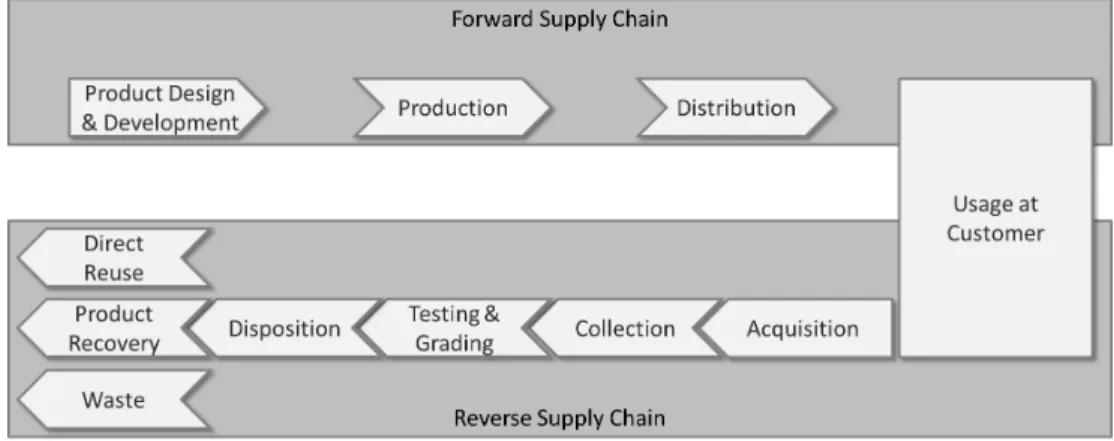
In a CLSC setting, the traditional forward SC is extended by the reverse flow of products and information as well as by financial flows. The main processes of such a CLSC are depicted in Figure 1.1.
We consider a forward SC consisting of three major processes: a product needs to be developed and designed, produced, and finally delivered to the customers via various distribution channels. The end point of the forward SC is the customers’ acquisition and use of the product.
The reverse flow of products starts with the customers’ decision to return their products. These products are acquired by the reverse SC and need to be collected.
An Introduction to CLSCs 4
Figure 1.1: Common Closed-Loop Supply Chain Processes
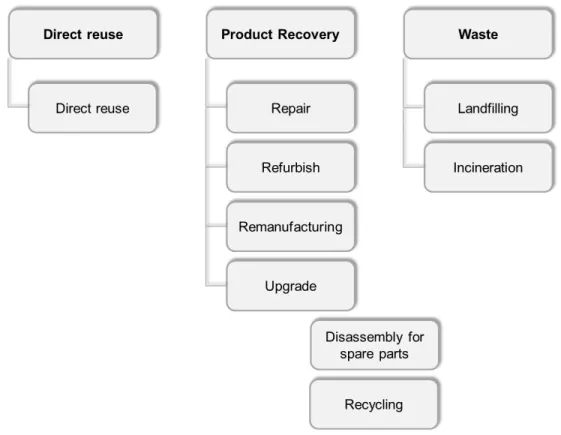
Collection can be designed in multiple ways: directly from the customer, from collec-tion points such as retailers, or via mail services (Aras et al., 2010). During the usage phase, customers handle their products in various ways. This is why the condition of returned products - and thus the quality of reverse SC supplies - is particularly heterogeneous. This makes the testing and grading of returned products necessary to obtain quality information. Depending on the reverse logistics network design, these processes are conducted either before or after the products are transported to the reprocessing facility. While the advantage of the first, decentralized option is that transportation costs for worthless products can be saved, it is accompanied by the implementation costs of decentralized grading resources (Fleischmann et al., 2000). Based on the grading outcome, what to do with a product of a given quality has to be determined - that is, the disposition decision has to be made. A common categorization of the available reprocessing options was introduced by Thierry et al. (1995). They distinguish three groups of disposition options: direct reuse, product recovery, and waste. Depending on the chosen disposition option, reprocessed prod-ucts are reintroduced into the forward SC on a product, component, or material level or discarded.
These additional processes of the reverse SC are conducted by the Original Equip-ment Manufacturer (OEM), retailers, or third parties (Fleischmann et al., 1997). This has two impacts. First, potentially there are more parties involved in CLSCs than in traditional SCs, which increases the complexity involved in managing CLSCs efficiently (Guide and Van Wassenhove, 2009). Second, the possibility to integrate forward and reverse SC processes is limited (Fleischmann et al., 1997).
Furthermore, customers take an important role by linking the forward and the reverse SC. They no longer represent the demand side only, but additionally act as suppliers. As the users of the products that are potentially returned, customers
An Introduction to CLSCs 5
are the origin of the most frequently mentioned challenging characteristic of reverse flows: the uncertainty with regard to the quality, quantity, and timing of product returns, the supply of reverse SCs (Guide and Van Wassenhove, 2009).
1.3
Reverse Logistics at SC Service Group: An
Illustrative Case
To highlight the relevance of coordination aspects in a CLSC context, we present an illustrative case. In particular, material is presented that is based on a master thesis project in collaboration with an Asset Recovery Center of the SC Service Group1 located in Germany (Tschan, 2011). The Asset Recovery Center is part of
the Contract Logistics division of SC Service Group.
In the following, we first provide information on the SC Service Group and the Asset Recovery Center. Afterwards, the considered reverse SC of which the Asset Recovery Center is part, is described in more detail. This includes an introduction to the actors involved in the SC as well as a description of the current reverse flows.
1.3.1
SC Service Group
Organizationally, the Asset Recovery Center (ARC in the following) belongs to Contract Logistics, which is one of five divisions of the SC Service Group. SC Service Group describes itself as a global multimodal provider offering end-to-end solutions for diverse industry sectors. In 120 different countries, SC Service Group has 30,000 employees, of whom 8,500 belong to Contract Logistics. This division is responsible for 18% of the group revenue and operates 3,000,000 m2 of logistics surface area at 170 sites in Europe. It is a worldwide operating player that offers its customers reliability, flexibility, and agile flow management as key factors in its competitiveness.
Among other services, Contract Logistics offers reverse logistics activities. The reverse logistics services provided can be clustered into three main tasks: collection, reprocessing, and reporting. One of the seven European technical centers responsible for reverse logistics services is the ARC, which we present here in more detail.
Besides general logistics activities, the focus in the regarded location is on reverse logistics activities - a focus that has grown historically. SC Service Group has been active in Germany since the late 90s, the period in which a strategic partnership with an OEM of IT hardware was established. A reverse logistics contract was added
An Introduction to CLSCs 6
to this partnership four years later. The contract covered the returns handling and dismantling of desktop PCs in Europe at the end of their leasing duration. Since 2009, the ARC has been a Microsoft Authorized Refurbisher, which means that this facility is allowed to install the operating system Windows on recovered desktop PCs.
Originally, the ARC was located on the OEM’s site. To develop its high-tech sector further, the company recently opened a new facility. The newly opened re-covery center has about 21,000 m2 of storage space and satisfies the highest security
standards. ARC’s workforce of about 200 employees offers services ranging from col-lection, data wiping, recovery, and remarketing over dismantling for spare parts to recycling. Due to certified process standards, both compliance with environmental regulations and data security can be ensured. Services are not offered exclusively to OEMs but also to other customers, such as independent leasing companies. Further-more, the portfolio of returned products has expanded over the years. Now, besides desktop PCs, end-of-lease returns include notebooks, screens, printers, and servers. The IT hardware sector is often the focus of reverse logistics research for several reasons. First is the economic perspective. The IT hardware sector is characterized by price competition, short product life cycles due to increasing innovation speed, and the usage of scarce resources. As technology allows for the reuse of products as a whole or their components on the one hand and IT hardware contains valuable elements such as rare earth metals on the other hand, reverse product flows have become increasingly attractive. Furthermore, the need for the establishment of reverse SCs in the IT sector is fostered by legislation as well as customer expectations of sustainability.
1.3.2
The Asset Recovery Center and its Reverse Supply
Chain
Let us now turn to the considered reverse SC and the description of reverse flows. We organize our description analogous to a framework introduced by Guide and Van Wassenhove (2009). In order to structure reverse SC activities and to show interdependencies, the authors introduce the process flow perspective and identify three subprocesses of reverse SCs:
1. Front End, meaning the supply of returned products,
2. Engine, meaning reprocessing activities,
An Introduction to CLSCs 7
Figure 1.2: Physical Flows of Leased IT Equipment and Actors Involved In our case, the actors involved are assigned to the subprocesses as follows (cf. Figure 1.2). ARC acts as a service provider offering reprocessing services and there-fore represents the reverse SC’s Engine. ARC is commissioned by companies to conduct the required reprocessing activities. Here, we talk about end-of-lease IT hardware that needs to be reprocessed. Both the companies leasing IT hardware to the primary market and the primary market users belong to the Front End as they supply ARC with returned products. Reprocessed units need to be resold. In the considered reverse SC, IT brokers are responsible for remarketing activities of reusable products. Raw materials are resold to the raw materials market directly by ARC. Thus, the Back End is represented by ARC, IT brokers, the secondary market, and the raw materials market.
We now address each of the three above subprocesses in more detail. OEMs or independent leasing companies lease IT hardware to their customers. The leasing of IT hardware is a common business concept, especially in the case of business customers. From the lessor’s perspective, leasing provides the advantage of extend-ing a product’s life due to successive leasextend-ing or resellextend-ing of returned units. Another advantage for lessors can be seen in the possibility of establishing close relationships with customers, which preferably result in subsequent deals. On the downside, lessors have to consider technological obsolescence and thus loss in value of the orig-inal products. Customers may benefit from leasing due to the flexibility obtained to update equipment frequently and for accounting purposes. At the end of the determined leasing duration, the lessor commissions ARC with collection and repro-cessing activities. The ownership of the returned products remains with the lessor, and ARC acts as a service provider.
An Introduction to CLSCs 8
Figure 1.3: Process Steps at the Asset Recovery Center
According to the requirements of ARC, the transportation of returned units from primary customers to ARC should not take longer than five days, starting on the day when ARC receives the mandate. The primary customers are spread all over Europe, the Middle East, and Africa. To collect end-of-lease IT equipment, ARC distinguishes two collection concepts. Either it is collected directly from primary customers’ location or customers take their end-of-lease units to a central collection point, from which ARC picks them up. Besides transportation, collection services include all the organizational issues and the supply of the required containers. ARC receives about 450,000 units annually from 33 different countries.
The process steps conducted by ARC are shown in Figure 1.3. All the processes that are described in the following in more detail are certified by different DIN ISO certificates.
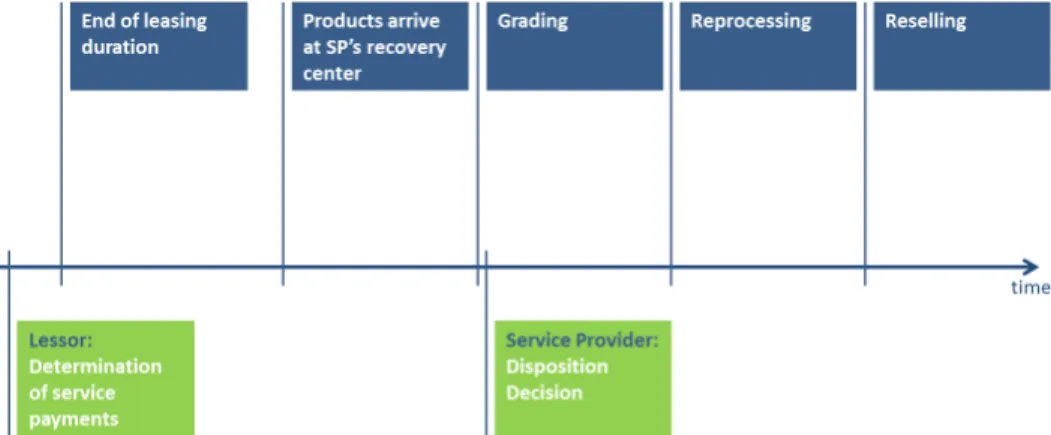
Once products arrive at ARC, the serial numbers as well as product and model types are registered in a SAP system. Furthermore, T ¨UV S ¨UD certified irreversible data wiping is conducted, and everything that may allow the identification of former users is removed. Subsequently, returned products are tested by means of special software on operability and configuration. Based on the outcome of the testing procedure, the returned products are sorted into different input quality classes. ARC schedules two days to complete these processes (registration, data wiping, testing, grading) for a whole batch that arrives at its facility.
Next, ARC makes the disposition decision. On a high level one can distinguish three disposition options:
• Recovery
• Dismantling for spare parts
• Recycling
The disposition decision is based on the payments received for reprocessing activities and the costs, which depend on the both condition of the returns and the dispo-sition option. About 80% of the returned products that arrive at ARC are worth
An Introduction to CLSCs 9
recovering and reselling on the secondary market. In the case of recovery, input-quality-dependent reprocessing steps are conducted to bring the returns to an output quality level that can be resold. ARC distinguishes different output quality levels, for example depending on the technology standard. The required recovery activities include cleaning, repair, installation of software, asset upgrading, and packing. To conduct recovery activities, ARC schedules a total of five days for the completion of one batch.
On behalf of its customers, ARC sells recovered IT equipment to an established group of IT brokers, who are then responsible for remarketing activities. Reprocessed products are sold in batches, rather than in individual units. When creating these batches, several aspects need to be considered. Brokers are interested in batches that include many homogeneous products. This is due to the savings in transportation costs as well as the experience that homogeneous batches can be sold more easily to secondary customers. From the seller’s perspective, the depreciation of recovered units during the waiting time to achieve a certain amount of products needs to be considered. Furthermore, the broker’s reselling network and its saturation need to be taken into account when thinking of the amounts within a batch. Currently, ARC arranges fixed prices for certain output quality levels with the brokers with whom they usually work. Commonly, the batches include about 200 units. Furthermore, it is ensured that all the recovered equipment is bought by one of the brokers in ARC’s network.
If a given return is not worth recovering, it is dismantled and the reusable parts are sorted out and stored. About 110,000 reusable parts, such as graphics cards or storage components, are obtained annually from dismantling. These reusable parts are used as spare parts in the recovery process. Everything else is recycled. In the case of ARC, this amounts to a volume of about 3.5 t per year. The composition of the materials actually included is not specified further.
We now turn to the back end of the reverse SC shown in Figure 1.2. Depending on the disposition decision and successive reprocessing activities, two redistribution channels are distinguished: reselling and recycling. We start with the reselling chan-nel. As mentioned above, ARC uses authorized IT brokers instead of selling directly to secondary end customers. A common role of such IT brokers is to buy recovered equipment and resell it to the secondary market. Motivated by the decreasing mar-gins that are achievable on the secondary market, lately, more and more IT brokers have extended their business portfolio. One method is to offer service packages in-cluding the installation of IT hardware and support issues. This represents an offer that is especially attractive to smaller companies that do not employ special IT
An Introduction to CLSCs 10
staff. An alternative extension to the IT broker business is to conduct reprocessing services. Hence, they become direct competitors to reverse logistics service providers such as ARC.
Here, IT equipment is returned after the end of the leasing duration of usually three years. This results in considerable depreciation in the IT hardware sector, and reprocessed IT hardware cannot be sold “as new”. According to Atasu et al. (2008), reprocessed products are attractive to the functional and green customer segments. While functional-oriented customers value the function of a product over its newness, the main driver of environmentally conscious customers to buy repro-cessed products is waste reduction. Therefore, the focus is on functional and green customers. Furthermore, the market consists of private and business customers; in the case of the latter, the company size plays an additional role. According to ARC, the recovered units are resold exclusively to business customers by the IT brokers.
The recycling of materials represents the second redistribution channel. Products that are not worth recovering and their parts that cannot be used as spare parts are recycled. ARC sorts these components according to 83 different materials and sells them directly to the raw materials market. IT hardware contains valuable elements, such as gold, silver, and copper, as well as different rare earth metals. As the value of these materials is expected to increase in the future, the recycling of IT hardware is seen as a profitable option.
In this chapter, we introduced an example of a reverse SC for end-of-lease IT equipment by focusing on the reverse logistics service provider ARC. We provided an overview of how the processes work at ARC and how it is linked to other actors in the considered reverse SC.
Why does this setting attract our attention? First, the SC structure described extends the previous literature by specifically addressing the role of a service provider responsible for the reprocessing activities. Second, we consider a reverse SC con-sisting of multiple, independent decision makers. Therefore, the described business case represents an interesting basis on which to deduce the coordination needs in a CLSC context.
1.4
Identified Research Needs
In Section 1.3, we introduced a service provider responsible for reprocessing activities and the reverse SC of which this service provider is part. Due to the decentralized setting, we concluded that there is a necessity to analyze CLSCs with regard to potential coordination obstacles. The vast spectrum of decisions that may be
con-An Introduction to CLSCs 11
sidered in this context offers diverse research opportunities. Our choice for the focus of this thesis is inspired by the major distinction between traditional SCs and CLSCs: the heterogeneity of the supply side. The Heterogeneity of supplies originates from the customers and their usage and return behavior. Hence, the link to the customers represents one research project of this thesis. Further, the heterogeneity of the sup-plies make the choice of appropriate reprocessing activities a necessity for profitable reverse SCs. Thus, the disposition of returned products is another research project. Both aspects are of special interest as they are CLSC-specific, and therefore open up the possibility to provide new insights to the research on coordination in SCs.
The Case of the Disposition Decision
In the business case introduced, two actors are directly affected by the disposition decision: the lessor and ARC. Currently, the lessor pays ARC to conduct repro-cessing services and receives the revenues that are achievable on the secondary and raw materials markets. These revenues in turn depend on the output quality level achieved. This means that the lessor’s achievable revenues depend on ARC’s dispo-sition decision. As we face a decentralized SC, this raises the question of whether a coordination need exists with respect to the disposition decision.
This becomes even more interesting against the background of the distribution of information on returns. Due to the chosen business model to lease IT hardware to primary customers, the uncertainty with respect to the timing and quantity of returns is relatively limited. However, quality uncertainty remains. In the current setting, only primary customers and ARC have knowledge of the actual quality of returns. The lessor, who owns the products and has to pay for reprocessing services, is not able to observe the actual quality of its end-of-lease IT equipment. This is because end-of-lease units are transported from primary customers directly to ARC (cf. Figure 1.2).
While previous research on reverse or CLSC coordination needs focuses on the OEM perspective (Savaskan et al., 2004; Savaskan and Van Wassenhove, 2006; Atasu et al., 2013), the setting described here offers a new perspective that is becoming more and more important. The increasing importance is due to two major factors. First, companies focus on core competences, such as research and development, and outsource the actual production. Consequently, they often lose know-how and are not able to establish profitable reprocessing activities. Second, growing numbers of leasing companies that are not OEMs are entering the market. These companies are not involved in any production processes and therefore are not able to conduct reprocessing activities on their own. Therefore, the reverse SC structure observed
An Introduction to CLSCs 12
in the business case is representative of other cases as well and worth addressing in greater detail. We investigate the coordination of the disposition decision in Chapter 3 and address the following research question:
How can the disposition decision be coordinated in the case of reverse SCs consisting of multiple, independent actors?
The Customer Interface
The first research focus is supported by the fact that the information asymmetry concerning the condition of returns may cause SC deficiency. As users of potential product returns, customers commonly have exclusive knowledge about the condition of products. Furthermore, end users have decision power regarding when to return a product, if they intend to return it at all.
The value of information on the aforementioned uncertainties present in CLSCs is analyzed by several authors (Ferrer, 2003; Ferrer and Ketzenberg, 2004; Ketzenberg et al., 2006; De Brito and Van der Laan, 2009). However, the focus of previous research, as well as the focus of industry practice, is on the operational aspects of CLSCs (Guide et al., 2003), which take these uncertainties as exogenous. Besides the market demand and technical feasibility of reprocessing activities, Geyer and Jackson (2004) and Guide and Van Wassenhove (2009) identify the limited access to supply and supply information as major obstacles to efficient reverse SCs. Since then, three different concepts (which we will introduce later on) to reduce supply uncertainty have been developed.
However, to the best of our knowledge, no research exists on customers and the effects of their decisions on CLSCs’ process from a SC coordination perspective. To close this gap, we address the following research question in Chapter 4:
Taking a holistic CLSC perspective, what are the needs for coordination at the customer interface?
1.5
Outline of the Thesis
This thesis consists of five chapters. Chapter 1 represents the basis on which both the research aim of this thesis and the actual research questions addressed in subse-quent chapters are motivated. In Chapter 2, we embed this research focus into the previous literature. An in-depth analysis of the identified coordination requirements is provided in Chapters 3 and 4. We conclude this thesis in Chapter 5 by recapitu-lating our results and pointing out future research directions. In the following, we
An Introduction to CLSCs 13
summarize the content of these chapters in more detail.
Chapter 1 is composed of four parts. In our introductory section, we highlight
the necessity to focus on decentralized CLSCs and the resulting research goals of this thesis are stated. Subsequently, we provide an overview of the actors involved in such a decentralized setting and the processes that are of relevance. The first contribution of this thesis is the introduction of the ARC business case. On the one hand, the case is a contribution to the literature itself, and on the other hand, we derive concrete research needs based on the decentralized setting.
Chapter 2 provides an overview of the previous research on coordination both in a
forward SC context and in a CLSC context. Based on the comparison of managerial requirements observed in the business case and the academic literature, we identify gaps that are addressed within the further analysis chapters of this thesis.
In Chapter 3, the coordination of the reverse-SC-specific process step
“disposi-tion” is addressed. To this end, we compare the introduced business case setting with our benchmark, a central decision maker. We see that the current setting re-sults in a suboptimal CLSC solution. To overcome this SC deficiency, we develop a coordinating mechanism. Beyond the analysis, we provide a numerical example to illustrate our insights.
CLSCs are characterized by heterogeneous supplies with respect to quality, quan-tity, and timing. The increase in supply uncertainty originates from the customer’s use phase, which in many cases is a kind of “black box” for the other actors in CLSCs. In Chapter 4, we address customer decisions and identify the coordination needs resulting from these decisions. Furthermore, we discuss the adaptability of existing mechanisms to the coordination requirements at the customer interface.
Finally, in Chapter 5, we summarize our findings and present the directions for future research.
Chapter 2
Coordination of Multiple Decision
Makers - Structuring the Field
In this chapter, the identified coordination issues considered in this thesis are em-bedded into the previous literature. Coordination has been studied extensively in traditional SCM; therefore, we start this review with an overview of the literature on coordination issues in the case of multiple, independent decision makers in forward SCs (Section 2.1). The aim is to provide an overview of the developed coordination mechanisms on which we can build in our analysis chapters (Chapters 3 and 4). Sub-sequently, we review the previous literature on coordination in CLSCs (Section 2.2) and highlight our contributions to this research stream.
2.1
Coordination in the Forward Supply Chain
Literature
Unaligned incentives as well as information asymmetries of the parties involved in decentralized SCs are identified as major obstacles to efficient SCM. Therefore, co-ordination “is perceived as a prerequisite to integrate operations of supply chain entities to achieve common goals” (Arshinder et al., 2011, p.44). The goal of coordi-nation commonly is to achieve SC-wide optimality with respect to profit maximiza-tion or cost reducmaximiza-tion (Tsay et al., 1999). Coordinamaximiza-tion takes a central role in the management of SCs and spans multiple directions (Ballou et al., 2000). On the one hand, one has to distinguish between intra-organizational and inter-organizational coordination. While the first concerns the coordination of activities like logistics, accounting, and marketing within one organization, the latter concerns the coordi-nation of legally independent organizations. On the other hand, one can distinguish
Coordination of Multiple Decision Makers - Structuring the Field 15
between vertical and horizontal coordination - coordination along the SC or coordi-nation between organizations at the same stage of the SC.
In the following, the mechanisms to achieve coordination are introduced. The mechanisms found in the previous literature address either settings in which coordi-nation is hampered due to unaligned incentives (Section 2.1.1) or settings suffering from both unaligned incentives and information asymmetries (Section 2.1.2).
2.1.1
How to Coordinate Actions in Decentralized Supply
Chains
To achieve optimal SC performance, certain actions are required. However, these SC optimal actions often conflict with actors’ individual objectives. To match the individual objectives with the SC objective, contracts defining transfer payments have been introduced. In the following, we review the mechanisms coordinating the order decision in SCs with unaligned incentives, under the assumption that there is no information asymmetry between the actors involved. We close this section with an overview of the extensions to this basic setting.
Mechanisms to Achieve Supply Chain Optimal Order Quantities
In the most basic setting for which contracts are developed, two risk-neutral actors and a one-period time horizon are assumed: a single upstream party sells a product to a single downstream party, which faces the so-called newsvendor problem. In a newsvendor setting, the demand for a certain product is stochastic and only one ordering opportunity exists well in advance of the actual selling season. Products can be used to satisfy the demand of one selling season only. Thus, the trade-off between the risk of ordering too much and the risk of ordering too little has to be considered when determining the optimal order quantity. “Optimal” is hard to define here as the demand is uncertain. A usual performance measure is the expected profit.
The analyzed SC consists of a supplier and a retailer. In the basic setting, it is assumed that both actors have access to all the relevant information. Although common in practice, a wholesale price contract does not coordinate this setting due to double marginalization. Incentives are needed to make the retailer order the SC optimal quantity1 q◦. It is shown that this can be achieved by several contracts: buyback, revenue-sharing, quantity-flexibility, sales-rebate, and quantity-discount contracts. Cachon (2003) provides an excellent overview of SC coordination with contracts. The following introduction to the aforementioned contracts coordinating
Coordination of Multiple Decision Makers - Structuring the Field 16
the basic setting is based on this commonly cited chapter. Thereby, we focus on the general, underlying mechanisms. For a more detailed analysis of contract structures, we refer the interested reader to Cachon (2003).
Buyback and revenue-sharing contracts are proven to be equivalent in the basic setting. Under a buyback contract, the supplier charges a wholesale price wb per
unit, but additionally a second parameter is part of the contract: a certain amount
b is paid per unsold unit at the end of the selling season, with b ≤ wb. Applying a
revenue-sharing contract results in a reduced wholesale price wr ≤ w. In addition
to the wholesale price, the retailer pays an agreed fraction 1−φ of his achieved revenue to his supplier. Hence, in both cases, the retailer is refunded in the case that the actual demand is below the ordered quantity, a mechanism that (Cachon, 2003, p.255) refers to as “downside protection”.
A quantity-flexibility contract also works by the “downside protection”
mecha-nism. However, the structure differs from the aforementioned contracts. A quantity-flexibility contract consists of two components: the wholesale price wq, which is
charged for each ordered unit, and a refund, which the retailer receives at the end of the selling season according to the following scheme: (wq+cr−salvage value)∗
min{leftover units;δ∗q}, with contract parameterδ ∈[0,1]. “Hence, the quantity-flexibility contract fully protects the retailer on a portion of the retailer’s order whereas the buyback contract gives partial protection on the retailer’s entire order” (Cachon, 2003, p.248). A further distinction is that in contrast to the buyback and revenue-sharing contracts, the quantity-flexibility contract is not assured to result in SC coordination under voluntary compliance.
One can distinguish between forced and voluntary compliance. While forced compliance assumes that exactly the amount ordered is delivered due to sufficiently hard consequences, under voluntary compliance the supplier delivers the amount that results in the maximum profits for him (but not more than the ordered quan-tity).
A sales-rebate contract consists of three parameters: the wholesale price ws, the
rebate r, and the threshold t. The retailer pays ws as long as the ordered amount
is below the threshold. If q ≥ t, the retailer has to pay a reduced wholesale price
ws−rfor all the ordered units plus a rebate for the firsttunits and for all the unsold
units above t. Here, so-called “upside protection” is given. For any unit sold above t, the retailer pays less than the production cost. A sales-rebate contract does not coordinate SCs under voluntary compliance.
Diverse quantity-discount contracts are proposed in the literature. In general, coordination can be achieved due to manipulation of “(. . . ) the retailer’s marginal
Coordination of Multiple Decision Makers - Structuring the Field 17
cost curve, while leaving the retailer’s marginal revenue untouched” (Cachon, 2003, p.254).
Extensions
The extensions to the basic model cover two directions: either the optimal order quantity is considered in different settings or an additional decision is taken into account.
Kouvelis and Lariviere (2000) introduce the alternative setting in which the set of transfer payments is not fixed but determined via internal markets after the relevant information has been revealed. The authors show that such internal markets coordinate the SC as well. Donohue (2000) introduces a setting with two ordering opportunities. Here, the optimal order quantity of the first order (before the early demand is observable) and the optimal second order quantity (after the early demand has been observed) need to be incentivized. Alternatively, the considered “one-to-one” SC structure is changed. Cachon (2003) describes and extends contracts for the optimal order quantity with multiple retailers (“one-to-many”). Cachon and K¨ok (2010) introduce a SC consisting of competing manufacturers and one single retailer (“many-to-one”). On this line, Li et al. (2013) analyze the contract choice in the case of competition between multiple retailers as well as between multiple manufacturers. Ha and Tong (2008) analyze the optimal contract design in the case of two competing “one-to-one” SCs. Recent research effort also points in two further directions: Feng and Lu (2013) introduce bilateral bargaining instead of the common Stackelberg game, and Chen et al. (2014) analyze the question of stability of contracts in the case of the involvement of risk-averse actors.
Furthermore, besides the pure consideration of order quantity, the coordinating contracts found in the literature jointly specify different parameters, like retail prices, time, or quality. We refer to Arshinder et al. (2011) for a summary.
In sum, three different contract types (downside protection, upside protection,
andquantity discounts) are introduced to coordinate the basic setting (thus, making
the retailer order the SC optimal order quantity). Some of these contracts are reported to coordinate extensions of the basic setting as well - either in their pure form or as combinations.
The contracts differ with respect to the cost of administration, the distribu-tion/shifting of risk between the actors involved and the information required to choose the contract parameters. These factors may indicate which contract is the best match in different real-world situations and need to be checked when transfer-ring the contracts to alternative settings.
Coordination of Multiple Decision Makers - Structuring the Field 18
2.1.2
How to Coordinate Actions and Pursue Information
Transfer in Decentralized Supply Chains
An underlying assumption of the aforementioned models is that all the actors have access to all the available and required information. However, this is not always the case. Information with respect to the demand, exerted selling effort, inventory position, or inventory control policy that is in place (so-called “downstream infor-mation”) and information with respect to cost structures, lead time, or capacity (“upstream information”) may be scattered among diverse actors. Therefore, in the case of asymmetric information, besides the coordination of actions, the sharing of accurate information needs to be pursued (Chen, 2003).
In such settings, the idea of the agency literature2 is often applied.
Depend-ing on whether the principal or the agent is offerDepend-ing the contract, the concepts of screening and signaling are distinguished. Besides contracts, collaborative initiatives to coordinate such SC settings are found in the literature. The following overview of the literature dealing with the exchange of information in decentralized SCs is structured accordingly.
Screening
The objective of screening models is to design contracts that provide incentives to gather the private information held by one SC entity. The action to coordinate is the order quantity.
Information asymmetry on an actor’s cost structure represents one research di-rection within this stream. Corbett and De Groote (2000) consider a retailer’s holding cost parameter that is unknown to the supplier. They derive the optimal quantity discount policy to make the buyer order the SC optimal quantities. Ha (2001) and Corbett et al. (2004) consider supplier-buyer relationships under infor-mation asymmetry with regard to the buyer’s cost structure. Ha (2001) shows the optimality of “a cutoff policy on the buyers marginal cost to determine whether a contract should be signed” (p.43). The optimal cutoff level is affected by both the supplier’s marginal costs and the buyer’s reservation profit. Corbett et al. (2004) compare different contract types in the case of full and asymmetric information. One of their major findings is that the “value of information is greater under two-part contracts than under one-two-part contracts, and the value of being able to offer two-part contracts rather than one-part contracts is greater under full information than under asymmetric information” (p.558).
Coordination of Multiple Decision Makers - Structuring the Field 19
Private demand information is the second research direction considered in the previous literature (e.g. Lariviere, 2002; ¨Ozer and Wei, 2006). Lariviere (2002) considers a SC consisting of a supplier and a retailer facing the newsvendor prob-lem. The demand information is likely to be improved due to costly forecasting by the retailer. The supplier wants to induce the retailer to forecast and to share this information with him. However, the supplier cannot observe the retailer’s fore-casting activities. The authors examine and compare the performance of buyback and quantity-flexibility contracts in this regard. They conclude that the perfor-mance depends on the costs of forecasting. In the case of high forecasting costs, the quantity-flexibility contract is preferred (and vice versa). ¨Ozer and Wei (2006) show that a non-linear price capacity reservation contract results in credible information sharing and profit maximization. Ha and Tong (2008) consider two one-to-one SCs and analyze “how the incentive contracts change under different information struc-tures in a competitive environment” (p.703).
Besides the aforementioned information on the demand and cost structure, the decision on exerted selling effort is usually known only by the responsible actor, that is, the retailer. Higher selling effort, thus increased demand, is beneficial to both actors but only costly to the retailer. An intuitive solution is to share the costs occurring between the two actors, but the actual effort may be hard to monitor by the supplier and sometimes not only one supplier benefits from the retailer’s selling efforts. Thus, direct transfer payments are not possible (Porteus and Whang, 1991). Cachon (2003) shows that buyback, revenue-sharing, and quantity-flexibility con-tracts result in less effort than is SC optimal, whereas a sales-rebate contract leads to too much effort. A combination of the sales-rebate and buyback contracts can solve this problem and result in the optimal SC effort, but as many as four different parameters are required to implement this combination. Besides this combined con-tract, the quantity-discount contract leads to SC optimal effort and order quantity decision. It is not only the demand that can be influenced by the exerted efforts. Several papers (e.g. Reyniers and Tapiero, 1995; Baiman et al., 2000) analyze the influence of the chosen effort on the resulting quality of the delivered products, whereas Wang and Shin (2013) consider the innovation effort and its effects on cus-tomers’ product valuation.
Signaling
The objective of an informed entity in transferring its private information to an uninformed one is known as signaling. Interestingly, signaling is mostly used in the context of new product introduction (Chen, 2003). The models assume that
man-Coordination of Multiple Decision Makers - Structuring the Field 20
ufacturers introducing a new product usually possess superior information on the market demand. This information is shared either with downstream SC partners, such as retailers, or with upstream partners, such as suppliers. Papers like Chu (1992), Desai and Srinivasan (1995), or Lariviere and Padmanabhan (1997) address signaling games between well-informed manufacturers and retailers. The underlying problem is to convince the uninformed retailer to carry the product, although this incurs costs and overstocks may not be returnable. With respect to upstream part-ners, Cachon and Lariviere (2001) investigate the issue that manufacturers need to convince their supplier(s) to build up sufficiently large capacities.
Coordination by Joint Decision-Making Initiatives
Joint decision-making initiatives represent another set of mechanisms to achieve SC optimal actions under information asymmetry (Arshinder et al., 2011). The basis of all of them consists of information and communication technology (ICT) tools. In the following, the most common initiatives are introduced, sorted by increasing collaboration effort and the degree of information sharing required.
Quick Response is an inventory management initiative that originates from the
apparel industry. The underlying idea is that lead times are shortened and retailers can therefore order closer to the actual selling season and thus based on a better forecast. Nevertheless, certain actions, such as service level or volume commitments, are required to make both actors better off than without Quick Response (Iyer and Bergen, 1997).
Collaborative Planning, Forecasting, and Replenishmentmeans that the SC
part-ners share information and work closely together in their core SC business processes (Aviv, 2001). Among other benefits, increased sales, better service levels, and re-duced capacity requirements are mentioned in the literature. A road map showing how to achieve these objectives is offered by the Voluntary Interindustry Commerce Standard Association (1999). Subsets of this standard set of technology-enabled business processes, like collaborative forecasting, are discussed in the literature as well (e.g. Aviv, 2001, 2007).
Vendor Managed Inventory (VMI) is a further technology-enabled mechanism
to achieve optimal decision making within a SC. If VMI is in place, the timing and quantity of the reordering decision is shifted from the retailer to the supplier (Aviv and Federgruen, 1998). The basic requirement of a VMI system is that the demand and inventory information is shared within the SC. Furthermore, ICT is required to enable real-time and accurate transmission. A major advantage of VMI for suppliers is the possibility to overcome the bullwhip effect (Disney and Towill,
Coordination of Multiple Decision Makers - Structuring the Field 21
2003). On the retailer side, ordering and inventory monitoring cost savings are often highlighted. Mishra et al. (2009) argue that such savings are possibly realized already by the introduction of technology like electronic data interchange systems, hence looking for an alternative explanation for why retailers often “force” their supplier to install a VMI system. They show that the competition between suppliers of product substitutes is intensified by VMI. Retailers benefit from this increased competition, which the authors take as reasoning for the observed popularity of VMI among retailers.
Summarizing the literature on the coordination of forward SCs, Arshinder et al. (2011) state, “(. . . ) literature has emphasized more on demand uncertainty, whereas supply uncertainty can be of equal concern in the era of globalization and outsourc-ing” (p.67). This circumstance may complicate the transferability of the developed mechanisms to a CLSC context, in which supply uncertainty represents a major challenge. Nevertheless, the mechanisms introduced in this section may be useful as a starting point and can be drawn on in this thesis.
2.2
Coordination in the Closed-Loop Supply
Chain Literature
The vast majority of the literature in CLSC research addresses technical and oper-ational issues (Guide and Van Wassenhove, 2009). A common assumption is that the planning of the CLSC processes, such as scheduling and shop floor control, inventory management, or network planning, is undertaken by a central planner. Ferguson (2009) and Souza (2013) provide recent reviews of previous publications in this literature stream.
The focus of this section is on the literature modeling the issues arising from mul-tiple, independent decision makers in CLSCs with non-aligned objectives. Thierry et al. (1995) are among the first to transfer the necessity to take multiple decision makers into account in a CLSC setting. Studying the product recovery management of an international copier manufacturer, BMW, and IBM, one of their key findings is that it is important to cooperate with other organizations in one’s reverse (or even better closed-loop) SC. According to the authors, cooperation opportunities include working with companies that specialize in product reprocessing activities as well as joint product redesign.
In line with Savaskan et al. (2004), we distinguish two “clusters” of resulting research efforts on the strategic interaction among CLSC actors. We start with the
Coordination of Multiple Decision Makers - Structuring the Field 22
literature on the reverse channel structure for collection and the literature on false failure returns. Both coordination issues occur ex post, that is, they are related to the after-usage phase. Finally, we address product-design-related issues, which occur ex ante.
Reverse Channel Structure for Collection
The general idea of this research stream is to obtain a detailed understanding of the implications that a manufacturer’s reverse channel choice has for forward channel pricing decisions and for the collection rate, specifically how the profits are affected. To make collection economically beneficial, it is assumed that the production of new products is cheaper in the case that returned products are used instead of new supplies. Linked to this assumption, it is assumed that returned products are of homogeneous quality.
Savaskan et al. (2004) consider a two-echelon SC consisting of a single manu-facturer and a single retailer. The manumanu-facturer can choose between three different reverse channel structures: (1) the manufacturer collects returns directly from cus-tomers, (2) the retailer is responsible for the collection, and (3) a third party is commissioned with the collection of product returns. These decentralized settings are compared with a central decision maker in terms of wholesale price, retail price, product return rate, and total SC profit. All the settings are modeled as Stackelberg games, with the manufacturer as the Stackelberg leader.
The analysis shows that in the case that prices are sensitive to changes in the unit production costs, the best option is to choose the retailer to collect used products. This choice results in the highest collection rate, the lowest retail price, and thus the highest sales volumes. This consequently results in the best SC profit in a decentralized setting. Furthermore, it is shown that the profits of both actors, manufacturer and retailer, increase in comparison with the alternative settings. The authors explain their result in the following way. The amount of potentially collected products is limited by the sales volume of the first period. As the retail price affects the sales volume, it is seen as the main driver in this model. In the case that a retailer takes into account the future benefits from the collected products, he is able to decrease his retail price. Due to the lower retail price, the sales volume increases, from which the manufacturer benefits as well - hence, he is able to offer a decreased wholesale price to the retailer. This effect is observable only to some extent in the case that the manufacturer collects the products. Again, the production costs are lowered due to the usage of returned products, but these savings will not be transferred completely in terms of a reduced wholesale price. This problem is known
Coordination of Multiple Decision Makers - Structuring the Field 23
from traditional SCM coordination as double marginalization (Spengler, 1950). The third-party option is the least preferred one as again the double marginalization problem arises. Additionally, the SC profits are decreased due to the payments for the collection activities of the third party. Furthermore, the authors show that as a result of the introduction of a two-part tariff, the retailer collection setting leads to SC optimal profits, obtained by a central planner. However, this assumes complete information on the costs as well as the demand.
Savaskan and Van Wassenhove (2006) extend the above model of a single man-ufacturer-retailer dyad by incorporating competing retailers. The authors analyze five different reverse channel structures: on the one hand, decentralized settings with (1) no collection at all, (2) returns are collected directly from the manufacturer, (3) retailers being responsible for the collection; and on the other hand, two centralized settings with (4) direct collection and (5) indirect collection via retailers. Using a game theoretic modeling framework, they provide insights into how wholesale prices and the retailer’s intensity of competitive behavior are affected by the reverse channel structure. In the case of competing retailers, the manufacturer’s optimal choice depends on the product under consideration. In the case of consumer products, that is, when retailers compete on prices, the indirect, retailer collection is the best option. If the retailers cannot affect the prices, or only to a small extent, manufacturer collection is preferred.
Atasu et al. (2013) provide another extension to the model of Savaskan et al. (2004) by incorporating volume-dependent costs. Depending on the environment in which a company operates, two different collection cost structures are distinguished. A company faces either economies of scale in the collection cost, for example due to the quantity discounts of a mail provider, or diseconomies of scale, which relate to settings in which more distant (thus more expensive) customers need to be reached to increase the collection volume. Similar to the result of Savaskan et al. (2004), retailer collection is the manufacturer’s optimal choice in the case that the retailer is incentivized to increase the sales volume. This is achieved either due to the above scale effect in investment costs or due to economies of scale in collection costs. Otherwise - such as in the case of diseconomies of scale - manufacturer collection is preferred. Again, third-party collection is always dominated. While this differentiation according to costs is not too surprising, the major contribution of this paper is to show that the analysis of the collection cost structure is of importance for the optimal reverse channel structure choice.
Karakayali et al. (2007) focus on a CLSC setting motivated by the automotive industry. OEMs are often obligated by law to fulfill certain recycling targets.
How-Coordination of Multiple Decision Makers - Structuring the Field 24
ever, due to disappointing experiences, they tend to outsource these activities. To model this decision, a SC consisting of a collector and a reprocessor is considered. In contrast to the aforementioned papers, the authors include heterogeneous qualities of returned products. The collecting actor decides on the quality-dependent acqui-sition price for the used products. The reprocessing actor decides on the amount of products that are remanufactured, pays a transfer price to the collector, and deter-mines the reselling price. The authors analyze how the pricing decisions of agents responsible for the collecting or processing of end-of-life product returns influence the collection rate. As a benchmark, they introduce a central decision maker respon-sible for both collection and reprocessing. Two decentralized settings are compared with this benchmark: either the collector or the reprocessor is modeled as the Stack-elberg leader. It is shown that a two-part tariff consisting of a quality-dependent unit wholesale price and a fixed payment coordinates both decentralized settings.
False Failure Returns
While the aforementioned models address returns that have been used by customers for a longer period of time, Ferguson et al. (2006) consider false failure returns, that is products that are returned by customers although they do not have any functional or cosmetic disfunctionalities. According to the authors, most returns of this type could be avoided due to increased sales efforts. However, these efforts need to be taken by the retailers, while the manufacturer benefits from them as he can save the costs incurred by the reverse flows. To coordinate the setting, the authors in-troduce a target rebate contract. This means that the manufacturer pays a certain amount per unit of false failure return below a target value to the retailer. Due to the payment, the retailer has the incentive to exert sales effort, thereby decreasing the amount of false failure returns and thus the decreasing reverse SC costs for the manufacturer.
Product Design
A precondition of the above considerations is the reusability of a product. Reusabil-ity is a central product design decision and is related to further CLSC processes and actors. The production of reusable products usually is more expensive than the pro-duction of a single-use product (Debo et al., 2005). However, reusable products can be recovered at lower costs than the initial production costs (e.g. Ferguson, 2009). The most fundamental question that has to be answered is whether reusability of a product is profitable.
Coordination of Multiple Decision Makers - Structuring the Field 25
customers. Customers differ from each other in terms of high and low degrees of willingness to pay for a new product as well as heterogeneity with respect to the willingness to pay for reprocessed products - whereas new and reprocessed prod-ucts are substitutes, but reprocessed prodprod-ucts are valued less than new ones. As key drivers of an increasing reusability level, the authors identify decreasing repro-cessing costs as well as decreasing incremental costs associated with producing a reusable product instead of a single-use one. Besides costs structures, the choice of reusability is driven by the customer structure: “the optimal remanufacturability level is the highest for medium levels of market heterogeneity. For markets with high concentrations of customers on either the high end or the low end, the opti-mal remanufacturability level is low”(p.1200). Hence, knowledge of the customer structure is central when determining attributes like reusability.
The coexistence of new and reprocessed products is briefly covered by the au-thors. The focus is consequently on the special role of new products. Their results indicate that the “practice of focusing on the profits obtained from new and reman-ufactured products separately can be counterproductive, and that considering the total product line as part of the same profit center may lead to higher profitability for the firm”(p.1201).
The reusability potentially offers the opportunity for independent reprocessing companies to enter the market. Therefore, competition with independent repro-cessors also needs to be considered when deciding on the level of reusability. In this regard, the authors find that the key drivers for the introduction of a reusable product remain. However, the level of reusability decreases with the number of competitors.
Geyer et al. (2007) analyze several aspects that potentially influence the cost savings obtained from reprocessing activities besides the product design. Their result highlights the necessity to consider simultaneously the production cost structure, collection rate, product life cycle, and component durability. This is a very complex task that - according to the authors is possibly an explanation for why many OEMs avoid closing the loop.
To summarize, it can be stated that the research on coordination in CLSCs is still in an early stage. We contribute to this stream of research in multiple ways:
• Due to the introduction of a business case the necessity of coordination in the CLSC context is highlighted.
• The literature on the optimal reverse channel structure is extended by our analysis of the coordination of the disposition decision in a decentralized CLSC.
Coordination of Multiple Decision Makers - Structuring the Field 26
• The analysis of the customer interface adds a new layer to the research on the coordination of CLSCs. Customers as the origin of supply uncertainties are analyzed in more detail and the effects of their decisions on CLSC processes are considered from a coordination perspective.
Chapter 3
Coordination in Closed-Loop
Supply Chains - The Case of the
Disposition Decision
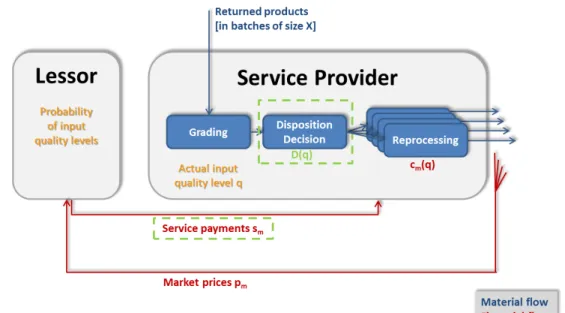
So far, the foundations for coordination issues in CLSCs have been laid. In this chap-ter, we focus on one specific coordination aspect: the coordination of the reverse-SC-specific process step dispositionand related decisions. The main driver of this focus is the business case introduced. We consider a decentralized reverse SC consisting of a lessor and a service provider that conducts the reprocessing activities of end-of-lease returns. The disposition decision affects the profits of both actors involved. However, the essential information for the disposition decision - the information on the actual quality of the returned products - is available only to the service provider. Hence, decentralized decision making and scattered information between multiple SC members raise the question of appropriate SC coordination with regard to the disposition decision. Furthermore, the coordination of the disposition is of inter-est as there is no obvious corresponding process step in a traditional forward SC. Specifically, we address the research question raised in Section 1.4:
How can the disposition decision be coordinated in the case of reverse SCs consisting of multiple, independent actors?
The chapter is structured as follows. In Section 3.1, a review of the relevant literature on the disposition decision is provided, followed by the statement of as-sumptions and the notation used (Section 3.2). The actual analysis of the identified coordination need starts with the introduction of our benchmark - following the standard SCM literature, we use a central decision maker who owns all the relevant information (Section 3.3.1). The current business case setting is analyzed in
The Case of the Disposition Decision 28
tion 3.3.2. As it is shown not to be optimal, a coordinating strategy is developed in Section 3.3.3. We illustrate the aforementioned settings in terms of an example (Section 3.4) and conclude with a discussion of the assumptions and future research directions (Section 3.5).
3.1
Literature Review - Disposition Decisions in
Closed-Loop Supply Chains
The main distinction between reverse SCs and traditional ones is the uncertainty on the supply side with respect to the quantity, timing, and quality of returns (Fleischmann et al., 2010). This is why the inbound processes, namely product acquisition, grading, and disposition are of special interest in CLSC settings. In our business case, we identified a potential SC deficiency with respect to one of these inbound processes: the disposition decision. In this chapter, we characterize the disposition decision (Section 3.1.1) and provide an overview of the previous literature on the disposition decision (Section 3.1.2).
3.1.1
Characterizing the Disposition Decision
The objective of the disposition decision is to choose the most suitable disposition option for returned products of a certain category. In the following, we summarize the commonly distinguished categories of return flows and disposition options. In the section on objectives, we state the basis for the choice of the most suitable dis-position decision.
Categories of Return Flows
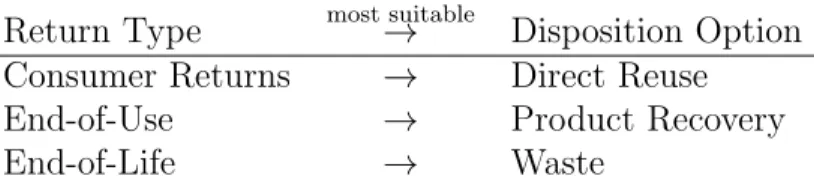
Heterogeneity of supplies makes it necessary to assess the condition of returned products to be able to determine a suitable disposition option (Guide et al., 2000). However, to some extent, information on the quality of supplies can be gathered even without actually assessing the returned products. This is due to the different kinds of return flows that exist. Three different categorization schemes of reverse flows can be found in the literature. Thierry et al. (1995) are the first to mention return types and their inherent different characteristics. Using the terminology of Guide and Van Wassenhove (2009), three return types are distinguished: consumer returns, end-of-use, and end-of-life. Consumer returns are products that are returned by end customers due to dissatisfaction within a short period of time after the purchase. This return type is usually hardly used and requires quick reintroduction into the