Doctoral Dissertations Student Theses and Dissertations Fall 2015
Privacy-preserving query processing over encrypted data in cloud
Privacy-preserving query processing over encrypted data in cloud
Yousef M. Elmehdwi
Follow this and additional works at: https://scholarsmine.mst.edu/doctoral_dissertations Part of the Computer Sciences Commons
Department: Computer Science Department: Computer Science
Recommended Citation Recommended Citation
Elmehdwi, Yousef M., "Privacy-preserving query processing over encrypted data in cloud" (2015). Doctoral Dissertations. 2442.
https://scholarsmine.mst.edu/doctoral_dissertations/2442
This thesis is brought to you by Scholars' Mine, a service of the Missouri S&T Library and Learning Resources. This work is protected by U. S. Copyright Law. Unauthorized use including reproduction for redistribution requires the permission of the copyright holder. For more information, please contact [email protected].
OVER ENCRYPTED DATA IN CLOUD
by
YOUSEF M. ELMEHDWI
A DISSERTATION
Presented to the Faculty of the Graduate School of the MISSOURI UNIVERSITY OF SCIENCE AND TECHNOLOGY
In Partial Fulfillment of the Requirements for the Degree
DOCTOR OF PHILOSOPHY in
COMPUTER SCIENCE 2015
Approved by
Dr. Wei Jiang, Advisor Dr. Ali Hurson
Dr. Dan Lin
Dr. Xuerong (Meggie) Wen Dr. Zhaozheng Yin
YOUSEF M. ELMEHDWI All Rights Reserved
ABSTRACT
The query processing of relational data has been studied extensively throughout the past decade. A number of theoretical and practical solutions to query processing have been proposed under various scenarios. With the recent popularity of cloud computing, data owners now have the opportunity to outsource not only their data but also data processing functionalities to the cloud. Because of data security and personal privacy concerns, sensitive data (e.g., medical records) should be encrypted before being outsourced to a cloud, and the cloud should perform query processing tasks on the encrypted data only. These tasks are termed as Privacy-Preserving Query Processing (PPQP) over encrypted data. Based on the concept of Secure Multiparty Computation (SMC), SMC-based distributed protocols were developed to allow the cloud to perform queries directly over encrypted data. These protocols protect the confidentiality of the stored data, user queries, and data access patterns from cloud service providers and other unauthorized users. Several queries were considered in an attempt to create a well-defined scope. These queries included thek-Nearest Neighbor (kNN) query, advanced analytical query, and correlated range query. The proposed protocols utilize an additive homomorphic cryptosystem and/or a garbled circuit technique at different stages of query processing to achieve the best performance. In addition, by adopting a multi-cloud computing paradigm, all computations can be done on the encrypted data without using very expensive fully homomorphic encryptions. The proposed protocols’ security was analyzed theoretically, and its practicality was evaluated through extensive empirical results.
ACKNOWLEDGMENTS
I would like to express my gratitude to all those who have helped me with this thesis. First, I would like to extend my sincere thanks to my advisor, Dr. Wei Jiang, for his continuous suggestions, encouragement, and motivation, which greatly helped me carry through difficult times. I consider him more than just an advisor, but a dear friend.
I would also like to thank the members of my Ph.D. committee, Prof. Ali Hurson, Dr. Dan Lin, Dr. Xuerong (Meggie) Wen, and Dr. Zhaozheng Yin, for their constructive and valuable suggestions.
I appreciate the advice and support of Gerry Howser, Hu Chun, Bharath Samanthula, Amir Bahmani, and Michael Howard. Thanks should be extended also to the staff members of the computer department and to Amy Ketterer, in the graduate editing services, for their great assistance.
Lastly, but most importantly, I owe a great debt to my father Mohammed, to whom I would like to dedicate this work- for his undying love and faith in me-, my mother Salma, my dear wife Azza, my lovely kids, Sammy and Mohammed, and all other family members. With their support over the years, I have overcome the difficulties in my study and life. Thank you all.
TABLE OF CONTENTS
Page
ABSTRACT . . . iii
ACKNOWLEDGMENTS . . . iv
LIST OF ILLUSTRATIONS . . . viii
LIST OF TABLES . . . ix
SECTION 1. INTRODUCTION . . . 1
1.1. DEFINING THE PROBLEM . . . 2
1.2. OBJECTIVES AND CONTRIBUTIONS . . . 3
1.3. ORGANIZATION . . . 5
2. RELATED WORK . . . 7
2.1. SECUREk-NEAREST NEIGHBOR TECHNIQUES . . . 7
2.2. PRIVACY-PRESERVING DATA MINING . . . 9
2.3. PRIVACY-PRESERVING BIOMETRIC AUTHENTICATION/ IDENTIFI-CATION . . . 11
3. SECURITY DEFINITIONS AND BASIC SECURITY PRIMITIVES . . . 15
3.1. SECURE MULTIPARTY COMPUTATION . . . 15
3.2. THREAT MODEL . . . 16
3.2.1. Justification of Use of Semi-Honest Model . . . 17
3.3. ADDITIVE HOMOMORPHIC ENCRYPTION . . . 18
3.4. DISTANCE COMPUTATION . . . 20
3.4.1. Euclidean Distance . . . 20
3.4.2. Hamming Distance . . . 20
3.5. BASIC SECURITY PRIMITIVES . . . 20
3.5.1. Secure Multiplication . . . 21
3.5.3. Secure Squared Euclidean Distance-Random Share . . . 25
3.5.4. Secure Hamming Distance-Random Share . . . 28
3.5.5. Secure Bit-Decomposition . . . 30
3.5.6. Secure Bit-OR . . . 31
3.5.7. Secure Minimum . . . 31
3.5.8. Secure Minimum out of n Numbers . . . 38
3.5.9. Secure Frequency . . . 41
3.5.10. Secure Comparison with a Threshold . . . 44
3.6. OVERVIEW OF THE PROPOSED PRIVACY-PRESERVING QUERY PRO-CESSING PROTOCOLS . . . 46
4. k-NEAREST NEIGHBOR QUERY . . . 48
4.1. DEFINING THE PROBLEM . . . 49
4.2. MAIN CONTRIBUTIONS . . . 51
4.3. THE PROPOSED SECUREk-NEAREST NEIGHBOR PROTOCOLS . . . 52
4.3.1. Basic Securek-Nearest Neighbor Protocol . . . 53
4.3.2. Maximally Secure k-Nearest Neighbor Protocol . . . 55
4.4. SECURITY ANALYSIS . . . 59
4.5. COMPLEXITY ANALYSIS . . . 60
4.6. PERFORMANCE EVALUATION . . . 61
4.6.1. Performance of the Basic Secure k-Nearest Neighbor Protocol . . . . 61
4.6.2. Performance of the Maximally Secure k-Nearest Neighbor Protocol . 62 4.6.3. Performance Improvement . . . 64
5. ADVANCED ANALYTICAL QUERY . . . 66
5.1. DEFINING THE PROBLEM . . . 67
5.2. MAIN CONTRIBUTIONS . . . 68
5.3. THE PROPOSED PRIVACY-PRESERVINGk-NEAREST NEIGHBOR CLAS-SIFICATION PROTOCOL . . . 69
5.3.1. Stage 1: Secure Retrieval of k-Nearest Neighbors . . . 70
5.4. SECURITY ANALYSIS . . . 75
5.4.1. Security Proof for Stage 1 . . . 76
5.4.2. Security Proof for Stage 2 . . . 77
5.5. COMPLEXITY ANALYSIS . . . 78
5.6. PERFORMANCE EVALUATION . . . 79
5.6.1. Performance Improvement . . . 80
6. CORRELATED RANGE QUERY. . . 83
6.1. OUTSOURCEABLE AND PRIVACY-PRESERVING BIOMETRIC AUTHEN-TICATION . . . 84
6.1.1. Defining the Problem . . . 84
6.1.2. Main Contributions . . . 85
6.1.3. The Proposed Outsourceable and Privacy-Preserving Biometric Au-thentication Protocol . . . 86
6.1.3.1. Sub-Components of the PPBAO Protocol . . . 87
6.1.3.2. The PPBAO Protocol: . . . 89
6.1.4. Security Analysis . . . 90
6.1.5. Complexity Analysis . . . 91
6.1.6. Performance Evaluation . . . 91
6.1.6.1. Performance Improvement . . . 92
6.2. OUTSOURCEABLE AND PRIVACY-PRESERVING BIOMETRIC IDEN-TIFICATION . . . 94
6.2.1. Defining the Problem . . . 94
6.2.2. The Proposed Outsourceable and Privacy-Preserving Biometric Identification Protocol . . . 95
6.2.3. Security Analysis . . . 97
6.2.4. Complexity Analysis . . . 97
7. CONCLUSIONS AND FUTURE DIRECTIONS . . . 99
BIBLIOGRAPHY . . . 101
LIST OF ILLUSTRATIONS
Figure Page
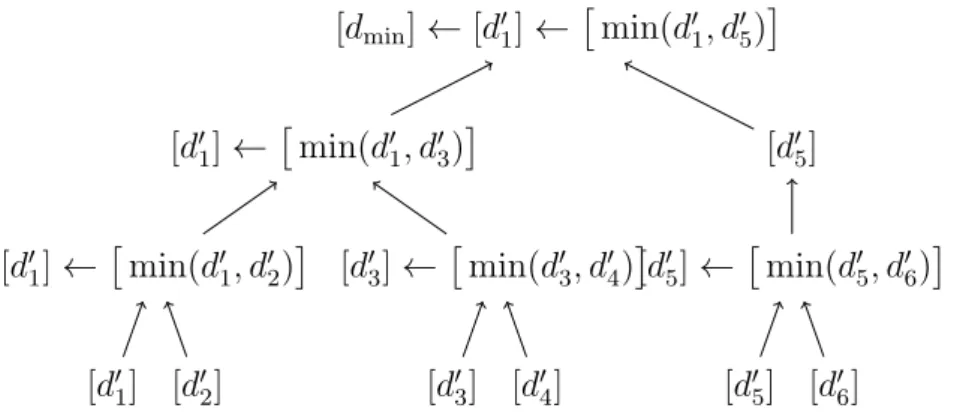
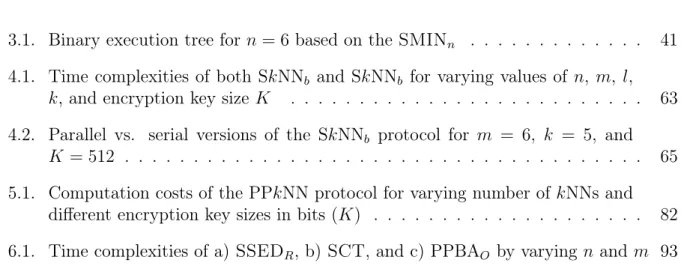
3.1. Binary execution tree forn = 6 based on theSMINn . . . 41
4.1. Time complexities of both SkNNb and SkNNb for varying values of n, m, l,
k, and encryption key size K . . . 63 4.2. Parallel vs. serial versions of the SkNNb protocol for m = 6, k = 5, and
K = 512 . . . 65 5.1. Computation costs of the PPkNN protocol for varying number of kNNs and
different encryption key sizes in bits (K) . . . 82 6.1. Time complexities of a)SSEDR, b) SCT, and c) PPBAO by varying n and m 93
LIST OF TABLES
Table Page
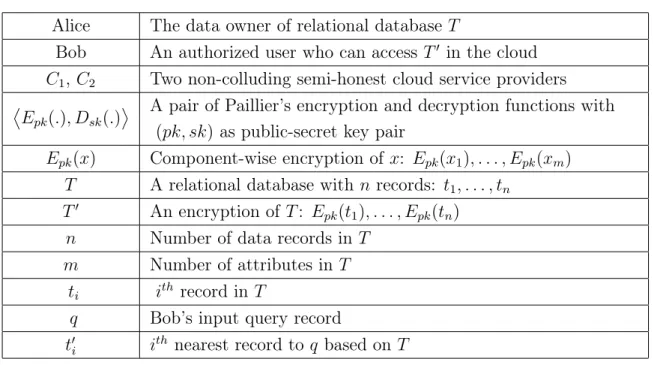
3.1. Common notations . . . 16
3.2. Garbled circuit vs. homomorphic-based secure multiplication . . . 31
3.3. P1’s random permutation functions . . . 36
3.4. SMIN example: P1 chooses F asv > u, whereu= 55 and v = 58 . . . 37
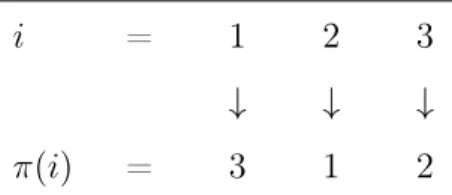
3.5. SF example: P1’s random permutation function . . . 43
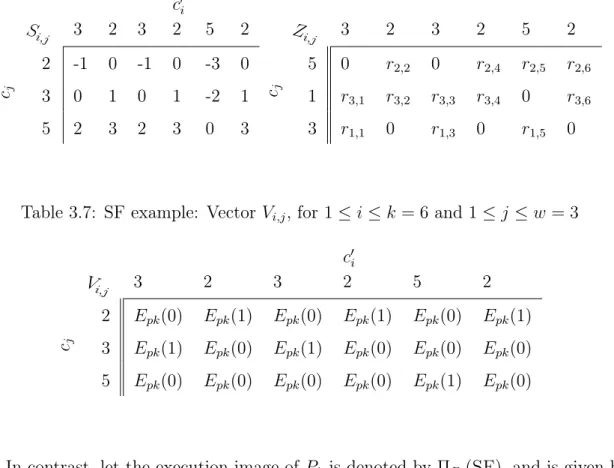
3.6. SF example: VectorsSi,j and Zi,j, for1≤i≤k = 6 and 1≤j ≤w= 3 . . . 44
3.7. SF example: VectorVi,j, for1≤i≤k = 6 and 1≤j ≤w= 3 . . . 44
4.1. Common notations used in the SkNN protocols . . . 50
4.2. Sample heart disease datasetT . . . 51
4.3. Attribute description of heart disease dataset T . . . 52
5.1. Common notations used in the PPkNN protocol . . . 68
Cloud computing [51, 66] enables an entity to outsource both its database and its data processing functionalities. The cloud provides access mechanisms for not only querying but also managing the hosted database. When data is outsourced, the data owner can enjoy the benefits of reduced data management costs, reduced data storage overhead, and improved service. Unfortunately, the cloud cannot be fully trusted; preserving data confidentiality and query privacy is a challenging task. This is because it is difficult for the cloud to actually guarantee the confidentiality of sensitive data. The challenge arises due to several well-documented security risks faced by existing cloud service providers [31, 47, 81, 82, 94, 103]. One such risk, for instance, is that when a breach occurs in the cloud, any sensitive data stored in the clear (i.e., not encrypted) can be easily exposed to the attacker.
One straightforward way to protect the confidentiality of outsourced data from the cloud as well as from unauthorized users involves the data owner encrypting the data before it is outsourced [1, 61, 77]. This encryption guarantees the confidentiality of data, even when a cloud is compromised due to external threats such as hacking. A potentially curious, untrustworthy, or even malicious cloud operator can track down the user’s queries and infer what the user is looking for. Thus, a user’s query privacy may be compromised while searching through hosted data within the cloud. To help preserve query privacy, authorized users demand that their queries become encrypted before they are sent to the cloud for evaluation. Furthermore, the cloud can derive useful and sensitive information about the actual data items by observing the data access patterns during query processing, even if the data and the query are encrypted [27, 97]. The term “data access patterns” refers to the relationships between the encrypted data that can be observed by the cloud during the query processing, such as the outcome of the search (i.e., which records have been retrieved). During query processing, the need is to keep not only the data private from the cloud but also the users’ input queries. The question to ask is “how can the cloud execute queries over encrypted data without ever decrypting them or compromising the user’s privacy?” Such a question has resulted in a specific research area known as query processing over encrypted data.
A trivial solution is to encrypt the data with symmetric key encryption schemes e.g., Advanced Encryption Standard (AES) and then outsource it to a cloud. At first, it seems to be a better approach. Data encryption by symmetric key encryption schemes, however, restricts a cloud’s ability to perform fundamental data processing functionality (e.g., query processing) without disclosing the original data and user queries. Under this case, the only option for the user is to download the whole encrypted data from the cloud, decrypt the data, and then perform queries on the plaintext data locally. However, this is clearly impractical, especially for mobile users and large data.
Following the aforementioned discussions, it is clear that there is a strong need to develop protocols for query processing over encrypted data that can guarantee the following:
(1) maintaining the confidentiality of encrypted data, (2) ensuring the privacy of a user’s query, and (3) hiding data access patterns.
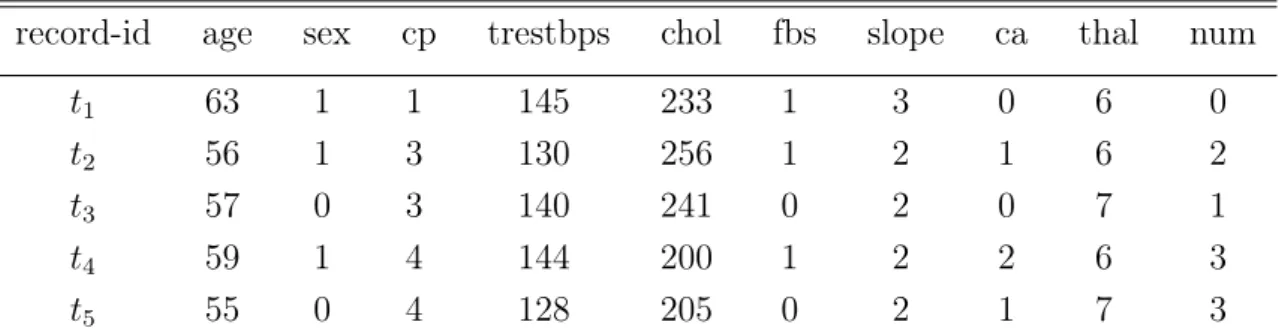
This work was conducted to address the challenge of performing queries on encrypted outsourced data in a cloud without compromising either the data’s confidentiality or the user’s queries. This work focuses on developing secure protocols over encrypted data under the semi-honest model for the following types of queries: the k-Nearest Neighbor (kNN) query, advanced analytical query, and correlated range query. The k-Nearest Neighbor query identifies the top k closest records to the query input record at the database. The advanced analytical query performs any data mining task (e.g., classification). Given a specific thresholdt, the correlated range query aims to find all records in the dataset whose distances with the query lie either below or above t, depending on the application.
1.1. DEFINING THE PROBLEM
This work considers the following scenarios. There are three different distributed parties including the data owner (here referred to as Alice), the cloud, and the data autho-rized consumer/user (here referred to as Bob). LetT denote Alice’s database withnrecords, denoted by ht1, . . . , tni, and m attributes. Let ti,j denote the jth attribute value of tuple ti
for 1≤i ≤n and 1≤ j ≤m. Assume that Alice encrypts her database (T) attribute-wise using her public key (pk) and outsources both the encrypted database and all future query
processing services to a cloud. This work assumed that Alice’s public/secret keys are gen-erated using a semantically secure and an Additive Homomorphic Public Key Encryption (AH-Enc) scheme (such as the Paillier cryptosystem [75]). Semantic security means that
ciphertexts should be computationally indistinguishable from the cloud’s perspective. If the encryption scheme is semantically secure, then the ciphertexts are random numbers from the cloud’s perspective. That ensures that the cloud cannot distinguish an encryption of one message from another [45]. More details are given in Section 3.3. By encrypting the data using an AH-Enc scheme, Alice makes it possible for the cloud to conduct certain
mathematical operations directly over encrypted data.
Let T0 denote Alice’s encrypted database. Suppose Alice allows Bob to securely retrieve data from T0 in the cloud. Suppose also that at some future time, Bob wants to execute a query q=hq1, . . . , qmi
onT0 in the cloud in a privacy-preserving manner. During this process, neither Bob’s query (q) nor the database’s contents (T) should be revealed to the cloud. Access patterns to the data should also be protected from the cloud and other unauthorized users. This process is referred to as Privacy-Preserving Query Processing (PPQP) over encrypted data in the cloud. Let qout denote the set of records that satisfies
q. The PPQP protocol can now be formally defined as:
PPQP(T0, q)→qout
At the end of the PPQP protocol, the output qout should be revealed only to Bob (the
authorized user who initiated the query).
1.2. OBJECTIVES AND CONTRIBUTIONS
This thesis addresses the problem of performing queries on encrypted data stored on a cloud. PPQP protocols are proposed to facilitate different types of queries, namely, the k -Nearest Neighbor query, the advanced analytical query, and the correlated range query that protect the confidentiality of the stored data, user queries, and data access patterns from cloud service providers and other unauthorized users. In the proposed protocols, once Alice outsources her encrypted data to the cloud, she stops participating in the query processing
task. Therefore, no information is revealed to Alice. The protocols proposed in this thesis meet the following privacy requirements:
• Data confidentiality - During the query processing, neither the contents (T) nor any intermediate results are disclosed to the cloud.
• Query privacy - At any point in time, Bob’s input query (q) should not be disclosed to the cloud or to Alice.
• Hiding data access patterns - Access patterns to the data (e.g., the records correspond-ing to q) should not be revealed to either Alice or the cloud to prevent any inference attacks. Access patterns related to any intermediate computations should also be hid-den from the cloud, thereby preserving the semantic security of the encrypted data.
• Output security - At the end of the protocol, the output qout should be revealed only
to Bob; no information should be revealed to the cloud. Additionally, no information other than qout should be revealed to Bob.
The intermediate results observed by the cloud in these protocols are either newly generated, randomized encryptions or random numbers. Thus, the data records that correspond to query q are unknown to the cloud.
The desirable privacy requirements can be relaxed to provide a practical, more ef-ficient protocol. For example, a protocol can be allowed to leak a specified amount of information (e.g., data access patterns) to the cloud to improve efficiency.
Additionally, the proposed protocols achieve the following properties:
• Efficiency - These protocols incur a low computational overhead (negligible compu-tation cost) on the end-user. After Bob sends his encrypted query to the cloud, he stops involving in any computations (less workload at Bob’s local machine). Hence, data access patterns are further protected from Bob. He only performs a very small number of encryption/decryption operations (bounded by the number of attributes).
1.3. ORGANIZATION
The thesis is organized as follows. Chapter 2 presents an overview of some existing work that is closely related to the research being proposed. Chapter 3 provides basic in-formation regarding SMC and the AH-Enc scheme. This chapter also introduces a set of
privacy-preserving primitives, along with their implementations and security analysis, under the semi-honest model.
Chapter 4 considers the kNN query over relational data. In particular, this chapter focuses on solving the secure processing ofkNN query over encrypted relational data. More specifically, this chapter presents two novel Secure k-Nearest Neighbor (SkNN) protocols [29]. Data confidentiality and query privacy of both protocols are completely protected. The first protocol (which acts as a basic solution) leaks a specified amount of information (data access patterns) to the cloud. The second protocol is more secure (provides a better security guarantee) as it hides the data access patterns. The second protocol, however, is more expensive than the first protocol.
Chapter 5 addresses the advanced analytical query over relational data. In par-ticular, this chapter focuses on solving the classification problem over encrypted data. A novel Privacy-Preserving k-Nearest Neighbor (PPkNN) protocol over semantically secure encrypted data is developed [85]. This protocol protects not only the confidentiality of the original data but also the user query from the cloud. It also hides the data access patterns and the classification result. The proposed protocol’s performance under different parameter settings is evaluated in this chapter.
The correlated range query over image data is discussed in Chapter 6. More specifi-cally, Content-Based Image Retrieval (CBIR) is considered. A desirable image was retrieved from a large amount of image data based on the similarity of some common attributes, known as features. More specifically, this chapter proposes a secure Outsourceable and Privacy-Preserving Biometric Authentication (PPBAO) protocol, which is a special case of
CBIR [21]. At a high level, a hybrid approach is adopted to implement PPBAO in order to
take advantage of both homomorphic encryption and garbled circuit-based approaches to achieve the best performance while simultaneously protecting both the confidentiality of the biometric data and the user’s input query, in addition to hiding the data access patterns.
In this chapter, the protocol’s security is analyzed and it’s performance under different pa-rameter settings is evaluated. The proposed PPBAO was also modified slightly to produce
an Outsourceable and Privacy-Preserving Biometric Identification (PPBIO) protocol. The
PPBIO protocol completely protects the confidentiality of the stored biometric data, user
queries, and data access patterns from cloud service providers and other unauthorized users. Both the contributions of this work as well as the potential for future studies are discussed in Chapter 7.
2. RELATED WORK
This chapter reviews the existing work related to the Secure k-Nearest Neighbor [29] techniques, Privacy-Preserving Data Mining [85], and Privacy-Preser- ving Biometric Authentication/Identification [21] protocols.
2.1. SECURE k-NEAREST NEIGHBOR TECHNIQUES
Retrieving thek-Nearest Neighbors to a given query (q) is one of the most fundamen-tal problems in many application domains such as similarity search, pattern recognition, and data mining. In the literature, many techniques have been proposed to address the SkNN problem, which can be classified into two categories based on whether the data are encrypted or not: centralized and distributed.
Centralized Methods: In the centralized methods, the data owner is assumed to outsource his/her database and DBMS functionalities (e.g., kNN query) to an untrusted external service provider, which manages the data on behalf of the data owner, where only the trusted users are allowed to query the hosted data. By outsourcing data to an untrusted server, many security issues arise such as data privacy (protecting the confidentiality of the data from both the server and the query issuer). To achieve data privacy, the data owner is required to use data anonymization models (e.g., k-anonymity) or cryptographic (e.g., encryption and data perturbation) techniques over his/her data before outsourcing them to the server.
Encryption is a traditional technique used to protect the confidentiality of sensitive data such as medical records. Due to data encryption, the process of query evaluation over encrypted data becomes challenging. Along this direction, various techniques have been proposed for processing range queries [49, 50, 91] and aggregation queries [46, 68] over encrypted data. This work, however, restricts the discussion to secure evaluation of the kNN query.
In the past few years, researchers have proposed different methods [51, 98, 99, 105] to address the SkNN problem. Wong et al. [98] proposed a new encryption scheme called
Asymmetric Scalar-Product-preserving Encryption (ASPE) that preserves the scalar prod-uct between the query vector (q) and any tuple vector (ti) from database (T) for distance
comparison, which is sufficient to find kNN. Both the data and query are encrypted using slightly different encryption schemes before outsourcing to the server, and all the query users know the decryption key. As an improvement, Zhu et al. [105] proposed a novel SkNN method in which the key of the data owner is not disclosed to the user. However, their architecture requires the participation of the data owner during query encryption. As an alternative, Hu et al. [51] proposed a method based on a provably secure privacy homomorphism encryption scheme from a provably secure additive and multiplicative pri-vacy homomorphism [28] that supports modular addition, subtraction, and multiplication over encrypted data. They addressed the SkNN problem under the following setting: the client has the ciphertexts of all data points in database T and the encryption function of T, whereas the server has the decryption function of T and some auxiliary information re-garding each data point. Both methods [51, 98], however, are not secure because they are vulnerable to chosen-plaintext attacks. All the above methods also leak data access patterns to the server.
Recently, Yao et al. [99] proposed a new SkNN method based on partition-based a Secure Voronoi Diagram (SVD). Instead of asking the cloud to retrieve the exact kNN, they required the cloud to retrieve a relevant encrypted partition Epk(G)forEpk(T)
such that G is guaranteed to contain the k-nearest neighbors of q. This work, however, solves the SkNN problem accurately by letting the cloud retrieve the exact k-Nearest Neighbors of q (in encrypted form). Additionally, most of the computations during the query processing step in [51, 99, 105] are performed locally by the end-user. That conflicts with the purpose of outsourcing the DataBase Management System (DBMS) functionalities to the cloud. Furthermore, the protocol in secure nearest neighbor revisited [99] leaks data access patterns, such as the partition ID corresponding to a user query, to the cloud.
Data Distribution Methods: In the data distributed methods, data are assumed to be partitioned either vertically or horizontally and distributed among a set of independent, non-colluding parties. The data distributed methods rely on SMC techniques that enable multiple parties to securely evaluate a function using their respective private inputs without
disclosing the input of one party to the others. Many efforts have been made to address the problem of the kNN query in a distributed environment. Shaneck et al. [89] proposed a privacy-preserving algorithm to perform the k-Nearest Neighbor search. The protocol in privacy preserving nearest neighbor search [89] is based on Secure Multiparty Computation for privately computing kNN points in a horizontally partitioned dataset. Qi et al. [79] proposed a single-step kNN search protocol that is provably secure with linear computa-tion and communicacomputa-tion complexities. Vaidya et al. [92] studied privacy-preserving top-k queries in which the data are vertically partitioned. Ghinita et al. [39] proposed a Private Information Retrieval (PIR) based framework for answering kNN queries in location-based services. Their solution, however, protects only the query privacy (i.e., it does not address data confidentiality and access pattern issues). Note that, in private queries in location based services [39], the data residing in the server are in plaintext format. However, if the data are encrypted to ensure data confidentiality, it is not clear how a user can obliviously retrieve the output records because he/she does not know the indices that match his/her input query. Nevertheless, even if a user can retrieve the records using PIR, the user still needs to perform local computations to identify the k-Nearest Neighbors. However, in this study, the user’s computation is completely outsourced to a cloud.
In summary, the above data distribution methods are not applicable to performkNN queries over encrypted data for two reasons: (1) This work deals with an encrypted form of the data and query, which is not the case in the above methods. (2) The data in this work are assumed to be encrypted and stored in the cloud, whereas, in the above methods, they are partitioned (in plaintext format) among different parties.
2.2. PRIVACY-PRESERVING DATA MINING
Privacy-Preserving Data Mining (PPDM) is defined as the process of extracting/ deriving knowledge about data without compromising the privacy of the data [3, 64, 80]. In the past decade, a number of PPDM techniques have been proposed to facilitate users in performing data mining tasks in privacy-sensitive environments. Agrawal and Srikant [3], as well as Lindell and Pinkas [63], were the first to introduce the notion of privacy-preserving
under data mining applications. Existing PPDM techniques can be classified into two broad categories: data perturbation and data distribution.
Data Perturbation Methods: With these methods, values of individual data records are perturbed by adding random noise in such a way that the distribution of the perturbed data look very different from that of the actual data. After such a transformation, the perturbed data is sent to the Miner to perform the desired data mining tasks. Agrawal and Srikant [3] proposed the first data perturbation technique that could be used to build a decision-tree classifier. A number of randomization-based methods were later proposed [6, 33, 34, 73, 104]. Data perturbation techniques are not, however, applicable to semantically-secure encrypted data. They also fail to produce accurate data mining results due to the addition of statistical noises to the data.
Data Distribution Methods: These methods assume that the dataset is partitioned either horizontally or vertically and distributed across different parties. The parties can later collaborate to securely mine the combined data and learn the global data mining results. During this process, data owned by individual parties is not revealed to other parties. This approach was first introduced by Lindell and Pinkas [63] who proposed a decision tree classifier under a two-party setting. A number of studies have since used SMC techniques [2, 22, 51, 57, 100].
Classification is one important task in many applications of data mining, including health-care and business. Recently, performing data mining in the cloud attracted signifi-cant attention. In cloud computing, the data owner outsources his/her data to the cloud. However, from the user’s perspective, privacy becomes an important issue when sensitive data needs to be outsourced to the cloud. The direct way to guard the outsourced data is to apply encryption on the data before outsourcing.
Existing privacy-preserving classification techniques are not sufficient and applicable in this work for the following reasons: (i) In the existing methods, data are partitioned (in plaintext format) among different parties, whereas in this work, they are assumed to be encrypted and stored in the cloud. (ii) They fail to produce accurate data mining results because some amount of information is lost due to the addition of statistical noises (in order to hide the sensitive attributes). (iii) Data access patterns can be leaked. The cloud can
easily derive useful and sensitive information about users’ data items by simply observing the data access patterns.
2.3. PRIVACY-PRESERVING BIOMETRIC AUTHENTICATION/ IDENTI-FICATION
Biometric authentication or identification is a special case of Content-Based Image Retrieval (CBIR). In a CBIR system, a desirable image is retrieved from a large image database based on the similarity of some common attributes, which are called features. There are two kinds of features: global and local. Global features usually include color, texture, and shape, which are well-known and studied in image retrieval. Local features are usually used in a localized circumstance, which needs to recognize objects more precisely.
The formulation of Privacy-Preserving Biometric Identification (PPBI) is slightly different from Privacy-Preserving Biometric Authentication (PPBA). The PPBI protocol generally returns the profile of any person whose biometric data record (stored on the server) matches the user’s input biometric data record. In contrast, the PPBA protocol only returns a single bit to indicate if there is a match or not. Existing PPBI protocols can be easily modified to satisfy the PPBA problem statement definition. From a technical perspective, the difference between PPBI and PPBA is negligible. Since there is a lack of existing work directly related to PPBA, works mainly related to PPBI are presented. In both PPBA and PPBI, the involved biometric data is never disclosed to the participating parties, except for their own data.
Erkin et al. [30] proposed the first privacy-preserving biometric face recognition protocol based on the standard Eigenfaces recognition algorithm. The protocol is a secure two-party computation protocol where one party (client) wants to learn whether its can-didate biometric reading matches for one or more records in the other party’s (server’s) database without disclosing any information except the final result. The protocol computes Euclidean distances between face image feature vectors from the client and server’s face image database, and it returns the profile information associated with the facial image data record that has the smallest distance to the client’s input biometric data. In the end, the client only knows the profile information without knowing other biometric data and their
associated profiles stored at the server, and the server knows nothing, even regarding the profile information returned to the client. The data exchanged during an execution of the protocol are encrypted by an AH-Enc scheme, but the data stored at the sever are not
encrypted. Therefore, the server knows the contents of its biometric database.
Sadeghi et al. [83] developed a hybrid privacy-preserving face recognition protocol that improved the efficiency of Erkin’s work. This protocol follows the problem setting of Erkin’s work and also uses an AH-Enc (the Paillier cryptosystem) to securely compute
Euclidean distances. On the other hand, garbled circuits [53, 102] are used to find out the minimum distance. The authors also proposed a method of packing multiple values together into a single ciphertext before blinding. This can save significant communication costs.
Huang et al. [32] developed an efficient Privacy-Preserving Biometric Identification protocol for fingerprint recognition. The basic algorithm for fingerprint identification is based on F ingerCode [55]. In the main system, the server and a client jointly perform the protocol to retrieve the identity record from the server’s database whose fingerprint best matches the client’s input fingerprint reading. The protocol provides the same security guarantee as the previously mentioned protocols. In addition, similar to Sadeghi’s work, this protocol also combines AH-Enc with garbled circuits. However, the protocol improves
efficiency for both the distance-computing phase and matching phase compared to Sadeghi’s work. The protocol separates the retrieval step from the matching phase, and it uses the by-product of evaluating the garbled circuit in the matching phase to perform the oblivious retrieval efficiently. In the retrieval phase, the protocol utilizes a backtracking tree to obliviously and efficiently recover the profile corresponding to the closest matching vector.
Blanton and Gasti [11] developed a Privacy-Preserving Biometric Identification pro-tocol for iris codes based on Hamming distance. In their propro-tocol, the client who possesses an iris reading would also like to learn whether his/her reading matches one or more records in an iris database managed by the server. The contents of the server’s database are never disclosed to the client, but the client learns the comparison results between his/her input iris record and every record in the server’s database. The implementation of the protocol also uses bothAH-Encand garbled circuits, and it reduces the complexity of the circuits used for
proposed techniques can be applied in protocols whereF ingerCodeand Euclidean distances are adopted to improve the performance compared to the existing Euclidean distance-based solutions.
SCiFI [74] is a realization of a privacy-preserving face identification system that uses a component-based face identification technique that builds a binary index into a vocabulary representation. The adopted image representation technique is robust against different viewing conditions, such as illumination, occlusions, and changes in appearance (like wearing glasses). The protocol utilizes Hamming distance to measure image similarity, and its implementation was based on AH-Enc and oblivious transfer [69].
Although the aforementioned privacy-preserving biometric identification/authentica-tion protocols protect the confidentiality of both the server’s and client’s biometric data, in this study, the problem setting is quite different from these protocols. This study deals with the encrypted form of the biometric database that is outsourced to a server (or a cloud), and the server does not have the key to decrypt the data. Thus, the server does not know anything regarding the original biometric database. Since the previously proposed solutions require the server to perform computations on the original biometric data, these solutions cannot be applied to solve this outsourced biometric authentication problem.
Recently, Blanton and Aliasgari [10] developed a secure approach to outsourcing the computations of matching iris biometric data records. The setting of their work is very similar to this study. Two protocols were proposed for either a single-server setting or a multiple-server setting. In their single-server setting, the protocol uses a predicated encryp-tion scheme [59, 90] that allows the server to perform non-interactive computaencryp-tions. The predicate encryption scheme is not as secure asAH-Enc. As a result, the protocol proposed
in this study offers much better protection of the biometric data’s confidentiality. Under the multiple-server setting, the protocol adopts a secret sharing scheme (e.g., Shamir [88]) to “encrypt” the outsourced biometric database. The protocol, however, requires at least three independent servers to perform the intermediate computations, whereas this study only requires two; thus, it is more practical. Additionally, the protocol mainly focuses on calculating Hamming distance, whereas this work allows Euclidean and Hamming distances to be calculated. Since both distances are commonly used to retrieve images according to
different kinds of biometric data, this work offers more generality. Another difference is that, at the end of protocol execution, the server can know which encrypted biometric data record matches the client’s input. This access pattern leakage can violate the security guarantee of the underlying encryption scheme [54]. Because this work does not disclose this information to any participating party, it offers the same security protection as the encryption scheme used to encrypt the outsourced biometric data.
3. SECURITY DEFINITIONS AND BASIC SECURITY PRIMITIVES
This chapter presents basic information about Secure Multiparty Computation along with the security threat or adversary models that best match in this study. Then, it sum-marizes the homomorphic properties of the encryption scheme used in this study as a back-ground. Finally, it introduces a set of sub-protocols [21, 29, 85] that were used as basic primitives when constructing the proposed PPQP protocols, along with their possible im-plementations, security, and complexity analysis. For ease of presentation, some common notations that are used extensively throughout this chapter are summarized in Table 3.1.
3.1. SECURE MULTIPARTY COMPUTATION
Secure Multiparty Computation (SMC) was first introduced by Yao’s Millionaire Problem [101, 102], where Alice and Bob want to know who is richer without disclosing their actual wealth to each other. Suppose there arenparties (P1, . . . , Pn) who hold private inputs
(a1, . . . , an). An SMC protocol allowsP1, . . . , Pnto collaboratively compute a functionf on
inputs a1, . . . , an without disclosing ai toPj, where1≤i, j ≤n and i6=j. To achieve that,
the participating parties have to exchange messages and perform some local computations until all the parties get the desired output. More formally, SMC allows the evaluation of the functionf(a1, . . . , an) = (r1, . . . , rn)such that the output (ri) is known only to partyPi
and the privacy of each party’s input (ai) is preserved.
The first general and provably secure solution for a two-party case was developed by Yao, and it demonstrated that any function that can be described by a polynomial size boolean circuit of logarithm depth can be solved securely [101, 102]. This work was extended to multiparty computations by Goldreich et al. [42]. It was proved in [42] that any computation that can be done in polynomial time by a single party can also be done securely by multiple parties. Since then, much work has been published for the multiparty case [7, 8, 18, 19, 23, 40, 58, 62].
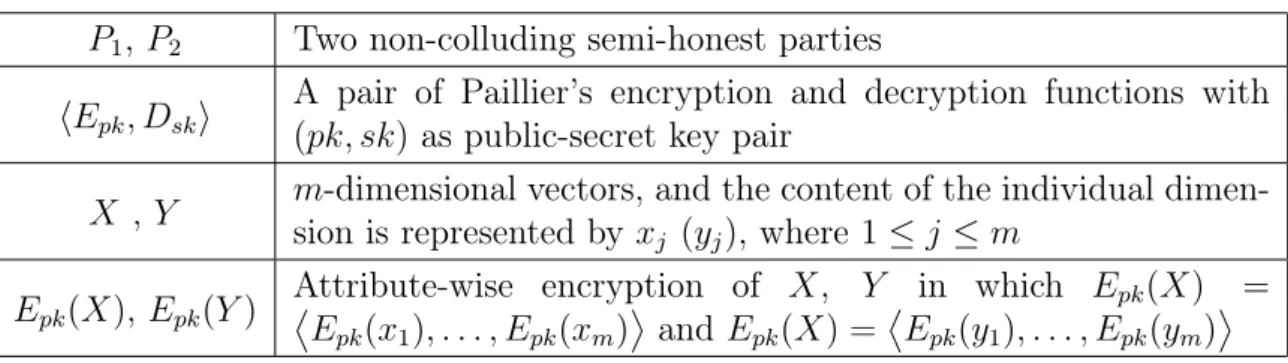
Table 3.1: Common notations P1, P2 Two non-colluding semi-honest parties hEpk, Dski
A pair of Paillier’s encryption and decryption functions with
(pk, sk)as public-secret key pair
X , Y m-dimensional vectors, and the content of the individual dimen-sion is represented by xj (yj), where 1≤j ≤m
Epk(X), Epk(Y)
Attribute-wise encryption of X, Y in which Epk(X) = Epk(x1), . . . , Epk(xm) and Epk(X) = Epk(y1), . . . , Epk(ym) 3.2. THREAT MODEL
In general, there is a conceptual difference between privacy and security. This work, however, will not differentiate the two terms. Regarding a distributed protocol, security is generally related to the amount of information leaked during the protocol execution. The goal is to ensure no information, other than what they can deduce from their own outputs, is leaked to the involved parties. There are many ways to define information disclosure. To maximize privacy, or minimize information disclosure, security definitions that appear in the literature of SMC were adopted for this study.
SMC-based secure protocols generally assume three basic adversarial models: semi-honest (also referred to as semi-honest but curious), covert, and malicious. An adversarial model generally specifies what an adversary or attacker is allowed to do during an execution of a secure protocol. In the semi-honest model, an attacker (i.e., one of the participating parties) is expected to follow the prescribed steps of a protocol. The attacker, however, can compute any additional information based on his/her private input, output, and messages received during an execution of the secure protocol. As a result, whatever can be inferred from the private input and output of an attacker is not considered as a privacy violation. An adversary in the semi-honest model can be treated as a passive attacker, whereas an adversary in the malicious model can be treated as an active attacker who can arbitrarily diverge from the normal execution of a protocol. In contrast, the covert adversary model [5] lies between the semi-honest and malicious models. More specifically, an adversary under the covert model may deviate arbitrarily from the rules of a protocol in the case of cheating. The honest party is guaranteed to detect this cheating with good probability. In
this study, to develop secure, efficient protocols, all the participating parties were assumed to be semi-honest.
Detailed security definitions and models can be found in other studies [40, 41]. The following definition briefly captures the previous discussion regarding a secure protocol under a semi-honest model:
Definition 1. Let ai be the input of party Pi, Πi(π) be the party Pi’s execution image of
the protocol π, and ri be the result computed from π for the party Pi. Then, π is secure
if Πi(π) can be simulated from (ai, ri) such that the distribution of a simulated image is
computationally indistinguishable from Πi(π).
A formal way to prove the security of a protocol under the semi-honest model is to use the simulation approach [43]. The execution image in Definition 1 typically includes the input, the output, and the messages communicated during the execution of a protocol. To prove a protocol is secure under the semi-honest model, it is required to show that the execution image of a protocol does not leak any information regarding the private inputs of participating parties [40].
Definition 2. Composition Theorem [41]: If a protocol consists of sub-protocols, the protocol is secure as long as the sub-protocols are secure and all the intermediate results are random or pseudo-random.
In this work, the proposed PPQP protocols are constructed based on a sequential composition of sub-protocols. Thus, the security of each sub-protocol needed to be proved before the PPQP’s security could be proved. In other words, to formally prove the security of the proposed PPQP protocols under the semi-honest model, according to the composi-tion theorem given in Definicomposi-tion 2, one needed to show that the simulated image of each sub-protocol was computationally indistinguishable from the actual execution image and it produced random shares or pseudo-random as intermediate results.
3.2.1. Justification of Use of Semi-Honest Model. By semi-honest model,
this work implicitly assumes that the cloud service providers (or other participating users) utilized in the protocols proposed in this study do not collude. This model may not be
appropriate for situations in which background knowledge on the parties is missing (e.g., P1 and P2). There are two main reasons to adopt the semi-honest adversary model in this study. First, as mentioned in “Faster secure two-party computation using garbled circuits” [53], developing protocols under the semi-honest setting is an important first step towards constructing protocols with stronger security guarantees. Almost all practical SMC-based protocols (e.g., [48, 52, 53, 72]) are secure under the semi-honest model. Using zero-knowledge proofs [43], these protocols can be transformed into secure protocols under the malicious model. Second, both P1 and P2 were assumed to be two cloud service providers. Today, cloud service providers in the market are legitimate, well-known companies (e.g., Amazon, Google, and Microsoft). These companies maintain reputations that are invaluable assets that need to be protected at all costs. Thus, a collusion between them is highly unlikely as it will damage their reputation, which, in turn, affects their revenues. Therefore, P1 and P2 can safely be assumed to be semi-honest. As a consequence, in this study, it is very realistic to assume that the participating parties are semi-honest.
3.3. ADDITIVE HOMOMORPHIC ENCRYPTION
Homomorphic encryption is a special type of encryption that allows operating on ciphertexts without decrypting them [67]. This work adopted an Additive Homomorphic Public Key Encryption (AH-Enc) scheme as the building block. Let Epk and Dsk be the
encryption and decryption functions, respectively, in anAH-Encscheme with public keypk and private key sk. Withoutsk, no one can discoverxfromEpk(x)in polynomial time. For
any given two plaintexts x, y ∈ZN, an AH-Enc scheme exhibits the following properties:
a. Homomorphic Addition - The encryption function is additive homomorphic. The product of two ciphertexts will decrypt to the sum of their corresponding plaintexts.
Dsk Epk(x+y)
=Dsk Epk(x)∗Epk(y) mod N2
b. Homomorphic Multiplication - An encrypted plaintext raised to the power of another plaintext will decrypt to the product of the two plaintexts. Given a constant c and
ciphertextEpk(x):
Dsk Epk(c∗x)
=Dsk Epk(x)cmodN2
c. Probablistic - Let c1 = Epk(x) and c2 =Epk(y),
P robability f or c1 6=c2 is very high even if x=y
d. Semantic Security - The encryption scheme is semantically secure, as defined in “The Foundations of Cryptography” and “The knowledge complexity of interactive proof systems” [41, 44]. Briefly, given a set of ciphertexts, an encryption scheme is seman-tically secure if an adversary cannot deduce/learn any information about the plain-text(s) with polynomial-bounded computing power. In other words, the encryption scheme is secure against a chosen-plaintext attack.
Any Additive Homomorphic Public Key Encryption (AH-Enc) system is applicable,
but the Paillier encryption scheme [75] was adopted in this study for its implementation simplicity. Informally speaking, the public key in the system is (N,g), whereN is the result of multiplying two large prime numbers of similar bit length and g ∈ Z∗
N2 is a randomly chosen generator. For succinctness, the mod N2 term that occurs during homomorphic operations has been dropped from the remainder of this work. Note that, for any given x ∈ZN, “N −x” is equivalent to “−x” under ZN. Hereafter, the notation r ∈R ZN is used
to denote r as a random number in ZN.
Example 1. LetEpk be the encryption function with public keypkfor any given two plaintexts
x, y ∈ZN, and r ∈R Z. According to the additive homomorphic property of the encryption
scheme, Epk(x−y+r) can be computed as follows:
Epk(x−y+r)←Epk(x)∗Epk(y) N−1
3.4. DISTANCE COMPUTATION
This work adopted the two most common distance metrics to implement the proposed PPQP protocols: Euclidean distance and Hamming distance. Suppose X and Y are m -dimensional vectors and the content of dimension j is represented byxj (yj), where1≤j ≤
m.
3.4.1. Euclidean Distance. The Euclidean distance between X and Y can be
computed as follows: Euclidean_Dist(X, Y) = v u u t m X i=1 (xj −yj)2 (3.1)
When comparing two distances, the square root does not make any difference. Thus, in this work, the square root was dropped to compute the square of the Euclidean distance between X and Y: Euclidean_Dist2(X, Y) =|X−Y|2 = m X i=1 (xj−yj)2 (3.2)
where |X−Y| denotes the Euclidean distance between vectorsX and Y.
3.4.2. Hamming Distance. When X and Y are binary vectors, Hamming
dis-tance can be used to determine how close X and Y are. At a high level, the Hamming distance can be computed as follows:
Hamming_Dist(X, Y) = m− m X
j=1
xj∗yj (3.3)
3.5. BASIC SECURITY PRIMITIVES
A set of generic sub-protocols that are used as basic primitives when constructing the proposed Privacy-Preserving Query Processing (PPQP) protocols are presented here [21, 29, 85]. All of the following protocols are considered under a two-party semi-honest setting. In particular, assume the existence of two semi-honest parties (P1 and P2) such that Paillier’s secret key (sk) is known only to P2; the pk is public. Also, let X and
Y be m-dimensional vectors in which Epk(X) = Epk(x1), . . . , Epk(xm) and Epk(Y) = Epk(y1), . . . , Epk(ym) .
The term random shares means that the actual value is divided into two additive random shares, each of which is independently and uniformly distributed in a group e.g.,
ZN ={0,1, . . . , N −1}
. The actual value can be reconstructed by adding the two shares’ modulo N.
As mentioned in Section 3.2, to formally prove that a protocol is secure under the semi-honest model, one must show that the simulated execution image of that protocol is computationally indistinguishable from its actual execution image [41]. In other words, an execution image of that protocol does not leak any information regarding the private inputs of participating parties. An execution image generally includes the messages exchanged and the information computed from these messages.
Next, each of these protocols are discussed in detail along with their complexity and security analysis. This work either proposed a new solution or referred to the most efficient known implementation to each of these protocols.
3.5.1. Secure Multiplication. Consider a party (P1) with input Epk(a), Epk(b)
and a party (P2) with the secret key (sk). The goal of the Secure Multiplication (SM) protocol is to return the encryption ofa∗b(i.e., Epk(a∗b)as output toP1). No information regarding eithera orb is revealed either to P1 orP2 during this protocol. The basic idea of the SM protocol is based on the following property, which holds for any given a, b∈ZN:
a∗b = (a+ra)∗(b+rb)−a∗rb−b∗ra−ra∗rb (3.4)
where all the arithmetic operations are performed under ZN. The overall steps in SM
are shown in Algorithm 1. Briefly, P1 initially randomizes both a and b by computing a0 = Epk(a)∗Epk(ra) and b0 = Epk(b)∗Epk(rb) and sends them to P2. Here, ra and rb are
random numbers in ZN and known only to P1. Upon receiving, P2 decrypts and multiplies them to get h = (a+ra)∗(b+rb) modN. Then, P2 encrypts h and sends it to P1. After
this, P1 removes extra random factors from h0 =Epk (a+ra)∗(b+rb)
based on Equation 3.4 to get Epk(a∗b).
Algorithm 1 SM(Epk(a), Epk(b))→Epk(a∗b)
Require: P1 has Epk(a) and Epk(b); P2 has sk
1: P1:
(a). Pick two random numbers ra, rb ∈ZN
(b). a0 ←Epk(a)∗Epk(ra)
(c). b0 ←Epk(b)∗Epk(rb)
(d). Send a0, b0 toP2 2: P2:
(a). Receive a0 and b0 from P1 (b). ha ←Dsk(a0); hb ←Dsk(b0)
(c). h←ha∗hb modN
(d). h0 ←Epk(h)
(e). Send h0 toP1 3: P1:
(a). Receive h0 fromP2 (b). s←h0∗Epk(a)N−rb
(c). s0 ←s∗Epk(b)N−ra
(d). Epk(a∗b)←s0 ∗Epk(N −ra∗rb)
Example 2. Assume thata = 59andb = 58. For simplicity, letra = 1and rb = 3. Initially,
P1 computes a0 = Epk(60) = Epk(a)∗Epk(ra) and b0 = Epk(61) = Epk(b)∗Epk(rb) and
sends them to P2. Then, P2 decrypts and multiplies them to get h = 3660. After this,
P2 encrypts h to get h0 = Epk(3660) and sends it to P1. Upon receiving h0, P1 computes s =Epk(3483) = Epk(3660−a∗rb) and s0 = Epk(3425) = Epk(3483−b∗ra). Finally, P1
computes Epk(a∗b) =Epk(3422) = Epk(3425−ra∗rb).
Security Analysis: According to Algorithm 1, the execution image of P2 is denoted by ΠP2(SM), where
ΠP2(SM) =
ha0, hai,hb0, hbi
Observe that ha = a+ramodN and hb = b+rb modN are derived upon decrypting a0
the simulated image of P2 is ΠSP2(SM), where
ΠSP
2(SM) =
ha∗, ra0i,hb∗, rb0i
Here, a∗ and b0∗ are randomly generated from ZN2, whereas r0a and r0b are randomly gen-erated from ZN. Because Epk is a semantically secure encryption scheme with a resulting
ciphertext size that is less than N2, a0
and b0 are computationally indistinguishable from a∗ and b∗, respectively. Similarly, as ra and rb are randomly chosen from ZN, ha and hb
are computationally indistinguishable from ra0 and rb0, respectively. As a result, ΠP2(SM)is computationally indistinguishable from ΠS
P2(SM).
Similarly, assume that the execution image of P1 is denoted byΠP1(SM), where
ΠP1(SM) ={h 0}
Here, h0 is an encrypted value. Let the simulated image of P1 be denoted by ΠSP1(SM), where
ΠSP1(SM) = {h∗}
whereh∗is randomly chosen fromZN2. SinceEpkis a semantically secure encryption scheme with a resulting ciphertext size of less thanN2,h0 is computationally indistinguishable from h∗. As a result, ΠP1(SM) is computationally indistinguishable fromΠ
S
P1(SM). Putting the above results together, and following from Definition 1, it was concluded that the SM was
secure under the semi-honest model.
Complexity Analysis: Each step of theSMprotocol needed to be examined before the upper
bound could be derived. TheSMprotocol performed4encryptions and2multiplications at
Step 1. Step 2(b) involved performing2decryptions. A decryption has a cost that is similar to an encryption (encryption and decryption times are almost the same under Paillier’s scheme). Thus, 2 encryptions were counted for Step 2(a). Step 2(c,d) involved performing
1 multiplication and 1 encryption. Step 3(b-d) involved performing 2 encryptions and 3
exponentiation operation was treated as one encryption operation. Thus, the two expo-nentiations Epk(a)N−rb and Epk(b)N−ra
were counted as two encryptions. Therefore, the total number of multiplications and encryptions for the Secure Multiplication protocol was
9 encryptions and 6 multiplications. Thus, the computation cost of Secure Multiplication was bounded by a (small) constant number of encryptions and multiplications.
3.5.2. Secure Squared Euclidean Distance. Suppose P1 holds two encrypted
vectors Epk(X), Epk(Y)
andP2 holds the secret key (sk). The goal of the Secure Squared Euclidean Distance (SSED) protocol is to securely compute the encryption of the squared
Euclidean distance between vectorsXandY. During this protocol, no information regarding X andY is revealed to either P1 orP2. The output of this protocol returnsEpk |X−Y|2
, which is known only to P1. According to Equation 3.2, the main challenge is to compute x2
j, y2j, and xj ∗yj fromEpk(xj) and Epk(yj), whereEpk(xj)and Epk(yj)are encryptions of
xj and yj.
The main steps involved in theSSED protocol are shown in Algorithm 2. Briefly, for
1≤j ≤m, P1 initially computesEpk(xj−yj)by using the homomorphic properties. Then,
P1 and P2 jointly compute Epk (xj −yj)2
, using the SM protocol, for 1 ≤ j ≤ m. Note that the outputs ofSMare known only to P1. Finally, by applying homomorphic properties on Epk (xj−yj)2
, P1 can compute Epk |X−Y|2
locally based on Equation 3.2.
Example 3. Suppose thatP1 holds the encrypted data records ofXandY, given byEpk(X) = Epk(63), Epk(1), Epk(1), Epk(145), Epk(233), Epk(1), Epk(3), Epk(0), Epk(6), Epk(0) and Epk(Y) = Epk(56), Epk(1), Epk(3), Epk(130), Epk(256), Epk(1), Epk(2), Epk(1), Epk(6), Epk(2)
. During the SSED protocol, P1 initially computes Epk(x1 −y1) = Epk(7), . . . , Epk(x10−y10) =Epk(−2). Then, P1 and P2 jointly compute Epk (x1−y1)2
= Epk(49) = SM Epk(7), Epk(7) , . . . , Epk (x10−y10)2 =SM Epk(−2) , Epk(−2) =Epk(4). P1 locally computes Epk |X−Y|2 =Epk P10 i=1(xi−yi)2 =Epk(813).
Security Analysis: The security of theSSEDprotocol directly follows from theSMprotocol,
which is used as the fundamental building block in the SSED protocol. This is because,
apart from the SMprotocol, the rest of the steps in theSSED protocol are non-interactive.
More specifically, as shown in Algorithm 2, P1 and P2 jointly compute Epk (xi−yi)2
Algorithm 2 SSED Epk(X), Epk(Y)
→Epk |X−Y|2
Require: P1 has Epk(X) and Epk(Y); P2 has sk
1: P1, for 1≤j ≤m do:
(a). Epk(xj−yj)←Epk(xj)∗Epk(yj)N−1
2: P1 and P2, for 1≤j ≤m do: (a). Compute Epk (xj −yj)2
using the SMprotocol
3: P1: (a). Epk |X−Y|2 ←Qm j=1Epk (xj −yj)2
using the SM protocol for 1 ≤ i ≤ m. P1 then performs homomorphic operations on Epk (xi−yi)2
locally (i.e., with no interaction between P1 and P2).
Complexity Analysis: Each step of the protocol needed to be examined before the upper bound could be derived. The protocol performed m encryptions and m multiplications at Step 1. Although it was slightly less expensive than an encryption operation, theEpk(yj)
N−1
was treated as one encryption. Since the SSED protocol utilized the SM protocol as a
sub-routine, Step 2 consisted of 7m multiplications and 10m encryptions (a detailed com-plexity analysis of SMis discussed in Section 3.5.1). Step 3 required m−1 multiplications. Therefore, the total number of multiplications and encryptions for the SSED protocol was
bounded byO(m). Additionally, because an encryption operation is generally several orders of magnitude more expensive than a multiplication, this work can claim that the computa-tion complexity of the SSED protocol was bounded by O(m) encryptions, where m is the vector size.
3.5.3. Secure Squared Euclidean Distance-Random Share. Suppose that P1
holds two encrypted vectors Epk(X), Epk(Y)
and P2 holds the secret key sk. The goal of the Secure Squared Euclidean Distance-Random Share (SSEDR) protocol is to securely
compute the encryption of squared Euclidean distance between vectors X and Y, denoted byEpk |X−Y|2
. During the computation, bothX andY are never decrypted to preserve the confidentiality of X and Y. Let de denote the squared Euclidean distance between X
Algorithm 3 SSEDR Epk(X), Epk(Y)
→(d0e, d00e)
Require: P1 has Epk(X) and Epk(Y); P2 has the decryption key
1: P1:
(a) Epk(tj)←Epk(xj)−Epk(yj) +Epk(rj), where rj ∈R ZN and 1≤j ≤m
(b) Send Epk(t1), . . . , Epk(tm)to P2 2: P2:
(a) Perform decryption to gett1, . . . , tm
(b) Compute Epk(t21), . . . , Epk(t2m), and send them to P1 3: P1:
(a) Obtain Epk (xj −yj)2
by eliminating r2
j and 2rj(xj −yj) from Epk(t2j), for 1 ≤
j ≤m (b) Epk(de)←Epk Pm j=1(xj −yj) 2 (c) Compute Epk(de+r), wherer∈R ZN
(d) Setd0e =N−r and send Epk(de+r)to P2 4: P2:
(a) Perform decryption onEpk(de+r) to obtain de+r
(b) Setd00e =de+r
party, such that d0e +d00e mod N = de. Note that the random share d0e is known only to
P1, whereas the random share d00e is known only to P2. The key steps to securely compute the Euclidean distance between the two vectors, X and Y, based on Equation 3.2 are given by Algorithm 3, where the computations are only based on either encrypted or randomized data. At Step 1(a) of the algorithm, tj is a randomized difference betweenxj and yj, and rj
is randomly chosen to hide the actual difference. According to the additive homomorphic property of the encryption scheme, Epk(tj) can be computed as follows:
Epk(xj −yj +rj)←Epk(xj)∗Epk(yj)N−1∗Epk(rj)
P2 can decrypt Epk(tj) to obtain tj because it has the decryption key. P2 then computes the square oftj and sends the encrypted results (e.g.,Epk(t1), . . . , Epk(tm)) toP1.
Because P1 knows rj and Epk(xj−yj), it can easily computeEpk(rj2)andEpk 2rj(xj−yj) . Since Epk(t2j) = Epk (xj−yj)2+ 2rj(xj −yj) +rj2 , P1 can obtain Epk (xj−yj)2 by: Epk (xj−yj)2 ←Epk(t2j)∗ Epk(xj−yj)2rj ∗Epk(r2j) N−1
From here, Epk(de) can be directly derived:
Epk(de)←Epk (x1−y1)2
∗ · · · ∗Epk (xm−ym)2
The rest of the steps are straightforward. All of the above computations are based on the additive homomorphic property of the encryption schemes.
Security Analysis: The security of the SSEDR protocol was dependent on the encryption
key’s size. In general, N needed to be at least 1024 bits long. One can then say that the Paillier encryption scheme possessed semantic security. Thus, N in this proof was assumed to be either 1024-bit or larger. The security guarantee in the semi-honest model was quite easy to prove because the computations were performed on either encrypted data or randomized data. The following steps were used to ensure the data are either protected or never disclosed.
The computations are performed directly on each pair of Epk(xj) and Epk(yj) at
Step 1(a) of Algorithm 3. They were never decrypted, nor was information leaked regarding X and Y, as long as the encryption scheme was semantically secure. The original data could only be disclosed at Step 2(a) because decryption operations are performed on the intermediate computation results. However, tj was uniformly distributed in ZN from the
viewpoint ofP2becausetj =xj−yj+rj mod N andrj was randomly chosen and known only
toP1. Therefore, tj did not leak any information regarding X and Y toP2. The remaining computations were based on either encrypted or randomized data. As a consequence, if P1 and P2 did not collude, no information related to either X or Y was ever disclosed to the two parties. (Note that collusion was prohibited under the semi-honest model).
Complexity Analysis: The number of multiplications and encryptions was bounded by O(m), where m is the vector size for theSSEDR protocol. Each step of the protocol needed to be
examined before the upper bound could be derived. The protocol performed2mencryptions and2mmultiplications at Step 1. Although it was slightly less expensive than an encryption operation, the Epk(yj)
N−1
was treated as one encryption. Step 2(a) involved performing m decryptions. A decryption has a cost that is similar to an encryption. Thus, m encryptions were counted for Step 2(a). Step 2(b) involved performing m encryptions and m multipli-cations. Step 3(a) involved performing 3m encryptions and 2m multiplications. The two exponentiations were counted as two encryptions. Step 3(b) requiredm−1multiplications. The computations for the remaining steps were constant. Therefore, the total number of multiplications and encryptions for this sub-protocol was bounded by O(m). Additionally, because an encryption operation is generally several orders of magnitude more expensive than a multiplication, this work can claim that the computation complexity of the SSEDR
protocol was bounded by O(m) encryptions.
3.5.4. Secure Hamming Distance-Random Share. Suppose that P1 holds two
encrypted binary vectors Epk(X), Epk(Y)
andP2holds the secret key (sk). Here,XandY are two m-dimensional binary vectors. The goal of the Secure Hamming Distance-Random Share (SHDR) protocol is to securely compute the encryption of Hamming distance between
the two binary vectors, X and Y. During this protocol, no information regarding X and Y is revealed to either P1 or P2. Let dh denote the Hamming distance between X and
Y. The output of this protocol returns two random shares (d0h and dh00) such that d0h +d00h mod N = dh. Note that the random share d0h is known only to P1, whereas the random share d00h is known only to P2.
According to Equation 3.3, the main challenge is to computexj∗yj fromEpk(xj)and
Epk(yj), where Epk(xj)and Epk(yj) are encryptions of xj and yj. The key steps to securely
compute the Hamming distance between the two binary vectors, X and Y, are given by Algorithm 4, where the computations are only based on either encrypted or randomized data. At Step 1(a) of the algorithm,tj1 andtj2 are randomizations ofxj andyj, respectively, and rj1 and rj2 are randomly chosen to hide the actual values of xj and yj. According to the additive homomorphic property of the encryption scheme, Epk(tj1) and Epk(tj2) can be computed as follows:
Algorithm 4 SHDR Epk(X), Epk(Y)
→(d0h, d00h)
Require: P1 has Epk(X) and Epk(Y); P2 has the decryption key
1: P1:
(a) Epk(tj1) ← Epk(xj +rj1) and Epk(tj2) ← Epk(yj +rj2), where rj1, rj2 ∈R ZN and 1≤j ≤m (b) Send Epk(t11), Epk(t12) , . . . , Epk(tm1), Epk(tm2) toP2 2: P2:
(a) Perform decryption operation to get (t11, t12), . . ., (tm1, tm2) (b) Compute Epk(t11 ∗t12), . . . , Epk(tm1 ∗tm2), and send them to P1 3: P1:
(a) ObtainEpk(xj·yj)by eliminatingrj1∗rj2, rj2∗xj, andrj1∗yj fromEpk(tj1∗tj2), for 1≤j ≤m
(b) Epk(dh)←Epk m−Pmj=1xj ∗yj
(c) Compute Epk(dh+r), wherer ∈RZN
(d) Setd0h =N −r and send Epk(dh+r) to P2
4: P2:
(a) Perform decryption onEpk(dh+r) to obtain dh+r
(b) Setd00h =dh+r
Epk(yj +rj2)←Epk(yj ∗Epk(rj2)
P2 can decrypt Epk(tj1), Epk(tj2)
to obtain(tj1, tj2)at Step 2(a) because it has the decryp-tion key. P2 computes the multiplication of tj1 ∗tj2. It sends then the encrypted results to P1. Because P1 knows rj1, rj2, Epk(xj), and Epk(yj), it can easily compute Epk(rj1 ∗rj2), rj2∗xj, andrj1∗yj. In Step 3(a), sinceEpk(tj1∗tj2) = Epk(xj∗yj+rj1∗rj2+rj2∗xj+rj1∗yj), P1 can obtain Epk(xj ∗yj)by:
Epk(xj∗yj)←Epk(tj1 ∗tj2)∗(Epk(rj1 ∗rj2)∗Epk(rj2 ∗xj)∗Epk(rj1 ∗yj)) N−1
From here, Epk(dh) can be directly derived at Step 3(b):
Epk(dh)←Epk(m)∗ Epk(xj·yj)∗ · · · ∗Epk(xm·ym) N−1
The rest of the steps are fairly obvious. All of the above computations are based on the additive homomorphic property of the encryption schemes.
Security Analysis: The SHDR protocol has the same structure as the SSEDR protocol.
Therefore, it is secure under the semi-honest model as well.
Complexity Analysis: This work can claim that the computation complexity of SHDR was
bounded by O(m) encryptions. This asymptotic bound can be derived by following the same steps as discuses in Section 3.5.3.
Justification for using AH-Enc to securely implement a distance: The SM protocol is the
main building block and the performance bottleneck for securely computing the distance in both Euclidean and Hamming metrics. Therefore, the computation costs of two different implementations of the SMprotocol are analyzed and compared: homomorphic encryption
approach (SM-HE) and garbled circuit approach (SM-GC). The running times of the two
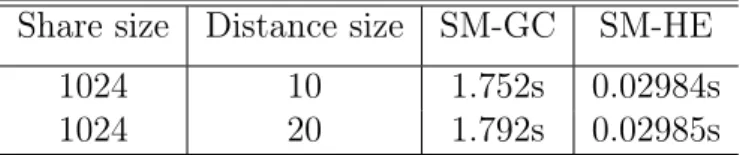
implementations were compared for varying number of bits required to perform multipli-cation. The running time of each implementation was independent of the input size, and the computation cost of SM-GC was significantly higher than that of SM-HE (see Table
3.2). For example, the computation time when SM-GC was used to multiply two 10-bit
numbers was 1.752 seconds. While in contrast was 0.02984 second when SM-HE is used. Therefore, the homomorphic encryption approach was adopted to implement the distance in both Euclidean and Hamming metrics.
3.5.5. Secure Bit-Decomposition. Assume that P1 has Epk(z) and P2 has sk,
wherezis not known to both parties and0≤z <2l, wherelis referred to as the domain size
(in bits) ofz. GivenEpk(z), the Secure Bit-Decomposition (SBD) protocol [86, 87] protocol
is used primarily to compute the encryptions of the individual bits of binary representation of z. The output [z] =Epk(z1), . . . , Epk(zl)
is known only to P1 at the end, where z1 and zl denote the most and least significant bits ofz, respectively. During this process, neither
the value of z nor any zi’s is revealed either to P1 or P2. Since the goal of this work is
not to investigate existing SBDprotocols, the most efficient SBD scheme that was recently
Share size Distance size SM-GC SM-HE 1024 10 1.752s 0.02984s 1024 20 1.792s 0.02985s
Table 3.2: Garbled circuit vs. homomorphic-based secure multiplication
Example 4. Assume z = 55 and l = 6. Then, the SBD protocol in [86] with input Epk(55)
returns [55] =Epk(1), Epk(1), Epk(0), Epk(1), Epk(1), Epk(1)
as the output to P1.
Security Analysis: The SBD protocol in “An efficient and probabilistic secure bit-
decom-position” [86] is secure under the semi-honest model.
Complexity Analysis: The computation complexity of the SBD protocol proposed in “An
efficient and probabilistic secure bit-decomposition” [86] was bounded by O(l) encryptions (under the assumption that encryption and decryption operations based on the Paillier cryptosystem [75] take similar amount of time) .
3.5.6. Secure Bit-OR. In the Secure Bit-OR (SBOR) protocol, both P1, with
input Epk(o1), Epk(o2)
and P2 with (sk) securely compute Epk(o1 ∨o2), where o1 and o2
are two bits. The output Epk(o1∨o2) is known only to P1.
Security Analysis: The security of theSBORdepends solely on the underlyingSMprotocol.
This is because, the only step at which P1 and P2 interact in the SBOR protocol is during the SM protocol. Since the SM is secure under the semi-honest model, this work claims
that the SBOR protocol is also secure under the semi-honest model.
Complexity Analysis: Since the SBOR protocol utilized the Secure Multiplication (SM)
protocol as a sub-routine, the computation cost of the Secure Bit-OR protocol was bounded by (small) constant number of encryptions and multiplications.
3.5.7. Secure Minimum. Assume that in the Secure Minimum (SMIN)
proto-col, P1 holds private input (u0, v0) and P2 holds sk, where u0 = [u], Epk(su) and v0 = [v], Epk(sv) . Here, [u] = Epk(u1), . . . , Epk(ul) and [v] = Epk(v1), . . . , Epk(vl) where u1 (resp., v1) and ul (resp., vl) are the most and least significant bits of u (resp., v),
re-spectively. Here, su (resp., sv) denotes the secret corresponding to u (resp., v). The goal
![Table 3.4: SMIN example: P 1 chooses F as v > u, where u = 55 and v = 58 [u] [v] W i T i G i H i Φ i L i Γ 0 i L 0 i M i λ i min i 1 1 0 r 0 0 −1 r 1 + r r r 0 1 1 1 0 r 0 0 −1 r r r r 0 1 0 1 1 −1 + r 1 1 0 1 1 + r r r −1 0 1 0 0 1 + r 1 r r r −1 + r r](https://thumb-us.123doks.com/thumbv2/123dok_us/420611.2548256/47.892.131.768.134.325/table-smin-example-p-chooses-φ-γ-min.webp)