
NEWCASTLE UNIVERSITY
Continuous Trust Management
Frameworks: Concept, Design, and
Characteristics
by
Ahmad Alonaizi
A thesis submitted in partial fulfillment for the
degree of Doctor of Philosophy
in the
Faculty of Science, Agriculture and Engineering
Computing Science
Abstract
A Trust Management Framework is a collection of technical components and govern-ing rules and contracts to establish secure, confidential, and Trustworthy transactions among the Trust Stakeholders whether they are Users, Service Providers, or Legal Authorities. Despite the presence of many Trust Frameworks projects, they still fail at presenting a mature Framework that can be Trusted by all its Stakeholders. Partic-ularly speaking, most of the current research focus on the Security aspects that may satisfy some Stakeholders but ignore other vital Trust Properties like Privacy, Legal Authority Enforcement, Practicality, and Customizability. This thesis is all about understanding and utilising the state of the art technologies of Trust Management to come up with aTrust Management Framework that could be Trusted by all its Stake-holders by providing a Continuous Data Control where the exchanged data would be handled in a Trustworthy manner before and after the data release from one party to another. For that we call it: Continuous Trust Management Framework.
In this thesis, we present a literature survey where we illustrate the general picture of the current research main categorise as well as the main Trust Stakeholders, Trust Challenges, and Trust Requirements. We picked few samples representing each of the main categorise in the literature of Trust Management Frameworks for detailed comparison to understand the strengths and weaknesses of those categorise. Showing that the current Trust Management Frameworks are focusing on fulfilling most of the Trust Attributes needed by the Trust Stakeholders except for the Continuous Data Control Attribute, we argued for the vitality of our proposed generic design of the Continuous Trust Management Framework.
To demonstrate our Design practicality, we present a prototype implementing its basic Stakeholders like the Users, Service Providers, Identity Provider, and Auditor on top of the OpenID Connect protocol. The sample use-case of our prototype is to protect the Users’ email addresses. That is, Users would ask for their emails not to be
shared with third parties but some Providers would act maliciously and share these emails with third parties who would, in turn, send spam emails to the victim Users. While the prototype Auditor would be able to protect and track data before their release to the Service Providers, it would not be able to enforce the data access policy after release. We later generalise our sample use-case to cover various Mass Active Attacks on Users’ Credentials like, for example, using stolen credit cards or illegally impersonating third-party identity.
To protect the Users’ Credentials after release, we introduce a set of theories and building blocks to aid our Continuous Trust Framework’s Auditor that would act as the Trust Enforcement point. These theories rely primarily on analysing the data logs recorded by our prototype prior to releasing the data. To test our theories, we present a Simulation Model of the Auditor to optimise its parameters. During some of our Simulation Stages, we assumed the availability of a Data Governance Unit, DGU, that would provide hardware roots of Trust. This DGU is to be installed in the Service Providers’ server-side to govern how they handle the Users’ data. The final simulation results include a set of different Defensive Strategies’ Flavours that could be utilized by the Auditor depending on the environment where it operates.
This thesis concludes with the fact that utilising Hard Trust Measures such as DGU without effective Defensive Strategies may not provide the ultimate Trust solution. That is especially true at the bootstrapping phase where Service Providers would be reluctant to adopt a restrictive technology like our proposed DGU. Nevertheless, even in the absence of the DGU technology now, deploying the developed Defensive Strate-gies’ Flavours that do not rely on DGU would still provide significant improvements in terms of enforcing Trust even after data release compared to the currently widely deployed Strategy: doing nothing!
For my beloved parents, passionate wife, and the three little
treasures I am blessed with; my young daughters, I dedicate
Acknowledgements
First and foremost, all the thanks and praises are due to Allah, the most gracious and the most merciful, for blessing me with a spirit that never stops seeking knowledge. My warm acknowledgments then go to my supervisor, Prof. Aad van Moorsel, whose continuous guidance, and encouragements accompanied me throughout my PhD jour-ney along with wise advice and kind attitude.
My acknowledgements also go to my dear friend and colleague, Dr. Suliman Al-suhibany for the valuable advice and encouragement he overwhelmed me with since my first day in the School. By letting me participate with him in some of his projects, I learned invaluable lessons and academic skills that I should never forget.
I extend my acknowledgements to everyone who spared time to listen to my ideas and gave valuable feedback. In particular, I mention my colleagues: Dr. Thomass Gross, Dr. Fransisco Rocha, and Dr. Maciej Machulak for their constructive discussion and evaluation. In fact, all my colleagues in Claremont Tower - Room 7.02 deserve the warmest greetings for making this place a social and brilliant place to pursue a PhD degree! Doing an extensive research project like a PhD requires a brilliant team of staff to take care of all the small details, so my appreciations go to all the staff in the CS department for their continuous support they always provide.
Spending over 4 years far away from home is insane without real friends who pro-vide invaluable social support. My appreciations go to everyone who spared time to talk, socialize, support in the hard times, and have fun in the good times! Particu-larly speaking, my warmest greetings goes to Dr. Abdulaziz Alsharidah, Dr. Yousef Alqahim, Dr. Abdulaziz Alnahed, Hasan and Othman Alkandari for the valuable support they overwhelmed me with during my studies.
My acknowledgments and appreciations go then overseas to my home institute, the Public Authority for Applied Education and Training in Kuwait, PAAET, for giv-ing me the opportunity to pursue the MSc and PhD degrees through their generous sponsorship.
I do not forget to warmly thank my parents who influenced me to seek knowledge and to devote myself to whatever I believe in. I extend my warm thanks to my wife who showed all the support and love that I desperately needed during my journey. Last but not least, my greetings are to my three little innocent girls who made my life exciting, happy, and full of action!
Contents
Abstract iii
Dedicatory v
Acknowledgements vii
Table of Contents ix
List of Figures xvii
List of Tables xix
List of Equations xxi
Glossary of Terms xxiii
1 Introduction 1
1.1 Hypothesis . . . 3
1.2 Methodology . . . 4
1.3 Scope . . . 5
1.4 Contributions . . . 6
2 Trust and Trust Framework Requirements 9 2.1 Defining Trust and Trust Frameworks . . . 10
2.2 Trust Stakeholders . . . 11
2.3 Trust Life Cycle . . . 12
2.5 Trust Requirements . . . 15
2.6 Properties of the Trust Enforcement Requirement . . . 16
2.6.1 Security . . . 17
2.6.2 Privacy . . . 20
2.6.3 Legal Authority Enforcement . . . 23
2.7 Properties of the Trust Flexibility Requirement . . . 27
2.7.1 Practicality . . . 27
2.7.2 Customizability . . . 29
2.8 Trust Measures Spectrum . . . 30
3 The Need for Continuous Trust Management Frameworks 37 3.1 Current Trust Frameworks at a Glance . . . 38
3.1.1 TCG . . . 39 3.1.2 UCON . . . 42 3.1.3 TAS3 . . . 46 3.1.4 PrimeLife . . . 51 3.1.5 ABC4Trust . . . 53 3.1.6 UMA . . . 56 3.1.7 OAuth 2.0 . . . 58 3.1.8 OpenID Connect . . . 59 3.1.9 Shibboleth . . . 62 3.1.10 Kerberos . . . 64
3.2 Evaluating the Current Trust Management Frameworks . . . 65
3.2.1 The Trust Enforcement Properties and Attributes Supported by Current Trust Frameworks . . . 65
3.2.2 The Trust Flexibility Properties and Attributes Supported by Current Trust Frameworks . . . 73
3.2.3 Current Trust Frameworks on the Trust Measures Spectrum . . 76
3.2.4 Other Relevant Projects and Frameworks . . . 80
3.3 Strengths of the Current Trust Management Frameworks . . . 84
3.3.2 Good realisation of the Privacy Attributes - except for the After
Release Data Protection . . . 85
3.3.3 Reasonable Practicality Attributes . . . 86
3.4 Weaknesses of the Current Trust Management Frameworks . . . 86
3.4.1 Lack of Continuous Data Control . . . 87
3.4.2 Lack of solid implementation of the Legal Authorities Attributes 88 3.4.3 Lack of solid implementation of the Customizability Attributes . 89 3.5 Why a Continuous Trust Management Framework and What it Should Provide? . . . 89
4 Designing the Continuous Trust Management Framework, Proto-type, and Problem Demonstration 91 4.1 Continuous Trust Management Framework Design . . . 92
4.2 Continuous Trust Management Framework, the Simple Prototype . . . 96
4.2.1 Development Utilities . . . 97
4.2.2 Problem Demonstrator, the Example Use-Case . . . 97
4.2.3 Prototype Implementation Based on OpenID Connect . . . 100
4.3 Generalising the Continuous Data Control Problem . . . 105
4.4 DGU, the Hypothetical Data Governance Unit . . . 106
4.4.1 DGU Sticky Policies . . . 108
4.4.2 DGU Generic Design . . . 109
4.5 Beyond the Continuous Trust Framework Prototype . . . 111
5 Trust Auditor Conceptual Design and Algorithms 113 5.1 Basic Elements . . . 114
5.2 TLRavg Ranking Approach . . . 116
5.2.1 Gradient Probability Distributor . . . 117
5.2.2 Local Trust Metric Record . . . 118
5.2.3 Average of Local Trust Metric Record . . . 119
5.3 TST Ranking Approach . . . 120
5.3.1 Sole Testing Distributor . . . 121
5.3.3 Sole Testing Metric Record . . . 124
5.4 TGT Ranking Approach . . . 126
5.4.1 Group Tester Ranking Agent . . . 126
5.4.2 Simple Colluding Group Metric . . . 128
5.4.3 Strong Colluding Group Metric . . . 129
5.4.4 Weak Colluding Group Metric . . . 131
5.4.5 Group Testing Metric Record . . . 132
5.5 Global Trust Metric Record . . . 137
5.6 Utility Units . . . 140
5.6.1 SPs Popularity Record . . . 140
5.6.2 Initial Interactions Record . . . 141
5.6.3 Data Governance Unit . . . 145
5.6.4 Trust Network Health Gauges . . . 148
5.7 Basic Deployment Rules . . . 153
5.8 Threat Model . . . 156
5.8.1 Users not Reporting All Abuse Cases . . . 157
5.8.2 Malicious Users Reports . . . 157
5.8.3 Making Money by Fooling the Testing Agents . . . 158
5.8.4 SPs Sharing Users’ Credentials with MSPs Unintentionally . . . 158
5.8.5 Reverse Engineering the Auditor Algorithms by an ME . . . 159
5.8.6 Misleading the Auditor with Simple Data Abusing Algorithms . 160 5.8.7 Colluding M(P)SPs . . . 161
5.8.8 MPSP Committing Suicide Attack . . . 165
5.8.9 MSPs Registration Bombarding . . . 167
6 Trust Auditor Model, Simulation and Results 169 6.1 Simulation Scope . . . 170 6.2 Development Environment . . . 172 6.3 Simulation Model . . . 173 6.4 Trust Model . . . 177 6.5 Simulation Approach . . . 183 6.5.1 Factors of Interest . . . 184
6.5.2 DOE . . . 189
6.5.3 Statistical Analysis . . . 191
6.6 Experimental Stages . . . 194
6.6.1 Stage 1: The no Auditor Case Followed by Initial Optimisation 195 6.6.2 Stage 2: 1st Optimisation Refinement of Attacks and Auditorial Settings . . . 196
6.6.3 Stage 3: 2nd Optimisation Refinement of Attacks and Audito-rial Settings . . . 197
6.6.4 Stage 4: Comparing the Performance of Manual and Automatic Optimisation Settings . . . 197
6.6.5 Stage 5: Introducing DGU with Offering Voluntarily DGU In-stallation Randomly along with a Refinement Iteration . . . 201
6.6.6 Stage 6: Removing the Voluntarily DGU Installation Option along with a Refinement Iteration . . . 204
6.6.7 Stage 7: Comparing the performance of vDGU and DGU . . . . 205
6.6.8 Stage 8: Evaluating the Different Defensive Strategies by ANOVA-Testing . . . 206
6.7 Summary of the Optimized Defensive and Attacking Strategies . . . 207
6.8 The Malicious Density Theory . . . 210
6.9 Evaluating the Defensive Strategies’ Flavours . . . 217
6.10 Known Limitations and their Expected Effects . . . 223
6.10.1 Unverified Trust Model . . . 223
6.10.2 Limitations of the Utilized Simulation Cycle Concept . . . 224
6.10.3 Biased Environmental Settings . . . 225
6.10.4 Awkward Experimental Stages Design . . . 226
6.10.5 Non-Linearity in the Measured Effects . . . 227
6.10.6 Programming Errors . . . 229
6.10.7 Human Mistakes in Updating the Experiments Settings . . . 230
7 Discussions and Future Prototype Enhancements 231 7.1 Discussing the Proposed Continuous Trust Framework, Should it be Trusted? . . . 232
7.1.1 Satisfying the Trust Stakeholders Needs . . . 232
7.1.2 Enforcing Continuous Data Control . . . 233
7.1.3 Enabling Real-Life Deployment Given the State of the Art Tech-nologies . . . 236
7.2 Discussing the Extents of the Posed Risks in the Threat Model . . . 238
7.2.1 Effects of Users Not Reporting all Abuse Cases . . . 238
7.2.2 Effects of Malicious Users . . . 239
7.2.3 Effects of Sharing with Malicious SPs . . . 239
7.2.4 Effects of Reverse Engineering the Detection Algorithms by a Malicious Entity . . . 240
7.2.5 Effects of Misleading the Auditor with Simple Data Abusing Algorithms . . . 242
7.2.6 Effects of Colluding MPSPs . . . 244
7.2.7 Effects of Popular SPs Committing Suicide Attack Combined with MSPs Registration Bombarding . . . 245
7.2.8 Effects of Introducing DGU . . . 247
7.3 Enhancements to the Developed Prototype . . . 248
7.3.1 Enhanced Defensive Strategies Release Order . . . 248
7.3.2 Enhanced Malicious Density Theory . . . 253
7.3.3 Enhanced DGU Deployment Rules . . . 253
7.3.4 Enhanced Users Sticky Policies Options . . . 254
7.3.5 Enhanced Ratings Publishing Mechanism . . . 255
7.3.6 Enhanced Internal Ratings Records . . . 255
7.3.7 Enhanced User Reporting Handling . . . 256
7.3.8 Enhanced Testing Agents Performance . . . 256
7.3.9 Enhanced Testing Agents Selection Algorithms . . . 257
8 Conclusion and Future Directions 259 8.1 Future Directions . . . 261
B Initial List of the Simulation’s Process Factors of Interest 279
C Detailed Milestones Data of the Simulation Stages 287 C.1 The Milestones of Stage 1: The no Auditor Case Followed by Initial
Optimisation . . . 287 C.2 The Milestones of Stage 2: 1st Optimisation Refinement of Attacks and
Auditorial Settings . . . 291 C.3 The Milestones of Stage 3: 2nd Optimisation Refinement of Attacks
and Auditorial Settings . . . 294 C.4 The Milestones of Stage 4: Comparing the Performance of Manual and
Automatic Optimisation Settings . . . 297 C.5 The Milestones of Stage 5: Introducing DGU with Offering Voluntarily
DGU Installation Randomly along with a Refinement Iteration . . . 306 C.6 The Milestones of Stage 6: Removing the Voluntarily DGU Installation
Option along with a Refinement Iteration . . . 310 C.7 The Milestones of Stage 7: Comparing the Performance of vDGU and
DGU . . . 315 C.8 The Milestones of Stage 8: Evaluating the Different Defensive
Strate-gies by ANOVA-Testing . . . 319
List of Figures
2.1 Digital Trust Life Cycle . . . 13
2.2 Trust Requirements . . . 15
2.3 Trust Measures Spectrum . . . 31
2.4 A New Venn Of Access Control For The API Economy [1] . . . 35
3.1 The Current Picture of The Trust Frameworks/Protocols Literature . . 38
3.2 UCON Model Components [2] . . . 43
3.3 A Components Overview for the TAS3 Architecture [3] . . . 47
3.4 A High-Level Architecture for the PrimeLife Privacy Language [4] . . . 52
3.5 Architecture for Attribute-based Credential Technologies [5] . . . 55
3.6 High-Level Overview of the UMA Protocol [6] . . . 57
3.7 A General Protocol Suite of the OpenID Connect [7] . . . 61
3.8 An Abstract Authentication Flow of OpenID Connect Protocol [8] . . . 61
4.1 Continuous Trust Framework Design . . . 93
4.2 The MVC Generic Design Pattern . . . 100
4.3 Authentication Flow using OpenID Connect . . . 102
4.4 Malicious Interaction Sequence Diagram . . . 104
4.5 DGU Generic Architecture . . . 110
5.1 Auditor Theoretical Building Blocks . . . 114
6.1 The Simulation Model High-Level Architecture . . . 174
6.2 Visualising the Observed Malicious Density Values during the Simula-tion Process . . . 213
List of Tables
3.1 Comparing the Trust Enforcement Attributes of Figure 2.2 Supported
by Current Trust Frameworks . . . 72
3.2 Comparing the Trust Flexibility Attributes of Figure 2.2 Supported by Current Trust Frameworks . . . 75
3.3 Themes Comparison of the Evaluated Trust Frameworks . . . 79
3.4 Other Industry/Standard Bodies Led Projects . . . 81
3.5 Other Academic Projects . . . 83
3.6 Other Deployed Authentication and Authorisation Solutions . . . 84
3.7 Other Governmental Initiatives . . . 84
6.1 Final List of Factors of Experiment Settings . . . 184
6.2 Final List of Environmental Factors . . . 184
6.3 Final List of Users’ Controlled Factors . . . 184
6.4 Final List of SPs’ Controlled Factors . . . 185
6.5 Final List of Auditor’s and IDP’s Controlled Factors . . . 186
6.6 Final List of Attackers’ Controlled Factors . . . 186
6.7 Final List of Monitored Outputs . . . 187
6.8 Environmental Factors Real Life Interpretation and Effects . . . 199
6.9 Optimal Defensive Strategy (Manual Vs. Automatic) at Different Pop-ulations Scenarios . . . 200
6.10 Classifications of the Defensive Strategies . . . 207
6.11 The Main Defensive Settings against the main Counter-Attacking Strate-gies . . . 209
6.12 The Observed Malicious Density Values during the Simulation Process 212 6.13 The Step Value Between Consecutive Density Points Based on the Den-sity Measure . . . 213
6.14 Evaluating the Defensive Strategies . . . 221
B.1 Factors of Experiment Settings . . . 279
B.2 Environmental Factors . . . 280
B.3 Users’ Controlled Factors . . . 280
B.4 SPs’ Controlled Factors . . . 281
B.5 Auditor’s and IDP’s Controlled Factors . . . 283
B.6 Attackers’ Controlled Factors . . . 284
List of Equations
5.1 Gradient Probability Distributor, GPD . . . 118
5.2 Local Trust Metric, TL . . . 119
5.3 Average of Local Trust Metric, T Lavg . . . 120
5.4 Sole Testing Distributor, STD . . . 122
5.5 Sole Testing Trust Metric, TST . . . 125
5.6 Group Trust Metric Rank for Gs, T GTsg(G) . . . 128
5.7 Group Trust Metric for SPs,T GTsg(SP) . . . 129
5.8 Strong Colluding Group Trust Rank, T GTsc(SP) . . . 130
5.9 Group Trust Rank, TGT(SP) . . . 132
5.10 Global Trust Metric, TG . . . 138
5.11 Recovery Period after Detecting an MPSP, τM P SP−Halt . . . 166
5.12 Recovery Period after Detecting MPSP assuming the MSPs Registration Bombarding Attack, τM P SP−Halt . . . 168
6.1 Trust increase in each cycle without an open Case . . . 178
6.2 Trust decrease after receiving an Abuse Case . . . 179
6.3 Trust decrease in each cycle with open Cases . . . 179
6.4 Trust increase after resolving Abuse Case . . . 180
6.5 Probability of generating a Credential at t . . . 181
6.6 Probability of assigning a Strict Sharing Policy to a new Credential at t . 182 6.7 Probability of assigning a Share with Any Policy to a new Credential at t 182 6.8 Basic Malicious Density Equation . . . 211
6.9 Malicious Density Equation - PSPs . . . 211
6.10 Malicious Density Equation - (P)SPs . . . 211
7.1 Recovery Period after Detecting MPSP launching a combined Suicide and MSPs registration Bombarding Attacks Considering the Soft Trust effects,
Glossary of Terms
Term Description
Auditor Agent or Testing Agent
An artificial User that is created by the Auditor to deal with suspicious (P)SPs to verify perceived doubts about them.
Auditor An internal governing unit of theContinuous Framework to pro-cess Credentials Abuse reports, Rank SPs, and ban or punish suspected M(P)SPs.
Case or C An Abuse Case containing a list of all the (P)SPs that have been dealt with since the last Case submitted by a User for the Auditor to detect the M(P)SP who is responsible for it.
Colluding M(P)SPs
A group of M(P)SPs collaborating to fool the Auditor’s Defensive Strategy by sharing their transactions history to deduce whether a User they intend to Abuse is just an Auditor Agent or to make sure that the targeted User have dealt with a large enough set of M(P)SPs that makes it hard for an Auditor to detect the colluding group.
Counter-Attacking Strategy
A counter-attacking pattern that could be adopted by the ma-licious Attackers to compromise the deployed Defensive Strat-egy of the Continuous Framework’s Auditor in the quest to abuse Users’ Credentials. The Main identifiedCounter-Attacking Strategies are: Weak Colluding and Strong Colluding.
Credentials or Personally Identifiable Information (PII)
Small, but valuable, pieces of information that uniquely identify an entity like, for example, email addresses, physical addresses, phone numbers, credit cards numbers, passwords, and so on.
Defensive Strategy
A defensive pattern that could be adopted by the Continuous Framework’s Auditor to defend against malicious Attackers try-ing to abuse Users’ Credentials. The main identified Defensive Strategies are: Random, Conservative, and Aggressive.
Defensive Strategy Flavour
A customized combination of Ranking Algorithms, Utilities, and Deployment Rules settings that have the characteristics of its main Defensive Strategy, whether it is a Random, Conservative, or Aggressive Defensive Strategy.
Digital Trust A special case of general Trust where the Trust Stakeholders agree to engage in Digital Trust transactions with the “Intention to accept vulnerability based upon positive expectations of the intentions or behaviour of another [Stakeholder] [9].”
DGU Data Governance Unit. A hardware utility to enforce Hard Trust in the Trust Network. If an SPInstalls DGU, it should be impos-sible for it to handle an acquired Credential without compliance to its sticky policies. In addition, DGU would record all inter-nal accesses to the Credential as well as all its approved sharing destinations.
GP D Gradient Probability Distributor. A Raw Ranking Algorithm that Ranks SPs badly the closer the User have dealt with them just before getting an Abuse.
GT Group Tester Agent. A Raw Testing Agent that interacts with a set of suspicious (P)SPs that are suspected to be colluding.
Continuous Data Control
Enforcing the Users’Sticky Policies before and after their release to requesting parties.
Continuous Trust Man-agement Framework
Our proposed Trust Management Framework that should pro-vide Continuous Data Control for its Stakeholders’ data before and after their release to the other parties.
Continuous Trust Man-agement Framework Design
A combination of the best practices we found in the current Trust Frameworks in addition to what we thought necessary and missing to present a generic design of a Continuous Trust Man-agement Framework that fulfils the essentialTrust Requirements with special attention to the Continuous Data Control Privacy Attribute.
IIL Initial Interaction List. A list containing the interactions that took place by a given User’s Credential prior to receiving the first Abuse on that Credential. This list would also include all the PSPs that this User have dealt with prior to that Abuse using other Credentials for detecting weak colluding attacks.
IIR Initial Interactions Record. A Record containing all the IILs.
Malicious Density Theory
A theory describing the relation between the Density of the ma-licious nodes population in a Network and the effectiveness of the Auditor that tries to detect malicious activities.
M GR Malicious Groups Record. A Record containing all the suspicious colluding groups. There are two variants of this Record to serve the Strong Colluding AlgorithmM GRscand the Weak Colluding AlgorithmM GRwc.
M P SP Malicious Popular Service Provider.
M SP Malicious Service Provider.
Personally Identifiable Information (PII)
See Credentials.
P IILs Popular Initial Interaction Lists. A Record containing the IILs
that have appeared frequently among different Users triggering the possibility of colluding SPs.
Ranking Approach
A family of Ranking Algorithms that cooperate to generate a single Rank for each SP showing how Trustworthy it is based on the combined efforts of all theRanking Algorithms of this family.
Ranking Algorithm
An Algorithm to process the aggregated data abuse records and, thus, assign each SP a Rank based on how Trustworthy it ap-pears per the analysis.
Selection Algorithm
A descriptor for a family of Algorithms that analyze Users’ logs to select suspicious (P)SPs to be processed byRaw Agent Rank-ing Algorithms.
Simple Data Abusing Algorithms
A descriptor for a family of simple Uncolluding Attacking Al-gorithms where the Attackers try to fool the Auditor by simple Delaying the Abuse, Repeating the Abuse, and/or Ignoring to Abuse certain Users’ or some of their Credentials.
SP R SPs Popularity Record. An Algorithm that sort all the SPs by their popularity based on the frequency of their appearing in the reported Cases.
SP Service Provider.
ST D(SPx) Sole Testing Distributor. A Raw Ranking Algorithm that gives all the Cases’ SPs an equivalent rank. The less SPs appearing in the Case, the lower this unified Rank would be.
Sticky Policy A policy that is attached to given Credential detailing how its owner wish it to be accessed, shared, used, and/or stored.
ST Sole Tester Agent. A Raw Testing Agent that interacts with only one suspicious (P)SP that is suspected to be Uncolluding with other M(P)SPs.
Testing Agent See Auditor Agent.
T GR Global Trust Metric Record. A Record containing all the as-signed global Ranks.
T G(SPx) Global Trust Metric. A Final Ranking Algorithm assigned to an individual SPx, T G(SPx), by combining the value of the three Final Ranks: T LRavg(SPx), T ST(SPx), and T GT(SPx) with customized weights given to each of them.
T GT Group Trust Metric. AFinal Ranking Algorithm assigned to ei-ther a group G, T GT(G), or an individual SP, T GT(SP), based on the size of the colluding group. The smaller the group size, the smaller the assigned Rank. There are three Intermediate Ranking Algorithms generating three different variations of this Metric: Group Trust MetricT GTg, Strong Colluding Trust Met-ricT GTsc, and Weak Colluding Trust MetricT GTwc. The Final
T GT value is generated by combining the value of the three intermediate Ranks with customized weights given to each of them.
T GT R Group Trust Metric Rank Record. A Record containing all the assigned group Ranks. There are two versions of this Record:
T GT R(G) for groups Ranks and T GT(SP) for individual SPs Ranks. Also, there are three variations of this Record for the use of the corresponding Intermediate Ranking Algorithms: Group Trust Metric T GT Rg, Strong Colluding Trust Metric T GT Rsc, and Weak Colluding Trust Metric T GT Rwc.
T Lavg(SPx) Global Average Trust Metric. AFinal Ranking Algorithm gener-ating a global Rank for a givenSPxby averaging the aggregated
T LRU values for that SPx.
T LRavg The Average T LRUs Record. A Record containing all the T Lavg Ranking values for all SPs.
T LRU Local Trust Metric Record. A Record containing all the T LUi
Ranking values.
T LUi(SPx) Local Trust Metric. An Intermediate Ranking Algorithm
gener-ating the average of the aggregated STD values for a given SP in the context of a single User.
Trust Attributes
A set of the main Trust Attributes of each of the main identi-fied Trust Properties of each of the Trust Requirements that we identified in the literature.
Trust Challenges
A set of the main Trust Challenges that are facing the current Trust Frameworks based on our literature survey.
Trust
Management Framework
A collection of technical components and governing rules and contracts to establish secure, confidential, and Trustworthy transactions among the Trust Stakeholders whether they are Users, Service Providers, or governing Authorities.
Trust Measures Level
A specific level, or category, in the Trust Measures Spectrum
Trust Measures Spectrum
A spectrum of different categorise of tools and solutions that are categorized based on how strictly they rely on proofs to enforce Trust in the Network ranging from Soft Trust to Hard Trust Measures Levels
Trust Model A rough mathematical model we developed to mimic the Trust Framework’s Users regarding to their perceived Trust and how this Trust would be affected after receiving a Data Abuse or after the Auditor detected the Abuser.
Trust Network Health Gauges
A set of sensors to provide feedback reports about the health status of the Trust Network. Such sensors would aid the Auditor in figuring out whether to alter its currently deployed defences and how harmful the effects of the current attacks are.
Trust Properties
A set of the main Trust Properties that make up each of the main Trust Requirements that we identified in the literature.
Trust
Requirements
A set of the main Trust Requirements that should be fulfilled by any Trust Management Framework to satisfy its Stakehold-ers that we came up with by analysing the main Trust Chal-lenges along with the best practices deployed by the current Trust Frameworks to tackle those Challenges.
Trust
Stakeholders
The main Stakeholders of our Continuous Trust Management Framework are: End Users, Service Providers, Legal Author-ity, the Framework’s Auditor (Governing the Network’s transac-tions), and Identity Providers.
T ST Sole Tester Trust Metric. AFinal Ranking Algorithmgenerating a global Sole Testing Rank by averaging the aggregated ST D
values for a given SP coming from both theST DAlgorithm and ST Agents.
T ST R Sole Testing Trust Record. A Record containing all the T ST
Ranks values.
Uncolluding M(P)SPs
A single M(P)SP that launches its attack without relying on collation feedback from other M(P)SPs.
Chapter 1. Introduction
TRUST is the magical enabler for any two, or more, parties to engage in successful interactions, transactions, or delegations, as we explore in Section 2.1. For a complex environment like the Internet, which is composed of heterogeneous sets of sites and services consumed by a heterogeneous mix of humans and automated agents, Trust should lie at the heart of such an environment. The more Trust the Stakeholders have in the environment, the more interactions will take place. Without Trust, such an environment would be paralyzed.
That raises the need for a Trust Management Framework that provides and manages a set of protocols and software units to enable establishing a Network where the participants could engage in Trustworthy interactions. The currently available Trust Frameworks cannot satisfy all the needs of their Stakeholders, described in Section 2.2. Hence, these Trust Frameworks cannot be truly Trusted by them, see our survey of the current Trust Frameworks in Section 3.1.
Security solutions are plentiful but while it is true that Security is an important Property of Digital Trust, it is not the only one. Enhancing the Security of online transactions alone does not generate Trust and, hence, would pose limitations on the nature of the transactions that the Trust Stakeholders would be willing to engage-in, see Subsection 2.6.1. Therefore, the aim of this thesis is to define and evaluate the fundamental building blocks for a practical Continuous Trust Management Framework that satisfies all its Stakeholders. Particularly speaking, we are focusing in supporting the vitally lacked feature in the literature: the Continuous Data Control as we argue in Section 3.5.
The rest of this Chapter presents the main hypothesis, methodology, scope, and the main contributions.
In Chapter 2, we present a technical background on the subject to introduce the concept of Trust and Trust Stakeholders along with a detailed study of the current Trust Challenges, the corresponding Trust Requirements, and the Trust Measures Spectrum of the available tools and protocols for the current Trust Frameworks to deploy.
In Chapter 3, we present a thorough study of the literature where representative Trust Management Frameworks samples for each Trust Measures Level, see Section 2.8, is evaluated. That is followed by a thorough comparison of those sample Trust Frameworks in terms of how effectively they fulfil the Trust Requirements we list in Section 2.5. That is followed by a discussion of the strengths and weaknesses of the evaluated Trust Frameworks. From this discussion, we conclude with the need for Continuous Trust Management Frameworks along with a list of the minimal Trust Requirements they should provide to be qualified for theContinuous prefix.
In Chapter 4, we present the high-level design of our proposed Continuous Trust Man-agement Framework along with a sample prototype to demonstrate the practicality of our proposal given the currently available technologies. We also present in that Chapter the design of a hypothetical Data Governance Unit, or simply DGU, that could solve a lot of the Trust issues currently facing the Trust Networks.
In Chapter 5, we present a set of basic formal building blocks and deployment rules to be used by an Auditor Unit to detect malicious activities and enforce Trust. These building blocks include our novel idea of artificial Testing Users, or Agents as we call them from now on, and how they could boost the performance of the proposed Auditor.
In Chapter 6, we present a Simulation Model representing the interactions that we implement in the prototype of Chapter 4. We describe in that Chapter the Simulation Process where we used the Simulation Model to study the behaviour and optimize the defensive parameters of our proposed Auditor when operating in large Networks with variable environmental settings. The results we present in that Chapter include
a set of Defensive Strategies Flavours that are suitable for deployment in different environmental conditions against different launched Counter-Attacking Strategies. In Chapter 7, we argue that our proposed Continuous Trust Framework Design is capable of satisfying all its Stakeholders given our presented prototype and optimized Defensive Strategies Flavours and, hence, prove our ideas are practical and provide significant improvements to Users overall Trust. In that Chapter, we also evaluate the performance of our Defensive Strategies Flavours and their immunity to the risks presented in the Threat Model of Section 5.8 along with a list of possible enhancements to improve our current Defensive Strategies Flavours.
Finally, In Chapter 8, we conclude this thesis with the outcomes of this study and the possible future directions.
1.1 Hypothesis
The world would be ideal if we can Trust that every other party have good intentions and would behave as expected. That is not the case and, hence, we have legislation that governs legal contracts that can be used to judge who have breached the contract terms in case of any dispute we have in public courts. To enforce such laws and facilitate the work of our public courts, policing authorities are needed in real-life. In cyber life, we need another form of policing authority and juridical system to foster Trust with a high degree of certainty. At the same time, these cyber authorities should be ethical in the sense that they do not overuse their digital powers to Abuse Users’ Data or falsely accuse a Network resident of breaching a contract term. In technical terms, the Trust Framework should be able to ethically protect two digital commodities: Users’ Credentials (PII) and Users’ Data, see Subsection 2.6.2. This protection should be provided before and after these digital commodities are released per the release contract. While many current Frameworks offer reasonable protection for these digital commodities before release, there is little done to offer after release protection, see Subsection 3.4.1.
The hypothesis of this thesis: it is possible, by aid of the novel Auditor Unit presented in Chapter 5, and by utilising the current available Trust Frameworks in the literature, to come up with a practical Continuous Trust Framework. This Continuous Framework would significantly improve theUsers’ Trust level by imposing Continuous Data Control on Users’ Data and Credentials. That is, Data protection before and after these digital commodities are released to the requesting Service Providers. By doing so, our proposed Continuous Framework would provide an important Trust Attribute that the current Trust Frameworks fail to provide: Data Control After Release.
1.2 Methodology
As stated before, the aim of this thesis is to define and evaluate the basic theoretical building blocks for a practical Continuous Trust Management Framework that satisfies all its Stakeholders. For that, it is crucial to thoroughly understand the general problem of Trust and, then, combine both novel theories and practical prototypes to show the extent of the problem, what the proposed Continuous Trust Framework Design could achieve, and how future Trust technologies could positively affect our proposed Continuous Framework. Our methodology consisted of the following main milestones:
• Surveying the Literature: This milestone is concerned with studying the role of Trust in human lives in general as well as in computing to get a holistic understanding of the extent of the Trust issues and their possible impacts. That is vital to define the main qualities of Trust Framework’s Role, Scope, Stake-holders, Challenges and Requirements. Moreover, a main goal of this milestone is to categorize the existing Trust Frameworks in the literature to understand their strengths and weaknesses as well as to utilize their best practices.
• Designing Continuous Trust Management Framework: This milestone is concerned with producing a generic Continuous Trust Framework Design based
on the best practices we observe in the literature survey milestone. This design should serve as a guideline for any future research in the area.
• Proving the Practicality of the Continuous Framework Design: This milestone is concerned with demonstrating the practicality of our proposed Con-tinuous Framework by implementing a minimal prototype showing its main fea-tures and how its Stakeholders would interact. An essential goal of this milestone is to utilize the currently available Trust Frameworks in the literature to avoid reinventing the wheel. Particularly speaking, it should incorporate an Identity Service Provider, IDP, to manage the Users’ identities and to keep access logs of them.
• Defining Theories and Building Blocks to Construct the Auditor Unit: This milestone is concerned with formally defining a set of novel theories and building blocks that would utilize the aggregated Users’ logs by the IDP of the previous milestone. This Auditor Unit is to investigate any Data Abuse report to figure out who is guilty for the Abuse that happened after the Data released from its owner to the requesting Service Provider(s).
• Simulating and Analysing the Performance of the Auditor Unit: This milestone is concerned with analysing the performance and efficiency of the proposed Auditor. This milestone is about developing a Simulation Model to run and optimize the proposed Auditor in a large Trust Network with variable deployment settings.
1.3 Scope
It would have been great if this thesis could have covered every aspect of Digital Trust and fully implement the proposed Continuous Framework. Nevertheless, we are limited by the factors of time, resources, and experience. Hence, the scope of this thesis is as following:
• Presenting a generic, not detailed, Continuous Framework Design based on the best practices we observe in the literature survey.
• Developing a simple, not complete or deployment-ready, prototype to demon-strate the practicality of our proposal.
• The presented Threat Model of Section 5.8 would describe many different at-tacking categorise. However, the proposed Auditor Unit focuses only on tackling Mass and Active Attacks rather than Targeted and/or Passive Attacks due to their complexity, see Section 2.4.
• The Simulation Model implements a partial set of the proposed theories for the Auditor Unit to give preliminary results proofing the hypothesis. Highly accurate results would require a real model that would be tested by real humans, which qualifies to be a separate research project by its own due to its complexity.
• Implementing specific core technologies that are present in the Continuous Trust Framework Design like advanced Sticky Policies or the DGU Unit is out of scope due to their complexity that may divert the development away from the original aim and hypothesis.
• While it is crucial for real-life deployments of the Trust Framework to have good QoS metrics such as scalability, resilience to Network conditions, and good re-sponsibility speeds, neither our design nor our prototype implementation would focus on these aspects at this early stage of conceptualizing the Continuous Trust Management Framework.
1.4 Contributions
In this thesis, we introduce the following contributions:
• Extensive Literature Survey: an extensive survey covering the Trust related concepts, categorise, and some important example Frameworks as we show in Chapters 2 and 3.
• Continuous Trust Management Framework Design: a generic design that satisfy all its Stakeholders needs in a continuous manner, see Section 4.1.
• Minimal Prototype of the Continuous Framework: to prove the practical-ity of the proposed Continuous Trust Framework Design based on the current available technologies, see Section 4.2. The Code of this Prototype is pub-lished as an open-source project and can be found on: https://gitlab.com/ Continuous_Trust_Prototype/Prototype.
• Designing a Hypothetical Data Governance Unit, DGU: this unit as-sumes the existence of mature TCG technologies, see Section 4.4. If the pro-posed design is implemented, it would significantly improve the Continuous Data Control Attribute as we show in our Simulation Process findings, see Subsection 7.1.2.
• Novel Auditor Unit: the theories, building blocks, and deployment rules for an Auditor Unit that can offer Continuous Data Control, see Chapter 5. Among these theories, we introduce the theories and governing rules to utilize artificial Testing Agents that would pose as real Users to prove whether a suspicious Service Provider is acting maliciously.
• Developing Defensive Strategies Flavours for the Auditor: this is a set of Defensive Strategies Flavours that resulted after many simulation refinement optimisation stages based on the three mainly identified Strategies: Random, Aggressive, and Conservative. These Flavours, are suitable for different environ-mental settings and against a variety of launched Counter-Attacking Strategies as we show in Sections 6.7 and 6.9. The Code of the Simulation Model of the Auditor and its interactions with the Trust Network Stakeholders, which we used to come up with our proposed Defensive Strategies is published as an open-source project and can be found on: https://gitlab.com/Continuous_ Trust_Simulator/Simulator.
Chapter 2. Trust and Trust Framework Requirements
The aim of this research project and thesis is to define and evaluate the basic build-ing blocks for a Continuous Trust Management Framework that could be Trusted by its Stakeholders by providing Continuous Trust where the exchanged Data would be handled in a Trustworthy manner throughout all the transactions phases. In this Chapter, we present the results of our survey and analysis of the rich literature of human Trust, in general, and Digital Trust, specifically, to answer the following fun-damental questions:• What is the definition of Digital Trust?
• Who are the digital Trust Stakeholders?
• How Digital Trust is established and how does its life cycle look?
• What are the current Trust Challenges?
• What are the Trust Stakeholders’ main Trust Requirements?
• What are the main Trust Measures that are being utilized by the current Trust Frameworks?
Despite the wealth of novel ideas in the Digital Trust literature, there are still many dynamically evolving Challenges to be tackled. For that, we list in this Chapter the main Trust Challenges facing the current Trust Management Frameworks. These Trust Challenges are followed by their corresponding Trust Requirements where each Requirement has a set of Properties, which in turn have their own Attributes. Finally, we conclude this Chapter by illustrating the Trust Measures Spectrum categorizing the available tools and protocols at the disposal of the current Trust Managements
Frameworks into different Spectrum Levels ranging from Soft Trust Levels like Cues and Clues to Hard Trust Levels like Hard Verification.
2.1 Defining Trust and Trust Frameworks
Searching the word Trust in any search engine would reveal all sorts of theories, opinions, and practices that are related to almost any form of interactions whether it is among humans or machines. As Nissenbaum describes, Trust, in general, is a precious capital to any community, online or off, which flourish communication and transaction with a tolerance level to vulnerabilities that would be due to non-ill intentions [10]. A special forum discussing the view of Trust across different disciplines came up with the following definition: “Trust is a psychological state comprising the intention to accept vulnerability based upon positive expectations of the intentions or behaviour of another [9].” In his PhD thesis that tried to formalize a computational concept of Trust, Marsh described the Trust situation as “choosing to put ourselves in another’s hands, in that the behaviour of the other determines what we get out of a situation [11].”
Interactions involving computers or other technical means are no exceptions to the Trust rules. It is stated by Osterwalder that any technical development would rely, in its heart, on a form of Trust or delegation of Trust to other institutions [12]. Zhang et al. gave a more detailed description by thinking that Digital Trust is a subset mapping of the general Trust, where the specific subset and interpretation of Trust are dependent on the context [13].
For that, we define the Trustworthy Transaction to be any digital transaction that promise to fulfil a minimum set of Trust Requirements, see Section 2.5, that proves the good intentions of all the parties engaged in this transaction. Accord-ingly, we define the Trust Management Framework as a collection of technical components, governing rules and contracts to establish secure, confidential, and Trust-worthy Transactions among the Trust Stakeholders, see Section 2.2, whether they are Users, Service Providers, or Legal Authorities.
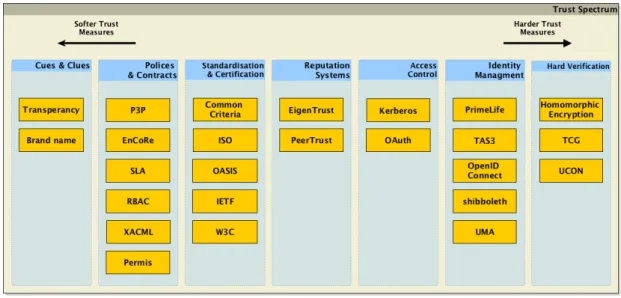
So far, Trust has been described as a mental state enabling the Trust parties to engage in risky interactions where the expected loss, due to the failure of one party to fulfil its promises, usually outweigh the expected gain, if the involved parties acted as expected [11]. One may argue that Trust could be solely initiated by strong evidence and guaranties, which would remove the risk factor from the Trust definition. Nevertheless, achieving this high level of certainty is usually very expensive, if not impossible, in terms of the computational cost, limitations on the range of offered services, and the uncomfortable User experience as described by Nissenbaum [10]. A good Trust Management Framework should utilize a balanced set of Trust Measures from the Trust Measures Spectrum, See Section 2.8, that are neither too soft to be easily compromised nor too hard to be hostile for the Trust Stakeholders.
2.2 Trust Stakeholders
Trust Stakeholders are the main parties that are involved directly or indirectly in a Trustworthy Transaction, see Section 2.1. Depending on the context of the transaction, the Stakeholders could be Human Users, Software Agents, Legal Entities, State Authorities, or even a mix of all the previously mentioned groups. Nevertheless, most of the Stakeholders could be classified in one of three general groups: Service Providers, ordinary Users, and Legal Authorities. Each group of Stakeholders has its own needs and Requirements to engage in Trustful interactions.
For the Service Providers, it is important to authenticate the services’ Users. Authen-tication could be as simple as an identity check but also could involve more complex analysis like credit history check. Moreover, some service providers wish to mine their Users’ Data to generate personal profiles that could be used, for example, for targeted advertisements [14].
For the Users, the most precious commodities that they care about during any Trust relationship are their Credentials and Data. They wish to protect them in two different points of time: before and after releasing them to the second party. For that, it is important to verify the credibility of the online system to Trust using it. In addition,
some Users have concerns about the Security levels of the system while others would have concerns about the Privacy of their Data. As a result, many clients would have different Trust Requirements that they wish to negotiate with the Service Providers before engaging in any transaction.
For the Legal and Governmental Authorities, it is important to track cyber criminals, to monitor any transaction they suspect, and to enforce digital laws that are con-cerned, for example, with copyrights or fair trade competition. Such Requirements are very challenging to implement in practice due to the universal nature of the In-ternet where there is not a single authority or even country that governs the cyber web. The introduction of inter-linked systems, like cloud computing, just amplified the previous issues and added a new dimension of challenges [15]. Moreover, many Service Providers would refuse to collaborate with the Legal Authorities because they do not want to upset their customers who demand Privacy.
2.3 Trust Life Cycle
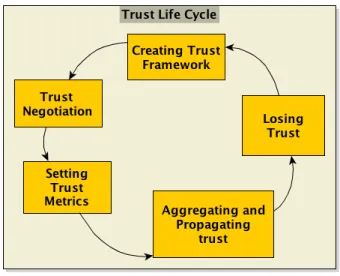
Per Nielsen, Trust is “hard to build and easy to lose [16].” As a result, it is im-portant to understand the Trust building process and to picture how the Trust life cycle looks like. Zhang et al. described the Digital Trust building process as the problem of: initiating Trust, coming up with proper Trust metrics, aggregating feed-back and propagating ratings, and setting a proper Trust Management Architecture [13]. Pearson and Benameur talked about the life cycle from a more abstract angle as they described three different phases in any Digital Trust relation: building Trust, maintaining stable Trust, and then losing Trust [15].
A general view of the Digital Trust Life Cycle, based on the current literature, is shown in Figure 2.1. The drawn cycle starts with building an appropriate Trust Framework to manage digital Trust in the desired context. Once the Trust Framework is ready, Trust Stakeholders could engage in Trust Requirements negotiation. Based on the agreed Requirements, proper Trust metrics are generated to provide solid ground to judge all parties’ conformance to the agreed contracts. After that, the Trust Framework
Figure 2.1: Digital Trust Life Cycle
should have the ability to aggregate useful feedback regarding the performance of all the engaged parties in the different Trusty interactions so it can prepare useful ratings and recommendations for any party wishing to engage in future transactions with any of the evaluated parties. If the Trust Management Framework failed to fulfil its promises or to keep up with its Users’ expectations, it would quickly lose their Trust and, hence, a major update or a completely new Framework should be introduced to continue the Trust cycle.
2.4 Trust Challenges
As stated earlier in the introduction, Digital Trust does not equal digital Security. In fact, increasing the Security level does not necessarily imply Trust; it could be the opposite. Securing all transactions and communication channels may require revealing private or confidential Data that may increase the concerns of the participants about the usage of their personally identifiable Data, PII, which would lead to a distrust situation [12].
Per the 2010/2011 Computer Crime and Security Survey, CSI, cyber Security attacks could be categorized based on their coding themes [17]:
• (Mass) Basic Attacks: Phishing, ports scan, brute force attacks, old school viruses, and so on.
– Malware Attacks: Extensions of the basic attacks utilising malware cus-tomisation and targeting toolkits.
• (Targeted) Attacks 2.0: Advanced Persistent Threat, APT, attacks where an organised committee of professional experts launch a digital attack targeting a specific entity with all the possible attacks at many different Security layers. Two recent examples are the Aurora and Stuxnet attacks.
Standard Security toolkits, like antiviruses and firewalls, could effectively minimise the risks of most of the Basic Attacks. However, that is not usually the case for the more advanced Malware Attacks that target specific entities with more complicated techniques, including social engineering. When it comes to the Targeted Attacks, the IT Security decision maker gets more confused due to the lack of visibility of the possible range of attacks that his enterprise might be exposed to or even face at any given time [17].
Another important classification of the possible Trust threats is based on the activity status, as explained by De Vivo in [18]:
• Active Attacks: The Attackers here would interfere in the performance of the compromised Network, trying to alter how it normally behaves. For example, erasing Data, modifying some entries, or causing denial of service.
• Passive Attacks: The Attackers here would not interfere in the performance of the compromised Network. Rather, they would simple sniff for the Data of their interest to utilize for their benefit, see Subsection 2.6.2. Unlike the Active Attacks, the Passive Attackers do not leave many foot-prints which makes their detection rather harder.
In many cases, a given attack could be described based on both above classifications. That is, an attack would normally be either a Mass or a Targeted Attack that is
indulging in Active or Passive attacking activities. When it it comes to the advanced Targeted Attacks, it is expected that the Attacks would be a mixture of both Ac-tive and Passive Attacks. Such a mixture may also be utilized by some Mass Basic Attackers, specially the Malware extended version of it.
2.5 Trust Requirements
Figure 2.2: Trust Requirements
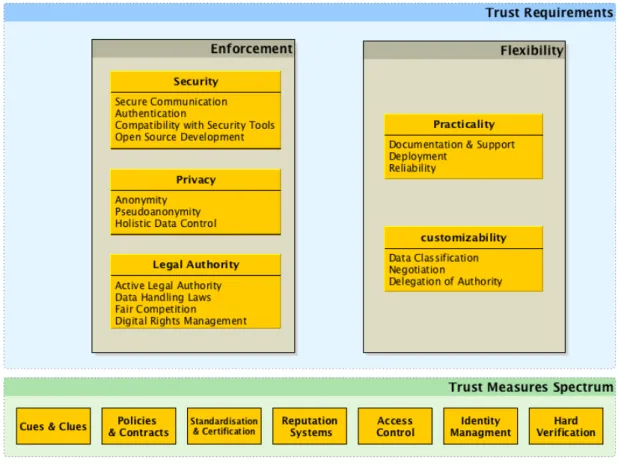
In this and the following Sections, we describe the main Trust Requirements that should be fulfilled by any Trust Management Framework to satisfy its Stakeholders. We came up with this list of Trust Requirements by analysing the main Trust Chal-lenges we list in Section 2.4 along with the best practices deployed by the current Trust Frameworks to tackle these Challenges. In other words, whenever it becomes possible to tackle a Trust Challenge, by means of technical advancements, then tack-ling this Challenge would become a requirement rather than a mere wish by the Trust
Stakeholders. Not fulfilling such Requirements may lead the Trust Stakeholders to lose their Trust in the corresponding Trust Framework. That would be especially true in case of a breach of the Trust contract between two Trust Stakeholders since such incidents would make it clear that one of the Stakeholders is not doing its best to fulfil the Requirements of the others, see Section 2.3 for more details about the Trust Life Cycle.
Like in real-life transactions, any two or more parties would have two main Require-ments to establish a Trustworthy contract:
• Enforcement: The ability to enforce the terms of the agreed upon contract by guarding the Trust transaction against malicious activities from outsider malicious entities as well as malicious activities conducted by some of the internal Trust Stakeholders against the agreed upon contract. Moreover, in case one party fails to deliver the quality of service it promised to in the contract, other parties should be able to resort to Legal Authorities for compensation.
• Flexibility: The ability to negotiate a tailor-made contract addressing the specific needs for the involved Stakeholders.
In Figure 2.2, we illustrate the two main Trust Requirements: Enforcement and Flex-ibility along with their main Trust Properties and those Properties’ Attributes as well as the Trust Spectrum of the variety of Measures levels that could be deployed by the Trust Frameworks for the sake of fulfilling the Trust Requirements. More details about the Trust Spectrum can be found in Section 2.8. In the following Subsections, we describe the main Trust Requirements of Figure 2.2 in more details.
2.6 Properties of the Trust Enforcement Requirement
The first keyword that would come up to many readers’ mind when mentioning the Trust Enforcement Requirement would be Security. It is true that Security is a crucial Property of the Trust Enforcement Requirement but this Requirement is more general
than just providing Security for the Trust Stakeholders. In fact, Security is like a safe guard for the communication and transactions among the Trust Stakeholders against outsider malicious entities. Nevertheless, Security does not necessarily guard against malicious entities that are part of the concerned Trust Stakeholders. That is, if one of the Trust Stakeholders decides to act maliciously, Security alone may not prevent him from doing so since he has unrestricted access to the exchanged Data among the Trust Stakeholders. To protect the exchanged Data from unauthorised malicious activities conducted by a malicious Trust Stakeholder, the Privacy Property is needed. In case the deployed Security and Privacy measures fail at preventing malicious activities whether these activities are from internal or external attackers, the Trust Stakeholders would need to resort to a Legal Authority that would have the power of law to gather all sorts of needed evidence, whether digital or physical. The gathered evidence would be used to investigate any dispute among the Trust Stakeholders to find out who is at fault and, hence, should compensate the other parties. For that, we discuss in the following Subsections these Trust Enforcement Requirement Properties, as they appear in Figure 2.2:
• Security
• Privacy
• Legal Authority Enforcement
2.6.1 Security
While Security is not the only Property of Trust Enforcement Requirement, it is defi-nitely the most important one. Security is like the outer gate for the Trust Framework. If malware and Trojans exploit the Security gate, all the internal Trust Enforcement mechanisms could fail dramatically. Apart from the standard Security threats that could be tackled with general toolkits like firewalls and antiviruses, there are many device specific or even situation specific Security dimensions that should be tackled carefully. For example, the introduction of ordinary web browsers to the smart phones
introduced a new set of unanticipated threats. That is because the original design of the web browsers was to show web pages, and was not to directly operate physical resources like sending SMS or making a phone call [19]. Another example can be found in a non-software dimension. While software Security toolkits are the main components of digital Security, it is worthwhile to consider the physical Security of the enterprise buildings. Davis showed that most of the enterprises today rely on third-party companies to guard their physical buildings where the Data warehouses are located. Such third parties do not usually deploy advanced guarding mechanisms such as biometric logging and pc-proximity detectors, which would generate a new layer of possible physical attacks [20]. A tricky part of Security is reliability. If a software cannot scale well, it may crash at the first DoS attack which may cause ir-reversible loses to Users business or even Data. In addition to scalability, a software should be well tested and sanctioned, as part of the reliability requirement, to prevent leaving unintended Security holes for the malicious hackers. Below we list some of the primary Security Attributes, as they appear in Figure 2.2, that should be imple-mented by any Trust Framework that is serious about enforcing Trust, based on the best practices that are already present by well-established solutions in the literature and in the market as well.
• Secure Communication: This is a basic, yet crucial, Security Attribute to eliminate the threat of the man in the middle attack, MiM, where an out-sider malicious entity may try to intercept the communication among the Trust Stakeholders to compromise the Trust Framework Security measures. This ba-sic Attribute has been identified early on the literature with the well-known Kerberos protocol that establishes secure communication channels appearing in the literature since the late 1980s, see Subsection 3.1.10 for more details about Kerberos.
• Authentication: This is another basic, yet crucial, Security Attribute that requires any party trying to access a sensitive set of Data or engage in a trans-action to be authenticated, i.e. to possess Credentials that prove she is allowed to do the action she is trying to perform. This is important to guard against
malicious outsider attackers trying to gain unauthorised access to the exchanged Data among the Trust Stakeholders. It is similarly important to prevent unau-thorised employees working for an entity that is part of the Trust Stakeholders from gaining unauthorised access to the Data as agreed upon in the Trust con-tract. Moreover, this Attribute could help in logging who accessed what and when for the purpose of presenting evidence for the Legal Authority that may investigate any disputes among the Trust Stakeholders, our proposed Auditor automate this task as presented in Chapters 4 and 5. There are various ways to accomplish authentication in the literature like biometric measures, two steps verification, or simply possessing valid usernames and passwords, see Subsection 3.2.3 that shows a variety of access control techniques deployed by some of the Trust Framework that appears in the literature.
• Compatibility with Security Tools: This Attribute is about the Trust Framework ability to to integrate with already existing legacy Security and Trust solutions. While a Trust Framework may be implemented completely from scratch to address all the Security and Trust Attributes, it would be prone to errors, due to the enormous size of the project, that would be easily mitigated by adopting the long established and polished solutions in the literature that are also maintained by dedicated teams of experts. In addition, entities welling to adopt such a new Trust Framework may find it challenging to abandon the current solutions they deploy in their servers for a fairly long time which would, in turn, cause a problematic bootstrapping phase for the new Trust Framework.
• Open Source Development: While the previous Security Attributes would not normally generate controversial debates among Security experts, this At-tribute does. The advocates of open source development argue that it boosts the Security level of the produced software by opening it up for more experts to review it other than its authors, just like how peer-reviewed academic pa-pers work [21]. Nevertheless, the opponents reply by questioning whether there are actually real experts taking the time to voluntarily review the open source software for Security vulnerabilities [22]. An empirical study by Guido suggests
that there is no significant advantage to either closed or open source software development approaches in terms of Security at the time of conducting their study in 2011 [23]. In other words, open source software, in theory, would boost the Security of the final product by letting external experts audit the produced code. In practice, there must be good motives for such experts to step in and do the auditing. Otherwise, the only experts who would review the code would be the malicious attackers trying to attack the system. Moreover, if there is any concern about malicious insider attackers, then closed source development should not be an option since the insider attackers could hide their malicious actions behind closed source code. For that, a Continuous Trust Management Framework that tries to ensure all parties about its fairness and neutrality to-ward the needs of all of them should be developed as an open source project so that all Trust Stakeholders who may have conflicting interests could check for themselves whether the project is fulfilling its promises or not.
2.6.2 Privacy
Data protection is a must for any Trust Framework to be truly Trusted by all of its Stakeholders. Data breachers usually look for financial sensitive Data for identity fraud or digital robbery crimes. This could be observed from the 2010 Verizon Se-curity report which states that 33% of Data breaches in 2010 affected the financial sectors while 23% of breaches in that year affected the hospitality sector [24]. For that, providing proper Privacy measures for the exchanged Data among the Trust Stakeholders is a vital Property for all of them. Below is a list of the main Privacy Attributes, as they appear in Figure 2.2, that should be provided by a Continuous Trust Management Framework whenever they are needed:
• Anonymity: This Attribute is about concealing the identity of the owner of the Data set that a certain party have collected through Trusted communications and transactions. In some applications, this Attribute is a must in all the Trust transaction life phases. In other words, Users should be able to engage in a
Trust transaction without even revealing their identity, or any side information leading to conclude their identity. Such applications include voting, whistle blowing, seeking medical advice be persons who are too embarrassed to discuss their issues in public, and the like of these scenarios. In other applications, it is acceptable that the Service Provider identify the owner of the collected Data set but whenever the provider decides to share its collected Data sets with a third-party, with prior consent with the Data owners, then the provider should make every effort to conceal the identities of the Data owners. Such applications include, for example, commercial online stores requiring the detailed information of the customers to fulfil their orders. These stores may decide to share their log of transactions with a marketing firm to perform Data mining to explore new purchases trends or demographics of their customers. In such cases, the online stores should conceal the identities of its customers before sharing with the third-party firm. When anonymising the Data sets, it is not always sufficient to obscure the name of the customer. If it is, somehow, known that only one customer is living in a given area, then that customer could be implied in the transferred Data sets even if his name was obscured. For that, the online store could agree with its customers to provide a certain K-anonymity factor where at least K customers could be implied given the obscured Data sets where the larger the K value is, the more anonymised the customer would be [25]. While most traditional P2P service providers, for example, scarify Users’ need for anonymity for the sake of improved Security [26], many newer Frameworks are focusing more on this important Privacy Attribute, see Section 3.1 for more details.
• Pseudoanonymity: This Attribute is about enabling the Trust Framework Users to have multiple identities when interacting within the Framework’s en-vironment. Just like in real-life, many of us would have a formal persona at the workplace that seems completely unrelated to our more relaxed and fun persona we have when we interact with friends and families. Likewise, we would have many different identities, or hats, depending on the context where we interact. In many cases, mixing up all the Attributes of our different identities to form a
![Figure 2.4: A New Venn Of Access Control For The API Economy [1]](https://thumb-us.123doks.com/thumbv2/123dok_us/424396.2548744/67.893.176.802.137.760/figure-new-venn-access-control-api-economy.webp)
![Figure 3.2: UCON Model Components [2]](https://thumb-us.123doks.com/thumbv2/123dok_us/424396.2548744/75.893.320.675.545.826/figure-ucon-model-components.webp)
![Figure 3.3: A Components Overview for the TAS3 Architecture [3]](https://thumb-us.123doks.com/thumbv2/123dok_us/424396.2548744/79.893.171.806.589.1068/figure-components-overview-tas-architecture.webp)
![Figure 3.4: A High-Level Architecture for the PrimeLife Privacy Language [4]](https://thumb-us.123doks.com/thumbv2/123dok_us/424396.2548744/84.893.185.628.441.645/figure-high-level-architecture-primelife-privacy-language.webp)
![Figure 3.5: Architecture for Attribute-based Credential Technologies [5]](https://thumb-us.123doks.com/thumbv2/123dok_us/424396.2548744/87.893.293.688.137.378/figure-architecture-for-attribute-based-credential-technologies.webp)
![Figure 3.6: High-Level Overview of the UMA Protocol [6]](https://thumb-us.123doks.com/thumbv2/123dok_us/424396.2548744/89.893.175.797.509.730/figure-high-level-overview-uma-protocol.webp)