portal: Libraries and the Academy, Vol. 15, No. 3 (2015), pp. 471–487.
Copyright © 2015 by Johns Hopkins University Press, Baltimore, MD 21218.
Academic Libraries and
High-Impact Practices for
Student Retention: Library
Deans’ Perspectives
Adam Murray
abstract: Numerous studies on retention have highlighted the role of student engagement in
influencing students’ withdrawal decisions. This study seeks to address how academic libraries affect student retention by examining the perception of academic library deans or directors on the alignment between library services and resources with ten nationally validated high-impact practices (HIPs). This study used a survey distributed to the academic library deans and directors of public master’s universities in the United States. A positive correlation was found between library instruction, library facilities, and library collections with each of the HIPs.
Introduction
I
nstitutions of higher education are increasingly judged based on a number of per-formance indicators, high among them retention rates. Between the lost potential revenue resulting from students dropping out and the performance-based funding that may provide large retention-related incentives to postsecondary institutions, as well as scrutiny of student persistence by accrediting agencies and governing bodies, student retention has become an increasingly critical issue for institutions of higher education.1 Failure to complete a degree has social and emotional consequences.With-drawn students have to pay back student loans, regardless of their lack of completion; students who drop out also may feel a sense of failure, which may hamper their return to postsecondary education.2 Students without a degree are not likely to earn as much
over a lifetime as those who complete college.3 Social benefits include an increased
likelihood of civic engagement and higher levels of health by college graduates, along with a decreased likelihood of prison sentences.4
This
mss.
is
peer
reviewed,
copy
edited,
and
accepted
for
publication,
portal
15.3.
Attempts to understand the causes of student withdrawal have resulted in a large field of studies dominated by two paradigmatic models of student retention, Vincent Tinto’s model of student integration with a sociological focus,5 and John Bean’s model
of student motivation,6 which is more psychologically oriented. Tinto’s model held that
students who become integrated into the campus community socially and feel greater commitment to the institution would more likely graduate. Bean found that a student’s motivation was the best predictor of retention: the more a student was motivated to stay, the less likely that student would drop out.
Emerging from the field of retention studies is the concept of student engagement. Student engagement has associated high-impact practices, which colleges and universities can implement to improve not only retention rates but also overall student intellectual
development.7 These high-impact practices (HIPs) require significant time and energy
from students, and they often take place outside the formal classroom environment. Academic libraries, with a shifting focus on providing an atmosphere accommodating different academic needs, can provide an informal academic environment that may foster student engagement in HIPs.8
Just as institutions of higher education are held increasingly accountable for various indicators of student success, academic libraries are under pressure to restructure their assessment methods to demonstrate more clearly the value they provide to institutions of higher education.9 Traditional measures of library quality, such as the number of
books held, the number of journals subscribed to, and the use of library resources, are declining as value propositions to university administrators.10 Academic librarians seek
methods of demonstrating the value of their libraries in meeting institutional priorities
in such areas as enrollment and retention, but they lack a significant body of literature or well-established methodologies for conducting such research. The studies that have been completed do not establish connections with HIPs, focusing instead on library services or expenditures. This study contributes to this growing field of research by examining the perspectives of academic library deans or directors on the alignment of their libraries with high-impact practices, which can positively impact student retention. It also lays the groundwork for future study into best practices for communicating to university administrators, such as chief academic officers and presidents, the potential impact of academic libraries on student retention.
Literature Review
Nearly every study into retention acknowledges that the factors influencing an individual to depart from college are complex, and that no single model of retention adequately explains student dropout. A range of retention studies examines traditional students, nontraditional students, online or distance education students, and many other popu-lations. The theoretical frameworks used in these studies tend to fall along a spectrum between sociology and psychology, with Tinto’s model of student integration serving as the major sociological theory11 and Bean’s model of student motivation serving as
the major psychological theory.12
While the cornerstone of retention studies is Tinto’s model of student integration, Alan Seidman and many others have noted that Tinto’s ideas assumed the life and social
This
mss.
is
peer
reviewed,
copy
edited,
and
accepted
for
publication,
portal
15.3.
circumstances of white, full-time traditional students.13 This assumption opened up the
model to much criticism and paved the way for the development of Bean’s model of student motivation, which was grounded in psychology and upon students’ life and social conditions.14 Each major model has associated strengths, weaknesses, and evidence
supporting or contradicting its validity. Alberto Cabrera and his coauthors conducted a convergence analysis to examine the convergence and discriminate validity between the two models.15 This analysis provided
empiri-cal evidence that the two theories are not mu-tually exclusive and complement each other. Tinto argued that institutions of higher education should focus retention efforts on those areas under practical control by the
institution.16 Repeatedly, the factors under
institutional control relate to the provision of activities and experiences that engage students both academically and socially. The
concept of student engagement, while not always explicitly connected to retention
studies, arises in part from these models of retention.17 In George Kuh’s report for the
Liberal Education and America’s Promise (LEAP) initiative established by the American Association of Colleges and Universities (AAC&U), Kuh draws upon the findings of the National Survey of Student Engagement (NSSE). Kuh demonstrates a positive cor-relation between students who engage in educationally effective practices and student persistence.18 As a result of these nationally validated data, AAC&U has adopted a list
of ten high-impact practices:
1. First-year seminars and experiences 2. Common intellectual experiences
3. Learning communities, in which students in the same year of college take courses together and may live together on campus
4. Writing-intensive courses
5. Collaborative assignments and projects 6. Undergraduate research
7. Diversity and global learning
8. Service learning and community-based learning 9. Internships
10. Capstone courses and projects—that is, culminating courses or final projects in a student’s major, usually done in the senior year.
These high-impact practices are not limited to the formal classroom environment; indeed, the majority of the activities associated with the high-impact practices take place in informal academic environments.19 Among the student activities associated with the
high-impact practices are integrating ideas or information from various sources, includ-ing diverse perspectives in class discussions or writinclud-ing, discussinclud-ing ideas with faculty members outside of class, talking about ideas with others outside of class, and mak-ing judgments about the value of information.20 The modern academic library, having
changed from a mission focused on warehousing books, can provide an informal
aca-Tinto argued that institutions of
higher education should focus
retention efforts on those areas
under practical control by the
institution.
This
mss.
is
peer
reviewed,
copy
edited,
and
accepted
for
publication,
portal
15.3.
demic environment that directly or indirectly supports these activities.21 Bean identified
the academic library as a place containing specially designed areas for socializing and informal academic interactions as a physical trait that encouraged student persistence.22
The environment that academic libraries
strive to provide may help foster edu -cationally effective behaviors and, thus, impact retention.
Numerous studies have investigated
the role or impact of academic libraries on retention. Notable studies include those by Gaby Haddow, by Gaby Haddow and Jayanthi Joseph, and by Krista Soria, Jan Fransen, and Shane Nackerud.23 These
investiga-tions reached similar conclusions: that high proporinvestiga-tions of withdrawn students had no or low use of library resources and that library users had higher retention rates from fall to spring semesters. While these and a few related studies show a correlation between library use and retention, there is little understanding of the alignment of library services and resources with known high-impact practices for retention. Most of the respondents to Melissa Hubbard and Amber Loos’s study of library deans “pointed to standard aca-demic library services and facilities as being important to retention efforts.”24 Hubbard
and Loos also reported that 62 percent of the encouragement for academic libraries to participate in retention initiatives came from administrators external to the library. The provision of “standard academic library services” without conceptualizing those services through the lens of best practices that are familiar to university administration, such as the HIPs, is lacking in the literature.
Conceptual Framework
The conceptual framework for this study is the ten HIPs adopted by AAC&U. Table 1 provides a brief description of each HIP.25 These specific educational practices have
consistently yielded anticipated and desired student learning outcomes over decades of study and have been nationally validated by the NSSE.26 Data from the NSSE provide
evidence of the effectiveness of these ten HIPs at increasing student engagement and improving student retention. Using the HIPs as a conceptual framework is appropriate for this study because it allows for contextualizing library services and resources within a set of practices that may be more familiar to university administrators than descrip-tions of library services.
Research Design
Because of the lack of studies investigating the connections between academic libraries and HIPs, the author conducted this study as an exploratory examination. The population under study was academic library deans or directors at the 271 public comprehensive universities in the United States with a Carnegie classification of master’s level as of January 2013. The study focused on this population due to the historical evolution of institutions currently ranked as master’s level. Many master’s level institutions originated
The environment that academic
libraries strive to provide may help
foster educationally effective
be-haviors and, thus, impact retention.
This
mss.
is
peer
reviewed,
copy
edited,
and
accepted
for
publication,
portal
15.3.
Table 1.
Descriptions of the high-impact practices adopted by AAC&U
High-impact practice Description
1. First-year seminars and experiences First-year seminars and experiences are organized around the concept of bringing small numbers of freshmen together with faculty and staff on a regular and structured basis.
2. Common intellectual experiences Common intellectual experiences build upon the concept that a core curriculum fosters the sharing of curricular and co-curricular activities between
students.
3. Learning communities Learning communities link curricular efforts across multiple courses, usually centered on a theme, and may extend to the residential areas of an institution. 4. Writing-intensive courses Writing-intensive courses require students to prepare
multiple drafts of writing assignments, and include frequent feedback from instructors.
5. Collaborative assignments and projects Collaborative assignments and projects encourage students to learn to work together, particularly with classmates from different backgrounds.
6. Undergraduate research Undergraduate research engages students in research with faculty and fellow students, allowing them to test current issues in disciplines and providing
opportunities for students to present and publish.
7. Diversity and global learning Diversity and global learning experiences draw undergraduate students into contact with individuals and perspectives different from their own.
8. Service learning and community-based Service learning and community-based learning learning are field-based experiences that provide students
the opportunity to apply the knowledge and skills they have learned in the classroom to relevant, real-world situations in their community.
9. Internships Internships allow students to engage in experiential learning in a work environment under the supervision of a professional in the field. 10. Capstone courses and projects Capstone courses and projects require students to
integrate and apply what they have learned over years of study into a final comprehensive product.
This
mss.
is
peer
reviewed,
copy
edited,
and
accepted
for
publication,
portal
15.3.
as “normal” teaching institutions and evolved as regional comprehensive universities with a mission-critical emphasis on undergraduate education. This emphasis continues today, despite the classification as “master’s level.”27 This long-standing focus on
under-graduate education, as opposed to institutions oriented toward under-graduate or two-year programs, and the natural connection between retention efforts and undergraduate students, served as the rationale for selecting this population for study.
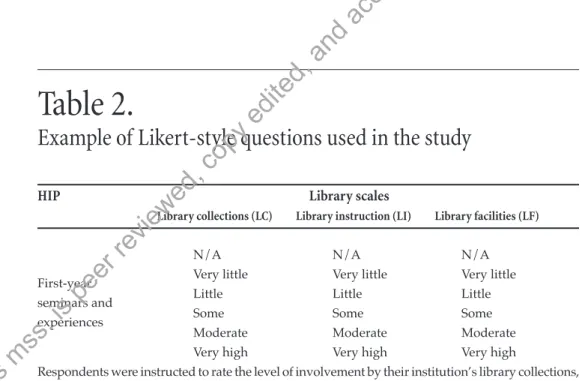
The author developed the survey utilized in this study based on the HIPs. National validation of the HIPs gives the instrument face validity. The survey consisted of a matrix of ten Likert-scale questions probing the level of alignment academic library deans or directors perceived their libraries to have with the ten HIPs. The survey also included four demographic questions to determine the years of experience of the survey respon-dent as a library dean or director at his or her current institution, to sample institutions’ undergraduate enrollment, and to find whether librarians at the sample institutions hold faculty rank. The investigator used the Qualtrics online survey system to construct the poll. Following reliability testing of the survey instrument, the author distributed it to the full population of library deans and directors at public master’s universities. The sample derived from this population consisted of 68 respondents, a response rate of 25 percent. Additional information on the reliability testing for this study’s survey instrument can be found online at http://muse.jhu.edu/journals/portal_libraries_and_the_academy/. Table 2 provides an example of the Likert-style questions.
Table 2.
Example of Likert-style questions used in the study
HIP Library scales
Library collections (LC) Library instruction (LI) Library facilities (LF)
N/A N/A N/A
Very little Very little Very little
Little Little Little
Some Some Some
Moderate Moderate Moderate Very high Very high Very high
Respondents were instructed to rate the level of involvement by their institution’s library collections, library instruction, and library facilities with each HIP.
First-year seminars and experiences
This
mss.
is
peer
reviewed,
copy
edited,
and
accepted
for
publication,
portal
15.3.
Data Analysis
As seen in Table 2, the Likert scale for each HIP variable offered selection options of N/A; very little; little; some; moderate; and very high. The investigator assigned each of these scales a value, with N/A having a value of 0 and very high having a value of 5. The value of each of the ten HIP scales was calculated by totaling the ratings assigned by respondents to library collections (LC), library instruction (LI), and library facilities (LF). This summation resulted in a range for each HIP scale of 1 to 15, with 1 represent-ing the lowest ratrepresent-ing and 15 indicatrepresent-ing the highest.
The author calculated the value of each of the three library scales (LC, LI, and LF) by totaling the ratings assigned by respondents to each of the high-impact practice variables. This summation resulted in a range for each library scale of 1 to 50, with 1 reflecting the lowest rating and 50 representing the highest.
The investigator determined Pearson correlation coefficients, which indicate the closeness of the relationship between two variables, for each scale interaction (that is, the correlation of HIP 1 with LC; the correlation of HIP 2 with LC; and so on). The matrix style of data collection resulted in an overlap of data within each correlation, meaning certain variables would be correlated with themselves if not removed. To prevent this overlap from skewing the analysis, the author removed the overlapped variable from the correlation calculations for each of the thirty scale interactions.
The investigator scored each institution for which a response was received, designat-ing them as havdesignat-ing high, moderate, or low alignment with the HIPs, based on an SAS (Statistical Analysis System) impact report of the sum of each institution’s responses to the HIP variables. Of the responding institutions, 23 were designated as high alignment, 25 as moderate, and 20 as low alignment. The author used these high, moderate, and low designations to sort qualitative data obtained from open-ended prompts for a “brief description of support practices” for each HIP. Once sorted into these designations, the open-ended responses were imported into NVivo data analysis software for coding using a three-tiered coding structure, which allowed for the identification of prevalent themes.
Following the calculation of descriptive statistics for the demographic variables, the investigator conducted further analysis using institutional alignment designation. A Pearson correlation coefficient was calculated between alignment designations and two of the demographic variables: years of service as the library dean or director at the cur-rent institution, and total years of service as a library dean or director. The investigator determined frequency distribution reports for institutional undergraduate enrollment and librarians as faculty or professional staff using the alignment designations as
cat-egories of analysis.
Findings
The author added up the ratings provided by survey respondents for each HIP scale and each library scale. The sums for each HIP scale were then correlated with the sums for each library scale. To calculate the relationship between the ten HIP scale scores and the three library scales, the investigator computed Pearson correlation coefficients. The Pearson correlation coefficients and probability for each of these interactions appear in Table 3.
This
mss.
is
peer
reviewed,
copy
edited,
and
accepted
for
publication,
portal
15.3.
Table 3.
Analysis of library services/resources alignment with HIPs
Library scales
HIP scales Library collections Library instruction Library facilities r N r N r N 1. First-year seminars 0.414* 50 0.392* 60 0.473* 57 2. Common intellectual experiences 0.514* 52 0.474* 54 0.385* 55 3. Learning communities 0.598* 40 0.687* 44 0.472* 44 4. Writing-intensive courses 0.414* 56 0.427* 59 0.534* 62 5. Collaborative assignments and projects 0.651* 55 0.722* 59 0.635* 62 6. Undergraduate research 0.505* 59 0.581* 58 0.533* 62
7. Diversity and global
learning 0.436* 63 0.499* 58 0.608* 63
8. Service learning and community-based
learning 0.569* 61 0.509* 54 0.454* 57
9. Internships 0.473* 54 0.429* 52 0.534* 56
10. Capstone courses
and projects 0.564* 61 0.512* 60 0.553* 6 4 * Denotes a significant correlation (p < 0.01)
As seen in Table 3, a positive correlation was found between each of the ten HIP scales and each of the three library scales. A moderately strong positive correlation was displayed between each library scale and first-year seminars (HIP 1), common intellectual experiences (HIP 2), writing-intensive courses (HIP 4), undergraduate research (HIP 6), diversity and global learning (HIP 7), service learning and community-based learning (HIP 8), internships (HIP 9), and capstone courses and projects (HIP 10). Library collec-tions and library facilities also showed a moderately strong positive correlation with learning communities (HIP 3) and collaborative assignments and projects (HIP 5). Library instruction displayed a strong positive correlation with learning communities (HIP 3) and a very strong positive correlation with collaborative assignments and projects (HIP 5). Each of these positive correlations was highly significant (p < 0.01). Increases in the rating of library alignment with each of the ten high-impact practices affecting retention
This
mss.
is
peer
reviewed,
copy
edited,
and
accepted
for
publication,
portal
15.3.
correlated with increases in the total rating of library collections, library instruction, and library facilities as supporting any particular HIP.
Qualitative Findings
The survey matrix also prompted respondents to provide a brief description of support practices for each HIP. Some themes emerged for each HIP.
First-Year Seminars (HIP 1)
A prevalent theme across alignment categories for first-year seminars was library in-struction. Many of the responses from high alignment libraries indicated that informa-tion literacy or bibliographic instrucinforma-tion is a required component of their instituinforma-tions’ first-year seminars, and that a library
liaison is assigned to work with these courses. By contrast, those from low
alignment libraries reported they had
little involvement with information literacy or bibliographic instruction, even in first-year seminars where information literacy is an integrated learning outcome. Responses from
the moderately aligned libraries in -dicated that these libraries became in-volved with first-year seminars when
invited. A less prevalent theme, particularly found within the high alignment libraries, included the provision of classroom space for first-year seminars and the involvement of librarians as instructors or co-instructors of first-year seminars.
Common Intellectual Experiences (HIP 2)
Responses to this HIP provided few observable themes. One theme that emerged involved the library facility as a space to host shared intellectual experiences through programming or events. Another centered on the role of library instruction in support-ing common intellectual experiences, a theme most prevalent among the low alignment libraries. Low alignment libraries indicated support of such activities in two ways: through information literacy instruction in shared experience courses, and through an information literacy learning outcome plan that would itself be a common intellectual experience for students in the same major.
Learning Communities (HIP 3)
Several themes related to the third high-impact practice. Responses from those in low
and moderately aligned libraries predominantly tended to note that their institution did
not offer learning communities, or that library involvement with learning communities was minimal. Particularly prevalent among the high alignment libraries was a theme involving library instruction, with comments indicating that information literacy or
Many of the responses from high
alignment libraries indicated that
information literacy or bibliographic
instruction is a required component of
their institutions’ first-year seminars,
and that a library liaison is assigned to
work with these courses.
This
mss.
is
peer
reviewed,
copy
edited,
and
accepted
for
publication,
portal
15.3.
bibliographic instruction took place either at the request of a faculty member leading a learning community or as part of an integrated sequence of learning community courses (of which the library’s instructional offering was a credit-bearing course).
A less prevalent theme revolved around the provision of a liaison librarian for learn-ing communities, noted exclusively by those at the moderately aligned libraries. Another minor theme was the availability of a designated “study hall space” for participants in learning communities, noted by those in the low alignment libraries.
Writing-Intensive Courses (HIP 4)
The themes related to writing-intensive courses differed across the alignment categories. A very prevalent theme emerged from comments of a general nature, indicating sup-port or lack of supsup-port for writing-intensive courses. Those at high alignment libraries tended to indicate support for this HIP, while those at low alignment libraries tended
to report little or no library help.
Across the alignment categories, those libraries that supported writing-intensive courses demonstrated a dominant theme in regard to library instruction. In this theme were many comments on a goal to provide information literacy instruction “tailored” to specific assignments for every student enrolled in writing-intensive courses. A less prevalent theme was the provision of space within the library for a writing center or for writing workshops. A final minor theme for those in the low and moderately aligned libraries was the availability of a liaison librarian and individualized assistance for students in writing-intensive courses.
Collaborative Assignments and Projects (HIP 5)
One highly dominant theme in the data on collaborative assignments and projects involved the provision of group study space as a component of library facilities, with many respondents noting that their group spaces and learning commons experienced heavy use. This theme occurred throughout the alignment categories. Other, less preva-lent themes included the availability of electronic resources to support collaborative assignments and projects, the incorporation of collaborative assignments and projects in library instruction pedagogy, and training for faculty on how best to deploy library resources and services in aid of collaborative projects.
Undergraduate Research (HIP 6)
A theme prevalent for this HIP, and seen again only in data for HIP 10 (capstone courses and projects), centered on the archival and publication responsibilities of the academic library with regard to undergraduate research, particularly among the highly aligned libraries. Within this theme, comments ranged from the publication of student research journals to hosting student research in digital repositories. Additionally, the provision of personalized assistance for students with regard to preparation of presentations or posters appeared across alignment categories.
Also spanning the alignment categories, but with lesser prevalence, was a theme revolving around the use of library space to support undergraduate research. Comments included such items as housing institutional offices for undergraduate research;
provid-This
mss.
is
peer
reviewed,
copy
edited,
and
accepted
for
publication,
portal
15.3.
ing specialized spaces with specific equipment, software, or both for undergraduate research projects; and the use of library space for research presentations by students. Diversity and Global Learning (HIP 7)
A consistent theme for high, moderate, and low alignment libraries regarded the role of the library collection in supporting diversity and global learning. Responses indicated that libraries provided support by making available specialized collections for particu-lar fields of study related to diversity. Many comments emphasized that the library deliberately developed its collection to
represent a diverse range of perspectives
or to respond to the needs of diverse populations.
Another consistent theme across the alignment categories was observed under “library facilities” and focused on the use of library space for exhibits,
events, or programs related to diversity
or global learning. The examples
pro-vided by respondents included displays of holidays for different cultures, international coffee hours, diversity book-reading clubs, and spotlights on different countries or study-abroad experiences. Also under the code of “library facilities” was a consistent theme related to the provision of specialized space in support of campus diversity initiatives, such as housing centers for international education or engagement, providing diversity libraries or multicultural rooms, or the use of group study space to nurture the interac-tion of students from different cultures.
One theme observed only among the high alignment libraries consisted of responses reporting that the library’s commitment to diversity was outlined in the library’s mis-sion statement or goals. This theme did not occur among the low or moderate alignment
libraries.
Service Learning and Community-Based Learning (HIP 8)
One observable theme was that of no support. In particular, comments from respondents at low and moderately aligned libraries consistently noted little or no involvement by the library in supporting service learning on campus, or the incidental or ad hoc nature of any such involvement. An additional minor theme involved the role of the library as a host to volunteers or as the recipient of service learning activities. No dominant themes were observed in the areas of library collections, instruction, or facilities.
Internships (HIP 9)
A single, overarching theme in the data related to the high-impact practice of internships. This theme, focused on internship opportunities within academic libraries, consistently occurred across the alignment categories. Comments indicated that internships offered within academic libraries were typically in the areas of special collections and archives, technical services, and circulation or information desks, or in support of a library science
Many comments emphasized that
the library deliberately developed
its collection to represent a diverse
range of perspectives or to respond
to the needs of diverse populations.
This
mss.
is
peer
reviewed,
copy
edited,
and
accepted
for
publication,
portal
15.3.
degree offered by the institution or by nearby institutions. No themes were observed in the areas of library collections, library instruction, or library facilities.
Capstone Courses and Projects (HIP 10)
Two predominant themes in the data related to capstone courses and projects. One, as noted in connection with undergraduate research (HIP 6), revolved around the archival role of the library in preserving the research and culminating projects resulting from cap-stones. However, the dominant theme associated with this HIP was information literacy instruction, with respondents from each of the alignment category libraries commenting about liaison librarians delivering tailor-made instruction and integration in capstone courses, along with personalized assistance for students enrolled in a capstone experience.
Demographic Trends
Given the exploratory nature of this study, further analysis of the data examined institu-tional alignment with the HIPs with demographic variables to identify possible correla-tions or trends warranting further study. The survey asked respondents to indicate the total number of years they had served as an academic library dean or director as well as the number of years they had held that role at their current institutions. The mean number of years serving as library dean or director at the current institution was 7.5, while the mean number of total years as a library dean or director was 10.7. A frequency distribution report showed that 45 percent of respondents had served five years or less at their current institution. This report also revealed that 55 percent of respondents had been a dean or director for less than ten total years. Of those who had served for longer, most of the respondents had been a dean or director for fifteen years or less.
The investigator computed a Pearson correlation coefficient to assess the relation-ship between institutional alignment with the HIPs and the two demographic variables related to years of service (years served as library dean or director at current institution; total years of service as a library dean or director). No correlation appeared among the variables. None of the relationships was statistically significant. Increases in years of service, either at the current institution or in total, have no relationship with increases in perceived institutional alignment with the HIPs.
As noted in Table 4, institutions with an undergraduate enrollment of fewer than 12,000 accounted for 79.42 percent of the responses, while institutions with undergraduate enrollment of 12,000 or above made up 20.59 percent. Due to the categorical nature of this demographic variable, correlation coefficients could not be calculated with alignment categories. This resulted from a methodological oversight discovered during analysis.
The final demographic question asked respondents to indicate whether librarians carry faculty rank at their current institutions. Seventy-nine percent of respondents noted that librarians carry faculty rank in their institutions, while 21 percent indicated that librarians were considered professional staff. The investigator calculated a frequency distribution for the alignment categories and the demographic variable regarding li-brarians as faculty or staff. As seen in Table 5, 43 percent of the lili-brarians at responding institutions who do not hold faculty rank serve at libraries designated as high alignment.
This
mss.
is
peer
reviewed,
copy
edited,
and
accepted
for
publication,
portal
15.3.
Table 4.
Undergraduate enrollment of survey respondents’ institutions
Undergraduate enrollment N Percentage
6,000 or less 27 39.71
6,000–12,000 27 39.71
12,000–18,000 9 13.24
More than 18,000 5 7.35
Table 5.
Analysis of the demographic variable regarding librarians as staff
or faculty
Alignment classification Librarians as staff Librarians as faculty Total
Frequency 6 16 22 Percentage 8.96 23.88 32.84 Row percentage 27.27 72.73 Column percentage 42.86 30.19 Frequency 3 22 25 Percentage 4.48 32.84 37.31 Row percentage 12.00 88.00 Column percentage 21.43 41.51 Frequency 5 15 20 Percentage 7.46 22.39 29.85 Row percentage 25.00 75.00 Column percentage 35.71 28.30 Frequency 14 53 67* Column percentage 20.90 79.10 100.00
*One survey respondent did not complete this question.
High alignment Moderate alignment Low alignment Total
This
mss.
is
peer
reviewed,
copy
edited,
and
accepted
for
publication,
portal
15.3.
At the high alignment institutions, 73 percent of librarians hold faculty rank. This ratio was even larger within the low and moderate alignment libraries. Librarians hold faculty rank in 75 percent of the low alignment libraries and in 88 percent of the moderate alignment libraries. Of the librarians with faculty rank, 42 percent worked in moderate alignment libraries. No discernible relationship between faculty rank and alignment with the HIPs was observed. Overall, the analysis of demographic data in this exploratory study did not demonstrate
any notable trends.
Discussion
Academic library deans or directors at public master’s universities tend to view their library as being involved with many high-impact practices. This perceived level of in-volvement exists regardless of longevity of the dean or director, or faculty rank held by librarians. Academic libraries tend to provide consistent support services for the various HIPs, although the support services offered by libraries with a high level of alignment with the high-impact practices differed from those provided by libraries with a low level of alignment with the HIPs. Low alignment libraries tend to indicate no support for some HIPs.
Within this finding, several notable interactions appeared between library services or resources and specific HIPs. Library instruction, in particular, displayed a stronger relationship with learning communities and collaborative assignments and projects than did library collections and library facilities. This finding is intriguing, given the theme in open-ended responses provided by low and moderate alignment libraries of little or no support for learning communities. Collaborative assignments and projects had an overall higher correlation for each of the three library services or resources categories than did any of the other HIPs. Qualitative data about the support services offered for this HIP had a diverse range of observable themes, with the provision of group study space as a component of library facilities ranking as the dominant theme across align-ment categories. Other, less prevalent themes for this HIP included the availability of electronic resources, the incorporation of collaborative assignments and projects in library instruction pedagogy, and training for faculty on how best to deploy library resources and services in support of collaborative projects.
A final strong positive correlation was observed between library facilities and diver-sity and global learning. Two themes in the qualitative data on support services offered for this HIP were the use of library space for exhibits, events, or programs related to diversity or global learning and the provision of space within the library in support of campus diversity initiatives. Such space included centers for international education or engagement, diversity libraries or multicultural rooms, or group study space to nurture the interaction of students from different cultures.
With the exception of learning communities and service learning and community-based learning, qualitative responses for each HIP contained at least one predominant theme providing descriptions of library support services for the HIP. Responses for
learn-No discernible relationship
between faculty rank and
alignment with the HIPs
was observed.
This
mss.
is
peer
reviewed,
copy
edited,
and
accepted
for
publication,
portal
15.3.
ing communities (among low and moderate alignment libraries) and service learning and community-based learning indicated little or no library support for these particular HIPs. Themes related to library instruction and library facilities were observed much more often than those associated with library collections. This finding is in keeping with the correlations computed between HIPs and library services or resources, which tended to have the strongest relationships among the library instruction and library facilities scales.
Information literacy instruction was a primary theme for first-year seminars, learning communities (among high alignment libraries), writing-intensive courses, and capstone courses and projects. Themes in regard to the library facility appeared in conjunction with common intellectual experiences (the
facility as host to shared experiences), writing-intensive courses (provi-sion of space for writing centers or writing workshops), collaborative assignments and projects (group study space), and diversity and global learning (space for events and
programming supporting diversity).
Themes related to library collections were observed in association with
diversity and global learning, with comments indicating that library collections sup-port diverse worldviews. The archival and publication responsibilities of the academic library were the dominant theme for undergraduate research.
Library deans or directors tend to view library instruction as the element of the academic library most involved with high-impact practices, particularly for learning communities and collaborative assignments and projects. Library deans or directors also tend to regard the “collaborative assignments and projects” HIP as a practice with which library collections, library instruction, and library facilities are most involved.
A number of opportunities exist for further research, building on the results of this study. One area for additional research is to adapt this study for use with other Carnegie classifications. This study is bounded and limited to public master’s level universities in the United States. These findings cannot be generalized to institutions in other Carnegie classifications. Practices that facilitate student engagement (and, thereby, potentially af-fect retention) may differ dramatically from community colleges to doctoral institutions. Such further study could adjust the conceptual framework to the study population. Alternately, replicating this study with the conceptual framework intact would yield a set of data that could be compared across institutional types.
Another area for further research is to focus more exclusively on individual HIPs, drawing on different sources of data to provide a more detailed picture of HIP imple-mentation, support, and impact. Since this study found that libraries do not tend to support learning communities or service learning and community-based learning, case studies of academic libraries that aid these practices could reveal methods of aligning services and resources not previously considered.
The literature on student engagement includes other practices that have potential impact on students’ withdrawal decisions, with varying degrees of empirical support.
Information literacy instruction was a
primary theme for first-year seminars,
learning communities (among high
alignment libraries), writing-intensive
courses, and capstone courses and
projects.
This
mss.
is
peer
reviewed,
copy
edited,
and
accepted
for
publication,
portal
15.3.
Further research could examine these other engagement practices in light of library services and resources.
Dramatic changes in state appropriations, coupled with increasing restrictions on tuition increases and performance-based funding models, have resulted in an increased focus on various stu-dent success metrics, including stustu-dent retention. Traditional measures of library success no longer resonate with university leaders, causing academic librarians to seek new methods of determining and demonstrating library value to student success.
This study utilized a conceptual framework that may help library leaders connect library impact with terminology and practices that are understood by university administrators and the general cam-pus community. Further research using the high-impact practices as a framework of study will benefit academic library deans or directors seeking a paradigm shift in how academic libraries measure success.
Adam Murray is dean of libraries and educational technologies at James Madison University in Harrisonburg, Virginia; he may be reached by e-mail at: [email protected].
Notes
1. Thomas Bailey, Research on Institution Level Practice for Postsecondary Student Success
(Washington, DC: National Postsecondary Education Cooperative [NPEC], 2006): 5. 2. Veronica McGivney, “Understanding Persistence in Adult Learning,” Open Learning 19, 1
(2004): 33–46.
3. Alan Seidman, “Minority Student Retention: Resources for Practitioners,” New Directions for Institutional Research 2005, 125 (2005): 7–24.
4. Willis McLeod and Jon Young, “A Chancellor’s Vision: Establishing an Institutional Culture of Student Success,” New Directions for Institutional Research 2005, 125 (2005): 73–85.
5. Vincent Tinto, “Dropout from Higher Education: A Theoretical Synthesis of Recent Research,” Review of Educational Research 45, 1 (1975): 89–125.
6. John Bean, “Dropouts and Turnover: The Synthesis and Test of a Causal Model of Student Attrition,” Research in Higher Education 12, 2 (1980): 155–87.
7. George Kuh, Ken O’Donnell, and Sally Reed, Ensuring Quality and Taking High-Impact Practices to Scale (Washington, DC: Association of American Colleges and Universities [AAC&U], 2013).
8. George Kuh and Robert Gonyea, “The Role of the Academic Library in Promoting Student Engagement in Learning,” College & Research Libraries 64, 4 (2003): 256–82.
9. Megan Oakleaf, Value of Academic Libraries: A Comprehensive Research Review and Report
(Chicago: American Library Association, 2010).
10. Beverly Lynch, Catherine Murray-Rust, Susan Parker, Deborah Turner, Diane Parr Walker, Frances Wilkinson, and Julia Zimmerman, “Attitudes of Presidents and Provosts on the University Library,” College & Research Libraries 68, 3 (2007): 213–27.
11. Tinto, “Dropout from Higher Education.” 12. Bean, “Dropouts and Turnover.”
13. Seidman, “Minority Student Retention.”
Traditional measures of
library success no longer
resonate with university
leaders, causing academic
librarians to seek new
methods of determining
and demonstrating library
value to student success.
This
mss.
is
peer
reviewed,
copy
edited,
and
accepted
for
publication,
portal
15.3.
14. Gwyneth Hughes, “Using Blended Learning to Increase Learner Support and Improve Retention,” Teaching in Higher Education 12, 3 (2007): 349–63.
15. Alberto Cabrera, Maria Castañeda, Amaury Nora, and Dennis Hengstler, “The
Convergence between Two Theories of College Persistence,” Journal of Higher Education 63,
2 (1992): 143–64.
16. Vincent Tinto and Brian Pusser, Moving from Theory to Action: Building a Model of Institutional Action for Student Success (Washington, DC: NPEC, 2006).
17. John Ryan, “The Relationship between Institutional Expenditures and Degree Attainment at Baccalaureate Colleges,” Research in Higher Education 45, 2 (2004): 97–114.
18. George Kuh, High-Impact Educational Practices: What They Are, Who Has Access to Them, and Why They Matter (Washington, DC: AAC&U, 2008).
19. Ibid.
20. George Kuh, “Why Integration and Engagement Are Essential to Effective Educational Practice in the Twenty-First Century,” Peer Review 10, 4 (2008): 27–28.
21. Kuh and Gonyea, “The Role of the Academic Library in Promoting Student Engagement in Learning.”
22. John Bean, “College Student Retention,” in Encyclopedia of Education, ed. James W. Guthrie (New York: Macmillan Reference USA, 2003): 401–407.
23. Gaby Haddow, “Academic Library Use and Student Retention: A Quantitative Analysis,”
Library & Information Science Research 35, 2 (2013): 127–36; Gaby Haddow and Jayanthi Joseph, “Loans, Logins, and Lasting the Course: Academic Library Use and Student Retention,” Australian Academic & Research Libraries 41, 4 (2010): 233–44; Krista Soria, Jan Fransen, and Shane Nackerud, “Library Use and Undergraduate Student Outcomes: New Evidence for Students’ Retention and Academic Success,” portal: Libraries and the Academy
13, 2 (2013): 33–45; Krista Soria, Jan Fransen, and Shane Nackerud, “Stacks, Serials, Search Engines, and Students’ Success: First-Year Undergraduate Students’ Library Use, Academic Achievement, and Retention,” Journal of Academic Librarianship 40, 1 (2014): 84–91.
24. Melissa Hubbard and Amber Loos, “Academic Library Participation in Recruitment and Retention Initiatives,” Reference Services Review 41, 2 (2013): 157–81; the quotation appears
on page 177.
25. Kuh, High-Impact Educational Practices.
26. Jayne Brownell and Lynn Swaner, Five High-Impact Practices: Research on Learning Outcomes, Completion, and Quality (Washington, DC: AAC&U, 2010).
27. Derek Bok, Higher Education in America (Princeton, NJ: Princeton University Press, 2013).
This
mss.
is
peer
reviewed,
copy
edited,
and
accepted
for
publication,
portal
15.3.
This
mss.
is
peer
reviewed,
copy
edited,
and
accepted
for
publication,
portal