Design Support for e-Commerce
Information Systems using
Goal, Business and Process Modelling
Ananda Edirisuriya
November 2009
A Dissertation submitted to the Stockholm University
in partial fulfillment of the requirements for the degree of Doctor of Philosophy
Department of Computer and Systems Sciences Stockholm University and Royal Institute of Technology
Forum 100 SE-164 40 Kista
Stockholm Sweden
DSV Report Series No. 09-009 ISBN 978-91-7155-948-7 ISSN 1101-8526
ISRN SU-KTH/DSV/R- -09/9- -SE
Printed in Sweden by Universitetsservice US-AB, Stockholm 2009 Distributor: Department of Computer and Systems Sciences
Dedicated to the
Abstract
Enterprises use various models to find design solutions to their e-Commerce information systems. Goal, business and process models are parts of a chain of models used for this purpose. Business modelling requires structured methods to support design and traceability. Process modelling also needs structured methods to manage design complexity, traceability and flexibility. The thesis proposes several artifacts to address these challenges.
It proposes a method to design business models from goal models. We start by analyzing strategic goals and express goal model notions using business notions. A set of guidelines is proposed to design a business model. The method provides structured business model design and traceability of the decisions from business to strategic level.
The thesis also discusses a set of mappings to relate goal modelling language constructs to process modelling notions. We use BMM, i* and KAOS for goal modelling. The mappings are used to identify how these techniques can support process design. In addition, a set of mappings is proposed to relate business modelling language constructs to process modelling notions. We use the e3value model for business modelling. Based on these mappings a number of activities are identified to structure process activities from a business viewpoint.
We also propose a method to design process models using goal and business models as inputs. As a bridge between two input models and a process model, the notion of an activity dependency model is introduced. The transitions between models are performed by using guidelines. The method provides structured process model design, flexibility for process models and traceability of the decisions from operational to strategic and business levels.
These artifacts can be used for designing enterprise business and process models. We follow the design science research method used in information systems research. The evaluation builds on
Acknowledgements
First of all I would like to offer many sincere thanks to my academic supervisor, Prof. Paul Johannesson, for his excellent supervising and assistance given to me in gaining knowledge during my research work. He always been available to look at my research work and has helped me to restructure my thoughts whenever necessary.
I also would like to give many thanks to Birger Andersson, Maria Bergholtz, Prof. Hans Weigand and Tharaka Illaperuma for knowledge, I gained through discussions and working together. Special thanks go to Dr. Jelena Zdravkovic who helps my research studies in numerous ways during last stages. Also, many thanks go to the staff of the Department of Computer and Systems Sciences, Stockholm University and Royal Institute of Technology, for providing me with the necessary facilities to carry out my research studies.
I acknowledge SIDA/SAREC-IT Sri Lanka project for financing my studies through a split Ph.D. programme. My gratitude goes to Dr. Gihan Wikramanayake of the School of Computing, University of Colombo, Sri Lanka and Dr. Prasad Jawaweera of the University of Ruhuna, Sri Lanka for the help given to me from time to time as the local supervisors.
Finally, my gratitude goes to my wife Indramani, daughter Lumini and son Charindu for their patience and support during my stay in Sweden.
Table of Content
1 Introduction
1
1.1 General Background 1
1.2 Research Domain 5
1.3 Problem Statement and Research Questions 5
1.4 Research Goals 7 1.5 Research Purpose 8 1.6 Research Methodology 9 1.6.1 Research Approach 9 1.6.2 Research Procedure 12 1.7 Disposition 21 1.8 Scientific Publications 22
2 Background Work
29 2.1 Requirements Engineering 29 2.2 Running Scenarios 312.2.1 Organizing Scientific Conference 31 2.2.2 Massively Multiplayer Online Game Playing 32
2.2.3 Eye-Care Treatment 32
2.3 Goal Modelling 33
2.3.1 The Business Motivation Model 33 2.3.2 The i* Goal Modelling Language 37 2.3.3 The KAOS Goal Modelling Language 40
2.3.3.1 Basic Constructs 40
2.3.3.2 KAOS Requirements Engineering Process 43
2.4 Business Modelling 44
2.5 Business Process Modelling 50
2.5.1 Research related to Business Process Design 50 2.5.2 Business Process Modelling Languages 53 2.5.2.1 Business Process Types 54 2.5.2.2 Business Process Modelling Notation
(BPMN): Core Elements
2.5.3 Business Process Design Framework 58 2.5.4 ISO open-edi Phases and Process Patterns 60
2.6 Summary 62
3 Goal Models to Business Models
633.1 Introduction 63
3.2 Formulating Goals and System Requirements 64
3.2.1 Goal Formulation 64
3.2.2 System Requirements Templates 65 3.2.3 The KAOS Agent Dependency Model 66 3.3 Design e3value Model from KAOS Models 68 3.4 Method Application to Create a Goal-Based Business
Model
3.4.1 Method Application: Scientific Conference Scenario 3.4.2 Method Application: Eye-Care Scenario
72 72 78
3.5 Conclusion 83
4 Exploring Goal Model support for Processes
Design
85
4.1 Introduction 85
4.2 Mappings between Constructs of Goal Modelling Languages and Business Process Notions
86 4.2.1 Organizational Perspective: Participant 87 4.2.2 Functional Perspective: Activity 88 4.2.3 Informational Perspective: Information Resource 88 4.2.4 Behavioral Perspective: Control Flow 90 4.2.5 Behavioral Perspective: Data Flow 92
4.3 Conclusion 93
5 Exploring Business Model support for
Process Design
97
5.2 Internal Structure of Value Object and Value Exchange 99 5.3 From Business Model to Process Design Framework 100 5.3.1 Organizational Perspective: Participant 100 5.3.2 Functional perspective: Activity 100 5.3.3 Informational perspective: Information Resource 102 5.3.4 Behavioral perspective: Control Flow 102 5.3.5 Behavioral perspective: Data Flow 103
5.4 Transition Guidelines 103
5.5 Process Patterns 107
5.6 Conclusion 109
6 Goal and Value Driven Process Design
1116.1 Introduction 111
6.2 Concepts and Notation for Activity Dependency Model 112
6.3 Model Transition 116
6.3.1 Goal and Business Model to Activity Dependency Model
116 6.3.1.1 Guidelines to Design an Activity Dependency
Model
116 6.3.1.2 Method Application to Create an Activity
Dependency Model
119 6.3.1.2.1 Method Application: Scientific Conference
Scenario
119 6.3.1.2.2 Method Application: Massively Multiplayer
Online Game Playing Scenario
122 6.3.2 Activity Dependency Model to Process Model 126
6.3.2.1 Guidelines to Design a Process Model 126 6.3.2.2 Method Application to Create a Process Model 131
6.3.2.2.1 Method Application: Scientific Conference Scenario
131 6.3.2.2.2 Method Application: Massively Multiplayer
Online Game Playing Scenario
134 6.4Processing Repetitive Actions 136
7 Implementation Details and Comparison to
Similar Research
141
7.1 Protégé and OWL Ontologies 141
7.2 Extensible StyleSheet Language Transformations (XSLT)
146 7.3 Comparison with Similar Research 150
7.4 Conclusion 153
8 Concluding Discussion and Future Research
Directions
155
8.1 Concluding Discussion 155
8.2 Future Research Directions 160
References
161Appendix I
169Program Output I: XML description corresponding to the e3value model for the Scientific Conference Scenario presented in Figure 3.3
169
Program Output II: XML description of mappings of elements in the BMM to the process design framework for the Scientific Conference scenario
172
Program Output III: XML description of mappings of elements in the i* language to the process design framework for the Scientific Conference scenario
173
Program Output IV: XML description of mappings of elements in the KAOS language to the process design framework for the Scientific Conference scenario
Program Output V: XML description of mappings of elements in the e3value model to the process design framework for the Scientific Conference scenario
175
Program Output VI: XML description of the process model corresponds to Figure 5.1
177 Program Output VII: XML description of the activity dependency model corresponds to Figure 6.2
178 Program Output VIII: XML description of the process model corresponds to Figure 6.7
179
Appendix II
181Program I: XSLT source code to produce an e3value model from the KAOS models
List of Figures
1.1 Summary of the organization of research results 22 2.1 Main activities of RE process: requirements
elicitation, specification and validation
30 2.2 An excerpt from a Business Motivation Model for the
Scientific Conference scenario
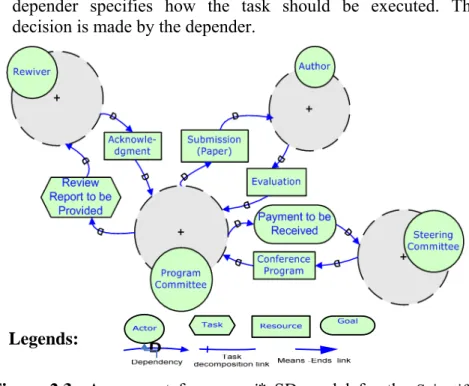
36 2.3 An excerpt from an i* SD model for the Scientific
Conference scenario
38 2.4 An example of a KAOS goal model for the Scientific
Conference scenario
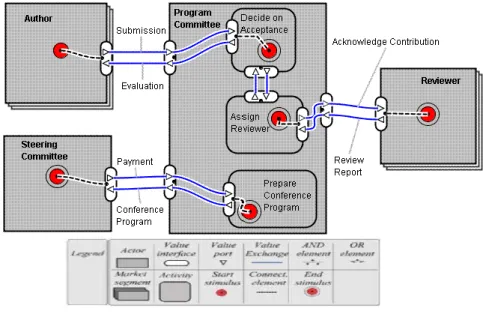
42 2.5 The UML class diagram of e3value business ontology 46 2.6 An e3value model for the Scientific Conference
scenario
49 2.7 An example of a BPMN process model 55 2.8 A process meta-model based on the process design
framework
59 2.9 ISO open-edi phases for business collaboration 61 3.1 An agent dependency diagram for the Scientific
Conference scenario
67 3.2 An excerpt from a KAOS goal model for the
Scientific Conference scenario
74 3.3 An e3value model for the Scientific Conference
scenario
76 3.4 An excerpt from a KAOS goal model for the
Eye-Care scenario
79 3.5 An agent dependency diagram for the Eye-Care
scenario
79 3.6 An e3value model for the Eye-Care scenario 81 4.1 An excerpt from a process model for the Scientific
Conference scenario
91 5.1 An excerpt from a process model for the Scientific
Conference scenario
6.1 An activity dependency model to coordinate submissions in the Scientific Conference scenario
115 6.2 An activity dependency model to coordinate
conference program in the Scientific Conference scenario
121
6.3 An excerpt from a KAOS goal model for the Massively Multiplayer Online Game Playing scenario
122
6.4 An agent dependency model for the Massively Multiplayer Online Game Playing scenario
123 6.5 An e3value model for the Massively Multiplayer
Online Game Playing scenario
123 6.6 An activity dependency model to coordinate game
access in the Massively Multiplayer Online Game Playing scenario
125
6.7 A process model to coordinate conference program in the Scientific Conference scenario
132 6.8 A process model to coordinate submissions, reviews
and conference program in the Scientific Conference scenario
133
6.9 A process model for the Massively Multiplayer Online Game Playing scenario
135 6.10 An alternative process model for the Scientific
Conference scenario
136 7.1 A part of the OWL code of the activity dependency
model for the Scientific Conference scenario
144 7.2 A screenshot of the activity dependency model for
the Scientific Conference scenario
146 7.3 A sample XSLT code of the Scientific Conference
scenario
List of Tables
1.1 Summary of commonly used Research Methods in IS Research
11
1.2 Design Evaluation Methods 15
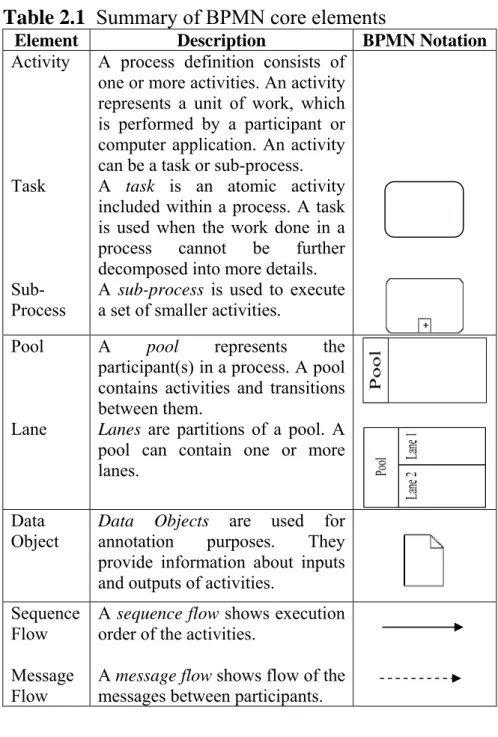
2.1 Summary of BPMN core elements 56 3.1 Summary of the design guidelines to construct an
e3value model from the KAOS models
71 3.2 Excerpt of objects relevant to the Scientific Conference
scenario
74 3.3 Excerpt of objects relevant to the Eye-Care scenario 78 4.1 Summary of the mappings of constructs of goal
modelling languages to process design framework
90 5.1 Summary of the mappings of e3value model concepts
to process design framework
101 5.2 Summary of the guidelines to construct a process
model from an e3value model
105
5.3 Primitive process patterns 108
6.1 Summary of the guidelines to construct an activity dependency model from an e3value Model
118 6.2 Summary of the guidelines to construct a process
model from an activity dependency model
130 6.3 Examples of compound process patterns constructed by
combining primitive process patterns
137 7.1 Summary of the comparison of process design methods 152
1 Introduction
1.1 General Background
Advances in Internet Technology in recent times have provided enterprises with new ways of doing their business activities. As a result, enterprises can now use electronic means to sell, distribute, market and buy products and services. Doing business transactions including business-to-business and business-to-consumer utilising electronic means is known as Electronic Commerce (e-Commerce) (Hartman, 2000). Such an e-Commerce environment provides enterprises with an opportunity to work together as a business value network, i.e. a group of enterprises that together fulfil customer needs, each excelling in its own specific speciality, products and services (Tapscott, 2000). These e-Commerce activities rely on information systems connected through the Internet and accessed by one or many actors. The e-Commerce information systems are a ‘specific kind of information systems, interconnected via the Internet, and exploited by one or more actors, which support and enable the exchange of objects of economic value between various actors’ (Gordijn, 2002).
As the interest in e-Commerce activities increases, major challenges for research communities are to develop the methods and techniques necessary to analyse, design, implement and manage e-Commerce information systems. For this purpose, the first step is to elicit the system requirements for such e-Commerce information systems. The system requirements define what the system is required to do and the circumstances under which it is required to operate (Kotonya, 1998). Requirements Engineering
(RE) techniques can be employed to derive, document and validate system requirements for such e-Commerce information systems.
To develop these system requirements, analysts and designers employ different views. The goal, economic-value and process views are the ones commonly used. In Goal-Oriented Requirements Engineering (GORE), strategic goals are exploited as the basis for the requirements engineering process (Lamsweerde, 2001). Value-oriented requirements engineering explores the concept of economic value during the requirements engineering process (Gordijn, 2003). In the process view business use cases are used to identify functional requirements, which are activities and services to be executed by the system (UML, 2003). These different views are captured in different models. The strategic goals are captured in goal models, while economic values are captured in business models. The process view is captured in process models.
Goal models represent interests, intentions and strategies of different actors. The goal models can be employed as a driving force for eliciting business activities and alternative ways of doing them, giving thereby a motivation for certain business decisions (Raadt, 2005). Thus, a goal model defines the ‘why’ aspect in e-Commerce. For representing goals in this thesis, we use three established goal modelling techniques, Business Motivation Model (BMM) (BMM, 2005), i* (Yu, 1995) and Knowledge Acquisition in automated Specification (KAOS) (Dardenne, 1993). Business models identify who is offering what of economic value (i.e. values) to whom and expect what in return (Gordijn, 2002). The business models give a high-level view by focusing on the ‘what’ aspect in e-Commerce. The purpose here is to understand the economic reciprocity of value exchanges and evaluate economic sustainability for each participating actor. To capture business views, we employ the e3value business model (Gordijn, 2002). A process model depicts the behaviour of actors. A process model focuses on the ‘how’ aspect in e-Commerce by explaining operational and procedural details in terms of orchestration and message communications (Andersson, 2005). The purpose here is to represent the process knowledge of doing business, which is
necessary for designing e-Commerce information systems solutions in enterprises. We use the Business Process Modelling Notation (BPMN) to represent process views (BPMN, 2003).
The research and development in the area of business process technology have gained momentum in the last two decades. This is witnessed by the advent of new workflow and process management systems, new process modelling languages and other tools (Andersson, 2005). Despite their success, process technologies and in particular process modelling techniques, face a number of challenges that need to be addressed. These are managing design complexity, providing traceability and offering flexibility.
Manage design complexity: Business process design and redesign are complex and time-consuming tasks (Gong, 2005). A lot of time and effort is needed for this purpose. Therefore, we need to manage design complexity by making the designing process easier.
Provide traceability: Traceability is related to design decisions. Constructing a process model includes taking a number of design decisions that affect the structure of the model. It should be possible to trace these design decisions back to reasoning behind the design decisions.
Offer flexibility: Most of the time, the main structure of the process model is stable over time, but the details may vary from case to case. The flexibility of a process model means allowing changes to parts of the process structure without much alteration to its main structure. It should be possible to offer flexibility at both design time and run time to save time and effort.
To address these challenges, many attempts have been made in different research works. Many researchers have considered the process operational aspects by developing languages (YAWL, 2003) (UML, 2003) (BPMN, 2003), design patterns (UMM, 2005) (Aalst, 2002) and design frameworks (Curtis, 1992) for designing process models. Some have considered the use of enterprise goals as the basis for process design (Kueng, 1997) (Bider, 2002) (Soffer,
2005) (Nurcan, 2005). A process model based on goals provides a rationale for the operational choices made in the process level in terms of long-term intentions. Other researchers have considered the use of economic values as the ground for designing process models (Jayaweera, 2004) (Pijpers, 2007) (Andersson, 2006b). A process model that is based on a business model gives a business orientation to the process model. That means process model components take a business-oriented view.
The research and development in the area of business models have also gained wide attention during recent times. Some research is oriented towards designing languages and ontologies for business modelling (McCarthy, 1992) (Gordijn, 2002) (Fox, 1992) (Osterwalder, 2004). Other research concentrate on designing approaches and the use of enterprise goals as the basis for designing business models (Gordijn, 2006) (Raadt, 2005). A business model should conform to the strategic goals of the enterprise. That is, the realisation and the characteristics of the business model should be in accordance with the enterprise’s long-term interests. Otherwise, values being offered and exchanged are not motivated properly, neither involvement of certain business actors. In this situation, even if the process model is derived from the business model it would not conform to the intentional dimension of the business.
Therefore, in RE there is a strong need for structured ways that can be used to construct these enterprise models which we address in this research work.
This chapter is organised as follows. Section 1.2 discusses the research domain. The research questions are identified in Section 1.3. Section 1.4 provides the research goals that we expect to achieve. Section 1.5 discusses the research purpose. The research method is discussed in Section 1.6. The thesis flow is presented in Section 1.7. The chapter concludes by summarising research contributions in Section 1.8.
1.2 Research
Domain
We summarise here our domain of interest and the scope of this research.
This research is about relating different enterprise models used in e-Commerce information systems. We primarily focus on goal models, business models and process models.
Our scope of interest is in designing business models and process models using other enterprise models.
1.3 Problem Statement and Research
Questions
Enterprises use different models in developing their e-Commerce information systems solutions. Goal models, business models and process models are parts of a chainof models used for this purpose. The process modelling is a difficult task and several challenges need to be dealt with. There is a need for structured design methods that reduce the complexity of designing process models. The design decisions taken during designing, which affect the structure of the process model, should be justifiable by providing traceability. The process modelling techniques must offer flexibility, by allowing changes to process model structure. The research and motivations on the importance of process model flexibility can be found in (UMM, 2005) (Aalst, 2002).
On the other hand, business modelling also requires structured approaches and methods to capture business ideas. The business decisions made explicit in business models should be justifiable by going backwards and thereby providing traceability. The motivations for providing business model traceability can be found in (Raadt, 2005).
In this research work, we investigate how these challenges can be addressed by relating enterprise goal models, business models and process models.
The research question we are going to address is:
How can the design of business models and process models be supported by the use of other kinds of enterprise models?
This main question is divided into the following four sub-questions. Question 1: How can goal modelling be used to support the design
of business models?
The business model constructed should conform to the goal model in the sense that participating in a value network based on the business model will support an actor in fulfilling the goals of the goal model (Raadt, 2005). If the business model does not conform to the strategic goals, business decisions made in the business model are not properly motivated.
Question 2: How can goal modelling be used to support the design of process models?
Goals can be used as a starting-point for designing process models (Kueng, 1997) (Bider, 2002) (Soffer, 2005) (Nurcan, 2005). A process model that is based on goals motivates operational choices made in the process level in terms of long-term intentions. Nevertheless, different goal modelling languages offer different support to this design task. Therefore, it is important to explore how different goal modelling languages support the design of process models.
Question 3: How can business modelling be used to support the design of process models?
Business models can be used as a basis for designing process models (Gordijn, 2000). A process model that is based on economic values provides a business orientation for operational choices made at the process level. Thus, it is important to analyse business model components and investigate their support for designing process models.
Question 4: How can goal modelling and business modelling together be used to support the design of process models?
The goal and economic value are two views that are used in designing process models. A process model that is based on both goals and economic values makes operational choices in line with long-term intentions and at the same time provides a business orientation to them.
In chapters to come, we address these questions by exploring concepts used in goal models, business models and process models.
1.4 Research
Goals
As discussed in Section 1.3, business modelling and process modelling techniques face a number of challenges that need to be addressed. Any methodology, technique, framework or tool support that has the capability to address these challenges would be welcome. The main goals of the research work presented in this thesis can be formulated as follows.
Corresponding to the main research question, the overall goal of this research work is: ‘To construct methods that support the design of business and process models by using other kinds of enterprise models’.
We decompose the main goal into the following sub-goals which are to be achieved as the work progresses.
Sub-goal 1: Construct a method to design a business model from a goal model.
To answer the first question, we build a method to construct a business model from a goal model. The method can be used to design a business model that conforms to the enterprise goals. Sub-goal 2: Create mappings between goal modelling language
To respond to the second question, the relationships between concepts of goal modelling languages and process notions are established. We consider here three established goal modelling languages (BMM, i*, KAOS) used in requirements engineering. The business processes are described by means of Curtis’s process design framework.
Sub-goal 3.1: Create mappings between business modelling language constructs and process modelling notions. Sub-goal 3.2: Construct a method to design a process model based
on a business model.
The third question is answered in two steps. First the relationships between concepts of a business modelling language and process notions are identified. The e3value model is used as a basis for business modelling. Curtis’s process design framework is used to represent business processes. During the second step, a method is developed to construct a partial process model based on a business model. Sub-goal 4: Construct a method to design a process model based
on a goal model and a business model.
To answer the fourth question, a method is developed to construct a process model based on a goal model and a business model. Such a process model conforms to the enterprise goals and at the same time meets the enterprise’s economic values.
1.5 Research
Purpose
The target users of the proposed methods are modelling experts, information system developers, business managers, business consultants and decision-makers.
The methods proposed can be applied in the design of business models and process models. Thus, the intended use of the methods can be summarised as follows.
• To facilitate the construction of business models that conforms to the strategic goals of an enterprise.
• To facilitate the construction of process models that conforms to the strategic goals and economic values of an enterprise.
1.6 Research
Methodology
1.6.1 Research Approach
Research is the process of discovering new knowledge based on a certain scientific study or some investigation on a critical issue. The research in information systems (IS) is basically performed with the aim of improving the effectiveness and efficiency of organisations by the application of information technology (IT).
The IS research is conducted in two complementary paradigms, behavioural science and design science (Hevner, 2004). The behavioural science research tries to build and verify new theories to describe some organisational phenomena or human phenomena. Design science research is concerned with applying knowledge and inventing new artifacts for human purposes.
March at el. (1995) outline a research framework that can be used for design science research. The framework has four design artifacts and two design processes which are based on the output produced and the activities carried out in research. The four design artifacts cover constructs,models, methods and instantiations.
• Construct: The constructs or concepts are used to form the vocabulary to define and communicate the problems and proposed solutions (Schon, 1993).
• Model: A model is a set of propositions used to represent a real-world situation, the design problem and solution statement by use of constructs (Simon, 1996).
• Method: A method can be an algorithm or guideline used to solve the designated problem (Nolan, 1973). Methods use constructs and models when outlining the solution.
• Instantiation: An instantiation is the implementation of constructs, models and methods in a working system.
The two design processes involved in the framework are build and evaluate.
• Build: Building is the process of constructing an artifact.
• Evaluate: Evaluation of an artifact refers to the process of assessing its output performance through a criterion.
The research approaches are categorised in different ways. A commonly accepted classification is the distinction between qualitative and quantitative research (Myers, 1997). Qualitative research uses qualitative data and focuses on understanding some social and cultural phenomena (Dawson, 2002). Quantitative research focuses on studying quantitative properties, phenomena and their relationships (Dawson, 2002).
Knowledge should be collected in a scientific way using appropriate research methods. Palvia et al. (2003) outline thirteen different research methods that are commonly used in IS research. These include speculation/commentary, frameworks, conceptual models, library research, literature analysis, case study, survey, field study, field experiment, laboratory experiment, interview, secondary data and qualitative research (Palvia, 2003). These research methods are briefly explained and captured in Table 1.1.
Action research and grounded theory are examples of qualitative research. Surveys and laboratory experiments are examples of quantitative research. A research can employ single or multiple methodologies depending on the research area, research question, research goals, researcher’s background and target audience (Palvia, 2003) (Robson, 2002). The utilisation of multiple methods provides greater confidence in the research findings (Palvia, 2003).
Table 1.1 Summary of commonly used Research Methods in IS Research (Palvia, 2003)
Speculation/ Commentary
These researches are not grounded on hard evidence. They rely on the knowledge and experience of the persons carrying the research. Frameworks
and Conceptual Models
These researches aim at developing frameworks or conceptual models.
Library
Research Library researches are mainly carried out by reviewing existing literature. Literature
Analysis
In a literature analysis existing literature are criticized, analyzed and extended in order to build new foundation.
Case Study A single phenomenon (e.g. an application, a technology) is studied in depth in a certain organizational setting.
Survey In surveys data are captured from individuals using predefined and structured questionnaires. Field Study A single or multiple phenomenon(s) is studied in
single or multiple organizational settings. Field
Experiment
Research conducted in an organizational environment by controlling the variables involved in the experiment.
Laboratory Experiment
These researches are conducted in laboratory environments by controlling the various experimental variables involved.
Interview Research conducted by collecting information by interviewing people.
Secondary Data
Research that used already collected data (e.g. public census).
Qualitative Research: (Examples) Action Research Grounded Theory
Research that are aimed at understanding people behavior in the social and cultural context. The action research is an iterative research process that involves researchers and practitioners (Keen, 1974). The data is collected and solution is proposed. Then the solution is evaluated to study its consequences. The problem is reassessed and cycle continues until the problem is solved.
In grounded theory discovery of theories are performed by systematically collecting and analyzing data (Glaser, 1967). The collected data are codified into concepts. The concepts have properties and the concepts with similar properties are formed into abstract categories. Finally, the generalized relationships between categories lead to formation of theories.
The research goals in this thesis are about developing methods to support the design of enterprise business models and process models using other enterprise models. Thus, given the above background, research problems and design-oriented research goals, we choose to proceed with the design science philosophy as proposed by March at el. (1995).
1.6.2 Research Procedure
In Section 1.6.1, we described the design science framework used in this thesis work. Hevner et al. (2004) provide a conceptual framework that can be used to evaluate design science research for its usefulness, applicability and effectiveness. The framework consists of seven guidelines that the design science research must
satisfy. We use these guidelines as the basis for validating our work.
• Design as an Artifact: The output of design science research must be a viable artifact. The artifact can be a construct, a model, a method or an instantiation (Hevner, 2004).
As outlined in our research goals, we focus our attention on constructing structured methods to design enterprise business models and process models. To this end, we propose the following artifacts to achieve our defined goals.
1. A method to design a business model from a goal model. 2. A set of mappings to relate goal modelling language constructs
and process modelling notions.
3. A set of mappings to relate business modelling language constructs and process modelling notions.
4. A method to design a process model based on a business model.
5. A method to design a process model from a goal model and a business model.
The methods that can be used to construct business models and process models from other enterprise models are clearly artifacts.
In addition, the mappings that relate goal modelling language (BMM, i*, KAOS) constructs and business modelling language (e3value) constructs with process model notions are also artifacts. These mappings belong to the construct category in the March classification (March, 1995).
• Problem Relevance: This requires a technology-based solution to an important real-world problem (Hevner, 2004). With inter-organisational e-Commerce activities growing rapidly, there is a need for artifacts that can be used to analyse, design, implement and manage e-Commerce information systems. Different models are used to capture the requirements of these systems. The goal models capture the ‘why’ aspect of e-Commerce,
while business models capture the ‘what´ aspects in e-Commerce systems. The process models express ‘how’ e-Commerce activities can be carried out. The process modelling techniques face a number of challenges that need to be addressed. These include managing the complexity involved in designing process models, providing traceability for operational choices made and offering flexibility to process models. The business modelling also benefits by having structured design methods and providing traceability to business decisions made explicit in business models. In RE, there are needs for structured methods that are able to address these challenges. The aim of this thesis work is to construct structured methods that can be used to design enterprise business models and process models.
• Design Evaluation: The usefulness of the artifact must be evaluated in terms of utility, quality and efficiency (Hevner, 2004).
As explained by Hevner et al. (2004), evaluation is an essential part of the research process. The business environment sets up the requirements for evaluation of the designed artifact. The artifacts can be evaluated by use of quality attributes such as functionality, usability, flexibility, simplicity, completeness, accuracy, reliability and others. Hevner et al. (2004) discuss the methods available in the knowledge base that can be used to evaluate the designed artifact. These methods are summarised in Table 1.2.
We assess our work using qualitative descriptive methods: scenarios and informed arguments.
(1) Evaluate using Scenarios:
The applicability of the mappings and methods are evaluated by applying them to different scenarios from different domains with different functional requirements. We use three scenarios for this purpose.
Table 1.2: Design Evaluation Methods (Hevner, 2004)
Observational Case Study – The artifact is studied in depth in a business setting
Field Study – Use of the artifact is monitored in multiple projects
Analytical Static Analysis – The structure of the artifact is examined for static qualities (e.g. complexity) Architecture Analysis – The artifact is studied for its fit into technical IS architecture
Optimisation – Demonstrate artifact optimal properties or provide optimality bounds on its behaviour
Dynamic Analysis – The artifact is studied for dynamic qualities (e.g. performance)
Experimental Controlled Experiment – Examine the artifact in controlled environment for its qualities (e.g. usability)
Simulation – The artifact is executed with artificial data
Testing Functional Testing – The artifact interfaces are executed to identify failures and defects
Structural Testing – Perform coverage testing to identify criterions that should be satisfied when testing an artifact
Descriptive Informed Argument – Use information in the relevant literature to form convincing arguments to show the artifact’s utility
Scenarios – Use detailed scenarios (examples) to demonstrate the artifact’s utility
Scenario 1: This business scenario is about organising a scientific conference. It involves four actors, a program committee, a steering committee, an author and a reviewer. For the purpose of handling the conference a set of activities have been organised to receive submissions, allocate reviewers, evaluate submissions and organise the conference.
Scenario 2: The second business scenario is about online game playing. This scenario involves four actors: a game provider, an Internet service provider, a shipper and a customer. A game provider is responsible for producing the game contents as well as selling and distributing its software CDs to the customers. An Internet service provider is responsible for game hosting and Internet provisioning. A shipper provides the shipping service. A customer buys games access from a game provider and in return pays a fee.
Scenario 3: The third business scenario is from the Swedish health care domain and concerns eye treatments (REMS, 2007). The case encompasses three actors: a patient, a primary care physician and an eye-care specialist. A primary care physician provides basic treatments to patients. If more advanced treatments are necessary, the patient will be referred to an eye-care specialist. In this case, the referral information will be sent to the eye-care specialist by the primary care physician.
(2) Evaluate using Informed Arguments:
To demonstrate the formalisation, we have automated the mappings and guidelines using available software tools. We discuss these automation details in Chapters 7.1 and Chapter 7.2.
The artifacts are evaluated for their effectiveness using informed arguments by comparing them with other similar artifacts available in the literature. This is done with the intention of describing similarities and differences and explains the advances of our artifacts. We discuss these comparisons in Chapter 7.3.
• Research Contribution: The design artifact must be novel, i.e. it introduces an improved or innovative approach to solving the designated problem. The contributions of the research must be clear and verifiable (Hevner, 2004).
As mentioned in the goal section, our primary aim is to construct methods that support the design of business models and process models.
The first goal of our research is to construct a method to design a business model from a goal model. For this purpose, the components in the goal model are expressed in terms of business notions. Thereafter, we propose a set of guidelines to design a business model using a goal model as input. The representation of goal model components using business notions and guidelines are an original contribution of this research. These results are published in publication 1 and publication 2.
The second goal is to create a set of mappings to relate goal modelling language constructs and process modelling notions. For this purpose, we explore three goal modelling languages (BMM, i*, KAOS) used in requirements engineering with respect to Curtis’s process design framework. A set of mappings is proposed to relate goal modelling language constructs to the process design framework. The mappings are original contribution of this work. The results are published in publication 3.
The third goal is to create a set of mappings to relate business modelling language constructs and process modelling notions. To achieve this goal, we have analysed a well-known business model (e3value model) with respect to Curtis’s process design framework. A set of mappings is proposed to relate business modelling language constructs to the process design framework. The mappings are original contribution of this research.
The next goal is to create a method to design a process model based on a business model. Based on the mappings created under the third goal, a set of guidelines is proposed to design a partial process model based on a business model. The guidelines are
original contribution of this research. The results are published in publication 4.
The final goal is to construct a method to design a process model based on a goal and a business model. This is done through an intermediary model. We use well-known goal and business modelling languages to model enterprise goals and business views. The intermediary model captures activities needed to coordinate, create and transfer values. Thereafter, a set of guidelines is proposed to map input models (goal and business) to an intermediary model, and then an intermediary model to a process model. The intermediary model and mapping guidelines are clear contributions. The results are published in publication 5 and publication 6.
• Research Rigour: In design science research, rigorous methods should be employed during development and evaluation of the artifact (Hevner, 2004).
The artifact must be develop and evaluate using rigorous methods. It should be represent formally, logical and internally consistent. According to Hevner et al. (2004) rigour is achieved by using existing knowledge bases in design research.
The work presented in this thesis has a theoretical foundation in requirements engineering (Loucopoulos, 1995), value theory (Porter, 1985) and value constellation theory (Normann, 1993). We employ prior research for goal, business and process modelling which has strong relations to the above areas.
For goal modelling, we employ BMM, i*, KAOS languages. KAOS is a semi-formal, mathematically-grounded modelling language used in requirements engineering for goal acquisition, definition, refinements and reasoning (Letier, 2001). To capture the business view we use e3value model. The work in e3value modelling is inspired by concepts in value theory and value constellation theory (Gordijn, 2002). For these languages comprehensive meta models can be found in BMM (BMM, 2005), i* (Gemma, 2006), KAOS (Objectiver, 2007) and e3value model (Gordijn, 2002).
To represent the process view of enterprises we exploit the Business Process Modelling Notation (BPMN) (BPMN, 2003). The BPMN has strong relations to XML Process Definition Language (XPDL, 2005). The XPDL is based on standard XML technology (XPDL, 2005).
During implementation, we use the Protégé knowledge base system and Extensible Stylesheet Language Transformations (XSLT). Protégé uses standard OWL technology as its base and XSLT uses standard XML technology. Protégé can verify the consistency of the knowledgebase itself. Formalisation is demonstrated through the implementations. The meta models of BMM, i*, KAOS and e3value are implemented using Protégé. The mappings and guidelines are automated by developing XSLT transformation programs. Our artifacts are compared with existing ones available in the knowledge. This provides research rigour for the evaluation of the work.
• Design as a Search Process: The search for a useful artifact needs to employed available means to reach the desired ends by satisfying laws and regulations in the problem environment. In this process laws and regulations in the problem environment should not be violated. The means are the course of actions and available resources to construct the artifact. The ends are the goals and constraints of the solution (Hevner, 2004).
Design science is basically an iterative process. The design is an incremental activity. Feedback will be provided from the evaluation phase to the development phase to improve the quality of the artifact. This is done until the artifact meets the specified requirements (Hevner, 2004).
The other research methods we used are speculations/ commentary, discussions and literature studies. The guidelines and mapping rules are developed by applying them to target scenarios iteratively until our goals are fulfilled.
Speculation/commentary: We use speculations/commentary to build the artifacts.
Literature studies: We use literature studies as a data collection method to accumulate existing knowledge on goal, business and process modelling researches. The scenarios that we use to test and evaluate the validity of the artifacts are based on literature studies.
As the research is focused on requirements engineering, we first collect relevant literature from requirements engineering using forward and backward tracing. This includes mainly goal, business and process modelling literature. As the research progresses, we collect other relevant literature from other areas, such as research methods and scientific communications according to the need. Discussions: Discussions are used as a method to build the artifacts. Extensive discussions are held, especially with fellow academic researchers and comments from peer reviews are used.
• Communication of Research: The results of design science research must be effectively communicated to both technical audiences and management audiences (Hevner, 2004).
The works presented are communicated to both audiences. The guidelines are presented at a level that makes it easy for technical and management audiences to understand them. We automate the mappings and guidelines using available software tools. The source codes carry the technical details required by the technical programmers for implementing them. The graphical models are used to present the results of goal, business and process modelling. In addition, we use scenarios to explain the application of the artifacts.
1.7 Disposition
The thesis is structured as follows:
Chapter 2 provides an overview of the background literature required for the work. A brief overview of requirements engineering is presented. The scenarios used to describe the applications of the different artifacts are also presented. In addition, we discuss goal modelling and business modelling languages used in this thesis. The chapter also provides a brief overview of process modelling.
Our first research question, ‘how can goal modelling be used to support the design of business models?’ is answered in Chapter 3. We discuss how to express KAOS goal model components using business model notions. The chapter also provides some guidelines on how to construct a business model from the KAOS models.
The answer to the second research question, ‘how can goal modelling be used to support the design of process models?’ is discussed in Chapter 4. The chapter explores three goal modelling languages used in requirements engineering, BMM, i* and KAOS with respect to Curtis’s process design framework. Some mappings are discussed to relate goal modelling language constructs to process design framework.
In Chapter 5 we provide answers to our third research question, ‘how can business modelling be used to support the design of process models?’. The concepts in e3value model are explored with respect to Curtis’s process design framework. Some mappings are discussed to relate e3value model components to the process design framework. We also present some guidelines to construct a partial process model using an e3value model.
Our fourth research question on ‘how can goal modelling and business modelling be used to support the design of process models?’ is answered in Chapter 6. In this chapter we discuss a method to build a process model using an input goal and business model. This is done through constructing an intermediary model.
The chapter also provides some guidelines for constructing the intermediary model from input goal and business models, as well as a process model from the intermediary model.
Chapter 7 discusses the implementation details. We also compare our work with similar research studies. Finally, concluding discussions are presented in Chapter 8 with some discussion on future research work.
1.8 Scientific Publications
The different parts of the research results from work related to the thesis have been accepted and published in several forums. These publications are listed below. The research results are organized and presented as shown in Figure 1.1.
Publication 1
Ananda Edirisuriya, Jelena Zdravkovic, ‘Aligning Goal and Value Models for Information System Design’, In the Proceedings of 4th International Conference on e-Technologies: Innovation in an Open World (MCETECH 2009), Springer, LNBIP 26, Ottawa 2009.
This paper discusses a method to construct a business model from a goal model. We use well-established techniques for presenting the two views: KAOS for goal view and e3value for business view. The method starts by eliciting and analysing strategic business goals using a goal model. We have formulated the main elements of the KAOS language, such as goals and system requirements, in a uniform way and in terms of business notions. Four goal patterns are discussed and a set of templates is proposed for formulating system requirements. We have also proposed a set of guidelines for creating a business model that conforms to the goals.
In this paper Ananda Edirisuriya is the main contributor in all sections. This includes formulation of goals, system requirement templates and construction of design guidelines.
Publication 2
Birger Andersson, Maria Bergholtz, Ananda Edirisuriya, Tharaka Ilayperuma, Paul Johannesson, Jelena Zdravkovic, Prasad Jayaweera, ‘Enterprise Sustainability through the Alignment of Goal Models and Business Models’, In the Proceedings of 3rd International Workshop on Business/IT Alignment and Interoperability (BUSITAL) in conjunction with the 20th International Conference on Advanced Information Systems Engineering (CAiSE’08), Springer, LNBIP 10, Montpelier 2008. This paper discusses the alignment of business models with goal models. We use BMM for goal modelling and e3value model for business modelling. The method starts with a BMM goal model and as-is e3value business model and ends with a goal-aligned business model. The method relies on the existence of a link
between goal and business models, which is primarily provided through the notion of means. We have formulated goals and means in terms of business model notions. A set of rules is discussed to create a to-be business model using a goal model and an as-is e3value model.
Ananda Edirisuriya contributed in all sections of this paper. He gave the main contributions in goal and mean formulations.
Publication 3
Ananda Edirisuriya, Jelena Zdravkovic, ‘Goal support towards Business Processes Modelling’, In the Proceedings of 5th International Conference on Innovations in Information Technology, IEEE Xplore, Dubai 2008.
In this paper we have addressed the problem of exploring goal modelling languages support for process design. We consider the use of three established goal modelling languages in requirements engineering, BMM, i* and KAOS. We explore language constructs of these goal languages with respect to different perspectives in the modelling of business processes. A set of mappings is discussed which relates the elements of BMM, i* and KAOS goal modelling languages to the elements that constitute business processes.
Ananda Edirisuriya is the main contributor in all sections of this paper.
Publication 4
Hans Weigand, Paul Johannesson, Birger Andersson, Maria Bergholtz, Ananda Edirisuriya, and Tharaka Ilayperuma, ‘Value Object Analysis and the Transformation from Value Model to Process Model’, In the Proceedings of 2nd International Conference on Interoperability for Enterprise Software and Applications Conference (I-ESA’06), Springer-Verlag, Bordeaux 2006.
In this paper, we have contributed to a method for constructing a partial process model from a business model. We use e3value
model as the basis for business modelling. The method is grounded in a renewed analysis of the value object notion. Based on the analysis a set of processes is identified to be included in a process model.
Ananda Edirisuriya contributed in all sections of this paper. He gave the main contribution in identification of different processes that are to be included in a process model.
Publication 5
Ananda Edirisuriya, Paul Johannesson, ‘On the Alignment of Business Models and Process Models’, In the Proceedings of 4th International Workshop on Business Process Management in conjunction with the 6th International Conference on Business Process Management (BPM’08), Springer, LNBIP 17, Milan, 2008.
In this paper, we have discussed a method for constructing a process model from a business model. For business modelling, we use e3value model. The method uses a notion of an activity dependency model to bridge the gap between an e3value model and a process model. A set of process patterns is discussed for designing process models. These patterns are grounded on renewed analysis of value exchange. Finally, a set of guidelines is presented to construct an activity dependency model from an e3value model, also a process model from an activity dependency model.
Ananda Edirisuriya is the main contributor in all sections of this paper. This includes construction of process patterns and design guidelines.
Publication 6
Birger Andersson, Maria Bergholtz, Ananda Edirisuriya, Tharaka Ilayperuma, and Paul Johannesson, ‘A Declarative Foundation of Process Models’, In the Proceedings of 17th International Conference on Advanced Information Systems Engineering (CAiSE’05), Springer-Verlag, LNCS 3520, Porto 2005.
The paper contributes to a method for constructing a process model from a business model. We introduce a notion of an activity dependency model to bridge the gap between a business model and a process model. The paper then discusses a set of guidelines to go from a business model to an activity dependency model and from an activity dependency model to a process model.
In this paper, Ananda Edirisuriya mainly contributed to the constructing guidelines for designing an activity dependency model from a business model.
Other Publications
Other works that this author has contributed to, but not are parts of this thesis.
1. Khurram Shahzad, Birger Andersson, Maria Bergholtz, Ananda Edirisuriya, Tharaka Ilayperuma, Parsad Jayaweera and Paul Johannesson, ‘Elicitation of Requirements for a Business Process Model Repository’, In Proceedings of 4th International Workshop on Business Process Design in conjunction with BPM’08, Springer LNBIP Volume 17, pp 42-53, Milan 2008.
2. Hans Weigand, Paul Johannesson, Birger Andersson, Maria Bergholtz, Ananda Edirisuriya and Tharaka Ilayperuma, ‘Value-based Service Design Based On A General Service Architecture’, In Proceedings of Workshop on Business/IT Alignment and Interoperability (BUSITAL)in conjunction with CAiSE, Montpelier, 2008.
3. Hans Weigand, Paul Johannesson, Birger Andersson, Maria Bergholtz, Ananda Edirisuriya and Tharaka Ilayperuma, ‘Strategic analysis using value modeling: the c3-value approach’, In Proceedings of 40th Hawaii International Conference on Systems Science, Hawaii 2007.
4. Birger Andersson, Maria Bergholtz, Ananda Edirisuriya, Tharaka Ilayperuma, Paul Johannesson and Jelena Zdravkovic, ‘Using Strategic Goal Analysis for Understanding and Enhancing Value-based Business Models’, In Proceedings of Workshop on Business/IT Alignment and Interoperability (BUSITAL), in conjunction withCAiSE, Trondheim 2007. 5. Hans Weigand, Paul Johannesson, Birger Andersson, Maria
Bergholtz, Ananda Edirisuriya and Tharaka Ilayperuma, ‘On the Notion of Value Object’, In Proceedings of Conference on Advanced Information Systems Engineering (CAiSE), Springer, LNCS, 2006.
6. Birger Andersson, Maria Bergholtz, Ananda Edirisuriya, Tharaka Ilayperuma, Paul Johannesson, Jaap Gordijn, Bertrand Grégoire, Michael Schmitt, Eric Dubois, Sven Abels, Axel Hahn, Benkt Wangler and Hans Weigand, ‘Towards a Common Business Ontology’, in Proceedings of the 3rd Open Interoperability Workshop on Enterprise Modelling and Ontologies for Interoperability (Introp-EMOI), Luxembourg 2006.
7. Birger Andersson, Maria Bergholtz, Ananda Edirisuriya, Tharaka Ilayperuma, Paul Johannesson, Jaap Gordijn, Bertrand Grégoire, Michael Schmitt, Eric Dubois, Sven Abels, Axel Hahn, Benkt Wangler and Hans Weigand, ‘Towards a Reference Ontology for Business Models’, 25th International Conference on Conceptual Modeling (ER), Arizona 2006.
2
Background Work
This chapter presents the background work required for the thesis. Section 2.1 provides a brief overview of requirements engineering. The running scenarios use to explain the applications of the different artifacts are discussed in Section 2.2. Section 2.3 and Section 2.4 discuss the goal and business modelling languages used. An overview of business process modelling is provided in Section 2.5. Section 2.6 concludes the chapter with a summary.
2.1 Requirements Engineering
Requirements Engineering (RE) is an approach used by information systems developers to develop system requirements. The system requirements are defined in the early stages of a system development in order to build specifications of what should be implemented.
According to Loucopoulos et al. (1995) ‘Requirements engineering is the process of developing requirements through an iterative co-operative process of analyzing the problem, documenting the resulting observations in a variety of representation formats, and checking the accuracy of the understanding gained’.
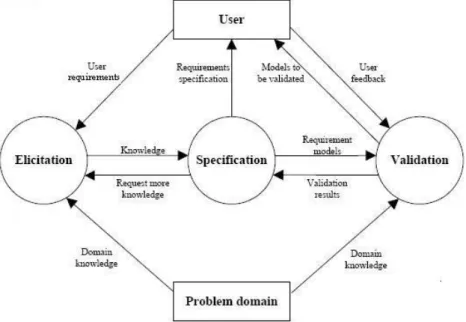
The main activities of the RE process involve requirements elicitation, specification and validation. These activities are summarised in Figure 2.1.
Elicitation
The purpose of requirements elicitation is to discover candidate requirements of the system to be developed, based on the weakness
of the current system as they emerge from domain understanding. The requirements are discovered through consultation with stakeholders, users, domain experts, system documents and so on. Different techniques are used to discover requirements, such as interviews, goal analysis, observation and scenario analysis (Lamsweerde, 2008). The output of the requirements elicitation process is a series of conceptual models that constitutes the knowledge required to understand the problem domain well.
Figure 2.1 Main activities of RE process: requirements elicitation, specification and validation (Loucopoulos, 1995).
Specification
The requirements specification phase has two main purposes:
• Decide requirements: The requirements are analysed in detail and stakeholders negotiate to decide which requirements are to be accepted. This is necessary to identify conflicting requirements, incomplete requirements and other constraints.
• Document requirements: Further requirements are documented at an appropriate level of detail. The requirements are documented in natural language and diagrams.
Validation
During the requirements validation phase specifications are checked to see whether they are in accordance with the stakeholders’ intentions. The requirements documents are carefully checked for consistency and completeness of requirements before they are used as a basis for the system development.
To develop the requirements of e-Commerce information systems, analysts and designers employ different views. They are goal view, economic-value view and process view. In Goal-Oriented Requirements Engineering (GORE) strategic goals are used as the foundation (Dardenne, 1993). Value-oriented requirements engineering uses the concept of economic value (Gordijn, 2002), while process view employed business use cases to identify functional requirements (UML, 2003).
2.2 Running Scenarios
This section describes the running examples used in this thesis to explain and illustrate different stages of the proposed artifacts.
2.2.1 Organising a Scientific Conference
The Scientific Conference scenario (SC) is about organising a scientific conference. For this purpose a set of activities have been arranged to acquire submissions, assign reviewers, decide on papers and organisation of the conference.
This business scenario involves four actors: program committee, steering committee, author and reviewer. The task of the program
committee is to organise the conference. The authors send submissions to the program committee. The program committee assigns reviewers to each paper and sends papers for reviewing. The reviewers submit their review reports to the program committee. Upon receiving the review reports the program committee decides on acceptance of papers. The decision is sent to the authors together with evaluations. The program committee is responsible for providing the conference program. The steering committee is responsible for funding the conference.
2.2.2 Massively Multiplayer Online Game
Playing
The Massively Multiplayer Online Game (MMOG) is about playing computer games through the Internet. There are four actors: game provider (GP), Internet service provider (ISP), shipper and customer. A GP is responsible for creating the game contents, selling and distributing game software on CDs to the customers. To sell and distribute games, a GP obtains the services from an ISP, who in turn receives a payment as compensation. To deliver software on CDs, a GP obtains the service of a shipper. The shipper receives a payment for shipping service. The customers access the game servers in order to play games. A GP is being paid for this service by a customer.
2.2.3 Eye-Care Treatment
The Eye-Care case is from the Swedish eye-care domain (REMS, 2007). The case encompasses three actors: patient, primary care physician and eye-care specialist. When a patient needs eye treatment, s/he goes to a primary care physician. After diagnosis the primary care physician provides treatment to the patient, getting a fee in return. If more advanced treatments are necessary, the patient will be referred to an eye-care specialist. In this case, the referral information will be sent to the eye-care specialist by the
primary care physician. The eye-care specialist provides advanced treatment to the patient and gets a fee in return.
2.3 Goal Modelling
Goals are an important aspect used to represent business strategies and decision support. They direct the enterprise toward concrete actions and as a consequence the actions are firmly based on a business justification. Goal models capture states (i.e. conditions) that enterprise stakeholders wish to achieve. As such they can be utilised as a driving force for elaborating requirements for business analysis (BMM, 2005) and system requirements (Dardenne, 1993) (Yu, 1995).
Research on goal-driven approaches has led to the development of a number of goal modelling techniques and languages, such as Business Motivation Model (BMM) (BMM, 2005), i* (Yu, 1995) and Knowledge Acquisition in automated Specification (KAOS) (Dardenne, 1993). The BMM was developed to build business plans in an enterprise. The i* framework is an intentional, agent-oriented approach for reasoning within an organisational environment and its information systems. The KAOS model was developed to collect system requirements specifications using organisational goals for automated systems.
2.3.1 The Business Motivation Model
The BMM was developed with the purpose of providing a structure for developing, communicating and managing business plans in an enterprise (BMM, 2005). A business model can be developed using elements in the business plan. Such a business model can be used as a foundation model for IS design phase. The BMM is constructed with respect to the enterprise for which a business plan is formulated.
According to BMM, there are two major areas in a business plan: (1) ends and means; (2) influencers and assessments.
• End: The Ends are the states the enterprise wishes to achieve. An endcan be a vision or a desired result.
Vision: A vision provides an overall picture of where the enterprise wishes to go in the long run.
Desired Result: The desired results are more specific goals and objectives that the enterprise intends to achieve. A goal is a statement about a state or a condition that the enterprise wishes to achieve or sustain. A goal amplifies a vision. An objective provides an attainable, time-dependent and measurable statement about a goal. The objectives quantify goals.
• Means: Means is something that enterprises use to achieve the end, such as technique, capability or instrument. The means can be differently categorised into mission, course of action and directive.
Mission: A mission describes the overall function of the enterprise through the ongoing operational activities. A mission makesa vision operative.
Course of Action: A course of action contains the basic elements of the general plan or overall solution that the enterprise will take to achieve its desired results. A course of action channels efforts towards desired results. The BMM identifies two types of course of actions, strategy or tactic. A strategy represents the course of action necessary to achieve the goals. A mission is planned by means of strategies. A tacticdescribes the strategy in more detail and implements the strategy.
Directive: The directives control the behaviour of course of actions. A directive could be a business policy or a business rule. The business policies are general practices established within the company. They are not fully structured and are less formally expressed rules. The aim of business rules is
to formulate atomic, structured and expressive statements about the courses of action. The business rules can be derived from business policies. A directive governs course of action.
• Influencer: An influencer is anything that may impact on the achievement of means or achievement of ends. These influencers can be either internal or external to the enterprise. The infrastructure and internal resources are examples of internal influencers. Competitors, customers, environment, partners, regulations, suppliers and technologies are external influencers.
• Assessment: An assessmentjudges the effect of an influencer in achieving ends by using means. A commonly accepted approach for assessments is SWOT (SWOT, 2007). In SWOT, assessments are categorised as strength, weakness, opportunity and threat. Strength or weakness is used to judge internal influencers. Opportunity or threat is