Study on Cyber Security and Threat Evaluation
in SCADA Systems
Marc Fabro Lofty Perch, Inc.
Scientific Authority: Rodney Howes DRDC Centre for Security Science
The scientific or technical validity of this Contract Report is entirely the responsibility of the Contractor and the contents do not necessarily have the approval or endorsement of Defence R&D Canada.
Defence R&D Canada – CSS
Contract Report
DRDC CSS CR 2012-006
March 2012
Study on Cyber Security and Threat
Evaluation in SCADA Systems
Marc Fabro Lofty Perch, Inc. 15-505 Hood Road Markham, ON L3R 5V6
Scientific Authority: Rodney Howes, DRDC Centre for Security Science
The scientific or technical validity of this Contract Report is entirely the responsibility of the Contractor and the contents do not necessarily have the approval or endorsement of Defence R&D Canada.
Defence R&D Canada – CSS
Contract Report
DRDC CSS CR 2012-006
March 2012
Principal Author
Original signed by Marc FabroMarc Fabro
Lofty Perch
Approved by
Original signed by Rodney Howes
Rodney Howes
DRDC Centre for Security Science
Approved for release by
Original signed by Dr. Mark WilliamsonDr. Mark Williamson
DRDC Centre for Security Science, DRP Chair
PSTP 02-347eSec
© Her Majesty the Queen in Right of Canada, as represented by the Minister of National Defence, 2012 © Sa Majesté la Reine (en droit du Canada), telle que représentée par le ministre de la Défense nationale,
DRDC CSS CR 2012-06 i
Abstract
……..
This report summarizes the finding of study PSTP 02-0347eSec Study on cyber Security and Threat Evaluation in SCADA Systems. The primary objective of the study was to support the e-Security Community of Practice by leading a study to fill the knowledge gap concerning the current cyber-threat environment affecting SCADA systems. This work is intended to enhance the resilience of Canada's critical infrastructure by providing direction to research and development programs and recommending best security practices. This primary objective is supported by the following complementary objectives:
1. To establish trusted relationships with private sector critical infrastructure SCADA operators; 2. To enable the production of research reports on the current cyber-threat environment to
SCADA systems;
3. To contribute to the development of a cyber-threat management system for continued situational awareness; and
4. To contribute to the development of best practices for the security of SCADA systems.
The report is divided into five parts :
1. Task 1 Milestone “Assess State of the Art for SCADA Security”
2. Task 2 Milestone “Development of a Cyber Threat and Vulnerability Guideline”
3. Task 3 Milestone “Define the Scope and Capabilities of a Cyber-Threat and Vulnerability Management System”
4. Task 4 Milestone “Produce a Best Practices Security Manual or Guide”
5. Final conclusions, strategic advisory note, capabilities road map, study fact sheet, and quad chart
ii DRDC CSS CR 2012-06
Résumé
…...
Le présent rapport fait la synthèse des résultats du projet PTSP 02-0347eSec intitulé Étude en cybersécurité et en évaluation des menaces pour les systèmes SCADA. L’objectif principal des responsables du projet est d’appuyer la communauté de praticiens de la sécurité électronique par la réalisation d’une étude scientifique qui vise à combler les lacunes dans les connaissances sur l’environnement de cybermenace actuel qui affecte les systèmes d’acquisition et de contrôle des données (SCADA). Ces travaux ont pour but d’accroître la résilience des infrastructures
essentielles canadiennes en fournissant une orientation aux programmes de recherche et de développement et en recommandant des pratiques exemplaires en matière de sécurité. Cet objectif principal se divise en objectifs complémentaires de la façon suivante :
1. établir des relations de confiance avec les opérateurs SCADA des infrastructures essentielles du secteur privé;
2. permettre la production de rapports de recherche sur l’environnement de cybermenace actuel qui affecte les systèmes SCADA;
3. contribué à l’élaboration d’un système de gestion des cybermenaces qui favorise une connaissance constante de la situation;
4. contribuer à l’élaboration de pratiques exemplaires pour la sécurité des systèmes SCADA.
Le rapport se divise cinq parties :
1. Tâche 1 : « Évaluer ce qui se fait de mieux en matière de cybersécurité des systèmes SCADA »
2. Tâche 2 : « Élaboration de lignes directrices en matière d’évaluation de la cybermenace et de la vulnérabilité »
3. Tâche 3 : « Définir la portée et les capacités d'un système de gestion de la cybermenace et de la vulnérabilité »
4. Tâche 4 : « Rédiger un guide ou un manuel des pratiques exemplaires en matière de sécurité »
5. Conclusions finales, note de consultation stratégique, feuille de route des capacités, fiche d’information relative à l’étude et tableau à quatre volets
iv DRDC CSS CR 2012-06
Executive summary
Study on Cyber Security and Threat Evaluation in SCADA
Systems:
Marc Fabro; DRDC CSS CR 2012-06; Defence R&D Canada – CSS; March 2012.
This report details the methodology, research, findings, conclusions and recommendations of Study on Cyber Security and Threat Evaluation in SCADA Systems. The document provides a report on specific tasking as it pertains to the ‘Final Study Report, Capability Roadmap, Final Quad Chart and Project Fact Sheet’. This document provides material summarizing content developed from a comprehensive review of the reporting across all study tasks. It includes other project completion activities including strategic advisory guidance, capability roadmap, a project fact sheet and a final quad chart for review purposes.
Overall, the study was completed on time and met or exceeded all expectations as defined by study objectives. In addition, due to the experience of the study leadership and their access to technology and industry stakeholders, the study was completed under budget. As the study was performed concurrent with many real-world SCADA security projects being performed by the study research team, additional observations and findings were able to enhance the work done in a laboratory environment.
The study results and recommendations were as follows:
• PSTP study programs that include dedicated activities towards a better understanding of SCADA and control system cyber security have tremendous value to Canadian critical infrastructure asset owners
• The SCADA security technical capabilities and subject matter expertise within the Canadian community of interest is considerable, the current level of interest
demonstrated by the federal government is well-positioned to accommodate current and future requirements to leverage this expertise in infrastructure resiliency programs
• Existing commercial security technologies have applicability in SCADA security programs, and those technologies addressing intrusion detection/prevention and forensics can clearly improve defensive strategies when deployed with due care. In many cases, the somewhat standard network configurations of SCADA networks creates opportunities for straightforward defensive strategies applicable across many sectors, and modifications in traditional deployment configurations can greatly improve the protection of control system domains.
• The volume of SCADA security research and information that is available from the global community is substantial, and the ubiquitous problem of how to secure control systems allows this information to have widespread and significant positive impact on the security risk profiles of Canadian critical infrastructure.
• Existing frameworks used by public and private sector entities to manage cyber threats and vulnerabilities are well-suited to accommodate for the requirements
DRDC CSS CR 2012-06 v
associated with SCADA systems. In addition, elements derived from historical approaches to threat and vulnerability management can be updated to create the capabilities to meet future states of threat management requirements.
• The effective deployment of security countermeasures within industrial control system environments is often dependent upon asset owner’s willingness and technical expertise to customize commercial security technologies. However, those
stakeholders that have created SCADA security risk reduction programs can provide insight that enhances current resiliency strategies and may be better prepared for information sharing with law enforcement and intelligence entities.
• The number of vulnerabilities that are specific to SCADA vendor technology is increasing, as is the understanding of research strategies and the inclusion of these vulnerabilities into contemporary exploit frameworks. In addition, the security of SCADA systems is also significantly impacted by vulnerabilities that are unique to underlying operating systems or third-party applications (as opposed to specific SCADA vendor solutions).
• The number of standards and recommended practices specific to SCADA security has increased considerably in the recent year, as has the amount of usable guidance uniquely designed for individual critical infrastructure sectors
vi DRDC CSS CR 2012-06
Sommaire
...
Étude en cybersécurité et en évaluation des menaces pour les
systèmes SCADA.
Marc Fabro ; DRDC CSS CR 2012-006 ; R & D pour la défense Canada – CSS; mars 2012.
Le présent rapport décrit la méthodologie, les recherches, les résultats, les conclusions et les recommandations de l’Étude en cybersécurité et en évaluation des menaces pour les systèmes SCADA. Il fait état d’une la tâche particulière du projet, soit la production du rapport d’étude final, de la feuille de route des capacités, du tableau final à quatre volets et de la fiche
d’information. Il fait la synthèse du contenu élaboré à partir d’un examen approfondi des rapports produits par l’ensemble des tâches liées à l’étude. Le rapport couvre d’autres
activités liées à la réalisation du projet, dont un guide contenant des conseils stratégiques, une feuille de route des capacités, une fiche d’information sur le projet et un tableau final à quatre volets aux fins d’examen.
Dans l’ensemble, l’étude réalisée dans les délais impartis a répondu aux attentes fixées dans les objectifs de l’étude, voire dépassé celles-ci. En outre, les limites du budget alloué ont été respectées grâce à l’expérience des dirigeants de l’étude et aux relations qu’ils entretiennent avec les intervenants de l’industrie et du domaine de la technologie. L’étude ayant été réalisée parallèlement à d’autres projets concrets sur la sécurité des systèmes SCADA dont était chargée l’équipe de recherche, d’autres résultats et observations ont permis de rendre plus efficace le travail accompli en laboratoire.
Voici les résultats de l’étude et les recommandations qui en découlent :
• Programmes de l’étude du PTSP comprenant des activités qui visent à mieux comprendre la cybersécurité des systèmes SCADA et des systèmes de contrôle présentant une importance capitale aux yeux des propriétaires de biens d’infrastructure essentielle au Canada.
• Les capacités techniques en matière de sécurité des systèmes SCADA et l’expertise de la communauté d’intérêts canadienne sont considérables. Le gouvernement fédéral manifeste présentement un tel intérêt qu’il mettra à profit cette expertise en matière de programmes touchant la résilience de l’infrastructure en regard des besoins actuels et à venir.
• Les technologies de sécurité disponibles sur le marché peuvent s’appliquer aux
programmes de sécurité des systèmes SCADA, et celles qui ont trait à la détection/prévention des intrusions et à la recherche de preuves améliorent nettement les stratégies de défense lorsqu’elles sont mises en œuvre avec la prudence nécessaire. Dans bien des cas, les
configurations plus ou moins normalisées des réseaux SCADA favorisent la mise en place de stratégies de défense simples dans de nombreux secteurs, et les changements apportés aux configurations de déploiement habituelles peuvent fortement améliorer la protection des systèmes de contrôle.
• La communauté mondiale propose une quantité considérable d’ouvrages de recherche et de documents sur la sécurité des systèmes SCADA. La protection des systèmes de contrôle étant un problème omniprésent, cette masse d’information se répercute de façon positive et généralisée sur le profil des risques liés à la sécurité de l’infrastructure essentielle du Canada.
DRDC CSS CR 2012-06 vii
• Les cadres de gestion des cybermenaces et des vulnérabilités dont se servent aujourd’hui les entités des secteurs public et privé sont bien adaptés aux exigences ayant trait la sécurité des systèmes SCADA. De plus, des éléments tirés des approches adoptées dans le passé dans ce type de gestion peuvent être actualisés de manière à créer les capacités nécessaires pour répondre aux besoins futurs dans ce domaine.
• Le déploiement efficace de contre-mesures de sécurité à l’intérieur d’un environnement informatique de contrôle est souvent tributaire de la volonté du propriétaire du bien
d’acquérir des programmes de sécurité commerciaux et de son expertise technique qui lui permettrait d’adapter ceux-ci à ses besoins particuliers. En revanche, les intervenants à l’origine de tels programmes de réduction des risques liés à la sécurité des systèmes SCADA peuvent communiquer leurs idées et améliorer ainsi les stratégies de résilience actuelles. Ils seraient également mieux placés pour échanger l’information avec les organismes chargés d’appliquer la loi et ceux du renseignement.
• Le nombre de vulnérabilités particulières à la technologie des systèmes SCADA ne cesse d’augmenter, tout comme l’on comprend mieux les stratégies de recherche et l’inclusion de ces vulnérabilités dans les cadres d’exploitation modernes. Également, la sécurité des systèmes SCADA est sérieusement compromise par les vulnérabilités que présentent les systèmes d’exploitation sous-jacents ou les applications de tierce partie (par opposition aux solutions du fournisseur SCADA).
• Les normes et les pratiques recommandées qui ontexclusivement trait aux systèmes SCADA se sont considérablement multipliées depuis quelques années, et le volume de conseils pratiques destinés à chacun des secteurs de l’infrastructure essentielle à lui aussi explosé.
viii DRDC CSS CR 2012-06
Table of contents
Abstract …….. ... i Résumé …... ... ii Executive summary ... iv Sommaire ... ... viTable of contents ... viii
Acknowledgements ... xi
1 Introduction – Task 1- Assess State of the Art for SCADA Security ... 13
1.1 Description of tasking and subtasking activities ... 14
1.2 Findings and observations ... 20
Annex A Project workflow TASK 1 ... 35
Annex B Selected Research Sources for Task 1.1 ... 36
Annex C Interview questions for asset owners ... 37
2 Introduction – Task 2- Development of a Cyber Threat and Vulnerability Evaluation Guide 38 2.1 Description of tasking and subtasking activities ... 40
2.2 Findings and observations ... 44
2.3 Cyber threat and vulnerability evaluation guide ... 55
2.4 Conclusions ... 57
Annex D Project workflow ... 58
Annex E Sample Memorandum of Understanding ... 59
Annex F Sample sOW - SCADA Risk Assessment Services ... 68
Annex G Cyber ics Asset Valuation Table ... 74
Annex H Cyber Control Systems Asset Listing ... 75
Annex I Threat Listing ... 86
This Threat Listing is not intended to be complete. It is a reference for the types of threats faced by operators of critical infrastructure and SCADA solutions. ... 95
Annex J Threat Assessment Table ... 96
Annex K Vulnerability and Risk Sources ... 101
The primary effect(s) of vulnerabilities related to inadequacies associated with any given safeguard are indicated in the foregoing table under Impact. ... 105
3 Introduction – Task 3- Define the Scope and Capabilities of a Cyber-Threat and Vulnerability Management System ... 106
3.1 Description of tasking activities ... 107
3.2 Findings and observations ... 108
3.3 First Generation Vulnerability Management: “Find and Fix” ... 109
DRDC CSS CR 2012-06 ix
3.3.2 Limitations: ... 111
3.4 Second Generation Vulnerability Management: “Clearing House” ... 111
3.4.1 Advantages: ... 112
3.4.2 Limitations: ... 112
3.5 Third Generation Vulnerability Management: “Enterprise Vulnerability Management” ... 113
3.5.1 Advantages: ... 114
3.5.2 Limitations: ... 114
3.6 Next Generation Threat/Vulnerability Management (SCADA): A Hybrid Approach ... 115
Figure 6- Next Generation Vulnerability Management ... 117
3.7 Conclusions ... 118
Annex L Project workflow ... 119
4 Introduction Task 4 – Produce a Best Practices Security Manual or Guide ... 120
4.1 Description of tasking and subtasking activities ... 120
4.2 Guidance ... 121
4.3 Security Basics ... 122
4.3.1 Security Standards of Good Practice ... 125
4.3.2 ISO 27001, 27002 ... 125
4.3.3 NIST 800-53, 800-82 ... 127
4.3.4 Others ... 128
4.4 Security Management ... 129
4.4.1 Ownership and Authority ... 129
4.4.2 Policy ... 130
4.4.3 Least Privilege ... 130
4.4.4 Asset Identification and Classification ... 131
4.4.5 Security Services Model ... 131
4.4.6 Procurement ... 132
4.5 Assessments - Threats, Risks, and Vulnerabilities ... 133
4.5.1 Risk Acceptance ... 136
4.6 Personnel Security ... 137
4.6.1 Roles and Responsibilities ... 137
4.6.2 Training ... 137
4.6.3 Awareness ... 138
4.6.4 Controls ... 138
4.6.5 Network Access Control ... 140
4.6.6 System Hardening ... 141
4.6.7 Incident Response ... 141
4.7 Conclusions ... 142
Annex M Project workflow ... 144
x DRDC CSS CR 2012-06
5 Introduction Final Study Report, Capability Road Map,Final Quad Chart, and Project
Fact Sheet ... 151
5.1 Study activities and observations ... 152
5.2 Strategic advisory note ... 160
5.3 Capabilities road map ... 162
5.4 Study fact sheet... 165
5.5 Final project quad chart ... 166
DRDC CSS CR 2012-06 xi
Acknowledgements
Lofty Perch recognizes the extensive support it received from its in-kind partners during the tasking activities, and in the final report deliverable will (wherever possible) be citing them by name. During the development of this and other report content it was deemed necessary to withhold the identity of partners due to the sensitive nature of the
observations and findings. Lofty Perch has, to the best of its ability, developed the material in this report to empower the reader to select the most appropriate technologies for their security needs. In addition, the material is delivered in a manner that can
facilitate for useful discussions between researchers and vendors, and provide valuable perspectives on current capabilities and future needs.
This work was supported by DRDC Centre for Security Science under study PSTP 02-347eSec and partners in RCMP, National Security Criminal Investigations.
xii DRDC CSS CR 2012-06
DRDC CSS CR 2012-006 13
1
Introduction – Task 1- Assess State of the Art for
SCADA Security
This document provides a comprehensive report on specific tasking as it pertains to Project Task 1 - Assess State of the Art for SCADA Security. The tasking in this project area was comprised of three core activities, all of which were performed with the study’s primary and supporting objectives in mind: Evaluate existing security technologies in view of identifying the best solutions for capturing wired and wireless SCADA traffic and detecting malicious activity.
Identify the capability gaps in efficiently detecting malicious traffic targeting SCADA systems, and survey and evaluate the research literature in relation to work being done to improve this capability. Evaluate forensic technologies and techniques that can be leveraged to understand the response of SCADA systems to malicious traffic.
Lofty Perch, Inc. (LPI) and the study team performed extensive research during this study activity, and in addition to working on other study areas concurrently, LPI executed lab and field based testing in
collaboration with industry stakeholders and in-kind partners. LPI made significant findings regarding communications capture techniques in SCADA and control system domains, and cross-correlated their findings with study work on intrusion detection and intrusion prevention capabilities. Perhaps most interesting is the fact that during the actual work activities LPI was involved in two (2) cyber-security incidents and seven (7) security assessments involving industrial control systems1. Using their on-site experience, the study team was able to make significant contributions to the study's requirements involving the evaluation of security technologies and techniques applicable to SCADA and industrial automation. The integration of findings from the resultant field work allowed for direct investigation pertinent to specific study tasking areas while actively supporting the study’s primary and complementary objectives.
The sub-tasking for the evaluation of existing security technologies that capture wired and wireless traffic to detect malicious activity on a control system network indicates that current commercial-off-the-shelf (COTS) and open-source network analysis tools are adequate for performing traffic analysis. However, current technology is best suited for network based communications, and there are a number of technical capability requirements that vary depending on the complexity of the architecture. Although existing traffic analysis technologies are suitable for non-routed protocols, the study has shown that the most effective capabilities exist when analysis is being performed in a networking environment.
The detection of malicious traffic is dependent on tuning the technology to either look for deviations in normal communications behaviour or to incorporate known intrusion signatures into the analysis. The study shows that technology designed to detect malicious traffic, or more accurately technology that can be tuned for SCADA environments, can only be optimized fully when administered by a subject matter expert. To that end, the subject matter expertise required to optimize malicious traffic detection
capabilities should be specific to the control system domain and, perhaps more importantly, specific to the actual control system technology and communication protocol. This observation suggests that future strategies for defending against malicious activity in SCADA networks will an active collaboration between the IT security, engineering, and vendor domains.
1 These activities were performed on both wired and wireless systems, and facilitated for extensive real-world observation and collaboration with
14 DRDC CSS CR 2012-06
The study team performed a comprehensive review of existing literature regarding historical perspectives on the functional requirements for detecting and mitigating abnormal and possibly malicious traffic targeting SCADA systems. During this review, a contrast and compare of historical and current/future trending was performed, and it was observed that a significant amount of academic and independent research provides a foundation for future technology development. It was also noted that several government research and development projects have resulted in technology specific for traffic analysis and intrusion detection for control systems, and that some of this technology is being transferred into the private sector domain. The rate at which this technology is being developed and deployed is concurrent with the growing security needs asset owners are experiencing. From this, it may be concluded that the gap between contemporary intrusion detection requirements and intrusion detection requirements for SCADA systems is closing, but more work is required.
This initial task also focused on the evaluation of forensic technologies and techniques that can be used in responding to SCADA system security events and analyzing malicious traffic. As mentioned above, during the study period the research team was engaged in two incident response engagements that directly involved the application of contemporary forensic investigation techniques and technologies, while simultaneously supporting investigations using current best practices and guidance. The observations and analysis from this activity has resulted in an improved understanding of current forensic computing approaches as applied to SCADA systems, and has uncovered some existing gaps in both techniques and technologies required to perform comprehensive investigations on industrial automation.
Concurrent to these field investigations, the study team worked closely with in-kind partners to perform analysis of commercial forensic technologies and determine if and how they can accommodate the unique operational environments associated with SCADA systems. This activity also coincided with regular interactions with several national law enforcement and intelligence entities, resulting in a substantial set of conclusions that have proven useful in other study task areas.2
This document is intended to provide content to be used in the comprehensive material to be delivered in the Final Project Study Report. The material in this document will, where possible, reference other study activities so that the reader will be able to interpret and leverage the information efficiently.
Section 2 is dedicated to discussing tasking and sub tasking activities, with in-depth discussion about the process, procedures, and investigative models used during the tasking. Section 3 discusses the findings and observations from the study activities, and from the analysis of how current state-of-the-art cyber-security technology and techniques may be applied to protecting SCADA and industrial control systems. Section 4 discusses conclusions, followed by appendices providing project workflow, literature sources, and an introduction to the base questions used in collecting traffic analysis requirements from critical infrastructure asset owners.
1.1
Description of tasking and sub- tasking activities
The primary task element, as a function of the overall study methodology, is shown in figure 2 below. This is derived from the comprehensive Study Workflow as shown in Appendix A.
2 As RCMP is the Technical Authority for the project, and subsequent study tasking addresses law enforcement stakeholder requirements, Lofty
Perch found the investigation activities and results pertinent to other areas in the study program. These findings and observations will be represented in other tasking reports in addition to this one.
15 Figure 2 - Detailed workflow for Task 1
The core activities of this task involved the establishment of the technical committee with partners, advisors, and subject matter experts specifically interested in addressing issues related to the detection and mitigation of malicious traffic in SCADA and control system environments. As this was the initial tasking activity for the study, the team study team leveraged their access to the asset owner, vendor, and research community to harvest current best practices and methodologies used. This approach provided foundations for the study team to understand what proven technical capabilities exist that are being used in real-world SCADA deployments.
In addition, concurrent research involving the testing and analysis of commercial technologies in the Lofty Perch laboratory created mechanisms to compare observations in real-world SCADA deployments against those obtained in a test environment. To facilitate this research, the study team used the real control system environment developed for the Lofty Perch intermediate and advanced training. This system comprises a variety of technical capabilities that include PLCs, field equipment, operator workstations, human machine interfaces, primary application servers and other capabilities that can be tuned to create a system mock-up for almost any architecture required. This proved exceptionally useful in the development of the architecture types developed for the first subtask in this activity. The study team also ensured that their approach took into consideration interoperability and interdependencies of both wired and wireless networks, and leveraged their technical subject matter expertise to create laboratory environments that addressed both technologies. The skill set required for the acquisition, configuration and deployment of commercial traffic capture technologies, both wired and wireless, was consistent with the level of expertise available in the network and engineering departments of more sophisticated asset owners.
The assessment tasking required the development of two very different approaches. By leveraging access to the vendor community, as well as the critical infrastructure asset owner community, the study team was able to ascertain that the technology requirements related to capturing and evaluating control system traffic (with the intent to look for abnormal behaviour which could be malicious) and the technology related to performing forensics investigation are quite different. Tasking in the study directed the research to evaluate forensic technologies and techniques that can be used to understand the response of SCADA systems to malicious traffic. The study team felt that investigating forensic technologies and techniques that can be used both during and after an abnormal cyber-incident would provide additional value to the primary task. This approach yielded both expected and unexpected results, and provided for a set of observations and analysis that will have a significant contribution to the final report and, more importantly, the material presented in the Best Practices Security Manual for Canada's critical infrastructure owners (Study Task 4).
Task 1 was completed using a series of core activities: Establishment of interim technical committee
Perform a literature review on current and emerging theoretical strategies involving intrusion detection and anomaly detection in SCADA and industrial control system environments, and begin to map those findings against the observations from laboratory research
Interaction with private sector asset owners to survey mission critical SCADA firmware and over-the-air (OTA) upgrade capabilities
Modification of the Lofty Perch proprietary assessment framework to allow for customization based on available in-kind support from asset owners and vendor community
Development and deployment of lab-based SCADA radio system, and comparative analysis of security functionality and requirements of collateral wireless communications
16 DRDC CSS CR 2012-06
Build-out of commercially available wired and wireless network protocol analyzers and deployment of these analyzers in both laboratory and field environments
Detailed discussion with SCADA and security vendor community representation regarding current and emerging capabilities for traffic analysis in both wired and wireless architectures
Configure and customize traffic generating technology for specific SCADA and industrial control system environments, and use partner technology to create a broad range of malicious stress and duress scenarios Obtain, configure, and test several commercially available anomaly and intrusion detection systems for applicability and usability in control system environments
Obtain, configure, and test perimeter-level defensive technologies designed specifically for industrial automation equipment and architectures
Obtain and configure market-leading forensic technology and perform forensics analysis on impacted SCADA and control architecture elements in both a proactive and reactive manner
Commence in-house analysis of emerging SIEM algorithm-based anomaly detection capabilities, and contrast/compare against current market leading signature-based solutions
Test applicability of various commercial forensics technologies on actual SCADA systems, and in
particular evaluate feasibility of post-incident memory analysis against feasibility of live memory analysis using active servlets and application state monitoring
Revisit contemporary best practices as published by the US Department of Homeland Security and review feasibility of proposed identification models used in the development of forensic investigation methods for SCADA systems
Engage representation from the law enforcement community to obtain perspectives related to advantages and disadvantages in various approaches involving forensic analysis on industrial automation
Engage representation from the asset owner community to obtain perspectives on acceptance or reticence related to the employment of forensic computing strategies within the industrial control system domain Leverage access to the research community to discuss emerging strategies regarding forensics in SCADA, and leverage physical presence at many SCADA security conferences (globally) to facilitate discussions on academic and asset owner perspectives on requirements for forensic capabilities in sector specific environments
Approach to Subtask 1.1: Evaluate existing security technologies in view of identifying the best solutions for capturing wired and wireless SCADA traffic and detecting malicious activity.
Lofty Perch modified their proprietary target of evaluation criteria for the laboratory assessments and performed numerous interview engagements with Canadian critical infrastructure asset owners. From these interviews and interactions, the study team was able to assess the needs and requirements that were often customized to a sector, and create a baseline for determining what mandatory capabilities should exist for security technologies that can be used for capturing and detecting malicious activity in control system networks.
The study team used a two-pronged approach to ensure a complete and robust sampling of existing security technology requirements was obtained. The study team had access to proprietary, commercial, open-source, and research systems. Where appropriate, the technology was deployed in a laboratory environment. The study team leveraged specific opportunities to observe traffic analysis capabilities in actual field deployments. By working with clients and partners the study team, was able to assess these capabilities in both a wired and wireless environment. In this tasking activity, Lofty Perch used their capabilities baseline as a foundation for the analysis of several different systems and configurations, and ensured that their approach took into consideration interoperability and interdependencies of both wired and wireless networks.
The study team created specific system scenarios to ensure suitable coverage of plausible architectures. The system architectures types, consisting of both wired and wireless communications, developed for this tasking were:
17
System Type 1: SCADA system comprised of single vendor solution technology, and a common integrated network facilitating communications between SCADA operations and field activities. The system is not connected to any other peer network. The system is connected directly to the Internet with no security countermeasures in place.
System Type 2: SCADA system comprised of single vendor solution technology and a common integrated network facilitating communications between SCADA operations and field activities. The system is not connected to any other peer network. The system is connected directly to the Internet and is protected by a firewall.
System Type 3: SCADA system comprised of single vendor solution technology, and a common integrated network facilitating communications between SCADA operations and field activities. The system is connected to corporate and is protected by a firewall.
System Type 4: SCADA system comprised of single vendor solution technology, and a common integrated network facilitating communications between SCADA operations and field activities. The system is connected to a peer control network via a firewall. The system is connected to corporate and is protected by a firewall.
System Type 5: SCADA system comprised of single vendor solution technology, and a common integrated network facilitating communications between SCADA operations and field activities. The SCADA system is connected to the Internet via a firewall to facilitate a persistent remote connection from the SCADA vendor to a dedicated server on the control network and is connected to corporate (via firewall).
System Type 6: SCADA system comprised of multiple vendor solution technologies, and a common integrated network facilitating communications between SCADA operations and field activities. The system is not connected to any other peer network. The system is connected directly to the Internet with no security countermeasures in place.
System Type 7: SCADA system comprised of multiple vendor solution technologies, and a common integrated network facilitating communications between SCADA operations and field activities. The system is not connected to any other peer network. The system is connected directly to the Internet and is protected by a firewall.
System Type 8: SCADA system comprised of multiple vendor solution technologies, and a common integrated network facilitating communications between SCADA operations and field activities. The system is connected to corporate and is protected by a firewall.
System Type 9: SCADA system comprised of multiple vendor solution technologies, and a common integrated network facilitating communications between SCADA operations and field activities. The system is connected to a peer control network via a firewall. The system is connected to corporate and is protected by a firewall.
System Type 10: SCADA system comprised of multiple vendor solution technologies, and a common integrated network facilitating communications between SCADA operations and field activities. The SCADA system is connected to the Internet via a firewall to facilitate a persistent remote connection from the SCADA vendor to a dedicated server on the control network and is connected to corporate (via firewall).
The study team collaborated with its technology committee of partners and vendors, and found that the system types provided the best representation of architectures while maintaining a manageable number requiring review. The simplified network base was created by using the Lofty Perch training system, and that allowed for timely and accurate testing of a number of different commercial solutions, resulting in comprehensive and useful observations.
The approach to developing normal and abnormal operating conditions and traffic was done both manually and by leveraging commercial technologies. The study team was exceptionally diligent in ensuring the test cases established accurately modeled real-life scenarios and also took into consideration the observations and concerns of project partners working in the stakeholder community. Having an existing control system available for testing expedited the results and allowed for efficient comparison against other research. The information gleaned from the testing allowed the research team to populate the
18 DRDC CSS CR 2012-06
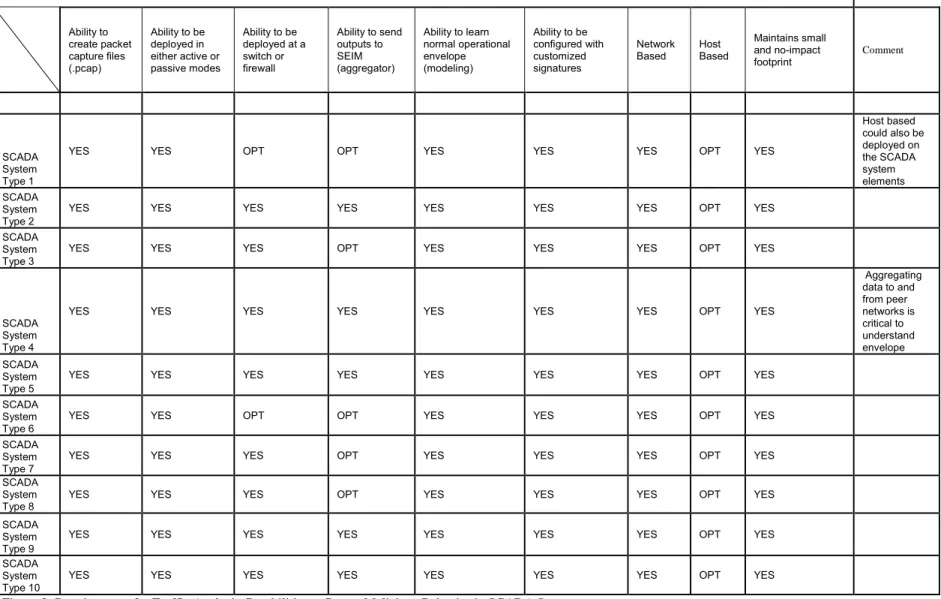
results matrix to define base requirements that a traffic inspection or intrusion detection system should have based on system type.
SCADA and control system traffic was generated with two models; normal and abnormal, with abnormal being defined as traffic that exceeded standard alarm and event thresholds and could therefore be deemed possibly malicious. The study team chose this approach so that the observations collected would be tied to anomalous behaviour worthy of investigation as opposed to alarms that may simply trigger a system reset by the operator. In short, the procedure for the testing helped define what specific capabilities traffic analysis and intrusion detection technology should have to provide an enhanced security posture (threat focused) above and beyond simple control system maintenance.
The study team performed a rigorous course of testing that could complement both existing research as well as capabilities of current traffic detection technologies. With the goals of the project correlated to improving the understanding of identifying cyber-threat activities in SCADA systems, the study team created a test suite representative of activities as seen from unorganized low-level threat actors to the most advance adversaries. These activities included (in no particular order):
Using standard commercial and open-source traffic analysis tools to capture datasets, and provide a capability to manually create baseline measurements of the normal system operational envelope Using standard commercial and open-source traffic analysis tools that can capture datasets and automatically create the baseline measurements of the normal system operational envelope
Using commercial and open-source traffic analysis tools that are embedded in other security devices Using commercial and open-source traffic analysis tools that have extensive capabilities to either collect from (import) or distribute (export) security logs to centralized security management services
Using standard commercial and open-source security assessment tools in a customized (i.e. non-SCADA specific) configuration
Using standard commercial and open source security assessment tools in a fully customized SCADA-specific configuration
Using commercial and open-source network and device stress testing technologies to ascertain failure modes and vulnerabilities
Using standard commercial and open-source security technologies and evaluate the impact on SCADA system security profiles depending on the placement of those security technologies
Detailed analysis of how the placement of traffic analysis solutions impact detection, and how detection capabilities are impacted at the network, host, or application level
Analysis of how detection rates change based on whether or not the communications are expected, as well as authenticated or unauthenticated (trusted or non-trusted).
The study team also benefited greatly from the access it had to the stakeholder and vendor community, and during the course of the tasking the team was able to perform analysis on live production systems
19 during formal assessment engagements. When analysis was not permitted on live production systems, the study team collaborated with the asset owner to discuss the aspects of the research approach, and
collected intelligence about the data capture and analysis practices currently being used by the Canadian critical infrastructure stakeholder community.
To facilitate useful conversations for the collection of data relevant to the study, the study team developed a series of questions for the asset owner and vendor. This approach allowed the study team to better understand existing practices that are working in actual field deployments, as well as contrast and compare perceived gaps as defined by the asset owner and vendor community. The framework for these discussions is defined by the questions provided in appendix C of this document.
The results from the activities in Task 1 Subtask 1.1 are discussed in Section 3 of this Report.
Approach to Subtask 1.2: Identify the capability gaps in efficiently detecting malicious traffic targeting SCADA systems, and survey and evaluate the research literature in relation to work being done to improve this capability.
This tasking element was not called out specifically as a unique item in the project plan. However the study team felt it appropriate to assign this activity its own subtask due to the relevance and importance of its output. The initial subtask (1.1) provided for the creation and population of a technical matrix that, when completed, would easily provide direction on how to interpret current and emerging gaps related to technology for detecting malicious traffic in SCADA systems.
Current literature was analyzed in this task, and in many cases this included the review of proprietary documentation provided by vendors and stakeholders. The results section of this report will provide more information on research reviewed.3 Current trending indicates that contemporary commercial solutions are quite suitable for detecting malicious traffic in control system environments but the success of that detection is highly dependent on the technological expertise used to configure the technology. Although this observation was expected, the approach to this subtask was to go beyond these expected observations. The study team decided that the approach to evaluate the outputs from the prior subtask (used to populate the requirements matrix) could be used in tandem with analysis of security assessment results and
interaction with both the stakeholder and vendor communities.
Results from this approach were useful in determining what gaps exist and what needs to be on the development horizon for solutions designed to capture SCADA traffic and detect malicious activity. The results from these activities are discussed in Section 3 of this Report.
Approach to Subtask: 1.3: Evaluate forensic technologies and techniques that can be leveraged to understand the response of SCADA systems to malicious traffic.
Contemporary forensic investigation technologies and techniques are thought to be useful across almost any standard operating platform. Using available research, combined with input from and
consultation with project stakeholders, the study team took the approach that data acquisition and collection of incident artifacts are able to be obtained from target system in either a ‘dead’ or ‘alive’ state. The study team looked to contemporary research to guide them in their approach and observed that based on the availability requirements of many industrial control systems the methodologies used to perform forensic analysis must be done on systems that are fully functional and in many cases cannot be taken off-line. In addition, current trending indicates that there is a notable increase in cyber-attacks taking place in the physical memory of a target system. This trending suggests that many of the artifacts needed to understand the impact of malicious activities on an information system, ones that exist in memory, may not be observed using traditional forensics methodologies designed for off-line systems.
In the interest of time and budget the study team chose to focus attention on the Windows operating system as the core operational platform for the majority of contemporary SCADA and control
3
Due to the sensitive nature of the materials, the report does not provide insight to specific proprietary documentation provided by stakeholders or vendors.
20 DRDC CSS CR 2012-06
system solutions. This decision was also driven by the fact that almost all of the study partners and asset owners used Windows environments as their base operating system. Based on these criteria the test bed to be utilized at the Lofty Perch facilities were developed on a Windows platform. It was serendipitous that Lofty Perch was active on cyber-incident investigations during the term of the study, allowing for advanced analysis on actual operational SCADA systems. The live systems under evaluation were also based on the Windows platform. It should be noted, however, the study activities were not exclusive to the Windows operating system, as forensic investigation tools for the reverse disassembly of firmware on embedded UNIX systems, particularly for those in the SCADA radio testing portion of the study, were also used. The study team spent significant effort on embedded Linux as well, particularly in adapting open source forensic utilities to extract proprietary files and encoding information for the purposes of reverse engineering. The analysis of contemporary forensics tools for UNIX systems was investigated and predominately used for evaluation of the technology associated with distribution automation and
advanced metering infrastructure (AMI). 4
In the laboratory environment, the study team used the base architectures developed for the previous task and performed various automated and customized attacks on them. In addition, some customized malware (developed prior to study activities) was released on the test bed systems in a controlled manner, with subsequent investigation performed by analysts who were both knowledgeable and not knowledgeable about the method of attack. This provided significant insight to the viability and usefulness of contemporary forensic investigation techniques on SCADA systems.
The methods used for the creation and deployment of unauthorized and malicious traffic were the same as those used in previous task elements. For the analysis of forensics technologies there was also the
inclusion of malware and malicious mobile code. Where possible, the study team made attempts to modify program payloads to have a specific impact on specific processes unique to the control system.
1.2
Findings and observations
Subtask 1.1: Evaluate existing security technologies in view of identifying the best solutions for capturing wired and wireless SCADA traffic and detecting malicious activity.
Figure 3 (page 23) provides a matrix showcasing what requirements would be necessary for effective traffic capture technology that can be used for detecting malicious activity on a SCADA network. This was cross correlated with existing types of technology and sampled SCADA configurations studied. The study team ensured that their approach took into consideration interoperability and interdependencies of both wired and wireless networks, and leveraged their technical subject matter expertise to create test-bed environments that addressed both. The acquisition, configuration, and deployment of commercial traffic capture technologies, whether wired or wireless, were very straightforward. As cited in the interim study report, network analysis tools are well-suited for analyzing net flows and traffic flows in industrial automation domains, and can include capabilities to analyze field traffic when protocol converters are used. There is a considerable amount of commercial and open source research dedicated to the development of enhancing traffic analysis and anomaly detection capabilities for SCADA, with the majority of the market leading commercial vendors providing for the integration of intrusion detection signatures into their suite. Of particular importance was the recognition of emerging independent research
4
Although the study activity was inclusive of both wired and wireless environments, the project focus was on traditional SCADA systems. Although AMI is often considered a vital component of energy management operations, by definition it is not usually considered part of a SCADA system and as such analysis of AMI security issues is beyond the scope of this report.
21 provisioning for the development of pre-processors that could facilitate straightforward analysis of captured traffic using contemporary intrusion detection technology.5
The study team worked with asset owners and integrators to evaluate the issues related to the placement of traffic capture technologies and the access to mission-critical network devices in which technologies could be deployed. Unlike contemporary IT infrastructures, access to critical network routing and gateway systems, as well as direct access to the command and control networks for automation
operations, is nontrivial. This is due both to local operational requirements and to separate governance for IT and engineering domains. Although the technology explored was passive in nature, the mandatory requirements for system availability and integrity (as opposed to confidentiality) provided the study team with direct exposure to the issues related to deploying security countermeasures within industrial
automation domains. Although the impediments were not always technical in nature, the cultural
requirements and security aspects associated with how the asset owner protects their networks can create barriers to the deployment of traffic analysis and intrusion detection software in SCADA operations environments.
The observations collected from the research addressing commercial, open-source technology, and emerging research strategies all conclude that the approach used by traffic capture and intrusion detection systems, when used passively, is applicable to control systems environments. However, it was observed that as the complexity of the control system network increases so does the effort required to discern between different traffic flows, the volume of the traffic, and the co-mingling of datasets that can be traversing the same network. When systems range in complexity (analogous to those architectures developed for the study), the accessibility to corporate, peer, and Internet information enclaves can radically impact the work effort associated with developing effective traffic analysis capabilities with the intent to look for malicious traffic. The decision for an asset owner to create a parallel or integrated traffic analysis system for SCADA data requires clear control objectives and mature IT processes which are not developed in all asset owner organizations.
In all cases however, the results suggest that the most effective approach to looking for network traffic that could be malicious in nature is one that involves looking for deviations from expected traffic (as opposed to trying to develop signatures against known and unknown attacks). Contemporary commercial and open-source offerings provide an entire suite of various technologies able to provide this service. The ability to compensate for the uniqueness of control system specific traffic lies in the ability to learn traffic envelopes and create triggers to detect deviations from them. These observations align well with the research reviewed for the study, and there is clear trending in the commercial domain that indicates the work done in the academic and research community is quickly being integrated in contemporary traffic analysis techniques and technologies.
The common thread in the literature reviewed was that the fundamental problem in analyzing network traffic to identify malicious behaviour in SCADA domains is correlating traffic type, volume, and payload analysis to recognize possibly malicious activity. As the study focused on network communications, it was clear that the modernization of traditional serial-based protocols to TCP/IP has reduced the
complexity associated with capturing and analyzing these communications. In fact, almost every modern traffic analysis tool makes clear concessions for the control system protocols over TCP/IP, IPv4 and does an excellent job of mapping port, timestamps, and payload. However, these protocols have primarily been encapsulated in TCP/IP. Session management, identity and authorization along with other features of modern application and data protocols have not been implemented.
By referring to the matrix in figure 3 the reader can review what the study emphasized to be the
fundamental elements for effective traffic analysis allowing for the ability to detect anomalous behaviour. The analysis is intended to provide quick reference to readers and provide insight on the evaluation of existing security technologies (and their capabilities) for capturing wired and wireless traffic and
5
The study focused on capturing SCADA traffic and detecting malicious activity. This focus allows for the easy extrapolation out to intrusion detection, but the methodologies surrounding intrusion prevention exceed the scope of this study and are not included in this report. The reader is encouraged to research the concept of intrusion prevention as applied to industrial control systems.
22 DRDC CSS CR 2012-06
detecting possible malicious activity. The study team determined that the format of this matrix should be structured to allow for readers to cross correlate traffic analysis and malicious behaviour detection methods with their own system architecture type. This approach proves valuable to the stakeholder, as a simplified discussion of what technologies either work or do not work cannot provide the level of granularity required to deliver value to the stakeholder. After the incorporation of requirements derived from interactions with stakeholder community, the vendor community, and the Lofty Perch test bed environment, nine (9) core functional areas that can be applicable across the entire family of study architectures were uncovered.
Create Packet Capture Files
All of the research and interactions with the stakeholder community, as well as those with the vendor, demonstrated that a requirement to be able to create packet capture files or traffic files that can be converted to common packet capture format is mandatory. During the study, it was determined that the most common path for analysis was using the TcpDump capability and the incorporation of the output files into any analysis tool such as Wireshark6. The use of these two technologies was pervasive across the entire study and was a component of almost every piece of commercial and research technology evaluated. More importantly, from interviews with the asset owners, it was noted that the personnel from the stakeholder domain responsible for the analysis of traffic within control system environments usually have an excellent understanding of these tools and use them exhaustively in data analysis programs. Any technology to be used for SCADA traffic analysis (with the intent to detect malicious behaviour) or any technology to be incorporated as part of an intrusion detection or intrusion prevention system will use these elements.
Deploy in Either Active or Passive Modes
The study derived 10 plausible SCADA architectures to account for the extensive diversity and uniqueness of industrial automation used in the real world. The factors associated with the integrity and availability requirements of these different systems create a situation where no two control systems have exactly the same restrictions on deploying security controls. This became very clear in the laboratory analysis and was underscored during the discussions with the stakeholder community. It is in
consideration of this issue that one of the requirements for traffic capture is an analysis capability that can be deployed in either an active or passive mode.
There has been considerable discussion about deploying traffic analysis capabilities (as a security function) as a real-time , in-line countermeasure in mission-critical industrial automation domains, as there is always a concern that the data packet capture and inspection methods can introduce latency into the communications. Obviously, for many entities, the introduction of any latency into communications is often unacceptable and the deployment of active and in-line traffic analysis technologies is simply not possible. It is also important to mention that many of the commercial security solutions that involve active analysis of traffic flows provide the user with the opportunity to have the system take reactive measures when possibly malicious traffic is detected. This can result in modifications to the data stream in an attempt to get the communications to conform to expected and allowed behaviours.
The study indicated that asset owners, who have varying degrees of availability requirements, desire an ability to deploy traffic analysis in either an active or passive mode. This requirement is in conjunction with the other requirements as illustrated in the matrix. However, the reader is reminded that the results from this study indicate that requirements do change based on system type.
Deploy at a Switch or Firewall
6 This observation refers to the technology in question using tcpdump as a core element of its package capture, and not simply using tcpdump
23 The study team found this requirement initially somewhat of a surprise, as some early
assumptions were made suggesting the asset owner has complete control over how SCADA traffic analysis was done. In addition, the extensive field experience the study team had in assessing SCADA and control system networks suggested that perimeter firewalls and switches were either deployed and managed by the corporate IT facility or were built, deployed, and managed only by the vendor or
integrator. The study was able to ascertain that if the capability existed to deploy traffic analysis within a switch or a perimeter firewall was possible, then it is a viable option that should be considered.
A switch or firewall traffic analysis capability, in the context of this study, would be most useful if able to facilitate the delivery of packet capture files as well as being able to be deployed in either an active or passive mode. The study indicated that those firewalls with packet capture capability do not necessarily require the ability to assess data in the passive mode due to the nature of the firewall core function (i.e. deep packet inspection). The study also showcased the fact that while switches offer a tremendous opportunity to do traffic analysis, it is often the case that the asset owner themselves do not have the permissions or ability to manage the network switch that was configured and deployed by the vendor or integrator.7
Send Outputs to SEIM Systems
The study showcased that the complexity of a control system environment greatly dictates the extent to which traffic analysis needs to be performed, and how important it is to ensure there is aggregation of the results of those analysis outputs. Contemporary security countermeasures in the IT domain often deploy aggregation techniques to correlate security event and incident information, and the systems are aptly called Security Event and Incident Management (SEIM) systems. The goal of the systems is to collect disparate security information and present it in a manner to provide security operators and analysts a comprehensive view of the security health of their operational environment.
During the study tasking, it was surprising to learn that the stakeholder community is becoming very aware of these technologies and the value proposition they have for protecting mission-critical control environments. However, the stakeholder community is also quickly realizing that not every commercial offering is a suitable solution for SCADA environments. As the systems have become more complex, and the asset owner is required to deploy traffic analysis and anomaly detection across a broader domain, these correlation capabilities are growing in acceptance. The success of these aggregating
systems is entirely dependent on the capability of constituent field devices (those capable of creating security incident information or logs) to ‘feed’ them with appropriate data. As such, regardless of the security technology used for capturing SCADA traffic (with the intent to detect malicious activity) the traffic capture function must have the ability to feed these aggregators and do so with the expectation the SEIM can interpret the inputs.
The study results suggest that this capability is not always mandatory but rather optional. The study found that the complexity of the SCADA system can dictate whether or not such a capability should be present, and concluded that when an asset owner is requiring ongoing comprehensive analysis of the security health of their control system that this feature may be required.
Learn Normal Operational Envelopes
Although the thrust of the study area was to determine what existing security technologies provide the best solutions for capturing wired and wireless SCADA traffic and detecting malicious activity, a by-product of the research indicated that the expected control system behaviour can be used to accelerate the detection of possibly malicious activity.
In each of the architecture samples, as well as observations from real world environments, and
interactions with both vendors and stakeholders, the detection of malicious activity in a control system
7
One of the more interesting elements that resulted from working with asset owners in the study was that the integrators and vendors often provide unmanaged switches in the control system environment, therefore extensively limiting the asset owner's capability to implement security centric traffic analysis capabilities. The cultural or implementation issues related to this are beyond the scope of this research, but it is provided here as the study team found the observation noteworthy.
24 DRDC CSS CR 2012-06
environment is directly tied to understanding anomalies from expected data transactions. In SCADA domains, there are regular communication patterns that are generated during normal operations. As the systems are designed and deployed to often perform highly repetitious and highly efficient processes, the architectures are deployed with a fixed and known number of network elements and operate with a limited number of protocols.8 These aspects, in addition to the collection and management of regular process parameters, facilitates information that can be used to create upper and lower thresholds between which a SCADA system is considered to be ‘well behaved’ when functioning. If the system
communication activities can be captured over periods of time, and under various operational scenarios, it is usually straightforward to create an expected behaviour ‘envelope’. From this behaviour envelope operators can create parameters to be used in traffic analysis and intrusion detection systems, and have those systems trigger for possibly malicious activity when the bounds of the expected behaviours are exceeded (either high or low).
Although the study team expected that this requirement would be straightforward in understanding, investigation into the techniques and technologies used for this capability yielded various approaches. Based on this information it became very important to understand these approaches from a technology perspective, as well as understand how those approaches integrate with other fundamental capability requirements for traffic analysis and intrusion detection for SCADA systems.
The evaluation of literature and current commercial offerings indicated that the most useful output from data capture solutions, from a security perspective, is in the form of anomaly and attack detection systems. The research suggested a range of these capabilities exist, from basic configuration of open-source tools to the deployment of algorithm-based pattern matching and anomaly detection engines. Regardless of the technology however, it was very clear that the most efficient use of data capture technologies for detecting malicious behaviour will exploit the fact that the SCADA system operates as ‘well behaved’ and provides a number of communications attributes that are easily defined.
The study team determined the parameters and technical attributes that would prove most beneficial in a data capture system designed to model and learn the normal operational envelope. In the most basic configuration, capability requirements for such traffic analysis technologies may include (in no particular order):
Source IP and port of data flow between devices Destination IP and port of data flow between devices
Range of fixed number of network devices and IP addressing schema
Scheduled communications including protocol type and timing (includes consideration for detection of the absence of scheduled communications)
Ingress and egress monitoring for critical trusted devices Payload analysis
Device-to-device ‘legal/allowed’ data transactions
Communications to devices specifically deployed as a security countermeasure9 (i.e. ‘canary’) Consideration for alarms and events
Consideration for network diagnostics and enumeration10
8 Depending on the architecture, this number can large. Generally speaking, however, there is usually only a single protocol being used within a
particular architecture enclave and in this study was limited to those protocols using TCP/IP (Ver. 4) . Multiple protocols can be used over disparate architectural elements, and it is through protocol conversion that data transcends across domains.
9
A canary is a pre-established point of presence on the network with no specific function and no permission to communicate with other devices. Any communication to it could be a sign of abnormal behaviour or malicious activity.
10
The networking tools and technologies used for these activities are identical to those used by adversaries in the early rounds of enumeration and target identification, and thus required special attention. This issue is beyond the scope of the study but continues to be an area of focus for working groups, security technology vendors, and asset owners.
25
Configurable with Customized Signatures
During the research phase, the study team worked closely with asset owners that have either deployed traffic analysis capabilities or are in the process of deploying them. Those entities that had an advanced understanding of cyber security requirements for control systems clearly indicated that any traffic analysis capability, especially those designed to support intrusion detection solutions required the capability to be customized with signatures specific to the operational environment. Although several commercial solutions evaluated during the study indicated that SCADA and control system signatures are widely available, many of the current solutions offer signatures that are unrelated to a large majority of asset owner architectures. With that, the study was able to conclude that those traffic analysis capabilities capable of being tuned (using very specific and customized detection signatures) show the most promise for detecting malicious activity in SCADA systems.
The study uncovered an exceptionally broad range of traffic analysis technologies available to facilitate for the uniqueness of SCADA operational environments, with the simplest and most
cost-effective solutions being those from the open source marketplace. At the other end of the spectrum resides commercial and research technologies that require some monetary investment but also some advanced technical capability to maximize the solution offering. Interactions with asset owners suggest that although no-fee technology is attractive, the most effective solutions appear to be those involving minimal cost expenditure as it pertains to the acquisition of the technology and the cost associated with tasking personnel to oversee the management of the traffic analysis solution.
The testing in the laboratory environment proved that simple modification of common traffic analysis tools can result in an effective capability for the detection of malicious traffic. Yet, there is clearly an opportunity for more advanced anomaly detection capabilities to provide value to the
stakeholder community. The study showed that there are three fundamental aspects with regards to how technology can support traffic analysis and the detection of malicious activity in SCADA systems. The fundamental aspects of technology that has the ability to be customized from a signature perspective include:
Template or primitives language for specifying patterns in data streams Scripting language for the conditional linking of signatures in rules Ranking of data elements to represent architecture assets and criticality
The study also demonstrated that an organization that has a good understanding of their cyber-risk (as it relates to assets and consequence) may be more successful in deploying effective traffic analysis and anomaly detection solutions. This observation highlights the importance of having the necessary subject matter expertise to deploy and manage traffic analysis systems in control system environments, and that the proper customization of anomaly detection systems is critical to detecting abnormal and possibly malicious traffic in the most efficient way possible.
The study demonstrated that when these three capabilities are present in the network analysis technology they can be appropriately tuned to perform effective anomaly detection, thus leading to a better
understanding of possible malicious behaviour. Currently, as per study activities, it has been determined that almost all contemporary network monitoring an