Are you The One to Share?
Secret Transfer with Access Structure
Yongjun Zhao and Sherman S.M. Chow⋆ Department of Information Engineering The Chinese University of Hong Kong, Hong Kong
{zy113, sherman}@ie.cuhk.edu.hk
Abstract. Sharing information to others is common nowadays, but the question is with whom to share. To address this problem, we propose the notion of secret transfer with access structure (STAS). STAS is a two-party computation protocol that enables the server to transfer a secret to a client who satisfies the prescribed access structure.
In this paper, we focus on the case of STAS for threshold access structure, i.e. threshold secret transfer (TST). We also discuss how to replace it with linear secret sharing to make the access structure more expressive. Our proposed TST scheme enables a number of applications including a simple construction of oblivious transfer with threshold access control, and (a variant of) threshold private set intersection (t-PSI), which are the first of their kinds in the literature to the best of our knowledge. Moreover, we show that TST is useful a number of applications such as privacy-preserving matchmaking with interesting features.
The underlying primitive of STAS is a variant of oblivious transfer (OT) which we call OT for sparse array. We provide two constructions which are inspired from state-of-the-art PSI techniques including oblivious polynomial evaluation and garbled Bloom filter (GBF). We implemented the more efficient construction and provide its performance evaluation.
Keywords: oblivious transfer, access structure, secret sharing, private set-intersection, garbled Bloom filter, oblivious polynomial evaluation, privacy
1
Introduction
Many people are disseminating information everyday, ranging from short tweet to video. While sharing about oneself is certainly a trend, information can be personal or sensitive. Deciding whom to share becomes an important question, especially when the counter-party may make abusive use of the information. For example, location based services in which sharing information makes sense only when two users are in proximity, or dating apps in which users may only want to share information based on (mutual) interests of the profiled attributes. Yet, the criteria of whom to share may be sensitive as well. Users may not want to reveal their whereabouts or their attributes. Moreover, one may not expect an exact match in many cases, e.g., it may be difficult to find someone via dating apps who matches every single desired attributes.
In this paper, we propose the notion ofsecret transfer with access structure(STAS), such that a secret from one user will only be transferred to another user who satisfies the prescribed access structure, with the aim of revealing as little information about the access structure as possible.
To illustrate, STAS can be considered as a general case of threshold private set intersection (PSI), where the secret to be shared is the intersection of two sets of the respective parties, and the access structure is a threshold policy on the two sets, which only reveals the intersection set if the size of the intersection is larger than a pre-defined threshold, Privacy guarantee offered by a typical PSI protocol is that, all the elements outside the intersection remain unknown to the counter-party.
Computing the intersection of two sets is useful in many scenarios, e.g., two Facebook users may check who are their common friends before accepting add-friend request; two companies want to find the number of common customers before launching a joint promotion; or apps like tworlds which share photos to a random stranger across the globe simply based on the supplied hashtags. A straightforward approach requires two parties to reveal their sets and then compute the result locally. However, the sets might contain valuable information that should not be disclosed for economic reasons or too sensitive to reveal. Revealing only the intersection, while protecting the confidentiality of elements which are not in the intersection, is an important task.
PSI is proposed to solve the above problem. It involves two parties: a client and a server, each holding a private setC and S respectively. At the end of the protocol, the client learns the intersection C∩S of their sets. The usual treatment in the literature is that the server learns nothing. If both parties need to learnC∩S, they could switch roles and engage in a second PSI instance1. In a variant called PSI-CA, only the cardinality|C∩S|is revealed (e.g.[12, 20]). Very
efficient PSI protocols have been proposed (e.g.[18, 38, 39]).
1.1 PSI with Access Structure
This paper considers a general PSI which only reveals the sets when the intersection satisfies a certain structure. A notable example is threshold PSI (t-PSI), which only reveals the intersection setC∩S when thesize of the intersection|C∩S|is larger than a pre-agreed thresholdt. When
t = 0, t-PSI reduces to PSI. When t = |C|, t-PSI reduces to PSI-CA. We consider t-PSI as a natural and useful extension to PSI.
Designing an efficient t-PSI protocol (without resorting togeneric secure multiparty compu-tation) is not an easy task, as observed by Pinkaset al.[39]. Using a generic secure computation protocol is probably not efficient especially when the datasets are large. Constructingt-PSI based on other techniques with better efficiency is non-trivial. To the best of authors’ knowledge, there is no such protocol in the literature, not to say access structure more general than threshold pol-icy,e.g., weighted threshold, in which different elements carry different weights counting towards the final threshold. Apart from the technical challenge, we believe that t-PSI is an interesting primitive that deserves further investigation. Other important cryptographic primitives also have their threshold version,e.g., signature [7, 44], password-based authenticated key exchange [35, 40], and attribute-based encryption. Existing threshold cryptosystems have shown their applicability in many scenarios. We foresee the same will hold fort-PSI.
1.2 Technical Overview of Our Results
We focus on threshold secret transfer (TST), as a special case of STAS. TST allows a server to transfer a secret κ to a client if and only if their respective private sets have more than t
common elements. We define appropriate security definitions for this new primitive, and provide two constructions, one based on oblivious polynomial evaluation (OPE) [20], and the other based on a variant of garbled Bloom filter (GBF) [18], both were used to construct state-of-art (vanilla) PSI protocols. For building TST, we introduce oblivious transfer for a sparse array (OTSA), in which the selection strings are from a large domain. This helps us to achieve privacy in threshold matching. In contrast, typical OT only works on an array indexed by polynomially many numbers. We first show how to solve a variant oft-PSI problem which we callt-PSI-CA.t-PSI-CA differs from t-PSI as it allows the client to always learn the size of the intersection |C∩S|. This may suffice for some application scenarios and actually can also be regarded as afeature (see Sec. 8).
With TST, t-PSI-CA is readily achievable. The server and the client engage in a TST with their respective sets. The client will obtain a secretκonly if there are more than toverlappings. Conceptually κcan be considered as a “proof token” to show that the client indeed holds a set containing at least tcommon elements. We stress that which elements belong to the set remains
1 In a malicious model, one may require both parties to first commit to the sets and carry out a
hidden at this point. Then the server appendsκto every element in its setS, and executes another PSI with the client using this new set.
Our construction blueprint is readily extensible to other access structures by replacing the polynomial-based threshold secret sharing to other schemes. For example, we can obtain secret transfer for weighted threshold and weightedt-PSI-CA. We also discuss how to construct STAS by replacing threshold secret sharing with linear secret sharing, which supports more expressive access control policy.
All the constructions in this paper are proven to be secure in the semi-honest model (sometimes called honest-but-curious), in which the adversary is assumed to follow the protocol exactly as specified, but may try to learn as much as possible about the input of the other party. We focus on semi-honest constructions because they are often more efficient than their fully secure counterparts. We leave it as an open question to propose efficient constructions in stronger security model.
1.3 Roadmap
The next section discusses primitives related to TST including PSI. Sec. 3 introduces notations and important building blocks of our protocol. In Sec. 4, we introduce OTSA, which may be of independent interests. We then define TST and construct TST from OTSA in Sec. 5. Our generic construction oft-PSI-CA is presented in Sec. 6 and we provide evaluation results in Sec. 7. Finally, we conclude our paper with further applications and future work.
OPPRF oblivious permuted pseudorandom function OTSA oblivious transfer for a sparse array TST threshold secret transfer
(ST)2 strong threshold secret transfer
STAS secret transfer with access structure
t-PSI threshold private set-intersection
t-PSI-CA threshold private set-intersection cardinality OPE oblivious polynomial evaluation
OPRF oblivious pseudorandom function OT oblivious transfer
BF Bloom filter
GBF garbled Bloom filter
LSSS linear secret sharing scheme PSI private set-intersection
PSI-CA private set-intersection cardinality
Table 1: List of major acronyms: the upper table contains acronyms introduced in this paper; the lower one contains existing acronyms in the literature.
2
Related Work
2.1 Private Set Intersections
As far as we know, the first rigorous treatment for PSI was done by Freedman et al. [20], who proposed a protocol based on oblivious polynomial evaluation (OPE). The key idea is that the client uses additive homomorphic encryption to encrypt the coefficients of a polynomial p(x) whose roots are the elements in the set. The server obliviously evaluates the polynomialrp(x) +x
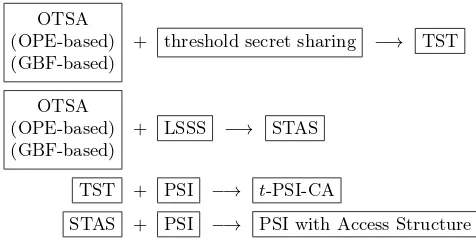
OTSA (OPE-based) (GBF-based)
+ threshold secret sharing −→ TST
OTSA (OPE-based) (GBF-based)
+ LSSS −→ STAS
TST + PSI −→ t-PSI-CA
STAS + PSI −→ PSI with Access Structure
Fig. 1: Roadmap of Our Constructions
compare with its own set. Using similar technique, Kissner and Song [30] constructed multi-party PSI protocol. More efficient PSI protocols in the malicious model are also proposed [15, 23].
Another common approach of constructing PSI is using oblivious pseudorandom function (OPRF) [19, 22, 27]. The idea is very simple: the server sends to the client fk(si) for each ele-mentsi ∈S, where f(·) is a pseudorandom function and k is a random key. The client and the server then engage in an OPRF protocol such that the client learnsfk(ci) for each ci∈C while the server learns nothing except the size of C. PSI protocols based on OPRF can achieve linear computational and bandwidth complexity.
Very recently, Dong et al. [18] introduced new techniques for PSI. The core component is a variant of Bloom Filter, which they calledgarbled Bloom filter(GBF). We will give a more detailed description of GBF in the next section. Combining GBF andoblivious transfer (OT), Donget al. constructed a very efficient PSI in both semi-honest and malicious models. Inspired by their paper, we construct PSI with access structure with linear complexity in the semi-honest model. We remark that their technique of constructing malicious model PSI might be useful in constructing PSI with access structure in the malicious model. Their PSI protocol is further improved [38, 39].
Researchers have considered variants of PSI. Some reveal only the size (cardinality) of intersec-tion but not the set itself [2, 12, 20, 25, 30, 45], which we callPSI-CA. Some achieve more features. For example, Camenisch and Zaverucha [11] and De Cristofaroet al.[13,14] consideredauthorized PSI (APSI) which requires the input sets to be signed by a trusted party. Ateniese et al. [3] and D’Arco et al. [16] proposed size-hiding PSI which hides the size of the client’s input set. Outsourcing the computation of PSI to an oblivious cloud is considered by Abadi et al. [1] and Kerschbaum [29]. Kissner and Song [30] considered threshold set union and its variants in multi-user setting: allnplayers learn which elements appear more thanttimes in the union (which is a multiset) of their private input set.
2.2 Fuzzy Vault
A fuzzy vault, introduced by Juels and Sudan [28], allows a server to “lock” a small secret value
κ using a set S, such that a client holding another set C which is similar to S could recover κ
efficiently. This primitive looks very much like TST, but we would like to highlight the differences here.
We first briefly recall the existing construction [28]: the elements in the server setSare encoded as distinctx-coordinate values. The server selects a random polynomialp(·) that encodesκin some way (sayp(0) =κ), and evaluates p(·) on these coordinates. To hideκ, the server adds a number of random “noisy” points that do not lie on p(·), and publishes the set of both real and noisy pointsin clear.
large enough, then the client is not able to identify enough “correct” x-coordinates to perform polynomial interpolation.
Even if the polynomial (say, of degreek) cannot be reconstructed when the size of the intersec-tion|C∩S|isk(i.e.one more point is needed), an adversary can still launch the following attack to reveal the rest of the setS. Consider the server set is of sizens, and the number of noisy points isN. The client could simply try reconstructingκby choosing one of the (ns+N−k) remaining points. The probability of success is nsns−k+N−k.
One might consider this as a feature: the more similar the client set is, the more likely to recoverκ. However, in TST, we aim to impose asharp distinction between “over threshold” and “below threshold”. Again, the client only knows that |C∩S| is not greater than the threshold, but not exactly which elements inC lie in the intersection. To achieve the same guarantee using fuzzy vault, an exponential number of noisy points must be added, which is impractical.
2.3 Attribute-Based Encryption
Attribute-based encryption (ABE) [41] is a generalization of public key encryption, which allows sharing of encrypted content to people according to some prescribed access control policy, without the need of knowing all public keys of those people. Anyone in possession of attributes satisfying the access policy can use their secret keys for decryption. Early ABE schemes suffer from the weakness of revealing the access policy of ciphertexts to everyone, which might be sensitive. Anonymous ABE [31, 36] is then proposed.
One might attempt to implement STAS as follows: encrypt the secret value using anonymous ABE, then send the ciphertext to the receiver. This solution seems plausible. Yet, ABE requires a trusted authority to set up the whole system, and issue secret keys to participants according to their attributes. Such requirement somewhat trivializes the two-party computation since both parties need to trust the authority not to reveal the attributes to others. ABE constructions also typically make extensive use of rather expensive pairing operations.
Furthermore, the anonymity offered by practical anonymous ABE schemes nowadays are not ideal. Having a closer look of existing works, the size of public key and ciphertext in the first scheme [36] are both linear in the size of the attribute universeU. Liet al.[34] reduced the public key size to O(1) and the ciphertext size to O(log|U |), but unfortunately their scheme is inse-cure [33]. These two constructions only support limited form of policies. Laiet al.[31] constructed an anonymous ABE which supports more expressive policy in the form of LSSS (see Sec. 3.2), yet sacrifices anonymity to some extent. In more details, each attribute is a category-value (e.g.Title: Professor, Department: CS) pair in their construction. The LSSS matrix is defined over the cate-gories, and this matrix is public. Only the attribute values are anonymized. That is to say, a policy “(Title: Professor)AND(Department: CS)” is anonymized as “(Title: ∗)AND(Department: ∗)”. In contrast, such an access policy is anonymized as “AANDB” in our STAS construction whereA
andBare predicates. To conclude, anonymous ABE is not a good fit for our problem.
3
Preliminary
3.1 Notations
For a binary stringx, |x|denotes its length. Theith bit of xisx[i] andx[i, j] denotesx[i]. . . x[j]
for 1≤i≤j≤ |x|. For a finite set S,|S| denotes its size ands←−$ S denotes picking an element uniformly at random from the set S. For i ∈ N, we let [1, i] = {1, . . . , i}. We write {si}n as a
shorthand for the set S={s1, . . . , sn}of nelements. We drop the subscriptn if it is clear from context. We denote the security parameter byλ∈Nand its unary representation by 1λ.
Algorithms are polynomial time (PT) and randomized unless otherwise indicated. By y ←−$ A(x1, . . .;R) we denote running algorithm Aon inputx1, . . .using randomnessR, and assigning
A probability ensemble indexed byIis a sequence of random variables indexed by a countable index set I. Namely, X = {Xi}i∈I where Xi is a random variable. Two distribution ensembles
X ={Xn} andY ={Yn} are computationally indistinguishable, denoted byX c
≡Y, if for every probabilistic polynomial-time (PPT) algorithm D, there exists a negligible function negl(·) such that for everyn∈N,
|Pr[D(Xn,1n) = 1]−Pr[D(Yn,1n) = 1]| ≤negl(n). We letG=hgibe a group of orderp, aλbit-prime number.
3.2 Secret Sharing
Threshold secret sharing is a fundamental cryptographic primitive and it could be considered as the most basic tool for threshold cryptography. It allows a dealer to split a secretκintonshares, such thatκcan be recovered efficiently with any subset oftor more shares. Any subset of size less than
treveals no information about the secret value. Shamir’s secret-sharing scheme [43], which is based on polynomial interpolation, is such a (t, n)-secret sharing scheme. We denoteSecretSharing(t,n)(κ)
andReconstruct(t,n)({κi}n′) as its sharing algorithm and reconstruction algorithm.
When t=n, an efficient (n, n)-secret sharing scheme can be obtained from ⊕(XOR) opera-tions [42]. It works by picking random|κ|-bit stringsκ1, κ2, . . . , κn−1as the firstn−1 shares. The
last share is computed byκn=
Ln−1
i=1 κi
⊕κ. We will use this simple scheme extensively. We can extend threshold secret sharing scheme to support more general access structure. Let
{κ1, . . . , κn}be a set of secret shares. An access structure [5] is a collectionAof non-empty subsets of{κ1, . . . , κn},i.e.,A⊆2{κ1,...,κn}\ {∅}. We denoteSecretSharingA(κ) andReconstructA({κi}n′) as the sharing algorithm and reconstruction algorithm in a secret sharing scheme implementing access structureA. Any monotone access structure can be realized by a linear secret sharing scheme
defined below [5].
Definition 1 (Linear Secret-sharing Schemes (LSSS)) A secret sharing scheme Π over a set of parties P is called linear overZp if
1. The shares of each party form a vector overZp.
2. There exists a matrixM called the share-generating matrix for Π. The matrix M has ℓrows andncolumns. For a column vectorv= (κ, r2, . . . , rn), whereκ∈Zpis the secret to be shared and r2, . . . , rn ∈ Zp are randomly chosen, then M v is the vector of ℓ shares of the secret κ according to Π. The share (M v)x, the x-th row of M v, belongs to partyρ(x), where ρ maps
{1, . . . , ℓ} toP.
Any LSSS defined as above enjoys the linear reconstruction property as follows. Suppose that
Π is an LSSS for access structureA. LetS∈ Abe an authorized set, andI⊆ {1, . . . , ℓ}be defined as I={i:ρ(i)∈S}. There exist constants {wi∈Zp}i∈I satisfyingPi∈IwiMi= (1,0, . . . ,0), so that if {λi} are valid shares of any secret κaccording to Π, then Pi∈Iwiλi =κ. Furthermore, these constants{wi} can be found in time polynomial in the size of the share-generating matrix
M. For any unauthorized set, no such constants exist. The LSSS is denoted by (M, ρ), and its size is the number of rows ofM.
Access structures can also be represented by monotonic boolean formulas. The techniques of transforming any monotonic boolean formula to LSSS are well known in the literature [5]. One can also convert the boolean formula into an access tree. An access tree ofℓ nodes results in an LSSS matrix ofℓrows. Readers can refer to [32, appendix] for the conversion algorithm.
3.3 Oblivious Transfer (OT)
Formally, in an OTm
ℓ protocol, the sender inputsmpairsℓ-bit strings (xi,0, xi,1) (1≤i≤m) and
the receiver inputs an m-bit selection string b = (b1, . . . , bm). At the end of the protocol, the
sender learns nothing about b, while the receiver only getsxi,bi for 1≤i≤m. OT protocols in the random oracle model can be very efficient2.
Basically the above formulation only allows the receiver to choose1-out-of-2 according to each bit in the selection string. Researchers have also considered more general k-out-of-n OT, where the receiver preparesnstrings, and the receiver only getskof them by specifying a set of distinct indexes (in range [1, n] instead of{0,1}) of sizek.
Looking ahead, we use the notion (which slightly abuses the one defined above) OT|Is∩Ir|Is for oblivious transfer for a sparse array (OTSA). Note that the superscript is a number while the subscript is a set, thus differentiates OTSA from OTm
ℓ . Roughly speaking, OT |Is∩Ir| Is can be considered as an|Is∩Ir|-out-of-|Is|OT. The meaning behind such superscript and subscript will be more clear after we explained the meaning ofIsandIrin Sec. 4.1.
3.4 Additive Homomorphic Encryption
We will also use semantically-secure additive homomorphic encryption scheme. One well known example is Paillier’s cryptosystem [37]. It supports addition, and multiplication by a constant, without private key sk. Specifically, given two ciphertexts Encpk(m0) and Encpk(m1), there is
an efficient operation that can compute Encpk(m0+m1); given one ciphertext Encpk(m) and a
constantc, there is an efficient operation that can produceEncpk(c·m). A corollary of these two properties is: given encryptions of the coefficientsa0, . . . , ak of a polynomialp(x) of degreek, and a plaintexts, it is possible to compute an encryption ofp(s).
3.5 Oblivious Pseudorandom Function
An oblivious pseudorandom function [19] is a two-party protocol between a serverS and a client
C for securely computing a pseudorandom function fk(·) under key k known by S only, while the input x is known by C. The client learns fk(x) while the server learns nothing after their interaction. In this work, we consider the construction given by Jarecki and Liu [27]. It is secure under parallel composition [27] and our second construction relies on this special property. This protocol uses Camenisch-Shoup version [10] of Paillier encryption [37] (Encpk(·),Decsk(·)), which is additive homomorphic, to compute Dodis-Yampolskiy PRF [17] fk(x) =gk+1x. We sketch the main procedures as follows:
1. The server sendsEncpks(k) to the client.
2. The client chooses a random number rc, computes Encpks(rc(k+x)) by the homomorphic property, and then replies with (c1, c2) = (Encpks(rc(k+x)),Encpkc(rc)).
3. The server decryptsc1 and computes its inverse rc(k1+x). It also chooses a random numberrs and uses the homomorphic property to computes1 =c2
1
rc(k+x) ·Enc
pkc(−rs). Then it replies with (s1, s2) = (Encpkc(k+1x−rs), g
rs).
4. The client decryptss1 to get k+1x−rs, and computes the final output asg
1
k+x =g
1
k+x−rs·s2. The parallel version of this OPRF can be easily obtained by replacingrc, rs,(c1, c2) and (s1, s2)
with {r(ci)}|C|,{rs(i)}|C|,{(c(1i), c (i)
2 )}|C| and {(s(1i), s (i)
2 )}|C| respectively in Steps 2 to 4. Also note that if the server applies a random permutation Π on{(s(1i), s
(i)
2 )}|S|, the client will still get the
same setngk+1xio
|C|, but it does not know whichg
1
k+xi corresponds to whichx
i due to property of PRF. We denote such parallel OPRF with additional permutation step asoblivious permuted pseudorandom function (OPPRF).
2 In the random oracle model, one can reduce expensive public key operations for OTm
3.6 Bloom Filters and Garbled Bloom Filters
An (m, n, k, H)-Bloom filter [6] is a compact array ofmbits that can represent a setSof at most
nelements for efficient set membership testing. It consists of a set ofkindependent hash functions
H = (h1, h2, . . . , hk) where eachhi maps elements to index numbers in the set [1, m] uniformly. Initially, all bits in the array are set to 0. To insert an element x∈S into a Bloom filter, the element is hashed using thekhash functions to getkindex numbers. The bits at all these indexes in the bit array are set to 1, regardless of its original value. To check if an item y is inS, y is hashed by thekhash functions to getkindexes. If any of the bits at these indexes is 0, we conclude thaty is certainly not inS. Otherwise,yis probably inS. So, it never yields a false negative, but there is a small fraction of false positives. The upper bound of the false positive probability [8] is:
ǫ=pk×
1 +O
k p
q
lnm−klnp m
wherep= 1−(1−1/m)kn.
The false positive rate should set to be less than a certain thresholdǫ. It can be shown that the length of the bit arraymshould be at leastm≥nlog2e·log21/ǫ, and the number of hash functions
k= (m/n)·ln 2 = log21/ǫ, whereeis the base of the natural logarithm. In the rest of this paper,
we will stick with these optimal values when we use (garbled) Bloom filter. Specifically, we set the false positive probability ǫ = 2−λ where λ is the security parameter. As a result, m =λnlog
2ǫ
andk=λin all cases. So we represent a Bloom filter with optimal parameters as an (n, H, λ)-BF. An (m, n, k, H, λ)-garbled Bloom filter [18] is a variant of Bloom filter introduced by Donget al. that supports efficient private set-intersection. Roughly speaking, a garbled Bloom filter uses an array ofλ-bit strings instead of an array of bits in a normal Bloom filter. Initially allmstrings in the garbled Bloom filter are set to NULL. To insert an elementx∈ {0,1}λ,xis first split intokshares by XOR-based (k, k)-secret sharing. Thekthshare is placed at locationhi(x). If the locationhi(x)
is already occupied due to previous insertion, wereuse the string at that location, and adjust the value of subsequent shares accordingly, subject to the constraint thatLk
i=1GBF[hi(x)] =x. Such
adjustment is always possible unless all locations{hi(x)}1≤i≤kare all occupied, which corresponds to a false positive. The probability of this happening can be negligible if the parameters are set properly. After inserting all elements inS to the garbled Bloom filter, the undefined slots in the vector are filled with random strings. To check if an item y is in S, y is hashed by the k hash functions, and the strings in those locations are retrieved. If y can be reconstructed from these shares, we conclude thatyis surely inS. For brevity, GBF with optimal parameters will be denoted by (n, H, λ)-GBF.
3.7 Semi-honest Secure Computation
We use the following simulation-based definition for security. We considerstatic semi-honest adver-saries [21], which can control one of the two parties and assumed to follow the protocol specification exactly. However, it may try to learn more information about the other party’s input.
A two-party protocol π computes a function that maps a pair of inputs to a pair of outputs
f :{0,1}∗× {0,1}∗→ {0,1}∗× {0,1}∗, wheref = (f
1, f2). For every pair of inputsx, y∈ {0,1}∗,
the output-pair is a random variable (f1(x, y), f2(x, y)). The first party obtains f1(x, y) and the
second party obtainsf2(x, y).
In the semi-honest model, a protocol π is secure if whatever can be computed by a party in the protocol can be obtained from its input and output only. This is formalized by the simulation paradigm. We require a party’s view in a protocol execution to be simulatable given only its input and output. The view of the partyiduring an execution of πon input (x, y) is denoted by
Viewπi(x, y) = (w, ri, mi
1, . . . , mit) wherew∈(x, y) is the input ofi, ri isi’s internal random coin tosses andmi
j denotes thejth message that it received.
Definition 2 (Semi-honest Model) Let f = (f1, f2) be a deterministic function. Protocol π
probabilistic polynomial-time algorithms Sim1 andSim2 such that
{Sim1(x, f1(x, y))}x,y c
≡ {Viewπ1(x, y)}x,y
{Sim2(y, f2(x, y))}x,y c
≡ {Viewπ2(x, y)}x,y
4
OT for a Sparse Array
We propose oblivious transfer for a sparse array (OTSA) as a building block for secret transfer with access structure (STAS). We first provide a formal definition for OTSA and then sketch the main design idea before presenting two concrete constructions.
Although in an abstract level, the two constructions both make use of the idea of PSI with data transfer, we believe the first OPE-based construction is conceptually simpler and easier to understand than the second GBF-based one for readers who do not have prior knowledge in recent advances of PSI, in particular, (garbled) Bloom filter. As a consequence, the OPE-based one is worth mentioning, even though its computation complexity is quite high (quadratic in the number of elements). The second construction achieves linear complexity using more recent techniques (i.e., combining garbled Bloom filter and oblivious transfer) in the area of PSI. In Sec. 7, we implement the second (more practical) construction and evaluate its performance.
4.1 Definitions
OTSA is a new variant of the original OT concept. The sender holds an array of ns elements
{ei}1≤i≤ns(from a certain domain), which are associated withnsdistinct indicesIs={s1, . . . , sns}, where eachsj for 1≤j≤nsis an element from the domainD, not necessarily [1, ns]. The receiver specifies a set of indicesIr={r1, . . . , rnr}, not necessarily a subset of Is, and asks for retrieving the associated elements. We assume the domainD is large, i.e., ns ≪ |D| andnr ≪ |D|, so not every indexrj∈Irspecified by the receiver indeed has an element from the server associated with it. Our OTSA satisfies the following properties:
– Correctness: The receiver retrieves E′ ={e′
j}1≤j≤nr, wheree′j =ej ifsj ∈Is∩Ir, ore′j is an element randomly picked from a pre-defined domain ifsj ∈/ Is∩Ir.
– Receiver privacy:The sender learns nothing aboutIr.
– Sender array privacy:The receiver learns nothing about ej’s whose indexsj ∈/ Is∩Ir. – Sender indices privacy: The receiver learns nothing aboutIsexcept|Is∩Ir|.
Distinction from Normal OT Normal OT typically represents the server indices by [1, ns]. A possible way to use OT to realize the functionality we want to achieve is to require the server to publish a 1-to-1 mapping between [1, ns] and{s1, . . . , sns}, but this breaks the sender indices privacy. Another possibility is to simply use normal OT in which the server holds|D| elements. This will incurO(|D|) communication complexity. Ideally, we shoot forO(max(nr, ns)). We remark that our primitive implies the normal OT since one can simply setIs= [1, ns].
More on Correctness Requirement For OTSA to be useful, the client should have the ability to differentiate a correct data element from a random string. In case the application (e.g., in TST) may not make it apparent, it can be achieved by asking the server to append a special symbol toei for recognition, or simply publish{H(ei)}whereH(·) is a cryptographic (one-way) hash function.
Security Using the language of secure two-party computation, we define OT for a sparse array as the following functionality:
Definition 3 (Oblivious Transfer for a Sparse Array (OTSA)) OTSA is a two-party com-putation protocol that implements the following functionality
f(x, y) = (⊥, E′)
where the server’s inputx= (E, Is)consists of two sets of the same sizens, one being the (multi-)set of data elements E ={e1, . . . , ens}, another being the sender’s index setIs={s1, . . . , sns}. The receiver’s input y=Ir is a set of indices of sizenr. The output of the receiverE′ is a subset of E, such that ej∈E′ if and only if its indexsj ∈Is∩Ir.
We assume that the size of index sets, namely nsandnr, are publicly known by both parties. We say that a protocol πis an OTSA in the semi-honest model if it securely implements the above functionf in the semi-honest model. As discussed in Sec.3.3, we denote such a protocol by OT|Is∩Ir|Ir .
4.2 Construction Idea
Our two constructions borrow ideas from the area of private set-intersection. One is based on oblivious polynomial evaluation (OPE); the other one is based on a variant of garbled Bloom filter. It has been observed that the PSI protocol from OPE can actually allow the transfer of auxiliary information. Hence, we exploit this storage capacity to store the data elements for our OTSA. Corresponding, we make the same observation for the GBF-based PSI. We note that while both PSI protocols share the same property, their construction ideas are quite different.
4.3 OPE-based OT|Is∩Ir| Ir
Now we describe our first construction, which is based on oblivious polynomial evaluation, in Fig. 2.
Protocol: OPE-based OT|Is∩Ir| Ir
Input: The receiver’s input is an index setIr={r1, . . . , rnr}. The sender’s input is an index set
Is={s1, . . . , sns}and a data setE={e1, . . . , ens}.
1. The receiver chooses a key pair (pk, sk) for a semantic secure additive homomorphic encryption scheme (Encpk,Decsk), and publishespk.
2. The receiver computes the coefficients of the polynomial p(x) = Pnr
i=0aixi of degree nr with roots being elements in theselection strings setIr.
3. The receiver encrypts each of the (nr+ 1) coefficients by the additive homomorphic encryption scheme and gives the sender the resulting set of ciphertexts, {Encpk(ai)}.
4. For each indexsi∈Is, the sender:
(a) Uses the homomorphic property to evaluate the encrypted polynomial atsi, namely computes
Encpk(p(si)).
(b) Chooses a random valuer and computesEncpk(rp(si) +ei). 5. The sender sends a permutation of thesens ciphertexts to the client.
6. The receiver decrypts allns ciphertexts received, picks up the set of valid elements.
The correctness of this OPE-based OT|Is∩Ir|Ir is straightforward: ifsi∈Ir∩Is, thenrp(si)+ei=
ei, meaning that the receiver successfully received one element; otherwise rp(si) +ei will be a random string containing no useful information aboutei. More formally, we assert the security of the above protocol in the following theorem:
Theorem 1 The protocol in Fig. 2 securely implements the functionf in Sec. 4 in the semi-honest model.
Proof. Constructing an ideal world sender SIMs will be easy, since the sender’s view only con-tainspk and{Encpk(ai)}. The first one is simply a valid public key, while the second one can be simulated by encryption of random strings due to semantic security of the encryption scheme.
Constructing an ideal world receiver SIMr from a malicious receiver R∗ in the real world can be done in the following way: SIMr first gets the public key pk and the set Γ = {γi} where
|Γ|=|Ir|+ 1. On gettingIr from the receiverR∗, it sends ((E, Is), Ir) to the ideal functionality
FOT AS, which outputsE′={e
j}sj∈Is∩Ir to the receiver, on the ideal world sender’s input (E, Is) and SIMr’s input Ir. Then SIMr first gives the sender the set of ciphertexts by encrypting the coefficient of a polynomial constructed fromIras in the real world, then sends toR∗a permutation of the following set of ciphertext: (1) among |Is∩Ir| of them, each encrypts ej, (2) the rest of them just encrypt random strings.
4.4 GBF∗-based OT|Is∩Ir| Ir
Our second construction is based on a variant of garbled Bloom filter (GBF), which we call it GBF∗. An (n, H, λ)-GBF∗
X,I stores a secret set X using another setI of the same sizen. In the original GBF, each elementxj∈Xis first split intok=λshares and then these shares are placed at locationsh1(xj), . . . , hk(xj). While in our GBF∗X,I, eachxj∈X is split and placed at locations defined by h1(ij), . . . , hk(ij), where ij ∈ I. Namely, the set I “indexes” the locations to place
X. When we query GBF∗
X,I using some elementi′ ∈I, then GBF∗X,I returns the corresponding elementx′. Ifi′ ∈/ I, then GBF∗
X,I returns a uniformly random string.
TheBuildGBF∗,QueryGBF∗, andGBF∗Intersectionalgorithms constituting our GBF∗are listed as follows:
It is easy to see that Algorithm 1 fails only when emptySlot remains unchanged before line 22. The false positive of GBF∗ means when querying GBF∗X,I with some index i′ ∈/ I, Algorithm 2 returns some element x ∈ X. Following the existing analysis [18], we have with the following theorems:
Theorem 2 Algorithm 1 fails with probability negl(λ).
Theorem 3 The false positive probability is negl(λ).
The underlying idea of Algorithm 3 is very similar to the GBFIntersection algorithm [18]. Thus Algorithm 3 inherits the corresponding theorems forGBFIntersectionalgorithm. We omit the largely repeated proofs for the page limit.
Theorem 4 ForGBF∗
˜
S,I∩I′ produced by Algorithm 3. Letaℓ be the event thatGBF ∗
˜
S,I∩I′[hℓ(ij)] equals the ℓ-th share ofsj,1≤ℓ≤k; then (i)∀ij∈I∩I′: Pr[a1∧. . .∧aℓ] = 1(ii)∀ij∈/I∩I′: Pr[a1∧. . .∧ak]isnegl(k).
Theorem 5 Given sets I, I′ and their intersectionI∩I′, let S˜⊆S be a set such that sj ∈S˜ if and only if ij ∈I∩I′. Let GBFS,I∩I∗˜ ′ be the output of the Algorithm 3 from GBF
∗
S,I andBFI′,
let GBFS,I∩I∗′˜ ′ be another GBF
∗ produced by Algorithm 1 using S˜ and I∩I′, then GBF∗
˜
S,I∩I′ c
≡ GBF∗′
˜
Algorithm 1BuildGBF∗(n, H, λ)
Input: A secret setX, an indexing setI,n, λ, andλuniform hash functionsH={h1, . . . , hλ}
Output: An (n, H, λ)-GBFX,I∗ 1: procedure
2: Setm=λnlog2e
3: GBFX,I∗ = newm-element array ofλ-bit strings 4: forj←1, mdo
5: GBFX,I∗ [j] = NULL 6: end for
7: for eachxj∈X do
8: emptySlot =−1, finShare =xj 9: forℓ←1, λdo
10: index=hℓ(ij);
11: if GBFX,I∗ [index] == NULLthen 12: if emptySlot==−1then
13: emptySlot =index
14: else
15: GBFX,I∗ [index]
$
←− {0,1}λ
16: finShare=finShare⊕GBFX,I∗ [index]
17: end if
18: else
19: finShare=finShare⊕GBFX,I∗ [index]
20: end if
21: end for
22: GBFX,I∗ [emptySlot] = finShare 23: end for
24: forj←1, mdo
25: if GBF∗
X,I[j] == NULLthen 26: GBFX,I∗ [j]
$
←− {0,1}λ
27: end if
28: end for
29: returnGBFX,I∗ 30: end procedure
Now we are ready to detail the procedure of our second OT|IsIr∩Ir| construction in Fig. 3. Note that in the second step, the receiver’s setIris transformed into a pseudorandom setIr′. We implement this transformation using an OPPRF protocol (Sec. 3.5) instead of a normal OPRF because we need to hide the one-to-one correspondence betweenrj andrj′ from the receiver. Note that our scheme is also modular since any secure OPPRF suffices.
Theorem 6 The protocol in Fig. 3 securely implements the functionf in Sec. 4 in the semi-honest model.
Proof. (sketch). The proof mostly follows that of [18, Theorem 7], except that the simulator needs to randomly generate a set of indices ˜I of size |Is∩Ir|, and uses it as the additional input to construct GBF∗π
˜
E,I˜, which is computationally indistinguishable fromGBF ∗
˜
E,I′
r∩Is′ by the security of PRF, and thus indistinguishable fromGBF∗π
˜
E,I′ s∩Ir′
by Theorem 5 above.
5
(Threshold) Secret Transfer
Algorithm 2QueryGBF∗(GBF∗
X,I, i′, k, H)
Input: A (n, H, λ)-secret embedding garbled Bloom filterGBFX,I∗ ,λ, H={h1, . . . , hλ}
Output: An elementx∈X ifi′∈I, a random string otherwise 1: procedure
2: x˜={0}λ 3: forℓ←1, λdo
4: index=hℓ(i′)
5: x˜= ˜x⊕GBFX,I∗ [index] 6: end for
7: returnx˜ 8: end procedure
Algorithm 3GBF∗Intersection(GBF∗
X,I, BFI′, m)
Input: An (n, H, λ)-secret embedding garbled Bloom filterGBFX,I∗ , an (n, H, λ)-Bloom filterBFI′
Output: (n, H, λ)-GBFX,I∗˜ ∩I′ 1: procedure
2: Setm=λnlog2e
3: GBFX,I∗˜ ∩I′= newm-element array ofλ-bit strings 4: forj←1, mdo
5: if BFI′[j] == 1then 6: GBFX,I∗˜ ∩I′[j] =GBF
∗ X,I[j]
7: else
8: GBF∗
˜
X,I∩I′[j]
$
←− {0,1}λ
9: end if
10: end for
11: returnGBFX,I∗˜ ∩I′ 12: end procedure
secret transfer (TST). Next we demonstrate how to easily extend TST to support general access structure, namely STAS.
5.1 Definition
Using the language of secure two-party computation, we define TST as the following functionality:
Definition 4 (Threshold secret transfer (TST)) TST is a two-party computation protocol that implements the following functionality
f(x, y) =
(
(⊥, κand |C∩S|) if |C∩S| ≥t
(⊥,|C∩S|) otherwise
where the server’s inputx= (κ, S)and the client’s inputy=C.
Above definition always leaks the intersection size to the client. This is due to the technical difficulty for simulation to the client without this knowledge. More discussion will be given later. For the sake of completeness, we give the stronger definition.
Definition 5 (Strong threshold secret transfer ((ST)2)) (ST)2 is a two-party computation
protocol that implements the following functionality:
f′(x, y) =
(
(⊥, κ) if |C∩S| ≥t
Protocol: GBF∗ based OT|Is∩Ir| Ir
Input: The receiver’s input is an index setIr={r1, . . . , rnr}, the sender’s input is an index set
Is={s1, . . . , sns}and a data setE={e1, . . . , ens}.
1. The sender chooses a random keykPRFfor Dodis-Yampolskiy pseudorandom functionfkPRF(·).
2. The receiver and the sender engage in an OPPRF protocol usingIrandkPRFas input respectively, such that the sender learns nothing while the receiver obtainsIr′ ={r′j}whererj′ =fkPRF(rj) for
allj. The sender also converts its own private setIs intoIs′ in similar manner.
3. The receiver generates an (n, H, λ)-BFI′r that encodes its private setIr′, the sender invokes Al-gorithm 1 to generate a (n, H, λ)-GBFE,I′∗ s.
4. The receiver usesBFI′r as theselection strings and acts as the receiver in an OTmλ protocol. 5. The sender sendsmpairs ofλ-bit strings (xi,0, xi,1)(1≤i≤m) in OTmλ, wherexi,0is a uniformly
random string andxi,1 isGBFE,I′∗ s[i]. For 1≤i≤m, ifBFI′r[i] is 0, then the receiver receives a random string; ifBFI′
r[i] is 1 it receivesGBF ∗ E,I′
s[i]. The result obtained by the client is denoted byGBFE,I∗˜π′
s∩Ir′.
6. The receiver queriesGBFE,I′∗πs∩I′r using its own setIr′, and picks up the set of valid element{E˜}.
Fig. 3: Protocol: GBF∗-based OT|Is∩Ir| Ir
In (ST)2, the server remains oblivious about the client’s input set, but the client only learns if
|C∩S| ≥tor not.
5.2 TST Construction from OT|Is∩Ir| Ir
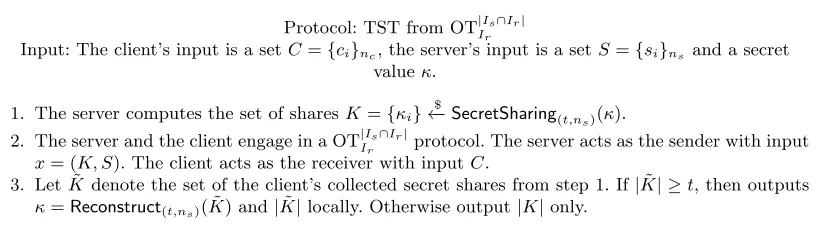
The basic idea behind the construction is to split κinto K ={κi} using (t,|S|)-secret sharing scheme. The server and the client then engage in an OT|Is∩Ir|Ir protocol with the server acting as sender using secret input set K and indexing set S, and the client acting as the receiver using
C as input set. By the security of OT|Is∩Ir|Ir , the client receives only a subset of secret shares of κ corresponding to elements in |C∩S|. The security of TST naturally follows from that of (t,|S|)-secret sharing scheme.
The detailed construction is given in Fig. 4.
Protocol: TST from OT|Is∩Ir| Ir
Input: The client’s input is a setC={ci}nc, the server’s input is a setS={si}ns and a secret valueκ.
1. The server computes the set of sharesK={κi}
$
←−SecretSharing(t,ns)(κ). 2. The server and the client engage in a OT|Is∩Ir|
Ir protocol. The server acts as the sender with input
x= (K, S). The client acts as the receiver with inputC.
3. Let ˜K denote the set of the client’s collected secret shares from step 1. If|K˜| ≥t, then outputs
κ=Reconstruct(t,ns)( ˜K) and|K˜|locally. Otherwise output|K|only.
Fig. 4: TST Construction from OT|Is∩Ir|Ir
Proof. (sketch). If the OT|Is∩Ir|Ir is secure, the simulators for both sides exist. We can use them as subroutines to construct the simulator for the whole protocol.
Server’s view: We construct a simulatorSimS, when given the server’s private input and out-put, simulates the server’s view ViewS of a real protocol execution. ViewS contains the input set S, the secret value κ, the random coins, and the view of OT|Is∩Ir|Ir . The simulator SimS se-lects random coinsrsuniformly random, and also computes K′ ={κ′
i}
$
←−SecretSharing(t,ns)(κ).
ThenSimS invokes the simulator for OT |Is∩Ir|
Ir to obtainSim OT
sx ((K′, S),⊥). Finally,SimS outputs (S, K′, rs,SimOT
sx ((K′, S),⊥)) as the simulated view. Because K′ is generated in the same way as
in the real protocol, it follows that SimOTsx ((K
′, S),⊥)≡c SimOT
sx ((K, S),⊥). Thus by the security
of OT|Is∩Ir|Ir , the simulated view should be indistinguishable fromViewS.
Client’s view: We construct a simulatorSimC, when given the client’s private input and output, simulates the client’s viewViewCof a real protocol execution.ViewCcontains the input setC, the random coins, and the view of OT|IsIr∩Ir|.
– If |C∩S| ≥ t, the simulator SimC is given C, κ,|K| = |C∩S| as input. SimC picks coins
rc uniformly random, and also computes K′ ←−$ SecretSharing
(t,ns)(κ). SimC then selects a random subset ˜K′ ⊆K′ of size |K| uniformly at random. ThenSim
C invokes the simulator for OT|Is∩Ir|Ir to obtainSimOTrx (C,( ˜K′,|K|)).SimC outputs (C, rc,Sim
OT
rx (C,( ˜K′,|K|))) as the
simulated view. Since K′ and ˜K′ are generated in the same way as K and ˜K in the real protocol, SimOTrx (C, ( ˜K′,|K|)) is identically distributed as Sim
OT
rx (C,( ˜K,|K|)). Thus by the
security of OT|Is∩Ir|Ir , the simulated view should be indistinguishable fromViewC.
– If |C ∩S| < t, SimC is given only C,|K| = |C ∩S| as input. This time SimC selects a random κ′, and computes K′′ ←−$ SecretSharing
(t,ns)(κ′). SimC then selects a random subset ˜
K′′⊆K′′ of size|K|< tuniformly at random.Sim
C outputs (C, rc,SimOTrx (C,( ˜K′′,|K|))) as
the simulated view. To see that above simulated view works well, notice that by the security of (t, ns)-secret sharing scheme, both ˜K′′generated bySim
C and ˜K received in the real protocol execution leak no information about the original value κ′ and κ respectively. Thus ˜K′′ and
˜
K are computationally indistinguishable. Therefore SimOTrx (C,( ˜K′′,|K|)) simulates the view
of OT|IsIr∩Ir|perfectly.
In both cases, the client’s view can be simulated. Combining the result for the server’s view, we conclude that the protocol in Fig. 4 is secure in the semi-honest model.
5.3 Transferring Multiple Secrets
Our exposition only considers transferring the secret shares of a single secret. Yet, it is possible to store multiple shares of the same secret in the same slot for supporting weighted TST. One step further, it is also possible to store multiple share of different secrets in the same slots. However, since the capacity of each slot is limited. One may need to resort to a hybrid approach where symmetric keys are stored in the TST, while these symmetric keys can in turn unlock the corresponding ciphertext encrypting multiple shares.
5.4 Extending to General Access Structure
It is not hard to see that the threshold access structure of TST comes directly from the under-lying threshold secret sharing scheme (SecretSharing(t,ns),Reconstruct(t,n)). If we replace it with
other secret sharing scheme with different access structure (SecretSharingA,ReconstructA), the TST construction will be readily transformed into STAS with access structure A. The proof strategy
remains mostly unchanged.
Recall that in LSSS (see Def. 1), the share generating matrix M is public. The secret value
κ is embedded in a column vector v = (κ, r2, . . . , rn), and party ρ(x) gets the share (M v)x. In STAS, the server also needs to publish M. Moreover, it explicitly appends an index x to each share (M v)x, so that the client knows how to calculate constants{wi ∈Zp}i∈|Is∩Ir| according to
M in the reconstruction phase. Exposing M in clear reveals some information about the access structure, i.e., the shape of the access tree. However, we would like to stress that by the secu-rity property (sender’s indices privacy) of the underlying OTSA, the client does not know the correspondence between the elements in its secret setC and the leave nodes of the access tree.
5.5 Discussion on Leaking Intersection Size
From a theoretical point of view, knowledge of both C and |C∩S| allows one to infer some information aboutS, especially when|C| ≈ |C∩S|. For instance, ifCis of size 100 and the client learns that |C∩S|= 70. The client is able to conclude that many elements in C are also inS. Moreover, if the client can interact with the server multiple times, it can changeCby one element each time and monitor how|C∩S|changes accordingly, which will eventually lead toS.
From a practical standpoint, such leakage is acceptable because the aforementioned probing attack can be mitigated by limiting the number of interactions. Moreover, in the next section we will see an immediate application of TST (resp. STAS),i.e.generict-PSI-CA (resp. PSI with access structure) construction from TST (resp. STAS). The fact that TST always leaks the cardinality of intersection hinders us from obtainingt-PSI. Nevertheless, we believet-PSI-CA is still a useful primitive and it is the first of its kind in the literature. Finally, we remark that, when the cardinality of the intersection is not exceeding the threshold, t-PSI-CA is the same as PSI-CA; otherwiset -PSI-CA works as normal PSI.
6
Threshold-PSI-CA Protocol
With all necessary building blocks at hand, we are now ready to formally introducet-PSI(-CA). Again, we first formally define functionality oft-PSI-CA andt-PSI, then describe how to use TST to realizet-PSI-CA.
6.1 Definitions
Definition 6 (Threshold Private Set-intersection (t-PSI)) t-PSI is a two-party computa-tion protocol that implements the following funccomputa-tionality
f(x, y) =
(
(⊥, C∩S) if|C∩S| ≥t
(⊥,⊥) otherwise
where the server’s inputx=S and the client’s input y=C.
Definition 7 (Threshold Private Set-intersection (t-PSI-CA)) t-PSI-CA is a two-party com-putation protocol that implements the following functionality
f(x, y) =
(
(⊥, C∩S) if|C∩S| ≥t
(⊥,|C∩S|) otherwise
where the server’s inputx=S and the client’s input y=C.
6.2 Generic t-PSI-CA Construction from TST
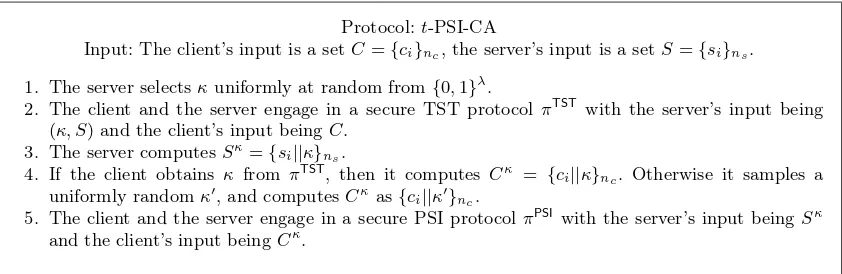
The idea is simple: the client and the server first engage in a TST protocol, such that the client learns κif |C∩S| ≥t; then they engage in a normal PSI protocol, in which the server and the client usesSκ={s
i||κ}ns andCκ={ci||κ}nc as input respectively. In case|C∩S|< t, the client chooses a randomκ′ uniformly at random and useCκ={c
i||κ′}nc instead. The correctness of the above idea is straightforward. What we need to prove is its security. To this end, we first formally describe the above construction in Fig. 5.
Protocol:t-PSI-CA
Input: The client’s input is a setC={ci}nc, the server’s input is a setS={si}ns. 1. The server selectsκuniformly at random from{0,1}λ.
2. The client and the server engage in a secure TST protocol πTST with the server’s input being (κ, S) and the client’s input beingC.
3. The server computesSκ={si||κ}ns. 4. If the client obtains κ from πTST
, then it computes Cκ = {c
i||κ}nc. Otherwise it samples a uniformly randomκ′, and computesCκas{ci||κ′}nc.
5. The client and the server engage in a secure PSI protocolπPSIwith the server’s input beingSκ and the client’s input beingCκ.
Fig. 5: Protocol:t-PSI-CA
Theorem 8 Let πTST
be a secure two-party computation protocol that securely implements the functionf defined in Sec. 5 in the semi-honest model. LetπPSI be a secure PSI protocol in the
semi-honest model. Then the protocol defined in Fig. 5 securely evaluates thet-PSI-CA functionality.
Proof. (sketch) IfπTST
andπPSI
are secure, there exist the simulators for the participants in both protocols. We can use them as subroutines to construct our simulators.
Server’s view: The view of a real protocol execution contains the input setS, the random coins, the view ofπTST, the view ofπPSI(
ViewS = (S, rs,Viewπ
TST
svr ,View
πPSI
svr)). GivenS, the simulatorSimS
pick coins rsuniformly at random, choosesκuniformly at random from {0,1}λ, computesSκ =
{si||κ}ns.SimS then invokes the simulator for the underlying protocols to obtainSimπ
TST
svr ((κ, S),⊥)
andSimπ PSI
svr(Sκ,⊥).SimS outputs (S, rs,Simπ
TST
svr ((κ, S),⊥),Sim
πPSI
svr(Sκ,⊥)) as the simulated view.
Because κ is identically distributed as in the real execution, so will Sκ. Thus by the security of πTST and πPSI,
Simπ TST
svr ((κ, S),⊥),Sim
πPSI
svr(Sκ,⊥) are computationally indistinguishable from
ViewπsvrTST,View
πPSI
svr.
Client’s view: The view of a real protocol execution contains the input setC, the random coins, the view ofπTST
, the view of πPSI
(ViewC= (C, rc,Viewπ
TST
clt ,View
πPSI
clt)).
– If|C∩S| ≥t, the simulatorSimCis givenC, C∩Sas input.SimC selectsκ′ from{0,1}λand coins rcuniformly at random, and computesCκ′
andCκ′
∩Sκ′
accordingly.SimC invokes the simulator forπPSI
andπTST
to obtain respectively the simulated viewsSimπ PSI
clt(Cκ
′
, Cκ′
∩Sκ′ ) andSimπ
TST
clt (C,(κ
′,|C∩S|)).Sim
Cthen outputsC, rc,Simπ
PSI
clt(C
κ′
, Cκ′
∩Sκ′
) andSimπ TST
clt (C,(κ
′,|C∩
S|)) as the simulated view. Because κ′ is identically distributed as κ(which is selected uni-formly at random by the server in the real protocol),Simπ
PSI
clt(Cκ
′
, Cκ′
∩Sκ′
) andSimπ TST
clt (C,(κ′,|C∩
S|)) are identically distributed asSimπ PSI
clt(Cκ, Cκ∩Sκ) andSim
πTST
clt (C,(κ,|C∩S|)). Then by
the security of πPSI and πTST, the simulated view is computationally indistinguishable from
– If|C∩S|< t,SimCis the same as above except replacingSimπ
PSI
clt(C
κ′
, Cκ′
∩Sκ′
) bySimπ PSI
clt(C
κ′
,⊥) andSimπ
TST
clt (C,(κ′,|C∩S|)) bySim
πTST
clt (C,|C∩S|).
In both cases, the client’s view can be simulated. Combining the result for the server’s view, we conclude that the protocol in Fig. 5 is secure in the semi-honest model.
6.3 Extending to PSI with Access Structure
In Sec. 5.4 we show how to construct STAS by replacing threshold secret sharing in TST with linear secret sharing scheme. Following the same vein, we obtain PSI with expressive access structure easily by replacing threshold secret sharing in t-PSI-CA with linear secret sharing scheme. The detailed description is largely the same, thus is omitted for brevity.
7
Evaluation
Comparing our two OT|Is∩Ir|Ir constructions, it is easy to see that both computational cost and communication cost of GBF∗ are linear in n =|I
s|, while OPE-based one is quadratic. For this reason, we only implemented the GBF∗-based OT|Is∩Ir|
Ir inC, by modifying the GBF source code3 provided by Dong, and evaluated its performance. The major modification we did is adding OPPRF before GBF related operations. We use existing Paillier encryption implementation4 for OPPRF.
We consider|Ir|=nhere.
The experiment is conducted on a virtual machine running Ubuntu 12.04 LTS, allotted 2GB memory and 2 CPUs. Both the client and the server program are run on this virtual machine. The host machine is running Windows 8.1, with 2 Intel(R) Core(TM) i5-4590 3.30GHz CPUs, and 8GB RAM. We only implemented single thread version but we remark that both OPPRF and GBF∗ are easily parallelizable. We expect the resulting OT|Is∩Ir|
Ir retains such property. The major bottleneck of our GBF∗-based OT|Is∩Ir|
Ir is Paillier encryption, decryption and computingEncpk(c·m) in OPPRF. For a na¨ıve implementation of OPPRF withnelements, the client needs to encryptnelements in its setX, together withnrandom numberrc. The server also needs to encryptnrandom elementsrs. However, these values do not depend on the other party’s input, so both the client and the server can precompute these values before starting the whole protocol. Our implementation exploits this observation. We remark that when a more efficient OPPRF is available, the efficiency of our protocol will be improved correspondingly.
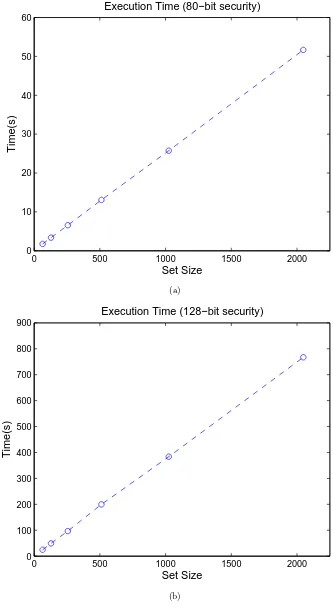
We first fix the key length for Paillier encryption to be 1024-bit, and the security of GBF∗ as 80-bit, because NIST [4] suggests that factorization-based cryptography with 1024-bit key length has 80-bit security. We vary the set size n to be 64,128,256,512,1024,2048, and measure the execution time of GBF∗-based OT|Is∩Ir|
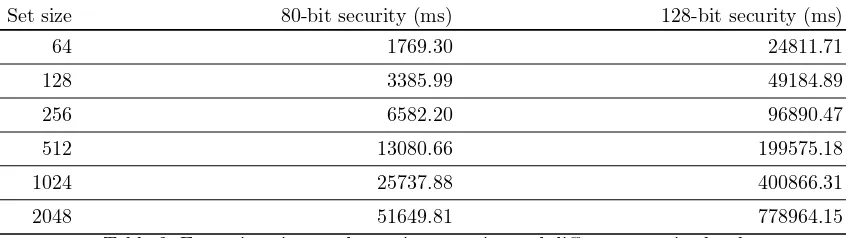
Ir construction. For higher level of security, we fix Paillier key length to be 3072-bit and the security of GBF∗as 128-bit. The result is shown in Table 2 and Figure 6. From the table and the figure we can see that the computation time increases linearly with the set size. When the access structure is simple,i.e.the set size is<20, OT|Is∩Ir|Ir terminates around half a second at 80-bit security. At 128-bit security, the protocol finishes in a few seconds.
8
Further Applications
We discuss a few more applications of our TST.
3
https://personal.cis.strath.ac.uk/changyu.dong/PSI/PSI.html
Set size 80-bit security (ms) 128-bit security (ms)
64 1769.30 24811.71
128 3385.99 49184.89
256 6582.20 96890.47
512 13080.66 199575.18
1024 25737.88 400866.31
2048 51649.81 778964.15
Table 2: Execution time under various set size and different security level
8.1 Private Match-making
As discussed in the introduction, dating apps which work by connecting two users if their set of attributes overlap, can be supported in a privacy-preserving manner via TST.
A nice observation here is that, the asymmetry in the roles of the client and the server in our protocol may actually be useful in the context of private match-making. For example, a business model of paying user (client) and free user (server) may be employed since the client will know if there is a match and hence has the choice to contact the other party (server) upon receipt of the secretκ(which can be the profile picture).
Moreover, even if the desired threshold is not reached, the users may know to what extent they are similar, which can be auseful feature allowing the users to adjust their expected level of similarity for future matching.
It is also possible to store the shares of multiple secrets corresponding to different policies through asingleinvocation of our protocol. For example, a requester who satisfies only the gender criteria can get the ((1,1) share of) an user’s pseudonym with a (1,2) share of a real first name, when another criteria such as the level of education is satisfied, the corresponding slot will contain only the other (1,2) share of the first name. This will give great flexibility for dating apps.
8.2 Publish/Subscribe System
As our protocol is for matching in general, it can also find applications in other scenarios where the transfer of material is based on matching of interests. One example is publish/subscribe sys-tem. Previous work (such as [46]) focus on using attribute-based encryption for the encryption and possibly also attribute-based mechanism or perhaps some other primitives for the interests matching part. Our solution can act as a handy tool.
8.3 Oblivious Transfer with Access Control
OT with access control (OTAC) is introduced by Camenischet al.[9]. Their construction supports conjunctive policy and is based on a specific construction which covers the credential and the encryption mechanisms. TST enables for the first time OT with threshold access control, in a modular manner.
The initial setup and execution of our approach are similar to those considered in the setting of Camenischet al.[9]. The server encrypts each data itempi by a homomorphic encryption into
ei under the server’s public key. The server publishes all these ciphertexts. The client can use private information retrieval (PIR) technique to getei of interest, re-randomizes it by a factorr, and sends it to the server.
Note that we need to add the corresponding zero-knowledge proofs, in particular, to prove that the re-randomized ciphertext is originated from the server. This can be done by proving that it is a ciphertext signed by the server which is then randomized by a factor of r, without revealing the signature or r. Also, we need to add the proof for showing the credential of the client is certifying the attributes which are used as the selection strings in TST. Remarkably, one can plugin any credential scheme and any encryption scheme supporting the corresponding zero-knowledge proofs efficiently (which are abundant). We think that it is a conceptually simpler and possibly more efficient approach, yet we enjoy more expressive policy.
At the application level, this class of primitive can find applications in pay-per-download music repository, pay-per-retrieval DNA database, etc. For example, a specific solution based on private information retrieval instead of OT with an integrated payment system has been proposed with these kinds of e-commerce applications in mind [24].
9
Conclusion and Future Work
In this paper, we study the problem of secret transfer with access structure, with the aim of revealing as little information as possible. We provide two constructions of STAS, one is based on oblivious polynomial evaluation, and the other one is based on a new variant of garbled Bloom filter. The former one is conceptually simple while the latter one is computationally more efficient. We then show how to use STAS to construct private set-intersection with access structure, which is the first of the kind to the best of our knowledge. Further applications of STAS are also discussed. All our proposed constructions are proven to be secure in the semi-honest model. It is of theoretical interest to consider stronger security model, like the malicious model and the universal composability model. Also, ourt-PSI-CA construction always leaks the size of intersection, leaving an interesting open question to fill up gap.
References
1. A. Abadi, S. Terzis, and C. Dong, “O-PSI: delegated private set intersection on outsourced datasets,” in ICT Systems Security and Privacy Protection - 30th IFIP TC 11 International Conference, SEC 2015, Hamburg, Germany, May 26-28, 2015, Proceedings, 2015, pp. 3–17. [Online]. Available: http://dx.doi.org/10.1007/978-3-319-18467-8 1
2. R. Agrawal, A. V. Evfimievski, and R. Srikant, “Information sharing across private databases,” in Proceedings of the 2003 ACM SIGMOD International Conference on Management of Data, San Diego, California, USA, June 9-12, 2003, 2003, pp. 86–97. [Online]. Available: http://doi.acm.org/10.1145/872757.872771
3. G. Ateniese, E. D. Cristofaro, and G. Tsudik, “(if) size matters: Size-hiding private set intersection,” in Public Key Cryptography - PKC 2011 - 14th International Conference on Practice and Theory in Public Key Cryptography, Taormina, Italy, March 6-9, 2011. Proceedings, 2011, pp. 156–173. [Online]. Available: http://dx.doi.org/10.1007/978-3-642-19379-8 10
4. E. Barker, W. Barker, W. Burr, W. Polk, and M. Smid, “Recommendation for key management,”
NIST Special Publication, vol. 800, no. 57, pp. 1–142, 2007.
5. A. Beimel, “Secure schemes for secret sharing and key distribution,” Ph.D. dissertation, Technion -Israel Institute of Technology, -Israel, 1996.
6. B. H. Bloom, “Space/time trade-offs in hash coding with allowable errors,”Commun. ACM, vol. 13, no. 7, pp. 422–426, 1970. [Online]. Available: http://doi.acm.org/10.1145/362686.362692
7. A. Boldyreva, “Threshold signatures, multisignatures and blind signatures based on the gap-diffie-hellman-group signature scheme,” in Public Key Cryptography - PKC 2003, 6th International Workshop on Theory and Practice in Public Key Cryptography, Miami, FL, USA, January 6-8, 2003, Proceedings, 2003, pp. 31–46. [Online]. Available: http://dx.doi.org/10.1007/3-540-36288-6 3 8. P. Bose, H. Guo, E. Kranakis, A. Maheshwari, P. Morin, J. Morrison, M. H. M. Smid, and Y. Tang,