Cryptanalysis of an Improved One-Way Hash Chain Self-Healing
Group Key Distribution Scheme
Yandong Zheng1, Hua Guo1 ∗
1 State Key Laboratory of Software Development Environment, Beihang University
Beijing 100191, China Email: [email protected]
Abstract
In 2014, Chen et al. proposed a one-way hash self-healing group key distribution scheme for resource-constrained wireless networks in Journal of Sensors (14(14):24358-24380, DOI: 10.3390/ s141224358). They asserted that their scheme 2 has the constant storage overhead, low commu-nication overhead, and is secure, i.e., achieves mt-revocation capability, mt-wise forward secrecy, any-wise backward secrecy and hasmt-wise collusion attack resistance capability. Unfortunately, an attack method against Chenet al.’s scheme 2 is found in this paper, which contributes to some security flaws. More precisely, a revoked user can recover other legitimate users’ personal secrets, which directly breaks the forward security,mt-revocation capability andmt-wise collusion attack resistance capability. Thus, Chenet al.’s scheme 2 is insecure.
Keywords: self-healing group key distribution, forward security, backward secrecy, collusion
at-tack.
1
Introduction
In secure group communications, the group manager (GM) distributes a common cryptographic key to the group members. Therefore, key management including secure key distribution and key updating becomes a vital problem under unreliable networks. In an unreliable network, a user might not receive the session key distribution broadcast in some sessions. Each of such users will communicate with the GM and require GM to retransmit the lost broadcast messages, which would aggravate the burden of the traffic on the network. The group key distribution scheme with self-healing mechanism succeeds to solve the problem for an unreliable network, which is resistant to packet loss. Generally speaking, a user is able to recover session keys even if he doesn’t receive the corresponding broadcast messages because of packet loss. More specifically, users are able to recover the lost session keys by combining a previous broadcast with a subsequent one without requesting anything to the GM if they lose some broadcast messages. Besides, the group key distribution scheme with self-healing property is fit for military environments. In case of users’ location and some important information revealed, users only send some essential messages. In addition, in commercial content distribution applications, the
∗
self-healing mechanism may be useful to protect the highly sensitive information. The self-healing mechanism is that when the users receive the broadcast message, they can recover the session key by combining the broadcast with their own secret and can not recovery the session key by the broadcast or their own secret alone, and he can recovery the lost session keys by combining the previous with subsequent broadcast messages.
Staddon et al. first proposed the concept of self-healing and introduced a group key distribution scheme with self-healing property [1]. However, the scheme’s storage and communication overhead is very high. Then, based on the work in [1], Blundo et al. [2] developed a new self-healing key distribution scheme which is more efficient and has less user memory storage. At the same time, they gave a lower bound on the resources required of such schemes [3]. Later, Liu et al. [4] introduced a new scheme to achieve the self-healing group key distribution, which is based on revocation polynomial rather than Lagrange interpolation. This scheme is more efficient and needs less storage. Then, some schemes based on hash chain were proposed [5, 6, 7, 8, 9, 10, 11, 12]. However, these hash chain-based schemes are not resistant to collusion attack. That is, if the revoked users collude with the new joined users, they can recover all of the session keys including. Obviously, this is not secure.
Recently, Chen et al.et al. [13] developed a scheme to realize the self-healing group key distribution based on one-way hash chain which can resist the collusion attack. In the new scheme, users are divided into the different groups according to the time they joined the group, and users can only recover the session keys from the session he joined in to the last session he is legitimate. They assert that their scheme is secure and satisfies all of the basic security properties, i.e.,mt-wise forward secrecy, any-wise backward secrecy and resistance to mt-wise collusion attack. Unfortunately, we found a revoked user can recover other legitimate users’ personal secrets which can be used to recover the current session’s session key, this directly breaks the forward security,mt-revocation capability andmt-wise collusion attack resistance capability. Thus, Chenet al.’s scheme 2 is insecure.
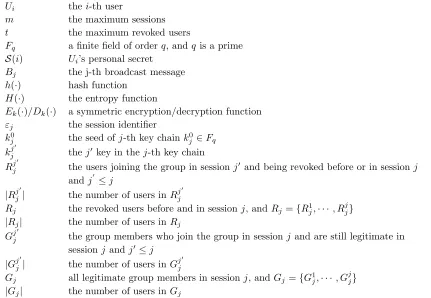
We arrange the rest paper as follows. Chenet al.’s scheme 2 and corresponding security model are briefly introduced in section 2. An attack on Chen et al.’s scheme 2 are introduced and analyzed in section 3. In Section 4, we present the conclusion of this paper. For convenience, we adopt the same notations as Chen et. al.’s scheme and list notations in Table 1.
2
Overview of Chen
et. al.
’s Scheme
In this section, we briefly review the system model, security model and self-healing group key distri-bution scheme of Chenet. al.’s scheme 2.
2.1 System Model
In the model, a communication group in wireless networks includes a group manager (GM) and group users of U = {U1,· · ·, Un} where n is the largest ID number. The group communication is set up
and maintained by the GM’s joining and revoking operations. Each group member Ui has uniquely
identity i, where iranges from 1 to N, andN is the largest. GM will distributes a personal secret Si
to user Ui ∈Gj when he joins the group. Let Kj denote the session key which is chosen by the GM.
For each session, the GM distributes a broadcast message Bj to group members and legitimate users
Ui thei-th user
m the maximum sessions
t the maximum revoked users
Fq a finite field of orderq, and qis a prime S(i) Ui’s personal secret
Bj the j-th broadcast message
h(·) hash function
H(·) the entropy function
Ek(·)/Dk(·) a symmetric encryption/decryption function
εj the session identifier
k0j the seed ofj-th key chaink0j ∈Fq
kjj0 thej0 key in thej-th key chain
Rjj0 the users joining the group in sessionj0 and being revoked before or in sessionj
andj0 ≤j
|Rjj0| the number of users inRjj0
Rj the revoked users before and in sessionj, andRj ={R1j,· · ·, R j j} |Rj| the number of users inRj
Gjj0 the group members who join the group in sessionj and are still legitimate in sessionj andj0 ≤j
|Gjj0| the number of users inGjj0
Gj all legitimate group members in sessionj, andGj={G1j,· · ·, G j j} |Gj| the number of users inGj
Table 1: Notations
2.2 Security Model
The security model in Chenet. al.’s scheme 2 is introduced as follows.
Definition 1 (Group key distribution with self-healing property and mt-revocation capability). The
group key distribution scheme is self-healing and achieves mt-revocation capability if
(1) For any user Ui ∈ Gj 0
j , the session key Kj for session j is determined by the key updating
broadcast packet Bj and the personal secret Si. That is
H(Kj|Bj, Sj) = 0
(2) Only the broadcast messages or personal secrets alone can not obtain any information aboutKj.
That is
H(Kj|S1, S2,· · · , SN) =H(Kj|B1, B2,· · · , Bm) =H(Kj)
(3) mt-revocation capability: If for a collusion of users in Rj can not compute Kj. However, it is
easy for any legitimate user Ui ∈/Rj to recover Kj. That is
(4) Self-healing property: For any j,j1 < j≤j2, if a user Ui is legitimate both in session j1 and in
session j2, he can recover the lost session key Kj(j1≤j≤j2) from broadcast packetsBj2. That
is
H(Kj|Bj2,{Si|Ui ∈Gj1j ) = 0
Definition 2 (mt-wise forward secrecy). The scheme achieves mt-wise forward secrecy if
Even if any of users in Rj collude and they learn about session keys Kj0(1≤j 0
≤j), they cannot get any information about Kj+1 whereRj ⊆U denotes the users who are revoked before sessionj and
|Rj| ≤jt, j ∈ {1,2,· · · , m}. That is
H(Kj+1|B1, B2,· · · , Bm,{Sr|Ur ∈Rj}, K1, K2,· · · , Kj) =H(Kj+1)
Definition 3 (any-wise backward secrecy). The scheme guarantees any-wise backward secrecy if
Even if any of users in Dj collude and they learn about session keys Kj0(j 0
≥j), they cannot get any information about Kj whereDj ⊆U denotes the users who join the group after session j. That is
H(Kj|B1, B2,· · ·, Bm,{Sv|Uv ∈Dj}, Kj+1, Kj+2,· · · , Km) =H(Kj)
Definition 4 (resistance to mt-wise collusion attack). The scheme is resistant to mt-wise collusion
attack if
Even if any of users inRj1 andDj2 collude and they learn about{B1, B2,· · · , Bm,{Si|Ui ∈Rj1}}S
{B1, B2,· · ·, Bm,{Si|Ui ∈Rj2}}, they cannot get any information about Kj. That is
H(Kj|B1, B2,· · · , Bm,{Si|Ui∈Rj1 ∪Dj2}) =H(Kj)
2.3 Chen et. al.’s Self-Healing Group Key Distribution Scheme 2
Chen et. al.’s self-healing group key distribution scheme 2 includes five parts: Set up, Broadcast in session j, Group session key recovery and self-healing, Group member addition and Group member revocation.
• Set up
The GM selects a random 2t-degree polynomial s1(x) =a0+a1x+· · ·+a2tx2t and a random
t-degree polynomials2(x) =b0+b1x+· · ·+btxt from Fq[x]. Then, the GM chooses a number
ε1 at random from Fq. The GM sends the user’s personal secret Si ={ε1·s1(i), ε1·s2(i)}to a
user via a secure channel.
• Broadcast in sessionj (for 1≤j≤m) Let Rj = {Rj1, Rj2,· · ·, Rj
0
j ,· · · , R j
j} be the set of revoked users before and in session j, where
Rjj0 is the set of users who join the group in session j0 and are revoked before and in session j.
Rjj0 = {Urj0 1
, Urj0 2
,· · ·, Urj0 w j0
} and |Rjj0|= wj0 ≤t. rj 0 1, r
j0 2,· · · , r
j0
wj0 are the IDs of users in R j0 j.
– The GM chooses a random value k0j ∈ Fq and a one-way hash function h(·). Note that
hi(·) denotes applying itimes hash operation. Then GM constructs the j-th key chain for session j: {kj1, kj2,· · · , kjj}, where
kj1 = h(kj0),
kj2 = h(kj1) =h(h(k0j)) =h2(k0j), · · · ,
kjj = h(kjj−1) =h(h(kjj−2)) =· · ·=hj(kj0),
For security, kj0(1≤j≤m) is different from each other.
The GM splits thekjj0 into twot-degree polynomials, Ujj0(x) and Vjj0(x), where
kjj0 =Ujj0(x) +Vjj0(x), j0 = 1,2,· · ·, j.
– To construct the revocation polynomials for sessionj, the GM firstly chooses number sets
Rj
0
j , whereR j0 j ={r
j0 1, r
j0 2,· · ·, r
j0
t−wj0}are random numbers which are not used as a user ID
and different from each other. Then, the GM computes
Ajj0(x) = Π|R
j0 j| z=1(x−rj
0 z)Π
t−|Rjj0| z0=1 (x−rj
0
z0), j0 = 1,2,· · · , j
– The GM chooses a random session keyKj from Fq. Then, the GM computes
Mjj0(x) =Ajj0(x)·Ujj0(x) +εj0 ·s1(x)
and
Njj0(x) =Vjj0(x) +εj0 ·s2(x).
After that, the GM broadcasts the message
Bj = Rj∪Rj∪ {Mj 0 j (x)|j
0 = 1,2,· · · , j} ∪ {Nj0 j (x)|j
0 = 1,2,· · ·, j}
∪{E
kjj0(Kj0)|j
0 = 1,2,· · ·, j}
whereRj ={R 1 j, R
2
j,· · ·, R j
j}and Ek(·) is a symmetric encryption function.
• Group session key recovery and self-healing Any legitimate user Ui ∈ Gj
0
j can recover the j-th session key when he receives the broadcast
message Bj as follows.
– Ui uses his personal secret εj0·s1(i) and εj0 ·s2(i) to compute
Ujj0(i) = M
j0
j (i)−εj0·s1(i)
Ajj0(i) and
Vjj0(i) =Njj0(i)−εj0·s2(i)
respectively.
– Ui uses the hash functionh(·) to compute all {kj 00
j } forj0 < j 00
≤j in thej-th key chain.
– Ui recovers the session keys {Kj00}(j0 < j 00
≤ j) by decrypting E
kj 00 j
(Kj00) (j0 < j 00
≤ j)
with corresponding keys{kj
00
j }(j0 < j 00
≤j).
• Group member addition
When a new user Ui joins the group in session j, the GM sends him a personal key Si =
{εj+1·s1(i), εj·s2(i)} through a secure channel. For keeping backward secrecy, the GM starts
a new session.
• Group member revocation
When a userUiwho joins the group in sessionj0is revoked in sessionj, the GM includes (x−rj 0 j )
intoAjj000(x)(j≤j00≤m). For keeping forward secrecy, the GM starts a new session.
3
Cryptanalysis of Chen
et. al.
’s Scheme 2
We now show that Chenet.al.’s scheme 2 can not keep the forward security and can not resist collusion attack.
LetGjj10 denote the users who join the group in sessionj0 and are still legitimate in sessionj1 where
j0 < j1. Suppose that Ui ∈ Gj 0
j1 and Ui is revoked in session j2(j 0 < j
1 < j2). Now we are ready to
show how Ui, who is revoked in session j2, recovers other user’s personal secret who is legitimate in
session j2, furthermore uses this personal secret to compute the session key Kj2 which should be kept
secret fromUi.
Step 1.Ui computes kj
0
j0 and kj 0
j1 with his personal key Si and the broadcast messages Mj 0 j0(x),
Njj00(x) and Mj 0 j1(x),N
j0 j1(x).
Step 2.In sessionj0,Ui receives the broadcast messagesMj
0
j0(x), Nj 0
j0(x), where
Mjj0(x) =Ajj0(x)·Ujj0(x) +εj0·s1(x), (1)
and
Njj0(x) =Vjj0(x) +εj0 ·s2(x). (2)
Note that
kjj00 =Uj 0
j0(x) +Vj 0 j0(x),
Equation (2) can be converted to
Njj0(x) =kjj00 −U j0
j (x) +εj0·s2(x). (3)
Let (1)+Ajj0(x)·(3), Ui can obtain
Mjj00(x) +A j0 j0(x)·N
j0
j0(x) =k j0 j0 ·A
j0
j0(x) +εj0·s1(x) +Aj 0
With the values of kjj00 which is computed from step (1),Ui can obtain
Mjj00(x) +A j0 j0(x)·N
j0
j0(x)−A j0 j0(x)·k
j0
j0 =εj0·s1(x) +Aj 0
j0(x)·εj0 ·s2(x) (5)
Step 3. Since Ui is also legitimate in session j1, Ui can obtain the similar result in the same
way:
Mj1j0(x) +Ajj10(x)·Nj1j0(x)−Ajj10(x)·kj1j0 =εj0·s1(x) +Aj 0
j1(x)·εj0·s2(x) (6)
Let (3)-(4), userUi can obtain
Mjj00(x) +A j0 j0(x)·N
j0
j0(x)−A j0 j0(x)·k
j0 j0 −M
j0
j1(x)−A j0 j1(x)·N
j0
j1(x) +A j0 j1(x)·k
j0 j1
=(Ajj00(x)−A j0
j1(x))·εj0·s2(x)
(7)
Step 4.Ui computes εj0 ·s2(x) as
εj0 ·s2(x)
=M
j0
j0(x) +Aj 0
j0(x)·Nj 0
j0(x)−Aj 0 j0(x)·kj
0 j0 −Mj
0
j1(x)−A j0 j1(x)·N
j0
j1(x) +A j0 j1(x)·k
j0 j1
(Ajj00(x)−A j0 j1(x))
(8)
Takeεj0·s2(x) to (3), Ui computes εj0·s1(x) as
εj0·s1(x) =Mj 0
j0(x) +A j0 j0(x)·N
j0
j0(x)−A j0 j0(x)·k
j0 j0 −A
j0
j0(x)·εj0 ·s2(x) (9)
Step 5.Ui gets a legitimate user’s identity,v, in sessionj2 by observingRj
0
j where j > j2.
Step 6. Ui computes εj0 ·s1(v) and εj0 ·s2(v) through εj0 ·s1(x) and εj0 ·s2(x). Then, Ui
pretendsUv to compute the session key Kj2 using εj0 ·s1(v), εj0·s2(v) andMj 0 j2(x), N
j0
j2(x) from
the broadcast message Bj2.
Note that Ui is revoked in session j2, thus he should not have computed Kj2. Therefore the
scheme cannot achieve the forward security. When the revoked user Ui obtains the session key Kj2,
he of course can give this session key to a new user who joins the group after session j2 thus should
not knowKj2. Hence, the scheme can not resist the collusion attack. Similarly, the scheme does not
have the mt-revocation capability.
4
Conclusion
Acknowledgements
This work was supported by the National Natural Science Foundation of China (No. 61300172), the Research Fund for the Doctoral Program of Higher Education (No. 20121102120017) and the Fund of the State Key Laboratory of Software Development Environment (No. SKLSDE-2014ZX-14).
References
[1] Staddon, J.; et al. Self-healing key distribution with revocation. IEEE Symposium on Security and Privacy, 2002, 241-257.
[2] Blundo, C.; et al. Design of Self-Healing Key Distribution Schemes. Designs Codes and Cryptog-raphy. 2004, 32,13:15-44.
[3] Blundo, C.; P. D’Arco; A. De Santis. On Self-Healing Key Distribution Schemes. IEEE Transac-tions on Information Theory. 2006, 52,12:5455-5467.
[4] Liu, D.; P. Ning; K. Sun. Efficient Self-Healing Group Key Distribution with Revocation Capa-bility. In Proc. of the 10th ACM Conference on Computer and Communications Security (CCS03 (2003):231-240.
[5] Dutta, R., Y. D. Wu, and S. Mukhopadhyay. Constant storage selfhealing key distribution with revocation in wireless sensor network. In IEEE International Conference on Communications (ICC07), 2007: 1323-1328.
[6] Dutta, R.; S. Mukhopadhyay. Improved Self-Healing Key Distribution with Revocation in Wireless Sensor Network. Wireless Communications and Networking Conference. WCNC,2007: 2963-2968. [7] Ratna D.; Sourav Mukhopadhyay. Designing Scalable Self-healing Key Distribution Schemes with
Revocation Capability. Parallel and Distributed Processing and Applications. 2007, 419-430. [8] Dutta, R.; Mukhopadhyay, S.; Emmanuel, S. Low bandwidth self-healing key distribution for
broadcast encryption. In Proceedings of the 2nd Asia International Conference on Modeling and Simulation (ICOMS-2008), Kuala Lum pur, Malaysia, 13C15 May 2008, 867-872.
[9] Dutta, R.; E C. Chang; S. Mukhopadhyay. Efficient Self-healing Key Distribution with Revocation for Wireless Sensor Networks Using One Way Key Chains. International Conference on Applied Cryptography and Network Security Springer Berlin Heidelberg 2007: 385-400.
[10] Han, S.; et al. Efficient threshold self-healing key distribution with sponsorization for infrastruc-tureless wireless networks. IEEE Transactions on Wireless Communications. 2009, 8,4:1876-1887. [11] Kausar, F.; Hussain, S.; P. A. Masood. Secure group communication with self-healing and rekeying in wireless sensor networks. Proceedings of the 3rd international conference on Mobile ad-hoc and sensor networks Springer-Verlag 2007, 4864, 737-748.