Multilinear Maps from Obfuscation
Martin R. Albrecht (RHUL) Pooya Farshim (QUB) Shuai Han (SJTU)
Dennis Hofheinz (KIT) Enrique Larraia (RHUL) Kenneth G. Paterson (RHUL)
December 18, 2017
Abstract
We provide constructions of multilinear groups equipped with natural hard problems from in-distinguishability obfuscation, homomorphic encryption, and NIZKs. This complements known results on the constructions of indistinguishability obfuscators from multilinear maps in the reverse direction.
We provide two distinct, but closely related constructions and show that multilinear analogues of the DDH assumption hold for them. Our first construction issymmetricand comes with aκ-linear mape:Gκ−→
GT for prime-order groupsGandGT. To establish the hardness of theκ-linear DDH problem, we rely on the existence of a base group for which the κ-strong DDH assumption holds. Our second construction is for theasymmetricsetting, wheree:G1× · · · ×Gκ−→GT for a collection ofκ+1prime-order groupsGiandGT, and relies only on the 1-strong DDH assumption in its base group. In both constructions the linearityκcan be set to any arbitrary but a priori fixed polynomial value in the security parameter.
We rely on a number of powerful tools in our constructions: probabilistic indistinguishability obfuscation, dual-mode NIZK proof systems (with perfect soundness, witness indistinguishability and zero knowledge), and additively homomorphic encryption for the groupZ+N. At a high level, we enable “bootstrapping” multilinear assumptions from their simpler counterparts in standard cryptographic groups, and show the equivalence of PIO and multilinear maps under the existence of the aforementioned primitives.
Erratum
After the publication of this work at TCC 2016-A, we became aware of several technical prob-lems in our work. Specifically, the published version of our work (and of course a previous full version) claimed (a) the validity of the RANK assumption (a reformulation of theUn-matrix Diffie–Hellman assumption from [EHK+13]) in our framework, and (b) a variant of our construc-tion that only uses indistinguishability obfuscaconstruc-tion (instead of probabilistic indistinguishability obfuscation). We encountered serious problems in both respective proofs, and we are currently not aware of a way to repair these proofs.
Contents
1 Introduction 4
1.1 Main contribution . . . 4
1.2 General approach . . . 5
1.3 The current state of multilinear maps constructions . . . 6
1.4 Related work . . . 6
1.5 Follow-up work . . . 7
2 Preliminaries 8 2.1 Notation . . . 8
2.2 Homomorphic public-key encryption . . . 8
2.3 Obfuscators . . . 9
2.4 Dual-mode NIZK proof systems . . . 10
2.5 Hard membership problems . . . 11
3 Multilinear Groups with Non-unique Encodings 11 4 The Construction 14 4.1 Setup . . . 15
4.2 Validity and equality . . . 15
4.3 Group operations . . . 16
4.4 The multilinear map . . . 16
4.5 Sampling and extraction . . . 17
5 Indistinguishability of Encodings 18 5.1 Using probabilistic indistinguishability obfuscation . . . 18
6 The Multilinear DDH Problem 22 6.1 Intractable problems . . . 22
6.2 The symmetric setting . . . 23
6.3 The asymmetric setting . . . 25
A Full Proofs from the Main Body 29 A.1 Proof of Theorem 5.3: Indistinguishability of encodings using PIO . . . 29
A.2 Proof of Theorem 6.2: Hardness of symmetric MDDH . . . 31
1
Introduction
1.1 Main contribution
In this paper, we explore the relationship between multilinear maps and obfuscation. Our main contribution is a construction of multilinear maps for groups of prime order equipped with nat-ural hard problems, using indistinguishability obfuscation (IO) in combination with other tools, namely NIZK proofs, homomorphic encryption, and a base groupG0 satisfying a mild
crypto-graphic assumption. This complements known results in the reverse direction, showing that vari-ous forms of indistinguishability obfuscation can be constructed from multilinear maps [GGH+13b, CLTV15, Zim15]. The relationship between IO and multilinear maps is a very natural question to study, given the rich diversity of cryptographic constructions that have been obtained from both multilinear maps and obfuscation, and the apparent fragility of current constructions for multilin-ear maps. More on this below.
We provide two distinct but closely related constructions. One is for multilinear maps in the symmetricsetting, that is non-degenerate multilinear mapse :G1κ −→ GT for groups G1 andGT
of prime order N. Our construction relies on the existence of a base group G0 in which the κ
-SDDH assumption holds—this states that, given a (κ+1)-tuple ofG0-elements(g, gω, . . . , gω
κ ), we cannot efficiently distinguish gωκ+1 from a random element ofG0. Under this assumption,
we prove that theκ-MDDH problem, a natural analogue of the DDH problem as stated below, is hard.
(Theκ-MDDHproblem, informal)Given a generatorg1of G1andκ+1group elements
gai
1 inGwithai←$ZN, distinguishe(g1, . . . , g1)
Qκ+1
i=1ai from a random element of
GT.
This problem can be used as the basis for several cryptographic constructions [BS03] including, as the by now the classic example of multiparty non-interactive key exchange (NIKE) [GGH13a].
Our other construction is for theasymmetricsetting, that is multilinear mapse:G1×· · ·×Gκ−→
GT for a collection ofκgroupsGi andGT all of prime orderN. It uses a base groupG0in which
we require only that the 1-SDDH assumption holds. For this construction, we show that a natural asymmetric analogue of theκ-MDDH assumption holds.
At a high level, then, our constructions are able to “bootstrap” from rather mild assumptions in a standard cryptographic group to much stronger multilinear assumptions in a group (or groups, in the asymmetric setting) equipped with aκ-linear map. Hereκis fixed up-front at construction time, but is otherwise unrestricted. Of course, such constructions cannot be expected to come “for free,” and we need to make use of powerful tools including probabilistic IO (PIO) for obfuscating randomized circuits [CLTV15], dual-mode NIZK proofs enjoying perfect soundness (for a binding CRS), perfect witness indistinguishability (for a hiding CRS), and perfect zero knowledge, and additive homomorphic encryption for the group(ZN,+)(or alternatively, a perfectly correct FHE
1.2 General approach
Our approach to obtaining multilinear maps in the symmetric setting is as follows (with many details to follow in the main body).1 Let G0 with generatorg0 be a group of prime order Nin
which the κ-SDDH assumption holds.
We work with redundant encodings of elements h of the base group G0 of the form h =
gx0
0 (g ω 0)
x1 where gω
0 comes from a κ-SDDH instance; we write x = (x0, x1) for the vector of
exponents representingh. Then G1 consists of all strings of the form (h,c1,c2, π) where h ∈ G0,
ciphertextc1is a homomorphic encryption under public keypk1of a vectorxrepresentingh,
ci-phertextc2is a homomorphic encryption under a second public keypk2 of another vectoryalso
representingh, andπis a NIZK proof showing consistency of the two vectorsxandy, i.e., a proof that the plaintextsx,yunderlyingc1,c2encode thesamegroup elementh. Note that each element
of the base groupG0 is multiply represented when forming elements inG1, but that equality of
group elements inG1 is easy to test. An alternative viewpoint is to consider (c1,c2, π) as being
auxiliary information accompanying elementh ∈ G0; we prefer the perspective of redundant en-codings, and our abstraction in Section 3 is stated in such terms. When viewed in this way, our approach can be seen as closely related to the Naor–Yung paradigm for constructing CCA-secure PKE [NY90].
Addition of two elements inG1is carried out by an obfuscation of a circuitCAddthat is
pub-lished along with the groups. It has the secret keyssk1,sk2hard-coded in; it first checks the
respec-tive proofs, then uses the addirespec-tive homomorphic property of the encryption scheme to combine ciphertexts, and finally uses the secret keys sk1,sk2 as witnesses to generate a new NIZK proof
showing equality of encodings. Note that the new encoding is as compact as that of the two input elements.
The multilinear map on inputs(hi,ci,1,ci,2, πi)for1≤i≤κis computed using the obfuscation
of a circuitCMap that hassk1 andωhard-coded in. This allowsCMap to “extract” full exponents
ofhi in the form(xi,1+ω·xi,2)fromci,1, and thereby compute the elementg
Q
i(xi,1+ω·xi,2)
0 . This
is defined to be the output of our multilinear mape, and so our target groupGT is in factG0, the
base group. The multilinearity ofefollows immediately from the form of the exponent.
In the asymmetric case, the main difference is that we work with different values ωi in each of our input groupsGi. However, the groups are all constructed via redundant encodings, just as
above.
This provides a high-level view of our approach, but no insight into why the approach achieves our aim of building multilinear maps with associated hard problems. Let us give some intu-ition on why theκ-MDDH problem is hard in our setting. We transform a κ-MDDH tupleh = ((gai
1 )i≤κ+1, g d
T), wheredis the product of theai ∈ ZN, g1 is in the “encoded” form above, thus
g1 = (h1,c1,c2, π), andgT is a generator ofGT = G0, into anotherκ-MDDH tuple h0 with
expo-nentsai0 = ai +ωfori ≤ κ+1. This means that the exponent of the challenge element in the
target groupd0 = Qκi=+11(ai+ω)can be seen as a degree κ+1polynomial inω. Therefore, with the knowledge of theaiand a κ-SDDH challenge, withωimplicit in the exponent, we are able to randomizegdT0 replacing gωTκ+1with a uniform value.
Nevertheless, in the preceding simplistic argument we have made two assumptions. The first is that we are able to provide an obfuscation of a circuitCMap0 that has the same functionality as
CMapoverG1withoutthe explicit knowledge ofω. We resolve this by showing a way of evaluating
theκ-linear map on any elements of G1 using only the powersgω
i
0 for1 ≤ i ≤ κ, and vectors
extracted from the accompanying ciphertexts, and then applying IO to the two circuits.2
The second assumption we made is that we can indeed switch from h to h0 without being noticed. In other words, that the vectorsxi,yi representinggai can be replaced (without being
noticed) with vectors hi0 whose second coordinate is always fixed. Intuitively this is based on the IND-CPA security of the FHE scheme, but in order to give a successful reduction we also have to change the circuitCAdd (since CAdd uses both decryption keys) and apply probabilistic indistinguishability obfuscation [CLTV15] to the circuit.
We note that in this work we do not construct graded encoding schemes as in [GGH13a]. That is, we do not construct maps fromGi×GjtoGi+j. On the other hand, our construction is noiseless
and is closer to multilinear maps as defined by Boneh and Silverberg [BS03].
1.3 The current state of multilinear maps constructions
Multilinear maps have been in a state of turmoil, with the discovery of attacks [CHL+15, CFL+16, HJ16, CLLT16, MSZ16] against the GGH13 [GGH13a], CLT [CLT13] and GGH15 [GGH15] propos-als, and a sequence of countermeasures and fixes [CLT15, CGH+15], which since have been bro-ken, too. Hence, our confidence in constructions for graded encoding schemes (and thereby mul-tilinear maps) has been shaken. On the other hand, recently, several constructions of IO from in-creasingly weaker assumptions have been proposed [GGH+13b, AB15, Zim15, Lin16, AS17, Lin17, LT17], culminating in the construction [LT17] that requires only trilinear (non-graded) multilinear maps.
Hence, currently it is perhaps more plausible to assume that IO exists than it is to assume that secure (multi-level) multilinear maps exist. However, we stress that more cryptanalysis of IO constructions is required to investigate what security they provide.
Moreover, even though current constructions for IO rely on graded encoding schemes, it is not implausible that alternative routes to achieving IO without relying on multilinear maps will emerge in due course. And setting aside the novel applications obtained directly from IO, multi-linear maps, and more generally graded encoding schemes, have proven to be very fruitful as con-structive tools in their own right (cf. [BS03, PTT10], resp., [FHPS13, GGH+13c, HSW13, GGSW13, BWZ14, TLL14, BLR+15]). This rich set of applications coupled with the current uncertainty over the status of graded encoding schemes and multilinear maps provides additional motivation to ask what additional tools are needed in order to upgrade IO to multilinear maps. As an addi-tional benefit, we upgrade (via IO) noisy graded encoding schemes to clean multilinear maps— sometimes now informally called “dream” or “ideal” multilinear maps.
1.4 Related work
The closest related work to ours is that of Yamakawa et al. [YYHK14, YYHK15]; indeed, their work was the starting point for ours. Yamakawa et al. construct aself-pairing map, that is a bilinear map
fromG×GtoG; multilinear maps can be obtained by iterating their self-pairing. Their work is
limited to the RSA setting. It uses the group of signed quadratic residues modulo a Blum integer
N, denoted QR+N, to define a pairing function that, on input elementsgx,gyin QR+
N, outputsg2xy.
In their construction, elements of QR+N are augmented with auxiliary information to enable the pairing computation—in fact, the auxiliary information for an elementgxis simply an obfuscation
of a circuit for computing the 2xth power modulo ord(QR+N), and the pairing is computed by evaluating this circuit on an inputgy(say). The main contribution of [YYHK14] is in showing that these obfuscated circuits leak nothing aboutxor the group order.
A nice feature of their scheme is that the degree of linearity κthat can be accommodated is not limited up-front in the sense that the pairing output is also a group element to which further pairing operations (derived from auxiliary information for other group elements) can be applied. However, the construction has several drawbacks. First, the element output by the pairing does not come with auxiliary information.3 Second, the size of the auxiliary information for a product of group elements grows exponentially with the length of the product, as each single product involves computing the obfuscation of a circuit for multiplying, with its inputs already being obfuscated circuits. Third, the main construction in [YYHK14] only builds hard problems for the self-pairing of the computational type (in fact, they show the hardness of the computational version of theκ-MDDH problem in QR+Nassuming that factoring is hard). Still, this is sufficient for several cryptographic applications.
In contrast, our construction is generic with respect to its platform group. Furthermore, the equivalent of the auxiliary information in our approach does not itself involve any obfuscation. Consequently, the description of a product of group elements stays compact. Indeed, given per-fect additive homomorphic encryption for (Zp,+), we can perform arbitrary numbers of group operations in each component groupGi. It is an open problem to find a means of augmenting our
construction with the equivalent of auxiliary information in thetargetgroupGT, to make our
mul-tilinear maps amenable to iteration and thereby achieve graded maps as per [GGH13a, CLT13].
1.5 Follow-up work
The work [FHHL18] extends our approach from this work togradedencoding schemes (with mul-tilinear maps). They use techniques similar to ours, and in particular employ a suitable “switching theorem” (like our Theorem 5.3) to replace encodings of equivalent group elements.
On the other hand, the work [AH18] aims to construct groups (or, rather, encoding schemes) that support stronger computational assumptions. Specifically, [AH18] construct encoding schemes in which even an adaptive variant of the so-called “Uber assumption” [Boy08] holds. The price that [AH18] pay is that their encoding scheme has no extraction algorithm (i.e., no algorithm that takes an encoding and outputs a bitstring that is unique for the encoded group element). In this setting, the only means to compare two group elements (given by possibly different encodings) is an explicit comparison algorithm that takes two encodings as input, and outputs whether these encodings represent the same group element. ([AH18] provide such a comparison algorithm.) The techniques that [AH18] use are again an extension of our techniques.
2
Preliminaries
2.1 Notation
We denote the security parameter byλ∈Nand assume that it is implicitly given to all algorithms in the unary representation1λ. By an algorithm we mean a stateless Turing machine. Algorithms are randomized unless stated otherwise and PPT as usual stands for “probabilistic polynomial-time” in the (unary) security parameter. Given a randomized algorithmAwe denote the action of runningAon input(s)(1λ, x1, . . .)with fresh random coinsrand assigning the output(s) toy1, . . .
by(y1, . . .)←$ A(1λ, x1, . . .;r). For a finite setX, we denote its cardinality by|X|and the action of
sampling a uniformly random elementxfromXbyx←$ X. Vectors are written in boldfacexand
by slight abuse of notation, running algorithms on vectors of elements indicates component-wise operation. Throughout the paper⊥denotes a special error symbol, and poly(·)stands for a fixed polynomial. A real-valued function negl(λ)is negligible if negl(λ)∈ O(λ−ω(1)). We denote the set of all negligible functions by NEGL, and use negl(λ)to denote an unspecified negligible function.
2.2 Homomorphic public-key encryption
CIRCUITS. A polynomial-sized deterministic circuit family C := {Cλ}λ∈N is a sequence of sets of
poly(λ)-sized circuits for a fixed polynomial poly. We assume that for allλ∈N, all circuitsC∈ Cλ
share a common input domain ({0, 1}λ)a(λ), where a(λ) is a the arity of the circuit family, and codomain {0, 1}λ. A randomized circuit family is defined similarly except that the circuits now
also take random coinsr ∈ {0, 1}r(λ). To make the coins used by a circuit explicit (e.g., to view a randomized circuit as a deterministic one) we writeC(x;r).
SYNTAX AND COMPACTNESS. A tuple ofPPTalgorithmsΠ:= (Gen,Enc,Dec,Eval)is called a ho-momorphic public-key encryption (HPKE) scheme for deterministic circuit familyC ={Cλ}λ∈Nof
aritya(λ)if(Gen,Enc,Dec)is a conventional public-key encryption scheme with message space {0, 1}λandEvalis adeterministicalgorithm that on input a public keypka circuitC∈ Cλand cipher-textsc1, . . . ,ca(λ)outputs a ciphertextc. We require HPKE schemes to becompactin the sense that the outputs ofEvalhave a size that is bounded by a polynomial function of the security parameter (and independent of the size of the circuit). Without loss of generality, we assume that secret keys of an HPKE scheme are the random coins used in key generation. This will allow us to check key pairs for validity.
CORRECTNESS. We require the followingperfectcorrectness requirements from a HPKE scheme. (1) SchemeΠ := (Gen,Enc,Dec)is perfectly correct as a PKE scheme; that is for anyλ ∈N, any
(sk,pk)←$ Gen(1λ), anym∈{0, 1}λ, and anyc←$ Enc(m,pk)we have thatDec(c,sk) =m. (2) The
evaluation algorithm is also perfectly correct in the sense that for anyλ∈N, any(sk,pk)←$Gen(1λ),
anymi∈{0, 1}λfori∈[a(λ)], anyci←$ Enc(mi,pk), anyC∈ Cλand anyc←Eval(pk, C,c1, . . . ,ca(λ))
we have thatDec(c,sk) =C(m1, . . . ,ma(λ)).
known as a singly homomorphic PKE scheme for(Zp,+). Formally, such a scheme corresponds to a family of circuits of arity2which add twoλ-bit numbers moduloλ-bit primesp.
SECURITY. The IND-CPA security of an HPKE scheme is defined identically to a standard PKE
scheme without reference to theDecandEvalalgorithms. Formally, we require that for any legit-imatePPTadversaryA:= (A1,A2),
Advind-cpaΠ,A (λ) :=2·Pr
IND-CPAAΠ(λ)−1∈NEGL,
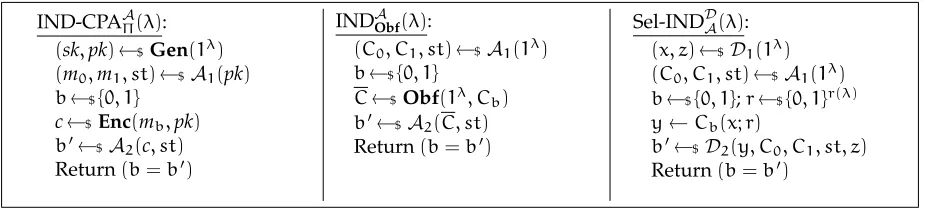
where game IND-CPAAΠ(λ)is shown in Figure 1 (left). AdversaryAis legitimate if it outputs two
messages of equal lengths.
2.3 Obfuscators
SYNTAX AND CORRECTNESS. A PPT algorithm Obf is called an obfuscator for (deterministic or randomized) circuit classC = {Cλ}λ∈NifObfon input the security parameter1λ and the
descrip-tion of a (deterministic or randomized) circuit C ∈ Cλ outputs a deterministic circuit C. For
deterministic circuits, we require Obf to be perfectly correct in the sense the circuits C and C
are functionally equivalent; that is, that for all λ ∈ N, all C ∈ Cλ, all C←$ Obf(1λ, C), and all
mi ∈ {0, 1}λ for i ∈ [a(λ)] we have that C(m1, . . . ,ma(λ)) = C(m1, . . . ,ma(λ)). For randomized circuits, the authors of [CLTV15] define correctness via computational indistinguishability of the outputs of CandC. For our constructions we do notrely on this property and instead require thatCandCare functionally equivalent up to a change in randomness; that is, for allλ ∈N, all
C ∈ Cλ, allC←$ Obf(1λ, C)and all mi ∈ {0, 1}λ fori ∈ [a(λ)]we require there is anr such that C(m1, . . . ,ma(λ)) = C(m1, . . . ,ma(λ);r). In this paper by correctness we refer to this latter property. We note that the construction from [CLTV15] is correct as it relies on a correct (indistinguishability) obfuscator (and a PRF to internally generate the required random coins).
SECURITY. The security of an obfuscatorObfrequires that for any legitimatePPTadversaryA:= (A1,A2)
AdvindObf,A(λ) :=2·Pr
INDAObf(λ)−1∈NEGL,
where game IND is shown in Figure 1 (middle). Depending on the notion of legitimacy different security notions for the obfuscator emerge; we consider two such notions below.
FUNCTIONALLY EQUIVALENT SAMPLERS. We call (the first phase of)A a functionally equivalent samplerif for any (possibly unbounded) distinguisherD
AdveqA,D(λ) :=PrhC0(x)6=C1(x) : (C0, C1, st)←$ A1(1λ);x←$ D(C0, C1, st)
i
∈NEGL.
The security notion associated with equivalent samplers is calledindistinguishability. We call an obfuscator meeting this level of security anindistinguishability obfuscator [GGH+13b] and useIO instead ofObfto emphasize this.
X-INDSAMPLERS[CLTV15]. Roughly speaking, the first phase ofAis anX-IND sampler if there is a setX of size at mostXsuch that the circuits output byAare functionally equivalent outsideX
IND-CPAAΠ(λ):
(sk,pk)←$Gen(1λ)
(m0,m1, st)←$A1(pk) b←${0, 1}
c←$Enc(mb,pk) b0←$ A2(c, st) Return(b=b0)
INDAObf(λ):
(C0, C1, st)←$A1(1λ) b←${0, 1}
C←$Obf(1λ, Cb) b0←$ A2(C, st) Return(b=b0)
Sel-INDDA(λ): (x, z)←$ D1(1λ)
(C0, C1, st)←$A1(1λ) b←${0, 1};r←${0, 1}r(λ) y←Cb(x;r)
b0←$ D2(y, C0, C1, st, z) Return(b=b0)
Figure 1:Left: IND-CPA security of a (homomorphic) PKE scheme.Middle: Indistinguishability security of an obfus-cator.Right: Static-input (aka. selective)X-IND property ofA:= (A1,A2).
of size at mostX(λ)such that the following two conditions holds: (1) for all (possibly unbounded)
Dthe advantage function below is negligible
Adveq$A,D(λ) :=PrhC0(x;r)6=C1(x;r)∧x /∈ Xλ : (C0, C1, st)←$ A1(1λ); (x, r)←$ D(C0, C1, st)
i
.
(2) For all non-uniformPPTdistinguishersD:= (D1,D2)
X(λ)·Advsel-indA,D (λ) :=X(λ)·Pr
h
Sel-INDDA(1λ)
i
∈NEGL,
where game Sel-INDDA(1λ)is shown in Figure 1 (right). This game has a static (or selective) flavor
asD1chooses a differing-inputxbeforeit gets to see the challenge circuit pair. We call an obfuscator
meeting this level of security a probabilistic indistinguishability obfuscator[CLTV15] and use PIO instead ofObfto emphasize this.
2.4 Dual-mode NIZK proof systems
In our constructions we will be relying on special types of non-interactive zero-knowledge proof systems [GS08]. These systems have “dual-mode” common reference string (CRS) generation algorithms that produce indistinguishable CRSs in the “binding” and “hiding” modes. They also enjoy perfect completeness in both modes, are perfectly sound and extractable in the binding mode, and perfectly witness indistinguishable (WI) and zero-knowledge (ZK) in the hiding mode. The standard prototype for such schemes are pairing-based Groth–Sahai proofs [GS08], and using a generic NP reduction to the satisfiability of quadratic equations we can obtain a suitable proof system for any NP language.4 We formalize the syntax and security of such proof systems next.
SYNTAX. A relation with setup is a pair ofPPTalgorithms(S,R)such thatS(1λ)outputs(gpk,gsk)
andR(gpk, x, w)is a ternary relation and outputs a bit b ∈ {0, 1}. A dual-mode non-interactive zero-knowledge (NIZK) proof systemΣfor(S,R)consists of six algorithms as follows. (1) Algo-rithmBCRS(gpk,gsk)outputs a (binding) common reference stringcrsand an extraction trapdoor tdext; (2)HCRS(gpk,gsk) outputs a (hiding) common reference stringcrs and a simulation
trap-doortdzk; (3)Prove(gpk,crs, x, w)on inputcrs, an instancex, and a witnessw, outputs a proofπ;
4We note that extraction in Groth–Sahai proofs does not for all types of statements recover a witness. (Instead, for some types of statements, onlygwi for a witness variablew
i ∈ Zpcan be recovered.) Here, however, we will only
be interested in witnessesw= (w1, . . . , wn)∈{0, 1}nthat are bit strings, in which case extraction always recoversw.
(4) Verify(gpk,crs, x, π) on input a bit stringcrs, an instance x, and a proofπ, outputs accept or reject; (5)WExt(tdext, x, π)on input an extraction trapdoor, an instancex, and a proofπ, outputs
a witnessw; and (6) Sim(tdzk,crs, x) on input the simulation trapdoortdzk, the CRScrs, and an
instance x, outputs a simulated proof π. We require a dual-mode NIZK to meet the following requirements.
CRS INDISTINGUISHABILITY. The common reference strings generated through BCRS(gpk,gsk)
andHCRS(gpk,gsk)are computationally indistinguishable. We denote the distinguishing advan-tage of aPPTadversaryAin the relevant security game byAdvcrsΣ,A(λ).
PERFECT COMPLETENESS UNDER BCRS/HCRS. For any λ ∈ N, any (gpk,gsk)←$ S(1λ), any
crs←$ BCRS(gpk,gsk), any (x, w) such that R(gpk, x, w) = 1, and any π←$ Prove(gpk,crs, x, w)
we have that Verify(gpk,crs, x, π) = 1. We require this property to also hold for any choice of crs←$ HCRS(gpk,gsk).
PERFECT SOUNDNESS UNDER BCRS. For anyλ∈ N, any(gpk,gsk)←$ S(1λ), any common
refer-ence stringcrs←$ BCRS(gpk,gsk), any xfor which for all w ∈ {0, 1}∗, we haveR(gpk, x, w) = 0,
and anyπ∈{0, 1}∗we have thatVerify(gpk,crs, x, π) =0.
PERFECT EXTRACTABILITY UNDERBCRS. For anyλ∈N, any(gpk,gsk)←$ S(1λ), any(crs,tdzk)←$
BCRS(gpk,tdext), any(x, π)with Verify(gpk,crs, x, π) = 1, and forw←$ WExt(tdext, x, π), we
al-ways have thatR(gpk, x, w) =1.
PERFECT WIUNDERHCRS. For anyλ∈ N, any(gpk,gsk)←$ S(1λ), any(crs,tdzk)←$ HCRS(gpk,
gsk), any(x, wb)such thatR(gpk, x, wb) =1forb∈{0, 1}, we have thatπb←$ Prove(gpk,crs, x, wb)
forb∈{0, 1}are identically distributed.
PERFECT ZKUNDERHCRS. For anyλ∈N, any(gpk,gsk)←$ S(1λ), any(crs,tdzk)←$ HCRS(gpk,
gsk), any (x, w) such that R(gpk, x, w) = 1, we have that π0←$ Prove(gpk,crs, x, w) and π1←$
Sim(tdzk, x)are identically distributed.
2.5 Hard membership problems
Finally, we will use languages with hard membership problems. More specifically, we say that a familyL = {Lλ}of familiesLλ = {L}of languagesL ⊆Uin a universeU = Uλ has a hard subset membership problem if the following holds. Namely, we require that noPPTalgorithm can, given
L←$ Lλ, efficiently distinguish betweenx←$ Landx←$ U.
3
Multilinear Groups with Non-unique Encodings
Before presenting our constructions, we formally introduce what we mean by a multilinear group (MLG) scheme. Our abstraction differs from that of Garg, Gentry and Halevi [GGH13a] in that our treatment of MLG schemes is a direct adaptation of the “dream” MLG setting (called the “cryp-tographic” MLG setting in [BS03]) to a setting where group elements havenon-uniqueencodings. In our abstraction, on top of the procedures needed for generating, manipulating and checking group elements, we introduce an equalityprocedure which generalizes the equality relation for groups with unique encodings.
Setup(1λ, 1κ): This is the setup algorithm. On input the security parameter1λ and the multilin-earity1κ, it outputs the group parameterspp. These parameters includegenerators g
1, . . . ,gκ+1,
identity elements 11, . . . ,1κ+1, and integers N1, . . . , Nκ+1, which will represent group orders.
(Generators, identity elements and group orders are discussed below.) We assumepp is pro-vided to the various algorithms below.
Vali(h): This is the validity testing algorithm. On input (the group parameters), a group index1≤
i≤κ+1and a stringh∈{0, 1}∗, it returnsb∈{0, 1}. We defineGi, which is also parameterized
bypp, as the set of allhfor whichVali(h) =1. We writeh∈GiwhenVali(h) =1and refer to
such strings asgroup elements(since we will soon impose a group structure onGi). We require
that the bit strings inGi have lengths that are polynomial in1λandκ, a property that we refer
to ascompactness.
Eqi(h1, h2): This is the equality algorithm. On input two valid group elements h1, h2 ∈ Gi, it
outputs a bitb∈{0, 1}. We requireEqito define an equivalence relation. We say that the group has unique encodings ifEqisimply checks the equality of bit strings. We writeGi(h)for the set
of allh0 ∈Gisuch thatEqi(h, h0) =1; for any suchh, h0inGi we writeh=h0; sometimes we
writeh =h0 inGifor clarity. Since “=” refers to equality of bit strings as well as equivalence
underEqiwe will henceforth write “as bit strings” when we mean equality in that sense. We require |Gi/Eqi|, the number of equivalence classes into whichEqi partitionsGi, to be finite
and equal to Ni (where Ni comes frompp). Note that equality algorithmsEqi for1 ≤ i ≤ κ
can be derived from one forEqκ+1using the multilinear mapedefined below, providedNκ+1
is prime. We assume throughout the paper that various algorithms below return⊥when run on invalid group elements.
Opi(h1, h2): This algorithm defines the group operation. On input two valid group elements
h1, h2 ∈Gi it outputsh∈Gi. We writeh1h2in place ofOpi(h1, h2)for simplicity. We require that Opi respect the equivalence relationsEqi, meaning that if h1 = h2 in Gi and h ∈ Gi,
thenh1h= h2hinGi. We also demand thath1h2 = h2h1inGi(commutativity), for any third
h3∈Giwe requireh1(h2h3) = (h1h2)h3inGi(associativity) andh11i=h1inGi.
The algorithmOpi gives rise to an exponentiation algorithmExpi(h, z)that on input h ∈ Gi
andz∈Noutputs anh0 ∈Gisuch thath0 = h· · ·hinGi withzoccurrences ofh. When noh
is specified, we assumeh= gi. This algorithm runs in polynomial time in the length ofz. We
denoteExpi(h, z)byhzand defineh0:=1i. Note that under the definition ofNifor anyh∈Gi
we have thatExpi(h, Ni) = 1i.5 This in turn leads to an inversion algorithmInvi(h)that on
input h ∈ Gi outputs hNi−1. We insist that gi in fact has order Ni, so that (the equivalence
class containing)gigeneratesGi/Eqi. We do not treat the case where theNiare unknown but
the formalism is easily extended to include it by adding an explicit inversion algorithm and by replacingNiinppwith an approximation (which may be needed for sampling purposes). The
above requirements ensure that Gi/Eqi acts as an Abelian group of order Ni with respect to
the operation induced byOpi, with identity (the equivalence class containing)1i, and inverse
operationInvi.
We use the bracketnotion [EHK+13] to denote an elementh = gx
i inGi with[x]i. When using
this notation, we will write the group law additively. This notation will be convenient in the
5However, note thatN
construction and analysis of our MLG schemes. For example, [z]i + [z0]i succinctly denotes Opi(Exp(gi, z),Exp(gi, z0)). Note that when writing[z]i it isnotnecessarily the case thatzis
explicitly known.
e(h1, . . . , hκ): This the multilinear map algorithm. For κ group elements hi ∈ Gi as input, it
outputshκ+1 ∈Gκ+1. We demand that for any1≤j≤κand anyhj0 ∈Gj
e(h1, . . . , hjh0j, . . . , hκ) =e(h1, . . . , hj, . . . , hκ)e(h1, . . . , hj0, . . . , hκ)inGκ+1.
We also require the map to be non-degeneratein the sense that for some tuple of elements as input the multilinear map outputs an element of Gκ+1 outside the equivalence class of1κ+1.
(This implies that eis surjective ontoGκ+1/Eqκ+1 whenNi is prime, but need not imply
sur-jectivity whenNκ+1is composite.) We call an MLG schemesymmetricif the group algorithms are independent of the group index for1≤i≤κandeis invariant under permutations of its inputs. That is, for any permutationπ: [κ]−→[κ]we have
e(h1, . . . , hκ) =e(hπ(1), . . . , hπ(κ))inGκ+1.
We refer to all the other cases as being asymmetric. To distinguish the target group we fre-quently writeGT instead ofGκ+1 (and similarly for1T andgT in place of1κ+1andgκ+1) as its
structure in our construction will be different from that of the source groupsG1, . . . ,Gκ.
Sami(z): This is the sampling algorithm. On input z ∈ Nit outputs h ∈ Gi whose distribution
is “close” to that of uniform over the equivalence classGi(gzi). Here “close” is formalized via
computational, statistical or perfect indistinguishability. We also allow a special inputεto this algorithm, in which case the sampler is required to output a uniformly distributed h ∈ Gi
together with azsuch thath∈Gi(giz). When outputtingzis not required, we say thatSami(ε)
is discrete-logarithm oblivious. Note that for groups with unique encodings these algorithms trivially exist. For notational convenience, for a known a we define [a]i to be an element sampled viaSami(a).
Some applications also rely on the following algorithm which provides a canonical bit string for the group elements within a single equivalence class.
Exti(h): This is the extraction algorithm. On inputh ∈Gi it outputs a strings ∈ {0, 1}poly(λ). We
demand that for anyh1, h2 ∈ Gi withh1 = h2in Gi we have thatExti(h1) = Exti(h2)(as bit
strings). We also require that for[z]i←$ Sami(ε), the distribution ofExti([z]i)is uniform over
{0, 1}poly(λ). For groups with unique encodings this algorithm trivially exists.
COMPARISON WITHGGH. Our formalization differs from that of [GGH13a] which defines agraded encoding scheme. The main difference is that a graded encoding scheme defines bilinear maps ei,j : Gi ×Gj −→ Gi+j. Using this algorithm, one can implement Eqi for any 1 ≤ i ≤ κ from
Eqκ+1 as follows (ifei,j is injective). To check the equality of h1, h2 ∈ Gi callei,κ+1−i(h,gκ+1−i)
forh = h1, h2 to map these elements to the target group and check equality there using Eqκ+1.
Similarly, Exti(h) can be constructed from Extκ+1(h)and 1j for all Gj. (Note that for extraction
these are useful in certain adversarial situations such as CCA security and signature verification. Further, all known candidate constructions of graded encoding schemes are noisy and only permit a limited number of operations. Finally, the known candidate graded encoding schemes do not permit sampling for specific values ofz, but rather only permit sampling elements with azthat is only known up to its equivalence class.
SYNTACTIC EXTENSIONS. Although our syntax does not treat the cases of graded [GGH13a,
CLT13], exponentially multilinear, or self-pairing [YYHK14] maps, it can be modified to capture these variants. We briefly outline the required modifications. For graded maps, we require the existence of a map that on inputhi ∈Gifor indicesi= i1, . . . , i`witht :=P`i=1ij ≤κoutputs a group element inGt. This map is required to be multilinear in each component. For exponential
(aka. unbounded) linearity, we provide the linearity κ in its binary representation to theSetup algorithm. We also include procedures for generator and identity element generation.6 Proper self-pairing maps correspond to a setting where the group algorithms are independent of the group index for 1 ≤ i ≤ κ+1(including the target index κ+1), and the group generators and identity elements are all identical. Observe that a proper self-pairing would induce a graded en-coding scheme of unbounded linearity; recall from the introduction that the scheme of Yamakawa et al. [YYHK14] does not meet this definition because of the growth in the size of its auxiliary information.
4
The Construction
We now present our construction of an MLG scheme Γ according to the syntax introduced in Section 3. In the later sections we will consider special cases of the construction and prove the hardness of analogues of the multilinear DDH problem under various assumptions.
We rely on the following building blocks in our MLG scheme. (1) A cyclic groupG0 of some
order N0 with generatorg0 and identity 10; formally we think of this as a 1-linear MLG scheme
Γ0with unique encodings in whicheis trivial; the algorithmVal0implies that elements ofG0are
efficiently recognizable. (2) A general-purpose obfuscatorObf. (3) An additively homomorphic public-key encryption schemeΠ := (Gen,Enc,Dec,Eval)with plaintext spaceZN (alternatively,
a perfectly correct HPKE scheme). (4) A dual-mode NIZK proof system. (5) A family T D of (families of) languagesTDwhich has a hard subset membership problem, and such that all TD
have efficiently computable witness relations with unique witnesses.7 (See Section 2 for more formal definitions.)
We reserve variables and algorithms with index0for the base schemeΓ0; we also writeN=N0.
We require that the algorithms ofΓ0 except forSetup0 andSam0 are deterministic. We will also
use the bracket notation to denote the group elements inG0. For example, we write[z]0,[z0]0 ∈
G0 for two valid elements of the base group and [z]0+ [z0]0 ∈ G0 for Op0([z]0,[z0]0). Variables
with nonzero indices correspond to various source and target groups. Given all of the above components, our MLG schemeΓ consists of algorithms as detailed in the sections that follow.
6It is also more natural to work with unbounded maps in the graded setting as otherwise we would have to provide an exponential number of inputs and hence assume “default” values rather than being able to include them all inpp.
7An example of such a language is the Diffie–Hellman languageTD = {(gr
1, gr2) | r ∈ N}in a DDH group with
generatorsg1, g2. In particular, a suitable trapdoor language imposes no additional computational assumption in our
4.1 Setup
The setup algorithm forΓ samples parameterspp0←$ Setup0(1λ)for the base MLG scheme,
gen-erates two encryption key pairs(pkj,skj)←$ Gen(1λ)(j=1, 2), and a matrixW= (ω1, . . . ,ωk)t∈
ZκN×`whereκis the linearity and `=2is a parameter of our construction. It sets
gpk:= (pp0,pk1,pk2,[W]0,TD, y),
where [W]0 denotes a matrix of G0 elements that entry-wise is written in the bracket notation,
TD←$ T D, andyisnot inTD. In our MLG scheme we setN1 = · · · = Nκ+1 := N, whereNis
the group order implicit inpp0. The setup algorithm then generates a common reference string crs= (crs0, y)wherecrs0←$ BCRS(gpk,gsk)for a relation(S,R)that will be defined in Section 4.2.
It also constructs two obfuscated circuits CMap andCAdd which we will describe in Sections 4.3 and 4.4. For 1 ≤ i ≤ κ, the identity elements 1i and group generators gi are sampled using
Sami(0)andSami(xi)respectively for algorithmSami described in Section 4.5 withxi ∈ [N]that
is co-prime toN. We emphasize that this approach is well defined since the operation ofSamiis
defined independently of the generators and the identity elements and depends only ongpkand crs. We set1κ+1 =10andgκ+1=g0. The scheme parameters are
pp:= (gpk,crs, CMap, CAdd,g1, . . . ,gκ+1,11, . . . ,1κ+1).
We note that this algorithm runs in polynomial time inλas long asκis polynomial inλ.
4.2 Validity and equality
The elements of Gi for1 ≤ i ≤ κare tuples of the form h = ([z]0,c1,c2, π) where c1,c2 are
en-cryptions of vectors fromZ`Nunderpk1,pk2, respectively (encryption algorithmEncextends from
plaintext spaceZNtoZ`Nin the obvious way) and whereπis a NIZK to be defined below. We refer to(c1,c2, π)as theauxiliary informationfor[z]0. The elements ofGκ+1are just those ofG0.
The NIZK proof system that we use corresponds to the following inclusive disjunctive relation
(S,R := R1∨R2). Algorithm S(1λ)outputs gpk = (pp0,pk1,pk2,[W]0,TD)as defined above and
setsgsk = (sk1,sk2). RelationR1 on inputgpk, tuple([z]0,c1,c2), and witness(x,y,r1,r2,sk1,sk2)
accepts iff [z]0 ∈ G0, therepresentations of [z]0 asx,y ∈ Z`
N are valid with respect to[W]0 in the
sense that
[z]0= [hx,ωii]0∧ [z]0 = [hy,ωii]0,
(whereh·,·idenotes inner product) and the following ciphertext validity condition (with respect to the inputs to the relation) is met:
(c1=Enc(x,pk1;r1)∧c2 =Enc(x,pk2;r2))
∨
(pk1,sk1) =Gen(sk1)∧ (pk2,sk2) =Gen(sk2)
∧x=Dec(c1,sk1)∧y=Dec(c2,sk2))
keys and ciphertexts the two checks in the expression above are equivalent (although this not generally the case when ciphertexts are malformed).
RelationR2depends on the languageTD, and on inputgpk, tuple([z]0,c1,c2), and witnesswy
accepts iffwyis a valid witness toy∈TD. (Note thatR2completely ignores([z]0,c1,c2).)
For 1 ≤ i ≤ κ, the Vali algorithm for Γ, on input ([z]0,c1,c2, π), first checks that the first
component is in G0 using Val0 and then checks the proof π; if both tests pass, it then returns
>, else⊥. Observe that for an honest choice ofcrs = (crs0, y), the perfect completeness and the perfect soundness of the proof system ensure that only those elements which pass relationR1are
accepted. AlgorithmValκ+1just usesVal0.
The equality algorithm Eqi of Γ for1 ≤ i ≤ κ first checks the validity of the two group ele-ments passed to it and then returns true iff their first components match, according to Eq0, the equality algorithm from the base schemeΓ0. AlgorithmEqκ+1 just uses Eq0. The correctness of
this algorithm follows from the perfect completeness ofΣ.
4.3 Group operations
We provide a procedure that, given as inputsh = ([z]0,c1,c2, π) andh0 = ([z0]0,c10,c20, π0) ∈ Gi,
generates a tuple representing the producth·h0. This, in particular, will enable our multilinear map to be run on the additions of group elements whose explicit representations are not neces-sarily known. We exploit the structure of the base group as well as the homomorphic properties of the encryption scheme to “add together” the first three components. We then use(sk1,sk2)as
a witness to generate a proof π00 that the new tuple is well formed. (For technical reasons we check the validity ofhandh0 in two different ways: using proofsπ,π0, and also explicitly using
(sk1,sk2). Note that, although useful in the analysis, the explicit check is redundant by the perfect
soundness of the proof system under a bindingcrs0.)
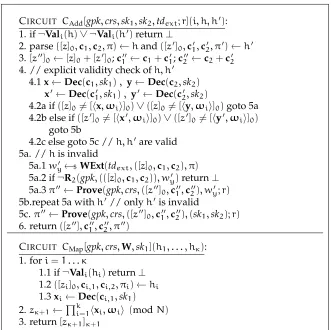
In pp we include an obfuscation of the CAdd circuit shown in Figure 2 (top), and again we emphasize that steps5aor5bare never reached with a bindingcrs0(but they may be reached with a hidingcrs0later in the analysis). Note that although we have assumed the evaluation algorithm to be deterministic, algorithmProveis randomized and we need to address how we deal with its coins. To this end, we use aPIOto obfuscateCAdd; the probabilistic obfuscator directly deals with the needed randomness.8 TheOpialgorithm for1 ≤ i≤ κruns the obfuscated circuit oni, the input group elements. AlgorithmOpκ+1just usesOp0as usual. The correctness of this algorithm follows from those of Γ0 and Π, the completeness ofΣ and the correctness, in our sense, of the probabilistic obfuscatorObf=PIO; see Section 2 for the definitions.
4.4 The multilinear map
The multilinear map forΓ, on input κgroup elementshi = [zi]i = ([zi]0,ci,1,ci,2, πi), usessk1 to
recover the representationxi. It then uses the explicit knowledge of the matrixWto compute the
output of the map as
e([z1]1, . . . ,[zκ]κ) :=
"Yk
i=1
hxi,ωii
#
κ+1
.
CIRCUIT CAdd[gpk,crs,sk1,sk2,tdext;r](i, h, h0): 1. if¬Vali(h)∨ ¬Vali(h0)return⊥
2. parse([z]0,c1,c2, π)←hand([z0]0,c10,c20, π0)←h0 3.[z00]0←[z]0+ [z0]0;c100←c1+c10;c
00
2 ←c2+c20 4. // explicit validity check ofh, h0
4.1x←Dec(c1,sk1), y←Dec(c2,sk2) x0←Dec(c10,sk1), y0 ←Dec(c20,sk2)
4.2a if([z]06= [hx,ωii]0)∨([z]06= [hy,ωii]0)goto 5a 4.2b else if([z0]06= [hx0,ωii]0)∨([z0]06= [hy0,ωii]0)
goto 5b
4.2c else goto 5c //h, h0are valid 5a. //his invalid
5a.1wy0 ←$WExt(tdext,([z]0,c1,c2), π) 5a.2 if¬R2(gpk,(([z]0,c1,c2)), wy0)return⊥ 5a.3π00←Prove(gpk,crs,([z00]0,c100,c
00
2), w
0
y;r) 5b.repeat 5a withh0// onlyh0is invalid
5c.π00←Prove(gpk,crs,([z00]0,c100,c
00
2),(sk1,sk2);r) 6. return([z00],c100,c
00
2, π
00)
CIRCUIT CMap[gpk,crs,W,sk1](h1, . . . , hκ): 1. fori=1 . . . κ
1.1 if¬Vali(hi)return⊥ 1.2([zi]0,ci,1,ci,2, πi)←hi 1.3xi←Dec(ci,1,sk1) 2.zκ+1←
Qk
i=1hxi,ωii (modN) 3. return[zκ+1]κ+1
Figure 2:Top: Circuit for addition of group elements. Explicit randomnessr is internally generated when using aPIO. Bottom: Circuit implementing the multilinear map. Recall that heregpk= (pp0,pk1,pk2,[W]0,TD, y).
Recalling thatGκ+1is nothing other thanG0, andgκ+1 =g0, the output of the map is just theG0
-element(g0)
Qk
i=1hxi,ωii. The product in the exponent can be efficiently computed over
ZNforany
polynomial level of linearityκand any`as it usesxiandωiexplicitly. The multilinearity of the
map follows from the linearity of each of the multiplicands in the above product (and the com-pleteness ofΣ, the correctness ofΠ, and the correctness of the (possibly probabilistic) obfuscator Obf). An obfuscationCMap of the circuit implementing this operation (see Figure 2, bottom) will be made available through the public parameters andeis defined to run this circuit on its inputs.
4.5 Sampling and extraction
Given vectorsx andyin Z`Nsatisfying hx,ωii = hy,ωii, we set [z]0 := [hy,ωii]0 (which can be
computed using[W]0and explicit knowledge ofx) and
[z]i← [z]0,c1=Enc(x,pk1;r1),c2=Enc(y,pk2;r2),
π=Prove(gpk,crs,([z]i,c1,c2),(x,y,r1,r2)
.
for`=2. (We call these the canonical representations.) Note that the outputs of the sampler arenot statistically uniform withinGi([z]i). Despite this, under the IND-CPA security of the encryption
scheme it can be shown that the outputs are computationally close to uniform.
Since the target group has unique encodings, as noted in Section 3, an extraction algorithm for all groups can be derived from one for the target group. The latter can be implemented by applying a universal hash function to the group elements inGT, for example.
5
Indistinguishability of Encodings
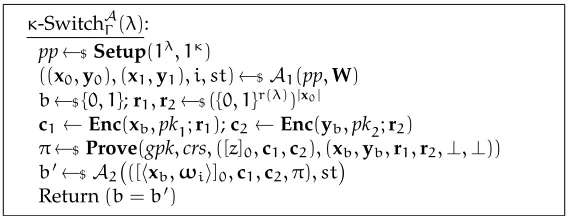
In this section we will prove a theorem that is an essential tool in establishing the intractability of theκ-MDDH for our MLG schemeΓ constructed in Section 4. This theorem, roughly speaking, states that valid encodings of elements within a single equivalence class are computationally in-distinguishable. We formalize this property via theκ-Switch game shown in Figure 3. This game lets an adversaryAchoose an element[z]i ∈ Gi by producing two valid representations(x0,y0)
and(x1,y1)for it. The adversary is given an encoding of[z]igenerated using(xb,yb)for a random
b, and has to guess the bitb. In this game, besides access to pp, which contains the obfuscated circuits for the group operation and the multilinear map, we also provide the matrix W in the clear to the adversary. This strengthens theκ-Switch game and is needed for our later analysis.
To prove that the advantage of A in theκ-Switch game is negligible we rely on the security of the obfuscator, the IND-CPA security of the encryption scheme, and the security of the NIZK proof system.
5.1 Using probabilistic indistinguishability obfuscation
Intuitively, the IND-CPA security of the encryption scheme will ensure that the encryptions of the two representations are indistinguishable. This argument, however, does not immediately work as the parametersppcontain componentCAddthat depends onbothdecryption keys. We deal with this by finding an alternative implementation of this circuit without the knowledge of the secret keys, in the presence of a slightly different public parameters (which are computationally indistin-guishable to those described in Section 4). The next lemma, roughly speaking, says thatprovided parameterspp include an instancey ∈ TD, then there exists an alternative implementationCbAdd
that does not use the secret keys, and whose obfuscation is indistinguishable to that ofCAdd of Figure 2 (top) for an adversary thatknowsthe secret keys. It relies on the security of the obfuscator and the security of the NIZK proof system.
Lemma 5.1(CAddwithout decryption keys). LetPIObe a secure obfuscator forX-INDsamplers, and Σbe a dual-mode NIZK proof system. Additionally, let parameterspp sampled as in Section 4 but withe
e
y ∈ TD, and let pp sampled asb pp but with a hiding CRSe crsc
0
, and an obfuscation of circuit CbAdd of
Fig. 4 (bottom). Then, for anyPPTadversaryAthere arepptadversariesB1andB2of essentially the same
complexity asAsuch that for allλ∈N
Pr[A(ppe,sk1,sk2) =1 : (sk1,sk2)←$ Gen(1
λ)] −Pr[A(
b
pp,sk1,sk2) =1 : (sk1,sk2)←$ Gen(1λ)] ≤2·AdvindPIO,B1(λ) +Adv
crs
Σ,B2(λ).
Proof. The crucial observation is that a witness wy to ey ∈ TD is also a witness to x ∈ R, and
κ-SwitchAΓ(λ):
pp←$ Setup(1λ, 1κ)
((x0,y0),(x1,y1), i, st)←$A1(pp,W) b←${0, 1};r1,r2←$({0, 1}r(λ))|x0|
c1←Enc(xb,pk1;r1);c2←Enc(yb,pk2;r2)
π←$Prove(gpk,crs,([z]0,c1,c2),(xb,yb,r1,r2,⊥,⊥)) b0←$A2 ([hxb,ωii]0,c1,c2, π), st
Return(b=b0)
Figure 3: Game formalizing the indistinguishability of encodings with an equivalence class. This game is specific to our constructionΓ. An adversary is legitimate ifz = hxb,ωii = hyb,ωiiforb∈{0, 1}. We note thatAgets explicit
access to matrixWgenerated during setup.
descriptions of the transformation fromCAddtoCbAdd, and let Widenote the event thatAin Gamei
outputs1.
Game0 : We start with (a PIO obfuscation of) circuitCAddof Fig. 2 and withppe includingey∈TD
and a bindingcrs0.
Game1 : The circuit has witnesswy to ey ∈ TDhard-coded. If some input reaches the “invalid”
branches,CAdddoes not extract a witness from the corresponding proof, but instead useswy
to generate proofπ00 (see Fig. 4 (top)). Note that Game1requires no extraction trapdoortdext
anymore.
We claim that|Pr[W0(λ)] −Pr[W1(λ)]| ≤AdvindPIO,B1(λ).
By construction, the only difference between the games is that in Game1proofπ00, with respect
to invalid (input) encodings, is generated using hard-coded witnesswytoey∈TD. Sincewyis
unique, and the CRScrs0guarantees perfect soundness, this leads toidenticalbehavior ofCAdd
in Game 0. Hence this hop is justified by PIO.
Game2 : The CRScrsc
0
included in the public parameters is now hiding (such that the generated proofs are perfectly witness-indistinguishable). We have that
|Pr[W1(λ)] −Pr[W2(λ)]| ≤AdvcrsΣ,B2(λ),
whereB2is aPPTalgorithm against the indistinguishability of binding and hiding CRS’s.
Game3 : Here, output proofsπ00 for those inputs entering the “valid” branch (step 5b of Fig. 4
(top)) use wy (and notsk1,sk2) as witness. In particular, this game does not need to perform
a explicit validity check (usingsk1,sk2) anymore, and therefore the addition circuit can be
de-scribed as in Fig. 4 (bottom).
We claim that|Pr[W2(λ)] −Pr[W3(λ)]| ≤AdvindPIO,B1(λ).
By constrution the only difference between both games is that, the public parameters in Game2
contain a PIO obfuscation ofCAdd, and in Game3contain a PIO obfuscation ofCbAddof Fig. 4. In
CIRCUIT CAdd[gpk,crs,sk1,sk2, wy;r](i, h, h0): 1. if¬Vali(h)∨ ¬Vali(h0)return⊥
2. parse([z]0,c1,c2, π)←hand([z0]0,c10,c20, π0)←h0 3.[z00]
0←[z]0+ [z0]0;c100←c1+c10;c200←c2+c20 4. // explicit validity check ofh, h0
4.1x←Dec(c1,sk1), y←Dec(c2,sk2) x0 ←Dec(c10,sk1), y0←Dec(c20,sk2) 4.2a if([z]06= [hx,ωii]0)∨([z]06= [hy,ωii]0)
or([z0]06= [hx0,ωii]0)∨([z0]06= [hy0,ωii]0) goto 5a
4.2c else goto 5b 5a. //horh’ invalid
5a.1π00←Prove(gpk,crs,([z00]0,c100,c200), wy;r) 5b. //handh’ valid
5b.1π00←Prove(gpk,crs,([z00]0,c100,c200),(sk1,sk2);r) 6. return([z00],c00
1,c200, π00)
CIRCUIT CbAdd[gpk,crs, wy;r](i, h, h0): 1. if¬Vali(h)∨ ¬Vali(h0)return⊥
2. parse([z]0,c1,c2, π)←h, and([z0]0,c10,c20, π0)←h0 3.[z00]0←[z]0+ [z0]0;c100←c1+c10;c200←c2+c20 4.π00←Prove(gpk,crs,([z00]
0,c100,c200), wy;r) 5. return([z00],c100,c
00
2, π
00)
Figure 4: Circuits for addition of group elements used in Lemma 5.1. ppb includesgpk = (pp0,pk1,pk2,[W]0,TD,ey)
whereey∈TD(also includes a hiding CRScrsc
0
). Both circuits also have hard-coded (the) witnesswytoey∈TD. Top: sk1,sk2are used to produceπ00on valid inputs.Bottom:wyis always used to produceπ00.
Lemma 5.2(X-IND sampling). LetΣbe a dual-mode NIZK proof system for the relation(S,R)defined in Section 4.2. SupposeΣis perfectly witness-indistinguishable under a hiding CRS. LetA1 be a sampler which outputs circuits(CAdd,CbAdd)of Fig. 4. (Both circuits have the system parameters hard-coded in.)
Then anyA:= (A1,A2)for aPPT A2isX-INDfor (the optimal)X, the size of the domain of the circuits.
More precisely, for any (possibly unbounded) distinguisherD0and for anyPPTdistinguisherD= (D
1,D2)
and anyλ∈N,
Adveq$A,D0(λ) =0 and Advsel-indA,D (λ) =0 .
Proof. The first equality is immediate asXis set to be the entire domain of the circuits. The second equality follows from the perfect witness-indistinguishability property of the proof system. In-deed, the only difference between the two circuits is that, for those inputs that are valid encodings,
CAdduses decryption keyssk1,sk2as witness to generate the output proofπ00←Prove(gpk,crs,([z00]0,
c100,c200),(sk1,sk2);r), andCbAdduses witnesswytoey∈TD(witheyin the public parameters) to
gen-erate the proofπb
00 ←
Prove(gpk,crs,([z00]0,c100,c200), wy;r). The WI property with a hidingcrsc
0
guar-antees thatπ00andπb
00areidentically distributed, and hence so are the outputs ofC
AddandCbAdd.
Note that no random coins are hardwired into these circuits—we are in the PIO setting—and fresh coins are used to compute the circuits’ outputs.
of the proof below (see also Fig. 5).
Theorem 5.3 (Switching encodings using PIO). LetΓ be the MLG scheme constructed in Section 4, wherePIOis secure forX-IND samplers,Πis an IND-CPA-secure encryption scheme, andΣis a dual-mode NIZK proof system. Then, encodings of equivalent group elements are indistinguishable. More pre-cisely, for anyPPTadversaryAand allλ ∈ N, there arepptadversariesB1,B2,B3 andB4of essentially
the same complexity asAsuch that for allλ∈N
AdvκΓ,-switchA (λ)≤3·AdvsmTD,B1+7·Adv
ind
PIO,B2(λ) +3·Adv
crs
Σ,B3(λ) +2·Adv
ind-cpa
Π,B4 (λ). FurthermoreB2is anX-INDsampler for any functionX(λ).
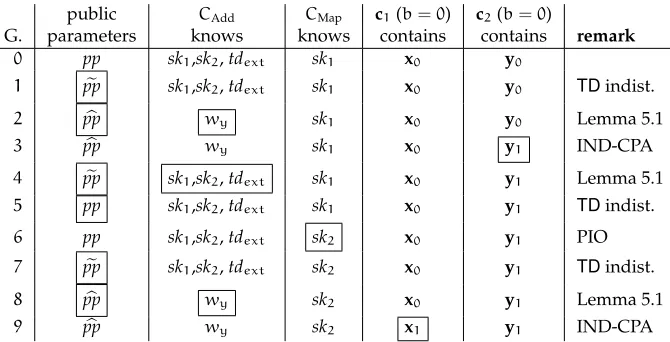
Proof sketch. The proof of this theorem proceeds via a sequence of9games as follows.
Game0 : This is the κ-Switch game. The public parameterspp contain a no-instancey /∈ TD, a
bindingcrs0,CAddis constructed using(sk1,sk2)andCMapusingsk1(see Fig. 2). The ciphertexts
c1andc2containxbandybfor a random bitb.
Game1 : This game generates the public parametersppe so that include a yes-instancey∈TD. The
difference to the previous game can be bounded via the hardness of deciding membership to
TD.
Game2 : The public parametersppc change so that include a hidingcrsc
0
, and a (PIO) obfuscation of circuitCbAdd, see Fig. 4. (Recall that this circuit uses the witnesswytoy∈TDto produce the
output proofsπe
00, and therefore the simultaneousknowledge of decryption keyssk
1,sk2 is not
needed anymore.) By Lemma 5.1 the difference with the previous game can be bounded by PIO and CRS indistinguishability.
Game3 : This games generatesc2by encryptingy1, even whenb=0. We can bound the difference
in any adversary’s success probability via the IND-CPA advantage ofΠwith respect topk2(the reduction will know(pk1,sk1)so as to be able to constructCMap.)
Game4: The public parameters are changed back toppe, so that include a bindingcrs
0, and a (PIO)
obfuscation of circuitCAddof Figure 2 (top). The difference with the previous game is bounded again with Lemma 5.1.
Game5 : Now a no-instancey /∈TDis included in the public parameterspp. This game is justified
by the hardness of deciding membership toTD.
Game6 : This game usessk2 (in place ofsk1) in the generation of CMap circuit. In this transition
we rely on the security of Obf and the perfect soundness of Σ. Perfect soundness implies consistency of the two representations underlyingc1,c2 (recall that this means they represent
the same group element with respect to W). We then get that the two circuits (usingsk1, and
sk2, respectively) are funcitonally equivalent. We can then use the IO security ofObfto justify
the switch from usingsk1to usingsk2. (Note tht for any functionX, any obfuscator that is for
X-IND samplers is also secure as an indistinguishability obfuscator.) Note that in this game it is crucial that thecrs0is in the binding mode.
Game7 : This game, similarly to Game1 switches to public parameters ppe with a yes-instance
Game8 : This game, similarly to Game2, includes inppc a hidingcrsc
0
, and a (PIO) obfuscation of circuitCbAdd(see Fig. 4). The analysis is as before.
Game9 : This game generatesc1by encryptingx1, even whenb=0. The analysis is as in Game3.
Observe that the challenge encoding in Game9is independent of the random bitband the
ad-vantage of any (possibly unbounded) adversaryAis0. Collecting bounds on the probabilities involved in the various game hops concludes the proof.
public CAdd CMap c1(b=0) c2(b=0)
G. parameters knows knows contains contains remark
0 pp sk1,sk2,tdext sk1 x0 y0
1 ppe sk1,sk2,tdext sk1 x0 y0 TDindist.
2 ppb wy sk1 x0 y0 Lemma 5.1
3 ppb wy sk1 x0 y1 IND-CPA
4 ppe sk1,sk2,tdext sk1 x0 y1 Lemma 5.1
5 pp sk1,sk2,tdext sk1 x0 y1 TDindist.
6 pp sk1,sk2,tdext sk2 x0 y1 PIO
7 ppe sk1,sk2,tdext sk2 x0 y1 TDindist.
8 ppb wy sk2 x0 y1 Lemma 5.1
9 ppb wy sk2 x1 y1 IND-CPA
Figure 5: Outline of the proof steps of Theorem 5.3.bis the random bit of theκ-Switch game (see Figure 3). Changing betweenppandppe is justified by the hardness of deciding membership ofTD, and changing betweenppe andppb by
Lemma 5.1. The hops relying on PIO use the perfect completness and the perfect soundness under bindingcrs0 to argue function equivalence ofCMap.
6
The Multilinear DDH Problem
In this section we show that natural multilinear analogues of the decisional Diffie–Hellman (DDH) problem are hard for our MLG scheme Γ from Section 4. We will establish this for two specific Setupalgorithms which give rise to symmetric and asymmetric multilinear maps in groups of prime order N. (See Section 3 for the formal definition.) In the symmetric case, we will base hardness on theq-strong DDH problem [BBS04] and in the asymmetric case on the 1-strong DDH problem.
6.1 Intractable problems
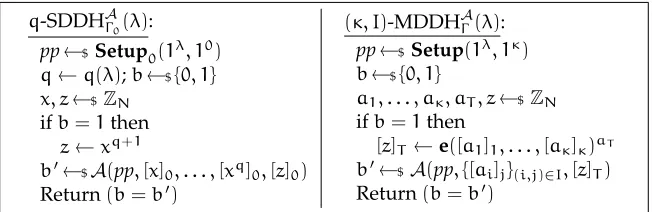
We start by formalizing the hard problems that we will be relying on and those whose hardness we will be proving. We do this in a uniform way using the language of group schemes of Section 3. Informally, the q-SDDH problem requires the indistinguishability of gxq+1 from a random ele-ment given(gx, gx2, . . . , gxq)for a randomx, and theκ-MDDH problem, whose hardness we will be establishing, generalizes the standard bilinear DDH problem (and its variants) and requires this forga1···aκ+1
q-SDDHAΓ0(λ):
pp←$Setup0(1λ, 10) q←q(λ);b←${0, 1} x, z←$ ZN
ifb=1then z←xq+1
b0←$A(pp,[x]0, . . . ,[xq]0,[z]0) Return(b=b0)
(κ, I)-MDDHAΓ(λ):
pp←$Setup(1λ, 1κ) b←${0, 1}
a1, . . . , aκ, aT, z←$ ZN ifb=1then
[z]T ←e([a1]1, . . . ,[aκ]κ)aT b0←$ A(pp,{[ai]j}(i,j)∈I,[z]T) Return(b=b0)
Figure 6:Left: The strong DDH problem.Right: The multilinear DDH problem, whereIspecifies the available group elements. By slight abuse of notation, repeated use of[ai]idenotes the same sample.
THEq-SDDHPROBLEM. Forq∈Nwe say that a group schemeΓ0isq-SDDH intractable if
AdvqΓ0-sddh,A (λ) :=2·Prq-SDDHAΓ0(λ)
−1∈NEGL,
where gameq-SDDHAΓ0(λ)is shown in Figure 6 (left).
THE (κ, I)-MDDH PROBLEM. For κ ∈ N we say that an MLG schemeΓ isκ-MDDH intractable with respect to the index setIif
Adv(Γ,κ,IA)-mddh(λ) :=2·Pr
(κ, I)-MDDHAΓ (λ)−1∈NEGL,
where game(κ, I)-MDDHAΓ (λ) is shown in Figure 6 (right). Here I is a set of ordered pairs of integers(i, j) with 1 ≤ i ≤ κ+1, 1 ≤ j ≤ κ. The adversary is provided with challenge group elements[ai]jfor(i, j)∈I, so that its challenge elements may lie in any combination of the groups. The standard MDDH problem corresponds to the case where
I=I∗:={(1, 1), . . . ,(κ, κ),(κ+1, κ)}.
6.2 The symmetric setting
We describe a special variant of our general construction in Section 4 which gives rise to a sym-metricMLG scheme as defined in Section 3. Recall that in the construction a matrixWwas chosen uniformly at random inZκN×`. We set`:=2and sampleW= (ω1, . . . ,ωκ)tby settingωi = (1, ω)
for a randomω ∈ ZN. The generators and identity elements for all groups are set to be a single value generated for the first group. These modifications ensure that the scheme algorithms are independent of the index for1≤i≤κand thateis invariant under all permutations of its inputs. The following lemma, which provides a mechanism to compute polynomial values “in the exponent,” will be helpful in the security analysis of our constructions.
Lemma 6.1 (Horner in the exponent). Let ω = (ω0, ω1) ∈ Z2
N, and xi = (xi,0, xi,1) ∈ Z2N for
i = 1, . . . , κ. Define zi := hxi,ωi. Then given only the implicit values[ωj0ωk1]T, for all j, ksuch that
j+k=κand the explicit valuesxithe element[z1· · ·zκ]T can be efficiently computed.
Proof. Let
P(ω0, ω1) :=
κ
Y
i=1
(xi,0·ω0+xi,1·ω1) = X
j+k=κ
![Figure 4: Circuits for addition of group elements used in Lemma 5.1. Bottom: is always used to produce�, sk are used to produce′′ppwheresk′′ on valid inputs.12 �y ∈2 (also includes a hiding CRS TD←pp includes gpk = (0, pk1, pk, [W]0, TD, �y) �crs′)](https://thumb-us.123doks.com/thumbv2/123dok_us/7928081.1316391/20.612.130.483.66.362/figure-circuits-addition-elements-produce-ppwheresk-includes-includes.webp)