Tightly-Secure PAK(E)
Jos´e Becerra1, Vincenzo Iovino1, Dimiter Ostrev1, Petra ˇSala12, and Marjan ˇSkrobot1
1 University of Luxembourg
{name.lastname}@uni.lu, 2 ´
Ecole Normale Sup´erieure, Computer Science Department
Abstract. We present a security reduction for the PAK protocol instantiated over Gap Diffie-Hellman Groups that is tighter than previously known reductions. We discuss the implications of our results for concrete security. Our proof is the first to show that the PAK protocol can provide meaningful security guarantees for values of the parameters typical in today’s world.
Keywords: Password-Authenticated Key Exchange, PAK, Tight Reductions, Random Oracle.
1
Introduction
1.1 PAKE protocols
A password authenticated key exchange (PAKE) protocol allows two users who only share a pass-word to establish a high entropy shared secret key by exchanging messages over a hostile network. PAKE protocols have only minimal requirements for the long-term secrets that users need to hold in order to succeed and therefore are interesting both theoretically and in practice. To date, there have been over twenty years of intensive research on PAKE, and PAKE protocols have recently seen more and more deployment in applications such as ad hoc networks [2] or the Internet of Things [1].
Numerous PAKE protocols have been proposed over the years. Among them, only a handful have been considered for use in real-world applications: EKE [8], SPEKE [19], SRP [36], PPK and PAK [10,28,27], KOY [21], Dragonfly [17], SPAKE2 [5] and J-PAKE [16]. The last two protocols, along with SRP and Dragonfly that have been standardized in the form of RFC2945 and RFC7664 respectively, are currently being considered by the Internet Engineering Task Force (IETF).
When evaluating different PAKE designs, two main criteria are the protocol’s efficiency in terms of computation and communication, and the security guarantees that the protocol provides. Of these two criteria, the efficiency is easier to understand by just looking at the protocol description. On the other hand, it is difficult to judge whether a protocol is secure. A necessary condition for security is that no attacks on the protocol have been found so far, but most researchers agree that this is not sufficient.
1.2 Security models and reductions for PAKE
One way to rigorously discuss the security of PAKE protocols is to formally define a security challenge: an interaction between two algorithms called a challenger and an adversary. The inter-action is designed to model the capabilities that a real world adversary is believed to have; the success of an adversary in the security challenge corresponds to a successful attack on the protocol. Several such security models have been introduced over the years. A few prominent ones are the indistinguishability-based models of Bellare, Pointcheval and Rogaway [7] and Abdalla, Fouque and Pointcheval [4], the simulation-based model of Boyko, MacKenzie and Patel [10]3, and the Universally Composable (UC) model of Canetti et al. [11].
In this approach, the security of a protocol is established in the following way: given an adversary Athat runs in time t and has success probability in the security challenge, one constructs an
3 For the relation between the indistinguishability-based and simulation-based models, see the recent work
algorithm BA known as a reduction. BA runs A as a subroutine and solves some known hard
computational problem in timet0 and with success probability0. If it is widely believed that it is
impossible to solve the hard computational problem in timet0 and with success probability0, then one can conclude that no adversary running in timet can have a probability of to successfully attack the protocol.
1.3 Online dictionary attacks
Security models for PAKE must properly account for online dictionary attacks, in which an ad-versary guesses a password and tries to run the protocol with one of the honest users to verify the guess. Since passwords come from a small set, this attack has a non-negligible chance of success. Online dictionary attacks cannot be entirely prevented, but their effects can be mitigated to some extent for example by requiring users to choose strong passwords, limiting the number of unsuc-cessful login attempts, or even using machine learning to detect a pattern in login attempts that suggests an online dictionary attack might be in progress.
From the point of view of cryptographic research on PAKE, online dictionary attacks and the countermeasures listed above are taken as given; the focus is on ensuring that the adversary can do essentially no better than to run the best online dictionary attack in the circumstances. This intuitive requirement is formalized differently in indistinguishability-based and simulation-based models. In the indistinguishability-based model that we use in this paper4, the formal requirement is that for all PPT adversariesAthat perform at mostnonline dictionary attacks,
Adv(A)≤ F(D,L, n) + (1)
where Adv(A) is the advantage5of the adversary in breaking the protocol, whereF(D,L, n) is the maximum probability of success6 of any password guessing strategy that usesnguesses against a password distributionDand login attempt policyL, and whereis a negligible term.
In the present work, we focus on the behavior of the term of equation (1). A precise the-oretical or empirical characterization of the functionF(D,L, n) is an important and interesting research question, but is outside the scope of this paper. Here, we merely mention that many previous works use the formulation F(D,L, n) = n/N of [7,4] which corresponds to making the simplifying assumptions that there is no login attempt policy and that passwords are independent and uniformly distributed from a dictionary of sizeN. On the other hand, some recent research [34] suggests that real-life passwords follow Zipf’s law, and proposes [35, Section 3] the formulation F(D,L, n) =CnswhereC, sare parameters that have to be estimated empirically. Our results re-garding the behavior of the termof equation (1) hold independently of the password distribution and login attempt policy, and in particular, they hold for any of the cases mentioned above.
1.4 The PAK protocol
One of the PAKE protocols whose security has been studied in the provable security framework is the PAK protocol [10,28,27]. It is a PAKE protocol with several desirable characteristics: low computation and communication cost, and security proofs in two different security models: the simulation-based model of Boyko, MacKenzie and Patel [10] and the so-called Find-then-Guess (FtG) model of Bellare, Pointcheval and Rogaway [7]. A modified version of PAK has been used to detect man-in-the-middle attacks against SSL/TLS without third-parties [12], and a lattice-based version of PAK has been used to provide security against quantum adversaries [13]. Moreover, variants of the PAK protocol have been included in IEEE standard [18], while the patent held by Lucent Technologies [29] is expiring soon. Therefore, the PAK protocol is a candidate for wide-scale practical deployment.
While there are security proofs for PAK in two different models, in both cases the reductions are loose, meaning either that the running time t0 of the reduction BA is much larger than the
4 A detailed description of the FtG model of Bellare, Pointcheval and Rogaway [7] can be found in Section
4.
5 The advantage is twice the success probability minus one. 6
running time t of the adversaryA or that the success probability 0 of BA is much smaller than
the success probabilityofA, or some combination of the two.
A loose reduction is usually considered less than ideal. From a qualitative point of view, a reduction gives the assurance that “breaking the protocol is at most a little easier than solving the hard computational problem” [14]. However, if a reduction is loose, it leaves open the possibility that “a little easier” is in fact “substantially easier”. From a quantitative point of view, a loose reduction means that larger security parameters must be chosen to guarantee a given level of security, which in turn increases the communication and computation cost of the protocol; therefore, a tight reduction is considered preferable [6].
We illustrate the last point by looking in detail at the best previous result for PAK [27, Theorem 6.9], which we reproduce here for convenience.
Theorem 1 (Theorem 6.9 in [27]). Consider the PAK protocol7 instantiated over a group
G=hgi of order q and with password dictionary of size N. Let A be an adversary that runs in
timetand performs at mostnse,nex,nre,nco,nroqueries of type SendSend, ExecuteExecute, RevealReveal, CorruptCorrupt, Random Oracle
Random Oracle and a single TestTest query. Let Adv(A) be the advantage of this adversary in the security challenge as defined in the FtG model8. Lettexpbe the time required for an exponentiation inG. Then, fort0 =O(t+ ((nro)2+nse+nex)texp)
Adv(A) = nse
N +O
nseAdvLG−CDH(t0,(nro)2) +
(nse+nex)(nro+nse+nex) q
(2)
where AdvL−CDH G (t
0,(n
ro)2) is the maximum success probability of an algorithm that is allowed to
run for timet0 and to output a list of(nro)2 candidate solutions to the CDH problem, and succeeds if at least one solution in the list is correct.
We plug in some concrete values in the above theorem. For the order of the group q, we use the recommendedq≈2256for long-term security from [14, Chapter 7]. For the number of random oracle queries, we takenro≈263, the number of SHA1 computations performed in the recent attack
[33]. Next, we use the approximation that solving the discrete logarithm problem in groupGtakes about√q ≈2128 operations [24, Section 7]. We see that with these values of the parameters, we can estimate
AdvLG−CDH(t0,(nro)2)≈1 and therefore the term
nseAdvLG−CDH(t0,(nro)2)>>1
makes the right hand-side of Eq.2 meaningless in bounding Adv(A), which, by definition, is a number less than or equal to 1. This means that we cannot reasonably claim that the security proof gives the guarantee ”an adversary can essentially do no better than an online dictionary attack”, except in the trivial case when the online dictionary attack itself succeeds with probability close to one.
1.5 Our contribution
We provide a tight reduction for PAK instantiated over Gap Diffie-Hellman groups; these are groups in which solving the Decisional Diffie-Hellman Problem is easy but solving the Computational Diffie-Hellman problem is equivalent to solving the Discrete Logarithm Problem and is believed to be hard [20]9. We employ proof techniques that have been used previously in [3,22].
The formal statement of our result can be found in Theorem 2.
Theorem 2. Consider the PAK protocol instantiated over a Gap Diffie-Hellman group G1 =hgi of order q and with password dictionary of size N. Let A be an adversary that runs in time t
and performs at most nse, nex, nre, nco, nro queries of type SendSend, ExecuteExecute, RevealReveal, CorruptCorrupt,
7
A detailed description of the protocol is in Section 3.
8 A detailed description of the FtG model of Bellare, Pointcheval and Rogaway [7] can be found in Section
4.
9 More details on Gap Diffie-Hellman groups and the relevant computational problems and assumptions
Random Oracle
Random Oracle and a single TestTest query. Let Adv(A) be the advantage of this adversary in the security challenge as defined in the FtG model. Let texp and tddh be the time required for an
exponentiation in G1 and deciding DDH in G1, respectively. Then, for t00 =O(t+ (nro+nse+ nex)texp+ (nse+nro)tddh)
Adv(A)≤ F(D,L, nse) + 8AdvgapG −CDH
1 (t
00) +O
(nse+nex)(nro+nse+nex)
q
(3)
whereAdvgap−CDH G1 (t
00)is the maximum success probability of an algorithm that is allowed to run for
timet00 in solving the Gap-Diffie-Hellman (Gap-DH) problem in group G1.
We perform a similar analysis of our result as in the previous section, using the same val-ues of q, and nro. Since t00 << 2128 (assuming the most powerful adversaries today have t
at most ≈ 280 to 285), we can assume that Advgap−CDH
G1 (≈ 2
85)
/ 2−35. Furthermore, the term
O((nse+nex)(nro+nse+nex)/q) is negligible compared to the other two terms. Thus, by using
the tight reduction, we are able to obtain the guarantee: assuming that Advgap−CDH G1 (≈2
85)
/2−35 then for all adversariesAwith running timet/285, the advantage in breaking the PAK protocol instantiated over a Gap Diffie Hellman group of order≈2256 is at most ≈2−30 higher than the advantage of breaking the protocol using the best online dictionary attack for the given password distribution and login attempt policy.10
Thus, by relying on the Gap-Diffie-Hellman assumption instead of the List-Diffie-Hellman as-sumption as in [27] we are able to remove the degradation factors that cause the previous security proof for PAK to fail to provide meaningful guarantees for typical values of the parameters in today’s world.
1.6 Organization of the paper
The rest of the paper is organized as follows: in Section 2, we introduce notation and give details on the Gap Diffie-Hellman groups and hardness assumptions used in this paper. In Section 3, we give a detailed description of the PAK protocol. In Section 4, we introduce the security model FtG of Bellare, Pointcheval and Rogaway [7]. In Section 5, we prove our main result. We conclude the paper in Section 6.
2
Preliminaries
In this section, we introduce notation, define pairings, and state the hardness assumptions upon which the security of PAK protocol rests.
2.1 Notation
We writed←−$ D for sampling uniformly at random from setD and|D| to denote its cardinality. The output of a probabilistic algorithmA on input xis denoted by y ← A(x), while y := F(x) denotes a deterministic assignment of the valueF(x) to the variabley. Let{0,1}∗ denote the bit
string of arbitrary length while{0,1}lstands for those of lengthl. Letκbe the security parameter
andnegl(κ) denote a negligible function. When we sample elements fromZq, it is understood that
they are viewed as integers in [1. . . q], and all operations on these are performed modq. In general, we useGto denote any cyclic group while G1 refers to a bilinear group. Let H1 be a full-domain hash mapping{0,1}∗ to G1. All remaining hash functions, H2, H3 andH4, map from{0,1}∗ to {0,1}κ.
10 We refer to [35, Figure 4] for an estimation of the advantage of online dictionary attacks as a function
2.2 Cryptographic building blocks
LetG1,GT be cyclic groups of prime order qandga generator ofG1.
Definition 1. A bilinear map is a functione:G1×G1 →GT such that the following properties
are satisfied:
1. Bilinear: ∀u, v ∈G1,a, b∈Zq,e(ua, vb) =e(u, v)ab.
2. Non-degenerate:e(g, g)generates GT.
3. Computable:∀ u, v∈G1,a, b∈Zq, there is an efficient algorithm to compute e(ua, vb).
Definition 2. (Bilinear Group). G1 is a bilinear group if there exists group GT and a bilinear
mape:G1×G1→GT.
2.3 Cryptographic hardness assumptions
LetGbe any multiplicative cyclic group, with generator g and|G|=q. ForX =gxand Y =gy,
letDH(X, Y) =gxy, where{gx, gy, gxy} ∈
G.
Definition 3. (Computational Diffie-Hellman (CDH) Problem). Given (g, gx, gy) compute gxy, where{gx, gy, gxy} ∈G and(x, y)←−$ Z2q. Let the advantage of a PPT algorithm Ain solving the
CDH problem be:
AdvCDHG (A) = Pr [(x, y)←−$ Z2q, X=g
x, Y =gy :A(X, Y) =DH(X, Y)].
CDH assumption: There exist sequences of cyclic groupsG indexed by κ such that for all PPT
adversariesAAdvCDHG (A)≤negl(κ), where κis the security parameter.
Definition 4. (List-Computational Diffie-Hellman (L-CDH) Problem). Given(g, gx, gy)compute
gxy, where {gx, gy, gxy} ∈Gand(x, y)←−$ Z2q. LetA be a PPT algorithm which attempts to solve
the L-CDH problem and outputs a list ofnelements, its advantage is defined as follows:
AdvLG−CDH(A, n) = Pr [(x, y)←−$ Z2q, X=g
x, Y =gy :DH(X, Y)∈ A(X, Y)].
L-CDH assumption: There exist sequences of cyclic groupsGindexed by κsuch that for all PPT adversariesAAdvLG−CDH(A, n)≤negl(κ), whereκis the security parameter.
Definition 5. (Decision Diffie-Hellman (DDH) Problem). Distinguish(gx, gy, gxy)from(gx, gy, gz), where {gx, gy, gz} ∈ G1 and(x, y, z)
$
←−Z3q. Let the advantage of a PPT algorithm A in solving
DDH problem be:
AdvDDH
G (A) =|Pr [(x, y) $
←−Z2q, X =g
x, Y =gy, Z=DH(X, Y) :
A(X, Y, Z) = 1]−
Pr [(x, y, z)←−$ Z3q, X=g
x, Y =gy, Z=gz:A(X, Y, Z) = 1]|. (4)
DDH assumption: There exist sequences of cyclic groups Gindexed by κ such that for all PPT adversariesAAdvDDHG (A)≤negl(κ), where κis the security parameter.
Gap Diffie-Hellman (Gap-DH) groups are those where the DDH problem can be solved in polynomial time but no PPT algorithm can solve the CDH problem with advantage greater than negligible, e.g. bilinear groups from Def. 2. More formally:
Definition 6. (Gap-Diffie-Hellman (Gap-DH) Problem). Given (g, gx, gy)and access to a Deci-sion Diffie-Hellman Oracle (DDH-O) computegxy.
AdvgapG −CDH
1 (A) = Pr [(x, y)
$
←−Z2q, X=g
x, Y =gy:ADDH−O(X, Y) =DH(X, Y)].
Gap-DH assumption: There exists sequences ofbilinear groups G1indexed byκ, such that for all PPTAAdvgapG −CDH
3
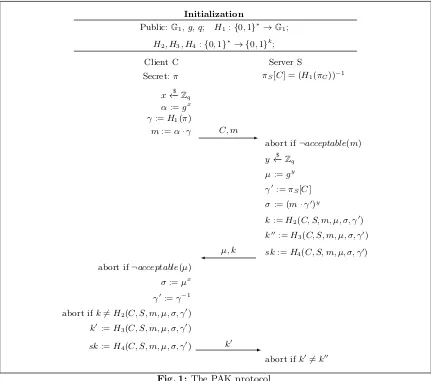
The PAK Protocol
In this section, we describe the PAK protocol from [27], whose mathematical description is pre-sented in Fig. 1. A few other variants of PAK were developed in [28].
3.1 Protocol description
Here, we make use of the same notation as in [27] (October version). Now, we describe the protocol informally.
Initialization
Public:G1,g,q; H1:{0,1}
∗
→G1;
H2, H3, H4:{0,1}
∗
→ {0,1}k
;
Client C Server S
Secret:π πS[C] = (H1(πC))−1
x←−$ Zq α:=gx γ:=H1(π)
m:=α·γ C, m
abort if¬acceptable(m)
y←−$ Zq
µ:=gy
γ0:=πS[C]
σ:= (m·γ0)y
k:=H2(C, S, m, µ, σ, γ0)
k00:=H3(C, S, m, µ, σ, γ0)
µ, k sk:=H4(C, S, m, µ, σ, γ0
)
abort if¬acceptable(µ)
σ:=µx
γ0:=γ−1
abort ifk6=H2(C, S, m, µ, σ, γ0)
k0:=H3(C, S, m, µ, σ, γ0)
sk:=H4(C, S, m, µ, σ, γ0) k0
abort ifk06=k00
Fig. 1:The PAK protocol.
Before any protocol execution, public parameters are fixed and passwords are shared between clients and servers during the initialization phase. More specifically, for efficiency reasons and secu-rity in case of password file compromise, servers only keep the inverse element of each password’s hash value.
The PAK protocol consists of three message rounds. In the first message round, the client sends a group elementm– generated by multiplying a random group elementαwith the mask γ (also a group element) that is derived from the shared passwordπ – along with its ID to the server. In the second message round, upon receiving the messageC, m, the server first checks with the
first checks ifµis valid group element. If so, it computes the shared secret and confirmation codek
and checks the validity of the latter. If all checks are correct, the client computes his confirmation code k0 and a session key sk, sets sid and pid values, and then it sends k0 in the third message round and terminates. The server, once it receives valuek0 and checks its validity, also terminates.
3.2 Instantiating the protocol over Gap Diffie-Hellman groups
Gap-DH groups were introduced in the pioneering work of Boneh, Lynn and Shacham [9]. For instance, Gap-DH groups can be derived by the supersingular elliptic curve given by the equation
y2 =x3+ 2x±1 over the field F3l. It can be seen that for some values ofl the number of points in this curve divides 36l−1. The value 6 is called the multiplier that has to be neither too small for the CDH problem to be hard, nor too big for the Decision Diffie-Hellman Oracle (DDH-O) to be efficient. An example of DDH-O on this curve is the Weil pairing [32]. Gap-problems were also studied by Okamoto and Pointcheval [31].
In order to have efficient PAK execution,H1:{0,1}∗→G1 must be an efficiently computable function. We point the reader to [28,30] for efficient implementations ofH1. Note that it is crucial for such an algorithm to run in constant time, otherwise timing attacks on a password are possible. For more details on pairings, we refer readers to [15].
4
Model
For our proof, we will use the well-known Find-then-Guess (FtG) security model from [7], which guarantees security against an adversary fully controlling the network, concurrent sessions, loss of session keys, as well as forward secrecy. Furthermore, the security model incorporates the essential requirements that PAKE protocols must satisfy: i) an eavesdropper adversary should not learn any information about the password and ii) an adversary can verify at most one password guess per protocol execution in an active attack.
In the FtG model, security is defined via a security experiment Gf tgplayed between a challenger
CHf tg and some adversary A. The task ofCHf tg is to administrate the security experiment while
keeping the appropriate secret information outside fromA’s view. Roughly speaking,Awins the security experiment if he is able to distinguish established session keys from random strings.
We will start by formally defining PAKE protocols. This will be followed by an in-depth de-scription of the FtG security model.
PAKE protocol. A PAKE protocol can be represented as a pair of algorithms (genP W,P), where genP W is a password generation algorithm and P is the description of the protocol that specifies how honest parties behave. AgenP W algorithm takes as input a set of possible passwords
P asswords, together with a probability distributionP.
Participants and passwords. In the two-party PAKE setting, each principalU is either from a
Clientsset or aServersset, both of which are finite, disjoint, nonempty sets. The setIDrepresents the union ofClientsandServers. Furthermore, we assume that each clientC∈Clientspossesses a passwordπC, while on the other hand each server S∈Serversholds a vector of the passwords
of all clientsπS :=hπCiC∈Clients.
Protocol execution. P is a PPT algorithm that specifies reaction of principals to network mes-sages. In a real scenario, each principal may run multiple executions of P with different users, thus in our model each principal is allowed an unlimited number ofinstances executing P in parallel. We denote withΠU
i thei-th instance of aU principal. In some places, where distinction matters,
we will denote client instances withΠC
i and server instances byΠjS.
When assessing the security of P, we assume that the adversary A has complete control of the network. Practically, this means that principals solely communicate through the adversary that may consider delaying, reordering, modifying, dropping messages sent by honest principals or injecting messages of its choice in order to attack the protocol. Moreover, the adversary has access to instances of the principals through the game’s interface (offered by the challenger). Thus, while playing the security game,Aprovides the inputs to the challengerCHf tg– who parses the received
– SendSend(U, i, M):Asends messageM to instanceΠiU. As a response,ΠiU processesM according to the protocol description P, updates its correspondinginternal stateand outputs a reply that is given toA. Whenever this query causesΠU
i toaccept,terminate or abort, it is indicated to
A. Additionally, to instruct clientC to initiate a session with server S, the adversary sends a message containing the name of the server to an unused instance ofC, i.e. SendSend(C, i, S).
– ExecuteExecute(C, i, S, j): This triggers an honest run of P between instancesΠC
i andΠjS. The
tran-script of the protocol execution is given to A. It covers passive eavesdropping on protocol flows.
– RevealReveal(U, i): As a response to this query,A receives the current value of the session keyski U
computed atΠU
i .Amay do this only ifΠiU holds a session key, e.g. it is inaccept orterminate
state. This query captures potential session key leakage as a result of its use in higher level protocols. Also, it ensures that if some session key gets compromised, other session keys remain protected.
– TestTest(U, i):CHf tg flips a bitband answers this query as follows: ifb= 1,AgetsskUi. Otherwise,
it receives a random string from the session key space. This query can only be asked once byA at any time during the execution of Gf tg. This query simply measures the adversarial success
and does not correspond to any real-world adversarial capability.
– CorruptCorrupt(U): The passwordπU is given toA ifU is a client, and the list of passwords πU in caseU is a server11.
As can be seen above, the adversary is allowed to send multiple SendSend, ExecuteExecute, RevealReveal and CorruptCorrupt queries to the challenger, and only a single TestTest query.
Accepting and terminating. In the FtG model from [7], an instanceΠiU accepts whenever it holds a session keyski
U, a session IDsid i
Uand a partner IDpid i
U. Note that the meaning of ”accept”
in this context is different from the usage of ”accept” in other settings such as computational complexity.
An instanceΠiU terminates if it holdsskiU,sidiU,pidiU and will not send nor receive any more messages. Due to the protocol design,ΠU
i may accept once and terminate later. Note also that it
is possible for a server running the PAK protocol to accept at the time it sends the second protocol flow and to later abort if it receives a wrong confirmation code in the third protocol flow.
Partnering. We say that instancesΠC
i andΠjSare partnered if both oracles accept holding (skCi, sidiC,pidiC) and (skSj,sidjS,pidjS) respectively and the following conditions hold:
1. skiC=skjS,sidiC=sidjS,pidiC =S, pidjS =C
2. no other instance accepts with the samesid.
Freshness. It captures the idea that the adversary should not trivially know the session key being tested. We incorporate forward secrecy in the definition of freshness. An instanceΠiU is said to be fs-fresh unless i) a RevealReveal query was made toΠiU or its partner (if it has one) or ii) a CorruptCorrupt(U0) query was made before the TestTest query (whereU0 is any participant) and SendSend(U, i, M) query was made at some point.
PAKE security. The goal ofAis to guess the bitbused to answer the test query. Let SuccFtGP (A) be the event whereA asks a single test query directed to a fs-fresh instance and A outputs his guessb0, where b0=b. The advantage ofAattackingP is defined as:
AdvFtGP (A) = 2·Pr [SuccFtGP (A)]−1 (5) In the original formulation of the model from [7], we say that protocol P is FtG-secure if there exists a positive constantB such that for every PPT adversaryAit holds that
AdvFtGP (A)≤ B·nse
N +ε (6)
11
where nse is an upper bond on the number of SendSend queries A makes, and ε is negligible in the security parameter. Following our discussion in section 1.3, we can modify the definition to allow arbitrary password distribution and login attempt policy; thus, we can define a protocol to be secure if for for every PPT adversaryA,
AdvFtGP (A)≤ F(D,L, nse) +ε (7)
where we are usingnseas an upper bound on the number of online password guesses the adversary
can make.
The following fact can be easily verified using Eq. 5:
Fact 1
Pr [SuccFtGP (A)] = Pr [SuccFtGP0 (A)] + ⇔ AdvFtGP (A) = AdvFtGP0 (A) + 2. (8)
5
Proof of Security
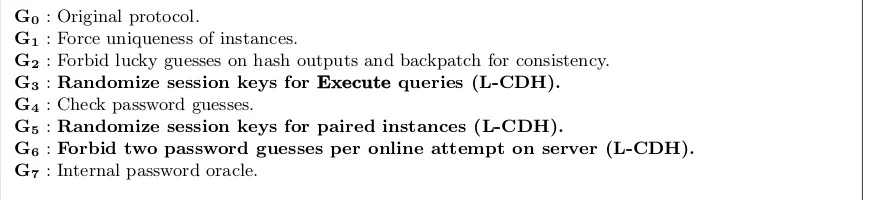
In this section, we prove the security of the PAK protocol instantiated over Gap Diffie-Hellman groups. Due to similarity with the proof of the original PAK protocol [27], we present an overview for those security games that remain the same as in the original protocol and focus on those that deviate from the original proof. In Fig. 2 we provide the description of the game hops and highlight those games which differ from the original security proof. The terminology regarding adversary’s actions, partnering and events stays as in [27] (see App. A).
G0: Original protocol.
G1: Force uniqueness of instances.
G2: Forbid lucky guesses on hash outputs and backpatch for consistency.
G3:Randomize session keys for ExecuteExecute queries (L-CDH).
G4: Check password guesses.
G5:Randomize session keys for paired instances (L-CDH).
G6:Forbid two password guesses per online attempt on server (L-CDH).
G7: Internal password oracle.
Fig. 2: Description of games for the original PAK.
The main difference between the existing proof in the FtG model and our proof is that our reduction algorithm makes use of a Decisional Diffie-Hellman Oracle (DDH-O). Such oracle is avail-able in gap groups, and it will output 1 on input (g, gx, gy, gz) ifgz =DH(gx, gy) and 0 otherwise.
This additional information can be leveraged – in games G3, G5and G6 – to increase the success probability and reduce the running time of the reduction compared to Theorem 6.9 in [27].
Proof of Theorem 2:We will denote by Pi the protocol executed in game Gi, for i from 0 to
7. Before we start with the revised games, we will first describe in Fig. 3 how the random oracle queries to H1 are answered by the simulator (reduction). It is important to highlight that the simulator has access toψ1[π] values (see Fig. 3).
H1: For each hash query H1(π), if the same query was previously asked, the simulator retrieves the record (π, Φ, ψ1) from the listLh1 and answers withΦ. Otherwise, the answerΦis chosen according to the following rule:
? RuleH1 Chooseψ1
$
←−Zq. ComputeΦ:=gψ1 and write the record (π, Φ, ψ1) toLh
Game G0:Original protocol.In this game, the challenger runs the original protocolP0for the adversaryA.
Game G1: Force uniqueness of instances.Let G1 be exactly the same as G0, except that if any of the valuesmandµchosen by honest instances collide with previously generated ones, the protocol aborts and the adversary fails.
The probability of this event happening is negligible in the security parameter and limited by the birthday bound. More precisely, for all adversariesA:
AdvFtGP0 (A)≤AdvFtGP1 (A) +(nse+nex)(nse+nex+nro)
q . (9)
Game G2:Forbid lucky guesses on hash outputs and backpatch for consistency.Let G2 be the same as G1, with the difference that now the simulator answers SendSend and ExecuteExecute queries without making any random oracle queries, while ensuing random oracle queries are backpatched to ensure consistency in the view of the adversary.
In addition, G2forbids lucky guesses on hash functions. Specifically, in G1there are cases where an unpaired client instanceΠC
i may accept a confirmation codek, but the adversary has not asked
the required random oracle queries toH1andH2in order to computek, i.e. he proactively produced the correct one. The probability of this event happening is O(nro+nse)
q . A similar scenario occurs
when considering an unpaired server instance. Then:
AdvFtGP1 (A) = AdvFtGP2 (A) +O(nro+nse)
q . (10)
Game G3:Randomize session keys for Execute queries.Let G3be exactly the same as G2, except that during processing of anHl(C, S, m, µ, σ, γ0) query forl∈ {2,3,4}, there is no check for atestexecpw(C, i, S, j, πc) event.
As a result of this change, even if testexecpw(C, i, S, j, πc) event is triggered, the simulator will answer anHl(C, S, m, µ, σ, γ0) query with a random string from {0,1}κ.
Claim 1 For all adversaries A running in time t, there exists an algorithm D running in time
t00=O(t+ (nro+nse+nex)·texp+nro·tddh), such that:
AdvFtGP2 (A)≤AdvFtGP3 (A) + 2Advgap−CDH
G1 (t
00). (11)
Proof:Let be the probability thattestexecpw occurs in G2. In that caseP r(SuccFtGP2 (A))≤ P r(SuccFtGP
3 (A)) +. By Fact 1, Adv
FtG
P2 (A)≤Adv
FtG
P3 (A) + 2. Note that games G2 and G3 are
indistinguishable if testexecpwdoes not occur.
Now, we will construct an algorithmDthat attempts to win its Gap-DH game against CHcdh
by runningAas a subroutine on a simulation of the protocolP2. For fixed (X, Y) that are coming fromCHcdh,Dsimulates G2 toAwith the following changes:
1. For every ExecuteExecute(C, i, S, j) query, setm =X ·gρiC, µ = Y ·gρjS, where (ρi C, ρjS)
$ ←− Z2q,
whilek, k0 stay random strings from{0,1}κ.
2. Each timeAasks aHl(C, S, m, µ, σ, γ0) query forl∈ {2,3,4} – where valuesm, µwere gener-ated in ExecuteExecute(C, i, S, j) query, andH1(πc) query returned (γ0)−1–Dcalls DDH-O with input (m·γ0, µ, σ). Once DDH-O returns 1, the “winning”Hlquery is identified, andDcomputesZ
value as follows
Z=σ·XρjS·YρiC ·gρiC·ρjS ·µψ1[πc], (12)
submits it toCHcdh as a solution for (X, Y) challenge, and stops. The advantage ofDin solving
Gap-DH is equal toand its running time ist00=O(t+ (nse+nex+nro)texp+nrotddh). ut
reduction where a list of sizenrois submitted toCHcdh.
Game G4 : Check password guesses. The challenger executes P3 as in G3, except that if correctpwevent occurs, then the protocol execution aborts and the adversary succeeds.
As consequence, before any CorruptCorrupt query, whenever the simulator detects (via oracle queries) that the adversary uses the correct password to compute the confirmation codek, the protocol will be aborted and the adversary will be deemed successful, i.e., nounpaired client or server instance will terminate prior tocorrectpwevent or CorruptCorrupt query.
AdvFtGP3 (A)≤AdvFtGP4 (A). (13)
Game G5: Randomize session keys for paired instances.G5 is identical to G4, except in casepairedpwguessevent occurs. In that case, the game stops and adversary fails.
In this particular reduction, we will show that an adversary Awho i) can adaptively corrupt user (thus knowing the passwordπc) and ii) manages to computesk forpaired instances ΠC
i and ΠS
j, could be used as a subroutine to solve the Gap-DH problem.
Claim 2 For any adversary A running in time t, an algorithm D running in time t00 = O(t+ (nse+nro+nexe)texp+ (nse+nro)tddh)can be built such that:
AdvFtGP
4 (A)≤Adv
FtG
P5 (A) + 2Adv gap−CDH
G1 (t
00). (14)
Proof:If pairedpwguessdoes not occur, then games G4 and G5are indistinguishable. Letbe the probability thatpairedpwguessevent occurs, whenAis running in G4.
Next, we will construct an algorithmDthat attempts to win its Gap-DH game againstCHcdh
by running A as a subroutine on a simulation of the protocol P4. For a given pair (X, Y), D simulates G4to Awith the following changes:
1. In CLIENT ACTION 0 query toΠC
i and inputS, setm=X·gρC,i whereρC,i
$ ←−Zq.
2. In SERVER ACTION 1 query toΠS
j and inputhC, mi, set µ=Y ·gρS,j, where ρS,j
$ ←−Zq.
3. In CLIENT ACTION 1 to ΠiC and input hµ, ki, if ΠiC is unpaired, D first verifies k using DDH-O and the list of random oracle queries. If kis correctly constructed (DDH-O outputs 1),ΠC
i outputsk0 and terminates, or rejects otherwise.
4. In SERVER ACTION 2 query to ΠjS with input k0, if ΠjS was paired after its SERVER ACTION 1 but is now unpaired, then D verifies k0. If k0 is correctly constructed, then ΠjS
terminates. Otherwise, it rejects.
5. After A terminates, the simulator selects queries of the form Hl(C, S, m, µ, σ, π), for which the following conditions are satisfied: i) m and µ generated by some instances ΠiC and ΠjS
respectively, ii)ΠiC is paired withΠjS and ΠjS is paired withΠiC after SERVER ACTION 1, iii) (γ0)−1=H
1(π). For every such query,Dcalls DDH-O with input (m·γ0, µ, σ).
Once DDH-O returns 1,D computesZ value in the same way as for G3 (Eq. 12), submits it toCHcdh as a solution for (X, Y) challenge, and stops. The advantage ofDin solving Gap-DH is
equal toand its running time ist00=O(t+ (nse+nro+nexe)texp+ (nse+nro)tddh). ut
DISCUSSION. To explain why the original reduction from [27] contains nse degradation factor, and how we can avoid such degradation in ours, consider the following scenario:
Suppose that the adversary A against protocol P4 first makes a CLIENT ACTION 0 query to ΠC
i and receives as an answer m = X ·gρC,i value in which Diffie-Hellman challenge X is
planted. Next,Aobtainsπc=π[C, S] via CorruptCorrupt(S) query. With this information,Amay decide
to impersonateStoCby making a CLIENT ACTION 1 query with an inputhµ, kitoΠC
i . SinceA
knows the correct password, he could compute and send the correct confirmation codek; however, Acould also choose to send an incorrect one. Now, the simulator faces a problem:ΠC
i has to verify k and based on the verification outcome either accept or reject. Put differently, the simulator is unable to verify whethertestpw(C, i, S, πc, l= 2) is triggered; this could be done by checking if
To circumvent this obstruction, the reduction in [27] has to guess an instance that will be the target of the TestTest query: this provides guarantee that there won’t be any corruption before session keys are accepted, and thus the simulator can safely plant the received Diffie-Hellman challenge (X, Y) in the TestTest session. This technique yields a factor ofnse in front of AdvLG−CDHadvantage in
Theorem 1.
In contrast, by using Gap-DH groups, our simulator can query DDH-O with input (α, µ, σ) to verify ifσ =DH(α, µ) and check whether the event testpw(C, i, S, πc, l = 2) is triggered or
not. Hence, we can avoid guessing of the TestTest instance, which makes our reduction tight with respect to the success probability. Compared to [27], the running time of the reduction algorithm has increased by an additive term (nse+nro)tddh, due to the invocation of DDH-O needed for the
simulator to identify correct random oracle queries.
Game G6:Forbid two password guesses per online attempt on server. Let G6be identical to G5, except that if doublepwserver event occurs, the protocol halts and the adversary fails. We assume that the check fordoublepwserveroccurs before the check forpairedpwguess.
Claim 3 For any adversary A running in time t, there exists an algorithm D running in time
t00=O(t+ (nse+nro+nexe)texp+nrotddh)such that
AdvFtGP
5 (A)≤Adv
FtG
P6 (A) + 4Adv gap−CDH
G1 (t
00) (15)
Proof:We will construct an algorithmDthat attempts to win its Gap-DH game againstCHcdhby
runningAas a subroutine on a simulation of the protocolP5. For a given pair (X, Y),Dsimulates G5 toAwith the following changes:
1. InH1(π) query, outputXψ1[π]gψ 0
1[π], where ψ1[π]←− {0$ ,1} andψ0
1[π] $ ←−Zq.
2. In a SERVER ACTION 1 query to a serverΠS
j with inputhC, miwhereacceptable(m) is true,
setµ=Y ·gρ0S,j.
3. Tests forcorrectpwandpairedpwguess, from G4 and G5 respectively, are not made. 4. AfterAterminates, the simulatorDusing DDH-O first creates a listLc ofHl(C, S, m, µ, σ, γ0)
queries, with l ∈ {2,3,4}, such thatσ=DH(m·γ0, µ). ThenD selects from the listLc two
different queries, sayHl(C, S, m, µ, σ, γ0) andHˆl(C, S, m, µ,σ,ˆ ˆγ0), for l,ˆl ∈ {2,3,4} such that there was i) a SERVER ACTION 1 query to a server instance ΠS
j with input hC, mi and
output hµ, ki, ii) an H1(π) query that returned (γ0)−1, anH1(ˆπ) query that returned (ˆγ0)−1 and iii)ψ1[π]6=ψ1[ˆπ]. ThenDoutputs:
Z=
σ·σˆ−1·(γ0)−ρ0S,j·(ˆγ0)ρ 0 S,j·Yψ
0
1[π]−ψ
0
1[ˆπ]
ψ1[π]−ψ1[ˆπ]
, (16)
whereZ =DH(X, Y).
G6 is indistinguishable from G5 until the event doublepwserveroccurs. Let the be the prob-ability that doublepwserver occurs when A is running in G5. When doublepwserver oc-curs for two passwords π 6= ˆπ, the success probability of D is /2 and its running time is
t00=O(t+ (nse+nro+nexe)texp+nrotddh). ut
DISCUSSION: This game shows thatA’s probability of simultaneously guessing (discarding) more thanone password during a single online attempt on a server executing P6 is negligible. In most PAKE proofs (in [27] too), this reduction typically brings the highest security degradation: e.g. 1/n3
ro appears in the case of Dragonfly [23] and SPEKE [26]. In contrast, our protocol only suffers
from a constant loss (4) in the success probability. The reason for 1/n2
ro degradation when using L-CDH in PAK reduction is the following: D
In contrast, by using Gap-DH groups,Dcan identify the right pair of Hl queries (at the cost of at mostnrotddh in the running time) and then compute a single, correctZ value using Eq. 16.
As a result, we can remove the quadratic factor in the running time ofD.
Game G7:Internal password oracle.The purpose of this game is to estimate the probability of thecorrectpw event occurring, i.e. the adversary guessing the correct passwordπc.
Let G7 be as G6, except that there is an internal password oracle Opw which generates all
passwords during the initialization of the users. The simulator uses it to i) handle CorruptCorrupt queries and ii) test whethercorrectpw occurs. More specifically, whenA asks CorruptCorrupt(U), the query is simply forwarded toOpwwhich returnsπU ifU ∈Clients, otherwise returnshπU[C]iC∈Clients. To
determine whether correctpw occurs, the simulator queries Opw with test(π, C), which returns
TRUE ifπ=πC and FALSE otherwise.
By definition G6and G7 are perfectly indistinguishable. Then:
AdvFtGP
6 (A) = Adv
FtG
P7 . (17)
Claim 4 For all PPT adversariesA:
AdvFtGP7 ≤ F(D,L, nse). (18)
Proof:Letψdenote thecorrectpwevent andψcits compliment. The probability thatAsucceeds
in G7is given by:
Pr [SuccFtGP7 (A)] = Pr [ψ]·Pr [Succ
FtG
P7 (A)|ψ] +
Pr [ψc]·Pr [SuccFtGP7 (A)|ψc] (19)
We look at the first term of Eq. 19. Since there are nse SendSend queries, the probability of cor-rectpw occurring is bounded by Pr [ψ] ≤ F(D,L, nse). Additionally, it follows from G4 that Pr [SuccFtGP7 (A)|ψ] = 1. Now we look at the second term of Eq. 19. Given thatcorrectpw does not occur,Asucceeds by making a TestTest query to a fresh instanceΠiU and guessing the bitbused in the TestTest query. By examining RevealReveal andH4queries throughout the proof, it follows that the view of A is independent of skiU, therefore Pr [SuccFtGP7 (A)|ψ
c] = 1/2. Putting everything together,
using Eq. 19 and Eq. 5:
AdvFtGP7 ≤ F(D,L, nse). ut
6
Conclusion
In this paper, we proposed a new instantiation for the PAK protocol and showed that the security proof from [27] can be adapted to cover our proposal. Our reduction to the Gap Diffie-Hellman problem is significantly tighter than the previous reduction to the List Diffie-Hellman problem. From a theoretical point of view, this shows that the security of PAK is closely related to the security of Gap-DH assumption. In terms of concrete security, the advantage of the tighter proof is that it provides the guarantee that with typical values of the group size for today, even the most computationally powerful adversaries today cannot do significantly better than an online dictionary attack. In future work it would be interesting to see if similar techniques could lead to tighter security proofs in other existing PAKE protocols.
ACKNOWLEDGEMENTS
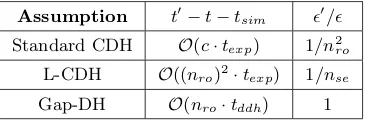
Assumption t0−t−tsim 0/
Standard CDH O(c·texp) 1/n2ro
L-CDH O((nro)2·texp) 1/nse
Gap-DH O(nro·tddh) 1
Table 1.Comparison of running time and success probability of PAK reduction algorithm when using different variants of CDH assumption. Variabletexprepresents the running time to compute exponentiation
inG,tddh the time for deciding DDH,tsim= (nse+nro+nexe)texp,cis a constant,nroandnseare the
number of random oracle and send queries respectively.
References
1. Thread Protocol.http://threadgroup.org/(2015)
2. Magic Wormhole.https://github.com/warner/magic-wormhole(2016)
3. Abdalla, M., Chevassut, O., Pointcheval, D.: One-Time Verifier-Based Encrypted Key Exchange. In: Vaudenay, S. (ed.) Public Key Cryptography - PKC 2005. LNCS, vol. 3386, pp. 47–64. Springer (2005) 4. Abdalla, M., Fouque, P., Pointcheval, D.: Password-Based Authenticated Key Exchange in the Three-Party Setting. In: Vaudenay, S. (ed.) Public-Key Cryptography – PKC 2005. LNCS, vol. 3386, pp. 65–84. Springer (2005)
5. Abdalla, M., Pointcheval, D.: Simple Password-Based Encrypted Key Exchange Protocols. In: Menezes, A. (ed.) Topics in Cryptology - CT-RSA 2005. LNCS, vol. 3376, pp. 191–208. Springer (2005) 6. Bellare, M.: Practice-Oriented Provable Security. In: Damg˚ard, I. (ed.) Lectures on Data Security,
Modern Cryptology in Theory and Practice. LNCS, vol. 1561, pp. 1–15. Springer (1998)
7. Bellare, M., Pointcheval, D., Rogaway, P.: Authenticated Key Exchange Secure Against Dictionary Attacks. In: Advances in Cryptology – EUROCRYPT 2000. LNCS, vol. 1807, pp. 139–155. Springer (2000)
8. Bellovin, S.M., Merritt, M.: Encrypted Key Exchange: Password-Based Protocols Secure Against Dic-tionary Attacks. In: 1992 IEEE Symposium on Research in Security and Privacy, SP 1992. pp. 72–84 (1992)
9. Boneh, D., Lynn, B., Shacham, H.: Short Signatures from the Weil Pairing. In: Boyd, C. (ed.) Advances in Cryptology - ASIACRYPT 2001. LNCS, vol. 2248, pp. 514–532. Springer (2001)
10. Boyko, V., MacKenzie, P.D., Patel, S.: Provably Secure Password-Authenticated Key Exchange Using Diffie-Hellman. In: Preneel, B. (ed.) Advances in Cryptology – EUROCRYPT 2000. LNCS, vol. 1807, pp. 156–171. Springer (2000)
11. Canetti, R., Halevi, S., Katz, J., Lindell, Y., MacKenzie, P.D.: Universally Composable Password-Based Key Exchange. In: Cramer, R. (ed.) Advances in Cryptology – EUROCRYPT 2005. LNCS, vol. 3494, pp. 404–421. Springer (2005)
12. Dacosta, I., Ahamad, M., Traynor, P.: Trust No One Else: Detecting MITM Attacks against SSL/TLS without Third-Parties. In: Foresti, S., Yung, M., Martinelli, F. (eds.) Computer Security - ESORICS 2012. LNCS, vol. 7459, pp. 199–216. Springer (2012)
13. Ding, J., Alsayigh, S., Lancrenon, J., RV, S., Snook, M.: Provably Secure Password Authenticated Key Exchange Based on RLWE for the Post-Quantum World. In: Handschuh, H. (ed.) Topics in Cryptology - CT-RSA 2017. LNCS, vol. 10159, pp. 183–204. Springer (2017)
14. Ecrypt, I.: ECRYPT II Yearly Report on Algorithms and Keysizes. European Network of Excellence in Cryptology II, Tech. Rep (2012)
15. Galbraith, S.D., Paterson, K.G., Smart, N.P.: Pairings for Cryptographers. Discrete Appl. Math. 156(16), 3113–3121 (Sep 2008)
16. Hao, F., Ryan, P.: J-PAKE: Authenticated Key Exchange without PKI. Transactions on Computa-tional Science 11, 192–206 (2010)
17. Harkins, D.: Simultaneous Authentication of Equals: A Secure, Password-Based Key Exchange for Mesh Networks. In: Proceedings of the 2008 Second International Conference on Sensor Technologies and Applications. pp. 839–844. SENSORCOMM ’08, IEEE Computer Society (2008)
18. Standard Specifications for Password-Based Public Key Cryptographic Techniques. Standard, IEEE Standards Association, Piscataway, NJ, USA (2002)
19. Jablon, D.P.: Strong Password-Only Authenticated Key Exchange. ACM SIGCOMM Computer Com-munication Review 26(5), 5–26 (1996)
21. Katz, J., Ostrovsky, R., Yung, M.: Efficient Password-Authenticated Key Exchange Using Human-Memorable Passwords. In: Pfitzmann, B. (ed.) Advances in Cryptology – EUROCRYPT 2001. LNCS, vol. 2045, pp. 475–494. Springer (2001)
22. Krawczyk, H.: Hmqv: A High-Performance Secure Diffie-Hellman Protocol. In: Shoup, V. (ed.) Ad-vances in Cryptology - CRYPTO 2005. LNCS, vol. 3621, pp. 546–566. Springer (2005)
23. Lancrenon, J., ˇSkrobot, M.: On the Provable Security of the Dragonfly Protocol. In: Lopez, J., Mitchell, C.J. (eds.) Information Security – ISC 2015. LNCS, vol. 9290, pp. 244–261. Springer (2015)
24. Lenstra, A.K.: Key Lengths. Tech. rep., Wiley (2006)
25. Lopez Becerra, J.M., Iovino, V., Ostrev, D., ˇSkrobot, M.: On the Relation Between SIM and IND-RoR Security Models for PAKEs. In: SECRYPT 2017. SCITEPRESS (2017)
26. MacKenzie, P.: On the Security of the SPEKE Password-Authenticated Key Exchange Protocol. Cryp-tology ePrint Archive, Report 2001/057 (2001), http://eprint.iacr.org/2001/057
27. MacKenzie, P.: The PAK Suite: Protocols for Password-Authenticated Key Exchange. DIMACS Tech-nical Report 2002-46 (2002)
28. MacKenzie, P.D.: More Efficient Password-Authenticated Key Exchange. In: Naccache, D. (ed.) Topics in Cryptology - CT-RSA 2001. LNCS, vol. 2020, pp. 361–377. Springer (2001)
29. MacKenzie, P.: Methods and Apparatus for Providing Efficient Password-Authenticated Key Exchange (2002),https://www.google.com/patents/US20020194478, publication number US20020194478 A1 30. Mrabet, N.E., Joye, M.: Guide to Pairing-Based Cryptography. Chapman & Hall/CRC (2016) 31. Okamoto, T., Pointcheval, D.: The Gap-Problems: A New Class of Problems for the Security of
Cryp-tographic Schemes. In: Kim, K. (ed.) Public-Key Cryptography - PKC 2001. LNCS, vol. 1992, pp. 104–118. Springer (2001)
32. Silverman, J.H.: The Arithmetic of Elliptic Curves, vol. 106. Springer Science & Business Media (2009) 33. Stevens, M., Bursztein, E., Karpman, P., Albertini, A., Markov, Y.: The First Collision for full SHA-1.
IACR Cryptology ePrint Archive 2017, 190 (2017),http://eprint.iacr.org/2017/190
34. Wang, D., Cheng, H., Wang, P., Huang, X., Jian, G.: Zipf’s Law in Passwords. IEEE Transactions on Information Forensics and Security (2017)
35. Wang, D., Wang, P.: On the Implications of Zipf’s Law in Passwords. In: Askoxylakis, I.G., Ioannidis, S., Katsikas, S.K., Meadows, C.A. (eds.) Computer Security - ESORICS 2016. LNCS, vol. 9878, pp. 111–131. Springer (2016)
A
Terminology from [27]
First, we introduce the terminology that deals with adversary’s actions and partnering. We say “in a CLIENT ACTION κquery to ΠC
i ”, to refer to “in a SendSend query to ΠiC that
results in execution of CLIENT ACTIONκprocedure” and “in a SERVER ACTIONκquery to
ΠS
j”, to refer to “in a Send query toΠjS that results in execution of SERVER ACTIONκ
proce-dure”. A client instanceΠC
i is paired with a server instanceΠjS if there is a CLIENT ACTION 0
query toΠC
i with input S and output hC, mi, there is a SERVER ACTION 1 query to ΠjS with
inputhC, miand outputhµ, kiand there is a CLIENT ACTION 1 query toΠC
i with inputhµ, ki.
A server instanceΠS
j is paired with client instanceΠiC whenever there is a CLIENT ACTION 0
query toΠC
i with input S and output hC, mi, there is a SERVER ACTION 1 query to ΠjS with
inputhC, miand outputhµ, ki, and if there is a SERVER ACTION 2 query toΠS
j with inputk0,
then there was previously a CLIENT ACTION 1 query toΠC
i with inputhµ, kiand outputk0.
Next we describe those events taken from [27] which are required in our proof of security.
– testpw(C, i, S, π, l): for some m, µ and γ0, A makes i) an Hl(C, S, m, µ, σ, γ0) query, ii) a CLIENT ACTION 0 query to a client instance ΠiC with input S and output hC, mi, iii) a CLIENT ACTION 1 query toΠiC with inputhµ, kiand iv) anH1(π) query returning (γ0)−1, where the last query is either theHl(·) query or the CLIENT ACTION 1 query,σ=DH(α, µ),
m=α·(γ0)−1 andl∈ {2,3,4}.
– testpw!(C, i, S, π): for some k, a CLIENT ACTION 1 query with inputhµ, kicauses an event testpw(C, i, S, π,2) to occur, with associated value k.
– textpw(S, j, C, π, l): for some m, µ, γ0 andk,Amakes anHl(C, S, m, µ, σ, γ0) query, and
pre-viously made i) a SERVER ACTION 1 query to a server instance ΠS
j with input hC, miand
outputhµ, ki, and ii) anH1(π) query returning (γ0)−1, whereσ=DH(α, µ),m=α·(γ0)−1 and ACCEPTABLE(m). The associated value of this event isk, k00 orskjs.
– testpw!(S, j, C, π): SERVER ACTION 2 query toΠS
j is made with inputk0, and previously
a testpw(S, j, C, π,3) event occurs with associated valuek0.
– testpw∗(S, j, C, π): testpw(S, j, C, π, l) event occurs for somel∈ {2,3,4}.
– testpw(C, i, S, j, π) : for somel∈ {2,3,4}, both a testpw(C, i, S, π, l) and testpw(S, j, C, π, l) event occur, where ΠiC is paired with ΠjS, and ΠjS is paired with ΠiC after its SERVER ACTION 1 query.
– testexecpw(C, i, S, j, π): for some m, µ and γ0, A makes an Hl(C, S, m, µ, σ, γ0) query, for
l ∈ {2,3,4}, and previously made i) an ExecuteExecute(C, i, S, j) query that generates m, µ, and ii) anH1(π) query returning (γ0)−1, whereσ=DH(α, µ) andm=α·(γ0)−1.
– correctpw: before any CorruptCorrupt query, either a testpw!(C, i, S, πC) event occurs for someC,i
andS, or a testpw∗(S, j, C, πC) event occurs for someS,j, andC.
– doublepwserver: before any Corrupt queryCorrupt query, both testpw∗(S, j, C, π) event and a testpw∗(S, j, C,ˆπ), for someS, j, C andπ6= ˆπ.