President’s Report
Still Growing and Developing in
‘76
B. J. RAGSDALE
It has indeed been an honor and privilege to have served the Society for Range Management as president in 1976, the year in which the United States celebrated its 200th birthday. As a professional society we have only been in existence since 1948, a relatively short time as compared to the United States’ 200-year life span or the time Mexico, Canada, or other nations represented in the membership of our Society have been nations. During this brief time we have grown, matured, and made significant impact on the art and science of range manage- ment and rangelands of the world. Several significant accom- plishments took place during 1976, but much remains to be done if we are to be the professional society to represent range people and reach that ultimate goal of seeing proper use and manage- ment imposed on the world’s rangelands and range resources. A goal of each president, whether of parent Society or Section, is to significantly increase the number of viable interested members. We did not make a great increase, as we had 5,56 1 members January 3 1, 1977, as compared to 5,504 on the same date in 1976. What may be significant is that renewals are coming in faster and at this time are some 5% ahead of last year.
Membership must be the concern of all elements of the Society. Each member must see that his membership is renewed and recruit new members. Membership committees must pro- vide guidance and incentive to members; Sections and the parent Society must in turn provide desired membership services.
A GOAL OF MINE in the area of information, education, and communication was accomplished to some extent through the president’s and secretary’s messages in Rangeman’s Journal. Through responses by the officers, directors, and
individual members, we have communicated with many agri- cultural, governmental, and other groups. I feel we have not reached the general public.
A LONG-TERM GOAL reached in 1976 was the acquiring of our own building. The desire of our members as well as growth in number and workload of the Denver staff predicated this action. Many contributed to this venture-Dr. Robert Hyde and the Permanent Headquarters Building Committee; Mr. Robert Williamson and the Finance Committee; Mr. Milton Sechrist, who served as liaison between the two committees; and Mr. David Smith, executive secretary, who coordinated the trans- actions. To these we owe a debt of gratitude.
THE FINANCE COMMITTEE is a relatively new one, only completing its second year of work, but one which has contrib- uted greatly. They developed guidelines for financing which cleared the way for securing our building. The contribution policy proposed by them and later adopted by the Board, guidance in amending the Articles of Incorporation, the pro- posal for an Audit Committee, and guidance in budget and financial management make the contributions of this committee great in terms of our success and progress.
While on the subjects of the building and financing, I urge you to consider how you can contribute to the future of the Society for Range Management through donations, gifts, and pure hase of the promissory notes. Your support and cooperation will assure the retiring of the note on the building and maintain- ing a sound financial program.
CONSIDERATION HAS BEEN GIVEN for some time to the Society’s becoming a member of CAST, Council of Agri- cultural Science and Technology. Membership costs have been included in the proposed budget and formal petition for mem- bership is anticipated for 1977.
A study is being made of membership services, cost of new programs, both initiated and proposed, and current dues struc- ture. With inflation, progress and services desired by members, it is inevitable that dues must be increased above the current level. Many other societies have already imposed such in- creases.
Delivered February 16, 1977, at the 30th Annual Meeting, SRM, in Portland, Oregon. A STATEMENT IS CONTAINED in Benchmarks: A State- ment of Concepts and Positions about internationalism. It is
within this area that a major step was finalized in 1976 with the final organization of the International Rangeland Commission. The Commission is sponsored by the Society with membership currently limited to Mexico, Canada, and the United States. Membership will include Society members as well as represen- tatives from the Departments of Agriculture of the three participating countries. A major goal of the Commission will be to address mutual problems of the participating countries, convey information of these problems to the governments of the participating countries, and secure additional interest and action from the governments in solving the problems. The first activity planned by the Commission will be to delineate mutual prob- lems and develop a plan of action to work toward solving these problems. Dr. Martin Gonzalez .of Mexico is chairman of the Commission, and Mr. E. A. McKinnon of Canada is vice- chairman.
PROGRESS IS CONTINUING on schedule for the First International Rangeland Congress scheduled for August, 1978. Dr. Harold Heady and the International Affairs Committee are to be commended for their efforts in planning and organizing and eventually bringing to fruition this event, which will provide for the exchange of knowledge of the world’s range- lands.
ANOTHER RELATIVELY NEW PROGRAM of the Soci- ety is the Old West Regional Range Program. The 2-year program is scheduled for completion in March, 1977, but all indications are that a second grant will be made by the Old West Regional Commission for continuing the program for 2 more years. Increased educational activities for both adults and youth; development of films, one of which was premiered at the plenary session of this annual meeting; and development of range inventory data and maps, indicate the success of this program. The overall value will be the continuance of activities within the five states of the Old West Region after our involvement is completed; all indications point to this.
An outgrowth of the Old West Program was the “Governor’s Conference on Montana Rangelands” hosted by Governor Thomas L. Judge of Montana. Hopefully, other governors will follow with similar programs.
The Society’s first venture with a grant has not been “all roses,” but from this experience a set of guidelines was adopted by a January Board Meeting to govern our future actions concerning such activities.
THE BOARD DURING ITS JANUARY MEETING adopted a set of standards and a plan developed by the Professional
Affairs Committee to upgrade Civil Service standards for range conservationists. Support has been secured from the Bureau of Land Management, Soil Conservation Service, and Forest Service. Hopefully, this will result in the Civil Service Com- mission revising their standards.
THE INITIATION OF THE FELLOW AWARD PRO- GRAM, to me, is a long overdue, worthwhile addition to our Honor Award Program. The responses received from those to be recognized at this meeting indicate the high value placed on this award. E. William “Bill” Anderson and the Honor Award Committee did a magnificent job in implementing this program to recognize those who have contributed so greatly to the Society for Range Management.
TWO OF THE ORIGINAL GOALS for the Society as outlined by Mr. Joseph F. Pechanec in his article in the first issue of the Journal of Range Management were for the publication of a Journal devoted to the subject of range and to provide for meetings to exchange ideas, new developments, and discussion of policies. Improvement of the Journal of Range Management through the years and the addition of Rangeman’s Journal indicateto me that we are continuing to meet this goal. Continual evaluation must be made for the improvement of these publications to meet the needs of our members as well as the many users outside our ranks.
IT WAS MY PRIVILEGE to attend several Section and other meetings during the year. It was gratifying to see current topics of concern discussed both pro and con by meeting participants. I sensed a feeling of increasing interest in range and solving range problems by both Society members and others; this feeling was experienced at the National Veterinary Congress in Mexico City, the Governor’s Conference in Montana, at the Section meetings, and at local field days.
In this brief report I have attempted to highlight some of the major events of 1976. All of our committees and liaison representatives have been active and working on their assign- ments. The Sections, Chapters, Advisory Council Board, Executive Secretary David Smith, the Denver staff, and above all, you the individual member, have demonstrated by your dedication and hard work that you want the Society for Range Management to continue to grow and meet our responsibilities. I challenge each of you to rededicate yourself to the tasks ahead.
Thank you again for the honor accorded me by allowing me to be your president in 1976.
New Editor
Dr. Rex D. Pieper will assume the responsibilities of editor of the Journal of Range Management following the resignation of Editor Elbert H. Reid for health reasons. Manuscripts and correspondence concerning them should be sent to Dr. Pieper, Dept. of Animal Sciences, New Mexico State University, Las Cruces, NM 88001.
Herbicides and the Range Ecosystem: Resi-
dues, Research, and the Role of Rangemen
C,
J. SCIFRESHighlight: Increasing sophistication in application techniques, herbicide chemistry, and related technology in conjunction with intensified public awareness of herbicide use on rangeland has provided the impetus for research on the fate of herbicides in the range ecosystem. The complexity of the range ecosystem in comparison to monocultural systems dictates that persons versed in range ecology and herbicide technology conduct necessary research and play a dominant role in interpretation of results. The role of the atmosphere, ecosystem surfaces, vegetation, soil, and water in herbicide transfer and dissipation from the range eco- system are reviewed. Properly applied, herbicides applicable to range improvement programs provide excellent levels of weed and brush control without undue hazard to sensitive crops; do not endanger man, his livestock or wildlife; and, in most cases, are dissipated from the ecosystem during the growing season in which they are applied.
Herbicides have been integral parts of range improvement systems for over 25 years. However, until the late 1940’s and early 1950’s, most herbicide use was as individual-plant treat- ments; and, available herbicides were not highly selective. It would have been interesting to have observed the reactions of the first ranchers who were told, after fighting brush by hand and with heavy equipment for most of their lives, that new chemicals had been developed which, when sprayed in small quantities on the brush, would kill the trees with little or no damage to the grasses. Rapid technological advancement, especially in herbicide development and methods of appli- cation, provided the capability of rapidly treating extensive acreages with aircraft.
Brush and weed control on rangeland is basically a manage- ment problem that must be approached on an ecological basis within an economic framework. Effective herbicides are essen- tial tools for the modern range resource manager. Herbicide use for range improvement serves as an ideal example of the increasing complexity of effectively approaching the brush problem in the Southwest when proper management, ecological requirements, and economic criteria are considered.
In the early days, the ultimate fate of herbicides after appli- cation to rangeland was a relatively small consideration, es- pecially if the chemicals were known to be nontoxic to grazing animals. Also, most herbicide use was concentrated on large
Author is professor. Department of Range Science, Texas A&M University, College Station 77843.
Thib report is published with approval of the Director, Texas Agricultural Experiment Station, as TA-12263.
areas much of which was privately owned. Public opinion played a minor role in the decision-making process involved in management and use of these lands. Also, most of the range improvement efforts with herbicides involved use of one class of chemicals, phenoxy herbicides, primarily 2,4-D [(2,4-di-
chlorophenoxy)acetic acid], 2,4,5-T [(2,4,5-trichlorophenoxy) acetic acid], and silvex [2-(2,4,5-trichlorophenoxy)propionic acid]. Herbicides and the technology associated with their use have become more sophisticated in the past 25 years; and public interest in the use and management of all natural resources has intensified. Range researchers have made an exceptional contri- bution to the knowledge base relative to performance of herbicides and their use in range management. However, today’s rangemen, ranchers, researchers, educators, public land managers, and action-agency personnel, must also be broadly versed in the fate of herbicides after application to rangeland. Until approximately 10 years ago, most of the research dealing with the fate of herbicides was left to agronomists, plant physi- ologists, and others who dealt primarily with monocultural systems. However, qualified rangemen must take a more active part in conducting residue research to assure their proper role in data interpretation; and, most important, an active voice in the decision-making processes affecting herbicide use patterns on rangeland.
Technological sophistication in residue research is being directly applied to studies in the range ecosystem with herbi- cides. A few years ago, 0.5 to 1 part herbicide residue per million parts of air, soil, water, or vegetation was considered a sensitive lower limit of detection. Techniques have been refined such that residue levels of many herbicides are presently measured as parts per billion (Merkle et al. 1966). Methods are being developed which may ultimately make it routinely possi- ble to detect herbicides at parts per trillion levels! If time relationships were compared, 1 second lapse every 11.57 days is equivalent to 1 ppm; and 1 second lapse every 3 1.7 years is toughly equipvalent to 1 ppb. Based on weight, 1 lb of soil mixed with a 6-inch layer from 1 acre in area equals 1 part per million; and 1 lb of soil mixed in the same 6-inch layer but from 1,000 acres is roughly equivalent to 1 ppb. Obviously, such sensitivity allows detailed monitoring of the fate of herbicides in the environment. However, the biological significance of these almost infinitely small quantities of herbicides in natural sys- tems must be defined and common sense asserted in the decision-making process. This logic may be best offered by workers with a grasp of requisites for effective natural resource
management who are qualified to assess the significance of given levels of herbicide residues.
The complexity of range ecosystems, especially the diversity in vegetation and soils, makes research on fate of herbicides in rangeland more complicated than in cropland. An understanding of the form and function of these natural systems is required for
proper interpretation of research results leading to decisions concerning herbicide use. To reiterate, it is critical that runge- men play an active part in conceiving, devising, conducting, and interpreting research on dissipation of herbicides from rangeland.
Since the early 1960’s, considerable research has been conducted on herbicide residues in rangeland emphasizing their longevity in various portions of the ecosystem and the inter- relations of the atmosphere, vegetation, soil, and water with herbicide dissipation. The following is a summary of the residual potential of phenoxy herbicides (primarily 2,4-D and 2,4,5-T, picloram (4-amino-3,5,6-trichloropicolinic acid), and dicamba (3,6-dichloro-o-anisic acid) in various compartments of the range system. Although the latter two herbicides are commercially formulated in various ratios with the former two, there is no evidence that their application in mixtures influences rate of dissipation of either component. Therefore, the herbi- cides will be dealt with separately. Dry formulations of pic- loram and dicamba are available and show promise for some nmge uses; however, aerial application of sprays for weed and brush control are emphasized in this paper.
The spray contacts the environment immediately upon re- lease from the spray nozzle, and must travel through the atmosphere to reach the target (undesirable vegetation). A certain portion of the chemical comes in contact with the soil and eventually with the soil solution. Consequently, water volubility of the herbicide and weather conditions, especially occurrence of precipitation following application, determine relative mobility of the herbicide in the ecosystem.
Each environmental component, atmosphere, vegetation, soil, and water, will be discussed separately. However, it is understood that the environment cannot be compartmentalized in the strictest sense; and the interactions among compartments may be of more importance than activity within a compartment (Covey and Scifres 1971) (Fig. 1).
Atmosphere Effects
The most pronounced atmospheric effects on herbicide sprays are spray drift (displacement of airborne spray particles from the target area) and volatilization (the conversion of liquid to a gas). The action of air currents is primarily responsible for extent of spray drift as related to ( 1) droplet size, (2) wind direction and velocity, and (3) height above the target at which the spray is released.
Droplet size is affected by spraying pressure, type of carrier (whether oil or water), and nozzle size. In general, low spraying pressure and large nozzle orifices produce large droplets. As the spraying pressure is increased and/or nozzle orifice size de- creased, the spray is broken up into progressively smaller particles increasing potential for their displacement.
As the spray droplets fall through the atmosphere, they become increasingly smaller until completely evaporated (the rate of evaporation depends on temperature, relative humidity, and carrier) or until contacting a plant or soil surface. Thus, the height above ground line at which sprays are released is extremely important in regulating extent of spray drift. Obvi- ously, the potential for spray drift is greater from aerial than
from most ground sprayers. In general, 8 to 10 mph winds at ground level are borderline velocities for aerial application of sprays. Where susceptible crops are in close proximity to the spray operation and the air temperature is 85°F or higher, aerial spraying probably should not be considered, especially in wind velocities of 8 mph or greater. The definite upper limits for spraying are air temperature of 90°F and a wind speed of 10 mph, especially when applying herbicides within a mile of highly susceptible crops such as cotton, soybeans, fruit crops, and garden vegetables. Also, it is highly desirable that the relative humidity be at least 30% during spraying to promote effective foliar absorption.
The tendency of herbicide to volatilize is directly related to its vapor pressure. Vapor pressure is the pressure exerted when a solid or liquid is in equilibrium with its own vapor and is a function of the substance and of the temperature. Herbicide vapors may escape the target area and damage susceptible crops or simply reduce herbicide effectiveness by reducing amount of chemical at the target area. Formulation, the chemical form for dispensing the herbicide, strongly affects potential for volatility (Marth and Mitchell 1949; Que Hee and Sutherland 1974). Salt formulations, for example the potassium, dimethylamine, and triethanolamine salts, of herbicides have relatively little tenden- cy to volatilize, whereas certain esters are prone to volatili- zation. Drift potential (vapor + physical) of the butyl ester of 2,4-D was found to be eight times greater than the dimethyl- amine salt (Grover et al. 1972). Tendency of esters to volatilize is directly related to length of the side chain. For example, two commonly used esters of 2,4-D, the isopropyl and the butyl, are
HERBICIDE APPLIED
Volatiljzation
j
Drift d-, [ATMO;‘PHEREI
\
Volatjlization
Photilysir
i Folk /
Microbial degradation,
chemical decomposition. chemical Microbial decomposition, degradation, adsorption. adrorpt ion to hydrasol.
[SOILI [IMPOUNDED WATER]
HERBICIDE DISSIPATED
Fig. 1. Documented modes of herbicide dissipation from range ecosystem and mechanisms of transfer of residues among atmospheric, vegetational, edaphic, and aquatic components.
short chain esters and in the “high volatility” category. Examples of “low volatile” esters are the propylene glycol butyl esters and the butoxyethanol ester.
Specific chemical activity also greatly affects extent of herbicide damage from volatilization and may over-ride the influence of formulation. Although salts do not volatilize readily, vapors from the potassium salt of picloram were more toxic to broadleaved plants than those from the propylene glycol butyl ether esters of 2,4-D (Genter 1964). This, presumably, is due to the extremely strong growth regulating properties of picloram. Smaller amounts of picloram were volatilized than the 2,4-D ester but did more damage than the latter to the susceptible crop.
The significance of loss of herbicides to the atmosphere was demonstrated by Adams ( 1964). They obtained air samples near Pullman, Washington, over a 106-day period (May-August) and estimated 2,4-D content. The samples contained detectable and identifiable 2,4-D esters on more than 90% of the 106 days
applied was dissipated from native grass after 6 weeks (Bovey and Baur 1971). Rainfall is evidently important in accelerating dissipation of the herbicides from dry forages and metabolic activity from renewed growth in living grasses.
Rates of picloram loss from grasses, primarily buffalograss (Buchloe ductyloides (Nutt.) Engelm.), of northwest Texas tangeland following application of 0.25 lb/acre was measured at 2.5 to 3%/day for 30 days (Scifres et al. 1971). At higher rates (0.5 to 2 lb/acre) picloram may persist in grass tissues for 8 to 16 weeks (Getzendaner et al. 1969). In general, picloram is more persistent in forage than 2,4-D, 2,4,5-T, or dicamba.
Little research has been conducted on herbicide persistence in woody plants. Leaf drop following herbicide application is a mechanism of transfer to the soil surface (Scifres et al. 1971); but much of the herbicide intercepted by woody plants is moved into the wood and dissipated (Baur et al. 1969).
Surface Movement of Herbicides
sampled.
Loss of Herbicides from Surfaces
Once the herbicide has traveled through the atmosphere, it must come into contact with, and remain for some time on, surfaces in the ecosystem. These surfaces are most usually afforded by mulch, plants, soils, or water. Animals in the ecosystem at the time of spraying must also be considered as affording environmental surfaces but probably an insignificant amount. Herbicides on plant surfaces may be absorbed by the foliage, consumed by animals, volatilized, washed onto the soil surface, or decomposed by light (photolysis) (Fig. 1). Residue on soil surfaces may be leached into the soil profile. The probability and extent of leaching depends on formulation (water solubility) and timeliness of rainfall after herbicide application.
After contacting plant and soil surfaces, herbicides are sus- ceptible, depending on water solubility, to movement into the soil profile or, theoretically, across the. soil surface to im- pounded water supplies. Highly water-soluble formulations, such as amines, are usually moved into the soil with first moisture contact (Bamett et al. 1967) rather than being washed off unless (1) a high-intensity storm occurs shortly after application (especially of a high herbicide rate; (2) the surface is extremely heavy textured and/or compacted; (3) the site sup- ports a very low cover of vegetation; and (4) slope is excessive. The less water-soluble ester formulations will be washed off the
soil surface in greater quantities than amines (Barnett et al. 1967). Application of high rates of pellet formulations may increase washoff potential as compared to sprays (Davis and Ingebo 1973).
Phenoxy herbicides and dicamba evidently are not as rapidly photodecomposed as picloram. Photolysis of picloram by sun- light is slower than under continuous ultraviolet light but photodecomposition is considered a significant route of pic- loram loss from natural systems (Hall et al. 1968). Ester formulations are more susceptible to photolysis than salt formu- lations of picloram (Bovey et al. 1970). Also, salt formulations, being highly water soluble, are more likely to be leached into the soil and protected from light than are esters (Bovey et al. 1969).
Herbicide Persistence in Plants
Experiments in northwest Texas indicated that rainfall must occur almost immediately after application of picloram formu- lated as the triethanolamine slats to wash appreciable quantities from rangeland (Scifres et al. 1970). Heavy rainfall the first few days following application of the herbicide resulted in 17 ppb detectable residue of picloram in surface runoff. Rainfall 20 or 30 days after application resulted in less than 1 ppb of picloram residue in runoff water. Presumably, more picloram was available on the soil surface soon after treatment than at later dates.
loram was greater-from sod than from fallow plots; and, the maximum loss obtained with rainfall within 24 hours after application was 5.5% for picloram, dicamba, or 2,4,5-T (Trichell et al. 1968). The average herbicide loss was approxi- mately 3%. The probability of runoff of significant quantities of herbicide under normal usage patterns for range improvement is relatively low (Baur et al. 1972).
Extent of vegetation cover and soil surface characteristics are also important to potential runoff of herbicides. Loss of pic-
application. Milk from cows grazing sprayed pastures may Herbicides absorbed by plants persist for varying lengths of
contain small amounts (less than 1 ppm) 2,4-D for a few days after spraying (Klingman et al. 1966). By 4 or 5 days after time depending on plant species and weather. There is some
spraying, residues in milk are usually not detectable. Per- sistence of 2,4-D, 2,4,5-T, and dicamba has been compared in concern relative to persistence of herbicides in forage and
many grasses including silver bluestem (Bothriochloa sac- charoides (Swartz.) Rydb.), little bluestem (Schizachyrium possible transfer through grazing animals to man. The broad-
scoparium (Michx.) Nash), dallisgrass (Paspalum dilatatum Poir.), and sideoats grama (Bouteloua curtipendulu (Michx.) scale use of phenoxy herbicides has resulted in more research on
Tot-r) (Morton et al. 1967). Half-lives of the herbicides general- ly was 2.5 to 3 weeks. In other studies, 98% of the 2,4,5-T these compounds than on other materials. Most 2,4-D esters are converted by the plants to the acid form within 0.5 hour after
Movement of Herbicides through Soils
Herbicide not dissipated from the environmental surfaces may be moved into the soil by rainfall (Fig. 1). Movement into the soil profile is more likely to occur than complete degradation on the soil surface. The rate of leaching depends on (1) soil permeability, (2) herbicide solubility (regulated to a large extent by formulation), and (3) relative affinity of the herbicide for the soil colloid and/or organic matter fraction.
Picloram in the salt or amine form is highly water soluble and can be expected to move with the wetting front in soils (Baur et
al. 1972; Hamaker et al. 1966; Scifres et al. 1969). The degree and rate of movement are dictated by characteristics of the vegetation and soil and the rate of picloram applied. In general, when a low rate (0.5 lb/acre or less) is applied to rangeland, especially those with clay soils, downward movement is much less than where higher rates are applied to highly permeable, sandy soils (Scifres et al. 1969). The degree and rate of movement are dictated by characteristics of the vegetation and soil and the rate of picloram applied. In general, when a low rate (0.5 lb/acre or less) is applied to rangeland, especially land with clay soils, downward movement is much less than where higher rates are applied to highly permeable, sandy soils (Scifres et al. 1969). However, even in sandy loams to fine sands, most picloram residues remain in the surface 2 to 3 feet of soil (Scifres et al. 1971; Scifres et al. 1976).
Most phenoxy herbicides are rapidly absorbed on soils high in organic matter which reduces movement through the profile. The tendency of ester formulations to leach through soil profiles is reduced by their lower water solubility. For instance, when enough water was added to Pullman silty clay loam to move the wetting front to 22 inches, an amine salt of 2,4-D was leached to 15 inches deep; and amine salts of 2,4,5-T and silvex were leached to approximately 9 inches (Wiese and Davis 1964). Esters of 2,4-D, 2,4,5-T, and silvex remained in the top 3 inches of soil. Once phenoxy herbicides are adsorbed on soils, they resist leaching and usually degrade without further vertical movement in the profile.
Subsurface lateral movement is dependent on direction and rate of soil water flow. Subsurface lateral movement, however, is apparently of lesser importance than vertical mobility of herbicides in the soil profile (Bovey et al. 1975; Scifres et al. 197 1). Drainage samples were recovered from a field lysimeter for a year after treatment of a watershed with 1 lb/acre of 2,4,5-T + picloram (1:l) (Bovey et al. 1975). Picloram was detected only in small amounts, 1 to 4 ppb, in lysimeter water 2 to 9 months after application.
Persistence of Herbicides in Soils
Too often, herbicide residues in soils are considered un- desirable. However, herbicides such as dicamba and picloram are readily taken up by the roots of many undesirable species. Therefore, residual activity in the soil may be beneficial by affording herbicides available for root uptake which, ultimate- ly improves control level of some species (Bovey and Scifres 197 1). Primary factors which affect length of residual activity of herbicides in the soil are susceptibility to (1) decomposition by microorganisms, (2) adsorption on the soil colloid, (3) chemical decomposition, and (4) leaching.
Microbial detoxication of herbicides is an important method of regulating persistence of many herbicides in soil (Klingman et al. 1975); and at normal rates under field conditions, there are no documented cases of herbicides significantly reducing mi- crobial growth. Microbial decomposition of herbicides is af- fected by weather and soil conditions (notably soil temperature, moisture content, and soil reaction). Any factor that restricts growth of microbial populations consequently retards the rate of herbicide breakdown. Cool, dry, poorly aerated soils retain herbicide longer than warm, moist, well aerated soils (Friesen 1965; Hahn et al. 1969; Hamaker et al. 1967; Grover 1970). The generalized optimum temperature for herbicide degradation by microbes is 80 to 90°F with soil moisture at 50 to 100% of field capacity. Effect of soil reaction depends on the particular herbicides and microbes involved (Corbin and Upchurch 1967).
There are some indications that microbial populations “adapt” to certain herbicides and utilize the carbon as an energy source. This has been substantiated by growth curves, the “adaptive” decomposition pattern, of microbial populations in treated soils. The “adaptive” decomposition pattern is com- posed of three distinct phases-a lag phase, a rapid decomposi- tion phase, and a slow decomposition phase (Klingman et al. 1975). During the lag phase, a population of microbes capable of decomposing the herbicide develops. This phase is com- pleted almost 20 times more rapidly for 2,4-D than for 2,4,5-T, accounting for the longer residual for the latter. The lag phase for 2,4-D may require 10 to 15 days. The rapid decomposition phase, reflecting activity of the increased population of mi- crobes capable of degrading the herbicides, may be completed in a matter of hours. The slow decomposition phase lasts until depletion of the carbon source. Not all herbicides degraded by microorganisms require an “adapted” population. In these cases, there is no lag phase and degradation proceeds at a rate depending on relative availability of the herbicide to the microbial population.
Herbicides such as 2,4-D, which are highly susceptible to microbial decomposition, would be unlikely to persist into the succeeding year even at rates much higher than normally used for range improvement. Other herbicides such as picloram, which are decomposed only very slowly by microorganisms (Meikle et al. 1973; Meikle et al. 1974; Youngson et al. 1967) may persist for a year after application at rates of 1 lb/acre or more under cool, dry conditions with no detrimental effect on the microbial population (Goring et al. 1967).
Dicamba, although more persistent than phenoxy herbicides, is evidently degraded by microorganisms more rapidly than is picloram (Scifres and Allen 1973b). Dicamba is more readily adsorbed on clay than sands and dissipated more rapidly from acidic than from basic soils (Corbin and Upchurch 1967). Extent of dicamba leaching may be dependent on time from application to first rainfall (Scifres and Allen 1973b). The herbicide moves with the wetting front in soil profiles, including upward movement with subirrigation (Harris 1964). Although dicamba is more persistent than 2,4-D in soil, general degra- dation conditions are evidently similar for the two herbicides.
Dissipation of dicamba from soils is usually complete within a month after application of low rates (5 0.25 lb/acre) to grass- lands and 2 to 4 months after application of moderate rates (0.5 to 1 lb/acre) (Scifres and Allen 1973b). Residues of dicamba in the soil usually occur no deeper than 3 to 4 ft following applica- tion of moderate herbicide rates. Dicamba sprays are usually applied at 0.5 to 1 lb/acre for grassland restoration. Thus, it is unlikely that residues will persist in the soil for the duration of the growing season from spring application.
Adsorption of picloram on organic matter is of more impor- tance than affinity for clay (Hamaker et al. 1966; Grover 197 1). This lack of affinity for the colloid may account for the relatively high mobility of picloram in soils.
Herbicides in Impounded Water
As previously mentioned, there is a low probability that large quantities of herbicide will be transferred by surface movement. However, some herbicide may be introduced directly into
impounded water during the spray operation. Once in the water system, herbicides are degraded by the same general mecha- nisms as in the soil. Esters of phenoxy herbicides are hydrolyzed to the acid form as an initial step in dissipation (Bailey et al. 1970).
Microbial decomposition is an important mode of dissipation _ Friesen, H. A. 1965. The movement and persistence of dicamba in the soil.
of phenoxy herbicides and dicamba from aqueous systems. Weeds 13:30-33.
Light in the presence of sediment augments the dissipation of Genter, W. A. 1964. Herbicidal activity of vapors of 4-amino-3,5,6-trichloro-
dicamba (Scifres and Allen 1973a). picolinic acid. Weeds 12:239-240. Photolysis is evidently an important mode of picloram loss
Getzendaner, M. E., J. L. Herman, and Bart Van Giessen. 1%9. Residues of 4-amino-3,5,6-trichloropicolinic acid from application of Tordon herbi-
from impounded water (Haas et al. 1971). Decomposition tides. Agr. and Food Chem. 17(6):1251-2156.
follows a concentration-dependent curve proceeding rapidly at Goring, C. A. I., J. D. Griffith, F. C. O’Melia, H. H. Scott, and C. R. first then slowing as picloram concentration in the water is Youngson. 1967. The effect of picloram on microorganisms and soil bio-
reduced. Phenoxy herbicides may be adsorbed by the pond
logical processes. Down to Earth 22(4):14-17.
Grover, R. 1970. Influence of soil moisture content on bioactivity of picloram.
sediment (Bailey et al. 1970; Frank and Comes 1967); however, Weed Sci. 18:110-111.
it is doubtful that picloram is highly adsorbed in view of Grover, R. 1971. Adsorption of picloram by soil colloids and various other
resistance to adsorption in soils (Grover 1971). Relative per- adsorbants. Weed Sci. 19:417-418.
sistence in impounded water of herbicides used for range Grover, R., J. Maybank, and K. Yoshida. 1972. Droplet and vapor drift from improvement would be 2,4-D, 2,4,5-T, silvex<dicamba<
butyl ester and dimethylamine salts of 2,4-D. Weed Sci. 20:320-323.
Haas, R. H., C. J. Scifres, M. G. Merkie, R. R. Hahn, and G. 0. Hoffman. nicloram. Due to the low order of toxicitv of these herbicides.
;hey should not present a hazard to livestolk or wildlife (Kenaga 1969; Leng 1972; Palmer and Radeleff 1969; Norris 197 1; Rowe and Hymas 1954; Sears and Meehan 197 1). The primary hazard might be use of water containing the herbicides for irrigation of susceptible crops (Bovey and Scifres 1971).
1971. Occurrence and persistence of picloram in natural water resources. Weed Res. I 1:54-62.
Hahn, R. R., 0. C. Burnside, and T. L. Lavy. 1969. Dissipation and phyto- toxicity of dicamba. Weed Sci. 17:3-g.
Hall, R. C., C. S. Giam, and M. G. MerkIe. 1968. The photolytic degra- dation of picloram. Weed Res. 3:292-297.
Hamaker, J. W., C. A. I. Goring, and C. R. Youngson. 1966. Sorption and leaching of 4-amino-3,5,6-trichloropicolinic acid in soils. Adv. Chem. Ser 60:23-27.
There is no evidence that herbicides are transferred in food chains or that they are biologically magnified (Goring et al. 1967; Hardy 1966; Mullison 1970; Rodgers and Stallings 1972). Herbicides consumed by higher animals are eliminated primarily via urinary excretion (Lisk et al. 1964).
In summary, use of herbicides for range improvement has become a progressively more sophisticated area of study in the past 25 years. The fate of herbicides in range ecosystem is a complex area of study by virtue of the complexity of the eco- system. This area of study should be pursued by persons trained in the ecology and management of natural resources to help assure proper data interpretation and application of research results.
Literature Cited
Adams, D. F., C. M. Jackson, and W. L. Eamesberger. 1964. Quantitative studies of 2,4-D esters in air. Weeds 12:280-283.
Bailey, G. W., A. D. Thruston, Jr., J. D. Pope, Jr., and D. R. Cochrane. 1970. The degradation kinetics of an ester of silvex and the persistence of silvex in water and sediment. Weed Sci. 18:413-418.
Barnett, A. P., E. W. Hauser, A. W. White, and J. H. Holladay. 1967.
Loss of 2,4-D in washoff from cultivated fallow land. Weeds 15: 133-137.
Baur, J. R., R. D. Baker, R. W. Bovey, and J. D. Smith. 1972. Concen- tration of picloram in the soil profile. Weed Sci. 20:305-309.
Baur, J. R., R. W. Bovey, and M. G. Merkle. 1972. Concentration of pic- loram in the soil profile. Weed Sci. 20:309-3 13.
Baur, J. R., R. W. Bovey, and J. D. Smith. 1969. Herbicide concentrations 17:567-570.
Bovey, R. W., and C. J. Scifres. 1971. Residual characteristics of picloram in grassland ecosystems. Tex. Agr. Exp. Sta. Bull. 1111. 22 p.
Bovey, R. W., and J. R. Baur. 1971. Persistence of 2,4,5-T in grasslands of in liveoak treated with mixtures of picloram and 2,4,5-T. Weed Sci.
Hamaker, J. W., C. R. Youngson, and C. A. I. Goring. 1967. Prediction of the persistence and activity of Tordon herbicide in soils under field con- ditions. Down to Earth 23(2):30-36.
Hamaker, J. W., C. R. Youngson, and C. A. I. Goring. 1968. Rate of de- toxification of 4-amino-3,5,6-trichloropicolinic acid in soil. Weed Res. 8:46-57.
Hardy, J. L. 1966. Effect of Tordon herbicides on aquatic chain organisms. Down to Earth 22(2): 11-l 3.
Kenaga, E. E. 1969. Tordon herbicides-evaluation of satety to fish a:d birds. Down to Earth 25(1):5-9.
KBngmnn, D. L., C. H. Gordon, C. Yip, and H. P. Burchtield. 1966. Resi- dues in the forage and in the milk from cows grazing forage treated with esters of 2,4-D. Weeds 14:164-167.
Kiingman, Glenn C., Floyd M. Ashton, and Lyman J. Noordhoff. 1975.
Weed science: Principles and practices. Wiley & Sons, New York. 431 p.
Leng, M. L. 1972. Residues in milk and meat and safety to livestock from use of phenoxy herbicides in pastures and rangeland. Down to Earth 28( 1): 12-20.
Liik, D. J., W. H. Gutenmann, C. A. Bathe, R. G. Warner, and D. G. Wagner. 1964. Elimination of 2,4-D in the urine of steers fed 4-(2,4-DB) or 2,4-D. J. Dairy Sci. 1435-1436.
Marth, P. C., and J. W. Mitchell. 1949. Comparative volatility of various forms of 2,4-D. Bot. Gaz. 110:932-936.
Meikie, R. W., C. R. Youngson, R. T. Hebiund, C. A. I. Goring, and W. W. Addington. 1974. Decomposition of picloram by soil micro- organisms: A proposed reaction sequence. Weed Sci. 221263-268.
Meikle, R. W., C. R. Youngson, R. T. Heblund, C. A. I. Goring, J. W. Hamaker, and W. W. Addington. 1973. Measurement and prediction of picloram disappearance rates from soil. Weed Sci. 6:549-555.
Merkle, M. G., R. W. Bovey, and R. Hall. 1966. The determination of pic-
Morton, H. L., E. D. Robison, and R. E. Meyer. 1967. Persistence of 2,4-D, 2,4,5-T and dicamba in range forage grasses. Weeds 15:268-271.
Mullison, W. R. 1970. Effects of herbicides on water and its inhabitants. Weed Sci. 18:738-750.
loram residues in soil using gas chromatography. Weeds 14: 161-164.
Texas. Bull. Environ. Contam. and Toxicol. 8:229-233. Norris, L. A. 1971. Chemical brush control: Assessing the hazard. J. Forest. Bovey, R. W., C. C. Dowler, and M. G. Merkle. 1969. The persistence and 69:715-720.
movement of picloram in Texas and Puerto Rican soils. Pest. Monit. J. Palmer, J. C., and R. D. Radeleff. 1969. The toxicity of some organic herbi- 3:177-181. -
Bovey, R. W., M. L. Ketchersid, and M. G. Merkle. 1970. Comparison of
tides to 26 p.
cattle, sheep and chickens. U.S. Dep. Agr. Prod. Res: Rep. 106. salt and ester formulations of picloram. Weed Sci. 18447-45 1. Que J&e, S. S., and R. G. Sutherland. 1974. Volatilization of various esters Bovey, R. W., Earl Burnett, Clarence Richardson, J. R. Baur, M. G. and salts of 2,4-D. Weed Sci. 22:313-318.
Merkle, and D. E. Kissel. 1975. Occurrence of 2,4,5-T andpicloram in sub- Rodgers, Charles A., and David L. Stallings. 1972. Dynamics of an ester of surface water in the Blacklands of Texas. J. Environ. Qual. 4:103-106. 2,4-D in organs of three fish species. Weed Sci. 20:101-105.
Burnside, 0. C., and T. L. Lavy. 1966. Dissipation of dicamba. Weeds Rowe, V. K., and T. A. Hymas. 1954. Summary of toxicological information 14:21 l-21. on 2,4-D and 2,4,5-T type herbicides and an evaluation of the hazards to live-
Corbin, T. T., and R. P. Upchurch. 1967. Influence of pH on detoxification stock concerned with their use. Amer. J. Vet. Res. 15:622-629.
of herbicides in soil. Weeds 15:370-376. Scifres, C. J., 0. C. Burnside, and M. K. McCarty. 1969. Movement and
Davis, E. A., and P. A. Ingebo. 1973. Picloram movement from a chaparral persistence ofpicloram in pasture soils of Nebraska. Weed Sci. 17:486-488. watershed. Water Resources Res. 9: 1304- 13 13. Scifres, C. J., R. R. Hahn, J. Diaz-Colon, and M. G. Merkie. 1971. Pic-
Frank, P. A., and R. D. Comes. 1967. Herbicidal residues in pond water and loram persistence in semi-arid rangeland soils and water. Weed Sci. hydrosol. Weeds 15:210-213. 19:381-384.
Scifres, C. J., R. R. Hahn, and M. G. MerkIe. 1971. Dissipation of picloram from vegetation of semi-arid rangelands. Weed Sci. 19:329-332.
Scifres, C. J., and T. J. Allen. 1973a. Dissipation and phytoxicity of dicamba residues in water. J. Environ. Qual. 2:306-309.
Scifres, C. J., and T. J. Allen. 1973b. Dissipation of dicamba from grassland soils of Texas. Weed Sci. 211393-396.
Scifres, C. J., H. G. McCall, R. Maxey, and H. Tai. 1976. Residual properties of 2,4,5-T and picloram in sandy rangeland soils. J. Environ. Qual. 5:(In press).
Sears, Howard S., and William R. Meebam. 1971. Short term effects of
2,4-D on aquatic organisms on Nakwasina River Watershed, Southeastern Alaska. Pest. Monit. J. 5:213-217.
Trichell, D. W., H. L. Morton, and M. G. Merkle. 1968. Loss of herbicides in runoff water. Weed Sci. 16447449.
Wiese, A. F., and R. G. Davis. 1964. Herbicide movement in soil with various amounts of water. Weeds 12: 10 I- 103.
Influence of Grazing on Age-Yield Interactions
in Bitterbrush
BURT R. MCCONNELL AND JUSTIN G. SMITH
Highlight: Significant relationships were found between yield and age of bitterbrush. Individual plants that were heavily grazed during the spring and early summer produced more forage than plants that were moderately grazed during late summer and fall. Under the heavy grazing treatment, however, plant longevity was sharply reduced and fewer plants survived until the age of maximum production. As a result, only 88 kg/ha of air-dry forage was produced under heavy early-season grazing compared with 172 kg/ha under moderate late-season grazing.
There is an apparent interaction between performance and age for most, if not all, perennial plants, but data are available for only a few species (Kershaw 1964). This interaction is important because it indicates the existence of a generalized pattern of building and degenerating growth phases in plant life cycles. If this relationship can be altered by grazing, it could have practical implications for managing key forage species for maximum long-term yields.
Methods
We undertook the present preliminary work to see if there is a meaningful relationship between yield and age in bitterbrush (Purshia tridentutu) and, if so, whether it is influenced by grazing.
We made a fence-line comparison between two bitterbrush popula- tions growing on a uniform site in the high desert country near Lakeview, Oregon. Both populations were intermingled with sage- brush (Artemisia tridentam). Bitterbrush plants on one side of the fence had been consistently heavily grazed (80-90% removal of current twig production) by cattle-generally during the spring and early summer-and their crowns were low, compact, and tightly hedged. Plants growing on the other side of the fence received light to moderate use (30-50%) by cattle during late summer and fall and had taller, more open-growing crowns. Both grazing treatments had been reasonably consistent for a minimum of 15-20 years prior to our study.
The authors are principal plant ecologist and former project leader (retired) with the Pacific Northwest Forest and Range Experiment Station, Forest Service, U.S. Department of Agriculture, La Grande, Oregon.
They wish to thank C. W. Ferguson of the Laboratory of Tree-Ring Research, Uni- versity of Arizona, for making ring counts on many difficult specimens and rancher Con Flynn of Lakeview, Ore., for allowing the collecting of plants on his land.
Manuscript received April IO, 1976.
JOURNAL OF RANGE MANAGEMENT 30(2), March 1977
Other studies indicate that grazing during the spring and early summer is more detrimental to shrub vigor than grazing during late summer and fall; e.g., see McConnell and Garrison ( 1966) and Willard and McKell (1973). Therefore, season of use undoubtedly interacted with intensity of use and accentuated differences in grazing response on the two areas, but this did not interfere with our study objectives. Our main interest was in demonstrating the existence of a meaningful yield-age relationship in bitterbrush and determining whether it is influenced by grazing, so pronounced differences in grazing treatments were accepted.
A 2-acre (0.8-ha) study plot was fenced on each side of the division fence to protect plants from being grazed during the study period. Within each plot, representative samples of approximately 150 plants (excluding current seedlings) were selected to determine the age structure of each population. Because of the work involved, sub- samples of 40 plants each were then randomly selected to establish comparative yield-age relationships for the two shrub populations. All current twigs over 0.5 inch were clipped from these plants, air dried, and weighed to the nearest 0.1 g. Age was determined by counting growth rings with a low-power binocular microscope.
Polynomial regressions were fitted to these yield-age data from each grazing treatment, and regression surfaces were compared by covari- ante analysis. Age structures were compared by a chi-square test using a 2 X c contingency table. Productivity rates for each shrub popu-
?J 300
f ?
.i Heavily grazed,/’ /--
‘\
200- / \ \
cl / \
ii! / / \
1’
\ \
F \
1 loo- \
3
Z %!
1
0 10 20 30 40 50 60 70 80 90 100
YEARS OF AGE
Fig. 1. Relationship between annual twig yield and age of individual bitter- brush plants under heavy early-season and moderate late-season grazing.
lation were estimated from age-class densities and regressions of was accounted for by age under heavy early~season grazing, in current twig yields on plant age. Similar correlations of production and contrast with 69% under moderate late-season use. The esti- size have been successfully used for other shrubs by Chew and Chew
(1965). Kittredge (1945). Medin (1960). and Whittaker (1961).
mating equations for these relationships in the two populations are
Results and Discussion Heavi/y grazed:
Significant curvilinear regressions were found which in- dicated rising and falling trends between current twig yield (leaves and twigs) and the age of bitterbrush shrubs under both grazing intensities. The productivity of shrubs increased with age, reached a maximum at about 60 to 70 years, and then declined. Generally, yield-age trends were comparable in both shrub populations, although the strength of the relationship varied somewhat.
Log Y=-2.5398+0.2338(x)~0.0019(x~)
r’=0.80
Moderately grazed:
Log Y=-0.1943+0.1640(x)~0.0012(x~) r’=0.69
where Y = logarithm of annual twig yield in air-dry grams/ plant, and x = plant age in yean.
As variations in yield increased with age, we transformed these data logarithmically before conducting statistical tests. These tests indicated that 80% of the total variation in log yield
Covariance analysis used to compare these two regressions indicated that there was a significant difference between ad- justed mean yields but no difference between net regression co- efficients. Thus, when plotted, the transformed regressions would have identical slopes but different intercepts. However, to more clearly demonstrate the phasic relationships between yield and age, the transformed data in Figure I have been converted to arithmetic values. However, only a limited number of plants over 50 years of age were included in the heavily gazed sample. Since the yields of these older plants were also quite variable that portion of the curve in Figure I should be interpreted with caution. The same caution should probably aIs0 be used with Table I.
_
Two interesting points are evident in the generalized yield- age relationships shown in Figure I. First, heavy early-season grazing produced greater current twig yield per plant than moderate late-season grazing-even though continued for a prolonged period. This difference in production is well illus- trated by Figure 2. Noticeably more leafage occurred on short spurs under moderate grazing (B) and considerably fewer current twigs were produced. In contrast, there was a pro- nounced increase in both length and number of current twigs on heavily grazed shrubs (A). This is possible because the heavily grazed shrubs had tightly sculptured crowns which protected enough leaf area within the plant crown to produce the reserve foods needed for abundant twig growth during periods of amuse. Second, although increases and decreases in yield were greater for heavily grazed plants, peak yields were reached at approximately the same age (6CL70 years) under both grazing treatments. Moreover, no noticeable increases in yieldoccurred
until plants in each population were approximately 20 years old. Then, an apparent physiological threshold was reached and
2.08 0.16 12.25 1.87
11.92 7.29
yields increased sharply. After a short period of peak produc- tion, yields of plants in both populations declined with in- creasing age.
It is possible that the high rate of twig production under the heavy grazing treatment may also have been favored by certain other growth characteristics. For example, Bedell and Heady (1959) reported that twig elongation in chamise (Adenostoma fasciculatum) began earlier and lasted longer in hedgelike
grazed plants than in ungrazed plants. It seems reasonable that such an increase in the overall length OF the growing season might also occur in bitterbrush and that it would result in greater overall yields. As in bitterbrush, there also appeared to be an inverse relationship between degree of hedging and degree of flowering in chamise. The apparent stimulating effects of heavy twig removal have also been reported (Ellison 1960) for several other native shrubs; e.g., cliffrose (Cowania stansburiana), mountainmahogany (Cercocarpus spp.), and rabbitbrush (Chrysothamnus nauscosus). Ferguson ( 1973) put this growth response to practical use by topping stagnated bitterbrush plants to increase browse production on critical deer winter ranges. Berg and Plumb (1972) and Romberger (1963) provide a physiological background for understanding how twig growth is stimulated by clipping or grazing.
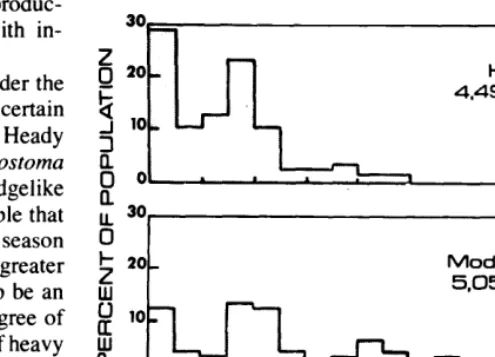
We point out, however, that the yield curves developed in Figure 1 present only half the story. The other half can be deduced from Figure 3, which shows comparative age com- positions of the two study populations, and from Table 1, which shows their production profiles on a kilogram per hectare basis. Under heavy early-season grazing, the rate of mortality is apparently much higher (Fig. 3), and very few plants survived until the period of maximum yield at about 70 years of age. As a result, only about half as much air-dry forage per hectare is being produced under early heavy grazing (Table 1) as under late moderate use. It should be possible, however, to develop a system of grazing that will be capable of using this potential yield increment without appreciably affecting plant longevity- a possibility that seems worth further study.
Densities of bitterbrush plants older than 1 year are also shown in Figure 3. There were 4,495 shrubs/ha under heavy early-season grazing compared with 5,058 shrubs/ha under moderate late-season use. A r-test indicated that these two densities were not significatly different at the 0.05 probability level. The ability of the heavily grazed population to maintain a level of density comparable with that of the moderately grazed population is due to a higher rate of seedling survival, which we believe is the result of a lower level of competition from associated understory species. An inventory of understory vegetation showed that cover of understory species, mostly cheatgrass (Bromus tectorum), on the moderately grazed area was nearly twice that on the heavily grazed area. Holmgren (1956) has shown that bitterbrush seedlings are generally unable to survive under such conditions. In addition, trampling may be
Moderate grazing
5,058 shrubs /ha
[loo
*A
0 10 20 30 40 50 60 70 80 90 loo
YEARS OF AGE
Fii. 3. Comparison of age structures of bitterbrush stands under heavy early- season and moderate late-season grazing. The age structures are significant- ly different at the 0.05 probability level. Plant density figures include all plants over I year of age.
operati ng as a natural planting phenomenon in the heavily grazed area to help maintain comparable population densities.
Literature Cited
Bedell, T. E., and H. F. Heady. 1959. Rate of twig elongation in chamise. J. Range Manage. 12:116-121.
Berg, A. R., and T. R. Plumb. 1972. Bud activation for regrowth, p. 279- 296. In: C. M. McKell, J. P. Blaisdell, and J. R. Goodin (Ed.), Wildland shrubs-their biology and utilization. U.S. Dep. Agr., Forest Serv., General Tech. Rep. INT-1. 494 p.
Chew, R. M., and A. E. Chew. 1965. The primary productivity of a desert shrub (Larrea tridentata) community. Ecol. Monogr. 35:353-375.
Ellison, L. 1960. The influence of grazing on plant succession of rangelands. Bot. Rev. 26:1-78.
Ferguson, R. B. 1973. Bitterbrush topping: Shrub response and cost factors. U.S. Dep. Agr., Forest Serv. Intermountain Forest and Range Exp. Sta. Res. Pap. INT-125. 11 p.
Holmgren, R. C. 1956. Competition between annuals and young bitterbrush
(Purshia tridentata) in Idaho. Ecology 37:370-377.
Kershaw, K. A. 1964. Quantitative and dynamic ecology. American Elsevier Publ. Co., New York. 183 p.
Kittredge, J. 1945. Some quantitative relations of foliage in the chaparral. Ecology 26:70-73.
McConnell, B. R., and G. A. Garrison. 1966. Seasonal variations ofavailable carbohydrates in bitterbrush. J. Wild]. Manage. 30: 168-172.
Medin, D. E. 1960. Physical site factors influencing annual production of true mountain mahogany, Cercocarpus montanus. Ecology 41:454-460.
Romberger, J. A. 1963. Meristems, growth, and development in woody plants. U.S. Dep. Agr. Tech. Bull. 1293. 214 p.
Willard, E. E., and C. M. McKell. 1973. Simulated grazing management systems in relation to shrub growth responses. J. Range Manage. 26: 17 I- 174.
Whittaker, R. H. 1961. Estimation of net primary productivity of forest and shrub communities. Ecology 42: 177- 180.
Liquid Supplements
for
Cattle on Southern
Forest Range
HAROLD E. GRELEN AND HENRY A. PEARSON
Highlight: A molasses-urea mixture fed free-choice yearlong as a supplement to cows on pine-bluestem range produced a higher calf crop and heavier calves than cottonseed cake fed only during winter. Because the liquid supplement required no feeding labor, it was $14.63 per cow and $0.81 per acre more profitable than the cottonseed cake.
Native forages on southern forest range are deficient in some nutrients throughout the year but are especially poor during winter (Campbell et al. 1954). Supplemental feeding can sub- stantially increase cattle production (Duvall and Whitaker 1963; Duvall and Hansard 1967), but the usual supplements-cotton- seed cake and hay- increase labor requirements considerably. Liquid supplements containing molasses and urea can be fed free-choice and may be more economical andequally beneficial.
A study was initiated in November 1969 to determine if liquid supplements fed free-choice would adequately support a year- long cow-calf operation on southern pine ranges. Preliminary results reported by Pearson (1974) indicated that liquid supple- ment is not satisfactory when fed in winter only. The data reported here were collected from November 1969 through September 1975, and indicate that liquid supplements have important potential as a yearlong supplement on southern forest range.
Methods
The study was conducted on the Palustris Experimental Forest in central Louisiana on an area where moderate yearlong grazing has been practiced since 1951. Cattle stocking rates are 1.5 acres per animal unit month, and utilization averages about 42% of the current year’s herbage growth.
Soils vary from poorly drained flatwoods to well-drained sandy loams with slopes up to 10%. Longleaf pine (Pinus palustris Mill.) was clearcut in 1965, and only a scattering of small pines and some scrub oaks (Quercus spp.) remain. The herbaceous vegetation is mainly slender bluestem (Andropogon tener (Nees) Kunth), pinehill bluestem (A. scoparius var. divergens Anderss. ex Hack.), other bluestems, and panicums (Panicurn spp.). The primary shrub is southern waxmyrtle (Myrica ceriferu L.). Annual herbage production averages about 2,000 pounds per acre.
To improve forage availability and to stimulate new growth, the range is prescribe-burned on a 3-year rotation (Campbell et al. 1954; Duvall and Whitaker 1964). Utilization is heaviest immediately after burning but declines during the second and third years, allowing time for the plants to regain vigor.
Beginning in 1969, two supplementation treatments were com- pared. The control treatment (CSC) provided 418 pounds of cotton-
Authors are principal range scientist, Southern Forest Experiment Station, Forest Service, U.S. Department of Agriculture, Alexandria, Louisiana; and principal range and wildlife scientist, Forest Service, U.S. Dep. Agr., Washington, D.C.
Manuscript received June 7, 1976.
seed cake per cow year on a graduated schedule. Feeding began in November-with 1 pound per cow per day and was increased &3 pounds per day from Jam&y 1 t6 March- 10. The daily amount was gradually decreased to 1 pound during April and was kept at that level until feeding ended May 31. Approximately 260 pounds of grass-legume hay was supplied during the latter part of winter and on cold, rainy days. Whenever cottonseed cake or hay was fed, it was distributed three times a week (Pearson and Whitaker 1972).
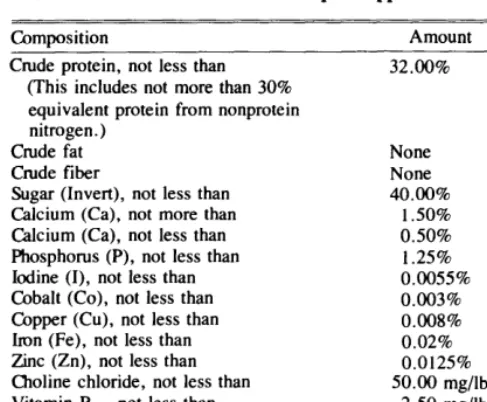
In the yearlong liquid supplement treatment (LS), self-feeding roller tanks (Fig. 1) dispensed a liquid supplement mixture of urea and molassescontaining 32% crude protein (Table 1). Some additional hay and range cubes (20% protein) were supplied during severe winter weather. Salt and steamed bonemeal were provided free-choice yearlong in both treatments.
Fig. 1. Liquid supplement was dispensedfree-choice yearlong in “lick” tanks.
In November 1969, two herds of 15 Brahman crossbred cows were randomly assigned to the treatments. Each year the cows were bred to good quality Angus bulls for calving in December through March. Calves were weaned and sold in mid-August to allow cows adequate recovery time before winter.
Results and Discussion
Feed Consumption
Supplemental feed consumption varied with treatment (Table 2). CSC cows ate 418 pounds of cottonseed cake and 260 pounds of grass-legume hay. Cows on the LS treatment aver- aged 1,200 pounds of liquid feed each year; during the severe winters of 1970, 1973, and 1974, they were also given some hay and range cubes.
The LS herd ate no more salt and slightly less steamed bone- meal than the CSC herd. Bonemeal primarily compensates for phosphorus deficiencies, and the phosphorus in the liquid