Improved Generic Attacks Against Hash-based
MACs and HAIFA
?Itai Dinur1 and Ga¨etan Leurent2
1 D´epartement d’Informatique, ´Ecole Normale Sup´erieure, Paris, France
2
Inria, EPI SECRET, France [email protected]
Abstract. The security of HMAC (and more general hash-based MACs) against state-recovery and universal forgery attacks was very recently shown to be suboptimal, following a series of surprising results by Leurent
et al.and Peyrinet al.. These results have shown that such powerful attacks require much less than 2`computations, contradicting the common belief (where`denotes the internal state size). In this work, we revisit and extend these results, with a focus on properties of concrete hash functions such as a limited message length, and special iteration modes. We begin by devising the first state-recovery attack on HMAC with a HAIFA hash function (using a block counter in every compression function call), with complexity 24`/5. Then, we describe improved
trade-offs between the message length and the complexity of a state-recovery attack on HMAC. Consequently, we obtain improved attacks on several HMAC constructions used in practice, in which the hash functions limit the maximal message length (e.g.,SHA-1andSHA-2). Finally, we present the first universal forgery attacks, which can be applied with short message queries to theMACoracle. In particular, we devise the first universal forgery attacks applicable toSHA-1andSHA-2.
Keywords:Hash functions, MAC, HMAC, Merkle-Damg˚ard, HAIFA, state-recovery attack, universal forgery attack, GOST, Streebog, SHA family.
1
Introduction
MAC algorithms are an important symmetric cryptography primitive, used to verify the integrity and authenticity of messages. First, the sender appends to the message a tag, computed from the message and a key. The receiver can recompute the tag using the key and reject the message when the computed tag does not match the received one. The main security requirement of a MAC is the resistance to existential forgery. Namely, after querying theMACoracle to obtain the tags of some carefully chosen messages, it should be hard to forge a valid tag for a different message.
?
One of the most widely used MAC algorithms in practice is HMAC, a MAC construction using a hash function designed by Bellare, Canetti and Krawczyk in 1996 [4]. The algorithm has been standardized by ANSI, IETF, ISO and NIST, and is widely deployed to secure internet communications (e.g. SSL, SSH, IPSec). As these protocols are widely used, the security of HMAC has been extensively studied, and several security proofs [3,4] show that it gives a secure MAC and a secure PRF up to the birthday bound (assuming good properties of the underlying compression function). At the same time, there is a simple existential forgery attack on any iterative MAC with an`-bit state, with complexity 2`/2, matching the security proof. Nevertheless, security beyond the birthday bound for stronger attacks (such as state-recovery and universal forgery) is still an important topic.
Surprisingly, the security of HMAC beyond the birthday bound has not been thoroughly studied until 2012, when Peyrin and Sasaki described an attack on HMAC in the related-key setting [18]. Later work focused on single-key security, and included a paper by Naito, Sasaki, Wang and Yasuda [16], which described state-recovery attacks with complexity 2`/`. At Asiacrypt 2013, Leurent, Peyrin and Wang [15] gave state-recovery attacks with complexity 2`/2, closing the gap with the security proof. More recently, at Eurocrypt 2014, Peyrin and Wang [19] described a universal forgery attack with complexity as low as 25`/6. The complexity of the universal forgery attack was further improved to 23`/4 in [8], showing that even this very strong attack is possible with less than 2` work.
These generic attacks have also been used as a first step to build specific attacks against HMAC with the concrete hash function Whirlpool [10,9].
These very recent and surprising results show that more work is needed to better understand the exact security provided by HMAC and hash-based MACs.
1.1 Our results
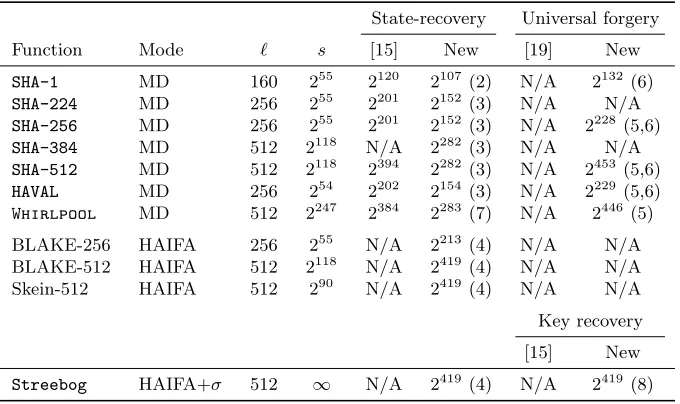
In this paper, we provide several important contributions to the security analysis of HMAC and similar hash-based MAC constructions. In particular, we devise improved attacks when HMAC is used with many popular concrete hash functions, and in several cases our attacks are the first to be applicable to HMAC with the given hash function. Some results with concrete instantiations are summarized in Table 1.
1 2`/4
2`/2 2`/2
23`/4 2`
Length of the messages
Complexit
y
Merkle-Damg˚ard mode
Prev. [15] New: Attack 3 Attack 2 Section 6.2
1 2`/4
2`/2 2`/2
23`/4 2`
Length of the messages HAIFA mode
New results: Attack 1 Attack 4
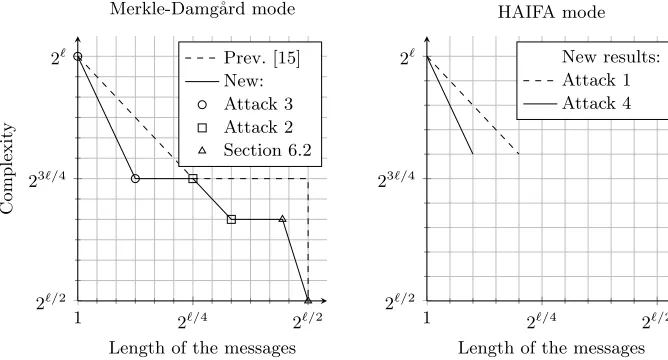
Fig. 1.Trade-offs between the message length and the complexity
In an interesting application of our state-recovery attack on HAIFA (given in Appendix A), we show how to extend it into a key-recovery attack on the new Russian standardStreebog, recovering the 512-bit key ofHMAC-Streebog
with a complexity of 2410. This key recovery attack is similar to the one of [15] for Merkle-Damg˚ard, and confirms its surprising observation: adding an internal checksums in a hash function (such as Streebog)weakens the design when used in HMAC, even for hash functions based on the HAIFA mode.
As a second contribution of this paper, we revisit the results of [15], and give a formal proof of the conjectures used in its short message attacks. Some of our proofs are of broad interest, as they give insight into the behavior of classical collision search algorithms for random functions. These proofs explain for the first time an interesting phenomenon experimentally observed in several previous works (such as [17]), namely, that the collisions found by such algorithms are likely to belong to a restricted set of a surprisingly small size.
Then, based on our proofs, we describe several new algorithms with various improved trade-offs between the message length and the complexity as shown in Figure 1. As many concrete hash functions restrict the message size, we obtain improved attacks in many cases: for instance, we reduce the complexity of a state-recovery attack againstHMAC-SHA-1 from 2120 to 2107(see Table 1).
Table 1. Complexity of attacks on HMAC instantiated with some concrete hash functions. The state size is denoted as`, and the maximum message length as 2s. For the new results, we give a reference to the Attack number.
State-recovery Universal forgery
Function Mode ` s [15] New [19] New
SHA-1 MD 160 255 2120 2107(2) N/A 2132 (6)
SHA-224 MD 256 255 2201 2152(3) N/A N/A
SHA-256 MD 256 255 2201 2152(3) N/A 2228(5,6)
SHA-384 MD 512 2118 N/A 2282(3) N/A N/A
SHA-512 MD 512 2118 2394 2282(3) N/A 2453(5,6)
HAVAL MD 256 254 2202 2154(3) N/A 2229(5,6)
Whirlpool MD 512 2247 2384 2283(7) N/A 2446 (5)
BLAKE-256 HAIFA 256 255 N/A 2213(4) N/A N/A
BLAKE-512 HAIFA 512 2118 N/A 2419(4) N/A N/A
Skein-512 HAIFA 512 290 N/A 2419(4) N/A N/A
Key recovery
[15] New
Streebog HAIFA+σ 512 ∞ N/A 2419(4) N/A 2419 (8)
1.2 Framework of the attacks
In order to recover an internal state, computed by the MAC oracle during the processing of some message, we use a framework which is similar to the framework of [15]. Namely, we match states that are computed offline with (unknown) states that are computed online (during the processing of messages by the MAC oracle). However, as arbitrary states match with low probability (which does not lead to efficient attacks), we only matchspecial states, which have a higher probability to be equal. These special states are the result of iterating random functions using chains, computed by applying the compression function on a fixed message from arbitrary initial states. In this paper, we exploit special states of two types, which were also exploited in [15]: states on which two evaluated chains collide, and states on which a single chain collides with itself to form a cycle. Additionally, some of our attacks (and in particular our attacks on HAIFA) use special states which are a result of the reduction of the image space that occurs when applying a fixed sequence of random functions.
interested in building filters efficiently. In this paper, we use two types of filters: collision filters (which were also used in [15]) and diamond filters, which exploit the diamond structure (proposed in [12]) in order to build filters for a large set of nodes with reduced average complexity. Furthermore, in this paper we use a novel online construction of the diamond structure via theMACoracle, whereas such a structure is typically computed offline. In particular, we show that despite the fact that the online diamond filter increases the complexity of building the filter, the complexity of the actual matching phase is significantly reduced, and gives improved attacks in many cases.
Outline The paper is organized as follows: we begin with a description of HMAC in Section 2. We then describe and analyze the algorithms we use to compute special states in Section 3, and the filters we use in our attacks in Section 4. Next, we present a simple attack against HMAC with a HAIFA hash function in Section 5, and revisit the results of [15] in Section 6, presenting new trade-offs for attacks on Merkle-Damg˚ard hash functions. In Section 7, we give more complex attacks for shorter messages. Finally, in Section 8, we present our universal forgery attacks with short queries, and conclude in Section 9.
2
HMAC and hash-based MACs
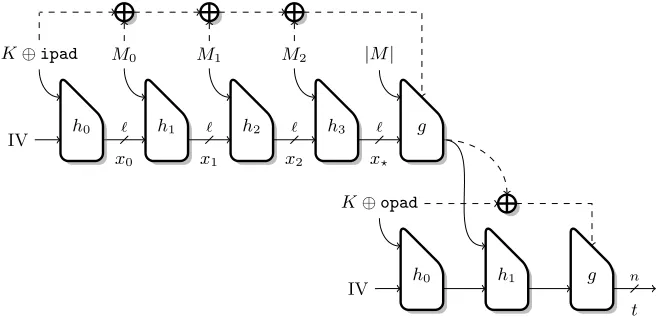
In this paper we study MAC algorithms based on a hash function, such as HMAC. HMAC is defined using a hash function H as HMAC(K, M) = H(K⊕opadk H(K⊕ipadkM)).More generally, we consider a class of designs represented by Figure 2, and defined as:
x0=IK xi+1 =hi(xi, mi) t=g(K, xp,|M|).
The message processing updates an internal state of size `, starting from a key-dependant value IK, and the output is produced with a key-dependant finalization function g. In particular, we note that the state update does not depend on the key. Our description covers HMAC [4], Sandwich-MAC [22] and envelope-MAC [21] with any common hash function. The hash function can use the message length in the finalization process, which is a common practice, and the rounds function can depend on a block counter, as in the HAIFA mode. If the hash function uses the plain Merkle-Damg˚ard mode, the round functionshi are all identical (this is the model of previous attacks [15,19]).
h0 ` m0
x0
h1 ` m1
x1
h2 ` m2
x2 x3
MACK(M)
` n
|M|
IK
gK
Fig. 2.Hash-based MAC with HAIFA. Only the initial value and the final transformation are keyed.
IV
K⊕ipad
h1 ` M0
x0
h2 ` M1
x1
h3 ` M2
x2 x?
`
|M|
h0 g
IV
K⊕opad
h0 h1 g n
t
Fig. 3.HMACbased on a hash function with a block counter and a checksum (dashed lines).
3
Description and Analysis of Collision Search
Algorithms
In this section, we describe and analyze the collision search algorithms which are used in our state-recovery attacks in order to compute special states. We then analyze these algorithms and prove the conjectures of [15]. Lemma 1 proves the first conjecture, while Lemma 3 proves the second conjecture. We also give further results in Appendix A.
3.1 Collision search algorithms
Free-offset collision search. When searching offline for collisions in iterations of afixed random function f, we evaluate 2tchains starting from arbitrary points, and extended to length 2sfors≤`/2.
Assuming that 2t·2t+s≤2` (i.e., 2t+s≤`), then each of the chains is not expected to collide with more than one other chain in the structure. This implies that the structure contains a total of about 2t+sdistinct points, and (according to the birthday paradox) we expect it to contain a total of 2c = 22(t+s)−`collisions. We can easily recover all of these collisions in O(2t+s) = O(2(c+`)/2) time by storing all the evaluated points and checking for collisions in memory.
We note that we can reduce the memory requirements of the algorithm by using the parallel collision search algorithm of van Oorschot and Wiener [17]. However, in this paper, we generally focus on time complexity and do not try to optimize the memory complexity of our attacks.
Same-offset collision search. While free-offset collisions are the most general form of collisions, they cannot always be efficiently detected and exploited by our attacks. In particular, they cannot be efficiently detected in queries to the online oracle (as a collision between messages of different lengths would lead to different values after the finalization function). Furthermore, if the hash function uses the HAIFA iteration mode, it is also not clear how to exploit free-offset collisions offline, as the colliding chains do not merge after the collision (and thus we do not have any easily detectable non-random property).
In the cases above, we are forced to only use collisions that occur at the same-offset. When computing 2tchains of length 2s (fort not too large), a pair of chains collide at a fixed offsetiwith probability 2−`, and thus a pair of chains collide with probability 2s−`. As we have 22tpairs of chains, we expect to find about 22t+s−` fixed-offset collisions.
Locating collisions online. Online collisions are detected by sorting and comparing the tags obtained by querying the MACoracle with chains of a fixed length 2s. If we find two massages such thatMAC(M) =MAC(M0), we can easily compute the message prefix that gives the (unknown) collision state, as described in [15]. Namely, if we denote by M|i thei-block prefix ofM, then we find the smallesti such that MAC(M|i) =MAC(M|0i) using binary search. This algorithm queries the
MACoracle withO(s) messages of lengthO(2s), and thus the time complexity of locating a collision online iss·2s= ˜O(2s).
3.2 Analysis of the collision search algorithms
from different arbitrary starting points, is perhaps higher than one would expect. This phenomenon was already observed in previous works such as [17], but to the best of our knowledge, this is the first time that this lemma is formally proven. As the proof of lemma 4 is very similar to that of lemma 3, it is given in Appendix A.
Lemma 1. Lets≤`/2be a non-negative integer. Letf1, f2, . . . , f2s be a sequence
of random functions over the set of 2` elements, and g
i , fi ◦. . .◦f2◦f1
(with the fi being either all identical, or independently distributed). Then, the
images of two arbitrary inputs to g2s collide with probability of about 2s−`,i.e. Prx,y[g2s(x) =g2s(y)] =Θ(2s−`).
Lemma 2. Letf1, f2, . . . , f2s be a sequence of random functions, then the image
of the functiong2s ,f2s◦. . .◦f2◦f1 contains at mostO(2˜ `−s)points.
Lemma 3. Let xˆ and yˆ be two random collisions (same-offset or free-offset) found by a collision search algorithm using chains of length2s, with afixed `-bit function f such that s < `/2. ThenPr [ˆx= ˆy] =Θ(22s−`).
Proof. First, we note that we generally have 4 cases to analyze, according to whether ˆxand ˆywere found using a free-offset, or a same-offset collision search algorithm. However, the number of cases can be easily reduced to 3, as we have 2 symmetric cases, where one collision is free-offset, and the other is same-offset. In this proof, we assume that ˆxis a same-offset collision and ˆy is a free-offset collision (this is the configuration used in our attacks). However, the proof can easily be adapted to the 2 other different settings.
We denote the starting points of the chains which collide on ˆxby (x0, x00), and the actual corresponding colliding points of the chains by (xi, x0i), and thus f(xi) =f(x0i) = ˆx. In the following, we assume that 0.25·2
s≤i≤0.75·2s, which occurs with probability about 1/2 since the offset of the collision ˆxis roughly uniformly distributed in the interval [0,2s].3 This can be shown using Lemma 1, as increasing the length of the chains, increases the collision probability by the same multiplicative factor.
Fixing (x0, x00), we now calculate the probability that 2 chains of length 2s, starting from arbitrary points (y0, y00), collide on ˆx. This occurs ify0, y1, . . . , y2s−i collides with x0, x1, . . . , xi, and y00, y01, . . . , y02s−i collides withx00, x01, . . . , x0i (or vise-versa), which happens with probabilityΘ(22(2s−`)) (assuming 0.25·2s≤ i ≤ 0.75·2s, all chains are of length Θ(2s)). This lower bounds the collision probability on ˆxbyΩ(22(2s−`)). At the same time, the collision on ˆxis also upper bounded by O(22(2s−`)), as all 4 chains are of lengthO(2s). We conclude that the collision probability on ˆxisΘ(22(2s−`)).
On the other hand, the probability that the chains starting from (y0, y00) collide on any point isΘ(22s−`). Assuming that the collision search algorithm evaluates 2t chains such that 2t+s ≤ `, then each evaluated chain is not expected to collide with more than one different chain, and the pairs of chains can essentially be analyzed independently.
3
We denote by A the event that the chains starting from (y0, y00) collide on ˆx, and by B the event that the chains starting from (y0, y00) collide. We are interested in calculating the conditional probability Pr[A|B], and we have Pr[A|B] = Pr[ATB]/Pr[B] = Pr[A]/Pr[B] = Θ(22(2s−`)−(2s−`)) = Θ(22s−`),
as required. ut
Lemma 4. Letxˆandyˆbe two arbitrary same-offset collisions found, respectively, at offsetsiandjby a collision search algorithm using chains of fixed length2s, with
independent `-bit functions fi, such thats < `/2. ThenPr [(ˆx, i) = (ˆy, j)] = Θ(2s−`). Furthermore, given thati=j, we have Pr [ˆx= ˆy] =Θ(22s−`).
4
Filters
We describe the two types of filters that we use in our attacks in order to match (known) states computed offline with unknown states computed online.
4.1 Collision filters
A simple filter that we use in some of our attacks was also used in the previous work of [15]. We build a collision filter ([b],[b0]) for a statexoffline by finding message blocks ([b],[b0]) such that the states, obtained after processing these blocks from x, collide. In order to build this filter, we find a collision in the underlying hash function by evaluating its compression function for about 2`/2 different messages blocks from the statex. In order to test this filter online on the unknown nodex0 obtained after processing a messagem0, we simply check whether the tags ofm0k[b] andm0k[b0] collide. As the tags ofm0k[b] andm0k[b0] collide with probability 2−n <2−` if the state obtained after processingm0 is
notx, we can conclude that the collision filter identifies the state xwith high probability.
The complexity of building a collision filter offline is O(2`/2). Testing the filter online requires querying the MAC oracle with m0k[b] andm0k[b0], and assuming that the length ofm0 is 2s0, then it requiresO(2s0) time.
4.2 Diamond filters
In order to build filters for 2tnodes, we can build a collision filter for each one of them separately, requiring a total ofO(2t+`/2) time. However, this process can be optimized using the diamond structure, introduced by Kelsey and Kohno in the herding attack [12]. We now recall the details of this construction.
The diamond structure is built from a set of 2tstatesx
Starting from the first layer with 2t points, we evaluate the compression function from each pointxi with about 2(`−t)/2 random message blocks. This gives a total of about 2(`+t)/2 random values, and we expect them to contain about 2tcollisions. Each collision allows to match two different valuesx
i, xj and to send them to a common value in the next layer, such that its size is reduced to about 1/2. The messagemi for a statexi is constructed by concatenating the O(t) message blocks on its path leading toy. According to the detailed analysis of [14], the time complexity of building the structure is isΘ(2(`+t)/2).
x0 x1 x2 x3 x4 x5 x6 x7
Once we finish building the diamond structure, we construct a standard collision filter for the final nodey, using some message blocks ([b],[b0]). Thus, building a diamond filter offline for 2tstates requiresO(2(`+t)/2) time, which is faster than the O(2t+`/2) time required to build a collision filter for each node separately.
In order to test the filter for a statexi (in the first layer of the diamond structure), on the unknown node x0 obtained after processing a message m0
online, we simply check whether the tags ofm0kmik[b] andm0kmik |[b0] collide. Assuming that the length ofm0 is 2s0, then the online test requiresO(t+ 2s0) time.
Online diamond filter. A novel observation that we use in this paper, is that in some attacks it is more efficient to build the diamond structure online by calling theMACoracle. Namely, we construct a diamond structure for the set of 2tstates xi, where (the unknown)xi is a result of querying theMACoracle with a message Mi. Note the online construction is indeed possible, as the construction algorithm does not explicitly require the value ofxi, but rather builds the corresponding mi by testing for collisions between the states (which can be detected according to collisions in the corresponding tags). However, testing for collisions online requires that all the messagesMi, for which we build the online diamond filter, are of the same length. Assuming that the messagesMi are of length 2s, this construction requiresO(2s+(t+`)/2) calls to the compression function.
In order to test the filter for an unknown online statexi, on a known statex0, we simply evaluate the compression function fromx0onmik[b] andmik |[b0], and check whether the resulting two states are equal. Thus, the offline test requires O(t) time.
5
Internal state-recovery for
NMAC
and
HMAC
with HAIFA
attack has a complexity of ˜O(2`−s) using messages of length 2s, but this only applies with s ≤ `/5; the lowest complexity we can reach is 24`/5. We note that attacks against HAIFA can also be used to attack a Merkle-Damg˚ard hash function; this gives more freedom in the queried messages by removing the need for long series of identical blocks as in [15].
In this attack, we fix a long sequence of random functions in order to reduce the entropy of the image states, based on Lemma 1. We then use an online diamond structure to match the states computed online with states that are compute offline. The detailed attack is as follows:
Attack 1: State-recovery attack against HMAC with HAIFA
Complexity ˜O(2`−s), withs≤`/5 (min: 24`/5)
1. (online) Fix a messageCof length 2s. Query the oracle with 2umessages Mi = [i]kC. Build an online diamond filter for the set of unknown statesX,obtained afterMi.
2. (offline) Starting from 2t arbitrary starting points, iterate the compres-sion function with the fixed messageC.
3. (offline) Test each image pointx0, obtained in Step 2, against each of the unknown states ofX. If a match is found, then with high probability the state reached after the correspondingMi isx0.
Ik
1 2s
2u
[i] C
Online structure
2s 2t $
C
Offline structure
We detect a match between the grey points ( ) using the diamond test built online.
Complexity analysis. In Step 3, we match the setX of size 2u (implicitly computed during Step 1), and a set of size 2t (computed during Step 2). We compare 2t+u pairs of points, and each pair collides with probability 2s−` ac-cording to Lemma 1. Therefore, the attack is successful with high probability if t+u≥`−s. We now assume thatt=`−s−u, and evaluate the complexity of each step of the attack:
Step 1: 2s+u/2+`/2 Step 2: 2s+t= 2`−u Step 3: 2t+u·u= 2`−s·u
6
New Tradeoffs for Merkle-Damg˚
ard
In this section, we revisit the results of [15], and give more flexible tradeoffs for various message lengths.
6.1 Trade-off based on iteration chains
In this attack, we match special states obtained using collision, based on Lemma 3. This attack extends the original tradeoff of [15] by using two improved techniques: first, while [15] used a fixed-offset offline collision search, we use a more general, free-offset offline collision search, which enables us to find collisions more efficiently. Second, while [15] used collision filters, we use a more efficient diamond filter.
Attack 2: Chain-based trade-off for HMAC with Merkle-Damg˚ard
ComplexityO(2`−s), withs≤`/3 (min: 22`/3)
1. (offline) Use free-offset collision search from 2`−2sstarting points with chains of length 2s, and find 2c collisions (denoted by the set ˆX). 2. (offline) Build a diamond filter for the points in ˆX.
3. (online) Query the oracle with 2t messages M
i = [i]k[0]2 s
. Sort the tags, and locate 1 collision.
4. (online) Use a binary search to find the message prefix giving the unknown online collision state ˆy.
5. (online) Match the unknown online state ˆy with each offline state in ˆ
X using the diamond filter. If a match with ˆx∈Xˆ is found, then with very high probability ˆy= ˆx.
2s 2`−2s
{2ccollisions} $
[0]∗
Offline structure
Ik
2s 1
2t
[i] [0]∗ {1 collision}
Online structure
We generate collisions offline using free-offset collision search, build a diamond filter for the collision points ( ), and recover the state of an online collision.
Complexity analysis. In Step 1, we use free-offset collision search with 2`−2s starting points and chains of length 2s, and thus according to Section 3.1, we find 2`−2scollisions (i.e.c=`−2s). Furthermore, according to Lemma 3, ˆy∈Xˆ with high probability, in which case the attack succeeds.
each step of the attack:
Step 1: 2`/2+c/2= 2`−s Step 2: 2`/2+c/2= 2`−s
Step 3: 2t+s= 2(`+s)/2 Step 4: s·2s
Step 5: 2c+s= 2(`+s)/2
With s ≤`/3, we have (`+s)/2≤2/3·` ≤`−s, and the complexity of the attack isO(2`−s).
6.2 Trade-off based on cycles
We also generalize the cycle-based state-recovery attack of [15], which uses messages of length 2`/2and has a complexity of 2`/2. Our attack uses (potentially) shorter messages of length 2sfors≤`/2, and has a complexity of 22`−3s. The full attack and its analysis is given in Appendix B.
7
Shorter Message Attacks
In this section, we describe more complex attacks that can reach a tradeoff of 2`−2s, for relatively small values ofs. These attacks are useful in cases where the message length of the underlying hash function is very restricted (e.g.the SHA-2
family). In order to reach a complexity of 2`−2s, we combine the idea of building filters in the online phase with lemmas 3 and 4.
In the case of Merkle-Damg˚ard with identical compression functions, we reach a complexity of 2`−2sfor s≤`/8,i.e.the optimal complexity of this attack is 23/4·`. With the HAIFA mode of operation, we reach a complexity of 2`−2sfor s≤`/10i.e.the optimal complexity of 24/5·`, matching the optimal complexity of the attack of Section 5.
7.1 Merkle-Damg˚ard
Attack 3: Short message attack for HMAC with Merkle-Damg˚ard
Complexity ˜O(2`−2s), withs≤`/8 (min: 23`/4)
1. (online) Query the oracle with 2u messagesMi= [i]k[0]2 s
, and locate 2c1 collisions.
2. (online) For each collision (i, j), use a binary search to find the distance (offset) µij from the starting point to the collision, and denote the (unknown) state reach afterMi (orMj) byyij.
Denote the set of allyij (containing about 2c1 states) byY. Build an online diamond filter for all the states inY.
4. (offline) For each offline collision ˆx, match its iterates with all points yij ∈Y: iterate the compression function with a zero message starting from ˆx(up to 2s times), and match iterate 2s−µ
ij (i.e.,f2 s−µij
(ˆx)) withyij using the diamond filter. If a match is found, then with high probabilityyij=f2
s−µij (ˆx).
Ik
2s 1
2u
[i] {2
c1collisions}
[0]∗
Online structure
2t
2s
{2c2collisions}
$
[0]∗
Offline structure
We generate collisions and build a diamond filter online, and match them with collisions found offline.
Complexity analysis. Using similar analysis to Section 6.1, we have c1 = 2u+s−` (as a pair of chains collide at the same offset with probability 2s−`, and we have 22u such pairs) and c
2 = 2t+ 2s−`. The attack succeeds if the sets of collisions found online and offline intersect. According to Lemma 3, this occurs with high probability if c1+c2 ≥`−2s. In the following, we assume c1+c2=`−2s.
Step 1: 2u+s= 2s/2+c1/2+`/2 Step 2: 2s+c1/2+`/2= 2`−c2/2
Step 3: 2t+s= 2`/2+c2/2 Step 4: 2c2+s+ 2c1+c2·c1= 2c2+s+ 2`−2s·c1 The best tradeoffs are achieved by balancing steps 2 and 3,i.e.withc2=`/2. This reduces the complexity to:
Step 1: 23`/4−s/2 Step 2: 23`/4
Step 3: 23`/4 Step 4: 2`/2+s+ 2`−2s·`/2 Withs≤`/8, we have`/2 +s≤5`/8 and 3`/4≤`−2s; therefore the complexity of the attack is ˜O(2`−2s).
7.2 HAIFA
Since the attack is very similar to the previous attack on Merkle-Damg˚ard, we only specify the differences between the attacks.
Attack 4: Short message attack for HMAC with HAIFA
Complexity ˜O(2`−2s), withs≤`/10 (min: 24`/5)
• Correspondingly, in Step 3, we use a fixed-offset collision search by iterating the compression function withC from 2tstarting points. • In Step 4, we match each offline collision ˆx, only with online collisions
that occur at the same offset as ˆx. Thus, for each ˆx, we test only the end point of its chain (at offset 2s) with the corresponding states inY. Note that each ˆxis matched with 2c1·2−sstates inY on average.
Ik
2s 1
2u
[i] {2
c1collisions} C
2t
2s
{2c2collisions}
$
C
Offline structure Online structure
We generate collisions and build an online diamond filter, and match them with offline collisions using the collision offset as a first filter.
Analysis. The attack succeeds in case there is a match between the set of collisions detected online and offline, that occurs at the same offset. According to Lemma 4, this match occurs with high probability whenc1+c2≥`−s, and thus we assume thatc1+c2=`−s.
Complexity analysis. Similar to the analysis of the previous attacks, we have c1= 2u+s−`andc2= 2t+s−`.
Step 1: 2u+s= 2s/2+c1/2+`/2 Step 2: 2s+c1/2+`/2= 2`−c2/2+s/2
Step 3: 2s+t= 2s/2+c2/2+`/2 Step 4: 2c1+c2−s·u= 2`−2s·u The best tradeoffs are achieved by balancing steps 2 and 3,i.e.withc2=`/2. This reduces the complexity to:
Step 1: 23`/4 Step 2: 23`/4+s/2 Step 3: 23`/4+s/2 Step 4: 2`−2s·3`/4 With s≤`/10, we have 3`/4 +s/2≤4`/5≤`−2s; therefore the complexity of the attack is ˜O(2`−2s).
8
Universal Forgery Attacks with Short Queries
The main draw back of the attack of Peyrin and Wang (as well as its recent improvement [8]) is that its first phase uses very long queries to theMACoracle, regardless of the length of the challenge. In this section, we use the tools developed in this paper to devise two universal forgery attacks which use shorter queries to theMACoracle. Our first universal forgery attack has a complexity of 2`−tfor t≤`/7, using queries to the MACoracle of length of at most 22t(which is much smaller than 2`/2 for anyt≤`/7). Thus, the optimal complexity of this attack is 26`/7, obtained with a challenge of length at least 2`/7. Our second universal forgery attack has a complexity of only 2`−t/2. However, it is applicable for any t≤2`/5, using queries to theMACoracle of length of at most 2t. Thus, this attack has an improved optimal complexity of 24`/5, which is obtained with a challenge of length at least 22`/5.
In order to devise our attacks, we construct different state-recovery algorithms than the one used in [19], but reuse its second phase (i.e., the second-preimage attack) in both of the attacks. Thus, in the following, we concentrate of the state-recovery algorithms, and note that since the complexity of the second phase of the attack is 2`−tfor any value oft, it does not add a significant factor to the time complexity.
8.1 A universal forgery attack based on the reduction of the image-set size
Directly matching the 2tstates of the challenge message with some states evalu-ated offline is too expensive. Thus, we first reduce the number of nodes we match by computing and matching the images of the states under iterations of a fixed function. After matching the images, we can efficiently match and recover on the states of the challenge message.
We denote the challenge message asC, and the firstκ blocks ofC as C|κ. The details of the first phase of the attack are as follows.
Attack 5: Universal forgery attack based on the reduction of the image-set size (first phase)
Complexity ˜O(2`−t), witht≤`/7 (min: 26`/7)
1. (online) Build a collision filter for the last (unknown) statez obtained during the computation ofMAC(C).
2. (online) Query the oracle with 2tmessagesM
i =C|ik[0]2 2t−i
. Denote the set of (unknown) final states of the chains byY. Build a diamond filter for all states inY.
4. (offline) Match all the pointsx∈X with the 2tpoints inY. For each match between x∈X and an online state in Y (obtained usingMi), restart the chains that merge intox, in order to locate all the points at a (backward) distance of 22t−ifrom x. Denoted this set by
Cand(x).
5. (offline) Test the candidates: for eachx0 ∈Cand(x), compute the state obtained by following the last 2t−i blocks of the challenge message, and match this state withz using the collision filter. When a match is found, the state obtained afterC|i isx0 with high probability.
Ik
2t 22t 2t
C
Online structure Offline structure
22t 22t
{2`−tpoints}
{2`−2tpoints}
We efficiently detect a match between the challenge points ( ) and the first part of the offline structure, by first matchingX ( ) andY ( ).
Analysis. The structure of Step 3 contains 2`−tpoints, and thus according to the birthday paradox, it covers one of the 2t points of the challenge with high probability. In this case, the attack will successfully recover the state of the covered point with high probability, as we essentially have in the offline setX almost all 2`−2timages off22t (including the image of the covered point).
AsX contains almost all 2`−2timages off22t, we expect a match for every point inY in Step 3 (a total of 2tmatches). In order to calculate the expected size ofCand(x) in Step 5, we first calculate the expected number of the endpoints of the chains computed in Step 3 of the attack. As the chains are of length of 22t+1, we expect that after evaluating the first 2`−4tchains, a constant fraction of the chains will not collide with any other chain, and thus we have (at least) about 2`−4tendpoints. Since the structure contains a total of 2`−tpoints, each endpoint is a root of a tree of average size of (at most) 2`−t−(`−4t)= 23t. This gives about 23t−2t= 2tcandidates nodes
Cand(x) at a fixed (backwards) distance (note that
eachx0 ∈Cand(x) is extended with a message of length about 2t, according to the challenge).
Complexity.
Step 1: 2`/2+t Step 2: 22t+t/2+`/2= 2`/2+5t/2
Step 3: 2`−t Step 4: t·2`−t
With t≤ `/7, we have `/2 + 5t/2≤6`/7≤ `−t; the complexity of the first phase of the universal forgery attack is ˜O(2`−t), and as the second phase has a similar complexity, this is also the complexity of the full attack.
8.2 A universal forgery attack based on collisions
In this attack, we devise a different algorithm which recovers one of the states computed during the execution of the challenge message. The main idea here is to find collisions between chains evaluated online, and directly match them with collisions obtained offline. This is different from the previous algorithm, which matched the endpoints of the chains, rather than nodes on which the collisions occur. Once the collisions are matched, similarly to the previous algorithm, we obtain a small set of candidate nodes, which we match with the actual challenge nodes.
Attack 6: Universal forgery attack based on collisions (first phase)
ComplexityO(2`−t/2), witht≤2`/5 (min: 24`/5)
1. (online) Query the oracle with 2t messagesM
i =C|ik[0]2 t+1−i
, and sort the tags.
2. (online) Execute state-recovery Attack 2 using messages of length min(2t,2`/3), and denote by W a message of length 2t whose last computed state is recovered.a
3. (online) Query the oracle with 2v messagesWj =Wk[j]k02 t−1
, sort the tags, and locate 2ccollisions with the tags computed using the messages Mi. For each collision of tags betweenMi andWj, find the first collision point using binary search (note that the state of the collision is known, as the state obtained after processingW is known). Store all the collision states ˆxij in a sorted list, each one next to its distancedij fromC|i. 4. (offline) Compute a structure of chains containing a total of 2`−c points.
Each chain is extended to a maximal length of 2t+1, or until it collides with a previous chain.
5. (offline) For each offline point in the structurey which collides with an online collision ˆxij (i.e.,y= ˆxij), retrieve candidate pointsCand(y) for the state obtained after processingC|i. This is done by computing the dij-preimage points ofy in the structure (i.e., the points which are at distancedij backwards fromy). Assume that for eachy= ˆxij, we have an average of 2ucandidate points, and thus we have a total of at most 2c+u candidate points to test in the setS
ij(Cand(y= ˆxij)). Build a diamond filter for all the 2c+ucandidate points.
6. (online) For each (ˆxij, y), match the state obtained after C|i with all the corresponding 2u candidate points in
Cand(y) using the diamond
Ik
2t 2t
2t C
[0]∗
Ik 2v
2t 1 2t−1 W
[i] [0]∗
Online structure {2ccollisions}
Offline structure
2t 2t
{2`−cpoints}
{2`−tpoints}
We match the known points inX ( ) andY ( ) in order to detect a match between the challenge points ( ) and the first part of the offline structure.
a
In caset > `/3, we first recover the last computed state of a message of size 2`/3, and then complement it arbitrarily to a length of 2t.
Analysis. In Step 3 of the attack, we find 2c collisions between pairs of chains, where the prefix of one chain in each pair is some challenge prefixC|i. Thus, the 2c collisions cover 2c such challenge prefixes, and moreover, the offline structure, computed in Step 4, contains 2`−cpoints. Thus, according to the birthday paradox, with high probability, the offline structure covers one of the states obtained after the computation of a prefix C|i, such that the messageMi collides with some Wj on a point ˆxij in Step 3. Since the state obtained after the computation ofC|i is covered by the offline structure, then ˆxij is also covered by the offline structure, and thus the state corresponding toC|iwill be matched as a candidate and recovered in Step 6.
In order to calculate the value ofc, note that the online structure, computed in Step 1, contains 2tchains, each of length at least 2t, and thus another arbitrary chain of length 2tcollides with one of the chains in this structure at the same offset with probability of about 22t−`. Since the structure computed in Step 3 contains 2v such chains, the expected number of detected collisions between the structures is 2c= 22t+v−`, i.e., c= 2t+v−`.
In order to calculate the value ofu, we first calculate the expected number of the endpoints of the chains computed in Step 3 of the attack. As the chains are of length of 2t+1, after evaluating the first 2`−2tchains, a constant fraction of the chains will not collide with any other chain, and thus we have (at least) about 2`−2tendpoints. Since the structure contains a total of 2`−cpoints, each endpoint is a root of a tree of average size of (at most) 2`−c−(`−2t) = 22t−c. This gives about 22t−c−t= 2t−ccandidates nodes at a fixed depth, i.e.,u=t−c=`−t−v.
of the full attack. Furthermore, we can perform a more complicated matching phase, in which we iteratively build filters for the offline structure at depths about 2t−1,2t−2, . . ., and match them with the online structure. This guarantees that the expected complexity of the attack is as claimed below.
Step 1: 22t Step 2: max(2`−t,22`/3)
Step 3: 2v+t Step 4: 2`−c= 22`−2t−v
Step 5: (c+u)·2(c+u+l)/2=t·2`/2+t/2 Step 6: 2c+u+t= 22t We balance steps 3 and 4 by settingv+t= 2`−2t−v, orv=`−3t/2. This gives a total complexity ofO(2`−t/2) for anyt≤2`/5.
9
Conclusions and Open Problems
In this paper, we provided improved analysis of HMAC and similar hash-based MAC constructions. More specifically, we devised the first state-recovery attacks on HMAC built using hash functions based on the HAIFA mode, and provided improved trade-offs between the message length and the complexity of state-recovery attacks for HMAC built using Merkle-Damg˚ard hash functions. Finally, we presented the first universal forgery attacks which can be applied with short queries to the MACoracle. Since it is widely deployed, our attacks have many applications to HMAC constructions used in practice, built usingGOST, the SHA family, and other concrete hash functions.
Our results raise several interesting future work items such as devising efficient universal forgery attacks on HMAC built using hash functions based on the HAIFA mode, or proving that this mode provides resistance against such attacks. At the same time, there is also a wide gap between the complexity of the best known attacks and the security proofs for HMAC built using Merkle-Damg˚ard hash functions. For example, the best universal forgery attacks on these MACs are still significantly slower than the birthday bound, which is the security guaranteed by the proofs.
References
1. Aumasson, J.P., Henzen, L., Meier, W., Phan, R.C.W.: SHA-3 proposal BLAKE. Submission to NIST (2008/2010),http://131002.net/blake/blake.pdf
2. Aumasson, J.P., Neves, S., Wilcox-O’Hearn, Z., Winnerlein, C.: BLAKE2: Simpler, Smaller, Fast as MD5. In: Jr., M.J.J., Locasto, M.E., Mohassel, P., Safavi-Naini, R. (eds.) ACNS. Lecture Notes in Computer Science, vol. 7954, pp. 119–135. Springer (2013)
3. Bellare, M.: New Proofs for. In: Dwork, C. (ed.) CRYPTO. Lecture Notes in Computer Science, vol. 4117, pp. 602–619. Springer (2006)
5. Biham, E., Dunkelman, O.: A Framework for Iterative Hash Functions - HAIFA. IACR Cryptology ePrint Archive, Report 2007/278 (2007)
6. Dolmatov, V., Degtyarev, A.: GOST R 34.11-2012: Hash Function. RFC 6986 (Informational) (Aug 2013),http://www.ietf.org/rfc/rfc6986.txt
7. Ferguson, N., Lucks, S., Schneier, B., Whiting, D., Bellare, M., Kohno, T., Callas, J., Walker, J.: The Skein hash function family. Submission to NIST (2008/2010), http://skein-hash.info
8. Guo, J., Peyrin, T., Sasaki, Y., Wang, L.: Updates on Generic Attacks against HMAC and NMAC. In: CRYPTO (2014)
9. Guo, J., Sasaki, Y., Wang, L., Wang, M., Wen, L.: Equivalent Key Recovery Attacks against HMAC and NMAC with Whirlpool Reduced to 7 Rounds. In: FSE (2014) 10. Guo, J., Sasaki, Y., Wang, L., Wu, S.: Cryptanalysis of HMAC/NMAC-Whirlpool.
In: Sako and Sarkar [20], pp. 21–40
11. Joux, A.: Multicollisions in Iterated Hash Functions. Application to Cascaded Constructions. In: Franklin, M.K. (ed.) CRYPTO. Lecture Notes in Computer Science, vol. 3152, pp. 306–316. Springer (2004)
12. Kelsey, J., Kohno, T.: Herding Hash Functions and the Nostradamus Attack. In: Vaudenay, S. (ed.) EUROCRYPT. Lecture Notes in Computer Science, vol. 4004, pp. 183–200. Springer (2006)
13. Kelsey, J., Schneier, B.: Second Preimages on n-Bit Hash Functions for Much Less than 2n Work. In: Cramer, R. (ed.) EUROCRYPT. Lecture Notes in Computer Science, vol. 3494, pp. 474–490. Springer (2005)
14. Kortelainen, T., Kortelainen, J.: On Diamond Structures and Trojan Message Attacks. In: Sako and Sarkar [20], pp. 524–539
15. Leurent, G., Peyrin, T., Wang, L.: New Generic Attacks against Hash-Based MACs. In: Sako and Sarkar [20], pp. 1–20
16. Naito, Y., Sasaki, Y., Wang, L., Yasuda, K.: Generic State-Recovery and Forgery Attacks on ChopMD-MAC and on NMAC/HMAC. In: Sakiyama, K., Terada, M. (eds.) IWSEC. Lecture Notes in Computer Science, vol. 8231, pp. 83–98. Springer (2013)
17. van Oorschot, P.C., Wiener, M.J.: Parallel Collision Search with Cryptanalytic Applications. J. Cryptology 12(1), 1–28 (1999)
18. Peyrin, T., Sasaki, Y., Wang, L.: Generic Related-Key Attacks for HMAC. In: Wang, X., Sako, K. (eds.) ASIACRYPT. Lecture Notes in Computer Science, vol. 7658, pp. 580–597. Springer (2012)
19. Peyrin, T., Wang, L.: Generic Universal Forgery Attack on Iterative Hash-based MACs. In: Eurocrypt (2014)
20. Sako, K., Sarkar, P. (eds.): Advances in Cryptology - ASIACRYPT 2013 - 19th International Conference on the Theory and Application of Cryptology and In-formation Security, Bengaluru, India, December 1-5, 2013, Proceedings, Part II, Lecture Notes in Computer Science, vol. 8270. Springer (2013)
21. Tsudik, G.: Message authentication with one-way hash functions. SIGCOMM Comput. Commun. Rev. 22(5), 29–38 (Oct 1992),http://doi.acm.org/10.1145/ 141809.141812
A
Extended Analysis of Collision and Cycle Search
Algorithms
In this section, we prove the lemmas of Section A, in addition to further results. The collision probabilities in the lemmas are estimated up to a constant factor (using the Θ notations), but in order to upper bound the running time of our algorithms, we only need to lower bound these collision probabilities. Thus, for the sake of simplicity, we only prove lower bounds on collision probabilities (formulated using the Θ notation) in this paper, and note that the matching
upper bounds can be proven by standard probabilistic arguments.
Lemma 1 (restated).Lets≤`/2be a non-negative integer. Letf1, f2, . . . , f2s
be a sequence of random functions over the set of 2` elements, andgi,fi◦. . .◦ f2◦f1 (with thefi being either all identical, or independently distributed). Then,
the images of two arbitrary inputs to g2s collide with probability of about 2s−`, i.e. Prx,y[g2s(x) =g2s(y)] =Θ(2s−`).
Proof. Let x and y be two arbitrary points, xi = gi(x) and yi = gi(y) (or equivalently x0=x, xi=fi(xi−1) andy0=y, yi=fi(yi−1)). Asfi is a random function, at each step of the iteration, there is a probability of 2−` that the two chains collide, given that they have not collides before (otherwise, they collide with probability 1). This proves the lower bound Pr[g2s(x) =g2s(y)]≤ 1−(1−2−`)2s
=Ω(2s−`) ut
Lemma 2 (restated). Let f1, f2, . . . , f2s be a sequence of random functions,
then the image of the function g2s,f2s◦. . .◦f2◦f1 contains at mostO(2˜ `−s)
points.
Proof. Letα≥1 be a parameter, and considerα·(2`−s) inputs tog
2s (denoted byxj for 1≤j ≤α·(2`−s)) that generate distinct images. Letxbe a different input tog2s, then for eachj, Pr(g2s(x) =g2s(xj))≈2s−`. Thus, forα= 1,g2s(x) collides with one of the (2`−simages with constant probability, and for a general α >1, this collision probability is about 1−e−α. Forα=`, the probability that g2s(x) is a new distinct image become exponentially small in`, and this allows us to take a union bound on all the inputsx(whose number is about 2`), and prove the lemma.
Lemma 4 (restated). Let xˆ and yˆ be two arbitrary same-offset collisions found, respectively, at offsetsi andj by a collision search algorithm using chains of fixed length 2s, with independent `-bit functions fi, such that s < `/2.
Then Pr [(ˆx, i) = (ˆy, j)] =Θ(2s−`). Furthermore, assuming that i=j, we have Pr [ˆx= ˆy] =Θ(22s−`).
We have Pr[B] = Θ(2s−`) (see Lemma 1) and Pr[A] = Ω(22(s−`)), and thus Pr[A|B] = Pr[ATB]/Pr[B] = Pr[A]/Pr[B] = Ω(2s−`), which is the claimed lower bound.
When assuming that i = j, we need to change the definition of event B such that the chains starting from (y0, y00) collide at the fixed offset i. This gives Pr[B] = Θ(2−`) and Pr[A|B] = Pr[AT
B]/Pr[B] = Pr[A]/Pr[B] =Ω(22s−`),
which is the claimed lower bound. ut
Definition 1. A u-deep collision is a node with two distinct preimages, both of them being u-th images.
Lemma 5. A random mappingf has at mostO(2˜ `/u2)u-deep collisions.
Proof. Consider a structure ofα·2`/u2chains, starting fromα·2`/u2terminal nodes (i.e., nodes with no preimages) forα≥1, and generatingα·2`/u2 u-deep collisions. This structure contains at least α·2`/u distinct points. Consider another chain, starting from a different terminal node that is not contained in the initial structure. This chain will collide with the structure ofα·2`/upoints within the firstu−1 iterations, with probability of about 1−e−α, and in this case, it will not generate an additionalu-deep collision. We choose α=`and consider all the chains starting from all the terminal nodes which are not contained in the initial structure. Taking a union bound on all these chains, we conclude that with high probability, none of the chains will generate an additionalu-deep collision, implying thatf has at most`·2`/u2 u-deep collisions.
Cycle Search. Cycles are created when a chain collides with itself while iterating a fixed functionf. In order to search offline for a cycle of lengthO(2s) (fors≤`/2), we evaluate 2`−2schains starting from arbitrary points, and extended to length 2s. The probability that a chain collides with itself to form a cycle is equal (up to a constant factor) to the probability that its first half (of length 2s−1) collides with its second half, which occurs with probabilityΘ(22s−`). Thus, we expect to find a cycle within the evaluated 2`−2s chains.
Lemma 6. Let xˆ be the entry point of an arbitrary cycle found by the cycle search algorithm for the fixed `-bit function f, using chains of fixed length 2s
such that s≤`/2. Lety0 be an arbitrary point, and define the chainyi+1=f(yi)
fori∈ {0,1, . . . ,2s−1}. ThenPr [∃i|ˆx=y
i] =Θ(22s−`).
Proof. We denote the starting points of the chain which collides (cycles) on ˆ
B
State-Recovery Based on Cycles
The original cycle-based state-recovery attack of [15] exploits the main cycle of approximate length 2`/2 in the graph of the random mapping, in order to construct two colliding messages of the same length (thus having equal tags, which can be detected at the output). Our attack uses the same idea with shorted messages, and we refer the reader to [15] for a detailed description of the original attack.
Attack 7: Cycle-based trade-off for HMAC with Merkle-Damg˚ard
ComplexityO(22l−3s), withs≤`/2 (min: 2`/2)
1. (offline) Search for a cycle in the functional graph of h[0], using the algorithm of Section 3.1 with chains of length 2s. Denote the length of the cycle byL, and its entry point by ˆx.
2. (online) For different values of the message block [b], query the MAC
oracle with two messages M = [b]k [0]2s k[1]k[0]2s+L and M0 = [b]k[0]2s+Lk[1]k[0]2s (both of length 1 + 2s+ 1 + 2s+L= 2 + 2s+1+L), untilMAC(M) =MAC(M0).
3. (online) Find the first point on whichM andM0 collide using binary
search (i.e., detect the online collision, as described in Section 3.1). With high probability, the online collision state is equal to ˆx.
Complexity analysis. First, bothM, M0are of the same length 2 + 2s+1+L < 2s+2, and thus we can detect a collision in their final states by comparing the output tags in Step 2. In order for M, M0 to collide on the final state, it is sufficient that two conditions occur simultaneously: first, the states obtained after evaluating the prefixes [b]k[0]2s and [b]k[0]2s+L, collide. This occurs if one of the states computed during the evaluation of [b]k[0]2s collides with ˆx(and thus enters the cycle of lengthL), which has probabilityθ(22s−`) according to Lemma 6. Second, the states obtained after evaluating the suffixes [1]k[0]2s+L and [1]k[0]2s
, collide. Assuming that the states obtained after evaluating the prefixes collide, similarly to the previous case, this occurs if one of the states computed during the evaluation of [1]k[0]2s collides with ˆx. Again, this event occurs with probabilityθ(22s−`) according to Lemma 6.
Thus, the success probability of Step 2 isΩ(22(2s−`)), and we need to repeat it forO(22(`−2s)) different values of [b] for the attack to succeed with high probability. Consequently, the time complexity of Step 2 isO(22(`−2s)+s) =O(22`−3s). The time complexity of all the steps is summarized below.
Step 1: 2`−2s+s= 2`−s Step 2: 22·(`−2s)+s= 22`−3s Step 3: 2s·2`−2s·s= 2`−s·s
C
Key recovery attack on HMAC with
GOST
R 34.11-2012
In [15], the state-recovery attack on HMAC with a Merkle-Damg˚ard hash function (with complexity 2`/2) is extended into a key-recovery attack, in case the hash function uses an internal checksum like theGOST R 34.11-94 hash function (with complexity 23/4·`). In this section, we show that a similar attack can be applied to a hash function based on HAIFA with an internal checksum. Namely, the state-recovery attack (with complexity 24/5·`) can be extended into a key-recovery attack (with complexity 24/5·`).
In particular, this attack is applicable to the recent proposalGOST R 34.11-2012, and gives a key-recovery attack with complexity 2410for the 512-bit version. This result shows that HMAC-GOSTR 34.11-2012 is significantly weaker than HMAC-SHA-3-512.
C.1 Description of the attack
The attack uses the same framework as [15], exploiting the structure of hash functions with a checksum. We target the finalization function in the first hash function call: the state value can be recovered using the previous state-recovery attacks, and exploiting the fact that the checksum value is key dependant, but can be controlled by injecting differences in the message:σ=K⊕opad⊕Sum⊕(M). This allows for attacks which are somewhat similar to related-key attacks.
More precisely, we first generate a large set of messages of lengthL, leading to the same statex?, but with different checksumsσ. Then, we consider collisions in the functionσ7→g(x?, L, σ), which can be detected using online calls to the MAC oracle. At the same time, we can also generate collisions offline sincex? andLare known. Moreover, if we locate two collisions with the same difference in theσinput, then there is a high probability that the actual input pairs are the same (on average, we expect a single collision with a fixed difference). If we find an online collision and an offline collision with the same difference, we can therefore recover the value ofK usingσ=K⊕opad⊕Sum⊕(M).
C.2 Detailed attack process
The first step of the attack is to use the state-recovery attack of Section 7.2. In order to deal with the checksum, we modify the attack so that we only look for collisions between pairs of messages with same checksum:
• In step 1, we useMi= [i]k[i]kC
• In step 2, when building the diamond structure, we extend the messages by mkm. We do the same when building a collision pair for the end point of the diamond.
Attack 8: Key recovery attack against HMAC with a GOST-like hash function
Complexity ˜O(24`/5)
0. Use the Attack 4 to recover the statex1 after some messageM1, with |M1|=`/10.
1. (offline) Starting from statex1, use Joux’s multicollision attack [11] to generate a set of 27`/10 messages that all collide on the internal state before the checksum block, but with different checksums. Denote the final state asx?, and the length of the messages asL.
2. (online) Query the set of messages from Step 1 to HMAC and collect collisions (22`/5 collisions are expected). For each collision (M, M0),
compute the checksum difference ∆M =Sum⊕(M)⊕Sum⊕(M0), and store (∆M,Sum⊕(M)).
3. (offline) Choose a set of 24`/5 one-block random checksumsσ, compute g(x?, L, σ) and collect collisions (23`/5collisions are expected). For each collision (σ, σ0), compute the differenceσ⊕σ0 and compare it with the stored ∆M from Step 3. If a match is found, considerSum⊕(M)⊕σ andSum⊕(M)⊕σ0 as potential key candidates, and verify them using a known tag.
Analysis. Since we have 22`/5collisions in Step 2 and collisions 23`/5 in step 3, there is a high probability to find a match and recover the key.
Complexity. The total complexity is ˜O(24`/5):
Step 0: O(2˜ 4`/5) Step 1: `·2`/2
Step 2: 2`/10+7`/10= 24`/5 Step 3: 24`/5
Comparison with previous works. In [15], the attack uses a specific property of the finalization ofGOSTR 34.11-94: the message length is only used as a padding block, processed with the message input of the compression function. As a result, it is possible to build messages including a padding block, and to deduce the state of a short message from the state of a long message.