Constant-Size Structure-Preserving Signatures
Generic Constructions and Simple Assumptions
Masayuki Abe
∗Melissa Chase
∗∗Bernardo David
∗∗∗Markulf Kohlweiss
†Ryo Nishimaki
∗Miyako Ohkubo
††∗
NTT Secure Platform Laboratories, NTT Corporation, Japan
{abe.masayuki,nishimaki.ryo}@lab.ntt.co.jp
∗∗
Microsoft Research, Redmond, USA
∗∗∗
University of Brasilia, Brazil
†
Microsoft Research, Cambridge, UK
††
Security Architecture Laboratory, NSRI, NICT, Japan
Abstract
This paper presents efficient structure-preserving signature schemes based on assumptions as simple as Decision-Linear. We first give two general frameworks for constructing fully secure signature schemes from weaker building blocks such as variations of one-time signatures and random-message secure signatures. They can be seen as refinements of the Even-Goldreich-Micali framework, and preserve many desirable properties of the underlying schemes such as constant signature sizeand structure preservation. We then instantiate them based on simple (i.e., not q-type) assumptions over symmetric and asymmetric bilinear groups. The resulting schemes are structure-preserving and yield constant-size signatures consisting of 11 to 17 group elements, which compares favorably to existing schemes relying on q-type assumptions for their security.
Contents
1 Introduction 1
1.1 Our contribution . . . 1
1.2 Related Works . . . 2
2 Preliminaries 2 2.1 Notation . . . 2
2.2 Bilinear groups . . . 2
2.3 Assumptions . . . 3
3 Definitions 4 3.1 Common setup . . . 4
3.2 Signature schemes . . . 4
3.3 Partial one-time and tagged one-time signatures . . . 5
3.4 Structure-preserving signatures . . . 6
4 Generic Constructions 6 4.1 SIG1: Combining tagged one-time and RMA-secure signatures . . . 6
4.2 SIG2: Combining partial one-time and XRMA-secure signatures . . . 7
5 InstantiatingSIG1 8 5.1 Setup for Type-I groups . . . 8
5.2 Tagged one-time signature scheme . . . 8
5.3 RMA-secure signature scheme . . . 11
5.4 Security and efficiency of resultingSIG1 . . . 17
6 InstantiatingSIG2 17 6.1 Setup for Type-III groups . . . 17
6.2 Partial one-time signatures for uniliteral messages . . . 18
6.3 Partial one-time signatures for bilateral messages . . . 19
6.4 XRMA-secure signature scheme . . . 20
6.5 Security and efficiency of resultingSIG2 . . . 24
7 Applications and Open Questions 24
1
Introduction
A structure-preserving signature (SPS) scheme [1] is a digital signature scheme with two structural properties (i) the ver-ification keys, messages, and signatures are all elements of a bilinear group; and (ii) the verver-ification algorithm checks a conjunction of pairing product equations over the key, the message and the signature. This makes them compatible with the efficient non-interactive proof system for pairing-product equations by Groth and Sahai (GS) [28]. Structure-preserving cryptographic primitives promise to combine the advantages of optimized number theoretic non-blackbox constructions with the modularity and insight of protocols that use only generic cryptographic building blocks.
Indeed the instantiation of known generic constructions with a SPS scheme and the GS proof system has led to many new and more efficient schemes: Groth [27] showed how to construct an efficient simulation-sound zero-knowledge proof systems (ss-NIZK) building on generic constructions of [15, 37, 32]. Abe et al. [4] show how to obtain efficient round-optimal blind signatures by instantiating a framework by Fischlin [18]. SPS are also important building blocks for a wide range of cryptographic functionalities such as anonymous proxy signatures [20], delegatable anonymous credentials [6], transferable e-cash [21] and compact verifiable shuffles [14]. Most recently, [29] show how to construct a structure preserving tree-based signature scheme with a tight security reduction following the approach of [24, 16]. This signature scheme is then used to build a ss-NIZK which in turn is used with the Naor-Yung-Sahai [33, 36] paradigm to build the first CCA secure public-key encryption scheme with a tight security reduction. Examples for other schemes that benefit from efficient SPS are [7, 11, 8, 30, 25, 5, 35, 22, 19, 26].
Because properties (i) and (ii) are the only dependencies on the SPS scheme made by these constructions, any structure-preserving signature scheme can be used as a drop-in replacement. Unfortunately, all known efficient instantiations of SPS [4, 1, 2] are based on so-calledq-type or interactive assumptions that are primarily justified based on the Generic Group model. An open question since Groth’s seminal work [27] (only partially answered by [13]) is to construct a SPS scheme that is both efficient – in particularconstant-sizein the number of signed group elements – and that is based on assumptions that are as weak as those required by the GS proof system itself.
1.1
Our contribution
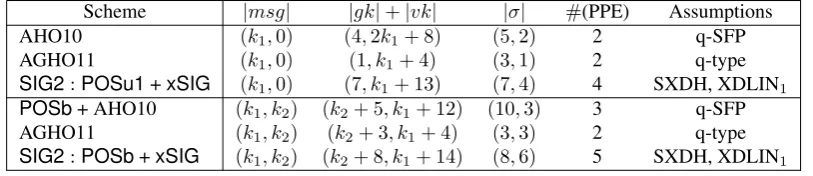
Our first contribution consists of two generic constructions for chosen message attack (CMA) secure signatures that combine variations of one-time signatures and signatures secure against random message attacks (RMA). Both constructions inherit the structure-preserving and constant-size properties from the underlying components. The second contribution consists in the concrete instantiations of these components which result in constant-size structure-preserving signature schemes that produce signatures consisting of only 11 to 17 group elements and that rely only on basic assumptions such as Decisional-Linear (DLIN) for symmetric bilinear groups and analogues of DDH and DLIN for asymmetric bilinear groups. To our knowledge, these are the first constant-size structure-preserving signature schemes that eliminate the use ofq-type assumptions while achieving reasonable efficiency.
We instantiate the first generic construction for symmetric (Type-I) and the second for asymmetric (Type-III) pairing groups. See Table 1 and 2 in Section 5.4 and 6.5, respectively, for the summary of efficiency of the resulting schemes. We give more details on our generic constructions and their instantiations:
• The first generic construction (SIG1) combines a new variation of one-time signatures which we calltagged one-time signaturesand signatures secure againstrandom message attacks(RMA). A tagged one-time signature scheme, denoted byTOS, is a signature scheme that attaches a fresh tag to a signature. It is unforgeable with respect to tags that are used only once. In our construction, a message is signed with ourTOSscheme using a fresh random tag, and then the tag is signed with the second signature scheme, denoted byrSIG. Since therSIGscheme only signs random tags, RMA-security is sufficient.
• The second generic construction (SIG2) combinespartial one-time signaturesand signatures secure againstextended random message attacks (XRMA). The latter is a novel notion that we explain below. Partial one-time signatures, denoted byPOS, are one-time signatures for which only a part of the one-time key is renewed for every signing opera-tion. They were first introduced by Bellare and Shoup [9] under the name of two-tier signatures. In our construction, a message is signed with thePOSscheme and then the random one-time public-key is certified by the second signature scheme, denoted byxSIG. The difference between aTOSscheme and aPOSscheme is that a one-time public-key is associated with a one-time secret-key. Since the secret-key is needed for signing, it must be known to the reduction in the security proof. XRMA-security guarantees thatxSIGis unforgeable even if the adversary is given auxiliary in-formation associated with the randomly chosen messages. The auxiliary inin-formation facilitates access to the one-time secret-key by the reduction.
• To instantiateSIG2, we construct structure-preservingPOSandxSIGsignature schemes based on assumptions that are analogues of DDH and DLIN in Type-III bilinear groups. The resultingSIG2 scheme is structure-preserving, produces signatures consisting of 11 group elements for uniliteral messages in a base group or 14 group elements for biliteral messages from both base groups.
The role of partial one-time signatures is to compress a message into a constant number of random group elements. This observation is interesting in light of [3] that implies the impossibility of constructing collision resistant and shrinking structure-preserving hash functions, which could immediately yield constant-size signatures. Our (extended) RMA-secure signature schemes are structure-preserving variants of Waters’ dual-signature scheme [39]. In general, the difficulty of con-structing CMA-secure SPS arises from the fact that the exponents of the group elements chosen by the adversary as a message are not known to the reduction in the security proof. On the other hand, for RMA security, it is the challenger that chooses the message and therefore the exponents can be known in reductions. This is the crucial advantage for constructing (extended) RMA-secure structure-preserving signature schemes based on Waters’ signature scheme.
Finally, we mention a few new applications. Among these is the achievement of a drastic performance improvement when using our partial one-time signatures in the work by Hofheinz and Jager [29] to construct CCA-secure public-key encryption schemes with a proof of security that tightly reduces to DLIN or SXDH.
1.2
Related Works
Even, Goldreich and Micali [17] proposed a generic framework (the EGM framework) that combines a one-time signature scheme and a signature scheme that is secure against non-adaptive chosen message attacks (NACMA) to construct a signature scheme that is secure against adaptive chosen message attacks (CMA).
In fact, our generic constructions can be seen as refinements of the EGM framework. There are two reasons why the original framework falls short for our purpose.The firstis that relaxing to NACMA does not seem a big help in constructing efficient structure-preserving signatures since the messages are still under the control of the adversary and the exponents of the messages are not known to the reduction algorithm in the security proof. As mentioned above, resorting to (extended) RMA is a great help in this regard. In [17], they also showed that CMA-secure signatures existiff RMA-secure signatures exist. The proof, however, does not follow their framework and their impractical construction is mainly a feasibility result. In fact, we argue that RMA-security alone is not sufficient for the original EGM framework. As mentioned above, the necessity of XRMA security arises in the reduction that uses RMA-security to argue security of the ordinary signature scheme, as the reduction not only needs to know the random one-time public-keys, but also their corresponding one-time secret keys in order to generate the one-time signature components of the signatures. The auxiliary information in the XRMA definition facilitates access to these secret keys. Similarly, tagged one-time signatures avoid this problem as tags do not have associated secret values.The second reasonthat the EGM approach is not quite suited to our task is that the EGM framework produces signatures that are linear in the public-key size of the one-time signature scheme. Here, tagged or partial one-time signature schemes come in handy as they allow the signature size to be only linear in the size of the part of the public key that is updated. Thus, to obtain constant-size signatures, we require the one-time part to be constant-size.
Hofheinz and Jager [29] constructed a SPS scheme by following the EGM framework. The resulting scheme allows tight security reduction to DLIN but the size of signatures depends logarithmically to the number of signing operation as their NACMA-secure scheme is tree-based like the Goldwasser-Micali-Rivest signature scheme [24]. Kohlweiss and Chase [13] construct a SPS scheme with security based on DLIN that improve the performance of Groth’s scheme [27] by several orders of magnitude. The size of the resulting signatures, however, are still linear in the number of signed group elements, and an order of magnitude larger than in our constructions.
2
Preliminaries
2.1
Notation
Appending elementyto a sequenceX= (x1, . . . , xn)is denoted by(X, y), i.e.,(X, y) = (x1, . . . , xn, y).
When algorithmAis defined for inputxand outputy, notation~y←A(~x)for~x:={x1, . . . , xn}means thatyi←A(xi) is executed fori= 1, . . . , nand~yis set as~y := (y1, . . . , yn). For setX, notationa←X denote a uniform sampling from
X. Independent multiple sampling from the same setXis denoted bya, b, c, ..←X.
2.2
Bilinear groups
are no efficient mapping between the groups in either direction. In the Type-III setting, we often use twin group elements, (Ga,Gˆa)∈
G1×G2for some basesGandGˆ. ForXinG1, notationXˆ denotes for an element inG2thatlogX = log ˆX where logarithms are with respect to default bases that are uniformly chosen once for all and implicitly associated toΛ. Should their relation be explicitly stated, we writeX ∼ Xˆ. We count the number of group elements to measure the size of cryptographic objects such as keys, messages, and signatures. For Type-III groups, we denote the size by(x, y)when it consists ofxandyelements fromG1andG2, respectively.
We refer to the Type-I setting whenG1=G2(i.e., there are efficient mappings in both directions). This is also called the symmetric setting. In this case, we defineΛ := (p,G,GT, e). When we need to be specific, the group description yielded by
Gwill be written asΛasymandΛsym.
2.3
Assumptions
We first define computational and decisional Diffie-Hellman assumptions (co-CDH, DDH1) and decision linear assumption (DLIN1) for Type-III bilinear groups. Corresponding more standard assumptions, CDH, DDH, and DLIN, in Type-I groups are obtained by settingG1=G2andG= ˆGin the respective definitions.
Definition 1 (Computation co-Diffie-Hellman Assumption: co-CDH).
The co-CDH assumption holds if, for any polynomial-time algorithmA, probability Advco-cdhG,A (λ) := Pr[Z = Gxy|Λ ←
G(1λ) ; x, y←
Zp; Z← A(Λ, G, Gx, Gy,G,ˆ Gˆx,Gˆy) ]is negligible inλ.
Definition 2 (Decisional Diffie-Hellman Assumption inG1: DDH1).
LetGddh1(1λ)be an algorithm that, on input security parameter1λ, runs group generatorΛ := (p,G1,G2,GT, e)← G(1λ), choosesG←G1andx, y, z←Zp, and outputsIddh1 := (Λ, G, Gx, Gy)and(x, y, z). The DDH1assumption holds if for polynomial-time adversaryA, advantage Advddh1G,A(λ) := |Pr[ 1← A(Iddh1, Gxy)|(Iddh1, x, y, z)← Gddh1(1λ) ]−Pr[ 1←
A(Iddh1, Gz)|(I
ddh1, x, y, z)← Gddh1(1λ) ]|is negligible inλ.
Definition 3 (Decision Linear Assumption inG1: DLIN1).
LetGdlin1(1λ)be an algorithm that on input security parameterλ, runs group generatorΛ := (p,G1,G2,GT, e)← G(1λ), selectsx, y, z←ZpandG1, G2, G3←G1∗, and outputsIdlin1:= (Λ, G1, G2, G3, Gx1, G
y
2)and(x, y, z). The DLIN1 assump-tion holds if, for all polynomial-time adversaryA, advantage Advdlin1G,A(λ) := |Pr[ 1← A(Idlin1, G3x+y)|(Idlin1, x, y, z)←
Gdlin1(1λ) ]−Pr[ 1← A(Idlin1, G3z)|(Idlin1, x, y, z)← Gdlin1(1λ) ]|is negligible inλ.
For DDH1 and DLIN1, we define an analogous assumption in G2 (DDH2) by swapping G1 andG2in the respective definitions. In Type-III bilinear groups, it is assumed that both DDH1 and DDH2 hold simultaneously. The assumption is
called the symmetric external Diffie-Hellman assumption (SXDH), and we define advantage AdvsxdhG,C by AdvsxdhG,C(λ) def= Advddh1G,A(λ) +Advddh2G,B(λ). We extend DLIN in a similar manner as DDH, and SXDH.
Definition 4 (External Decision Linear Assumption inG1: XDLIN1).
LetGxdlin(1λ)be an algorithm that on input security parameterλ, runs group generatorΛ := (p,
G1,G2,GT, e)← G(1λ), selectsx, y, z ← Zp andG1, G2, G3 ← G∗1, Gˆ1,Gˆ2,Gˆ3 ∈ G∗2 such that (G1, G2, G3) ∼ ( ˆG1,Gˆ2,Gˆ3), and outputs
Ixdlin:= (Λ, G1, G2, G3,Gˆ1,Gˆ2,Gˆ3, Gx1, G y 2,Gˆx1,Gˆ
y
2)and(x, y, z). The XDLIN1assumption holds if, for all polynomial-time adversaryA, advantage Advxdlin1G,A (λ) := | Pr[ 1 ← A(Ixdlin, G3x+y)|(Ixdlin, x, y, z) ← Gxdlin(1λ) ] −Pr[ 1 ←
A(Ixdlin, G3z)|(Ixdlin, x, y, z)← Gxdlin(1λ) ]|is negligible inλ.
The XDLIN1 assumption is equivalent to the DLIN1 assumption in the generic bilinear group model [38, 10] where one can simulate the extra elements,Gˆ1,Gˆ2,Gˆ3,Gˆx1,Gˆ
y
2, in XDLIN1fromG1, G2, G3, Gx1, G y
2 in DLIN1. We define the XDLIN2assumption analogously by givingGˆ3x+y, respectivelyGˆz3, toAinstead. Then we define the simultaneous external decision Diffie-Hellman assumption, SXDLIN, that assumes that both XDLIN1 and XDLIN2 hold at the same time. By Advxdlin2G,A (AdvsxdlinG,A , resp.), we denote the advantage function for XDLIN2(and SXDLIN, resp.).
Finally we recall two computational assumptions (tightly) reduced from one of the above basic assumptions.
Definition 5 (Double Pairing Assumption inG1[4]:DBP1).
The DBP1assumption holds if, for any polynomial-timeA, probability Advdbp1G,A(λ)
def
= Pr[ 1 =e(Gz, Z)e(Gr, R)∧Z ∈
G∗2|Λ← G(1λ) ; (Gz, Gr)←G1∗×G∗1; (Z, R)← A(Λ, Gz, Gr) ]is negligible inλ.
Lemma 1. SXDH⇒DBP1∧DBP2. In particular,Advdbp1G,A(λ) +Adv
dbp2
G,B(λ)≤AdvsxdhG,C(λ)holds.
Note that the double pairing assumption does not hold in Type-I groups sinceZ =Gr,R=Gzis a trivial solution. The following analogous assumption will be useful in Type-I groups.
Definition 6 (Simultaneous Double Pairing Assumption [12]: SDP).
The SDP assumption holds if, for any polynomial-timeA, advantage AdvsdpG,A(λ) def= Pr[ 1 = e(Gz, Z) e(Gr, R)∧ 1 =
e(Hz, Z)e(Hs, S)∧Z ∈G∗|Λ← G(1λ) ; (Gz, Gr, Hz, Hs)←G∗4; (Z, R, S)← A(Λ, Gz, Gr, Hz, Hs) ]is negligi-ble inλ.
As shown in [12] for the Type-I setting, the simultaneous double pairing assumption holds forG if the decision linear assumption holds forG.
Lemma 2. DLIN⇒SDP. In particular,AdvsdpG,A(λ)≤AdvdlinG,B(λ)holds.
3
Definitions
3.1
Common setup
All building blocks make use of a common setup algorithmSetupthat takes the security parameter1λand outputs a global parametersgk that is given to all other algorithms. Usuallygk consists of a descriptionΛof a bilinear group setup and a default generator for each group. In this paper, we include several additional generators ingkfor technical reasons. Note that when the resulting signature scheme is used in multi-user applications different additional generators need to be assigned to individual users or one needs to fall back on the common reference string model, whereasΛand the default generators can be shared. Thus we count the size ofgkwhen we assess the efficiency of concrete instantiations. For ease of notation, we makegkimplicit except w.r.t. key generation algorithms.
3.2
Signature schemes
We use the following syntax for signature schemes suitable for the multi-user and multi-algorithm setting. The key generation function takes global parametergkgenerated bySetup(usually it takes security parameter1λ), and the message spaceMis determined solely fromgk(usually it is determined from a public-key).
Definition 7 (Signature Scheme). A signature schemeSIGis a tuple of three polynomial-time algorithms(Key,Sign,Vrf) that;
• SIG.Key(gk)is a probabilistic algorithm that generates a long-term public-keyvkand a secret-keysk.
• SIG.Sign(sk, msg)is an algorithm that takesskand messagemsg, and outputs signatureσ.
• SIG.Vrf(vk, msg, σ)outputs1for acceptance or0for rejection.
Correctness requires that1 =SIG.Vrf(vk, msg, σ)holds for anygkgenerated bySetup, any keys generated as(vk, sk)←
SIG.Key(gk), any messagemsg∈ M, and any signatureσ←SIG.Sign(sk, msg).
Definition 8 (Attack Game(ATK)). LetOsigbe an oracle andAbe an oracle algorithm. We define a meta attack game as a sequence of execution of algorithms as follows.
ATK(A, λ) =
gk←Setup(1λ),
pre← A(gk),
(vk, sk)←SIG.Key(gk),
(σ†, msg†)← AOsig(vk)
(1)
AdversaryAcommits topre, which is typically a set of messages, in the first run. This formulation is to capture non-adaptive attacks. It is implicit that a state information is passed to the second run ofA. LetQmbe list of messages and signatures observed byAbefore outputting the resulting forgery. The output of ATK is(vk, σ†, msg†, Q
m).
Definition 9 (Adaptive Chosen-Message Attack (CMA)). Adaptive chosen message attack security is defined by the attack game ATK wherepreis empty and oracleOsig is the signing oracle that, on receiving a messagemsg, performsσ ←
Definition 10 (Non-Adaptive Chosen-Message Attack (NACMA)). Non-adaptive chosen message attack is is attacks game ATK wherepreis a list of messages and oracleOsigreturns signatures for the messages inpre.
Definition 11 (Random Message Attack (RMA)[17]). Random message attack security is defined by the attack game ATK wherepreis empty and oracleOsigis the following: on receiving a request, it choosesmsguniformly fromMdefined by
gk, computesσ←SIG.Sign(sk, msg), and returns(σ, msg).
LetMSGGenbe a uniform message generator. It is a probabilistic algorithm that takesgkand outputsmsg ∈ Mthat distributes uniformly overM. Furthermore, MSGGenoutputs auxiliary information auxthat may give a hint about the random coins used for selectingmsg.
Definition 12 (Extended Random Message Attack (XRMA)). Extended random message attack is attack game ATK where
preis empty and oracleOsig is the following. On receiving a request, it runs(msg,aux) ← MSGGen(gk), computes
σ←SIG.Sign(sk, msg), and returns(σ, msg,aux).
For an attack ATK∈ {CMA,NACMA,RMA,XRMA}, we define unforgeability as follows.
Definition 13 (Unforgeability against ATK). Signature schemeSIGis unforgeable against attack ATK (UF-ATK), if for all polynomial-time oracle algorithmAthe advantage function Advuf-atkSIG,Ais negligible inλ, where
Advuf-atkSIG,A(λ) = Pr
msg† 6∈Qm∧
1 =SIG.Vrf(vk, σ†, msg†)
(vk, σ†, msg†, Qm)←ATK(A, λ)
. (2)
Fact 1. UF-CMA ⇒ UF-NACMA ⇒ UF-XRMA ⇒ UF-RMA, i.e., Advuf-cmaSIG,A(λ) ≥ Advuf-nacmaSIG,A (λ) ≥ Advuf-xrmaSIG,A(λ)
≥Advuf-rmaSIG,A(λ).
3.3
Partial one-time and tagged one-time signatures
Partial one-time signatures, also known as two-tier signatures [9], are a variation of one-time signatures where only part of the public-key must be updated for every signing, while the remaining part can be persistent.
Definition 14 (Partial One-Time Signature Scheme [9]). A partial one-time signatures schemePOSis a set of polynomial-time algorithmsPOS.{Key,Update,Sign,Vrf}.
• POS.Key(gk)generates a long-term public-keypkand a secret-keysk. The message spaceMois associated withpk. (Recall however, that we require thatMobe completely defined bygk.)
• POS.Update()takesgk as implicit input, and outputs a pair of one-time keys(opk,osk). We denote the space for
opkbyKopk.
• POS.Sign(sk, msg,osk)outputs a signatureσon messagemsgbased on secret-keysskandosk.
• POS.Vrf(pk,opk, msg, σ)outputs1for acceptance, or0for rejection.
For correctness, it is required that1 = POS.Vrf(pk,opk, msg, σ)holds except for negligible probability for anygk,
pk,opk, σ, and msg ∈ Mo, such that gk ← Setup(1λ), (pk,sk) ← POS.Key(gk),(opk,osk) ← POS.Update(),
σ←POS.Sign(sk, msg,osk).
A tagged one-time signature scheme is a signature scheme whose signing function in addition to the long-term secret key takes a tag as input. A tag is one-time, i.e., it must be different for every signing.
Definition 15 (Tagged One-Time Signature Scheme). A tagged one-time signature schemeTOS is a set of polynomial-time algorithmsTOS.{Key,Tag,Sign,Vrf}.
• TOS.Key(gk)generates a long-term public-keypkand a secret-keysk. The message spaceMtis associated withpk.
• TOS.Tag()takesgkas implicit input and outputstag. ByT, we denote the space fortag.
• TOS.Sign(sk, msg,tag)outputs signatureσfor messagemsgbased on secret-keysk and tagtag.
Correctness requires that1 =TOS.Vrf(pk,tag, msg, σ)holds except for negligible probability for anygk,pk,tag,σ, andmsg∈ Mt, such thatgk←Setup(1λ),(pk,sk)←TOS.Key(gk),tag ←TOS.Tag(),σ←TOS.Sign(sk, msg,tag). ATOSscheme isPOSscheme for whichtag =osk =opk. We can thus give a security notion forPOSschemes that also applies toTOSschemes by readingUpdate=Tagandtag =osk=opk.
Definition 16 (Unforgeability against One-Time Adapative Chosen-Message Attacks). A partial one-time signature scheme is unforgeable against one-time adaptive chosen message attacks (OT-CMA) if for all polynomial-time oracle algorithmA
the advantage function Advot-cmaPOS,Ais negligible inλ, where
Advot-cmaPOS,A(λ) = Pr
∃(opk, msg, σ)∈Qms.t.
opk† =opk ∧ msg†6=msg∧
1 =POS.Vrf(pk,opk†, σ†, msg†)
gk←Setup(1λ),
(pk,sk)←POS.Key(gk),
(opk†, σ†, msg†)← AOt,Osig(pk)
. (3)
Qmis initially an empty list.Otis the one-time key generation oracle that on receiving a request invokes a fresh sessionj, performs(opkj,oskj)←POS.Update(), and returnsopkj. Osigis the signing oracle that, on receiving a messagemsgj for sessionj, performsσj ← POS.Sign(sk, msgj,oskj), returnsσj toA, and records(opkj, msgj, σj)to the list Qm.
Osigworks only once for every session. Strong unforgeability is defined as well by replacing conditionmsg† 6=msgwith (msg†, σ†)6= (msg, σ).
We define a non-adaptive variant (OT-NACMA) of the above notion by integratingOtintoOsig so thatopkj andσj are returned toAat the same time. Namely,Amust submitmsgj before seeingopkj. It is obvious that if a scheme is secure in the sense of OT-CMA, the scheme is also secure in the sense of OT-NACMA. If a scheme is strongly unforgeable, it is unforgeable as well. By Advot-nacmaPOS,A (λ)we denote the advantage ofAin this non-adaptive case. ForTOS, we use the same notations, OT-CMA and OT-NACMA, and define advantage functions Advot-cmaTOS,A and Advot-nacmaTOS,A accordingly. For strong unforgeabiltiy, we use labelsot-cmaandsot-nacma.
We define a condition that is relevant for coupling random message secure signature schemes with partial one-time and tagged one-time signature schemes in later sections.
Definition 17 (Tag/One-time Public-Key Uniformity). TOSis called uniform-tag ifTOS.Tagoutputstag that uniformly distributes over tag spaceT. Similarly,POSis called uniform-key ifPOS.Updateoutputsopk that uniformly distributes over key spaceKopk.
3.4
Structure-preserving signatures
A signature scheme is structure-preserving over a bilinear groupΛ, if public-keys, signatures, and messages are all base group elements ofΛ, and the verification only evaluates pairing product equations. Similarly, partial one-time signature schemes are structure-preserving if their public-keys, signatures, messages, and tags or one-time public-keys consist of base group elements and the verification only evaluates pairing product equations.
4
Generic Constructions
4.1
SIG1: Combining tagged one-time and RMA-secure signatures
LetrSIGbe a signature scheme with message spaceMr, andTOSbe a tagged one-time signature scheme with tag spaceT
such thatMr =T. We construct a signature schemeSIG1fromrSIGandTOS. Letgkbe a global parameter generated by
Setup(1λ).
• SIG1.Key(gk): Run(pkt,skt)←TOS.Key(gk),(vkr, skr)←rSIG.Key(gk). Outputvk:= (pkt, vkr)andsk:= (skt, skr).
• SIG1.Sign(sk, msg): Parse skinto (skt, skr). Run tag ← TOS.Tag(), σt ← TOS.Sign(skt, msg,tag),σr ← rSIG.Sign(skr,tag). Outputσ:= (tag, σt, σr).
• SIG1.Vrf(vk, σ, msg): Parsevkandσaccordingly. Output1, if1 =TOS.Vrf(pkt,tag, σt, msg)and1 =rSIG.Vrf(vkr, σr,tag). Output0, otherwise.
Theorem 1. SIG1is unforgeable against adaptive chosen message attacks (UF-CMA) ifTOSis uniform-tag and unforge-able against one-time non-adaptive chosen message attacks (OT-NACMA), andrSIGis unforgeable against random message attacks (UF-RMA). In particular,Advuf-cmaSIG1,A(λ)≤Advot-nacmaTOS,B (λ) +Advuf-rmarSIG,C(λ).
Proof.Any signature that is accepted by the verification algorithm must either reuse an existing tag, or sign a new tag. The success probability Advuf-cmaSIG1,A(λ)of an attacker onSIG1is bounded by the sum of the success probabilities Advot-nacmaTOS,B (λ) of an attacker onTOSand the success probability Advuf-rmarSIG,C(λ)of an attacker onrSIG.
Game 0: The actual Unforgeability game.Pr[Game 0] =Advuf-cmaSIG1,A(λ).
Game 1: The real security game except that the winning condition is changed to no longer accept repetition of tags.
Lemma 3. |Pr[Game 0]−Pr[Game 1]| ≤Advot-nacmaTOS,B (λ)
Proof. AttackerAwins in Game 0, but loses in Game 1, iff it produces a forgery that reuses a tag from a signing query. We describe a reductionBthat use such an attacker to break the OT-NACMA-security ofTOSThe reductionB
receivesgkandpktfrom the challenger ofTOS, sets upvkrandskrhonestly by runningrSIG.Key(gk), and provides
gkandvk= (vkr,pkt)toA.
To answer a signing query,Buses the signing oracle ofTOSto gettag andσt, signstagusingskrto produceσr, and returns(tag, σt, σr). WhenAproduces a forgery(tag†, σ†t, σ†r)on messagemsg†,Boutputs(msg†,tag†, σ
†
t)as a forgery forTOS.
Game 2: The fully idealized game. The winning condition is changed to reject all signatures.
Lemma 4. |Pr[Game 1]−P r[Game 2]| ≤Advuf-rmarSIG,C(λ)
Proof. AttackerAwins in Game 1, iff it produces a forgery with a fresh tag. We describe a reductionCthat useA
to break the UF-RMA security ofrSIG. AlgorithmC receives gk andvkr, runs(pkt,skt) ← TOS.Key(gk), and providesgkandvk= (vkr,pkt)toA.
To answer signing query on messagemsg,CconsultsOsigand receives random messagemsgrand signatureσr. C then usesmsgras a tag, i.e.,tag =msgr, and create signatureσtonmsgby runningTOS.Sign(skt, msg,tag). It then returns(tag, σt, σr). Note that for a uniform-tagTOSscheme these tags distribute uniformly over the tag space. Thus the reduction simulation is perfect. WhenAproduces a forgery(tag†, σ†t, σ†r)onmsg†, reductionC outputs (tag†, σ†r)as a forgery.
Thus Advuf-cmaSIG1,A(λ) = Pr[Game 0]≤Advot-nacmaTOS,B (λ) +Advuf-rmarSIG,C(λ)as claimed.
Theorem 2. IfTOS.Tagproduces constant-size tags and signatures in the size of input messages, the resultingSIG1 pro-duces constant-size signatures as well. Furthermore, ifTOSandrSIGare structure-preserving, so isSIG1.
We omit the proof of Theorem 2 as it is done simply by examining the construction.
4.2
SIG2: Combining partial one-time and XRMA-secure signatures
LetxSIGbe a signature scheme with message spaceMx, andPOSbe a partial one-time signature scheme with one-time
public-key spaceKopk such thatMx = Kopk. We construct a signature schemeSIG2fromxSIGandPOS. Letgkbe a global parameter generated bySetup(1λ).
• SIG2.Key(gk): Run (pkt,skt) ← POS.Key(gk), (vkx, skx) ← xSIG.Key(gk). Output vk := (pkt, vkx) and
sk:= (skt, skx).
• SIG2.Sign(sk, msg): Parseskinto(skt, skx). Run(opk,osk)←POS.Update(),σt←POS.Sign(skt, msg,osk),
σx←xSIG.Sign(skx,opk). Outputσ:= (opk, σt, σx).
• SIG2.Vrf(vk, σ, msg): Parsevkandσaccordingly. Output1if1 =POS.Vrf(pkt,opk, σt, msg), and1 =xSIG.Vrf(vkx,
Theorem 3. SIG2is unforgeable against adaptive chosen message attacks (UF-CMA) ifPOSis uniform-key and unforge-able against one-time non-adaptive chosen message attacks (OT-NACMA), andxSIGis unforgeable against extended ran-dom message attacks (UF-XRMA) with respect toPOS.Updateas the message generator. In particular,Advuf-cmaSIG2,A(λ) ≤
Advot-nacmaPOS,B (λ) +Advuf-xrmaxSIG,C(λ).
Proof.The proof is almost the same as that for Theorem 1. The only difference appears in constructingCin the second step. SincePOS.Update is used as the extended random message generator, the pair(msg, aux)is in fact(opk,osk). Given (opk,osk), adversaryCcan runPOS.Sign(sk, msg,osk)to yield legitimate signatures.
As for our first generic construction, the following theorem holds immediately from the construction.
Theorem 4. IfPOSproduces constant-size one-time public-keys and signatures in the size of input messages, resultingSIG2
produces constant-size signatures as well. Furthermore, ifPOSandxSIGare structure-preserving, so isSIG2.
5
Instantiating
SIG1
We instantiate the building blocksTOSandrSIGof our first generic construction to obtain our first SPS scheme. We do so in Type-I bilinear group setting. The resultingSIG1scheme is an efficient structure-preserving signature scheme based only on the DLIN assumption.
5.1
Setup for Type-I groups
The following setup procedure is common for all instantiations in this section. The global parametergk is given to all functions implicitly.
Setup(1λ): RunΛ = (p,
G,GT, e) ← G(1λ)and choose random generators (G, C, F, U1, U2) ← G∗5. Outputgk :=
(Λ, G, C, F, U1, U2).
The parametersgkalso fix the message spaceMr :={(Cm1, Cm2, Fm1, Fm2, U1m1, U m2
2 )∈G6|(m1, m2)∈Z2p}for the RMA-secure signature scheme defined below. For our generic framework to work, the tagged one-time signature schemes should have the same tag space.
5.2
Tagged one-time signature scheme
Basically, a tag in our scheme consists of a pair of elements inG. However, due to a constraint fromrSIGwe show in the
next section, the tags will have to be in an extended form. We therefore parameterize the one-time key generation function Updatewith a flagmode∈ {normal,extended}so that it outputs a key in the original or extended form. Althoughmodeis given toUpdateas input, it should be considered as a fixed system-wide parameter that is common for every invocation of Updateand the key space is fixed throughout the use of the scheme. Accordingly, this extension does not affect the security model at all.
[SchemeTOS]
• TOS.Key(gk): Parsegk= (Λ, G, C, F, U1, U2). Choosewz, wr, µz, µs, τ1, τ2randomly fromZ∗pand computeGz:=
Cwz,G
r:=Cwr,Hz:=Cµz,Hs:=Cµs,Gt:=Cτ1andHt:=Cτ2. Fori= 1, . . . , k, uniformly chooseχi,γi,δi fromZpand compute
Gi:=GχziG γi
r, and Hi:=HzχiH δi
s . (4)
Outputpk := (Gz, Gr, Hz, Hs, Gt, Ht, G1, . . . , Gk, H1, . . . , Hk)∈G2k+6andsk := (χ1, γ1, δ1, . . . , χk, γk, δk, wz,
wr, µz, µs, τ1, τ2).
• TOS.Tag(mode): Take(G, C, F, U1, U2)fromgk. Choose(t1, t2)←Zpand outputtag := (T1, T2) = (Ct1, Ct2)∈
G2ifmode=normalortag := (T1, T2, T3, T4, T5, T6) = (Ct1, Ct2, Ft1, Ft2, U1t1, U t2
2 )∈G6ifmode=extended.
• TOS.Sign(sk, msg,tag): Parsemsginto(M1, . . . , Mk)∈Gk,tag into(T1, T2, T3, T4, T5, T6), andskaccordingly. Chooseζrandomly fromZpand compute Then compute
Z:=Cζ
k
Y
i=1
M−χi
i and R:= (T τ1 1 G
−ζ z )
1
wr
k
Y
i=1
M−γi
i and S:= (T τ2 2 H
−ζ z )
1
µs
k
Y
i=1
M−δi
i . (5)
• TOS.Vrf(pk, σ, msg,tag): Parseσ as (Z, R, S) ∈ G3,msg as (M1, . . . , Mk) ∈ Gk, and tag as (T1, T2, T3, T4,
T5, T6)or(T1, T2)depending onmode. Return1if
e(T1, Gt) =e(Gz, Z)e(Gr, R) k
Y
i=1
e(Gi, Mi) (6)
e(T2, Ht) =e(Hz, Z)e(Hs, S) k
Y
i=1
e(Hi, Mi) (7)
holds. Return0, otherwise.
The scheme is correct as the following relation holds for the verification equation and the computed signatures.
e(Gz, Z)e(Gr, R) k
Y
i=1
e(Gi, Mi) =e(Gz, Cζ k
Y
i=1
M−χi
i )e(Gr,(T1τ1G
−ζ z )
1
wr
k
Y
i=1
M−γi
i ) k
Y
i=1
e(Gχi
z G γi
r , Mi)
=e(Gz, Cζ)e(C, T1τ1)e(C, G
−ζ z ) =e(C, Tτ1
1 ) =e(T1, Gt)
and
e(Hz, Z)e(Hs, S) k
Y
i=1
e(Hi, Mi) =e(Hz, Cζ k
Y
i=1
M−χi
i )e(Hs,(T2τ2H
−ζ z )
1
µs
k
Y
i=1
M−γi
i ) k
Y
i=1
e(Hχi
z H δi
s , Mi)
=e(Hz, Cζ)e(C, T2τ2)e(C, H
−ζ z ) =e(C, Tτ2
2 ) =e(T2, Ht)
Theorem 5. AboveTOSis strongly unforgeable against one-time adaptive chosen message attacks (OT-CMA) if the SDP assumption holds. In particular,Advsot-cmaTOS,A ≤AdvsdpG,B+ 1/p.
Proof.Given successful forgerAagainstTOSas a black-box, we constructBthat is successful in breaking SDP. We consider the casemode =extendedin the following. The other case,mode = normalcan be automatically obtained by dropping (T3, T4, T5, T6).
Given instance Isdp = (Λ, Gz, Gr, Hz, Hs)of SDP, algorithmBsimulates the attack game against TOS as follows. It first buildgk. ChooseGandC randomly fromG∗, and choosef, u1, u2 fromZ∗p. Compute F := Cf, U1 := Cu1,
U2:=Cu2 and setgk := (Λ, G, C, F, U1, U2). This yields agkfrom the same distribution as produced bySetup. NextB simulatesTOS.Keyby following the original prescription except thatΛand (Gz, Gr, Hz, Hs) are taken fromIsdp. Note that
wz, wr, µz, µs, i.e., the discrete-logs ofGz,Gr,Hz,Hswith respect to baseC, are not known to the simulator, but they are not needed in simulatingGiandHias in (4).
On receiving one-time key query, algorithmBsimulatesTOS.Tagby randomly selectingζ, ρ, ϕfromZpand computing
T1:= (GζzG ρ r)
1
τ1, T
2:= (HzζH ϕ s)
1
τ2, (8)
andT3:=T f
1, T4:=T f
2, T5:=T1u1, T6:=T2u2 by usingf,u1andu2generated inSetup.
On receiving signing querymsgifromA, algorithmBsimulatesOsigby simulatingTOS.Signwithout havingwrand
µs. It is done by usingζ,ρ, andϕused inTOS.Tagas follows.
Z :=Cζ
k
Y
i=1
M−χi
i and R:=C ρ
k
Y
i=1
M−γi
i and S:=C ϕ
k
Y
i=1
M−δi
The above simulated signature (Z, R, S) can satisfy verification equations.
e(Gz, Z)e(Gr, R) k
Y
i=1
e(Gi, Mi) =e(Gz, Cζ k
Y
i=1
M−χi
i )e(Gr, Cρ k
Y
i=1
M−γi
i ) k
Y
i=1
e(Gχi
z G γi
r , Mi)
=e(Gz, Cζ)e(Gr, Cρ)
=e(GζzGρr, C)
=e((GζzGρr) 1
τ1, Cτ1) =e(T1, Gt)
and
e(Hz, Z)e(Hs, S) k
Y
i=1
e(Hi, Mi) =e(Hz, Cζ k
Y
i=1
M−χi
i )e(Hs, Cϕ k
Y
i=1
M−δi
i ) k
Y
i=1
e(Hχi
z Hsδi, Mi)
=e(Hz, Cζ)e(Hs, Cϕ)
=e(HzζHsϕ, C)
=e((HzζHsϕ)τ12, Cτ2) =e(T2, Ht)
For each signing, transcript(tag, σ, msg)is recorded. WhenAoutputs a forgery(tag†, σ†, msg†), algorithmBsearches the records for(tag, σ, msg)such thattag†=tagand(msg†, σ†)6= (msg, σ). If no such entry exists,Baborts. Otherwise,
Bcomputes
Z?:= Z
†
Z
k
Y
i=1
Mi† Mi
!χi
, and R?:= R
†
R
k
Y
i=1
Mi† Mi
!γi
, and S?:= S
†
S
k
Y
i=1
Mi† Mi
!δi ,
where(Z, R, S, M1, . . . , Mk)and its dagger counterpart are taken from(σ, msg)and(σ†, msg†), respectively. Bfinally outputs(Z?, R?, S?). This completes the description ofB.
We first claim that the simulation byBis perfect. The parameters and keys generated inSetupandTOS.Keydue to the uniform choice ofIsdp= (Λ, Gz, Gr, Hz, Hs). The distribution of every tag and signature is perfect asT1andT2distribute uniformly due to the randomness ofρandϕ, and so doesZ due to the randomness ofζ. (T3,· · · , T6,RandS are then uniquely determined from the relevant relations.) Accordingly,Aoutputs successful forgery with noticeable probability and
Bfinds a corresponding record(tag, σ, msg).
We next claim that eachχi is independent of the view ofA. We show that, if coinsχ1, . . . , χk distribute uniformly overZkp, other coins, i.e.,(γ1, . . . , γk, δ1, . . . , δk)and(ζ(1), ρ(1), ϕ(1), . . . , ζ(qs), ρ(qs), ϕ(qs))forqsqueries, distribute uni-formly as well retaining consistency with the view of A. (By ζ(j), we denote ζ with respect to the j-th query. We follow the convention hereafter. For simplicity, we assume that A makes qs one-time key queries and the same num-ber of signing queries.) Observe that the view ofA making qs signing queries consists of independent group elements (C, F, U1, U2, Gz, Gr, Hz, Hs, Gt, Ht, G1, H1, . . . , Gk, Hk)and(T
(j) 1 , T
(j)
2 , Z(j), M (j) 1 , . . . , M
(j)
k )forj = 1, . . . , qs. (We omitGfrom the view as it is independent and not used at all.) We represent the view by the discrete-logarithms of these group elements with respect to baseC. Namely, the view is(1, f, u1, u2, wz, wr, µz, µs, τ1, τ2, w1, . . . , wk, µ1, . . . , µk)and (t(1j), t(2j), z(j), m(1j), . . . , m(kj))forj= 1, . . . , qs. The view and the coins follow relations
wi=wzχi+wrγi, µi=µzχi+µsδi fori= 1, . . . , k, (10)
τ1t (j)
1 =wzζ(j)+wrρ(j), τ2t (j)
2 =µzζ(j)+µsϕ(j), and (11)
z(j)=ζ(j)−
k
X
i=1
m(ij)χiforj= 1, . . . , qs. (12)
Equations in (10), (11), and (12) correspond to those in (4), (8), and the first one in (9), respectively.
Consider χ` for fixed ` in{1, . . . , k}. For every value of χ`, the linear equations in (10) determine γ1, . . . , γk and
χ`is independent ofζ(j),ρ(j), andϕ(j)forj = 1, . . . , qs. The above holds for every`in{1, . . . , k}. Thus, ifχ1, . . . , χk distributes uniformly overZkp, then other coins distribute uniformly as well retaining the consistency with the view ofA.
Finally, we claim that(Z?, R?, S?)is a valid solution to the given instance of SDP. Since both forged and recorded signatures fulfil equation (6) (7), dividing the equations results in
1 =e
Gz,
Z† Z
e
Gr,
R† R
k Y
i=1
e Gχi
z G γi
r ,
Mi† Mi
!
=e Gz,
Z† Z
k
Y
i=1
Mi† Mi
!χi!
e Gr,
R† R
k
Y
i=1
Mi† Mi
!γi!
=e(Gz, Z?) e(Gr, R?),
and
1 =e
Hz,
Z† Z
e
Hs,
S† S
k Y
i=1
e Hχi
z H δi
s ,
Mi† Mi
!
=e Hz,
Z† Z
k
Y
i=1
Mi† Mi
!χi!
e
Hs,
S† S
k
Y
i=1
Mi† Mi
!δi
=e(Hz, Z?) e(Hs, S?).
What remains is to prove thatZ? 6= 1. We have eithermsg† 6= msg(j) or σ† 6= σ. In the former case, there exists
` ∈ {1, . . . , k} such that M
† `
M` 6= 1. As already proven, χ` is independent of the view ofA. Thus
M† `
M`
χ`
distributes
uniformly overGandZ? = 1holds only ifZ† = ZQ(Mi†/Mi)−
χi, which happens only with probability1/pover the
choice ofχ`. In the latter case,(Z†, R†, S†) = (6 Z, R, S)andmsg† = msg(j). Suppose that, without loss of generality,
Z† =Z. ThenR† =Rholds since they are uniquely determined from the first verification equation. S† =Sholds as well from the second verification equation. Thus such a case can never happen. We thus have Advsot-cmaTOS,A ≤AdvsdpG,B+1/pas stated.
5.3
RMA-secure signature scheme
For our random message signature scheme we will use a construction based on the dual system signature proposed in [39]. While the original scheme is CMA-secure under the DLIN assumption, the security proof makes use of a trapdoor com-mitment to elements inZp and consequently messages are elements inZp rather thanG. Our construction below resorts
to RMA-security and removes this commitment to allows messages to be a sequence of random group elements satisfying a particular relation. As mentioned above, the message spaceMx :={(Cm1, Cm2, Fm1, Fm2, U1m1, U
m2 2 ) ∈ G
6 | (m 1,
m2)∈Z2p}is defined by generators(C, F, U1, U2)ingk.
[SchemerSIG]
rSIG.Key(gk): Givengk := (Λ, G, C, F, U1, U2)as input, uniformly selectV, V1, V2, H fromG∗anda1, a2, b, α, andρ from Z∗p. Then compute and output vk := (B, A1, A2, B1, B2, R1, R2, W1, W2, V, V1, V2, H, X1, X2) andsk := (vk, K1, K2)where
B:=Gb, A1:=Ga1, A2:=Ga2, B1:=Gb·a1, B2:=Gb·a2
R1:=V V1a1, R2:=V V2a2, W1:=Rb1, W2:=Rb2,
X1:=Gρ, X2:=Gα·a1·b/ρ, K1:=Gα, K2:=Gα·a1 .
rSIG.Sign(sk, msg): Parsemsg into (M1, M2, M3, M4, M5, M6). Pick randomr1, r2, z1, z2 ∈ Zp. Let r = r1+r2. Compute and output signatureσ:= (S0, S1, . . . S7)where
S0:= (M5M6H)r1, S1:=K2Vr, S2:=K1−1V r 1G
z1, S
3:=B−z1,
S4:=V2rG
z2, S
rSIG.Vrf(vk, σ, msg): Parsemsginto(M1, M2, M3, M4, M5, M6)andσinto(S0, S1, . . . , S7). Also parsevkaccordingly. Verify the following pairing product equations:
e(S7, M5M6H) =e(G, S0)
e(S1, B)e(S2, B1)e(S3, A1) =e(S6, R1)e(S7, W1)
e(S1, B)e(S4, B2)e(S5, A2) =e(S6, R2)e(S7, W2)e(X1, X2)
e(F, M1) =e(C, M3) e(F, M2) =e(C, M4) e(U1, M1) =e(C, M5) e(U2, M2) =e(C, M6)
The scheme is structure-preserving by construction and the correctness is verified by inspecting the following relation.
e(S1, Gb)e(S2, Gb·a1)e(S3, Ga1) =e(K2Vr, Gb)e(K1−1V r 1G
z1, Gb·a1)e(B−z1, Ga1)
=e(Gα·a1Vr, Gb)e(G−αVr 1G
z1, Gb·a1)e(G−b·z1, Ga1)
=e(Gα·a1Vr, Gb)e(G−αVr 1, G
b·a1)
=e(Gα·a1Vr, Gb)e(G−α·a1Vr·a1 1 , G
b)
=e(Vr, Gb)e(Vr·a1 1 , G
b)
=e(G, V Va1 1 )
b·r
e(S6, V V1a1)e(S7, Rb1) =e(B
r2, V Va1 1 )e(G
r1, VbVb·a1 1 ) =e(Gb·r2, V Va1
1 )e(G
r1, VbVb·a1 1 ) =e(G, V Va1
1 ) b·r
Thus, the second equation holds sincer = r1+r2. The third equation can be verified analogously, and the remaining equations are easily verified.
Theorem 6. The aboverSIGscheme is secure against random message attacks under the DLIN assumption. In particular, for any polynomial-time adversaryAagainstrSIGthat makes at mostqssigning queries, there exists polynomial-time algorithm
Bfor DLIN such thatAdvuf-rmarSIG,A(λ)≤(qs+ 2)·AdvdlinG,B(λ).
Proof. We refer to the signatures output by the signing algorithm as anormal signature. In the proof we will consider an additional type of signatures to which we refer to assimulation-type signaturesthat are computationally indistinguishable but easier to simulate. Forγ∈Zp, simulation-type signatures are of the form
σ= (S0, S10 =S1·G−a1a2γ, S20 =S2·Ga2γ, S3, S04=S4·Ga1γ, S5, . . . , S7)
We first give the outline of the proof using some lemmas. Proofs for the lemmas are given after the outline.
Lemma 5. Any signature that is accepted by the verification algorithm must be formed either as a normal signature, or a simulation-type signature.
Based on the notion of simulation-type signatures, we consider a sequence of games. Letpi be the probability that the adversary succeeds inGame i, andpnorm
i (λ)andpsimi (λ)that he succeeds with a normal-type respectively simulation-type forgery. Then by Lemma 5,pi(λ) =pnorm
i (λ) +psimi (λ)for alli.
Game 0: The actual Unforgeability under Random Message Attacks game.
Lemma 6. In Game 0, the adversary produces a valid forgery which is a simulation-type signature only with negligible probabilitypsim
0 (λ)under the DLIN assumption. More concretely, there exists an adversaryB1such that psim0 (λ) = AdvdlinG,B1(λ).
Lemma 7. The probability thatAoutputs a normal-type forgery is the same (up to a negligible amount) in Gamei−1
as in Gamei:pnorm
i−1(λ)≤pnormi (λ) + ∆i(λ)for some negligible∆i(λ)under the DLIN assumption. More concretely,
there exists an adversaryB2such that|pnormi−1(λ)−pinorm(λ)|=AdvdlinG,B2(λ).
Game q: All private key queries are answered with simulation-type signatures.
Lemma 8. In Game q,Aoutputs a normal-type forgery with at most negligible probabilitypnorm
q (λ)under the CDH
assumption. More concretely, there exists an adversaryB3such thatpnormq (λ) =AdvcdhG,B3(λ).
We have shown that inGame q,Acan output a normal-type forgery with at most negligible probability. Thus, by Lemma 7 we can conclude that the same is true inGame 0. Since we have already shown that inGame 0the adversary can output simulation-type forgeries only with negligible probability, and that any signature that is accepted by the verification algo-rithm is either normal or simulation-type, we conclude that the adversary can produce valid forgeries with only negligible probability
Advuf-rmarSIG,A(λ) = p0(λ) =p0sim(λ) +pnorm0 (λ) =psim0 (λ) + q
X
i=1
|pnormi−1(λ)−pinorm(λ)|+pnormq (λ)
≤ AdvdlinG,B
1(λ) +qAdv
dlin
G,B2(λ) +Adv
cdh
G,B3(λ)≤(q+ 2)·Adv
dlin
G,B(λ).
Proof.(of Lemma 5)
We have to show that only normal and simulation-type signatures can fulfil these equations. We ignore the first row of verification equations that establish thatM is well-formed. A signature has4random exponents,r1, r2, z1, z2. A simulation-type signatures has additional exponentγ.
We interpretS7 asGr1, and it follows from the first verification equation thatS0 is(M5M6H)r1. We interpretS3as
G−bz1,S
5asG−bz2, andS6asGr2b. Now we have fixed all exponents of a normal signature. The remaining two verification equations tell us that
e(Gb, S1)·e(Gba1, S2) = e(V V1a1, G
r2b)·e((V Va1 1 )
b, Gr1)·e(Ga1, Gbz1),
e(Gb, S1)·e(Gba2, S4) = e(V V2a2, G
r2b)·e((V Va2 2 )
b, Gr1)·e(Ga2, Gbz2)·e(G, G)αa1b.
We interpretS1asGα·a1VrG−a1a2γ. Now we have two equations and two unknowns that fixS2toG−αV1rGz1Ga2γ andS4 toV2rGz2Ga1γrespectively. Forγ= 0we have a normal signature otherwise a simulation-type signature.
Proof.(of Lemma 6).
Suppose for contradiction that there is an adversaryA, which, when playing Game Real (and thus receiving only normal signatures), produces forgeries which are formed like simulation-type signatures. Then we can create an adversaryBfor DLIN as follows:
LetIdlin = (Λ, G1, G2, G3, X, Y, Z)be an instance of DLIN where there exist randomx, y, z∈Zpsuch thatX =Gx1,
Y = Gy2 andZ = Gz 3 or G
x+y
3 . Given Idlin, adversary Bworks as follows. It first sets G := G3, and A1 := G1 and
A2 := G2. Then it chooses randomb, α, ρ ∈ Zp and computesB1 := Gb1 andB2 := Gb2,K1 := Gα3, K2 := Gα1 and
X1:=Gρ3,X2:=G αb/ρ
1 . It also chooses randomv, v1, v2and setsV =Gv3,V1=Gv31, andV2=Gv32. (This way we know the discrete log of these values w.r.t. G3.) Bfurther computesR1=V V1a1 =G
v 3G
v1
1 andR2:=V V2a2 =G v 3G
v2
2 . It then choosesU, Hat random fromG. Our final public-key is
vk= (Gb3, G1, G2, Gb1, G b 2, G
v 3G
v1 1 , G
v 3G
v2 2 , G
vb 3 G
v1b 1 , G
vb 3 G
v2b 2 , G
v 3, G
v1 3 , G
v2
3 , U, H, X1, X2) and our final secret key is
sk= (vk, Gα3, Gα1).
Note that both the distribution of the public and secret keys is statistically close to that in the real DLIN game. Moreover, to sign random messages,Bcan follow the real signing algorithm by usingsk.
Suppose that Aproduces a valid forgery σ† andmsg†. Then B proceeds as follows: It parses σ† as (S0, . . . , S7). Recall that in Lemma 5, it is shown that if the verification equations hold, then we must have S1 = Gαa1VrG−a1a2γ,
S2 = G−αV1rGz1Ga2γ, andS4 = V2rGz2Ga1γ. If this is a simulation-type signature, we will have γ 6= 0. Rewritten according to our choice of public-key, this means thatS1=Gα1VrG
−f γ
2 ,S2=G−3αV1rVz1G γ
2, andS4=V2rG z2 3 G
fis the discrete log ofG1w.r.t.G3. Thus, if we can extractG− f γ 2 , G
γ 2, G
γ
1, we can easily break the DLIN instance by testing whethere(Z, G−2f γ) =e(G2γ, X)e(Gγ1, Y). But, recall that the signature includesS3 =G3−bz1,S5 =G3−bz2,S6 =Gbr32, andS7=Gr31, and we knowb, αand the discrete logarithms ofV, V1, V2w.r.t.G3. Thus, it will be straightforward to extract the above values.
Proof.(of Lemma 7).
Suppose for contradiction that there exists an adversaryAsuch that the probabilities thatAoutputs a normal-type forgery in Gameiand Gamei+ 1differ by a non-negligible amount. Then we will useAto construct an algorithmBthat breaks the DLIN assumption.
We are given an instance of DLIN;Idlin = (G1, G2, G3, X, Y, Z). Note that determining whether a signature is of normal-type or simulation-normal-type naturally corresponds to a DLIN problem: each signature containsS7 =Gr1,S6= (Gb)r2, andS1 which will includeVr1+r2orVr1+r2G−a1a2γ depending on whether this is a normal- or simulation-type signature. (Recall that we definer=r1+r2.) If we setG=G2,Gb =G1, andV =G3, then it seems fairly straightforward to argue based on the DLIN assumption that it will be impossible for the adversary to distinguish normal and simulation-type signatures. However, we cannot tell whetherA’s forgery is normal- or simulation-type in this simulation. Thus, there will be no way for
Bto take advantage of a change inA’s success probability to solve the DLIN challenge.
The solution is to set things up so that, with high probability we can takeS0from the adversary’s forgery and extract something that looks like Gr1 (which will allow us to distinguish DLIN tuples and consequently detect simulation-type signatures), but at the same time we are guaranteed that for thei-th message, theGcomponent ofS0will cancel out, leaving only anGr1
2 component which will not allow the challenger itself to know whether a simulated signature is normal-type or simulation-type.
More specifically, the idea will be to choose some secret valuesξ1, ξ2, β, χ1, χ2, χ3and embed them in the parameters so thatUw1
1 U w2 2 H =G
χ1w1+χ2w2+χ3
2 G
ξ1w1+ξ2w2+β
3 . ThenS0= (U1w1U w2
2 H)r1=G
(χ1w1+χ2w2+χ3)r1
2 G
(ξ1w1+ξ2w2+β)r1
3 .
Ifξ1w1+ξ2w2+β 6= 0, this gives useful information onGr31 (in particular it will allow us to test candidate values), while ifξ1w1+ξ2w2+β = 0, this has noG3component and thus doesn’t help at all with findingGr31. We chooseξ1, ξ2, βso thatξ1w1+ξ2w2+β = 0for the(w1, w2)used to generate theith message. Furthermore, we will guarantee thatξ1, ξ2, β are information theoretically hidden even given this pair(w1, w2), so the adversary has only negligible chance of producing another message withUw1∗
1 , U w∗
2
2 such thatξ1w∗1+ξ2w2∗+β= 0as well.
Message space setup and key generation: Set(C, F), used to define message spaceM, to(Gϕ1, G3). We choose random
ξ1, ξ2, β, χ1, χ2, χ3 ← Zp, and compute U1 = G χ1 2 G
ξ1
3 ,U2 = G χ2 2 G
ξ2
3 , andH = G χ3 2 G
β
3. These values will be uniformly distributed, and independent ofξ1, ξ2, β.
gk = (G, C, F, U1, U2) = (G, Gϕ1, G3, G χ1 2 G
ξ1 3 , G
χ2 2 G
ξ2 3 )
We setG=G2,B =G1. We choose randoma1, a2, α, ρ←Zp, and computeGa1,Ga2,Ga1b,Ga2b,Gρ,andGαa1b/ρ using these values.
Next, we chooseV, V1, V2. We must choose these values carefully so that we can compute bothRiandRbi, and at the same time so that the componentVrof a signature-valueS1gives us some useful information (in particular it will allow us to deriveGr3). We do this by choosingv1, v2, δ, and computingV =G3−a1a2δ,V1=Gv21G
a2δ
3 , andV2=Gv22G a1δ 3 . Now, this meansR1=Ga21v1andR2=Ga22v2, and we can easily computeR
b 1=G
a1v1 1 andR
b 2=G
a2v2
1 . At the same time, note that these values are all distributed identically to the corresponding values in the real public and secret key. Storea1, a2, α, v1, v2, δand
sk= (vk, Gα, Gαa1) = (vk, Gα 2, G
αa1 2 ). Publish
vk = (Gb, Ga1, Ga2, Gba1, Gba2, R
1, R2, Rb1, R b
2, V, V1, V2, H, Gρ, Gαa1b/ρ) = (G1, Ga21, G
a2 2 , G
a1 1 , G
a2 1 , G
a1v1 2 , G
a2v2 2 , G
a1v1 1 , G
a2v2 1 , G
−a1a2δ 3 , G
v1 2 G
a2δ 3 , G
v2 2 G
a1δ 3 ,
Gχ3 2 G
β 3, G
ρ 2, G
αa1/ρ 1 ).
Note that both of these tuples are distributed statistically close to those produced bySetupandSIGr.Key.
Signatures forj-th message wherej < i. Pickwj1,wj2 at random and compute(M1, M2, M3, M4, M5, M6) = (Cwj1,
Cwj2, Fwj1, Fwj2, Uwj1 1 , U
wj2
2 ). B can compute a simulation-type signatures for this message since it hassk and
Signatures fori-th message: Pickw1,w2 such thatξ1w1+ξ2w2+β = 0and compute(M1, M2, M3, M4, M5, M6) = (Cw1, Cw2, Fw1, Fw2, Uw1
1 , U w2
2 ). Note that since no information aboutξ1, ξ2, β is revealed this message will look appropriately random to the adversary. We will implicitly setr1=yandr2=x. We computeS6=Gbr2 =Gx1 =X andS7 =Gr1 =G
y
2 =Y. Recall that we choseU1, U2, H such thatU1w1U w2 2 H =G
χ1w1+χ2w2+χ3
2 . Thus, we can computeS0= (M5M6H)r1 =Yχ1w1+χ2w2+χ3.
What remains is to computeS1, S2, S4. Note that this involves computingVr,V1r, andV2rrespectively. This is where we will embed our challenge. Recall thatV =G−a1a2δ
3 . Thus, we will computeVr= (G r1+r2
3 )−a1a2δasZ−a1a2δ. If
Z=Gx3+ythis will be correct; ifZ=Gz
3for randomz, then there will be an extra factor ofG
−a1a2δ(z−(x+y))
3 . If we let
Gγ =Gδ(z−(x+y))
3 (which is uniformly random from the adversary’s point of view), then this is distributed exactly as it should be in a simulation-type signature. Thus, we computeS1which should be eitherGαa1VrorGαa1VrG−a1a2γ asGαa1
2 Z−a1a2δ.
We can try to apply the same approach to computeV1rto getS1. However, recall that we setV1 =Gv21G a2δ 3 . Thus, computing V1r involves computing Gr2, which we cannot do. (If we could we could use that to break the DLIN assumption.) To get around this, we use z1, z2: choose random s1, s2 and implicitly set Gz1 = G−2v1r2+s1 and
Gz2 = G−v2r2+s2
2 . While we cannot compute these values, we can computeG−
z1b = Gv1r2−s1
1 = X
v1G−s1 1 and
G−z2b=Xv2G−s2
1 . Then to generateS2, we can compute
G−2αYv1Za2δGs1 2 =G
−αGr1v1 2 Z
a2δGs1 2 G
r2v1 2 G
−r2v1 2
=G−αG(r1+r2)v1
2 Z
a2δGs1−r2v1 2
=G−αGrv1 2 Z
a2δGz1.
IfZ=Gx3+y =Gr
3, then this will be
G−αGrv1 2 G
ra2δ 3 G
z1 =G−α(Gv1 2 G
a2δ 3 )
rGz1
=G−αV1rGz1.
IfZ=Gz36=x+y, then this will be:
G−αGrv1 2 G
za2δ 3 G
z1 =G−αGrv1 2 G
ra2δ 3 G
a2δ(z−(x+y))
3 G
z1
=G−αGrv1 2 G
ra2δ 3 G
a2γGz1
=G−αV1rGa2γGz1
where the second to last equality follows from our choice ofγ above. By a similar argument, we compute S4 as
Yv2Za1δGs2
2 and argue that this will be eitherV2rGz2orV2rGz2Ga1γas desired. LetS:= (S0, S1, S2, S3, S4, S5, S6, S7) where
S0=Yχ1wi1+χ2wi2+χ3 S1=Gαa2 1Z
−a1a2δ S
2=G−2αY
v1Za2δGs1 2
S3=Xv1G1−s1 S4=Yv2Za1δGs22 S5=Xv2G−1s2
S6=X S7=Y.
Signatures forj-th message wherej > i: Pickw1, w2and computemj = (M1, M2, M3, M4, M5, M6) = (Cw1, Cw2, Fw1,
Fw2, Uw1 1 , U
w2
2 )and a signatureσaccording toSIGr.Sign(sk, mj). Outputσ, mj.
On receivingA’s forgery: Asends a signatureS= (S0, S1, . . . , S7)and(M1, M2, M3, M4, M5, M6) = (Cw1, Cw2, Fw1,
Fw2, Uw1 1 , U
w2
2 )for some messagew1, w2.Boutputs1if and only if
e(S0, G1)·e(M3ξ1M ξ2 4 G
β 3, S6) =e((S1G−2αa1)−
1/(−a1a2δ),(M1/ϕ 1 )
ξ1(M1/ϕ 2 )
ξ2Gβ
1)·e(S7,(M 1/ϕ 1 )
χ1(M1/ϕ 2 )
χ2Gχ3 1 ).
By Lemma 5, we are guaranteed that if the signatureSverifies, then there must existw1, w2, r1, r2, γsuch thatS0= (Uw1
1 U w2
2 H)r1,S1=Gαa1VrG−a1a2γ,S6=Gbr2, andS7 =Gr1 wherer=r1+r2. We are also guaranteed that
M1= (G ϕ
1)w1,M2= (G ϕ
Rephrased in terms of our parameters, this means
S0= (G
χ1w1+χ2w2+χ3
2 G
ξ1w1+ξ2w2+β
3 )
r1 S
1=Gαa2 1G
−a1a2δr
3 G
−a1a2γ 2
S6=Gr12 S7=Gr21 .
Plugging this into the above computation we get thatBwill output1if and only if
e((Gχ1w1χ2w2+χ3
2 G
ξ1w1+ξ2w2+β
3 )
r1, G
1)·e((Gw31) ξ1(Gw2
3 ) ξ2Gβ
3, G r2 1 ) =e((Gαa1
2 G
−a1a2δr
3 G
−a1a2γ
2 G
−αa1 2 )
1/(−a1a2δ),(Gw1 1 )
ξ1(Gw1 1 )
ξ2Gβ 1)·e(G
r1 2 ,(G
w1 1 )
χ1(Gw2 1 )
χ2Gχ3 1 ).
Simplifying the left side to
e(Gχ1w1+χ2w2+χ3
2 G
ξ1w1+ξ2w2+β
3 )
r1, G 1)·e(G
ξ1w1+ξ2w2+β
3 , G
r2 1 )
=e(G2, G1)(χ1w1+χ2w2+χ3)r1·e(G3, G1)(ξ1w1+ξ2w2+β)r1·e(G3, G1)(ξ1w1+ξ2w2+β)r2
=e(G2, G1)(χ1w1+χ2w2+χ3)r1·e(G3, G1)(ξ1w1+ξ2w2+β)r
and the right side to
e((G−a1a2δr
3 G
−a1a2γ
2 )
1/(−a1a2δ), Gξ1w1+ξ2w2+β 1 )·e(G
r1 2 , G
χ1w1+χ2w2+χ3
1 )
=e(Gr3Gγ/δ2 , Gξ1w1+ξ2w2+β 1 )·e(G
r1 2 , G
χ1w1+χ2w2+χ3
1 )
=e(G2, G1)(χ1w1+χ2w2+χ3)r1·e(G3, G1)(ξ1w1+ξ2w2+β)r·e(G2, G1)γ/δ(ξ1w1+ξ2w2+β)
and by dividing out all the pairings of the left side we obtain the simplified equation
1 =e(G2, G1)γ/δ(ξ1w1+ξ2w2+β)
which is true if and only if eitherξ1w1+ξ2w2+β = 0orγ = 0. Since the only information that the adversary has onξ1, ξ2, βis thatξ1wi1+ξ2wi2+β = 0, we are guaranteed thatξ1w1+ξ2w2+β = 0happens with negligible probability. Thus, we conclude thatBoutputs 1 iffγ = 0and this was a normal-type signature, andBoutputs 0 iff
γ6= 0and this was a simulation-type signature.
Proof.(of Lemma 8).
Suppose that there exists an adversaryAthat outputs normal-type forgeries with non-negligible probability in Gameq. Then we construct an adversaryBfor the CDH problem as follows:
Bis givenX =Gx,Y =Gyand must computeGxy.Bwill proceed as follows:
Message space setup and key generation: We will implicitly setα=xyanda2=y. We chooseb, a1at random fromZp. We need to be able to computeVa2
2 , so we choose randomv2and setV2 =Gv2. We also want to know the discrete logarithm ofV1, so we will choose randomv1 and setV1 = Gv1. We chooseU1, U2, H, V at random fromG. We
computeV Va2
2 =V Yv2 andGa2 =Y. We choose randomρ0and setGρ =Xρ 0
andGαa1b =Ya1b/ρ0. The rest of the parameters can be constructed honestly.
Signature queries: On a signature query, we pickw1,w2 at random and compute(M1, M2, M3, M4, M5, M6) = (Cw1,
Cw2, Fw1, Fw2, Uw1 1 , U
w2
2 )and generate a simulation-type signature as follows: Choose random r1, r2, z1, z2, and randoms. Implicitly setγ= (x−s).
Compute S1 = Ysa1Vr = Gysa1Vr = Gysa1+xya1−xya1Vr = Gxya1VrG(s−x)ya1 = Gαa1VrG−γa2a1, and
S2 = Y−sV1rGz1 = G−ysV1rGz1 = G−ys+xy−xyV1rGz1 = G−xyV1rGz1G(x−s)y = G−αV1rGz1Gγa2, andS4 =
Vr
Adversary’s forgery: When the adversary outputs a normal-type forgery, there existsr1, r2, z1such thatS2=G−αV1r1+r2G z1,
S3= (Gb)−z1,S6=Gr2b, andS7=Gr1. Thus, we can compute
S2−1·Sv1 7 S
v1/b 6 S
−1/b 3 =G
αV−(r1+r2)
1 G
−z1·(Gr1)v1(Gr2b)v1/b((Gb)−z1)−1/b
=GαV−r1−r2
1 G
−z1·(Gv1)r1(Gv1)r2Gz1
=GαV−r1−r2
1 G
−z1·Vr1 1 V
r2 1 G
z1
=Gα.
Bwill output this value. By our choice of parameters,α=xy, soGα=Gxyas desired.
LetMSGGenbe an extended random message generator that first choosesaux= (m1, m2)randomly fromZ2pand then computesmsg = (Cm1, Cm2, Fm1, Fm2, Um1
1 , U m2
2 ). Note that this is what the reduction algorithm does in the proof of Theorem 6. Therefore, the same reduction algorithm works for the case of extended random message attacks with respect to message generatorMSGGen. We thus have the following.
Corollary 1. Under the DLIN assumption, the aboverSIGscheme is secure against extended random message attacks with respect to the message generator that provides aux= (m1, m2)for every messagemsg= (Cm1, Cm2, Fm1, Fm2, U1m1, U
m2 2 ).
In particular, for any polynomial-time adversaryAagainstrSIGthat makes at mostqssigning queries, there exists
polynomial-time algorithmBsuch thatAdvuf-xrmarSIG,A(λ)≤(qs+ 2)·AdvdlinG,B(λ).
5.4
Security and efficiency of resulting
SIG1
LetSIG1be the signature scheme obtained fromTOS(withmode = extended) andrSIGby following the first generic construction in Section 4. From Theorem 1, 2, 5, 6, and Lemma 2, the following is immediate.
Theorem 7. SIG1is a structure-preserving signature scheme that yields constant-size signatures, and is unforgeable against adaptive chosen message attacks under the DLIN assumption. In particular, for any polynomial-time adversaryAforSIG1
making at mostqssigning queries, there exists polynomial-time algorithmBsuch thatAdvuf-cmaSIG1,A(λ)≤(qs+3)·AdvdlinG,B(λ)+
1/p.
The efficiency is summarised in Table 1 and compared to the scheme in [4]. We measure efficiency by counting the number of group elements and the number of pairing product equations for verifying a singature. The figures do not count default generatorGingk.
Table 1: Efficiency ofSIG1.
Scheme |msg| |gk|+|vk| |σ| #(PPE) Assmp. AHO10 k 2k+ 12 7 2 q-SFP
SIG1 k 2k+ 25 17 9 DLIN
6
Instantiating
SIG2
We instantiate thePOSandxSIG building blocks of our second generic construction to obtain our second SPS scheme. Here we choose the Type-III bilinear group setting. The resultingSIG2scheme is an efficient structure-preserving signature scheme based on SXDH and XDLIN.
6.1
Setup for Type-III groups
The following setup procedure is common for all building blocks in this section. The global parametergk is given to all functions implicitly.
• Setup(1λ): RunΛ = (p,
G1,G2,GT, e)← G(1λ)and choose generatorsG∈G∗1andGˆ ∈G∗2. Also chooseu,f2,
f3randomly fromZ∗pand computeF2 :=Gf2,F3:=Gf3,Fˆ2 := ˆGf2,Fˆ3:= ˆGf3,U :=Gu, andUˆ := ˆGu. Output
gk:= (Λ, G,G, Fˆ 2, F3,Fˆ2,Fˆ3, U,Uˆ).