EXPRESS LETTER
Experimental approach to rootless
eruptions using kitchen materials
Rina Noguchi
1,2*, Ai Hamada
3, Ayako I. Suzuki
2and Kei Kurita
4Abstract
Rootless eruption is caused by lava flow entering inland water or wet sediment and forms craters and cones far from the actual vent. Since the rootless eruption can be significantly explosive, the possibility of rootless eruption is critical for hazard management; however, forecasting occurrence and explosiveness of a rootless eruption remains difficult because explosiveness is considered to correlate nonlinearly with the mass ratio of hot lava and water. Here, we show the nonlinear nature of this type of eruption roots from the nonlinearly determined area between lava and underlying wet sediment as a function of water content within the wet sediment by a series of analog experiments can be imple-mented in a kitchen. In our analog experiment, lava and wet sediment were replaced by heated syrup and mixture of baking soda (sodium bicarbonate) and cake syrup. From measurements of mass loss due to CO2 gas emission during
the heat-induced decomposition of baking soda, we estimated the reaction efficiency for various proportions of bak-ing soda and cake syrup in the substrate. We observed a nonlinear dependence of CO2 emission; the peak efficiency
was achieved for the substrate with 15 and 35 g of baking soda and cake syrup, respectively. Considering physical properties such as density and viscosity, we found that the Rayleigh–Taylor instability between the poured heated syrup and the substrate can explain the observed nonlinear dependence of CO2 emission. For natural settings, the
results of this study suggest that both the availability of water and rheological properties of the substrate affect the occurrence and stability of hydrovolcanic eruptions.
Keywords: Rootless eruption, Lava–water interaction, Kitchen earth experiment, Syrup, Soda
© The Author(s) 2018. This article is distributed under the terms of the Creative Commons Attribution 4.0 International License (http://creat iveco mmons .org/licen ses/by/4.0/), which permits unrestricted use, distribution, and reproduction in any medium, provided you give appropriate credit to the original author(s) and the source, provide a link to the Creative Commons license, and indicate if changes were made.
Introduction
Explosions caused by magma making contact with water, such as phreatomagmatic eruptions, vary in their inten-sity (efficiency of the transformation from thermal to mechanical energy). This variation is considered to cor-relate with the mass ratio of magma and water (Wohletz and Sheridan 1983), especially for basaltic magma. In water-rich environments, such as submarine regions, for basaltic magma, no vigorous explosion occurs and extruded lava solidifies as pillow lava, sheet-flow lava (e.g., at the ocean entry and on the deep ocean floor), or both, although many exceptions exist. These exceptions may be related to the eruption system (e.g., submarine eruption of Teishi Knoll in 1989; Yamamoto et al. 1991)
and may result from a volatile-rich magma composi-tion. In contrast, in drier environments (far from water sources), lava fragments are ejected ballistically (i.e., Strombolian-style eruption). In a setting with a water– magma mass ratio of around 0.3 (Wohletz and Sheridan
1983, see the supplementary material for details), vigor-ous eruption occurs and pyroclastic surges are produced (i.e., Surtseyan-, Hawaiian-, and Vulcanian-style erup-tions). This explosive interaction of basaltic magma and water has been observed in a subaerial environment (e.g., Ukinrek maars; Kienle et al. 1980). This nonlinear relationship of the explosion intensity in hydrovolcanism has been experimentally investigated (e.g., Zimanowski et al. 1997) with lava–water interaction where there is no direct magma feeding system beneath a volcano (i.e., rootless eruptions; Fagents and Thordarson 2007).
Rootless eruptions are continuous explosive interac-tions between lava and water-saturated sediments (e.g., Thorarinsson 1953; Mattox and Mangan 1997; Greeley
Open Access
*Correspondence: [email protected]; [email protected]
2 Present Address: Institute of Space and Astronautical Science, Japan Aerospace Exploration Agency, Tokyo, Japan
and Fagents 2001; Fagents and Thordarson 2007; Ham-ilton et al. 2010a). When hot molten lava covers water-saturated sediments, explosions occur due to rapid vaporization of packed water by heating. With repeated explosions (i.e., eruptions) and ejection of fragments, caused by subsequent lava flow, a conical body forms, called a rootless cone or pseudocrater. In general, rootless cones have a relatively small edifice (5 to 450 m, Fagents and Thordarson 2007, and references therein) compared to that of other volcanoes. Geomorphological and rock sample analyses have shown explosion intensity varia-tion in rootless erupvaria-tions (Fagents and Thordarson 2007; Gregg and Christle 2013; Noguchi et al. 2016; Hamilton et al. 2017; Fitch et al. 2017). In the early phase, the erup-tion is intense enough to produce dilute pyroclastic den-sity currents (Hamilton et al. 2017). Deposits from this phase include not only lava fragments but also aggregates of water-logged sediments ( ∼ 60% by weight), which is evidence of the dynamic mixing of lava and the water-logged substrates. Then, through a rhythmic explosion cycle, a conical edifice forms around the explosion center due to the emplacement of a series of lapilli-dominated bed pairs. A lapilli-dominated bed pair consists of a fine lower layer and a coarse upper layer, which are thought to be formed by tephra falling and ballistic ejection, respectively (Hamilton et al. 2017). This rhythmic explo-sion cycle has been inferred to be the result of a recharge of groundwater to the explosion point (Hamilton et al.
2017). As the eruption proceeds, because available water runs out, the explosion intensity decreases and the ejecta shifts to spatter-dominant (Fagents and Thordarson
2007). Gregg and Christle (2013) showed a non-explosive interaction of lava and water, where only remnants of the steam vent were found as vertical basaltic pipes (lava pillars) in the collapsed area of the lava drainage system because low fragmentation occurred in the interaction. Thus, the interaction of molten lava and water-saturated sediments leads to a wide range of explosion intensities, and there is a nonlinear relationship between explosion intensity and available water. This nonlinear variation in explosion intensity of rootless eruptions is comparable to that of hydrovolcanism (e.g., the Strombolian/Hawaiian– Surtseyan–submarine sequence) (Wohletz and Sheridan
1983; Fagents and Thordarson 2007). Clarifying explosion processes in rootless eruptions as one of the phenomena of magma and water interaction plays an important role in understanding phreatic and phreatomagmatic erup-tions, in which external water drives explosions.
Rootless eruptions have been observed in several envi-ronmental settings, but direct documentation is rare due to their short formation timescale. In Hawaii, lit-toral explosion activities (i.e., lava–sea water interac-tions) were observed in the period 1992–1994 (Mattox
and Mangan 1997). The explosions occurred in a lava tube system on a lava delta, not in a fissure vent system. The explosions were unusual. The longest duration was 43 h, and bubble bursts, lava fountains, steam jets, lithic blasts, and tephra jets were observed. Mattox and Man-gan (1997) noted that the trigger of the littoral eruptions was the collapse of a bench (bounded inland by an ocean-facing scarp). Explosive interactions of lava and snow were observed in Fimmvörðuháls during the 2010 Eyjaf-jallajökull eruption (Thorkelsson et al. 2012). Accord-ing to Thorkelsson et al. (2012), explosive interactions of lava and snow (water after melting) were observed on several days from the end of March to early April, 2010. The explosions occurred where lava flowed into gullies, not at the fissure vent. As a result of these explosions, small tephra cones (i.e., rootless cones) formed, though they later disappeared due to the coverage by subsequent lava flow (Á. Höskuldsson, personal communication). Although rootless eruptions have been documented, there are no descriptions of a continuous rootless erup-tion that formed conical edifices.
The triggering and stability of continuous explosions have been the critical argument for a rootless eruption. For rootless eruptions in a littoral area, the collapse of a lava delta and the subsequent inflow of lava into water-bearing coastal sediments triggers lava–water interaction (Mattox and Mangan 1997). For an inland setting, Reyn-olds et al. (2015) showed a possible stabilizing mecha-nism of a conduit that can produce continuous rootless eruption. The spatter lining on the inner wall may main-tain the conduit during the explosions. There are no integrated explanations of the triggering and continuous maintenance of eruptions that form rootless cones. Root-less eruptions can be hazardous. On March 16, 2017, the explosive interaction of lava and snow on the flank of Mt. Etna injured 10 people, with ejected products rang-ing from ash to decimeter-sized bombs (Todesco 2017; Andronico et al. 2018). A sudden explosion at the ocean entry of Kilauea, Hawaii, on July 16, 2018, damaged a tour boat, and 23 people were burned by a lava bomb that had penetrated the roof (U.S. Geological Survey 2018; DLNR
2018). In this background, understanding the triggering and stability of continuous explosions in a rootless erup-tion would contribute to regional disaster prevenerup-tion around volcanic areas. Furthermore, such an understand-ing would apply to not only rootless eruptions but also other external water-related volcanic eruptions.
of substrate water was simulated by decomposition of the baking soda, although the bubbling observed in our experiment was not explosive and caused no ejection of material. This study thus focuses on the efficiency of the reaction in terms of the magnitude of thermal decompo-sition of the baking soda by poured heated syrup. For the analog rootless eruptions, we attempt to determine the trigger of explosions and explain explosion stability. This experiment is the first to create analog rootless eruptions using kitchen materials.
Experimental method
The basic procedure for our experiment is similar to that in a karumeyaki (Japanese honeycomb toffee) recipe (Additional file 1: Fig. S1). As an analog for water vapori-zation, which drives rootless eruptions in nature, we use
CO2 emission from the thermal decomposition of
bak-ing soda (sodium bicarbonate). Sodium bicarbonate ( NaHCO3 ) thermally decomposes into sodium carbonate ( Na2CO3 ), water ( H2O ), and carbon dioxide ( CO2).
Because of this reaction, sodium bicarbonate is often used as a leavening agent in cooking. We used heated syrup (Kogo Starch Co. Ltd) as an analog of molten lava, and baking soda (Shouwa Seiyaku) and cake syrup (TOPVALU) as that of the substrate (Additional file 1: Fig. S2). The substrate, prepared to be 50 g in total, was poured into a petri dish (inner diameter: 76 mm). First, we heated the syrup to around 140◦C using an induction cooktop. After heating, the syrup was kept still for about 20 s to remove the bubbles generated during heating. We poured the heated syrup onto substrates with vari-ous ratios of baking soda and cake syrup, covering their surface completely (roughly 40 g of syrup per substrate). Since the density of the heated syrup is higher than that of the substrate, the poured syrup sank in the substrate. The heat of the syrup induced the thermal decomposi-tion of the substrate. During the experiment, we logged the mass changes due to CO2 emission using an electric
balance (EK-610i, A&D Company). To quantify reaction efficiency, the decomposed percentage of baking soda (Dsoda) was calculated as follows:
where molCO2 is the amount (mol) of produced CO2 , and
84 and 2 come from the molecular weight of NaHCO3 and the amount (mol) of decomposed NaHCO3 , respec-tively. S is the input weight of baking soda. After the experiment, we measured the size of bubbles generated on the surface of the solidified syrup using ImageJ soft-ware (version 1.49). We visually identified bubbles and
2NaHCO3−→Na2CO3+H2O+CO2↑
(1) Dsoda= (molCO2×84×2)
S
approximated them as ellipses. The bubble size, bubble area, and their totals were calculated using the “Analyze Particles” function after binarization to select bubble areas.
Results
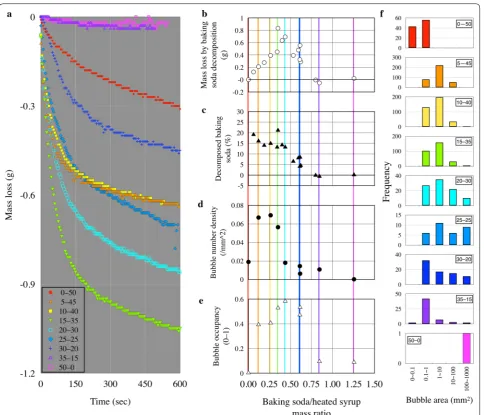
In the experiments, we found a peak in the final mass loss for the substrate with 15 g of baking soda and 35 g of cake syrup (Fig. 1b). Hereafter, the proportion of baking soda and syrup is shown (e.g., 15–35 substrate). Figure 1a shows the mass change of the system dur-ing experiments. The mass rapidly decreased in the first 100 s for 5–45, 10–40, 15–35, 20–30, and 25–25 sub-strates. We observed small mass loss (0.31 g) for the 0–50 substrate. We regarded this mass change as being due to the generation and release of water vapor by an interaction of poured heated syrup and the water in the cake syrup. Assuming this, we obtained an efficiency of 0.31/50 = 0.0062 g per gram of poured syrup. Consid-ering this effect, we calculated mass loss caused by bak-ing soda decomposition (i.e., generation and release of
CO2 ). In our experimental setting, the maximum mass
loss was observed for the 15–35 substrate (0.83 g, Addi-tional file 1: Table S1). This nonlinear peak seems enig-matic because of the occurrence of increasing amount of the source material in more soda-rich substrates. For the 15–35 substrate, rapid mass loss was initially observed (Fig. 1a). The decomposed baking soda ratio (decom-posed baking soda mass calculated from generated CO2
/input baking soda mass) is high at low baking soda con-tent and low at high baking soda concon-tent (Fig. 1c).
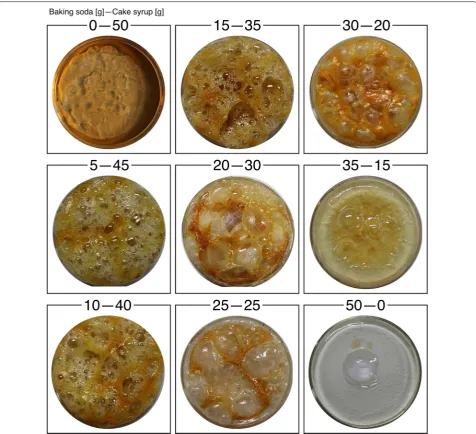
The surface of the solidified heated syrup is character-ized by a vesiculated structure (Fig. 2, Additional file 1: Figs. S3–S11). The circular structures are quenched remnants of CO2 bubbles on the surface. The bubble
size, total number of bubbles, and bubble number den-sity greatly vary with substrate composition (Fig. 1d, e). Bubble number density is relatively high for 5–45, 10–40, and 15–35 substrates. Bubble occupancy (bubble area/ area of petri dish) is relatively high for 15–35, 20–30, and 25–25 substrates. We found four patterns for the bubble characteristics: (1) Only a few microbubbles ( <1 mm2 )
were observed for the 0–50 substrate, (2) small bubbles ( 1∼10 mm2 ) were dominant for the 5–45, 10–40, and
15–35 substrates, (3) large bubbles ( 10∼1000 mm2 )
space were found. They are vents through which CO2 gas
continuously escaped.
The load and flame structure of the heated syrup and the substrate after the experiment (e.g., Fig. 3) suggests that the heated syrup sank into the substrate during the experiments. Such a load and flame structure of a viscous fluid is associated with Rayleigh–Taylor instability (RTI). RTI refers to the instability of the interface between two fluids with different densities, which occurs when a heavy fluid superposes a lighter fluid in a gravitational field (Ray-leigh 1882; Taylor 1950). The density of the heated syrup (upper layer) was higher than that of the substrate in the
experiments with 0 to 15 g baking soda content ( 1.47 g/cm3 for the heated syrup, 1.35 to 1.44 g/cm3 for the substrate,
as shown in Additional file 1: Table S2). In addition, extra experiments (Additional file 1: Figs. S12, S13) confirmed that RTI could occur under the conditions of our main experiments. (Detailed information on the extra experi-ments is shown in the supplementary materials.)
Discussion and implications
The nonlinear dependence of CO2 emission on the baking
soda concentration is similar to the trend in of Wohletz and Sheridan (1983). The reason why the maximum emission Fig. 1 Experimental results. a Mass changes of the system during experiments. Relationship between the mass ratio of baking soda/poured heated
syrup and b mass losses caused by baking soda decomposition, c percentage of decomposed baking soda, d bubble number density, and e
bubble occupancy in a petri dish. f Bubble size and number for each substrate composition. Colors correspond to substrate composition, as shown
occurs at an intermediate value of the baking soda concen-tration is important for understanding the nonlinear rela-tionship of explosion intensity in rootless eruptions. Based on the observation of RTI, we hypothesize that the heated syrup sinks into the substrate and warms the substrate, inducing a thermal decomposition reaction. In this hypoth-esis, two timescales are relevant; the cooling timescale, τcool and the sinking timescale, τsink . The cooling timescale, τcool is given as follows:
(2)
τcool∼
a2
δ ,
where a and δ are the thickness and thermal diffusivity of
the substrate, respectively. Using δ∼10−7m2/s (Kuma-gai et al. 2007, and references therein; we used the ther-mal diffusivity of syrup in place of that of the substrate), τcool is estimated as ∼103 s. The timescale can be shorter because the masses of the heated syrup and substrate were comparable in the experiments. The sinking time-scale, τsink , is estimated from the growth rate of RTI. The disturbance of height between two fluids, w(t), increases exponentially as w(t)=w0et/τ from the initial distur-bance, w0 . In two-dimensional case, the wavelength, , and the growth rate, τ , of the dominant disturbance of Fig. 2 Final surface morphology for each substrate composition. Detailed photographs are shown in Additional file 1: Figs. S3–S11 in the
RTI in fluids with the same thickness (a) and the same viscosity ( η ) are given by Turcotte and Schubert (2002):
and
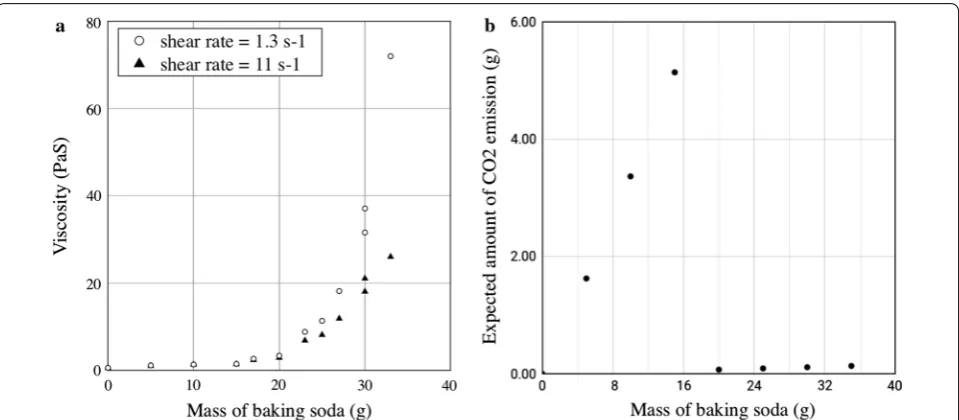
Figure 4a shows the results of viscosity measurements of the substrate, which is a two-phase suspension mix-ture of cake syrup (liquid) and baking soda. The viscosity measurements were taken at constant shear rates ( 1.3 s−1
and 11 s−1 ) using a cone-plate-type rheometer (Boh-lin CVO, Malvern Instruments) at 25◦C . The viscosity gradually increases with the mass (i.e., concentration) of the baking soda for masses up to 15 g and then greatly increases for masses above 20 g (Fig. 4a). Although the growth rate of the disturbance by RTI ( τ ) varies with bak-ing soda concentration, all growth rates are on the order of 1 s and sufficiently smaller than the cooling rate ( τcool ; Additional file 1: Table S2).
During the sinking of the heated syrup, the surround-ing substrate is heated, inducsurround-ing a thermal decomposi-tion reacdecomposi-tion. The amount of reacdecomposi-tion products should scale with the volume of the heated region and the con-centration of baking soda. The total amount of reaction products (Q) is given as follows:
(3) =2.568a
(4)
τ = 13.04η
(ρsyrup−ρsubstrate)ga.
where V is the heated volume in the substrate and Csoda is the concentration of baking soda (i.e., the mass of bak-ing soda per unit volume in the substrate). Because we observed that the poured heated syrup sparsely reached the bottom of the petri dish, it is assumed that the vol-ume of the substrate has been completely heated and can be used for the heated volume V in this model. Figure 4b compares the amount of CO2 emission
esti-mated from the model with that measured in the experi-ments as a function of baking soda mass. Note that the amount of CO2 was calculated as (Q/84/2)×44 , where
84 and 44 are the molecular weights of baking soda and
CO2 , respectively, and 2 is the amount (mol) of
decom-posed NaHCO3 . Both the estimated (Fig. 4b) and meas-ured (Fig. 1b) amounts of CO2 emission have a peak at
a baking soda mass of around 15 g. When the density of the substrate is lower than that of the poured heated syrup (i.e., the mass of baking soda is less than 15 g), RTI enhances the decomposition of the baking soda in the substrate. On the other hand, RTI barely occurs when the mass of baking soda is higher than 15 g. The peak of Q thus arises from the balance between the concentration of baking soda and the presence of RTI.
The key aspect for understanding the successive rootless eruptions in our analog experiments is the density difference between the upper layer and the (5) Q=V×Csoda
substrate that leads to RTI. Such a density difference, where the upper layer density is higher than the sub-strates density, is plausible in the case of lava flow over lacustrine sediments. The density of Younger Laxá lava in Iceland, which produced many rootless cones, is 1.49∼2.21 g/cm3 (Noguchi et al. 2016). The
wet bulk density of lacustrine sediments under the lava flow has not been determined, but one example (in West Lake, Hangzhou, China; Yang et al. (2018)) is about 0.95∼1.1 g/cm3 . Lava flow over lacustrine
sedi-ment could thus be gravitationally unstable. Adopt-ing a lacustrine sediment viscosity of 103 Pa s (Yang et al. 2018) and a lava flow thickness of 20 m (17 m in Höskuldsson et al. 2010), the characteristic time of RTI is order of 10−1s . The cooling rate of the lava flow is
on the order of 108 s based on a thermal diffusivity of 5×10⁻⁷m2/s (Gregg and Christle (2013), and
refer-ences therein). Since the characteristic time of RTI is significantly shorter than the estimated cooling time, explosive interactions between lava and lacustrine sediments might be enhanced by the instability of the interfacial area due to the density variation, even in a natural system. To evaluate this further, detailed obser-vation of natural rootless vents, which possibly stopped an explosion in a very early phase (Additional file 1: Fig. S14), could give hints.
In previous studies, the controlling factors of rootless eruptions have been regarded be (1) the mass ratio of water and magma, (2) the interfacial geometry between magma and substrates, (3) the injection rate of magma into substrates, and (4) the interpenetration degree
between magma and water (Fagents and Thordarson
2007, and references therein). Our calculation model and experimental results are consistent with these factors.
The viscous behavior of the substrate correlates with observed bubble size in our experiment. The cases where small bubbles are dominant (0–50, 5–45, 10–40, and 15–35 substrates) mostly correspond to the low-viscosity phase of the substrate. A low viscosity of a substrate (i.e., a short τsink ) indicates a large contact area between the heated syrup and the substrate. CO2 gas is emitted
suc-cessively at the interface and released as small bubbles. On the other hand, the cases where large bubbles appear (20–30, 25–25, 30–20, and 50–0 substrates) roughly cor-respond to the regime in which RTI could not occur. A lack of RTI indicates a small contact area between the heated syrup and substrate. In this case, the amount of
CO2 gas emission is small. The highly viscous substrate
also indicates shear thinning features (Fig. 4a). Under this condition, the first large bubble, which can form a stable vent, pulls surrounding bubbles. With further verification of the relationship between viscosity and bubble charac-teristics, including the spatial distribution, we can obtain useful information about the substrate conditions.
Based on consideration of the RTI, two parameters of the substrate, namely layer thickness and viscosity, are correlated with the characteristics of rootless cones, such as geomorphology and geospatial distribution. When lava flows onto thick substrates, it sinks for a longer time compared to that for thin substrates. This can be reflected by the ejected volume (i.e., the edifice size of Fig. 4 a Rheological characteristics of substrates with various compositions. b Expected amount of CO2 emission calculated from viscosity (shear rate: 1.3 s −1
rootless cones). Since the interaction efficiency is thought to correlate with the increasing rate of the interfacial area between lava and the substrate by RTI, the explo-sion intensity might be related to substrate viscosity. At a certain substrate viscosity, the interaction efficiency is maximized and the explosion intensity is strongest. In this condition, pyroclastic flows and ballistic ejections of pyroclasts are expected. At other substrate viscosi-ties, the interaction efficiency is weaker, and spatters are expected as the products of the explosion. These differ-ences between products may be reflected by the slope angle of the edifice (Noguchi et al. 2016). For a uniform grain size, the substrate viscosity can be correlated with water content. If the water content is high (i.e., lower substrate viscosity), since the wavelength of RTI is short, the geospatial density of rootless cones is expected to be dense. In the case of low water content (i.e., higher sub-strate viscosity), the geospatial density of rootless cones is expected to be sparse due to the longer wavelength of RTI. Therefore, substrate thickness and viscosity are expected to correlate with the edifice size, slope angle, and geospatial density of rootless cones. Although these correlations can also be affected by lava thickness and the competition of water with neighbor explosion points during eruptions (Hamilton et al. 2010b), we expect that with further verification using analog experiments and field observations, it may be possible to infer substrate properties from remote sensing geomorphology data (Additional files 2, 3, 4 and 5).
Conclusion
We demonstrated that the complication of the interface morphology between a molten hot ceiling and a loose wet substrate triggers and enhances rootless eruption in laboratory experiments using kitchen materials. In our experiments, the thermal decomposition reaction of bak-ing soda was applied to create rootless eruptions. The maximum reaction efficiency was produced for a particu-lar substrate composition (15 g of baking soda and 35 g of cake syrup). The nonlinear relationship between reac-tion efficiency and baking soda/poured heated syrup pro-portion resembles that found from a magma–water ratio diagram of Wohletz and Sheridan (1983) and subsequent studies. The rheological behavior of the poured heated syrup and the substrate indicates that the interaction sur-face between the poured heated syrup and the substrate affects reaction efficiency. Considering RTI in a natural setting, our study suggests that water availability and the rheological properties of the surface material affect the occurrence and stability of hydrovolcanic eruptions.
Additional files
Additional file 1. Supplementary material included figures and tables which appeared in the main text. Figure S1: The experimental system in this study. Figure S2: Package information of the products used in the experiment. Figure S3—S11: Detailed final surface morphology for each substrate composition. Figure S12: The experimental system in an extra experiment for the Rayleigh-Taylor instability verification. Figure S13: Sinking of poured heated syrup (red) on the baking soda and cake syrup mixture substrate (green) in each substrate proportion. The proportion of baking soda and syrup is shown as, e.g., 15–35. Yellow dash lines show interfacial boundaries between the poured syrup and the substrate. Since this system is larger than that on the petri dish, we used three times of materials. The white bar indicates the length of 1 cm. Figure S14: An example of hole on the lava (Kahuku basalt) which can be found near Ka Lae, Hawaii. The diameter and depth of the hole are 3.5 m and 1.4 m, respectively. There is no ejecta around the hole. Inside the hole, blocks which are thought to be formed by the collapse of the rim exist. The wall surface has two layers: lower shingle roof-like lava and upper well-vesiculated lava.
Additional file 2. A fast-forward movie for an extra experiment to examine whether RTI occurs in the condition of the main experiment in the case of 45–105 of substrate condition which is same as 15–35 of the SC condition.
Additional file 3. A fast-forward movie for an extra experiment to examine whether RTI occurs in the condition of the main experiment in the case of 75–75 of substrate condition which is same as 25–25 of the SC condition.
Additional file 4. A fast-forward movie for an extra experiment to examine whether RTI occurs in the condition of the main experiment in the case of 105–45 of substrate condition which is same as 35–15 of the SC condition.
Additional file 5. Mass loss change log, summary of experimental results, and shear rate measurement for the baking soda and cake syrup mixture substrate (Excel sheets).
Authors’ contributions
All authors participated in the experiments, calculations, and discussions. RN designed the experiment protocol. KK measured the rheological properties. All authors read and approved the final manuscript.
Author details
1 Volcanic Fluid Research Center, School of Science, Tokyo Institute of Tech-nology, Tokyo, Japan. 2 Present Address: Institute of Space and Astronautical Science, Japan Aerospace Exploration Agency, Tokyo, Japan. 3 Central Research Institute of Electric Power Industry, Tokyo, Japan. 4 Earthquake Research Insti-tute, The University of Tokyo, Tokyo, Japan.
Acknowledgements
Discussions with the participants of a meeting called “Kitchen Earth Science,” which was supported by the Earthquake Research Institute The University of Tokyo Joint Usage/Research Program, stimulated our research. We wish to thank Dr. Hiroki Ichikawa for his constructive comments and sugges-tions, which greatly improved the manuscript. We appreciate Dr. Ronaldo Ballouz and Dr. Lucie Riu for their generous effort in editing the English of this manuscript. We would also like to thank editor Kazutaka Mannen and two anonymous reviewers for their encouragements and constructive comments during the review process.
Competing interests
Availability of data and materials
Supplementary materials are available at: https ://www.resea rchga te.net/publi catio n/32705 1330_Suppl ement ary_mater ials_for_Exper iment al_appro ach_ for_rootl ess_erupt ions_using _kitch en_mater ials (https ://doi.org/10.13140 / RG.2.2.15714 .79048 ).
Funding
RN was supported by the Japan Society for the Promotion of Science (JSPS) Core-to-Core Program “International Network of Planetary Sciences” and JSPS 17H06459.
Publisher’s Note
Springer Nature remains neutral with regard to jurisdictional claims in pub-lished maps and institutional affiliations.
Received: 10 April 2018 Accepted: 10 December 2018
References
Andronico D, Cappelli L, Ciancitto F, Cioni R, Cristaldi A, Corsaro RA (2018) The 16 March 2017 phreatomagmatic explosion at Mt Etna, Italy. In: Corsaro RA., Di Giuseppe MG, Isaia R, Mormone A, Nave R (eds.) Millenia of strati-fication between human life and volcanoes: strategies for coexistence— COV 10 abstracts volume, vol 43. Misc. INGV, pp 1–1300
Department of Land and Natural Resources (2018) 07/16/18 Ocean lava explo-sion injures 23 passengers on tour boat; state and federal investigation underway. In: Blog of DLNR. https ://dlnr.hawai i.gov/blog/2018/07/16/ nr18-140/. Accessed 21 Sept 2018
Fagents SA, Thordarson T (2007) Rootless volcanic cones in Iceland and on Mars. In: Chapman M (ed) The geology of Mars. Cambridge University Press, Cambridge, pp 151–177
Fitch EP, Fagents SA, Thordarson T, Hamilton CW (2017) Fragmentation mechanisms associated with explosive lava-water interactions in a lacustrine environment. Bull Volcanol 79:12. https ://doi.org/10.1007/ s0044 5-016-1087-3
Greeley R, Fagents SA (2001) Icelandic pseudocraters as analogs to some volcanic cones on Mars. J Geophys Res 106(E9):20527–20546. https ://doi. org/10.1029/2000J E0013 78
Gregg TK, Christle KW (2013) Non-explosive lava–water interaction in Skaelingar, Iceland and the formation of subaerial lava pillars. J Volcanol Geotherm Res 264:36–48
Hamilton CW, Thordarson T, Fagents SA (2010a) Explosive lava–water interac-tions I: architecture and emplacement chronology of volcanic rootless cone groups in the 1783–1784 Laki lava flow, Iceland. Bull Volcanol 72:449–467. https ://doi.org/10.1007/s0044 5-009-0330-6
Hamilton CW, Fagents SA, Thordarson T (2010b) Explosive lava–water interac-tions II: self-organization processes among volcanic rootless eruption sites in the 1783–1784 Laki lava flow, Iceland. Bull Volcanol 72:469–85. https ://doi.org/10.1007/s0044 5-009-0331-5
Hamilton CW, Fitch EP, Fagents SA, Thordarson T (2017) Rootless tephra stratigraphy and emplacement processes. Bull Volcanol 79:11. https ://doi. org/10.1007/s0044 5-016-1086-4
Höskuldsson Á, Dyhr C, Dolvik T (2010) Grænavatnsbruni og Laxárhraun yngra. Haustrá dstefna Jardfrædafélags Íslands, Ágrip erinda, pp. 41–44 (in Icelandic)
Kienle J, Kyle PR, Self S, Motyka RJ, Lorenz V (1980) Ukinrek Maars, Alaska, I. April 1977 eruption sequence, petrology and tectonic setting. J Volcanol Geotherm Res 7(1–2):11–37
Kumagai I, Davaille A, Kurita K (2007) On the fate of thermally buoyant mantle plumes at density interfaces. Earth Planet Sci Lett 254(1–2):180–193 Mattox TN, Mangan MT (1997) Littoral hydrovolcanic explosions: a case study
of lava–seawater interaction at Kilauea Volcano. J Volcanol Geotherm Res 75:1–17
Noguchi R, Höskuldsson Á, Kurita K (2016) Detailed topographical, distri-butional, and material analyses of rootless cones in Myvatn, Iceland. J Volcanol Geotherm Res 318:89–102
Rayleigh L (1882) Investigations of the character of the equilibrium of an incompressible heavy fluid of variable density. Proc Lond Math Soc s1–14:170–177. https ://doi.org/10.1112/plms/s1-14.1.170
Reynolds P, Brown RJ, Thordarson T, Llewellin EW, Fielding K (2015) Rootless cone eruption processes informed by dissected tephra deposits and conduits. Bull Volcanol 77(9):1–17
Sheridan MF, Wohletz KH (1983) Hydrovolcanism: basic considerations and review. J Volcanol Geotherm Res 17(1):1–29
Taylor GI (1950) The instability of liquid surfaces when accelerated in a direction perpendicular to their planes. I. Proc R Soc Lond A 201(1065):192–196
Thorarinsson S (1953) The crater groups in Iceland. Bull Volcanologique 2:1–44 Thordarson T, Höskuldsson Á (2002) Iceland. Terra Publishing, Edinburgh, p 200 Thorkelsson B, Karlsdóttir S, Gylfason ÁG, Höskuldsson Á, Brandsdóttir B,
Ilyin-skaya E, Gudmundsson MT, Högnadóttir T (2012) The 2010 Eyjafjallajökull Eruption, Iceland. Report to ICAO-June 2012
Todesco M (2017) The leap in the dark: geological thoughts about an unpredictable planet. J Geophys Res 122:2780–2783. https ://doi. org/10.1002/2017J B0142 74
Turcotte DL, Schubert G (2002) Geodynamics. Cambridge University Press, New York, p 456
U.S. Geological Survey (2018) Hawaiian volcano observatory status report: Kilauea volcano Monday, July 16, 2018, 9:31 AM HST (Monday, July 16, 2018, 19:31 UTC). In: Volcano hazards program. https ://volca noes.usgs. gov/vhp/archi ve_searc h.html. Accessed 20 Jul 2018
White JD, Valentine GA (2016) Magmatic versus phreatomagmatic fragmen-tation: absence of evidence is not evidence of absence. Geosphere 12(5):1478–1488
Wohletz KH (2002) Water/magma interaction: some theory and experiments on peperite formation. J Volcanol Geotherm Res 114:19–35
Wohletz KH, Sheridan MF (1983) Hydrovolcanic explosions; II, evolution of basaltic tuff rings and tuff cones. Am J Sci 283(5):385–413
Wood CA (1979) Monogenetic volcanoes of the terrestrial planets. In: Proceed-ings of lunar and planetnetary science conference, 10th, pp 2815–2840 Yamamoto T, Soya T, Suto S, Uto K, Takada A, Sakaguchi K, Ono K (1991) The
1989 submarine eruption off eastern Izu Peninsula, Japan: ejecta and eruption mechanisms. Bull Volcanol 53(4):301–308
Yang W, Yu M, Yu G (2018) Stratification and rheological properties of near-bed cohesive sediments in West Lake, Hangzhou, China. J Coastal Res 34(1):185–192