AUDIO SPOTLIGHT
Ayushi Kaushik
1, Jyoti Pandey
2, Neha tomar
31, 2, 3
UG, Department Of Electronics And Communication Engineering
Raj Kumar Goel Institute Of Technology For Women, Ghaziabad, (India)
ABSTRACT
Audio spotlight is a very current technology that creates focused beam of sound similar to light beams coming
out of a flash light. By shining sound to one site, particular listeners can be targeted with sound without others
nearby hearing it. It uses an arrangement of non-linear acoustics and some fancy mathematics. But it is factual
and is fine to knock and socks of any conventional loud speaker. This acoustic device comprise a speaker that
fires out of earshot ultrasound pulses with very small wavelength which act in a manner very similar to that of
a narrow column. The ultrasound beam acts as an airborne speaker and as the beam moves through the air
gradual distortion takes place in an expected way due to the property of non-linearity of air. This results in
audible components that can be precisely controlled and accurately predicted. Audio Spotlight is made up of an
amplifier, a sound processor and the transducer.
I INTRODUCTION
The targeted or directed audio technology is going to a huge commercial market in entertainment and consumer
electronics and technology developers are scrambling to tap into the market. Being the most recent and drastic
change in the way we perceive sound since the invention of coil loud speaker, audio spotlight technology can do
many miracles in various fields like private messaging system, home theaters etc. Thus audio spotlighting helps
us to control where sound comes from and where it goes!
II BRIEF HISTORY OF NAVIGATION SYSTEM
The technique of using a nonlinear interaction of high- frequency waves to generate low-frequency waves was
originally pioneered by researchers developing under water sonar technique dating back to 1960’s. These early
acoustics researchers had successfully derived the formal mathematical basis for this effect and developed the
innovative sonar systems with more directivity and bandwidth than would otherwise be available to develop.
This device was named a parametric array.
In 1975, the first publication appeared which demonstrated that these nonlinear effects indeed occur in air.
While these researchers had not attempted to reproduce audio, also they nonetheless proved that such a device
can be possible.
Over the next two decades, several large companies, including Matsushita (Panasonic), NC Denon, and Rioch
attempted to develop a loudspeaker based on this principle. A paper describing one attempt was published in
extremely high levels of distortion (>50% THD) and feasibility which caused the almost total abandonment of
the technology by the end of the 1980’s
.
III THEORY
About half-dozen usually used speaker types are in general use today. They range from piezoelectric tweeters
which recreate the high end of audio spectrum, to various kinds of mid-range of speakers and woofers that
produces the lower frequencies. Even the sophisticated hi-fi speakers have a difficult time in producing clean
bas, and generally rely on a large woofer/ enclosure combination to assist in the task. Weather they are
electrostatic, dynamic, or some other transducer-based design, all the loudspeakers today have one thing in
common: they are direct radiating—that is, they are fundamentally piston-like device designed to directly pump
air molecules into the motion to create the audible sound waves that we hear. The audible portions of sound tend
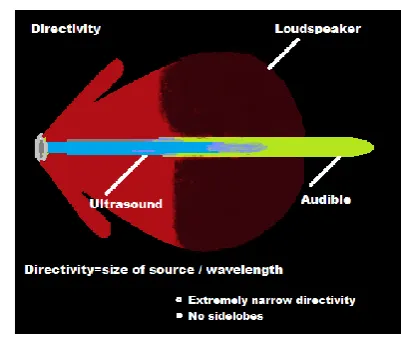
to spread out in all the directions from the point of origin. They do not travel as narrow beams this is why you
don’t need to be right in front of a radio to hear music. In fact, beam angle of audible sound is very wide, just
about 60 degrees. This effectively means the sound that you hear will be propagated through air equally in all
directions
Fig 1: Audiospotlight Create Focused Beam Of Sound Unlike Conventional Loudspeaker
In order to focus sound into narrow beam, you need to maintain a low beam angle that is dictated by
wavelength. The smaller is the wavelength, the less is the beam angle, and hence, the more focused is the sound.
Unfortunately, most of the human audible sound is a mixture of signals with varying wavelengths that is
between 2 centimeters to 17 meters (the human hearing ranges from a frequency of 20Hz to 20,000 Hz). Hence,
except for very low wavelengths, just about entire audible spectrum tends to spread out at 360 degrees. To
create narrow sound beam, the aperture size of the source also matters a large loud speaker will focus sound
over the smaller areas. If the source loudspeaker can be made several times larger than the wavelength of the
sound transmitted, then the finely focused beam can be created. The problem here is that this not a very practical
solution. To ensure that the shortest audible wavelength is focused into a beam, loudspeaker about 10 meters
across is required, and to guarantee that the entire audible wavelength is focused, even bigger loudspeakers are
needed.Audio spotlight seems like a disc-shaped loudspeaker, trailing a wire, with the small laser guide-beam
chosen to play for you perhaps jazz from a CD. But he turns the disc away; the sound fades almost to nothing. It
is different from a conventional speaker, whose orientation makes very lessdifference.
IV TECHNOLOGY OVERVIEW
The hypersonic sound technology and audio spotlight, uses ultrasonic energy to create extremely narrow beams
of sound which behaves like beams of light. Ultrasonic sound is the sound that has very small wavelength in the
millimeter range and you can’t hear ultrasound since it lies beyond the threshold of human.
Components and Specification
Audio Spotlight consists of three major components: A thin circular transducer array, an amplifier and A signal
processor. The light weight, non-magnetic transducer is about 0.5 inches (1.27 cm) thick, and it typically has an
active area one foot (30.48 cm) in diameter. It can project a three-degree white beam of sound betters audible
even at distances over 100 meters (328 feet). The amplifier and signal processor are integrated into a system
about the size of a traditional audio amplifier, and they use almost the same amount of power
V WHAT IS AUDIO SPOTLIGHTING
Audio spotlighting is a very recent technology that creates focused beams of sound similar to light beams
coming out of a flashlight. By shining a sound to one location, specific listeners can be targated with sound
without others nearby hearing it that is to focus sound into a coherent and highly directional beam. It uses a
combination of non-linear acoustic and mathematics. But this is real and is fine to knock the socks of any
conventional loud speaker.
The Audio Spotlight & Hyper Sonic Sound Technology (developed by American Technology Corporation),
uses ultrasonic energy for creating extremely narrows beams of sound which behave like beams of light. Audio
spotlighting destroys the property of non-linearity of air. When an inaudible ultrasound pulses are fired into the
air, it spontaneously converts the inaudible ultrasound into the audible sound tones, and hence proved that as
with water, sound propagation in air is as non-linear, and can be calculated and predicted mathematically. A
device well known as a parametric array employs the non-linearity of the air to create audible by-products from
inaudible ultrasound, resulting in extremely beamlike, directive wide-band acoustical source. This source may
be projected about an area much like the spotlight, and creates an actual spatialised sound distant from the
transducer. The ultrasound column acts as an airborne speaker and an area much like a spotlight, and creates an
actual spatialized sound distant from the transducer. The ultrasound column acts as an airborne speaker, and
when the beam moves through the air, then gradual distortion takes place in a predictable way. This gives rise to
an audible component that can be accurately predicted and precisely controlled.
VI NON LINEARITY OF AIR
Audio spotlighting exploits and destroys the property of non-linearity of air. When inaudible ultrasound pulses
proved that as like water, sound propagation in air is non-linear, and it can be calculated mathematically. A
device known as parametric array employs the non- linearity of the air to create audible by-products from
inaudible ultrasound, which results in an extremely directive, beamlike wide-band acoustical source. This source
can be projected about an area much like an audio spotlight, and creates an actual spatialized sound distant from
the transducer. The ultrasound column acts as an airborne speaker, and when the beam moves through the air,
gradual distortion takes place in a predictable way. This gives rise to audible components which can be
accurately predicted and precisely controlled. However, the problem with the firing off ultrasound pulses and
having them interference to produce audible tones is that the audible components created are nowhere similar to
the complex signals in speech and music. Human speech, as well as music, contains multiple varying frequency
signals, which interfere to produce distortion and sound. To generate such sound out of pure ultrasound tones is
not an easy job. This is when teamsof researchers from Ricoh and other Japanese companies got together
to
come up with the idea of using pure ultrasound signals as a carrier wave, and superimposing the audible speech
and music signals on it to create a hybrid wave. If the range of the human hearing is expressed as a percentage
of shifts from the lowest audible frequency to the highest, it spans a range of 100,000%. Also no single
loudspeaker element can operate efficiently or uniformly over this range of frequencies. In order to deal with
this speaker manufacturers carve the audio spectrum into smaller sections. This requires multiple transducers
and crossovers to create a ‘higher fidelity’ system with current technology.
Fig 2: Showing the Difference in Modulating Audible Frequencies with Ultrasonic Carrier
(Airborne ultrasounds of 28 kHz are envelope-modulated with audio signals. Inherent non-linearity of the air
works as demodulator. Thus the demodulated sounds impinge on our eardrums. We can hear this sound! )
Using a technique of multiplying audible frequencies upwards and superimposing them on a “carriers” of say,
200,000 cycles the required frequency shift for a transducer would be only 10%. Building a transducer that only
needs to produce waves uniformly over only a 10% frequency range.
This is similar to the idea of amplitude modulation (AM), a technique used to broadcast commercial radio
stations signals over a wide area. The speech and music signals are mixed with the pure ultrasound carrier wave,
and then the resultant hybrid wave is broadcast. As the resultant wave moves through the air, it creates complex
distortions which give rise to two new frequency sets, one slightly lower than the hybrid wave. Berktay’s
moves through the components, as the equation says. One is identical to the original sound wave, and the other
is a badly distorted component. This is where the problem lies the volume of the original sound wave becomes
proportional to that of the ultrasounds, while the volume of the signals distorted component is exponential. So, a
slight increase in the volume drowns out the original sound wave as the distorted signal becomes predominant.
It was at this point and stage that all research on ultrasound as a carrier wave for an audio spotlight got bogged
down in the 1980s.
Focusing on the signals distorted component, since the behavior of signal components is mathematically
predictable, the technique to create the audio beam is simple; modulate the amplitude to get the hybrid wave,
next is to calculate what the Backstay’s Equation does to this signal, and do the exact opposite of this. In other
words, to distort it, before Mother Nature does it. Finally, pass this wave through the air, and now what you get
is the original sound wave component whose volume, at this time, is exponentially related to the volume of the
ultrasound beam, and to a distorted component, whose volume now directly varies as the ultrasound wave. By
creating the complex ultrasound waveform (using a parametric array of ultrasound sources), so many different
sources of sound can be created. If their phases are controlled carefully, then these interfere constructively and
destructively laterally in the forward direction, and resulting in a collimated sound beam or audio spotlight.
Today, the transducers which are required to produce these beams are just half an inch and lightweight, and the
system which is required to drive it has similar power requirements to conventional amplifier technology.
Fig 3: Computer Simulation Of Sound Propogation: Complex Sets Of High Intensity
Ultrasound Signaintermodulatier, Among Their Product Is Collimated Audiospotlight
VII
DIRECT AUDIO AND PROJECTED AUDIO
There are two ways to use Audio Spotlight. Firstly, it can be directed at a specific target, creating a contained
area of listening space which is called Direct Audio. Secondly, it can bounces off object, creating an audio
image. This audio image gives the illusion of a loudspeaker, which the listener perceives as the source of the
sound, which is called the projected Audio. This is similar to the way light bounces off of objects. In case, the
Fig 4: Direct Audio and Projected Audio
Hyper Sonic Sound technology provides linear frequency response with virtually none of the forms of distortion
associated with conventional speakers. Physical size no longer defines the fidelity. The faithful reproduction of
the sounds is freed from bulky enclosures. There are no, woofer, tweeters, crossovers, or bulky enclosures. Thus
this helps to visualize the traditional loudspeaker as a light bulb, and HSS technology as spotlight, that is you
can direct the ultrasound emitter toward the hard surface, the wall for instance, and the listener perceives the
sound as coming from the spot on the wall. The listener does not perceive the sound as emanating from the face
of the transducer, but only from the reflection off the wall. Contouring the face of HSS ultrasonic emitter can
tightly control Dispersion of the audio wave front. For example, a very narrow wave system might require a
border wave front to envelop multiple listeners
.
Fig 5: Conventional Loudspeaker And Ultrasonic Emitter
VIII CONCLUSION
Loudspeaker sources of a variety of configurations are used to demonstrate that even in ideal circumstances,
directivity and localization of sound is extremely limited. Degree of phasing, focusing, or other manipulation
The Holosonic technique for sound generation in the Audio Spotlight is a fundamentally different way of
creating sound, and is not limited by the barriers facing acoustics stated above. This is because the source of
sound from an Audio Spotlight is not the physical loudspeaker panel – it is the volume of air in front of it. This
makes the actual sound source to be far larger than the physical loudspeaker seen – it just happens to be
invisible, and made from ultrasound. This enables the Audio Spotlight to fundamentally provide far more
directivity and isolation which is more than any kind of loudspeaker.
“Being the most radical technological development in acoustics since the coil loudspeaker was invented in 1925... The audio spotlight will force people to rethink their relationship with sound...”
-Newyork Times “NOVEMBER 2006”
So we can conclude- Audio Spotlighting really put sound where you want it and will be “A REAL BOON TO
THE FUTURE”.
IX APPLICATIONS OF AUDIO SPOTLIGHTING -TOWARDS THE FUTURE
"So you can control where your sound comes from and where it goes," says Joe Pompei, the inventor of Audio
Spotlight. , Pompei was awarded a Top Young Innovator award from Technology Review Magazine for his
achievements.
The targeted or directed audio technology is going to capture a huge commercial market in entertainment and in
consumer electronics, and the technology developers are scrambling to tap into that market. Analysts claim that
this is possibly the most dramatic change in the way we perceive sound since the invention of the coil
loudspeaker. The technology that the Holosonics Research Labs and the American Technology Corporation are
lining up may seem to be a novelty of sorts, but there are a wide range of applications . Continuing to improve
on the commercial success of the Audio Spotlight sound system, Holosonics has announced that its
next-generation which is laser-like sound system, with improved performance with less cost, is now actively in
production. These new systems are being exhibited at the 2004 Consumer Electronics Show in Las Vegas
alongside MIT Media Lab technology.
The performance and reliability of the Audio Spotlight have made it the choice of the Smithsonian
Institution, Motorola, Kraft, and Cisco Systems etc.
Holosonics put in four individual Audio Spotlights into the Daimler Chrysler MAXXcab prototype
truck to let all the passengers enjoy their own choice of music. Boston Museum of Science - as well as
the United States military.
There is a huge market for personalized sound systems in entertainment and consumer electronics.
Holosonic Labs is working on another interesting application at the Boston Museum of Science that
allows the listeners to understand and hear explanations, without raising the ambient sound levels. The
idea is that museum exhibits can be discretely wired up with tiny speaker domes that can provide
explanations.
There are also other interesting applications that they are looking at, such as private messaging using
that could put up animated sound displays similar to today’s light shows. Holosonic has installed their Audio Spotlight system at Tokyo’s Sega Joyopolis theme park.
The US Navy has installed sound beaming technology on the deck of an Aegis-class Navy destroyer,
and is looking at this as a substitute to the radio operators headphones.
Sound bullets: Jack the sound level 50 times the human threshold of pain, and an offshoot of audio
spotlight technology becomes weapon which does not cause death of any person.
Military application: ship to ship communication.
Safety officials:It is used for communication with a specific person in a crowd of people.
REFERENCES
[1] F. Joseph Pompei, “The use of airborne ultrasonic's for generating audible sound beams”, Journal of the
audio engineering society, J. Acoust. Soc. Am., Vol. 73, No. 5, May 1983 Page 1532-1536.
[2] M.R.F. Kidner, C. Petersen, A.C Zander and C. H. Hansen.”Feasibility Study of Localized Active Noise
Control Using an Audio Spotlight and Virtual Sensor. Proceeding of ACOUSTICS 2006, November 22.
2006, Christchurch, New Zealand, Page- 55 -61.
[3] D. Thomas Kite, John T. Post, and Mark F. Hamilton. Parametric array in air: “Distortion reduction by preprocessing.” Journal of the Acoustical society of America. May 1998 Volume 103, Issue 5, pp.
2241-3096.
[4] P. J. Westervelt. Parametric acoustic array “,J. Acoust. Soc. Am., Vol. 73, No. 5, May 1983 Page
1532-1536”
[5] “ELECTRONICS FOR YOU” Vol. 40 January 2008