Available online: https://edupediapublications.org/journals/index.php/IJR/ P a g e | 299
Improvement of Strength of Concrete with Partial Replacement Of Course
Aggregate With Coconut Shell and Coir Fibres
1
S.Kalyani1, C.Manikanta Reddy2, B.Upendra Reddy3, (Project guide, Assistant Professor, Anurag Engineering College)
2
(HOD, Assistant Professor, Anurag Engineering College) 3
(Structural Engineering, Anurag Engineering College)
ABSTRACT
Coconut shell and coir fibres are the natural materials which is abundantly available in tropical regions. Wastes generated by industrial and agricultural processes have created disposal and management problems which pose serious challenges to efforts towards environmental conservation. A considerable amount of coconut shells and fibres remain in the environment as waste, so utilization of these materials for construction will be an important step to improve sustainability and eco-friendly construction. In addition to that it will help to produce light weight and economically profitable materials in construction field. The current study examined the suitability of partial replacing of coarse aggregate with coconut shell and coir fibres. To compare the above, test for compressive strength, splitting tensile strength, temperature resistance, water absorption, electrical resistance, chemical resistance, pH test of sample were performed. The specific gravity, bulk density and water absorption of coconut shell and fibres were analyzed. A study on the economic aspects was also carried out. The addition of fly ash helps to increase the strength and workability of concrete. The results obtained from above will be compared with conventional concrete of same mix.
Keywords: coconut shell, coir fibres, compressive strength, electrical resistivity, fly ash, pH, splitting tensile strength, temperature resistivity, water absorption.
INTRODUCTION General:
Concrete is the widely used first number of structural material in the world today. Infrastructure developed across the world created demand for different construction materials. Different waste materials and industrial by products such as fly ash, recycle aggregates, foundry sand, bottom ash, glass ware and coconut
shell were replaced with natural aggregate. In India demand of construction aggregate in 2010 was 2210 million metric tons.(in 2015 it will be expected as 3330 million metric tons and after 2020 it will be more than 5075 million metric tons.
The growing concern of resource depletion and global pollution has challenged many researchers to seek and develop new materials relying on renewable resources. These include the use of by-products and waste materials for building construction. Aggregates categorized under this section are those directly used without the need for processing.
The high cost of conventional building materials is a major factor affecting construction in India.
In developing countries where abundant
Available online: https://edupediapublications.org/journals/index.php/IJR/ P a g e | 300 Fig1.Coconut Shells
Coconut shell is one of the most important natural fillers produced in tropical countries like Malaysia, Indonesia, Thailand, andSri Lanka. Many works have been devoted to use of other natural fillers in composites in the recent past years and coconut shell filler is a potential candidate for the development of new composites because they have high strength and modulus properties along with the added advantage of high lignin content.
Figure 1 Coconut shell (left) and coconut fiber (right)
The chemical compositions of CS contains is 33.61% cellulose, 36.51% lignin, 29.27% pentosans and 0.61% ash. CS has low ash content but high volatile matter, 65-75%3. While CF has the lowest cellulose content, 36 - 43% but with twice amount of lignin (41- 45%) compared to
jute and sisal which makes it has greater resistance and hardness. CF will act as stabilizing additives when added into the asphalt mix around 180°C .
The characteristics and properties of coconut fiber are given Table 1.
CF has outstanding moisture absorption because the irregular of crack in the cross section surface provides unique structure. The unique structure also results in better air permeability and moisture conductivity. In addition, the unique structure of the CF will improve the moisture susceptibility, viscoelasticity and rutting resistance as well as ameliorate low temperature anti-cracking properties, durability, material toughness, fatigue life and lowering reflective cracking of asphalt concrete mixtures and pavements.
Coconut shell as coarse aggregate
The concrete obtained using Coconut Shell aggregates satisfies the minimum necessities of concrete. Coconut Shell concrete has superior workability because of the smooth surface on one side of the shells. The impact resistance of Coconut Shell concrete is high when compared with conventional concrete. Moisture retaining and water absorbing capacity of Coconut Shell are more compared to conventional aggregate. The amount of cement content may be more when Coconut Shell are used as an aggregate in the production of concrete compared to conventional aggregate concrete. The presence of sugar in the CS as long as it is not in a free sugar form, will not affect the setting and strength of concrete. It is found that wood based materials, being hard and of organic.
Present status of coconut shell:
Available online: https://edupediapublications.org/journals/index.php/IJR/ P a g e | 301 the world. Global production of coconut is 51
billion nuts from an area of 12 millionhectares. South East Asia is regarded as the origin of coconut. The four major players India, Indonesia, Philippines and Sri Lanka contribute 78% of the world production. According to FAO statistics (Food and Agriculture Organization) 2007, global production of coconuts was 61.5 MT with Indonesia, Philippines, India, Brazil and Sri Lanka as the major contributors to coconut production. The total world coconut area was estimated as approximately 12 million hectares and around 93 percent is found in the Asian and Pacific region. The average annual production of coconut was estimated to be 10 million metric tons of copra equivalents. Of the world production of coconut, more than 50 percent is processed into copra. While a small portion is converted into desiccated coconut 5 and other edible kernel products, the rest is consumed as fresh nuts.
Present use of coconut shell:
Coconut shells have good durability
characteristics, high toughness and abrasion resistant properties; it is suitable for long standing use. Coconut shells are mostly used as an ornament, making fancy items, house hold utensils, and as a source of activated carbon from its charcoal. The powdered shell is also used in the industries of plastics, glues, and abrasive materials and it is widely used for the manufacture of insect repellent in the form of mosquito coils and in agarbathis. The purpose of this research work is to develop a concrete with coconut shells as coarse aggregate. The whole entity could be called coconut shell aggregate concrete (CSAC). After the coconut is scraped out, the shell is usually discarded as waste as shown in Figure 1. The vast amount of this discarded coconut shells resource is as yet unutilized commercially; its use as a building material, especially in concrete, on the lines of other LWA is an interesting topic for study. The study of coconut shells will not only provide a new material for construction but will also help in the preservation of the environment in addition to improving the economy by providing new use for the coconut shells.
MATERIALS AND METHODOLOGY Description of Materials:
Coconut Shell
Coconuts are referred to as "man's most useful trees", "king of the tropical flora" and "tree of life". Global production of coconut is 51 billion nuts from an area of 12 million hectares. South East Asia is regarded as the origin of coconut. Although the lignin content is higher and the cellulose content is lower, coconut shells are similar in chemical composition to hard wood. Coconut shell has good durability characteristics, high toughness & abrasion resistant properties. Coconut shell which is crushed in appropriate sizes (Fig. 1) can be used in concrete. Literature study shows 10% replacement is optimum. Coir Fibres
Coconut fibres (Fig. 2) are extracted from the outer shell of a coconut. There are two types of coconut fibres, brown fibres extracted from matured coconuts and white fibres extracted tender coconuts. Brown fibres are thick, strong and have high abrasion resistance, which is used commonly.
There are many advantages of coconut fibreseg. They are moth-proof, fungi and rot resistant, provide excellent insulation against temperature & sound, not easily combustible, unaffected by moisture and dampness,tough, durable, resilient, springs back to shape even after constant use, totally static free and easy to clean. Coir fibres were added 3% by the weight of cement and in 5 cm length.
Fig 1: Crushed Coconut Shell Fig 2: Coir fibre Cement:
Ordinary Portland cement grade 53, conforming to I.S.12269-1987 was used. The physical property of cement is shown as per table 1.
Table – 1
Basic Result Of Ordinary Portland Cement (OPC)
TEST RESULT
Initial setting time 185 min
Final setting time 320 min
Available online: https://edupediapublications.org/journals/index.php/IJR/ P a g e | 302
Soundness 4.9 mm
Fineness (90 um sieve) 1.70%
Standard consistency 30.50%
Coarse Aggregate:
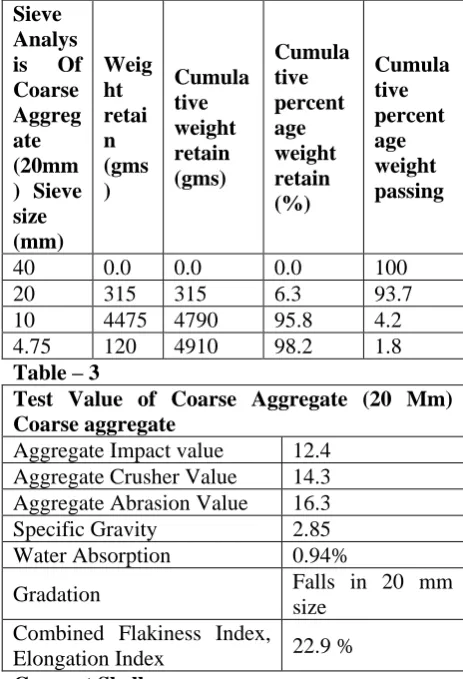
As coarse aggregate in concrete consist 35 to 70% of volume of the concrete.an aggregate with specific gravity more than 2.55 and absorption less than 1.5%.the physical properties of coarse aggregate is shown in table 2.
Sieve Analys is Of Coarse Aggreg ate (20mm ) Sieve size (mm)
Weig ht retai n (gms )
Cumula tive weight retain (gms)
Cumula tive percent age weight retain (%)
Cumula tive percent age weight passing
40 0.0 0.0 0.0 100
20 315 315 6.3 93.7
10 4475 4790 95.8 4.2
4.75 120 4910 98.2 1.8
Table – 3
Test Value of Coarse Aggregate (20 Mm) Coarse aggregate
Aggregate Impact value 12.4
Aggregate Crusher Value 14.3
Aggregate Abrasion Value 16.3
Specific Gravity 2.85
Water Absorption 0.94%
Gradation Falls in 20 mm
size Combined Flakiness Index,
Elongation Index 22.9 %
Coconut Shell:
In this work coconut shell was used as partial replacement of coarse aggregate which is crushed granite. Coconut shells were unruffled from the local temple after that it was cleaned, sun dried, removed fibers to evaluate its properties. Coconut shell needs no pre treatment, except for water absorption. Coconut shell has very high water absorption. Due to this property, before use coconut shells were soaked in potable water for 24 hours.
Table – 4
S.N. Physical property Test result
1. Maximum Size
(mm) 20
2. Fineness modulus 6.48
3. Specific Gravity 1.56
4. Bulk Density(kg/m3) 510-600
5. Water Absorption
(%) 23
6. Aggregate Crushing
Value (%) 2.49
7. Aggregate Impact
Value (%) 8.55
8. Moisture Content
(%) 4.2
9. Shell
Thickness(mm) 3-6
Coir Fiber: Table – 5
Physical Properties
Of Coir Fibre TEST RESULT
Sp. Gravity 0.74
Water absorption (%) 68.69
Fine Aggregate:
The fractions from 4.75 mm to 150 microns are termed as fine aggregate. Locally available natural river sand conforming to grading of IS: 383 1970 with specific gravity 2.77 was used as fine aggregate.
Table – 6.Sieve Analysis of Fine Aggregate.
Siev e size (mm )
Weig ht retai n (gms)
Cumulat ive weight retain (gms)
Cumulat ive percenta ge weight retain (%)
Cumulat ive percenta ge weight passing
10 0 0 0 100
4.75 118 118 5.9 94.10
2.36 68 186 9.3 90.7
1.18 296 364 24.10 75.9
600 micr on
332 694 40.70 59.3
300 micr on
874 1568 84.40 15.6
Available online: https://edupediapublications.org/journals/index.php/IJR/ P a g e | 303 micr
on
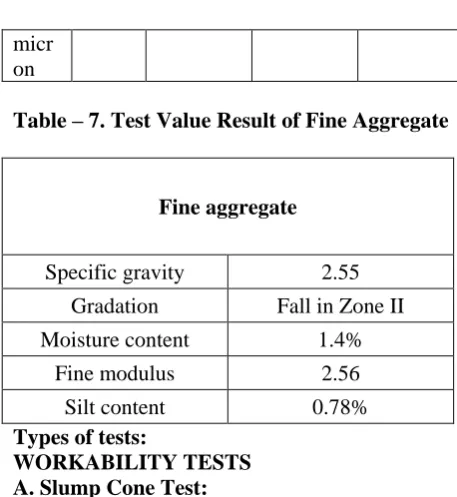
Table – 7. Test Value Result of Fine Aggregate
Fine aggregate
Specific gravity 2.55
Gradation Fall in Zone II
Moisture content 1.4%
Fine modulus 2.56
Silt content 0.78%
Types of tests:
WORKABILITY TESTS A. Slump Cone Test:
Slump test is the most commonly used method of measuring workability of concrete which can be employed either in laboratoryor at site of work. It is not a suitable method for very wet or very dry concrete. It does not measure all factors contributing toworkability, nor is it always representative of the placability of the concrete. However, it is used conveniently as a control test and gives an indication of the uniformity of concrete from batch to batch. Repeated batches of the same mix, brought to the sameslump, will have the same water content and water cement ratio; provided the weights of aggregate, cement and admixtures areuniform and aggregate grading is within acceptable limits. Additional information on workability and quality of concrete can beobtained by observing the manner in which concrete slumps. Quality of concrete can also be further assessed by giving a fewtamping or blows by tamping rod to the base plate.
TESTS FOR CONCRETE
A. Test for Compressive Strength of Concrete Cubes:
Compression test is the most common test conducted on hardened concrete, partly because it is an easy test to perform, andpartly because most of the desirable characteristic properties of concrete are qualitatively related to its compressive strength. Thecube specimen is the sizes 150x150x150 mm are used for compression test. These specimens are tested by compression
testingmachine after 7 days,14 days and 28 days curing. The compressive strength test on hardened concrete will be performed on a2000 KN capacity compression testing machine.
Compressive strength=maximum load/area = P/A
B. Test for Split Tensile of Concrete Cylinder:
The tensile strength is one of the basic and important properties of the concrete. The tensile strength test on hardened concrete is performed on a 400 KN capacity testing machine. Specimen of concrete cylinder is 150 mm diameter x 300 mm height. In the splitting tension test a 150 mm x 300 mm concrete cylinder is subjected to compression loads along two axial lines which are diametrically opposite. In these tests in general a compressive force is applied to a concrete specimen in such a way that the specimen fails due to tensile stresses developed in the specimen. Direct tension test of concrete are seldom carried out, mainly because the specimen holding devices introduce secondary stresses cannot be ignored.
Test for Flexural Strength of Concrete Beams: Flexural strength is one measure of the tensile strength of concrete. It is a measure of an unreinforced concrete beam or slab to resist failure in bending size of concrete beam specimen is 100 mm breadth x 100 mm depth x 500 mm length or 150 mm breadth x 150 mm depth x 700 mm length. The flexural strength is expressed as modulus of rupture in Mpa and is determined by standard test methods third point loading or centre point loading. In the central point loading, maximum fibre stress will come below the point where the bending moment is maximum. In case of symmetrical of loading two point loading, the critical crack may appear at any section, not strong enough to resist the stress within the middle third, where the bending moment is maximum.
Test for Durability of Concrete Cube:
Available online: https://edupediapublications.org/journals/index.php/IJR/ P a g e | 304 durability under one set of conditions does not
necessarily mean durability under another, it is customary to include a general reference to the environment when defining durability.
TESTING OF MATERIALS
Testing of concrete is done to determine the various properties of concrete when the coarse aggregate is partially replaced by coconut shell and coir. Material properties such as specific gravity, density and water absorption of coconut shell and coir fibres were tested as per IS: 2386 (part III) – 1963. Strength properties were analyzed by conducting compressive strength test as per IS: 516 - 1959 (reaffirmed 1999) and splitting tensile strength test as per IS: 5816 - 1999. Nature of concrete was determined by pH test using pH paper. Durability characteristics such as water absorption, chemical, temperature and electrical resistivity properties were investigated. Also density and feasibility study was conducted. The strength property of concrete having coir fibres and coconut shell was improved by the addition of fly ash as per IS: 3812 (part I) – 2003.
RESULTS AND DISCUSSIONS Bulk Density Test
The bulk density in compacted state is more as compared to the loose which shows that the bulk density greatly depends on the degree of compaction or how densely it is packed.
TABLE 1: Bulk Density of Coconut shell
DESCRIPTION Quantity
Volume of vessel (A) 1.5000 m3
Weight of empty vessel (B) 1.9835 kg
Weight of sample + vessel without
compaction (C) 2.7568 kg
Weight of sample + vessel with
compaction (D) 2.8969 kg
Bulk density of coconut shell, Loose = C-B/A = 515.53 kg/m3
Bulk density of coconut shell, Compacted= D-B/A = 608.93 kg/m3
Aggregates with bulk densities less than 1120 kg/m3 are called Lightweight. From experiment, the bulk density of coconut shell is
less than 1120 kg/m3, so that which helps to produce Light-Weight concrete.
Specific Gravity And Water Absorption Test On Construction Materials
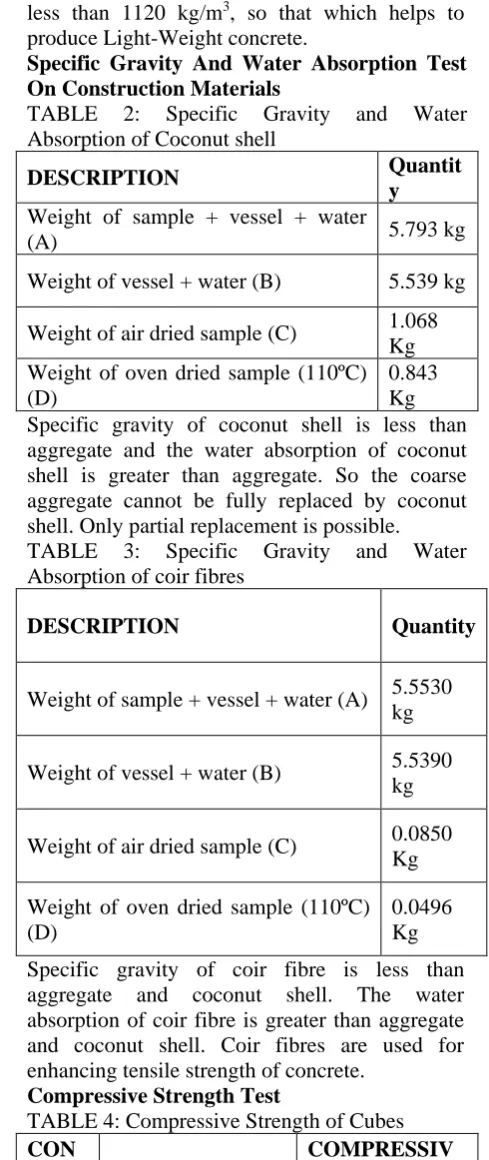
TABLE 2: Specific Gravity and Water
Absorption of Coconut shell
DESCRIPTION Quantit
y Weight of sample + vessel + water
(A) 5.793 kg
Weight of vessel + water (B) 5.539 kg
Weight of air dried sample (C) 1.068
Kg Weight of oven dried sample (110ºC) (D)
0.843 Kg Specific gravity of coconut shell is less than aggregate and the water absorption of coconut shell is greater than aggregate. So the coarse aggregate cannot be fully replaced by coconut shell. Only partial replacement is possible.
TABLE 3: Specific Gravity and Water
Absorption of coir fibres
DESCRIPTION Quantity
Weight of sample + vessel + water (A) 5.5530 kg
Weight of vessel + water (B) 5.5390
kg
Weight of air dried sample (C) 0.0850
Kg
Weight of oven dried sample (110ºC) (D)
0.0496 Kg
Specific gravity of coir fibre is less than aggregate and coconut shell. The water absorption of coir fibre is greater than aggregate and coconut shell. Coir fibres are used for enhancing tensile strength of concrete.
Compressive Strength Test
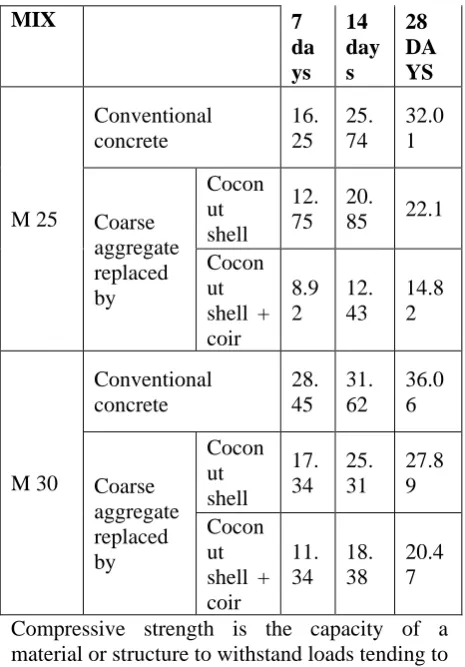
TABLE 4: Compressive Strength of Cubes CON
CRET E
DESCRIPTION
Available online: https://edupediapublications.org/journals/index.php/IJR/ P a g e | 305
MIX 7
da ys
14 day s
28 DA YS
M 25
Conventional concrete
16. 25
25. 74
32.0 1
Coarse aggregate replaced by
Cocon ut shell
12. 75
20.
85 22.1
Cocon ut shell + coir
8.9 2
12. 43
14.8 2
M 30
Conventional concrete
28. 45
31. 62
36.0 6
Coarse aggregate replaced by
Cocon ut shell
17. 34
25. 31
27.8 9
Cocon ut shell + coir
11. 34
18. 38
20.4 7
Compressive strength is the capacity of a material or structure to withstand loads tending to reduce size. It always increases with age and curing. Strength is the stress required to cause fracture of the material. Compressive strength is affected by the factors such as effect of materials, mix proportions and curing conditions.
Coarse aggregate replaced by 10% coconut shell attains 65% to 80% strength of conventional concrete and coarse aggregate replaced by 10% coconut shell & 3% coir by the weight of cement attains 45% to 60% strength of conventional concrete.
Fig 6: Graph Showing Compressive Strength inM 25& M 30 Concrete
Ph Test
When salt (pH of roughly 6 to 7) or other acids are introduced onto the concrete, they enter into small pores and micro-cracks of the concrete and attack the surrounding materials which lowering their pH. When the pH is lowered, the ability of cement to hold things together is compromised.
Concrete having partial replacement of coarse aggregate with 10% coconut shell and 10% coconut shell + 3% coir in M 25 and M 30 concrete gives pH value 12. This results shows that the concrete is alkaline in nature.
Water Absorption Test
The increase in weight as a percentage of the original weight is expressed as its absorption (%). The average absorption of the test samples shall not be greater than 5% with no individual unit greater than 7%.
TABLE 5: Water Absorption of Cubes
From test results, the addition of coconut shell and coir increases the water absorption property of concrete. Water absorption of concrete having coconut shell + coir is more than concrete with coconut shell, which exceeds limit of 7% water absorption in M 25 and M 30 concrete.
CONC RETE
MIX
COARSE AGGREGAT E REPLACED
BY
WATER ABSORPTION (%) 0.
5 hr
1 hr
24 hr
72 hr
16 8 hr
M 25
Coconut shell 4. 8
5. 28
5. 32
5. 91
6. 42 Coconut shell +
coir
5. 91
6. 47
6. 78
6. 93
7. 42
M 30 Coconut shell 4.
46 4. 65
4. 76
4. 86
Available online: https://edupediapublications.org/journals/index.php/IJR/ P a g e | 306
Coconut shell + coir
5. 6
6. 06
6. 43
6. 3
7. 03
Electrical Resistivity Test
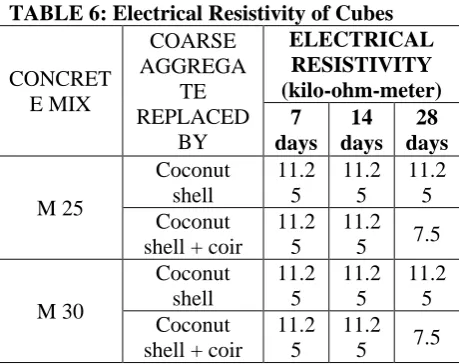
Conventional concrete is not electrically conductive in nature. The electric resistivity of normal weight concrete ranges between 6.54 – 11 kilo-ohm-meter.
TABLE 6: Electrical Resistivity of Cubes
CONCRET E MIX
COARSE AGGREGA
TE REPLACED
BY
ELECTRICAL RESISTIVITY (kilo-ohm-meter)
7 days
14 days
28 days
M 25
Coconut shell
11.2 5
11.2 5
11.2 5 Coconut
shell + coir
11.2 5
11.2
5 7.5
M 30
Coconut shell
11.2 5
11.2 5
11.2 5 Coconut
shell + coir
11.2 5
11.2
5 7.5
Electrical resistivity of concrete having coconut shell and coir is 11.25 kilo-ohm-meter, which is
nearer to the electrical resistivity of conventional concrete. After 28 days curing concrete with coconut shell + coir having electrical resistivity of 7.50 kilo-ohm-meter. It is comparable with conventional concrete.
7. Temperature Resistivity Test
TABLE 7: Temperature Resistivity of Specimens
CONCR ETE
COMPRES SIVE STRENGT H
DESCRIPTI
ON (N/mm2)
MIX After 28
day curing
M 25
Conventional 10.28
Coars e
aggreg ate
Coconut
shell 4.87
repla ced by
Coconut shell +
coir 4.05
Conventional 12.92
M 30
Coars e
aggreg ate
Coconut
shell 5.50
repla ced by
Coconut shell +
coir 5.11
The rise in temperature causes a decrease in the strength of concrete. However, the rate at which the strength decrease depends on the rate of increase in the temperature of the fire and the insulating properties of concrete. The change in concrete properties due to high temperature depends on the type of coarse aggregate used. Chloride Test
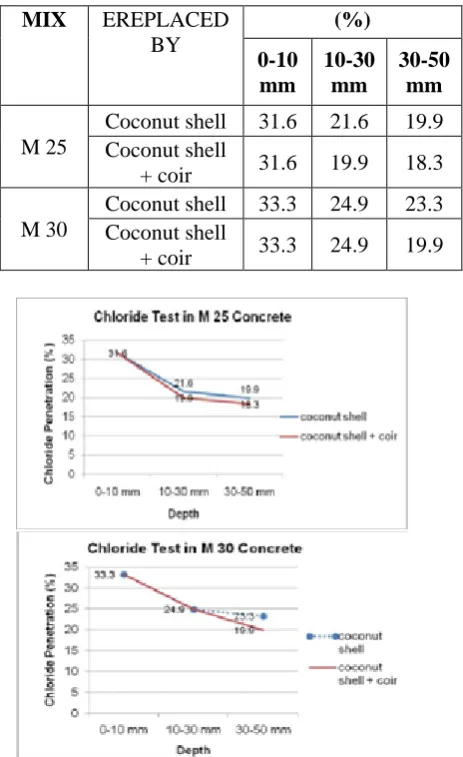
When chloride present in sufficient amounts, may initiate or accelerate the corrosion of metals such as steel embedded in or contacting a cement system such as mortar, grout or concrete. The rate of ingress of chlorides into concrete depends on the pore structure of the concrete, which is affected by factors including materials used, construction practices and age.
TABLE 8: Chloride Penetration of Cubes
CONC RETE
COARSE AGGREGAT
Available online: https://edupediapublications.org/journals/index.php/IJR/ P a g e | 307
MIX EREPLACED
BY
(%)
0-10 mm
10-30 mm
30-50 mm
M 25
Coconut shell 31.6 21.6 19.9
Coconut shell
+ coir 31.6 19.9 18.3
M 30
Coconut shell 33.3 24.9 23.3
Coconut shell
+ coir 33.3 24.9 19.9
Fig 10: Graph Showing Chloride test in M 25 & M30 Concrete
The permeability of concrete is obviously related to the pore structure of the cement paste matrix. This will be influenced by many factors such as water-cement ratio and type of aggregate Sulphate Test
Sulphate attack on ordinary Portland cement matrix is generally characterized by sulphate ions with cement hydration products and it causes expansion, cracking and spalling of concrte. The form and extent ofdamage to
concrete will depend on the sulphate
concentration, the type of cations in the sulphate solution.
TABLE 9: Compressive Strength of Cubes after Sulphate Attack
CONCRET E
Compressiv e strength COARSE (N/mm2)
AGGREGATE
MIX REPLACE
D BY
After 28 day curing
M 25 Coconut shell 13.85
Coconut shell + coir 10.28
M 30
Coconut shell 24.43
Coconut shell + coir 18.34 10. Splitting Tensile Strength Test
Generally concrete is not designed to resist direct tension; the knowledge of tensile strength is of value in estimating the load under which cracking will develop.
TABLE 10: Splitting Tensile Strength of Cylinders
CON CRE TE MIX
DESCRIPTIO N
SPLITTING TENSILE STRENGT H (N/mm2)
7 days 1 4 d a ys
2 8 d a ys
M 25
Conventional 1.89
2. 3 4
3. 2 1
Coarse aggrega tereplac ed by
Coco nut shell
1.43
1. 8 9
2. 1 5 Coco
nut shell +coir
1.2
1. 6 7
1. 9 4
M 30
Conventional 1.93
2. 5 1
3. 7 1
Coarse aggrega
te replace
d by
Coco nut shell
1.47
2. 0 5
2. 5
Coco nut shell
+ coir
1.23
1. 9 1
Available online: https://edupediapublications.org/journals/index.php/IJR/ P a g e | 308 Fig 12: Graph Showing Splitting
TensileStrength in M 25&M 30 Concrete Density of Concrete
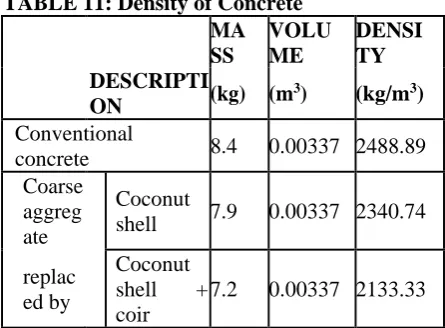
Density of normal concrete is in the order of about 2400 kg/m3. The density of light weight concrete will be less than about density 1900 kg/m3 and high density concrete have unit weight ranging from about 3360 kg/m3.
TABLE 11: Density of Concrete
MA
SS
VOLU ME
DENSI TY DESCRIPTI
ON (kg) (m
3) (kg/m3)
Conventional
concrete 8.4 0.00337 2488.89
Coarse aggreg ate
Coconut
shell 7.9 0.00337 2340.74
replac ed by
Coconut
shell +
coir
7.2 0.00337 2133.33
When coconut shell and coir fibres added to the concrete, it reduces the density of concrete. So the material is comparable to light weight concrete.
Improvement of Strength by Using Fly Ash Fly ash is the modern pozzolona which helps to improving the performance of concrete. This helps to increases the strength properties of concrete.
TABLE 12: Compressive Strength of Cubes Containing Fly Ash
CONC RETE MIX
COARSE AGGREGATE REPLACED BY
COMPRESSIVE STRENGTH (N/mm2)
7 days 28 days
M 25
conventional 16.42 28.74
Coconut shell 15.2 25.91
Coconut shell +
coir 10.82 23.36
M 30
conventional 20.98 30.17
Coconut shell 18.43 28.84
Coconut shell +
coir 12.7 27.1
M 35
conventional 23.57 34.84
Coconut shell 20.76 32.19
Coconut shell +
coir 13.1 29.35
M 40
conventional 25.01 41.47
Coconut shell 23.96 38.03
Coconut shell +
coir 13.47 35.05
M 45
conventional 27.93 45.67
Coconut shell 24.63 42.45
Coconut shell +
coir 14.15 37.92
M 50
conventional 31.66 56.13
Coconut shell 25.01 52.94
Coconut shell +
Available online: https://edupediapublications.org/journals/index.php/IJR/ P a g e | 309 Addition of fly ash helps to improve the strength
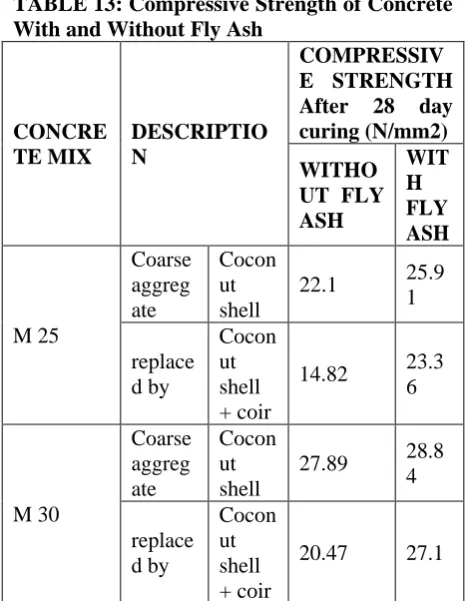
of concrete with partial replacement of coarse aggregate with coir fibres and coconut shell. Compressive strength of concrete having coarse aggregate replaced by coconut shell reaches 90 – 95% of conventional concrete and coarse aggregate replaced by coconut shell + coir fibres reaches 80 – 90% of conventional concrete.
Fig 14: Graph Showing Compressive Strength of Concrete with Fly Ash
TABLE 13: Compressive Strength of Concrete With and Without Fly Ash
CONCRE TE MIX
DESCRIPTIO N
COMPRESSIV E STRENGTH After 28 day curing (N/mm2)
WITHO UT FLY ASH
WIT H FLY ASH
M 25
Coarse aggreg ate
Cocon ut shell
22.1 25.9
1
replace d by
Cocon ut shell + coir
14.82 23.3
6
M 30
Coarse aggreg ate
Cocon ut shell
27.89 28.8
4
replace d by
Cocon ut shell + coir
20.47 27.1
Fly ash having advantages of greater strength, increases durability, increase workability, improve finishing etc. Void filling property of fly ash helps to improve the strength of concrete by reducing the voids in the concrete matrix having
coconut shell and coir fibers.Improvements in strength of concrete having coconut shell + coir fibers are found to be more as compared to coconut shell alone. Because of the addition of coir fibers creates more voids in concrete matrix and also reduces the workability of concrete. TABLE 14: Cost of Conventional Concrete for 1 Cu.m
QUANTI TY
DESCRIPT ION
REQUIR
ED RATE
TOT AL COST
(m3) (Rs/m3
) (Rs)
Cement 0.1159 10951.
00
1269.2 2
River sand 0.2476 2648.2
5 655.71
Aggregate 0.4217 706.20 297.8
Labour 1 3500 3500
Wastage of
materials 300
Total 6022.7
3
TABLE 15: Cost of Concrete Replaced by Coarse Aggregate with 10% of Coconut Shell for 1 Cu.m
QUANTIT Y
DESCRIPTIO N
REQUIRE
D RATE
TOTA L COST (m3) (Rs/m3) (Rs)
Cement 0.1159 10951.0
0
1269.2 2
River sand 0.2476 2648.25 655.71
Aggregate 0.3795 706.20 268.00
Coconut shell 0.0421 190.02 8.00
Labour 1 3502.50 3502.5
0
Wastage of
materials 300
Total 6003.4
3 Amount saved
Available online: https://edupediapublications.org/journals/index.php/IJR/ P a g e | 310 = 19.3 Rs/m3
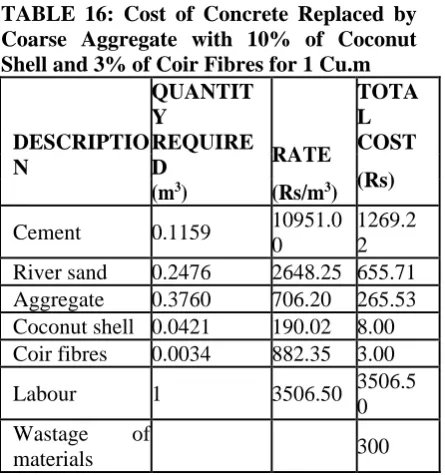
TABLE 16: Cost of Concrete Replaced by Coarse Aggregate with 10% of Coconut Shell and 3% of Coir Fibres for 1 Cu.m
QUANTIT Y
TOTA L COST DESCRIPTIO
N
REQUIRE
D RATE
(Rs) (m3) (Rs/m3)
Cement 0.1159 10951.0
0
1269.2 2
River sand 0.2476 2648.25 655.71
Aggregate 0.3760 706.20 265.53
Coconut shell 0.0421 190.02 8.00
Coir fibres 0.0034 882.35 3.00
Labour 1 3506.50 3506.5
0
Wastage of
materials 300
Amount saved = 6022.73 - 6007.96 = 14.77 Rs/m3
The usage of coconut shell and coir fibres in construction field initiates low cost construction as well as waste management.
Conclusion
The use of coconut shell and coir fibres as partial replacement of coarse aggregate should be encouraged for sustainable and eco friendly construction. By the utilization of agricultural waste materials in concrete tends to low cost construction and waste management. The results conclude that the concrete with coarse aggregate partially replaced with coconut shell and coir
fibres shows lesser strength but can
recommended for low cost construction with addition of fly ash. Strength properties of concrete having coconut shell and coir fibres improve to 80% – 95% by the addition of fly ash. References
1) R.Nagalakshmi, “Experimental Study on Strength Characteristics on M 25 Concrete with Partial Replacement of Cement with Fly Ash and Coarse
Aggregate with Coconut Shell”,
International Journal of Science &
Engineering Research, 2013, Vol. 4, Issue 1.
2) K. Gunasekaran, “Utilization of Coconut Shell as Coarse Aggregate in the Development of Light Concrete”, Thesis- SRM University, 2011.
3) Majid Ali and Nawawi Chouw, “Coir Fibre and Rope Reinforced Concrete Beam under Dynamic Loading”, Thesis- University of Auckland, New Zealand, 2009.
4) Mostafa Jalal, Ali Reza. Pouladkhan, Hassan Norouzi, Ghobad Choubdar, “Chloride Penetration, Water Absorption and Electrical Resistivity of High Performance Concrete Containing Nano Silica and Silica Fume”, Journal Of American Science, 2012, Vol. 8, Issue 4.
5) D. Maruthachalam., “Studies of
Durability Aspects of Fibre Reinforced Concrete”, International Journal of Engineering Science and Technology, 2012, Vol. 4, No.02.
6) Abdullaha A. A. (1984) “Basic Strength Properties of light weight concrete Using Agricultural Waste as Aggregate” International conference on Low Coast
Housing in developing countries,
Roorkee, India, app624- 623.
7) Basri H.B. et al (1999), “Concrete using waste oil palm shells as aggregate”, International Journal of Cement and Concrete research, pp 619-622.
8) E.A Olanipekun, K.O. Oluola, et al 2006. “A comparative study of concrete properties uses coconut shell and palm kernel shell as coarse aggregate”, Building and environment 41, pp.297-301.
9) K.Gunasekaran, P.S. Kumar et al 2008, “Proceedings of International Conference
on Advances in Concrete and
Construction, ICACC-2008”, 2008,
Hyderabad, India pp 450-459.
10) Asokan Pappu (2007), “Solid wastes