Economic Comparison of Honey Mesquite
Control Methods with Special Reference to
the Texas Rolling Plains
R.E. WHITSON AND C.J. SCIFRES
Abstract
Although economic responses to honey mesquite control varied considerably within and among resource regions in Texas, aerial applications of herbicides generally produced higher annual rates of return on the investment than did mechanical alternatives. Statewide, aerial applications of 2,4,5-T produced the greatest annual rates of return, averaging 15.7% for deep range sites and 11.0% for shallow range sites for projected livestock responses when cattle prices were estimated to average %0.97/kg (%44.00/cwt, 1978 dollars). Statewide, annual rates of return from aerial appli- cation of herbicides for honey mesquite control on shallow sites (statewide) varied from -8.3% to l&l%, based on the !§0.97/kg livestock price. When cattle prices were varied from $O.S2/kg (%37.00/cwt) to $l.O5/kg (%47SO/cwt), annual rates of return from aerial application of 2,4,5-T to deep sites on the Rolling Plains and Rolling Red Plains of Texas ranged from 9.6% to 17.9%. Chaining of honey mesquite on deep sites of the Rolling Plains and Rolling Red Plains proiluced rates of return from 7.1% to 12.5%. While the economic feasibility of herbicides in general was determined to be greater than that from the use of mechanical practices, rates of return from herbicides are more price sensitive than mechanical treatments. Over the 20-year planning period, tame pastures in the Rolling Plains produced the greastest accumulated net present value ($/ha) when the annual interest rate charged to the added investment was 5% or less. When the annual interest rate was 7% or 9%, the net present values of herbicide treatments exceeded those of the mechanical methods.
The Texas range livestock industry faces perennial economic problems because of unstable markets, inevitable drought, increas- ing taxes, livestock losses from predators and poisonous plants, and rising production costs. Economic pressures have forced many ranch firms to increase breeding herd numbers and reduce fixed costs to increase profit potential. However, most ranchers have limited means for increasing land holdings by purchase or lease because of the limited availability of lands and the relatively low
The authors are associate professor, Departments of Range Science and Agricultu- ral Economics; and professor, Department of Range Science, Texas A&M University, College Station, Texas 77843.
The efforts of Julia Scifres in manuscript typing and preparation are highly appre- ciated. The authors are grateful to Rhett Johnson and D.B. Polk, Sr., Soil Conserva- tion Service, Temple, Texas, for their work in data collection.
Approved by the Director, Texas Agr. Exp. Sta. as TA-15666. Manuscript received January 10, 1980.
JOURNAL OF RANGE MANAGEMENT 34(5), September 1981
cash flow potential of rangelands. Consequently, many producers “become larger” by increasing the herd size on their existing land area in response to short-term economic pressures. Unfortunately, cow herds have often been expanded beyond the long-term forage production potential of the land.
Continual heavy grazing, periodic drought, and the absence of the influence of fire (which once suppressed brush invading Texas grassland) have reduced annual forage production on most native rangeland, compared to its ecological potential (Scifres 1980). Approximately 28 million ha of Texas rangeland are infested with one or more brush species, and honey mesquite (Prosopis glandu- losa Torr. var. glandulosa) infests about 22 million ha of these rangelands (Smith and Rechenthin 1964). It has been estimated that 16 million ha of Texas rangeland require brush control to improve forage production (U.S.D.A., Cons. Needs Inv. 1970).
Considerable research has emphasized improved honey mes- quite control methods (Bovey and Meyer 1974; Fisher et al. 1970; Scifres 1973; Scifres et al. 1977; Wiedemann et al. 1977) but there is relatively little published information concerning the economic efficiency of these methods. Some workers have evaluated treat- ment costs (Boykin 1960; Wiedemann and Cross 1975) but did not consider benefits of brush control because of the lack of produc- tion response data amenable to economic analysis. As Dahl et al. (1978) indicated, some of the past research on livestock production responses to honey mesquite control resulted in conservative live- stock response estimates because stocking rates were not adjusted following treatment. For example, Robison et al. (1970) reported an average 9%/ha increase (20.3 kg/ ha to 22.1 kg/ ha) in weaned calf production on the Rolling Plains if stocking rates were not
adjusted following aerial spraying with 2,4,5-T [2,4-
trichlorophenoxy)acetic acid]. Robison et al. (1970) reviewed research indicating that weaning weights were increased by about 15 kg/calf, and that steer gains were increased by about 14 kg (summer grazing) following honey mesquite control (Fisher et al. 1959; Robison et al. 1969). In a subsequent study, Cross and Fisher (1975) reported an average weaning weight increase of about 11.3 kg/ calf as well as an increased stocking rate from 1 AU / 11.1 ha to 1 AU/9.8 ha which jointly increased production by 19%/ha. Moreover, based on conversion of forage standing crop to carrying capacity of steers and averaged across differing site conditions, Dahl et al. (1978) reported a predicted increase in beef production (kg/ha) of nearly 30% following aerial spraying on the Rolling
Plains. Although these results are restricted to relatively few pro- duction situations, they indicate the importance of increasing car- rying capacity as well as individual animal performance as indicators of economic effectiveness of honey mesquite control alternatives.
Although previous studies generally report favorable economic benefits associated with brush control in Texas (Brown et al. 1974, Osborne and Witkowski 1974, Sharp and Boykin 1967, Whitson et al. 1975, Whitson et al. 1977, Workman et al. 1965), they cannot be used to assess fully statewide economic feasibility of honey mes- quite control because of variation in methodology, economic deci- sion criteria, time period of the study, or because they were based on an evaluation of a single control alternative at one location. Variation in degree of infestation, rainfall, soils, livestock produc- tion practices, and management objectives results in an extremely large number of potential production situations.
Reliable economic comparisons are needed by governmental agencies responsible for establishing policy and technical assist- ance, by range managers concerned with decisions at the firm level, and by research organizations for use in determining research priorities. Impacts of eliminating or limiting use of a particular practice cannot be assessed accurately unless all other feasible control alternatives are included in the analysis, and the economic trade-offs among the control alternatives are identified. Ranch managers need results of comparative economic studies to improve firm-level decisions regarding the feasibility of honey mesquite control and the most profitable method for their situation. Research planning should incorporate economic implications of potential practices to efficiently allocate available resources for development of brush management technology.
The principal objective of this study was to develop economic comparisons at the ranch firm level of some of the more commonly used honey mesquite control practices in Texas. Statewide eco- nomic comparisons and more specific detailed comparisons from the Rolling Plains and the Rolling Red Plains are reported.
Procedures and Rationale
Range scientists employed by the Soil Conservation Service completed questionnaires requiring “best estimates” of livestock production responses to more common honey mesquite control alternatives for the major land resource areas. These data were developed into projected 20-year livestock carrying capacity response curves for specific honey mesquite control situations. Economic analysis of specific honey mesquite control alternatives as related to general range site production potential (deep or shallow), level of pretreatment honey mesquite canopy cover (dense = >21% and moderate = 10 - 20%), and rainfall patterns within a given resource region are reported by Whitson and Scifres (1979). Estimates were based on representative cow-calf operations within each of the 14 major land resource areas of the state (Fig. 1).
For this study, a capital budgeting present value analysis (Whit- son et al. 1979) was conducted for selected honey mesquite control alternatives to allow calculation of an internal rate of return and a 20-year accumulated present value for selected discount rates of O%, 5%, 7% and 9%’ Projected rates of return from across the state were compared based on four commonly used practices selected to represent a range in cost/return relationships often utilized by ranch mangers in each resource region. While the honey mesquite control situations in this study represent a significant part of each region, they do not necessarily represent an “average” response over the total resource region.
Honey mesquite control alternatives evaluated were aerial appli- cations of 2,4,5-T or dicamba (3,6-dichloro-o-anisic acid), root
I. HIGH PLAINS 8. TEXAS CLAYPAN 2. ROLLING PLAINS 9. EAST TEXAS TIMBERLAND 3. ROLLING RED PLAINS IO. COASTAL PRAIRIES 4. NORTH CENTRAL PRAIRIES I I. RIO GRANDE PLAINS 5. CROSS TIMBERS 12. CENTRAL BASIN 6. GRAND PRAIRIES 13. EDWARDS PLATEAU 7. BLACKLAND PRAIRIES 14. TRANS PECOS
Fig. 1. Major land resource areas of Texas.
plowing and seeding an adapted native grass mixture, and the establishment of tame pasture .* Cost of aerial application of 2,4,5- T varied from $13.58/ha to $15.22/ha/treatment depending on rate of herbicide applied. Cost of other alternatives were $18.53/ha to $2 1.87/ha for dicamba application; $88.98/ ha to $284.17/ha for root plowing and seeding; and $172.971 ha to $295.361 ha for tame pasture establishment. Initial costs/ ha averaged $14.02, $19.40, $147.06 and $183.05 for 2,4,5-T dicamba, root plowing, and tame pasture establishment, respectively.
Average rainfall conditions (normal variation within a 20-year period) and sound grazing management following treatment were assumed for development of the response curves. Deferment costs were included for treatments as needed. It was also assumed that honey mesquite control would not adversely affect wildlife habitat or hunting revenues. Each control alternative was evaluated as a separate activity within a ranch firm, and no indirect economic benefits were included in the analysis.
Variable costs for cow-calf production were developed from Texas Agricultural Extension Service Budgets (1978). Increases in annual variable livestock costs associated with adding a cow to an existing ranch firm averaged $74 and ranged from $63 to $821 cow, depending upon the particular resource region. Added annual livestock expenditures averaged $1 lo/ cow and ranged from $94 to $13O/cow for tame pasture alternatives across the State. These increased livestock costs were considered to be “out-of-pocket” costs and did not include fixed costs such as for land.3
ZA critical assumption of this analysis is that essentially pure stands of honey mesquite were treated. Responses to alternatives evaluated could vary considerably ifapplied to mixed brush rather than single species stands. Tame pasture establishment, primarily to Kleingrass (Panicurn coloratum L.), was considered feasible only on range sites with deep soils and relatively high production potential. Tame pastures were assumed to be fertilized annually and intensively managed.
‘Interest charges are not directly included in annual livestock costs. Interest charges are properly accounted in the analysis when the annual stream of net cash flows are converted to an accumulated net present value.
Pretreatment beef production for the State was estimated to average 190 kg/ weaned calf (average of steers and heifers with an 82% weaned calf crop). Livestock production increases following honey mesquite control were estimated to increase weaning weights by 4.5 to I 1.3 kg/ weaned calf after herbicide use, and by 4.5 to 22.7 kg/calf following mechanical brush control. Estimated calf crops were generally increased by 3% to 5% following honey mesquite control, but Soil Conservation Service estimates ranged from 2% to 10% depending upon the particular resource situation and treatment alternative (Whitson and Scifres 1980).
More detailed economic comparisons of honey mesquite control on the Rolling Plains and Rolling Red Plains were conducted because of the importance of range livestock production to the regional economies, and because honey mesquite is the primary range brush management problem in those regions. In addition to the honey mesquite control alternatives evaluated on a statewide basis, aerial applications of 2,4,5-T i- dicamba ( 1: 1) and 2,4,5-T -I- picloram (4-amino-3,5,6-trichloropicolinic acid) (1: I), chaining one-way, and tree dozing (power grubbing) and seeding to native forage mixtures were also evaluated. Herbicides were assumed to be applied in standard carrier volumes (28.1 to 46.8 liters/ ha spray solution).
Partial budgeting was used to estimate changes in annual net cash flows over the 20-year planning period. Net cash flows (expressed in 1978 dollars) were obtained by subtracting annual increased costs from annual increased benefits. These net changes were calculated only for the treated area and did not include possible interactions of the treated areas with adjacent manage- ment units. Weaned calf prices, averaged for steers and heifers, were varied from $0.82/kg ($37.00/cwt) to $1 .OS/kg ($47.50/cwt). Salvage values were included in the last year of the planning horizon as a positive cash flow. Net cash flows were not adjusted for income taxes because of the widely differing impact that taxes could have for individual ranch operators.
Annual net cash flows were converted to a present value by multiplying each by the appropriate annual discount factor.4 The stream of annual present values were summed over the 20-year planning period, and a honey mesquite control alternative was assumed to be economically feasible if the accumulated net present value was zero or positive for the given discount rate. Internal rates
4An annual discount factor is defined as (I + r).“, where r= annual interest (discount) rate and n = number of years since implementation of the practice.
of return were estimated by a computerized procedure which iden- tified the specific discount rate resulting in a 20-year accumulated net present value of zero.
Results and Discussion
Statewide Analysis
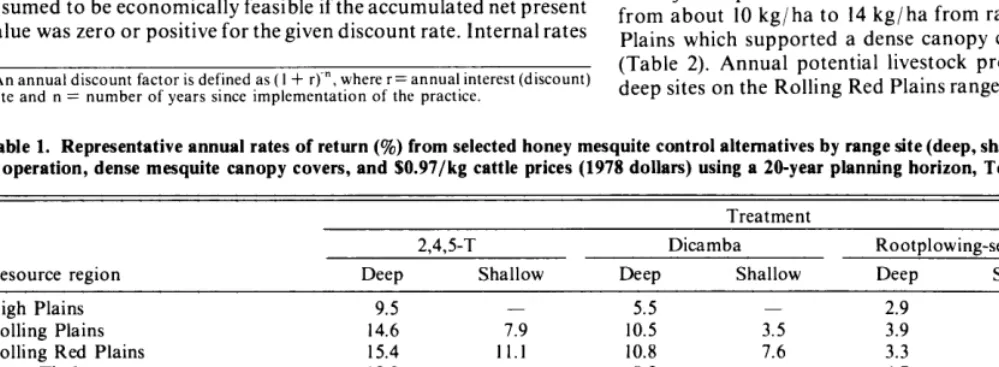
Aerial application of herbicide produced higher annual rates of return on the investment than did mechanical treatments, regard- less of resource region (Table 1). Annual rates of return from 2,4,5-T applied to dense canopies on deep range sites varied from 7.0% in the Trans Pecos to 21.8% on the Rio Grande Plains. Annual rates of return also varied with site potential within resource region. For example, weighted (by acres of dense canopy) rates of return from aerial applications of 2,4,5-% were 15.7% from deep range sites and 11.1% from shallow sites. Variation in annual rates ot return from deep range sites was less than annual rates of return from shallow range sites. Highest rates of return from herbicides occurred when 2,4,5-T was aerially applied to honey mesquite stands on deep range sites of the Rio Grande Plains, and lowest returns occurred when dicamba was applied to shallow sites of the Trans Pecos.
Average rates of return from dicamba were almost one-third less than annual rates of return from 2,4,5-T (Table 1). Differences in rates of return from 2,4,5-T and dicamba were attributable to differences in treatment costs since control responses were assumed to be the same (Scifres 1973; Scifres and Hoffman 1972).
Weighted average annual rates of return from the selected mechanical alternatives on deep range sites were substantially lower than from aerial herbicide application (Table 1). Rates of return averaged 3.9% (ranged from 0.9% to 5.2%) from root plow- ing and seeding rangeland with a native forage mixture, and 5. I % (ranged from 1.9% to 6.9%) for tame pasture establishment. Annual rates of return on shallow range sites from root plowing and seeding a native grass mixture were 2.4% or less, and were negative for three of the five vegetation resource regions evaluated.
Rolling Plains and Rolling Red Plains
Projected pretreatment annual weaned calf production ranged from about 10 kg/ha to 14 kg/ha from rangelands of the Rolling Plains which supported a dense canopy cover of honey mesquite (Table 2). Annual potential livestock production increases from deep sites on the Rolling Red Plains ranged from 7.6 kg/ ha follow-
Table 1. Representative annual rates of return (%) from selected honey mesquite control alternatives by range site (deep, shallow), operation, dense mesquite canopy covers, and %0.97/kg cattle prices (1978 dollars) using a to-year planning horizon, Texas.1
based on a cow-calf
Treatment
Resource region
2,4,5-T Dicamba Rootplowing-seeding Tame pastures3
Deep Shallow Deep Shallow Deep Shallow Deep
High Plains Rolling Plains Rolling Red Plains Cross Timbers North Central Prairies Grand Prairies Blackland Prairies Texas Claypan East Texas Coastal Prairies Rio Grande Plains Edwards Plateau Central Basin Trans-Pecos Weighted Aug.
9.5 - 5.5
14.6 7.9 10.5
15.4 11.1 10.8
12.3 - 8.2
19.5 18.1 13.6
11.1 3.5 6.1
13.5 11.7 9.5
14.0 11.4 11.5
13.1 - 8.2
21.8 - 16.6
15.2 13.5 11.0
14.1 9.9
7.0 -4.4 3.3
15.7 11.1 11.2
2.9
3.5 3.9 1.9 5.7
7.6 3.3 -0.2 4.5
4.7 2.6
11.7 2.8 -1.0 6.5
-1.7 0.9 -0.1 4.1
7.7 4.6 - 3.1
7.7 2.3 - 1.9
4.6
1.1 2.2
5.2 3.7
9.7 4.6 2.4 6.9
- 2.7
-8.3 2.4 -
6.9 3.9 1.6 5.1
‘The annual (internal) rate of return is a real rate based on 1978 dollars and considers all operating and investment capital in brush control and added breeding livestock. Dash indicates alternative not evaluated for that resource region/range site situation.
*Herbicides were assumed to be applied at 0.6 kg/ ha in resource areas receiving less than 60-70 cm of annual rainfall, and 0.75 kg/ ha for areas receiving greater than 70 cm an- nually.
3Tame pastures were assumed to be established to Kleingrass in all resource areas except the Rio Grande Plains which wasestablished to buffelgrass. All pastures wereassumed to be intensively managed, and received annual application(s) of fertilizer.
4Weighted by acres of dense canopy estimated for each resource region from Whitson and Scifres (1980).
Table 2. Average annual beef production potential (kg/ha) following control of dense canopy covers of honey mesquite based on cow-calf operations on the Rolling Plains and Rolling Red Plains of Texas, 1978.’
Initial control alternative2
Rolling Plains Rolling Red Plains
Deep soils Shallow soils Deep soils Shallow soils
Pretreatment 13.9 11.7 12.6 9.6
2,4,5-T 21.1 15.7 20.2 15.0
Dicamba 21.1 15.7 20.2 15.0
2,4,5-T i- dicamba (1: 1) 21.1 15.7 20.2 15.0
2,4,5-T + picloram (1: 1) 22.4 16.6 20.8 15.7
Chain 21.0 10.7 -
Treedoze-seed 24.0 20.8 26.8 16.4
Rootplow-seed 27.3 21.3 29.8 18.8
Tame pasture3 48.3 - 61.9
‘Production responses adapted from Whitson and Scifres (1979) and averaged over a 20-year planning period. Dashes indicated practice not evaluated.
ZHerbicides aerially applied initially and as maintenance treatments at 0.6 kg/ ha. Initial mechanical treatments were generally followed by low-energy grubbing (Wiedemann et al. 1977) except for chaining which was followed by aerial application of 2,4,5-T.
3Tame pastures were seeded to Kleingrass and were intensively managed thereafter with annual fertilizer applications of 56-l 12 kg N/ha.
ing aerial application of herbicides to 49.3 kg/ ha from establish- ment of tame pastures. This compared to beef production increases of 7.2 kg/ ha and 34.4 kg/ ha, respectively, when the same alterna- tives were selected for the Rolling Plains. Robison et al. (1970) reported average weaning weight increases equivalent to 1.8 kg/ ha without adjusting stocking rates. Cross and Fisher (1970) reported average increases of 4 kg/ ha with only a moderate increase in stocking rate following aerial spraying, and with initial beef pro- duction levels (20 kg/ha to 21.5 kg/ha) which were much higher than pretreatment average beef production levels in this study. Projected beef production increases from shallow range sites in the Rolling Plains varied from 4.0 kg/ ha to 9.6 kg/ ha, depending on the alternative selected, compared to increases of 5.4 kg/ha to 9.2 kg/ ha for comparable situations on the Rolling Red Plains (Table 2).
Annual Rates of Return
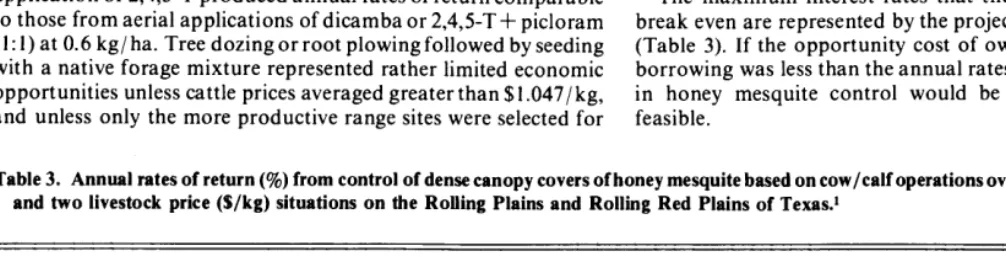
Highest annual rates of return from honey mesquite control on the Rolling Plains resulted from aerial applications of 2,4,5-T (0.6 kg/ha) on deep range sites (Table 3), and ranged from 9.6% to 16.9% for cattle prices of $0.816/kg ($37.00/cwt) and $l.O47/kg ($47.50/cwt), respectively. Chaining one-way followed by aerial application of 2,4,5-T produced annual rates of return comparable to those from aerial applications of dicamba or 2,4,5-T+ picloram ( 1: 1) at 0.6 kg/ ha. Tree dozing or root plowing followed by seeding with a native forage mixture represented rather limited economic opportunities unless cattle prices averaged greater than $l.O47/kg, and unless only the more productive range sites were selected for
honey mesquite control.
Annual rates of return on the investment in honey mesquite control were relatively low from shallow range sites, and would not likely meet minimal ranch firm economic criteria unless cattle prices averaged $l.O47/kg or higher, and/or 2,4,5-T or 2,4,5-T i- dicamba were selected as the control alternative. Mechanical alter- natives produced relatively low annual rates of return, and would likely be rejected by management for application to shallow range sites.
Cash Flows
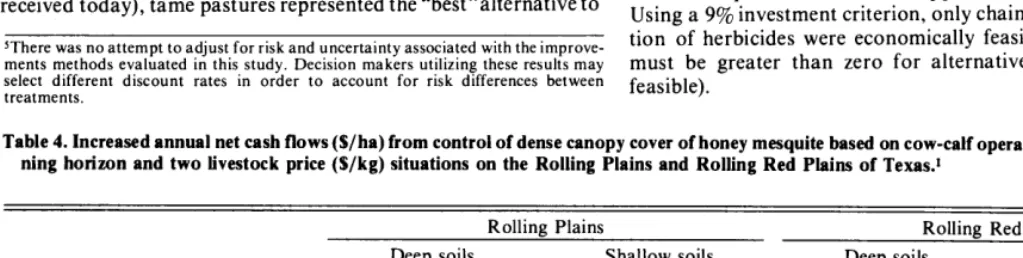
Net cash flows resulting from honey mesquite control (Table 4) represent the maximum yearly interest payment ($/ha) the ranch manager could make (on the average) and still recover all added investment in the alternative. The magnitude of investment and timing of the net cash flows are important considerations when determining economic feasibility of a given practice. Thus, two alternatives with similar average net cash flows could generate different annual rates of return. Since similar livestock production responses over time were projected from the herbicide treatments, differences in rates of return can be attributed to differences invest- ment costs.
The maximum interest rates that the manager could pay and break even are represented by the projected annual rates of return (Table 3). If the opportunity cost of owned capital or the cost of borrowing was less than the annual rates of return, the investment in honey mesquite control would be considered economically feasible.
Table 3. Annual rates of return (%) from control of dense canopy covers of honey mesquite based on cow/calf operations over a 20-year planning horizon and two livestock price (S/kg) situations on the Rolling Plains and Rolling Red Plains of Texas.1
Rolling Plains Rolling Red Plains
Deep soils Shallow soils Deep soils Shallow soils
Livestock price ($/kg) Livestock price ($/kg)
Initial control alternatives2 0.816 1.047 0.816 1.047 0.816 1.047 0.816 1.047
2,4,5-T 9.6 16.9 3.9 9.9 10.2 17.9 7.1 13.0
Dicam ba 6.1 12.5 -0.1 5.2 6.1 13.0 4.3 9.3
2,4,5-T + dicamba (1: 1) 8.8 15.9 2.8 8.6 9.2 16.7 6.4 12.0
2,4,5-T -I- picloram (1: 1) 4.8 11.2 0.6 6.1 6.0 12.0 3.3 8.5
Chain 7.1 12.5 - - 6.6 12.3 -
Treedoze-seed 0.7 2.8 0.5 2.7 3.1 5.8 -1.5 0.1
Rootplow-seed 2.1 5.1 0.5 2.6 1.8 4.0 -1.2 0.3
Tame pastures3 2.9 7.1 - - 1.4 6.0 - -
‘The annual rate of return represents a real rate based on 1978 dollars. It considers all operating and investment capital in brush control and added breeding livestock. Dash indi- cates practice not evaluated.
*Herbicides aerially applied initially and as maintenance treatments at 0.6 kg/ ha. Initial mechanical treatments were generally followed by low-energy grubbing (Wiedemann et al. 1977) except for chaining which was followed by aerial applications of 2,4,5-T.
While annual net cash flow is a useful consideration in the financial planning of honey mesquite control investments, it should not be used as the economic criterion for selecting the “best” practice from among mutually exclusive alternatives. The timing of cash flows and the magnitude of the investment are important functions in determining rates of return, and must be properly considered when selecting honey mesquite control alternatives. For example, tree dozing and seeding to a native range mixture produced about the same net cash flow (S/ ha) as did aerial applica- tion of dicamba for honey mesquite control. However, positive cash flow increases occurred later in the 20-year period following tree dozing than from aerial applications of dicamba. Further- more, initial costs of tree dozing could require 5 to 10 times more investment capital than use of the herbicide. Consequently, the annual rate of return from dicamba was 12.5% compared to 2.8% from tree dozing and seeding (Table 3).
Selection of the “Best” Practice
As with most investments, ranch managers are faced with the problem of selecting the “best” honey mesquite control practice from among several alternatives. Obviously, the concept of “best” practice may vary among ranch managers because of personal preferences and characteristics unique to the operation of any particular firm. The “best” specific honey mesquite control prac- tice, chosen from among mutually exclusive alternatives, is decided by considering factors such as capital availability, opportunity costs, objectives of management, risk and uncertainty differences among treatments, and potential synergisms or complementary effects of a given treatment with the remaining untreated manage- ment units on the ranch.
Annual rates of return provide a basis to eliminate alternatives that do not meet minimum rates of return. However, the proper use of an annual rate of return as the means to select the “best”practice from mutually exclusive alternatives requires an “incremental basis” approach which was not undertaken for this study (Haley and Schall 1973). Another accepted approach is to select the practice which produces the greatest accumulated present value for a given discount rate (differences in risk levels between treatments could be considered by adjustment in the discount rate5). This method assumes that adequate capital is available to carry out all alternatives.
Given an annual interest rate of 0% (a dollar is assumed to be as valuable to a manager at some point in the future as a dollar received today), tame pastures represented the “best”alternative to
5There was no attempt to adjust for risk and uncertainty associated with the improve- ments methods evaluated in this study. Decision makers utilizing these results may select different discount rates in order to account for risk differences between
treatments.
Table 5. Twenty-year value (%/ha, 1978 dollars) of control of dense canopy
covers of honey mesquite on deep soils for a cow-calf operations based on a %l.O47/kg cattle price on the Rolling Plains of Texas.1
Present value ($/ha) Annual interest rate (%)
Initial control alternative* 0 5 7 9
2,4,5-T 69.70 3 1.28 22.27 15.36
Dicamba 61.28 23.38 14.64
2,4,5-T -I- dicamba (1: 1) 67.06 30.12 21.11 14.12 8.05
2,4,5-T -I- picloram (1: 1) 67.0 1 24.00 14.00 6.40
Chain 75.21 30.86 19.75 10.99
Treedoze-seed 63.43 -30.49 -50.86 -65.75
Rootplow-seed 103.5 1 0.35 -23.75 -42.02
Tame pasture3 261.04 48.77 1.88 -32.64
‘Accumulated net present values were determined by estimating annual cash flows, converting each annual cash flow to a present value and summing over time. 2Herbicides aerially applied initially and as needed for maintenance at 0.6 kg/ha. Initial mechanical treatments were generally followed by low-energy grubbing (Wiedemann et al. 1977) except for chaining which was followed by aerially applied 2,4,5-T.
)Tame Pastures were seeded to Kleingrass and were intensively managed thereafter with annual fertilizer applications of M-112 kg N/ha.
increase returns to the ranch (Table 5). The next “best”alternative would be root plowing and seeding to a native forage mixture, followed by chaining and finally by aerial application of herbi- cides. If the ranch manager required at least a 5% annual rate of return on his investment, tame pastures again produced the grea- test present value but the “next best” alternative shifted to aerial application of 2,4,5-T, Thus, while establishment of tame pasture generated the sixth lowest annual rate of return (Table 3), it produced the greatest total present value when the rancher’s eco- nomic criterion was a 5% annual rate of return or lower (Table 5). That is, all added investment inputs required to establish the tame pasture yielded a 5% annual return and produced an additional $48.77/ha accumulated net present value. Thus, the rancher would have been $48.77/ha “better off’to invest in establishment of tame pastures than from making an equivalent investment in a savings account paying a real annual rate of 5% over a 20-year planning horizon.
When a 7% annual rate of return was the investment criterion, the “best” practice was aerial application of 2,4,5-T (Table 5). Using a 9% investment criterion, only chaining and aerial applica- tion of herbicides were economically feasible (net present value must be greater than zero for alternative to be considered as feasible).
Table 4. Increased annual net cash flows (%/ha) from control of dense canopy cover of honey mesquite based on cow-calf operations over a Z&year plan-
ning horizon and two livestock price (%/kg) situations on the Rolling Plains and Rolling Red Plains of Texas.*
Rolling Plains Rolling Red Plains
Deep soils Shallow soils Deep soils Shallow soils
Livestock price ($/kg) Livestock price ($/kg)
Initial control alternative2 0.816 1.047 0.816 1.047 0.816 1.047 0.816 1.047
2,4,5-T 1.83 3.48 0.57 1.48 2.10 3.85 1.46 2.69
Dicam ba 1.41 3.06 -0.02 0.91 1.43 3.21 1.06 2.30
2,4,5-T + jicamba (1: I) 1.68 3.36 0.42 1.33 1.95 3.70 1.36 2.59
2,4,5-T -I- 2icloram (1: I) 1.36 3.36 0.12 1.26 1.80 3.70 0.86 2.27
Chain 2.07 3.78 - - 1.95 3.83 - -
Treedoze-seed 0.84 3.19 0.52 2.64 3.33 6.62 -1.38 0.20
Rootplow-seed 2.07 5.19 0.52 2.77 2.9 1 6.91 -1.65 0.49
Tame pastures3 5.04 13.04 - 3.14 14.52 -
‘Net cash flows are total added cash sales less costs of brush control, added breeding livestock and increased annual operating costs. Salvage values of cows and brush control were considered as a cash flow in the last year of the 20-year planning horizon. Interest charges were not included and the timing of cash flows was not considered. Dash indicates alternative not evaluated.
IHerbicides aerially applied initially and as maintenance treatments at 0.6 kg/ ha. Initial mechanical treatments were generally followed by low energy grubbing (Wiedemann et al. 1977) except for chaining, which was followed by aerially applied 2,4,5-T.
3Tame pastures were seeded to Kleingrass and were intensively managed thereafter with annual fertilizer applications of 56-112 kg N/ha.
Conclusions
Economic responses to honey mesquite control varied consider- ably within and among vegetation resource areas of Texas. Annual rates of return for honey mesquite control depend upon range site production potential, degree of mesquite infestation, total invest- ment required, projected livestock responses, livestock prices, and annual variable costs of production.
In general, aerial application of herbicides for control of dense canopy covers of honey mesquite on deep soils will likely represent an economically feasible investment for most producers. These results provide some insight regarding the popularity of aerial application of 2,4,5-T for honey mesquite control in Texas. Based on economic results from honey mesquite control on shallow range sites, aerial application of herbicides represents the principal feasi- ble alternative, if any exist, for sites of relatively low production potential. Mechanical honey mesquite control, even on deep soils of relatively high production potential, generally offer limited investment opportunities to improve ranch firm profitability (based on annual rates of return) unless livestock prices average significantly greater than $0.97/kg over the 20-year planning horizon, and/or treatment costs are reduced by new technology or cost-sharing arrangements. Profitability of mechanical treatments is especially limited when investment funds must be borrowed and additional charges for risk and uncertainty are included in the analysis.
Although intensively managed tame pasture alternatives appear to offer better rate of return possibilities than other mechanical practices evaluated, they usually require considerable investment capital. Additionally, rising costs of energy and fertilizer may reduce the projected rates of return for tame pasture establishment.
It is emphasized that comparisons herein do not consider poten- tial synergisms among alternatives-the possibility of selecting an appropriate mix of alternatives such that the annual rates of return to the firm would exceed rates of return from any one individual treatment. However, individual comparisons suggest that ranch managers must be highly selective in choosing honey mesquite control practices if economic considerations are important.
Dicamba was assumed to be the primary herbicide replacement should 2,4,5-T eliminated as a control alternative for honey mes- quite. Projected annual rates of return from dicamba averaged about one-third less than potential rates of return from aerial application of 2,4,5-T. However, rates of return from aerial appli- cation of dicamba were generally higher than could be achieved from other honey mesquite control alternatives except aerial appli- cation of 2,4,5-T.
The identification of a “best” honey mesquite control practice, based solely on economic responses, may vary considerably among individuals depending on their investment criteria. Results for the Rolling Plains indicated that for a 5% or lower discount rate, an individual could economically justify establishing tame pasture instead of aerially applying a herbicide for honey mesquite control. For higher discount rates, the best economic choice was aerial application of herbicides, and 2,4,5-T was economically superior to the other herbicide alternatives.
This study did not consider price changes via shifts in beef supply or demand, the impact of the cattle price cycle, or the influence of federal cost sharing on economic results. Results would be less favorable if declining beef prices occurred during early years of the planning horizon. Also, effects of income taxes were not consi- dered in this study. Although tax effects could have a significant impact on rates of return, cash flows, and total present value generated by honey mesquite control, the number of possible tax sceneries were so great as to be beyond the scope of this study. Finally, this study did not consider the influence of firm size, particularly inherent requirements for minimal cash flows or avail- ability of investment capital, on alternative selection. However, the relative importance of all these variables influence selection of
alternatives for honey mesquite control should be considered in future studies.
Literature Cited
Bovey, R.W., and R.E. Meyer. 1974. Mortality of honey mesquite and huisache seedlings from herbicides and top removal. Weed Sci. 22:276- 279.
Boykin, C.C., Jr. 1960. Costs of root plowing and seeding rangeland, Rio Grande Plain. Texas Agr. Exp. Sta. MP-425. 8 p.
Brown, T.C., P.R. O’Connell, and A.R. Hibbert. 1974. Chaparral conver- sion potential in Arizona Part II: An economic analysis. U.S. Dep. Agr. Forest Serv. Res. Pap. RM-127. 28 p.
Cross, B.T., and C.E. Fisher. 1975. Influence of aerial spraying honey mesquite on the weight of weaner calves and lambs. Texas Agr. Exp. Sta. Cons. Prog. Rep. 3341:12-13.
Dahl, B.E., R.E. Sosebee, J.P. Goen, and C.S. Brumley. 1978. Will mes- quite control with 2,4,5-T enhance grass production? J. Range Manage. 31:129-131.
Fisher, C.E., C.H. Meadors, R. Behrens, E.D. Robison, P.T. Marion, and H.I. Morton. 1959. Control of mesquite on grazing lands. Tex. Agr. Exp. Sta. Bull. 935.
Fisher, C.E., E.D. Robison, G.O. Hoffman, C.H. Meadors, and B.T. Cross. 1970. Aerial applications of chemicals for control of brush on rangelands. Tex. Agr. Exp. Sta. Prog. Rep. 2801. p. 5-l 1. In: Brush Research in Texas-1970. Tex. Agr. Exp. Sta. Consol. PR-2801-2828. 102
P.
Haley, C.W., and L.D. Schall. 1973. The Theory of Financial Decisions. p. 43-72. McGraw-Hill, Inc., New York. 383 p.
Osborn, J.E., and G.V. Witkowski. 1974. Economic impact of brush encroachment in Texas. So. J. Agr. Econ. 6:95-100.
Robison, E.D., B.T. Cross, P.T. Marion, and S.P. Hammack. 1969. Beef and forage production following mesquite control. Tex. A&M Res. Sta. Spur, Texas. Tech. Rep. No. 8.
Robison, E.D., B.T. Cross, and C.E. Fisher. 1970. Effect of aerial honey mesquite control on beef and forage production. Tex. Agr. Exp. Sta. Prog. Rep. 2802, p. 1 l-15. In: Brush research in Texas-1970. Tex. Agr. Exp. Sta. Consol. PR-2801-2828. 102 p.
Scifres, C.J. 1980. Brush Management. Principles and Practices for Texas and the Southwest. Texas A&M Univ. Press, College Sta. 360 p. Scifres, C.J. (Ed.). 1973. Mesquite. Tex. Agr. Sta. Res. Monogr. I:84 p. Scifres, C.J., and G.O. Hoffman. 1972. Comparative susceptibility of honey mesquite to 2,4,5-T and dicamba. J. Range Manage. 25: 143-145. Scifres, C.J., G.P. Durham, J.L. Mutz. 1977. Range forage production and consumption following aerial spraying of mixed brush. Weed Sci. 25:48- 54.
Sharp. W.W., and C.C. Boykin. 1967. A dynamic programming model for evaluating investments in mesquite control and alternative beef cattle systems. Tex. Agr. Exp. Sta. Tech. Monogr. 4. 38 p.
Smith, H.N., and C.A. Rechenthin. 1964. Grassland restoration. The Texas brush problem. U.S. Dep. Agr., Soil Conserv. Serv. Unnumbered Pub. 33 p.
Texas Agricultural Extension Service. 1978. Cow calf production (by region), estimated costs and returns per cow. Livestock budgets pro- jected 1978-1979.
U.S. Dep. of Agriculture. 1970. Conservation needs inventory: Texas 1970. Soil Conserv. Serv. Tex. Cons. Needs Committee. 297 p.
Whitson, R.E., and C.J. Scifres. 1980. Economic comparison of alterna- tives for improving honey mesquite-infested rangeland. Texas Agr. Exp. Sta. Bull. 1307-C:
Whitson, R.E., W.T. Hamilton, and C.J. Scifres. 1979. Techniques and considerations for economic analysis of brush control alternatives. Tex. Agr. Exp. Sta., Dep. Range Sci. Tech. Rep. 29-l. 40 p. (mimeo). Whitson, R.E., C.J. Scifres, and B.D. Polk, Jr. 1975. Economic efficiency
of ashe juniper control in the Edwards Plateau. p. 59-60. In: Rangeland Resources Res. 1971-1974. Tex. Agr. Exp. Sta. PR-3341. 70 p. Whitson, R.W., S.L. Beasom, and C.J. Scifres. 1977. Economicevaluation
of cattle and whitetailed deer responses to aerial spraying of mixed brush. J. Range Manage. 30:214-217.
Wiedemann, H.T., and B.T. Cross. 1975. Low-energy grubbing for eco- nomcial control of small trees. p. 35-36. In: Rangeland Resources Res.
1971-74. Tex. Agr. Exp. Sta. PR-3341. 70 p.
Wiedemann, H.T., B.T. Cross, and C.E. Fisher. 1977. Low-energy grubber for controlling brush. Trans. Amer. Sot. Agr. Engr. 20:210-213. Workman, D.R., C.R. Tefertiller, and C.L. Leinweber. 1965. Profitability
of aerial spraying to control mesquite. Tex. Agr. Exp. Sta. MP-425.8 p.