Re-Ranking Algorithms for Name Tagging
Heng Ji Cynthia Rudin Ralph Grishman
Dept. of Computer Science Center for Neural Science and Courant
Institute of Mathematical Sciences Dept. of Computer Science New York University
New York, N.Y. 10003
[email protected] [email protected] [email protected]
Abstract
Integrating information from different stages of an NLP processing pipeline can yield significant error reduction. We dem-onstrate how re-ranking can improve name tagging in a Chinese information extrac-tion system by incorporating informaextrac-tion from relation extraction, event extraction, and coreference. We evaluate three state-of-the-art re-ranking algorithms (MaxEnt-Rank, SVM(MaxEnt-Rank, and p-Norm Push Rank-ing), and show the benefit of multi-stage re-ranking for sentence and cross-document inference.
1 Introduction
In recent years, re-ranking techniques have been successfully applied to enhance the performance of NLP analysis components based on generative models. A baseline generative model produces N-best candidates, which are then re-ranked using a rich set of local and global features in order to select the best analysis. Various supervised learn-ing algorithms have been adapted to the task of re-ranking for NLP systems, such as MaxEnt-Rank (Charniak and Johnson, 2005; Ji and Grishman, 2005), SVMRank (Shen and Joshi, 2003), Voted Perceptron (Collins, 2002; Collins and Duffy, 2002; Shen and Joshi, 2004), Kernel Based Meth-ods (Henderson and Titov, 2005), and RankBoost (Collins, 2002; Collins and Koo, 2003; Kudo et al., 2005).
These algorithms have been used primarily within the context of a single NLP analysis com-ponent, with the most intensive study devoted to
improving parsing performance. The re-ranking models for parsing, for example, normally rely on structures generated within the baseline parser itself. Achieving really high performance for some analysis components, however, requires that we take a broader view, one that looks outside a sin-gle component in order to bring to bear knowl-edge from the entire NL analysis process. In this paper we will demonstrate the potential of this approach in enhancing the performance of Chi-nese name tagging within an information extrac-tion applicaextrac-tion.
Combining information from other stages in the analysis pipeline allows us to incorporate informa-tion from a much wider context, spanning the en-tire document and even going across documents. This will give rise to new design issues; we will examine and compare different re-ranking algo-rithms when applied to this task.
We shall first describe the general setting and the special characteristics of re-ranking for name tagging. Then we present and evaluate three re-ranking algorithms – MaxEnt-Rank, SVMRank and a new algorithm, p-Norm Push Ranking – for this problem, and show how an approach based on multi-stage re-ranking can effectively handle fea-tures across sentence and document boundaries.
2 Prior Work
2.1 Ranking
We will describe the three state-of-the-art super-vised ranking techniques considered in this work. Later we shall apply and evaluate these algorithms for re-ranking in the context of name tagging.
Maximum Entropy modeling (MaxEnt) has been extremely successful for many NLP
cation tasks, so it is natural to apply it to re-ranking problems. (Charniak and Johnson, 2005) applied MaxEnt to improve the performance of a state-of-art parser; also in (Ji and Grishman, 2005) we used it to improve a Chinese name tagger.
Using SVMRank, (Shen and Joshi, 2003) achieved significant improvement on parse re-ranking. They compared two different sample creation methods, and presented an efficient train-ing method by separattrain-ing the traintrain-ing samples into subsets.
The last approach we consider is a boosting-style approach. We implement a new algorithm called p-Norm Push Ranking (Rudin, 2006). This algorithm is a generalization of RankBoost (Freund et al. 1998) which concentrates specifi-cally on the top portion of a ranked list. The pa-rameter “p” determines how much the algorithm concentrates at the top.
2.2 Enhancing Named Entity Taggers
There have been a very large number of NE tagger implementations since this task was introduced at MUC-6 (Grishman and Sundheim, 1996). Most implementations use local features and a unifying learning algorithm based on, e.g., an HMM, Max-Ent, or SVM. Collins (2002) augmented a baseline NE tagger with a re-ranker that used only local, NE-oriented features. Roth and Yih (2002) com-bined NE and semantic relation tagging, but within a quite different framework (using a linear programming model for joint inference).
3 A Framework for Name Re-Ranking
3.1 The Information Extraction Pipeline
The extraction task we are addressing is that of the Automatic Content Extraction (ACE)1 evaluations. The 2005 ACE evaluation had 7 types of entities, of which the most common were PER (persons), ORG (organizations), LOC (natural locations) and GPE (‘geo-political entities’ – locations which are also political units, such as countries, counties, and cities). There were 6 types of semantic tions, with 18 subtypes. Examples of these rela-tions are “the CEO of Microsoft” (an organization-affiliation relation), “Fred’s wife” (a
1 The ACE task description can be found at
http://www.itl.nist.gov/iad/894.01/tests/ace/
personal-social relation), and “a military base in
Germany” (a located relation). And there were 8 types of events, with 33 subtypes, such as “Kurt Schork died in Sierra Leone yesterday” (a Die event), and “Schweitzer founded a hospital in 1913” (a Start-Org event).
To extract these elements we have developed a Chinese information extraction pipeline that con-sists of the following stages:
• Name tagging and name structure parsing (which identifies the internal structure of some names);
• Coreference resolution, which links "men-tions" (referring phrases of selected semantic types) into "entities": this stage is a combina-tion of high-precision heuristic rules and maximum entropy models;
• Relation tagging, using a K-nearest-neighbor algorithm to identify relation types and sub-types;
• Event patterns, semi-automatically extracted from ACE training corpora.
3.2 Hypothesis Representation and Genera-tion
Again, the central idea is to apply the baseline name tagger to generate N-Best multiple hypothe-ses for each sentence; the results from subsequent components are then exploited to re-rank these hypotheses and the new top hypothesis is output as the final result.
In our name re-ranking model, each hypothesis is an NE tagging of the entire sentence. For ex-ample, “<PER>John</PER> was born in <GPE>New York</GPE>.” is one hypothesis for the sentence “John was born in New York”.
hypothesis, as a function of the margin. We then divide the margin into ranges of values, and set a value of N for each range, with a maximum of 30.
To obtain the training data for the re-ranking algorithm, we separate the name tagging training corpus into k folders, and train the HMM name tagger on k-1 folders. We then use the HMM to generate N-Best hypotheses H = {h1, h2,…,hN} for
each sentence in the remaining folder. Each hi in
H is then paired with its NE F-measure, measured against the key in the annotated corpus.
We define a “crucial pair” as a pair of hypothe-ses such that, according to F-Measure, the first hypothesis in the pair should be more highly ranked than the second. That is, if for a sentence, the F-Measure of hypothesis hi is larger than that
of hj, then (hi, hj) is a crucial pair.
3.3 Re-Ranking Functions
We investigated the following three different for-mulations of the re-ranking problem:
• Direct Re-Ranking by Score
For each hypothesis hi, we attempt to learn a
scor-ing function f : H Æ R, such that f(hi) > f(hj) if the
F-Measure of hi is higher than the F-measure of hj.
• Direct Re-Ranking by Classification
For each hypothesis hi, we attempt to learn f : H
Æ {-1, 1}, such that f(hi) = 1 if hi has the top
F-Measure among H; otherwise f(hi) = -1. This can
be considered a special case of re-ranking by score.
• Indirect Re-Ranking Function
For each “crucial” pair of hypotheses (hi, hj), we
learn f : H × H Æ {-1, 1}, such that f(hi, hj) = 1 if
hi is better than hj; f (hi, hj) = -1 if hiis worse than
hj. We call this “indirect” ranking because we
need to apply an additional decoding step to pick the best hypothesis from these pair-wise compari-son results.
4 Features for Re-Ranking
4.1 Inferences From Subsequent Stages
Information extraction is a potentially symbiotic pipeline with strong dependencies between stages (Roth and Yih, 2002&2004; Ji and Grishman, 2005). Thus, we use features based on the output
of four subsequent stages – name structure parsing, relation extraction, event patterns, and coreference analysis – to seek the best hypothesis.
We included ten features based on name struc-ture parsing to capstruc-ture the local information missed by the baseline name tagger such as details of the structure of Chinese person names.
The relation and event re-ranking features are based on matching patterns of words or constitu-ents. They serve to correct name boundary errors (because such errors would prevent some patterns from matching). They also exert selectional pref-erences on their arguments, and so serve to correct name type errors. For each relation argument, we included a feature whose value is the likelihood that relation appears with an argument of that se-mantic type (these probabilities are obtained from the training corpus and binned). For each event pattern, a feature records whether the types of the arguments match those required by the pattern.
Coreference can link multiple mentions of names provided they have the same spelling (though if a name has several parts, some may be dropped) and same semantic type. So if the boundary or type of one mention can be deter-mined with some confidence, coreference can be used to disambiguate other mentions, by favoring hypotheses which support more coreference. To this end, we incorporate several features based on coreference, such as the number of mentions re-ferring to a name candidate.
Each of these features is defined for individual name candidates; the value of the feature for a hypothesis is the sum of its values over all names in the hypothesis. The complete set of detailed features is listed in (Ji and Grishman, 2006).
4.2 Handling Cross-Sentence Features by Multi-Stage Re-Ranking
sentence may depend on the tags assigned to the same names in other sentences.2
Ideally, when we re-rank the hypotheses for one sentence S, the other sentences that include men-tions of the same name should already have been re-ranked, but this is not possible because of the mutual dependence. Repeated re-ranking of a sen-tence would be time-consuming, so we have adopted an alternative approach. Instead of incor-porating coreference evidence with all other in-formation in one ranker, we apply two re-rankers in succession.
In the first re-ranking step, we generate new rankings for all sentences based on name structure, relation and event features, which are all sentence-internal evidence. Then in a second pass, we ap-ply a re-ranker based on coreference between the names in each hypothesis of sentence S and the mentions in the top-ranking hypothesis (from the first re-ranker) of all other sentences.3 In this way, the coreference re-ranker can propagate globally (across sentences and documents) high-confidence decisions based on the other evidence. In our final MaxEnt Ranker we obtained a small additional gain by further splitting the first re-ranker into three separate steps: a name structure based re-ranker, a relation based re-ranker and an event based re-ranker; these were incorporated in an incremental structure.
4.3 Adding Cross-Document Information
The idea in coreference is to link a name mention whose tag is locally ambiguous to another men-tion that is unambiguously tagged based on local evidence. The wider a net we can cast, the greater the chance of success. To cast the widest net pos-sible, we have used cross-document coreference for the test set. We cluster the documents using a cross-entropy metric and then treat the entire clus-ter as a single document.
We take all the name candidates in the top N hypotheses for each sentence in each cluster T to construct a “query set” Q. The metric used for the clustering is the cross entropy H(T, d) between the distribution of the name candidates in T and
2 For in-document coreference, this problem could be avoided if the tagging of an entire document constituted a hypothesis, but that would be impractical … a very large N would be required to capture sufficient alternative taggings in an N-best framework.
3 This second pass is skipped for sentences for which the confidence in the top hypothesis produced by the first re-ranker is above a threshold.
document d. If H(T, d) is smaller than a threshold then we add d to T. H(T, d) is defined by:
∑
∈
× −
= Q x
x d prob x
T prob d
T
H( , ) ( , ) log ( , ).
We built these clusters two ways: first, just clustering the test documents; second, by aug-menting these clusters with related documents retrieved from a large unlabeled corpus (with document relevance measured using cross-entropy).
5 Re-Ranking Algorithms
We have been focusing on selecting appropriate ranking algorithms to fit our application. We choose three state-of-the-art ranking algorithms that have good generalization ability. We now describe these algorithms.
5.1 MaxEnt-Rank
5.1.1 Sampling and Pruning
Maximum Entropy models are useful for the task of ranking because they compute a reliable rank-ing probability for each hypothesis. We have tried two different sampling methods – single sampling and pairwise sampling.
The first approach is to use each single hy-pothesis hi as a sample. Only the best hypothesis
of each sentence is regarded as a positive sample; all the rest are regarded as negative samples. In general, absolute values of features are not good indicators of whether a hypothesis will be the best hypothesis for a sentence; for example, a co-referring mention count of 7 may be excellent for one sentence and poor for another. Consequently, in this single-hypothesis-sampling approach, we convert each feature to a Boolean value, which is true if the original feature takes on its maximum value (among all hypotheses) for this hypothesis. This does, however, lose some of the detail about the differences between hypotheses.
In pairwise sampling we used each pair of hy-potheses (hi, hj) as a sample. The value of a
test procedures more efficient, we prune the data in several ways.
We perform pruning by beam setting, removing candidate hypotheses that possess very low prob-abilities from the HMM, and during training we discard the hypotheses with very low F-measure scores. Additionally, we incorporate the pruning techniques used in (Chiang 2005), by which any hypothesis with a probability lower thanαtimes the highest probability for one sentence is dis-carded. We also discard the pairs very close in performance or probability.
5.1.2 Decoding
If f is the ranking function, the MaxEnt model produces a probability for each un-pruned “cru-cial” pair: prob(f(hi, hj) = 1), i.e., the probability
that for the given sentence, hi is a better
hypothe-sis than hj. We need an additional decoding step to
select the best hypothesis. Inspired by the caching idea and the multi-class solution proposed by (Platt et al. 2000), we use a dynamic decoding algorithm with complexity O(n) as follows.
We scale the probability values into three types: CompareResult (hi, hj) = “better” if prob(f(hi, hj) =
1) >δ1, “worse” if prob(f(hi, hj) = 1) <δ2, and
“unsure” otherwise, where δ1≥δ2. 4
Prune for i = 1 to n
Num = 0;
for j = 1 to n and j≠i
If CompareResult(hi, hj) = “worse”
Num++;
if Num>βthen discard hi from H
Select
Initialize: i = 1, j = n while (i<j)
if CompareResult(hi, hj) = “better”
discard hj from H;
j--;
else if CompareResult(hi, hj) = “worse”
discard hi from H;
i++; else break;
4 In the final stage re-ranker we useδ
1=δ2 so that we don’t generatethe output of “unsure”, and one hypothesis is finally selected.
Output
If the number of remaining hypotheses in H is 1, then output it as the best hypothesis; else propa-gate all hypothesis pairs into the next re-ranker.
5.2 SVMRank
We implemented an SVM-based model, which can theoretically achieve very low generalization error. We use the SVMLight package (Joachims, 1998), with the pairwise sampling scheme as for MaxEnt-Rank. In addition we made the following adaptations: we calibrated the SVM outputs, and separated the data into subsets.
To speed up training, we divided our training samples into k subsets. Each subset contains N(N-1)/k pairs of hypotheses of each sentence.
In order to combine the results from these dif-ferent SVMs, we must calibrate the function val-ues; the output of an SVM yields a distance to the separating hyperplane, but not a probability. We have applied the method described in (Shen and Joshi, 2003), to map SVM’s results to probabili-ties via a sigmoid. Thus from the kth SVM, we get
the probability for each pair of hypotheses:
) 1 ) , (
(fk hi hj =
prob ,
namely the probability of hi being better than hj. Then combining all k SVMs’ results we get:
=
∏
=k
j i k j
i h prob f h h
h
Z( , ) ( ( , ) 1).
So the hypothesis hi with maximal value is
cho-sen as the top hypothesis:
∏
j
j i
hi Z h h
)) , ( ( max
arg .
5.3 P-Norm Push Ranking
The third algorithm we have tried is a general boosting-style supervised ranking algorithm called p-Norm Push Ranking (Rudin, 2006). We de-scribe this algorithm in more detail since it is quite new and we do not expect many readers to be fa-miliar with it.
Since for our application, we do not care about the rankings at the bottom of the list (i.e., we do not care about the exact rank ordering of the bad hy-potheses), this algorithm is suitable for our prob-lem. There is a tradeoff for the choice of p; larger p yields more accurate results at the very top of the list for the training data. If we want to consider more than simply the very top of the list, we may desire a smaller value of p. Note that larger values of p also require more training data in order to maintain generalization ability (as shown both by theoretical generalization bounds and experi-ments). If we want large p, we must aim to choose the largest value of p that allows generalization, given our amount of training data. When we are working on the first stage of re-ranking, we con-sider the whole top portion of the ranked list, be-cause we use the rank in the list as a feature for the next stage. Thus, we have chosen the value p1=4 (a small “push”) for the first re-ranker. For the second re-ranker we choose p2=16 (a large “push”).
The objective of the p-Norm Push Ranking al-gorithm is to create a scoring function f: HÆR such that for each crucial pair (hi, hj), we shall
have f(hi) > f(hj). The form of the scoring function
is f(hi) = ∑αkgk(hi), where gk is called a weak
ranker: gk : H Æ [0,1]. The values of αk are
de-termined by the p-Norm Push algorithm in an it-erative way.
The weak rankers gk are the features described
in Section 4. Note that we sometimes allow the algorithm to use both gk and g’k(hi)=1-gk(hi) as
weak rankers, namely when gk has low accuracy
on the training set; this way the algorithm itself can decide which to use.
As in the style of boosting algorithms, real-valued weights are placed on each of the training crucial pairs, and these weights are successively updated by the algorithm. Higher weights are given to those crucial pairs that were misranked at the previous iteration, especially taking into ac-count the pairs near the top of the list. At each iteration, one weak ranker gk is chosen by the
al-gorithm, based on the weights. The coefficient αk
is then updated accordingly.
6 Experiment Results
6.1 Data and Resources
We use 100 texts from the ACE 04 training corpus for a blind test. The test set included 2813 names: 1126 persons, 712 GPEs, 785 organizations and 190 locations. The performance is measured via Precision (P), Recall (R) and F-Measure (F).
The baseline name tagger is trained from 2978 texts from the People’s Daily news in 1998 and also 1300 texts from ACE training data.
The 1,071,285 training samples (pairs of hy-potheses) for the re-rankers are obtained from the name tagger applied on the ACE training data, in the manner described in Section 3.2.
We use OpenNLP5 for the MaxEnt-Rank ex-periments. We use SVMlight (Joachims, 1998) for SVMRank, with a linear kernel and the soft mar-gin parameter set to the default value. For the p-Norm Push Ranking, we apply 33 weak rankers, i.e., features described in Section 4. The number of iterations was fixed at 110, this number was chosen by optimizing the performance on a devel-opment set of 100 documents.
6.2 Effect of Pairwise Sampling
We have tried both single-hypothesis and pairwise sampling (described in section 5.1.1) in MaxEnt-Rank and p-Norm Push MaxEnt-Ranking. Table 1 shows that pairwise sampling helps both algorithms. MaxEnt-Rank benefited more from it, with preci-sion and recall increased 2.2% and 0.4% respec-tively.
Model P R F
Single Sampling 89.6 90.2 89.9
MaxEnt-Rank Pairwise Sampling 91.8 90.6 91.2 Single Sampling 91.4 89.6 90.5 p-Norm
Push Pairwise Sampling 91.2 90.8 91.0
Table 1. Effect of Pairwise Sampling
6.3 Overall Performance
In Table 2 we report the overall performance for these three algorithms. All of them achieved im-provements on the baseline name tagger. MaxEnt yields the highest precision, while p-Norm Push Ranking with p2 = 16 yields the highest recall.
A larger value of “p” encourages the p-Norm Push Ranking algorithm to perform better near the top of the ranked list. As we discussed in section
5.3, we use p1 = 4 (a small “push”) for the first re-ranker and p2 = 16 (a big “push”) for the second re-ranker. From Table 2 we can see that p2 = 16 obviously performed better than p2 = 1. In general, we have observed that for p2 ≤16, larger p2 corre-lates with better results.
Model P R F
Baseline 87.4 87.6 87.5
MaxEnt-Rank 91.8 90.6 91.2
SVMRank 89.5 90.1 89.8
p-Norm Push Ranking (p2 =16) 91.2 90.8 91.0
p-Norm Push Ranking (p2 =1, RankBoost)
[image:7.612.78.301.165.249.2]89.3 89.7 89.5
Table 2. Overall Performance
The improved NE results brought better per-formance for the subsequent stages of information extraction too. We use the NE outputs from Max-Ent-Ranker as inputs for coreference resolver and relation tagger. The ACE value6 of entity detec-tion (mendetec-tion detecdetec-tion + coreference resoludetec-tion) is increased from 73.2 to 76.5; the ACE value of relation detection is increased from 34.2 to 34.8.
6.4 Effect of Cross-document Information
As described in Section 4.3, our algorithm incor-porates cross-document coreference information. The 100 texts in the test set were first clustered into 28 topics (clusters). We then apply cross-document coreference on each cluster. Compared to single document coreference, cross-document coreference obtained 0.5% higher F-Measure, us-ing MaxEnt-Ranker, improvus-ing performance for 15 of these 28 clusters.
These clusters were then extended by selecting 84 additional related texts from a corpus of 15,000 unlabeled Chinese news articles (using a cross-entropy metric to select texts). 24 clusters gave further improvement, and an overall 0.2% further improvement on F-Measure was obtained.
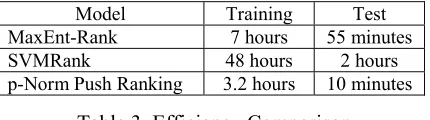
6.5 Efficiency
Model Training Test
MaxEnt-Rank 7 hours 55 minutes
SVMRank 48 hours 2 hours
p-Norm Push Ranking 3.2 hours 10 minutes
Table 3. Efficiency Comparison
6 The ACE04 value scoring metric can be found at:
http://www.nist.gov/speech/tests/ace/ace04/doc/ace04-evalplan-v7.pdf
In Table 3 we summarize the running time of these three algorithms in our application.
7 Discussion
We have shown that the other components of an IE pipeline can provide information which can substantially improve the performance of an NE tagger, and that these improvements can be real-ized through a variety of re-ranking algorithms. MaxEnt re-ranking using binary sampling and p-Norm Push Ranking proved about equally effec-tive.7 p-Norm Push Ranking was particularly ef-ficient for decoding (about 10 documents / minute), although no great effort was invested in tuning these procedures for speed.
We presented methods to handle cross-sentence inference using staged re-ranking and to incorpo-rate additional evidence through document clus-tering.
An N-best / re-ranking strategy has proven ef-fective for this task because with relatively small values of N we are already able to include highly-rated hypotheses for most sentences. Using the values of N we have used throughout (dependent on the margin of the baseline HMM, but never above 30), the upper bound of N-best performance (if we always picked the top-scoring hypothesis) is 97.4% recall, 96.2% precision, F=96.8%.
Collins (2002) also applied re-ranking to im-prove name tagging. Our work has addressed both name identification and classification, while his only evaluated name identification. Our re-ranker used features from other pipeline stages, while his were limited to local features involving lexical information and 'word-shape' in a 5-token window. Since these feature sets are essentially disjoint, it is quite possible that a combination of the two could yield even further improvements. His boost-ing algorithm is a modification of the method in (Freund et al., 1998), an adaptation of AdaBoost, whereas our p-Norm Push Ranking algorithm can emphasize the hypotheses near the top, matching our objective.
Roth and Yih (2004) combined information from named entities and semantic relation tagging, adopting a similar overall goal but using a quite different approach based on linear programming.
7 The features were initially developed and tested using the MaxEnt re-ranker,
[image:7.612.80.295.614.674.2]They limited themselves to name classification, assuming the identification given. This may be a natural subtask for English, where capitalization is a strong indicator of a name, but is much less use-ful for Chinese, where there is no capitalization or word segmentation, and boundary errors on name identification are frequent. Expanding their ap-proach to cover identification would have greatly increased the number of hypotheses and made their approach slower. In contrast, we adjust the number of hypotheses based on the margin in or-der to maintain efficiency while minimizing the chance of losing a high-quality hypothesis.
In addition we were able to capture selectional preferences (probabilities of semantic types as arguments of particular semantic relations as computed from the corpus), whereas Roth and Yih limited themselves to hard (boolean) type con-straints.
Acknowledgment
This material is based upon work supported by the Defense Advanced Research Projects Agency un-der Contract No. HR0011-06-C-0023, and the Na-tional Science Foundation under Grant IIS-00325657 and a postdoctoral research fellowship. Any opinions, findings and conclusions expressed in this material are those of the authors and do not necessarily reflect the views of the U. S. Govern-ment.
References
Daniel M. Bikel, Scott Miller, Richard Schwartz, and Ralph Weischedel. 1997. Nymble: a high-performance Learning Name-finder. Proc. ANLP1997. pp. 194-201.Washington, D.C.
Eugene Charniak and Mark Johnson. 2005. Coarse-to-Fine N-Best Parsing and MaxEnt Discriminative Reranking. Proc. ACL2005. pp. 173-180. Ann Arbor, USA
David Chiang. 2005. A Hierarchical Phrase-Based Model for Statistical Machine Translation. Proc. ACL2005. pp. 263-270. Ann Arbor, USA
Michael Collins. 2002. Ranking Algorithms for Named-Entity Extraction: Boosting and the Voted Perceptron. Proc. ACL 2002. pp. 489-496
Michael Collins and Nigel Duffy. 2002. New Ranking Algorithms for Parsing and Tagging: Kernels over Discrete Structures, and the Voted Perceptron. Proc. ACL2002. pp. 263-270. Philadelphia, USA
Michael Collins and Terry Koo. 2003. Discriminative Reranking for Natural Language Parsing.Journal of Association for Computational Linguistics. pp. 175-182.
Yoav Freund, Raj Iyer, Robert E. Schapire and Yoram Singer. 1998. An efficient boosting algorithm for combining preferences. Machine Learning: Pro-ceedings of the Fifteenth International Conference.
pp. 170-178
Ralph Grishman and Beth Sundheim. 1996. Message understanding conference - 6: A brief history. Proc. COLING1996,. pp. 466-471. Copenhagen.
James Henderson and Ivan Titov. 2005. Data-Defined Kernels for Parse Reranking Derived from Probabil-istic Models. Proc. ACL2005. pp. 181-188. Ann Ar-bor, USA.
Heng Ji and Ralph Grishman. 2005. Improving Name Tagging by Reference Resolution and Relation De-tection. Proc. ACL2005. pp. 411-418. Ann Arbor, USA.
Heng Ji and Ralph Grishman. 2006. Analysis and Re-pair of Name Tagger Errors. Proc. ACL2006 (POSTER). Sydney, Australia.
Thorsten Joachims. 1998. Making large-scale support vector machine learning practical. Advances in Ker-nel Methods: Support Vector Machine. MIT Press. Taku Kudo, Jun Suzuki and Hideki Isozaki. 2005.
Boosting-based Parse Reranking Derived from Probabilistic Models. Proc. ACL2005. pp. 189-196. Ann Arbor, USA.
John Platt, Nello Cristianini, and John Shawe-Taylor. 2000. Large margin dags for multiclass classifica-tion. Advances in Neural Information Processing Systems 12. pp. 547-553
Dan Roth and Wen-tau Yih. 2004. A Linear Program-ming Formulation for Global Inference in Natural Language Tasks. Proc. CONLL2004.pp. 1-8
Dan Roth and Wen-tau Yih. 2002. Probabilistic Rea-soning for Entity & Relation Recognition. Proc. COLING2002. pp. 835-841
Cynthia Rudin. 2006. Ranking with a p-Norm Push.
Proc. Nineteenth Annual Conference on Computa-tional Learning Theory (CoLT 2006), Pittsburgh, Pennsylvania.
Libin Shen and Aravind K. Joshi. 2003. An SVM Based Voting Algorithm with Application to Parse ReRanking. Proc. HLT-NAACL 2003 workshop on Analysis of Geographic References. pp. 9-16