Automatic Allocation of Training Data for Rapid Prototyping
of Speech Understanding based on Multiple Model Combination
Kazunori Komatani† Masaki Katsumaru† Mikio Nakano‡ Kotaro Funakoshi‡ Tetsuya Ogata† Hiroshi G. Okuno†
†Graduate School of Informatics, Kyoto University
{komatani,katumaru,ogata,okuno}@kuis.kyoto-u.ac.jp
‡Honda Research Institute Japan Co., Ltd.
{nakano,funakoshi}@jp.honda-ri.com
Abstract
The optimal choice of speech understand-ing method depends on the amount of training data available in rapid prototyp-ing. A statistical method is ultimately chosen, but it is not clear at which point in the increase in training data a statisti-cal method become effective. Our frame-work combines multiple automatic speech recognition (ASR) and language under-standing (LU) modules to provide a set of speech understanding results and se-lects the best result among them. The issue is how to allocate training data to statistical modules and the selection mod-ule in order to avoid overfitting in training and obtain better performance. This paper presents an automatic training data alloca-tion method that is based on the change in the coefficients of the logistic regres-sion functions used in the selection mod-ule. Experimental evaluation showed that our allocation method outperformed base-line methods that use a single ASR mod-ule and a single LU modmod-ule at every point while training data increase.
1 Introduction
Speech understanding in spoken dialogue systems is the process of extracting a semantic represen-tation from a user’s speech. That is, it consists of automatic speech recognition (ASR) and lan-guage understanding (LU). Because vocabularies and language expressions depend on individual
systems, it needs to be constructed for each sys-tem, and accordingly, training data are required for each. To collect more real training data, which will lead to higher performance, it is more desir-able to use a prototype system than that based on the Wizard-of-Oz (WoZ) method where real ASR errors cannot be observed, and to use a more ac-curate speech understanding module. That is, in the bootstrapping phase, spoken dialogue systems need to operate before sufficient real data have been collected.
We have been addressing the issue of rapid pro-totyping on the basis of the “Multiple Language model for ASR and Multiple language Under-standing (MLMU)” framework (Katsumaru et al., 2009). In MLMU, the most reliable speech un-derstanding result is selected from candidates pro-duced by various combinations of multiple ASR and LU modules using hand-crafted grammar and statistical models. A grammar-based method is still effective at an early stage of system devel-opment because it does not require training data; Schapire et al. (2005) also incorporated human-crafted prior knowledge into their boosting al-gorithm. By combining multiple understanding modules, complementary results can be obtained by different kinds of ASR and LU modules.
(LUMs), and a selection module that selects the most reliable speech understanding result from multiple candidates in the MLMU framework. When the amount of available training data is small, and an LUM and the selection module are trained on the same data set, they are trained un-der a closed-set condition, and thus the training data for the selection module include too many correct understanding results. In such cases, the data need to be divided into subdata sets to avoid overfitting. On the other hand, when the amount of available training data is large, so that overfit-ting does not occur, all available data should be used to train each statistical module to prepare as much training data as possible.
We therefore develop a method for switching data allocation policies. More specifically, two points are automatically determined at which sta-tistical modules with more parameters start to be trained. As a result, better overall performance is achieved at every point while the amount of training data increases, compared with all combi-nations of a single ASR module and a single LU module.
2 Related Work
It is important to consider the amount of available training data when designing a speech understand-ing module. Many statistical LU methods have been studied, e.g., (Wang and Acero, 2006; Jeong and Lee, 2006; Raymond and Riccardi, 2007; Hahn et al., 2008; Dinarelli et al., 2009). They generally outperform grammar-based LU meth-ods when a sufficient amount of training data is available; but sufficient training data are not nec-essarily available during rapid prototyping. Sev-eral LU methods were constructed using a small amount of training data (Fukubayashi et al., 2008; Dinarelli et al., 2009). Fukubayashi et al. (2008) constructed an LU method based on the weighted finite state transducer (WFST), in which filler transitions accepting arbitrary inputs and transi-tion weights were added to a hand-crafted FST. This method is placed between a grammar-based method and a statistical method because a sta-tistically selected weighting scheme is applied to a hand-crafted grammar model. Therefore, the amount of training data can be smaller
com-pared with general statistical LU methods, but this method does not outperform them when plenty of training data are available. Dinarelli et al. (2009) used a generative model for which overfitting is less prone to occur than discriminative models when the amount of training data is small, but they did not use a grammar-based model, which is expected to achieve reasonable performance even when the amount of training data is very small.
Raymond et al. (2007) compared the perfor-mances of statistical LU methods for various amounts of training data. They used a statis-tical finite-state transducer (SFST) as a genera-tive model and a support vector machine (SVM) and conditional random fields (CRF) as discrim-inative models. The generative model was more effective when the amount of data was small, and the discriminative models were more effec-tive when it was large. This shows that the perfor-mance of an LU method depends on the amount of training data available, and therefore, LU meth-ods need to be switched automatically. Wang et al. (2002) developed a two-stage speech under-standing method by applying statistical methods first and then grammatical rules. They also ex-amined the performance of the statistical methods at their first stage for various amounts of train-ing data and confirmed that the performance is not very high when a small amount of data is used.
Schapire et al. (2005) showed that accuracy of call classification in spoken dialogue systems improved by incorporating hand-crafted prior knowledge into their boosting algorithm. Their idea is the same as ours in that they improve the system’s performance by using hand-crafted hu-man knowledge while only a small amount of training data is available. We furthermore solve the data allocation problem because there are mul-tiple statistical models to be trained in speech understanding, while their call classification has only one statistical model.
3 MLMU Framework
train-LU model
ASR: automatic speech recognition LU: language understanding
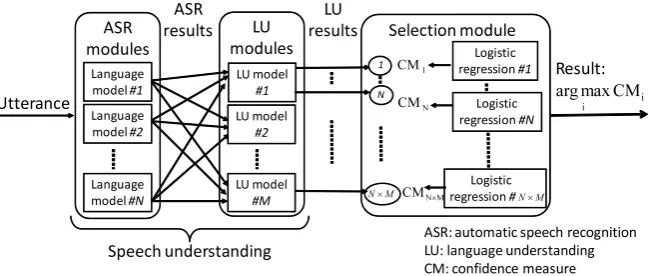
Figure 1: Overview of speech understanding framework MLMU
ing data. More specifically, the allocation policy of training data is changed and thus appropriate LMs and LUMs are selected as its result.
An overview of MLMU is shown in Figure 1. MLMU uses multiple LMs for ASR and multi-ple LUMs and selects the most reliable speech un-derstanding result from all combinations of them. We denote a speech understanding module asSUi (i= 1, . . . , n). Its result is a semantic representa-tion consisting of a set of concepts. The concept is either a semantic slot and its value or an utterance type. Note that n = N ×M, whenN LMs and
M LUMs are used. The confidence measure per utterance for a result ofi-th speech understanding module SUi is denoted asCMi. The speech un-derstanding result having the highest confidence measure is selected as the final result for the ut-terance. That is, the result is the output of SUm wherem= argmaxiCMi.
The confidence measure is calculated by logis-tic regression based on the features of each speech understanding result. A logistic regression func-tion is constructed for each speech understanding moduleSUi:
CMi =
1
1 +e−(ai1Fi1+...+ai7Fi7+bi). (1)
Parametersai1, . . . , ai7 andbi are determined by using training data. In the training phase, teacher signal 1 is given when a speech understanding re-sult is completely correct; that is, when no error is contained in the result. Otherwise, 0 is given. We use seven features, Fi1, Fi2, . . . , Fi7, as
indepen-dent variables. Each feature value is normalized
Table 1: Features of speech understanding result obtained fromSUi
Fi1: Acoustic score normalized by utterance length Fi2: Difference betweenFi1and normalized acoustic
scores of verification ASR
Fi3: Average concept CM in understanding result Fi4: Minimum concept CM in understanding result Fi5: Number of concepts in understanding result Fi6: Whether any understanding result is obtained Fi7: Whether understanding result is yes/no
CM: confidence measure
so as to make its mean zero and its variance one.
The features used are listed in Table 1. Com-pared with those used in our previous paper (Kat-sumaru et al., 2009), we deleted ones that were highly correlated with other features and added ones regarding content of the speech understand-ing results. Features Fi1 and Fi2 are obtained
from an ASR result. Another ASR with a gen-eral large vocabulary LM is executed for verifying thei-th ASR result. Fi2 is the difference between
its score andFi1 (Komatani et al., 2007). These
two features represent the reliability of the ASR result. Fi3andFi4are calculated for each concept
in the LU result on the basis of the posterior prob-ability of the 10-best ASR candidates (Komatani and Kawahara, 2000). Fi5 is the number of
con-cepts in the LU result. This feature is effective be-cause the LU results of lengthy utterances tend to be erroneous in a grammar-based LU.Fi6
U1: It is June ninth.
ASR result:
- grammar “It is June ninth.” - N-gram “It is June noon and” LU result:
- grammar + FST ”month:6 day:9 type:refer-time” - N-gram + WFST ”month:6 type:refer-time”
U2: I will borrow it on twentieth.
(Underlined part is out-of-grammar.) ASR result:
- grammar “Around two pm on twentieth.” - N-gram “Around two at ten on twentieth.” LU result:
- grammar + FST ”day:20 hour:14 type:refer-time” - N-gram + WFST ”day:20 type:refer-time”
Combination of LM and LUM is denoted as “LM+LUM”.
Figure 2: Example of speech understanding re-sults in MLMU framework
regarded as an error.Fi7is added because
affirma-tive and negaaffirma-tive responses, typically “Yes” and “No”, tend to be correctly recognized and under-stood.
Figure 2 depicts an example when multiple ASRs based on LMs and multiple LUs are used. In short, the correct speech understanding result is obtained from a different combination of LMs and LUMs.
4 Automatic Allocation of Training Data Using Change in Coefficients
The training data need to be allocated to the speech understanding modules (i.e., statistical LM and statistical LUM) and the selection module. If more data are allocated to the ASR and LU mod-ules, the performances of these modules are im-proved, but the overall performance is degraded because of the low performance of the selection module. On the other hand, even if more training data are allocated to the selection module, the per-formance of each ASR and LU module remains low.
4.1 Allocation Policy
We focus on the convergence of the logistic re-gression functions when the amount of training data increases. The convergence is defined as the change in their coefficients, which will appear later as Equation 2, and determines two points
1. All data are used to
train selection modules 2. Data are allocated to SUand selection modules 3. Data are
not divided
No No
Yes Yes
Selection module
first converges? No over-fittingoccurs?
Amount of training data increases
SU: speech understanding
Figure 3: Flowchart of data allocation
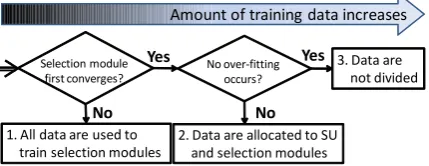
during the increase in training data, and thus three phases are defined. The flowchart of data alloca-tion is depicted in Figure 3. The three phases are explained below.
In the first phase, the first priority is given to the selection module. This is because the lo-gistic regression functions used in the selection module converge with relatively less training data than those in the statistical ASR and LU mod-ules for speech understanding; there are eight pa-rameters for each logistic regression function as shown in Equation 1, far fewer than for other sta-tistical models such as N-gram and CRF. The out-put from a speech understanding module that em-ploys grammar-based LM and LUM would be the most reliable in many cases because its perfor-mance is better than that of other statistical mod-ules when a very small amount of training data is available. As a result, equivalent or better perfor-mance would be achieved than methods using a single ASR module and a single LU module.
In the second phase, the training data are also allocated to the speech understanding modules af-ter the selection module converges. This aims to improve the performance of the speech under-standing modules by allocating as much training data to them as possible. The amount of train-ing data is fixed in this phase to the amount al-located to the selection module determined in the first phase. The remaining data are used to train the speech understanding modules.
mod-ules without dividing the data in this phase.
4.2 Determining When to Switch Allocation
Policies
Automatic switching from one phase to the next requires the determination of two points in the number of training utterances: when the selec-tion module first converges (konlysel) and when the speech understanding modules all become sta-ble (knodiv). These points are determined by fo-cusing on the changes in the coefficients of the logistic regression functions when the number of utterances used as training data increases. We ob-serve the sum of the changes in the coefficients of the functions and then identify the points at which the changes converge. The points are determined individually by the following algorithm.
Step 1 Construct two logistic regression
func-tions for speech understanding module SUi by using k and (k +δk) utterances out of
kmax utterances, where kmax is the amount of training data available.
Step 2 Calculate the change in coefficients from
the two logistic regression functions by
Δi(k) =
j
|aij(k+δk)−aij(k)|
+|bi(k+δk)−bi(k)|, (2)
where aij(k) and bi(k) denote the param-eters of the logistic regression functions, shown in Equation 1, for speech understand-ing moduleSUi, whenkutterances are used to train the functions.
Step 3 If Δi(k) becomes smaller than threshold
θ, consider that the training of the functions has converged, and record thiskas the point of convergence. If not, return to Step 1 after
k←k+δk.
Theδk is the minimum unit of training data con-taining various utterances. We set it as the number of utterances in one dialogue session, whose aver-age was 17. Thresholdθwas set to 8, which corre-sponds to the number of parameters in the logistic
regression functions. No experiments were con-ducted to determine if better performance could be achieved with other choices ofθ1.
The first point,konlysel, is determined using the speech understanding module that uses no training data. Specifically, we used “grammar+FST” as methodSUi. Here, “LM+LUM” denotes a com-bination of LM for ASR and LUM. If the func-tion converges at kutterances, we set konlysel to
kand fix thekutterances as training data used by the selection module. The remaining (kmax−k) utterances are allocated to the speech understand-ing modules, that is, the LMs and LUMs. Note that ifk becomes equal to kmax before Δi con-verges, all training data are allocated to the selec-tion module; that is, no data are allocated to the LMs and LUMs. In this case, no output is ob-tained from statistical speech understanding mod-ules, and only outputs from the grammar-based modules are used.
The second point,knodiv, is determined on the basis of the speech understanding module that needs the largest amount of data for training. The amount of data needed depends on the number of parameters. Specifically, we used “N-gram+CRF” asSUi in Equation 2. If the function converges, we hypothesize that the performance of all the speech understanding modules stabilize and thus overfitting does not occur. We then stop the divi-sion of training data, and use all available data to train the statistical modules.
5 Experimental Evaluation
5.1 Target Data and Implementation
We used a data set previously collected through actual dialogues with a rent-a-car reservation sys-tem (Nakano et al., 2007) with 39 participants. Each participant performed 8 dialogue sessions, and 5900 utterances were collected in total. Out of these utterances, we used 5240 for which the automatic voice activity detection (VAD) results agreed with manual annotation. We divided the utterances into two sets: 2121 with 16 participants as training data and 3119 with 23 participants as the test data.
1
We constructed another rent-a-car reservation system to evaluate our allocation method. The system included two language models (LMs) and four language understanding models (LUMs). That is, eight speech understanding results in total were obtained. The two LMs were a grammar-based LM (“grammar”, hereafter) and a domain-specific statistical LM (“N-gram”). The grammar model was described by hand to be equivalent to the FST model used in LU. The N-gram model was a class 3-gram and was trained on a tran-scription of the available training data. The vo-cabulary size was 281 for the grammar model and 420 for the N-gram model when all the training data were used. The ASR accuracies of the gram-mar and N-gram models were 67.8% and 90.5% for the training data and 66.3% and 85.0% for the test data when all the training data were used. We used Julius(ver. 4.1.2) as the speech recognizer and a gender-independent phonetic-tied mixture model as the acoustic model (Kawahara et al., 2004). We also used a domain-independent statis-tical LM with a vocabulary size of 60250, which was trained on Web documents (Kawahara et al., 2004), as the verification model.
The four LUMs were a finite-state transducer (FST) model, a weighted FST (WFST) model, a keyphrase-extractor (Extractor) model, and a conditional random fields (CRF) model. In the FST-based LUM, the FST was constructed by hand. The WFST-based LUM is based on the method developed by Fukubayashi et al. (2008). The WFSTs were constructed by using the MIT FST Toolkit (Hetherington, 2004). The weight-ing scheme used for the test data was selected by using training data (Fukubayashi et al., 2008). In the extractor-based LUM, as many parts as pos-sible in the ASR result were simply transformed into concepts. As the CRF-based LUM, we used open-source software, CRF++2, to construct the LUM. As its features, we use a word in the ASR result, its first character, its last character, and the ASR confidence of the word. Its parameters were estimated by using training data.
The metric used for speech understanding per-formance was concept understanding accuracy,
2
http://crfpp.sourceforge.net/
Table 2: Absolute degradation in oracle accuracy when each module was removed
Case (A) (B)
With all modules (%) 86.6 90.1 w/o grammar ASR -12.0 -1.1 w/o N-gram ASR -6.1 -7.7
w/o FST LUM -0.4 0.0
w/o WFST LUM -1.2 -0.5
w/o Extractor LUM -0.1 0.0
w/o CRF LUM -0.6 -3.7
(w/o FST & Extractor LUMs) -1.0 -0.1
(A): 141 utterances with 1 participant (B): 2121 utterances with 16 participants
defined as
1− SUB+INS+DEL
no. of concepts in correct results,
where SUB, INS, and DEL denote the numbers of substitution, insertion, and deletion errors.
5.2 Effectiveness of Using Multiple LMs and
LUMs
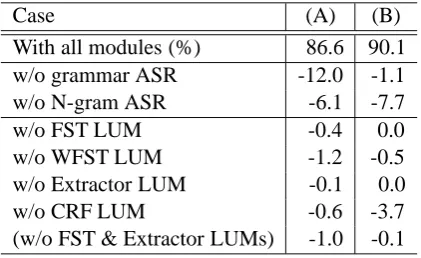
We investigated how much the performance of our framework degraded when one ASR or LU mod-ule was removed. We used the oracle accuracies, i.e., when the most appropriate result was selected by hand. The result reveals the contribution of each ASR and LU module to the performance of the framework. A module is regarded as more im-portant when the accuracy is degraded more when it is removed than when another one is removed. Two cases (A) and (B) were defined: when the amount of available training data was (A) small and (B) large. We used 141 utterances with 1 par-ticipant for case (A) and 2121 utterances with 16 participants for case (B). The results are shown in Table 2.
0
Number of training utterances available
(a) grammar+FST
Number of training utterances available
(b) N-gram+CRF
Figure 4: Change in the sum of coefficients Δiwhen amount of training data increases (“LM+LUM” denotes combination of LM and LUM)
On the other hand, when a large amount of training data was available (case (B)), the ac-curacy was degraded by 1.1 points when the grammar-based ASR was removed. This means that it became less important when there are plenty of training data because the coverage of the N-gram-based ASR became wider. In short, espe-cially when the amount of training data is smaller, speech understanding modules based on a hand-crafted grammar are more important because of the low performance of statistical modules.
Concerning the LUMs, the accuracy was de-graded when any of the LUM modules was re-moved when a small amount of training data was available. When a large amount of training data was available, the module based on CRF in par-ticular became more important.
5.3 Results and Evaluation of Automatic
Allocation
Figure 4 shows the change in the sum of the co-efficients, Δi, with the increase in the amount of training data. In Figure 4(a), the change was very large while the amount of training data was small, and decreased dramatically and converged around one hundred utterances. By applyingθ(=8) toΔi, we set 111 utterances as the first point, konlysel, up to which all the training data are allocated to the selection module, as described in Section 4.1. Similarly, from the results shown in Figure 4(b), we set 207 utterances as the second point,knodiv, from which the training data are not divided.
To evaluate our method for allocating training
55
50 100 200 400 800 1600
Co
Number of training utterances available Our method Naïve allocation No division
Figure 5: Results of allocation methods
data, we compared it with two baseline methods:
• No-division method: All data available at each point were used to train both the speech understanding modules and the selection module. That is, the same data set was used to train them.
• Naive-allocation method: Training data available at each point were allocated equally to the speech understanding modules and the selection module.
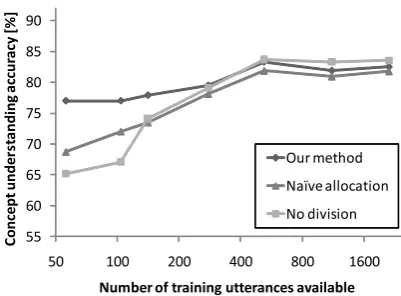
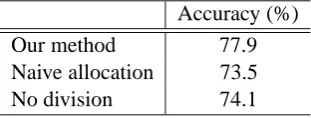
As shown in Figure 5, our method had the best concept understanding accuracy when the amount of training data was small, that is, up to about 278 utterances. This indicates that our method for allocating the available training data is effective when the amount of training data is small.
us-Table 3: Concept understanding accuracy for 141 utterances
Accuracy (%) Our method 77.9 Naive allocation 73.5 No division 74.1
ing the case in which 141 utterances were used as the training data. 111 (=konlysel) were secured to train the selection module and 30 utterances were allocated to train the speech understanding mod-ules. As shown in Table 3, the accuracy with our method was 3.8 points higher than that with the no-division baseline method. This was achieved by avoiding the overfitting of the logistic regres-sion functions; i.e., the data input to the functions became similar to the test data due to allocation, so the concept understanding accuracy for the test set was improved. The accuracy with our method was 4.4 points higher than that with the naive al-location baseline method. This was because the amount of training data allocated to the selection module was less than our method, and accordingly the selection module was not trained sufficiently.
5.4 Comparison with methods using a single
ASR and a single LU
Figure 6 plots concept understanding accuracy with our method against baseline methods using a single ASR module and a single LU module for various amounts of training data. Each module for comparison was constructed by using all available training data at each point while training data in-creased; i.e., the same condition as our method. The accuracies of only three speech understand-ing modules are shown in the figure, out of the eight obtained by combining two LMs for ASR and four LUMs. These three are the ones with the highest accuracies while the amount of training data increased. Our method switched the alloca-tion phase at 111 and 207 utterances, as described in Section 5.3.
Our method performed equivalently or better than all baseline methods even when only a small amount of training data was available. As a result, our method outperformed all the baseline methods
55 60 65 70 75 80 85
50 100 200 400 800 1600
Co nc ep t u nd er st an di ng ac cu ra cy [% ]
Number of training utterances available our method grammar+FST N-gram+WFST N-gram+CRF
Figure 6: Comparison with baseline methods us-ing sus-ingle speech understandus-ing
at every point while training data increase.
6 Conclusion
We developed a method to automatically allo-cate training data to statistical modules so as to avoid performance degradation caused by overfit-ting. Experimental evaluation showed that speech understanding accuracies achieved by our method were equivalent or better than the baseline meth-ods based on all combinations of a single ASR module and a single LU module at every point while training data increase. This includes a case when a very small amount of training data is avail-able. We also showed empirically that the training data should be allocated while an amount of train-ing data is not sufficient. Our method allocated available training data on the basis of our alloca-tion policy described in Secalloca-tion 4.1, and outper-formed the two baselines where the training data were equivalently allocated and not allocated.
References
Dinarelli, Marco, Alessandro Moschitti, and Giuseppe Riccardi. 2009. Re-Ranking Models for Spoken Language Understanding. In Proc. European
Chap-ter of the Association for Computational Linguistics (EACL), pages 202–210.
Fukubayashi, Yuichiro, Kazunori Komatani, Mikio Nakano, Kotaro Funakoshi, Hiroshi Tsujino, Tet-suya Ogata, and Hiroshi G. Okuno. 2008. Rapid prototyping of robust language understanding mod-ules for spoken dialogue systems. In Proc.
Interna-tional Joint Conference on Natural Language Pro-cessing (IJCNLP), pages 210–216.
Hahn, Stefan, Patrick Lehnen, and Hermann Ney. 2008. System Combination for Spoken Language Understanding. In Proc. Annual Conference of the
International Speech Communication Association (INTERSPEECH), pages 236–239.
Hetherington, Lee. 2004. The MIT Finite-State Trans-ducer Toolkit for Speech and Language Processing. In Proc. Int’l Conf. Spoken Language Processing
(ICSLP), pages 2609–2612.
Jeong, Minwoo and Gary Geunbae Lee. 2006. Ex-ploiting non-local features for spoken language
un-derstanding. In Proc. COLING/ACL 2006 Main
Conference Poster Sessions, pages 412–419.
Katsumaru, Masaki, Mikio Nakano, Kazunori Ko-matani, Kotaro Funakoshi, Tetsuya Ogata, and
Hi-roshi G. Okuno. 2009. Improving speech
un-derstanding accuracy with limited training data us-ing multiple language models and multiple under-standing models. In Proc. Annual Conference of
the International Speech Communication Associa-tion (INTERSPEECH), pages 2735–2738.
Kawahara, Tatsuya, Akinobu Lee, Kazuya Takeda, Katsunobu Itou, and Kiyohiro Shikano. 2004. Re-cent progress of open-source LVCSR engine Julius and Japanese model repository. In Proc. Int’l Conf.
Spoken Language Processing (ICSLP), pages 3069–
3072.
Komatani, Kazunori and Tatsuya Kawahara. 2000.
Flexible mixed-initiative dialogue management us-ing concept-level confidence measures of speech recognizer output. In Proc. Int’l Conf.
Computa-tional Linguistics (COLING), pages 467–473.
Komatani, Kazunori, Yuichiro Fukubayashi, Tetsuya Ogata, and Hiroshi G. Okuno. 2007. Introducing utterance verification in spoken dialogue system to improve dynamic help generation for novice users. In Proc. 8th SIGdial Workshop on Discourse and
Dialogue, pages 202–205.
Nakano, Mikio, Yuka Nagano, Kotaro Funakoshi, Toshihiko Ito, Kenji Araki, Yuji Hasegawa, and Hi-roshi Tsujino. 2007. Analysis of user reactions to turn-taking failures in spoken dialogue systems. In
Proc. 8th SIGdial Workshop on Discourse and Dia-logue, pages 120–123.
Raymond, Christian and Giuseppe Riccardi. 2007.
Generative and Discriminative Algorithms for
Spo-ken Language Understanding. In Proc. Annual
Conference of the International Speech Communi-cation Association (INTERSPEECH), pages 1605–
1608.
Shapire, Robert E., Marie Rochery, Mazin Rahim, and Narendra Gupta. 2005. Boosting with prior knowl-edge for call classification. IEEE Trans. on Speech
and Audio Processing, 13(2):174–181.
Wang, Ye-Yi and Alex Acero. 2006.
Discrimina-tive models for spoken language understanding. In
Proc. Int’l Conf. Spoken Language Processing (IN-TERSPEECH), pages 2426–2429.
Wang, Ye-Yi, Alex Acero, Ciprian Chelba, Brendan Frey, and Leon Wong. 2002. Combination of Sta-tistical and Rule-based Approaches for Spoken Lan-guage Understanding. In Proc. Int’l Conf. Spoken