131
A Performance Evaluation on Lossy Compression
With Various Methods With A Proposed Hybridisation
of Harr-Dct Methods
P.Arul Prabu
1,
Dr.S.Rizwana
21Research Scholar,2Assistant Professor & Head 2Department of Computer Science Erode Arts &Science College ,Erode [email protected],[email protected]
Abstract:In the era of computer technology, information processing systems rides in path in multi-dimensional aspects for better accuracy and time consuming. In the field of image processing image consumes more storage spaces and occupy wide spectrum in transmitting such information via different types of network medium. Even though the image is processed by efficient methodologies it gets choked in the concept of storage and transmission. In order to overcome the barriers in storage and transmission various buds of image compression has been flowered in the way of Lossy compression. Various methods has been analysed and in this paper, we made a analysis and performance evaluation on various methods on lossy compression. Also the main objective of this research is to propose a novel methodology which is the hybridisation of Harr and DCT to overcome the maximum issues in the area of image compression. Based on the performance an integrated model is to be developed to achieve better results and make the storage and transmission in and triggered bullet manner. The experimentation is to be carried out with the MATLAB and the performance of the proposed compression technique is evaluated and compared with the existing models.
Keywords: Image Compression. Lossy, Compression Ratio, Haar Wavelet Transform, Fast Fourier Transform, Discrete Cosine Transform.
1. INTRODUCTION
An image is essentially a 2-D signal processed by the human visual system.[11] The signals representing images are usually in analog form. However, for processing, storage and transmission by computer applications, they are converted from analog to digital form. A digital image is basically a 2-Dimensional array of pixels. Images from the significant part of data, particularly in remote sensing, biomedical and video conferencing applications. The use of and dependence on information and computers continue to grow, so too does our need for efficient ways of storing and transmitting large amounts of data.
Image compression addresses the problem of reducing the amount of data required to represent a digital image.[1] It is a process intended to yield a compact representation of an image, thereby reducing the image storage/transmission requirements. Compression is achieved by the removal of one or more of the three basic data redundancies: 1. Coding Redundancy 2. Interpixel Redundancy 3. Psycho visual Redundancy .There are basically two types of image compression: 1. Lossy compression 2. Lossless compression
In the technique of Lossy compression, it decreases the bits by recognizing the not required information and by eliminating it. The system of decreasing the size of the file of data is commonly termed as the data-compression, though its formal
name is the source-coding that is coding get done at source of data before it gets stored or sent. In these methods few loss of the information is acceptable. Dropping non-essential information from the source of data can save the storage area. The Lossy data-compression methods are aware by the researches on how the people anticipate data in the question. As an example, the human eye is very sensitive to slight variations in the luminance as compare that there are so many variations in the colour. The Lossy image compression technique is used in the digital cameras, to raise the storage ability with the minimal decline of the quality of picture. Similarly in the DVDs which uses the lossy MPEG-2 Video code technique for the compression of the video. In the lossy audio compression, the techniques of psycho acoustics have been used to eliminate the non-audible or less audible components of signal.
Lossy compression methods have larger compression ratios as compared to the lossless compression techniques. Lossy methods are used for most applications. By this the output image that is reconstructed image is not exact copy but somehow resembles it at larger portion. The various lossy compression methods such as Block truncation coding , Code Vector quantization, Fractal coding , Transform coding , Sub-band coding
2. RELATED WORK
132 processing. Lossy methods of compression produce
loss of information at the cost of reduction in size, whereas lossless methods do not produce any loss in information. But they have certain limitations so their commercial importance is less. Lossy compression is used where losing some information is tolerable such as audio, still images.
[2] The lossless method of image compression and decompression using a simple coding technique called Run length coding is compared with Huffman coding and lossy compression technique using DCT (Discrete Cosine Transform) and FFT(Fast Fourier Transform) are compared with Haar wavelet transform. The experimental results are analysed to compare the performance of various compression techniques.
[3] A compound image compression scheme based on the dictionary-based Lempel-Ziv-Markov chain algorithm (LZMA), under the framework of High Efficiency Video Coding (HEVC). Through matching strings from the sliding window dictionary, LZMA exploits the characteristics of the repeated patterns over the text and graphics regions of compound images, and represents them compactly. To obtain high compression efficiency even for noisy text and graphics contents, we have modified LZMA to support both lossless and lossy compression.
[4]Two reversible algorithms, (BWT: Burrows-Wheeler and MTF: Move to Front), principally developed for the compression of texts, in combination with the spectrum quantification of the quaternionic transformation, for realize the compression of 2D image. Subsequently, the performance will be determined by the compression ratio chose and the level of loss accepted, and comparison, with the similar results obtained with standard methods. Finally, minimization of computing time and possible extension from the colour image, open interesting prospects.
In lossless, the original image is exactly reconstructed after the decompression whereas, lossy may loose some information from the image data. Lossless gives more accuracy as compared to the lossy compression [ [5] The Lossless method of image compression and decompression using a simple coding technique called Huffman coding. This technique is simple in implementation and utilizes lessmemory. A software algorithm has been developed and implemented to compress and decompress the given image using Huffman coding techniques in a MATLAB platform [6] The basic approach in compressing methods is based on the fractal features and searching the best replacement block for the original image. In this approach the best blocks are the neighbourhood blocks, this approach tries to find the best neighbour blocks; Huffman coding can offer better fast fractal compression than Arithmetic coding When compare to Arithmetic coding ,Huffman coding is best for compression, It increases the speed of compression and produces high PSNR. This work saves lot of bits
in the image transmission and it also decrease the time for producing a compressed image and also increase the quality of decompressed image. Totally genetic algorithm increases the speed of convergence for reaching the best block.
[7] An image compression algorithm using Modified Fast Haar Wavelet Transformation(MFHWT) and SPIHT. It is considered that Haar functions are simplest wavelets.[9] Compression of the colour images has many applications in most of the mobile technologies. Reducing the time taken for file transfer is important in digital communication fields. Image compression means reducing the graphics file size,without degrading the quality of the image. For digital images, Fractal image Compression (FIC) has been considered as an efficient method. FIC is a lossy compression method that explores the self similar property for natural image. In this paper, a combination of Discrete Cosine Transform and fractal with quad tree technique and Run Length Encoding is proposed to compress the image. Implementation result shows that the image is compressed effectively using the proposed work.
3. METHODOLOGY
3.1 Haar Wavelet Transform [12]
Wavelets [14,15] are lossy compression technique essentially a type of multiresolution function approximation that allow for the hierarchical de-composition of a signal or image. Wavelets are functions generated from a single function by its dilations and translation. Haar transforms the simplest compression process of this kind. The Haar transform provides a multiresolution representation of an image with wavelet features at different scales capturing different levels of detail; the scale wavelets encode large regions, while the fine scale wavelets describe smaller, local regions. The wavelet coefficients preserve all the information in the original image. Haar transform decomposes each signal into two components namely the average and the difference [5, 6]. It is used to reduce the memory requirements and the amount of inefficient movement of Haar coefficients.
3.2 Fast Fourier Transform (Fft)
The FFT is a basic algorithm used in much of signal processing, image processing, and data compression. A Fast Fourier Transform (FFT) is a faster, computational, efficient algorithm to compute the Discrete Fourier Transform (DFT) [15] and it’s inverse.
Let x0, ...., xN-1be complex numbers. The DFT is defined by the formula
(1)
133 representation [21]. The functions Y = fft(x) and y =
ifft(X) implement the transform and inverse transform pair given for vectors of length N by:
2)
The FFT algorithm reduces the computational burden to O(nlog)arithmetic operation. FFT requires the number of data points to be a power of 2.FFT requires evenly spaced time series.
3.3 Discrete Cosine Transform (Dct)
A discrete cosine transform (DCT) is a technique for converting a signal into elementary frequency components [16]. It expresses a sequence of finitely numerous data points in terms of a sum of cosine functions oscillating at different frequencies which is widely used in image compression.
The DCT helps to separate the image into parts (or spectral sub-bands) of differing importance (with respect to the image's visual quality). DCT converts an image from spatial domain into a frequency domain. The DCT is closely related to the Discrete Fourier Transform (DFT) with some dissimilarity. Coefficients produced by a DCT operation on a block of pixels are similar to the frequency domain coefficients produced by a DFT operation. For processing one-dimensional signals such as speech waveforms one-dimensional DCT is used.
For analysis of two dimensional (2D) signals such as images, a 2D version of the DCT is required. As the 2-Dimensional DCT can be computed by applying 1D transforms separately to the rows and columns, it can be said that the 2D DCT is separable in the two dimensions.
For an M × N digital image f (x, y), its two-dimensional discrete cosine transform and its inverse transformation is defined by the following equations [15].
3.4 Proposed Methodology
In the previous section the existing three methodologies were discussed. In order to improve the efficiency the hybridisation of Haar and DCT transform were hybridized and the process flow diagram is represented as follows.
Fig.1 proposed Hybrid HARR-DCT Method From the above figure the input image is selected from the image database. Initially the image is gets compressed with the Harr transform and then the output of the Harr transform is again compressed with the DCT using the following equations as discussed below. Then the compression ratio is been estimated and the resultant image is displayed.
There, C (u, v) is the result of discrete transform, and also known as DCT coefficient. Where, u, v = 0, 1, 2 ... N-1x, y = 0, 1, 2, ... N-1
α (u) is defined as follows:
4. ALGORITH
Input :Original Image
Output: Compressed Image
Select Input Image
Apply Harr Wavelet
Transform
Apply DCT
Estimate the Compression Ratio
Output Image
Step 1: Select Image from Image Database
Step 2: Apply the Haarwavlet transform
Step 3 : Apply DCT for the output image from Step 2
Step 4: Estimate the Compression ratio
134
5. EXPERIMENTATION & RESULTS
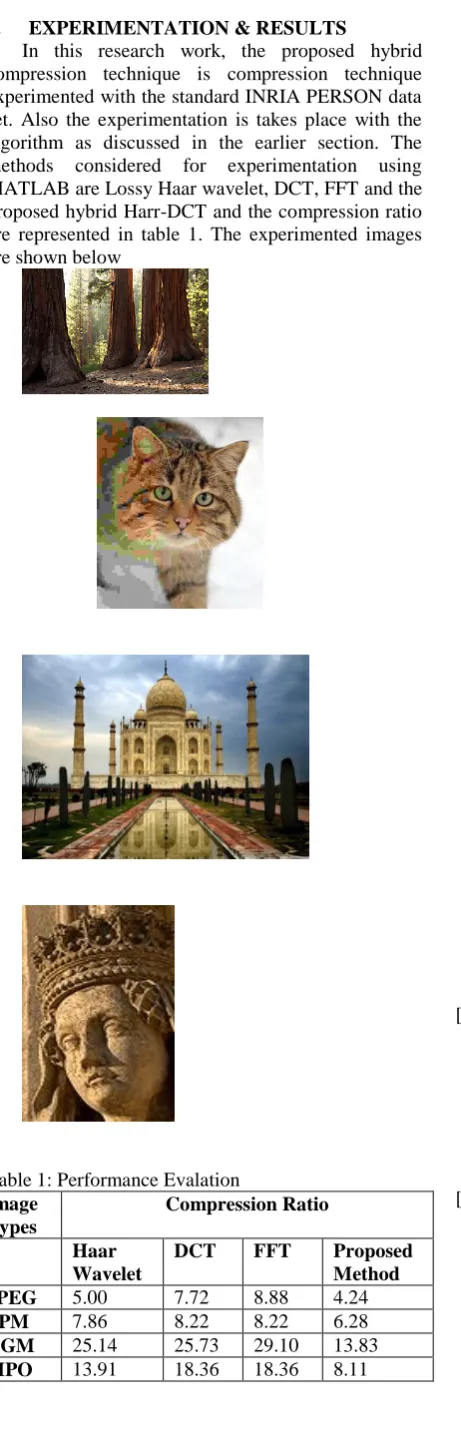
In this research work, the proposed hybrid compression technique is compression technique experimented with the standard INRIA PERSON data set. Also the experimentation is takes place with the algorithm as discussed in the earlier section. The methods considered for experimentation using MATLAB are Lossy Haar wavelet, DCT, FFT and the proposed hybrid Harr-DCT and the compression ratio are represented in table 1. The experimented images are shown below
[image:4.595.79.310.64.781.2]
Table 1: Performance Evalation Image
Types
Compression Ratio
Haar Wavelet
DCT FFT Proposed
Method
JPEG 5.00 7.72 8.88 4.24
PPM 7.86 8.22 8.22 6.28
CGM 25.14 25.73 29.10 13.83 MPO 13.91 18.36 18.36 8.11
From the above table 1 four images types were experimented and the compression ratios were presented. From the above results the proposed hybrid model provides better results compared to the existing methods.
6. CONCLUSION
In the field of image processing image consumes more storage spaces and occupy wide spectrum in transmitting such information via different types of network medium. An analysis and performance evaluation on various methods on lossy compression such as The Harr Wavelet transform, DCT and FFT . In this research is to proposed a novel methodology which is the hybridisation of Harr and DCT to overcome the maximum issues in the area of image compression. Based on the performance an integrated model is to be developed to achieve better results .The experimentation is carried out with the MATLAB and the performance of the proposed compression technique is evaluated and compared with the existing models.
7. FUTURE WORK
In the future work the image were get proper pre-processed with an efficient filter and an integrated model for lossy compression will be developed to achieve more results
REFERENCES
[1] Dinesh V. Rojatkar, Nitesh D. Borkar, Buddhabhushan R. Naik, Ravindra N. Peddiwar, Image Compression Techniques: Lossy and Lossless, International Journal of Engineering Research and General Science Volume 3, Issue 2, March-April, 2015 , ISSN 2091-2730
[2] Gomathi, T.Santhana , Performance Analysis of Lossless and Lossy Image Compression Techniques for Human Object, International Journal of Applied Engineering Research ISSN 0973-4562 Volume 13, Number 15 (2018) pp. 11715-11723
[3] Cuiling Lan1, Jizheng Xu1, Wenjun Zeng1,
Feng WuCOMPOUND IMAGE
COMPRESSION USING LOSSLESS AND LOSSY LZMA IN HEVC 2 ,1Microsoft Research Asia, 2University of Science and Technology of China {culan, jzxu, wezeng}@microsoft.com,
135 Cedex France
[5] Khandwani , P E Ajmire, A Survey of Lossless Image Compression Techniques , International Journal of Electrical Electronics & Computer Science Engineering Volume 5, Issue 1 (February, 2018) | E-ISSN : 2348-2273 | P-ISSN : 2454-1222
[6] JAGADISH H. PUJAR, LOHIT M. KADLASKAR, A NEW LOSSLESS METHOD OF IMAGE COMPRESSION
ANDDECOMPRESSION USING
HUFFMAN CODING TECHNIQUES, Journal of Theoretical and Applied Information Technology,pp.18-23,jatit.org [7] D. Venkatasekhar*, P. Aruna, A FAST
FRACTAL IMAGE COMPRESSION
USING HUFFMAN CODING, Asian Journal of Computer Science And Information Technology 2: 9 (2012) 272– 275.,ISSN:1149-5126
[8] Kaur, Preeti Singh, A NEW METHOD OF
IMAGE COMPRESSIONUSING
IMPROVED SPIHT AND MFHWT,
International Journal of Latest Research in Science and Technology, Vol.1,Issue 2 :Page No124-126 ,July-August 2012, ISSN (Online):2278-5299
[9] K. Sharmila, K. Kuppusamy, An Efficient Image Compression Method using DCT,Fractal and Run Length Encoding Techniques, International Journal of Engineering Trends and Technology (IJETT) – Volume 1,pp.287-290, Number 6 – Jul 2014, ISSN: 2231-5381
[10] Kharate G. and Patil V., “Color Image Compression Based on Wavelet
Packet Best Tree,” International Journal of Computer Science Issues,vol. 7, no. 2, pp. 31-35, 2010.
[11] Malkitsingh, REVIEW OF LOSSLESS IMAGE COMPRESSION, IJSRET, ISSN 2278 – 0882 Volume 5, Issue 2, February 2016.
[12] T.Santhanam, S.Gomathi,” Representing a image using a Haar-wavelet Transformation for Human Parts Detection”,2014, International Conference on Information Communication and Embedded Systems (ICICES).
[13] NavjotKaur, Pree.ti Singh,2012 “A New Method of Image Compression Using Improved SPIHT andMFHWT,” International Journal of Latest Research inScience and Technology,Vol.1(2), pp.124-126.
[14] Frigo, M. and S. G. Johnson,1998, "FFTW: AnAdaptive Software Architecture for the FFT",Proceedings of the International Conference on Acoustics, Speech, and Signal Processing, Vol. 3, pp. 1381-1384.