3728
Structured Representation Learning for Online Debate Stance Prediction
Chang Li Aldo Porco Dan Goldwasser
Department of Computer Science Purdue University, West Lafayette, IN 47907 {li1873, aporco, dgoldwas}@purdue.edu
Abstract
Online debates can help provide valuable information about various perspectives on a wide range of issues. However, understanding the stances expressed in these debates is a highly challenging task, which requires modeling both textual content and users’ conversational interactions. Cur-rent approaches take a collective classification approach, which ignores the relationships between different debate topics.
In this work, we suggest to view this task as a representation learning problem, and embed the text and authors jointly based on their interactions. We evaluate our model over the Internet Argumentation Corpus, and compare different approaches for structural information embedding. Experimental results show that our model can achieve significantly better results compared to previous competitive models.
1 Introduction
In recent years, social media platforms play an increasingly important role in shaping political discourse. Online debate forums allow users to voice their opinions and engage with other users holding different views. Understanding the interactions between the users on these platforms can help provide insight into current political discourse, argumentation strategies and can help gauge public sentiment on policy issues on a large scale. The importance of understanding debate dialog has motivated significant research efforts (Somasundaran and Wiebe, 2010; Anand et al., 2011; Ghosh et al., 2014; Walker et al., 2012b; Hasan and Ng, 2013; Sridhar et al., 2015; Mohammad et al., 2016; Dong et al., 2017).
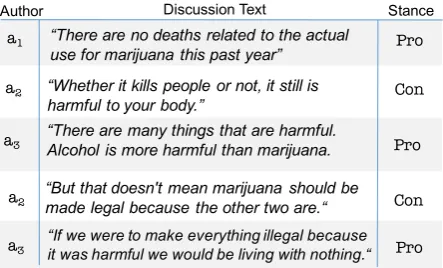
In this paper, we focus on stance prediction, automatically identifying the stance expressed in debate posts on various issues. For example, Figure 1 describes a short debate dialog about marijuana legal-ization between three users (denoteda1, a2, a3). The content associated with each user is classified as
supportive of legalization (PRO), or not (CON).
“There are no deaths related to the actual use for marijuana this past year”
“There are many things that are harmful. Alcohol is more harmful than marijuana.
“But that doesn't mean marijuana should be made legal because the other two are.“ a2
a3
“Whether it kills people or not, it still is harmful to your body.”
a2 a1
“If we were to make everything illegal because it was harmful we would be living with nothing.“
a3
Pro
Con
Pro
Con
Pro
Author Discussion Text Stance
Figure 1: Example of excerpts from a debate between three users about marijuana legalization.
Early work took a text classification approach (Somasundaran and Wiebe, 2010; Anand et al., 2011), classifying individual posts using a rich feature set. Since debate posts are not written in isolation, but rather express the conversational interactions between users, modeling these interactions can help allevi-ate some of the difficulty of this task. More recent work take a collective classification approach (Hasan and Ng, 2013; Sridhar et al., 2015), which models the dependencies between authors and their content and captures the debate structure. For example, the interactions between users can expressagreements
(or disagreements), which would entail a similar (or different) stance prediction associated with their content. The stance decision can also be considered as a user level decision, as users tend to maintain the same stance throughout the debate, forcing stance agreement between all of their posts. Unfortunately, despite these efforts, stance classification remains a challenging problem.
In this paper we suggest a new approach for representing the structural dependencies of debate dialogs, by taking astructured representation learningapproach. Intuitively, our system is designed to exploit the advantages of collective relational classification methods (often discussed in the context of graphical models) and distributed representation learning (often discussed in the context of deep learning and embedding). We suggest a method for combining the two approaches in a single framework that can exploit their complimentary strengths.
Our key intuition is that the embedding function can be trained to respect the relevant structural depen-dencies. We jointly embed all the debate objects (i.e., authors, stances and textual posts), by considering the relationships between these objects. For example, we model stance classification as a relationship between a post and a given stance label, by measuring the similarity between their embedded tations. We can also model the relationships between input objects; the similarity between the represen-tations of two posts would entail agreement between the labels associated with them, thus allowing us to perform collective classification over all the input instances. Specifically, we define the factor graph corresponding to the dependencies between stance predictions in a debate thread, and use the similarity between the embedded representation of objects as a scoring function for the factors. We explain this process in more detail in Section 3.
The main strength of distributed representations is in their ability to share information between the represented objects. We exploit this property, and show that by adding additional information to the embedding space, the overall performance of the model improves,even if this information is not directly relevant to the classification task. We demonstrate this fact by comparing stance prediction performance, when trained over the multiple topic separately or jointly (thus allowing the model to share information between the representations of multiple debate topics).
We evaluate our approach over the Internet Argument Corpus (Walker et al., 2012a; Abbott et al., 2016), collected from two debate websites,CREATEDEBATEand 4FORUMS. We conduct several exper-iments, both using in-domain data and out-of-domain data (when we train and test on different debate topics). Our experiments show that formulating the problem as structured representation learning indeed allows debate entities to share information and generalize better, resulting in even larger improvements when multiple stances (corresponding to different output labels) are trained jointly. Furthermore, we show that by using inference over the relationships between the learned representations we can outper-form traditional collective classification methods.1
Our contributions include (1) joint relational embedding for debate entities, allowing the model to share information between related topics and underlying ideologies (2) suggest a collective classification approach, defined over the embedding space, and using it to cast representation learning as a structured prediction problem, and (3) an extensive experimental study in which we evaluate several different mod-eling choices and information sharing scenarios.
2 Related Work
Stance prediction in online debates is an important subjectivity classification task. Early work viewed the problem as a binary classification task and focused on feature representations (Somasundaran and Wiebe, 2010; Anand et al., 2011), while later work took a collective approach (Walker et al., 2012b;
Gl
Debate Data Relational Embedding Output Predictions
Jo
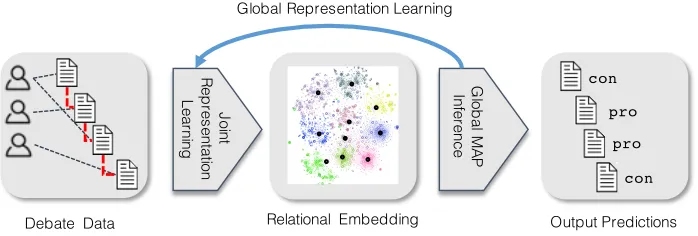
Figure 2: Overall Learning and Inference Processes
Hasan and Ng, 2013; Sridhar et al., 2015). Stance prediction is not limited to online debates, as was also studied in the context of congressional speeches (Bansal et al., 2008; Burfoot et al., 2011) and social media outlets, such as Twitter (Johnson and Goldwasser, 2016; Augenstein et al., 2016; Ebrahimi et al., 2016), including a recent SemEval-16 task (Mohammad et al., 2016). While most work view the task as supervised classification tasks, several work suggest exploiting the interactions between users as a form of distant supervision (Johnson and Goldwasser, 2016; Dong et al., 2017). This task is broadly related to argumentation mining (Ghosh et al., 2014) and stance reason classification (Hasan and Ng, 2014).
Our technical work relies on exploiting distributed representations (i.e., embedding), building on highly influential work on embedding words (Mikolov et al., 2013b; Pennington et al., 2014), sen-tences (Kiros et al., 2015) and even full documents (Le and Mikolov, 2014). Our work explores the connections between text, users and attributes, attempting to create a common representation for the them. The closest to our work is (Li et al., 2015), that jointly integrates different kinds of cues (text, attribute, graph) into a single latent representation to get user embeddings.
Our work is also broadly related to deep learning methods that capture the structural dependencies between decisions. This can be done either by modeling the dependencies between the hidden represen-tations of connected decisions using RNN/LSTM (Vaswani et al., 2016; Katiyar and Cardie, 2016), or by explicitly modeling the structural dependencies between output predictions (Durrett and Klein, 2015; Lample et al., 2016; Andor et al., 2016). Unlike these work, we formulate our problem as a structured representation learning problem, which to our knowledge is the first work to identify the ties between the two problems.
3 Model Overview
In this paper we suggest casting stance classification as a structured representation learning task. Our approach revolves around two key ideas.
First, stance classification can be done by embedding both the input objects (i.e., posts) and the output labels in the same space. The actual classification is performed by comparing the similarity between the embedded representations of an input object and the competing output labels.
Second, we can augment this representation with additional structural constraints, capturing relevant domain information, such as the connection between posts by the same author, the disagreements be-tween debate participants.
To help clarify these ideas intuitively, consider the debate dialog in Figure 1. Our learning approach uses the structural and textual information in the dialog in three ways, as shown in the process depicted in Figure 2.
1. Joint Representation Learning The embedding learning objective is designed to represent relevant
underlying ideologies are also represented. To accomplish this goal we define a joint objective function over different relations.
“..make everything illegal because it was harmful .. “ related to the actual use…”
“... Smoking cigarettes is harmful to the body and is still legal..” “..that doesn't mean
marijuana should be made legal because the other two are..“
“..To say something should be made legal because it is less harmful is ridiculous.”
a2
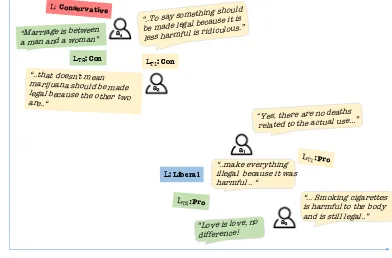
(a) Relational embedding representing authors, stances and posts on various topics in the same embedding space
…
(b) Collective decision over debate thread structure and authors
Figure 3: Model Overview Demonstration
The model is trained to maximize the similarity between corresponding entities (positive examples) compared to irrelevant ones (negative examples). We define the positive examples based on relational information, and negative examples to capture disagreements between authors and posts. We explain this process in detail in Section 5.
2. Global MAP Inference (Collective Classification) Representing the input objects and their labels
in the same embedding space allows us to reason about the relationships between them. We view the prediction task as a collective classification, in which all the posts in one or more given debate threads are decided together. We model inference required for the MAP assignment using a factor graph. For example, the graph described in Figure 3b, contains nodes corresponding to author level stance decisions (denoted Lai), their posts levels stance decision (denoted Lt(aj
i)). We score these decisions using the
learned embedding. For example, scoring the output assignment PROto the post corresponding toLt(aj i)
will be done by observing the similarity (dot product) between their vectorized representationsvPRO and
vt(aj i).
Factor nodes can either have a degree of 1 (scoring the similarity between an author or post and an output label), or 2 (scoring the relationship between consecutive posts in a debate discussion thread). We also allow hard constraints (light gray factors in Figure 3b), which force the model to produce consistent assignments.We explain this process in detail in Section 4.
3. Global Representation Learning A natural extension is to combine the previous two steps, and
adopt a global training approach that uses joint prediction during training. In this case the loss function used when learning the embedding is defined with respect to the structural dependencies imposed by the factor graph. This approach is similar in spirit to deep structured learning approaches (Andor et al., 2016), however, in this case the structured learning process is defined directly over the embedding space. This process is explained in Section 5.5.
4 Collective Classification
ILP Formulation We exploit the dependencies described above, using joint prediction over the dif-ferent aspects. We formulate the decision as an Integer Linear Programming (ILP) which allows us to enforce the consistency or preferences between decisions. The ILP objective function is defined over the similarity scores between objects’ vector representation in the joint embedding space. Since integer linear constraints over 0-1 variables can represent logical constraints, we define the ILP constraints using both representations to help improve readability.
In the stance prediction task, all the posts from multiple debate threads that potentially share authors form a single ILP instance. The ILP global optimization objective is defined over authorsai, the
tex-tual content (posts){t0
i, ..., tki}associated withai, and other textual posts{tpm, ..., tql}, responding to or
responded byai’s posts.
We create different types of boolean decision variables corresponding to the decision tasks above. We assign a boolean variable AuthorLabel(ai,rj)to represent authorai has attributerj (i.e., its
stance), and associate a scoresim(eai, erj)with that variable. Similarly, we assign a boolean variable
TextLabel(tki,rj)to represent that the texttki is labeled with an attributerj, and associate a score
sim(etk
i, erj)with that variable.
To ensure the consistency of the predicted variables, we define two types of constraints. 1.Single output value on a debate topic:
∀i P
jAuthorLabel(ai,rj)= 1
∀i, k P
jTextLabel(tki,rj)= 1
2.Output consistency:
∀i, j, k AuthorLabel(ai, rj)=TextLabel(tki, rj)
Note that in the debate domain, this constraint forces agreement between all the posts by the same author. We also add variables capturing the dependencies between connected posts. For debate threads, a boolean variableDisagree(tpi, tql)is created for any two poststip, tql whentql is a response totpi, and associate a score disagree parameter with that variable. This score is a hyper-parameter for local models, capturing the preference towards disagreement between consecutive posts in a debate. It is set according to the training set. When using global learning, it is also included in training, such that simi-larity scores of consecutive posts will be adjusted appropriately (similar intuition as a margin constraint).
∀tpi, tql Disagree(tpi, tql)∧TextLabel(tpi,rj)→ ¬TextLabel(tql,rj)
The set of all possible decisions for the three set of variables are denoted asAforAuthorLabel,B
forTextLabel,ΓforDisagree.
Given these variables, our prediction function can be define as follows
-arg max α,β,γ
X
α∈A
α·score(α) +X β∈B
β·score(β) +X γ∈Γ
γ·score(γ)
Subject ToC
WhereCis a set of constraints defined above.
5 Representation Learning
5.1 Embedding Perspectives
LetAandT denote the set of all authors and text respectively, letRdenote the set of all attributes for those authors and text. Stance on various topics are the major attributes considered in this paper. For each topic, we have an embedding vector for the Pro stance and another vector for the Con stance, such asP roabortion andConabortion. We train our embedding over multiple views of the data, each view
connecting users and their content.
Author vs. Text:This objective is to predict texttjlinked with authoraigiven the author representation.
LAT =
Author vs. Attribute: This objective is to predict attribute rj linked with author ai given the author
representation. Stance on different topics and user profile information form the attributes set in debate datasets. Each user attribute value (e.g. male or female in gender attribute) is represented by a vector.
LAR=
Text vs. Attribute:This objective is to predict attributerj of the text given textti. In our experiments,
we only used the stance label as attributes of text. However, it may also be possible to inherit attributes from the author of the text.
LT R=
Text vs. Text:This objective is to predict texttj given the texttithat share the same attribute. It is used
to promote similarity between posts sharing the same stance on a certain topic.
LT T =
All the conditional probabilities can be computed using a softmax function. Taking P(tj|ai) as an
example:
In our model, the embedding for each author and attribute can be randomly initialized. The text is a special case since there are complex structures involved. One way to capture this is to use an pre-trained text embedding model to get an initial representation, and then learn an neural network to map it to one in the shared space. Note that this also allows our model to generate embedding for unseen text in the new space.
Specifically, for a text inputx, we can compute its embeddingeusingMhidden layersli, i= [0, M− 1]. The first hidden layerl0is computed from the inputx:
l0 =f(W0x+b0)
Subsequent layers are computed recursively:
li=f(Wili−1+bi), i= 1, ..., M−1
Then the output from the final layer produces the embedding:
e=lM−1
f is the non-linear activation function. We used hyperbolic tangent (tanh) in our experiments.
5.3 Joint Embedding Learning
Our objective is to learn a semantic embedding for authors, text and attributes associated with them so that they are close in the embedding space if they are semantically close to each other.
Joint Embedding Loss Function: We can combine these embedding losses from Equations 1-4 into a
joint training objective:
LJ oint(A, T, R) =
X
i∈(AT ,AR,T R,T T)
λiLi (5)
whereλi is the coefficient for each view, indicating the relative importance in the loss function. We
set allλito the default value1in all our experiments.
This is the general framework. Additional views may be added or removed for a certain dataset. For example, we can add a term representing the author vs. author view in the loss function if links between them are available.
5.4 Model Optimization
We train our model using mini-batch Adam optimizer to minimize the loss in Eq.5. However, computing gradient for Eq.1, and Eq.4 is expensive due to the size of the authors or text. To address this problem, we refer to the popular negative sampling approach (Mikolov et al., 2013a), which reduce the time complexity to be proportional to the number of positive example pairs.
5.5 Global Embedding Learning
Although different views of the data are captured in our joint loss function, it does not ensure that the information they provide at inference time will be “cooperative”, i.e., it will result in consistent global prediction over all the debate outputs. One potential problem is that examples associated with one view will dominate the training and skew the prediction, when constraints are applied. To handle this issue, we included the inference procedure during training. Instead of making sure the loss for each local view is minimized, the global objective promotes the rank of all the gold predictionsjointly. For instance, at training, posts, together with their author and neighboring posts (if available) are used to infer their stance based on the inference procedure described in section 4. Then structured hinge loss can be used to define the prediction loss as in Eq.6.
Lpred=
X
i∈instances
max(0, maxy∈Y(∆(y, ti) +score(xi, y))−score(xi, ti)) (6)
wherexiandtiare the problem instances and corresponding gold predictions,Y denotes all possible
predictions, and score(·) is the inference score function. ∆(·,·) is the hamming loss. It measures the difference between two predictions and is used to create a margin between gold and other predictions.
The loss function used for updating the parameters in the global model is defined as follows.
LGlobal =λpredLpred+λATLAT +λT TLT T (7)
The coefficients for different terms in the global loss function can adjust the contribution of prediction objective (Lpred) versus information sharing objective (LAT andLT T). Again, we set allλto the default
value 1 in experiments of this paper. We leave the exploration of different coefficient settings to future work. Since the inference is used during global training, the scores for text stance and author stance are part of the inference scores. So they will get updated according toLpred. Therefore we do not include
LARandLT Rexplicitly in the global loss function.
Dataset Topic Posts Users
CREATEDEBATE
Abortion 1741 340
Gay Rights 1376 370
Marijuana 626 258
Obama 985 278
4FORUMS
Abortion 7937 342
Evolution 6069 311
Gay Marriage 6897 296
Gun Control 3755 281
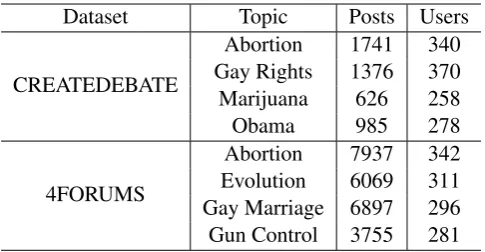
Table 1: Data Statistics for 4FORUMSand CREATEDEBATE
6 Experiments
To evaluate the different properties of our model and demonstrate their advantages, we evaluate the quality of our structured embedding model on two datasets 4FORUMS and CREATEDEBATE for stance classification tasks at post level, consisting of eight topics in total. The datasets are taken from the Internet Argumentation Corpus (Abbott et al., 2016). Table 1 shows statistics about these datasets.
Experimental Design Our experiments are designed to evaluate the different properties of our model.
To accomplish that, we compare different variations of the model, corresponding to (1) only the joint embedding (denotedJoint), (2) using inference at test time, over the joint embedding (denotedInference), and (3) using global training (denotedGlobal), which also uses inference during training. We report the results of these experiments in the two datasets in Tables 2 and 3.
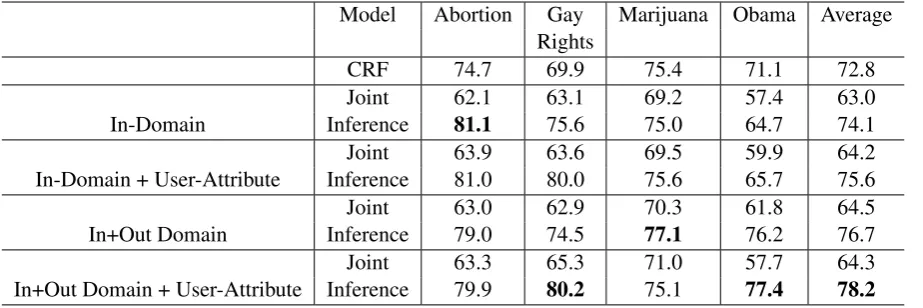
Our second set of experiments are designed to evaluate the joint embedding model’s ability to share information between the representations of different objects. In this case we compare the performance of theJoint andInferencemodels when additional information is available. We compare three settings (1) In-Domain, when the available training and testing data are from the same domain (2) In+Out Do-main, where we augment the In-Domain training data with additional debate threads from other topics. In this case the model can represent the relationships between stances on different topics and potentially generalize better. Finally, (3) User-Attribute, where we augment the author attributes with profile infor-mation extracted from the debate website. We conduct all of these experiments over the CREATEDEBATE
dataset, and report the results in Table 4.
6.1 Experimental Settings:
We used PyTorch (Paszke et al., 2017) to implement the embedding model and Gurobi (Gurobi Op-timization, 2016) as our ILP solver. Each debate post is initially represented using the Skip-Thought Vectors (Kiros et al., 2015), and then mapped to an embedding in the shared space through one hidden layer. We do not add more layers as both datasets are relatively small. Hyperbolic tangent (tanh) is used as non-linear activation function. All other embeddings are randomly initialized following a normal dis-tribution with variance1/√dim. The embedding sizedimfor all experiments is 300. For the training of the neural network, we used mini-batch Adam optimizer to update parameters. Dropout with probability 0.7 is used as regularization. The termination criteria is convergence on training loss. Five epoch of non-improvement on loss is considered as convergence for joint models, and one epoch for global models. Other parameters in our model includes negative sample sizek=5, mini-batch sizeb=10.
6.2 Results
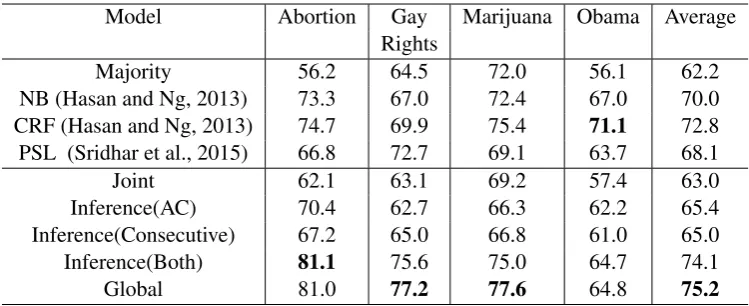
Our results on stance classification are described in Table 2 and Table 3. The results are computed using 5-fold cross-validation. For the CREATEDEBATEdataset, We used the same five data folds as in (Hasan
Model Abortion Gay Marijuana Obama Average Rights
Majority 56.2 64.5 72.0 56.1 62.2
NB (Hasan and Ng, 2013) 73.3 67.0 72.4 67.0 70.0
CRF (Hasan and Ng, 2013) 74.7 69.9 75.4 71.1 72.8
PSL (Sridhar et al., 2015) 66.8 72.7 69.1 63.7 68.1
Joint 62.1 63.1 69.2 57.4 63.0
Inference(AC) 70.4 62.7 66.3 62.2 65.4
Inference(Consecutive) 67.2 65.0 66.8 61.0 65.0
Inference(Both) 81.1 75.6 75.0 64.7 74.1
Global 81.0 77.2 77.6 64.8 75.2
Table 2: Average Accuracy on CREATEDEBATE dataset
Model Abortion Evolution Gay Gun Average
Marriage Control
Majority 56.8 65.8 66.0 67.8 64.1
PSL (Sridhar et al., 2015) 77.0 80.3 80.5 69.1 76.7
Joint 64.1 67.2 68.5 66.5 66.6
Inference(AC) 72.9 66.8 68.6 68.4 69.2
Inference(Consecutive) 67.5 67.7 72.3 69.6 69.3
Inference(Both) 85.9 80.9 88.1 81.6 84.1
Global 86.5 82.2 87.6 83.1 84.9
Table 3: Average Accuracy on 4FORUMS dataset
information from training to test.NBandCRFstands for the best local and collective models in (Hasan and Ng, 2013). Note that their system also uses the author constraints, as well as a highly engineered feature set and additional weakly-supervised data that we did not use. Despite that fact, our global model significantly outperforms their model with the exception of Obama domain. In the 4FORUMexperiments
we compare our models to result withPSL based model (Sridhar et al., 2015) which performs similar collective classification defined over a feature-rich representation. In this case as well, our Global model achieves the best overall performance.
We evaluate the contribution of two constraints sets, Author constraints (AC) enforce author and their posts share the same stance. Consecutive will encourage disagreement in stance between neighboring posts as introduced in section 3. The addition of these two constraints leads to significant increase in performance when used together. This is because AC and Consecutive add agreement and disagreement constraints between test posts, grouping them into clusters and making it easier to be predicted correctly. For instance, given multiple posts from the same author, the model can make correct decisions on all of them even if the prediction based on each individual post may be wrong. Finally, we observe that struc-tured representation learning (i.e., Global) leads to a performance improvement compared to inference over the joint embedding objective (Inference). This shows the effectiveness of the global learning.
Table 4 shows the result on CREATEDEBATEwhen additional information is available. We extracted user profile information (User-Attribute) from the website2, consisting of five attributes (Gender, Marital Status, Political Party, Religion, and Education). Clearly richer user information results in a better repre-sentation, both for users and as a result, also for the text they author, leading to improved performance. A similar trend occurs when out-of-domain data is available (In+Out Domain). Stances over different debate topics impact the text and author representations. Interestingly, when this data is available, our model is able to outperform the collective approach of (Hasan and Ng, 2013) in all debate topics, showing that our model can indeed exploit the information shared by the underlying ideologies.
Model Abortion Gay Marijuana Obama Average Rights
CRF 74.7 69.9 75.4 71.1 72.8
In-Domain
Joint 62.1 63.1 69.2 57.4 63.0
Inference 81.1 75.6 75.0 64.7 74.1
In-Domain + User-Attribute
Joint 63.9 63.6 69.5 59.9 64.2
Inference 81.0 80.0 75.6 65.7 75.6
In+Out Domain
Joint 63.0 62.9 70.3 61.8 64.5
Inference 79.0 74.5 77.1 76.2 76.7
In+Out Domain + User-Attribute
Joint 63.3 65.3 71.0 57.7 64.3
Inference 79.9 80.2 75.1 77.4 78.2
Table 4: Average Accuracy on CREATEDEBATEdataset with additional information
7 Conclusions and Future Work
We study the problem of stance prediction, a challenging text classification problem, which requires con-necting textual content analysis, conversational interactions and author information. Traditionally, this is done using a graphical model, which learns a scoring function for each aspect, over a fixed feature representation. We follow the observation that all of these problems are connected, and allow the model to capture these dependencies by allowing it tolearna representation for all these aspects jointly, rather than using a fixed representation. We show that by formulating the decision problem over the representa-tion directly, and requiring the representarepresenta-tion to respect the global dependencies between these aspects, our model can generalize better and exploit additional information even when it is not directly relevant.
To the best of our knowledge, this work is the first to cast representation learning as a structured prediction problem, we believe that this approach is applicable to many other domains where the input has complex inter-connected structure. Such domains can include other conversation analysis tasks, shared representations of text and images and information networks such as citations graphs and social network analysis. In the future we intend to study additional domains and evaluate whether including additional aspects, can help provide better generalization. Providing sufficient supervision is one of the main bottlenecks of NLP, we intend to apply our approach in weakly and distantly supervised settings, to help alleviate this difficulty.
References
Rob Abbott, Brian Ecker, Pranav Anand, and Marilyn A Walker. 2016. Internet argument corpus 2.0: An sql schema for dialogic social media and the corpora to go with it. InProc. of the International Conference on
Language Resources and Evaluation (LREC).
Pranav Anand, Marilyn Walker, Rob Abbott, Jean E Fox Tree, Robeson Bowmani, and Michael Minor. 2011. Cats rule and dogs drool!: Classifying stance in online debate. InProceedings of the 2nd workshop on computational approaches to subjectivity and sentiment analysis, pages 1–9. Association for Computational Linguistics.
Daniel Andor, Chris Alberti, David Weiss, Aliaksei Severyn, Alessandro Presta, Kuzman Ganchev, Slav Petrov, and Michael Collins. 2016. Globally normalized transition-based neural networks. InProc. of the Annual
Meeting of the Association Computational Linguistics (ACL), pages 2442–2452.
Isabelle Augenstein, Tim Rocktschel, Andreas Vlachos, and Kalina Bontcheva. 2016. Stance detection with bidirectional conditional encoding. In Conference on Empirical Methods in Natural Language Processing, pages 876–885.
Mohit Bansal, Claire Cardie, and Lillian Lee. 2008. The power of negative thinking: Exploiting label disagreement in the min-cut classification framework. COLING 2008: Companion Volume: Posters, pages 15–18.
Rui Dong, Yizhou Sun, Lu Wang, Yupeng Gu, and Yuan Zhong. 2017. Weakly-guided user stance prediction via joint modeling of content and social interaction. InProceedings of the 2017 ACM on Conference on Information
and Knowledge Management, pages 1249–1258. ACM.
Greg Durrett and Dan Klein. 2015. Neural crf parsing. In Proc. of the Annual Meeting of the Association
Computational Linguistics (ACL), pages 302–312.
Javid Ebrahimi, Dejing Dou, and Daniel Lowd. 2016. Weakly supervised tweet stance classification by relational bootstrapping. InProc. of the Conference on Empirical Methods for Natural Language Processing (EMNLP).
Debanjan Ghosh, Smaranda Muresan, Nina Wacholder, Mark Aakhus, and Matthew Mitsui. 2014. Analyzing argumentative discourse units in online interactions. InProceedings of the First Workshop on Argumentation Mining, pages 39–48.
Inc. Gurobi Optimization. 2016. Gurobi optimizer reference manual.
Kazi Saidul Hasan and Vincent Ng. 2013. Stance classification of ideological debates: Data, models, features, and constraints. InProceedings of the Sixth International Joint Conference on Natural Language Processing, pages 1348–1356.
Kazi Saidul Hasan and Vincent Ng. 2014. Why are you taking this stance? identifying and classifying reasons in ideological debates. In Proc. of the Conference on Empirical Methods for Natural Language Processing
(EMNLP), pages 751–762.
Kristen Johnson and Dan Goldwasser. 2016. ” all i know about politics is what i read in twitter”: Weakly supervised models for extracting politicians stances from twitter. InProceedings of COLING 2016, the 26th
International Conference on Computational Linguistics: Technical Papers, pages 2966–2977.
Arzoo Katiyar and Claire Cardie. 2016. Investigating lstms for joint extraction of opinion entities and relations.
In Proc. of the Annual Meeting of the Association Computational Linguistics (ACL), pages 919–929, Berlin,
Germany, August.
Ryan Kiros, Yukun Zhu, Ruslan Salakhutdinov, Richard S. Zemel, Antonio Torralba, Raquel Urtasun, and Sanja Fidler. 2015. Skip-thought vectors. InThe Conference on Advances in Neural Information Processing Systems
(NIPS), pages 3294–3302.
Guillaume Lample, Miguel Ballesteros, Kazuya Kawakami, Sandeep Subramanian, and Chris Dyer. 2016. Neural architectures for named entity recognition. InProc. of the Annual Meeting of the North American Association
of Computational Linguistics (NAACL), pages 1–10.
Quoc Le and Tomas Mikolov. 2014. Distributed representations of sentences and documents. InInternational
Conference on Machine Learning, pages 1188–1196.
Jiwei Li, Alan Ritter, and Dan Jurafsky. 2015. Learning multi-faceted representations of individuals from hetero-geneous evidence using neural networks.CoRR.
Tomas Mikolov, Ilya Sutskever, Kai Chen, Greg Corrado, and Jeffrey Dean. 2013a. Distributed representations of words and phrases and their compositionality. InProceedings of the 26th International Conference on Neural
Information Processing Systems - Volume 2, NIPS’13, pages 3111–3119, USA. Curran Associates Inc.
Tomas Mikolov, Ilya Sutskever, Kai Chen, Greg S Corrado, and Jeff Dean. 2013b. Distributed representations of words and phrases and their compositionality. InAdvances in neural information processing systems, pages 3111–3119.
Saif Mohammad, Svetlana Kiritchenko, Parinaz Sobhani, Xiaodan Zhu, and Colin Cherry. 2016. Semeval-2016 task 6: Detecting stance in tweets. InProceedings of the 10th International Workshop on Semantic Evaluation
(SemEval-2016), pages 31–41.
Adam Paszke, Sam Gross, Soumith Chintala, Gregory Chanan, Edward Yang, Zachary DeVito, Zeming Lin, Alban Desmaison, Luca Antiga, and Adam Lerer. 2017. Automatic differentiation in pytorch.
Jeffrey Pennington, Richard Socher, and Christopher Manning. 2014. Glove: Global vectors for word represen-tation. InProceedings of the 2014 conference on empirical methods in natural language processing (EMNLP), pages 1532–1543.
Dhanya Sridhar, James Foulds, Bert Huang, Lise Getoor, and Marilyn Walker. 2015. Joint models of disagreement and stance in online debate. InProc. of the Annual Meeting of the Association Computational Linguistics (ACL), volume 1, pages 116–125.
Ashish Vaswani, Yonatan Bisk, Kenji Sagae, and Ryan Musa. 2016. Supertagging with lstms. InProc. of the
Annual Meeting of the North American Association of Computational Linguistics (NAACL), pages 232–237.
Marilyn A Walker, Rob Abbott, and Joseph King. 2012a. A corpus for research on deliberation and debate. In
Proc. of the International Conference on Language Resources and Evaluation (LREC).
Marilyn A Walker, Pranav Anand, Robert Abbott, and Ricky Grant. 2012b. Stance classification using dialogic properties of persuasion. InProc. of the Annual Meeting of the North American Association of Computational